Upgrade to Pro — share decks privately, control downloads, hide ads and more …

Organizing AI-native software delivery with Gas...

Sponsored · Ship Features Fearlessly Turn features on and off without deploys. Used by thousands of Ruby developers. →

Organizing AI-native software delivery with Gastown

Coding with an agent has become commonplace. But as soon as you want to deliver a real product evolution with multiple agents, the problem changes: it's no longer just about generating code, it's about organizing the work.

Gas Town / Gas City explores this shift: moving from an individual assistant to an AI-native software factory.

In this talk, we'll show how to transform a product intention into distributed work: breaking it down, coordinating, supervising, integrating and verifying.

With a live demo, we'll start from a realistic application and let Gas Town / Gas City organize the delivery with multiple development agents.

Avatar for Emmanuel Sciara

Emmanuel Sciara

June 09, 2026

More Decks by Emmanuel Sciara

Other Decks in Programming

Transcript

  1. Jean-Louis Rigau & Emmanuel Sciara Thursday, May 21, 2026 #AI-native

    engineering #Distributed delivery #Agent orchestration #Supervised execution DiliTrust TechDay Organizing AI-native software delivery with Gastown
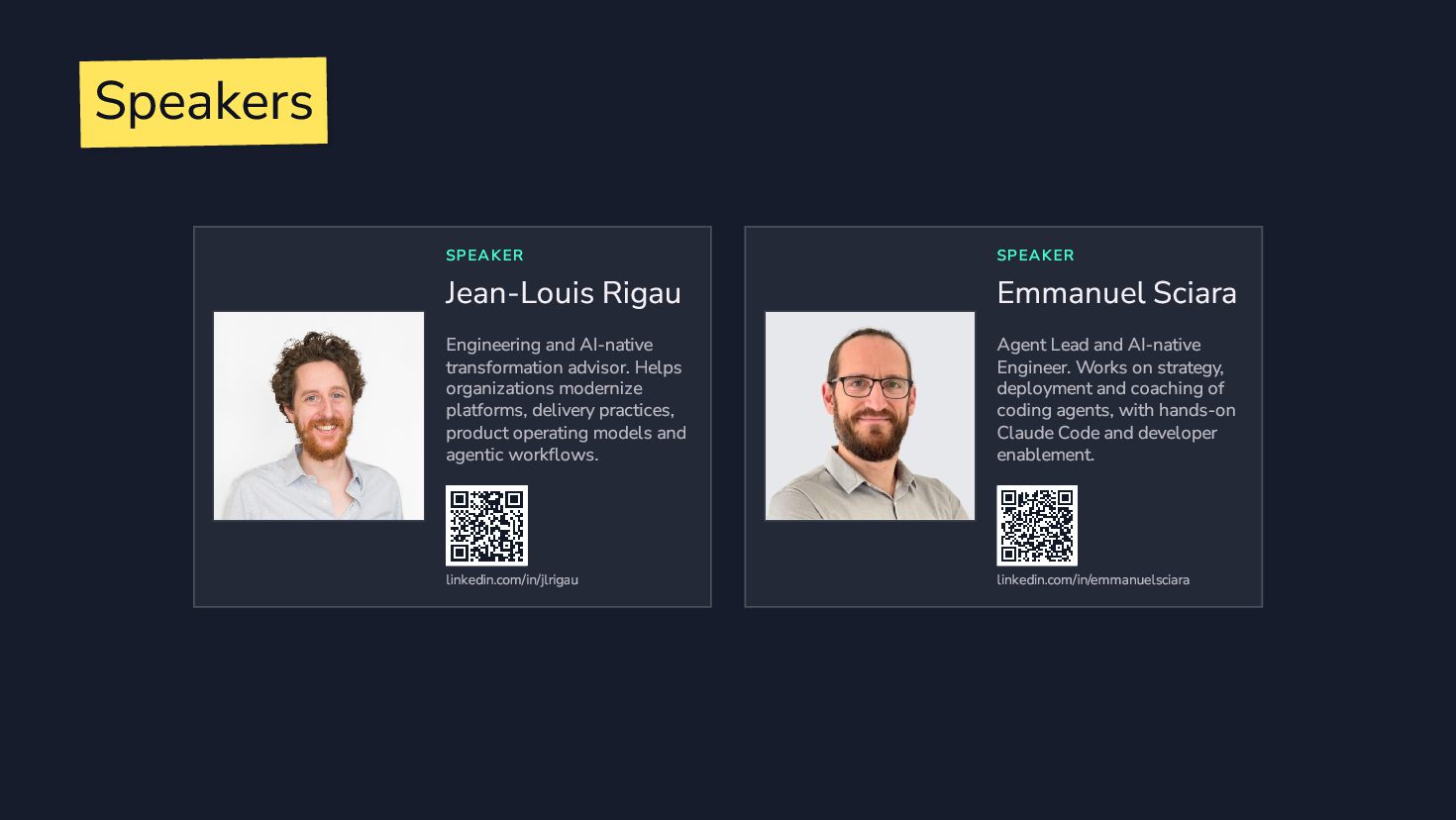
  2. SPEAKER Jean-Louis Rigau Engineering and AI-native transformation advisor. Helps organizations

    modernize platforms, delivery practices, product operating models and agentic workflows. linkedin.com/in/jlrigau SPEAKER Emmanuel Sciara Agent Lead and AI-native Engineer. Works on strategy, deployment and coaching of coding agents, with hands-on Claude Code and developer enablement. linkedin.com/in/emmanuelsciara Speakers
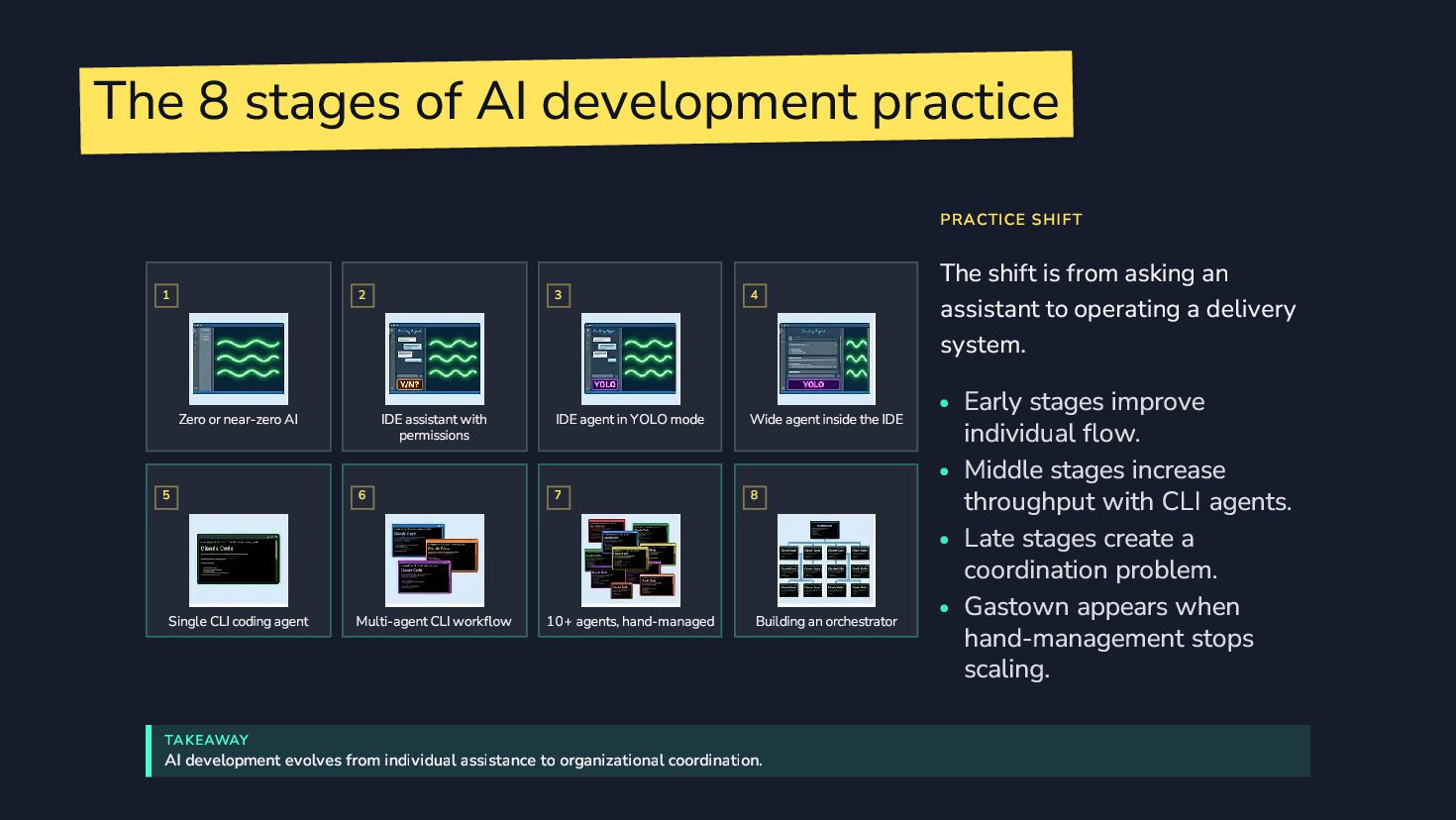
  3. 1 Zero or near-zero AI 2 IDE assistant with permissions

    3 IDE agent in YOLO mode 4 Wide agent inside the IDE 5 Single CLI coding agent 6 Multi-agent CLI workflow 7 10+ agents, hand-managed 8 Building an orchestrator PRACTICE SHIFT The shift is from asking an assistant to operating a delivery system. TAKEAWAY AI development evolves from individual assistance to organizational coordination. Early stages improve individual flow. Middle stages increase throughput with CLI agents. Late stages create a coordination problem. Gastown appears when hand-management stops scaling. The 8 stages of AI development practice
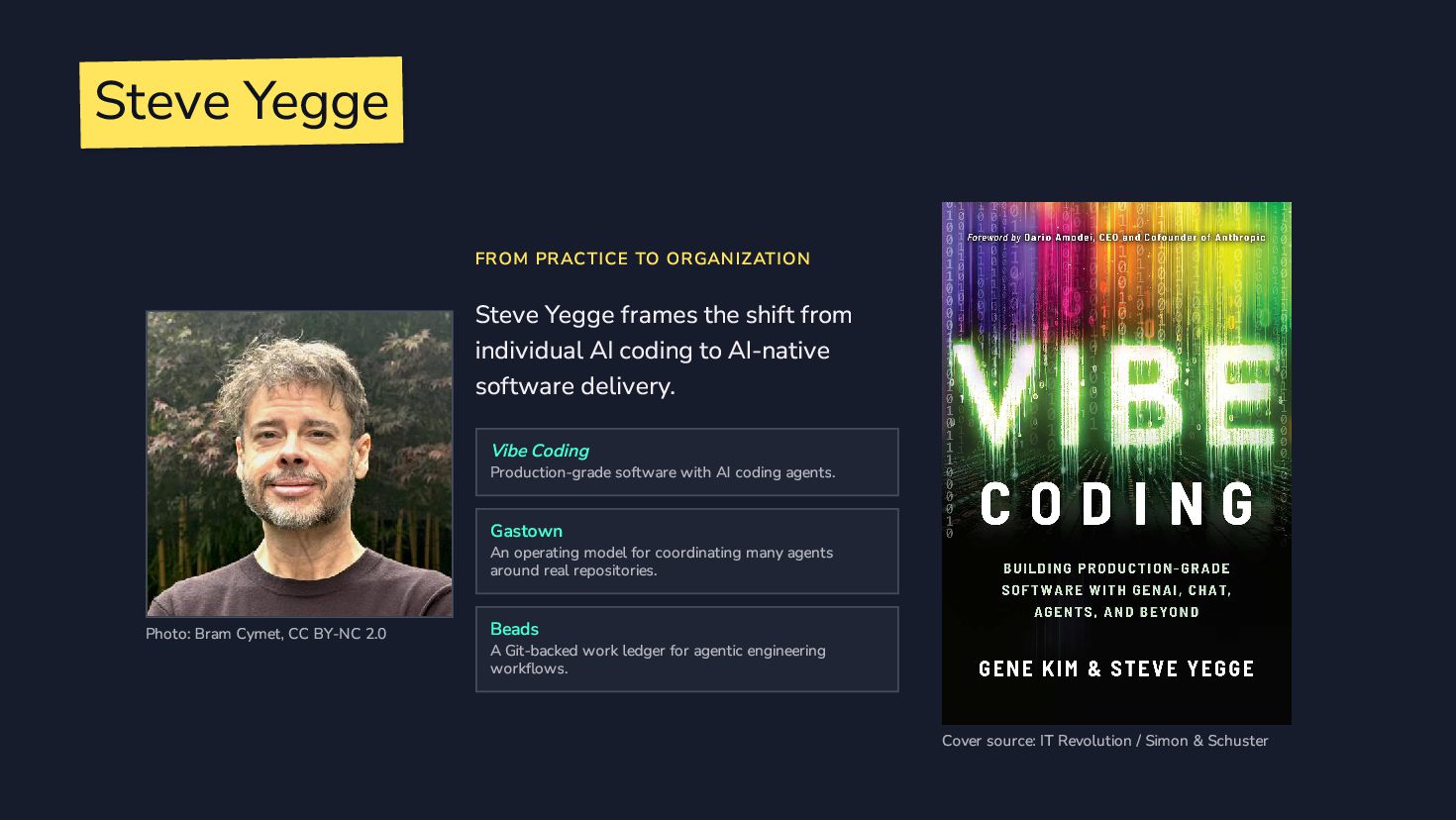
  4. Photo: Bram Cymet, CC BY-NC 2.0 FROM PRACTICE TO ORGANIZATION

    Steve Yegge frames the shift from individual AI coding to AI-native software delivery. Vibe Coding Production-grade software with AI coding agents. Gastown An operating model for coordinating many agents around real repositories. Beads A Git-backed work ledger for agentic engineering workflows. Cover source: IT Revolution / Simon & Schuster Steve Yegge
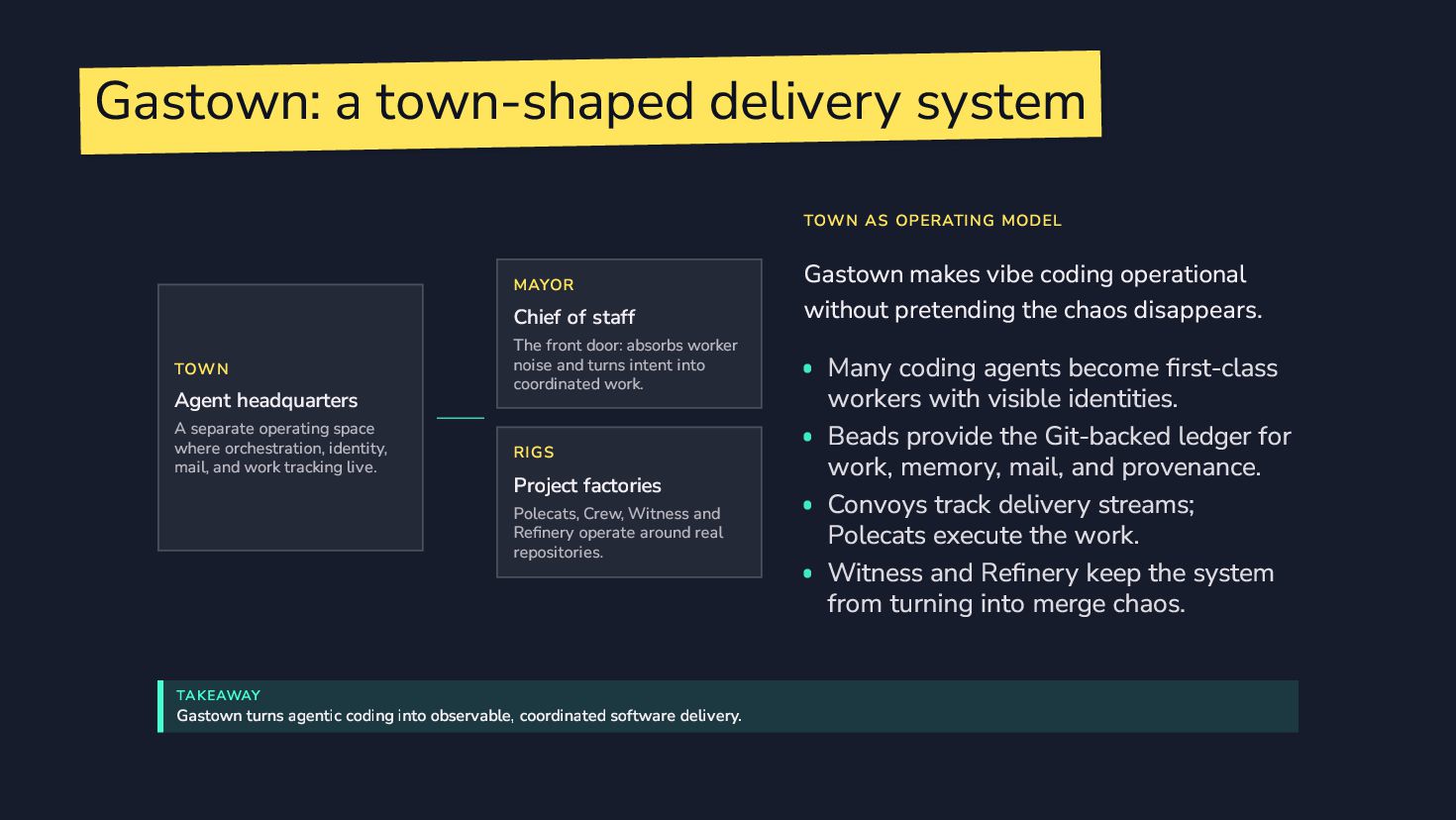
  5. TOWN Agent headquarters A separate operating space where orchestration, identity,

    mail, and work tracking live. MAYOR Chief of staff The front door: absorbs worker noise and turns intent into coordinated work. RIGS Project factories Polecats, Crew, Witness and Refinery operate around real repositories. TOWN AS OPERATING MODEL Gastown makes vibe coding operational without pretending the chaos disappears. TAKEAWAY Gastown turns agentic coding into observable, coordinated software delivery. Many coding agents become first-class workers with visible identities. Beads provide the Git-backed ledger for work, memory, mail, and provenance. Convoys track delivery streams; Polecats execute the work. Witness and Refinery keep the system from turning into merge chaos. Gastown: a town-shaped delivery system
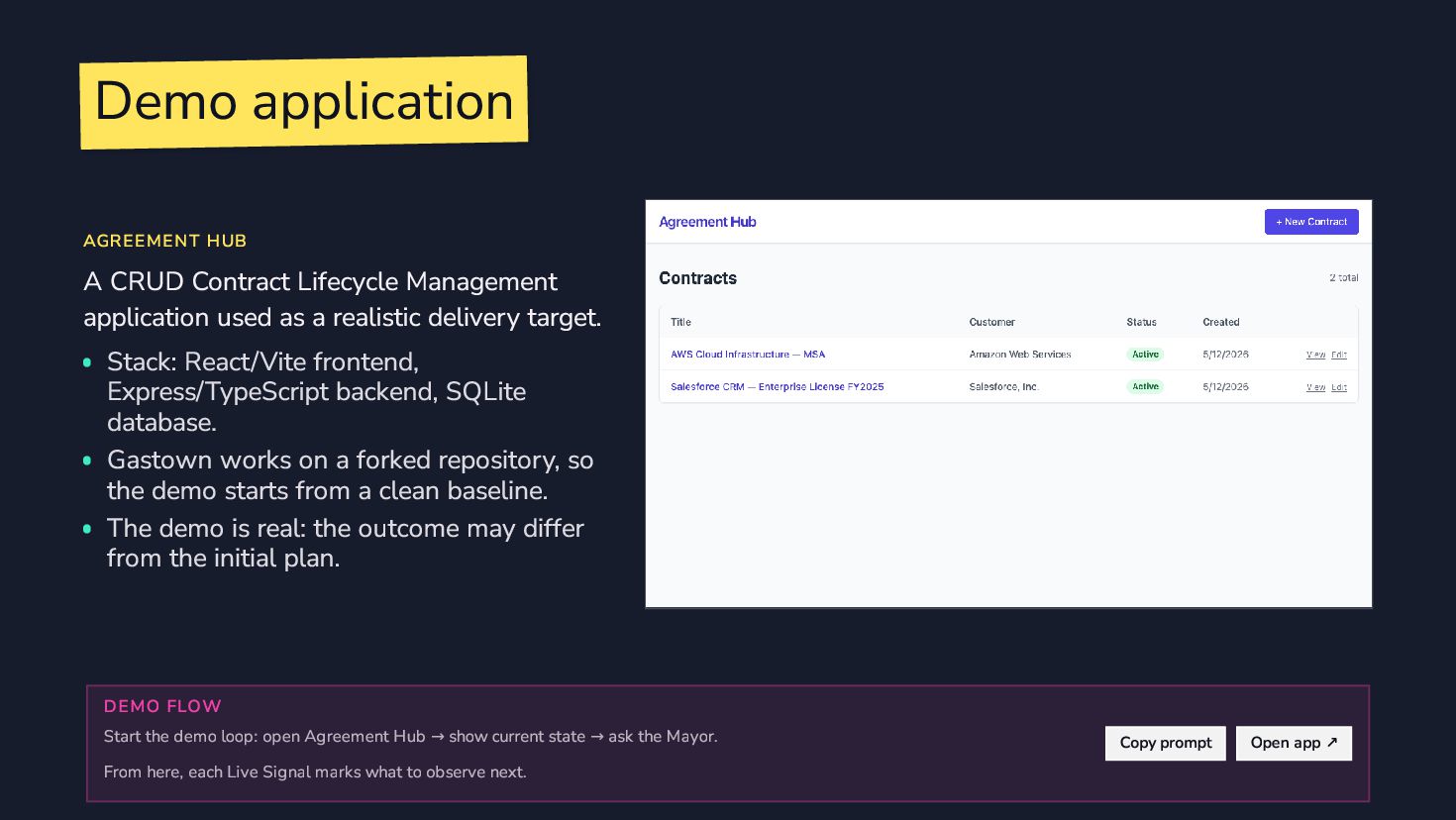
  6. AGREEMENT HUB A CRUD Contract Lifecycle Management application used as

    a realistic delivery target. Stack: React/Vite frontend, Express/TypeScript backend, SQLite database. Gastown works on a forked repository, so the demo starts from a clean baseline. The demo is real: the outcome may differ from the initial plan. DEMO FLOW Start the demo loop: open Agreement Hub → show current state → ask the Mayor. From here, each Live Signal marks what to observe next. Copy prompt Open app ↗ Demo application
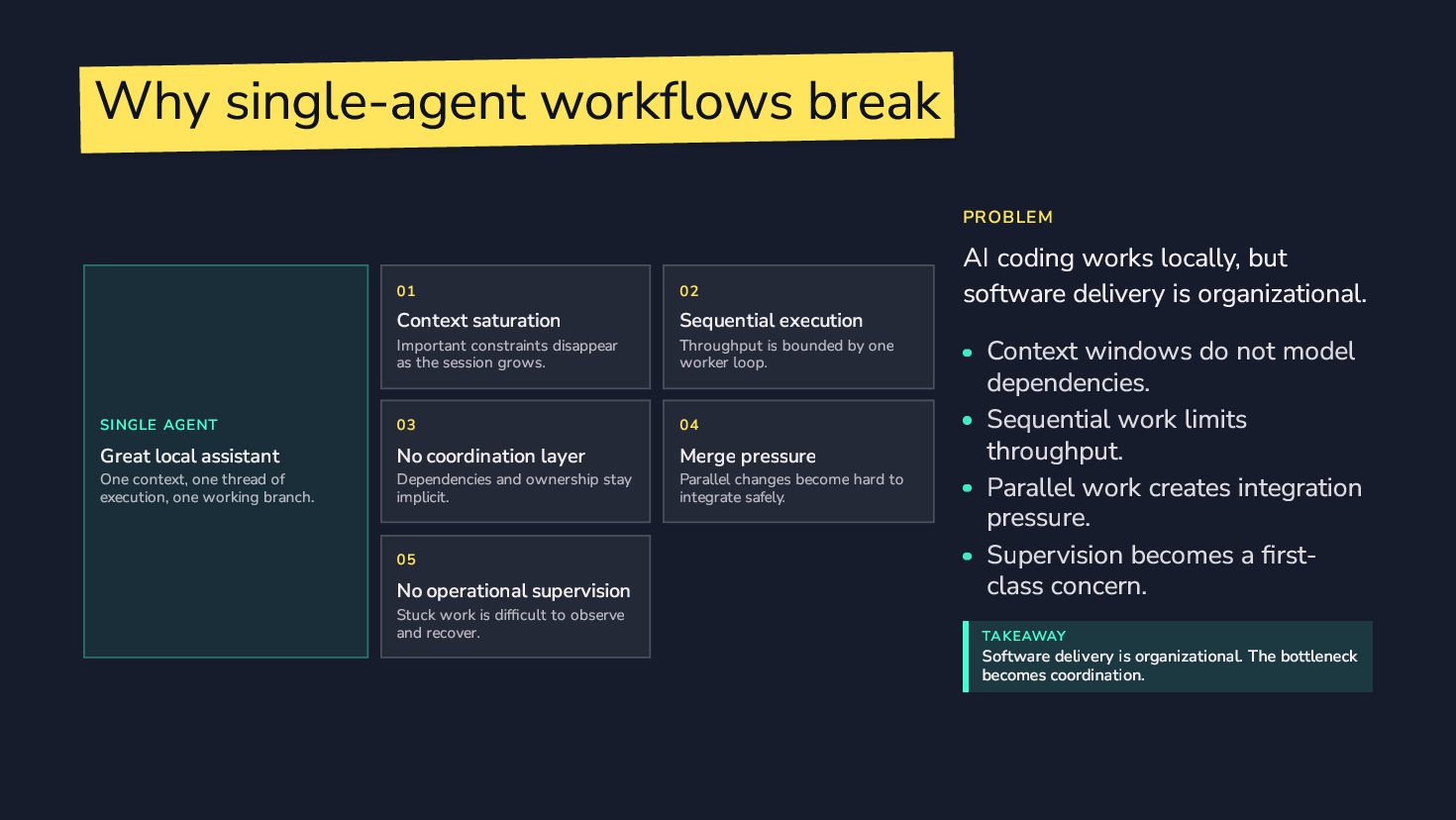
  7. SINGLE AGENT Great local assistant One context, one thread of

    execution, one working branch. 01 Context saturation Important constraints disappear as the session grows. 02 Sequential execution Throughput is bounded by one worker loop. 03 No coordination layer Dependencies and ownership stay implicit. 04 Merge pressure Parallel changes become hard to integrate safely. 05 No operational supervision Stuck work is difficult to observe and recover. PROBLEM AI coding works locally, but software delivery is organizational. TAKEAWAY Software delivery is organizational. The bottleneck becomes coordination. Context windows do not model dependencies. Sequential work limits throughput. Parallel work creates integration pressure. Supervision becomes a first- class concern. Why single-agent workflows break
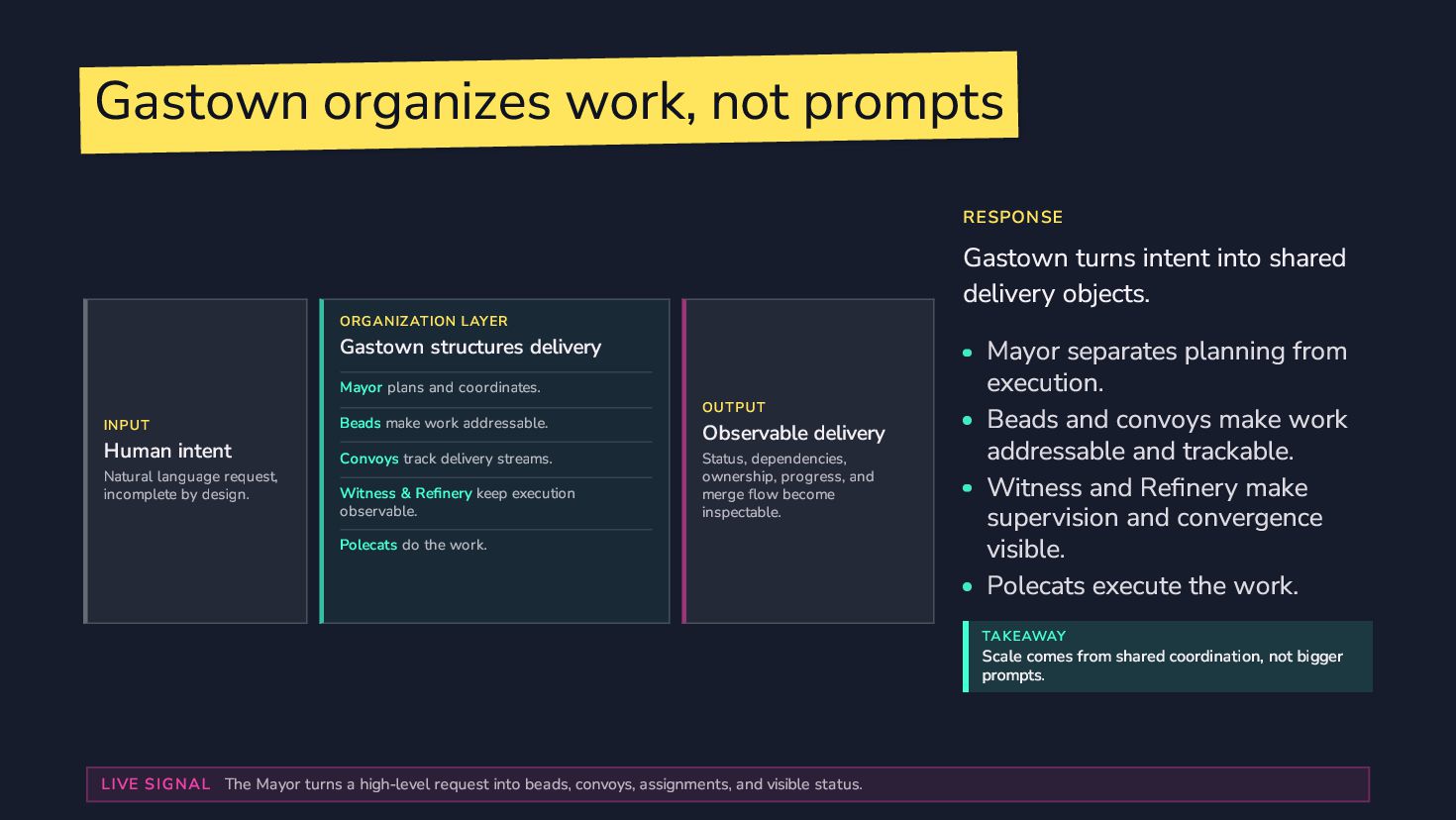
  8. INPUT Human intent Natural language request, incomplete by design. ORGANIZATION

    LAYER Gastown structures delivery Mayor plans and coordinates. Beads make work addressable. Convoys track delivery streams. Witness & Refinery keep execution observable. Polecats do the work. OUTPUT Observable delivery Status, dependencies, ownership, progress, and merge flow become inspectable. RESPONSE Gastown turns intent into shared delivery objects. TAKEAWAY Scale comes from shared coordination, not bigger prompts. Mayor separates planning from execution. Beads and convoys make work addressable and trackable. Witness and Refinery make supervision and convergence visible. Polecats execute the work. LIVE SIGNAL The Mayor turns a high-level request into beads, convoys, assignments, and visible status. Gastown organizes work, not prompts
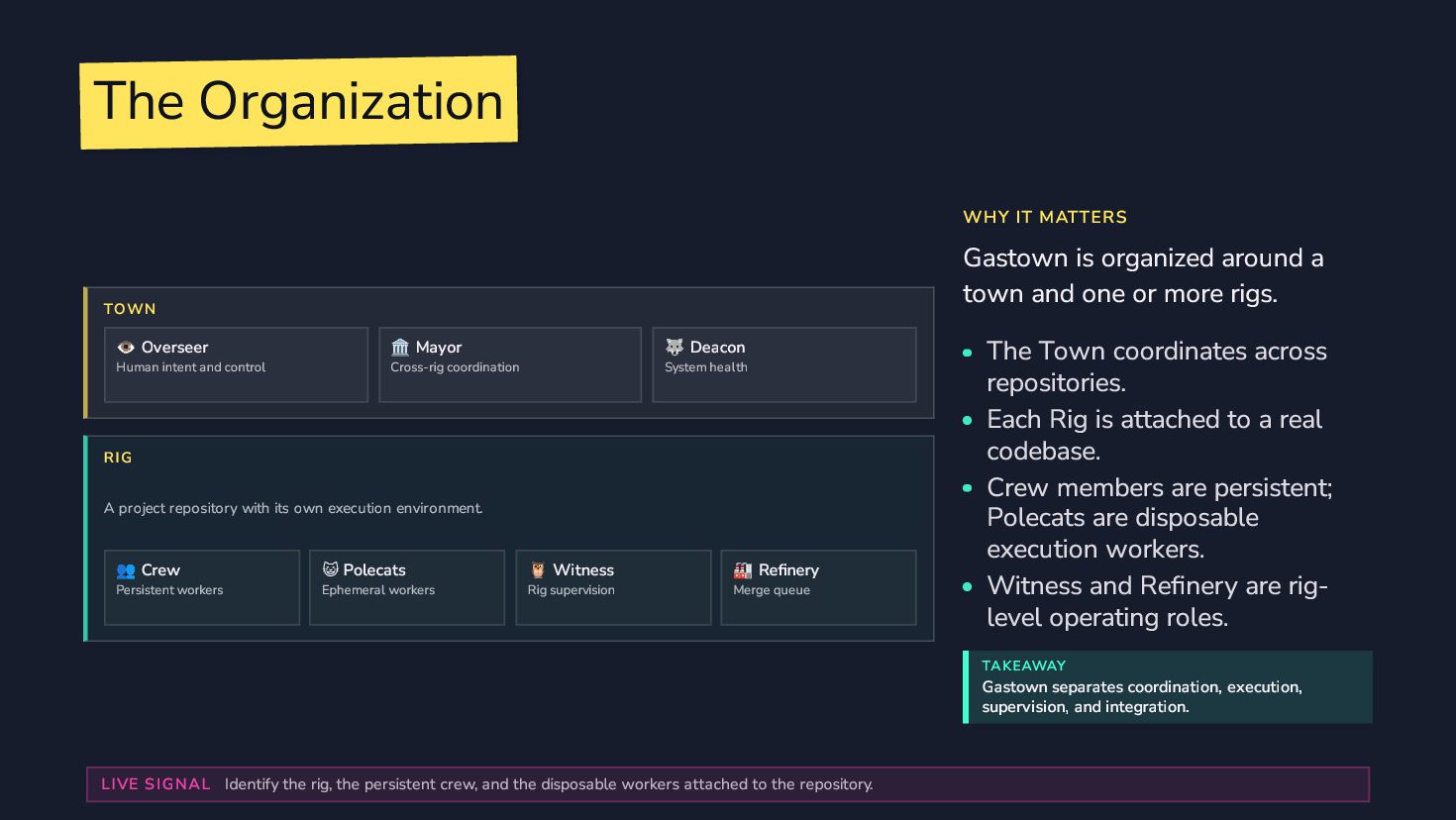
  9. TOWN 👁️ Overseer Human intent and control 🏛️ Mayor Cross-rig

    coordination 🐺 Deacon System health RIG A project repository with its own execution environment. 👥 Crew Persistent workers 😺 Polecats Ephemeral workers 🦉 Witness Rig supervision 🏭 Refinery Merge queue WHY IT MATTERS Gastown is organized around a town and one or more rigs. TAKEAWAY Gastown separates coordination, execution, supervision, and integration. The Town coordinates across repositories. Each Rig is attached to a real codebase. Crew members are persistent; Polecats are disposable execution workers. Witness and Refinery are rig- level operating roles. LIVE SIGNAL Identify the rig, the persistent crew, and the disposable workers attached to the repository. The Organization
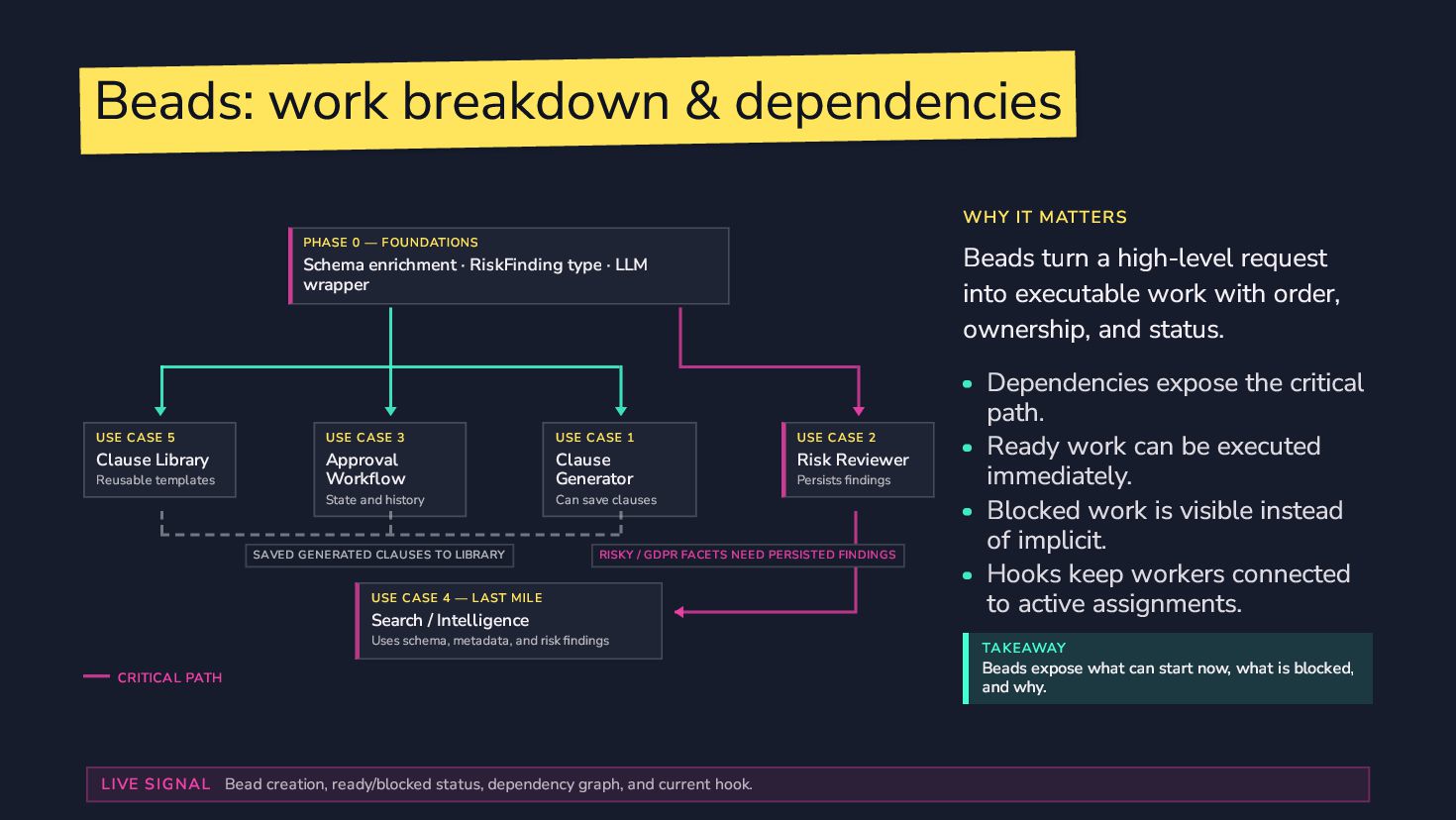
  10. WHY IT MATTERS Beads turn a high-level request into executable

    work with order, ownership, and status. TAKEAWAY Beads expose what can start now, what is blocked, and why. Dependencies expose the critical path. Ready work can be executed immediately. Blocked work is visible instead of implicit. Hooks keep workers connected to active assignments. LIVE SIGNAL Bead creation, ready/blocked status, dependency graph, and current hook. Beads: work breakdown & dependencies PHASE 0 — FOUNDATIONS Schema enrichment · RiskFinding type · LLM wrapper USE CASE 5 Clause Library Reusable templates USE CASE 3 Approval Workflow State and history USE CASE 1 Clause Generator Can save clauses USE CASE 2 Risk Reviewer Persists findings USE CASE 4 — LAST MILE Search / Intelligence Uses schema, metadata, and risk findings CRITICAL PATH SAVED GENERATED CLAUSES TO LIBRARY RISKY / GDPR FACETS NEED PERSISTED FINDINGS
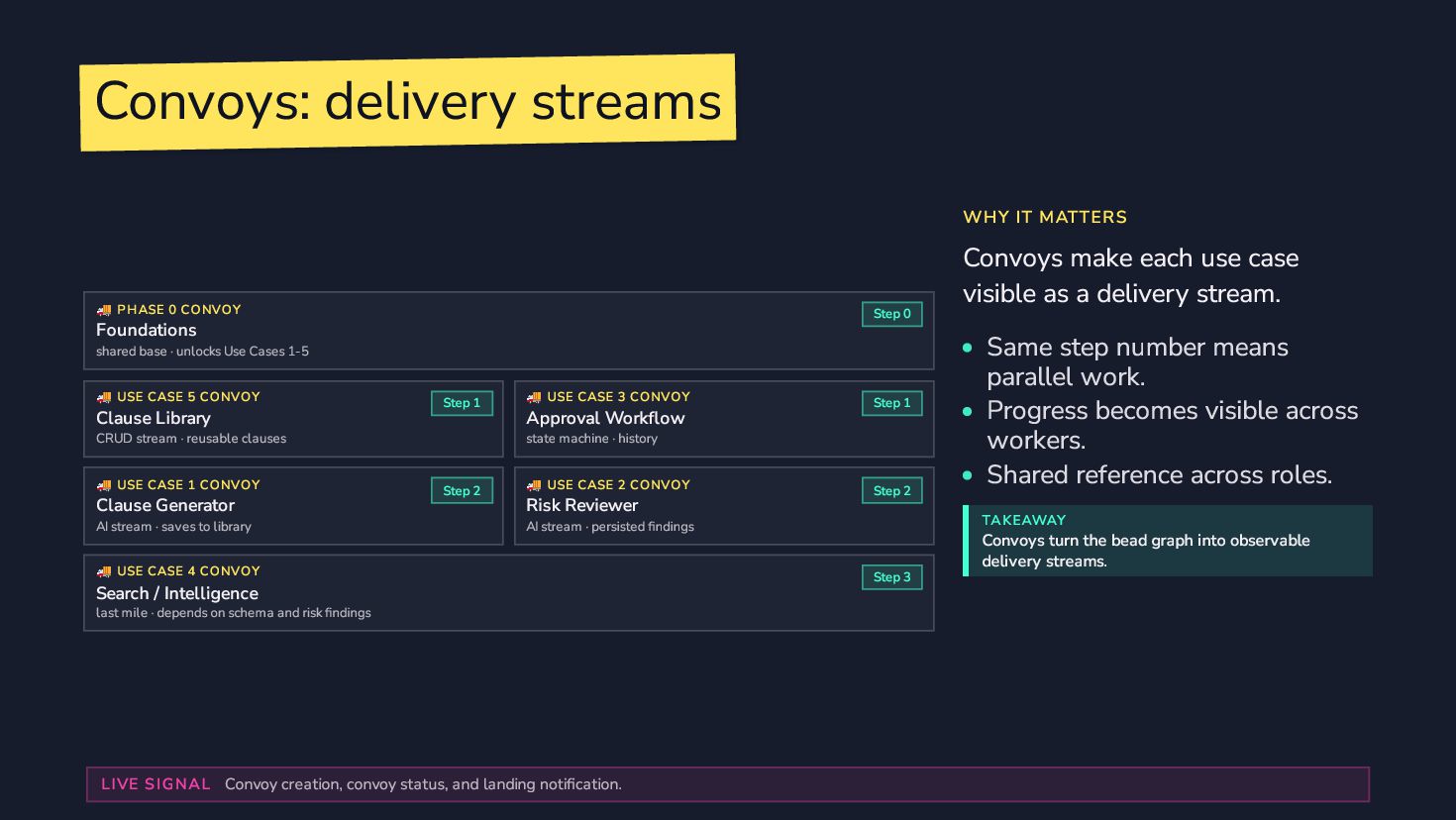
  11. WHY IT MATTERS Convoys make each use case visible as

    a delivery stream. TAKEAWAY Convoys turn the bead graph into observable delivery streams. 🚚 PHASE 0 CONVOY Foundations shared base · unlocks Use Cases 1-5 Step 0 🚚 USE CASE 5 CONVOY Clause Library CRUD stream · reusable clauses Step 1 🚚 USE CASE 3 CONVOY Approval Workflow state machine · history Step 1 🚚 USE CASE 1 CONVOY Clause Generator AI stream · saves to library Step 2 🚚 USE CASE 2 CONVOY Risk Reviewer AI stream · persisted findings Step 2 🚚 USE CASE 4 CONVOY Search / Intelligence last mile · depends on schema and risk findings Step 3 Same step number means parallel work. Progress becomes visible across workers. Shared reference across roles. LIVE SIGNAL Convoy creation, convoy status, and landing notification. Convoys: delivery streams
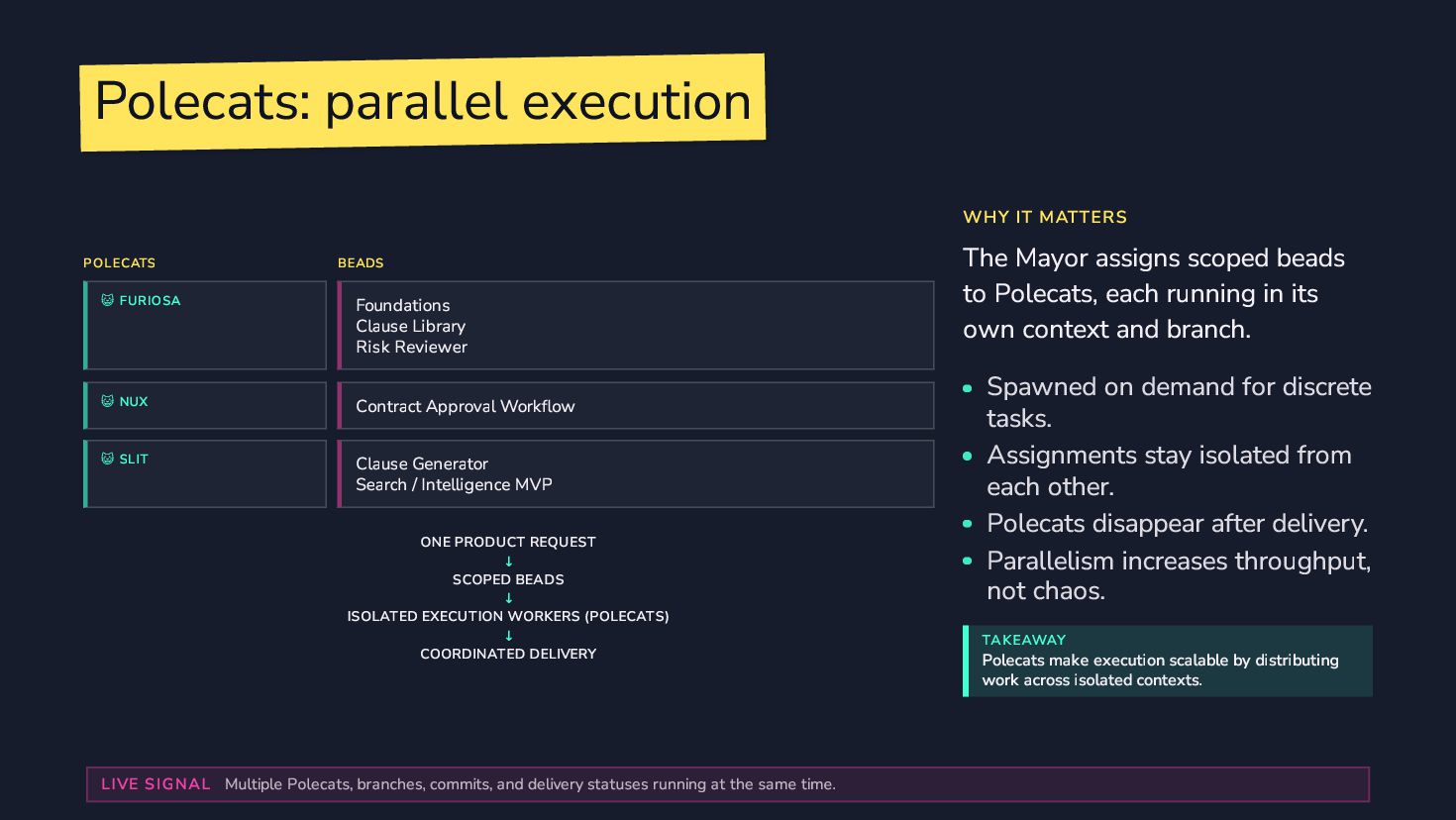
  12. POLECATS BEADS 😺 FURIOSA Foundations Clause Library Risk Reviewer 😺

    NUX Contract Approval Workflow 😺 SLIT Clause Generator Search / Intelligence MVP ONE PRODUCT REQUEST ↓ SCOPED BEADS ↓ ISOLATED EXECUTION WORKERS (POLECATS) ↓ COORDINATED DELIVERY WHY IT MATTERS The Mayor assigns scoped beads to Polecats, each running in its own context and branch. TAKEAWAY Polecats make execution scalable by distributing work across isolated contexts. Spawned on demand for discrete tasks. Assignments stay isolated from each other. Polecats disappear after delivery. Parallelism increases throughput, not chaos. LIVE SIGNAL Multiple Polecats, branches, commits, and delivery statuses running at the same time. Polecats: parallel execution
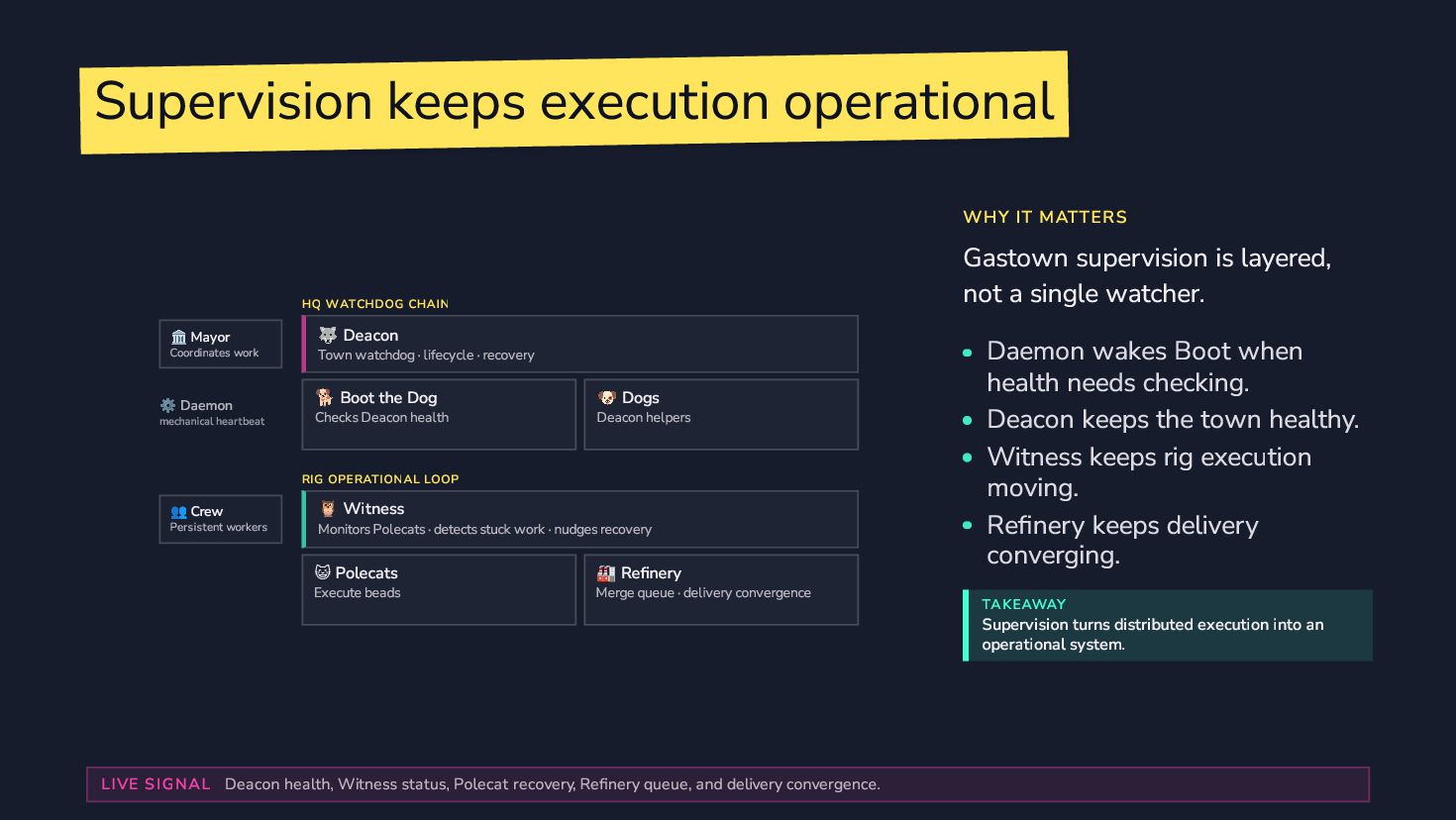
  13. HQ WATCHDOG CHAIN 🏛️ Mayor Coordinates work 🐺 Deacon Town

    watchdog · lifecycle · recovery ⚙️ Daemon 🐕 Boot the Dog Checks Deacon health 🐶 Dogs Deacon helpers RIG OPERATIONAL LOOP 👥 Crew Persistent workers 🦉 Witness Monitors Polecats · detects stuck work · nudges recovery 😺 Polecats Execute beads 🏭 Refinery Merge queue · delivery convergence WHY IT MATTERS Gastown supervision is layered, not a single watcher. TAKEAWAY Supervision turns distributed execution into an operational system. mechanical heartbeat Daemon wakes Boot when health needs checking. Deacon keeps the town healthy. Witness keeps rig execution moving. Refinery keeps delivery converging. LIVE SIGNAL Deacon health, Witness status, Polecat recovery, Refinery queue, and delivery convergence. Supervision keeps execution operational
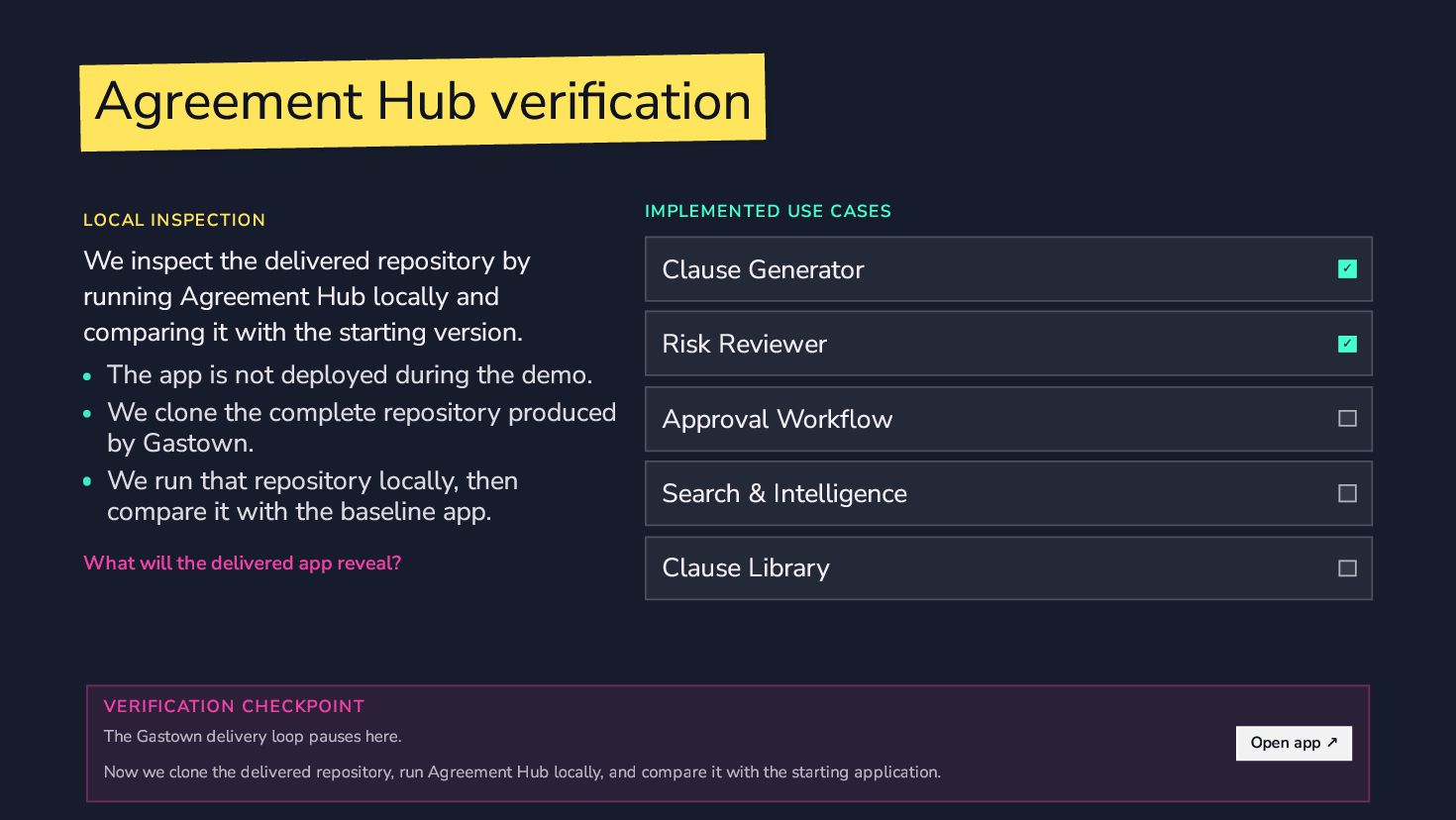
  14. LOCAL INSPECTION We inspect the delivered repository by running Agreement

    Hub locally and comparing it with the starting version. What will the delivered app reveal? IMPLEMENTED USE CASES Clause Generator ✓ Risk Reviewer ✓ Approval Workflow Search & Intelligence Clause Library The app is not deployed during the demo. We clone the complete repository produced by Gastown. We run that repository locally, then compare it with the baseline app. VERIFICATION CHECKPOINT The Gastown delivery loop pauses here. Now we clone the delivered repository, run Agreement Hub locally, and compare it with the starting application. Open app ↗ Agreement Hub verification
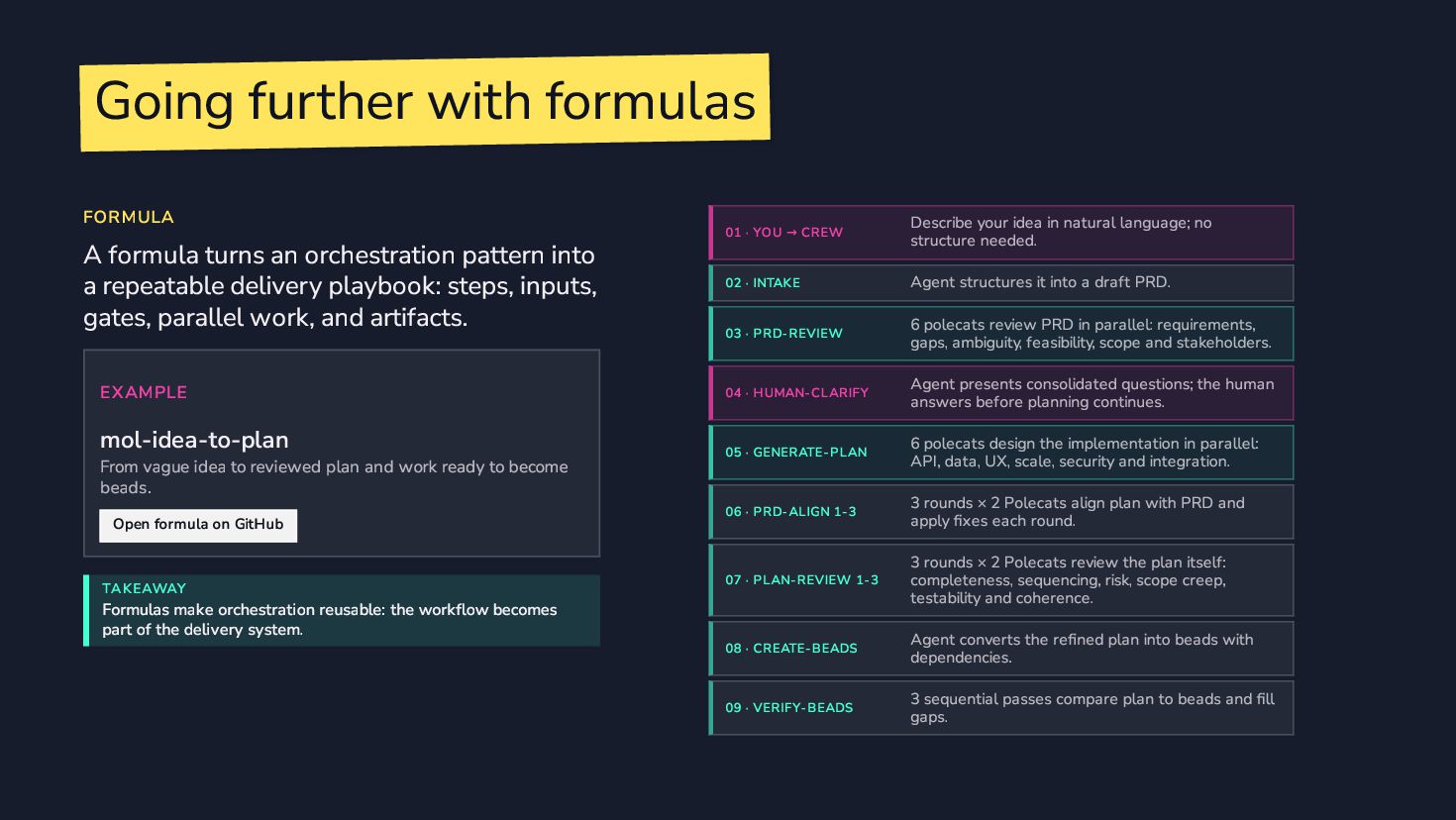
  15. FORMULA A formula turns an orchestration pattern into a repeatable

    delivery playbook: steps, inputs, gates, parallel work, and artifacts. EXAMPLE mol-idea-to-plan From vague idea to reviewed plan and work ready to become beads. Open formula on GitHub TAKEAWAY Formulas make orchestration reusable: the workflow becomes part of the delivery system. 01 · YOU → CREW Describe your idea in natural language; no structure needed. 02 · INTAKE Agent structures it into a draft PRD. 03 · PRD-REVIEW 6 polecats review PRD in parallel: requirements, gaps, ambiguity, feasibility, scope and stakeholders. 04 · HUMAN-CLARIFY Agent presents consolidated questions; the human answers before planning continues. 05 · GENERATE-PLAN 6 polecats design the implementation in parallel: API, data, UX, scale, security and integration. 06 · PRD-ALIGN 1-3 3 rounds × 2 Polecats align plan with PRD and apply fixes each round. 07 · PLAN-REVIEW 1-3 3 rounds × 2 Polecats review the plan itself: completeness, sequencing, risk, scope creep, testability and coherence. 08 · CREATE-BEADS Agent converts the refined plan into beads with dependencies. 09 · VERIFY-BEADS 3 sequential passes compare plan to beads and fill gaps. Going further with formulas
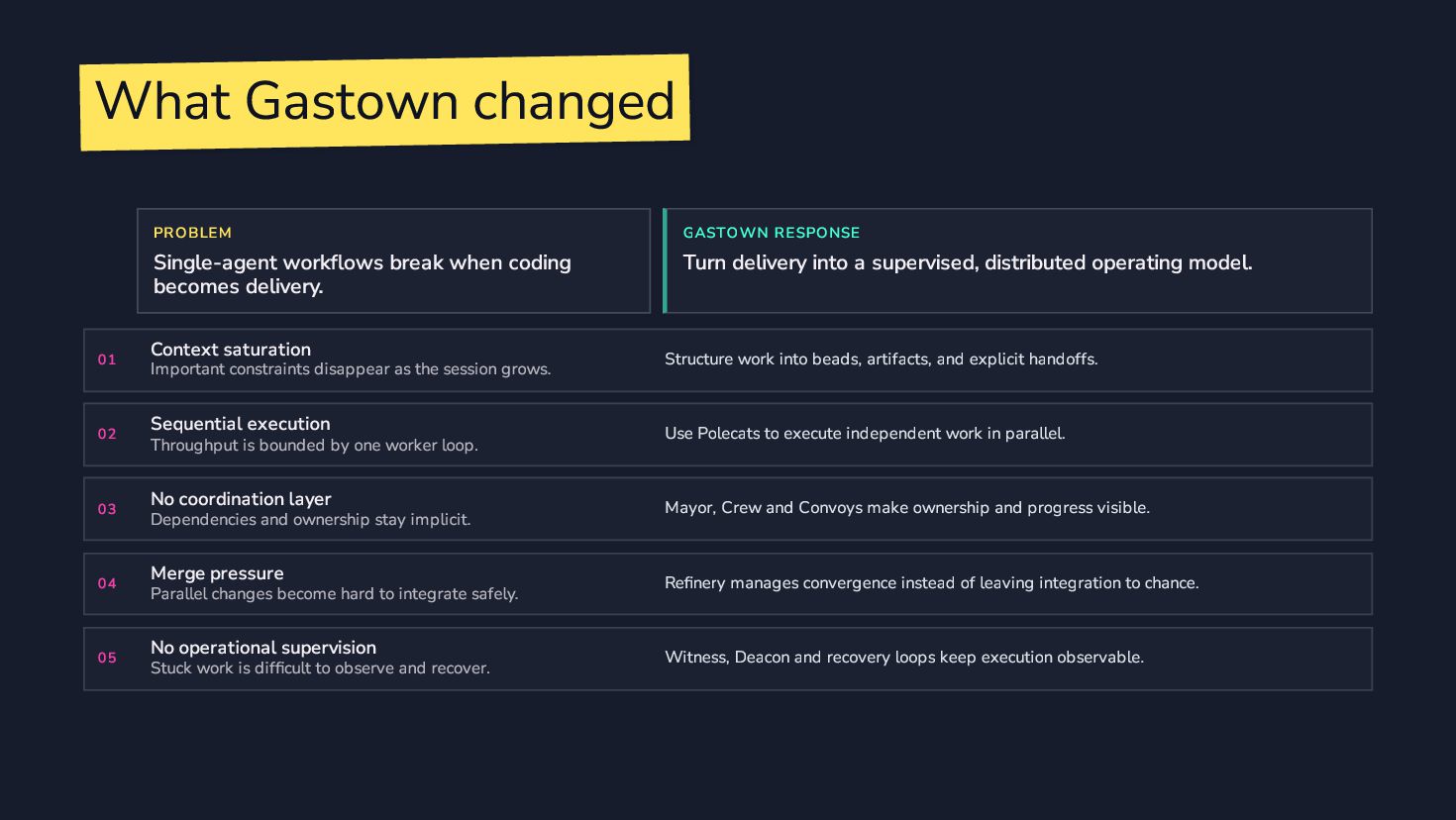
  16. PROBLEM Single-agent workflows break when coding becomes delivery. GASTOWN RESPONSE

    Turn delivery into a supervised, distributed operating model. 01 Context saturation Important constraints disappear as the session grows. Structure work into beads, artifacts, and explicit handoffs. 02 Sequential execution Throughput is bounded by one worker loop. Use Polecats to execute independent work in parallel. 03 No coordination layer Dependencies and ownership stay implicit. Mayor, Crew and Convoys make ownership and progress visible. 04 Merge pressure Parallel changes become hard to integrate safely. Refinery manages convergence instead of leaving integration to chance. 05 No operational supervision Stuck work is difficult to observe and recover. Witness, Deacon and recovery loops keep execution observable. What Gastown changed
  17. Questions & discussion EXAMPLE QUESTIONS What does it cost to

    deliver a feature with Gastown? How much control do we have over the models? When should we use the Crew instead of only the Mayor? Thank you