70’s - A Teoria Relacional • 80’s - O surgimento do Postgres • 90’s - De Berkeley para o mundo • 00’s - O fortalecimento da comunidade • 10’s - Brigando com gigantes • 20's - Novos modelos de negócio • E o futuro?
“Tabulating Machine Company”, com uma máquina de tabular dados para o censo demográfico de 1890 nos EUA usando cartões perfurados • 1911 - É criada a Computing-Tabulating-Recording Company (CTR) • 1924 - A CTR muda o nome para International Business Machine
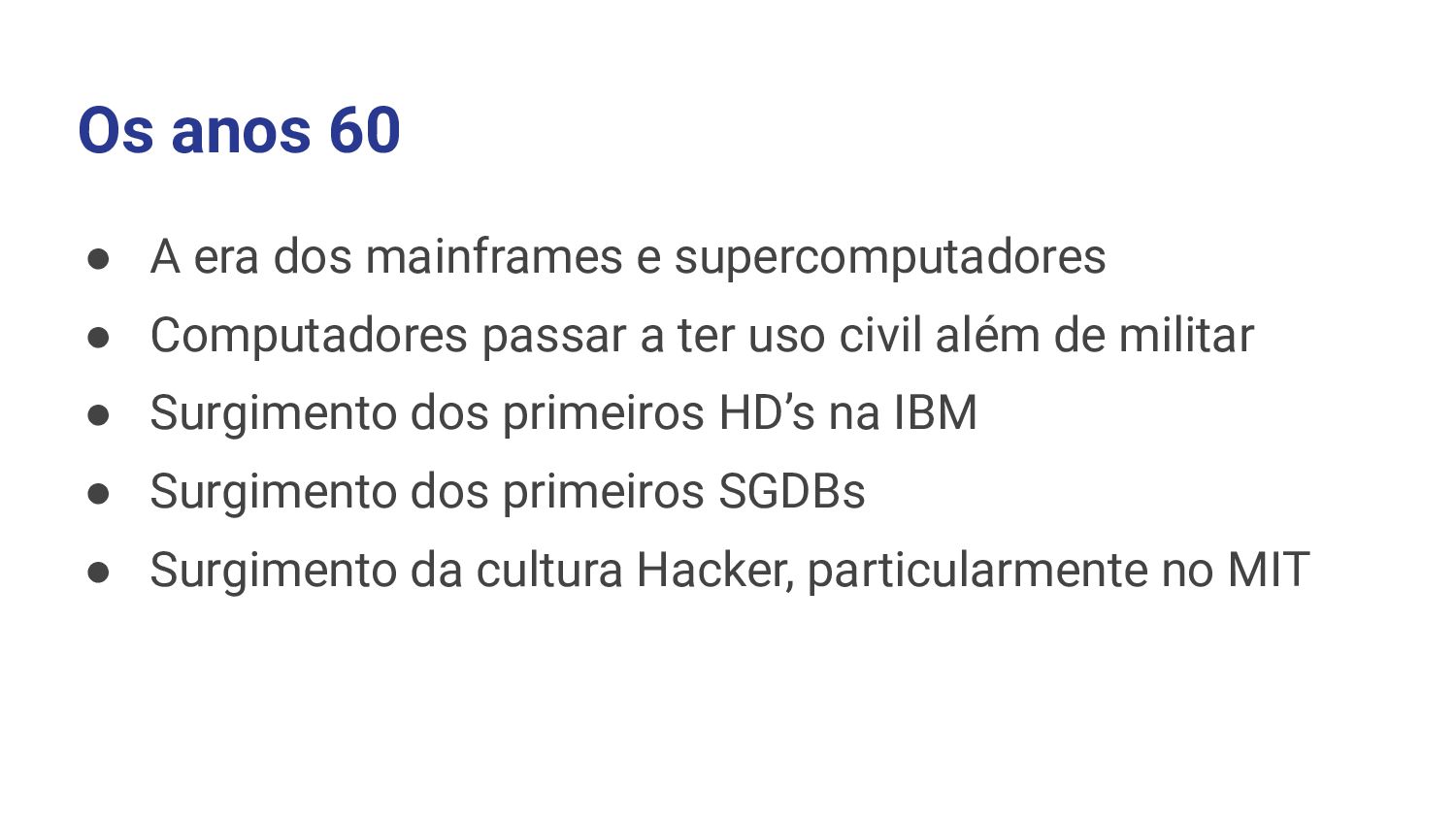
• Computadores passar a ter uso civil além de militar • Surgimento dos primeiros HD’s na IBM • Surgimento dos primeiros SGDBs • Surgimento da cultura Hacker, particularmente no MIT
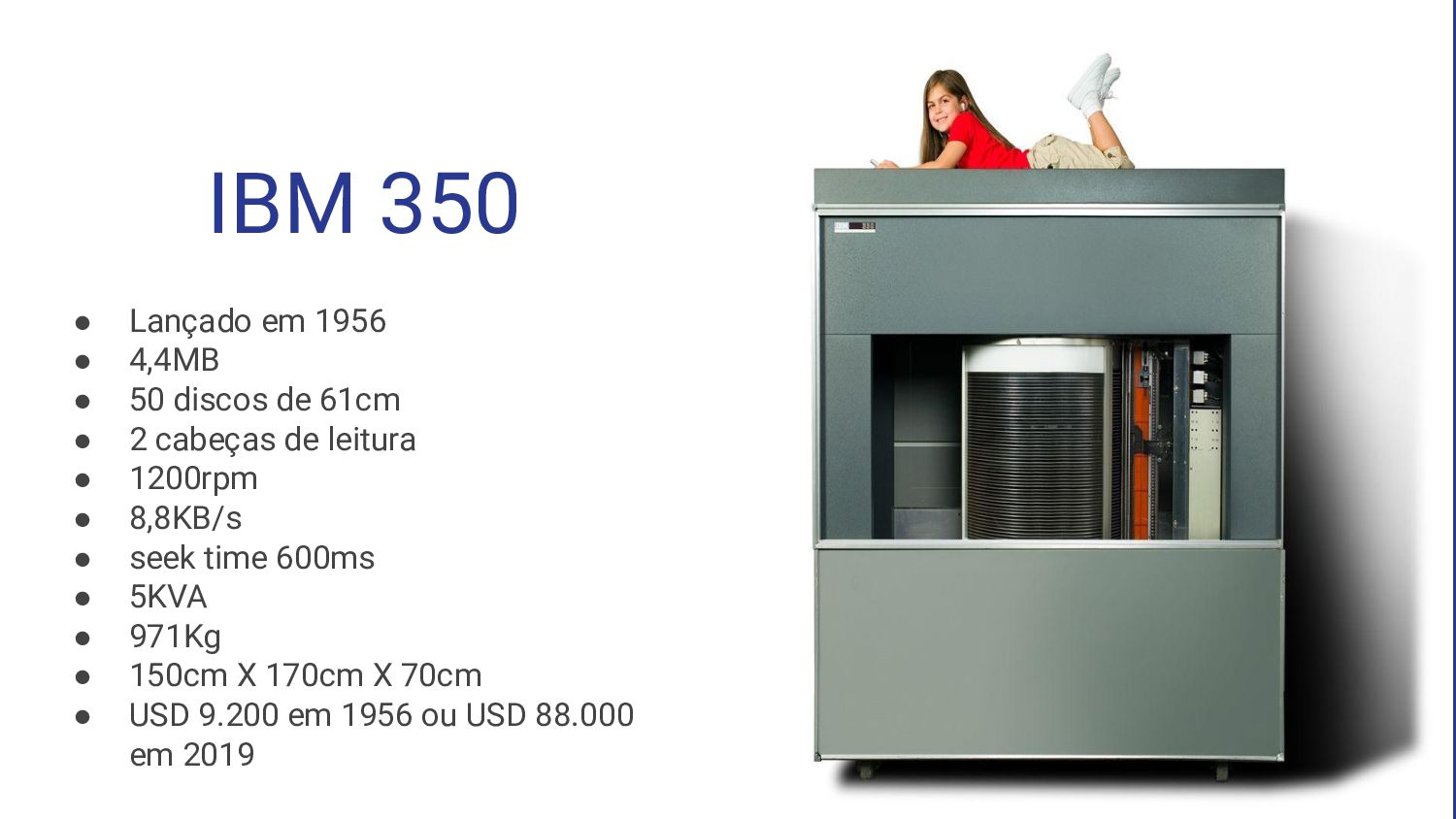
discos de 61cm • 2 cabeças de leitura • 1200rpm • 8,8KB/s • seek time 600ms • 5KVA • 971Kg • 150cm X 170cm X 70cm • USD 9.200 em 1956 ou USD 88.000 em 2019 crescimento máximo
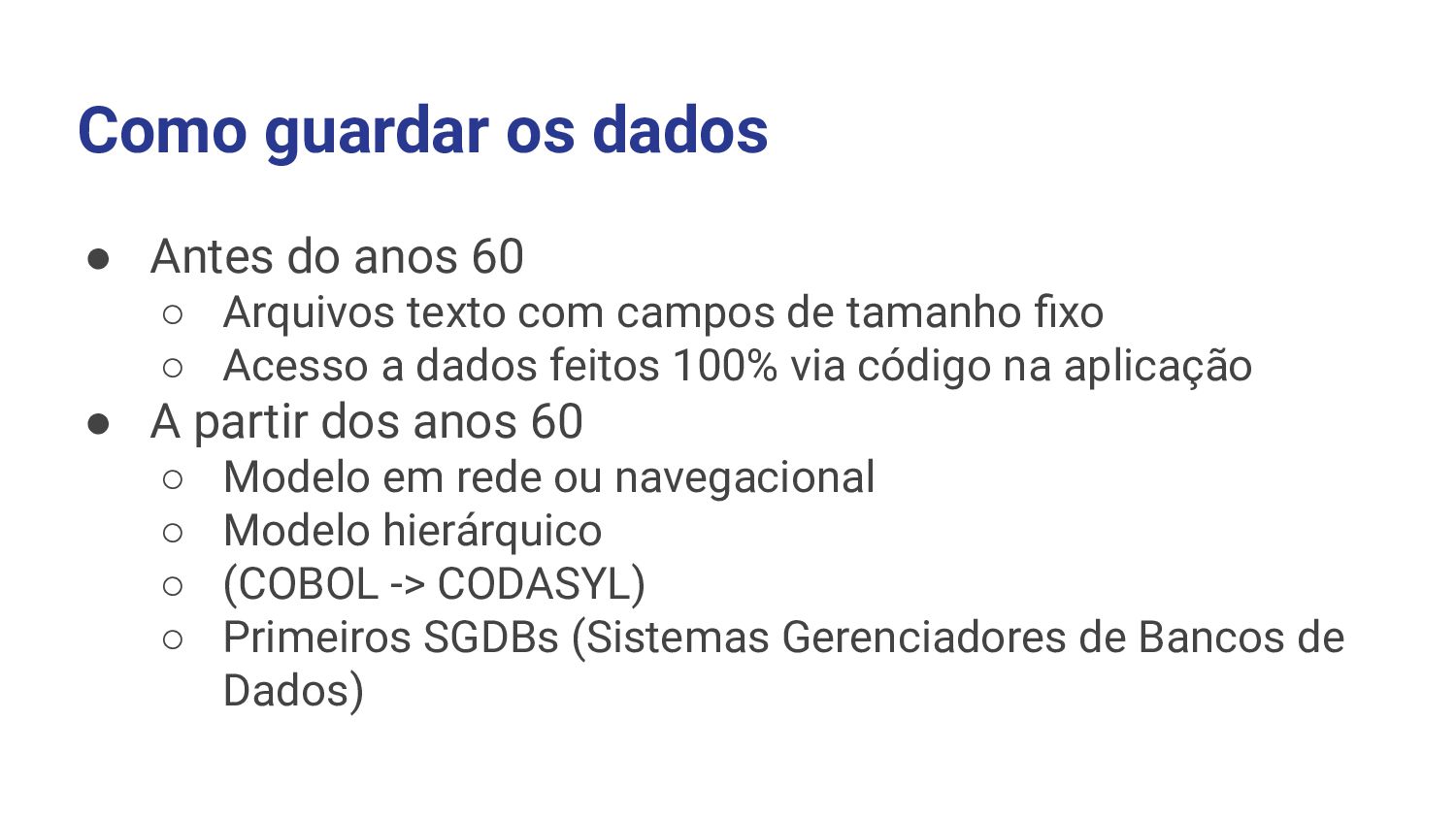
Arquivos texto com campos de tamanho fixo ◦ Acesso a dados feitos 100% via código na aplicação • A partir dos anos 60 ◦ Modelo em rede ou navegacional ◦ Modelo hierárquico ◦ (COBOL -> CODASYL) ◦ Primeiros SGDBs (Sistemas Gerenciadores de Bancos de Dados)
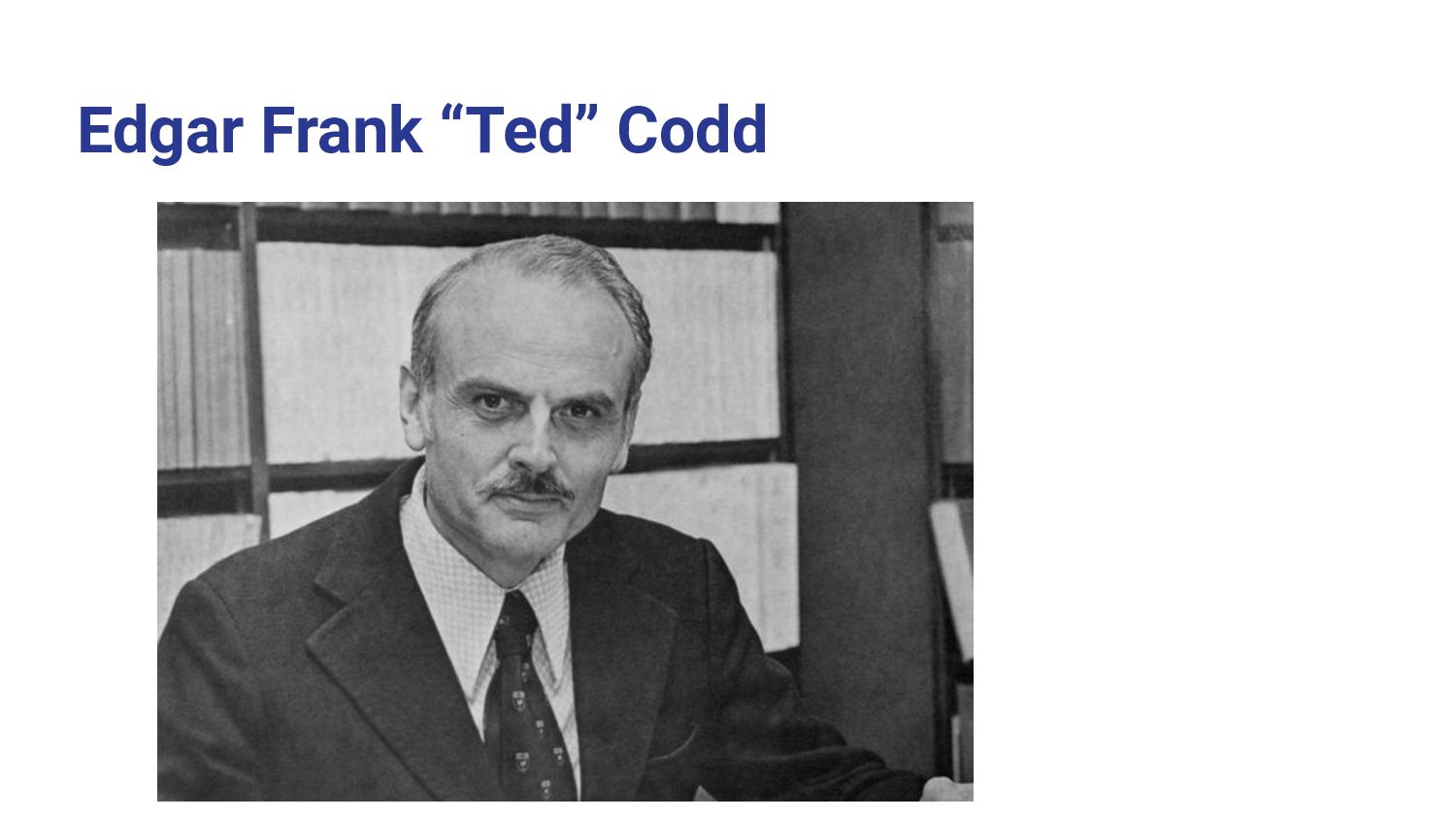
- Derivability, Redundancy and Consistency of Relations Stored in Large Data Banks. (publicação interna na IBM) • 1970 - A Relational Model of Data for Large Shared Data Banks • 1971 - A Data Base Sublanguage Founded on the Relational Calculus • 1972 - Relational Completeness of Data Base Sublanguages • 1974 - Interactive Support for Non-Programmers: The Relational and Network Approaches (c/ C. J. Date) • 1981 - The Capabilities of Relational Database Management Systems https://dblp.org/pers/hd/c/Codd:E=_F=
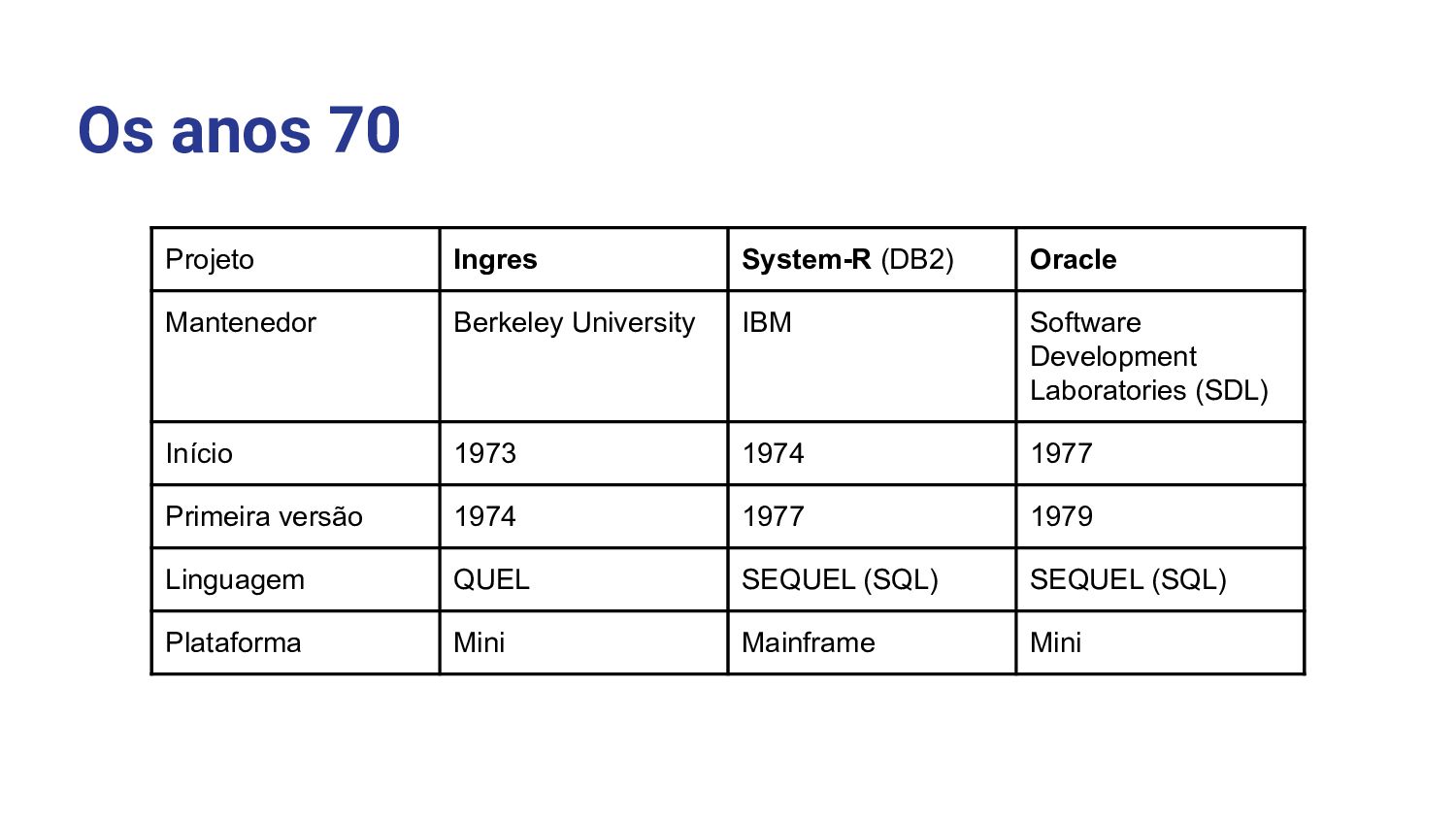
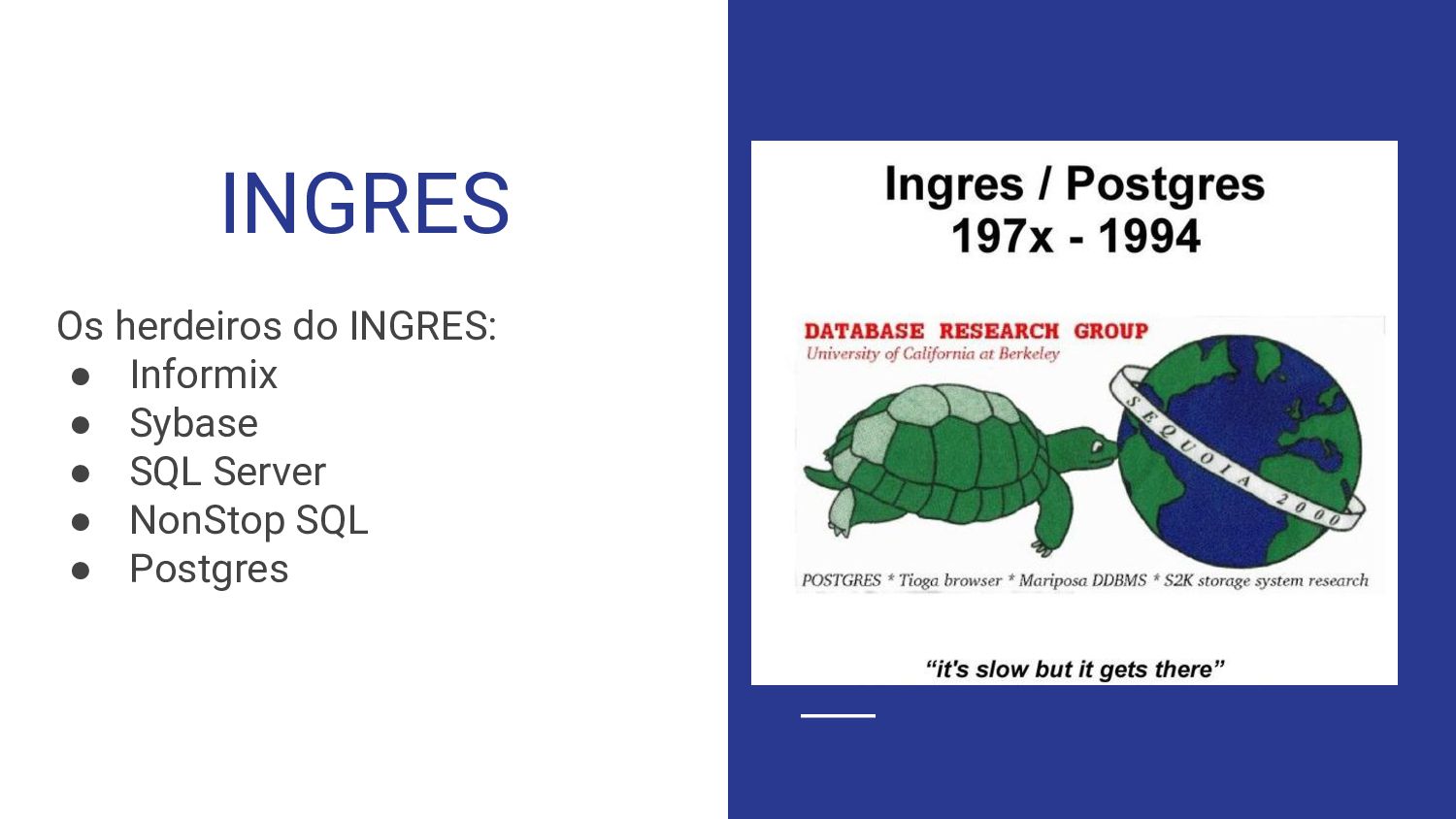
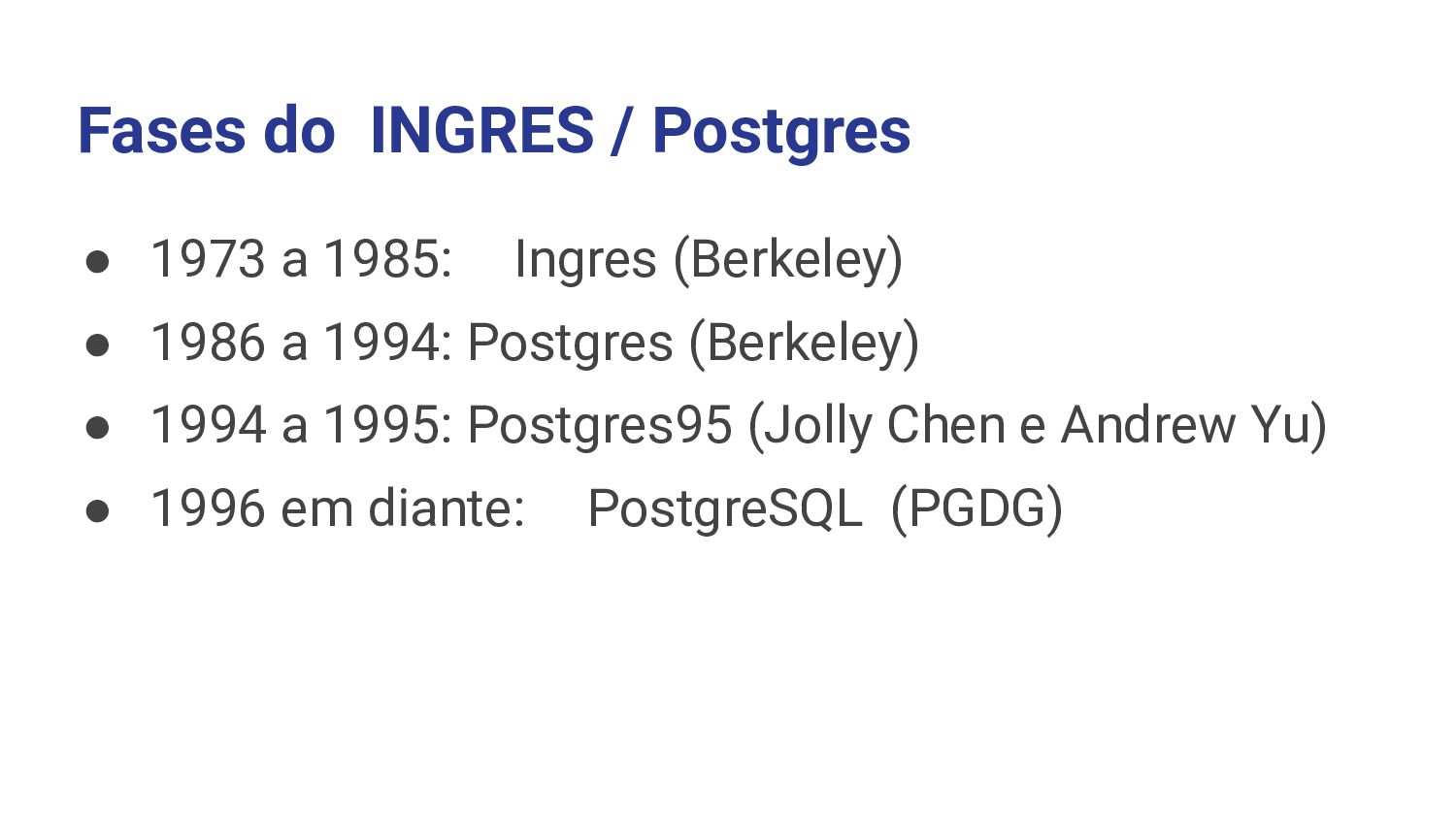
University IBM Software Development Laboratories (SDL) Início 1973 1974 1977 Primeira versão 1974 1977 1979 Linguagem QUEL SEQUEL (SQL) SEQUEL (SQL) Plataforma Mini Mainframe Mini
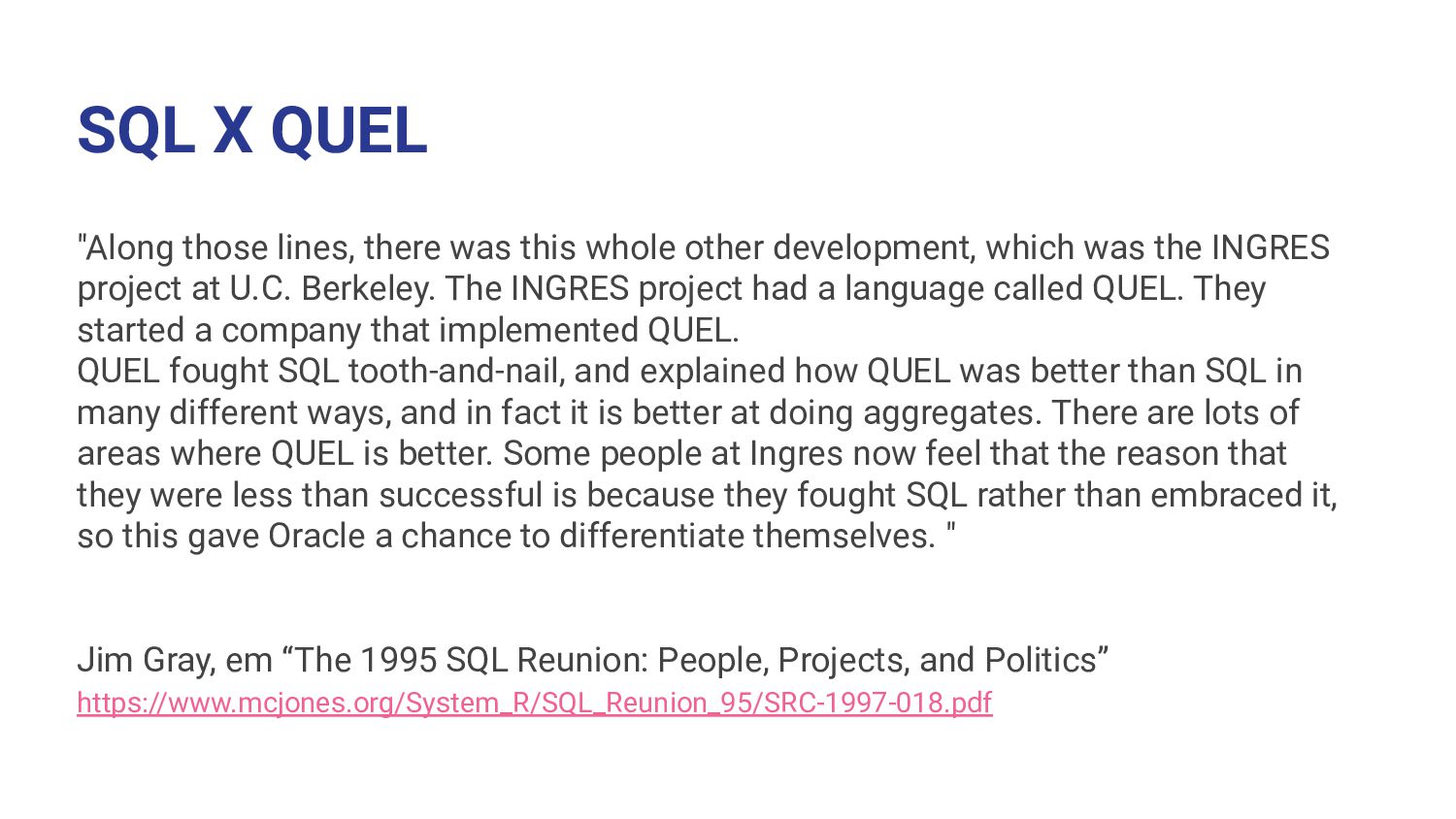
other development, which was the INGRES project at U.C. Berkeley. The INGRES project had a language called QUEL. They started a company that implemented QUEL. QUEL fought SQL tooth-and-nail, and explained how QUEL was better than SQL in many different ways, and in fact it is better at doing aggregates. There are lots of areas where QUEL is better. Some people at Ingres now feel that the reason that they were less than successful is because they fought SQL rather than embraced it, so this gave Oracle a chance to differentiate themselves. " Jim Gray, em “The 1995 SQL Reunion: People, Projects, and Politics” https://www.mcjones.org/System_R/SQL_Reunion_95/SRC-1997-018.pdf
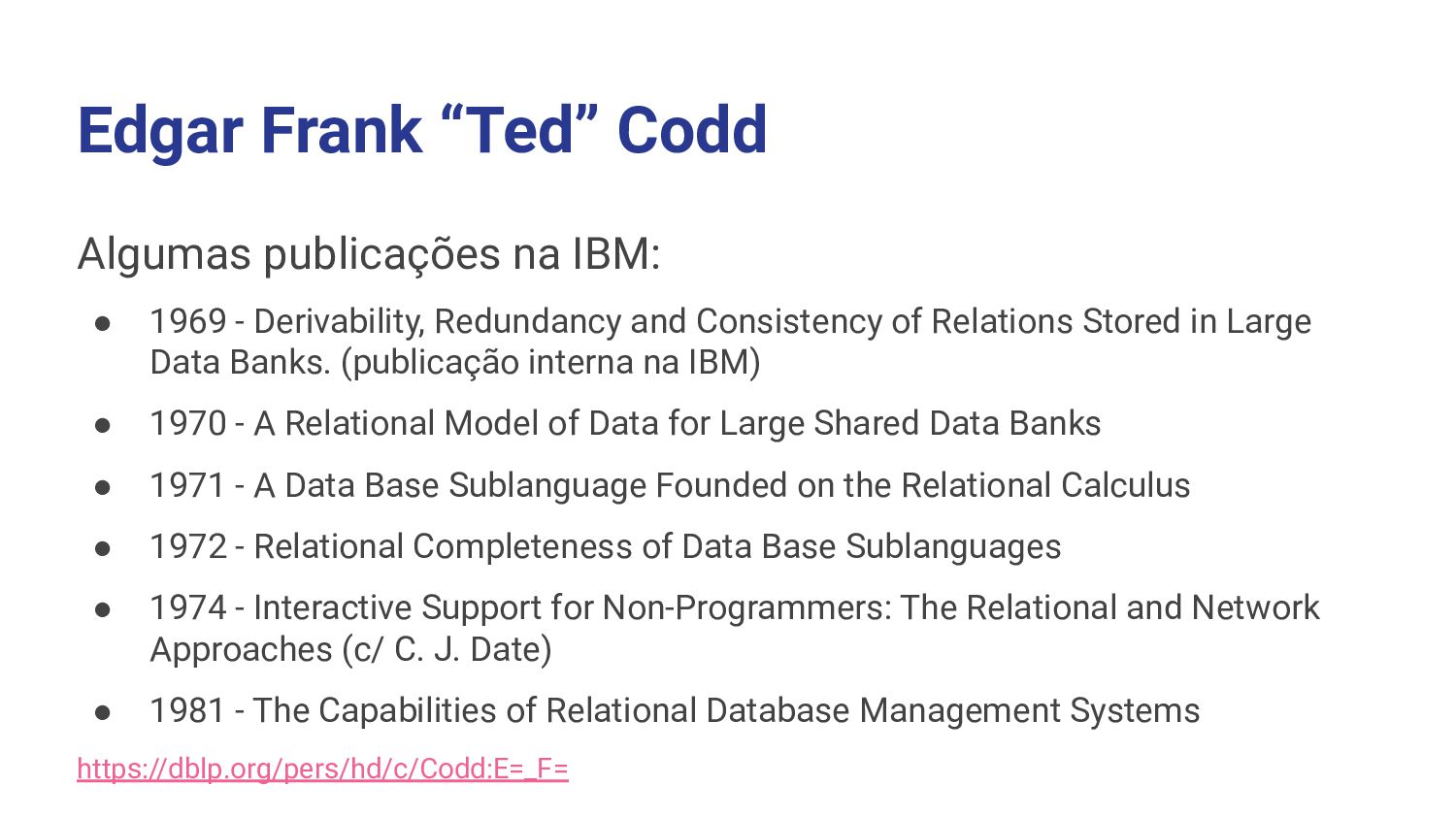
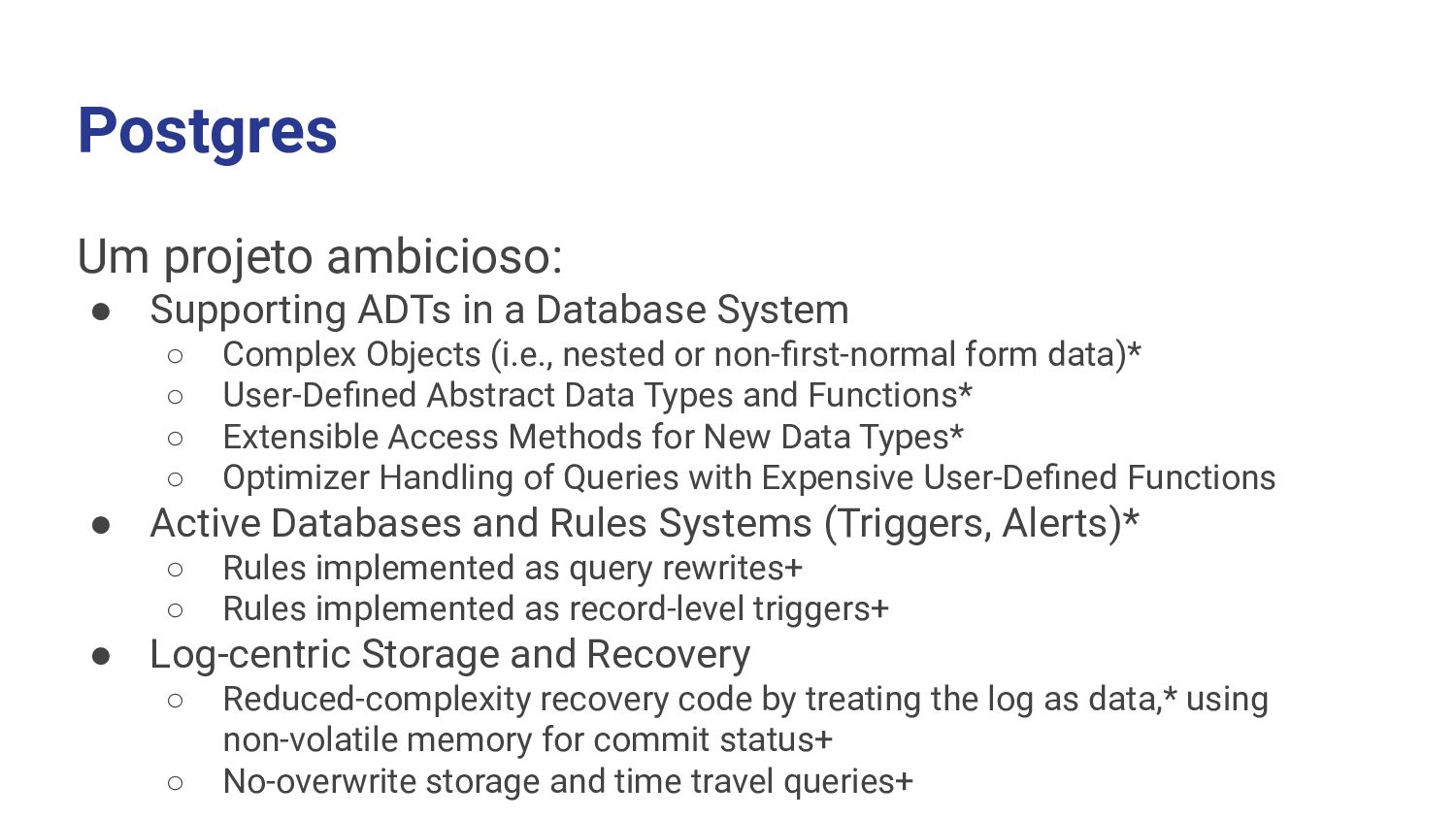
System ◦ Complex Objects (i.e., nested or non-first-normal form data)* ◦ User-Defined Abstract Data Types and Functions* ◦ Extensible Access Methods for New Data Types* ◦ Optimizer Handling of Queries with Expensive User-Defined Functions • Active Databases and Rules Systems (Triggers, Alerts)* ◦ Rules implemented as query rewrites+ ◦ Rules implemented as record-level triggers+ • Log-centric Storage and Recovery ◦ Reduced-complexity recovery code by treating the log as data,* using non-volatile memory for commit status+ ◦ No-overwrite storage and time travel queries+
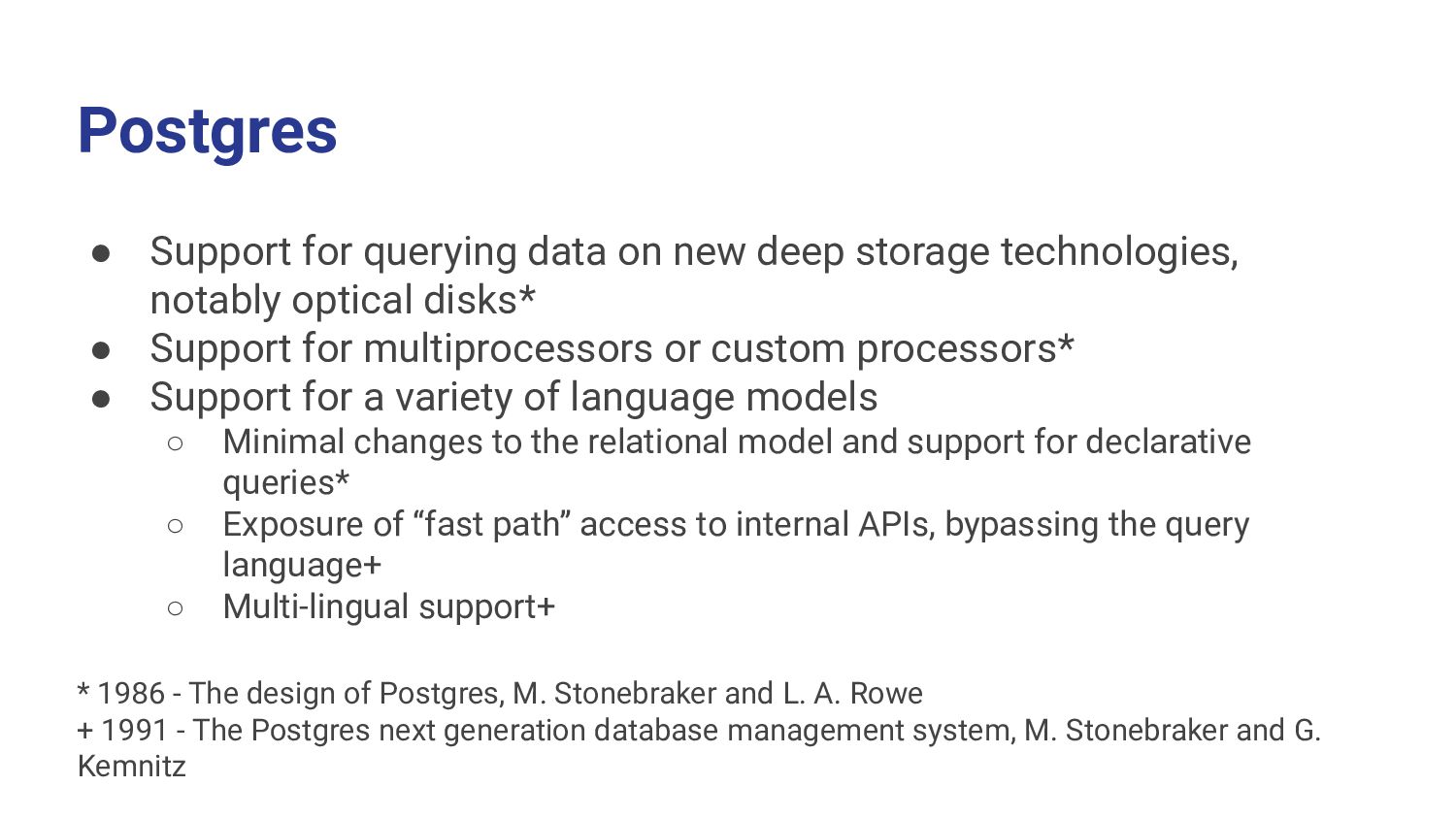
technologies, notably optical disks* • Support for multiprocessors or custom processors* • Support for a variety of language models ◦ Minimal changes to the relational model and support for declarative queries* ◦ Exposure of “fast path” access to internal APIs, bypassing the query language+ ◦ Multi-lingual support+ * 1986 - The design of Postgres, M. Stonebraker and L. A. Rowe + 1991 - The Postgres next generation database management system, M. Stonebraker and G. Kemnitz
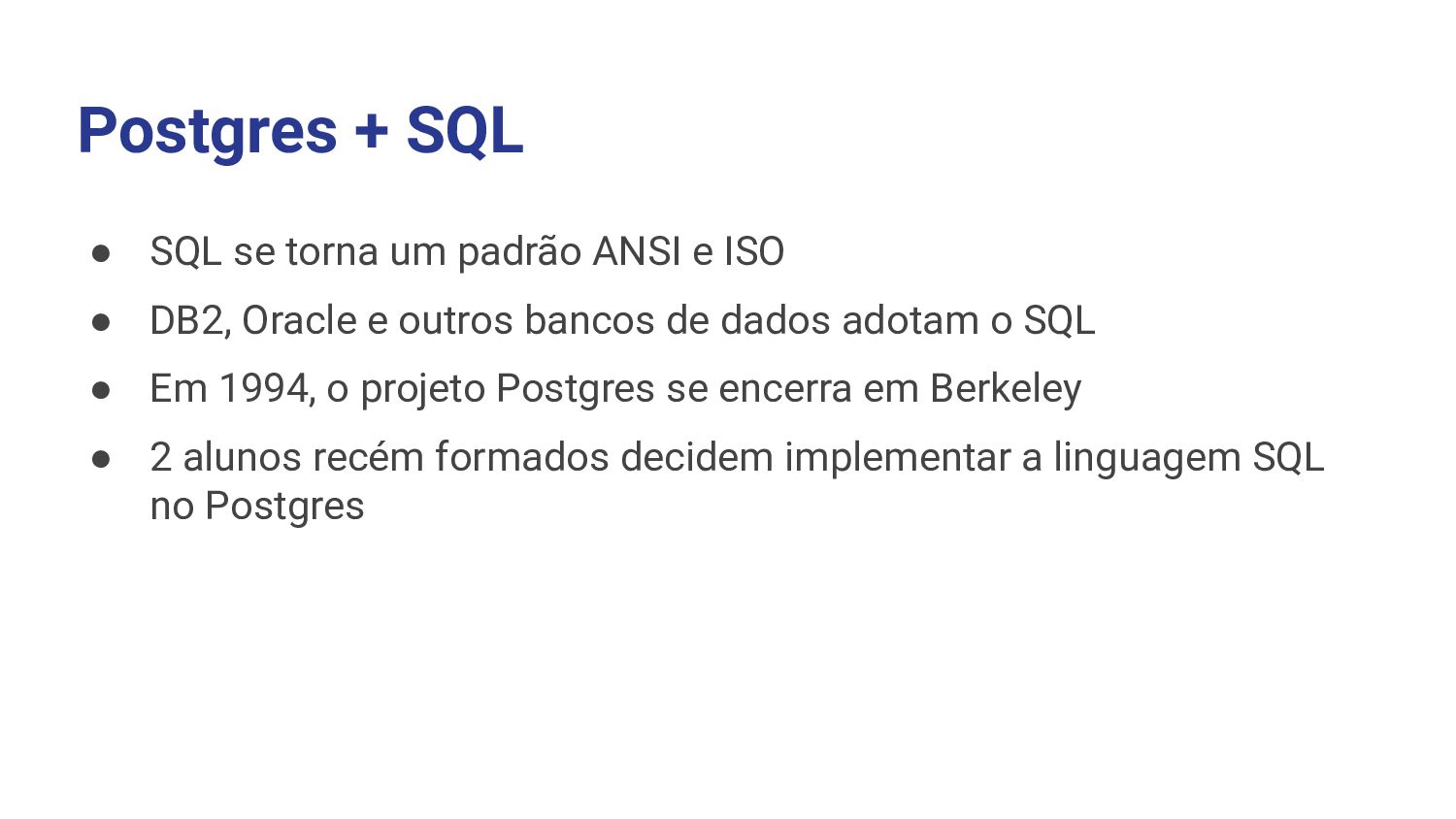
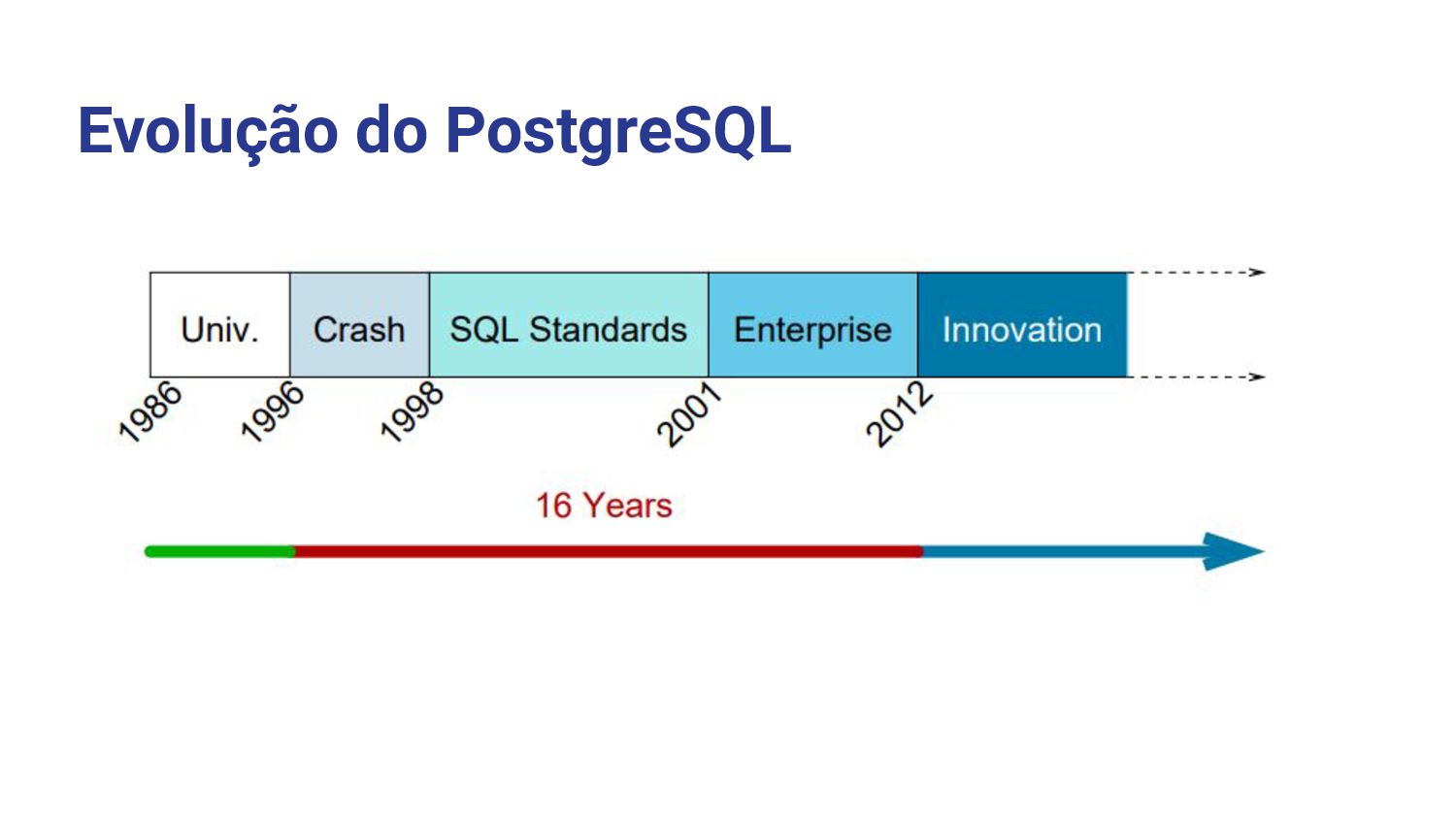
e ISO • DB2, Oracle e outros bancos de dados adotam o SQL • Em 1994, o projeto Postgres se encerra em Berkeley • 2 alunos recém formados decidem implementar a linguagem SQL no Postgres
name of the game Date: 2006-07-13 03:42:54 It might help to explain that the pronunciation is "post-gres" or "post-gres-cue-ell", not "post-gray-something". I heard people making this same mistake in presentations at this past weekend's Postgres Anniversary Conference :-( Arguably, the 1996 decision to call it PostgreSQL instead of reverting to plain Postgres was the single worst mistake this project ever made. It seems far too late to change now, though. regards, tom lane
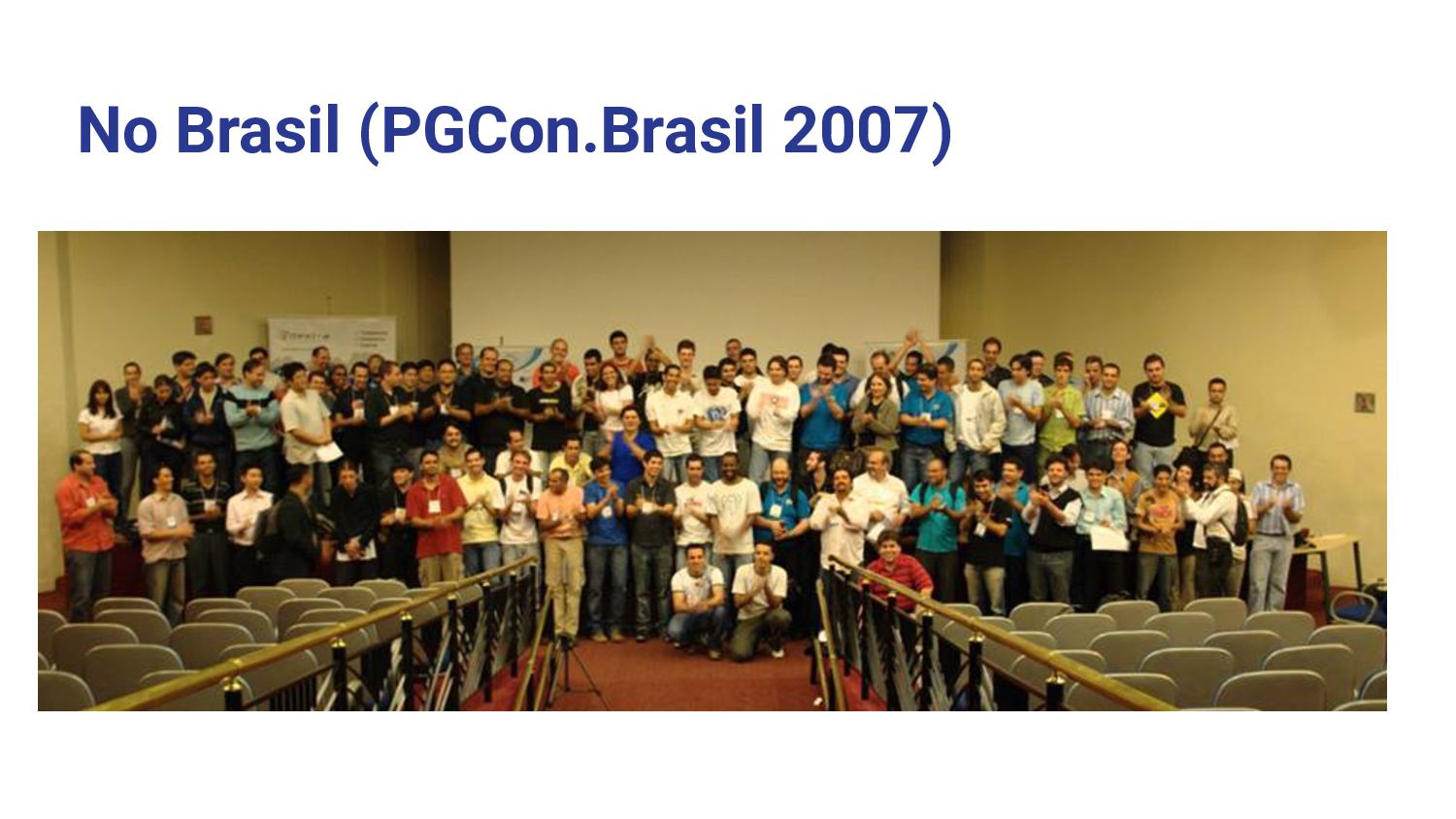
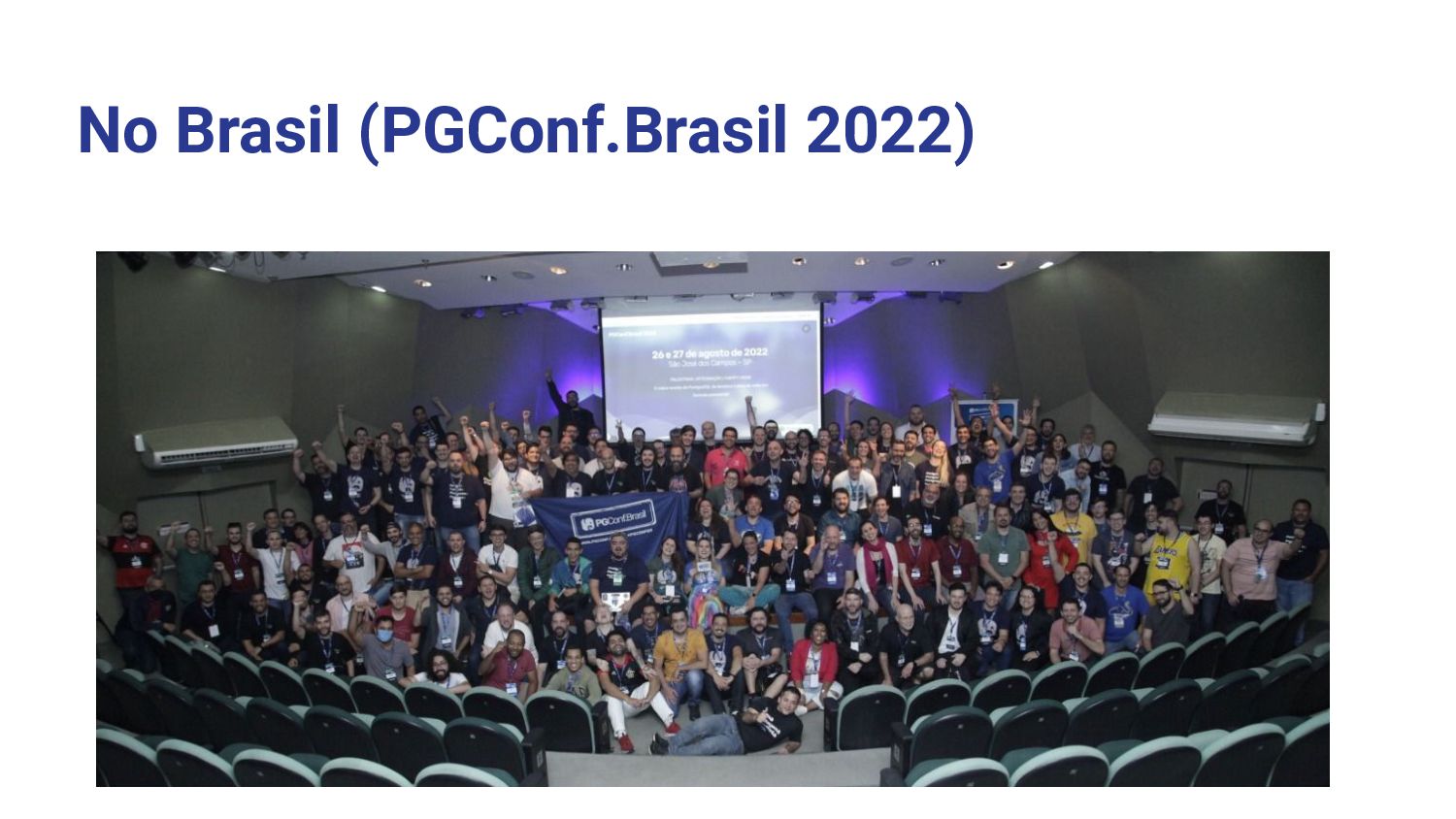
em https://www.postgresql.org/list/ • Grupo no telegram c/ ~3800 inscritos https://t.me/postgresqlbr • PGCon Brasil 2007 - São Paulo / SP • PGCon Brasil 2008 e 2009 - Campinas / SP • PGBR Brasil 2011 - São Paulo / SP • PGBR Brasil 2013 - Porto Velho / RO • PGBR Brasil 2015 e 2017 - Porto Alegre / RS • PGConf Brasil 2018 - São Paulo / SP • PGConf Brasil 2019 • PGConf Brasil 2022 • PGDays em todo país!
on the postgres95 web site (http://s2k-ftp.CS.Berkeley.EDU:8000/postgres95/www/todo.html) I’ve casually sorted the list by priority and I have some editorial comments on some of them. If all the items on the TODO list were completed, postgres95 would be much improved, and would really be a viable replacement for commercial RDBMSs in some settings. Some of the items require quite a bit of work and deep knowledge of postgres95 internals, though. We would need a few contributors with quite a lot of volunteer hours to make this happen anytime soon. (A large number of contributors each with only a little bit of time to contribute would not be equivalent)
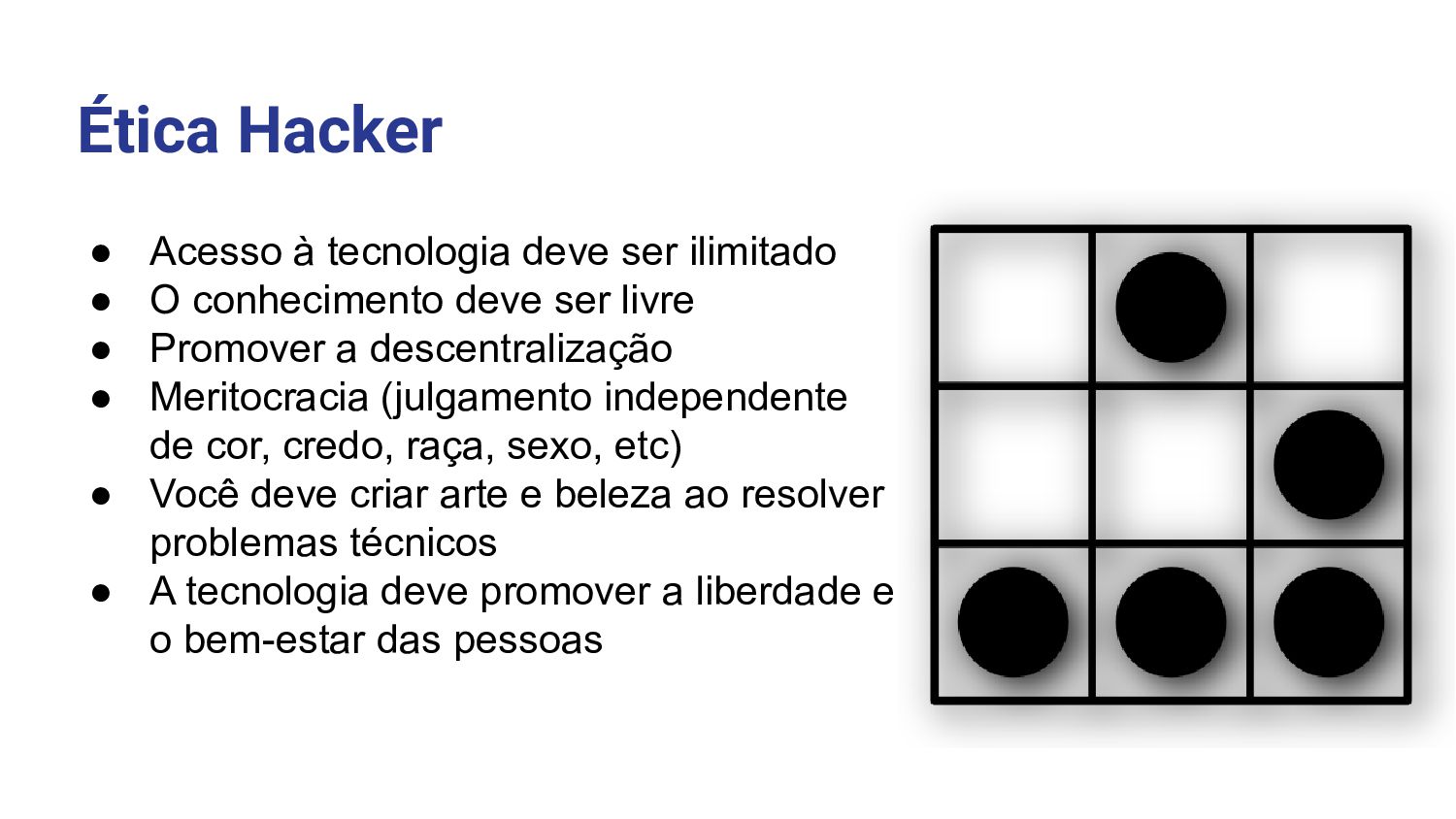
O conhecimento deve ser livre • Promover a descentralização • Meritocracia (julgamento independente de cor, credo, raça, sexo, etc) • Você deve criar arte e beleza ao resolver problemas técnicos • A tecnologia deve promover a liberdade e o bem-estar das pessoas
Like) • Não existe um “dono” • Comunicação aberta • Ferramentas abertas • Aberto para novos desenvolvedores • Regras claras e objetivas para todos (commitfest)


 fabiotr
 miidas
 oracle4engineer
 marceloancelmo
 ykagano
 kitagawaz
 foursue
 dafujii
 leveragestech
 bcantrill
 toshimaru
 pauli
pauli
 iwatatomoya
 mongodb
 rocio
rocio
 productmarketing
 kneath
 aki_iinuma
 destraynor
 tonyrice
 notwaldorf
 rkaga
rkaga
 ammeep
 nmsamuel
 danielanewman





![Perguntas? Fábio Telles Rodriguez • email: [email protected] • telegram: @fabio_telles](https://files.speakerdeck.com/presentations/26c84c93dded48df8642c477309308d7/slide_50.jpg)