Share
Embed
Transcript
103 slides
-
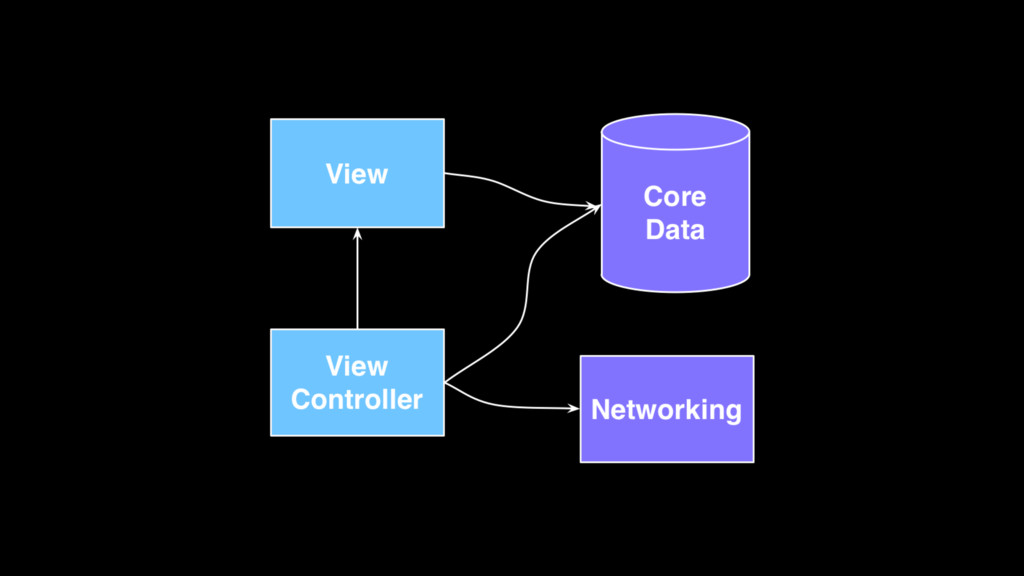
Core Data is a framework that you use to manage
the model layer objects in your application. -
A framework that you use to build the persistence layer
in your application. -
Fetch class TweetListViewController: UITableViewController { ... func fetchTweets() { let
application = UIApplication.sharedApplication() guard let appDelegate = application.delegate as? AppDelegate else { return } let managedObjectContext = appDelegate.managedObjectContext } } -
Fetch ? class TweetListViewController: UITableViewController { ... func fetchTweets() {
let application = UIApplication.sharedApplication() guard let appDelegate = application.delegate as? AppDelegate else { return } let managedObjectContext = appDelegate.managedObjectContext let fetchRequest = NSFetchRequest(entityName: "ManagedTweet") fetchRequest.predicate = NSPredicate(format: "homeTimeline != NULL") fetchRequest.sortDescriptors = [NSSortDescriptor(key: "identifier", ascending: false)] } } -
Fetch ?! class TweetListViewController: UITableViewController { ... func fetchTweets() {
let application = UIApplication.sharedApplication() guard let appDelegate = application.delegate as? AppDelegate else { return } let managedObjectContext = appDelegate.managedObjectContext let fetchRequest = NSFetchRequest(entityName: "ManagedTweet") fetchRequest.predicate = NSPredicate(format: "homeTimeline != NULL") fetchRequest.sortDescriptors = [NSSortDescriptor(key: "identifier", ascending: false)] let results = try? managedObjectContext.executeFetchRequest(fetchRequest) if let managedObjects = results as? [NSManagedObject] { data = managedObjects } } } -
data property class TweetListViewController: UITableViewController { ... var data: [ManagedTweet]
= [] { didSet { tableView.reloadData() } } } -
cellForRowAtIndexPath: override func tableView(tableView: UITableView, cellForRowAtIndexPath indexPath: NSIndexPath) -> UITableViewCell
{ let cell = tableView.dequeueReusableCellWithIdentifier(reuseIdentifier, forIndexPath: indexPath) as! TweetTableViewCell } -
cellForRowAtIndexPath: override func tableView(tableView: UITableView, cellForRowAtIndexPath indexPath: NSIndexPath) -> UITableViewCell
{ let cell = tableView.dequeueReusableCellWithIdentifier(reuseIdentifier, forIndexPath: indexPath) as! TweetTableViewCell let tweet = data[indexPath.row] } -
cellForRowAtIndexPath: override func tableView(tableView: UITableView, cellForRowAtIndexPath indexPath: NSIndexPath) -> UITableViewCell
{ let cell = tableView.dequeueReusableCellWithIdentifier(reuseIdentifier, forIndexPath: indexPath) as! TweetTableViewCell let tweet = data[indexPath.row] if let text = tweet.valueForKey("text") as? String { cell.multilineTextLabel?.text = text } // set up other views return cell } -
The app delegate works alongside the app object to ensure
your app interacts properly with the system and with other apps. — Apple -
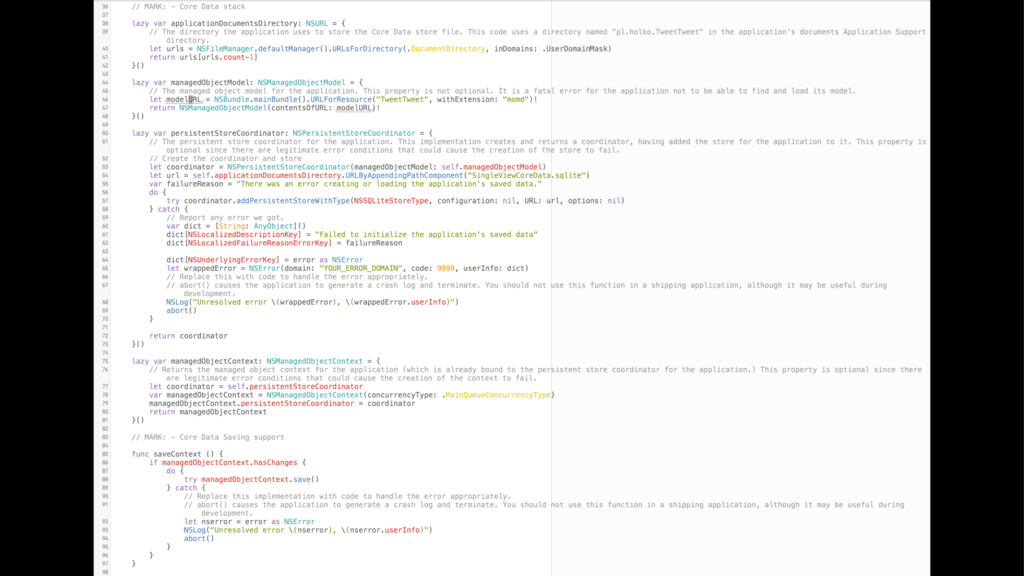
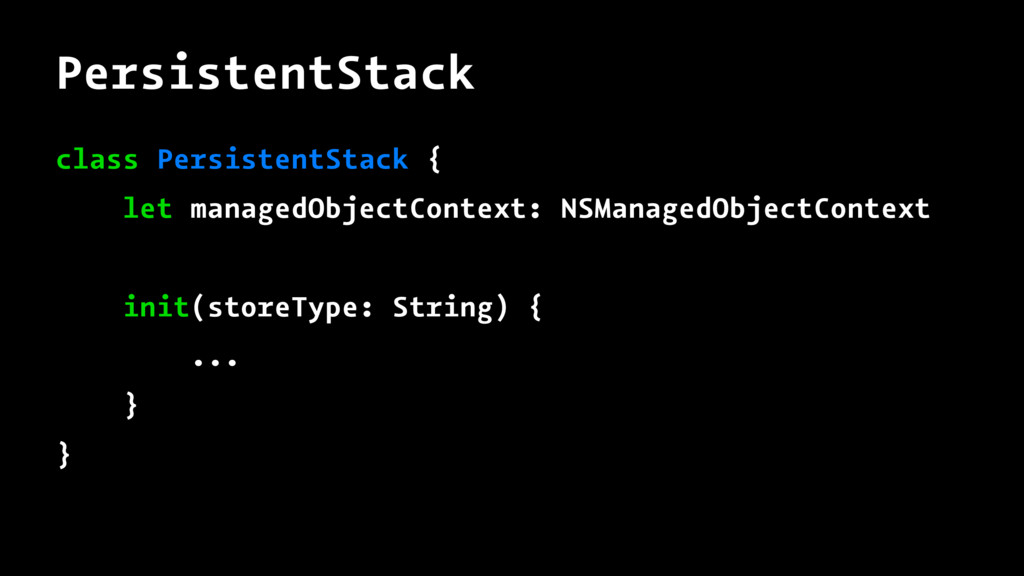
AppDelegate now class AppDelegate: UIResponder, UIApplicationDelegate { let persistentStack =
PersistentStack(NSSQLiteStoreType) ... } -
The Easy Way class TweetListViewController: UITableViewController { let managedObjectContext: NSManagedObjectContext
init() { if let appDelegate = UIApplication.sharedApplication().delegate as? AppDelegate { managedObjectContext = appDelegate.persistentStack.managedObjectContext } super.init(nibName: nil, bundle: nil) } } -
Singleton class TweetListViewController: UITableViewController { let managedObjectContext: NSManagedObjectContext init() {
managedObjectContext = PersistentStack.sharedInstance().managedObjectContext super.init(nibName: nil, bundle: nil) } } -
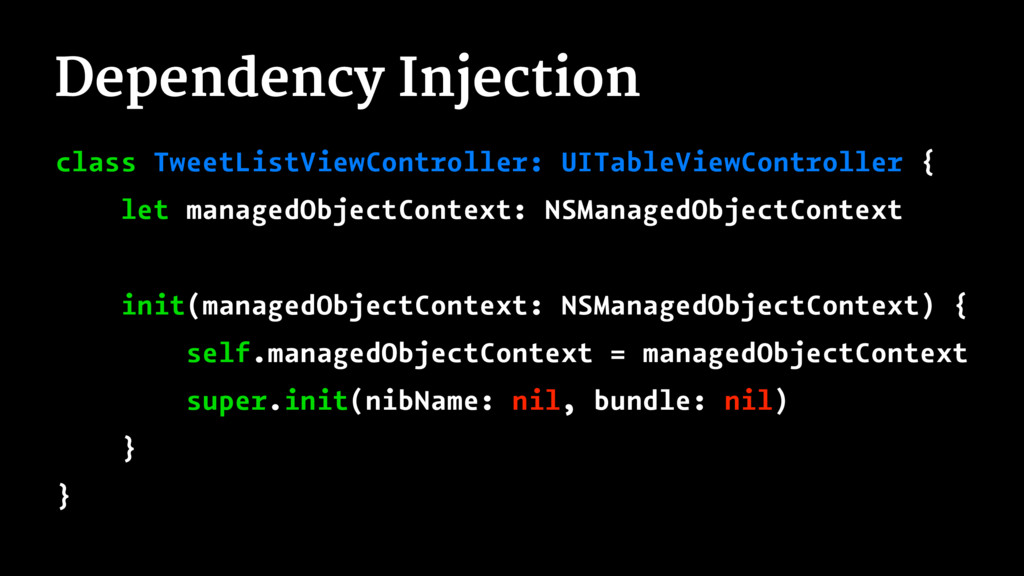
Dependency Injection class TweetListViewController: UITableViewController { let managedObjectContext: NSManagedObjectContext init(managedObjectContext:
NSManagedObjectContext) { self.managedObjectContext = managedObjectContext super.init(nibName: nil, bundle: nil) } } -
NSManagedObject with KVC let tweet: NSManagedObject = data[indexPath.row] if let
text = tweet.valueForKey("text") as? String { cell.multilineTextLabel?.text = text } -
class _ManagedTweet: NSManagedObject { ... // MARK: - Properties @NSManaged
var identifier: NSNumber @NSManaged var text: String // MARK: - Relationships @NSManaged var homeTimeline: ManagedHomeTimeline? @NSManaged var user: ManagedUser } -
enum ManagedTweetAttributes: String { case identifier = "identifier" case text
= "text" } enum ManagedTweetRelationships: String { case homeTimeline = "homeTimeline" case user = "user" } -
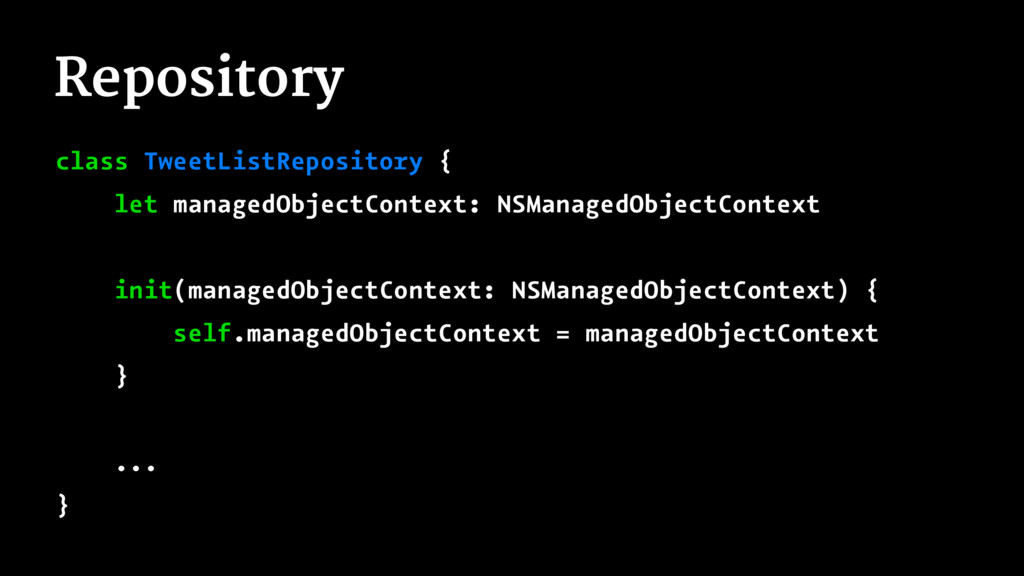
Repository class TweetListRepository { let managedObjectContext: NSManagedObjectContext init(managedObjectContext: NSManagedObjectContext) {
self.managedObjectContext = managedObjectContext } ... } -
class TweetListRepository { ... func performFetch(completion: [ManagedTweet] -> Void) {
let fetchRequest = NSFetchRequest(entityName: ManagedTweet.entityName()) let homeTimelineKey = ManagedTweetRelationships.homeTimeline.rawValue fetchRequest.predicate = NSPredicate(format: "%@ != NULL", homeTimelineKey); let identifierKey = ManagedTweetAttributes.identifier.rawValue fetchRequest.sortDescriptors = [NSSortDescriptor(key: identifierKey, ascending: false)] let results = try? managedObjectContext.executeFetchRequest(fetchRequest) if let managedTweets = results as? [ManagedTweet] { completion(managedTweets) } } } -
Impact on the view controller override func viewDidLoad() { super.viewDidLoad()
setupTableView() repository.performFetch { [weak self] managedTweets -> Void in self?.data = managedTweets } } -
NSManagedObjectContext gets hidden from the view controller class TweetListViewController: UITableViewController
{ let repository: TweetListRepository init(repository: TweetListRepository) { self.repository = repository super.init(nibName: nil, bundle: nil) } ... } -
Data repositories' flow class ProfileRepository { let managedObjectContext: NSManagedObjectContext let
profileIdentifier: Int init(managedObjectContext: NSManagedObjectContext, profileIdentifier: Int) { self.managedObjectContext = managedObjectContext self.profileIdentifier = profileIdentifier } } -
protocol Repository { var managedObjectContext: NSManagedObjectContext { get } }
extension ProfileRepository { convenience init(repository: Repository, profileIdentifier: Int64) { self.init(managedObjectContext: repository.managedObjectContext, profileIdentifier: profileIdentifier) } } let profileRepository = ProfileRepository(repository: repository, profileIdentifier: profileIdentifier) let viewController = ProfileViewController(repository: profileRepository) -
protocol Request { typealias ResultType var method: Method { get
} var path: String { get } var parameters: Dictionary<String, String> { get } func send(completion: (Result<ResultType, NSError> -> Void)) func resultFromJSON(JSON: AnyObject) throws -> ResultType } Result: github.com/antitypical/Result -
extension Request { var method: Method { return .GET }
var path: String { return "" } var parameters: Dictionary<String, String> { return Dictionary() } } -
extension Request { var method: Method { return .GET }
var path: String { return "" } var parameters: Dictionary<String, String> { return Dictionary() } func send(completion: (Result<ResultType, NSError> -> Void)) { let response = RequestSender().send(self) do { let result = try self.resultFromJSON(response) completion(Result(result)) } catch let nserror as NSError { completion(Result(error: nserror)) } } } -
struct Tweet { let identifier: Int let text: String let
user: User } struct User { let identifier: Int let name: String let profileImageUrl: String? let screenName: String } -
class TweetListRequest: Request { typealias ResultType = [Tweet] var path:
String { return "statuses/home_timeline" } func resultFromJSON(JSON: AnyObject) throws -> [Tweet] { return try [Tweet].decode(JSONString) } } decode: github.com/Anviking/Decodable -
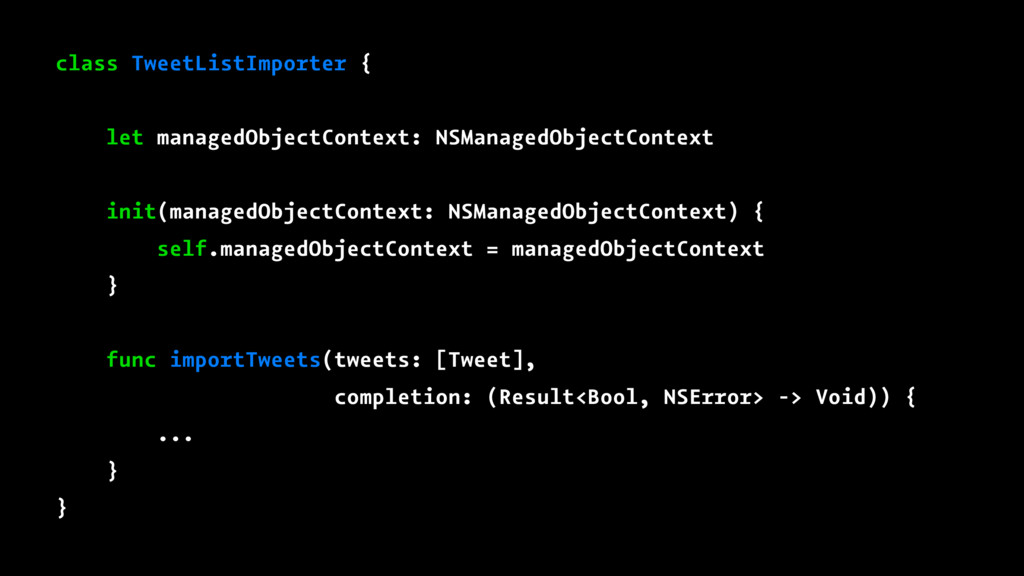
class TweetListImporter { let managedObjectContext: NSManagedObjectContext init(managedObjectContext: NSManagedObjectContext) { self.managedObjectContext
= managedObjectContext } func importTweets(tweets: [Tweet], completion: (Result<Bool, NSError> -> Void)) { ... } } -
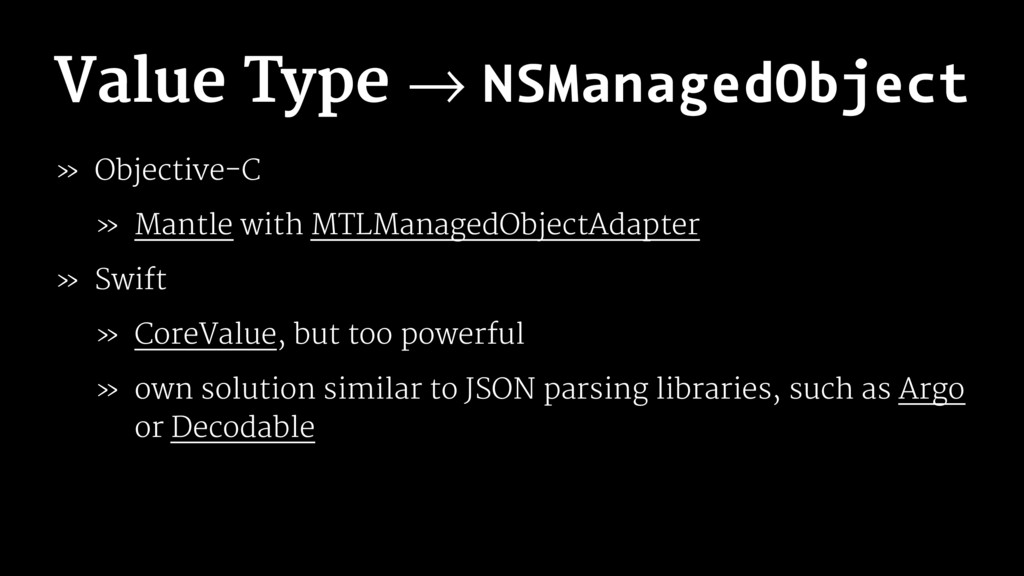
Value Type → NSManagedObject » Objective-C » Mantle with MTLManagedObjectAdapter
» Swift » CoreValue, but too powerful » own solution similar to JSON parsing libraries, such as Argo or Decodable -
Problem with NSFetchedResultsControllerDelegate optional public func controller(controller: NSFetchedResultsController, didChangeObject anObject:
AnyObject, atIndexPath indexPath: NSIndexPath?, forChangeType type: NSFetchedResultsChangeType, newIndexPath: NSIndexPath?) -
TweetListRepository API class TweetListRepository: Repository { weak var delegate: NSFetchedResultsControllerDelegate?
var objects: [ManagedTweet] // computed property } -
TweetListRepository API class TweetListRepository: Repository { weak var delegate: RepositoryDelegate?
var objects: [ManagedTweet] // computed property } -
Our own delegate protocol Repository { func performFetch() } protocol
RepositoryDelegate: class { func repository(repository: Repository, didFinishInitialRequestWithResult result: Result<Bool, NSError>) func repositoryWillChangeContent(repository: Repository) func repositoryDidChangeContent(repository: Repository) func repository(repository: Repository, didInsertRowAtIndexPath indexPath: NSIndexPath) func repository(repository: Repository, didDeleteRowAtIndexPath indexPath: NSIndexPath) func repository(repository: Repository, didUpdateRowAtIndexPath indexPath: NSIndexPath) } -
From NSFRCDelegate to RepositoryDelegate class TweetListRepository: Repository { // other
delegate methods omitted for clarity func controller(controller: NSFetchedResultsController, didChangeObject anObject: AnyObject, atIndexPath indexPath: NSIndexPath?, forChangeType type: NSFetchedResultsChangeType, newIndexPath: NSIndexPath?) { switch (type) { case .Insert: delegate?.repository(self, didInsertRowAtIndexPath: newIndexPath!) case .Delete: delegate?.repository(self, didDeleteRowAtIndexPath: indexPath!) case .Update: delegate?.repository(self, didUpdateRowAtIndexPath: indexPath!) case .Move: // consider adding separate update callback delegate?.repository(self, didDeleteRowAtIndexPath: indexPath!) delegate?.repository(self, didInsertRowAtIndexPath: newIndexPath!) } } } -
Reacting to changes extension TweetListViewController: RepositoryDelegate { // some methods
omitted func repository(repository: Repository, didInsertRowAtIndexPath indexPath: NSIndexPath) { tableView.insertRowsAtIndexPaths([indexPath], withRowAnimation: .Automatic) } func repository(repository: Repository, didDeleteRowAtIndexPath indexPath: NSIndexPath) { tableView.deleteRowsAtIndexPaths([indexPath], withRowAnimation: .Automatic) } func repository(repository: Repository, didUpdateRowAtIndexPath indexPath: NSIndexPath) { tableView.reloadRowsAtIndexPaths([indexPath], withRowAnimation: .Automatic) } } -
ProfileRepository protocol SingleElementRepository { func performFetch() } protocol SingleElementRepositoryDelegate: class
{ func singleElementRepositoryDidUpdate(repository: SingleElementRepository) } class ProfileRepository: SingleElementRepository { weak var delegate: SingleElementRepositoryDelegate? var user: User? // computed property ... } -
protocol TweetType { var identifier: Int { get } var
text: String { get } var user: UserType { get } } protocol UserType { var identifier: Int { get } var name: String { get } var profileImageUrl: String? { get } var screenName: String { get } } -
class TweetListRepository: Repository { weak var delegate: RepositoryDelegate? var objects:
[TweetType] // computed property } -
Those Structs struct Tweet: TweetType { let identifier: Int let
text: String let user: User } struct User: UserType { let identifier: Int let name: String let profileImageUrl: String? let screenName: String } -
class TweetListRepository: Repository { weak var delegate: RepositoryDelegate? var objects:
[TweetType] { // non-optimized version let fetchedObjects = fetchedResultsController.fetchedObjects return structsFromManagedObjects(fetchedObjects) } } -
New Issues » data duplication in memory » CPU time
for conversions (can be in the background) » possible lack of synchronization -
Links (1/2) » https://www.youtube.com/watch?v=WpkDN78P884 » https://www.destroyallsoftware.com/talks/boundaries » http://objectsonrails.com/ » http://blog.8thlight.com/uncle-bob/2012/08/13/the-clean-
architecture.html » https://realm.io/news/andy-matuschak-controlling- complexity/ -
Links (2/2) » http://khanlou.com/2015/06/protocol-oriented-networking/ » https://twitter.com/andy_matuschak/status/ 560857237640343552 » https://github.com/rentzsch/mogenerator »
https://www.objc.io/issues/13-architecture/viper/ » https://developers.facebooklive.com/videos/525/facebook- on-ios-inside-the-big-blue-app