Share
Embed

Transcript
61 slides
-
Me, Myself and I Maitre de conférence University Paris Est
Marne la vallée -
Me, Myself and I Maitre de conférence University Paris Est
Marne la vallée Developer: OpenJDK, ASM, Tatoo, … Java Community Process Expert – Invokedynamic (JSR 292) – Lambda (JSR 335 + java.util/java.util.stream) – Jigsaw (JSR 376) – Amber (Java 18.x), Valhalla (Java 18.x + 19.x) -
No reliable configuration ClassPath ? – Linear scan :( –
If two versions of the same package exist ? => Jar Hell Example: CLASSPATH = …:asm-2.3.jar:…:asm-3.1.jar A newly introduced class of ASM 3.1 will use an old class of ASM 2.3 => compile time information is different from runtime info -
No way to scale Down the platform Some libraries tend
to be too big – OpenJDK 8 rt.jar => 66 Mb – Guava 20 => 2.3 Mb – Spring Context => 1.1 Mb on Maven Central IoT anyone ? -
No Strong Encapsulation The JDK has only one line of
defense :( And 66 megs of privileged classes -
Module descriptor in mymodule/module-info.java module foo { requires java.base; requires
bar; exports com.acme.my.package; } requires → module dependencies exports → packages visible by other modules (classpath == unamed module) -
java.se java.sql.rowset java.sql java.xml java.base java.logging java.scripting java.datatransfer java.compiler java.desktop
Module graph of java.se (part of) -
A modular jar Modular jar == plain old jar +
module-info.class Configuration fidelity – module-info.java is verified by the compiler – module-info.class is verified by the VM -
Module Graph & module path From a module, the compiler
and VM computes the acyclic dependency graph the ClassPath is not needed anymore The ClassPath is dead* Long live to the Module-Path * if you don’t care about backward compat. and migration -
Java 9 compatibility issues (1/3) The Java 9 JDK disallow
split packages, one package == one module disallow access to non exported packages deep reflection on modules setAccessible can now fail -
Java 9 compatibility issues (2/3) Allowing illegal access with a
migration flag --illegal-access=<value> permit or deny access to members of types in modules <value> is one of "deny", "permit", "warn", or "debug" This option will be removed in a future release -
Java 9 compatibility issues (3/3) Downsizing the JDK – Some
packages have been deprecated java.corba, java.transaction, java.xml.bind, java.xml.ws, java.xml.ws.annotations They are not root modules and will be removed in Java 10? – Some classes (sun.*, com.sun.*) of the JDK have been deleted are in an non exported packages (may be deleted in the future) -
Command line java/javac Override root modules configuration --add-modules modules to
add as root modules --upgrade-module-path to replace some root modules Patch a module --patch-module module=files patch existing classes of a module Add a dependency (can be done by reflection too) --add-reads module=anotherModule Break encapsulation / allow setAccessible --add-exports module/package=anotherModule --add-opens modue/package=anotherModule -
Discovering usage of internal APIs $ jdeps --jdk-internals target deps/vertx-*.jar
target -> JDK removed internal API target -> jdk.unsupported io.snowcamp.papaya.doc.Document -> sun.misc.BASE64Decoder (JDK removed internal) io.snowcamp.papaya.doc.Document -> sun.misc.BASE64Encoder (JDK removed internal) io.snowcamp.papaya.reflect.ReflectionSupport -> sun.misc.Unsafe internal (jdk.unsupported) vertx-internal-3.3.3.jar -> java.base vertx-internal-3.3.3.jar -> jdk.unsupported io.netty.handler.ssl.util.OpenJdkSelfSignedCertGenerator -> sun.security.util.ObjectIdentifier internal (java.base) io.netty.util.internal.PlatformDependent0 -> sun.misc.Unsafe internal (jdk.unsupported) io.netty.util.internal.UnsafeAtomicIntegerFieldUpdater -> sun.misc.Unsafe internal (jdk.unsupported) ... JDK Internal API Suggested Replacement ---------------- --------------------- sun.misc.BASE64Decoder Use java.util.Base64 @since 1.8 sun.misc.BASE64Encoder Use java.util.Base64 @since 1.8 sun.misc.Unsafe See http://openjdk.java.net/jeps/260 sun.security.x509.X500Name Use javax.security.auth.x500.X500Principal @since 1.4 -
Example - ModuleTools A simple application – Allow to read/transform/write
a module-info 4 packages – fr.umlv.moduletools.main • command line – fr.umlv.moduletools.trasform • chain transformations – fr.umlv.moduletools.api • module input, module output – fr.umlv.moduletools.internal • Uses ASM to read/write module-info.class • Uses javac to read module-info.java -
Modules - jigsaw java.base org.objectweb.asm.* asm6.jar module moduletools.main { requires
java.base; requires moduletools.api: exports fr.umlv.moduletools.main; } fr.umlv.moduletools.main moduletools.main fr.umlv.moduletools.transform fr.umlv.moduletools.api moduletools.api fr.umlv.moduletools.internal java.compiler -
3 kind of requires 3 kinds of requires – default
• not transitive – transitive (1 hop) • If B requires transitive C, if A requires B, A get all exports of C – static • Requires at compile-time, maybe not present at runtime java --add-modules foo -
Layout of modules on disc Two layouts – Legacy layout,
1 module in 1 project, use --source-path – Multi-module layout, several modules in 1 project, use --module-source-path javac -d target/main/exploded \ --module-source-path src/main/java \ $(find src/main/java -name "*.java") -
Multi-modules / module-source-path javac -d target/main/exploded \ --module-source-path src/main/java \
$(find src/main/java -name "*.java") On disc src/main/java • moduletools.main module-info.java fr/umlv/moduletools/transform • … .java fr/umlv/moduletools/main • Main.java • moduletools.api module-info.java ... a folder with a qualified name -
Create module moduletools.main javac -d target/main/exploded \ --module-source-path src/main/java/ \
$(find src/main/java/ -name "*.java") jar --create \ --file target/main/artifact/moduletools.main-1.0.jar \ --module-version=1.0 \ --main-class fr.umlv.moduletools.main.Main \ -C target/exploded/moduletools.main . -
Modules java.base org.objectweb.asm.* asm-6.jar module moduletools.main { requires moduletools.api: exports
fr.umlv.moduletools.main; } fr.umlv.moduletools.main moduletools.main fr.umlv.moduletools.transform fr.umlv.moduletools.parser moduletools.api fr.umlv.moduletools.asm java.compiler module moduletools.api { requires java.compiler: requires asm; exports fr.umlv.moduletools.api; } -
Create module moduletools.api javac -d target/main/exploded \ --module-source-path src/main/java \
--class-path deps/asm-6.jar \ $(find src/main/java -name "*.java") This doesn't compile !! -
Mixing modules and jars Modules in module-path do not read
(see) classes in classpath modulepath classpath (unamed module) java.compiler moduletools.main moduletools.api asm-6.jar OK ! NO ! java.base -
Automatic modules (migration mode) Plain old jar in module-path –
can be used in requires – can read modules – can read any jars from the classpath modulepath classpath (unamed module) another-jar.jar modulepath module moduletools.api { requires java.compiler: requires asm; exports …; } java.compiler moduletools.main moduletools.api asm-6.jar java.base -
Name of an automatic module How the runtime find the
module name ? – Look the property Automatic-Module-Name in the Manifest – Otherwise, use the name of the jar If you are responsible of a Maven Central artifact • Add a AutomaticModuleName in the Manifest -
Create module moduletools.api javac -d target/main/exploded \ --module-source-path src/main/java \
--module-path deps \ $(find src/main/java -name "*.java") It works ! -
Run moduletools As legacy jars (Java 9 is compatible with
Java <9) $ /usr/jdk/jdk-9/bin/java --class-path \ target/main/artifact/moduletools.api-1.0.jar: \ target/main/artifact/moduletools.main-1.0.jar: \ deps/asm-6.jar fr.umlv.moduletools.main.Main \ ... As modular jars $ java --module-path target/main/artifact:deps \ --module moduletools.main \ ... -
With 3 Modules java.base org.objectweb.asm.* asm-6.jar module moduletools.main { requires
moduletools.api: exports fr.umlv.moduletools.main; } fr.umlv.moduletools.main moduletools.main fr.umlv.moduletools.transform fr.umlv.moduletools.api moduletools.api java.compiler module moduletools.api { requires moduletools.impl; exports fr.umlv.moduletools.api; } moduletools.impl fr.umlv.moduletools.internal module moduletools.impl { requires java.compiler: requires asm; exports fr.umlv.moduletools.internal; } -
Restricted export An exported package can be restricted to a
set of modules java.base org.objectweb.asm.* asm-6.jar fr.umlv.moduletools.api moduletools.api java.compiler module moduletools.api { requires moduletools.impl; exports fr.umlv.moduletools.api; } moduletools.impl fr.umlv.moduletools.internal module moduletools.impl { requires java.compiler: requires asm; exports fr.umlv.moduletools.internal to moduletools.api; } -
sun.misc.Unsafe in 9 ? $ javap -m java.base module-info module
java.base { …, exports sun.misc; exports jdk.internal.misc to java.rmi, java.sql, jdk.charsets, … } $ javap -m jdk.unsupported module-info module jdk.unsupported { exports sun.misc; } Keep sun.misc in 9, remove features when a public replacement APIs exist New internal unsafe API (hidden) -
Deep reflection Changing final fields, accessing private members, etc is
now invalid ! The VM doesn’t allow deep reflection by default setAccessible can now fail at runtime ! -
Open Module / Open package Deep reflection must to be
allowed explicitly with the directive opens module foo.bean { exports boo.bean.business; opens boo.bean.business; } Or you can open all the packages of a module open module foo.bean { exports boo.bean.business; } -
Module Service Want to decouple the interface ModuleInput (resp. ModuleOutput)
from its implementations Moduletools.api – fr.umlv.moduletools.api • ModuleInput.java – static List<ModuleInput> availableInputs(); • ClassModuleInput.java • SourceModuleInput.java API Implementations -
Module Service / Code package fr.umlv.moduletools.api; public interface ModuleInput {
Optionial<ModuleDescriptor> read(String name); } package fr.umlv.moduletools.api; … public interface ModuleInput { public static List<ModuleInput> availableInputs() { return ServiceLoader.load(ModuleInput.class).stream() ...; } } package fr.umlv.moduletools.service; public class ClassMdouleInput implements ModuleInput { … } interface an implementation usage -
Uses / Provides … with java.base org.objectweb.asm.* asm-6.jar module moduletools.main
{ … } moduletools.main fr.umlv.moduletools.api moduletools.api java.compiler module moduletools.api { exports fr.umlv.moduletools.api; uses ... .api.ModuleInput; } moduletools.impl fr.umlv.moduletools.internal module moduletools.impl { requires java.compiler: requires asm; exports fr.umlv.moduletools.internal to moduletools.service; } module moduletools.service { requires moduletools.api; requires moduletools.impl; provides … .api.ModuleInput with … .service.SouceModuleInput; } fr.umlv.moduletools.service moduletools.service -
jlink Create a custom runtime image from a set of
root modules Image is specific for a platform Intel 64bits Linux, ARM 32bits Windows, etc For small devices or in the cloud (BTW, jlink is not mandatory !) -
jlink and automatic module ! $ jlink --module-path $JAVA_HOME/jmods: \
target/main/artifact: \ deps \ --add-modules moduletools.main, \ moduletools.service \ --output image Error: jdk.tools.jlink.plugin.PluginException : module-info.class not found for asm module Automatic modules can see classes from the classpath so the world in not closed :( -
jlink launcher In fact, ASM 6 is already a jigsaw
module ! $ rm -fr image $ jlink --module-path $JAVA_HOME/jmods: \ target/main/artifact: \ deps \ --add-modules moduletools.main, \ moduletools.service \ --strip-debug \ --launcher moduletools=moduletools.main \ --output image -
jlink image - Run moduletools $ ls -R image image:
bin conf lib release image/bin: moduletools java keytool image/lib: amd64 classlist jexec modules security tzdb.dat … image/lib/amd64/server: classes.jsa libjsig.so libjvm.so Xusage.txt Run the executable $ ./image/bin/moduletools Run with the 'java' wrapper $ ./image/bin/java -m moduletools.main -
Minimal VM On small device, use the minimal VM, $
jlink --module-path $JAVA_HOME/jmods: \ target/main/artifact:deps \ --add-modules moduletools.main, \ moduletools.service \ --strip-debug \ --launcher moduletools=moduletools.main \ --vm=minimal \ --output image size of the classical VM: 20 megs size of the minimal VM: 3 megs -
Ahead Of Time compilation experimental feature ! Create a shared
library (.so, .dll, .dynlib) from a module 2 modes – Non-tiered-mode: use AOT libs + interpreter – tiered-mode: use AOT libs + interpreter + JIT $ jaotc --module-path target/main/artifact --module moduletools.main -
Ahead Of Time compilation experimental feature ! On disk $
ls lib/ libasm.all.so libjdk.compiler.so libmoduletools.impl.so libmoduletools.service.so libjava.base.so libmoduletools.api.so libmoduletools.main.so Run in AOT mode ./target/image/bin/java \ -XX:+UseAOT \ -XX:AOTLibrary=./lib/libjava.base.so \ -XX:AOTLibrary=./lib/libasm.all.so \ -XX:AOTLibrary=./lib/libmoduletools.impl.so \ -XX:AOTLibrary=./lib/libmoduletools.api.so \ -XX:AOTLibrary=./lib/libmoduletools.service.so \ -XX:AOTLibrary=./lib/libmoduletools.main.so \ -m moduletools.main/fr.umlv.moduletools.main.Main \ ... -
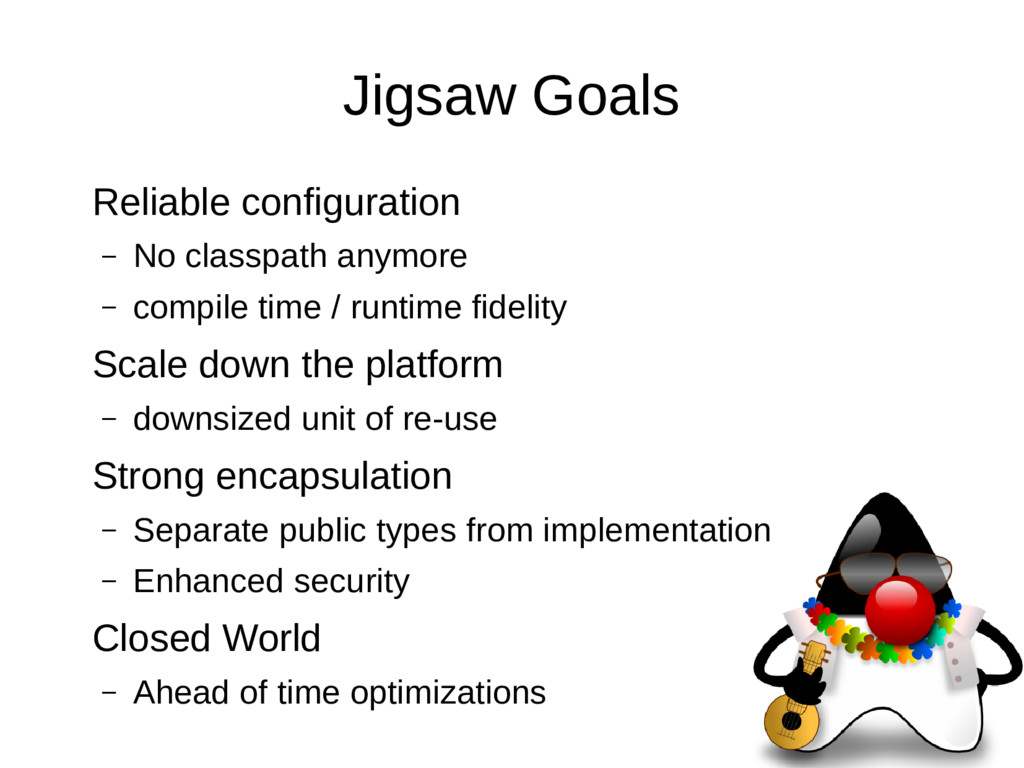
Jigsaw Goals Reliable configuration – No classpath anymore – compile
time / runtime fidelity Scale down the platform – downsized unit of re-use Strong encapsulation – Separate public types from implementation – Enhanced security Closed World – Ahead of time optimizations
 forax
 simas
 yuzneri
 kasacchiful
 giljongyu
 mtsmfm
 kosukesaigusa
 shiita0903
 leegeunhyeok
 phigasui
 itsmedreamwalker
 sodainc
 inariku
 lemiorhan
 raygrieselhuber
 helmedeiros
 denniskardys
 62gerente
 cromwellryan
 leimatthew05
 reverentgeek
 soudai
 maltzj
 tammyeverts
 kastner