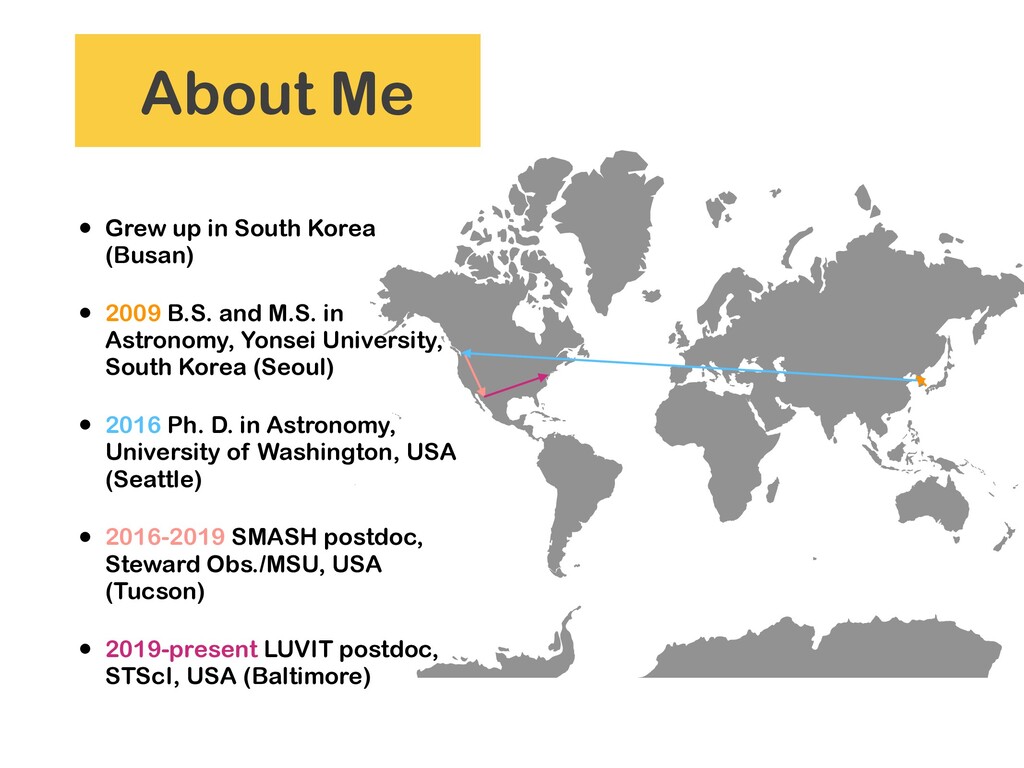
2009 B.S. and M.S. in Astronomy, Yonsei University, South Korea (Seoul) • 2016 Ph. D. in Astronomy, University of Washington, USA (Seattle) • 2016-2019 SMASH postdoc, Steward Obs./MSU, USA (Tucson) • 2019-present LUVIT postdoc, STScI, USA (Baltimore)
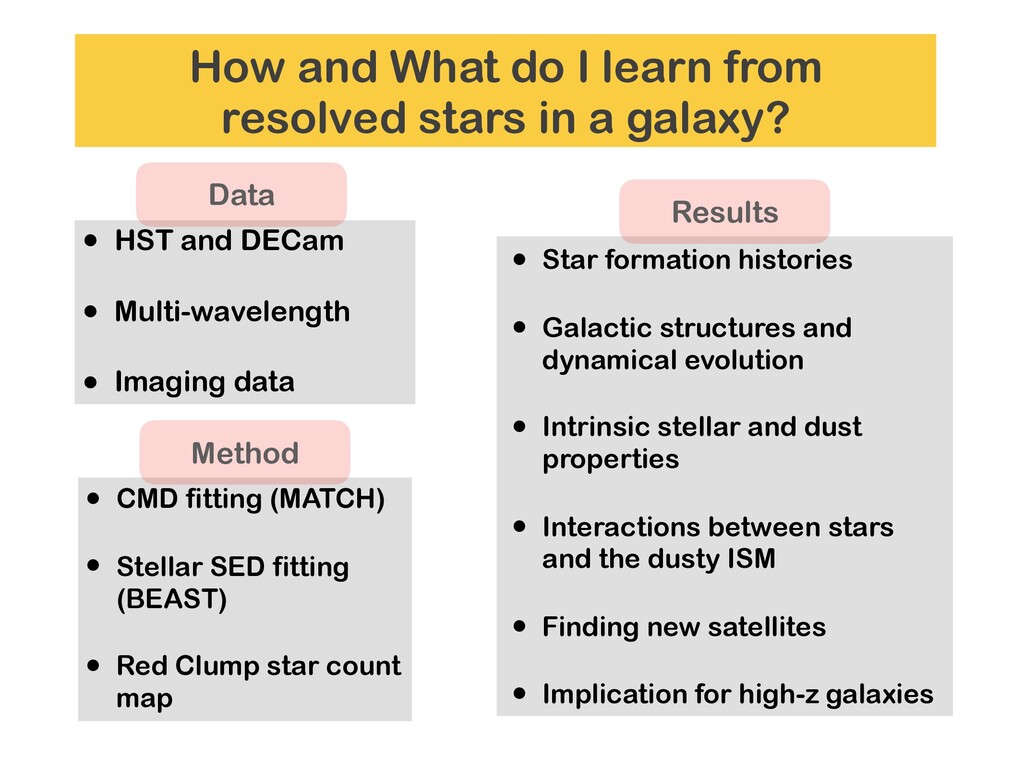
• Intrinsic stellar and dust properties • Interactions between stars and the dusty ISM • Finding new satellites • Implication for high-z galaxies How and What do I learn from resolved stars in a galaxy? • CMD fitting (MATCH) • Stellar SED fitting (BEAST) • Red Clump star count map Method Results • HST and DECam • Multi-wavelength • Imaging data Data
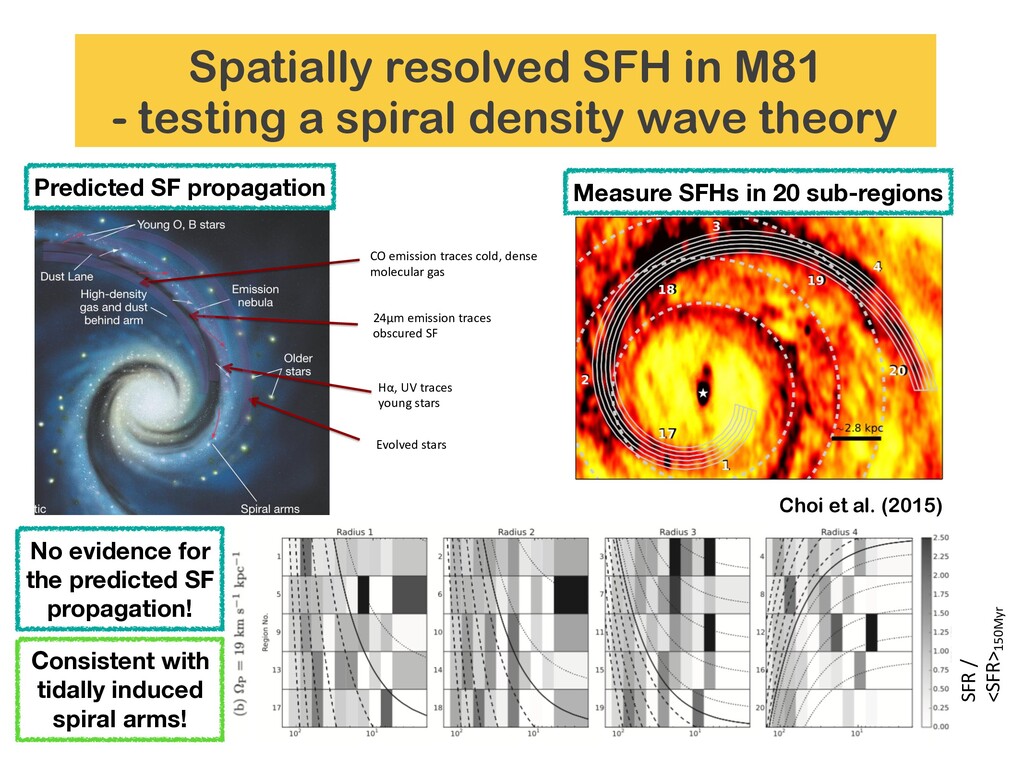
wave theory CO emission traces cold, dense molecular gas 24μm emission traces obscured SF Hα, UV traces young stars Evolved stars SFR / <SFR>150Myr Predicted SF propagation Measure SFHs in 20 sub-regions No evidence for the predicted SF propagation! Consistent with tidally induced spiral arms! Choi et al. (2015)
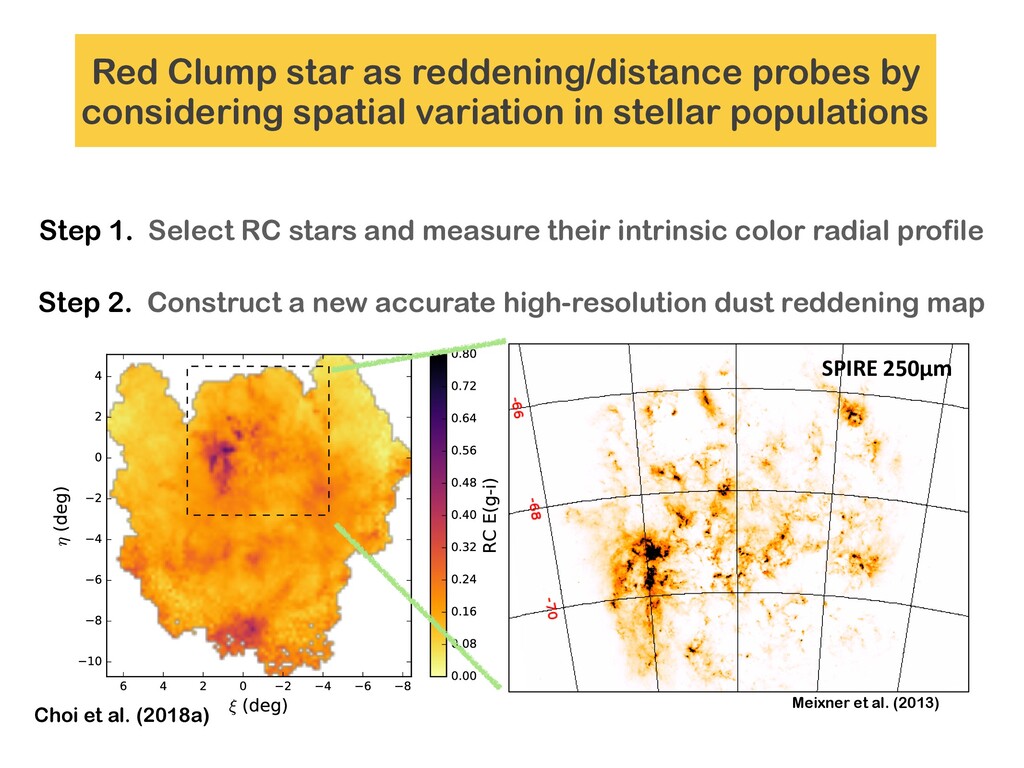
in stellar populations IRAS 100μm SPIRE 250μm Meixner et al. (2013) Step 2. Construct a new accurate high-resolution dust reddening map Step 1. Select RC stars and measure their intrinsic color radial profile Choi et al. (2018a)
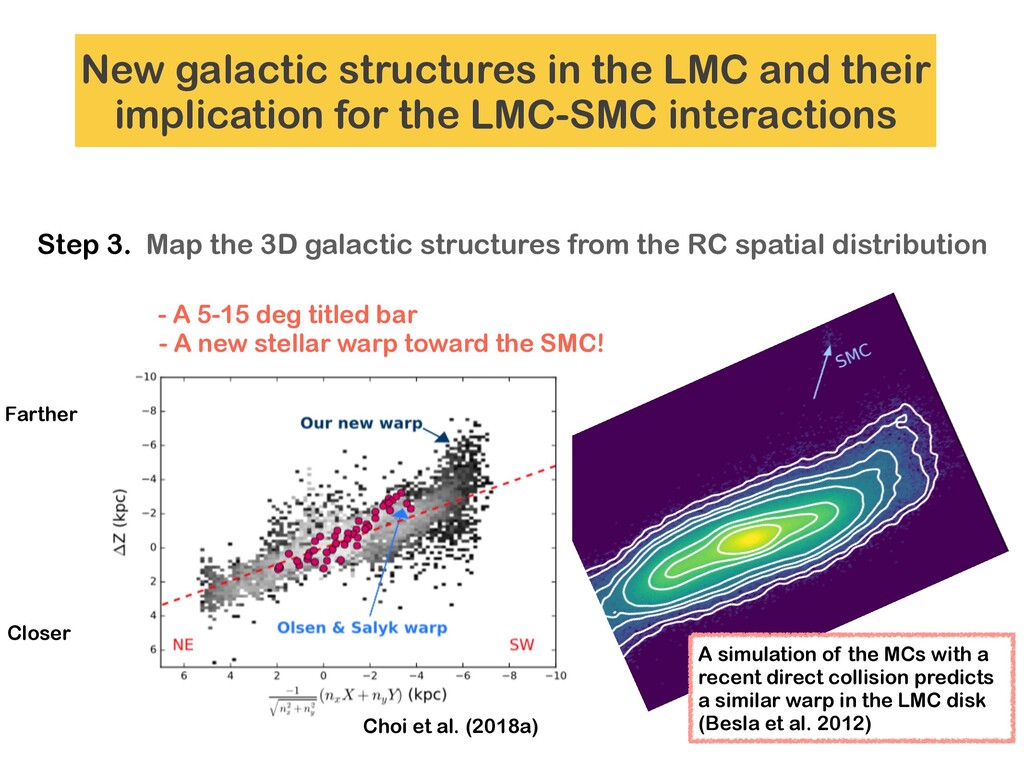
the LMC-SMC interactions A simulation of the MCs with a recent direct collision predicts a similar warp in the LMC disk (Besla et al. 2012) Closer Farther Step 3. Map the 3D galactic structures from the RC spatial distribution - A 5-15 deg titled bar - A new stellar warp toward the SMC! Choi et al. (2018a)
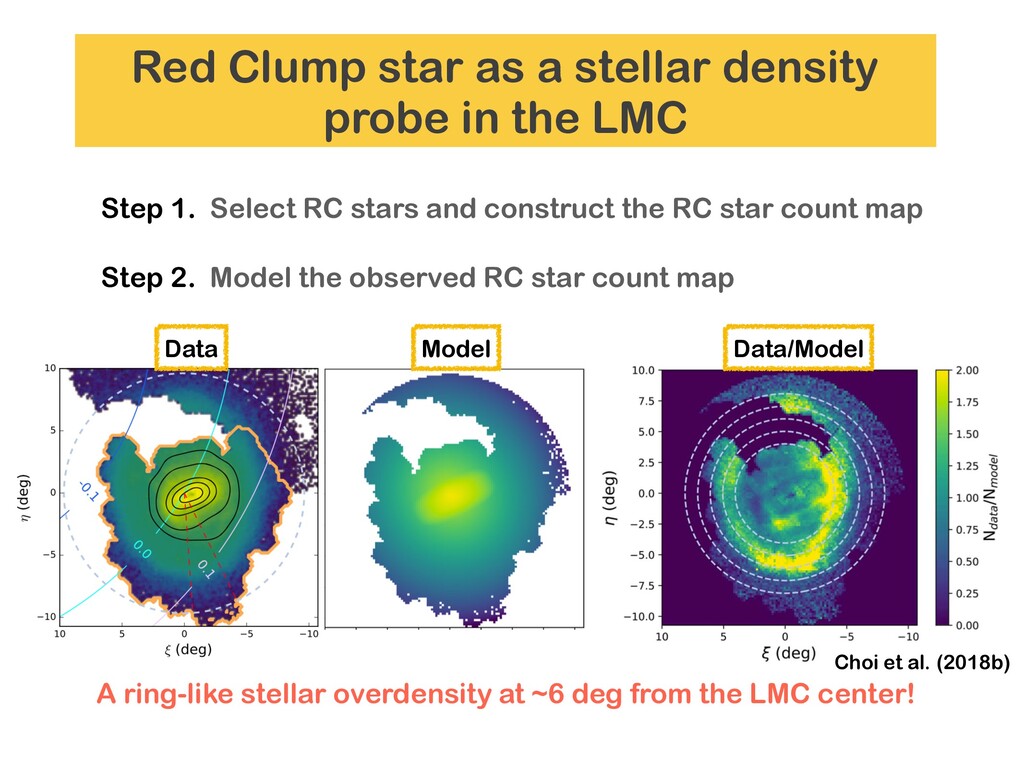
LMC Step 2. Model the observed RC star count map Step 1. Select RC stars and construct the RC star count map Data Model Data/Model A ring-like stellar overdensity at ~6 deg from the LMC center! Choi et al. (2018b)
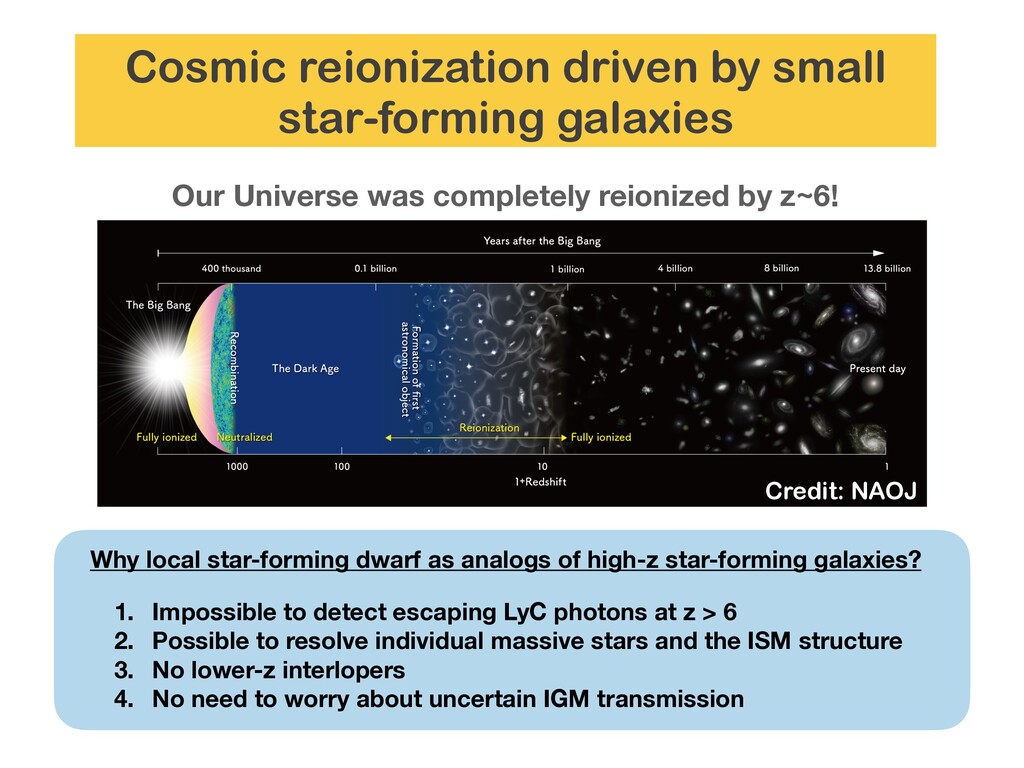
completely reionized by z~6! Credit: NAOJ Why local star-forming dwarf as analogs of high-z star-forming galaxies? 1. Impossible to detect escaping LyC photons at z > 6 2. Possible to resolve individual massive stars and the ISM structure 3. No lower-z interlopers 4. No need to worry about uncertain IGM transmission
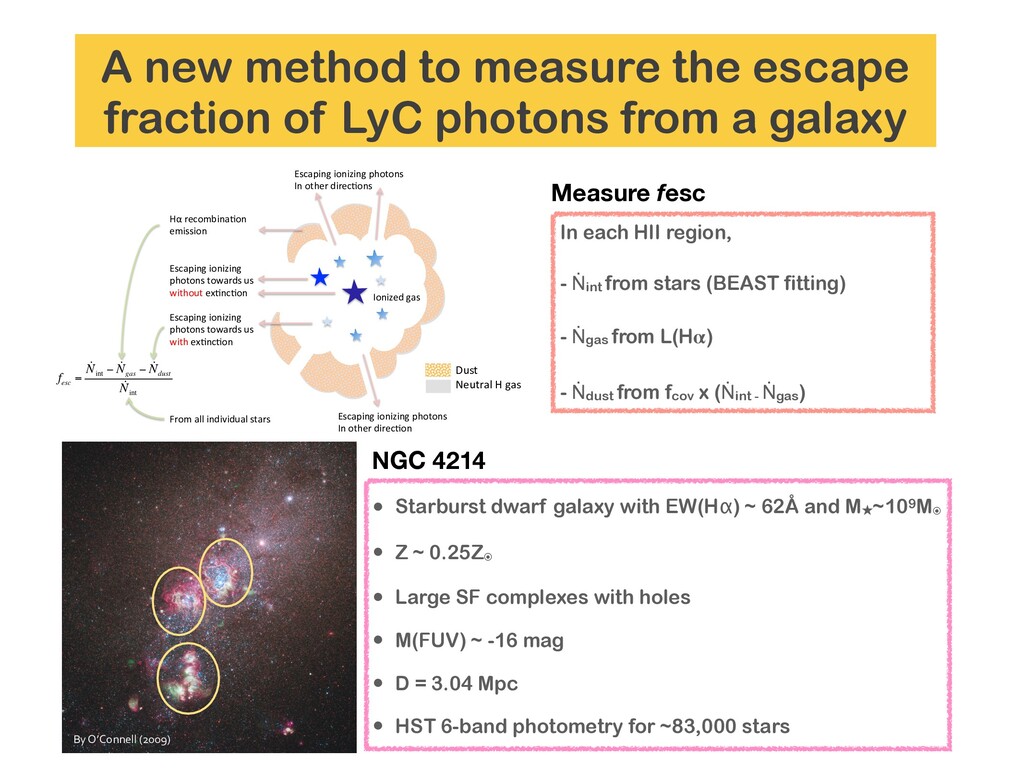
photons from a galaxy In each HII region, - Ṅint from stars (BEAST fitting) - Ṅgas from L(H) - Ṅdust from fcov x (Ṅint - Ṅgas) Dust Neutral H gas Ionized gas Escaping ionizing photons In other direc7ons Escaping ionizing photons towards us without ex7nc7on Escaping ionizing photons towards us with ex7nc7on Escaping ionizing photons In other direc7on Hα recombina7on emission f esc = ! N int − ! N gas − ! N dust ! N int From all individual stars Measure fesc By O’Connell (2009) • Starburst dwarf galaxy with EW(Hα) ~ 62Å and M ~109M⦿ • Z ~ 0.25Z⦿ • Large SF complexes with holes • M(FUV) ~ -16 mag • D = 3.04 Mpc • HST 6-band photometry for ~83,000 stars NGC 4214
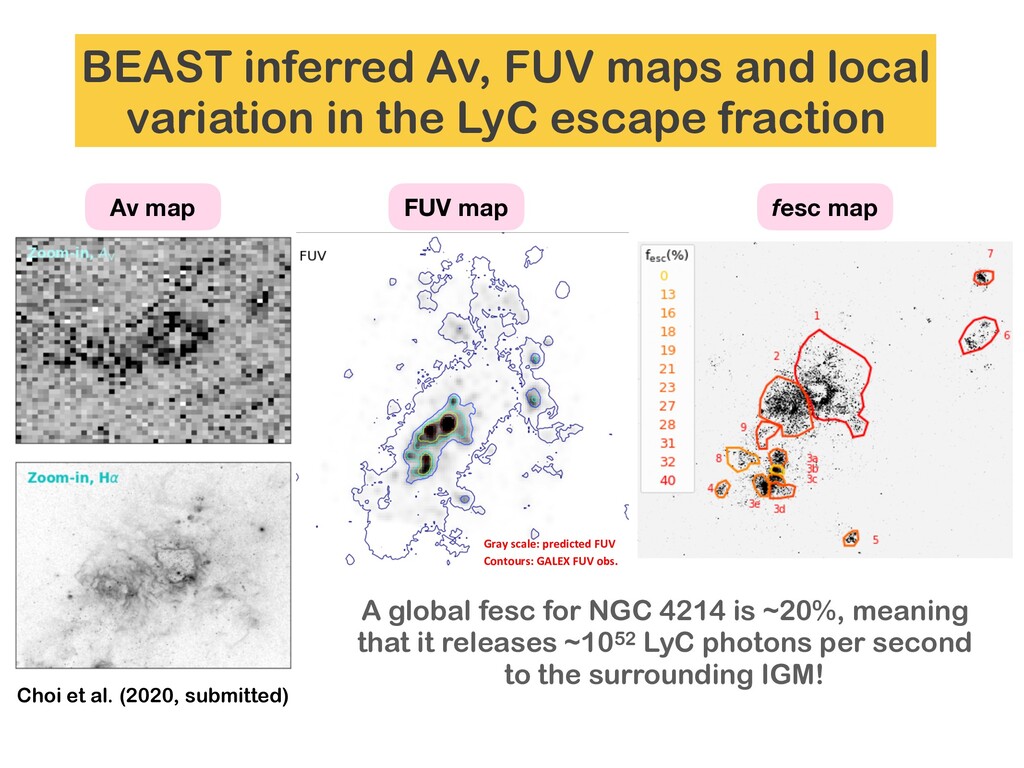
LyC escape fraction Credit: NAOJ Gray scale: predicted FUV Contours: GALEX FUV obs. Av map FUV map fesc map A global fesc for NGC 4214 is ~20%, meaning that it releases ~1052 LyC photons per second to the surrounding IGM! Choi et al. (2020, submitted)
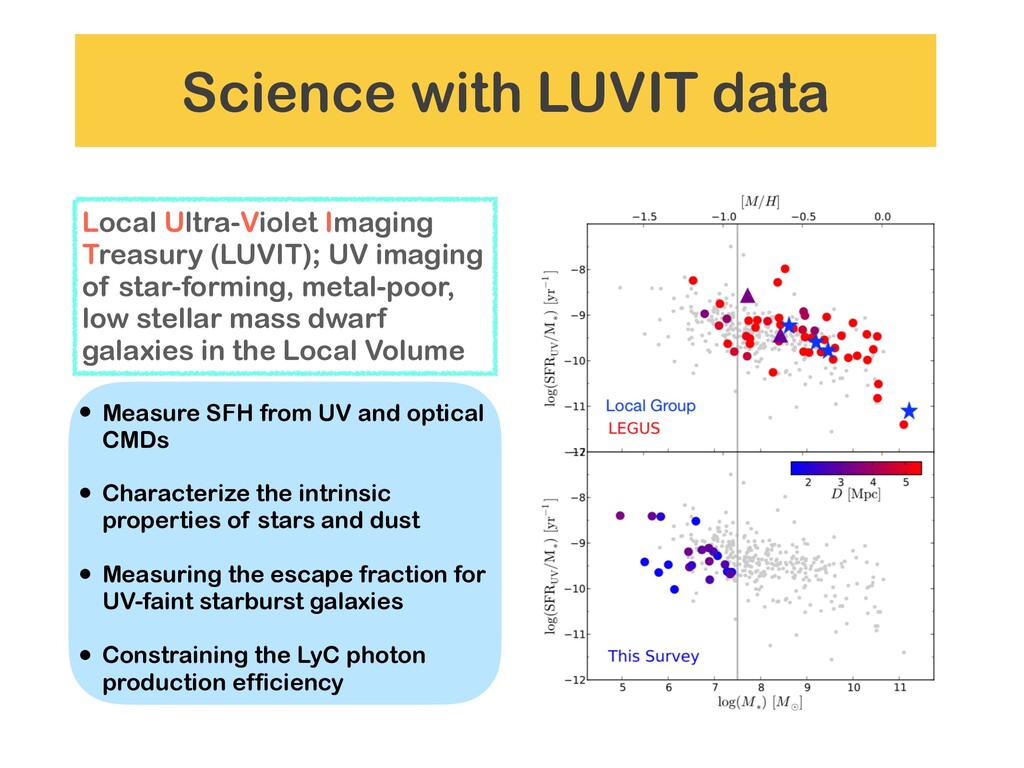
the intrinsic properties of stars and dust • Measuring the escape fraction for UV-faint starburst galaxies • Constraining the LyC photon production efficiency Science with LUVIT data Local Ultra-Violet Imaging Treasury (LUVIT); UV imaging of star-forming, metal-poor, low stellar mass dwarf galaxies in the Local Volume


 pomcho555
 ayatokanada
 institutdelelevage
 polipoli
 xspa2012
 yukiar
 kento1109
 rikkabotan7
 s_mizuki_nlp
 youten622
 enochan
 codingconduct
 ianozsvald
 jlugia
 keavy
 mraible
 tamaranovitovic
 akademiya2063
 speakerdeck
 chriscoyier
 sachag
 bryan
 hannesfritz