Upgrade to Pro — share decks privately, control downloads, hide ads and more …

20180911 Reading presentation - Contextual Stri...

Avatar for Gary Gary
September 11, 2018

20180911 Reading presentation - Contextual String Embeddings for Sequence Labeling

Alan Akbik, Duncan Blythe, and Roland Vollgraf. 2018. Contextual String Embeddings for Sequence Labeling. In proceedings of the (COLING) 2018, 27th International Conference on Computational Linguistics, pages 1638-1649.

2018/09/11
@emorynlp

Avatar for Gary

Gary

September 11, 2018

Other Decks in Programming

Transcript

  1. Gary Lai imgarylai [email protected] Contextual String Embeddings for Sequence Labeling

    2018/09/11 @emorynlp Reading Alan Akbik, Duncan Blythe, and Roland Vollgraf. 2018. Contextual String Embeddings for Sequence Labeling. In proceedings of the (COLING) 2018, 27th International Conference on Computational Linguistics, pages 1638-1649.
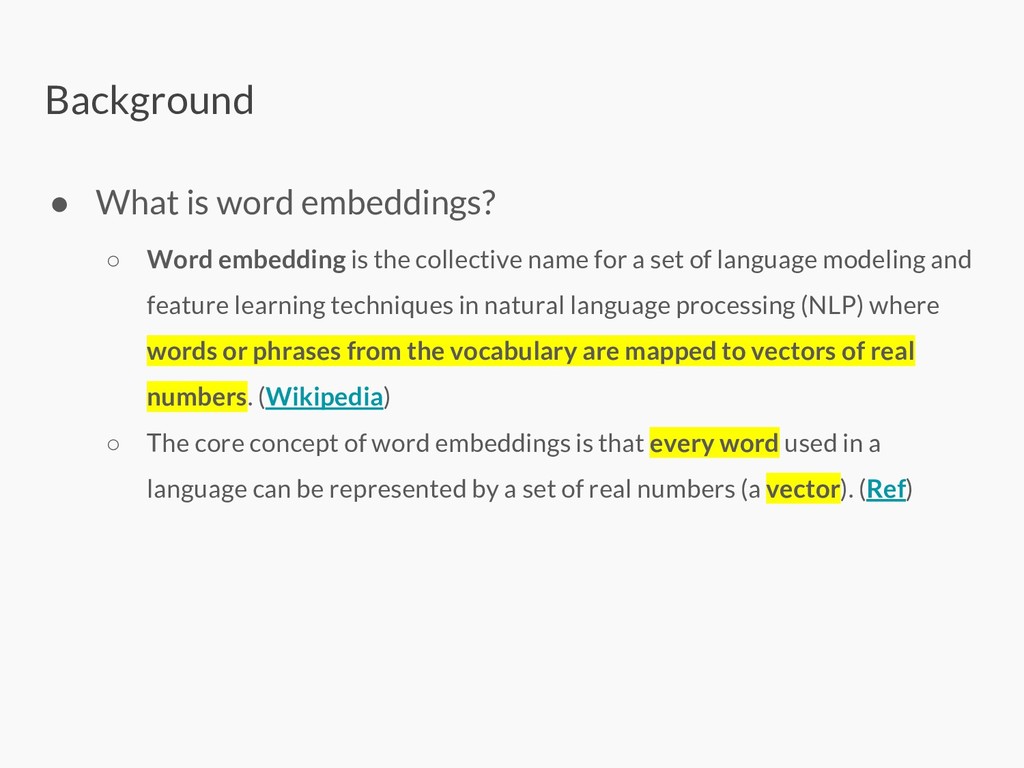
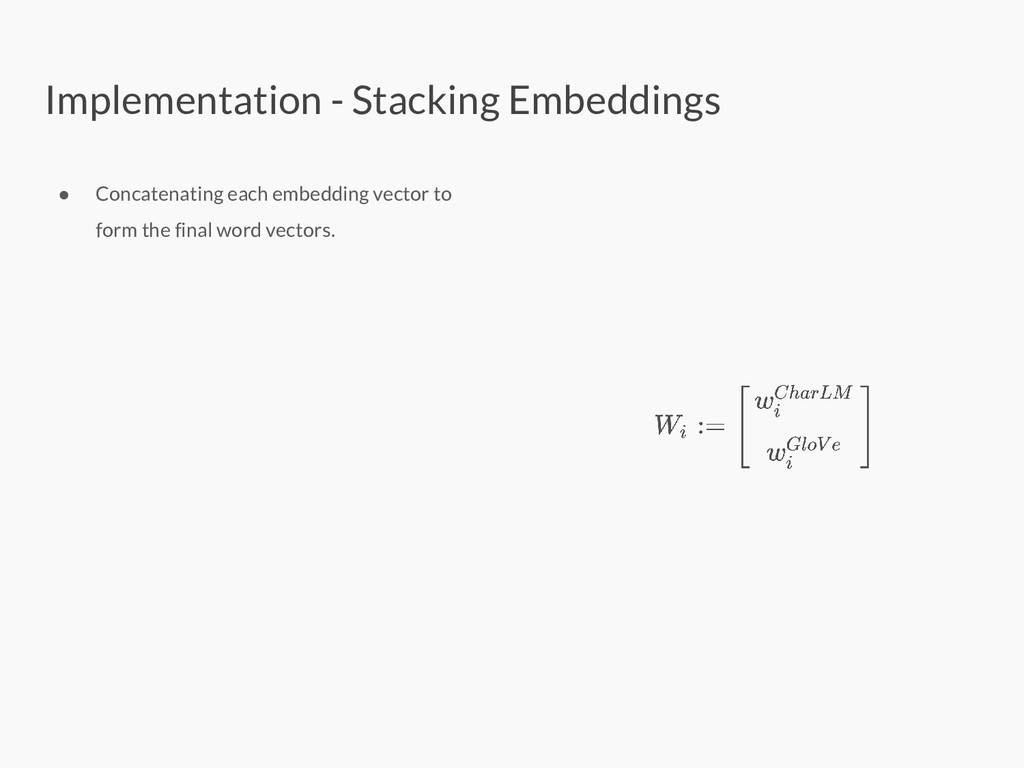
  2. Background • What is word embeddings? ◦ Word embedding is

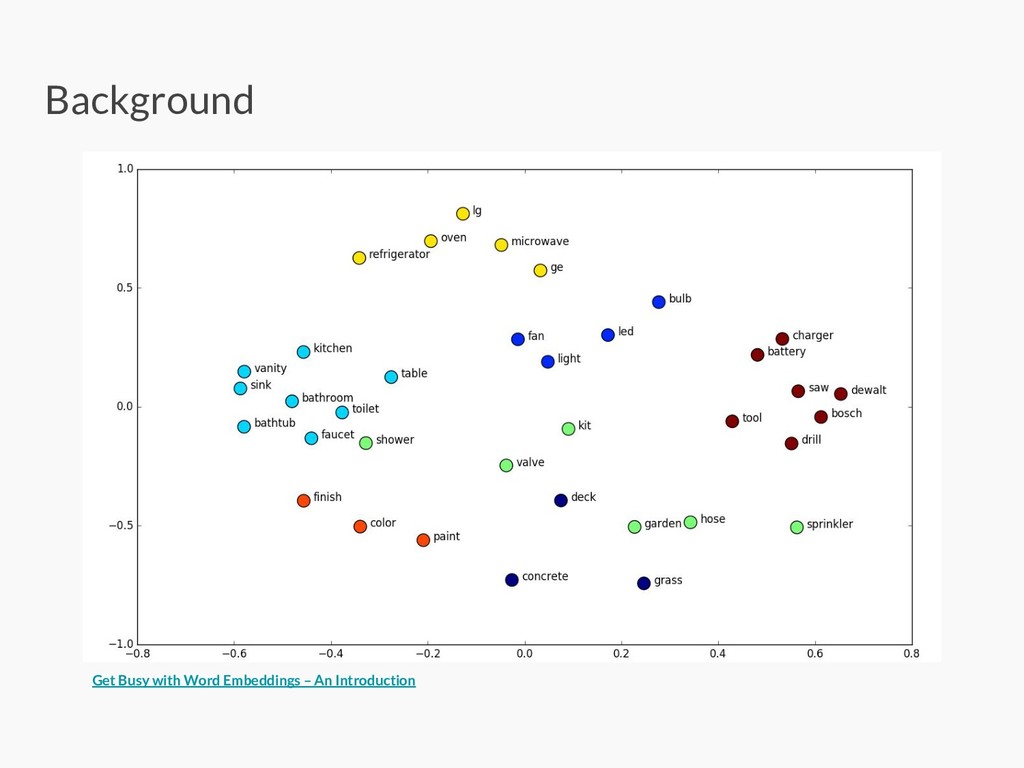
    the collective name for a set of language modeling and feature learning techniques in natural language processing (NLP) where words or phrases from the vocabulary are mapped to vectors of real numbers. (Wikipedia) ◦ The core concept of word embeddings is that every word used in a language can be represented by a set of real numbers (a vector). (Ref)
  3. Related Works • Current state-of-art word embedding model ◦ Classical

    word embeddings (Pennington et al., 2014; Mikolov et al., 2013) ▪ Pre-trained over very large corpora and shown to capture latent syntactic and semantic similarities. Ex: Glove, fastText ◦ Character-level features (Ma and Hovy, 2016; Lample et al., 2016) ▪ Which are not pre-trained, but trained on task data to capture task-specific subword features. Ex: anaGo ◦ Contextualized word embeddings (Peters et al., 2018; Peters et al., 2017) ▪ Which capture word semantics in context to address the polysemous and context-depend nature words. Ex: ELMo
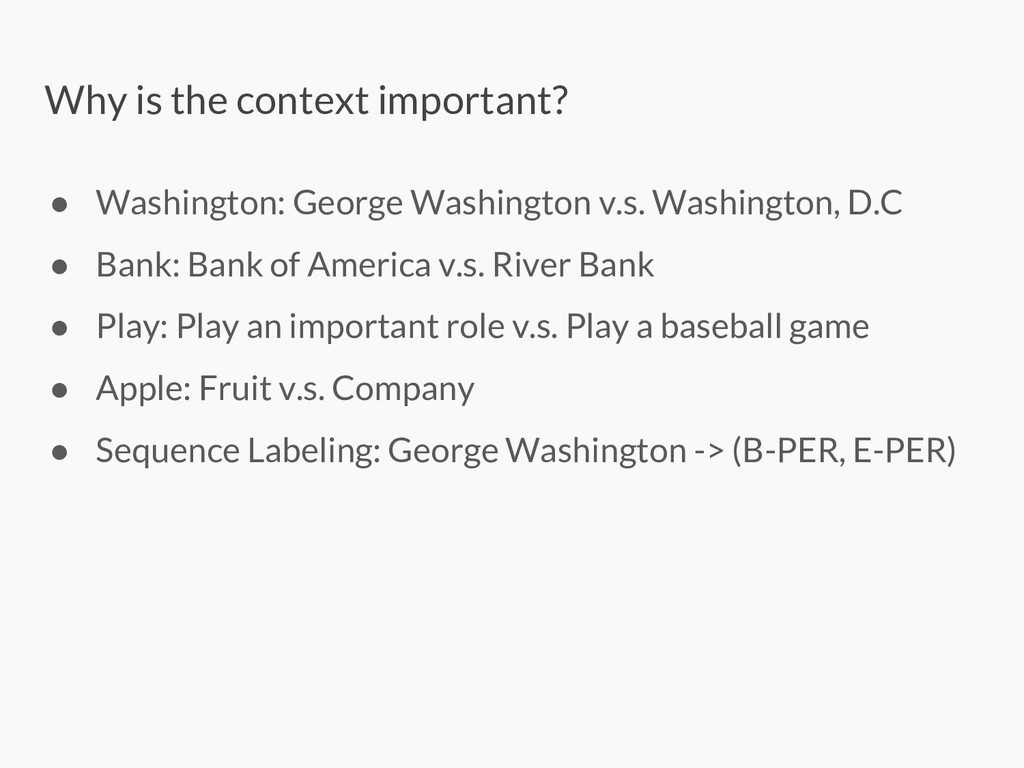
  4. Why is the context important? • Washington: George Washington v.s.

    Washington, D.C • Bank: Bank of America v.s. River Bank • Play: Play an important role v.s. Play a baseball game • Apple: Fruit v.s. Company • Sequence Labeling: George Washington -> (B-PER, E-PER)
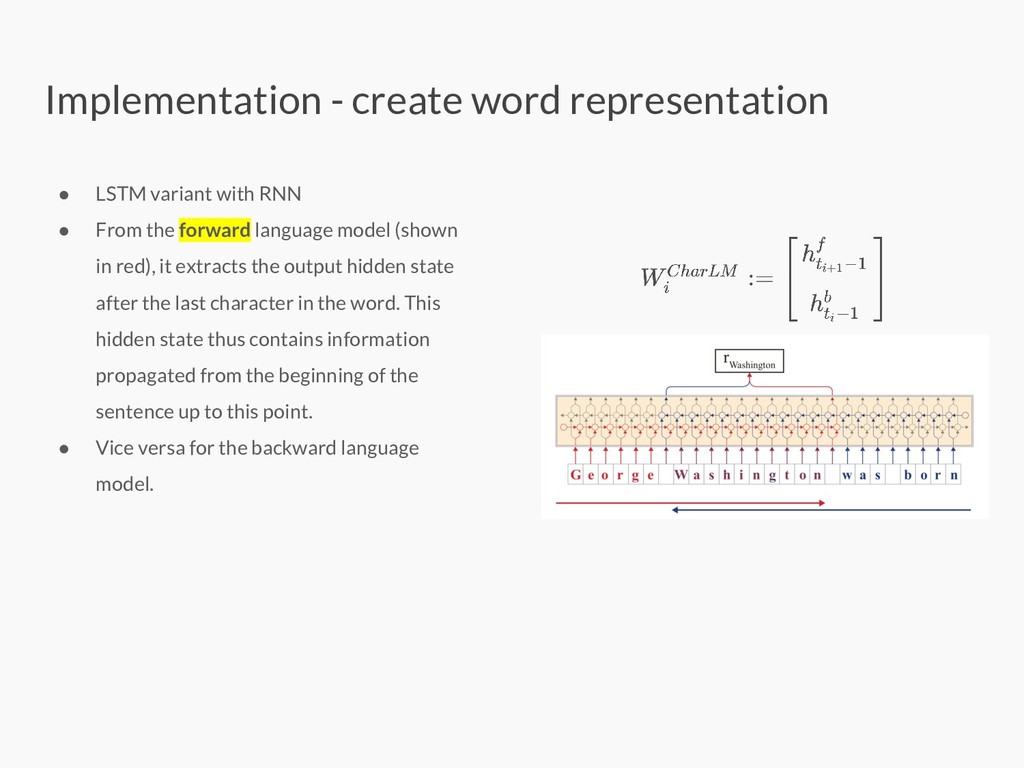
  5. Implementation - create word representation • LSTM variant with RNN

    • From the forward language model (shown in red), it extracts the output hidden state after the last character in the word. This hidden state thus contains information propagated from the beginning of the sentence up to this point. • Vice versa for the backward language model.
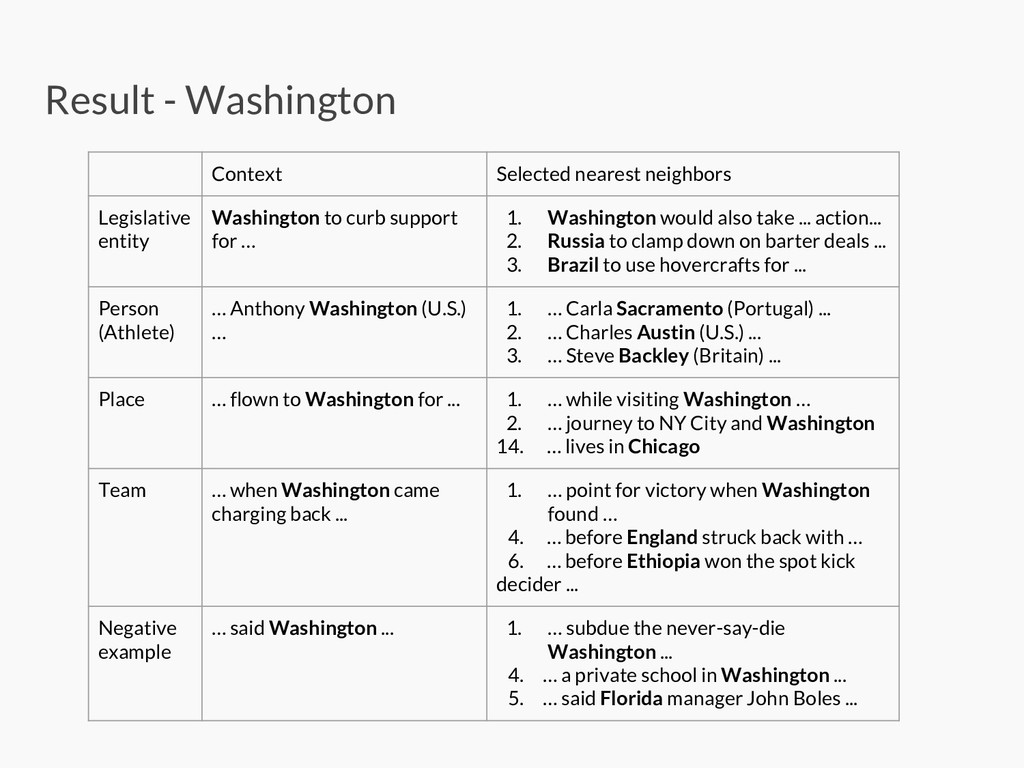
  6. Context Selected nearest neighbors Legislative entity Washington to curb support

    for … 1. Washington would also take ... action... 2. Russia to clamp down on barter deals ... 3. Brazil to use hovercrafts for ... Person (Athlete) … Anthony Washington (U.S.) … 1. … Carla Sacramento (Portugal) ... 2. … Charles Austin (U.S.) ... 3. … Steve Backley (Britain) ... Place … flown to Washington for ... 1. … while visiting Washington … 2. … journey to NY City and Washington 14. … lives in Chicago Team … when Washington came charging back ... 1. … point for victory when Washington found … 4. … before England struck back with … 6. … before Ethiopia won the spot kick decider ... Negative example … said Washington ... 1. … subdue the never-say-die Washington ... 4. … a private school in Washington ... 5. … said Florida manager John Boles ... Result - Washington
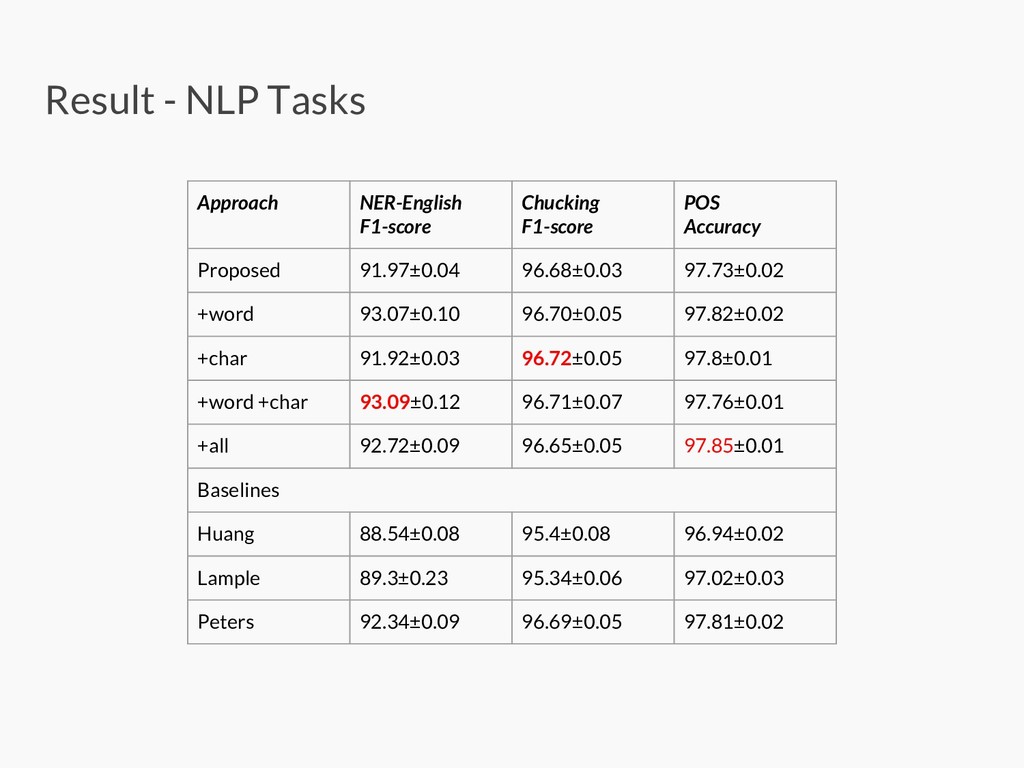
  7. Result - NLP Tasks Approach NER-English F1-score Chucking F1-score POS

    Accuracy Proposed 91.97±0.04 96.68±0.03 97.73±0.02 +word 93.07±0.10 96.70±0.05 97.82±0.02 +char 91.92±0.03 96.72±0.05 97.8±0.01 +word +char 93.09±0.12 96.71±0.07 97.76±0.01 +all 92.72±0.09 96.65±0.05 97.85±0.01 Baselines Huang 88.54±0.08 95.4±0.08 96.94±0.02 Lample 89.3±0.23 95.34±0.06 97.02±0.03 Peters 92.34±0.09 96.69±0.05 97.81±0.02
  8. Reference • Alan Akbik, Duncan Blythe, and Roland Vollgraf. 2018.

    Contextual String Embeddings for Sequence Labeling. In proceedings of the (COLING) 2018, 27th International Conference on Computational Linguistics, pages 1638-1649. • Jeffrey Pennington, Richard Socher, and Christopher Manning. 2014. Glove: Global vectors for word representation. In Proceedings of the 2014 conference on empirical methods in natural language processing (EMNLP), pages 1532–1543. • Tomas Mikolov, Ilya Sutskever, Kai Chen, Greg S Corrado, and Jeff Dean. 2013. Distributed representations of words and phrases and their compositionality. In Advances in neural information processing systems, pages 3111–3119. • Xuezhe Ma and Eduard Hovy. 2016. End-to-end sequence labeling via bi-directional LSTMs-CNNs-CRF. arXiv preprint arXiv:1603.01354. • Guillaume Lample, Miguel Ballesteros, Sandeep Subramanian, Kazuya Kawakami, and Chris Dyer. 2016. Neural architectures for named entity recognition. arXiv preprint arXiv:1603.01360. • Matthew Peters, Waleed Ammar, Chandra Bhagavatula, and Russell Power. 2017. Semi-supervised sequence tagging with bidirectional language models. In Proceedings of the 55th Annual Meeting of the Association for Computational Linguistics (Volume 1: Long Papers), pages 1756–1765, Vancouver, Canada, July. Association for Computational Linguistics. • Matthew Peters, Mark Neumann, and Christopher Clark Kenton Lee Luke Zettlemoyer Mohit Iyyer, Matt Gardner. 2018. Deep contextualized word representations. 6th International Conference on Learning Representations. • Zijun Yao, Yifan Sun, Weicong Ding, Nikhil Rao, and Hui Xiong. 2018. Dynamic Word Embeddings for Evolving Semantic Discovery. In Proceedings of the Eleventh ACM International Conference on Web Search and Data Mining (WSDM '18). ACM, New York, NY, USA, 673-681. DOI: https://doi.org/10.1145/3159652.3159703