Upgrade to Pro — share decks privately, control downloads, hide ads and more …

Creating an Effective IT Infrastructure for Cal...

Sponsored · Your Podcast. Everywhere. Effortlessly. Share. Educate. Inspire. Entertain. You do you. We'll handle the rest.
Avatar for Moun Seo Moun Seo
January 07, 2026
1

Creating an Effective IT Infrastructure for Calculating the Liquidity Coverage Ratio

Avatar for Moun Seo

Moun Seo

January 07, 2026
Tweet

Transcript

  1. Creating an effective IT infrastructure for calculating the liquidity coverage

    ratio on a daily basis Moun Seo, Associate Director, Solution Specialist, Moody’s Analytics
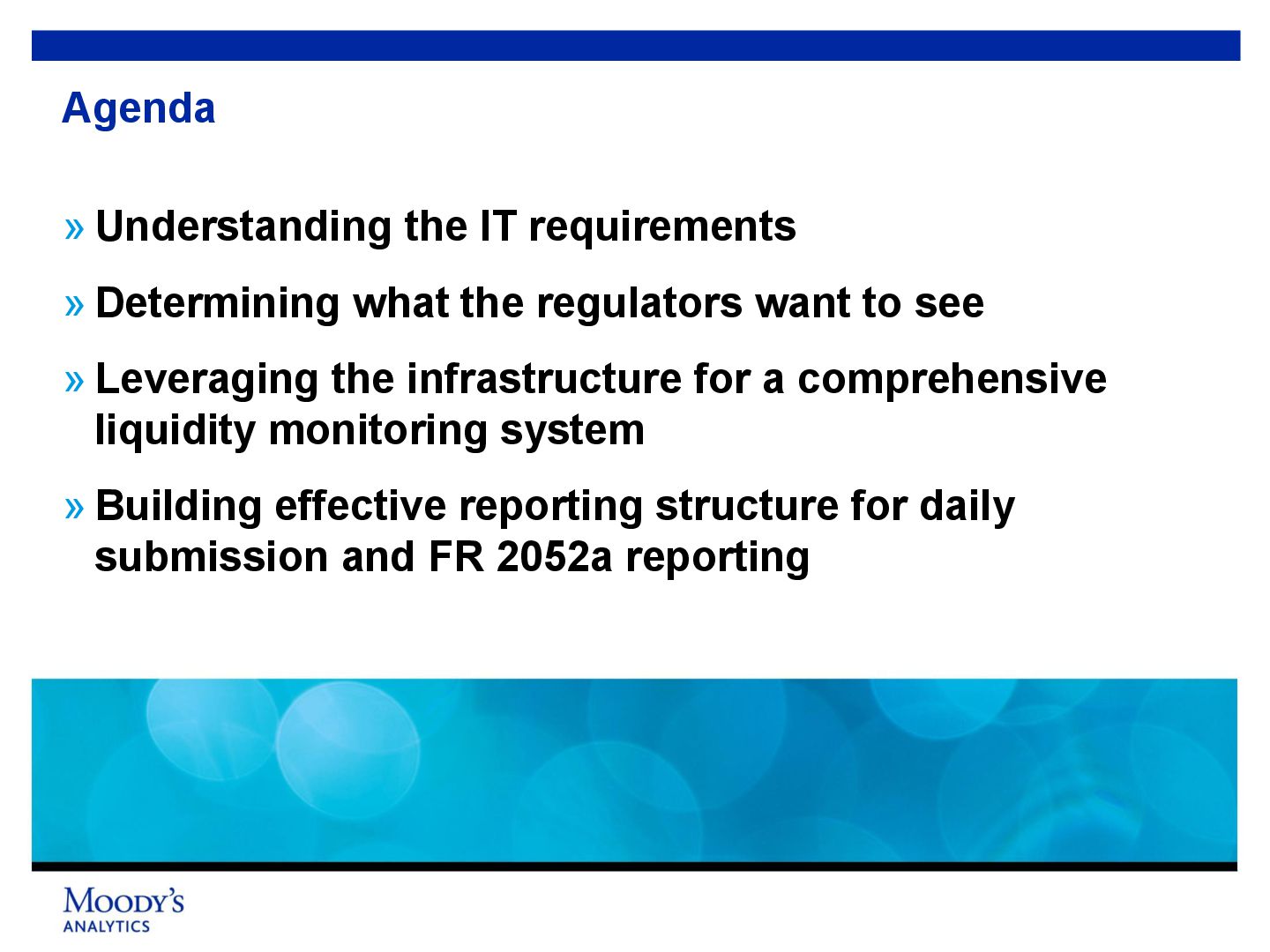
  2. Agenda » Understanding the IT requirements » Determining what the

    regulators want to see » Leveraging the infrastructure for a comprehensive liquidity monitoring system » Building effective reporting structure for daily submission and FR 2052a reporting
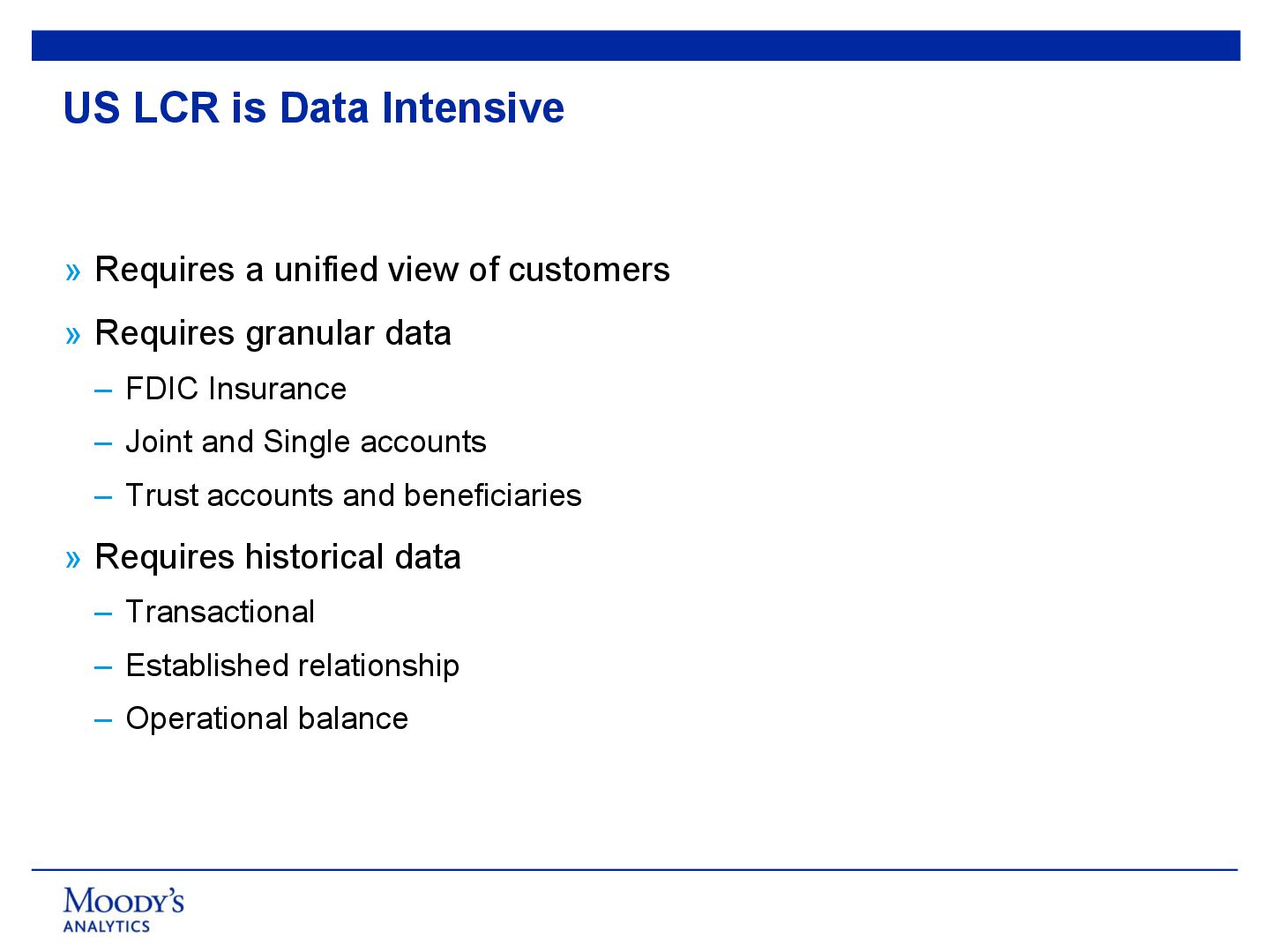
  3. US LCR is Data Intensive » Requires a unified view

    of customers » Requires granular data – FDIC Insurance – Joint and Single accounts – Trust accounts and beneficiaries » Requires historical data – Transactional – Established relationship – Operational balance
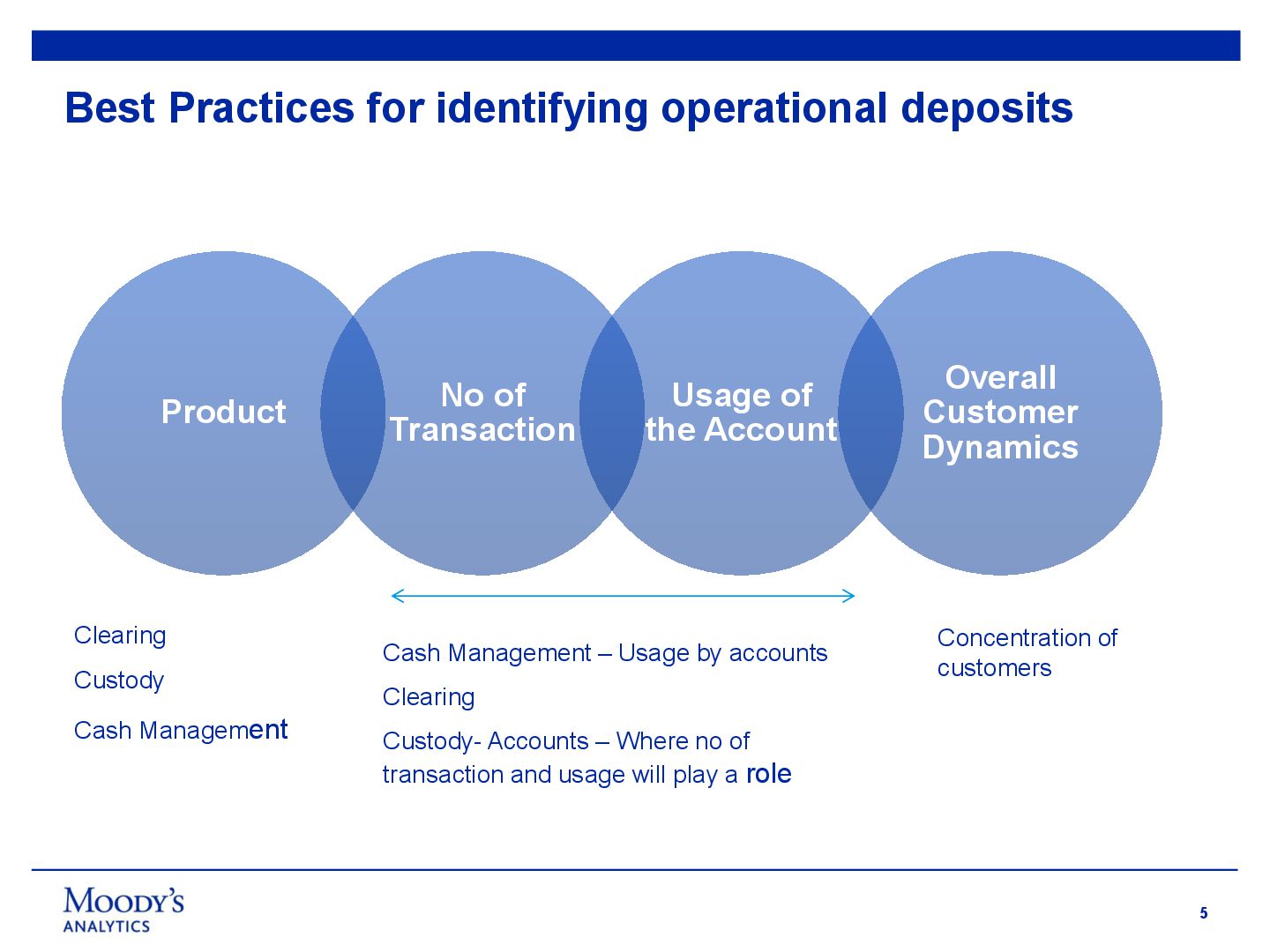
  4. 5 Best Practices for identifying operational deposits Product No of

    Transaction Usage of the Account Overall Customer Dynamics Clearing Custody Cash Management Concentration of customers Cash Management – Usage by accounts Clearing Custody- Accounts – Where no of transaction and usage will play a role
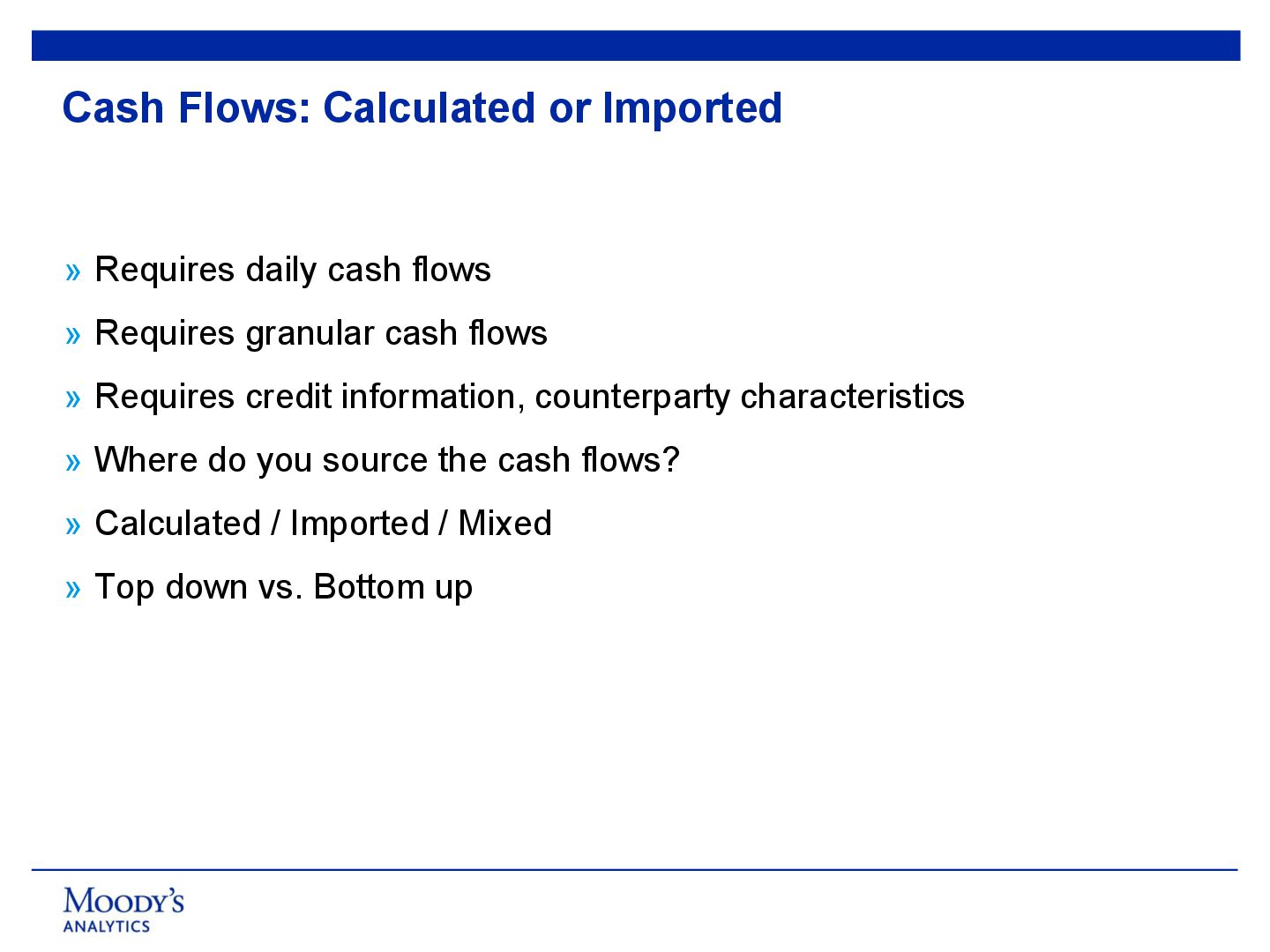
  5. Cash Flows: Calculated or Imported » Requires daily cash flows

    » Requires granular cash flows » Requires credit information, counterparty characteristics » Where do you source the cash flows? » Calculated / Imported / Mixed » Top down vs. Bottom up
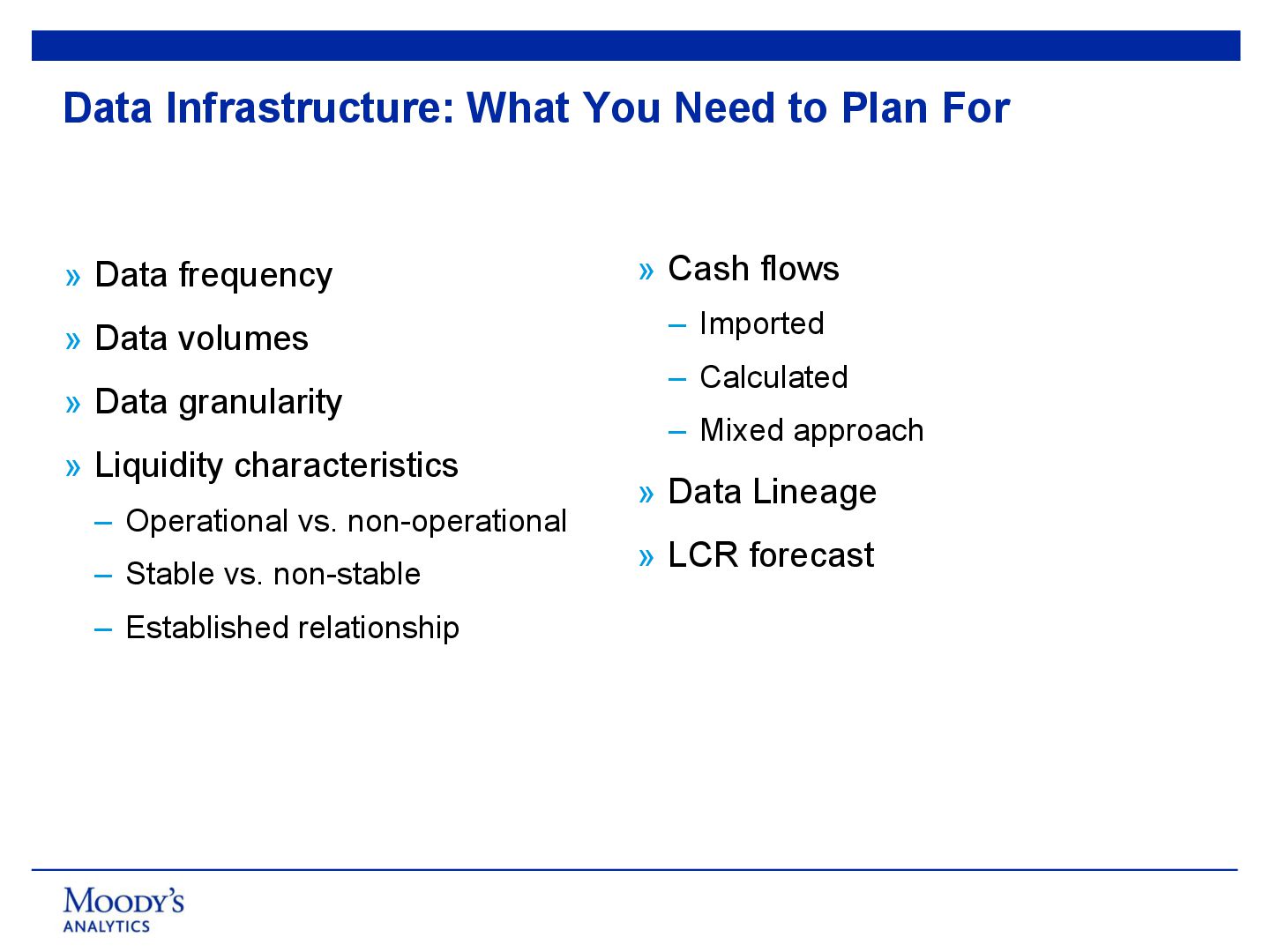
  6. Data Infrastructure: What You Need to Plan For » Data

    frequency » Data volumes » Data granularity » Liquidity characteristics – Operational vs. non-operational – Stable vs. non-stable – Established relationship » Cash flows – Imported – Calculated – Mixed approach » Data Lineage » LCR forecast
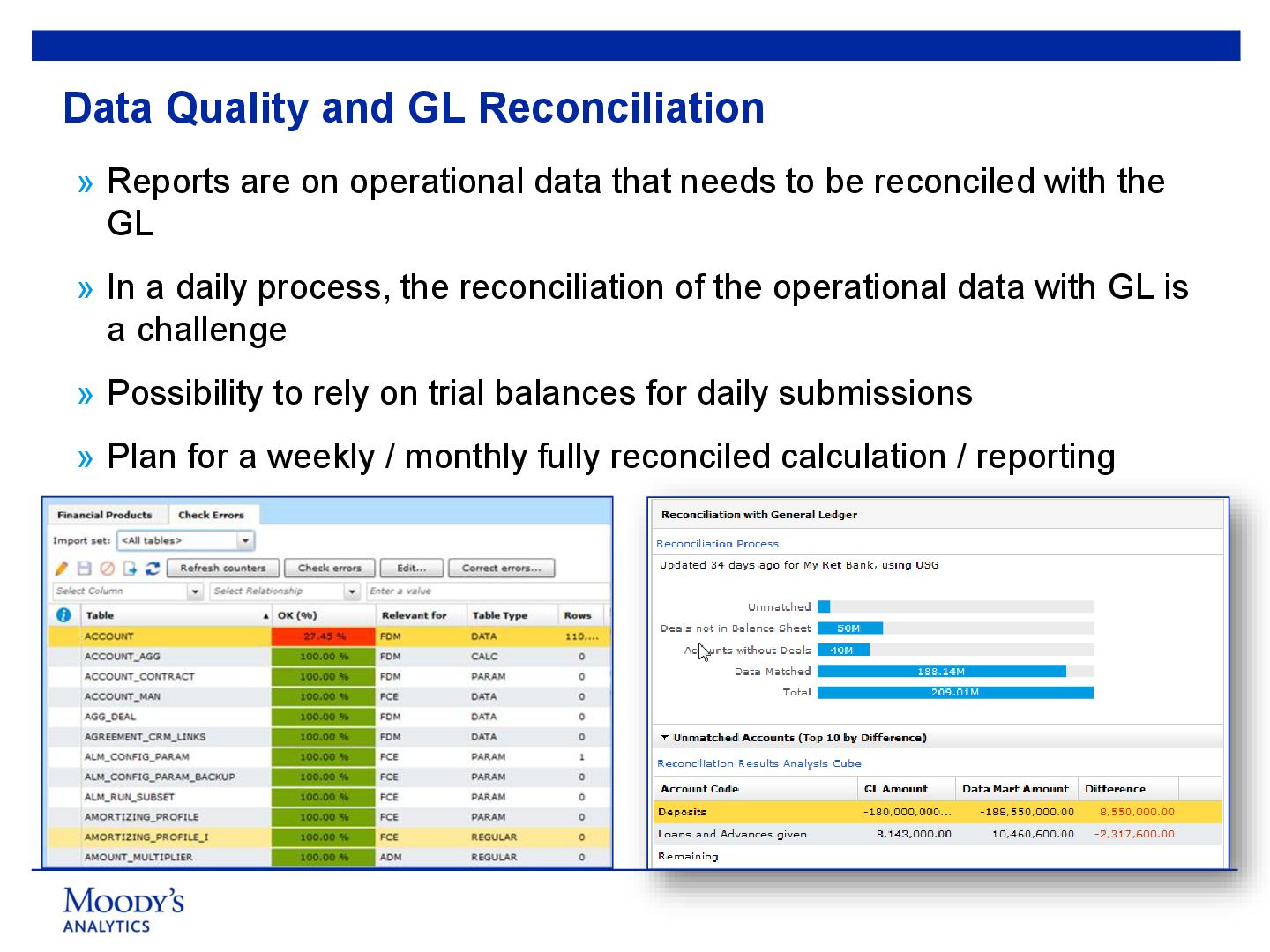
  7. » Reports are on operational data that needs to be

    reconciled with the GL » In a daily process, the reconciliation of the operational data with GL is a challenge » Possibility to rely on trial balances for daily submissions » Plan for a weekly / monthly fully reconciled calculation / reporting Data Quality and GL Reconciliation
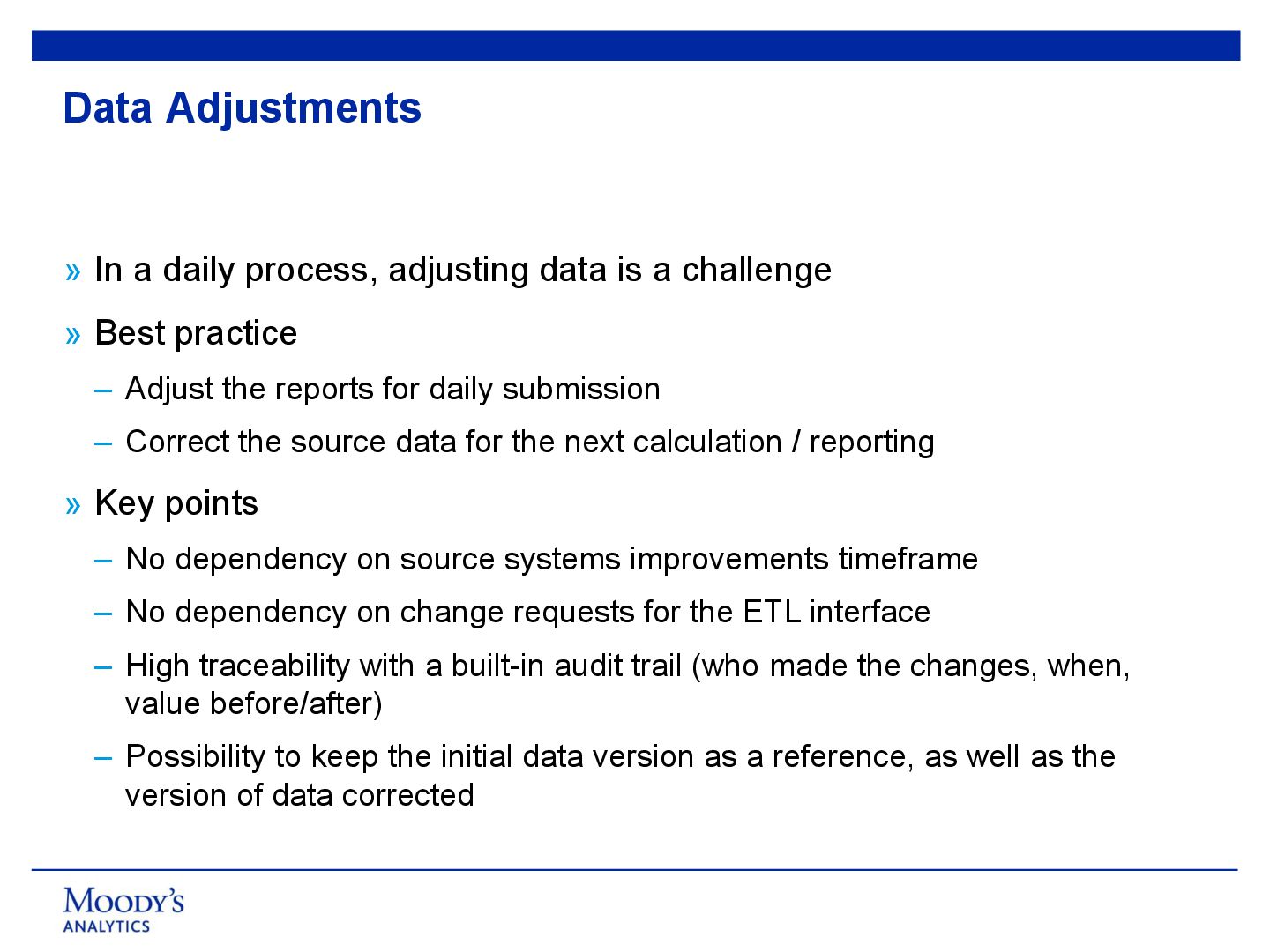
  8. Data Adjustments » In a daily process, adjusting data is

    a challenge » Best practice – Adjust the reports for daily submission – Correct the source data for the next calculation / reporting » Key points – No dependency on source systems improvements timeframe – No dependency on change requests for the ETL interface – High traceability with a built-in audit trail (who made the changes, when, value before/after) – Possibility to keep the initial data version as a reference, as well as the version of data corrected
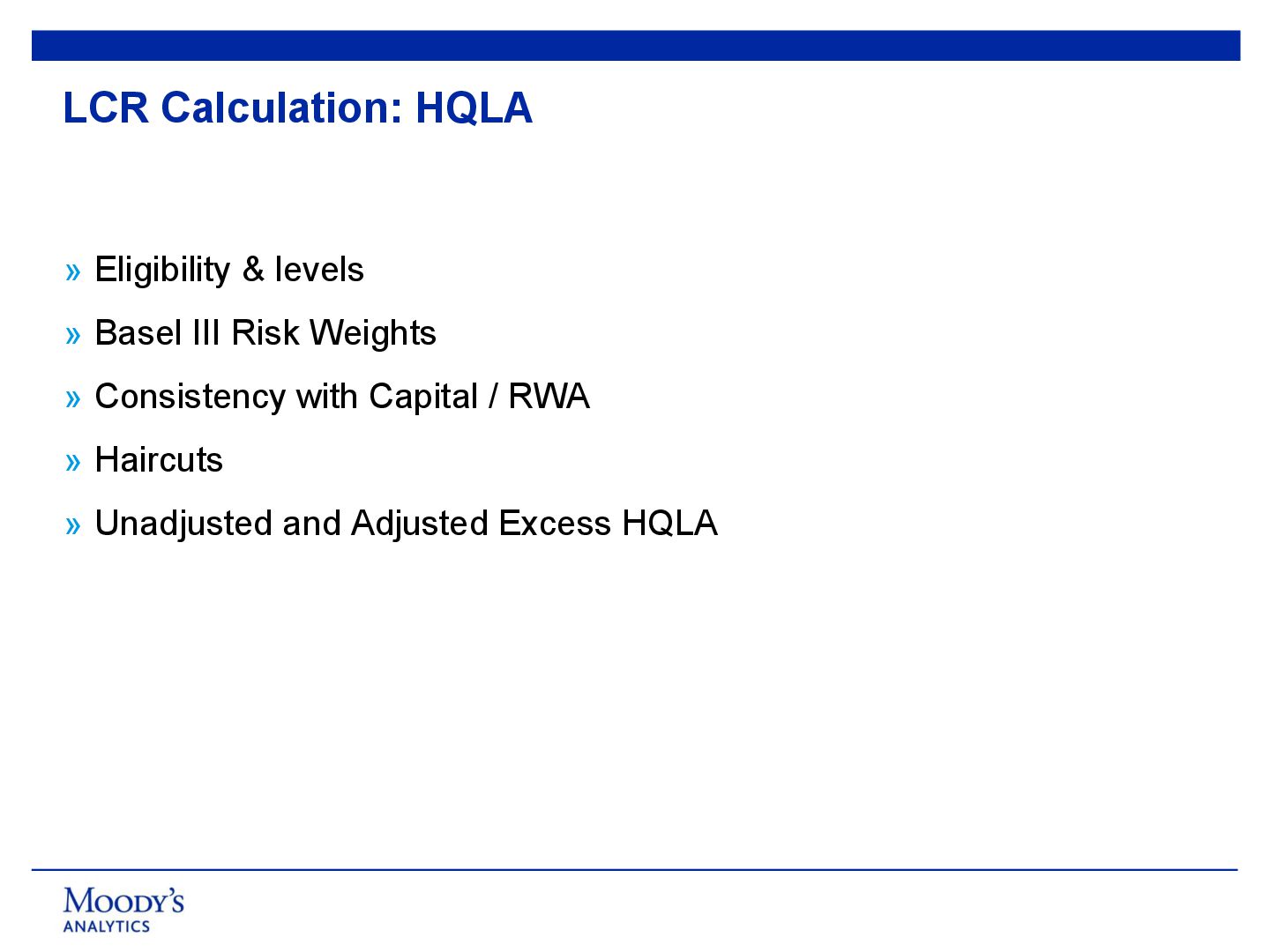
  9. LCR Calculation: HQLA » Eligibility & levels » Basel III

    Risk Weights » Consistency with Capital / RWA » Haircuts » Unadjusted and Adjusted Excess HQLA
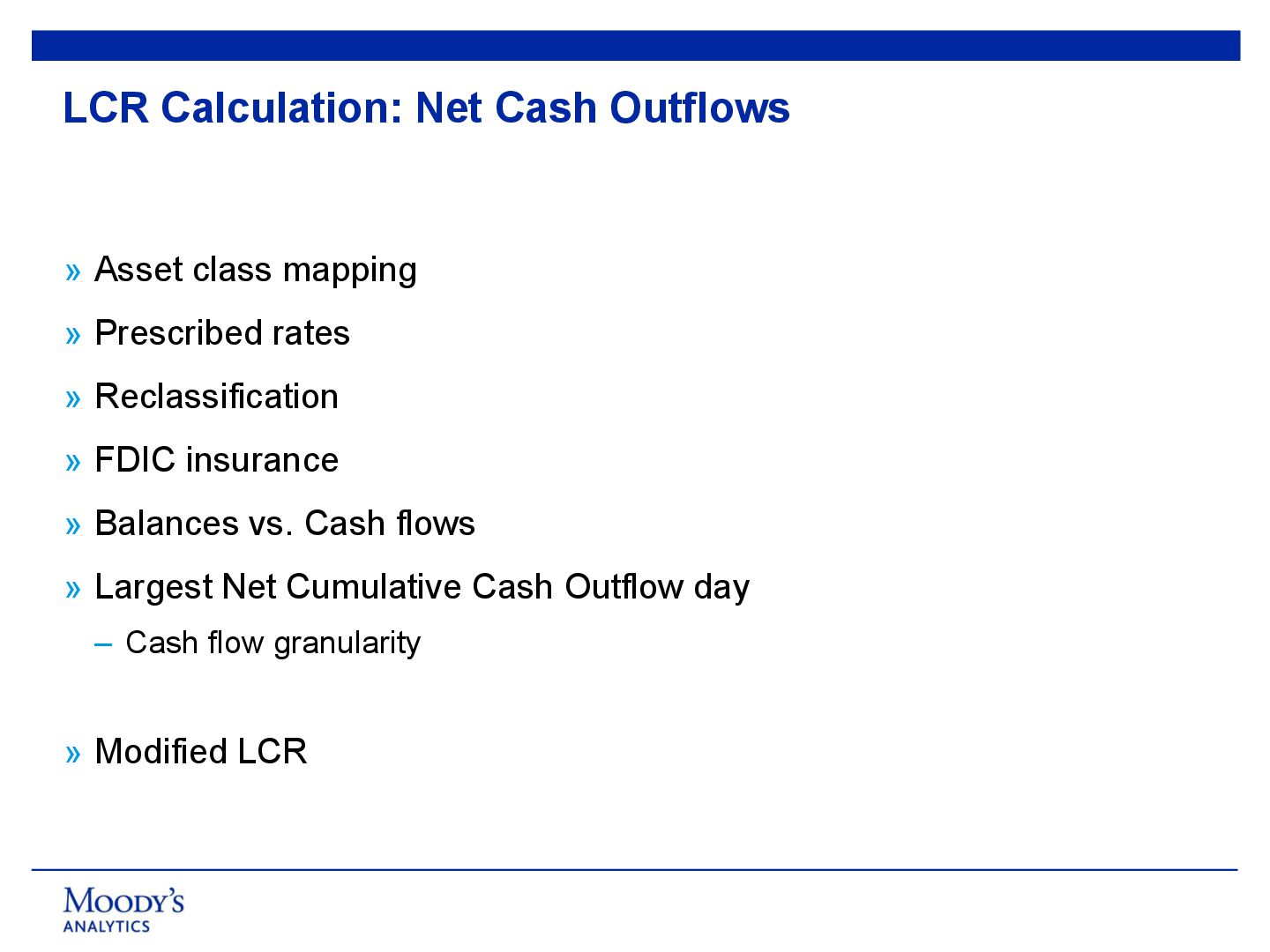
  10. LCR Calculation: Net Cash Outflows » Asset class mapping »

    Prescribed rates » Reclassification » FDIC insurance » Balances vs. Cash flows » Largest Net Cumulative Cash Outflow day – Cash flow granularity » Modified LCR
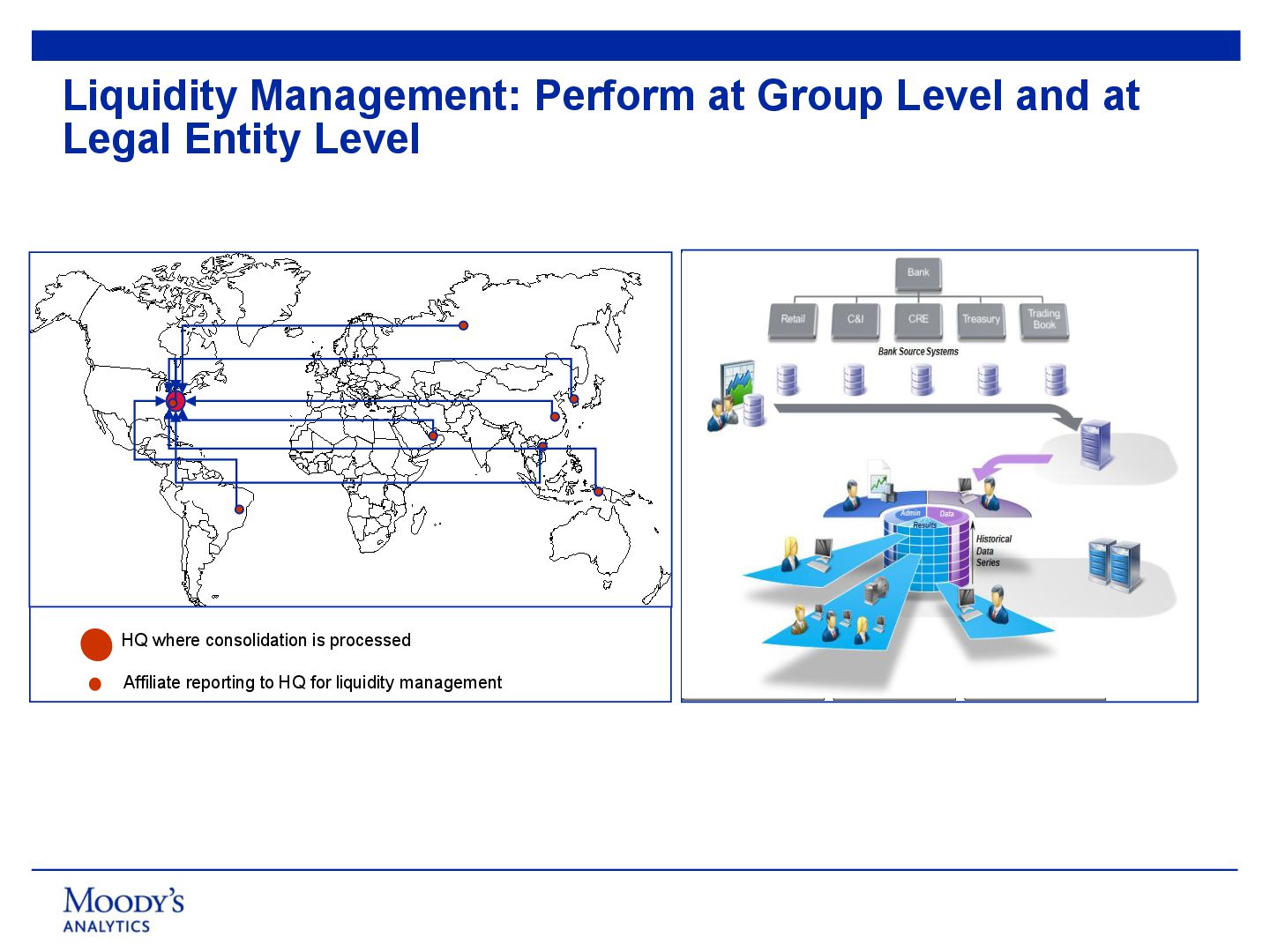
  11. Operational Data System Administration 2005-03-09 2005-02-06 2005-01-05 ... ... Historical

    Data FERMAT DATAMART FERMAT Calculation Servers Subs 1 Group Subs 2 Parameters & Results Source 1 Source 2 Source N Fermat T&L Data loader Data validation & adjustments : Edit & correct errors Integrity Checks Consistency Controls GL Reconciliation AUDIT Trail W orkspace 2 Subsidiary Audit on past calculation 2005-01-05 W orkspace N Subsidiary Calculation for Host supervisor 2005-03-09 Workspace 1 Group calculation Home supervisor 2005-02-06 Liquidity Management: Perform at Group Level and at Legal Entity Level HQ where consolidation is processed Affiliate reporting to HQ for liquidity management
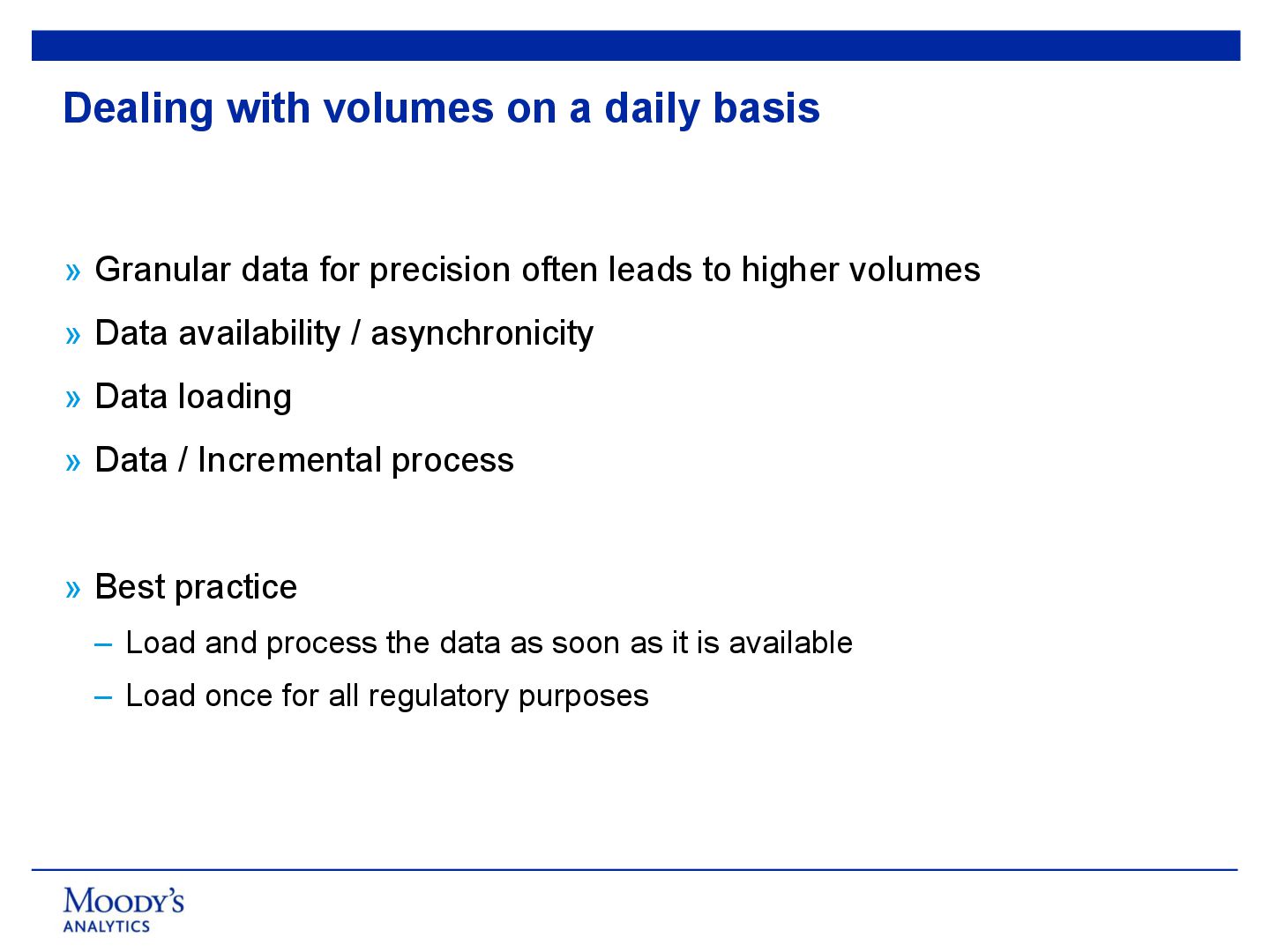
  12. Dealing with volumes on a daily basis » Granular data

    for precision often leads to higher volumes » Data availability / asynchronicity » Data loading » Data / Incremental process » Best practice – Load and process the data as soon as it is available – Load once for all regulatory purposes
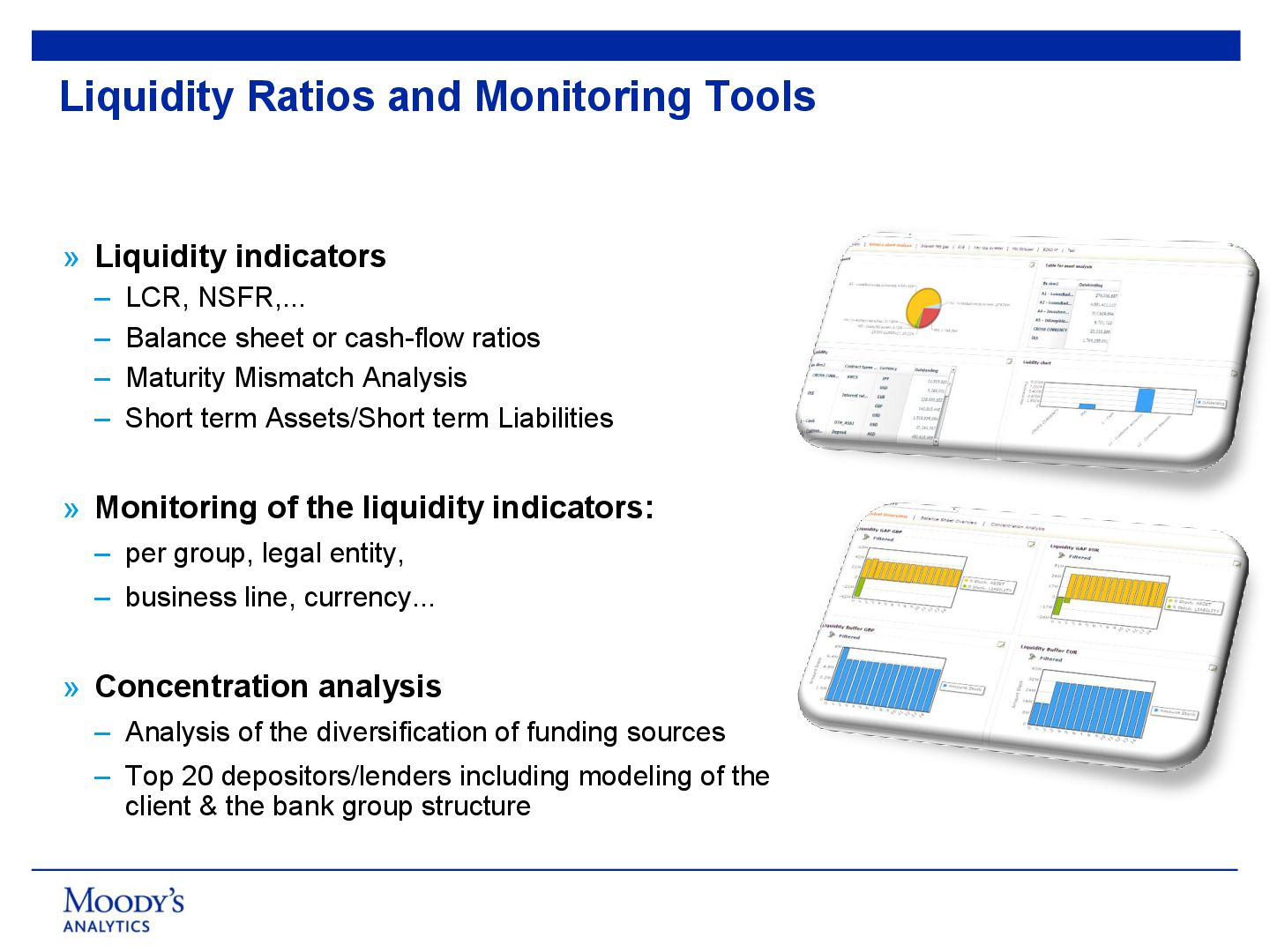
  13. Liquidity Ratios and Monitoring Tools » Liquidity indicators – LCR,

    NSFR,... – Balance sheet or cash-flow ratios – Maturity Mismatch Analysis – Short term Assets/Short term Liabilities » Monitoring of the liquidity indicators: – per group, legal entity, – business line, currency... » Concentration analysis – Analysis of the diversification of funding sources – Top 20 depositors/lenders including modeling of the client & the bank group structure 14
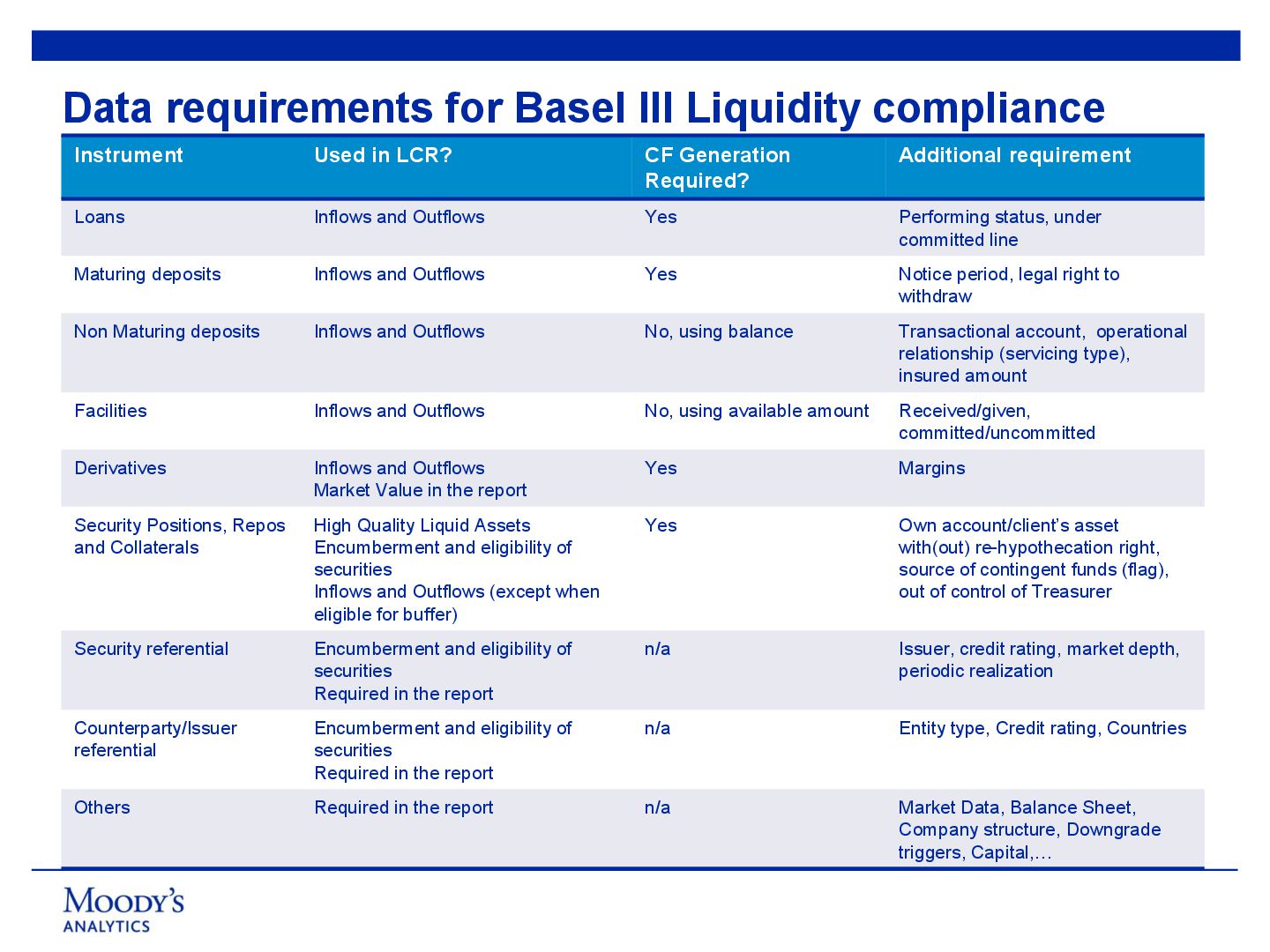
  14. Data requirements for Basel III Liquidity compliance Instrument Used in

    LCR? CF Generation Required? Additional requirement Loans Inflows and Outflows Yes Performing status, under committed line Maturing deposits Inflows and Outflows Yes Notice period, legal right to withdraw Non Maturing deposits Inflows and Outflows No, using balance Transactional account, operational relationship (servicing type), insured amount Facilities Inflows and Outflows No, using available amount Received/given, committed/uncommitted Derivatives Inflows and Outflows Market Value in the report Yes Margins Security Positions, Repos and Collaterals High Quality Liquid Assets Encumberment and eligibility of securities Inflows and Outflows (except when eligible for buffer) Yes Own account/client’s asset with(out) re-hypothecation right, source of contingent funds (flag), out of control of Treasurer Security referential Encumberment and eligibility of securities Required in the report n/a Issuer, credit rating, market depth, periodic realization Counterparty/Issuer referential Encumberment and eligibility of securities Required in the report n/a Entity type, Credit rating, Countries Others Required in the report n/a Market Data, Balance Sheet, Company structure, Downgrade triggers, Capital,…
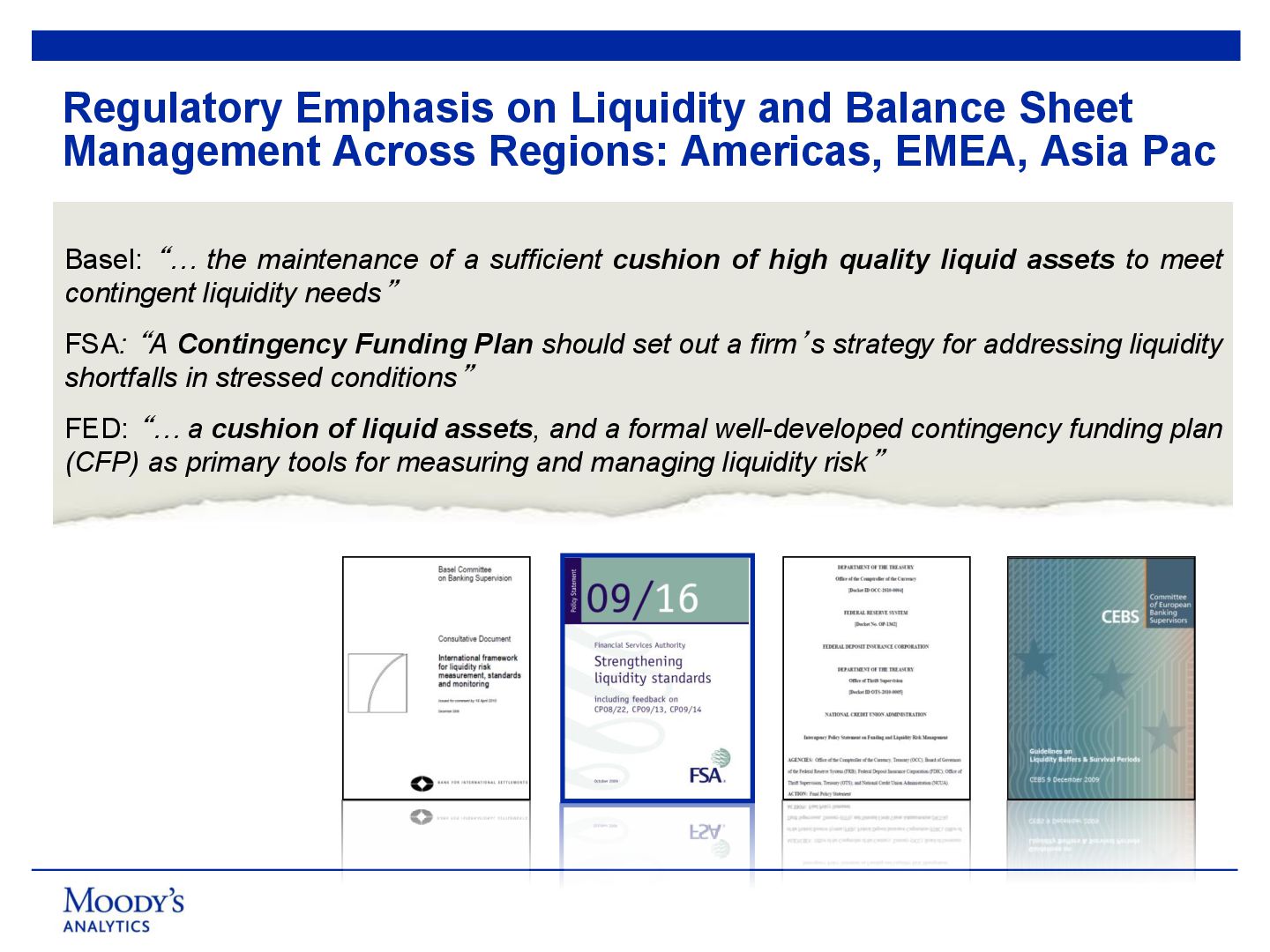
  15. Regulatory Emphasis on Liquidity and Balance Sheet Management Across Regions:

    Americas, EMEA, Asia Pac Basel: “… the maintenance of a sufficient cushion of high quality liquid assets to meet contingent liquidity needs” FSA: “A Contingency Funding Plan should set out a firm’s strategy for addressing liquidity shortfalls in stressed conditions” FED: “… a cushion of liquid assets, and a formal well-developed contingency funding plan (CFP) as primary tools for measuring and managing liquidity risk”
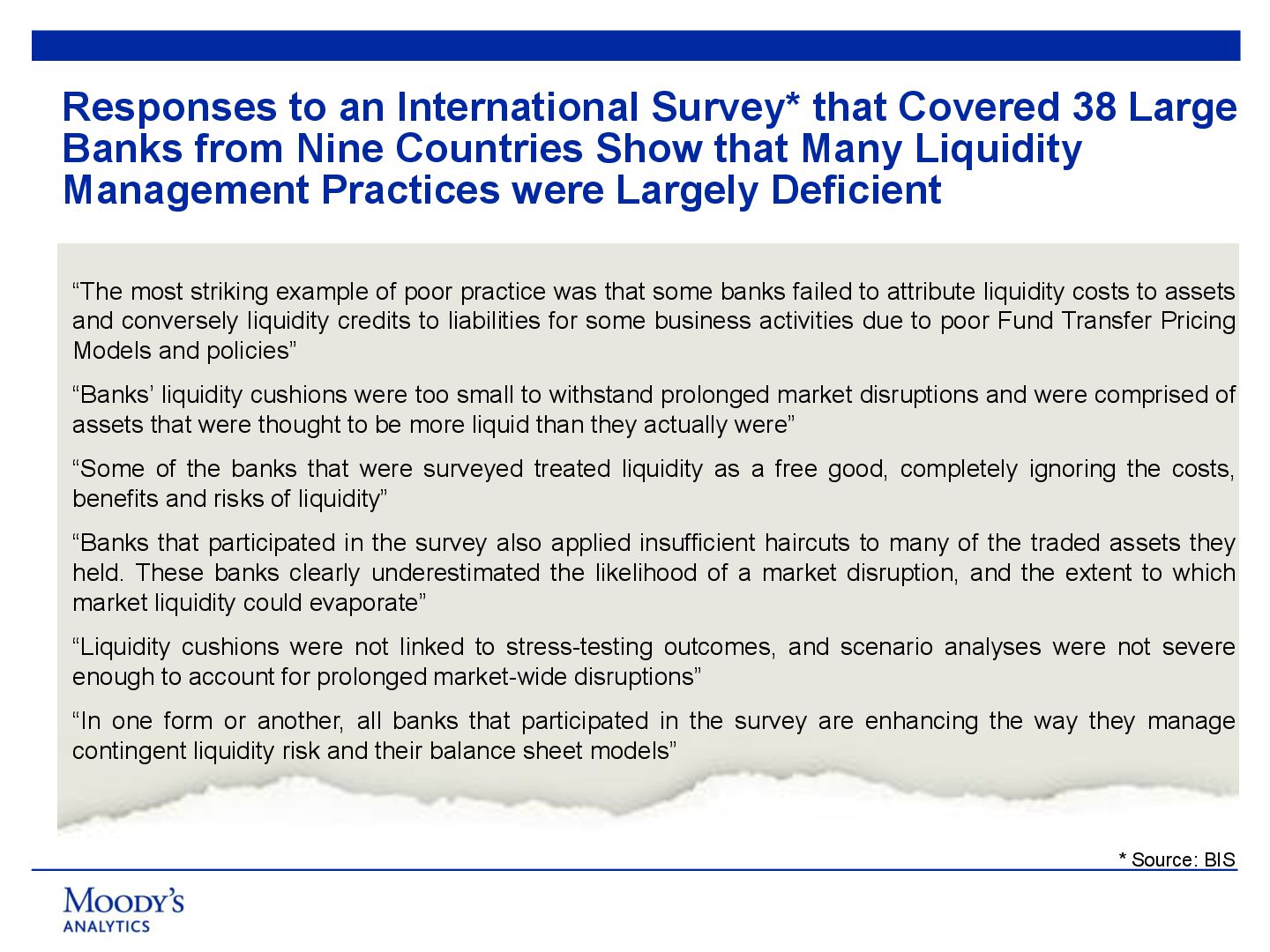
  16. Responses to an International Survey* that Covered 38 Large Banks

    from Nine Countries Show that Many Liquidity Management Practices were Largely Deficient “The most striking example of poor practice was that some banks failed to attribute liquidity costs to assets and conversely liquidity credits to liabilities for some business activities due to poor Fund Transfer Pricing Models and policies” “Banks’ liquidity cushions were too small to withstand prolonged market disruptions and were comprised of assets that were thought to be more liquid than they actually were” “Some of the banks that were surveyed treated liquidity as a free good, completely ignoring the costs, benefits and risks of liquidity” “Banks that participated in the survey also applied insufficient haircuts to many of the traded assets they held. These banks clearly underestimated the likelihood of a market disruption, and the extent to which market liquidity could evaporate” “Liquidity cushions were not linked to stress-testing outcomes, and scenario analyses were not severe enough to account for prolonged market-wide disruptions” “In one form or another, all banks that participated in the survey are enhancing the way they manage contingent liquidity risk and their balance sheet models” * Source: BIS
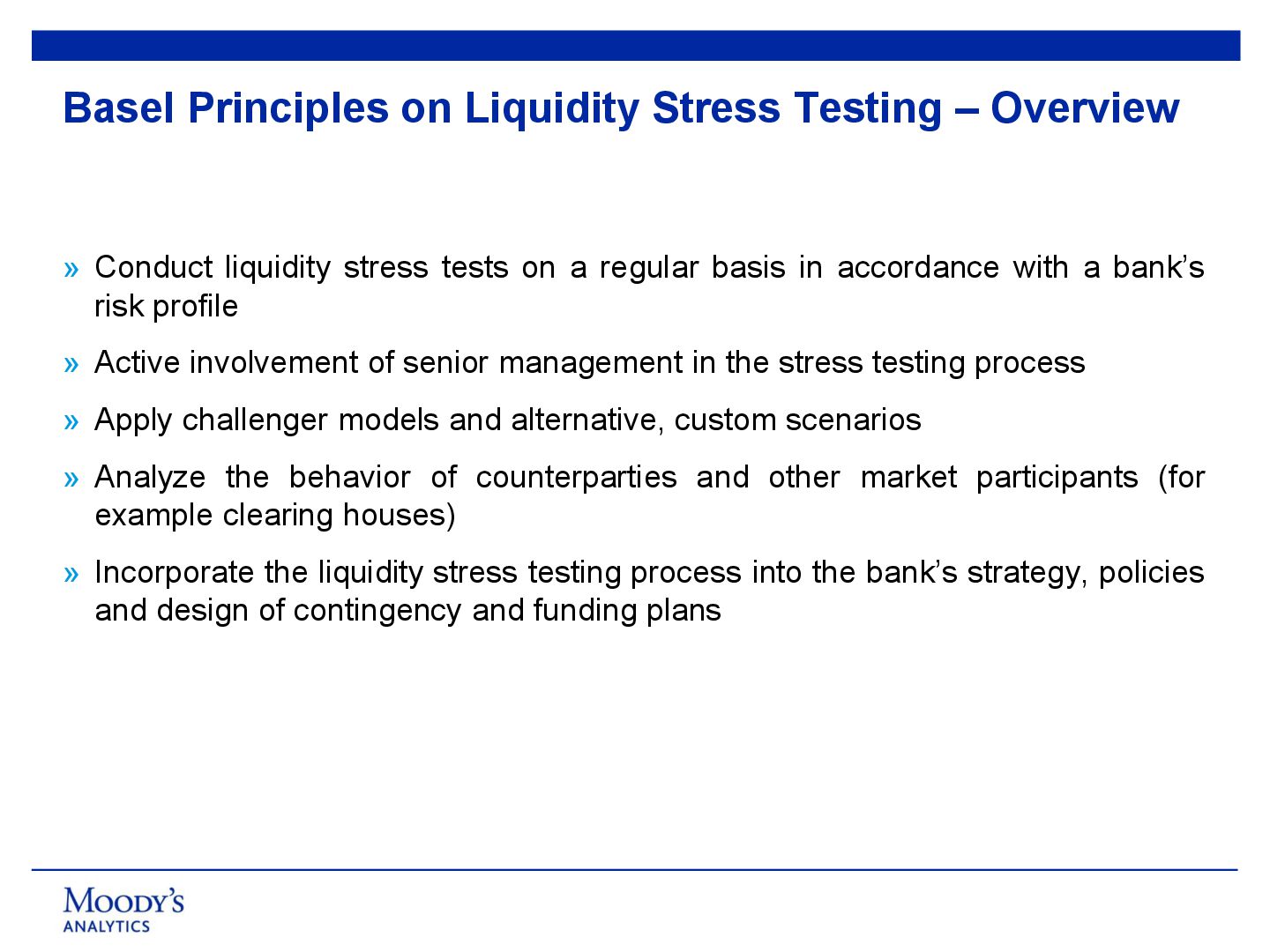
  17. Basel Principles on Liquidity Stress Testing – Overview » Conduct

    liquidity stress tests on a regular basis in accordance with a bank’s risk profile » Active involvement of senior management in the stress testing process » Apply challenger models and alternative, custom scenarios » Analyze the behavior of counterparties and other market participants (for example clearing houses) » Incorporate the liquidity stress testing process into the bank’s strategy, policies and design of contingency and funding plans
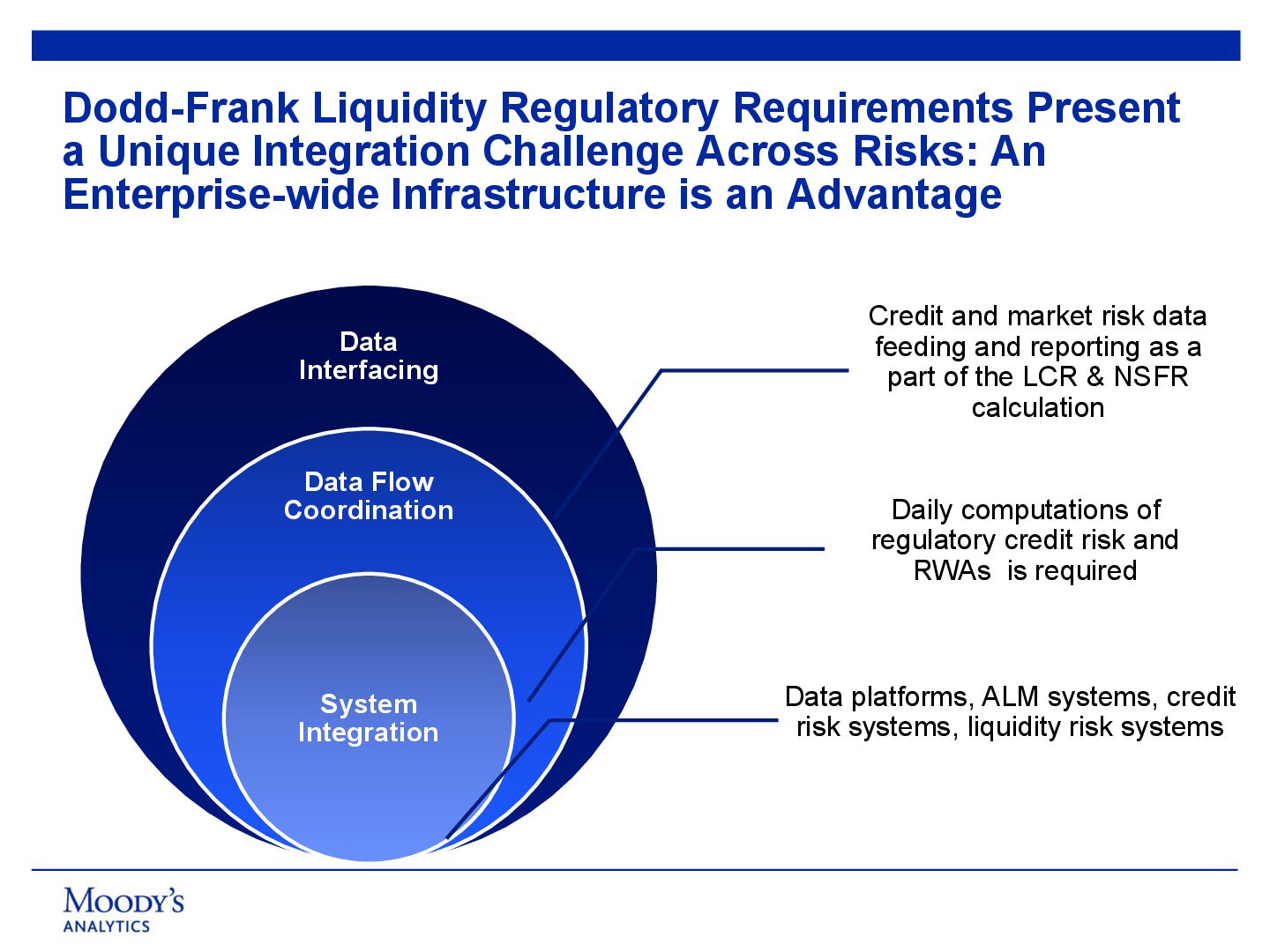
  18. Dodd-Frank Liquidity Regulatory Requirements Present a Unique Integration Challenge Across

    Risks: An Enterprise-wide Infrastructure is an Advantage Data Interfacing Data Flow Coordination System Integration Data platforms, ALM systems, credit risk systems, liquidity risk systems Daily computations of regulatory credit risk and RWAs is required Credit and market risk data feeding and reporting as a part of the LCR & NSFR calculation
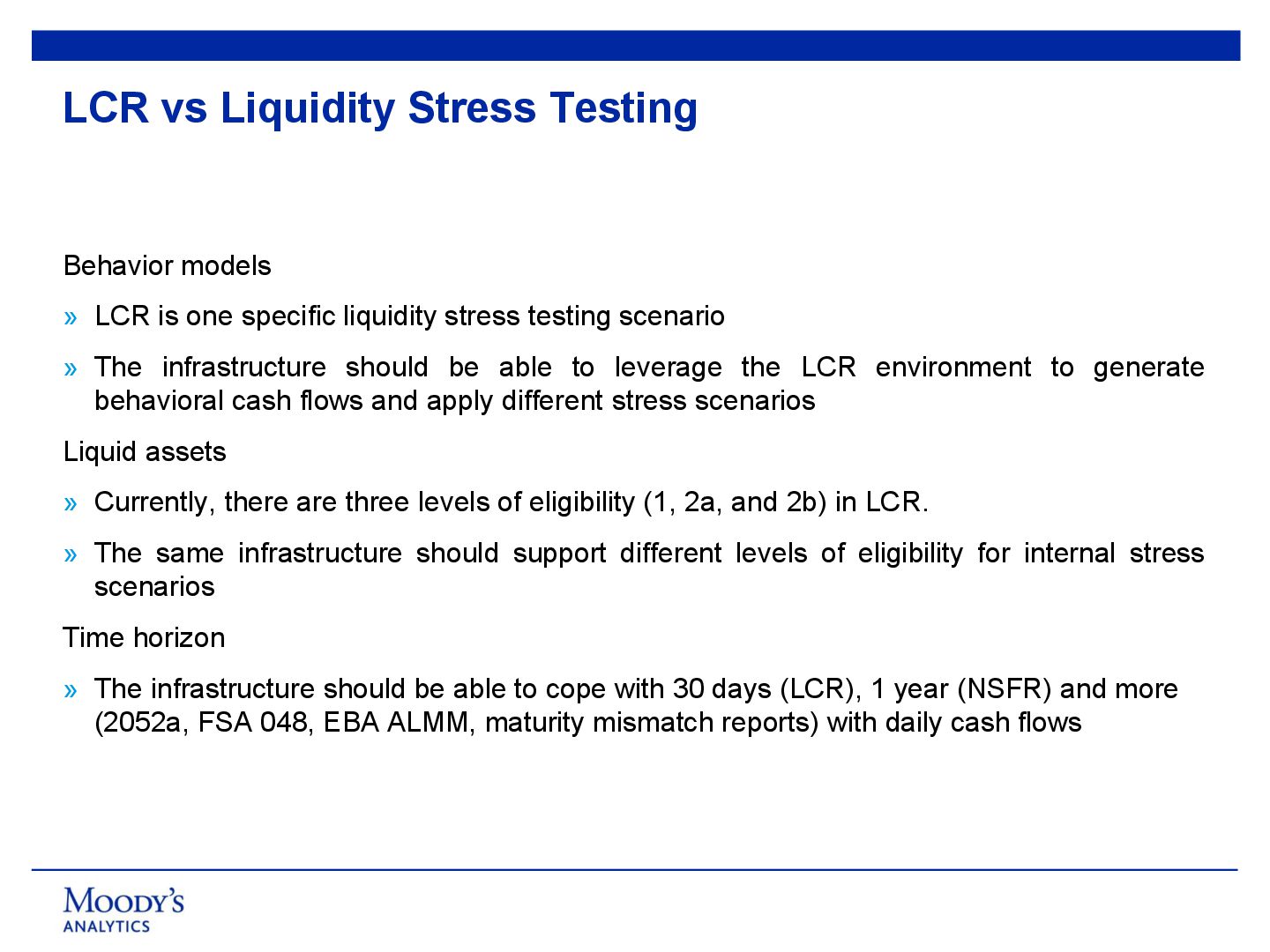
  19. LCR vs Liquidity Stress Testing Behavior models » LCR is

    one specific liquidity stress testing scenario » The infrastructure should be able to leverage the LCR environment to generate behavioral cash flows and apply different stress scenarios Liquid assets » Currently, there are three levels of eligibility (1, 2a, and 2b) in LCR. » The same infrastructure should support different levels of eligibility for internal stress scenarios Time horizon » The infrastructure should be able to cope with 30 days (LCR), 1 year (NSFR) and more (2052a, FSA 048, EBA ALMM, maturity mismatch reports) with daily cash flows
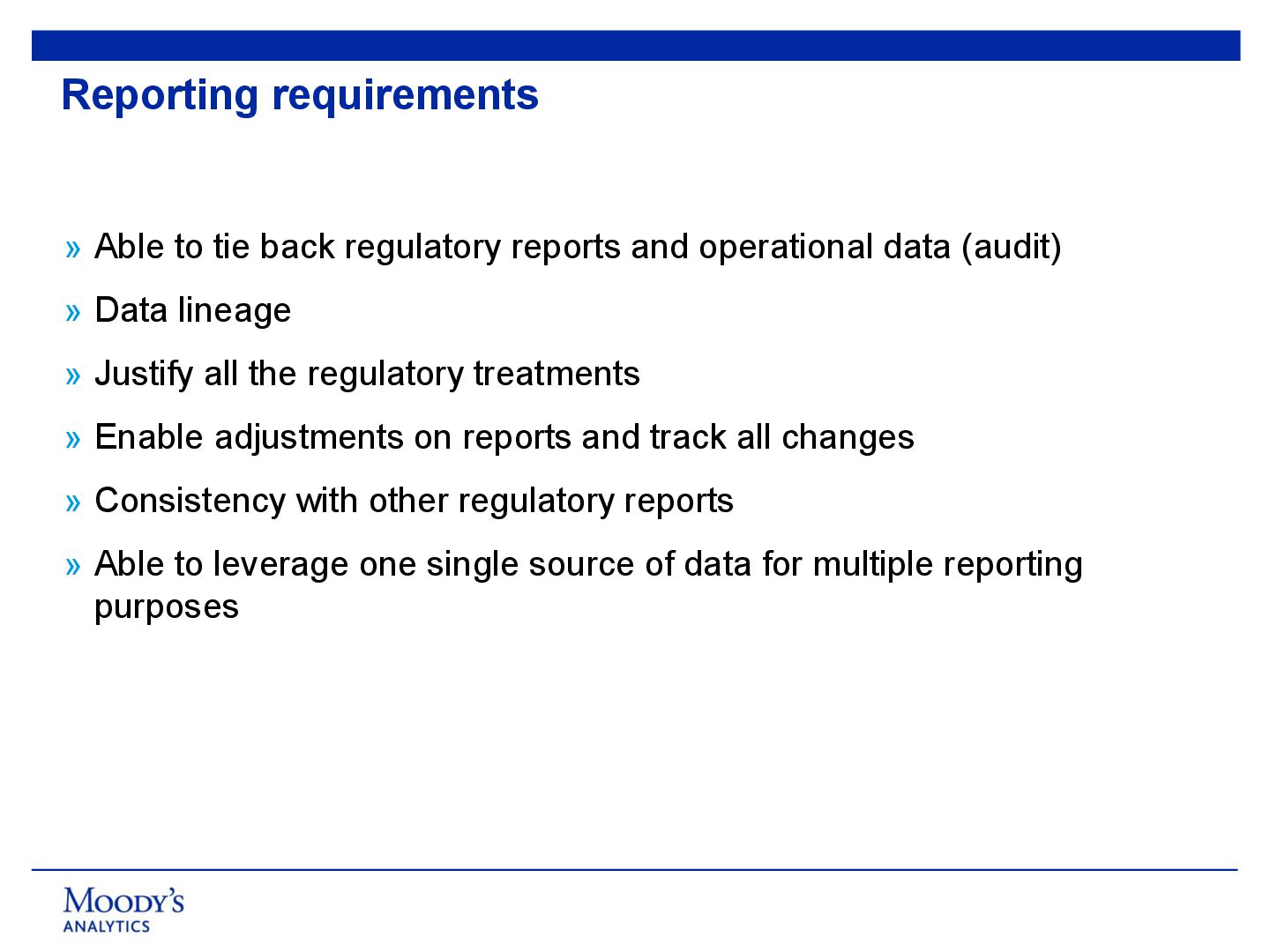
  20. Reporting requirements » Able to tie back regulatory reports and

    operational data (audit) » Data lineage » Justify all the regulatory treatments » Enable adjustments on reports and track all changes » Consistency with other regulatory reports » Able to leverage one single source of data for multiple reporting purposes
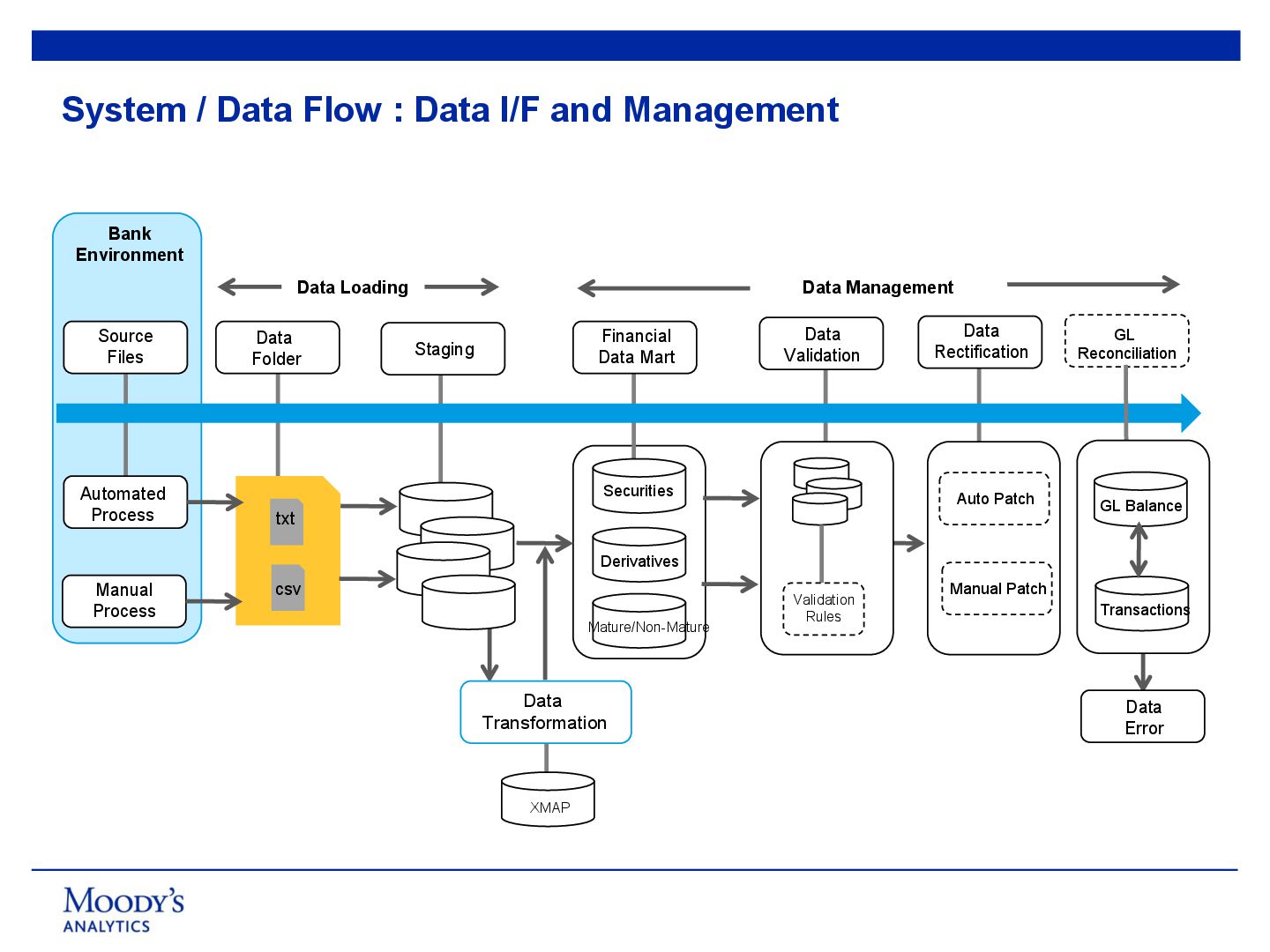
  21. Data Folder Staging Source Files Financial Data Mart Data Rectification

    Data Validation Automated Process Manual Process csv txt Data Transformation GL Reconciliation Data Loading Data Management Bank Environment System / Data Flow : Data I/F and Management Securities Derivatives Mature/Non-Mature Auto Patch Manual Patch Validation Rules GL Balance Transactions XMAP Data Error
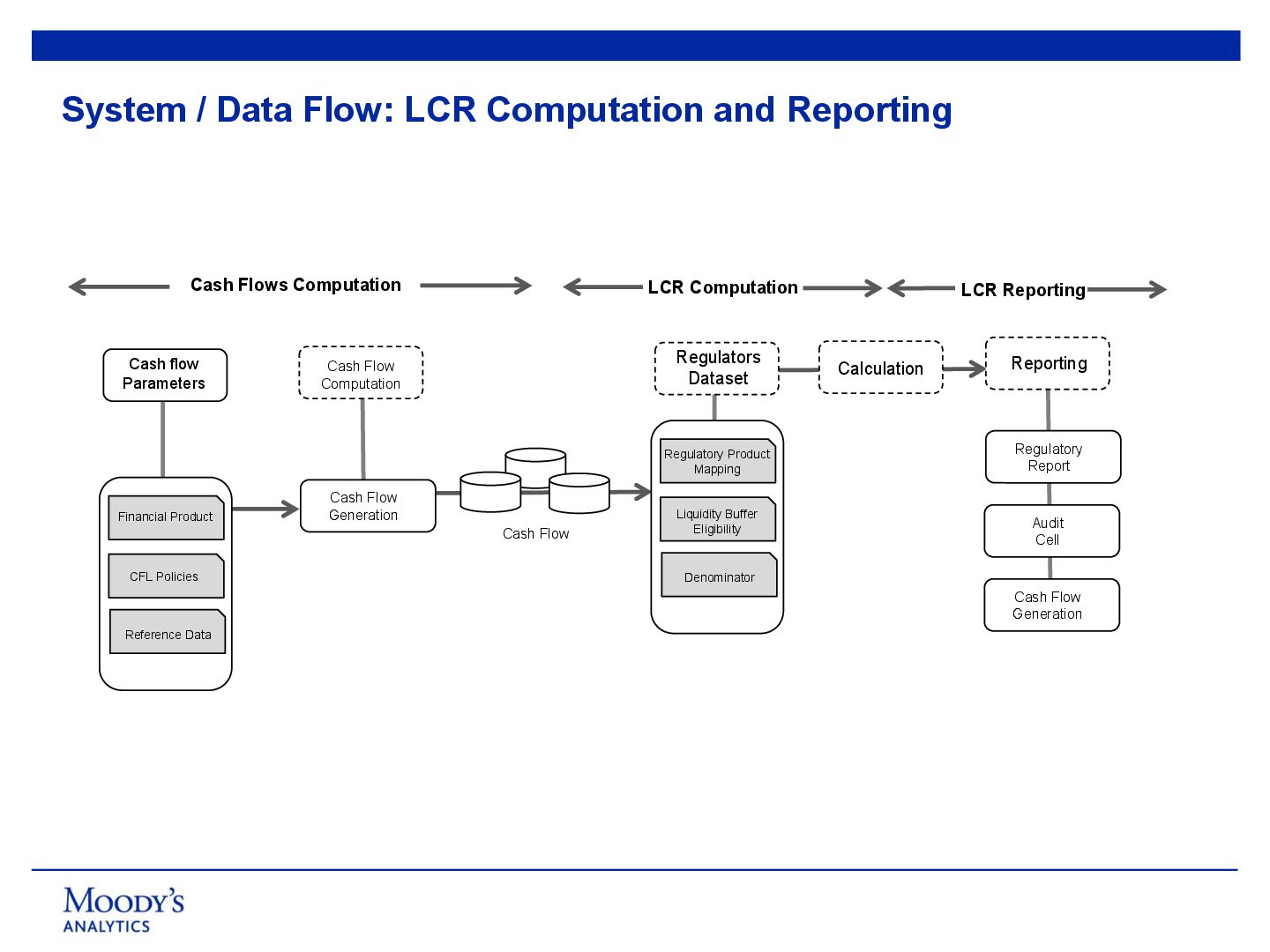
  22. Regulators Dataset Regulatory Product Mapping Liquidity Buffer Eligibility Denominator Calculation

    Reporting LCR Computation System / Data Flow: LCR Computation and Reporting Cash Flows Computation Cash flow Parameters Financial Product CFL Policies Reference Data Cash Flow Computation Cash Flow Generation Cash Flow LCR Reporting Regulatory Report Audit Cell Cash Flow Generation
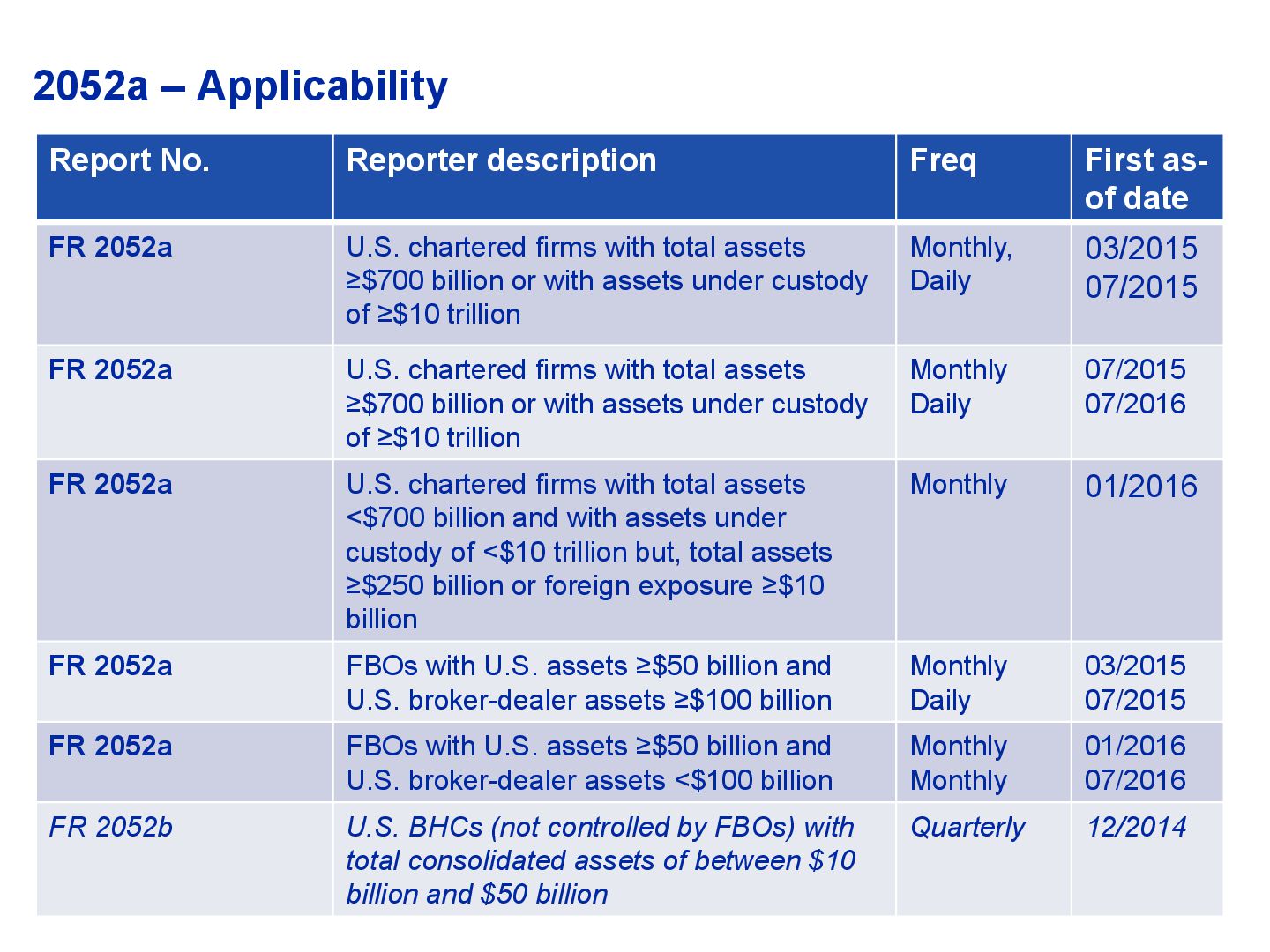
  23. 2052a – Applicability Report No. Reporter description Freq First as-

    of date FR 2052a U.S. chartered firms with total assets ≥$700 billion or with assets under custody of ≥$10 trillion Monthly, Daily 03/2015 07/2015 FR 2052a U.S. chartered firms with total assets ≥$700 billion or with assets under custody of ≥$10 trillion Monthly Daily 07/2015 07/2016 FR 2052a U.S. chartered firms with total assets <$700 billion and with assets under custody of <$10 trillion but, total assets ≥$250 billion or foreign exposure ≥$10 billion Monthly 01/2016 FR 2052a FBOs with U.S. assets ≥$50 billion and U.S. broker-dealer assets ≥$100 billion Monthly Daily 03/2015 07/2015 FR 2052a FBOs with U.S. assets ≥$50 billion and U.S. broker-dealer assets <$100 billion Monthly Monthly 01/2016 07/2016 FR 2052b U.S. BHCs (not controlled by FBOs) with total consolidated assets of between $10 billion and $50 billion Quarterly 12/2014
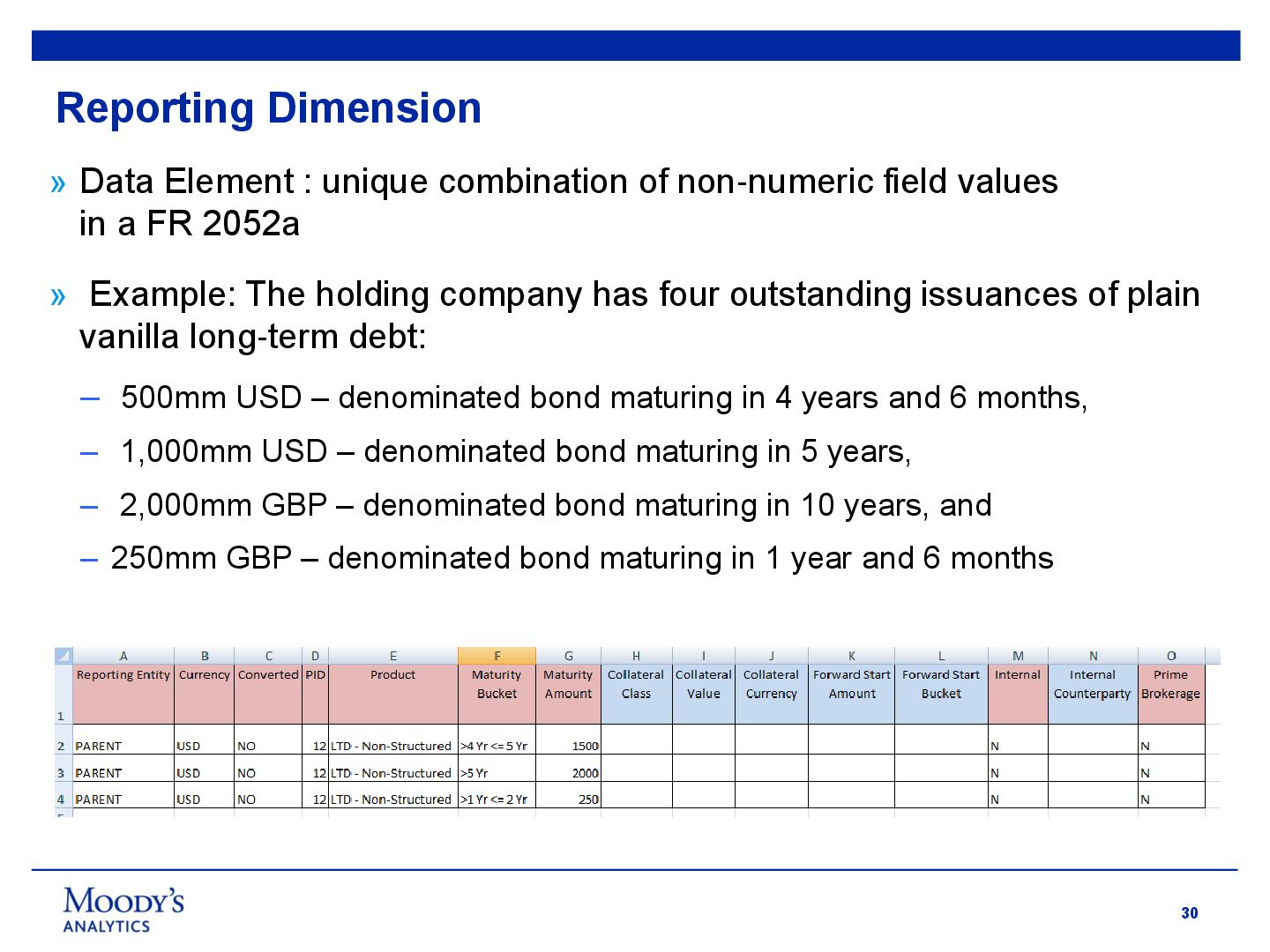
  24. 30 » Data Element : unique combination of non‐numeric field

    values in a FR 2052a » Example: The holding company has four outstanding issuances of plain vanilla long‐term debt: – 500mm USD – denominated bond maturing in 4 years and 6 months, – 1,000mm USD – denominated bond maturing in 5 years, – 2,000mm GBP – denominated bond maturing in 10 years, and – 250mm GBP – denominated bond maturing in 1 year and 6 months Reporting Dimension
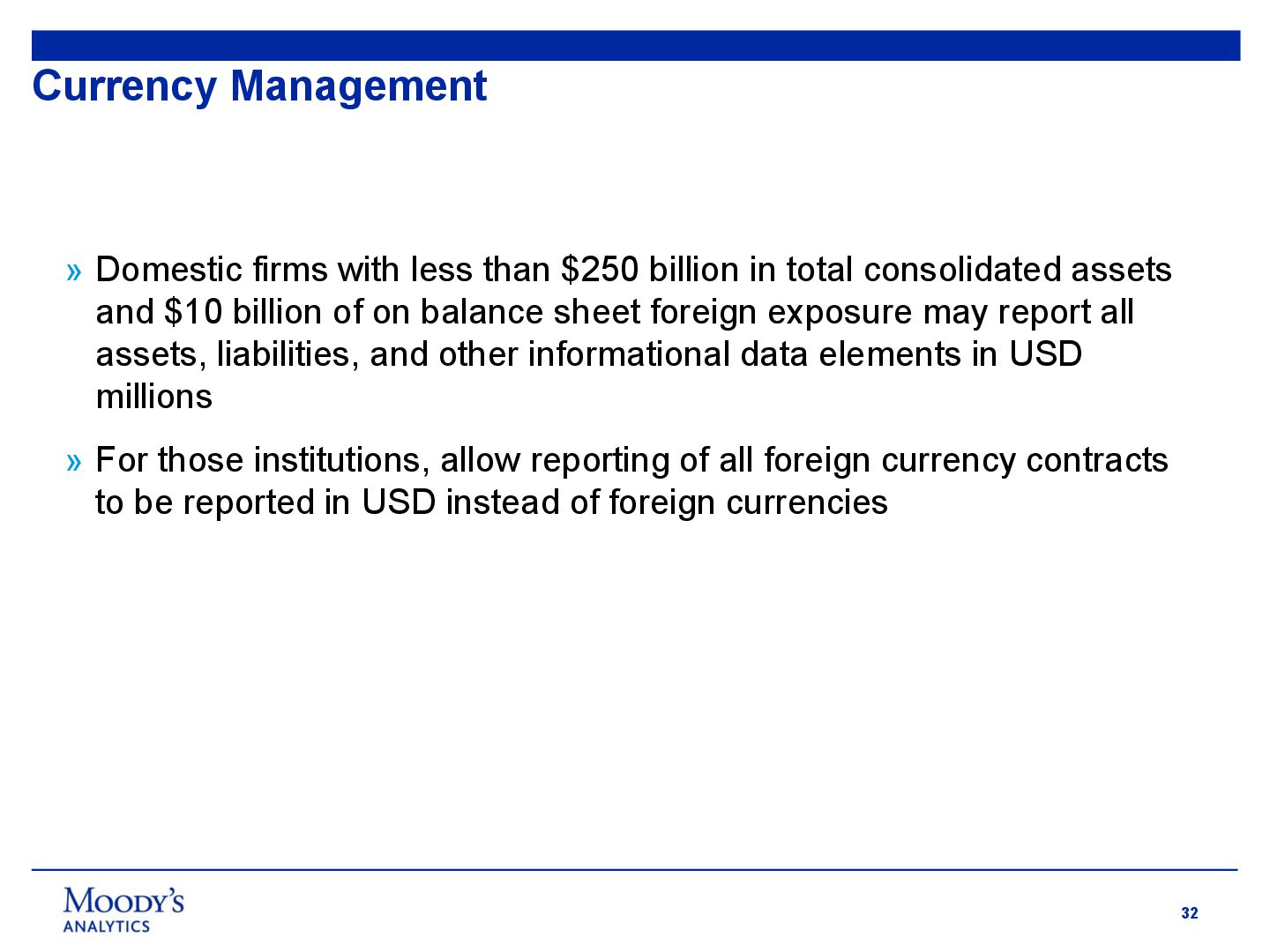
  25. 32 Currency Management » Domestic firms with less than $250

    billion in total consolidated assets and $10 billion of on balance sheet foreign exposure may report all assets, liabilities, and other informational data elements in USD millions » For those institutions, allow reporting of all foreign currency contracts to be reported in USD instead of foreign currencies
  26. © 2015 Moody’s Analytics, Inc. and/or its licensors and affiliates

    (collectively, “MOODY’S”). All rights reserved. ALL INFORMATION CONTAINED HEREIN IS PROTECTED BY COPYRIGHT LAW AND NONE OF SUCH INFORMATION MAY BE COPIED OR OTHERWISE REPRODUCED, REPACKAGED, FURTHER TRANSMITTED, TRANSFERRED, DISSEMINATED, REDISTRIBUTED OR RESOLD, OR STORED FOR SUBSEQUENT USE FOR ANY SUCH PURPOSE, IN WHOLE OR IN PART, IN ANY FORM OR MANNER OR BY ANY MEANS WHATSOEVER, BY ANY PERSON WITHOUT MOODY’S PRIOR WRITTEN CONSENT. All information contained herein is obtained by MOODY’S from sources believed by it to be accurate and reliable. Because of the possibility of human or mechanical error as well as other factors, however, all information contained herein is provided “AS IS” without warranty of any kind. Under no circumstances shall MOODY’S have any liability to any person or entity for (a) any loss or damage in whole or in part caused by, resulting from, or relating to, any error (negligent or otherwise) or other circumstance or contingency within or outside the control of MOODY’S or any of its directors, officers, employees or agents in connection with the procurement, collection, compilation, analysis, interpretation, communication, publication or delivery of any such information, or (b) any direct, indirect, special, consequential, compensatory or incidental damages whatsoever (including without limitation, lost profits), even if MOODY’S is advised in advance of the possibility of such damages, resulting from the use of or inability to use, any such information. The ratings, financial reporting analysis, projections, and other observations, if any, constituting part of the information contained herein are, and must be construed solely as, statements of opinion and not statements of fact or recommendations to purchase, sell or hold any securities. NO WARRANTY, EXPRESS OR IMPLIED, AS TO THE ACCURACY, TIMELINESS, COMPLETENESS, MERCHANTABILITY OR FITNESS FOR ANY PARTICULAR PURPOSE OF ANY SUCH RATING OR OTHER OPINION OR INFORMATION IS GIVEN OR MADE BY MOODY’S IN ANY FORM OR MANNER WHATSOEVER. Each rating or other opinion must be weighed solely as one factor in any investment decision made by or on behalf of any user of the information contained herein, and each such user must accordingly make its own study and evaluation of each security and of each issuer and guarantor of, and each provider of credit support for, each security that it may consider purchasing, holding, or selling.