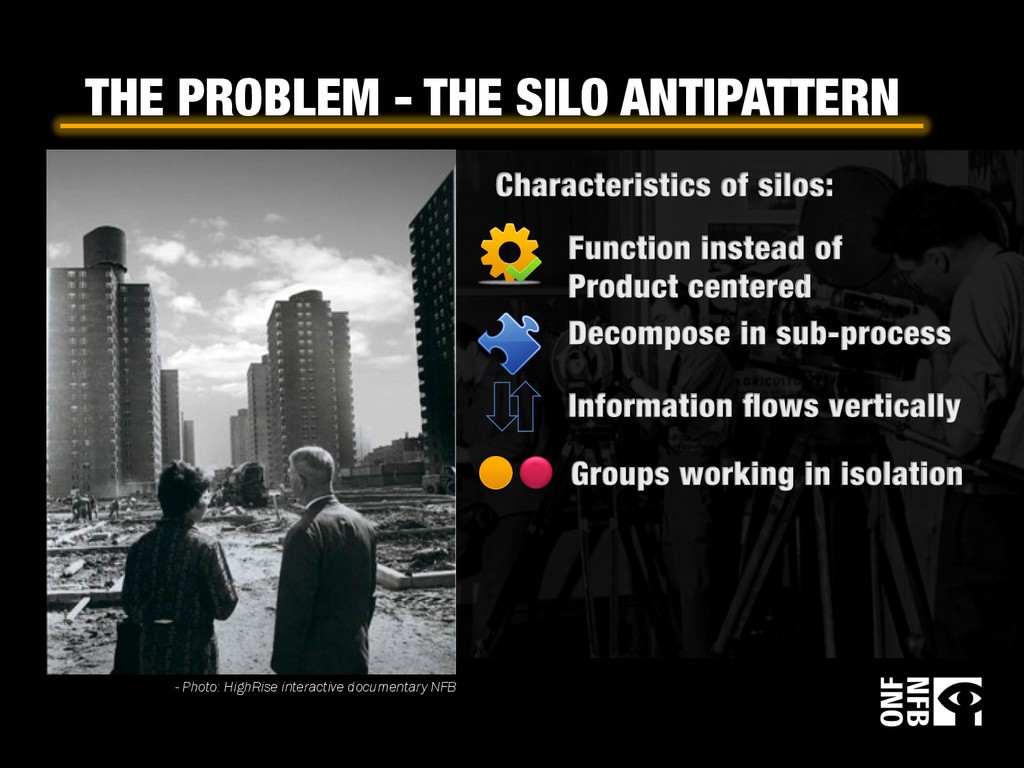
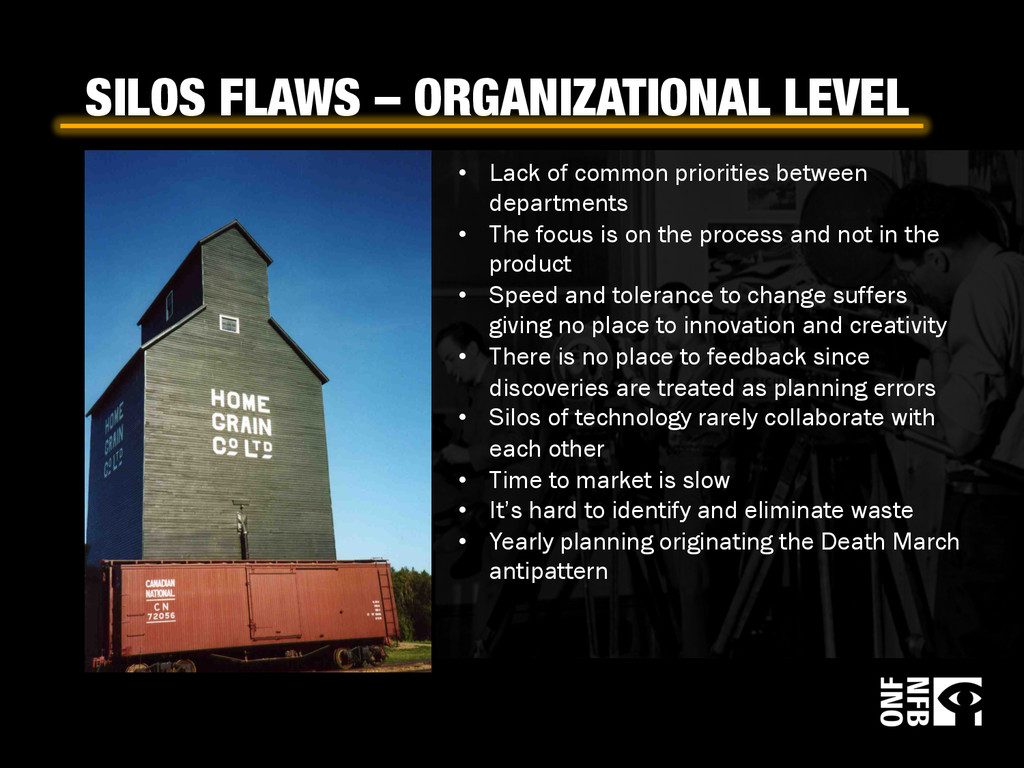
between departments • The focus is on the process and not in the product • Speed and tolerance to change suffers giving no place to innovation and creativity • There is no place to feedback since discoveries are treated as planning errors • Silos of technology rarely collaborate with each other • Time to market is slow • It’s hard to identify and eliminate waste • Yearly planning originating the Death March antipattern
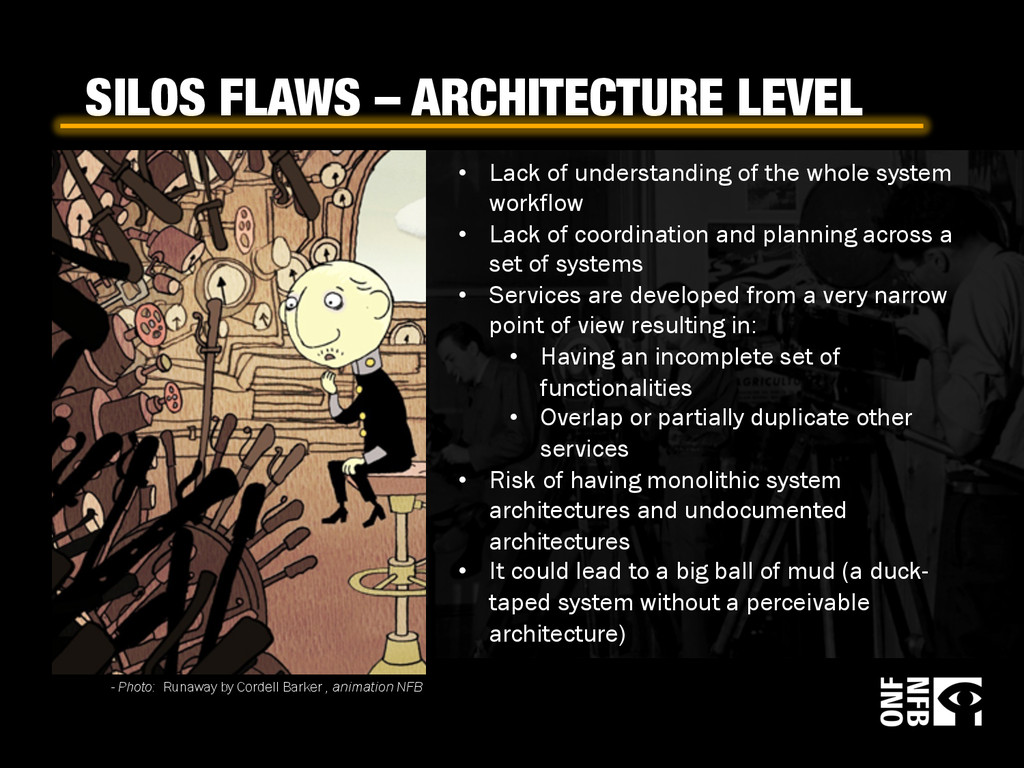
the whole system workflow • Lack of coordination and planning across a set of systems • Services are developed from a very narrow point of view resulting in: • Having an incomplete set of functionalities • Overlap or partially duplicate other services • Risk of having monolithic system architectures and undocumented architectures • It could lead to a big ball of mud (a duck- taped system without a perceivable architecture) - Photo: Runaway by Cordell Barker , animation NFB
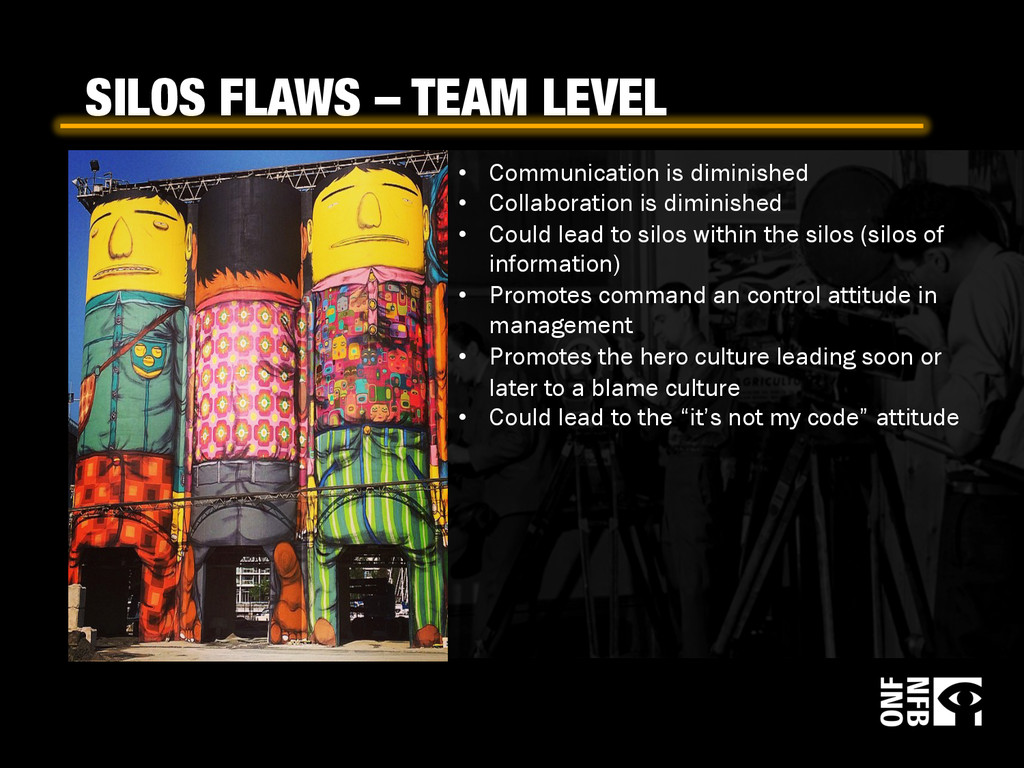
Collaboration is diminished • Could lead to silos within the silos (silos of information) • Promotes command an control attitude in management • Promotes the hero culture leading soon or later to a blame culture • Could lead to the “it’s not my code” attitude
practices (to deliver fast, see hero culture) • Lead to other antipatterns. Ex: the ”Repeating yourself” anti-pattern because of fear of refactoring someone else’s code • Discourages: • Learning/teaching new languages or better code practices between team members • Trying new things, innovation - Photo: It came from Outer Space, Universal-International, 1953
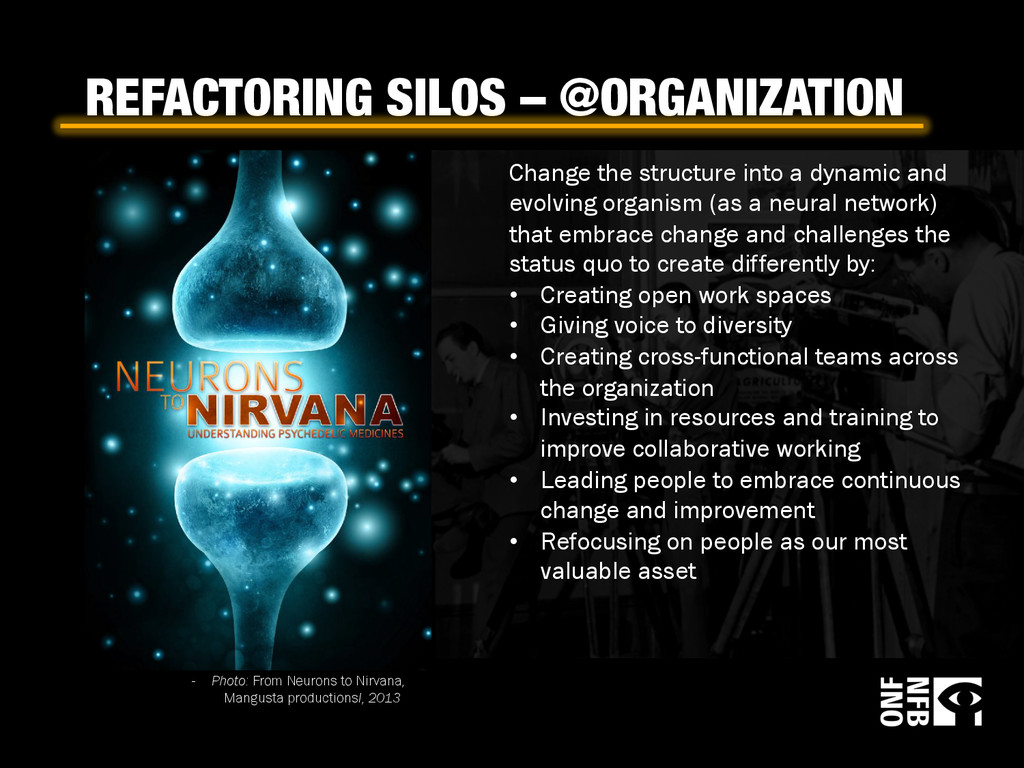
and evolving organism (as a neural network) that embrace change and challenges the status quo to create differently by: • Creating open work spaces • Giving voice to diversity • Creating cross-functional teams across the organization • Investing in resources and training to improve collaborative working • Leading people to embrace continuous change and improvement • Refocusing on people as our most valuable asset - Photo: From Neurons to Nirvana, Mangusta productionsl, 2013
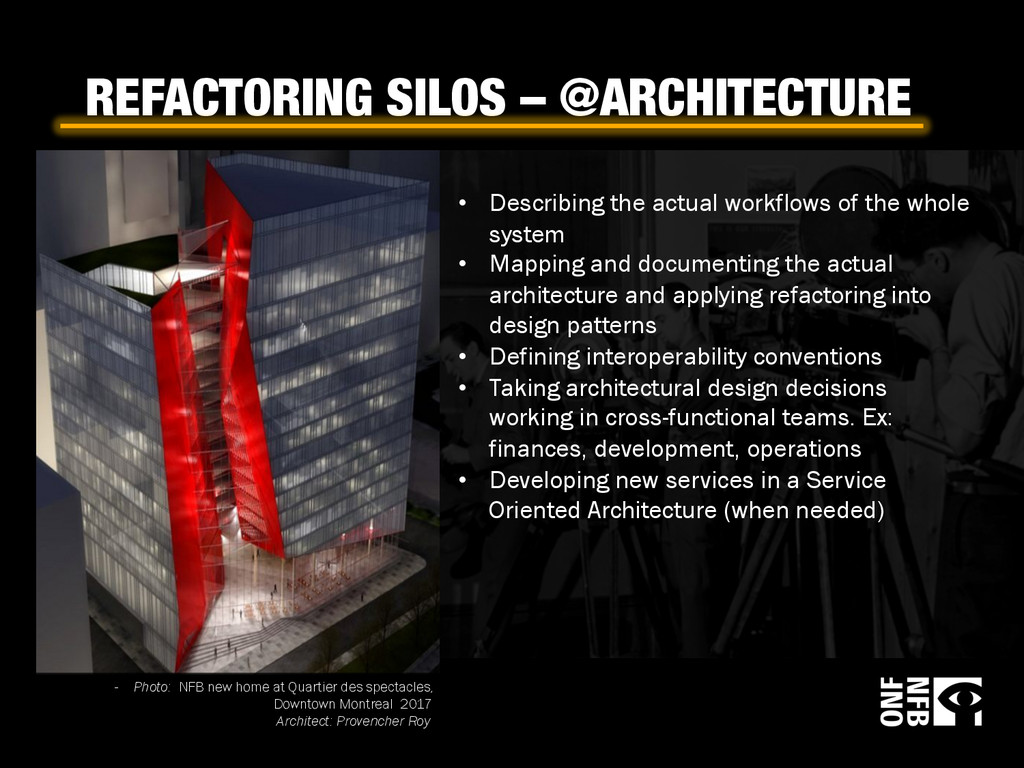
the whole system • Mapping and documenting the actual architecture and applying refactoring into design patterns • Defining interoperability conventions • Taking architectural design decisions working in cross-functional teams. Ex: finances, development, operations • Developing new services in a Service Oriented Architecture (when needed) - Photo: NFB new home at Quartier des spectacles, Downtown Montreal 2017 Architect: Provencher Roy
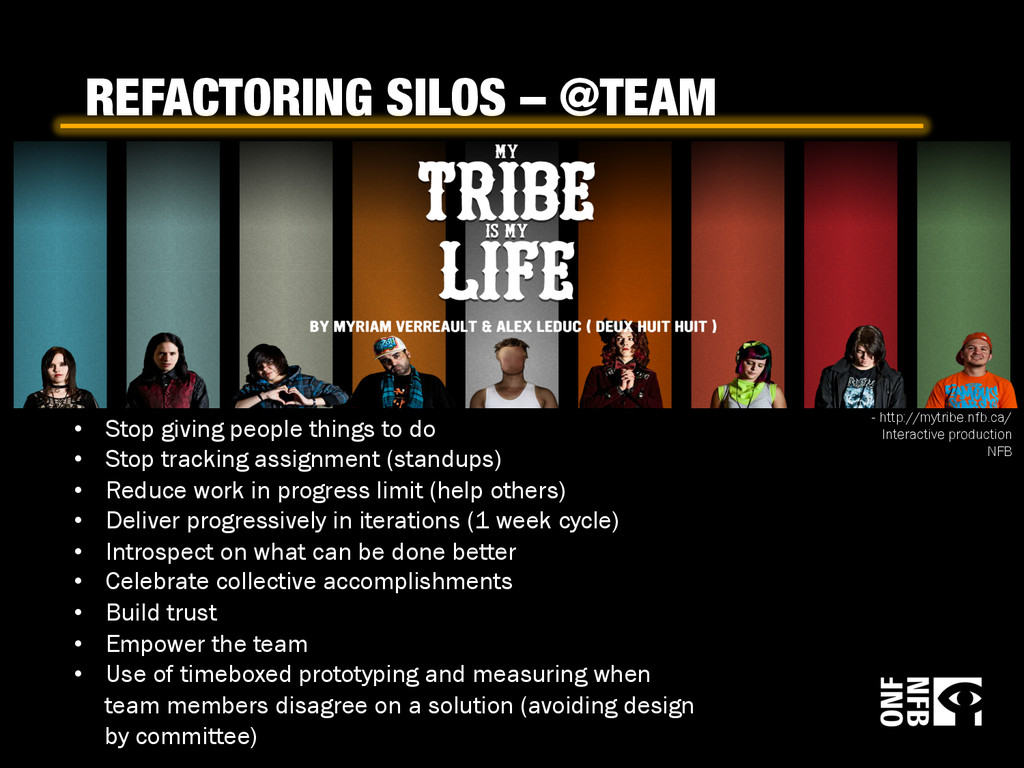
do • Stop tracking assignment (standups) • Reduce work in progress limit (help others) • Deliver progressively in iterations (1 week cycle) • Introspect on what can be done better • Celebrate collective accomplishments • Build trust • Empower the team • Use of timeboxed prototyping and measuring when team members disagree on a solution (avoiding design by committee) - http://mytribe.nfb.ca/ Interactive production NFB
• Doing micro design sessions • Encourage pairing • Use extensively code reviews • Promoting Test Driven Development • Promoting the application of good practices between members • Automation. Ex: environments (dev, test), running test suites (when merging), deployment • Refactoring • Promote creation of groups of interest and continuous learning
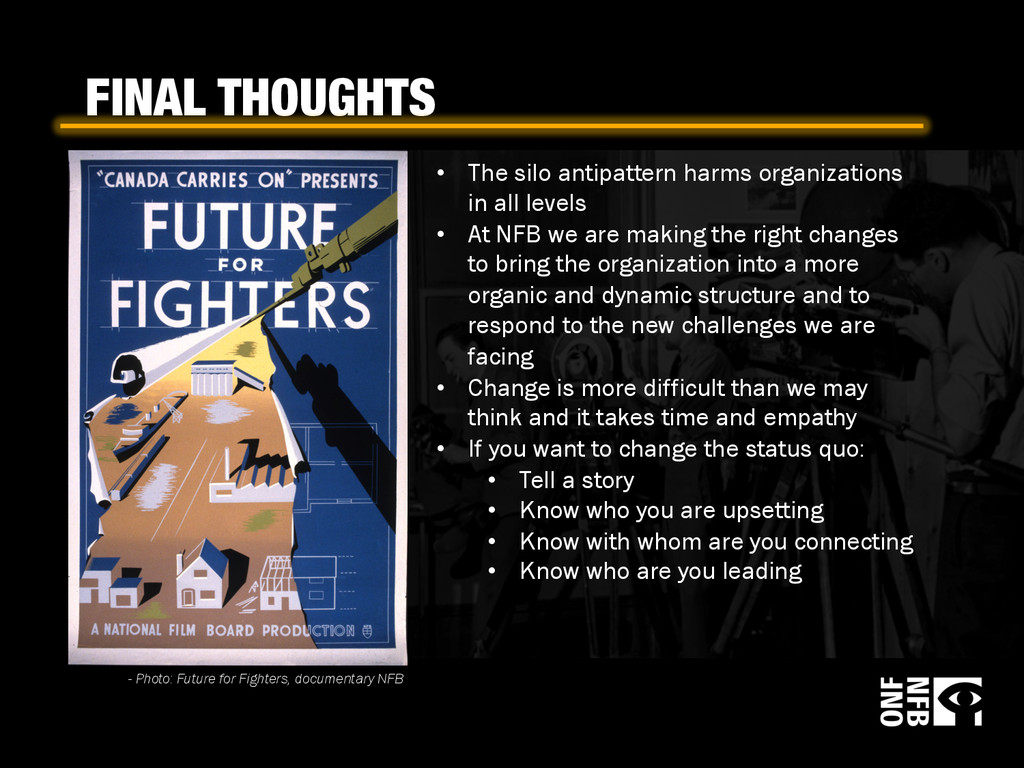
levels • At NFB we are making the right changes to bring the organization into a more organic and dynamic structure and to respond to the new challenges we are facing • Change is more difficult than we may think and it takes time and empathy • If you want to change the status quo: • Tell a story • Know who you are upsetting • Know with whom are you connecting • Know who are you leading - Photo: Future for Fighters, documentary NFB
Down Silos: Transitioning the Enterprise to Agile http://bit.ly/1E81Pkg • Agile and the seven sins of project management http://bit.ly/1vQo77b • The Lean UX anti-pattern: Cross-functional silos http://bit.ly/1EDZyML • Task assignment is a team antipattern http://bit.ly/18CNY8B • Software architecture antipatterns http://bit.ly/1CfXnPN • SOA anti-patterns revisited http://bit.ly/1Bvqai8 • What team structure is right for devops to flourish http://bit.ly/17Jeqwh


 greenmidori
 terapyon
 4o1sobblue
 codmoninc
 yamad
 satoshi7
 oasis1994liveforever
 akitoshiga
 shumei_ito
 ishikawa_satoru
 ezaki
 finengine
 bryan
 bluesmoon
 cassininazir
 mfonobong
 marketingsoph
 reverentgeek
 eileencodes
 sarafernandez
 techseoconnect
 codingconduct
 davidcarrasco