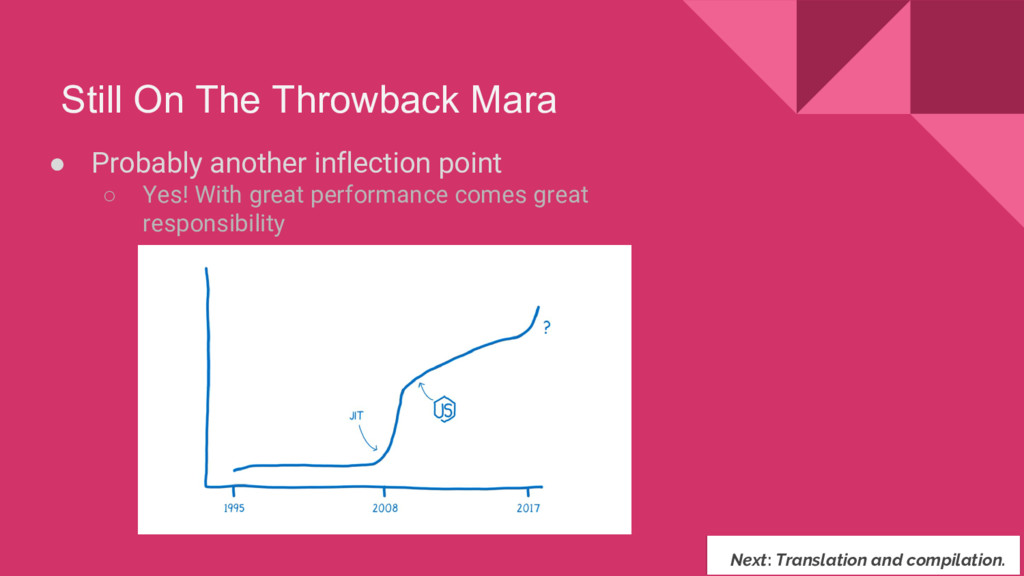
Throwback And Potential Impact of WA • Translation on the Web. • Pros and Cons of compilers and interpreters • The best of two worlds: JIT • Assembly • Finally.. Getting started.
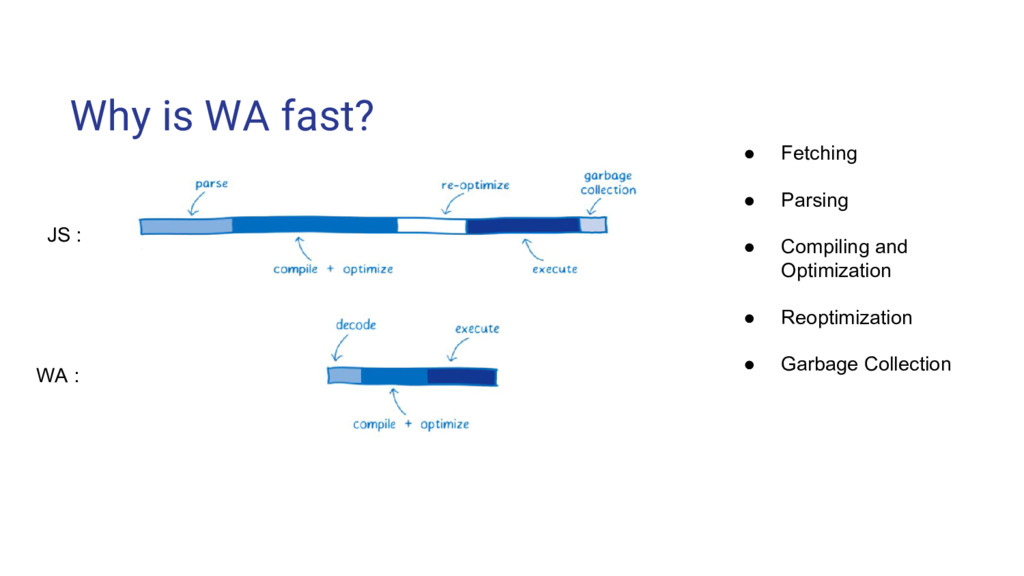
code written in programming languages other than JavaScript and running that code in the browser. It is also fast. ➔ FYI : For speed, the comparison is between WA and JS. Next: throw back
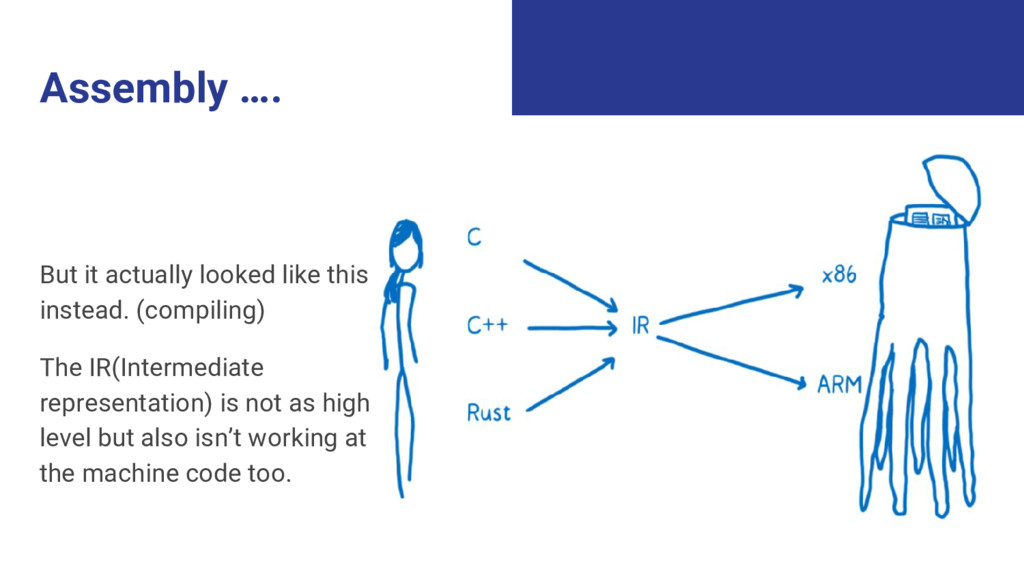
from C to WA. We could use the clang front-end to go from C to the LLVM intermediate representation. Once it’s in LLVM’s IR, LLVM understands it, so LLVM can perform some optimizations. To go from LLVM’s IR to WA, we need a back-end. Emscripten is a bit easier to use at the moment. It has its own back-end that can produce WebAssembly by compiling to another target (called asm.js) and then converting that to WebAssembly. It uses LLVM under the hood,
it can make the short hop from WebAssembly to that target machine’s assembly code. • there is an experimental tool that helps you build a WebAssembly module using TypeScript • you can code in the text representation of WebAssembly directly.


 gam0022
 akit37
 yutobara
 optim
 skydoves
 kinopeee
 ___akari11
 naokihaba
 marcoroth
 shihochan
 oniak3ibm
 y0hgi
 axbom
 rabernat
 rmw
 hannesfritz
 davetheseo
 akademiya2063
 aleyda
 jlugia
 3n
 smashingmag
 marketingsoph
 ivargrimstad