Upgrade to Pro — share decks privately, control downloads, hide ads and more …

Skills Required to Become a Job-Ready Digital M...

Sponsored · Your Podcast. Everywhere. Effortlessly. Share. Educate. Inspire. Entertain. You do you. We'll handle the rest. →
Avatar for Himanshi Himanshi
October 17, 2026

Skills Required to Become a Job-Ready Digital Marketer in India

Discover the essential skills required to become a job-ready digital marketer in India, including SEO, social media marketing, Google Ads, content marketing, email marketing, and web analytics. Learn how practical experience, industry-relevant tools, communication skills, and real-world projects can help you build a strong portfolio and prepare for digital marketing job opportunities.

Avatar for Himanshi

Himanshi

October 17, 2026

Other Decks in Education

Transcript

  1. Skills Required to Become a Job-Ready Digital Marketer in India

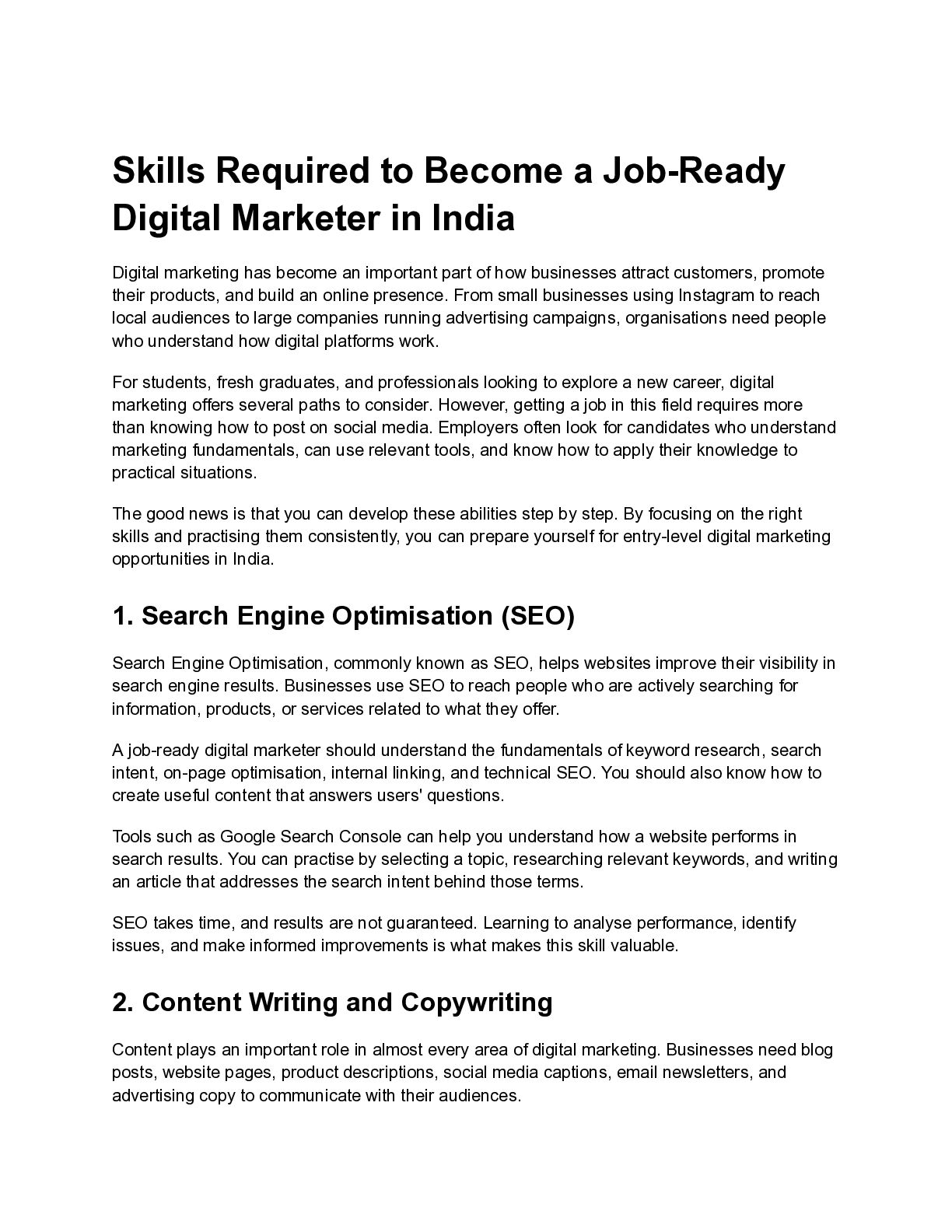
    Digital marketing has become an important part of how businesses attract customers, promote their products, and build an online presence. From small businesses using Instagram to reach local audiences to large companies running advertising campaigns, organisations need people who understand how digital platforms work. For students, fresh graduates, and professionals looking to explore a new career, digital marketing offers several paths to consider. However, getting a job in this field requires more than knowing how to post on social media. Employers often look for candidates who understand marketing fundamentals, can use relevant tools, and know how to apply their knowledge to practical situations. The good news is that you can develop these abilities step by step. By focusing on the right skills and practising them consistently, you can prepare yourself for entry-level digital marketing opportunities in India. 1. Search Engine Optimisation (SEO) Search Engine Optimisation, commonly known as SEO, helps websites improve their visibility in search engine results. Businesses use SEO to reach people who are actively searching for information, products, or services related to what they offer. A job-ready digital marketer should understand the fundamentals of keyword research, search intent, on-page optimisation, internal linking, and technical SEO. You should also know how to create useful content that answers users' questions. Tools such as Google Search Console can help you understand how a website performs in search results. You can practise by selecting a topic, researching relevant keywords, and writing an article that addresses the search intent behind those terms. SEO takes time, and results are not guaranteed. Learning to analyse performance, identify issues, and make informed improvements is what makes this skill valuable. 2. Content Writing and Copywriting Content plays an important role in almost every area of digital marketing. Businesses need blog posts, website pages, product descriptions, social media captions, email newsletters, and advertising copy to communicate with their audiences.
  2. Content writing focuses on providing useful information, while copywriting often

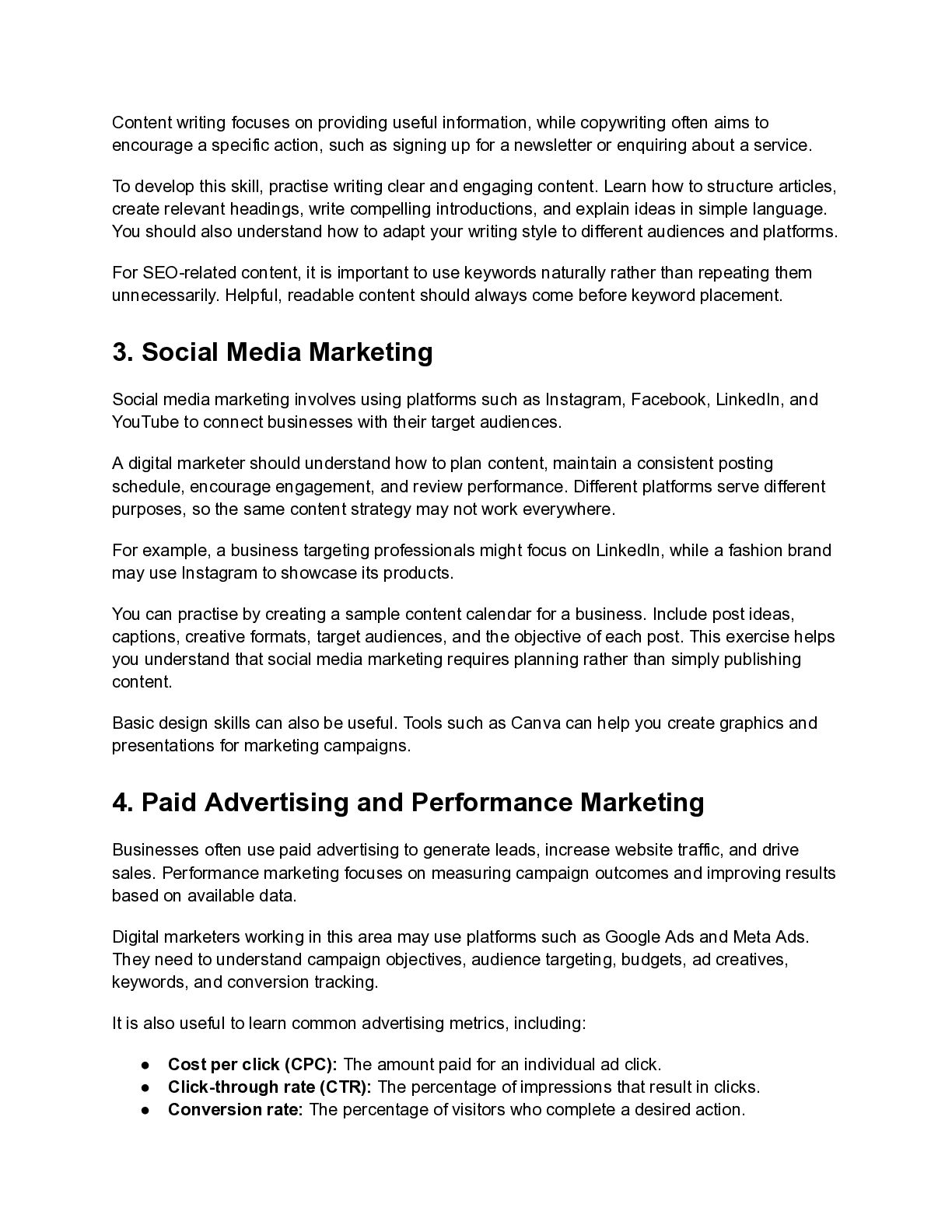
    aims to encourage a specific action, such as signing up for a newsletter or enquiring about a service. To develop this skill, practise writing clear and engaging content. Learn how to structure articles, create relevant headings, write compelling introductions, and explain ideas in simple language. You should also understand how to adapt your writing style to different audiences and platforms. For SEO-related content, it is important to use keywords naturally rather than repeating them unnecessarily. Helpful, readable content should always come before keyword placement. 3. Social Media Marketing Social media marketing involves using platforms such as Instagram, Facebook, LinkedIn, and YouTube to connect businesses with their target audiences. A digital marketer should understand how to plan content, maintain a consistent posting schedule, encourage engagement, and review performance. Different platforms serve different purposes, so the same content strategy may not work everywhere. For example, a business targeting professionals might focus on LinkedIn, while a fashion brand may use Instagram to showcase its products. You can practise by creating a sample content calendar for a business. Include post ideas, captions, creative formats, target audiences, and the objective of each post. This exercise helps you understand that social media marketing requires planning rather than simply publishing content. Basic design skills can also be useful. Tools such as Canva can help you create graphics and presentations for marketing campaigns. 4. Paid Advertising and Performance Marketing Businesses often use paid advertising to generate leads, increase website traffic, and drive sales. Performance marketing focuses on measuring campaign outcomes and improving results based on available data. Digital marketers working in this area may use platforms such as Google Ads and Meta Ads. They need to understand campaign objectives, audience targeting, budgets, ad creatives, keywords, and conversion tracking. It is also useful to learn common advertising metrics, including: •​ Cost per click (CPC): The amount paid for an individual ad click. •​ Click-through rate (CTR): The percentage of impressions that result in clicks. •​ Conversion rate: The percentage of visitors who complete a desired action.
  3. •​ Cost per acquisition (CPA): The cost of acquiring a

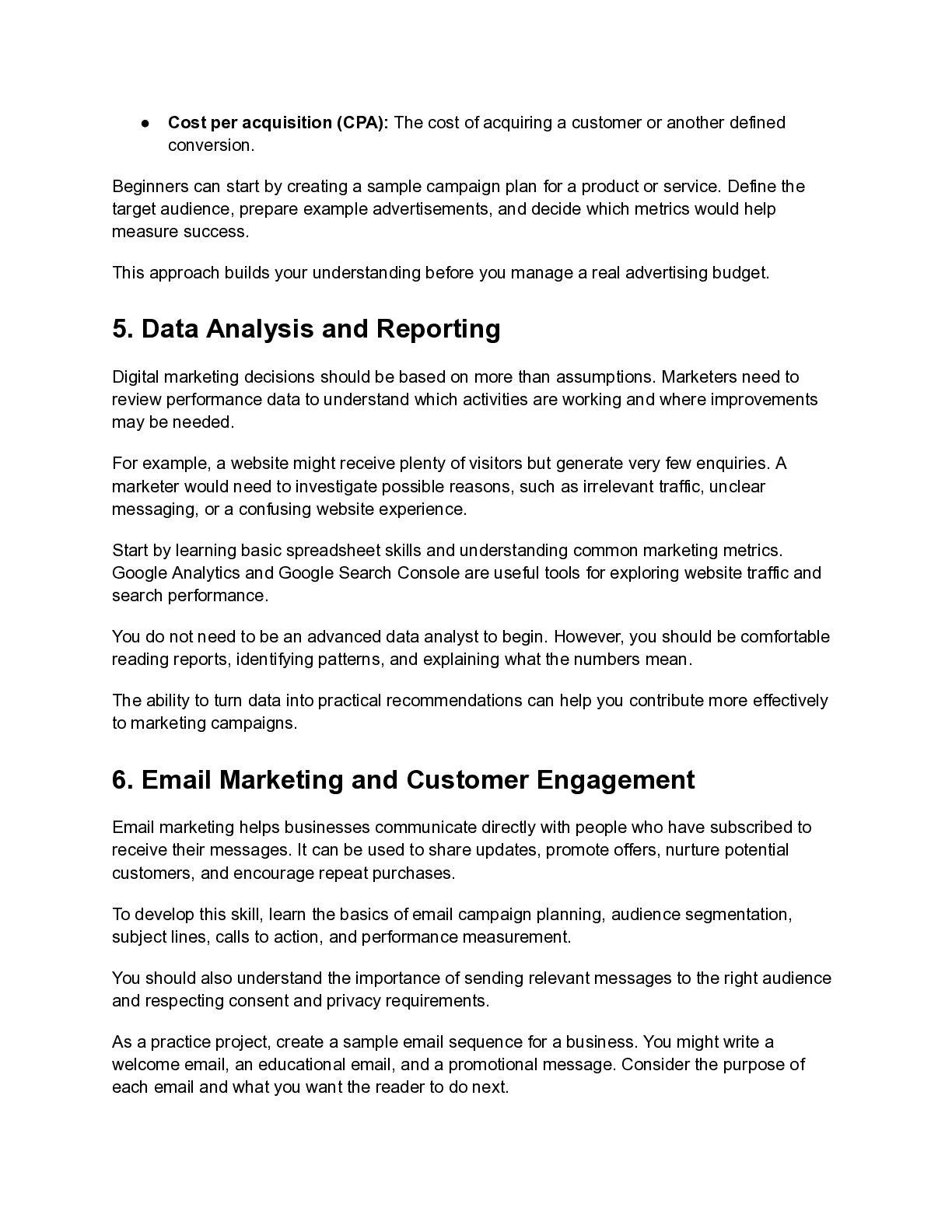
    customer or another defined conversion. Beginners can start by creating a sample campaign plan for a product or service. Define the target audience, prepare example advertisements, and decide which metrics would help measure success. This approach builds your understanding before you manage a real advertising budget. 5. Data Analysis and Reporting Digital marketing decisions should be based on more than assumptions. Marketers need to review performance data to understand which activities are working and where improvements may be needed. For example, a website might receive plenty of visitors but generate very few enquiries. A marketer would need to investigate possible reasons, such as irrelevant traffic, unclear messaging, or a confusing website experience. Start by learning basic spreadsheet skills and understanding common marketing metrics. Google Analytics and Google Search Console are useful tools for exploring website traffic and search performance. You do not need to be an advanced data analyst to begin. However, you should be comfortable reading reports, identifying patterns, and explaining what the numbers mean. The ability to turn data into practical recommendations can help you contribute more effectively to marketing campaigns. 6. Email Marketing and Customer Engagement Email marketing helps businesses communicate directly with people who have subscribed to receive their messages. It can be used to share updates, promote offers, nurture potential customers, and encourage repeat purchases. To develop this skill, learn the basics of email campaign planning, audience segmentation, subject lines, calls to action, and performance measurement. You should also understand the importance of sending relevant messages to the right audience and respecting consent and privacy requirements. As a practice project, create a sample email sequence for a business. You might write a welcome email, an educational email, and a promotional message. Consider the purpose of each email and what you want the reader to do next.
  4. This helps you understand how email marketing fits into a

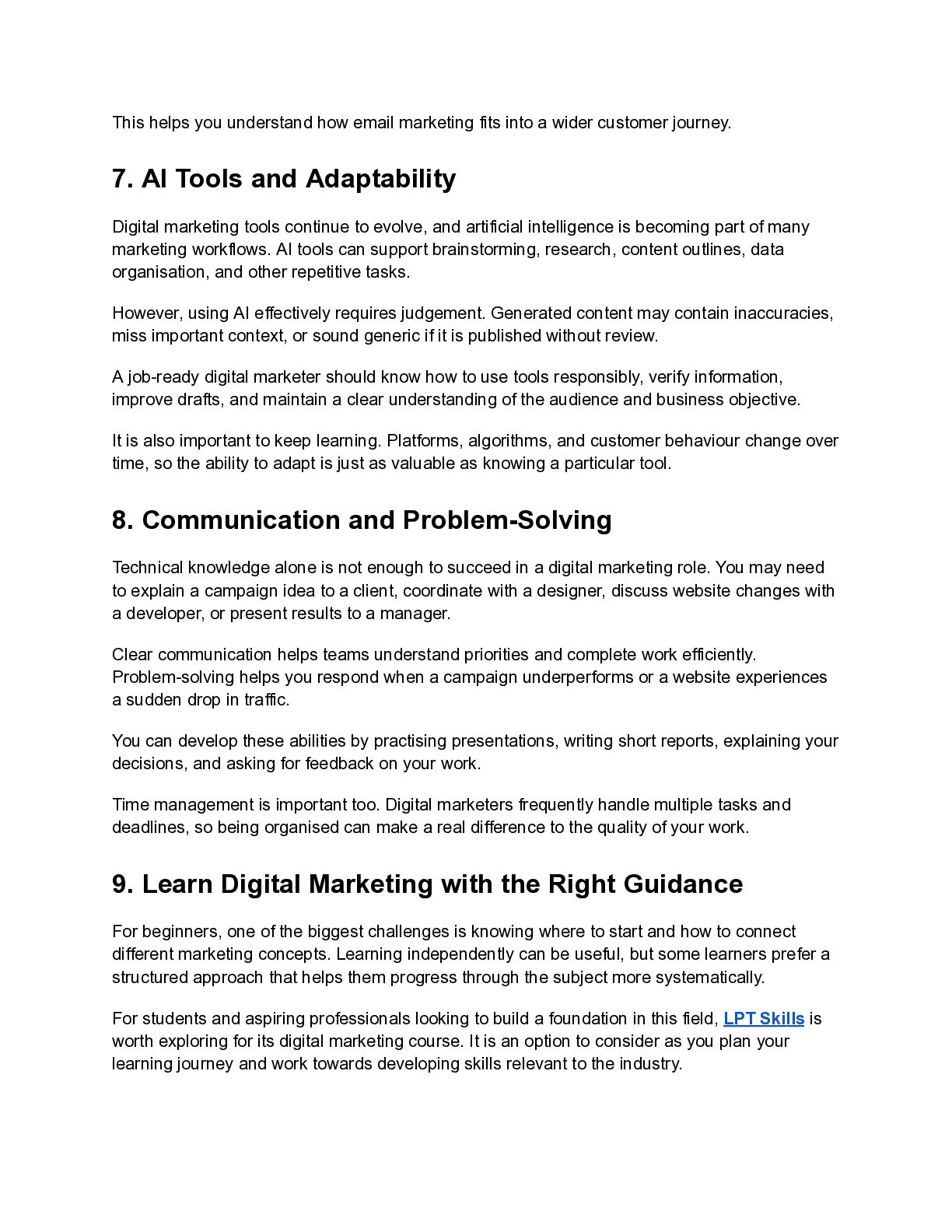
    wider customer journey. 7. AI Tools and Adaptability Digital marketing tools continue to evolve, and artificial intelligence is becoming part of many marketing workflows. AI tools can support brainstorming, research, content outlines, data organisation, and other repetitive tasks. However, using AI effectively requires judgement. Generated content may contain inaccuracies, miss important context, or sound generic if it is published without review. A job-ready digital marketer should know how to use tools responsibly, verify information, improve drafts, and maintain a clear understanding of the audience and business objective. It is also important to keep learning. Platforms, algorithms, and customer behaviour change over time, so the ability to adapt is just as valuable as knowing a particular tool. 8. Communication and Problem-Solving Technical knowledge alone is not enough to succeed in a digital marketing role. You may need to explain a campaign idea to a client, coordinate with a designer, discuss website changes with a developer, or present results to a manager. Clear communication helps teams understand priorities and complete work efficiently. Problem-solving helps you respond when a campaign underperforms or a website experiences a sudden drop in traffic. You can develop these abilities by practising presentations, writing short reports, explaining your decisions, and asking for feedback on your work. Time management is important too. Digital marketers frequently handle multiple tasks and deadlines, so being organised can make a real difference to the quality of your work. 9. Learn Digital Marketing with the Right Guidance For beginners, one of the biggest challenges is knowing where to start and how to connect different marketing concepts. Learning independently can be useful, but some learners prefer a structured approach that helps them progress through the subject more systematically. For students and aspiring professionals looking to build a foundation in this field, LPT Skills is worth exploring for its digital marketing course. It is an option to consider as you plan your learning journey and work towards developing skills relevant to the industry.
  5. Before choosing a course, review the syllabus, teaching format, practical

    assignments, and how well the learning approach matches your career goals. Look for opportunities to practise SEO, content creation, social media marketing, and other areas you want to understand. Most importantly, combine what you learn with hands-on exercises. Preparing a keyword research report, developing a content calendar, or creating a sample advertising strategy can help you apply concepts and identify areas that need more practice. The goal is not simply to complete a course or collect certificates. It is to develop skills that you can demonstrate when applying for internships and jobs. 10. Build a Portfolio to Demonstrate Your Skills A portfolio can help you show potential employers what you are capable of doing, particularly when you are starting without professional experience. You do not need to wait for your first job to create one. Begin with a few well-prepared sample projects that demonstrate different digital marketing skills. Your portfolio might include: •​ •​ •​ •​ •​ An SEO-friendly blog post supported by keyword research. A sample website audit with suggested improvements. A social media content calendar for a fictional business. A sample paid advertising campaign plan. A basic report analysing website or campaign performance. For each project, explain its objective, your approach, the tools you used, and what you learned. Clearly identify sample work as a practice project rather than presenting it as paid client work. Once your portfolio is ready, use it when applying for internships, trainee positions, and entry-level roles. You can also update it as you gain experience and complete more projects. Conclusion Becoming a job-ready digital marketer in India requires a combination of technical knowledge, creativity, analytical thinking, communication, and practical experience. Skills such as SEO, content writing, social media marketing, paid advertising, and data analysis provide a useful foundation for entering the industry. You do not have to master every area at once. Start with the fundamentals, practise through small projects, and gradually explore the specialisations that interest you most.
  6. With consistent learning, a portfolio that demonstrates your abilities, and

    the willingness to adapt to new tools and trends, you can prepare yourself for entry-level opportunities and build towards long-term growth in digital marketing.