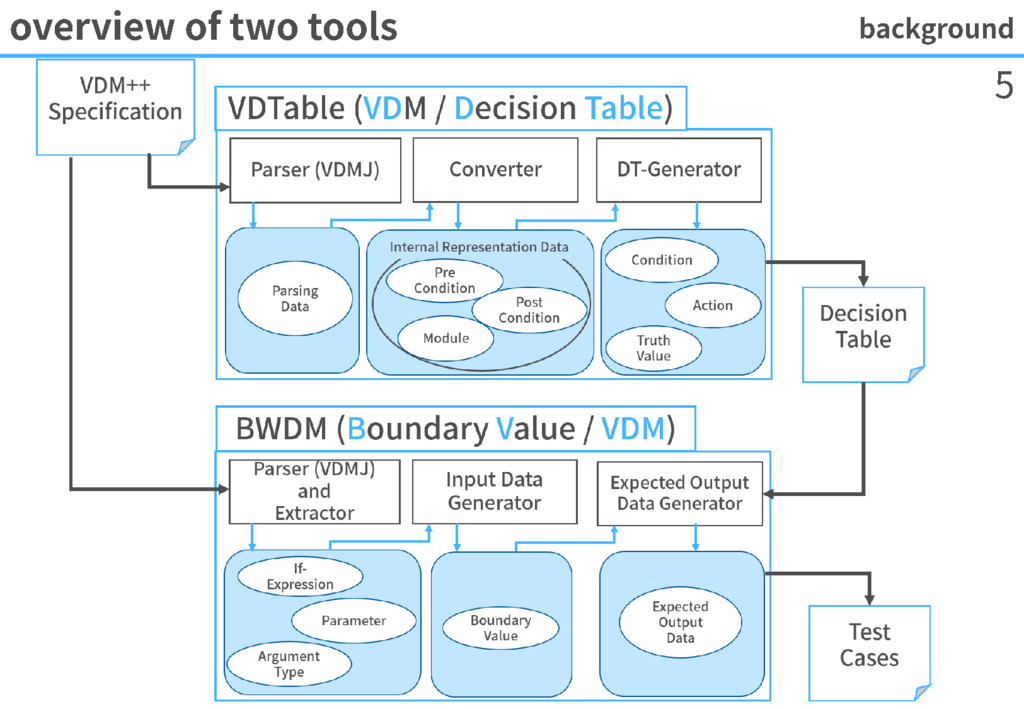
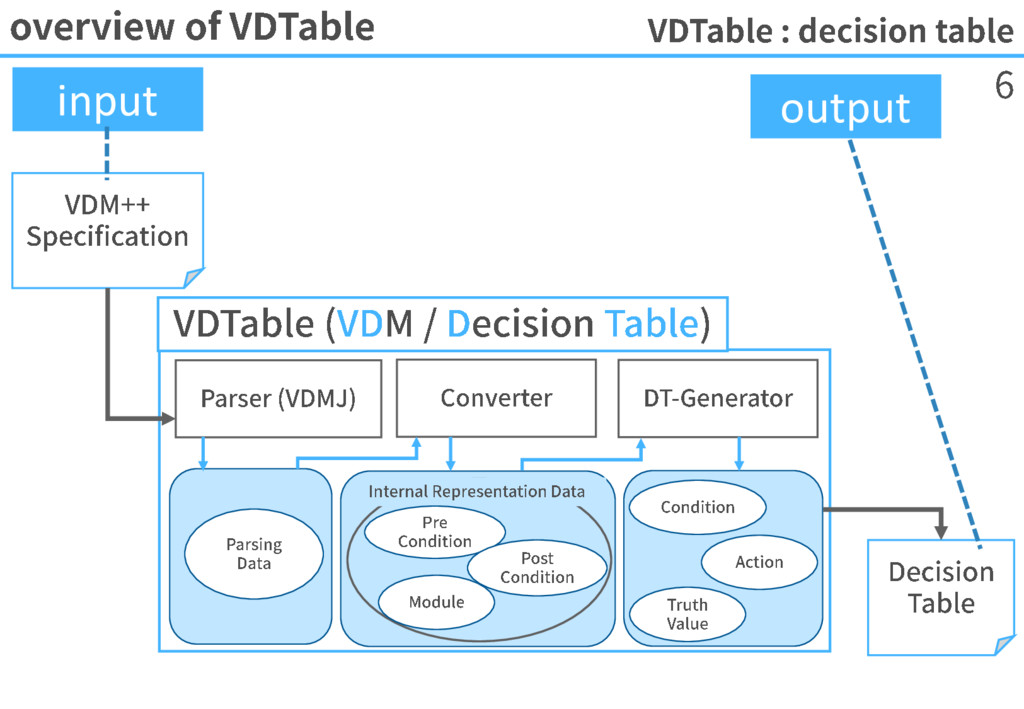
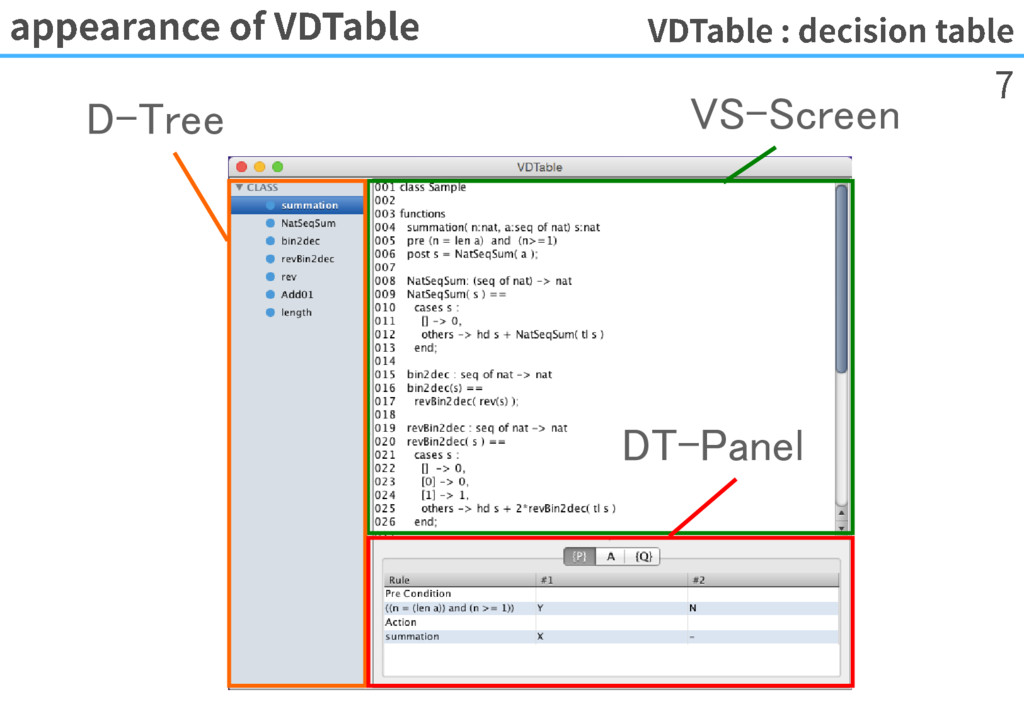
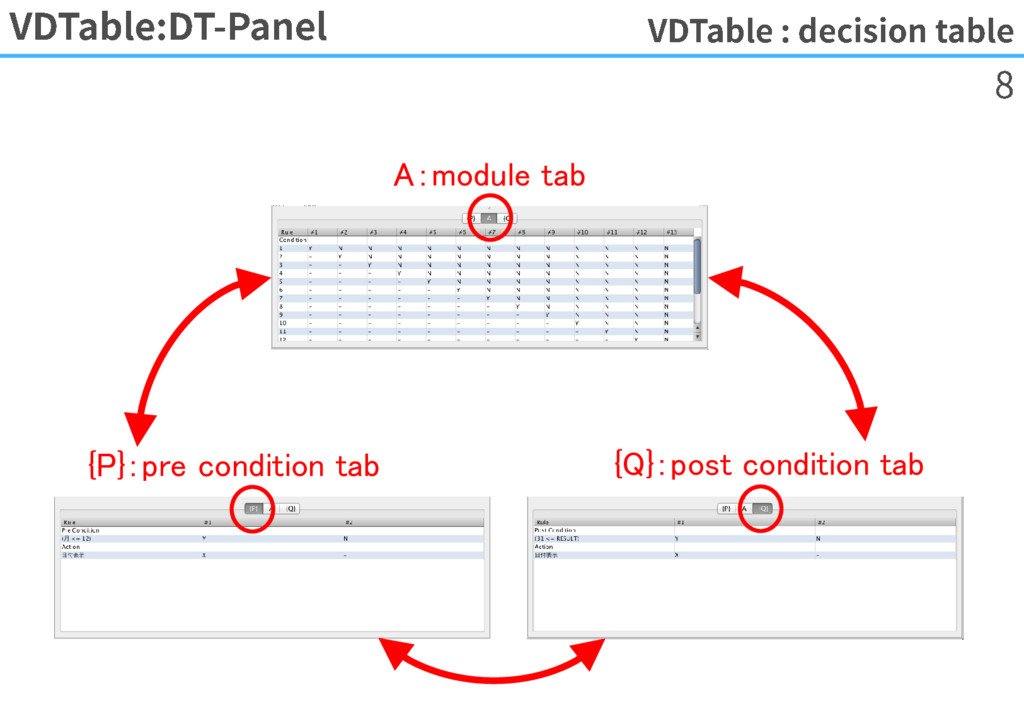
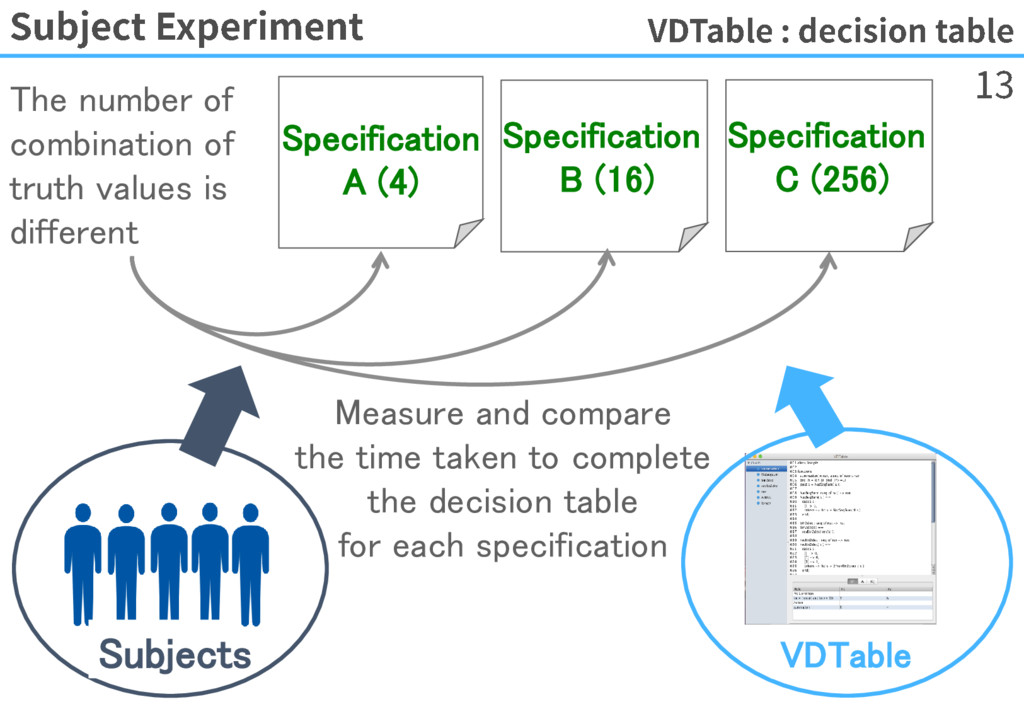
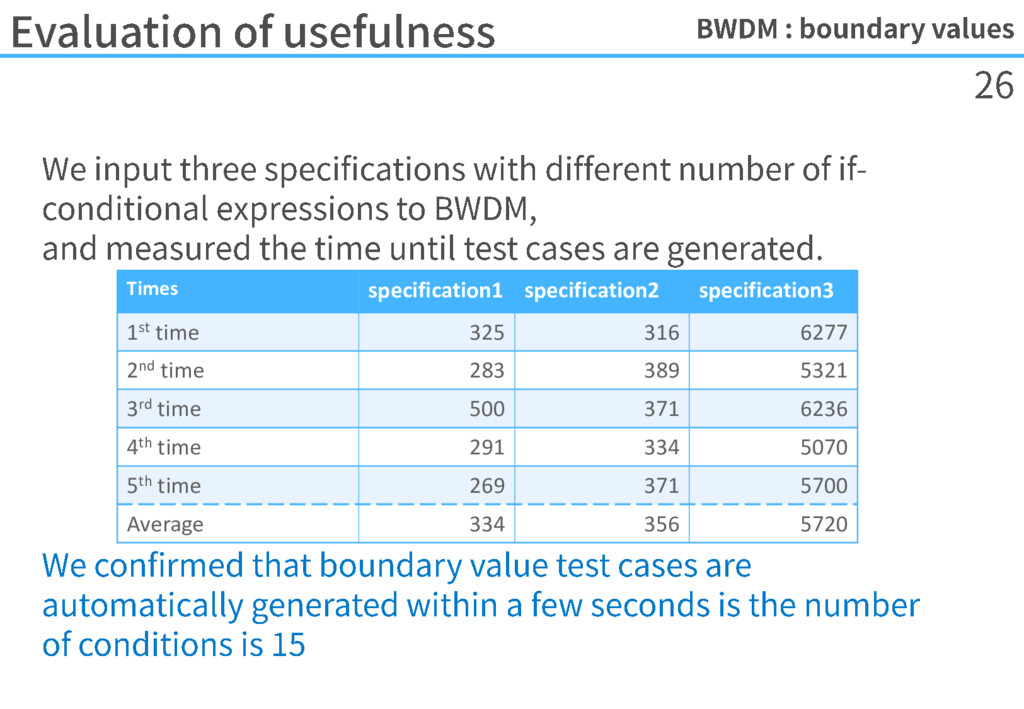
time taken to complete the decision table for each specification Subjects VDTable The number of combination of truth values is different Specification C (256)
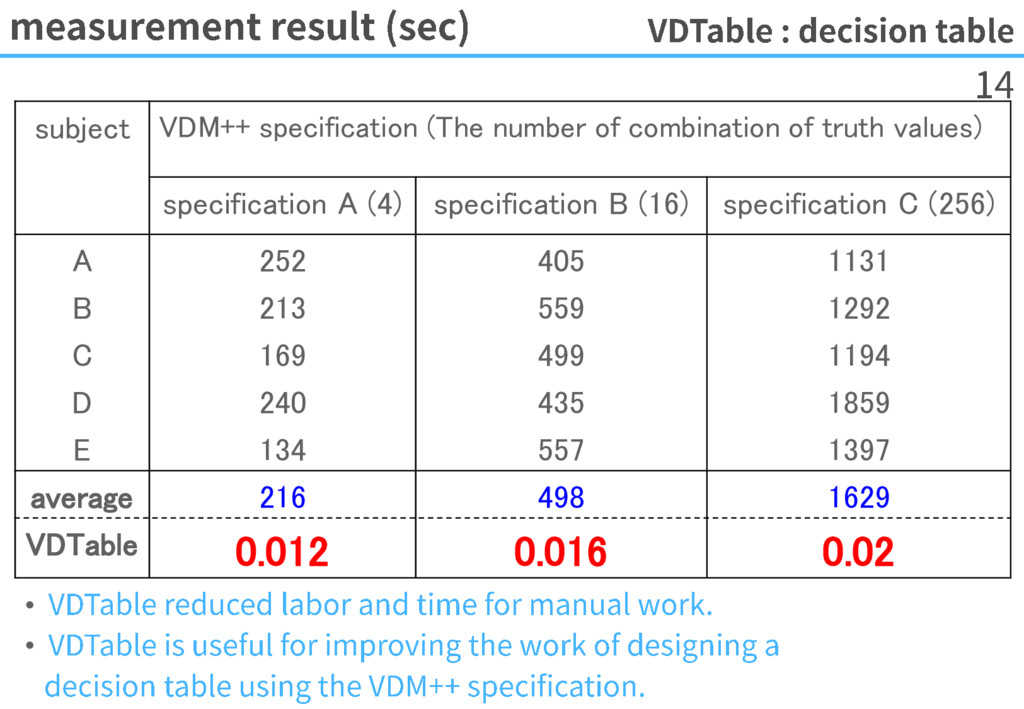
truth values) specification A (4) specification B (16) specification C (256) A 252 405 1131 B 213 559 1292 C 169 499 1194 D 240 435 1859 E 134 557 1397 average 216 498 1629 VDTable 0.012 0.016 0.02
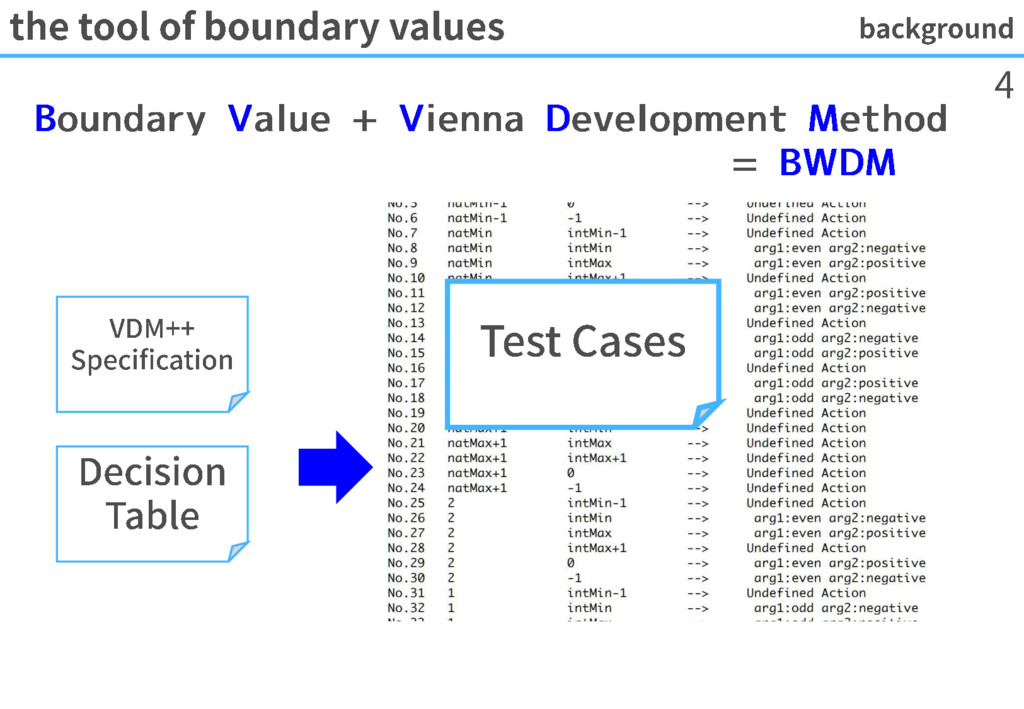
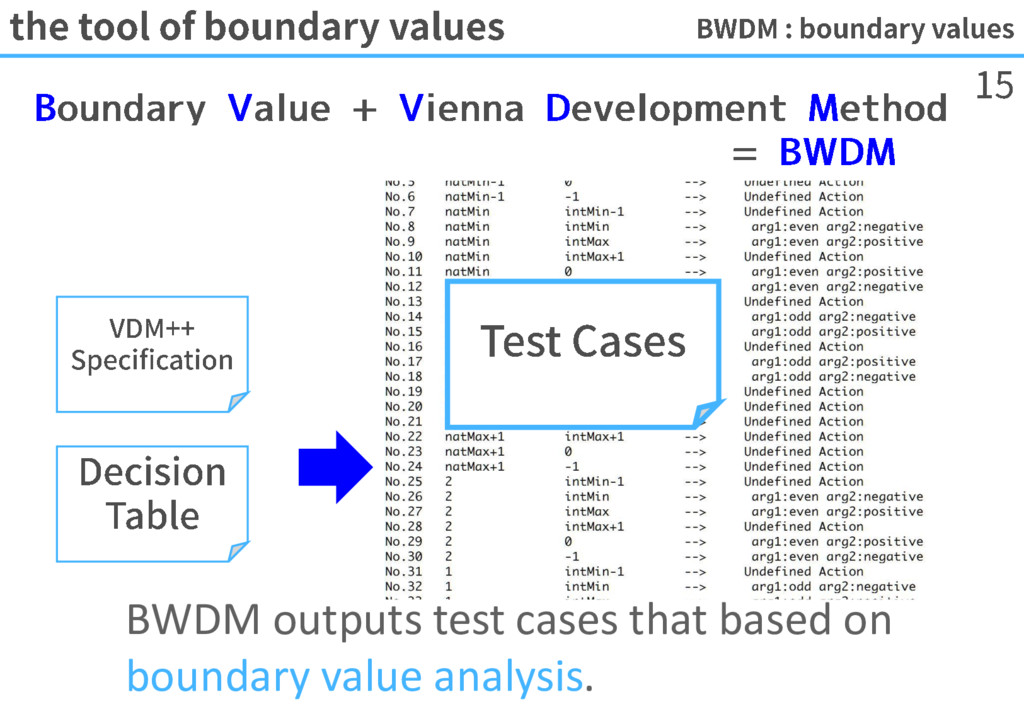
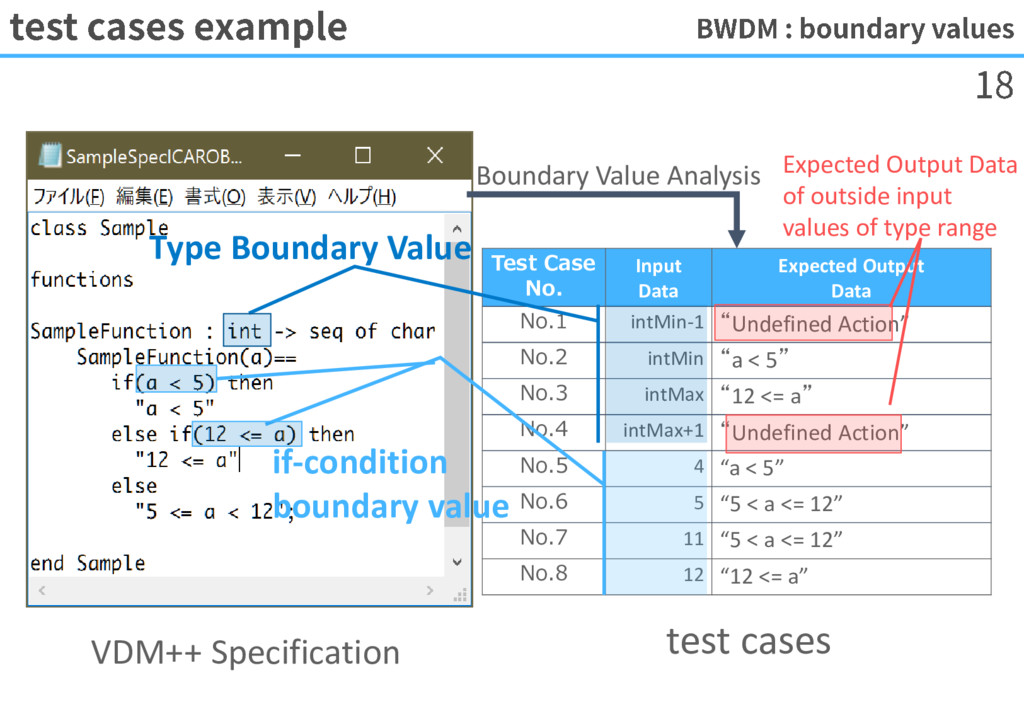
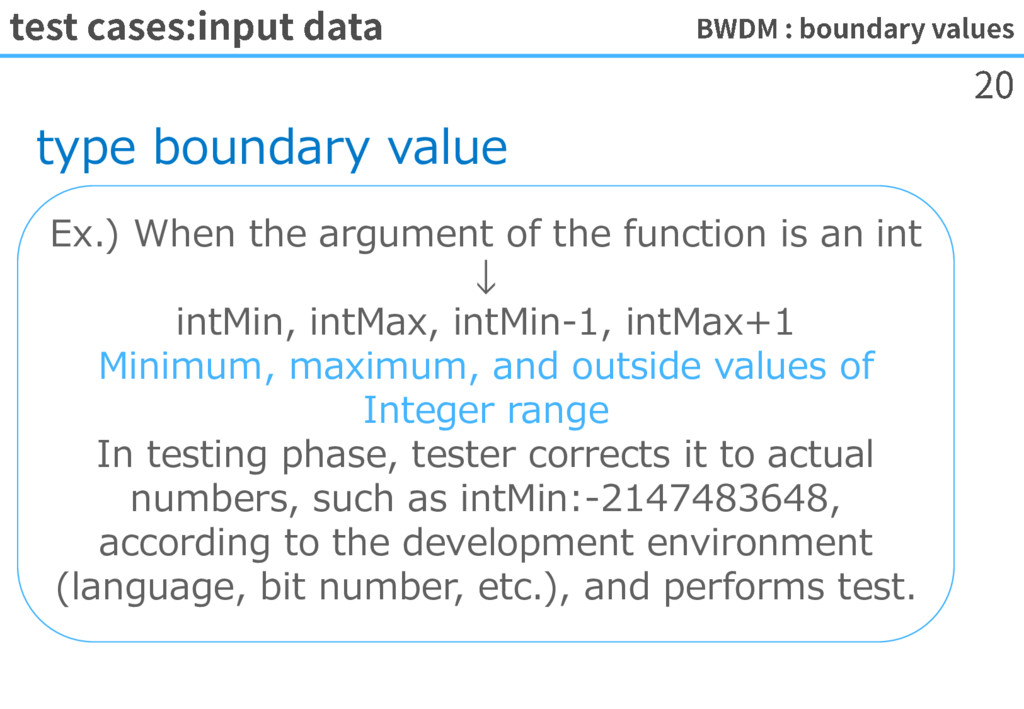
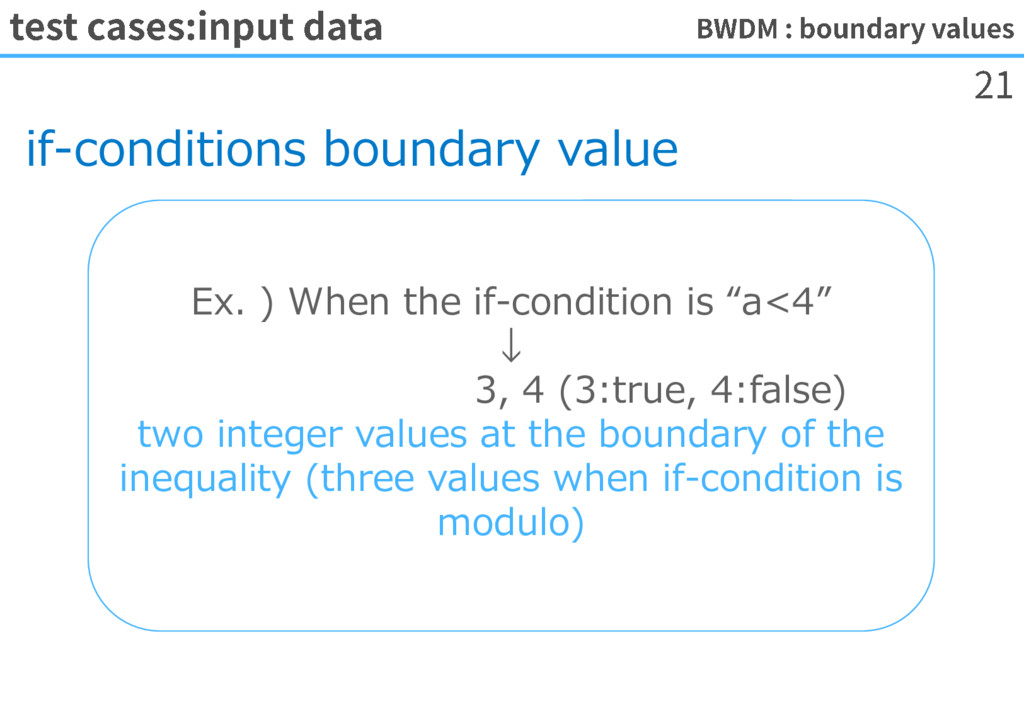
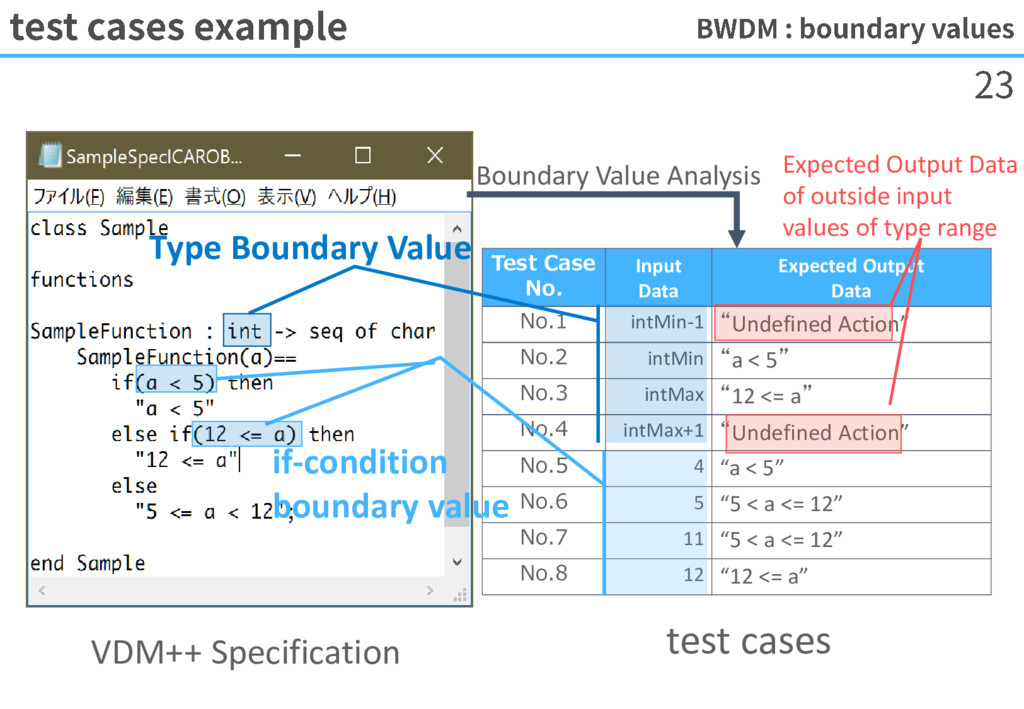
↓ intMin, intMax, intMin-1, intMax+1 Minimum, maximum, and outside values of Integer range In testing phase, tester corrects it to actual numbers, such as intMin:-2147483648, according to the development environment (language, bit number, etc.), and performs test. type boundary value
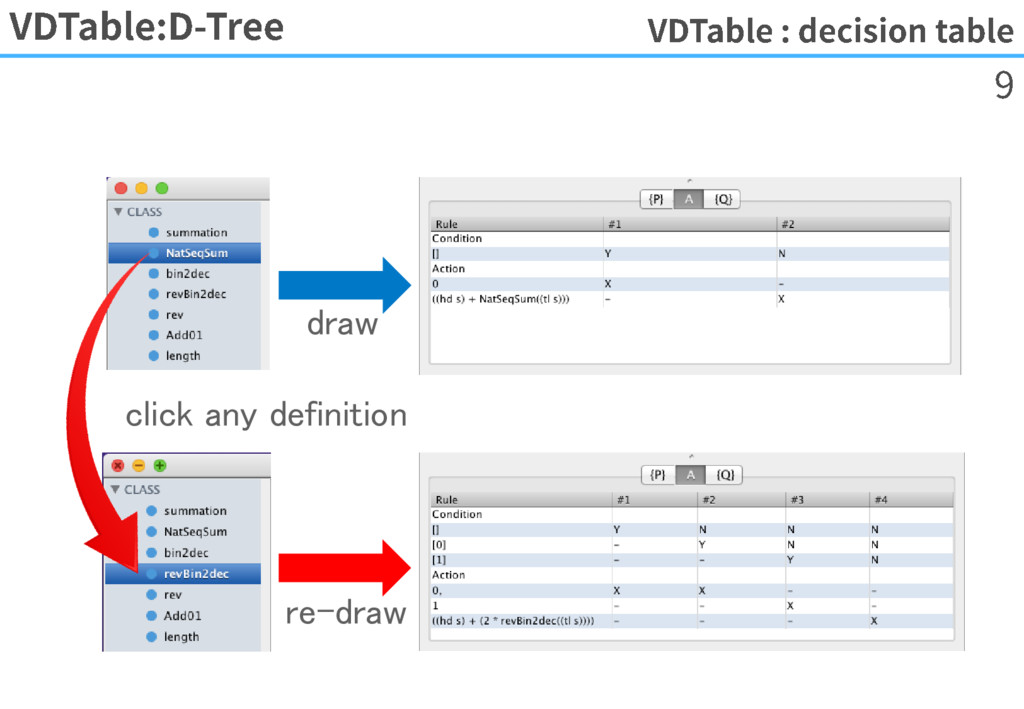
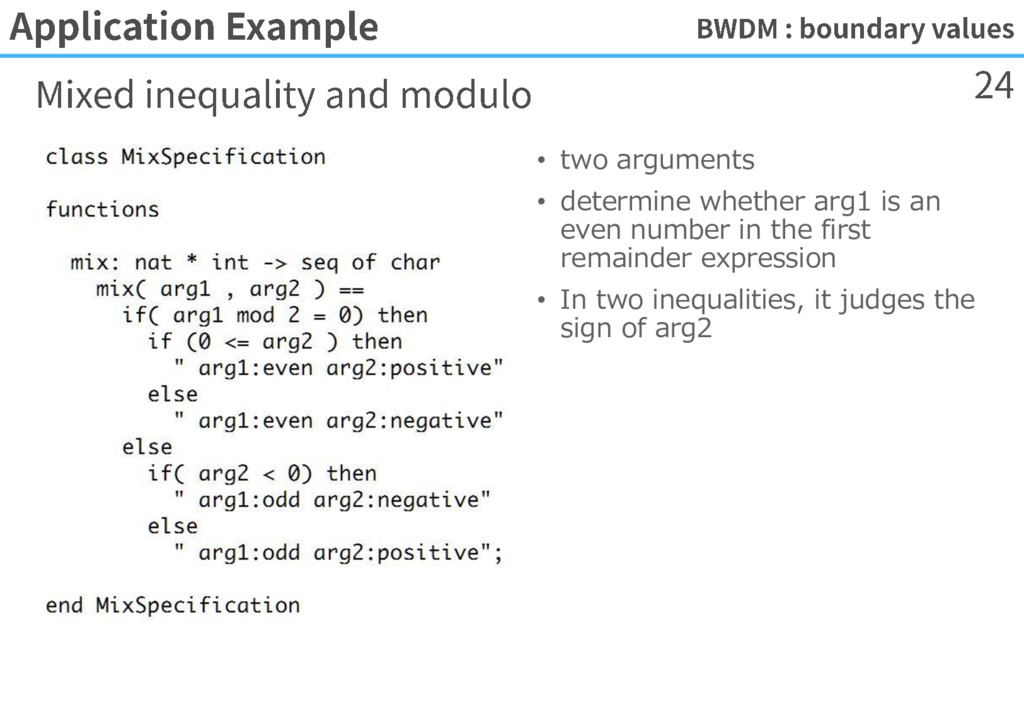
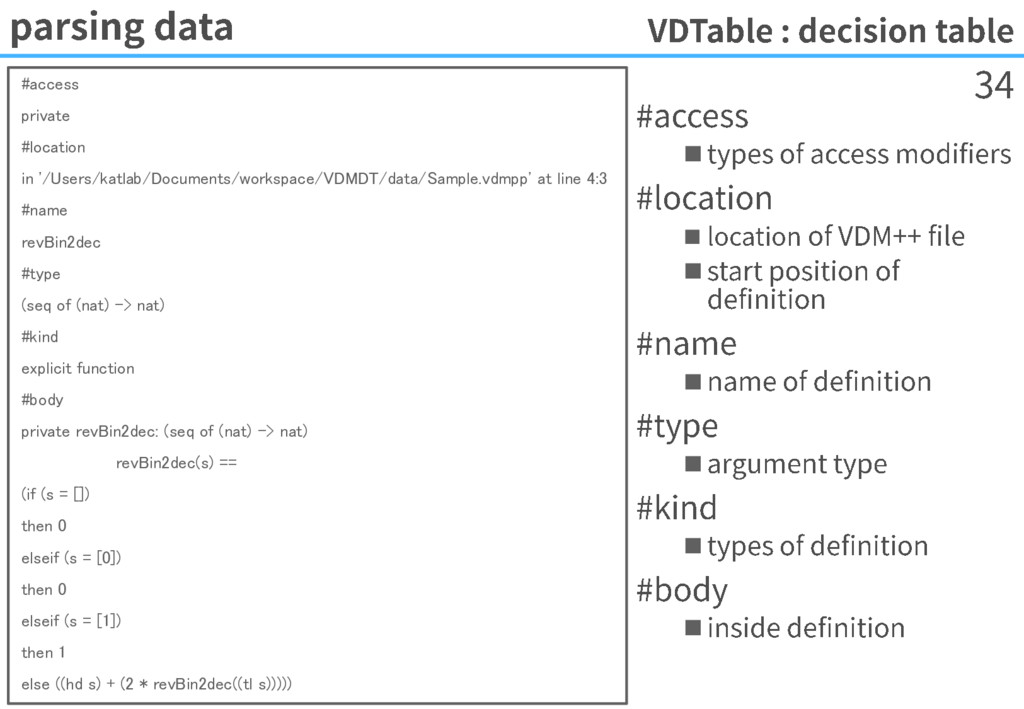
in '/Users/katlab/Documents/workspace/VDMDT/data/Sample.vdmpp' at line 4:3 #name revBin2dec #type (seq of (nat) -> nat) #kind explicit function #body private revBin2dec: (seq of (nat) -> nat) revBin2dec(s) == (if (s = []) then 0 elseif (s = [0]) then 0 elseif (s = [1]) then 1 else ((hd s) + (2 * revBin2dec((tl s)))))
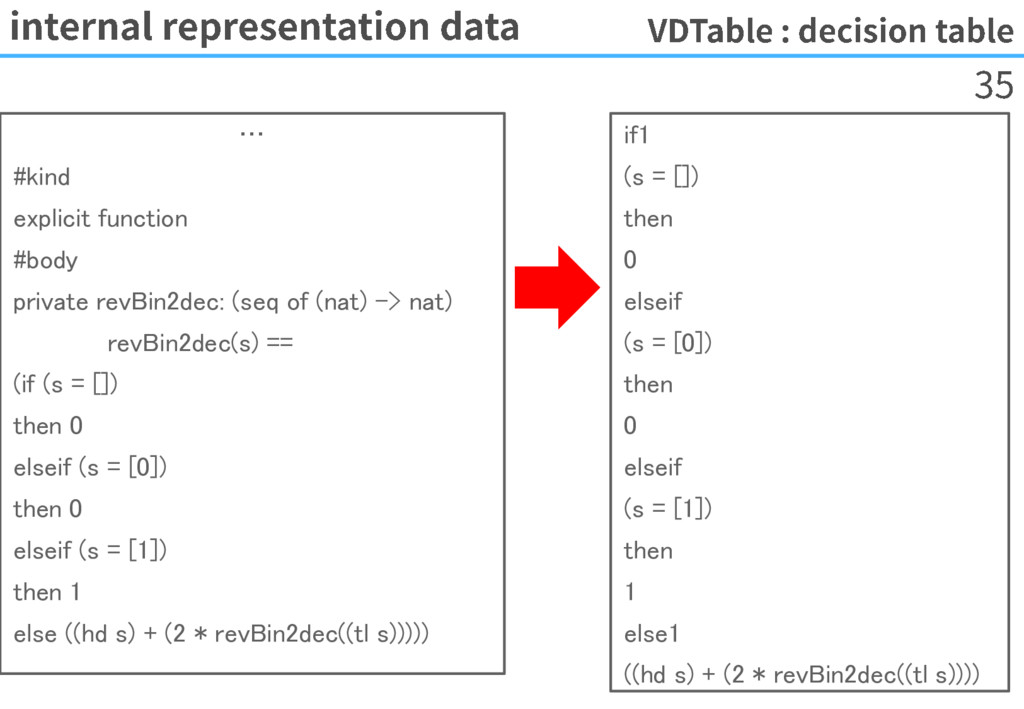
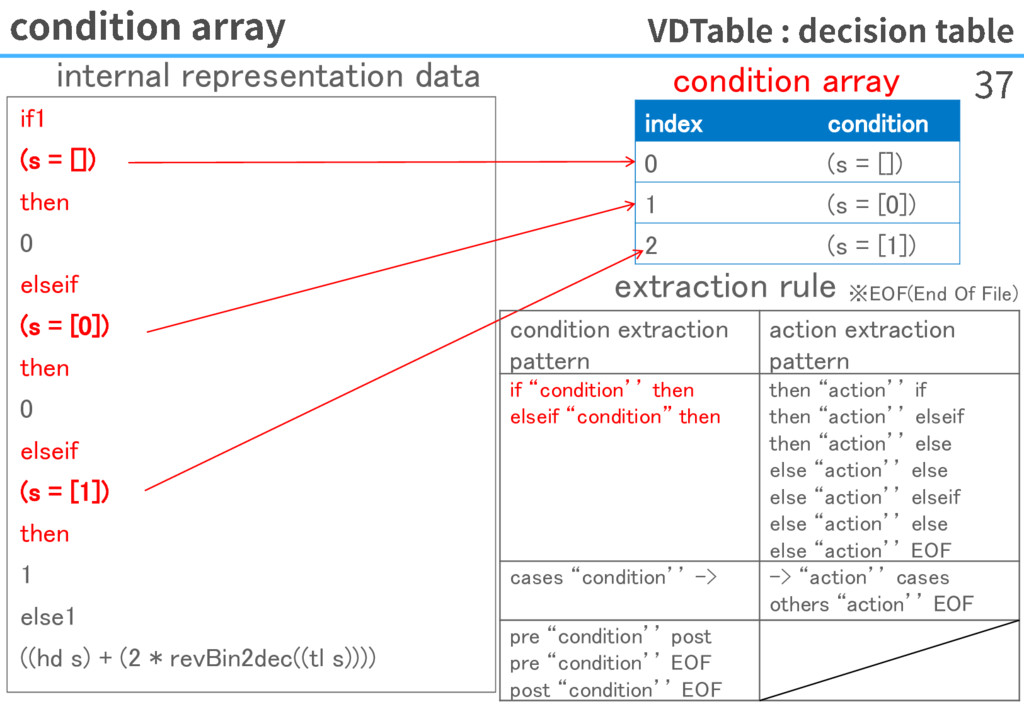
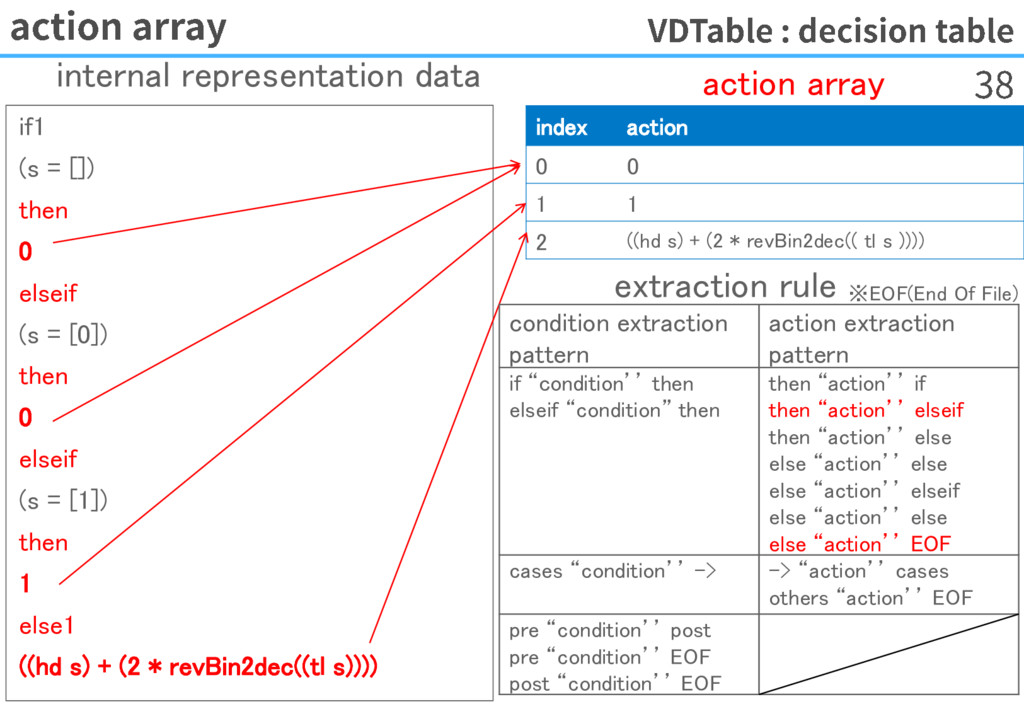
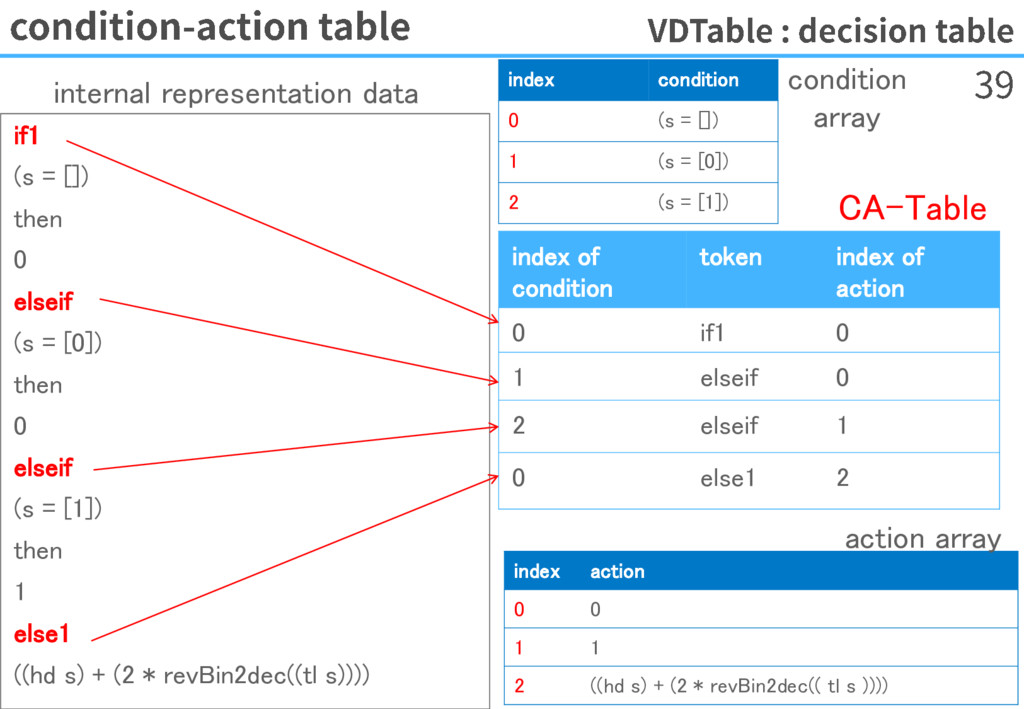
-> nat) revBin2dec(s) == (if (s = []) then 0 elseif (s = [0]) then 0 elseif (s = [1]) then 1 else ((hd s) + (2 * revBin2dec((tl s))))) if1 (s = []) then 0 elseif (s = [0]) then 0 elseif (s = [1]) then 1 else1 ((hd s) + (2 * revBin2dec((tl s))))
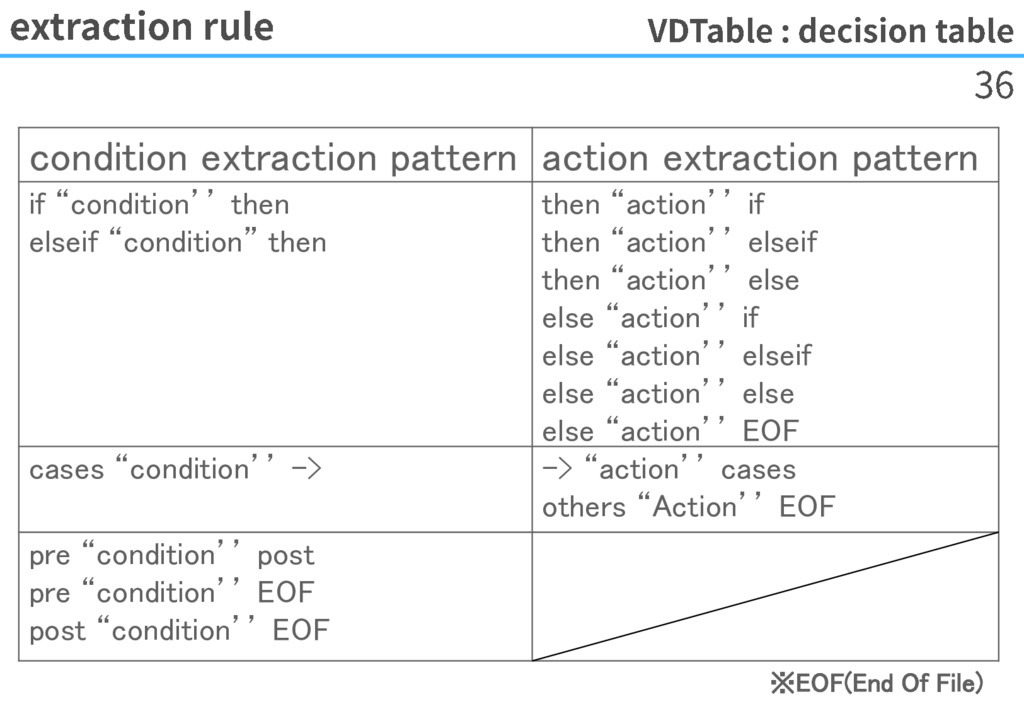
“condition” then then “action’’ if then “action’’ elseif then “action’’ else else “action’’ if else “action’’ elseif else “action’’ else else “action’’ EOF cases “condition’’ -> -> “action’’ cases others “Action’’ EOF pre “condition’’ post pre “condition’’ EOF post “condition’’ EOF ※EOF(End Of File)
= [0]) then 0 elseif (s = [1]) then 1 else1 ((hd s) + (2 * revBin2dec((tl s)))) index condition 0 (s = []) 1 (s = [0]) 2 (s = [1]) internal representation data extraction rule ※EOF(End Of File) condition extraction pattern action extraction pattern if “condition’’ then elseif “condition” then then “action’’ if then “action’’ elseif then “action’’ else else “action’’ else else “action’’ elseif else “action’’ else else “action’’ EOF cases “condition’’ -> -> “action’’ cases others “action’’ EOF pre “condition’’ post pre “condition’’ EOF post “condition’’ EOF
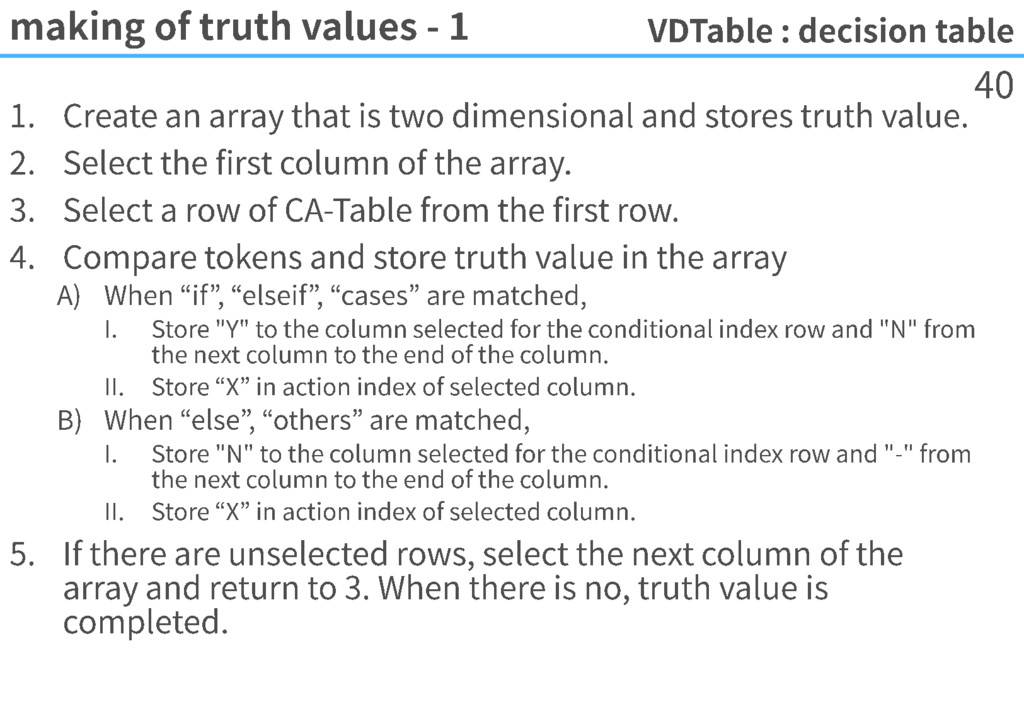
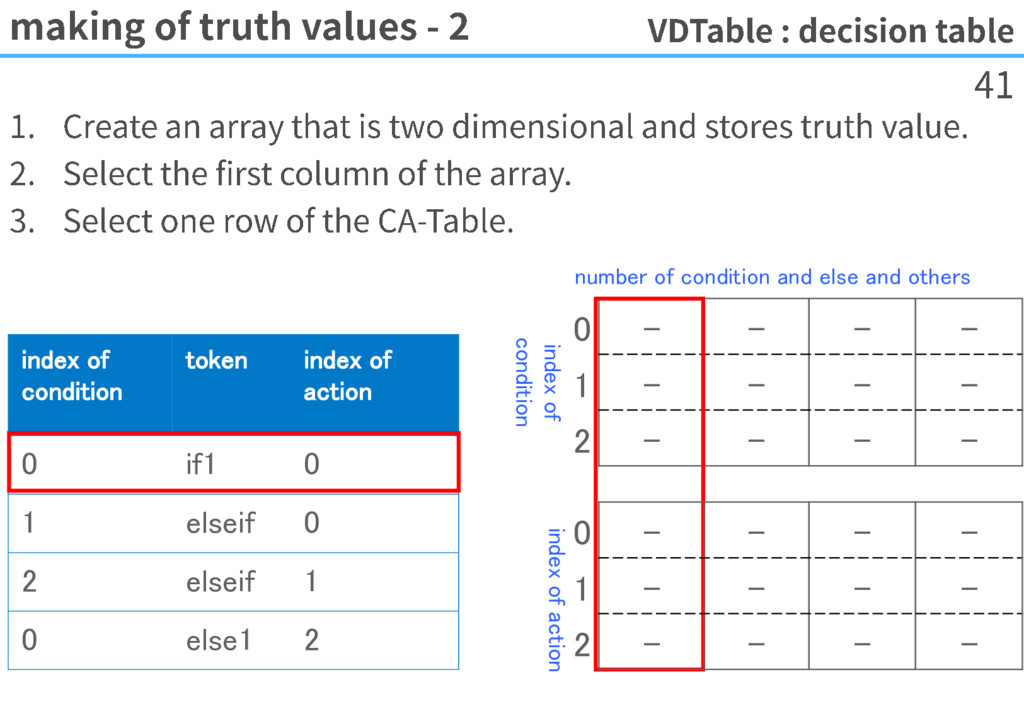
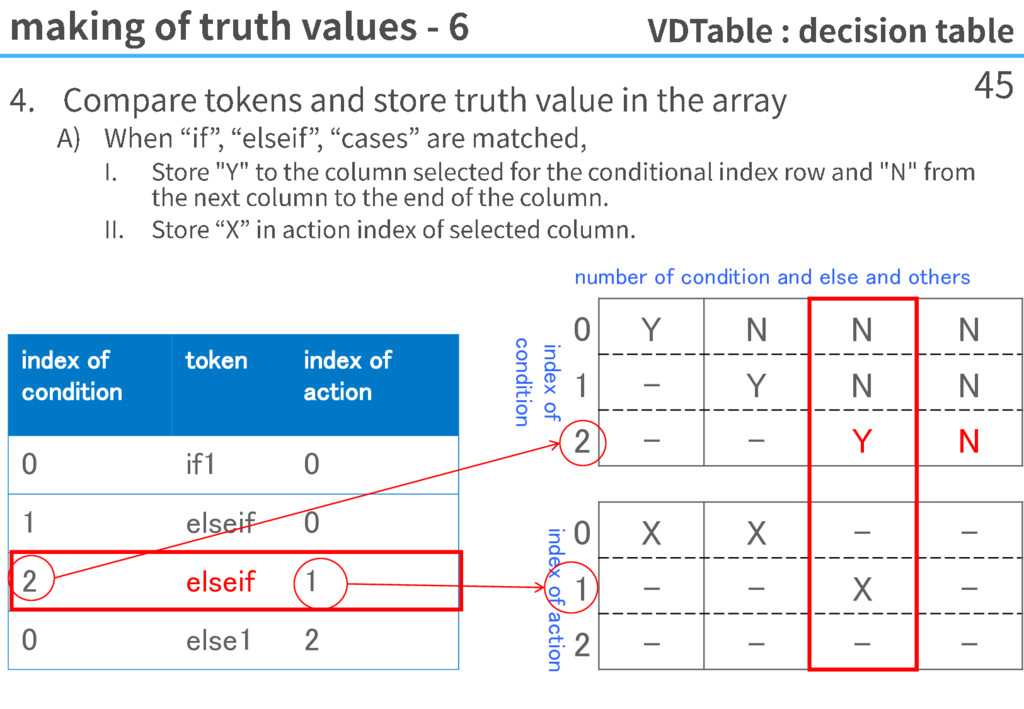
2 - - - - index of condition token index of action 0 if1 0 1 elseif 0 2 elseif 1 0 else1 2 number of condition and else and others index of condition index of action 0 - - - - 1 - - - - 2 - - - -
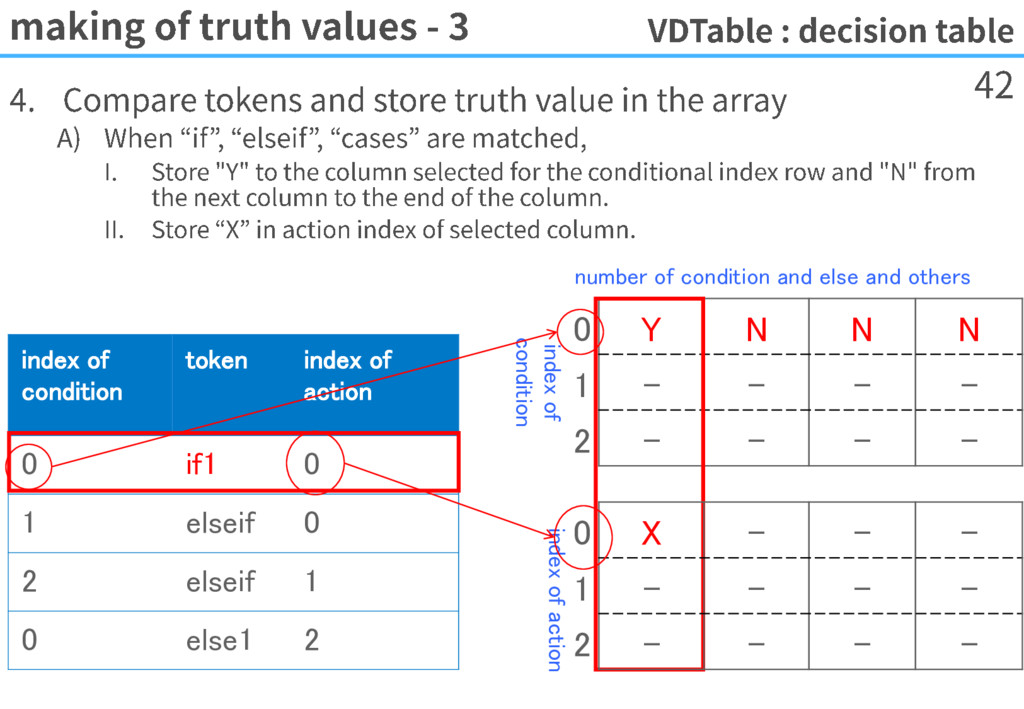
2 - - - - index of condition token index of action 0 if1 0 1 elseif 0 2 elseif 1 0 else1 2 number of condition and else and others index of condition index of action 0 X - - - 1 - - - - 2 - - - -
2 - - - - index of condition token index of action 0 if1 0 1 elseif 0 2 elseif 1 0 else1 2 number of condition and else and others index of condition index of action 0 X - - - 1 - - - - 2 - - - -
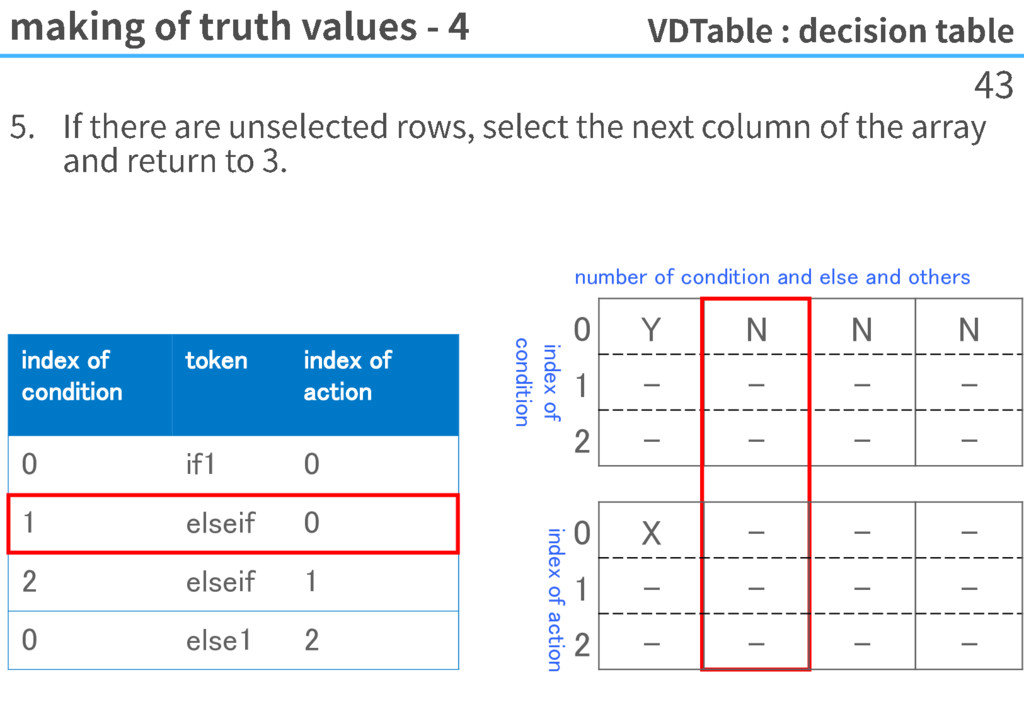
2 - - - - index of condition token index of action 0 if1 0 1 elseif 0 2 elseif 1 0 else1 2 number of condition and else and others index of condition index of action 0 X X - - 1 - - - - 2 - - - -
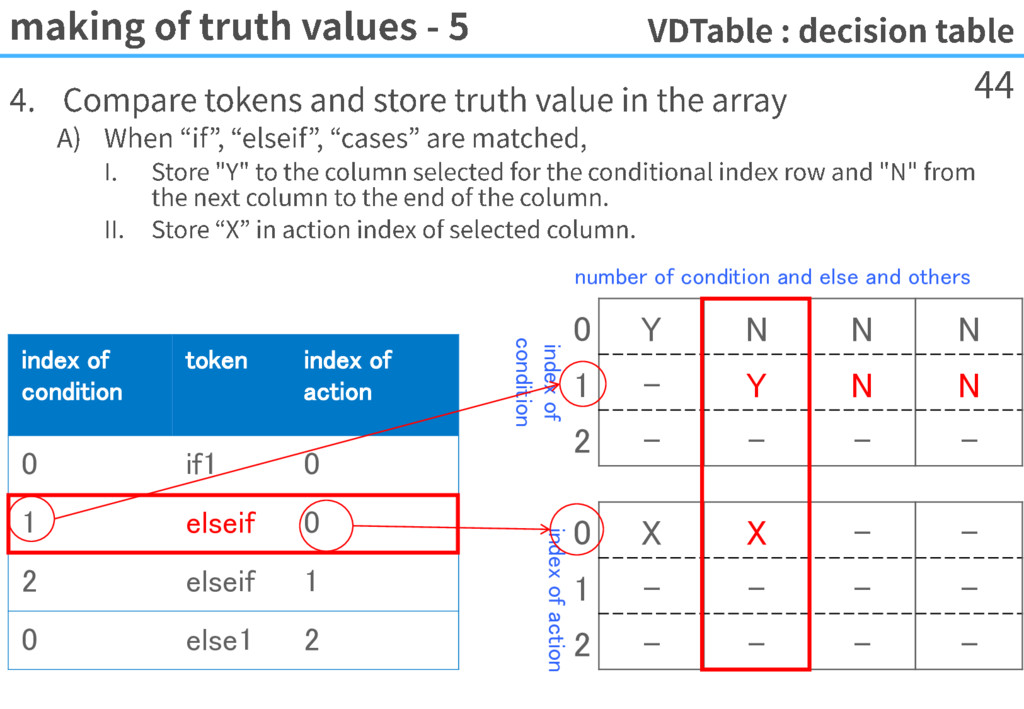
2 - - Y N index of condition token index of action 0 if1 0 1 elseif 0 2 elseif 1 0 else1 2 number of condition and else and others index of condition index of action 0 X X - - 1 - - X - 2 - - - -
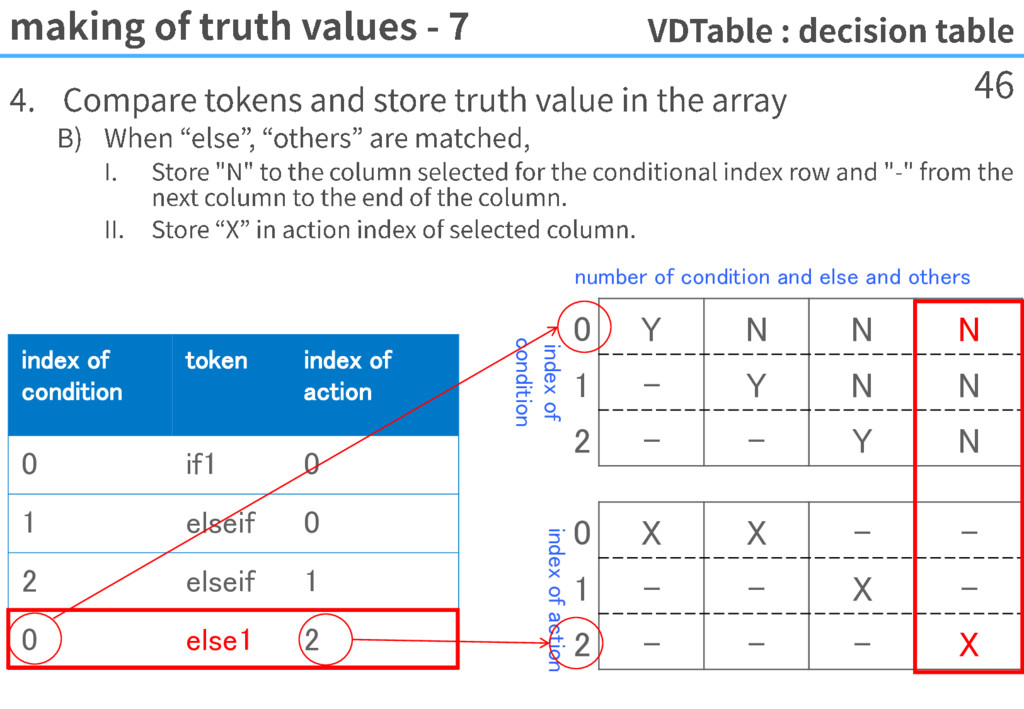
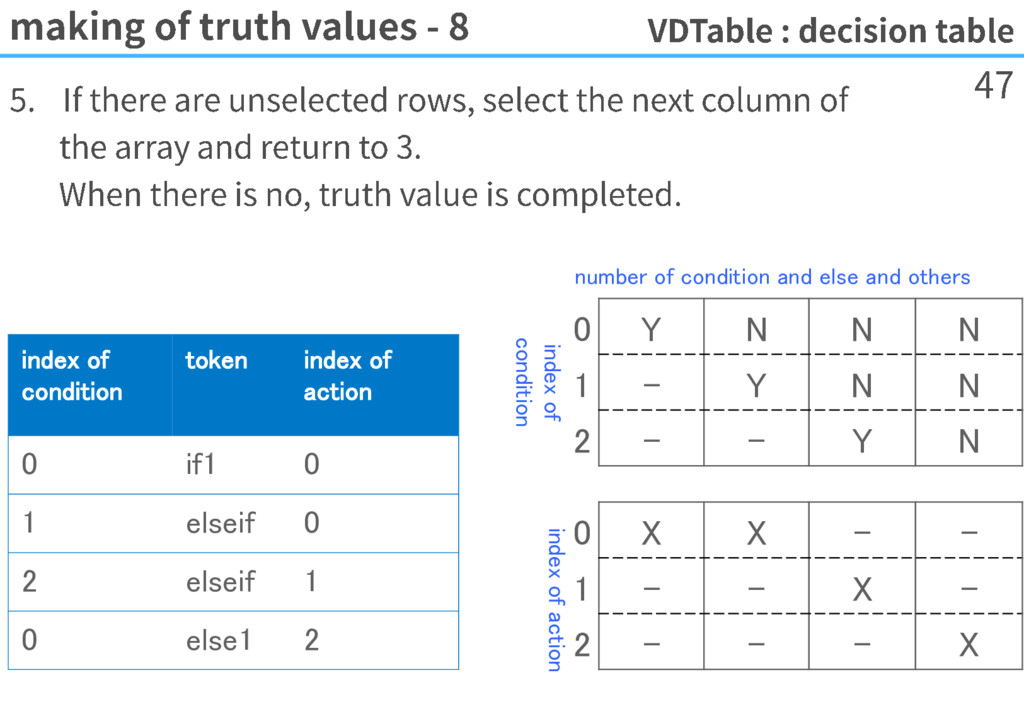
2 - - Y N index of condition token index of action 0 if1 0 1 elseif 0 2 elseif 1 0 else1 2 number of condition and else and others index of condition index of action 0 X X - - 1 - - X - 2 - - - X
2 - - Y N index of condition token index of action 0 if1 0 1 elseif 0 2 elseif 1 0 else1 2 number of condition and else and others index of condition index of action 0 X X - - 1 - - X - 2 - - - X
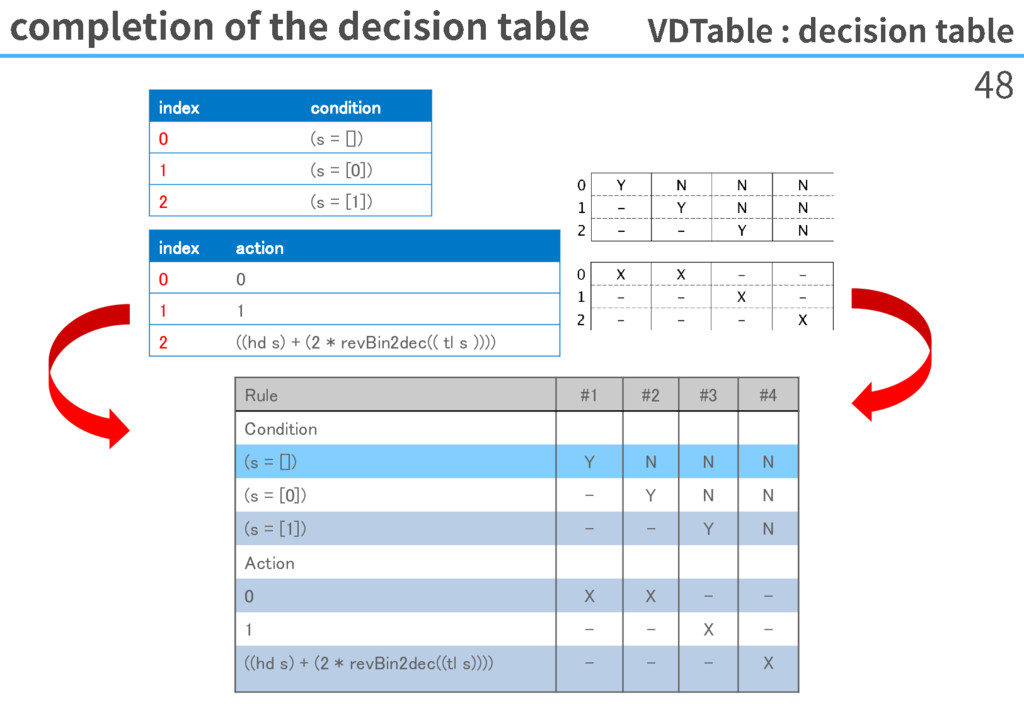
N N N (s = [0]) - Y N N (s = [1]) - - Y N Action 0 X X - - 1 - - X - ((hd s) + (2 * revBin2dec((tl s)))) - - - X index condition 0 (s = []) 1 (s = [0]) 2 (s = [1]) index action 0 0 1 1 2 ((hd s) + (2 * revBin2dec(( tl s ))))
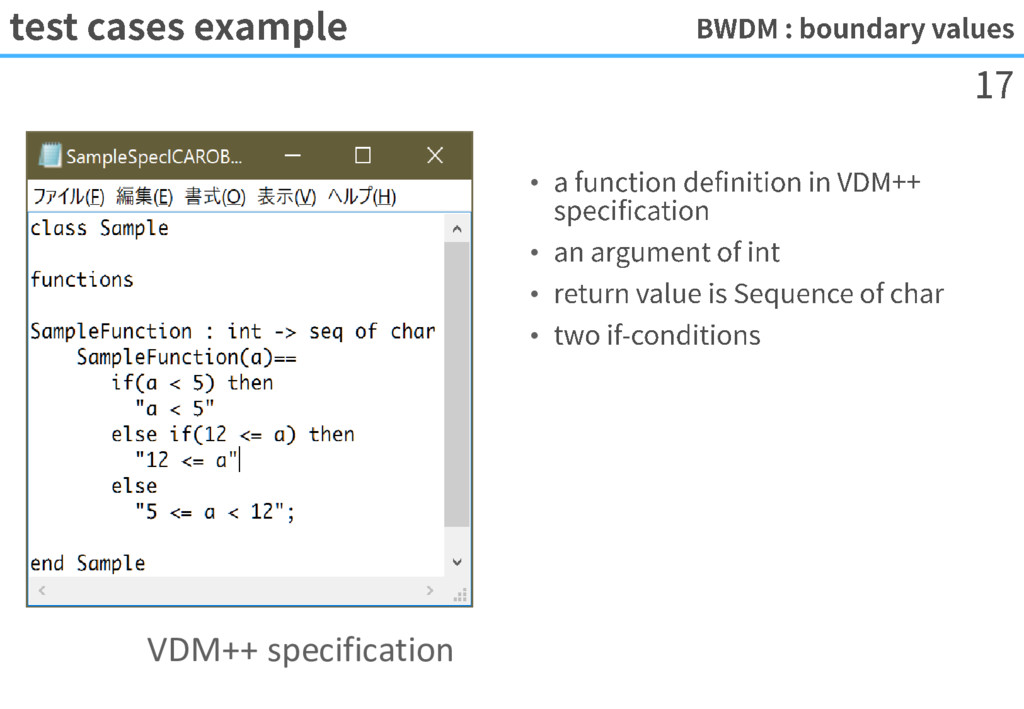
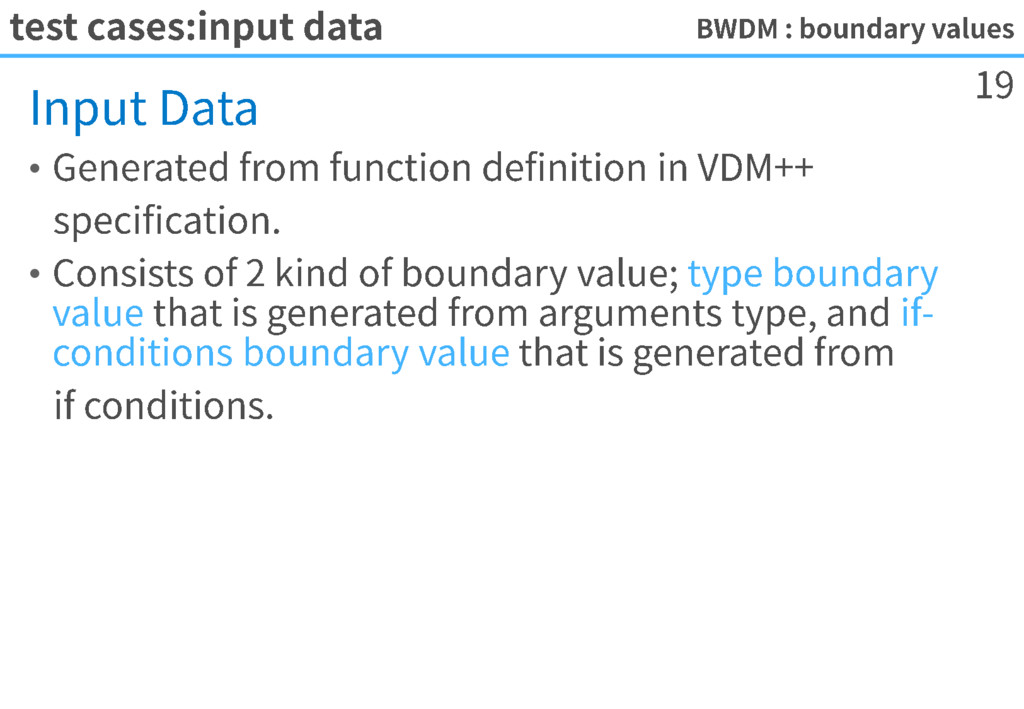
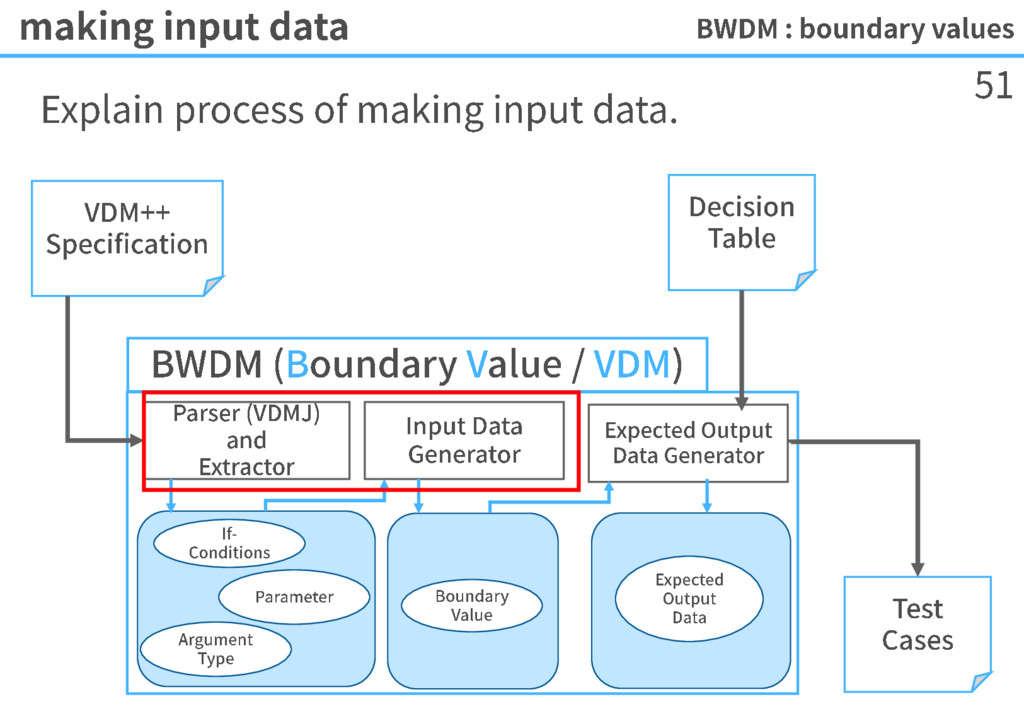
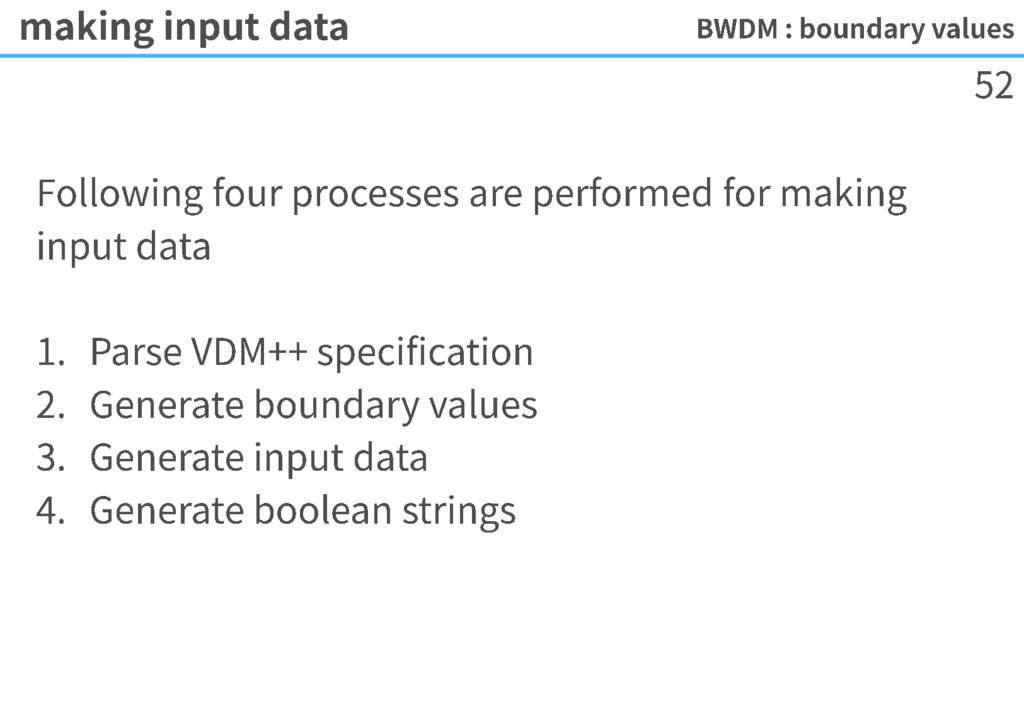
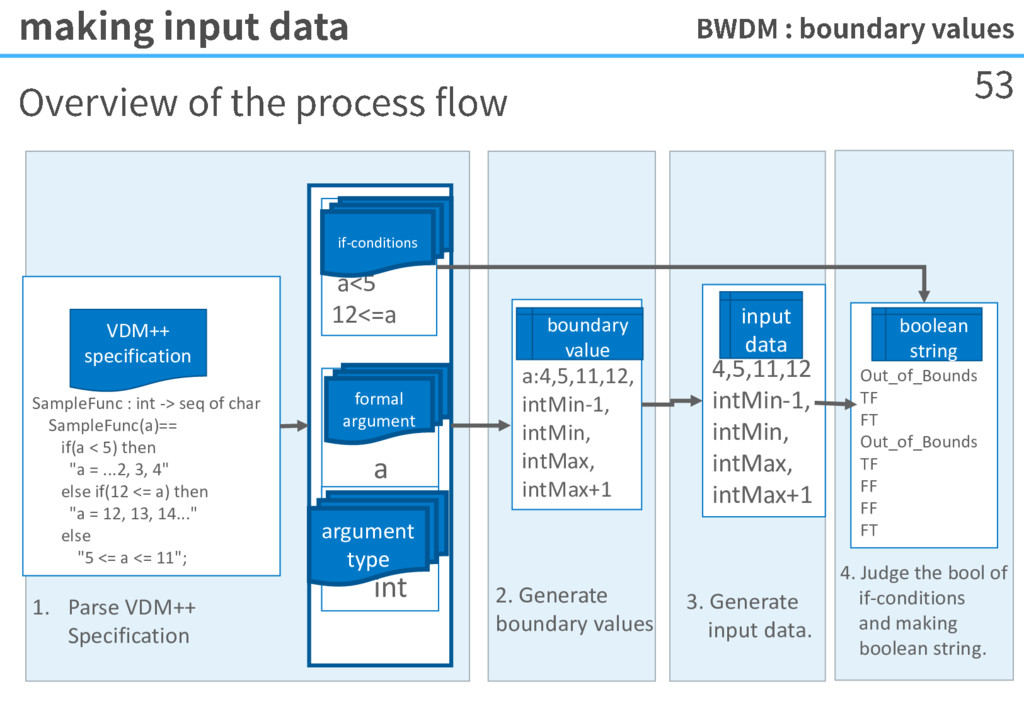
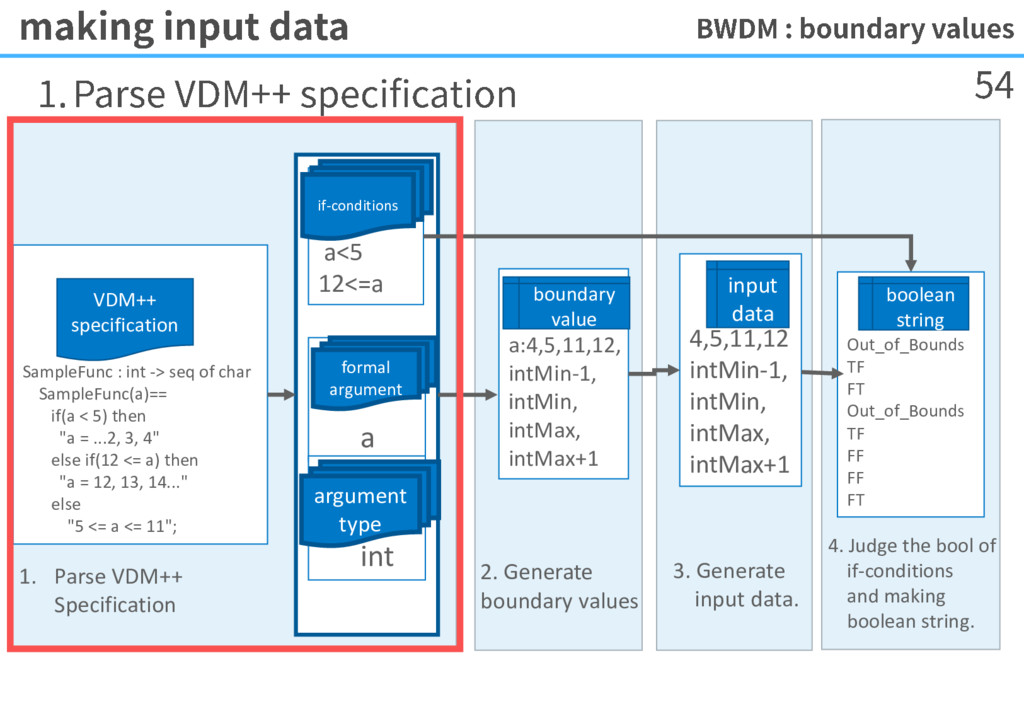
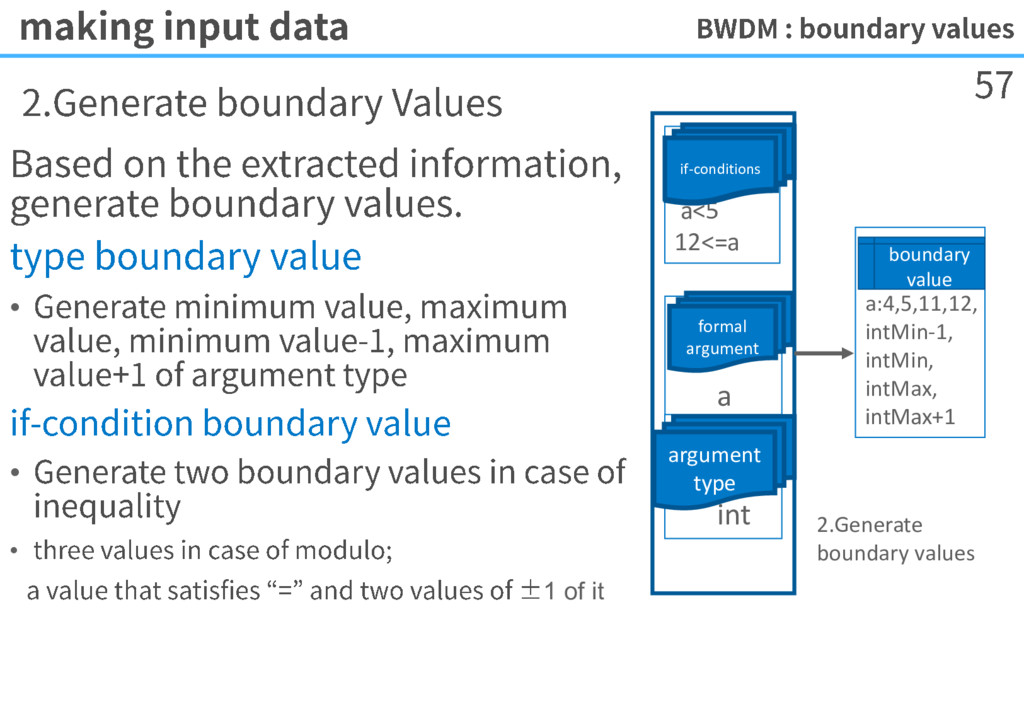
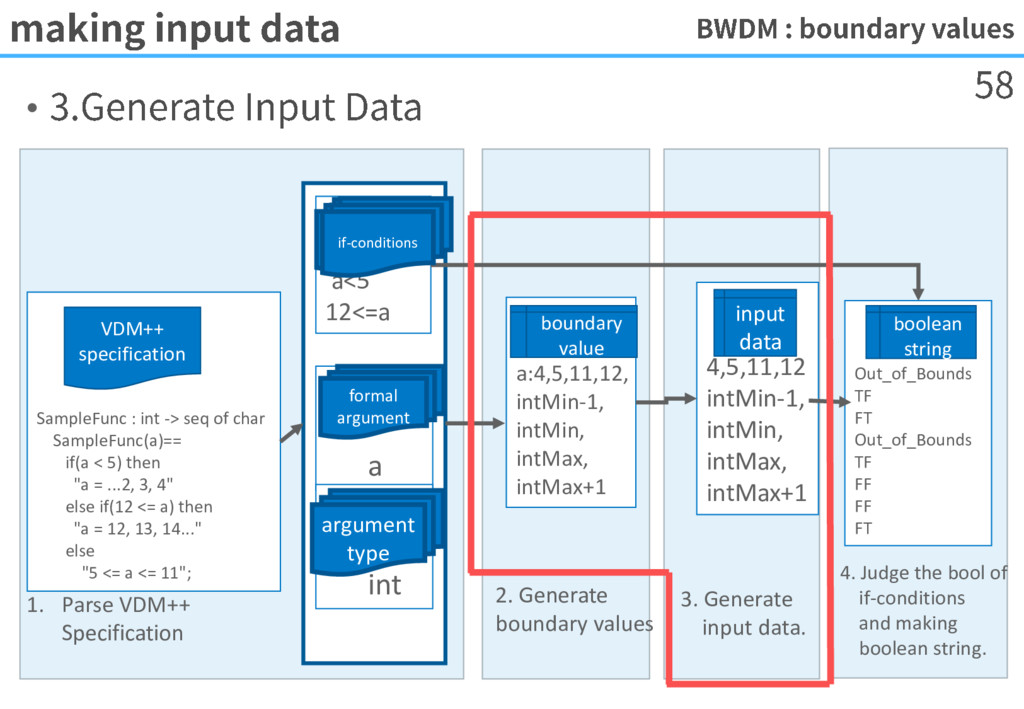
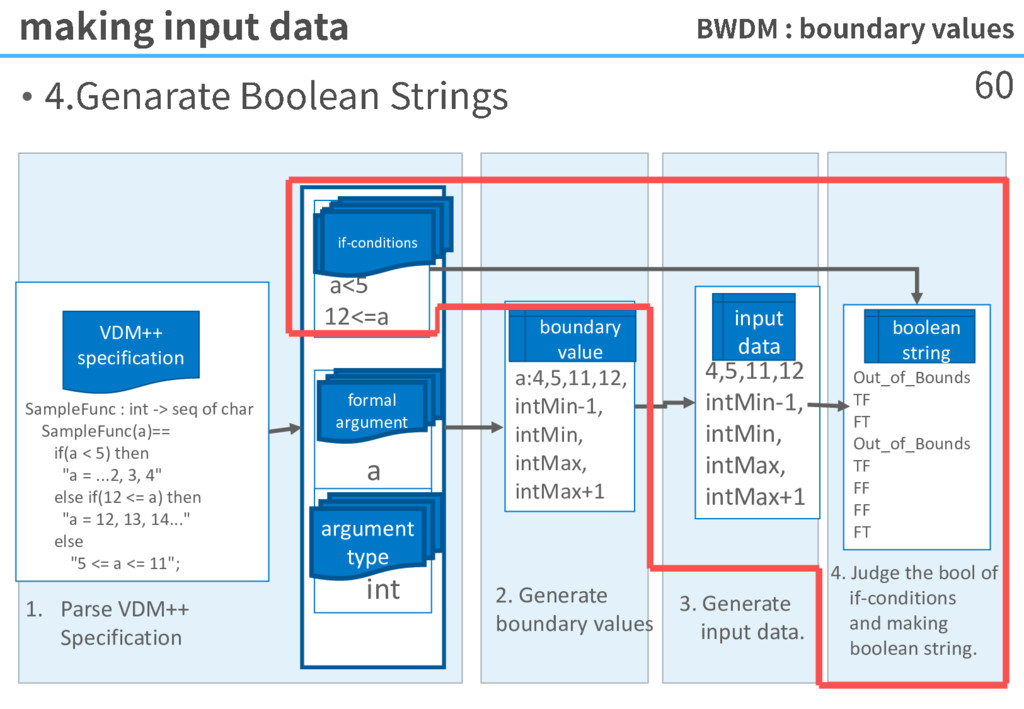
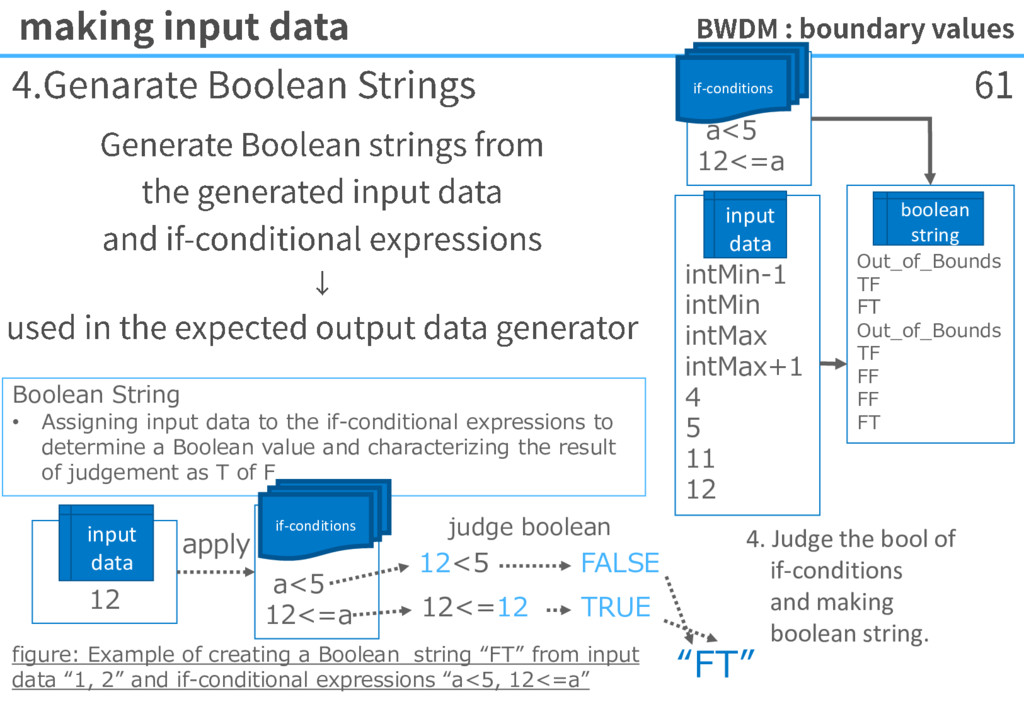
a<5 12<=a a int if-conditions formal argument boundary value SampleFunc : int -> seq of char SampleFunc(a)== if(a < 5) then "a = ...2, 3, 4" else if(12 <= a) then "a = 12, 13, 14..." else "5 <= a <= 11"; argument type VDM++ specification input data 2. Generate boundary values Out_of_Bounds TF FT Out_of_Bounds TF FF FF FT boolean string 3. Generate input data. 4. Judge the bool of if-conditions and making boolean string. 1. Parse VDM++ Specification
a<5 12<=a a int formal argument boundary value SampleFunc : int -> seq of char SampleFunc(a)== if(a < 5) then "a = ...2, 3, 4" else if(12 <= a) then "a = 12, 13, 14..." else "5 <= a <= 11"; argument type VDM++ specification input data Out_of_Bounds TF FT Out_of_Bounds TF FF FF FT boolean string 3. Generate input data. 1. Parse VDM++ Specification 2. Generate boundary values if-conditions 4. Judge the bool of if-conditions and making boolean string.
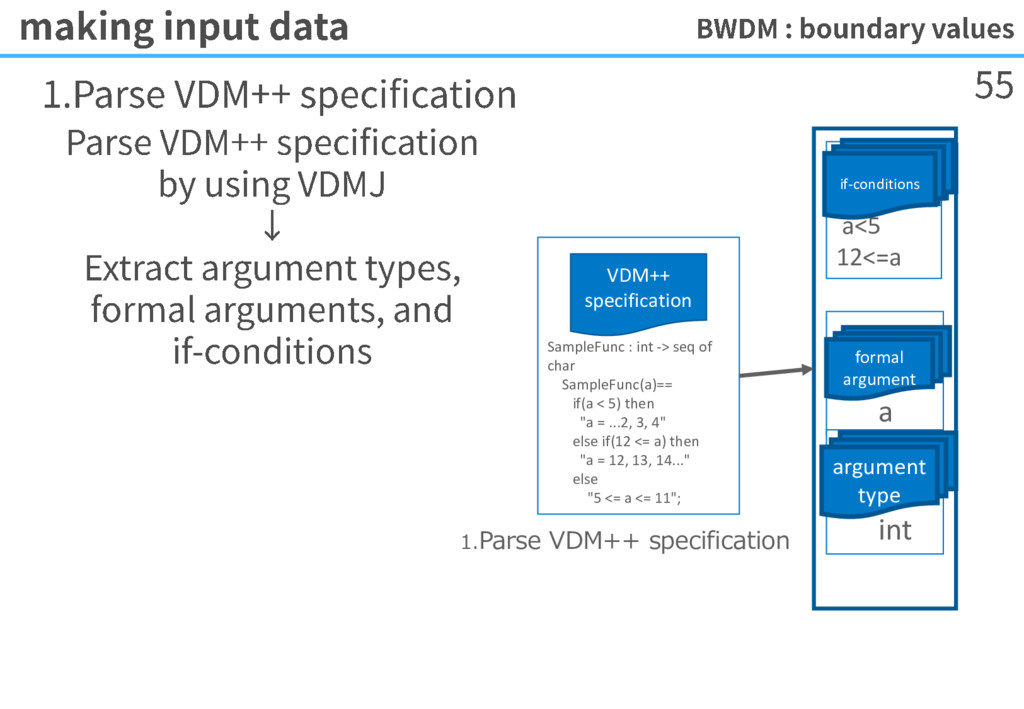
: int -> seq of char SampleFunc(a)== if(a < 5) then "a = ...2, 3, 4" else if(12 <= a) then "a = 12, 13, 14..." else "5 <= a <= 11"; argument type formal argument VDM++ specification if-conditions
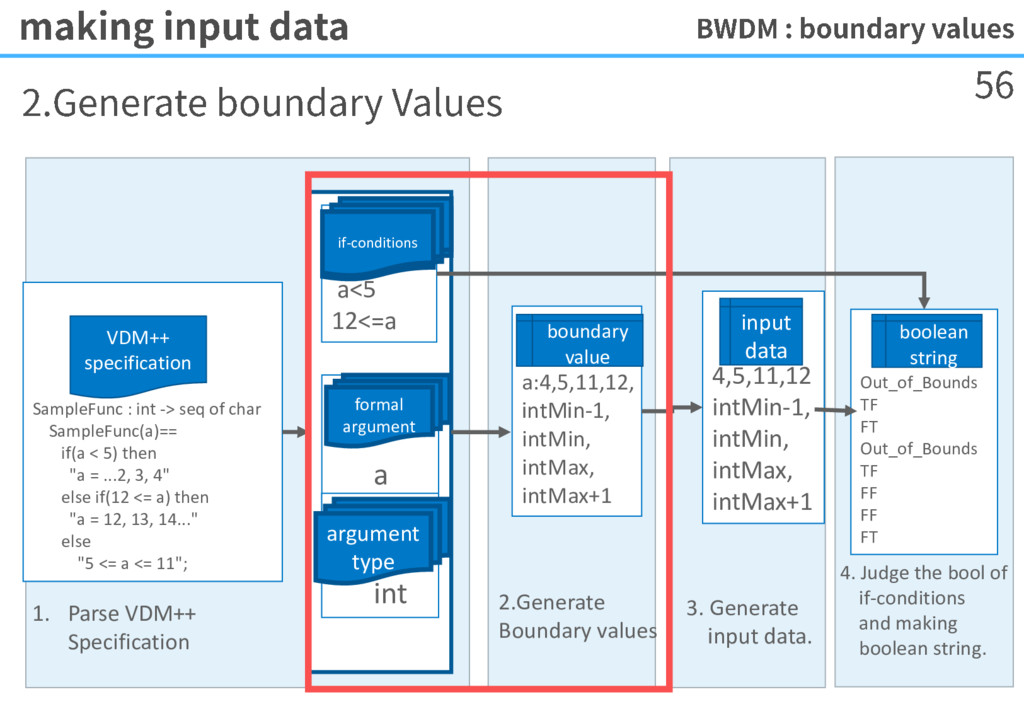
a<5 12<=a a int if-conditional expression formal argument boundary value SampleFunc : int -> seq of char SampleFunc(a)== if(a < 5) then "a = ...2, 3, 4" else if(12 <= a) then "a = 12, 13, 14..." else "5 <= a <= 11"; argument type VDM++ specification input data 2.Generate Boundary values Out_of_Bounds TF FT Out_of_Bounds TF FF FF FT boolean string 3. Generate input data. 1. Parse VDM++ Specification if-conditions 4. Judge the bool of if-conditions and making boolean string.
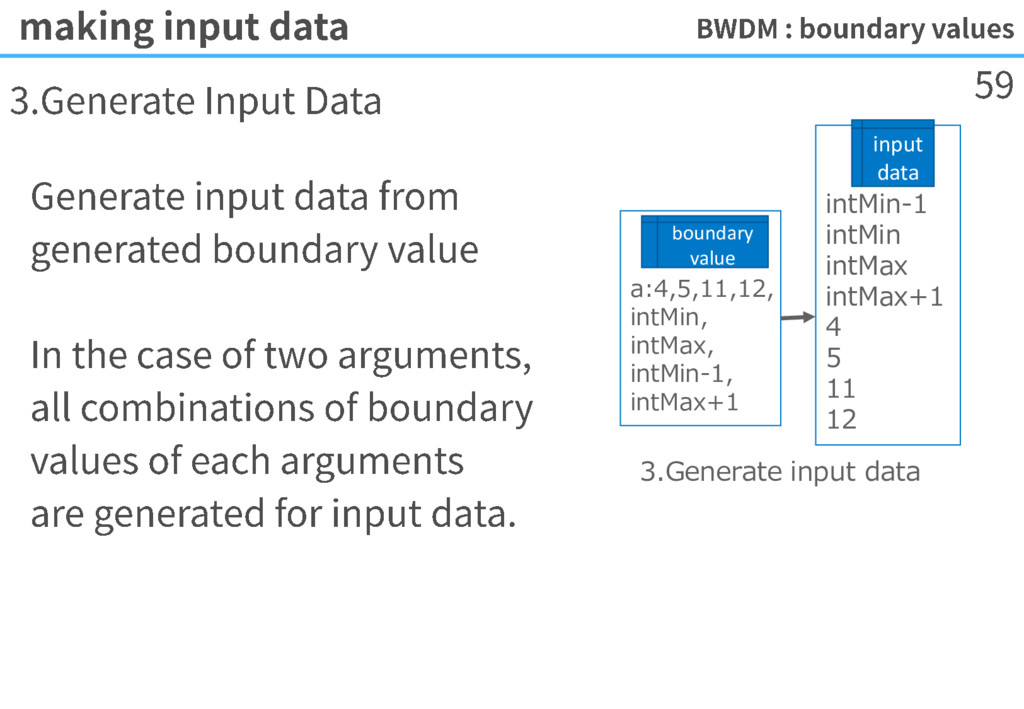
intMax+1 a<5 12<=a a int if-conditional expression formal argument boundary value SampleFunc : int -> seq of char SampleFunc(a)== if(a < 5) then "a = ...2, 3, 4" else if(12 <= a) then "a = 12, 13, 14..." else "5 <= a <= 11"; argument type VDM++ specification input data Out_of_Bounds TF FT Out_of_Bounds TF FF FF FT boolean string 3. Generate input data. 1. Parse VDM++ Specification 2. Generate boundary values if-conditions 4. Judge the bool of if-conditions and making boolean string.
intMax+1 a<5 12<=a a int if-conditional expression formal argument boundary value SampleFunc : int -> seq of char SampleFunc(a)== if(a < 5) then "a = ...2, 3, 4" else if(12 <= a) then "a = 12, 13, 14..." else "5 <= a <= 11"; argument type VDM++ specification input data Out_of_Bounds TF FT Out_of_Bounds TF FF FF FT boolean string 3. Generate input data. 1. Parse VDM++ Specification 2. Generate boundary values if-conditions 4. Judge the bool of if-conditions and making boolean string.
TF FT Out_of_Bounds TF FF FF FT a<5 12<=a Boolean String • Assigning input data to the if-conditional expressions to determine a Boolean value and characterizing the result of judgement as T of F a<5 12<=a apply 12<5 12<=12 FALSE TRUE judge boolean “FT” figure: Example of creating a Boolean string “FT” from input data “1, 2” and if-conditional expressions “a<5, 12<=a” boolean string input data input data if-conditions if-conditions 4. Judge the bool of if-conditions and making boolean string.
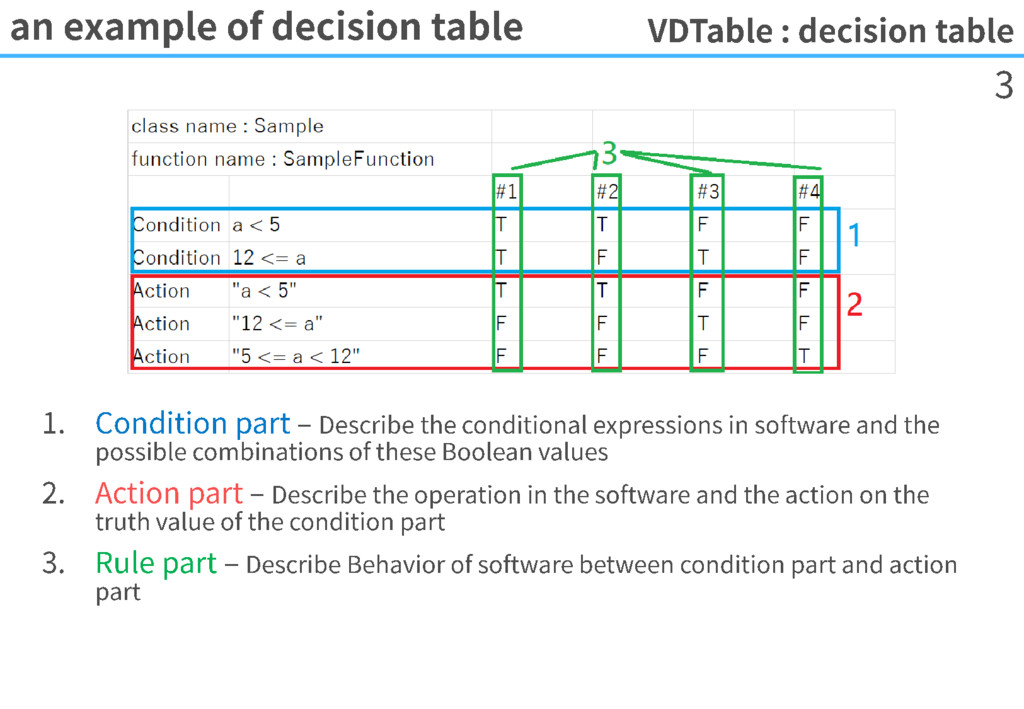
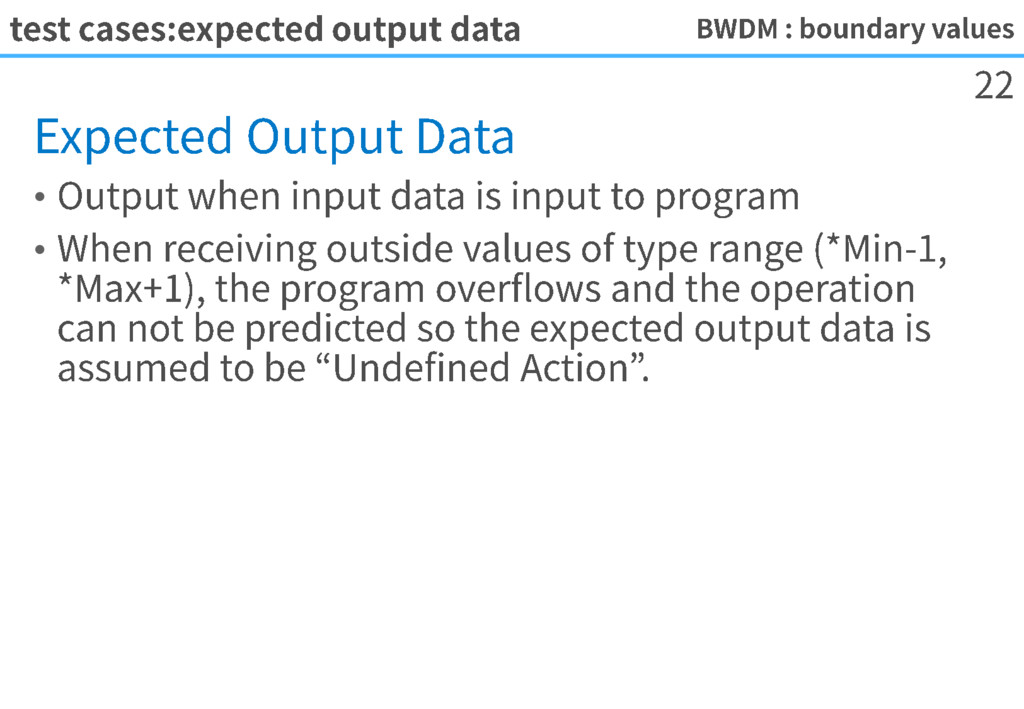
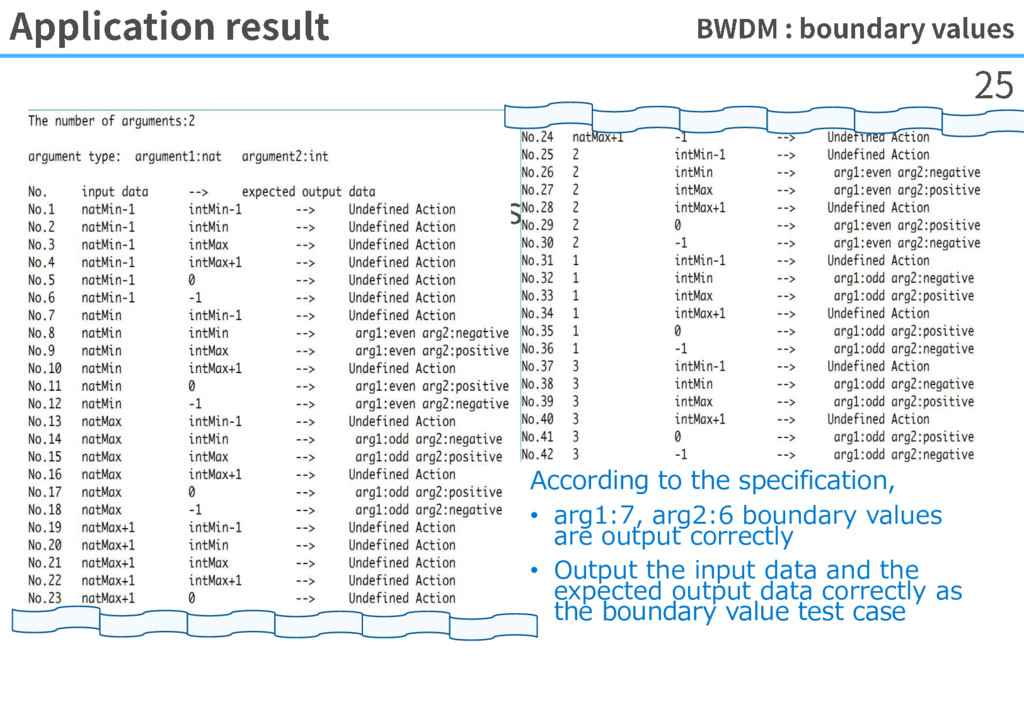
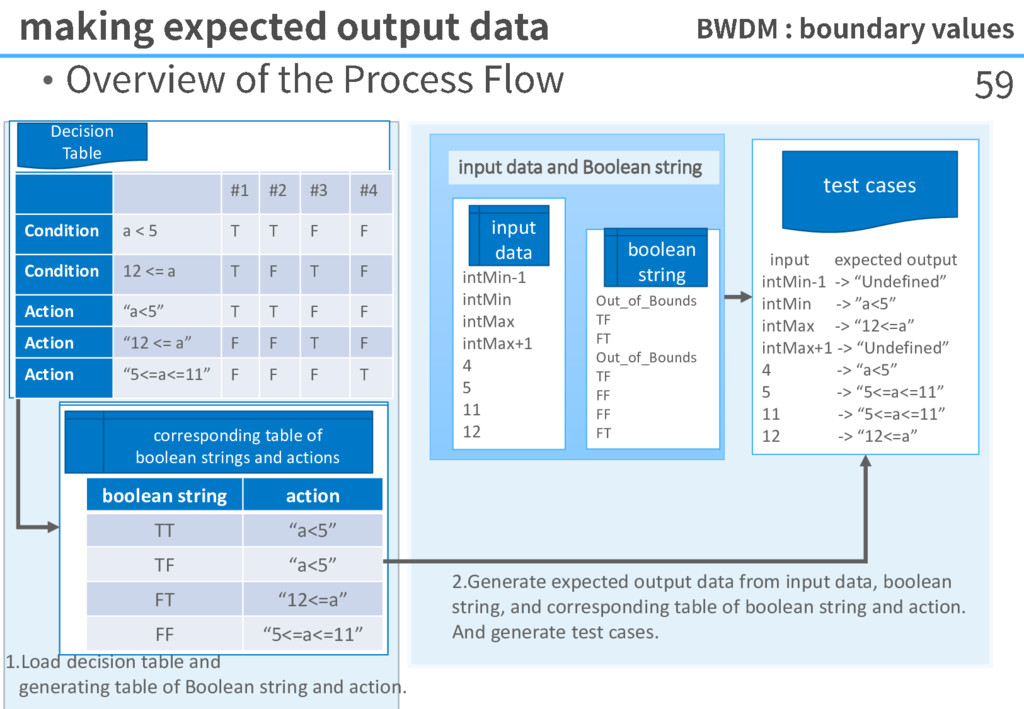
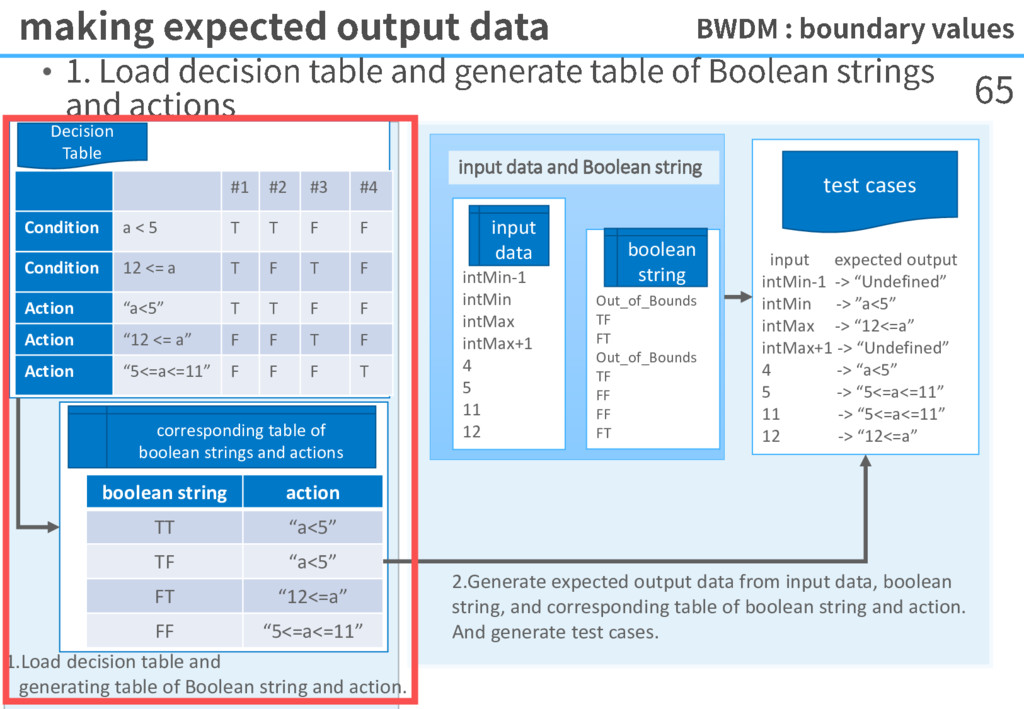
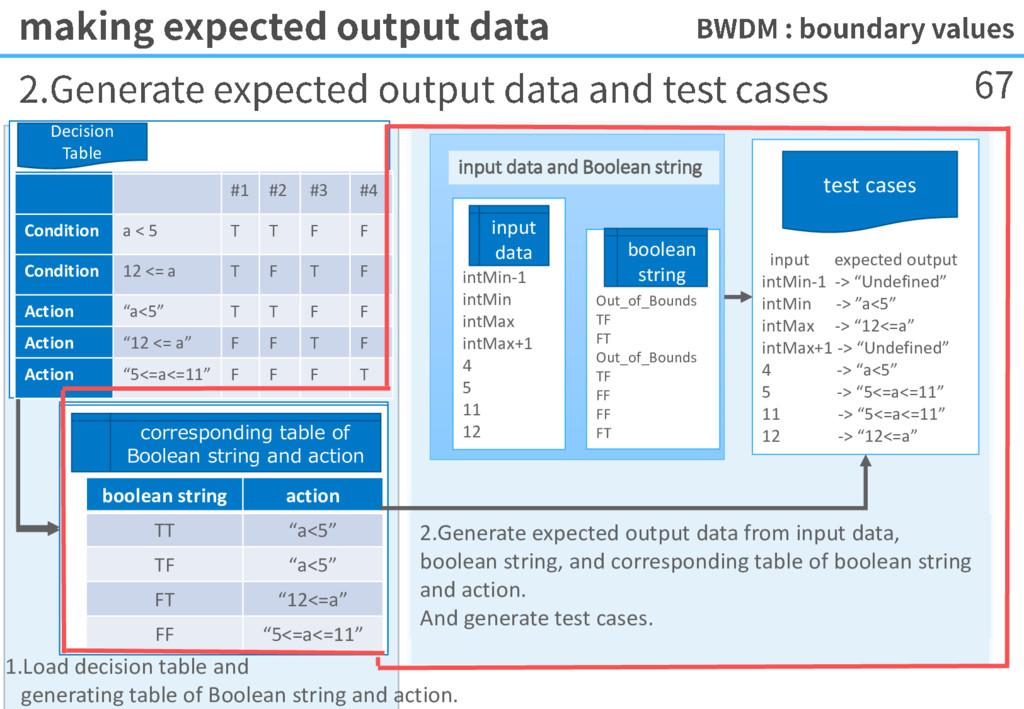
-> “12<=a” intMax+1 -> “Undefined” 4 -> “a<5” 5 -> “5<=a<=11” 11 -> “5<=a<=11” 12 -> “12<=a” test cases Out_of_Bounds TF FT Out_of_Bounds TF FF FF FT boolean string input data and Boolean string intMin-1 intMin intMax intMax+1 4 5 11 12 input data 2.Generate expected output data from input data, boolean string, and corresponding table of boolean string and action. And generate test cases. • #1 #2 #3 #4 Condition a < 5 T T F F Condition 12 <= a T F T F Action “a<5” T T F F Action “12 <= a” F F T F Action “5<=a<=11” F F F T Decision Table boolean string action TT “a<5” TF “a<5” FT “12<=a” FF “5<=a<=11” table of boolean string and action 1.Load decision table and generating table of Boolean string and action. #1 #2 #3 #4 Condition a < 5 T T F F Condition 12 <= a T F T F Action “a<5” T T F F Action “12 <= a” F F T F Action “5<=a<=11” F F F T boolean string action TT “a<5” TF “a<5” FT “12<=a” FF “5<=a<=11” corresponding table of boolean strings and actions
intMax -> “12<=a” intMax+1 -> “Undefined” 4 -> “a<5” 5 -> “5<=a<=11” 11 -> “5<=a<=11” 12 -> “12<=a” test cases Out_of_Bounds TF FT Out_of_Bounds TF FF FF FT boolean string input data and Boolean string intMin-1 intMin intMax intMax+1 4 5 11 12 input data #1 #2 #3 #4 Condition a < 5 T T F F Condition 12 <= a T F T F Action “a<5” T T F F Action “12 <= a” F F T F Action “5<=a<=11” F F F T Decision Table boolean string action TT “a<5” TF “a<5” FT “12<=a” FF “5<=a<=11” 1.Load decision table and generating table of Boolean string and action. corresponding table of boolean strings and actions 2.Generate expected output data from input data, boolean string, and corresponding table of boolean string and action. And generate test cases.
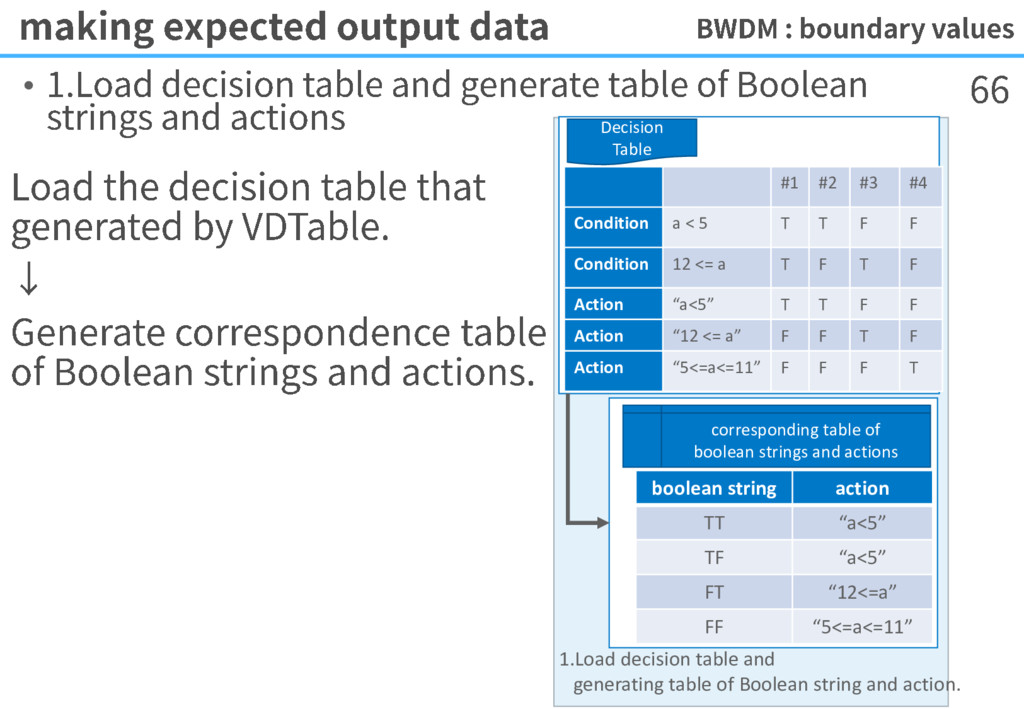
T F F Condition 12 <= a T F T F Action “a<5” T T F F Action “12 <= a” F F T F Action “5<=a<=11” F F F T Decision Table boolean string action TT “a<5” TF “a<5” FT “12<=a” FF “5<=a<=11” 1.Load decision table and generating table of Boolean string and action. corresponding table of boolean strings and actions
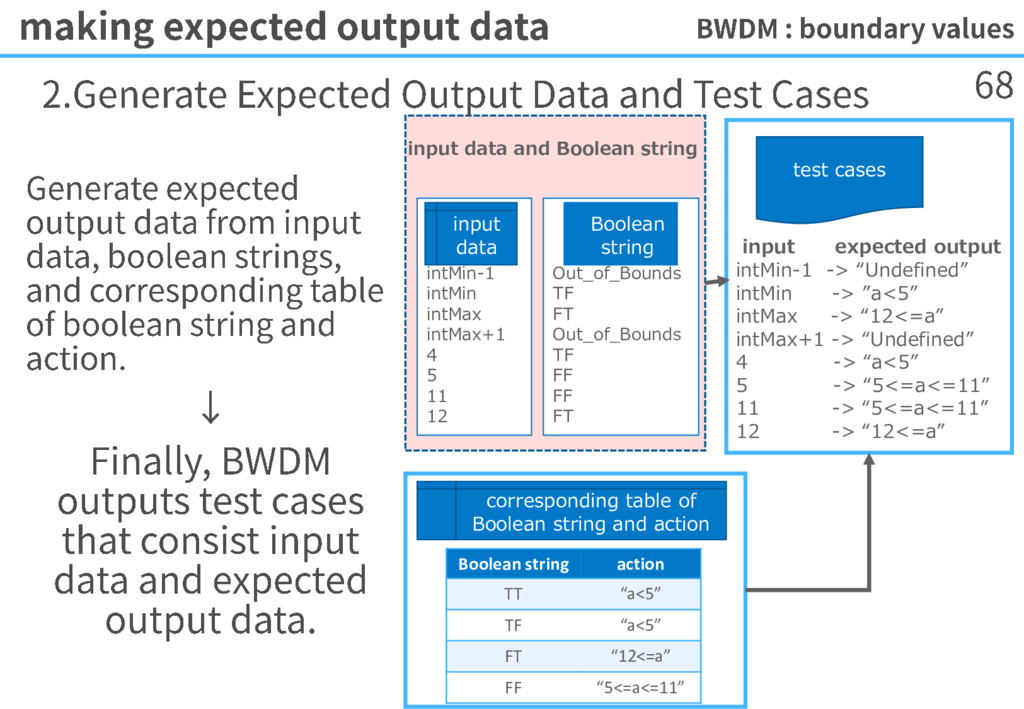
F F Condition 12 <= a T F T F Action “a<5” T T F F Action “12 <= a” F F T F Action “5<=a<=11” F F F T Decision Table boolean string action TT “a<5” TF “a<5” FT “12<=a” FF “5<=a<=11” table of boolean string and action #1 #2 #3 #4 Condition a < 5 T T F F Condition 12 <= a T F T F Action “a<5” T T F F Action “12 <= a” F F T F Action “5<=a<=11” F F F T boolean string action TT “a<5” TF “a<5” FT “12<=a” FF “5<=a<=11” corresponding table of Boolean string and action input expected output intMin-1 -> “Undefined” intMin -> ”a<5” intMax -> “12<=a” intMax+1 -> “Undefined” 4 -> “a<5” 5 -> “5<=a<=11” 11 -> “5<=a<=11” 12 -> “12<=a” test cases Out_of_Bounds TF FT Out_of_Bounds TF FF FF FT boolean string input data and Boolean string intMin-1 intMin intMax intMax+1 4 5 11 12 input data 1.Load decision table and generating table of Boolean string and action. 2.Generate expected output data from input data, boolean string, and corresponding table of boolean string and action. And generate test cases.


 glaforge
 raspython3
 takonda
 greenmidori
 tetsuya28
 hiracky16
 riyaamemiya
 shugo
 kash1064
 onk
 takanorip
 gionn
 inesmontani
 szymonslowik
 raygrieselhuber
 cromwellryan
 sabderemane
 katarinadahlin
 tamaranovitovic
 62gerente
 reverentgeek
 rabernat
 sonatard