Hello, Rust! — An overview
Sponsored
·
 Your Podcast. Everywhere. Effortlessly.
Share. Educate. Inspire. Entertain. You do you. We'll handle the rest.
→
Your Podcast. Everywhere. Effortlessly.
Share. Educate. Inspire. Entertain. You do you. We'll handle the rest.
→

Share
Embed
Hello, Rust! — An overview
This talk is an overview of the Rust language. It has been presented during http://www.agendadulibre.org/events/12769. Not all slides have been detailed. The goal of this meetup was to have an overview of the Rust language, and to talk about what the public was curious about.
A live-coding/live-contribution session has also been organized at the end: Take a real project from the audience, see how to enhance it, how to be more idiomatic, better memory management, better data design etc.

Ivan Enderlin
February 02, 2017
Transcript
187 slides
-
Disclaimer • I am not an expert • “Rust is
good at x” ⇏ “other languages are n00bs” • Not exhaustive, this is an overview! -
–me “A language is a way to express a solution
to a problem” -
History • Father Graydon Hoare (thanks!) • Officially born in
2009, announced in 2010 • 1.0 release the 15th of May 2015 • Sponsored by Mozilla Research -
tl;dr • Rust is a general-purpose, multi-paradigm, compiled programming language
• Safe, concurrent, and practical • Ciao . -
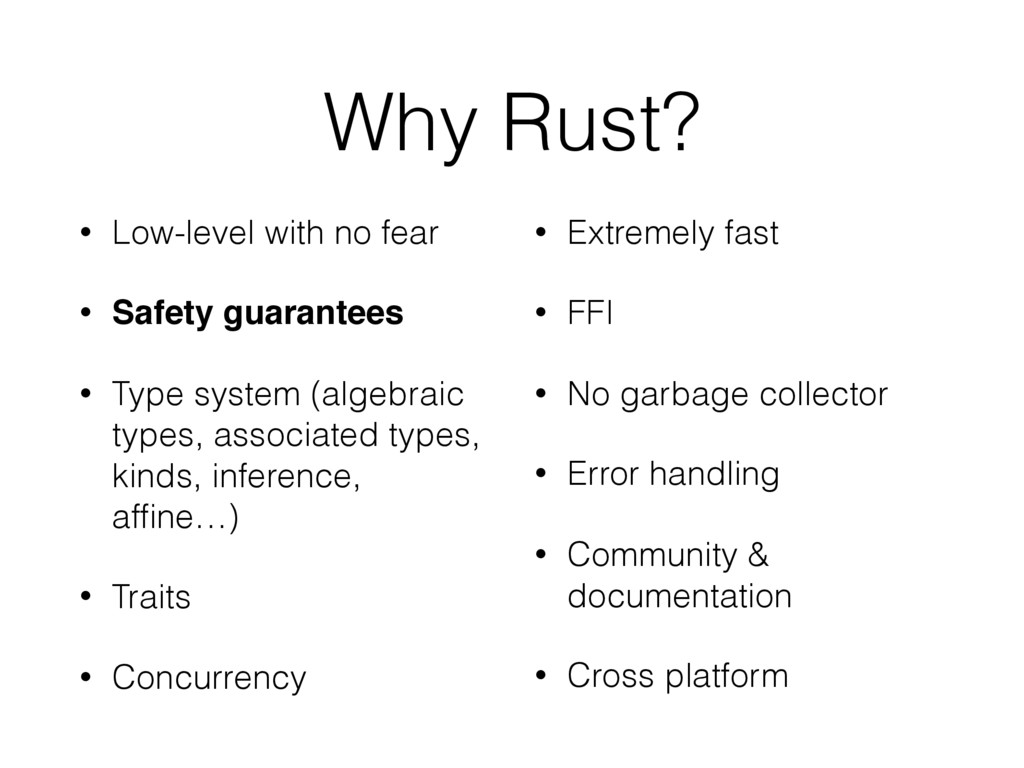
Why Rust? • Low-level with no fear • Safety guarantees
• Type system (algebraic types, associated types, kinds, inference, affine…) • Traits • Concurrency • Extremely fast • FFI • No garbage collector • Error handling • Community & documentation • Cross platform -
Foundations • Mutability • Ownership • Borrowing • Lifetimes •
Algebraic types -
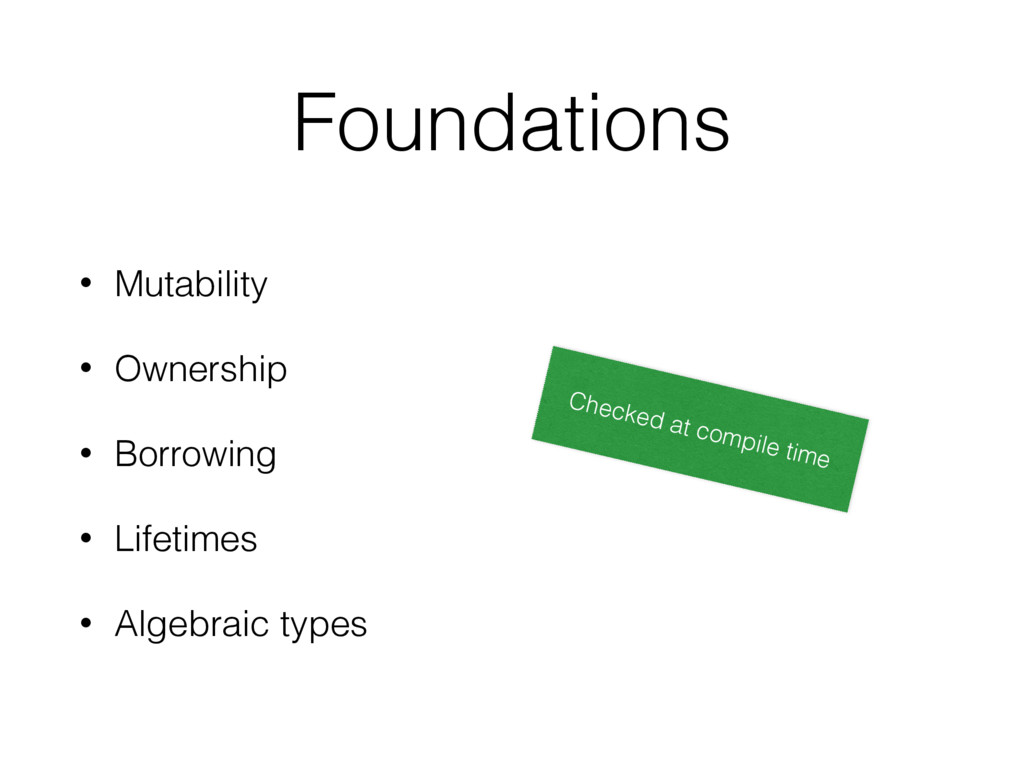
Foundations • Mutability • Ownership • Borrowing • Lifetimes •
Algebraic types Checked at compile time -
Mutability • Everything is immutable by default • mut to
make a data mutable -
Mutability • Everything is immutable by default • mut to
make a data mutable let x = 7; x = 42; -
Mutability • Everything is immutable by default • mut to
make a data mutable error[E0384]: re-assignment of immutable variable `x` let x = 7; x = 42; -
Mutability • Everything is immutable by default • mut to
make a data mutable let mut x = 7; x = 42; println!("x = {}", x); -
Mutability • Everything is immutable by default • mut to
make a data mutable let mut x = 7; x = 42; println!("x = {}", x); x = 42 -
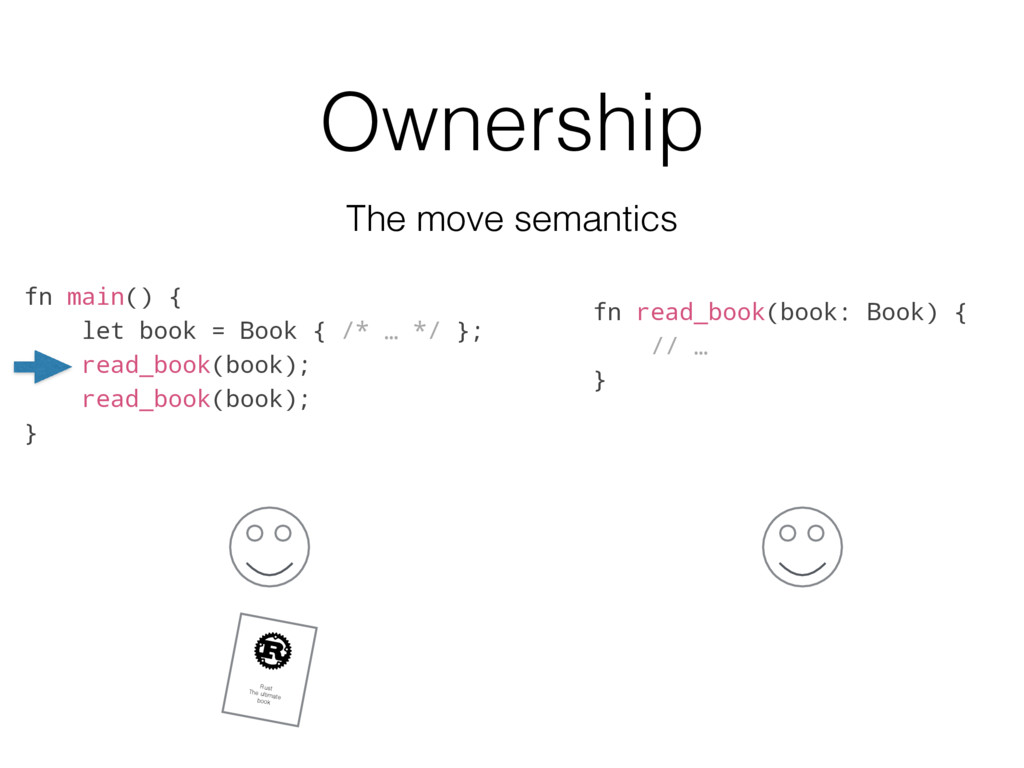
Ownership • Variable bindings (let) have a property in Rust:
they “have ownership” of what they are bound to • When a binding goes out of scope, Rust will free the bound resources • This happens deterministically, at the end of the scope -
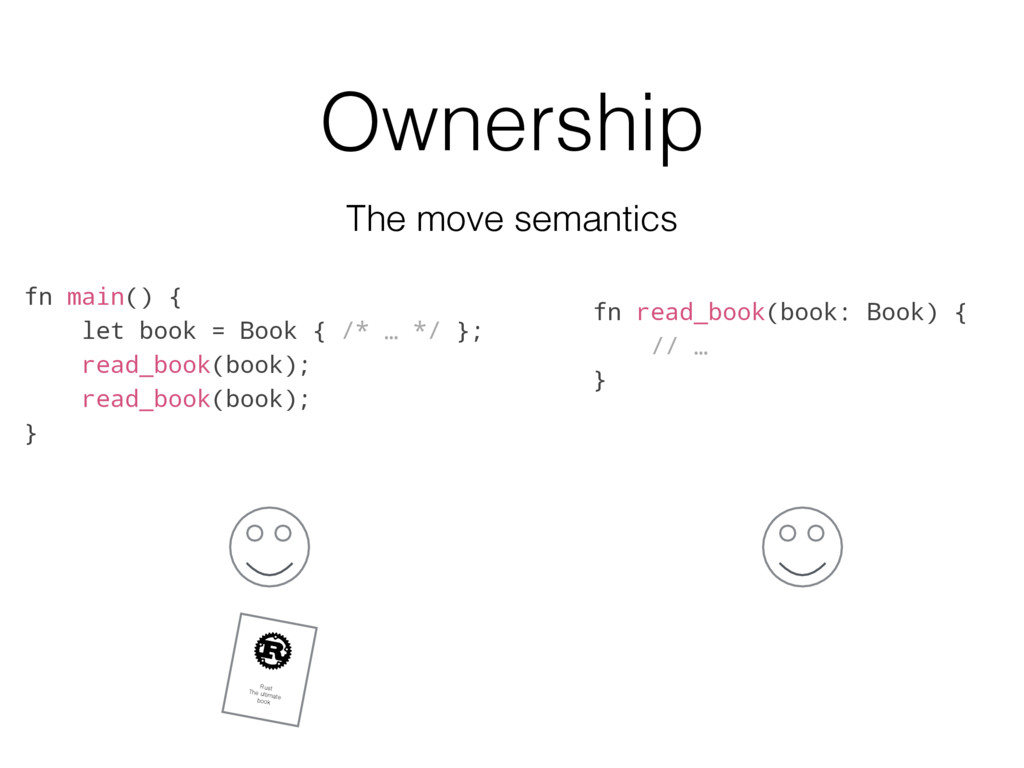
Ownership The move semantics fn main() { let book =
Book { /* … */ }; read_book(book); read_book(book); } fn read_book(book: Book) { // … } -
Ownership The move semantics fn main() { let book =
Book { /* … */ }; read_book(book); read_book(book); } fn read_book(book: Book) { // … } Rust The ultimate book -
Ownership The move semantics fn main() { let book =
Book { /* … */ }; read_book(book); read_book(book); } fn read_book(book: Book) { // … } Rust The ultimate book -
Ownership The move semantics fn main() { let book =
Book { /* … */ }; read_book(book); read_book(book); } fn read_book(book: Book) { // … } Rust The ultimate book -
Ownership The move semantics fn main() { let book =
Book { /* … */ }; read_book(book); read_book(book); } fn read_book(book: Book) { // … } Rust The ultimate book -
Ownership The move semantics fn main() { let book =
Book { /* … */ }; read_book(book); read_book(book); } fn read_book(book: Book) { // … } Rust The ultimate book -
Ownership The move semantics fn main() { let book =
Book { /* … */ }; read_book(book); read_book(book); } fn read_book(book: Book) { // … } -
Ownership The move semantics fn main() { let book =
Book { /* … */ }; read_book(book); read_book(book); } fn read_book(book: Book) { // … } -
Ownership The move semantics fn main() { let book =
Book { /* … */ }; read_book(book); read_book(book); } fn read_book(book: Book) { // … } error[E0382]: use of moved value: `book` -
Ownership Retrieve the book fn read_book(book: Book) -> Book {
// … book } Solution 1 Return the data Solution 2 Clone book before passing it to read_book Solution 3 Share it! -
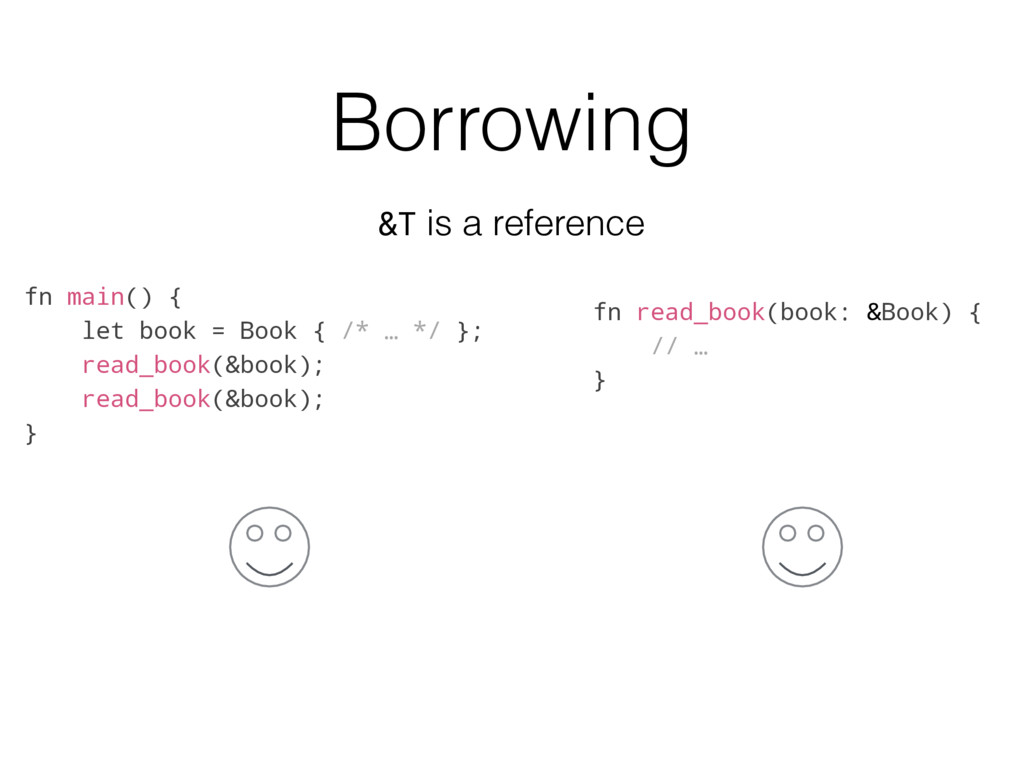
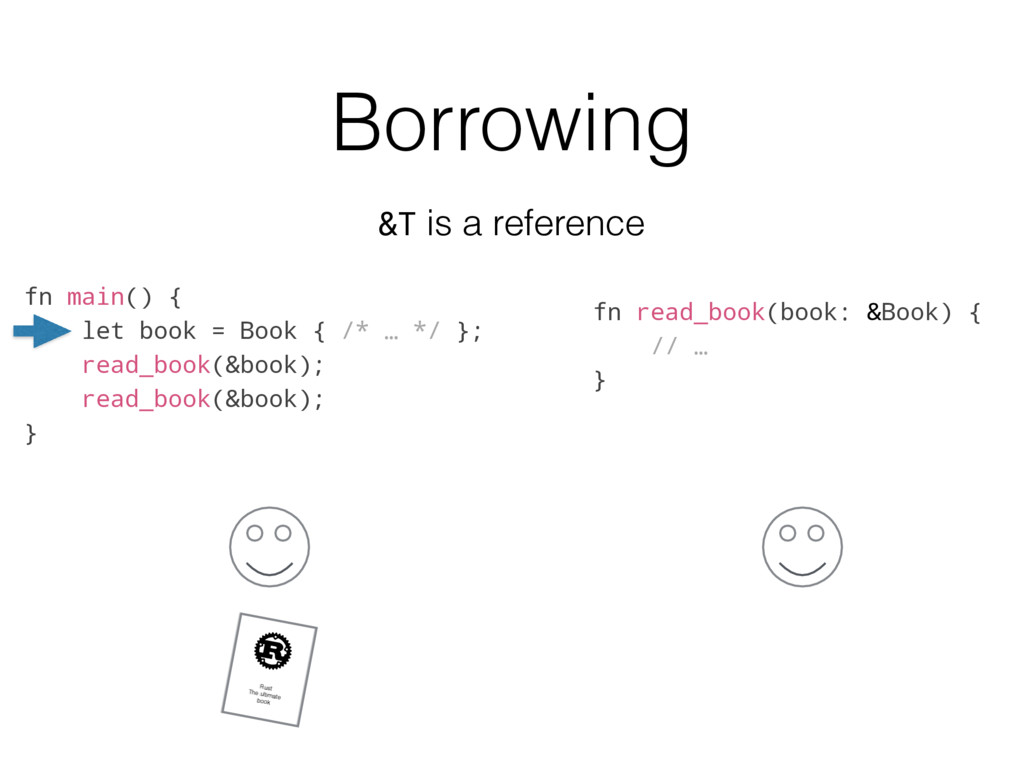
Borrowing • We call the &T type a “reference” •
Rather than owning the resource, a binding borrows ownership • A binding that borrows something does not deallocate the resource when it goes out of scope • A borrowed resource is immutable -
fn main() { let book = Book { /* …
*/ }; read_book(&book); read_book(&book); } Borrowing &T is a reference fn read_book(book: &Book) { // … } -
Rust The ultimate book Rust The ultimate book fn main()
{ let book = Book { /* … */ }; read_book(&book); read_book(&book); } Borrowing &T is a reference Rust The ultimate book fn read_book(book: &Book) { // … } -
Rust The ultimate book Rust The ultimate book fn main()
{ let book = Book { /* … */ }; read_book(&book); read_book(&book); } Borrowing &T is a reference Rust The ultimate book fn read_book(book: &Book) { // … } -
Rust The ultimate book Rust The ultimate book fn main()
{ let book = Book { /* … */ }; read_book(&book); read_book(&book); } Borrowing &T is a reference Rust The ultimate book fn read_book(book: &Book) { // … } -
Rust The ultimate book Rust The ultimate book fn main()
{ let book = Book { /* … */ }; read_book(&book); read_book(&book); } Borrowing &T is a reference Rust The ultimate book fn read_book(book: &Book) { // … } -
Rust The ultimate book Rust The ultimate book fn main()
{ let book = Book { /* … */ }; read_book(&book); read_book(&book); } Borrowing &T is a reference Rust The ultimate book fn read_book(book: &Book) { // … } -
Rust The ultimate book fn main() { let book =
Book { /* … */ }; read_book(&book); read_book(&book); } Borrowing &T is a reference Rust The ultimate book fn read_book(book: &Book) { // … } -
Rust The ultimate book fn main() { let book =
Book { /* … */ }; read_book(&book); read_book(&book); } Borrowing &T is a reference Rust The ultimate book fn read_book(book: &Book) { // … } -
Rust The ultimate book fn main() { let book =
Book { /* … */ }; read_book(&book); read_book(&book); } Borrowing &T is a reference Rust The ultimate book fn read_book(book: &Book) { // … } -
Rust The ultimate book fn main() { let book =
Book { /* … */ }; read_book(&book); read_book(&book); } Borrowing &T is a reference Rust The ultimate book fn read_book(book: &Book) { // … } -
fn main() { let book = Book { /* …
*/ }; read_book(&book); read_book(&book); } Borrowing &T is a reference Rust The ultimate book fn read_book(book: &Book) { // … } -
fn main() { let book = Book { /* …
*/ }; read_book(&book); read_book(&book); } Borrowing &T is a reference Rust The ultimate book fn read_book(book: &Book) { // … } -
fn main() { let book = Book { /* …
*/ }; read_book(&book); read_book(&book); } Borrowing &T is a reference fn read_book(book: &Book) { // … } -
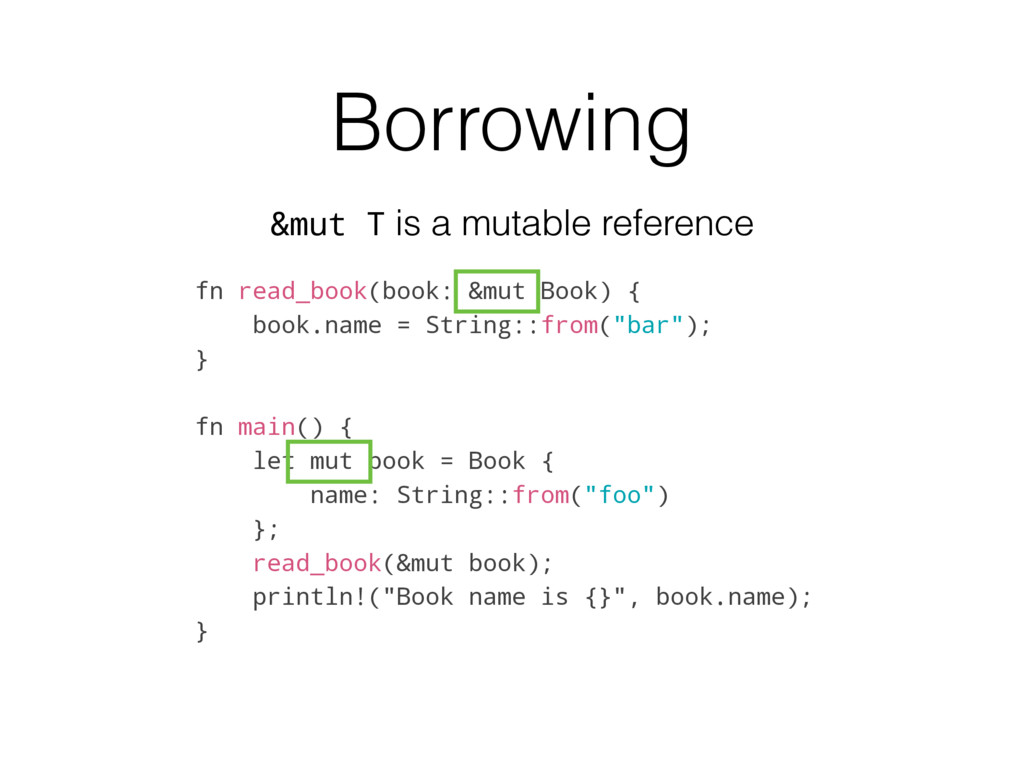
Borrowing &mut T is a mutable reference fn read_book(book: &mut
Book) { book.name = String::from("bar"); } fn main() { let mut book = Book { name: String::from("foo") }; read_book(&mut book); println!("Book name is {}", book.name); } -
Borrowing &mut T is a mutable reference fn read_book(book: &mut
Book) { book.name = String::from("bar"); } fn main() { let mut book = Book { name: String::from("foo") }; read_book(&mut book); println!("Book name is {}", book.name); } -
Borrowing &mut T is a mutable reference fn read_book(book: &mut
Book) { book.name = String::from("bar"); } fn main() { let mut book = Book { name: String::from("foo") }; read_book(&mut book); println!("Book name is {}", book.name); } -
Borrowing &mut T is a mutable reference fn read_book(book: &mut
Book) { book.name = String::from("bar"); } fn main() { let mut book = Book { name: String::from("foo") }; read_book(&mut book); println!("Book name is {}", book.name); } -
Borrowing &mut T is a mutable reference fn read_book(book: &mut
Book) { book.name = String::from("bar"); } fn main() { let mut book = Book { name: String::from("foo") }; read_book(&mut book); println!("Book name is {}", book.name); } Book name is bar -
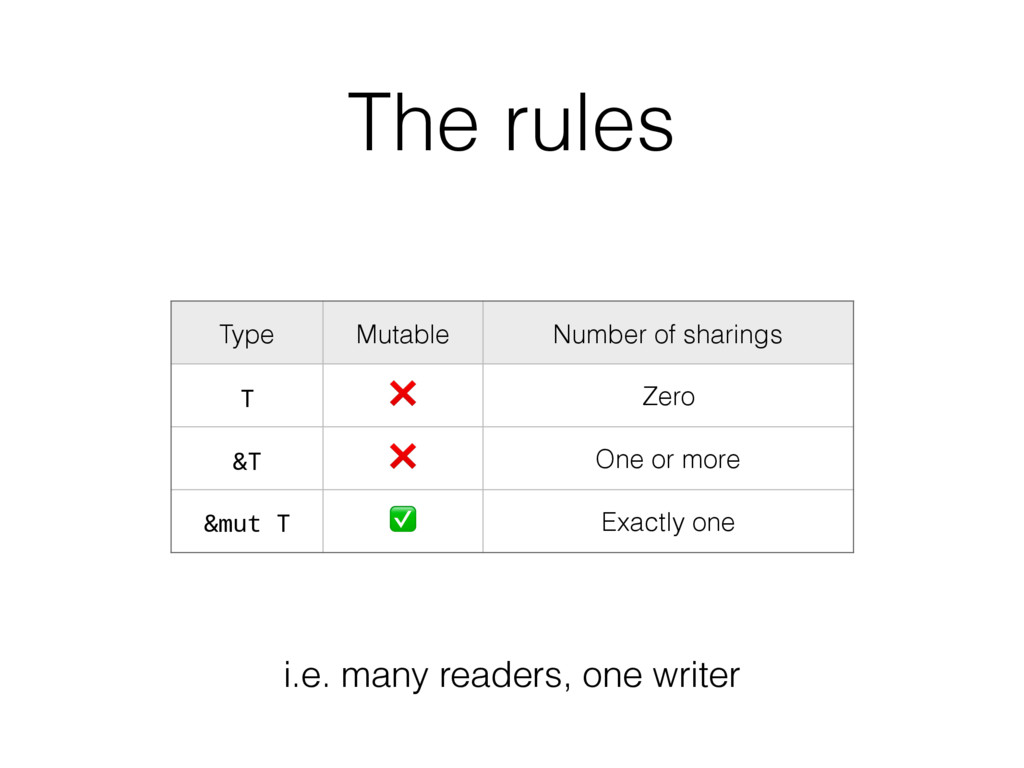
The rules Type Mutable Number of sharings T ❌ Zero
&T ❌ One or more &mut T ✅ Exactly one -
The rules Type Mutable Number of sharings T ❌ Zero
&T ❌ One or more &mut T ✅ Exactly one i.e. many readers, one writer -
Lifetimes • Each reference has a lifetime • Prevent dangling
pointer, aka use after free • Let the following scenario: • I have a data, • I send you a reference to this data, • I am done with it, and I deallocate it, while you still have the reference, • You use this data, and . -
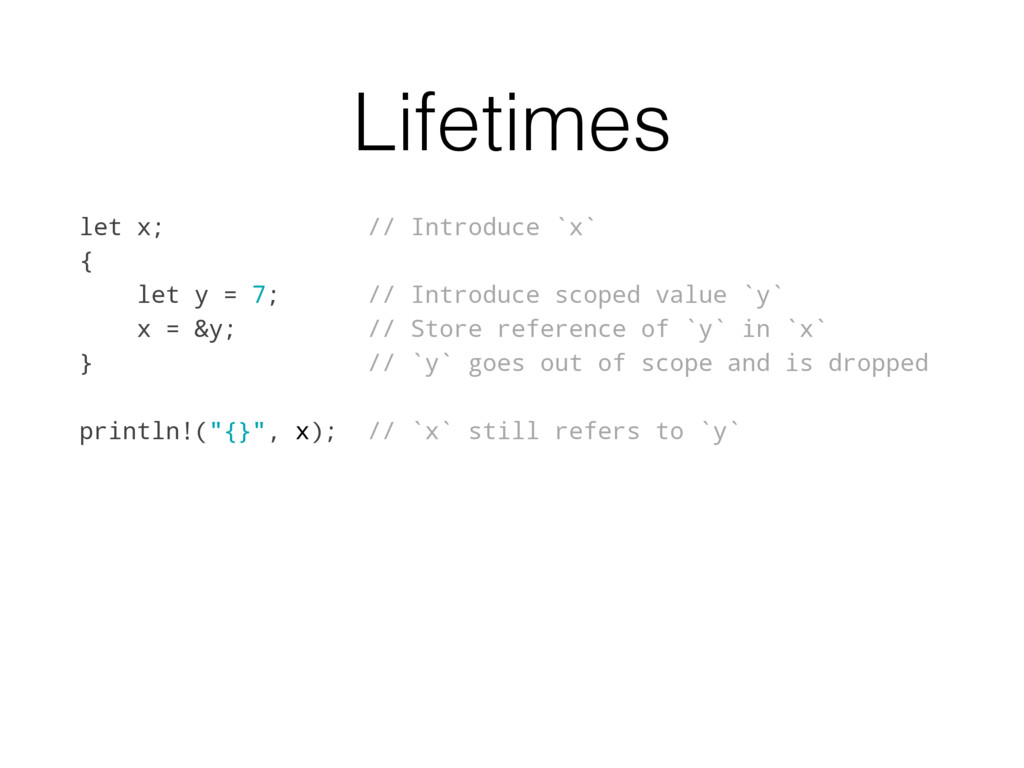
Lifetimes let x; // Introduce `x` { let y =
7; // Introduce scoped value `y` x = &y; // Store reference of `y` in `x` } // `y` goes out of scope and is dropped println!("{}", x); // `x` still refers to `y` -
Lifetimes let x; // Introduce `x` { let y =
7; // Introduce scoped value `y` x = &y; // Store reference of `y` in `x` } // `y` goes out of scope and is dropped println!("{}", x); // `x` still refers to `y` error: `y` does not live long enough | 4 | x = &y; | - borrow occurs here 5 | } | ^ `y` dropped here while still borrowed ... 8 | } | - borrowed value needs to live until here -
Lifetime elision • Function body: Lifetime is always inferred •
Function I/O: Lifetime can be ambiguous, so annotation might be required -
Lifetimes fn f(x: &str, y: &str) -> &str { x
} fn main() { let x = "foo"; let z; { let y = "bar"; z = f(x, y); } println!("z = {}", z); } -
Lifetimes fn f(x: &str, y: &str) -> &str { x
} fn main() { let x = "foo"; let z; { let y = "bar"; z = f(x, y); } println!("z = {}", z); } ^ expected lifetime parameter error[E0106]: missing lifetime specifier -
Lifetimes fn f<'a, 'b>(x: &'a str, y: &'b str) ->
&'a str { x } fn main() { let x = "foo"; let z; { let y = "bar"; z = f(x, y); } println!("z = {}", z); } • 'a means lifetime a • &'a means the reference has lifetime a • f<'a, 'b> means f has 2 explicit lifetimes -
Lifetimes fn f<'a, 'b>(x: &'a str, y: &'b str) ->
&'a str { y } error[E0312]: lifetime of reference outlives lifetime of borrowed content... --> <anon>:2:5 | 2 | y | ^ | note: ...the reference is valid for the lifetime 'a as defined on the block at 1:48... --> <anon>:1:49 | 1 | fn f<'a, 'b>(x: &'a str, y: &'b str) -> &'a str { | ^ note: ...but the borrowed content is only valid for the lifetime 'b as defined on the block at 1:48 --> <anon>:1:49 | 1 | fn f<'a, 'b>(x: &'a str, y: &'b str) -> &'a str { | ^ help: consider using an explicit lifetime parameter as shown: fn f<'a>(x: &'a str, y: &'a str) -> &'a str --> <anon>:1:1 | 1 | fn f<'a, 'b>(x: &'a str, y: &'b str) -> &'a str { | ^ -
Algebraic types • Types are inferred • What algebra means?
• ربجلا = reunion (of broken parts) ✓ Reunion of types • Elementary algebra includes arithmetic operations, like ⨉ and + -
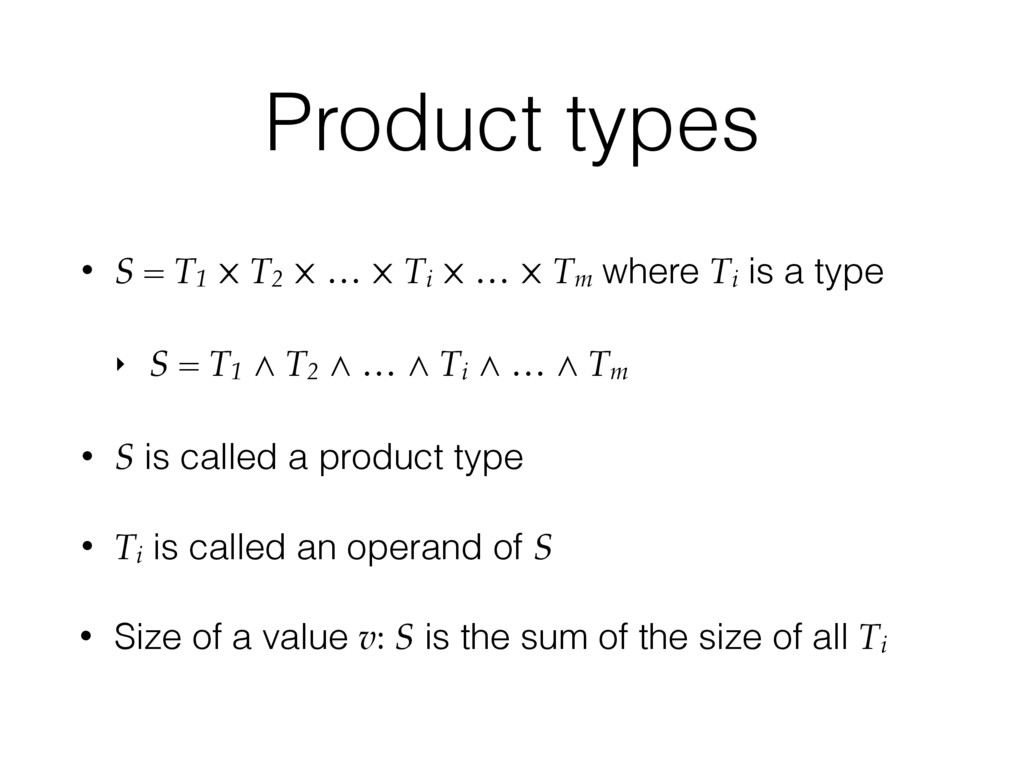
Product types • S = T1 ⨉ T2 ⨉ …
⨉ Ti ⨉ … ⨉ Tm where Ti is a type ‣ S = T1 ⋀ T2 ⋀ … ⋀ Ti ⋀ … ⋀ Tm • S is called a product type • Ti is called an operand of S • Size of a value v: S is the sum of the size of all Ti -
Sum types • E = T1 + T2 + …
+ Ti + … + Tm where Ti is a type ‣ E = T1 ⋁ T2 ⋁ … ⋁ Ti ⋁ … ⋁ Tm • E is called a sum type, or a tagged union • Ti is called a variant of E • A value v: E has one type Ti represented by a tag -
Units • Unit type is a degenerated form of a
product type • Product of no type: No name and no operands () • Construct let unit = (); -
Tuples • Product type with no name and indexed operands
(i32, i32, i32) • Construct let point = (7, 42, 153); • Read let x = point.0; let (x, _, z) = point; -
Tuple structures • Product type with a name and indexed
operands struct Point(i32, i32, i32) • Construct let point = Point(7, 42, 153); • Read let Point(x, y, z) = point; -
Structures • Product type with a name and named operands
struct Point { x: i32, y: i32, z: i32 } • Construct let point = Point { x: 7, y: 42, z: 153 }; • Read let x = point.x; let Point { x, .. } = point; -
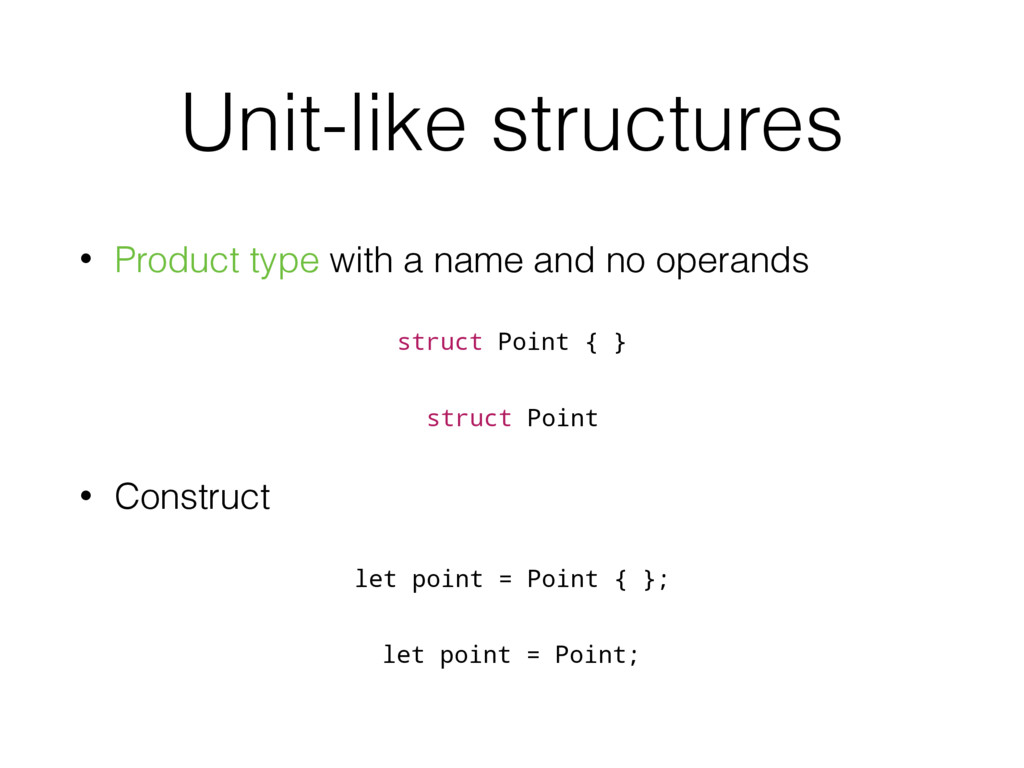
Unit-like structures • Product type with a name and no
operands struct Point { } struct Point • Construct let point = Point { }; let point = Point; -
Enumerators • Sum type with one or more variants •
Each variant can be of any type (tuple, structure…) enum Message { Quit, ChangeColor(i32, i32, i32, i32), Move { x: i32, y: i32, z: i32 }, Private(String), Public(String) } -
Enumerators • Construct let message = Message::Move { x: 7,
y: 42, z: 153 }; • Read let Message::Move { x, y, z } = message; -
––Uncle Ben “With great power comes great responsibility” ––Winston Churchill
––French National Convention (May 8th, 1793) -
––Uncle Ben “With great power comes great responsibility” ––Winston Churchill
––French National Convention (May 8th, 1793) -
Pattern matching • match is like if/else with super powers
• Can benefit from all types • If not exhaustive, compiler will yell • e.g. a variant of an enumerator is missing • i.e. not tested -
Pattern matching Single patterns let x = 3; let number
= match x { 1 => "one", 2 => "two", 3 => "three", 4 => "four", 5 => "five", _ => "something else" }; -
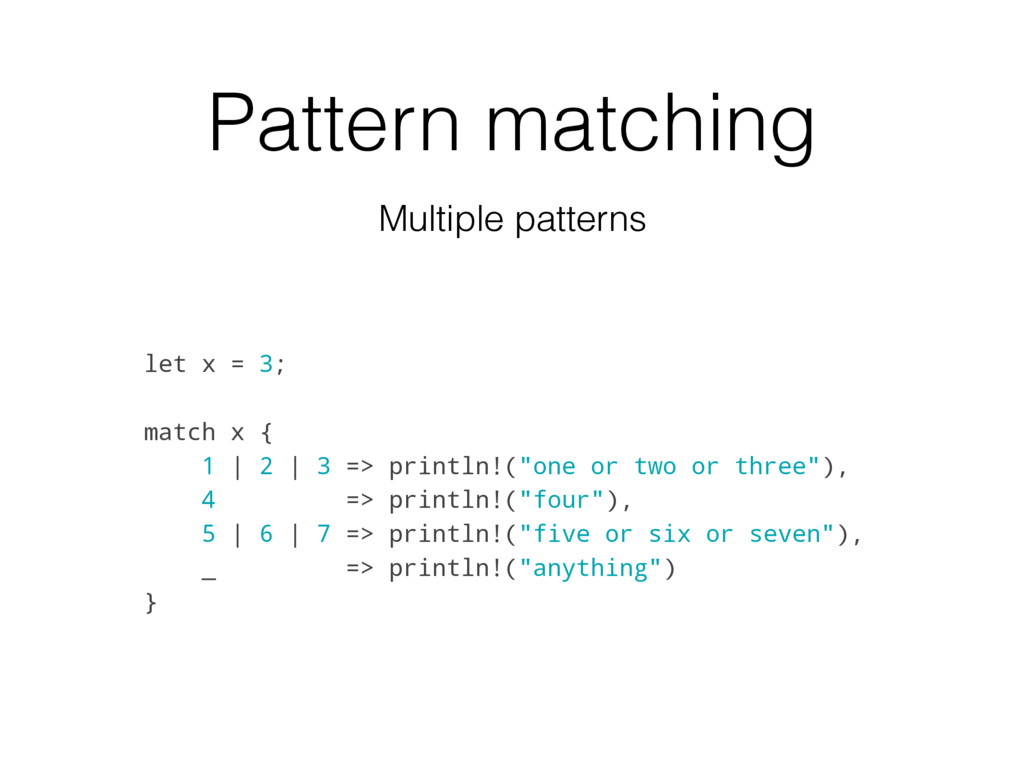
Pattern matching Multiple patterns let x = 3; match x
{ 1 | 2 | 3 => println!("one or two or three"), 4 => println!("four"), 5 | 6 | 7 => println!("five or six or seven"), _ => println!("anything") } -
Pattern matching Ranges let x = 7; match x {
1 ... 3 => println!("one or two or three"), 4 => println!("four"), 5 ... 7 => println!("five or six or seven"), _ => println!("anything") } -
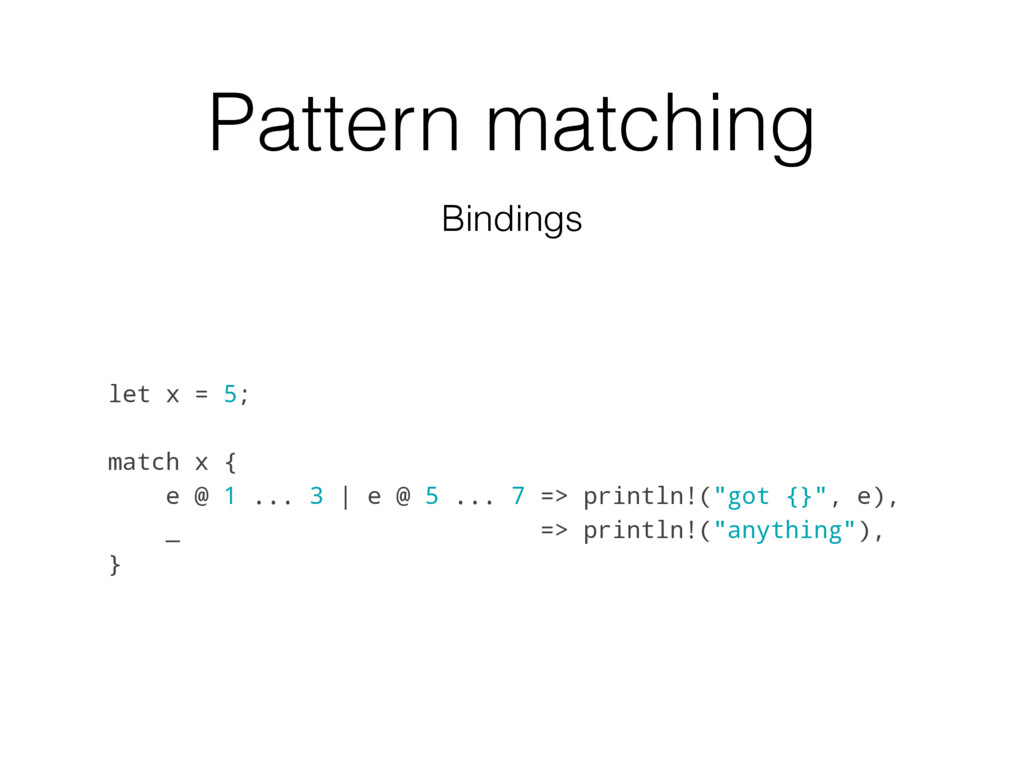
Pattern matching Bindings let x = 5; match x {
e @ 1 ... 3 | e @ 5 ... 7 => println!("got {}", e), _ => println!("anything"), } -
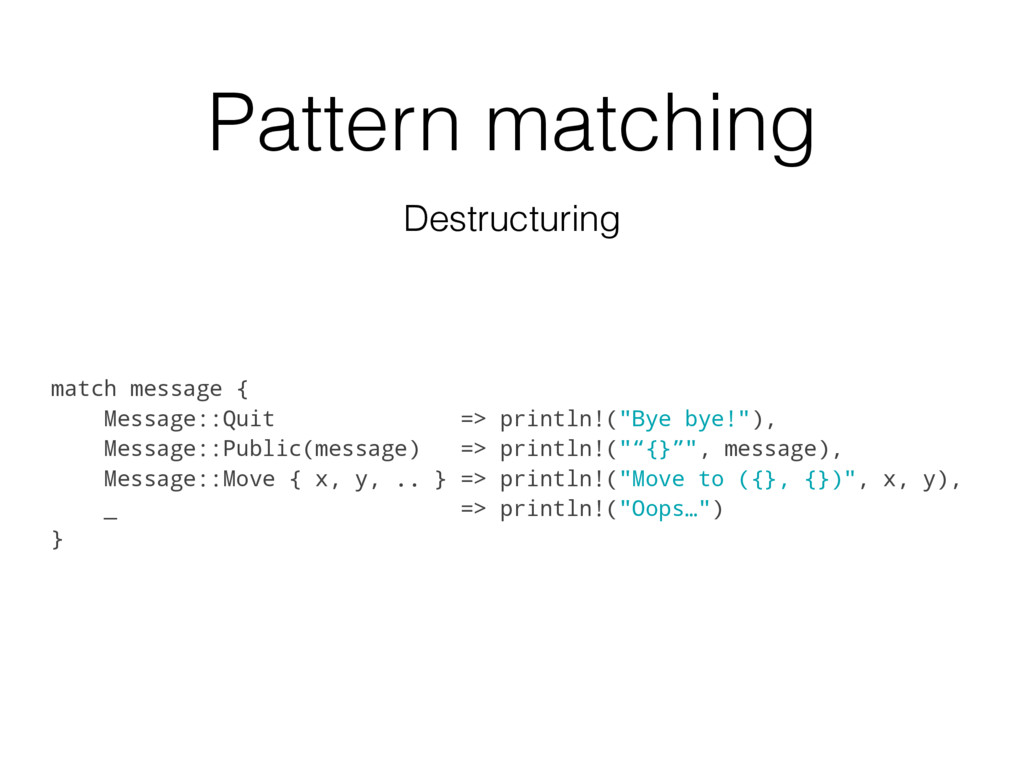
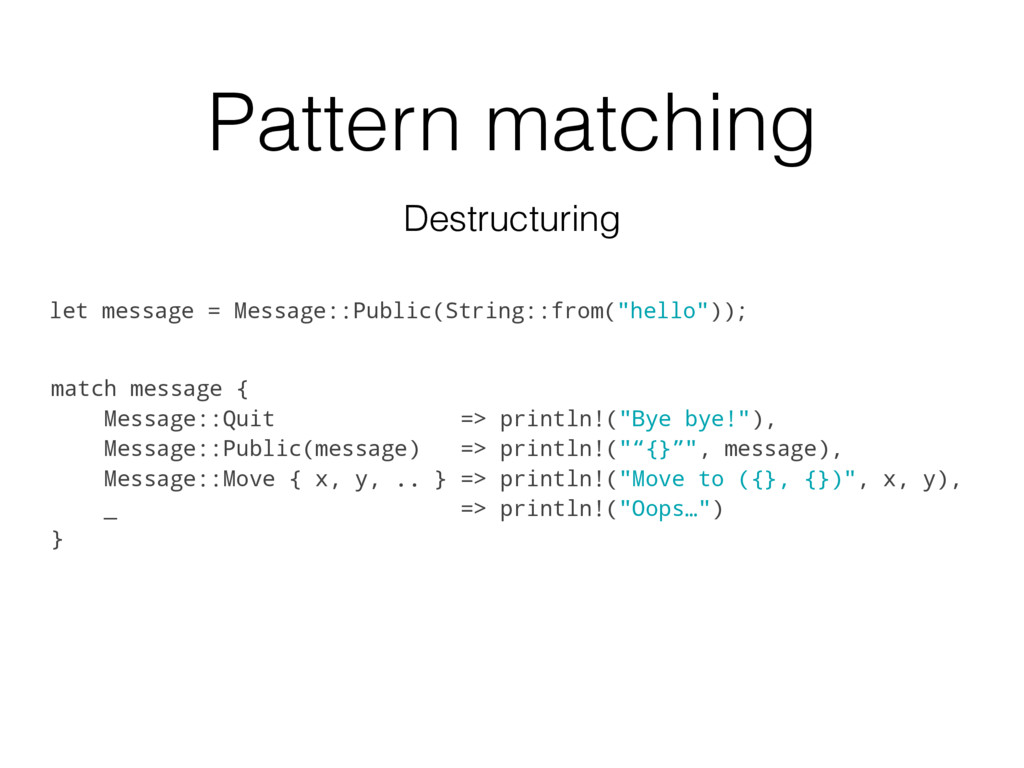
Pattern matching Destructuring match message { Message::Quit => println!("Bye bye!"),
Message::Public(message) => println!("“{}”", message), Message::Move { x, y, .. } => println!("Move to ({}, {})", x, y), _ => println!("Oops…") } -
Pattern matching Destructuring let message = Message::Quit; match message {
Message::Quit => println!("Bye bye!"), Message::Public(message) => println!("“{}”", message), Message::Move { x, y, .. } => println!("Move to ({}, {})", x, y), _ => println!("Oops…") } -
Pattern matching Destructuring let message = Message::Quit; match message {
Message::Quit => println!("Bye bye!"), Message::Public(message) => println!("“{}”", message), Message::Move { x, y, .. } => println!("Move to ({}, {})", x, y), _ => println!("Oops…") } Bye bye! -
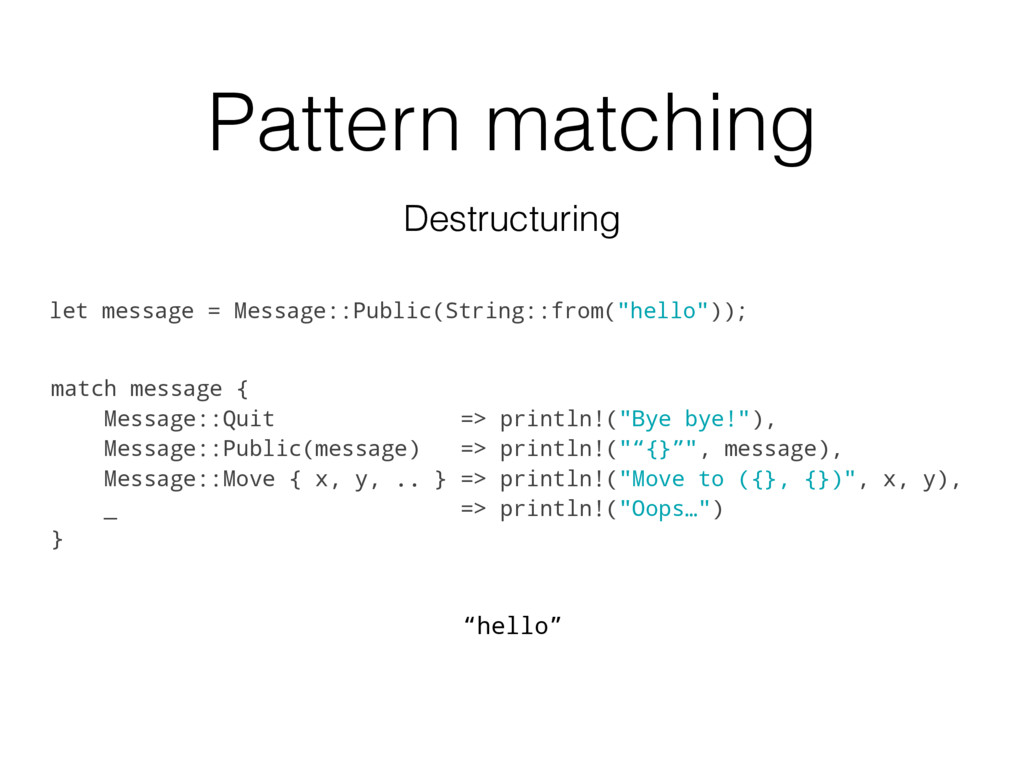
Pattern matching Destructuring match message { Message::Quit => println!("Bye bye!"),
Message::Public(message) => println!("“{}”", message), Message::Move { x, y, .. } => println!("Move to ({}, {})", x, y), _ => println!("Oops…") } let message = Message::Public(String::from("hello")); -
Pattern matching Destructuring match message { Message::Quit => println!("Bye bye!"),
Message::Public(message) => println!("“{}”", message), Message::Move { x, y, .. } => println!("Move to ({}, {})", x, y), _ => println!("Oops…") } let message = Message::Public(String::from("hello")); “hello” -
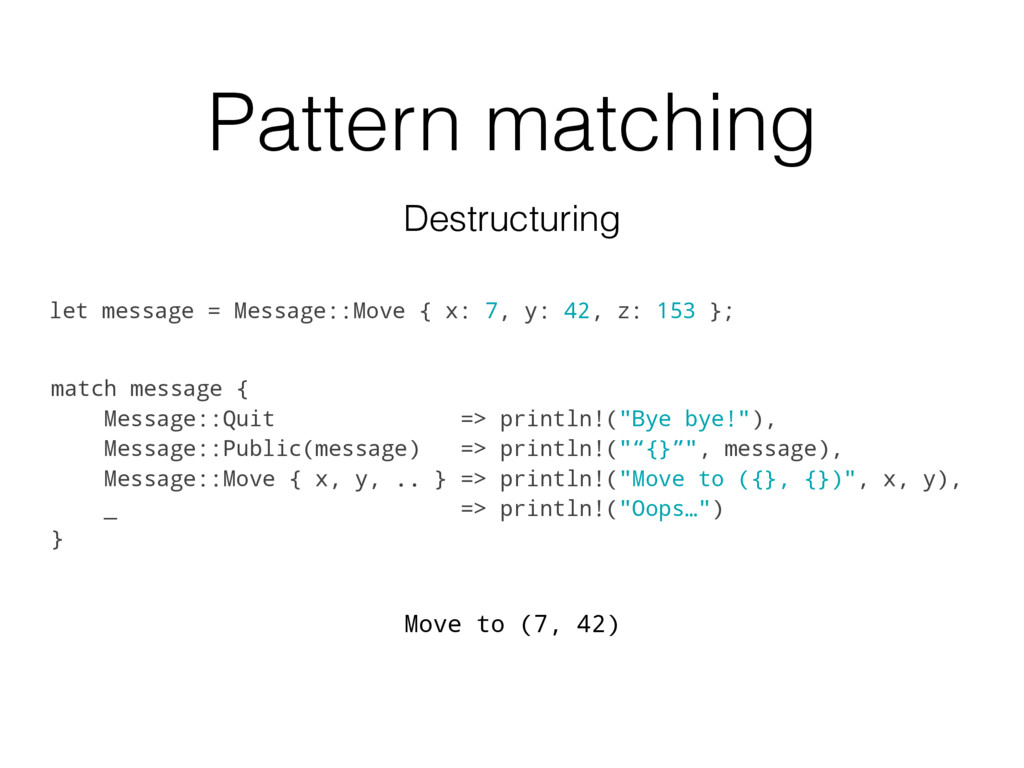
Pattern matching Destructuring match message { Message::Quit => println!("Bye bye!"),
Message::Public(message) => println!("“{}”", message), Message::Move { x, y, .. } => println!("Move to ({}, {})", x, y), _ => println!("Oops…") } let message = Message::Move { x: 7, y: 42, z: 153 }; -
Pattern matching Destructuring match message { Message::Quit => println!("Bye bye!"),
Message::Public(message) => println!("“{}”", message), Message::Move { x, y, .. } => println!("Move to ({}, {})", x, y), _ => println!("Oops…") } let message = Message::Move { x: 7, y: 42, z: 153 }; Move to (7, 42) -
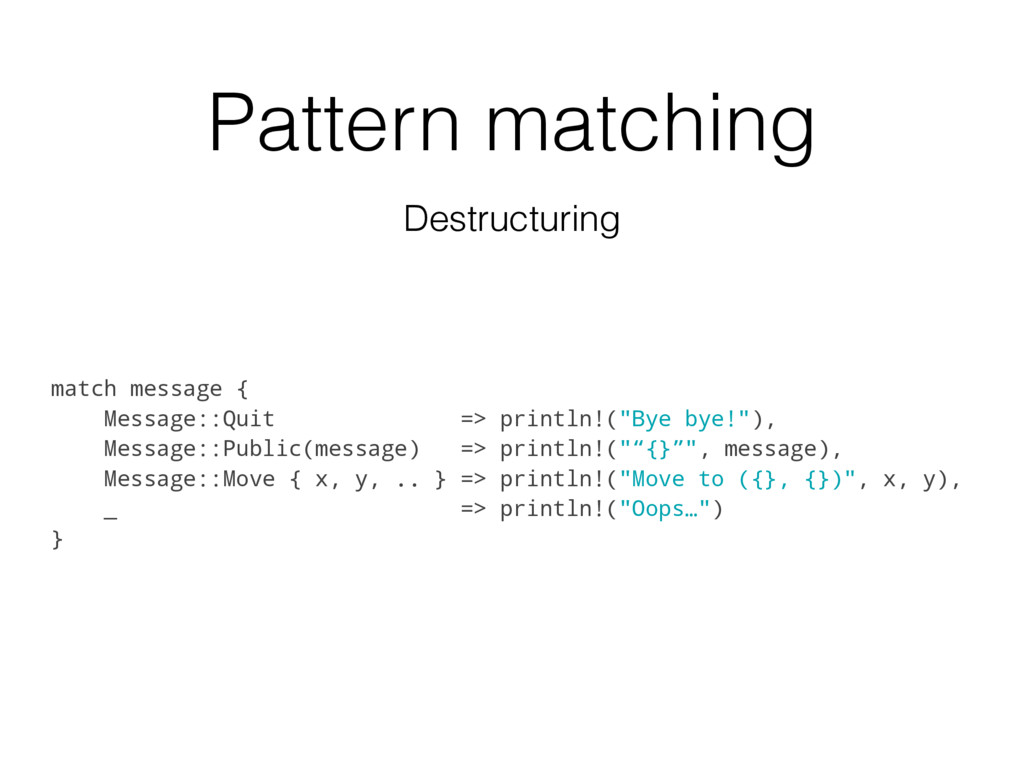
Pattern matching Destructuring match message { Message::Quit => println!("Bye bye!"),
Message::Public(message) => println!("“{}”", message), Message::Move { x, y, .. } => println!("Move to ({}, {})", x, y), _ => println!("Oops…") } -
Pattern matching Guards enum OptionalInt { Value(i32), MissingValue, } let
x = OptionalInt::Value(5); match x { OptionalInt::Value(i) if i > 5 => println!("Got an int bigger than 5!"), OptionalInt::Value(..) => println!("Got an int!"), OptionalInt::Missing => println!("No such luck.") } -
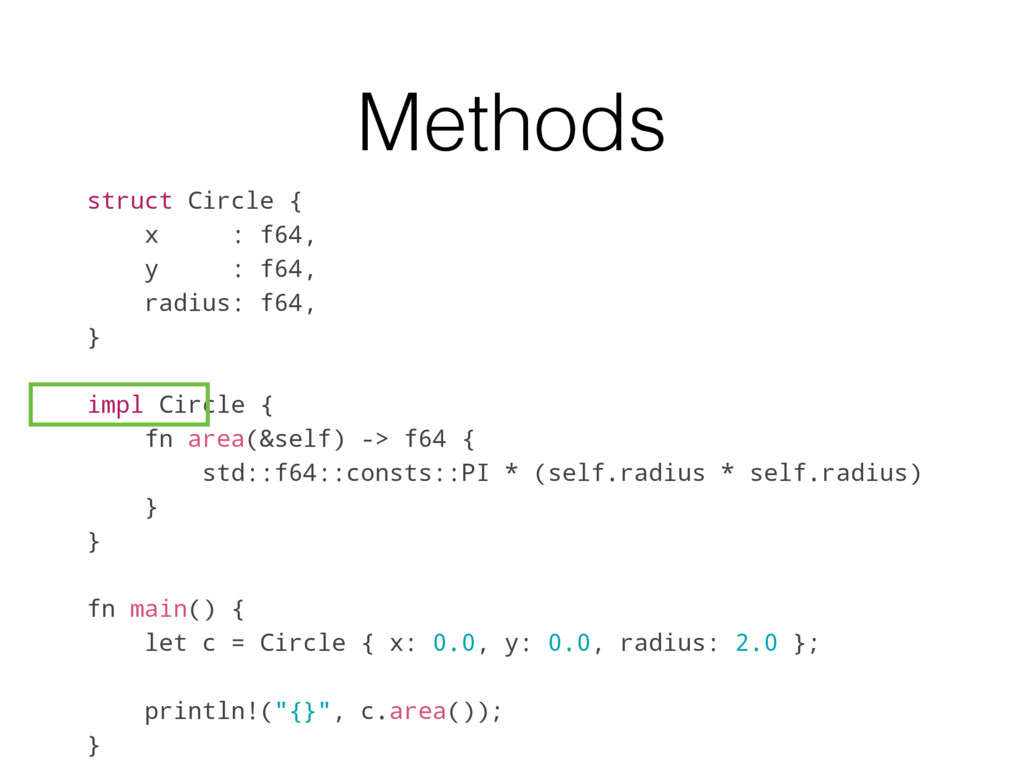
Methods • Methods are functions bounded to a type •
Structures • Enumerators • Primitives -
Methods struct Circle { x : f64, y : f64,
radius: f64, } impl Circle { fn area(&self) -> f64 { std::f64::consts::PI * (self.radius * self.radius) } } fn main() { let c = Circle { x: 0.0, y: 0.0, radius: 2.0 }; println!("{}", c.area()); } -
Methods struct Circle { x : f64, y : f64,
radius: f64, } impl Circle { fn area(&self) -> f64 { std::f64::consts::PI * (self.radius * self.radius) } } fn main() { let c = Circle { x: 0.0, y: 0.0, radius: 2.0 }; println!("{}", c.area()); } -
Methods struct Circle { x : f64, y : f64,
radius: f64, } impl Circle { fn area(&self) -> f64 { std::f64::consts::PI * (self.radius * self.radius) } } fn main() { let c = Circle { x: 0.0, y: 0.0, radius: 2.0 }; println!("{}", c.area()); } -
Methods struct Circle { x : f64, y : f64,
radius: f64, } impl Circle { fn area(&self) -> f64 { std::f64::consts::PI * (self.radius * self.radius) } } fn main() { let c = Circle { x: 0.0, y: 0.0, radius: 2.0 }; println!("{}", c.area()); } -
Methods struct Circle { x : f64, y : f64,
radius: f64, } impl Circle { fn area(&self) -> f64 { std::f64::consts::PI * (self.radius * self.radius) } } fn main() { let c = Circle { x: 0.0, y: 0.0, radius: 2.0 }; println!("{}", c.area()); } -
Methods struct Circle { x : f64, y : f64,
radius: f64, } impl Circle { fn area(&self) -> f64 { std::f64::consts::PI * (self.radius * self.radius) } } fn main() { let c = Circle { x: 0.0, y: 0.0, radius: 2.0 }; println!("{}", c.area()); } -
Methods struct Circle { x : f64, y : f64,
radius: f64, } impl Circle { fn area(&self) -> f64 { std::f64::consts::PI * (self.radius * self.radius) } } fn main() { let c = Circle { x: 0.0, y: 0.0, radius: 2.0 }; println!("{}", c.area()); } -
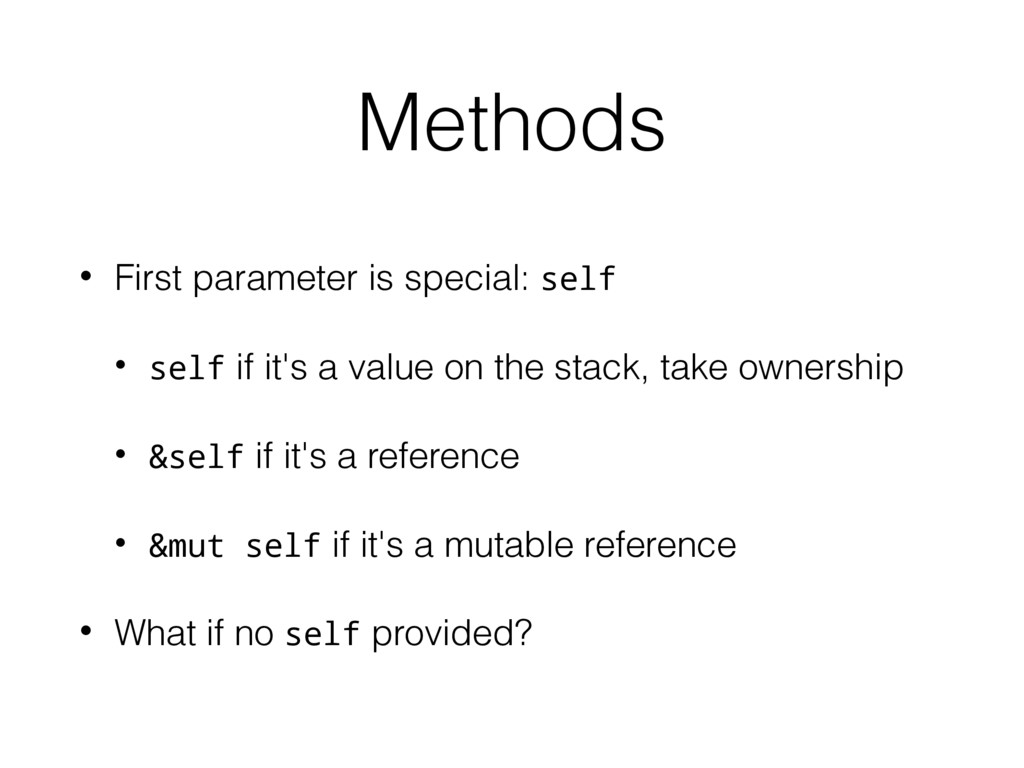
Methods • First parameter is special: self • self if
it's a value on the stack, take ownership • &self if it's a reference • &mut self if it's a mutable reference • What if no self provided? -
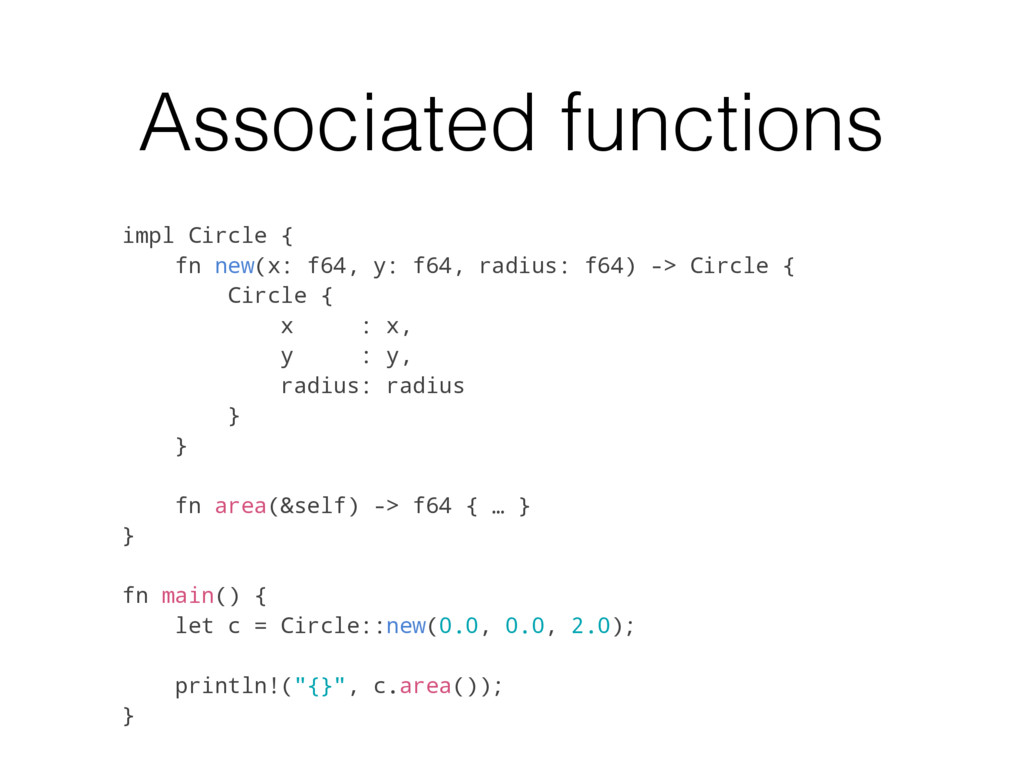
Associated functions impl Circle { fn new(x: f64, y: f64,
radius: f64) -> Circle { Circle { x : x, y : y, radius: radius } } fn area(&self) -> f64 { … } } fn main() { let c = Circle::new(0.0, 0.0, 2.0); println!("{}", c.area()); } -
Associated functions impl Circle { fn new(x: f64, y: f64,
radius: f64) -> Circle { Circle { x : x, y : y, radius: radius } } fn area(&self) -> f64 { … } } fn main() { let c = Circle::new(0.0, 0.0, 2.0); println!("{}", c.area()); } -
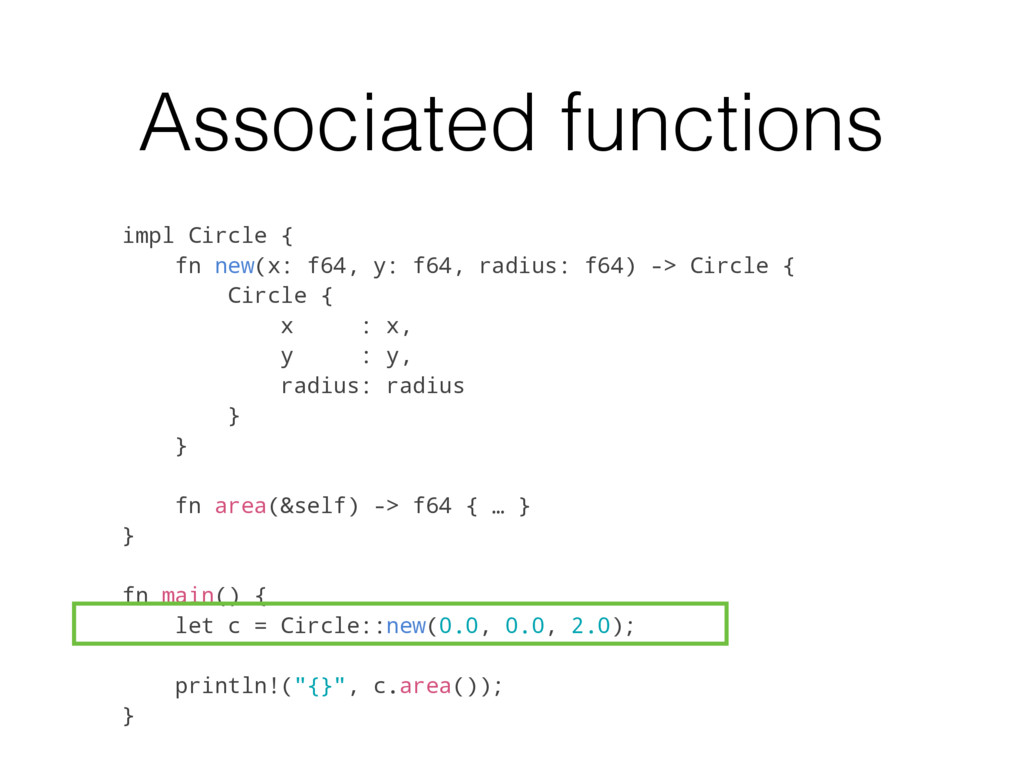
Associated functions impl Circle { fn new(x: f64, y: f64,
radius: f64) -> Circle { Circle { x : x, y : y, radius: radius } } fn area(&self) -> f64 { … } } fn main() { let c = Circle::new(0.0, 0.0, 2.0); println!("{}", c.area()); } -
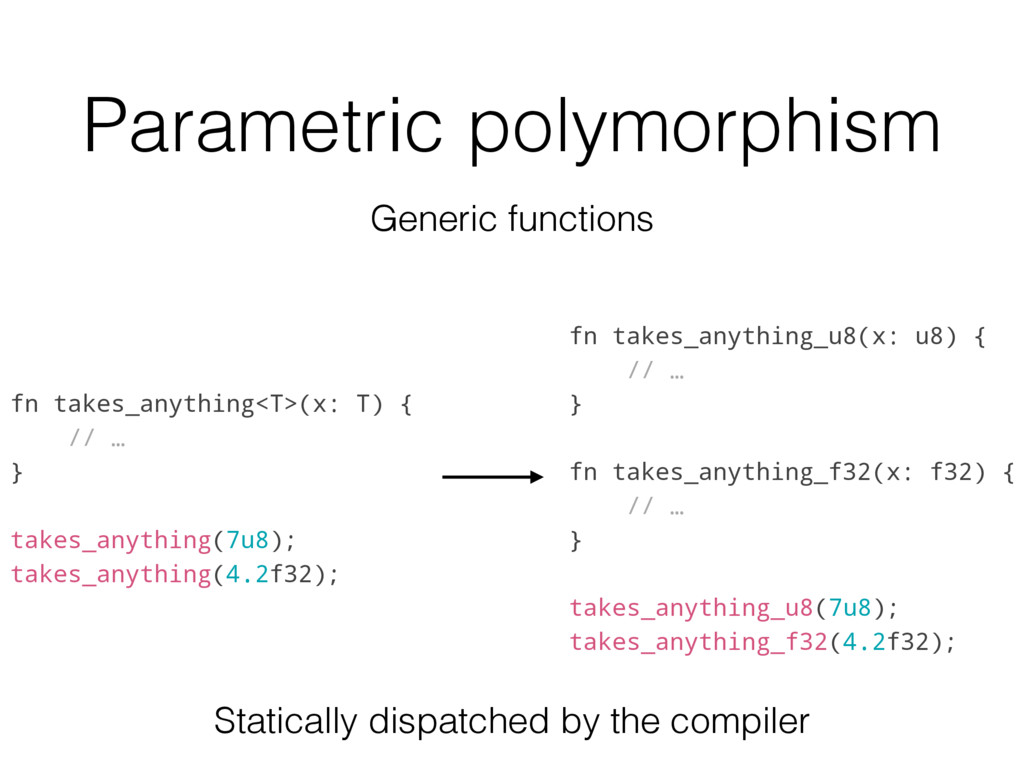
Parametric polymorphism • Also known as Generic • Many (poly)
forms (morph) • Static dispatch by default (monomorphization) • Dynamic dispatch for trait objects (not detailed, see doc) -
Parametric polymorphism Generic functions fn takes_anything<T>(x: T) { // …
} takes_anything(7u8); takes_anything(4.2f32); -
Parametric polymorphism Generic functions fn takes_anything<T>(x: T) { // …
} takes_anything(7u8); takes_anything(4.2f32); fn takes_anything_u8(x: u8) { // … } fn takes_anything_f32(x: f32) { // … } takes_anything_u8(7u8); takes_anything_f32(4.2f32); -
Parametric polymorphism Generic functions fn takes_anything<T>(x: T) { // …
} takes_anything(7u8); takes_anything(4.2f32); fn takes_anything_u8(x: u8) { // … } fn takes_anything_f32(x: f32) { // … } takes_anything_u8(7u8); takes_anything_f32(4.2f32); Statically dispatched by the compiler -
Parametric polymorphism Generic structures struct Point<T> { x: T, y:
T } let int_origin = Point { x: 0, y: 0 }; let float_origin = Point { x: 0.0, y: 0.0 }; -
Parametric polymorphism Generic enumerators enum Foo<T> { Bar, Baz(T), Qux
{ z: T } } let int_baz = Foo::Baz(0); let float_baz = Foo::Baz(0.0); -
Option • null does not exist in Rust • Option
to represent an optional value enum Option<T> { Some(T), None } let x = Some(7); let y = None; -
Result • No exception in Rust • Result is the
error handling mechanism enum Result<T, E> { Ok(T), Err(E) } let x = Ok(7); let y = Err("Too bad"); -
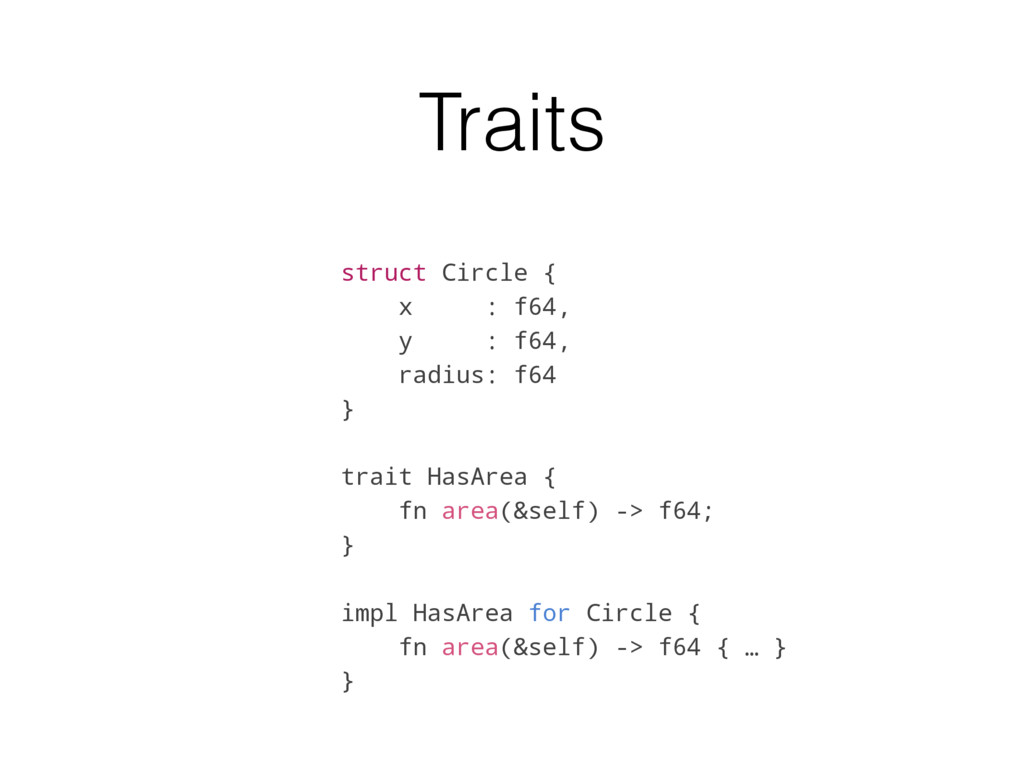
Traits • Object, interface, type capability… all mixed • Tells
the compiler about functionality a type must provide • Can be implemented on any types (structures, enumerators, primitive types) • This is where things becomes very interesting and delicious -
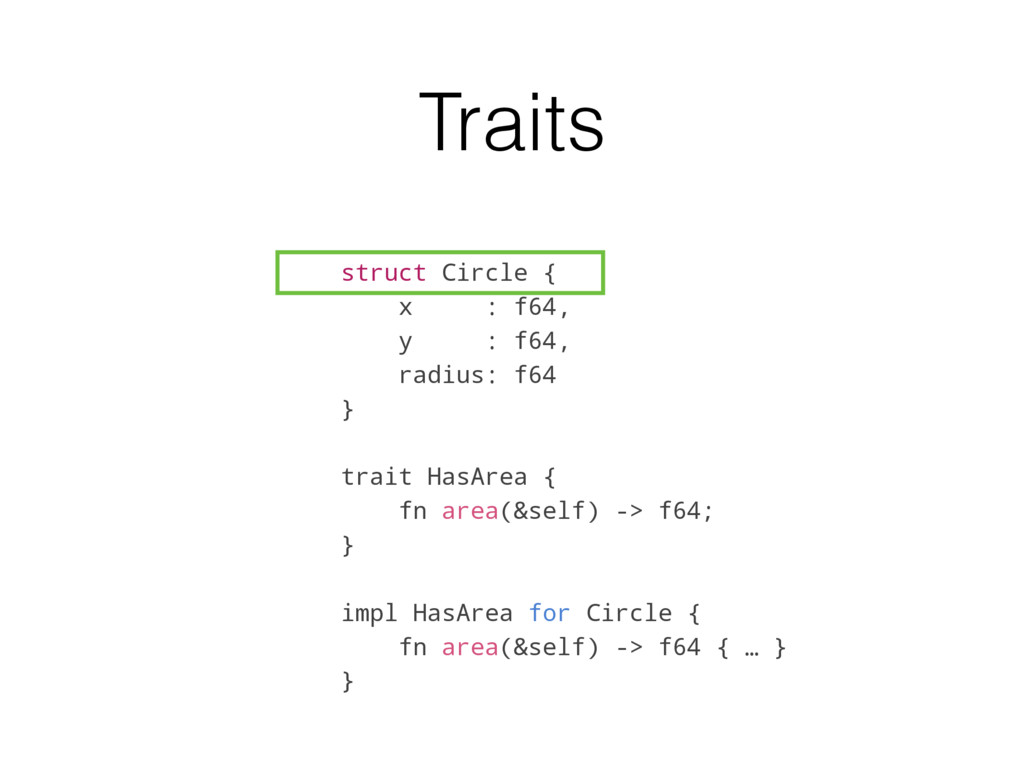
Traits struct Circle { x : f64, y : f64,
radius: f64 } trait HasArea { fn area(&self) -> f64; } impl HasArea for Circle { fn area(&self) -> f64 { … } } -
Traits struct Circle { x : f64, y : f64,
radius: f64 } trait HasArea { fn area(&self) -> f64; } impl HasArea for Circle { fn area(&self) -> f64 { … } } -
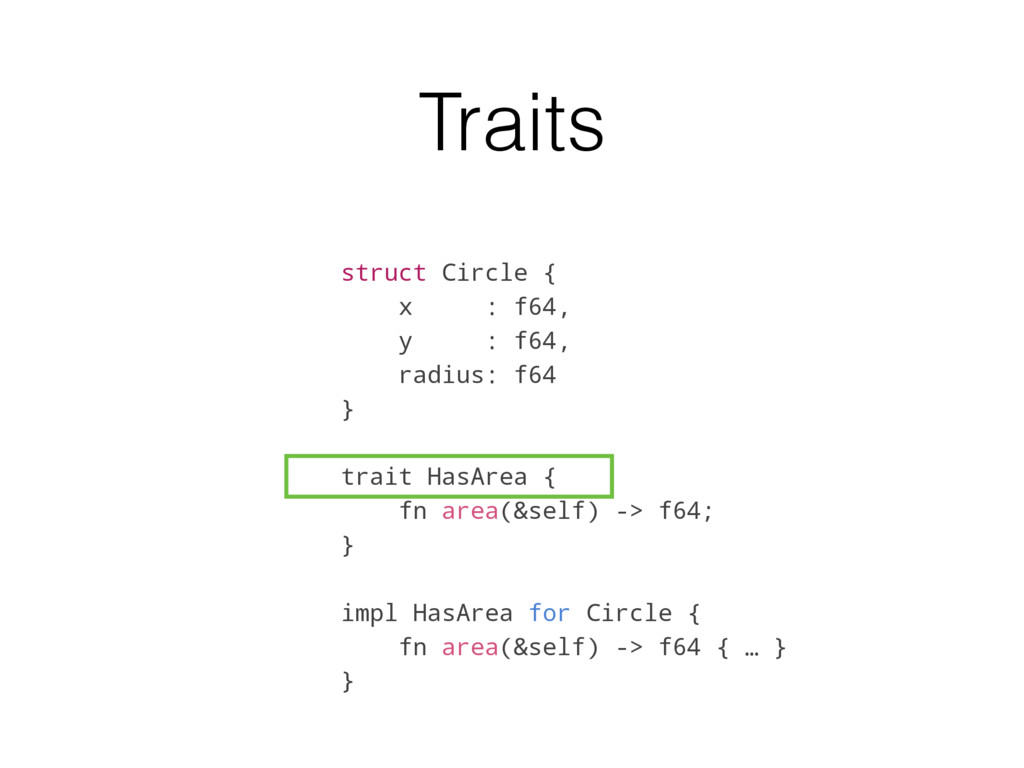
Traits struct Circle { x : f64, y : f64,
radius: f64 } trait HasArea { fn area(&self) -> f64; } impl HasArea for Circle { fn area(&self) -> f64 { … } } -
Traits struct Circle { x : f64, y : f64,
radius: f64 } trait HasArea { fn area(&self) -> f64; } impl HasArea for Circle { fn area(&self) -> f64 { … } } -
Traits Bound on generic functions fn print_area<T: HasArea>(shape: T) {
println!("This shape has an area of {}", shape.area()); } -
Traits Bound on generic functions fn print_area<T: HasArea>(shape: T) {
println!("This shape has an area of {}", shape.area()); } T: HasArea means type T implements the HasArea trait -
Traits Bound on generic functions fn print_area<T: HasArea>(shape: T) {
println!("This shape has an area of {}", shape.area()); } T: HasArea means type T implements the HasArea trait Monomorphization applies, i.e. statically dispatched -
Traits Multiple bounds on generic functions fn print_area<T: HasName +
HasArea>(shape: T) { println!("{} has an area of {}", shape.name(), shape.area()); } -
Traits Multiple bounds on generic functions fn print_area<T: HasName +
HasArea>(shape: T) { println!("{} has an area of {}", shape.name(), shape.area()); } + represents a list of traits -
Traits where clause fn print_area<T>(shape: T) where T: HasName +
HasArea { println!("{} has an area of {}", shape.name(), shape.area()); } -
Traits where clause fn print_area<T>(shape: T) where T: HasName +
HasArea { println!("{} has an area of {}", shape.name(), shape.area()); } where allows to express traits on type, just like before More powerful syntax, not detailed here -
Traits Default methods trait Foo { fn is_valid(&self) -> bool;
fn is_invalid(&self) -> bool { !self.is_valid() } } Can be overridden -
Traits Inheritance trait Foo { fn foo(&self); } trait FooBar
: Foo { fn foobar(&self); } -
RAII • Resource Acquisition Is Initialisation • No manual allocation,
no manual deallocation, no garbage collector • The Drop trait is used to run some code when a value goes out of scope • Default implementations for particular types (Rc, Weak, Arc…) -
Drop struct Firework { strength: i32 } impl Drop for
Firework { fn drop(&mut self) { println!("BOOM times {}!", self.strength); } } fn main() { let firecracker = Firework { strength: 1 }; let tnt = Firework { strength: 100 }; } -
Drop struct Firework { strength: i32 } impl Drop for
Firework { fn drop(&mut self) { println!("BOOM times {}!", self.strength); } } fn main() { let firecracker = Firework { strength: 1 }; let tnt = Firework { strength: 100 }; } BOOM times 100! -
Drop struct Firework { strength: i32 } impl Drop for
Firework { fn drop(&mut self) { println!("BOOM times {}!", self.strength); } } fn main() { let firecracker = Firework { strength: 1 }; let tnt = Firework { strength: 100 }; } BOOM times 1! -
Drop struct Firework { strength: i32 } impl Drop for
Firework { fn drop(&mut self) { println!("BOOM times {}!", self.strength); } } fn main() { let firecracker = Firework { strength: 1 }; let tnt = Firework { strength: 100 }; } BOOM times 1! First in, last out -
Stack & Heap • Everything is allocated on the stack
by default • Fast • Scoped to the function • Limited in size • To allocate on the heap, use Box -
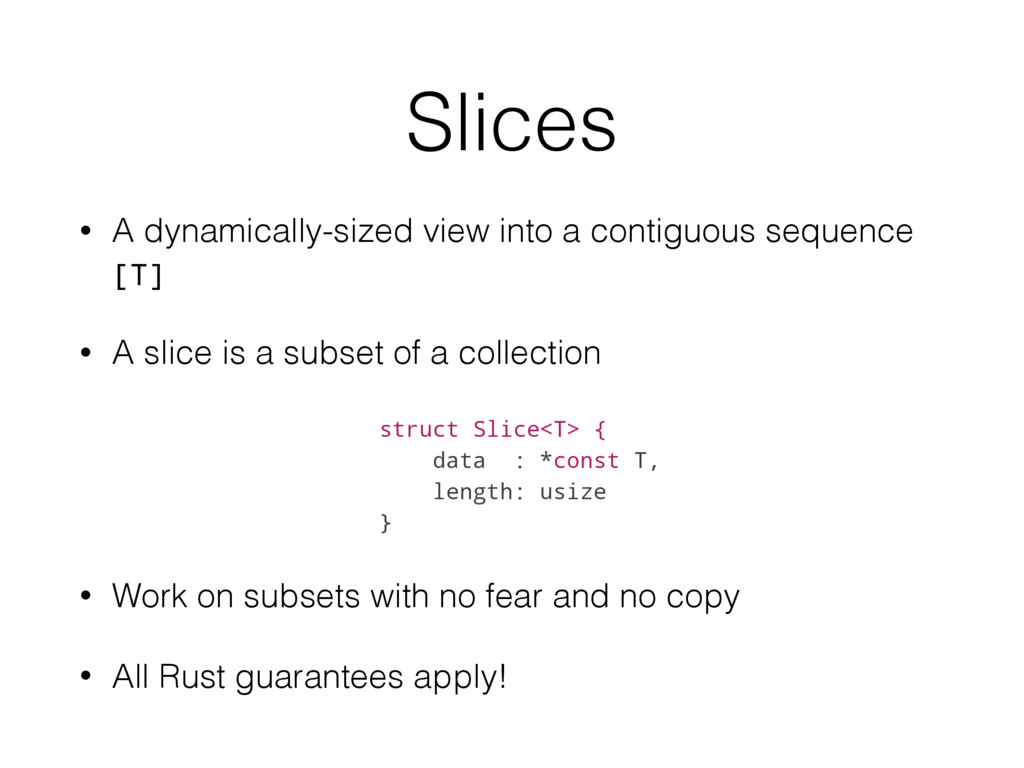
Slices • A dynamically-sized view into a contiguous sequence [T]
• A slice is a subset of a collection struct Slice<T> { data : *const T, length: usize } • Work on subsets with no fear and no copy • All Rust guarantees apply! -
Macros • Hygienic system • Procedural macros • Long story
short: It's cool and easy to use -
Unsafety • Some programs are safe but cannot be verified
by the compiler • unsafe keyword only allows three things: 1. Access or update a static mutable variable 2. Dereference a raw pointer 3. Call unsafe functions (the most powerful ability) • Does not turn off the borrow checker or other guarantees • See documentation for more details -
Iterators • Rust as its best • High-level constructions •
Short and efficient low-level results • Strong safety guarantees • Producers and consumers model -
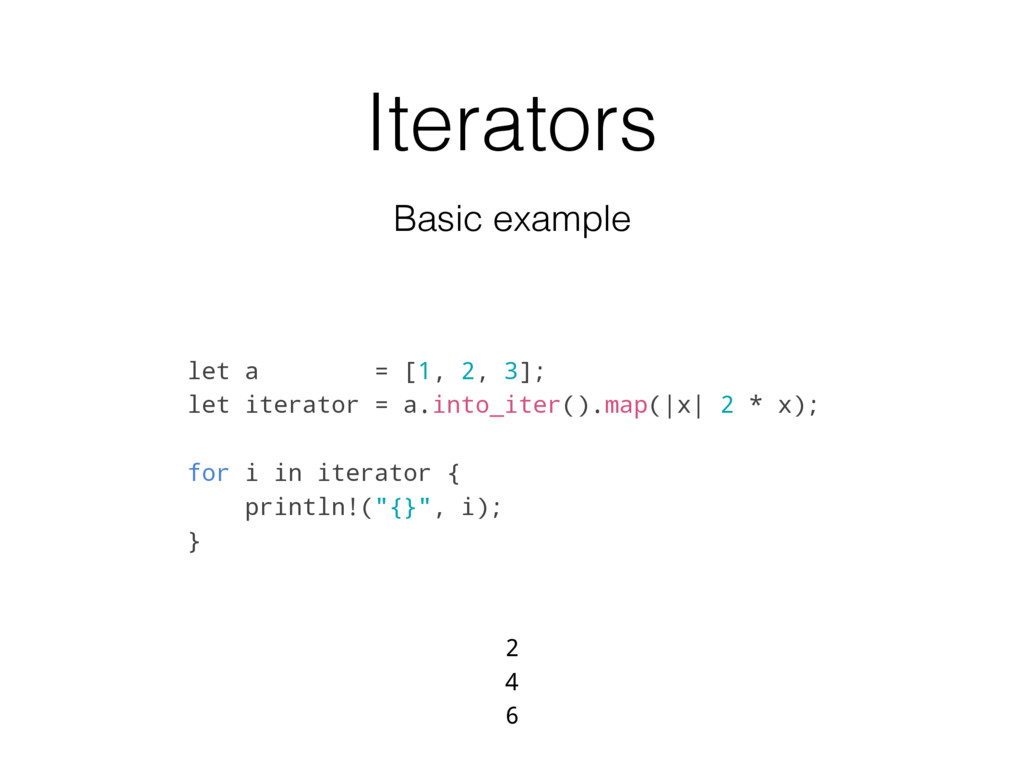
Iterators Basic example let a = [1, 2, 3]; let
iterator = a.into_iter().map(|x| 2 * x); for i in iterator { println!("{}", i); } 2 4 6 -
Iterators Basic example, unfolded let a = [1, 2, 3];
let mut iterator = a.into_iter().map(|x| 2 * x); while let Some(i) = iterator.next() { println!("{}", i); } -
Iterators Basic example, unfolded let a = [1, 2, 3];
let mut iterator = a.into_iter().map(|x| 2 * x); while let Some(i) = iterator.next() { println!("{}", i); } Producer -
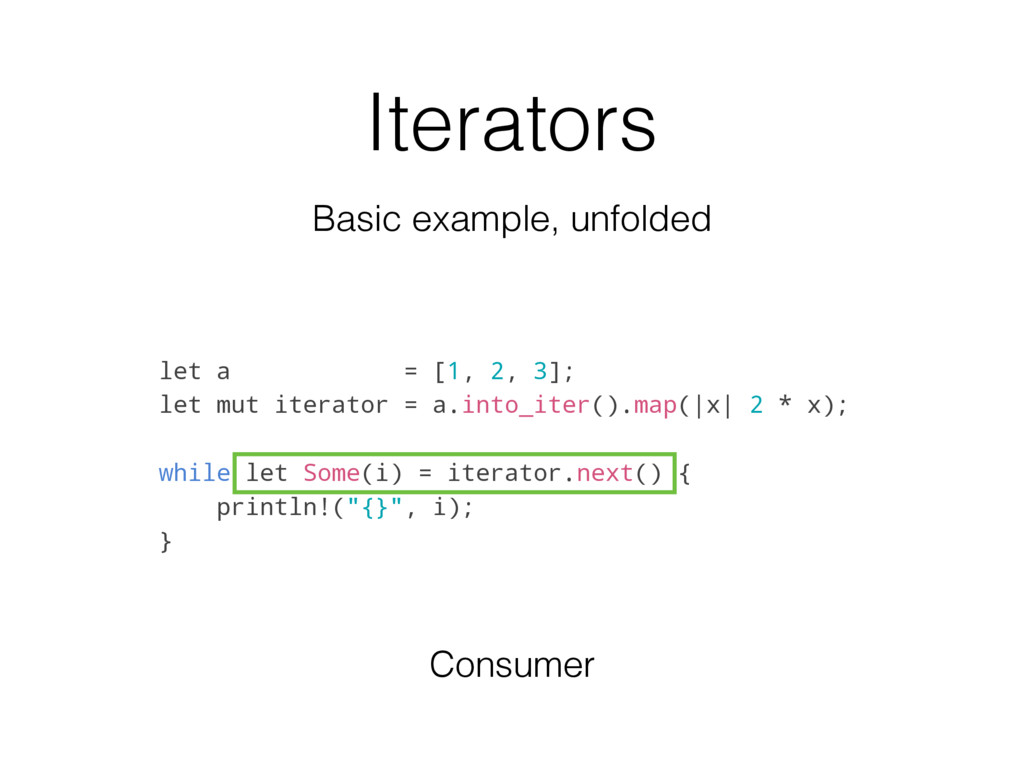
Iterators Basic example, unfolded let a = [1, 2, 3];
let mut iterator = a.into_iter().map(|x| 2 * x); while let Some(i) = iterator.next() { println!("{}", i); } Consumer -
Iterators Producers & consumers explained let a = [1u32, 2,
3, 4, 6, 7, 8]; let sum: u32 = a.into_iter() .filter(|&x| x % 2 == 0) .map(|x| x * 2) .sum(); println!("sum is {}", sum); -
Iterators Producers & consumers explained let a = [1u32, 2,
3, 4, 6, 7, 8]; let sum: u32 = a.into_iter() .filter(|&x| x % 2 == 0) .map(|x| x * 2) .sum(); println!("sum is {}", sum); Create an iterator -
Iterators Producers & consumers explained let a = [1u32, 2,
3, 4, 6, 7, 8]; let sum: u32 = a.into_iter() .filter(|&x| x % 2 == 0) .map(|x| x * 2) .sum(); println!("sum is {}", sum); Producer: Filter results (note the &x) -
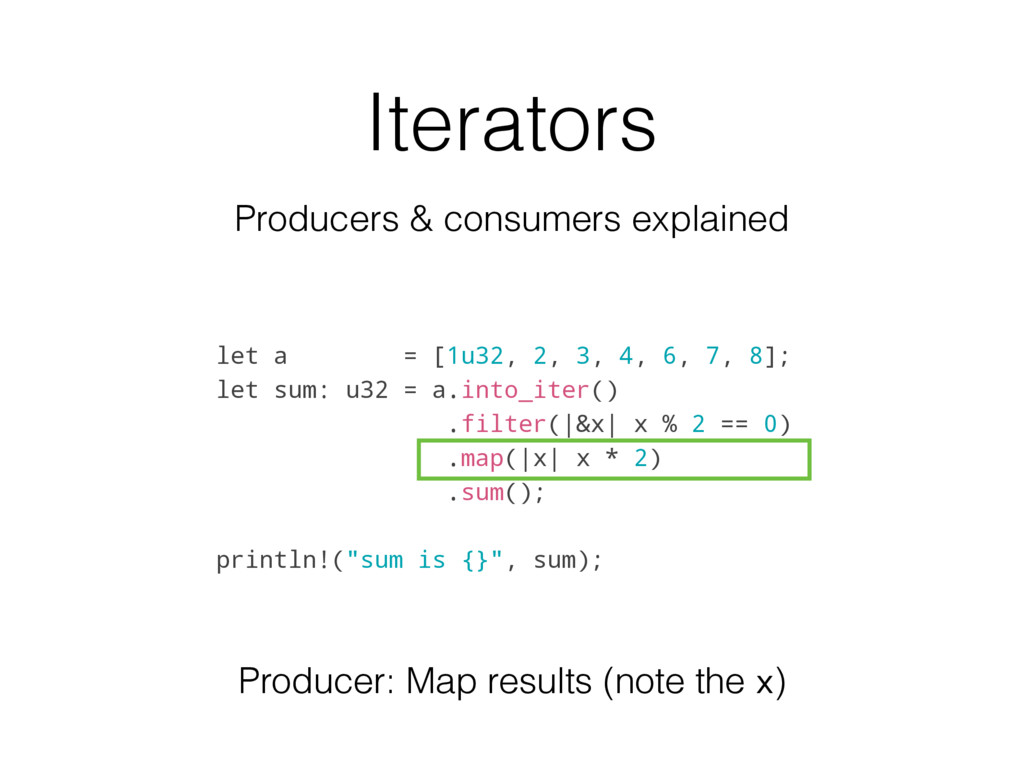
Iterators Producers & consumers explained let a = [1u32, 2,
3, 4, 6, 7, 8]; let sum: u32 = a.into_iter() .filter(|&x| x % 2 == 0) .map(|x| x * 2) .sum(); println!("sum is {}", sum); Producer: Map results (note the x) -
Iterators Producers & consumers explained let a = [1u32, 2,
3, 4, 6, 7, 8]; let sum: u32 = a.into_iter() .filter(|&x| x % 2 == 0) .map(|x| x * 2) .sum(); println!("sum is {}", sum); Consumer: Collect by summing results -
Iterators Producers & consumers explained let a = [1u32, 2,
3, 4, 6, 7, 8]; let sum: u32 = a.into_iter() .filter(|&x| x % 2 == 0) .map(|x| x * 2) .sum(); println!("sum is {}", sum); sum is 40 -
Concurrency & parallelism • Hard & long, but incredibly important
topics • Voluntarily small but powerful API in std • Two traits & the borrow checker to ensure safety • Several libraries to go further -
Send & Sync • When a type T implements Send,
it indicates that something of this type is able to have ownership transferred safely between threads • When a type T implements Sync, it indicates that something of this type has no possibility of introducing memory unsafety when used from multiple threads concurrently through shared references -
Thread Basic usage use std::thread; fn main() { thread::spawn(|| {
println!("Hello from a thread!"); }); } -
Thread Return a value use std::thread; fn main() { let
handle = thread::spawn(|| { "Hello from a thread!" }); println!("{}", handle.join().unwrap()); } -
Thread Closure, references & move semantics fn main() { let
x = 1; thread::spawn(|| { println!("x is {}", x); }); } -
Thread Closure, references & move semantics fn main() { let
x = 1; thread::spawn(|| { println!("x is {}", x); }); } 5:19: 7:6 error: closure may outlive the current function, but it borrows `x`, which is owned by the current function ... 5:19: 7:6 help: to force the closure to take ownership of `x` (and any other referenced variables), use the `move` keyword, as shown: thread::spawn(move || { println!("x is {}", x); }); -
Thread Closure, references & move semantics 5:19: 7:6 error: closure
may outlive the current function, but it borrows `x`, which is owned by the current function ... 5:19: 7:6 help: to force the closure to take ownership of `x` (and any other referenced variables), use the `move` keyword, as shown: thread::spawn(move || { println!("x is {}", x); }); fn main() { let x = 1; thread::spawn(move || { println!("x is {}", x); }); } -
–Someone “Shared mutable state is the root of all evil.
Most languages attempt to deal with this problem through the ‘mutable’ part, but Rust deals with it by solving the ‘shared’ part.” -
Thread Safe Shared Mutable State • Rc, a single-threaded reference-counting
pointer, immutable, no Send or Sync • Cell or RefCell to get immutability • Arc, a thread-safe (atomic) reference-counting pointer, immutable, with Send and Sync • Mutex or RwLock (or more) to get mutability • more… -
Thread Balance • Some constraints can be checked at compile-time
with the borrow checker, traits etc. • Some constraints are checked at runtime • My advices 1. Check if a crate already exists 2. Check “big projects”, e.g. Servo or Redox -
–Edsger W. Dijkstra, "The Humble Programmer" (1972) “Program testing can
be a very effective way to show the presence of bugs, but it is hopelessly inadequate for showing their absence” -
Tests • Rust hardly tries to ensure a high quality
ecosystem • Simple but efficient mechanisms to write and run tests • cargo test to run them all -
Tests Unit and integration suites #[test] fn case_foo() { let
input = …; let output = …; assert_eq!(sut(input), output); } $ cargo run --lib -
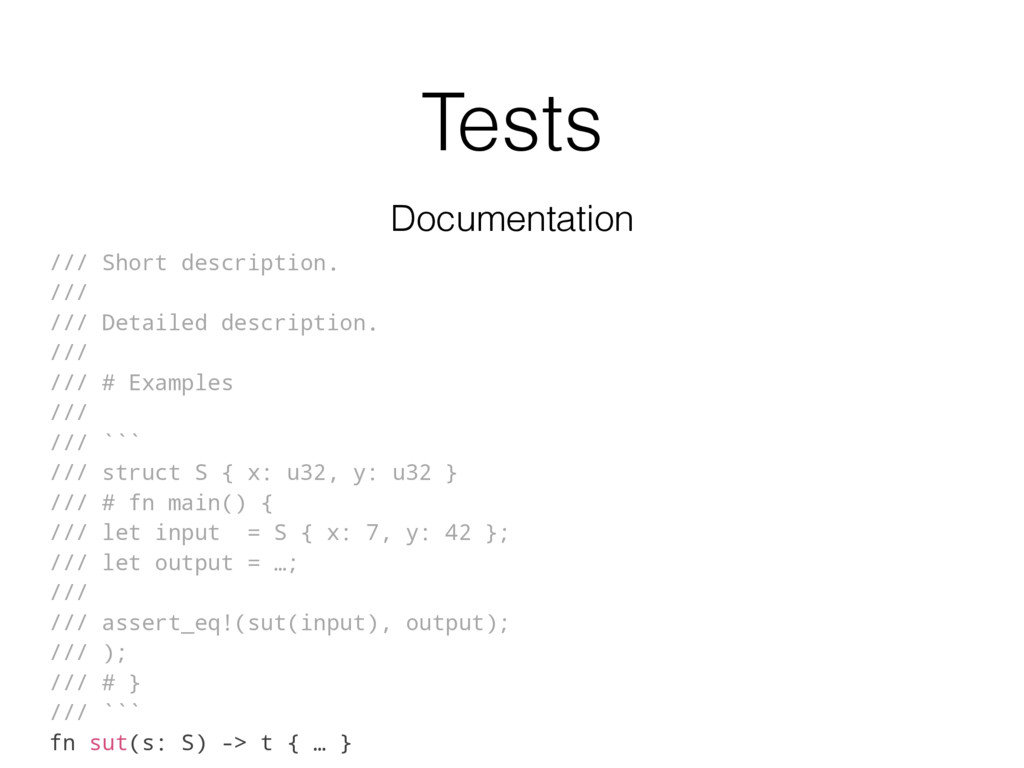
Tests Documentation /// Short description. /// /// Detailed description. ///
/// # Examples /// /// ``` /// struct S { x: u32, y: u32 } /// # fn main() { /// let input = S { x: 7, y: 42 }; /// let output = …; /// /// assert_eq!(sut(input), output); /// ); /// # } /// ``` fn sut(s: S) -> t { … } -
Tests Documentation /// Short description. /// /// Detailed description. ///
/// # Examples /// /// ``` /// struct S { x: u32, y: u32 } /// # fn main() { /// let input = S { x: 7, y: 42 }; /// let output = …; /// /// assert_eq!(sut(input), output); /// ); /// # } /// ``` fn sut(s: S) -> t { … } -
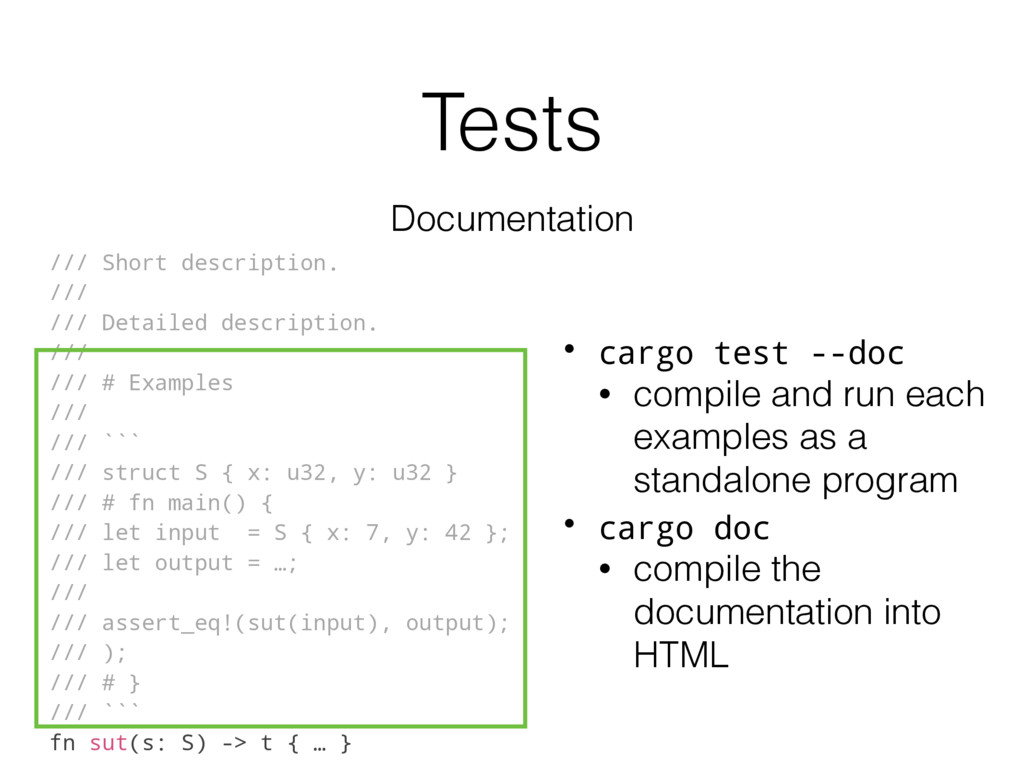
Tests Documentation /// Short description. /// /// Detailed description. ///
/// # Examples /// /// ``` /// struct S { x: u32, y: u32 } /// # fn main() { /// let input = S { x: 7, y: 42 }; /// let output = …; /// /// assert_eq!(sut(input), output); /// ); /// # } /// ``` fn sut(s: S) -> t { … } • cargo test --doc • compile and run each examples as a standalone program • cargo doc • compile the documentation into HTML -
Compiler • Self-hosted compiler (Rust is written in Rust) •
New release every 6 weeks • Different channels: stable, beta, nightly • LLVM for the backend • Lot of target triples supported • Including WebAssembly (experimental) -
Crate • Can be a binary • Can be a
library of type • lib (ambiguous) • dylib (.so, .dylib, .dll) • rlib (Rust static lib) • staticlib (.a, .lib) • cdylib (.so, .dylib, .dll) • proc-macro (procedural macros) -
rustup • Toolchain installer curl https://sh.rustup.rs -sSf | sh •
Update rustup update • Easy cross-compilation rustup target add arm-linux-androideabi -
cargo • build • clean • doc • new •
init • run • test • bench • install • … • Official package manager • Repository on crates.io • Invoke rustc for you -
xargo • Sysroot manager to build and customise std •
Cross compile Rust crates for targets that don't have binary releases of the standard crates cargo install xargo xargo build … • CLI is exactly like cargo -
Documentations • Book, https://doc.rust-lang.org/book/ • FAQ, https://www.rust-lang.org/en-US/faq.html • rustc --explain
• std, https://doc.rust-lang.org/std/ • Rust by example, http://rustbyexample.com/ • into_rust(), http://intorust.com/ -
Gardens • Forum, https://users.rust-lang.org • Reddit, https://reddit.com/r/rust • IRC, irc://irc.mozilla.org#rust
• YouTube, https://www.youtube.com/channel/UC… • Twitter, https://twitter.com/rustlang -
Gardens • This week in Rust, https://this-week-in-rust.org/ • Blog, https://blog.rust-lang.org/
• Teams, https://www.rust-lang.org/en-US/team.html -
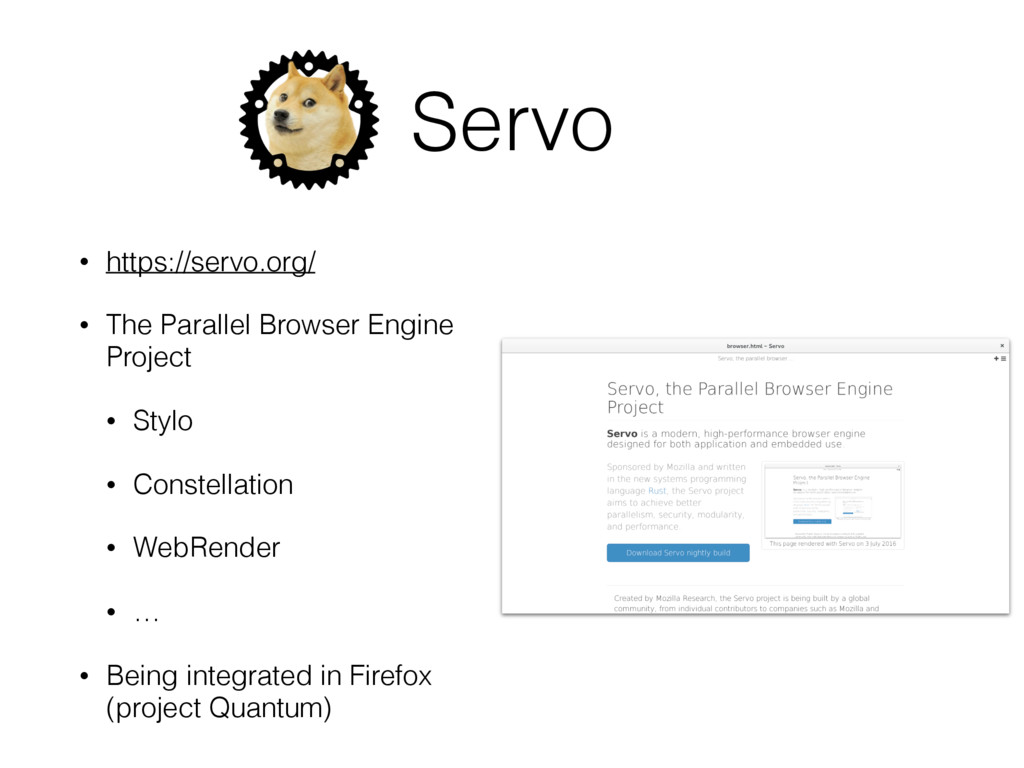
Servo • https://servo.org/ • The Parallel Browser Engine Project •
Stylo • Constellation • WebRender • … • Being integrated in Firefox (project Quantum) -
Redox • https://redox-os.org/ • Unix-like Operating System written in Rust
• kernel • orbital • tfs • ralloc • ion -
ralloc • https://github.com/redox-os/ralloc • A fast & memory efficient userspace
allocator • Thread-local allocation • First-class debugger support • Logging • Custom out-of-memory handlers • Thread-specific OOM handlers • Partial deallocation • Platform agnostic • Safe SBRK • Useless alignments • Top notch security • … -
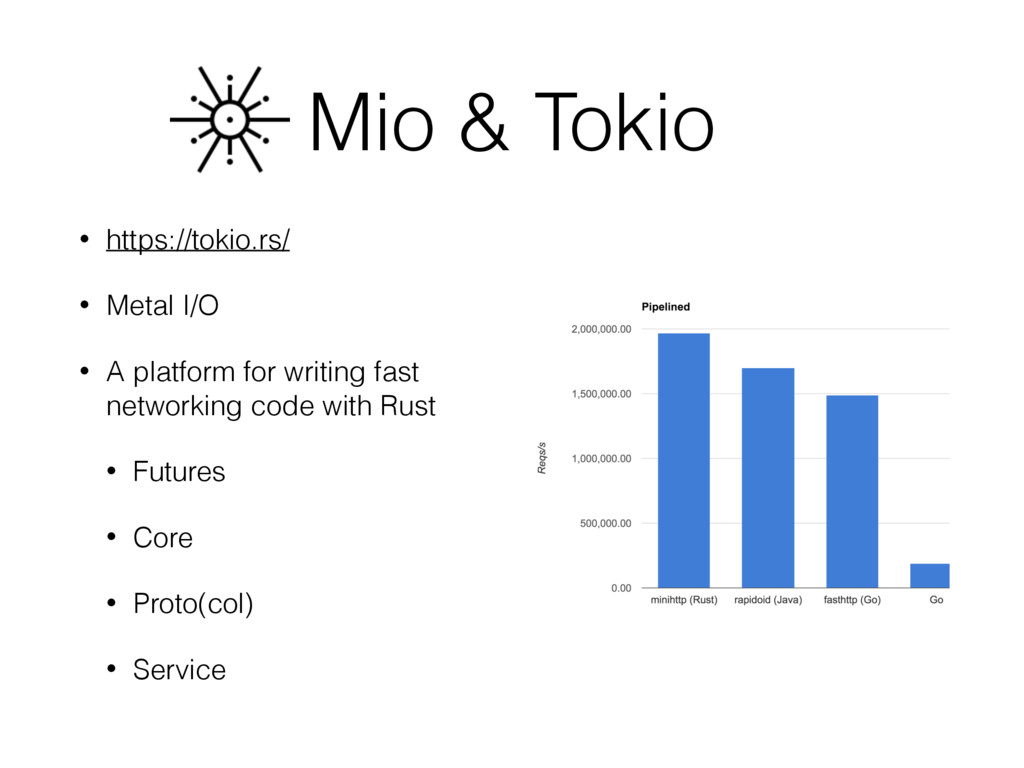
Mio & Tokio • https://tokio.rs/ • Metal I/O • A
platform for writing fast networking code with Rust • Futures • Core • Proto(col) • Service -
Rayon • https://github.com/nikomatsakis/rayon/ • A data parallelism library for Rust
• s/.iter()/.par_iter()/g, tadaa fn sum_of_squares(input: &[i32]) -> i32 { input.par_iter() .map(|&i| i * i) .sum() } -
Web, ORM, HTTP • http://arewewebyet.org • http://ironframework.io/ • Extensible, concurrent
web framework • http://diesel.rs/ • Safe, extensible ORM and query builder • https://hyper.rs/ • Low-level typesafe abstraction over raw HTTP • Provides an elegant layer over "stringly-typed" HTTP -
• http://www.piston.rs/ • A modular open source game engine •
Image • Music • Conrod, 2D GUI library • Gfx • Sprite • … -
ripgrep • https://github.com/BurntSushi/ ripgrep • Usability of The Silver Searcher
with the raw speed of grep • Very fast -
nom • https://github.com/Geal/nom/ • Rust parser combinator framework • Byte-,
bit-, string-oriented • Zero-copy • Streaming • Macro based syntax • State machine handling • Descriptive errors • Custom error types • Safe parsing • Fast • … -
Writing an OS in Rust • http://os.phil-opp.com/ • A series
of articles explaining how to write an OS in Rust • Very interesting and instructive! -
Tagua VM • http://tagua.io/ • An experimental PHP Virtual Machine
• Several libraries • Parser • Passes/analysis • Idiomatic LLVM bindings • Virtual Machine • All extensions • … -
Sorry if your awesome project is not here. And thanks
for working on it ❤! -
et cætera • It was just an overview • Tons
of interesting ideas and projects • Nothing new in Rust, just 40 years of research finally in a single efficient & productive language • RustBelt, Formally verify several Rust safety properties, http://plv.mpi- sws.org/rustbelt/ -
Sources for this talk • Rust Book and various documentations
• Blog posts • My experience and understanding • I have learned a lot, and I still have a lot to learn -
Q&A Thank you ❤ Ask me anything https://www.rust-lang.org/ [email protected] @mnt_io
https://www.liip.ch/ https://hoa-project.net http://atoum.org http://tagua.io
 hywan
 omatty198
 jsoizo
 yuzneri
 kumaiu
 akihisaikeda
 hakkadaikon
 kamina_zzz
 steliosf
 onozaty
 dalinaum
 ktombow
 hasutosasaki
 kimpetersen
 watany
 mclloyd
 techseoconnect
 thoeni
 addyosmani
 rkendrick25
 nonsquared
 palkan
 mkilby
 ryanjones
 aemeredith