Upgrade to Pro
— share decks privately, control downloads, hide ads and more …
Speaker Deck
Sign up for free
Menu
Search
Features
All features
Private URLs
Password Protection
Custom URLS
Scheduled publishing
Remove Branding
Restrict embedding
Deck Collections
Notes
Features
All features
Private URLs
Password Protection
Custom URLS
Scheduled publishing
Remove Branding
Restrict embedding
Deck Collections
Notes
Explore
Featured decks
Featured speakers
Programming
Technology
Storyboards
Explore
Featured decks
Featured speakers
Programming
Technology
Storyboards
Pricing
Search
Sign in
Sign up for free
Design and Evaluation of a Self-Sovereign Ident...
Search
Koshi Ikegawa
August 09, 2026
Research
16
0
Share
Embed
Copy iframe code
Copy JS code
Copy link
Start on current slide
Design and Evaluation of a Self-Sovereign Identity System with a Custodial Wallet
https://doi.org/10.1007/978-3-032-22088-2_8
Koshi Ikegawa
August 09, 2026
More Decks by Koshi Ikegawa
See All by Koshi Ikegawa
ブロックチェーンを用いた自己主権型デジタルID管理 (HL Workshop Ver.)
ikegawa
0
100
ブロックチェーンを用いた自己主権型デジタルID管理 (WebX Ver.)
ikegawa
0
190
Demo: Infrastructure for Managing, Sharing, and Utilizing Sensitive Data using Hyperledger Fabric Private Chaincode Running on Microsoft Azure
ikegawa
0
110
Trust Data Sharing and Utilization Infrastructure for Sensitive Data Using Hyperledger Projects
ikegawa
0
100
Trust Data Sharing and Utilization Infrastructure for Sensitive Data using Hyperledger Avalon
ikegawa
0
150
Other Decks in Research
See All in Research
VLMの推論を高速化する視覚トークン削減の仕組み
tattaka
2
380
Santé et fertilité des sols : ce que nous disent les pratiques dans les systèmes de polyculture-élevage
institutdelelevage
PRO
0
130
【Zozo Research 技術共有会】三次元領域の現在と展望
mickey_0226
3
680
CVPR2026論文紹介_VLMにとって良いvision encoderとは何か?Rethinking Model Selection in VLM Through the Lens of Gromov-Wasserstein Distance
kobayashi31
1
270
Santé et fertilité des sols : ce que nous disent les pratiques dans les systèmes de polyculture-élevage
institutdelelevage
PRO
0
130
Développer des solutions de réduction des émissions de méthane entérique : 1ers résultats Méthane 2030
institutdelelevage
PRO
0
260
Model Predictive Control for Uncertain Systems: Robust & Data-Driven Designs
kohlerjohannes
0
170
SAM3を用いたコマ・吹き出しの 領域検出と分割構造からの読み順推定
kzmssk
0
190
Les émissions de méthane entérique en élevage laitier : Enjeux et travaux menés en Afrique de l’Ouest et en France
institutdelelevage
PRO
0
130
データサイエンティストの就労意識~2015 → 2026 一般(個人)会員アンケートより
datascientistsociety
PRO
0
1k
TESSERA: Temporal Embeddings of Surface Spectra for Earth Representation and Analysis
satai
3
120
Evaluation génomique des femelles laitières croisées : comprendre la méthode pour accompagner les éleveurs à son utilisation
institutdelelevage
PRO
0
180
Featured
See All Featured
Embracing the Ebb and Flow
colly
88
5.2k
GraphQLとの向き合い方2022年版
quramy
50
15k
The Anti-SEO Checklist Checklist. Pubcon Cyber Week
ryanjones
0
270
Effective software design: The role of men in debugging patriarchy in IT @ Voxxed Days AMS
baasie
1
570
Are puppies a ranking factor?
jonoalderson
2
4.1k
Fantastic passwords and where to find them - at NoRuKo
philnash
53
4k
How to build a perfect <img>
jonoalderson
1
6.1k
Sam Torres - BigQuery for SEOs
techseoconnect
PRO
0
580
ラッコキーワード サービス紹介資料
rakko
1
5.4M
Stop Working from a Prison Cell
hatefulcrawdad
274
21k
Building Flexible Design Systems
yeseniaperezcruz
330
41k
Dominate Local Search Results - an insider guide to GBP, reviews, and Local SEO
greggifford
PRO
0
370
Transcript
2025 8th International Conference on Blockchain Technology and Applications (ICBTA
2025) Design and Evaluation of a Self-Sovereign Identity System with a Custodial Wallet December 13, 2025 Koshi IKEGAWA and Tatsuya SATO Services Computing Research Dept. Hitachi, Ltd. Research & Development Group ©Hitachi, Ltd. 2025. All rights reserved
Koshi IKEGAWA and Tatsuya SATO. “Design and Evaluation of a
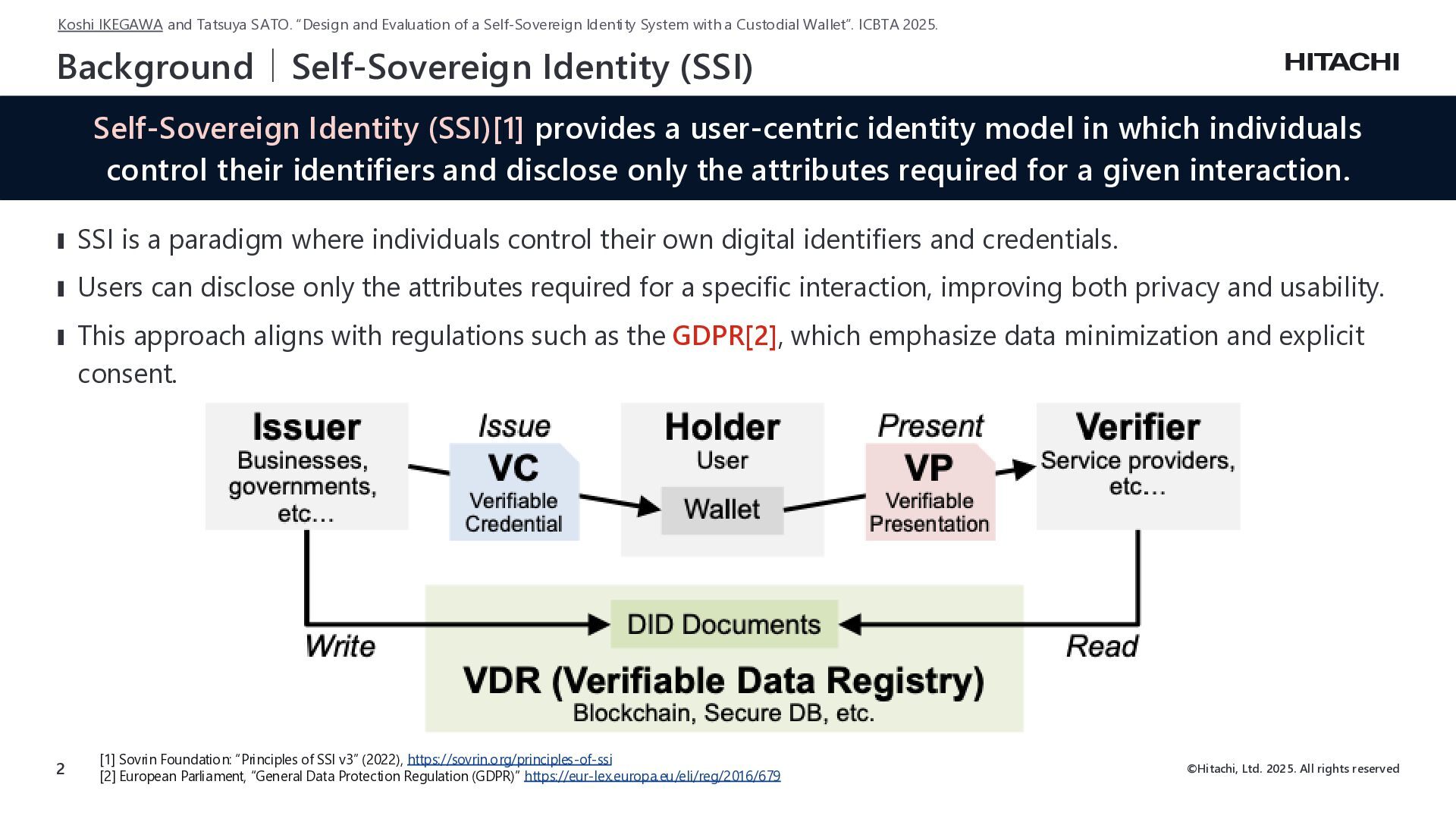
Self-Sovereign Identity System with a Custodial Wallet”. ICBTA 2025. Background|Self-Sovereign Identity (SSI) Self-Sovereign Identity (SSI)[1] provides a user-centric identity model in which individuals control their identifiers and disclose only the attributes required for a given interaction. ❚ SSI is a paradigm where individuals control their own digital identifiers and credentials. ❚ Users can disclose only the attributes required for a specific interaction, improving both privacy and usability. ❚ This approach aligns with regulations such as the GDPR[2], which emphasize data minimization and explicit consent. 2 [1] Sovrin Foundation: “Principles of SSI v3” (2022), https://sovrin.org/principles-of-ssi [2] European Parliament, “General Data Protection Regulation (GDPR)” https://eur-lex.europa.eu/eli/reg/2016/679 ©Hitachi, Ltd. 2025. All rights reserved
Koshi IKEGAWA and Tatsuya SATO. “Design and Evaluation of a
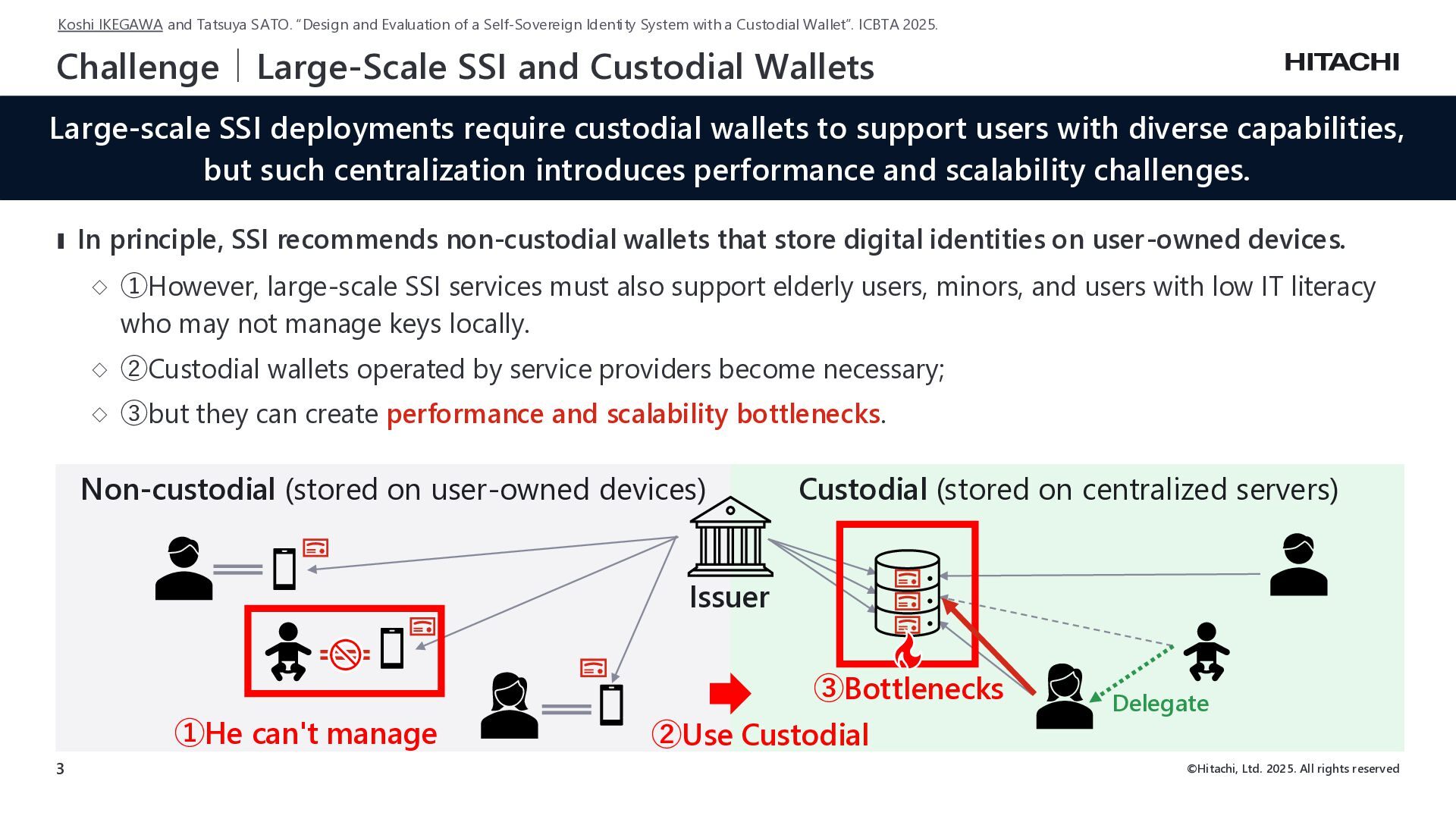
Self-Sovereign Identity System with a Custodial Wallet”. ICBTA 2025. Challenge|Large-Scale SSI and Custodial Wallets Large-scale SSI deployments require custodial wallets to support users with diverse capabilities, but such centralization introduces performance and scalability challenges. ❚ In principle, SSI recommends non-custodial wallets that store digital identities on user-owned devices. ⬦ ①However, large-scale SSI services must also support elderly users, minors, and users with low IT literacy who may not manage keys locally. ⬦ ②Custodial wallets operated by service providers become necessary; ⬦ ③but they can create performance and scalability bottlenecks. Non-custodial (stored on user-owned devices) Custodial (stored on centralized servers) Issuer ③Bottlenecks ①He can't manage 3 ②Use Custodial Delegate ©Hitachi, Ltd. 2025. All rights reserved
Koshi IKEGAWA and Tatsuya SATO. “Design and Evaluation of a
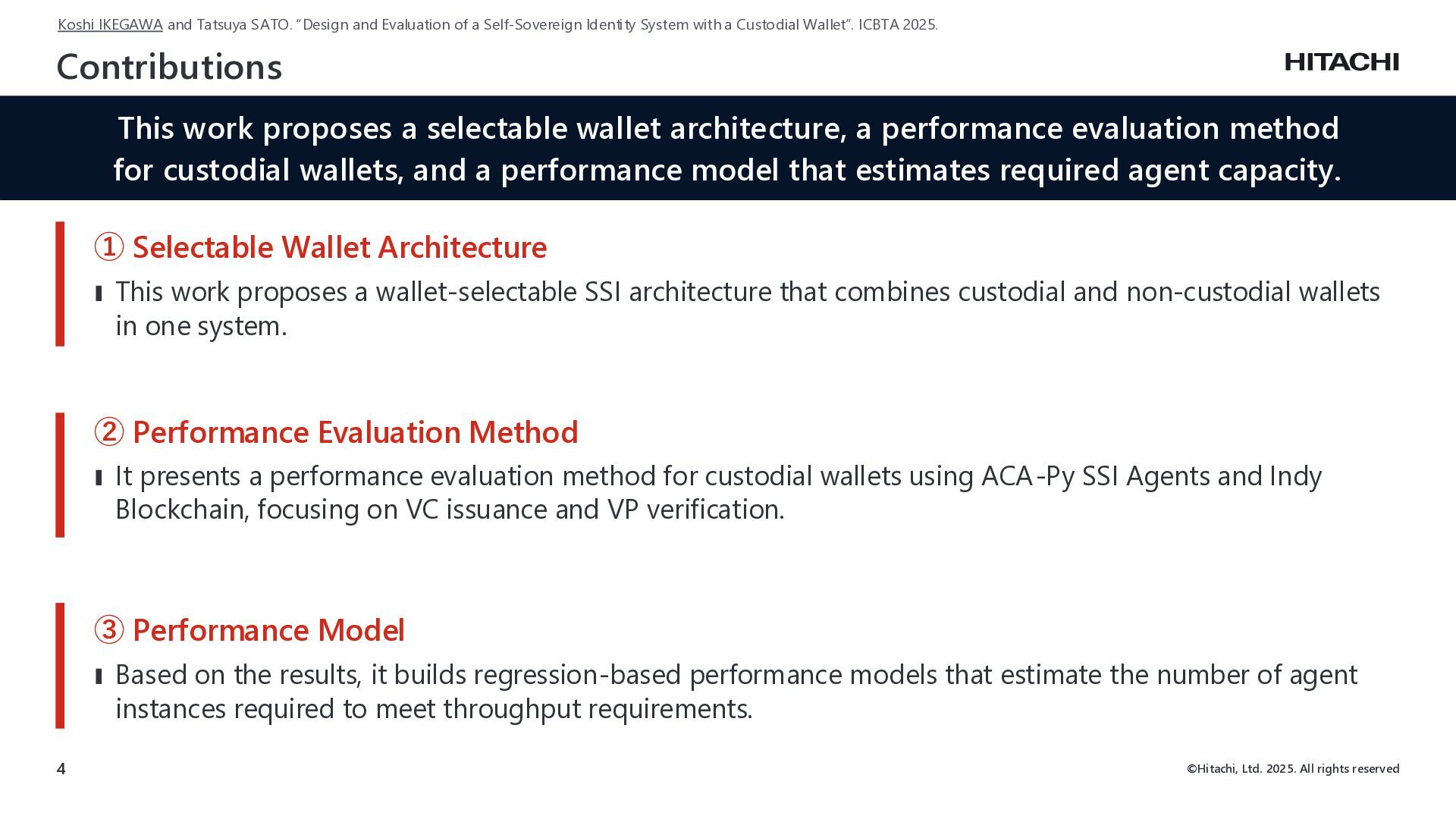
Self-Sovereign Identity System with a Custodial Wallet”. ICBTA 2025. Contributions This work proposes a selectable wallet architecture, a performance evaluation method for custodial wallets, and a performance model that estimates required agent capacity. ① Selectable Wallet Architecture ❚ This work proposes a wallet-selectable SSI architecture that combines custodial and non-custodial wallets in one system. ② Performance Evaluation Method ❚ It presents a performance evaluation method for custodial wallets using ACA-Py SSI Agents and Indy Blockchain, focusing on VC issuance and VP verification. ③ Performance Model ❚ Based on the results, it builds regression-based performance models that estimate the number of agent instances required to meet throughput requirements. 4 ©Hitachi, Ltd. 2025. All rights reserved
Koshi IKEGAWA and Tatsuya SATO. “Design and Evaluation of a
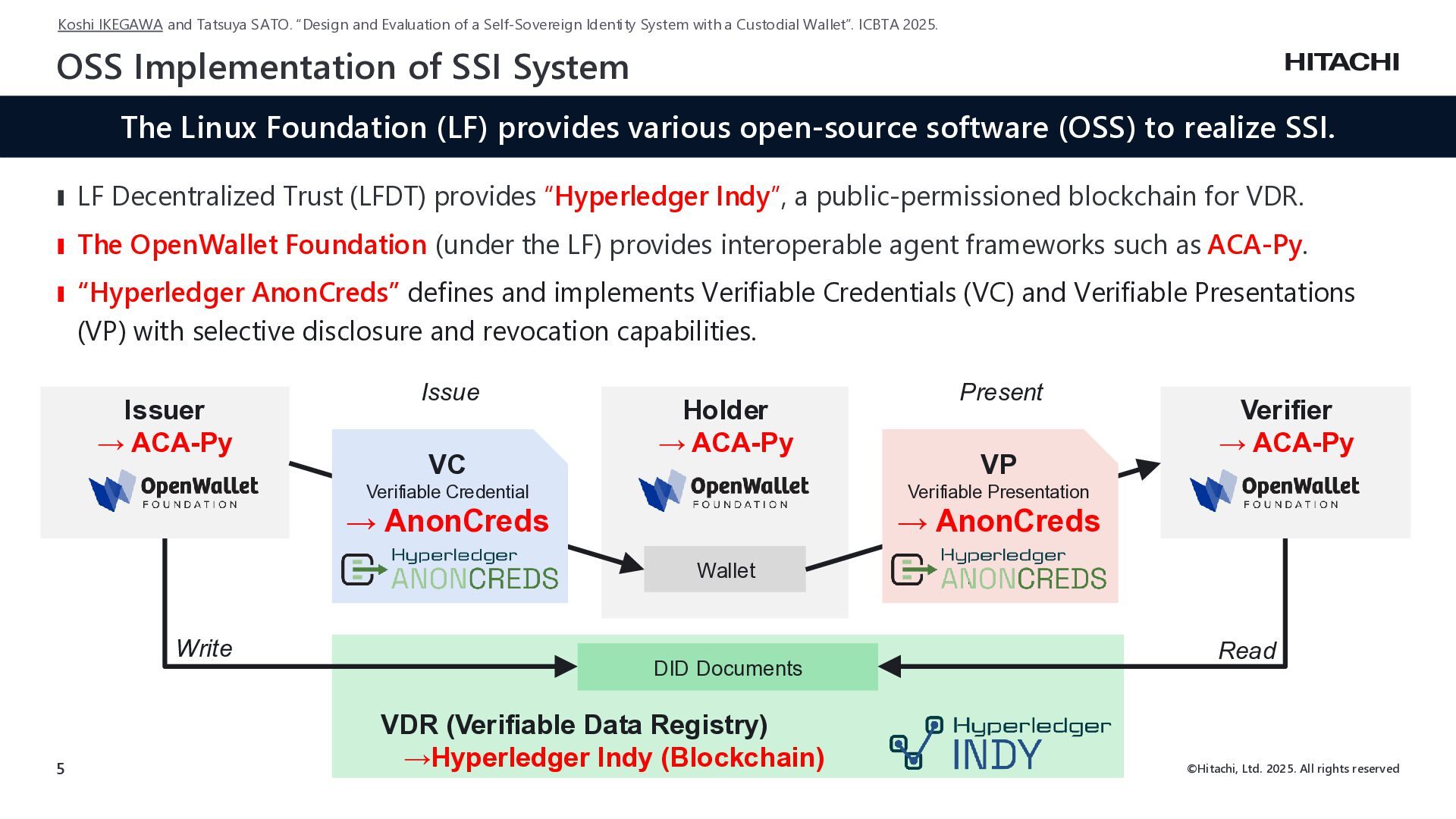
Self-Sovereign Identity System with a Custodial Wallet”. ICBTA 2025. OSS Implementation of SSI System The Linux Foundation (LF) provides various open-source software (OSS) to realize SSI. ❚ LF Decentralized Trust (LFDT) provides “Hyperledger Indy”, a public-permissioned blockchain for VDR. ❚ The OpenWallet Foundation (under the LF) provides interoperable agent frameworks such as ACA-Py. ❚ “Hyperledger AnonCreds” defines and implements Verifiable Credentials (VC) and Verifiable Presentations (VP) with selective disclosure and revocation capabilities. Issuer → ACA-Py Issue VC Holder → ACA-Py Present VP Verifiable Credential Verifiable Presentation → AnonCreds → AnonCreds Verifier → ACA-Py Wallet Write 5 DID Documents VDR (Verifiable Data Registry) →Hyperledger Indy (Blockchain) Read ©Hitachi, Ltd. 2025. All rights reserved
Koshi IKEGAWA and Tatsuya SATO. “Design and Evaluation of a
Self-Sovereign Identity System with a Custodial Wallet”. ICBTA 2025. Related Work|Performance Evaluation Studies of ACA-Py SSI Agent Several studies have evaluated the performance characteristics of ACA-Py SSI Agent. ❚ Pflanzner et al. [3] ⬦ analyzed ACA-Py latency in both cloud and on-premise environments and showed that local deployments can reduce write latency by up to 85% and read latency by up to 50%. ❚ Siqueira et al. [4] ⬦ evaluated multi-user Holder performance using ACA-Py and found that CPU usage becomes the primary bottleneck as concurrency increases. No research exists that verifies the scalability of custodial wallet architectures that multiplex multiple ACA-Py SSI Agents. ❚ ⇨ This is our motivation for researching performance modeling for large-scale SSI services. 6 [3] Pflanzner et al. “Latency analysis of blockchain-based SSI applications”. Future Internet 14(10) (2022). https://doi.org/10.3390/fi14100282 [4] Siqueira et al. “Performance evaluation of self-sovereign identity use cases”. IEEE International Conference on DAPPS (2023). https://doi.org/10.1109/DAPPS57946.2023.00026 ©Hitachi, Ltd. 2025. All rights reserved
Koshi IKEGAWA and Tatsuya SATO. “Design and Evaluation of a
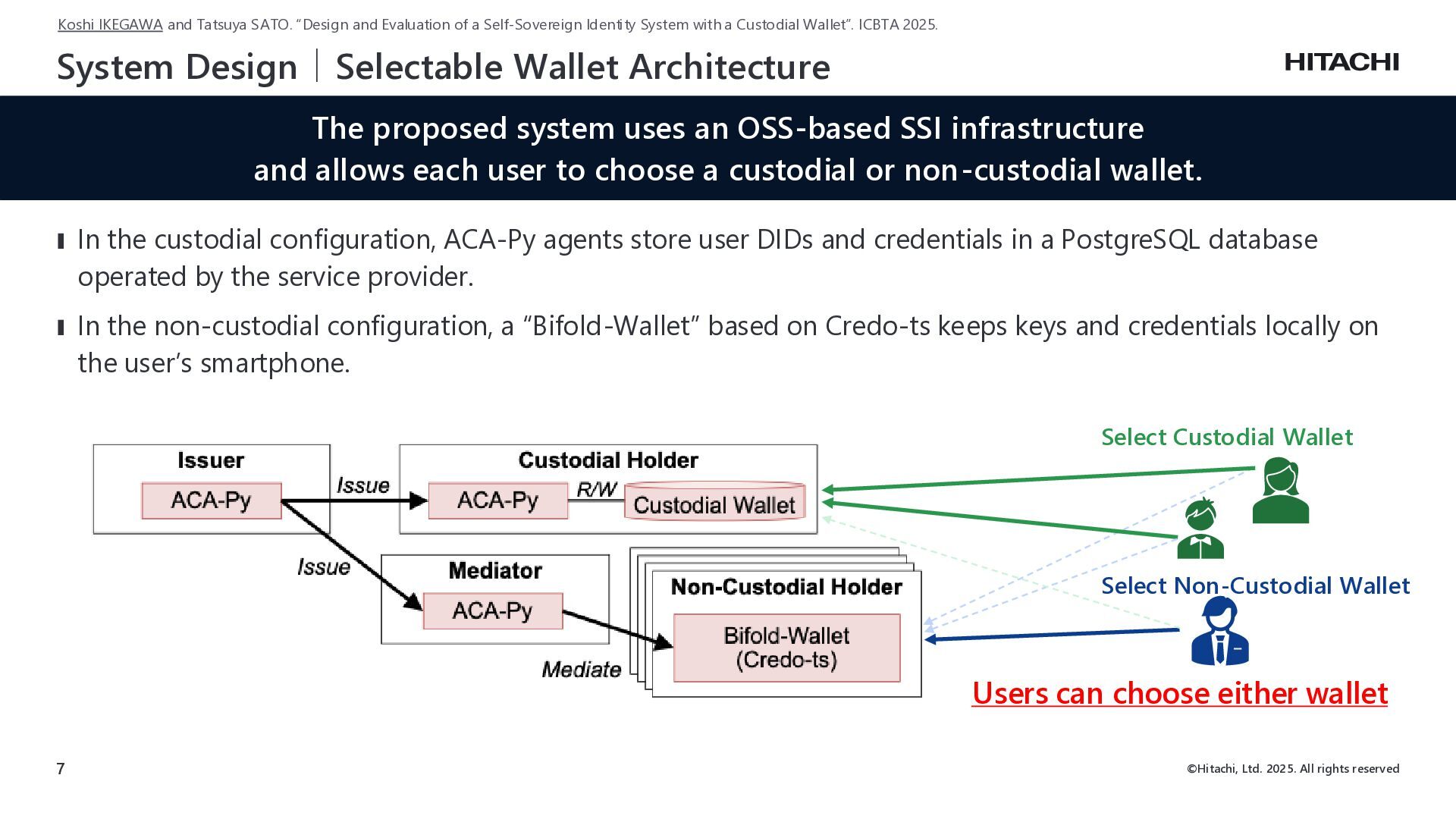
Self-Sovereign Identity System with a Custodial Wallet”. ICBTA 2025. System Design|Selectable Wallet Architecture The proposed system uses an OSS-based SSI infrastructure and allows each user to choose a custodial or non-custodial wallet. ❚ In the custodial configuration, ACA-Py agents store user DIDs and credentials in a PostgreSQL database operated by the service provider. ❚ In the non-custodial configuration, a “Bifold-Wallet” based on Credo-ts keeps keys and credentials locally on the user’s smartphone. Select Custodial Wallet Select Non-Custodial Wallet Users can choose either wallet 7 ©Hitachi, Ltd. 2025. All rights reserved
Koshi IKEGAWA and Tatsuya SATO. “Design and Evaluation of a
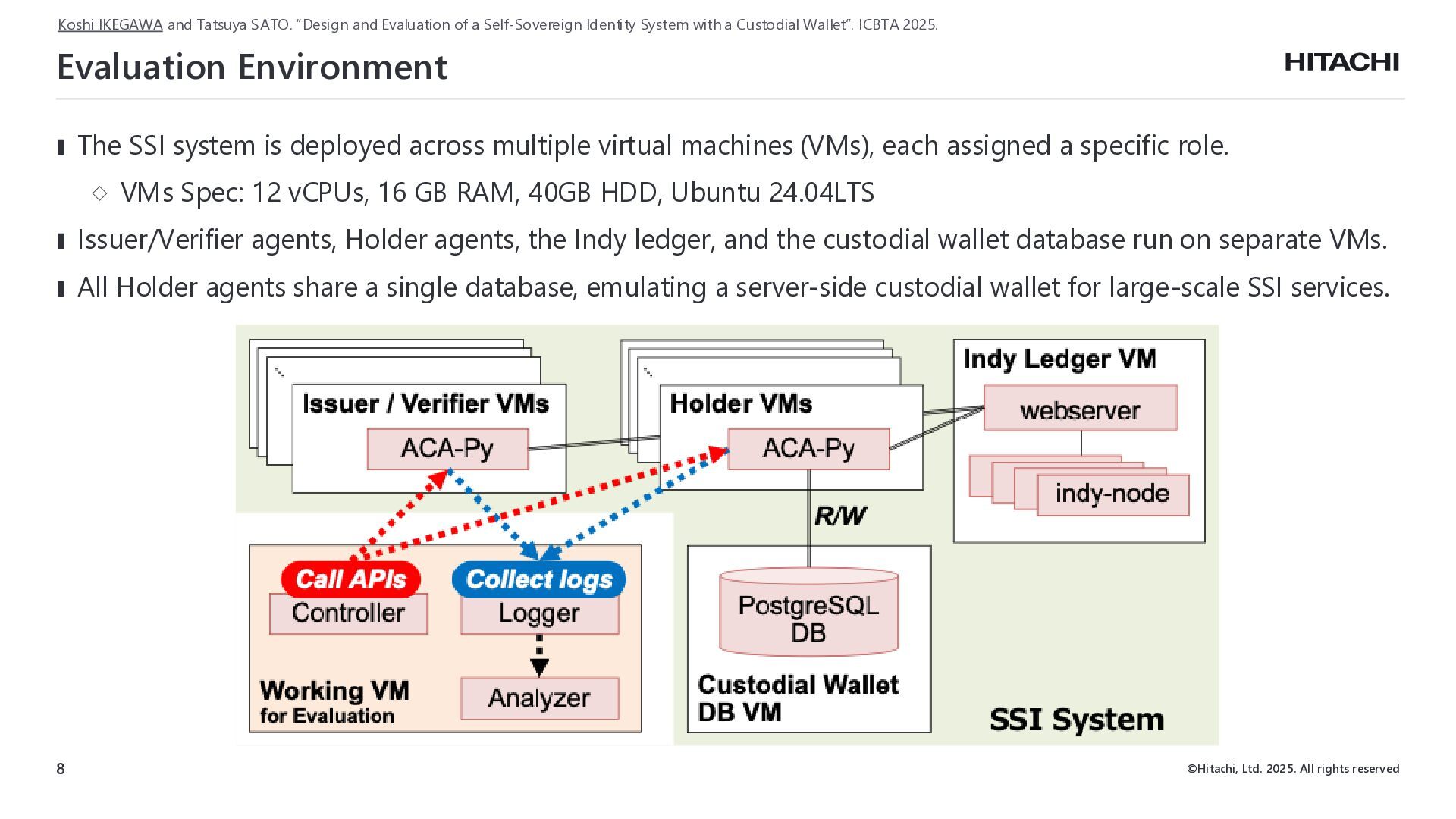
Self-Sovereign Identity System with a Custodial Wallet”. ICBTA 2025. Evaluation Environment ❚ The SSI system is deployed across multiple virtual machines (VMs), each assigned a specific role. ⬦ VMs Spec: 12 vCPUs, 16 GB RAM, 40GB HDD, Ubuntu 24.04LTS ❚ Issuer/Verifier agents, Holder agents, the Indy ledger, and the custodial wallet database run on separate VMs. ❚ All Holder agents share a single database, emulating a server-side custodial wallet for large-scale SSI services. 8 ©Hitachi, Ltd. 2025. All rights reserved
Koshi IKEGAWA and Tatsuya SATO. “Design and Evaluation of a
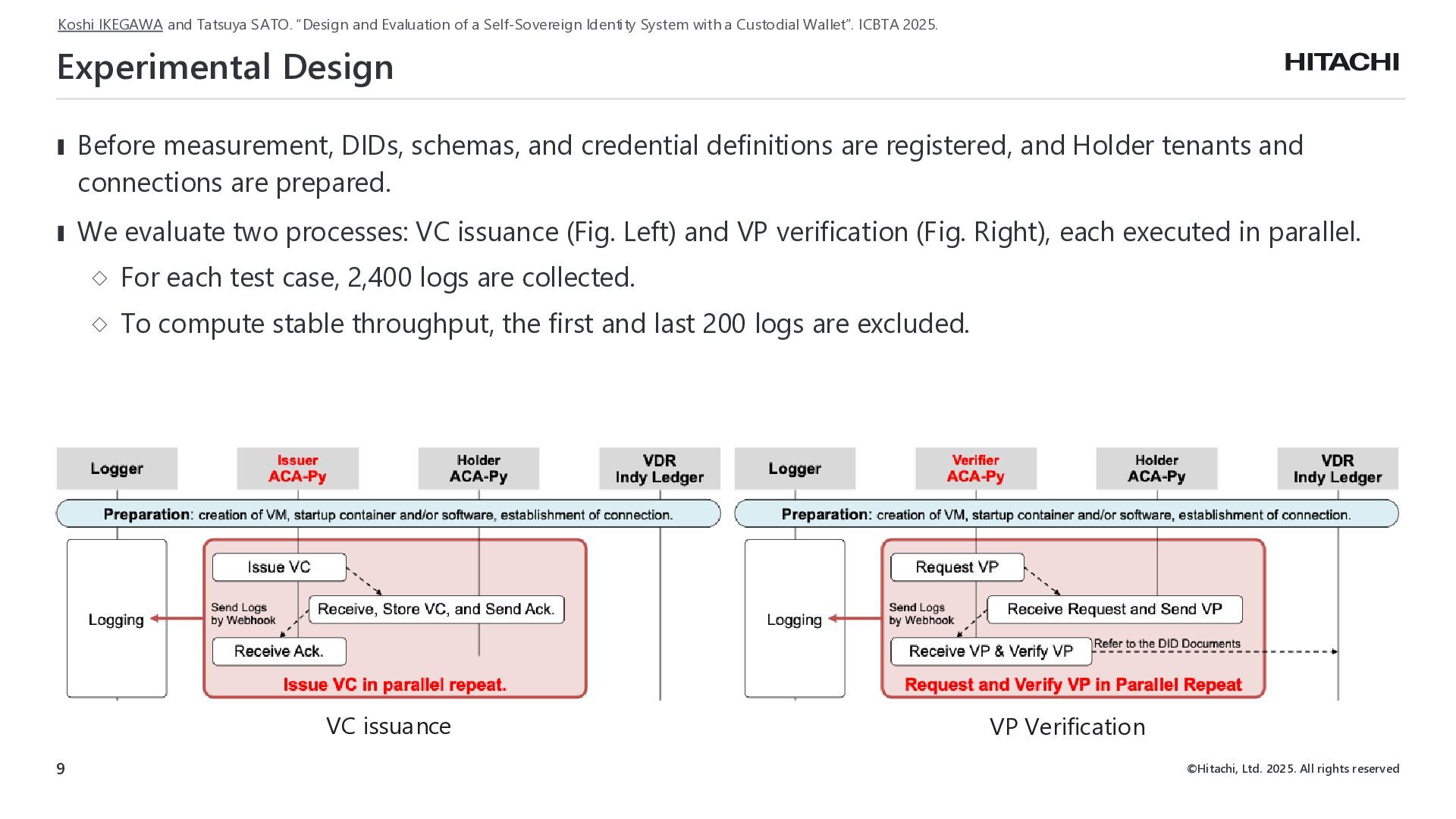
Self-Sovereign Identity System with a Custodial Wallet”. ICBTA 2025. Experimental Design ❚ Before measurement, DIDs, schemas, and credential definitions are registered, and Holder tenants and connections are prepared. ❚ We evaluate two processes: VC issuance (Fig. Left) and VP verification (Fig. Right), each executed in parallel. ⬦ For each test case, 2,400 logs are collected. ⬦ To compute stable throughput, the first and last 200 logs are excluded. VC issuance 9 VP Verification ©Hitachi, Ltd. 2025. All rights reserved
Koshi IKEGAWA and Tatsuya SATO. “Design and Evaluation of a
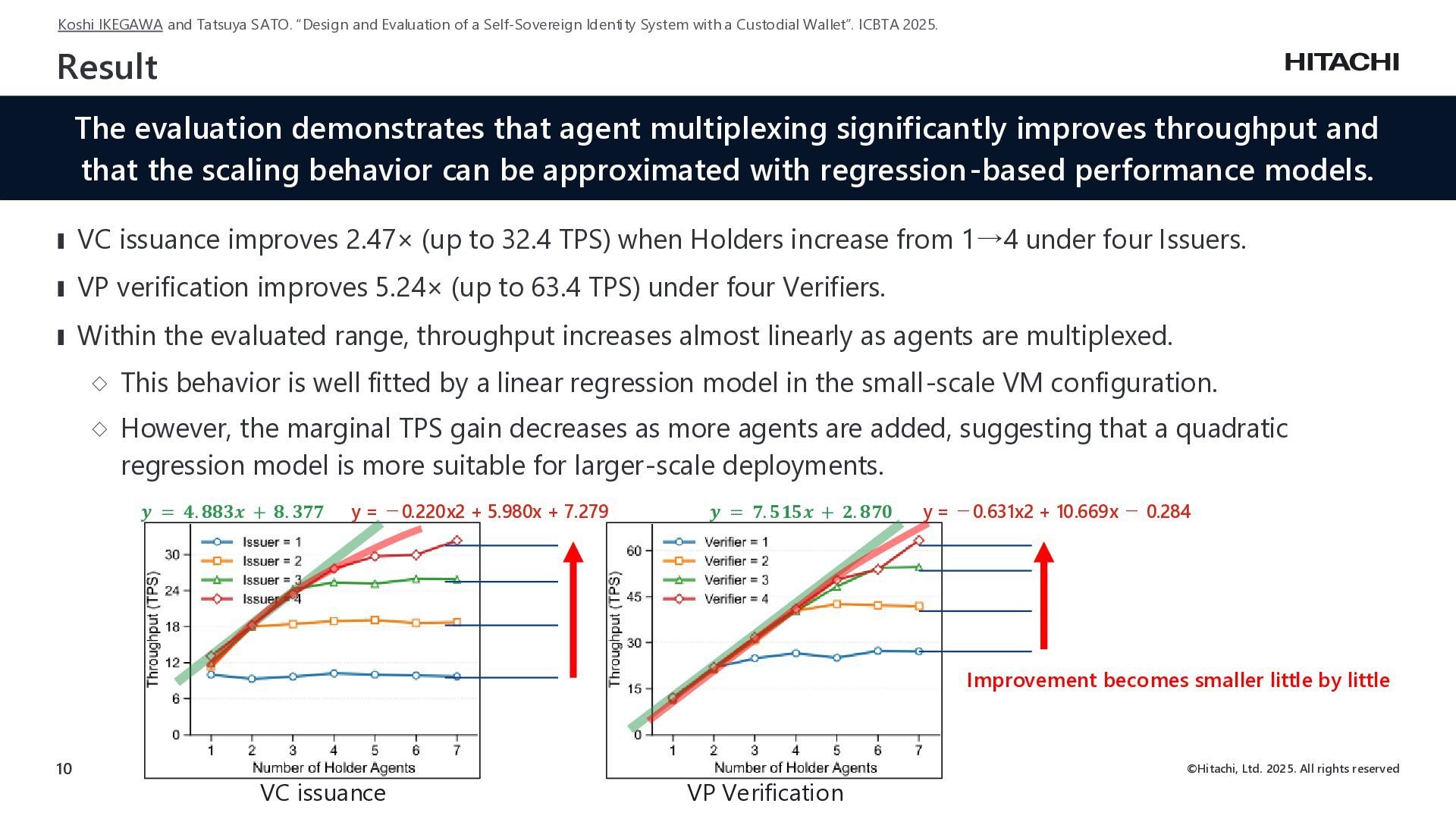
Self-Sovereign Identity System with a Custodial Wallet”. ICBTA 2025. Result The evaluation demonstrates that agent multiplexing significantly improves throughput and that the scaling behavior can be approximated with regression-based performance models. ❚ VC issuance improves 2.47× (up to 32.4 TPS) when Holders increase from 1→4 under four Issuers. ❚ VP verification improves 5.24× (up to 63.4 TPS) under four Verifiers. ❚ Within the evaluated range, throughput increases almost linearly as agents are multiplexed. ⬦ This behavior is well fitted by a linear regression model in the small-scale VM configuration. ⬦ However, the marginal TPS gain decreases as more agents are added, suggesting that a quadratic regression model is more suitable for larger-scale deployments. 𝒚 = 𝟒. 𝟖𝟖𝟑𝒙 + 𝟖. 𝟑𝟕𝟕 y = −0.220x2 + 5.980x + 7.279 𝒚 = 𝟕. 𝟓𝟏𝟓𝒙 + 𝟐. 𝟖𝟕𝟎 y = −0.631x2 + 10.669x − 0.284 Improvement becomes smaller little by little 10 VC issuance VP Verification ©Hitachi, Ltd. 2025. All rights reserved
Koshi IKEGAWA and Tatsuya SATO. “Design and Evaluation of a
Self-Sovereign Identity System with a Custodial Wallet”. ICBTA 2025. Conclusions and Future works This study presented an SSI architecture that introduces a custodial wallet and allows users to select either custodial or non-custodial wallets within a unified system. By multiplexing Issuer, Verifier, and Holder agents on an ACA-Py and Hyperledger Indy infrastructure, the proposed design achieved significant throughput improvements for verifiable credential issuance and verifiable presentation verification. Regression-based performance models derived from experimental results support capacity planning for large-scale SSI services with custodial wallets and motivate future studies on larger agent pools and dynamic scaling. 11 ©Hitachi, Ltd. 2025. All rights reserved
Koshi IKEGAWA and Tatsuya SATO. “Design and Evaluation of a
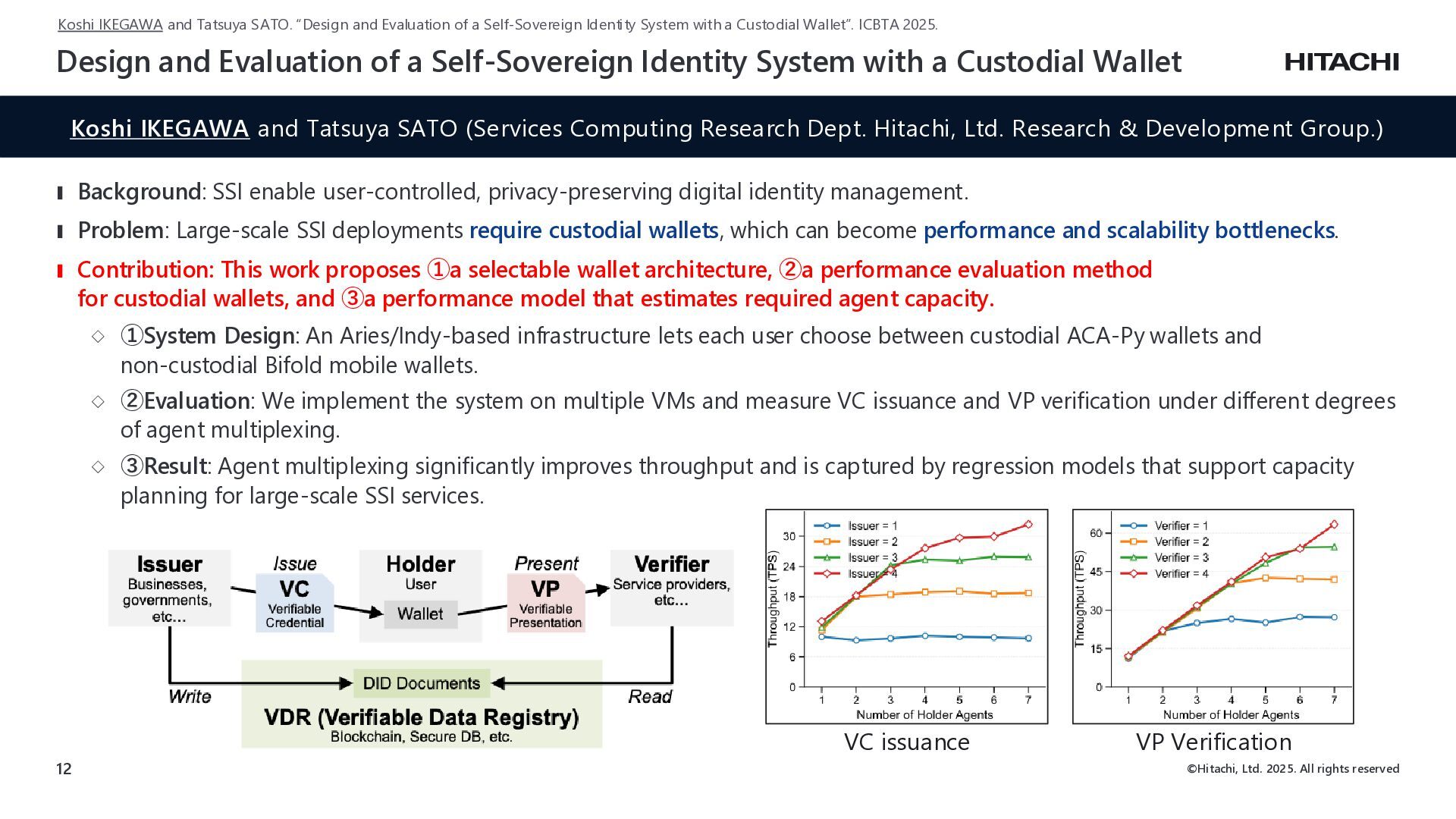
Self-Sovereign Identity System with a Custodial Wallet”. ICBTA 2025. Design and Evaluation of a Self-Sovereign Identity System with a Custodial Wallet Koshi IKEGAWA and Tatsuya SATO (Services Computing Research Dept. Hitachi, Ltd. Research & Development Group.) ❚ Background: SSI enable user-controlled, privacy-preserving digital identity management. ❚ Problem: Large-scale SSI deployments require custodial wallets, which can become performance and scalability bottlenecks. ❚ Contribution: This work proposes ①a selectable wallet architecture, ②a performance evaluation method for custodial wallets, and ③a performance model that estimates required agent capacity. ⬦ ①System Design: An Aries/Indy-based infrastructure lets each user choose between custodial ACA-Py wallets and non-custodial Bifold mobile wallets. ⬦ ②Evaluation: We implement the system on multiple VMs and measure VC issuance and VP verification under different degrees of agent multiplexing. ⬦ ③Result: Agent multiplexing significantly improves throughput and is captured by regression models that support capacity planning for large-scale SSI services. VC issuance 12 VP Verification ©Hitachi, Ltd. 2025. All rights reserved
None
None


 ikegawa
 tattaka
 institutdelelevage
 mickey_0226
 kobayashi31
 kohlerjohannes
 kzmssk
 datascientistsociety
.png) satai
satai
 colly
colly
 quramy
 ryanjones
 baasie
 jonoalderson
 philnash
 techseoconnect
 rakko
rakko
 hatefulcrawdad
 yeseniaperezcruz
 greggifford