Upgrade to Pro — share decks privately, control downloads, hide ads and more …

SAKURAONE: An Open Ethernet-based AI HPC System...

SAKURAONE: An Open Ethernet-based AI HPC System And Its Observed Workload Dynamics in a Single-Tenant LLM Development Environment

MLSys2026 Industrial Track Benchmarks: https://mlsys.org/virtual/2026/oral/3758

More Decks by Yuuki Tsubouchi (yuuk1)

Other Decks in Research

Transcript

  1. MLSys 2026 — Industry Track Benchmarks (Oral) SAKURAONE: An Open

    Ethernet-based AI HPC System And Its Observed Workload Dynamics in a Single-Tenant LLM Development Environment Authors — Fumikazu Konishi, Yuuki Tsubouchi, Hirofumi Tsuruta SAKURA internet, Inc. Paper(arXiv)
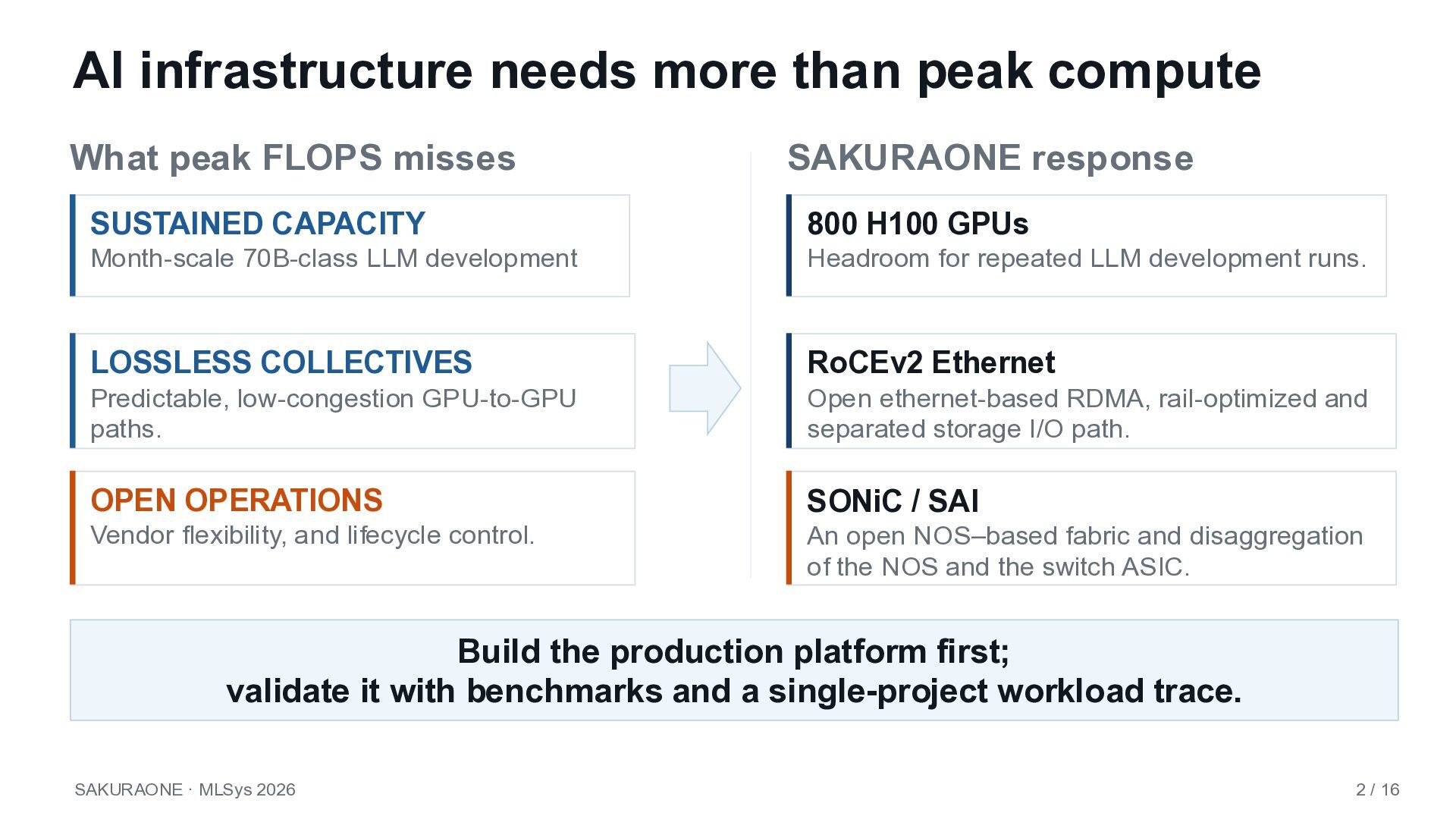
  2. AI infrastructure needs more than peak compute What peak FLOPS

    misses SAKURAONE response SUSTAINED CAPACITY Month-scale 70B-class LLM development LOSSLESS COLLECTIVES Predictable, low-congestion GPU-to-GPU paths. OPEN OPERATIONS Vendor flexibility, and lifecycle control. 800 H100 GPUs Headroom for repeated LLM development runs. RoCEv2 Ethernet Open ethernet-based RDMA, rail-optimized and separated storage I/O path. SONiC / SAI An open NOS–based fabric and disaggregation of the NOS and the switch ASIC. Build the production platform first; validate it with benchmarks and a single-project workload trace. SAKURAONE · MLSys 2026 2 / 16
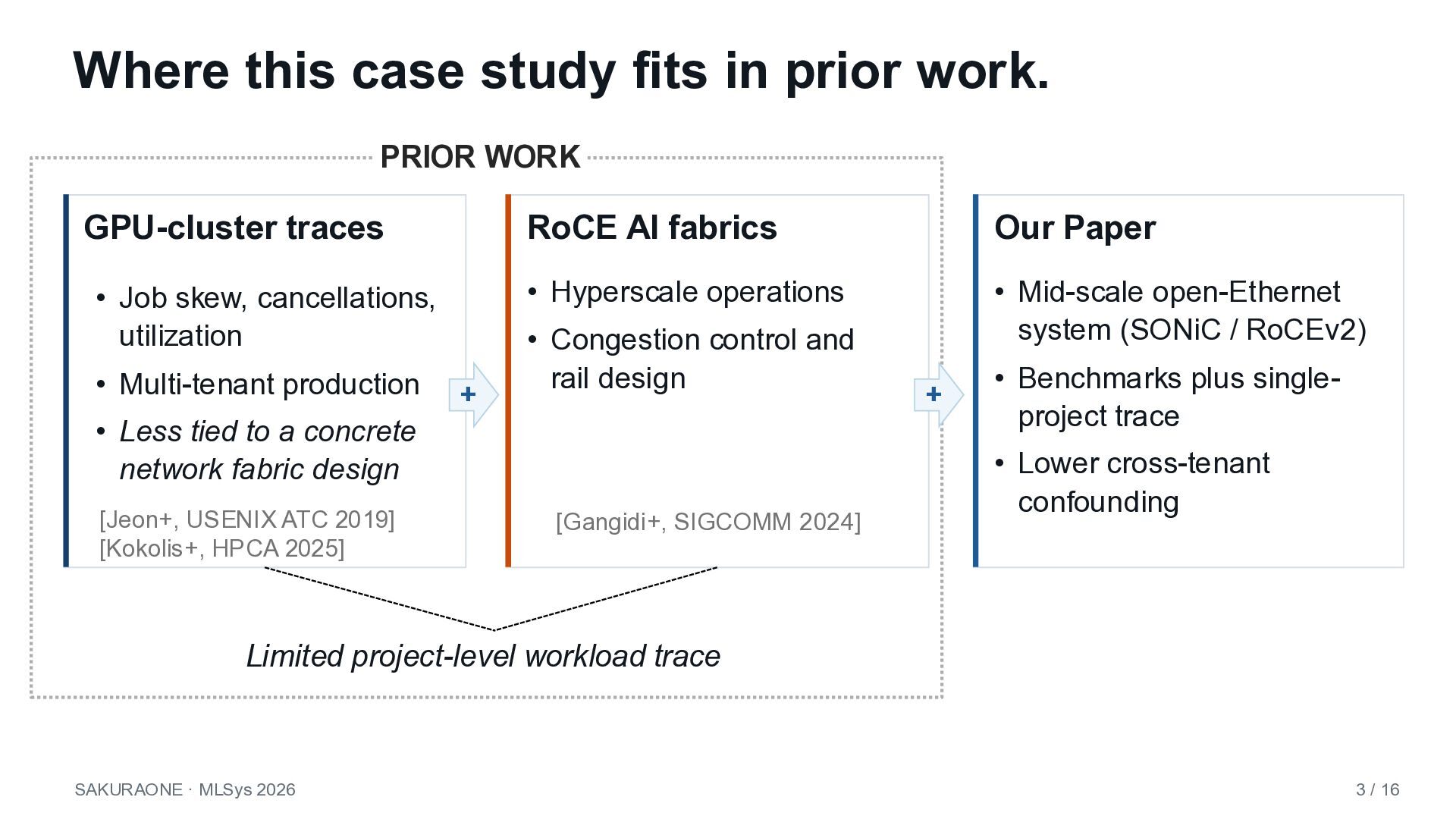
  3. Where this case study fits in prior work. GPU-cluster traces

    • Job skew, cancellations, utilization • Multi-tenant production • Less tied to a concrete network fabric design RoCE AI fabrics • Hyperscale operations • Congestion control and rail design Our Paper • Mid-scale open-Ethernet system (SONiC / RoCEv2) • Benchmarks plus single- project trace • Lower cross-tenant confounding + [Gangidi+, SIGCOMM 2024] SAKURAONE · MLSys 2026 3 / 16 PRIOR WORK + [Jeon+, USENIX ATC 2019] [Kokolis+, HPCA 2025] Limited project-level workload trace
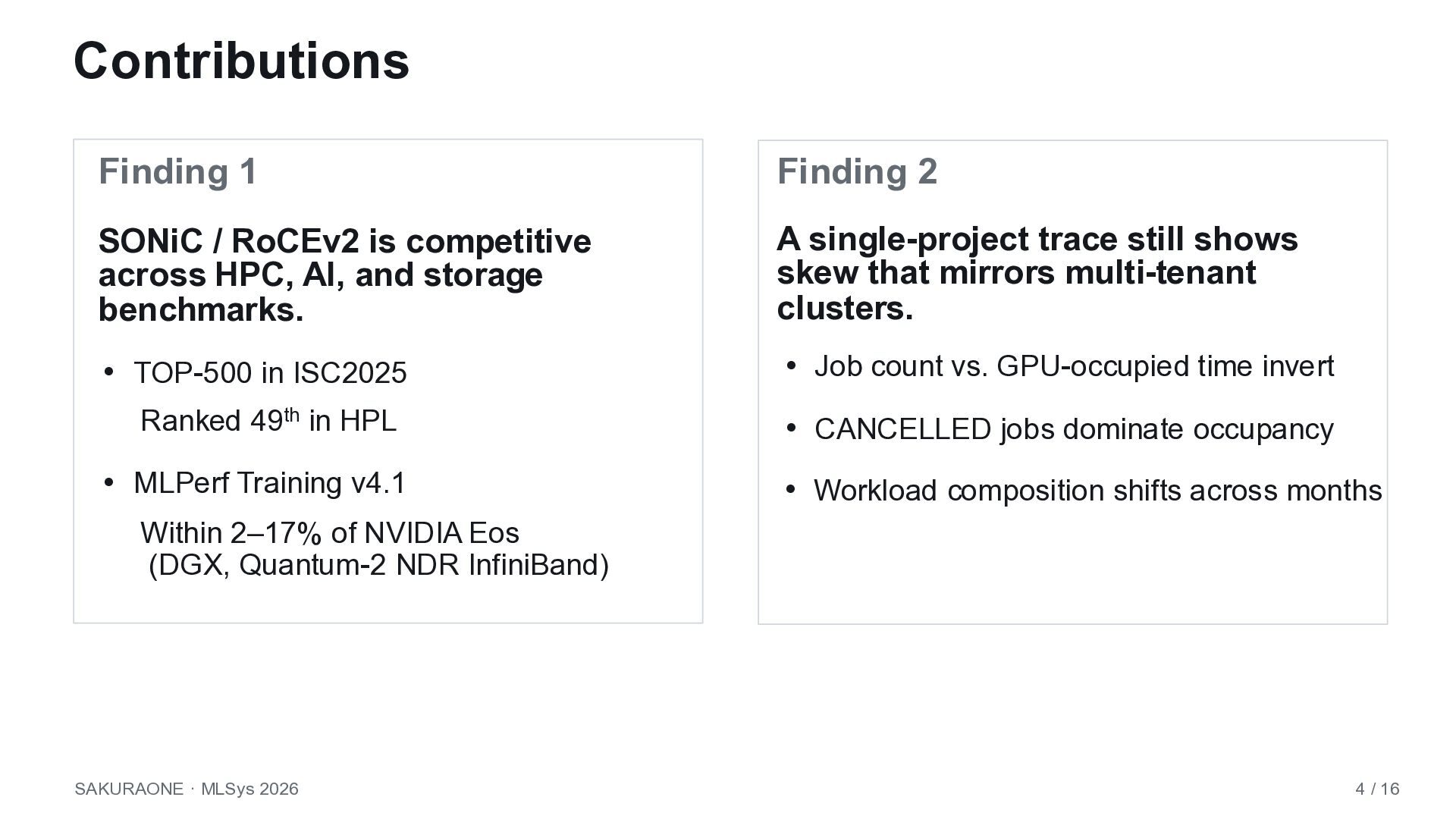
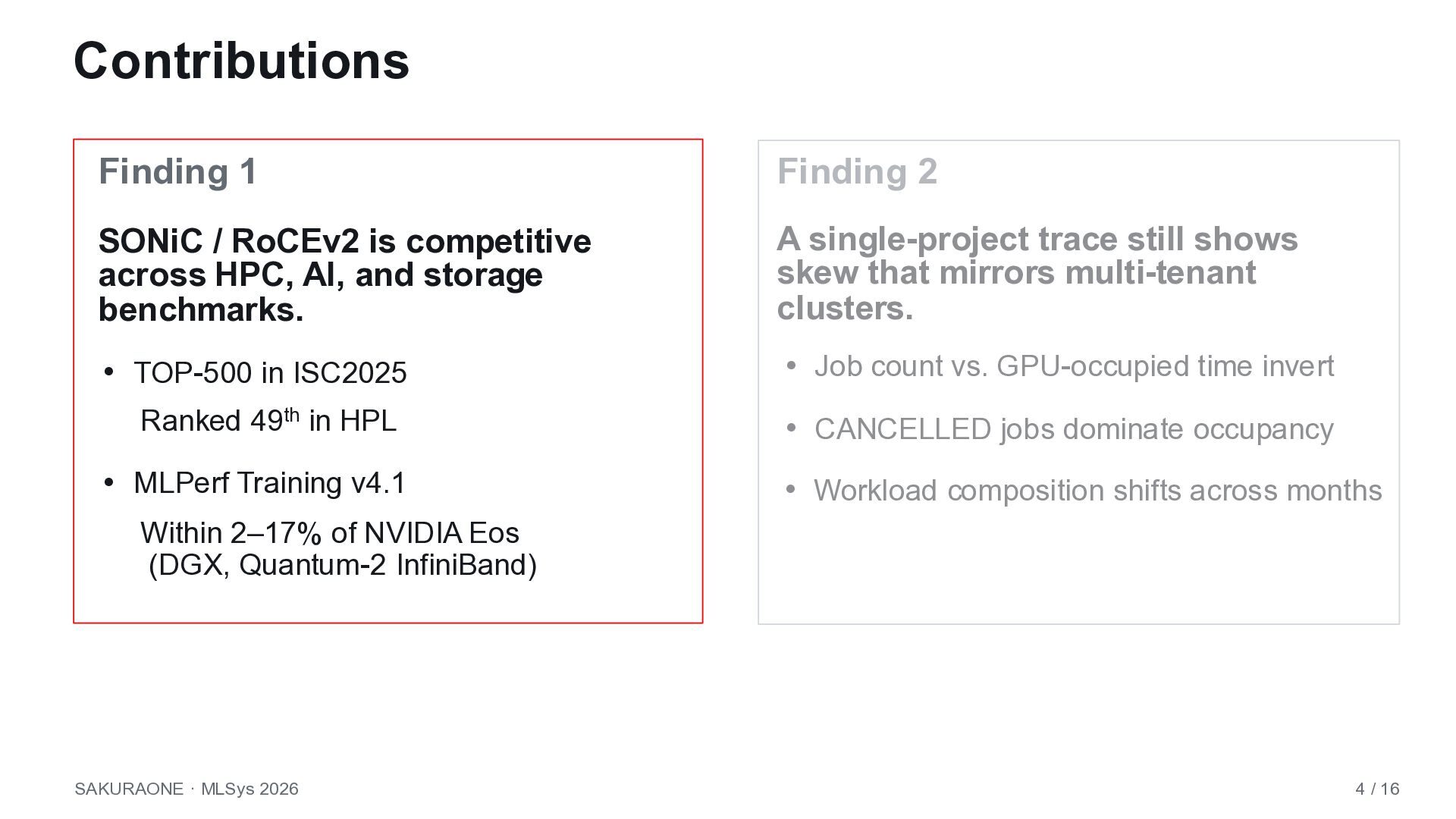
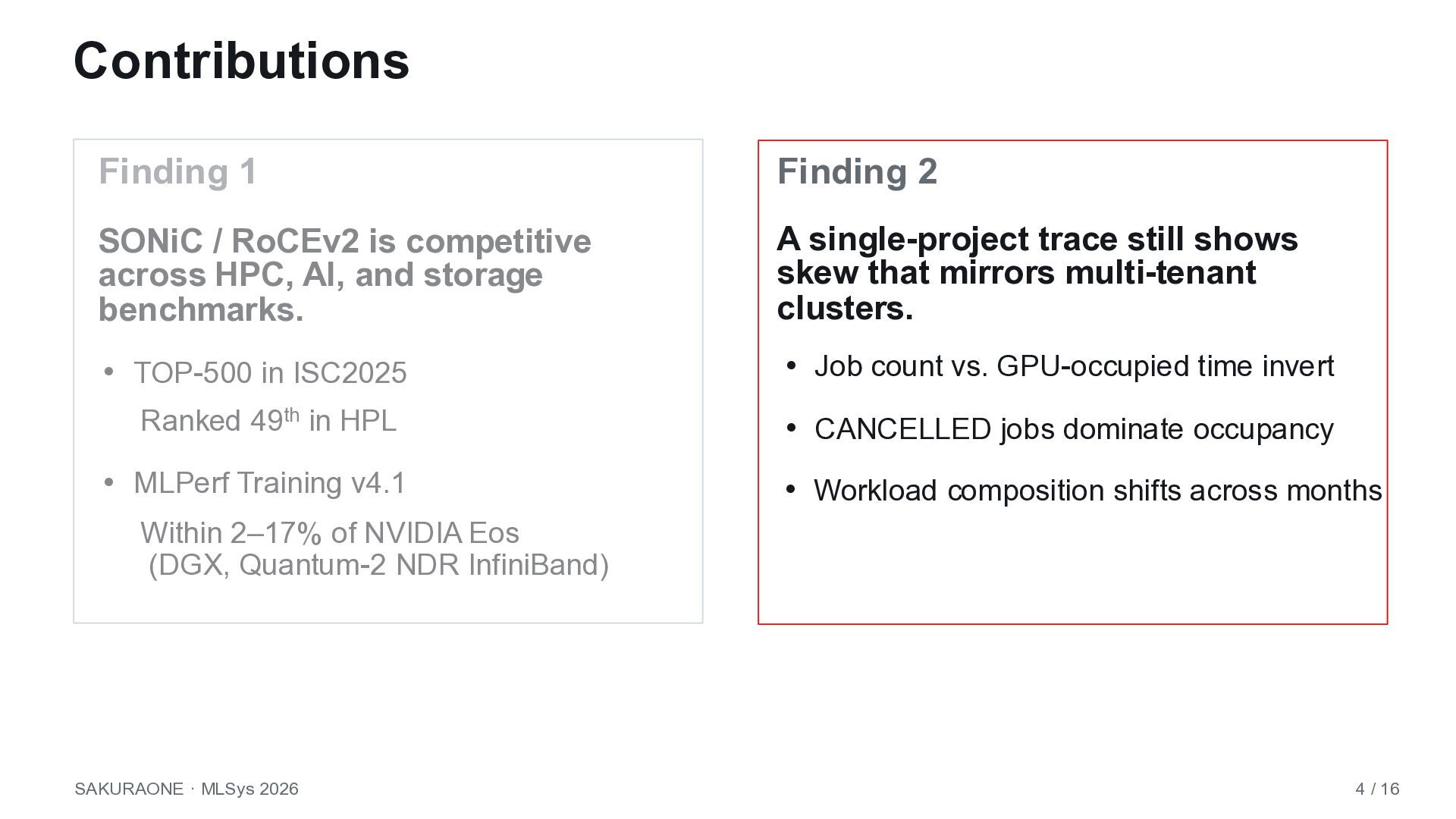
  4. Contributions Finding 1 SONiC / RoCEv2 is competitive across HPC,

    AI, and storage benchmarks. • TOP-500 in ISC2025 • MLPerf Training v4.1 Within 2–17% of NVIDIA Eos (DGX, Quantum-2 NDR InfiniBand) Finding 2 A single-project trace still shows skew that mirrors multi-tenant clusters. • Job count vs. GPU-occupied time invert • CANCELLED jobs dominate occupancy • Workload composition shifts across months SAKURAONE · MLSys 2026 4 / 16 Ranked 49th in HPL
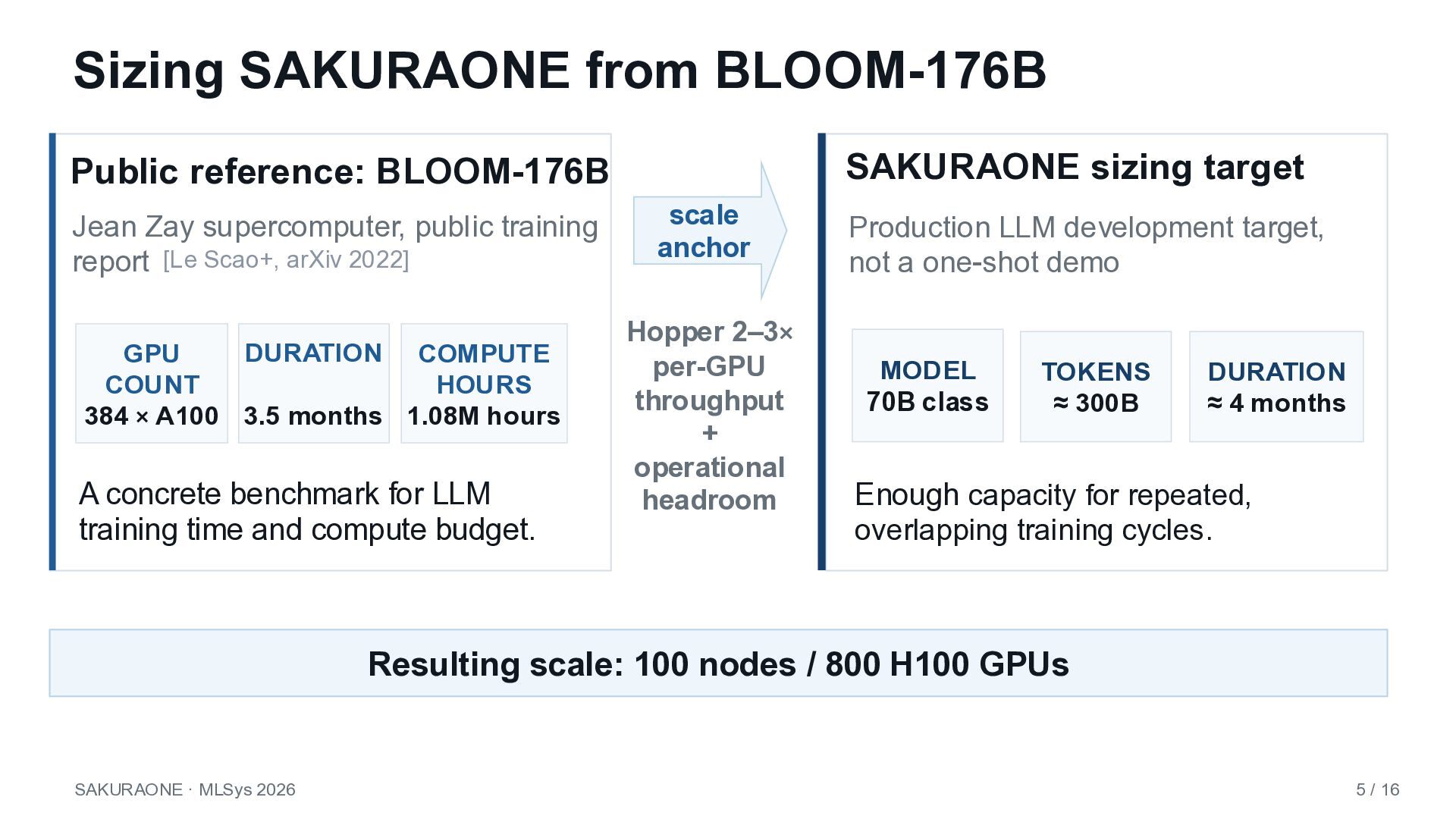
  5. Sizing SAKURAONE from BLOOM-176B Public reference: BLOOM-176B SAKURAONE sizing target

    Jean Zay supercomputer, public training report GPU COUNT 384 × A100 DURATION 3.5 months COMPUTE HOURS 1.08M hours A concrete benchmark for LLM training time and compute budget. Production LLM development target, not a one-shot demo MODEL 70B class TOKENS ≈ 300B DURATION ≈ 4 months Enough capacity for repeated, overlapping training cycles. scale anchor Hopper 2–3× per-GPU throughput + operational headroom Resulting scale: 100 nodes / 800 H100 GPUs [Le Scao+, arXiv 2022] SAKURAONE · MLSys 2026 5 / 16
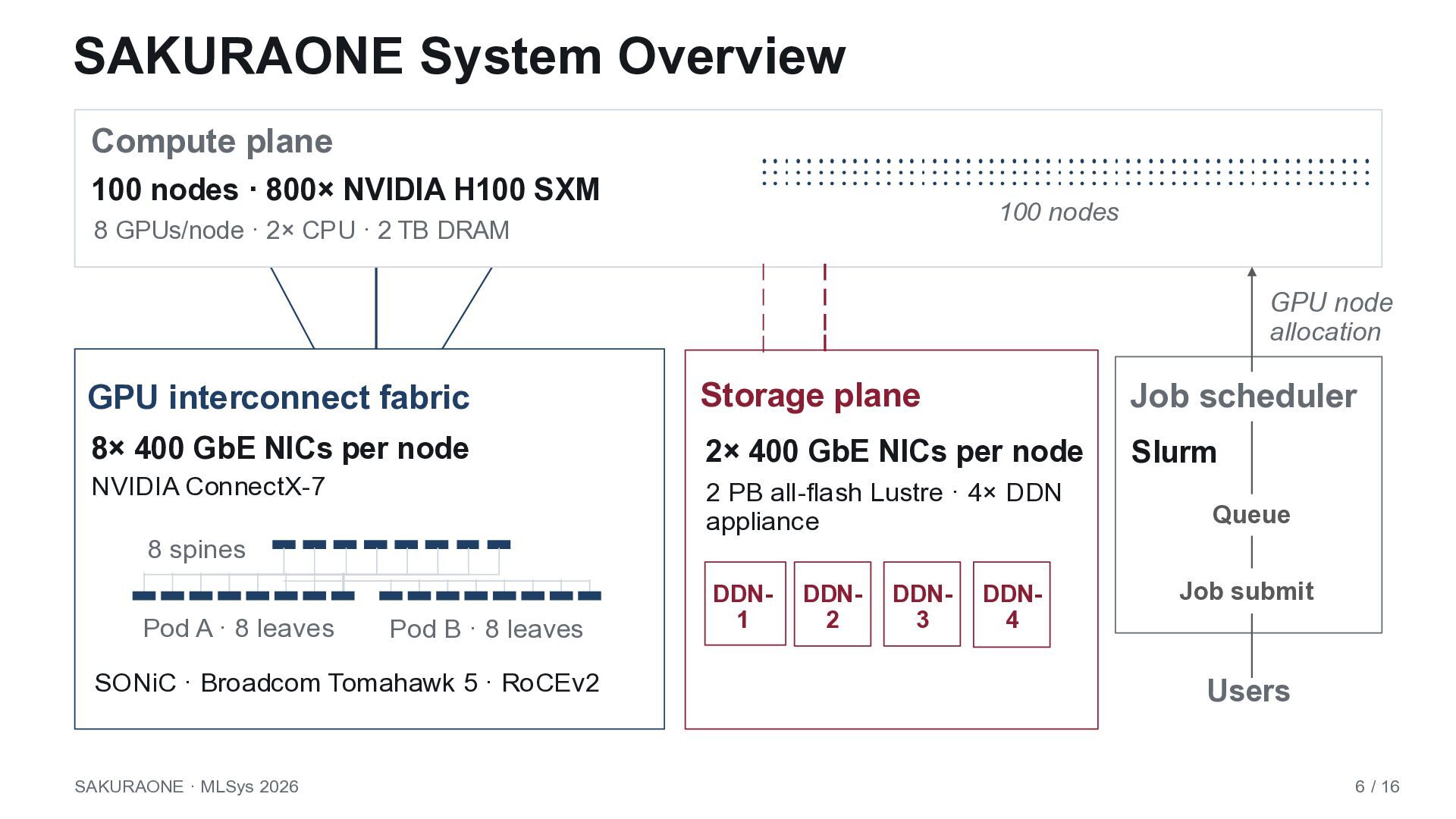
  6. SAKURAONE System Overview Compute plane 100 nodes · 800× NVIDIA

    H100 SXM 8 GPUs/node · 2× CPU · 2 TB DRAM 100 nodes GPU interconnect fabric 8× 400 GbE NICs per node SONiC · Broadcom Tomahawk 5 · RoCEv2 8 spines Pod A · 8 leaves Pod B · 8 leaves Storage plane 2× 400 GbE NICs per node 2 PB all-flash Lustre · 4× DDN appliance DDN- 1 DDN- 2 DDN- 3 DDN- 4 Slurm SAKURAONE · MLSys 2026 6 / 16 Users Job scheduler Job submit Queue GPU node allocation NVIDIA ConnectX-7
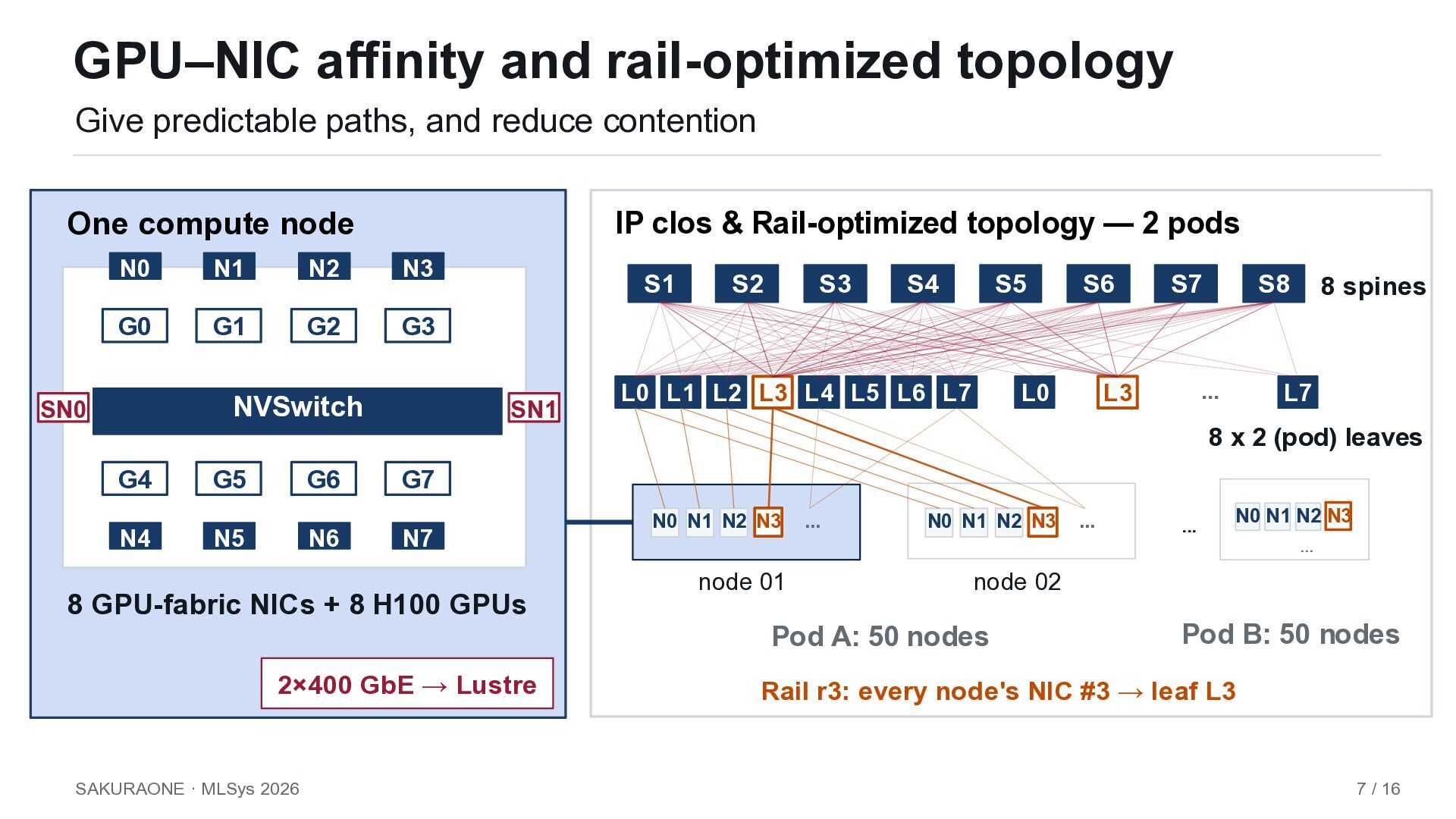
  7. GPU–NIC affinity and rail-optimized topology Give predictable paths, and reduce

    contention One compute node IP clos & Rail-optimized topology — 2 pods SAKURAONE · MLSys 2026 7 / 16 N0 G0 G4 N4 N1 G1 G5 N5 N2 G2 G6 N6 N3 G3 G7 N7 NVSwitch SN0 SN1 8 GPU-fabric NICs + 8 H100 GPUs 2×400 GbE → Lustre 8 spines S1 S2 S3 S4 S5 S6 S7 S8 8 x 2 (pod) leaves L0 L1 L2 L3 L4 L5 L6 L7 L0 L3 ... L7 node 01 N0 N1 N2 N3 ... node 02 N0 N1 N2 N3 ... ... N0 N1 N2 N3 ... Pod B: 50 nodes Pod A: 50 nodes Rail r3: every node's NIC #3 → leaf L3
  8. Contributions Finding 1 SONiC / RoCEv2 is competitive across HPC,

    AI, and storage benchmarks. • • Finding 2 A single-project trace still shows skew that mirrors multi-tenant clusters. • Job count vs. GPU-occupied time invert • CANCELLED jobs dominate occupancy • Workload composition shifts across months SAKURAONE · MLSys 2026 4 / 16 TOP-500 in ISC2025 MLPerf Training v4.1 Within 2–17% of NVIDIA Eos (DGX, Quantum-2 InfiniBand) Ranked 49th in HPL
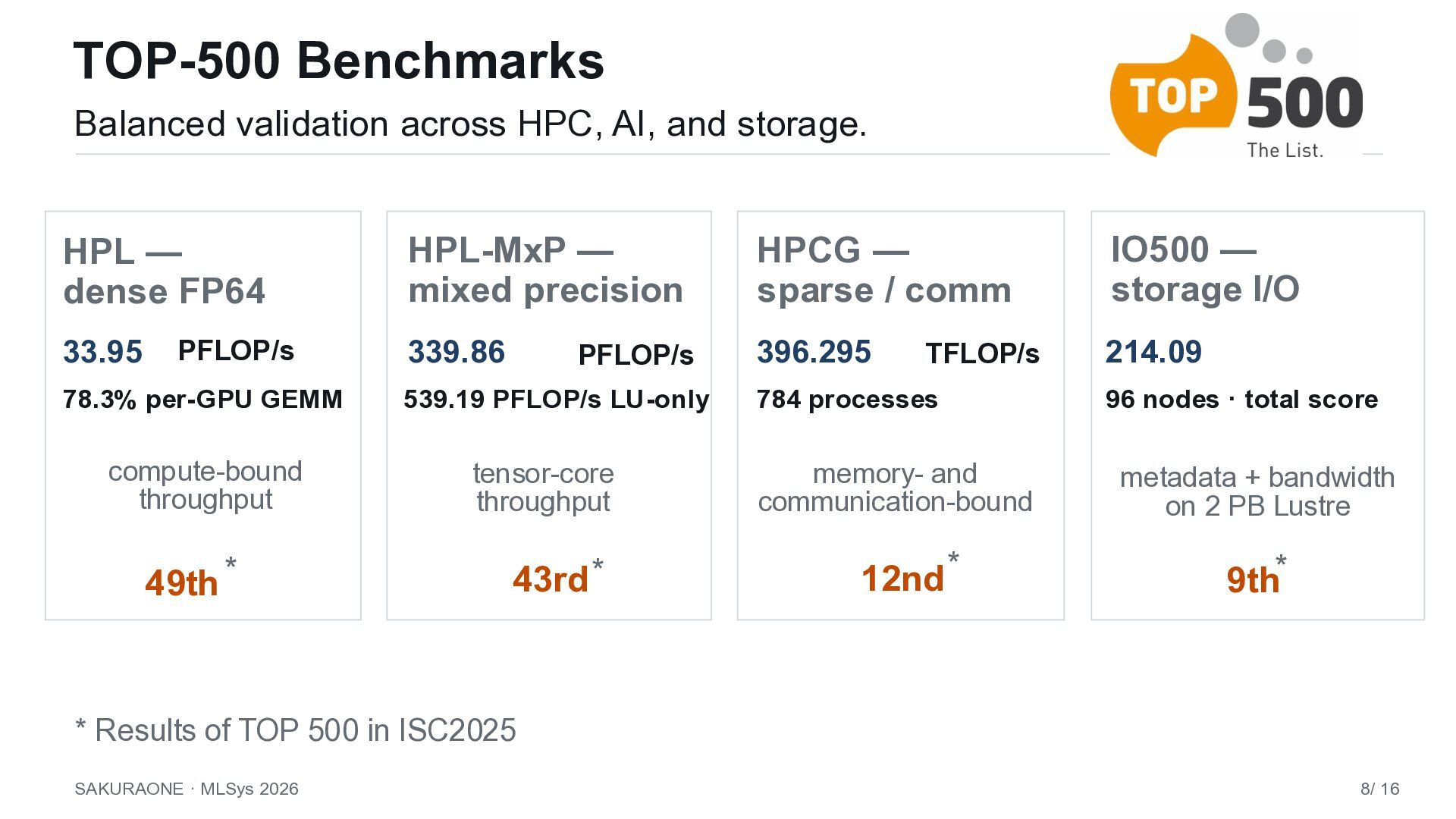
  9. TOP-500 Benchmarks Balanced validation across HPC, AI, and storage. HPL

    — dense FP64 33.95 PFLOP/s 78.3% per-GPU GEMM compute-bound throughput HPL-MxP — mixed precision 339.86 PFLOP/s 539.19 PFLOP/s LU-only tensor-core throughput HPCG — sparse / comm 396.295 TFLOP/s 784 processes memory- and communication-bound IO500 — storage I/O 214.09 96 nodes · total score metadata + bandwidth on 2 PB Lustre SAKURAONE · MLSys 2026 8/ 16 49th 43rd 12nd 9th * Results of TOP 500 in ISC2025 * * * *
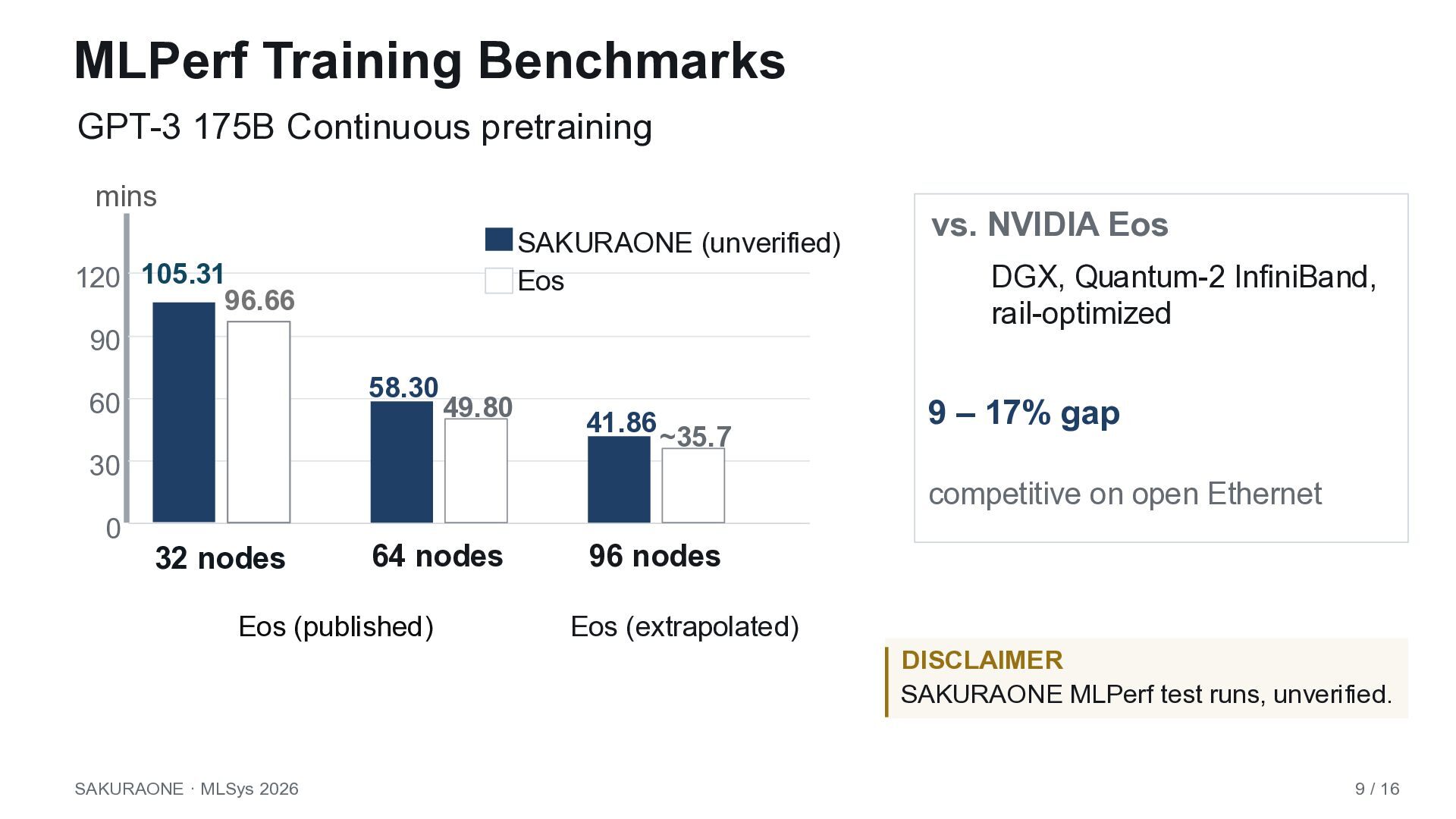
  10. MLPerf Training Benchmarks 0 30 60 90 120 58.30 49.80

    41.86 ~35.7 64 nodes 96 nodes Eos (published) SAKURAONE (unverified) Eos Eos (extrapolated) vs. NVIDIA Eos 9 – 17% gap competitive on open Ethernet DISCLAIMER SAKURAONE MLPerf test runs, unverified. SAKURAONE · MLSys 2026 9 / 16 105.31 96.66 32 nodes GPT-3 175B Continuous pretraining DGX, Quantum-2 InfiniBand, rail-optimized mins
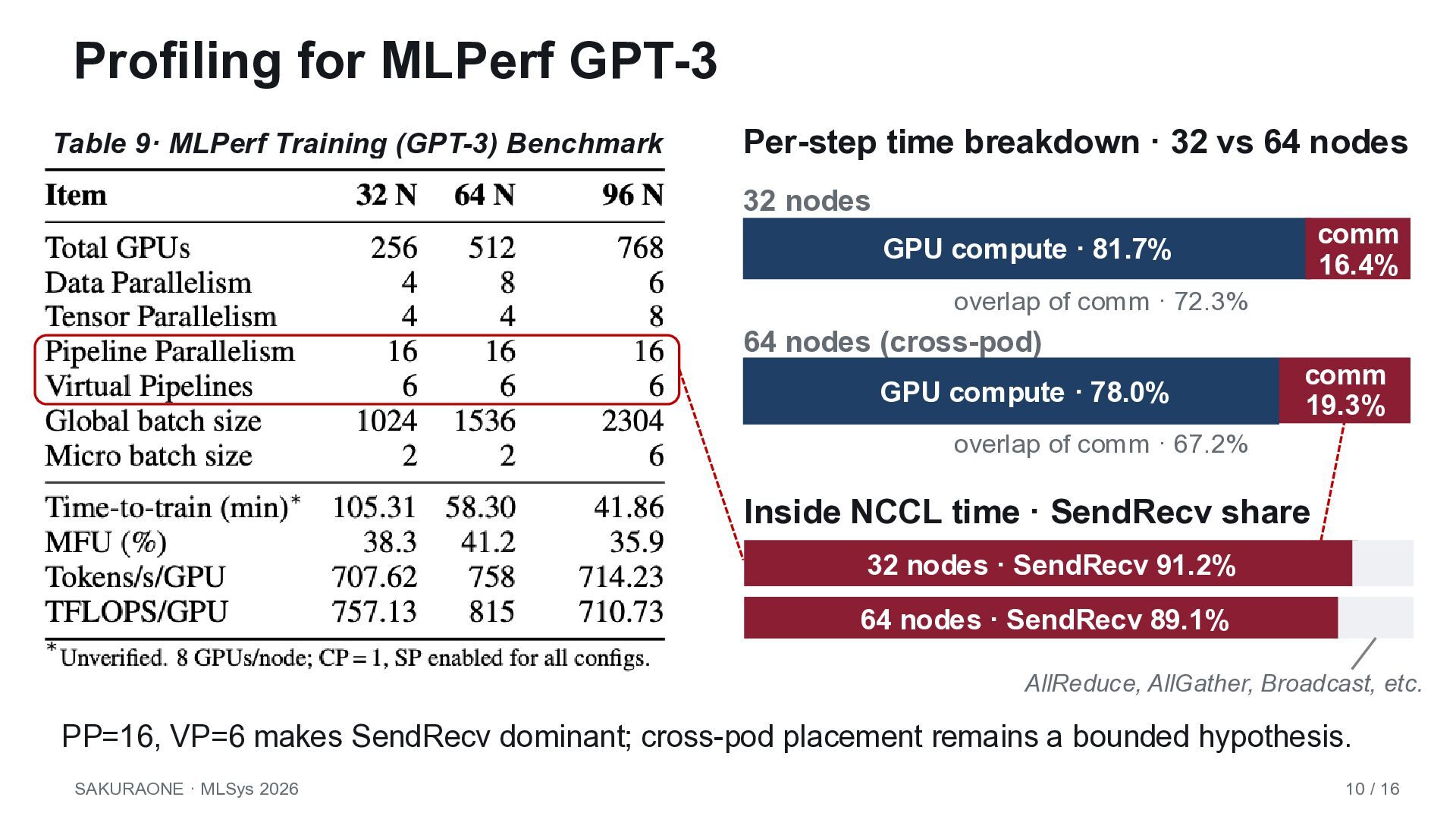
  11. SAKURAONE · MLSys 2026 Profiling for MLPerf GPT-3 PP=16, VP=6

    makes SendRecv dominant; cross-pod placement remains a bounded hypothesis. Table 9· MLPerf Training (GPT-3) Benchmark Summary OBSERVATION Per-step time breakdown · 32 vs 64 nodes 32 nodes GPU compute · 81.7% comm 16.4% overlap of comm · 72.3% 64 nodes (cross-pod) GPU compute · 78.0% comm 19.3% overlap of comm · 67.2% Inside NCCL time · SendRecv share 32 nodes · SendRecv 91.2% 64 nodes · SendRecv 89.1% AllReduce, AllGather, Broadcast, etc. 10 / 16
  12. Contributions Finding 1 SONiC / RoCEv2 is competitive across HPC,

    AI, and storage benchmarks. • • Finding 2 A single-project trace still shows skew that mirrors multi-tenant clusters. • Job count vs. GPU-occupied time invert • CANCELLED jobs dominate occupancy • Workload composition shifts across months SAKURAONE · MLSys 2026 4 / 16 TOP-500 in ISC2025 MLPerf Training v4.1 Within 2–17% of NVIDIA Eos (DGX, Quantum-2 NDR InfiniBand) Ranked 49th in HPL
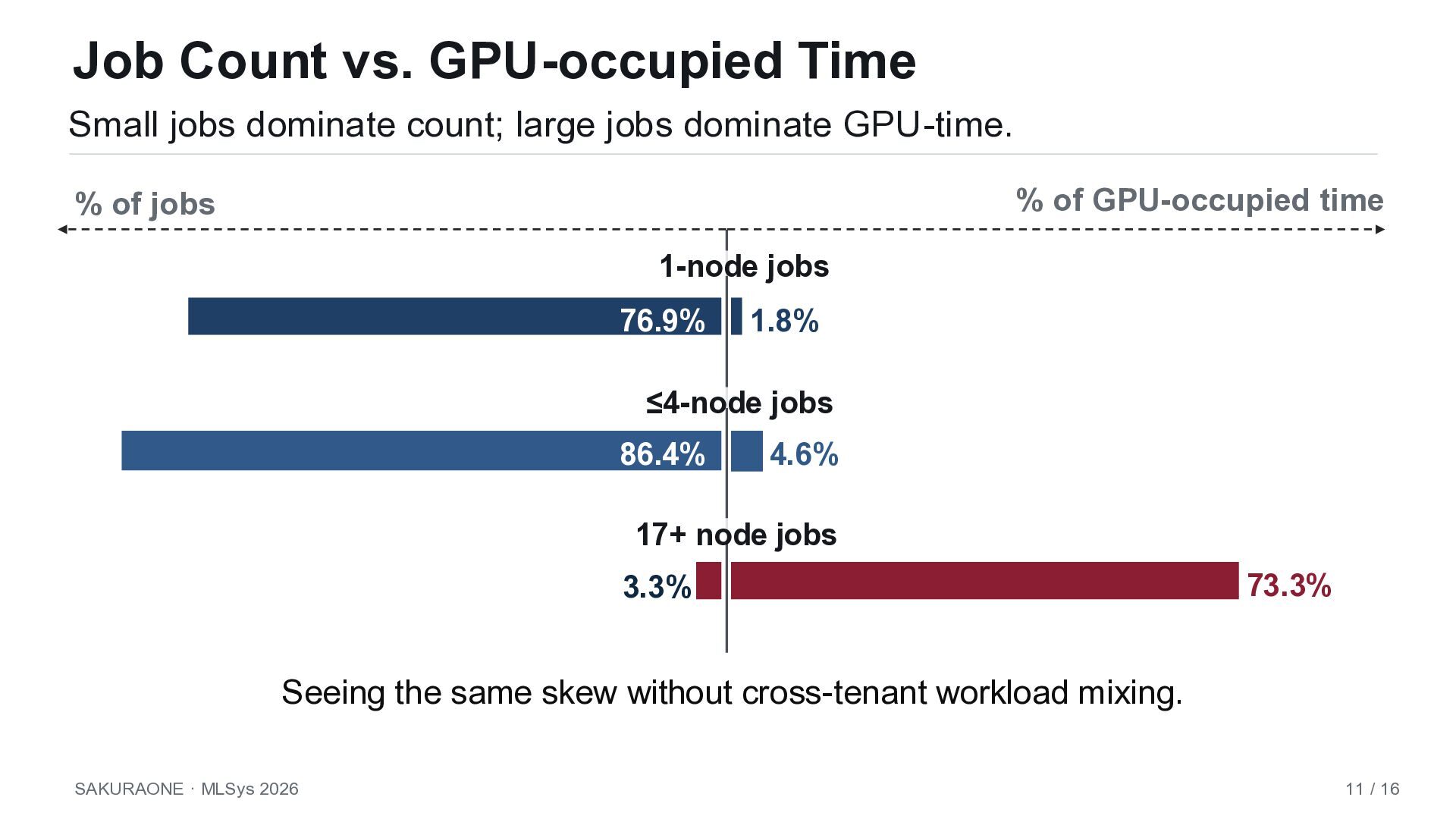
  13. Job Count vs. GPU-occupied Time Small jobs dominate count; large

    jobs dominate GPU-time. % of jobs % of GPU-occupied time 1-node jobs 76.9% 1.8% ≤4-node jobs 86.4% 4.6% 17+ node jobs 3.3% 73.3% Seeing the same skew without cross-tenant workload mixing. SAKURAONE · MLSys 2026 11 / 16
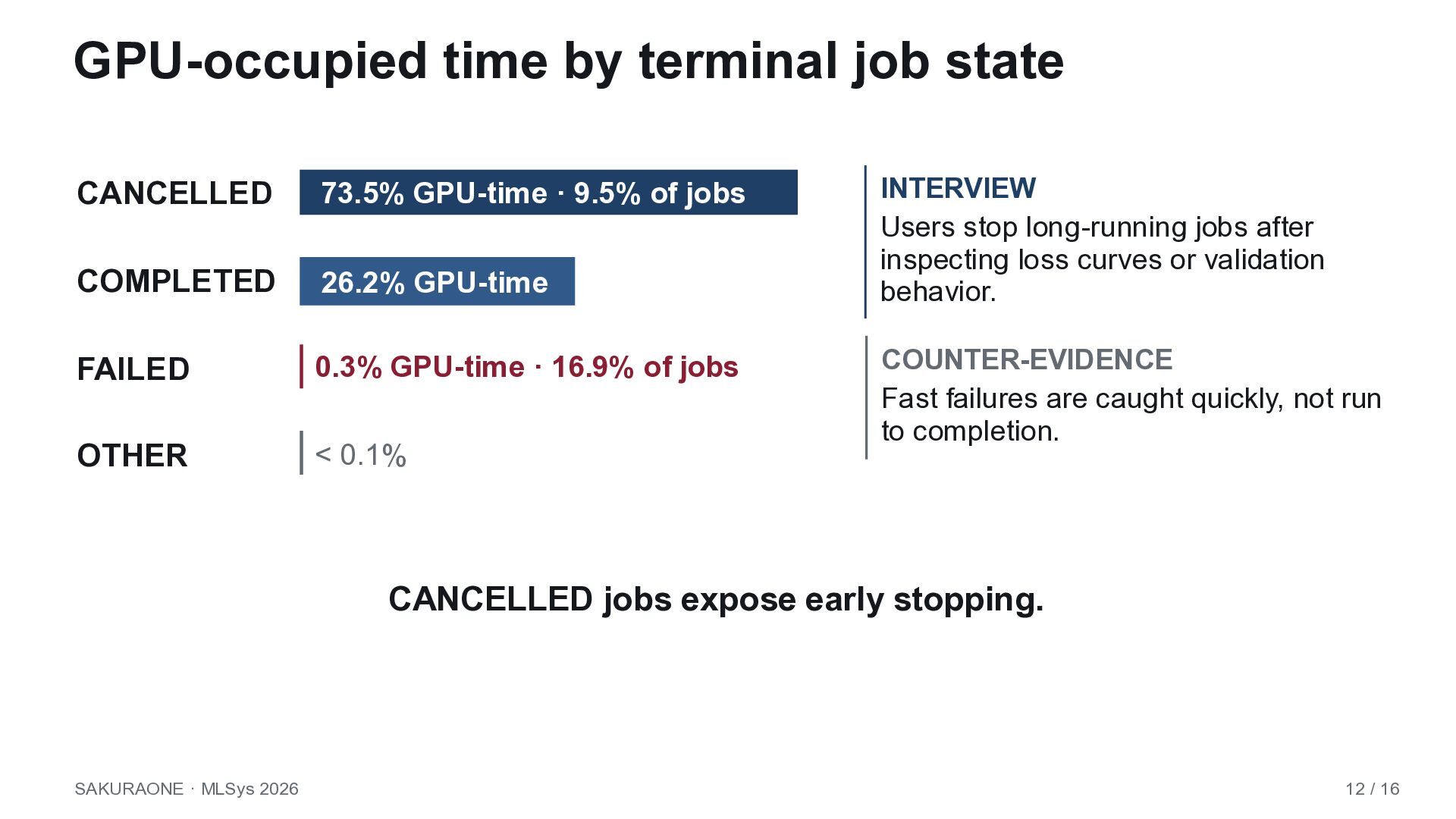
  14. GPU-occupied time by terminal job state CANCELLED jobs expose early

    stopping. CANCELLED 73.5% GPU-time · 9.5% of jobs COMPLETED 26.2% GPU-time FAILED 0.3% GPU-time · 16.9% of jobs OTHER < 0.1% INTERVIEW Users stop long-running jobs after inspecting loss curves or validation behavior. COUNTER-EVIDENCE Fast failures are caught quickly, not run to completion. SAKURAONE · MLSys 2026 12 / 16
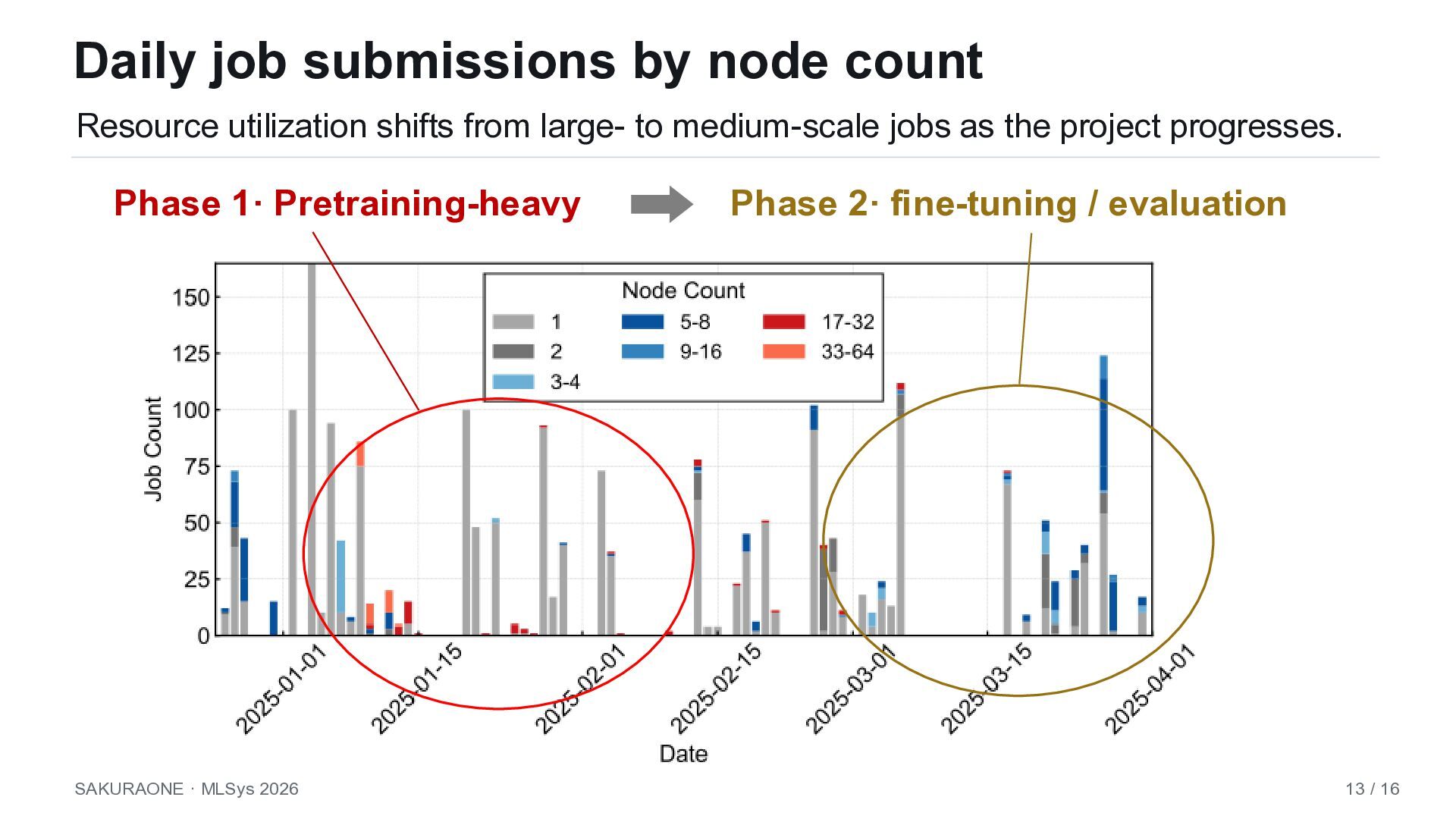
  15. Daily job submissions by node count Resource utilization shifts from

    large- to medium-scale jobs as the project progresses. SAKURAONE · MLSys 2026 13 / 16 Phase 1· Pretraining-heavy Phase 2· fine-tuning / evaluation
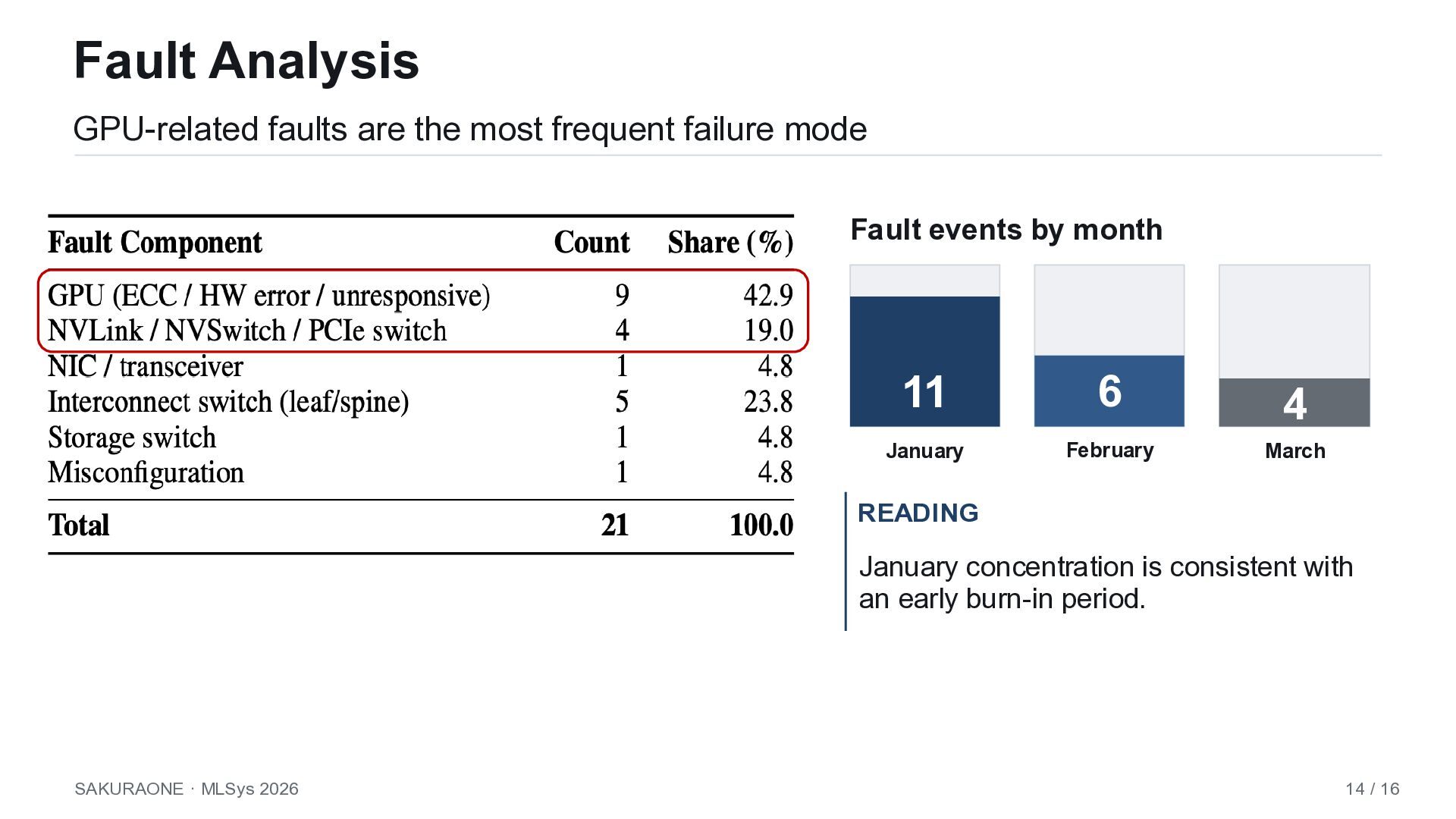
  16. Fault Analysis GPU-related faults are the most frequent failure mode

    Fault events by month 11 January 6 February 4 March READING January concentration is consistent with an early burn-in period. SAKURAONE · MLSys 2026 14 / 16
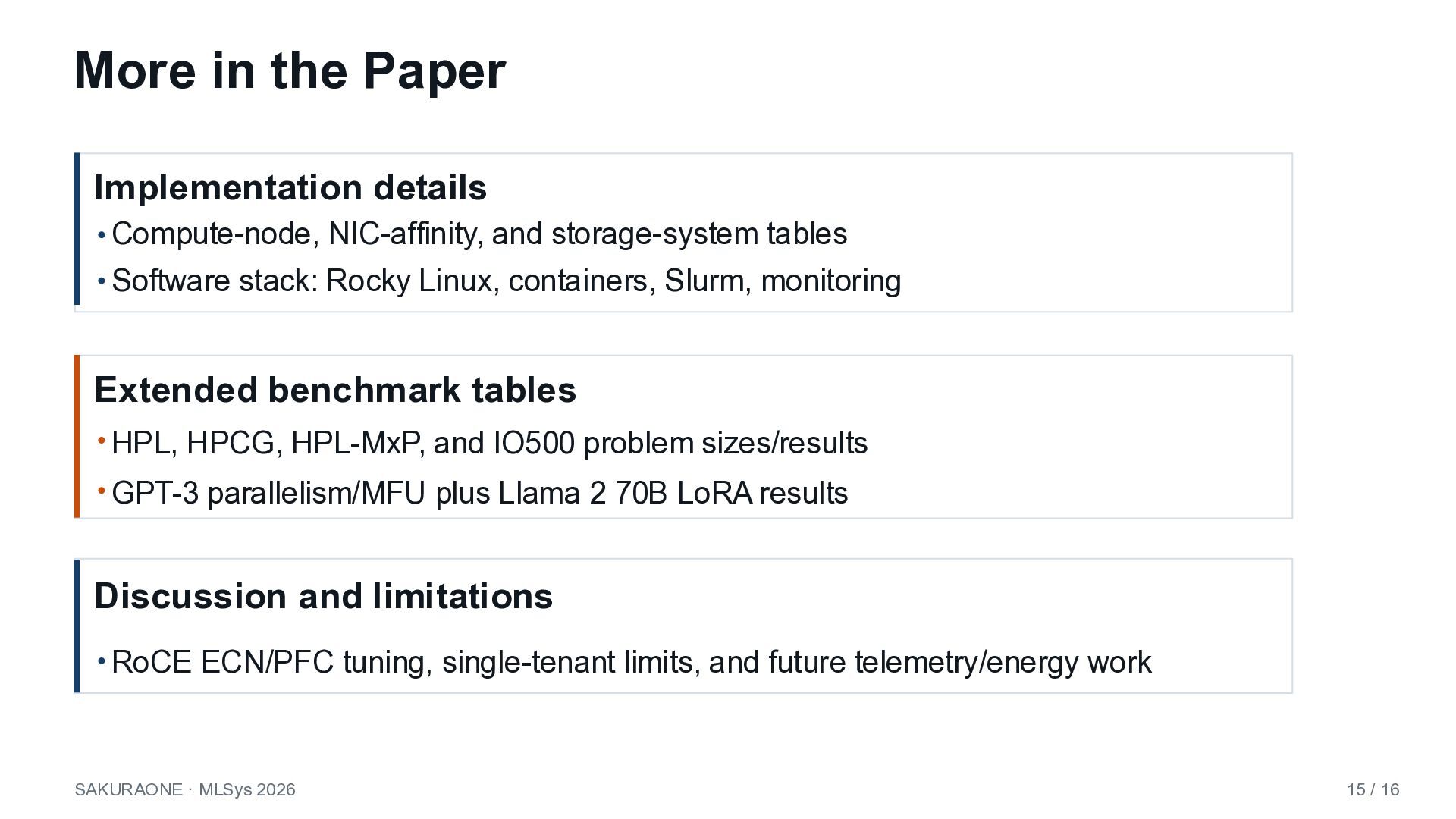
  17. More in the Paper Implementation details Compute-node, NIC-affinity, and storage-system

    tables Software stack: Rocky Linux, containers, Slurm, monitoring Extended benchmark tables HPL, HPCG, HPL-MxP, and IO500 problem sizes/results GPT-3 parallelism/MFU plus Llama 2 70B LoRA results Discussion and limitations RoCE ECN/PFC tuning, single-tenant limits, and future telemetry/energy work SAKURAONE · MLSys 2026 15 / 16
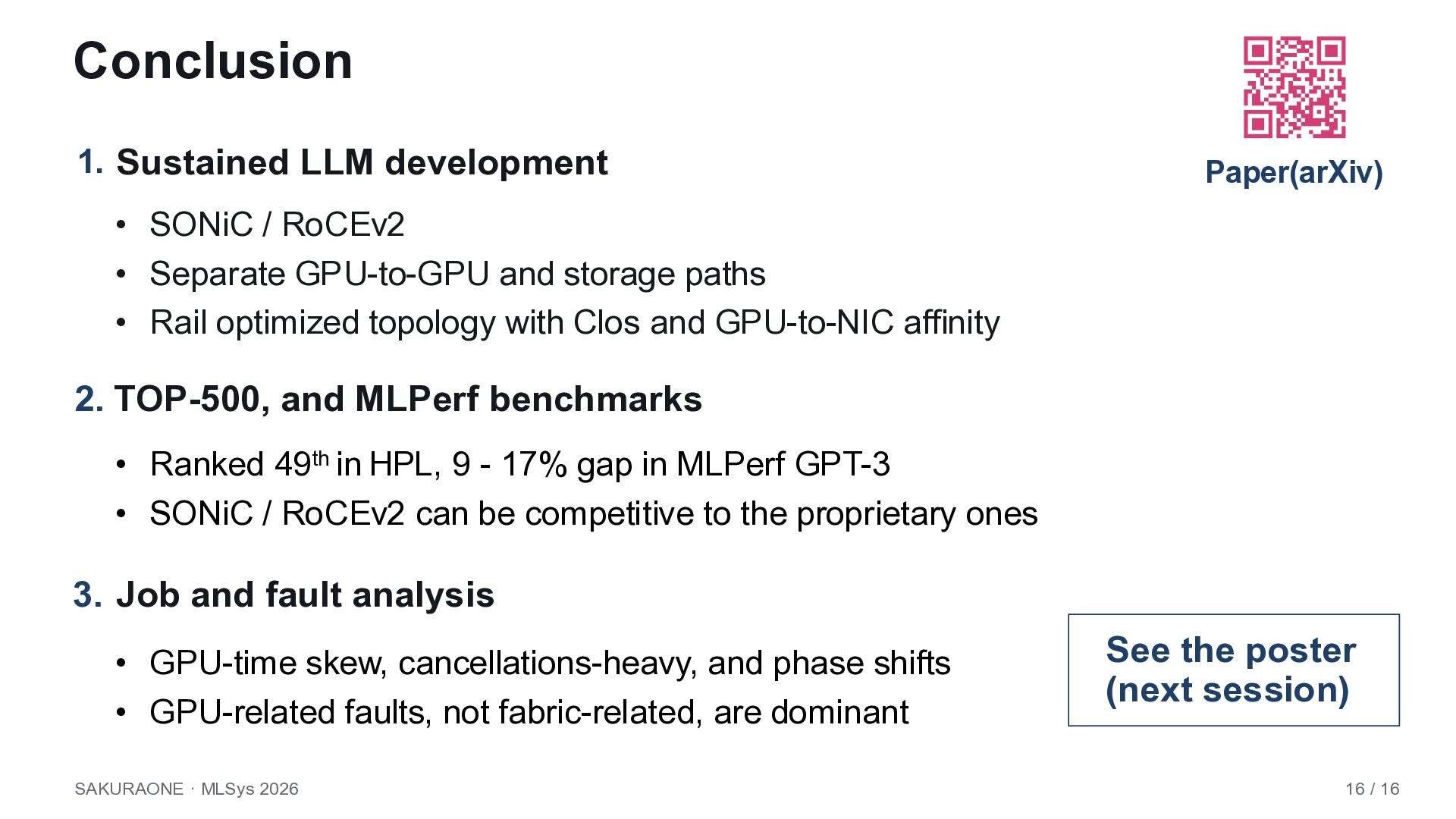
  18. Conclusion 1. Sustained LLM development 2. TOP-500, and MLPerf benchmarks

    3. Job and fault analysis See the poster (next session) SAKURAONE · MLSys 2026 16 / 16 • SONiC / RoCEv2 • Separate GPU-to-GPU and storage paths • Rail optimized topology with Clos and GPU-to-NIC affinity • Ranked 49th in HPL, 9 - 17% gap in MLPerf GPT-3 • SONiC / RoCEv2 can be competitive to the proprietary ones • GPU-time skew, cancellations-heavy, and phase shifts • GPU-related faults, not fabric-related, are dominant Paper(arXiv)