Upgrade to Pro — share decks privately, control downloads, hide ads and more …

Zettalane Systems - IT Press Tour #66 Jan 2026

Zettalane Systems - IT Press Tour #66 Jan 2026

Avatar for The IT Press Tour

The IT Press Tour PRO

January 28, 2026

More Decks by The IT Press Tour

Other Decks in Technology

Transcript

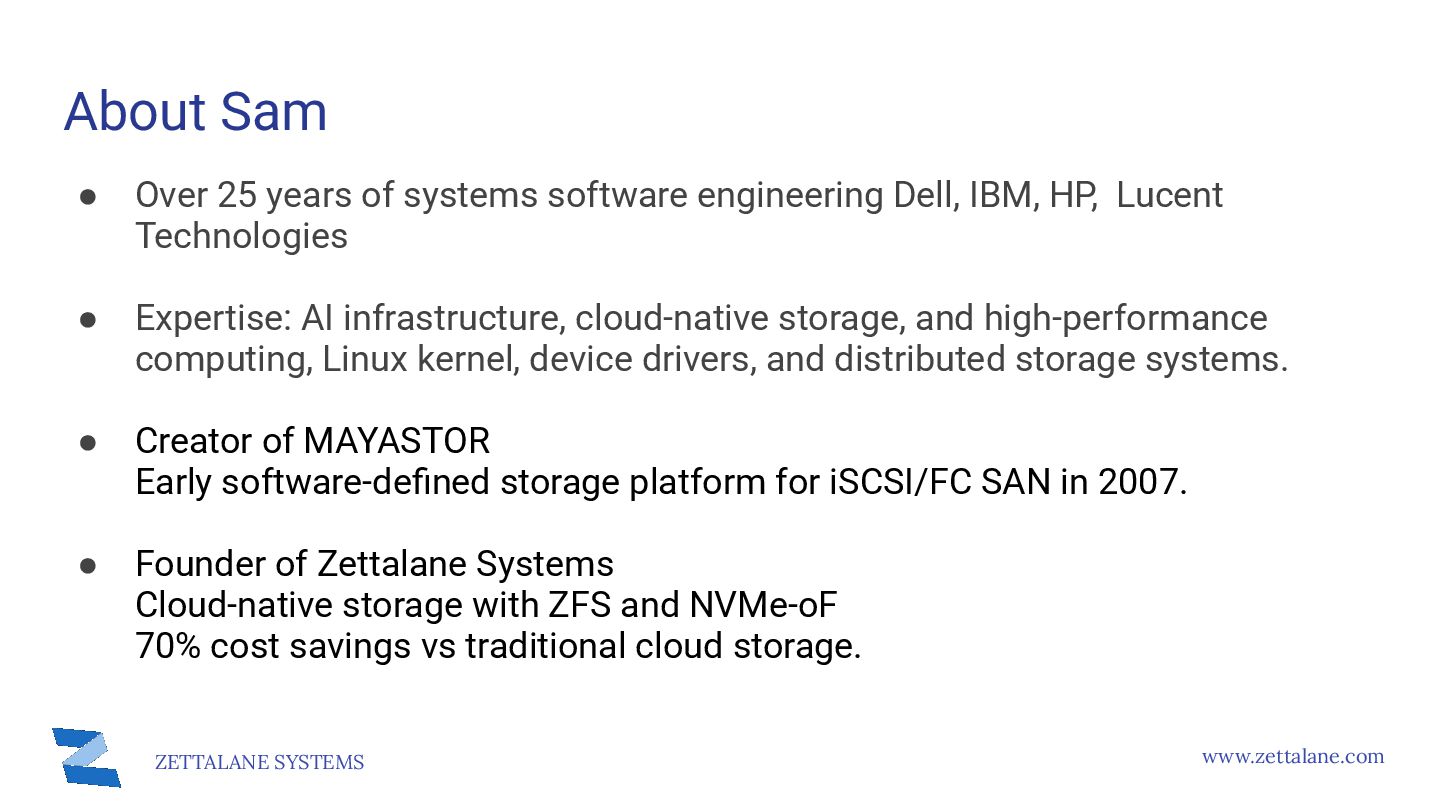
  1. ZETTALANE SYSTEMS www.zettalane.com About Sam • Over 25 years of

    systems software engineering Dell, IBM, HP, Lucent Technologies • Expertise: AI infrastructure, cloud-native storage, and high-performance computing, Linux kernel, device drivers, and distributed storage systems. • Creator of MAYASTOR Early software-defined storage platform for iSCSI/FC SAN in 2007. • Founder of Zettalane Systems Cloud-native storage with ZFS and NVMe-oF 70% cost savings vs traditional cloud storage.
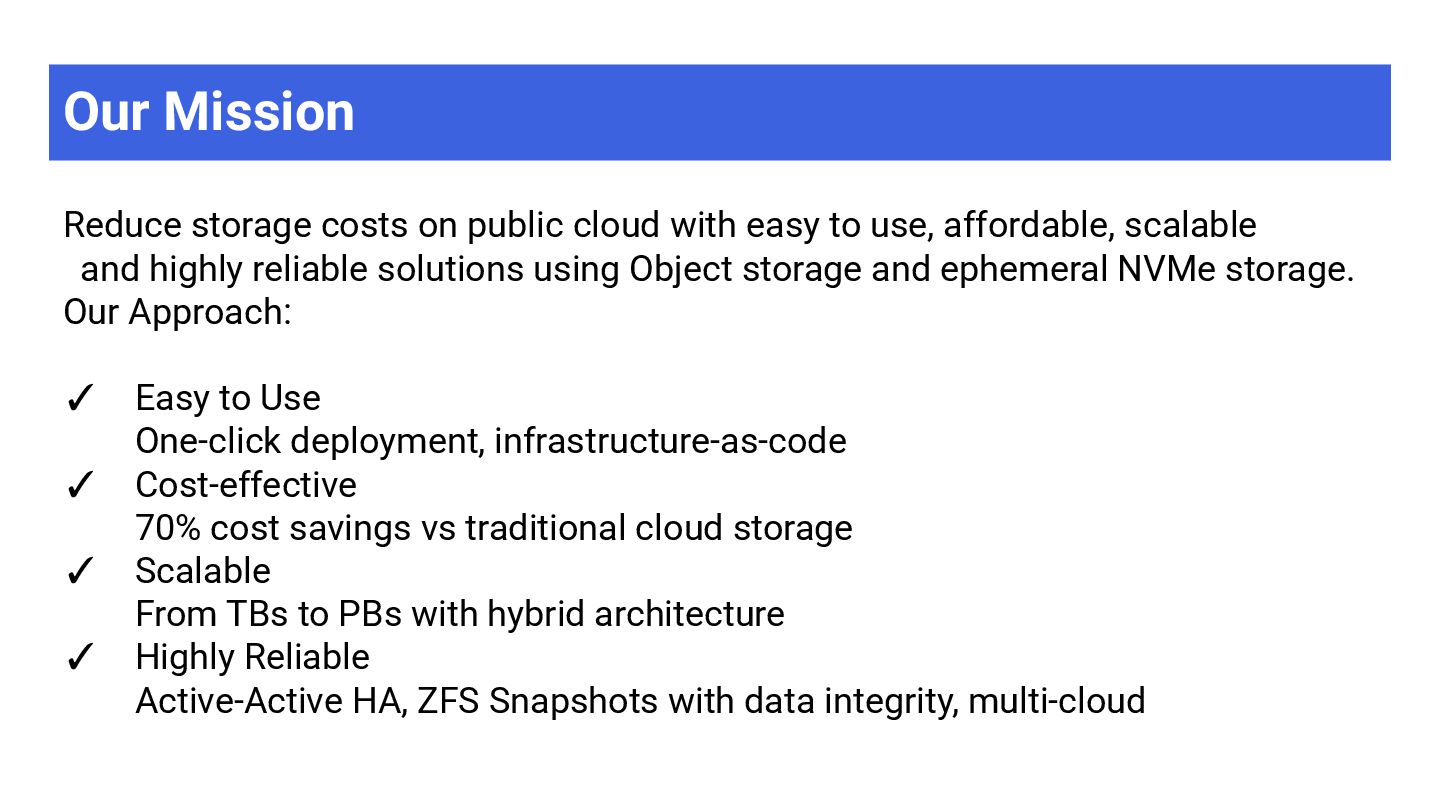
  2. Our Mission Reduce storage costs on public cloud with easy

    to use, affordable, scalable and highly reliable solutions using Object storage and ephemeral NVMe storage. Our Approach: ✓ Easy to Use One-click deployment, infrastructure-as-code ✓ Cost-effective 70% cost savings vs traditional cloud storage ✓ Scalable From TBs to PBs with hybrid architecture ✓ Highly Reliable Active-Active HA, ZFS Snapshots with data integrity, multi-cloud
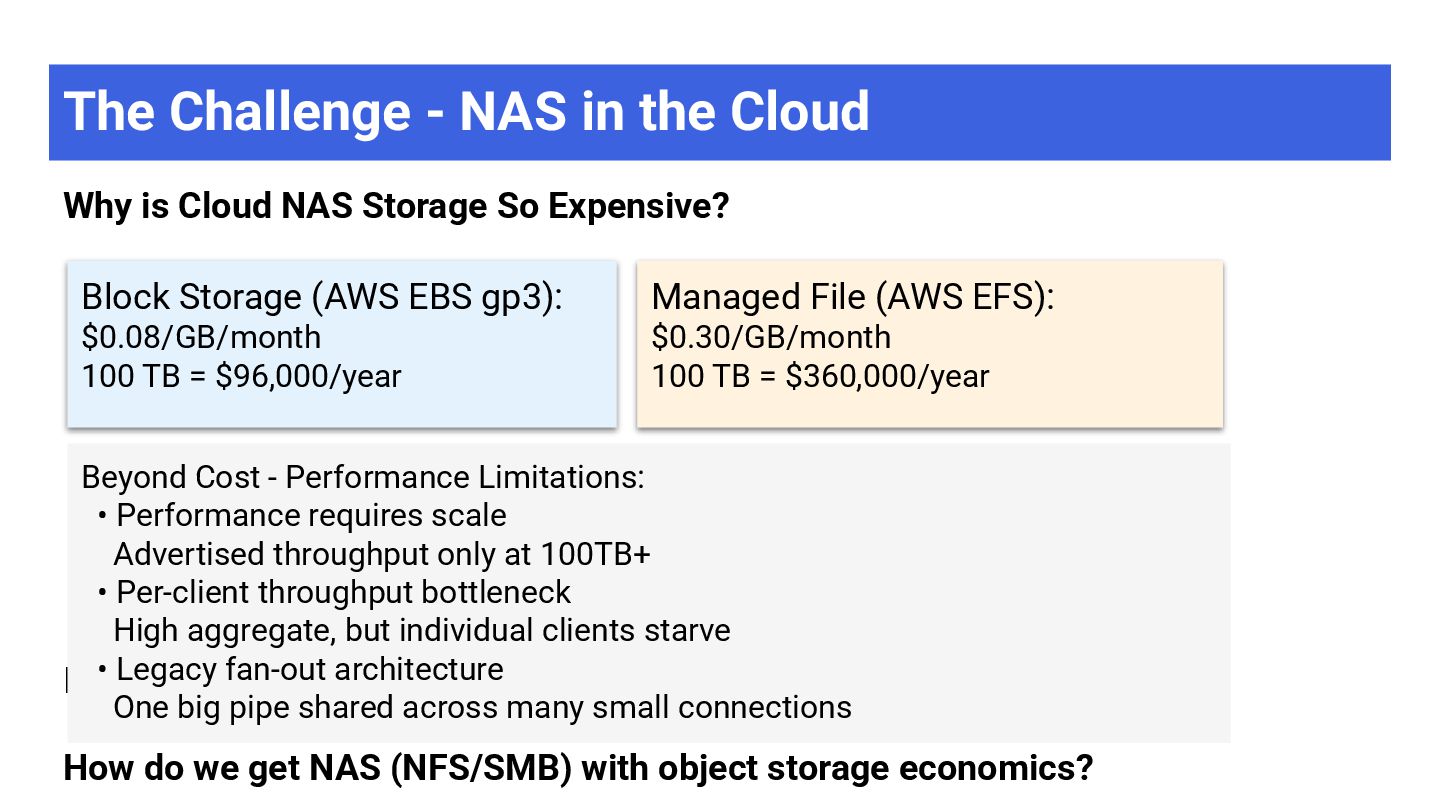
  3. The Challenge - NAS in the Cloud Why is Cloud

    NAS Storage So Expensive? How do we get NAS (NFS/SMB) with object storage economics? How do we get NAS (NFS/SMB) with object storage economics? Block Storage (AWS EBS gp3): $0.08/GB/month 100 TB = $96,000/year Managed File (AWS EFS): $0.30/GB/month 100 TB = $360,000/year Beyond Cost - Performance Limitations: • Performance requires scale Advertised throughput only at 100TB+ • Per-client throughput bottleneck High aggregate, but individual clients starve • Legacy fan-out architecture One big pipe shared across many small connections
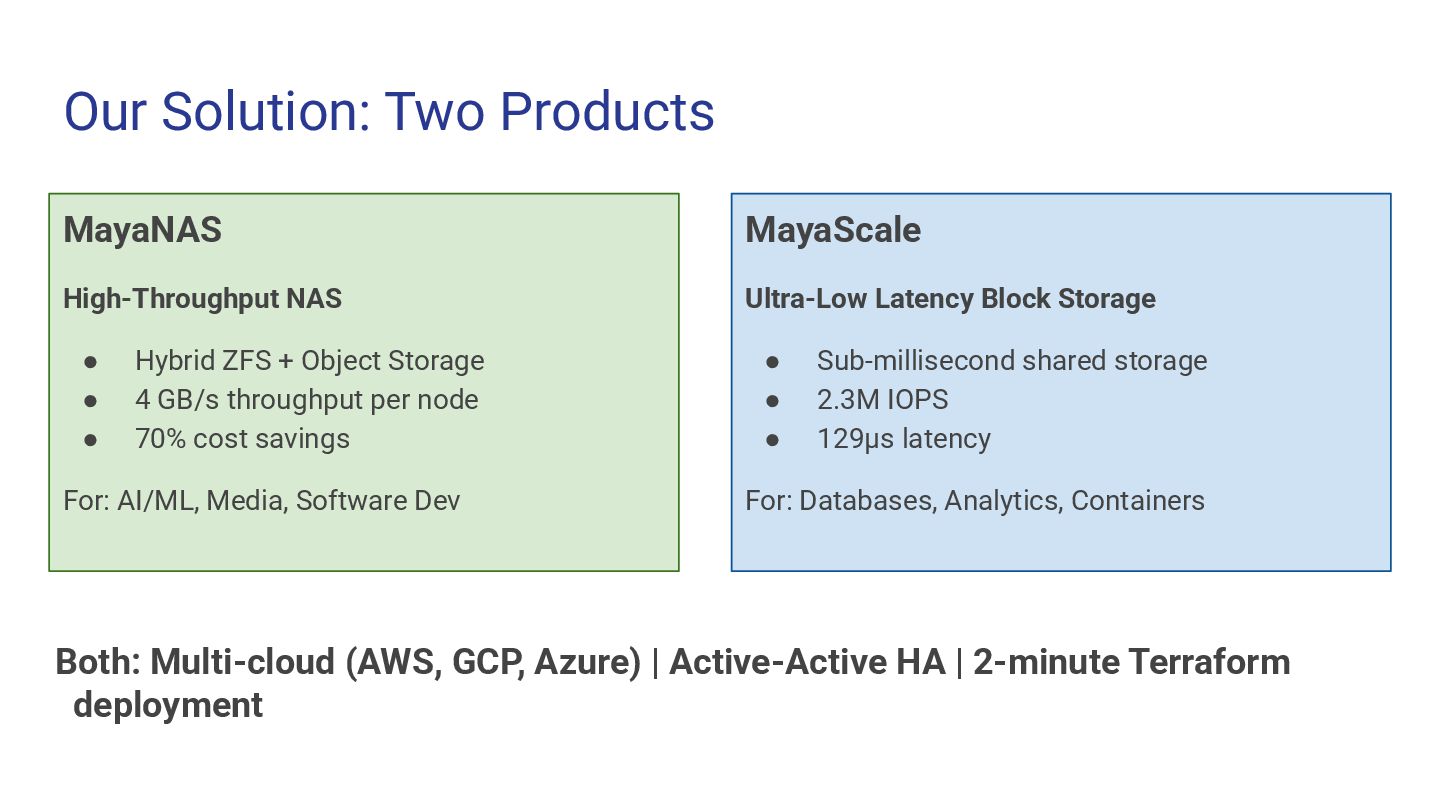
  4. Our Solution: Two Products MayaNAS High-Throughput NAS • Hybrid ZFS

    + Object Storage • 4 GB/s throughput per node • 70% cost savings For: AI/ML, Media, Software Dev MayaScale Ultra-Low Latency Block Storage • Sub-millisecond shared storage • 2.3M IOPS • 129μs latency For: Databases, Analytics, Containers Both: Multi-cloud (AWS, GCP, Azure) | Active-Active HA | 2-minute Terraform deployment
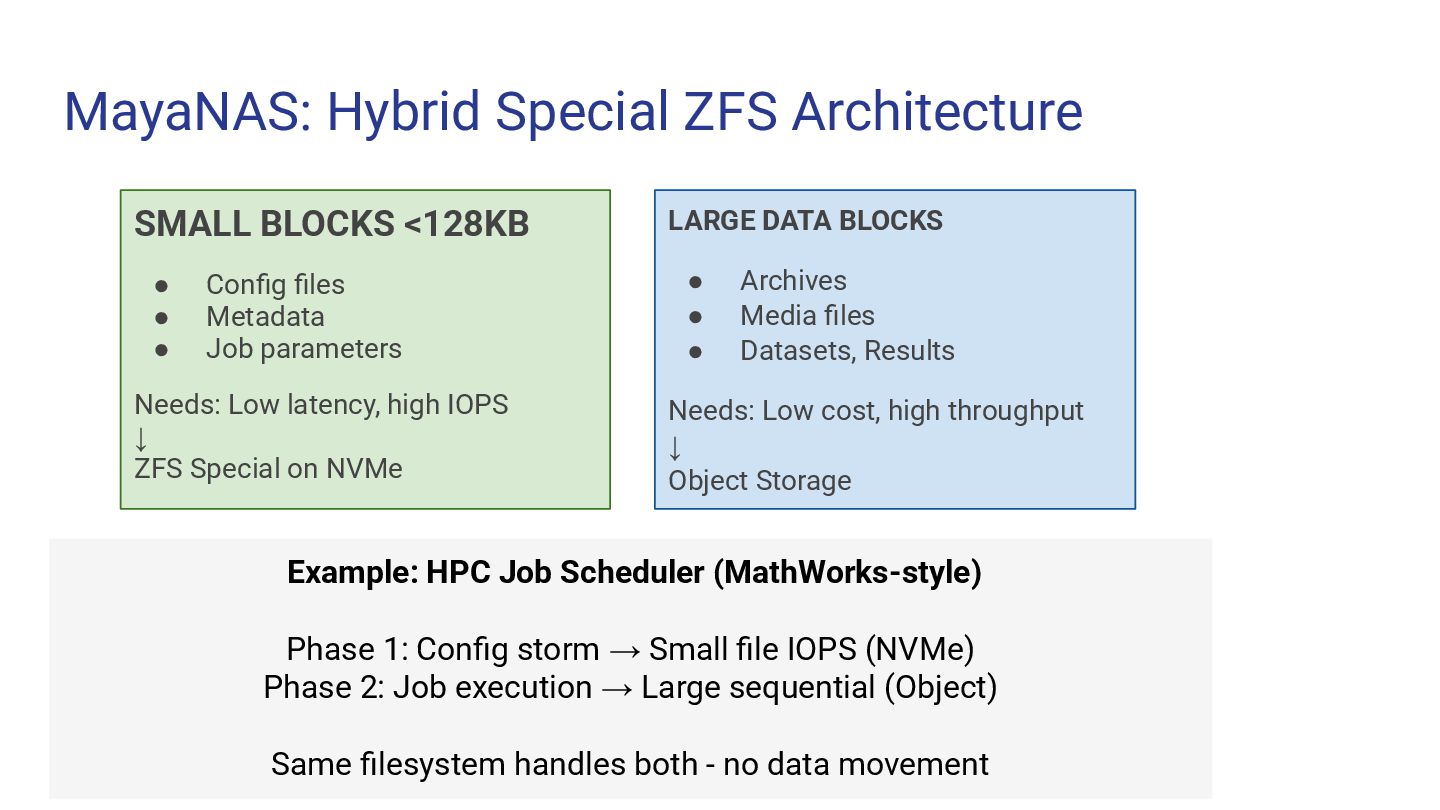
  5. MayaNAS: Hybrid Special ZFS Architecture SMALL BLOCKS <128KB • Config

    files • Metadata • Job parameters Needs: Low latency, high IOPS ↓ ZFS Special on NVMe LARGE DATA BLOCKS • Archives • Media files • Datasets, Results Needs: Low cost, high throughput ↓ Object Storage Example: HPC Job Scheduler (MathWorks-style) Phase 1: Config storm → Small file IOPS (NVMe) Phase 2: Job execution → Large sequential (Object) Same filesystem handles both - no data movement
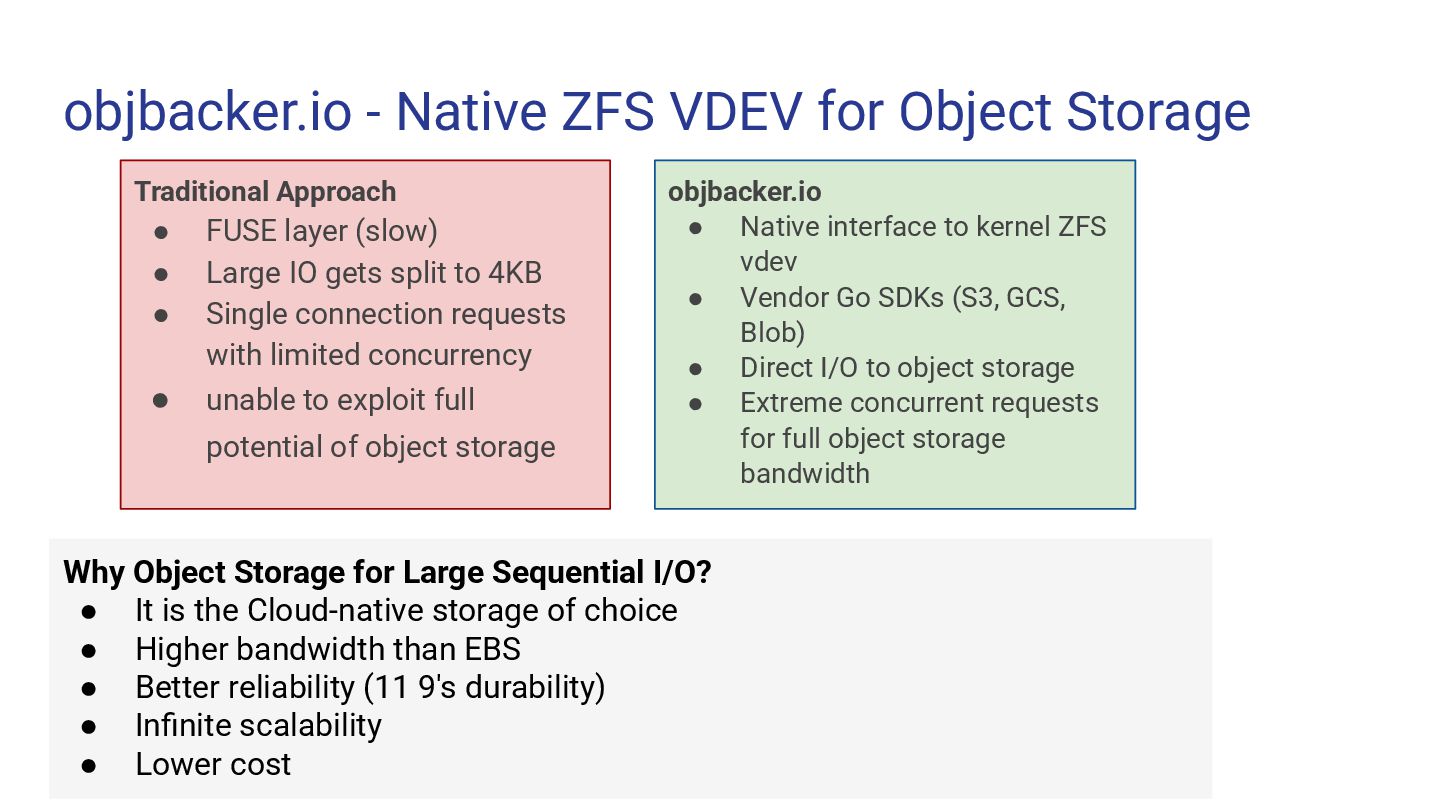
  6. objbacker.io - Native ZFS VDEV for Object Storage Traditional Approach

    • FUSE layer (slow) • Large IO gets split to 4KB • Single connection requests with limited concurrency • unable to exploit full potential of object storage objbacker.io • Native interface to kernel ZFS vdev • Vendor Go SDKs (S3, GCS, Blob) • Direct I/O to object storage • Extreme concurrent requests for full object storage bandwidth Why Object Storage for Large Sequential I/O? • It is the Cloud-native storage of choice • Higher bandwidth than EBS • Better reliability (11 9's durability) • Infinite scalability • Lower cost
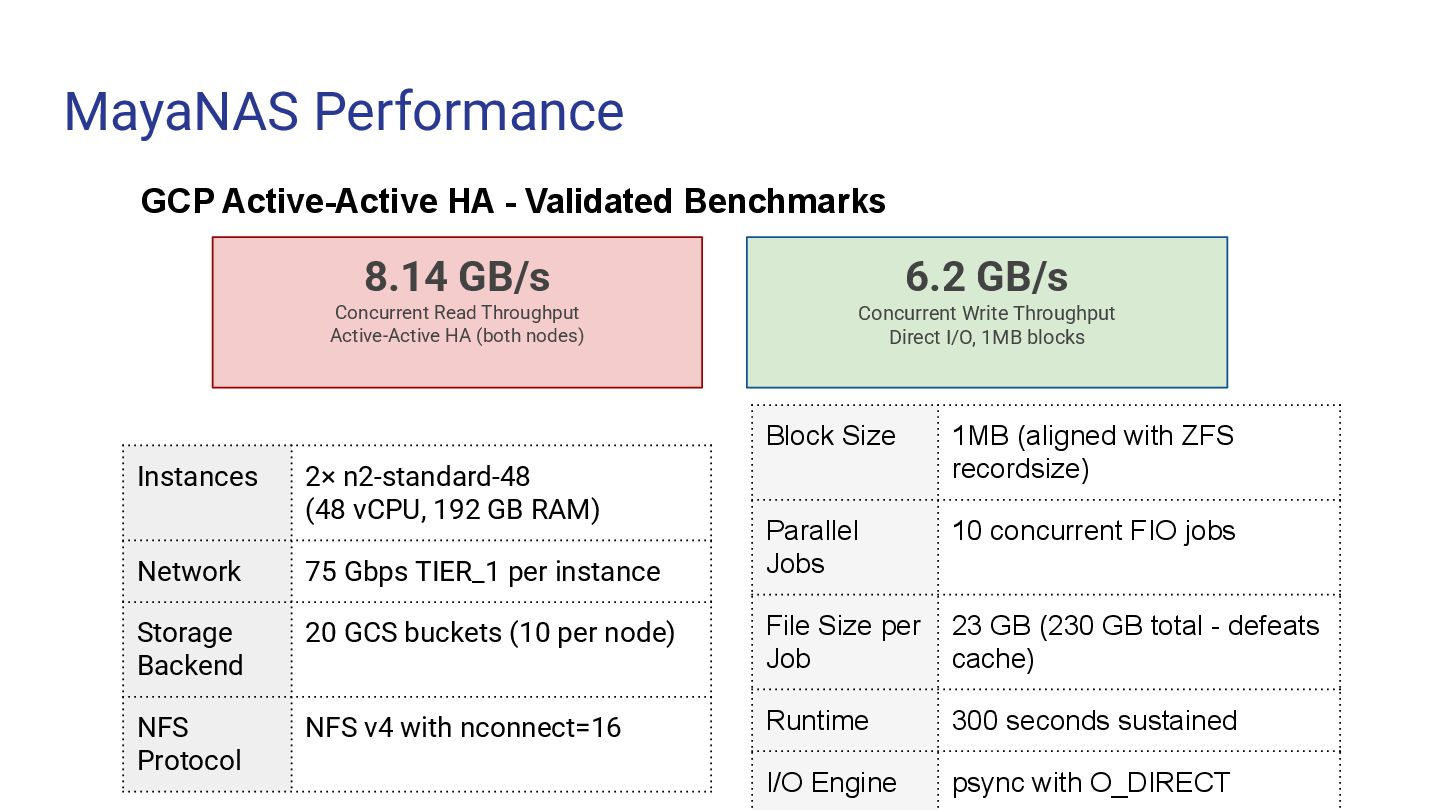
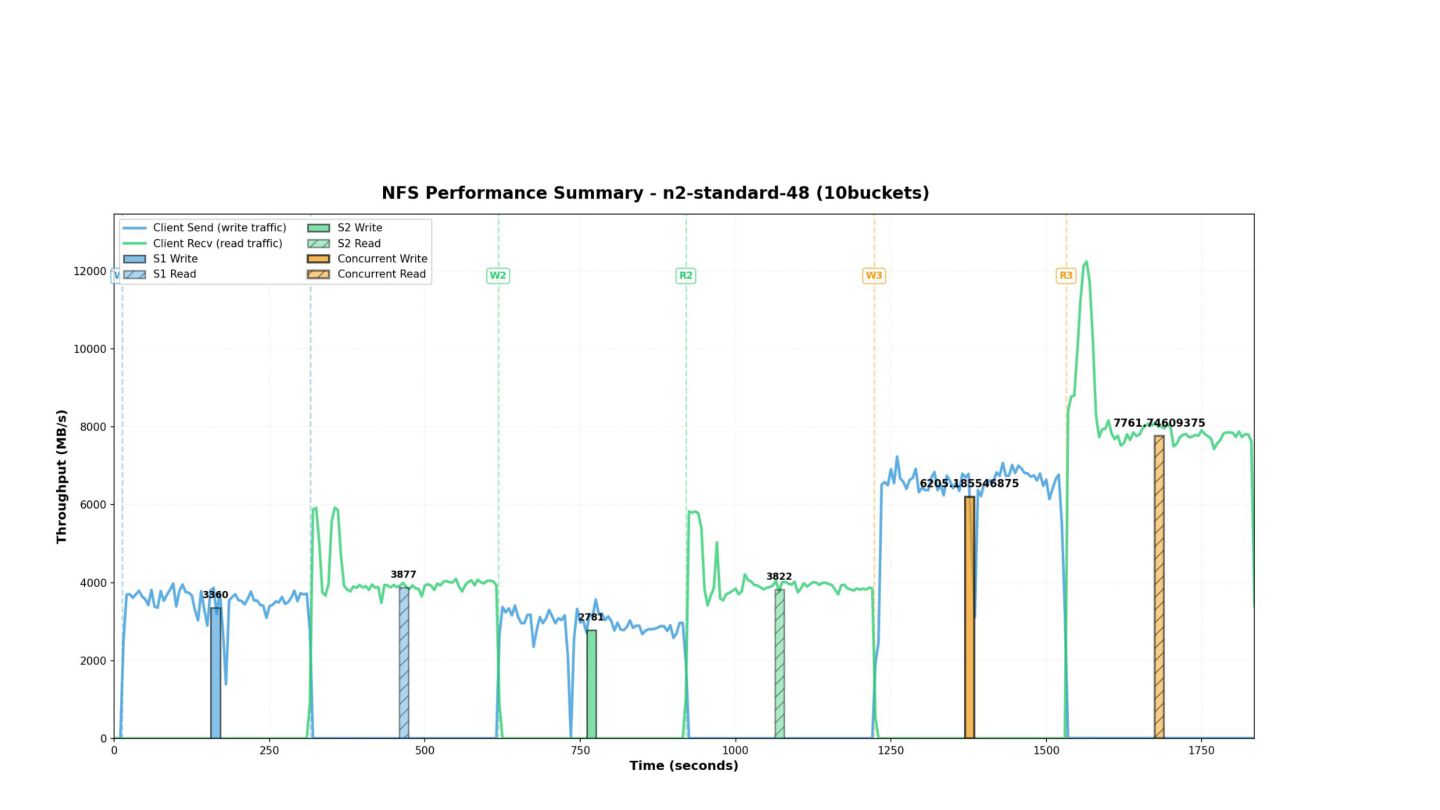
  7. MayaNAS Performance 8.14 GB/s Concurrent Read Throughput Active-Active HA (both

    nodes) 6.2 GB/s Concurrent Write Throughput Direct I/O, 1MB blocks GCP Active-Active HA - Validated Benchmarks Instances 2× n2-standard-48 (48 vCPU, 192 GB RAM) Network 75 Gbps TIER_1 per instance Storage Backend 20 GCS buckets (10 per node) NFS Protocol NFS v4 with nconnect=16 Block Size 1MB (aligned with ZFS recordsize) Parallel Jobs 10 concurrent FIO jobs File Size per Job 23 GB (230 GB total - defeats cache) Runtime 300 seconds sustained I/O Engine psync with O_DIRECT
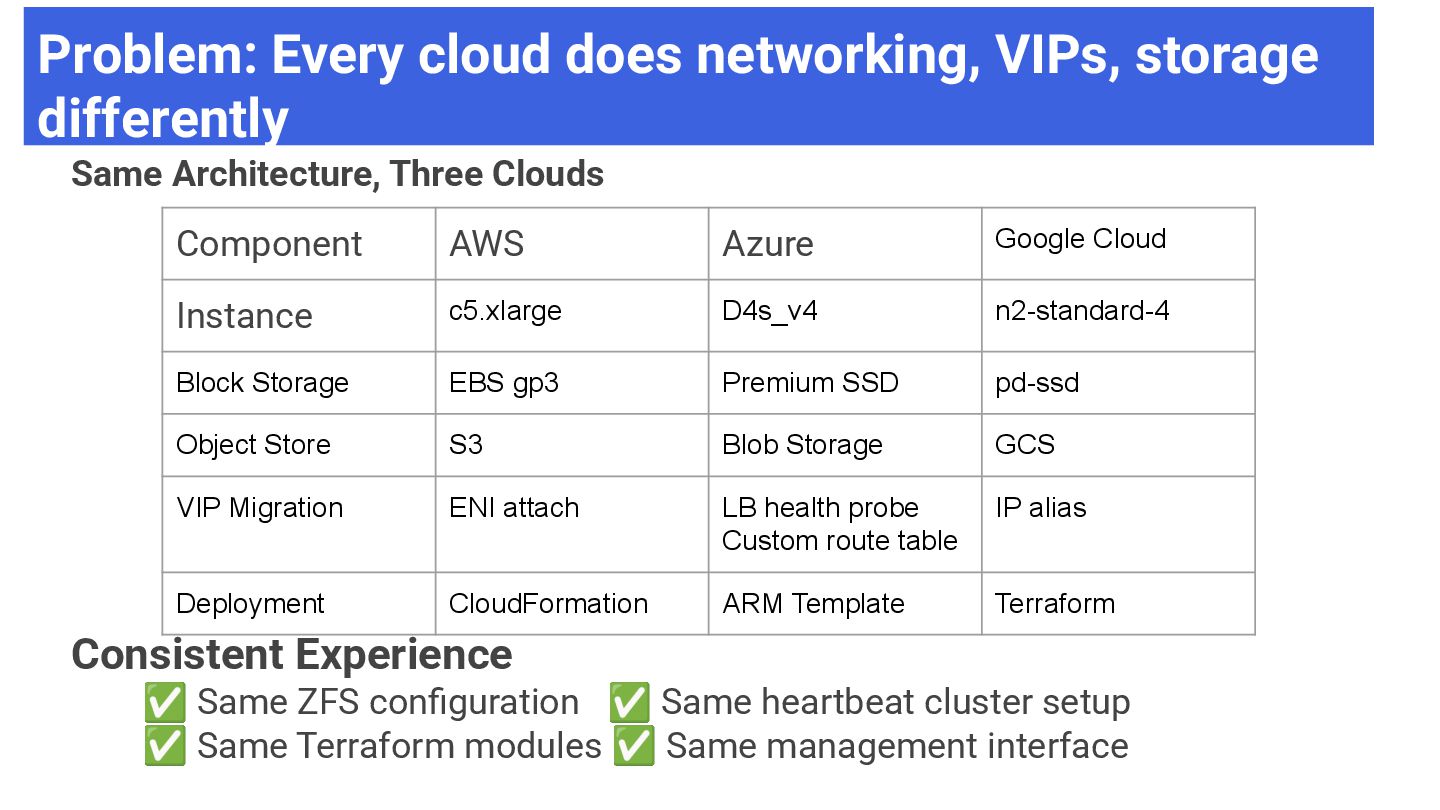
  8. Problem: Every cloud does networking, VIPs, storage differently Same Architecture,

    Three Clouds Consistent Experience ✅ Same ZFS configuration ✅ Same heartbeat cluster setup ✅ Same Terraform modules ✅ Same management interface Component AWS Azure Google Cloud Instance c5.xlarge D4s_v4 n2-standard-4 Block Storage EBS gp3 Premium SSD pd-ssd Object Store S3 Blob Storage GCS VIP Migration ENI attach LB health probe Custom route table IP alias Deployment CloudFormation ARM Template Terraform
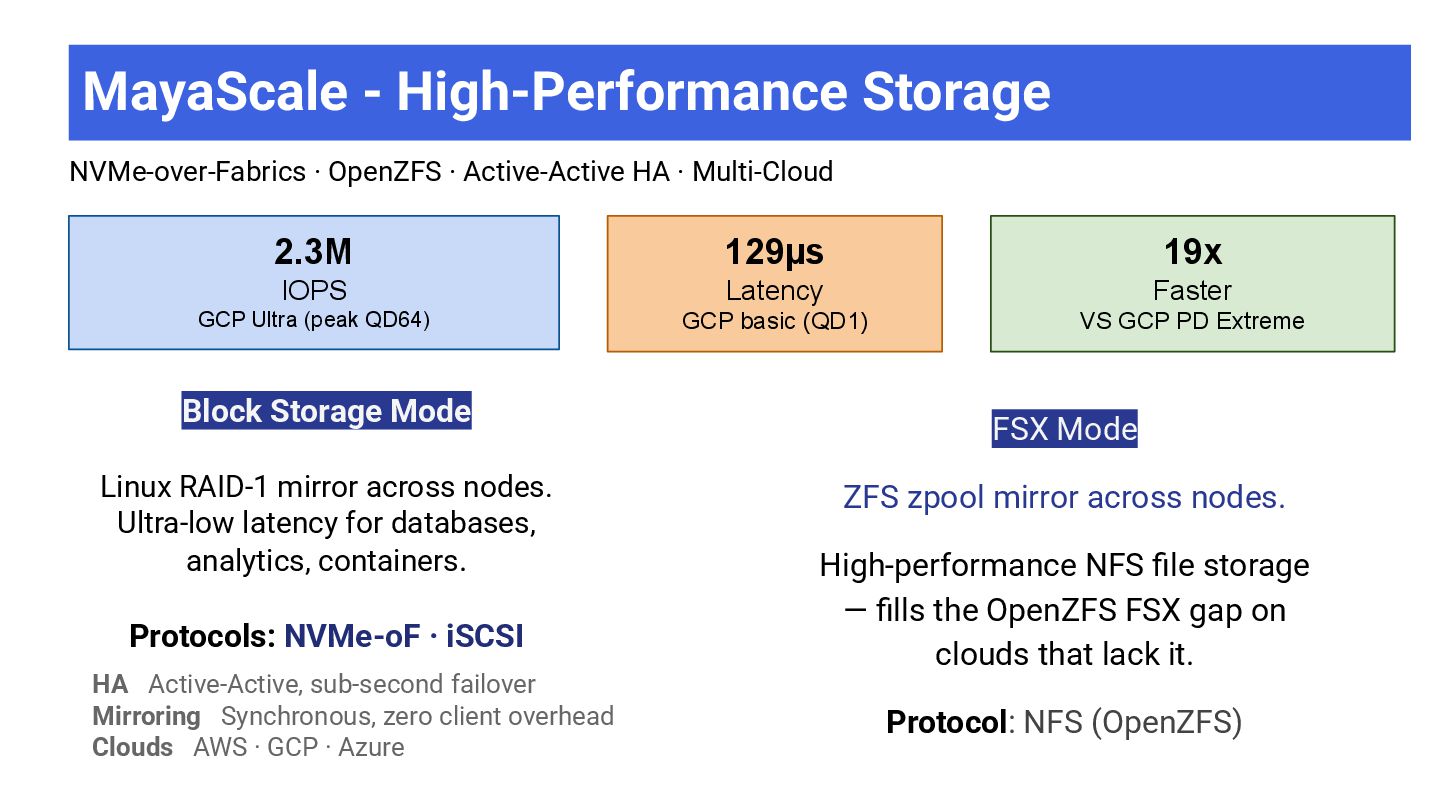
  9. NVMe-over-Fabrics · OpenZFS · Active-Active HA · Multi-Cloud 2.3M IOPS

    GCP Ultra (peak QD64) 129µs Latency GCP basic (QD1) 19x Faster VS GCP PD Extreme FSX Mode ZFS zpool mirror across nodes. High-performance NFS file storage — fills the OpenZFS FSX gap on clouds that lack it. Protocol: NFS (OpenZFS) Block Storage Mode Linux RAID-1 mirror across nodes. Ultra-low latency for databases, analytics, containers. Protocols: NVMe-oF · iSCSI HA  Active-Active, sub-second failover Mirroring  Synchronous, zero client overhead Clouds  AWS · GCP · Azure MayaScale - High-Performance Storage
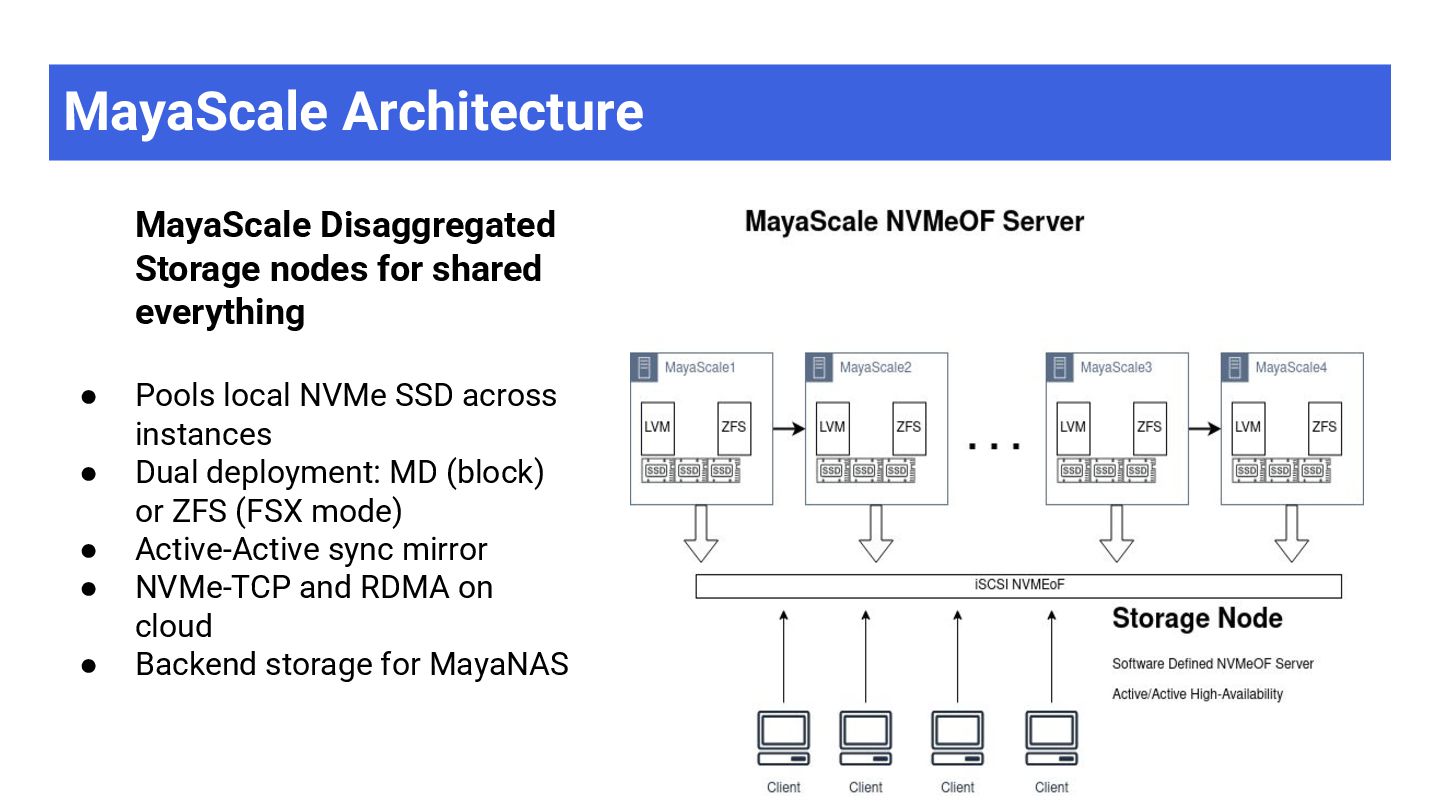
  10. MayaScale Architecture MayaScale Disaggregated Storage nodes for shared everything •

    Pools local NVMe SSD across instances • Dual deployment: MD (block) or ZFS (FSX mode) • Active-Active sync mirror • NVMe-TCP and RDMA on cloud • Backend storage for MayaNAS
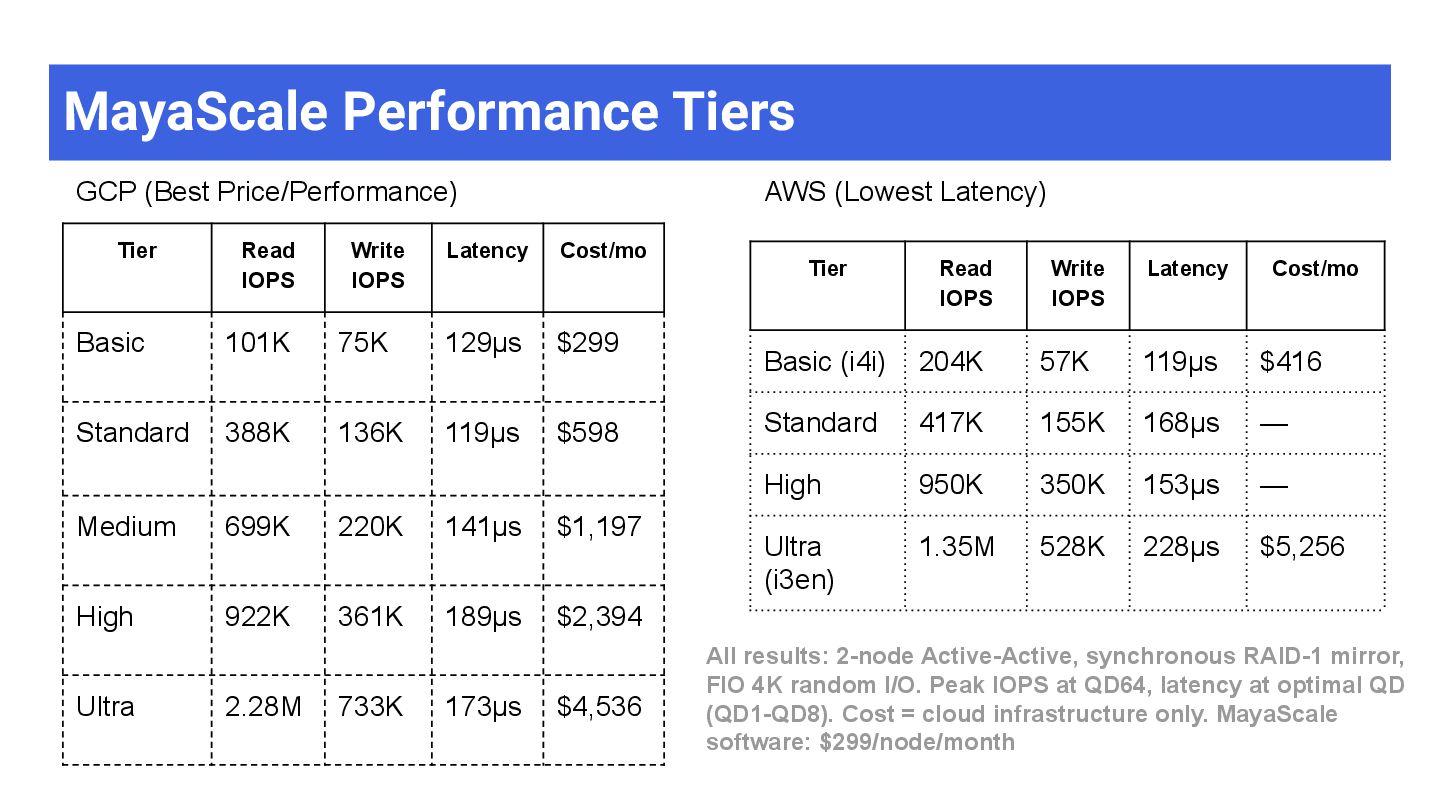
  11. Tier Read IOPS Write IOPS Latency Cost/mo Basic 101K 75K

    129µs $299 Standard 388K 136K 119µs $598 Medium 699K 220K 141µs $1,197 High 922K 361K 189µs $2,394 Ultra 2.28M 733K 173µs $4,536 Tier Read IOPS Write IOPS Latency Cost/mo Basic (i4i) 204K 57K 119µs $416 Standard 417K 155K 168µs — High 950K 350K 153µs — Ultra (i3en) 1.35M 528K 228µs $5,256 MayaScale Performance Tiers GCP (Best Price/Performance) AWS (Lowest Latency) All results: 2-node Active-Active, synchronous RAID-1 mirror, FIO 4K random I/O. Peak IOPS at QD64, latency at optimal QD (QD1-QD8). Cost = cloud infrastructure only. MayaScale software: $299/node/month
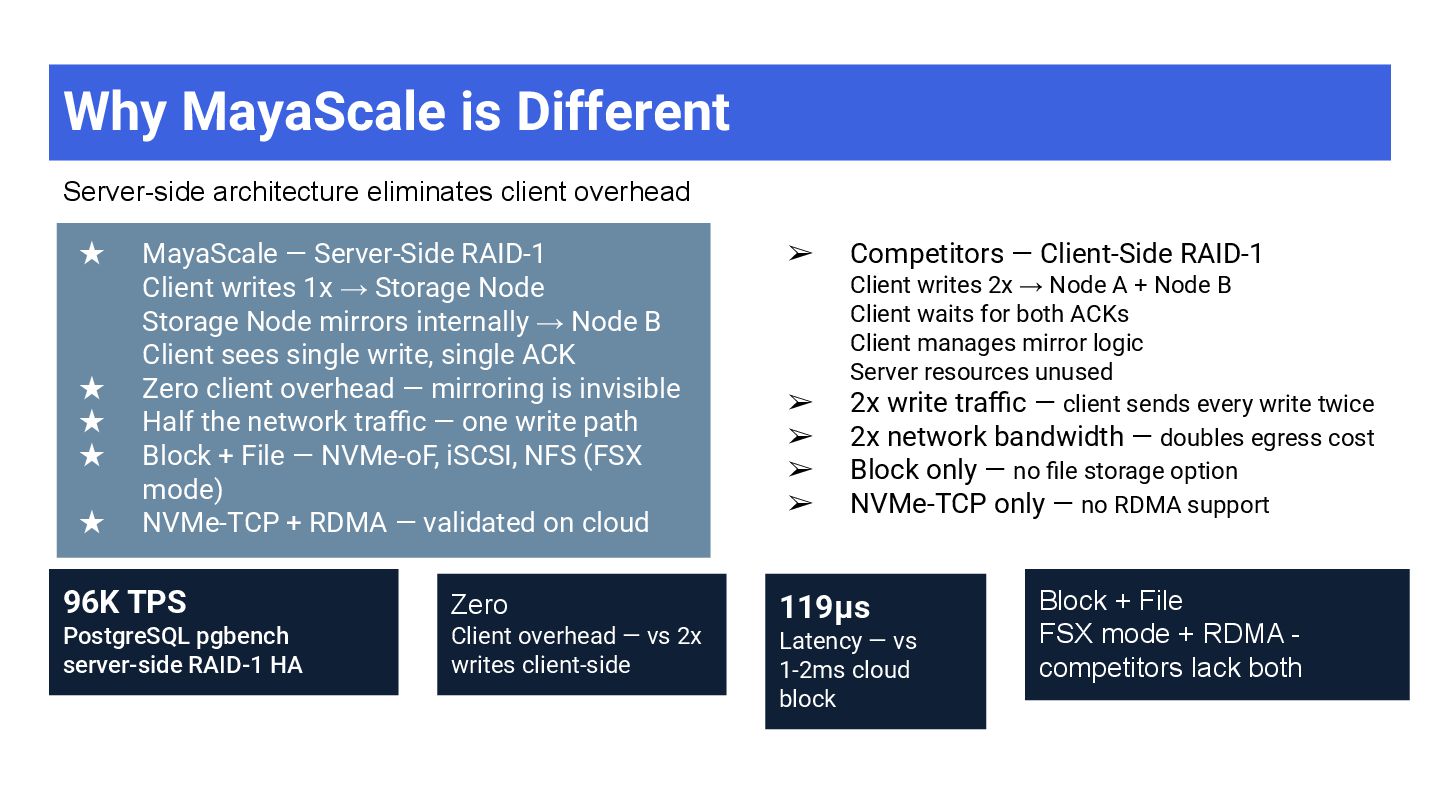
  12. Why MayaScale is Different Server-side architecture eliminates client overhead ★

    MayaScale — Server-Side RAID-1 Client writes 1x → Storage Node Storage Node mirrors internally → Node B Client sees single write, single ACK ★ Zero client overhead — mirroring is invisible ★ Half the network traffic — one write path ★ Block + File — NVMe-oF, iSCSI, NFS (FSX mode) ★ NVMe-TCP + RDMA — validated on cloud ➢ Competitors — Client-Side RAID-1 Client writes 2x → Node A + Node B Client waits for both ACKs Client manages mirror logic Server resources unused ➢ 2x write traffic — client sends every write twice ➢ 2x network bandwidth — doubles egress cost ➢ Block only — no file storage option ➢ NVMe-TCP only — no RDMA support 96K TPS PostgreSQL pgbench server-side RAID-1 HA Zero Client overhead — vs 2x writes client-side 119µs Latency — vs 1-2ms cloud block Block + File FSX mode + RDMA - competitors lack both
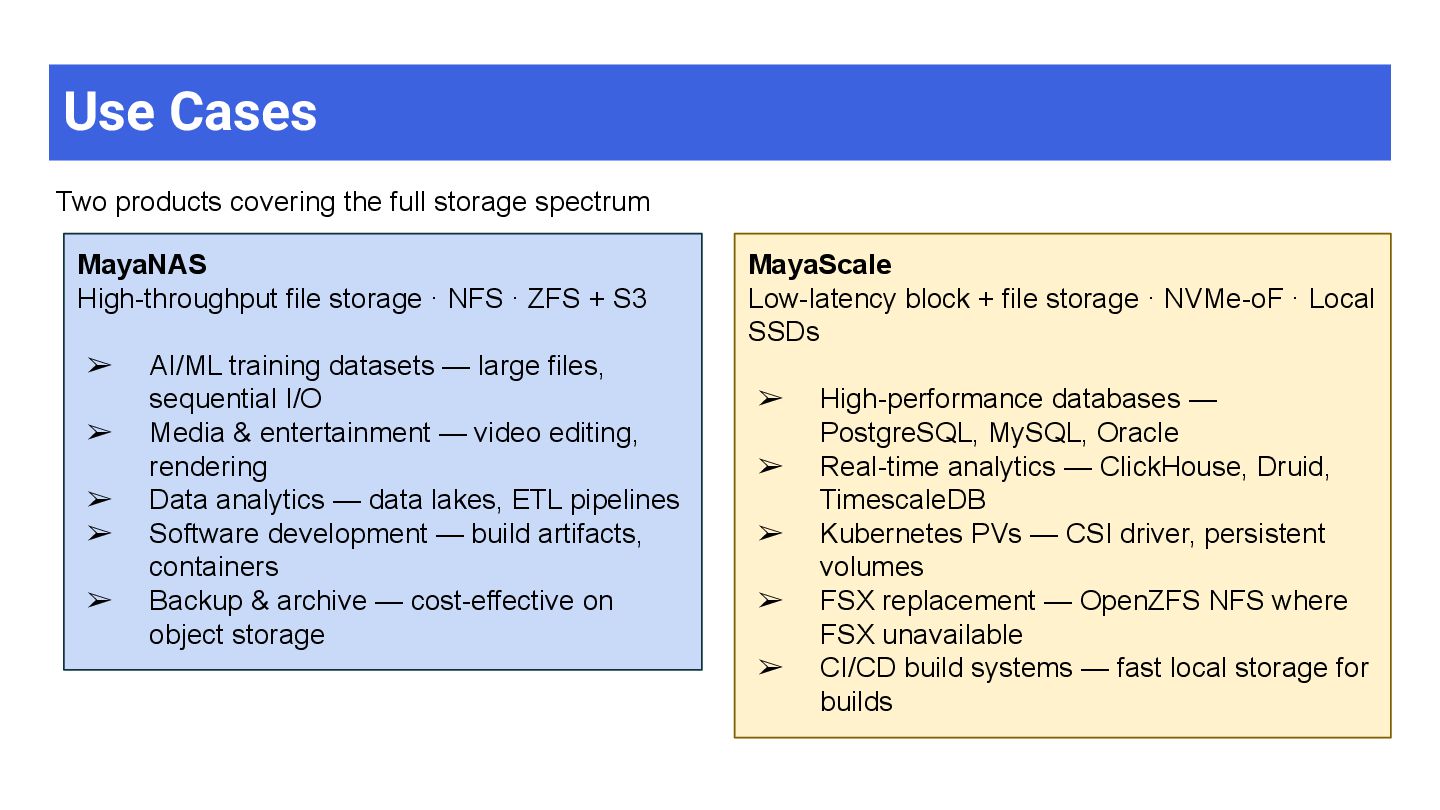
  13. Two products covering the full storage spectrum Use Cases MayaNAS

    High-throughput file storage · NFS · ZFS + S3 ➢ AI/ML training datasets — large files, sequential I/O ➢ Media & entertainment — video editing, rendering ➢ Data analytics — data lakes, ETL pipelines ➢ Software development — build artifacts, containers ➢ Backup & archive — cost-effective on object storage MayaScale Low-latency block + file storage · NVMe-oF · Local SSDs ➢ High-performance databases — PostgreSQL, MySQL, Oracle ➢ Real-time analytics — ClickHouse, Druid, TimescaleDB ➢ Kubernetes PVs — CSI driver, persistent volumes ➢ FSX replacement — OpenZFS NFS where FSX unavailable ➢ CI/CD build systems — fast local storage for builds
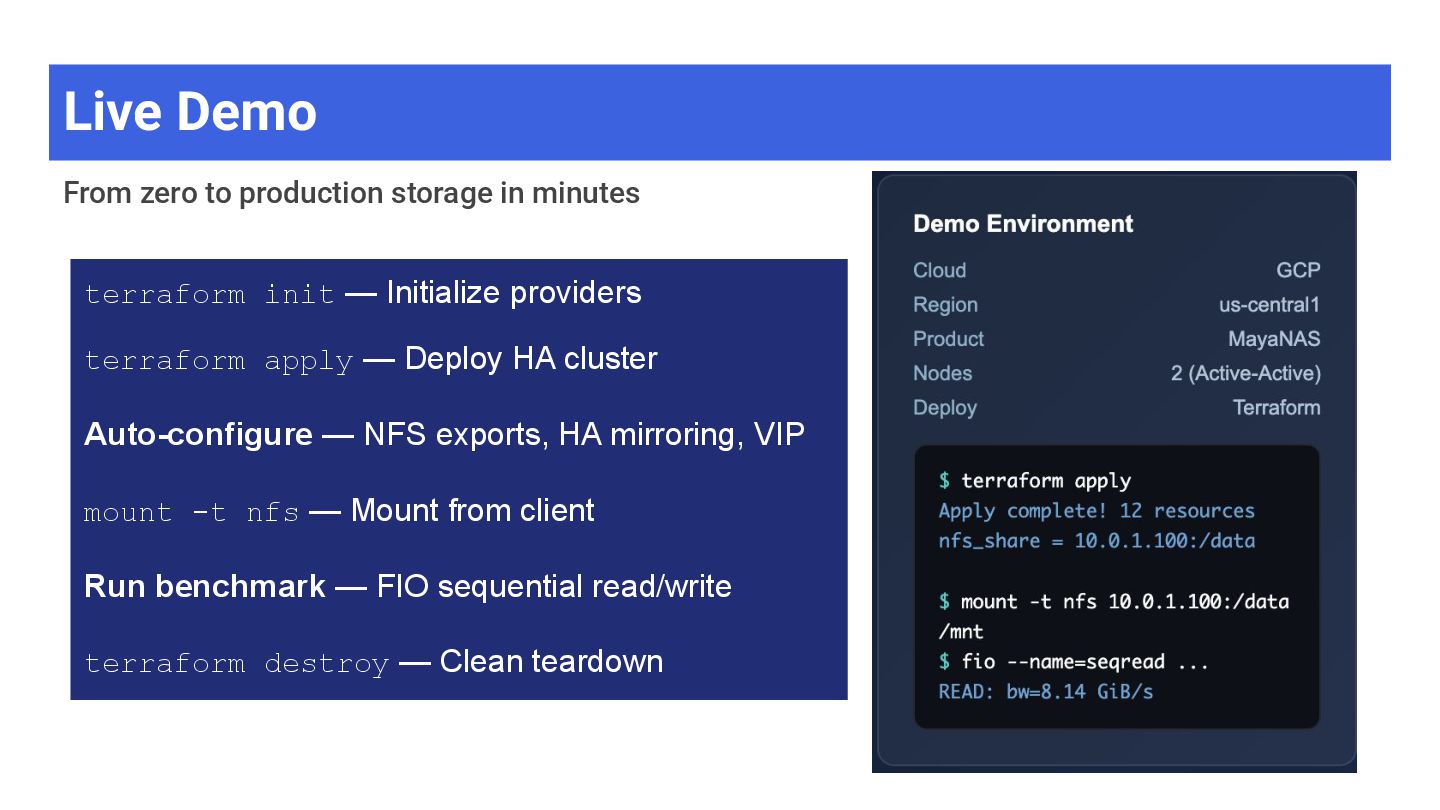
  14. Live Demo terraform init — Initialize providers terraform apply —

    Deploy HA cluster Auto-configure — NFS exports, HA mirroring, VIP mount -t nfs — Mount from client Run benchmark — FIO sequential read/write terraform destroy — Clean teardown From zero to production storage in minutes
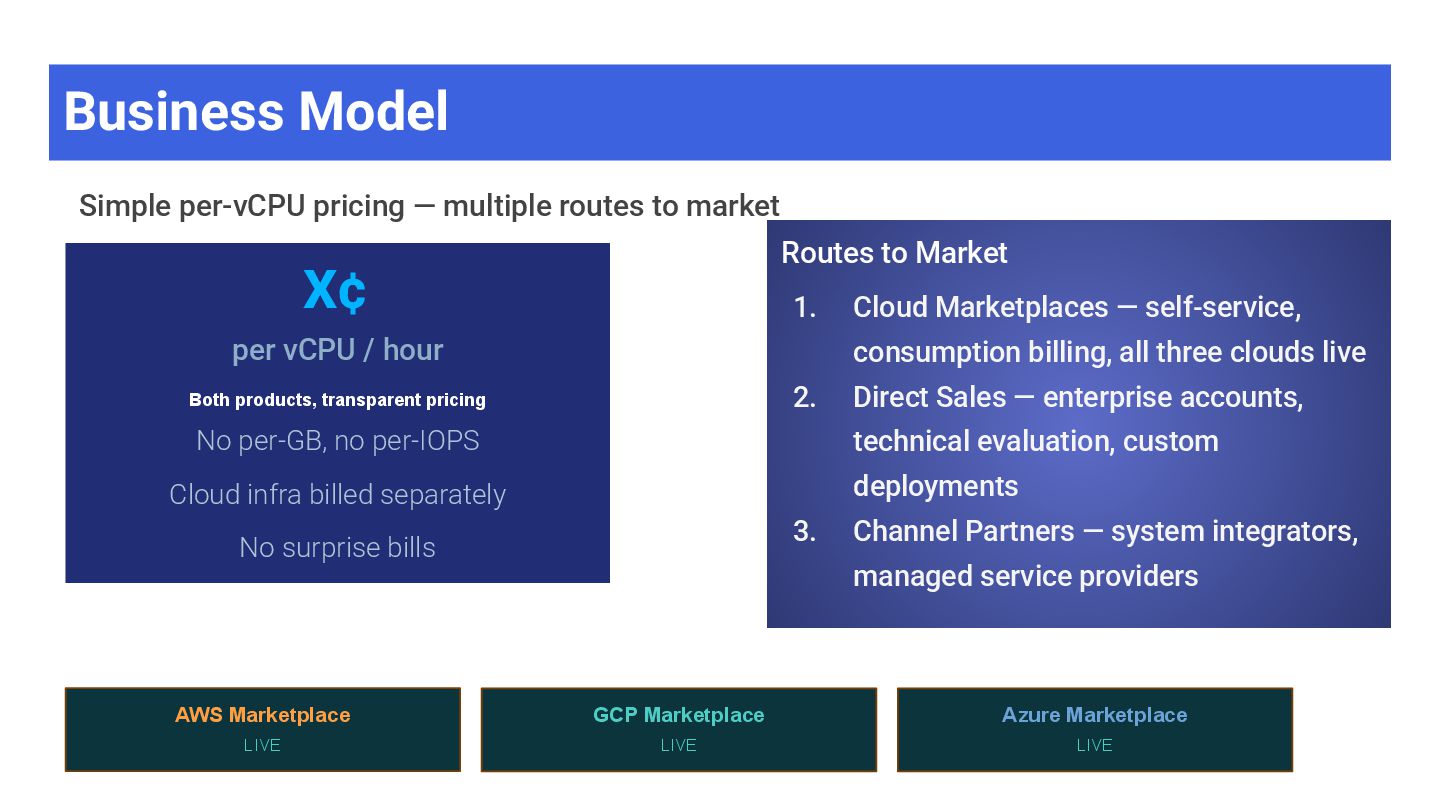
  15. Business Model Simple per-vCPU pricing — multiple routes to market

    X¢ per vCPU / hour Both products, transparent pricing No per-GB, no per-IOPS Cloud infra billed separately No surprise bills Routes to Market 1. Cloud Marketplaces — self-service, consumption billing, all three clouds live 2. Direct Sales — enterprise accounts, technical evaluation, custom deployments 3. Channel Partners — system integrators, managed service providers AWS Marketplace LIVE GCP Marketplace LIVE Azure Marketplace LIVE
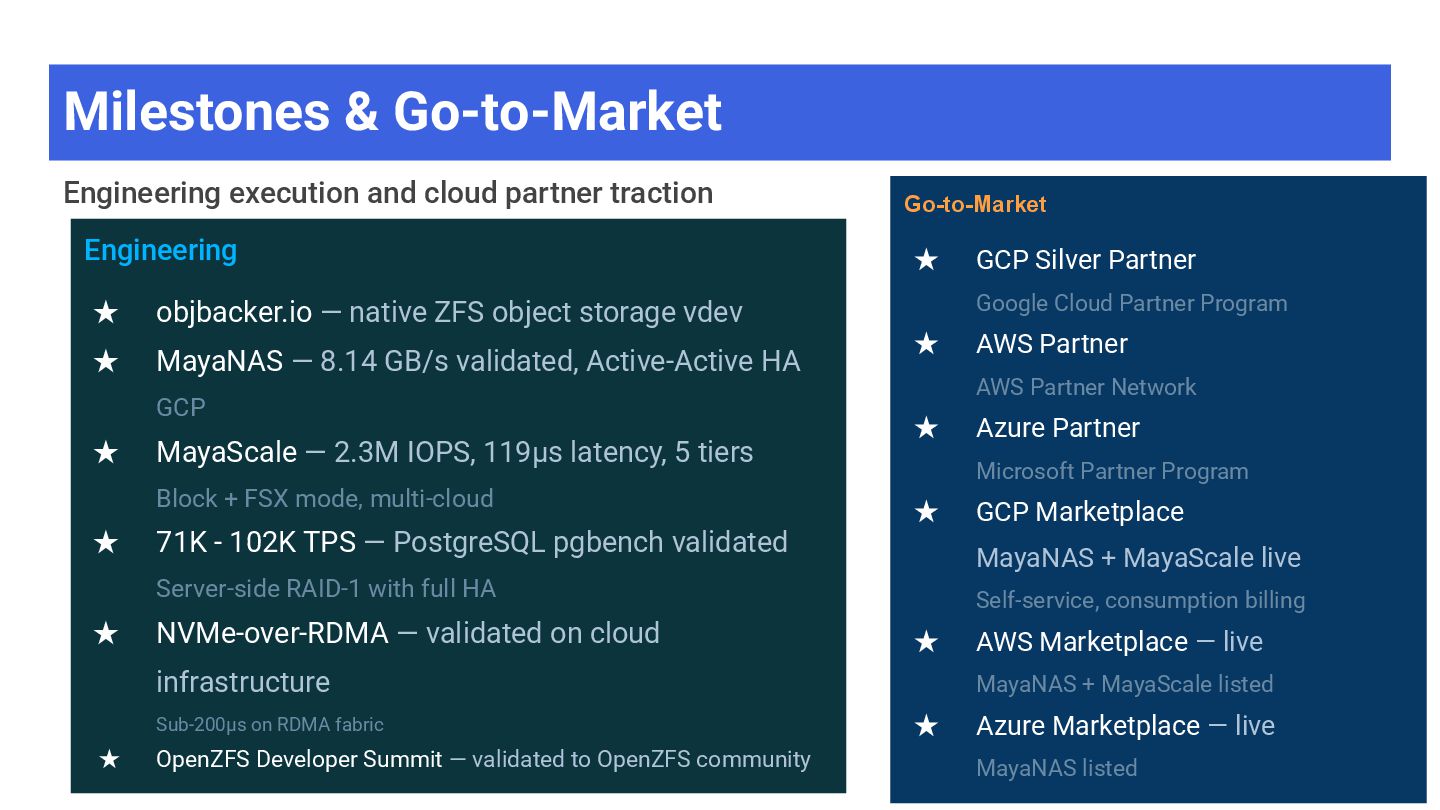
  16. Milestones & Go-to-Market Engineering execution and cloud partner traction Engineering

    ★ objbacker.io — native ZFS object storage vdev ★ MayaNAS — 8.14 GB/s validated, Active-Active HA GCP ★ MayaScale — 2.3M IOPS, 119µs latency, 5 tiers Block + FSX mode, multi-cloud ★ 71K - 102K TPS — PostgreSQL pgbench validated Server-side RAID-1 with full HA ★ NVMe-over-RDMA — validated on cloud infrastructure Sub-200µs on RDMA fabric ★ OpenZFS Developer Summit — validated to OpenZFS community Go-to-Market ★ GCP Silver Partner Google Cloud Partner Program ★ AWS Partner AWS Partner Network ★ Azure Partner Microsoft Partner Program ★ GCP Marketplace MayaNAS + MayaScale live Self-service, consumption billing ★ AWS Marketplace — live MayaNAS + MayaScale listed ★ Azure Marketplace — live MayaNAS listed
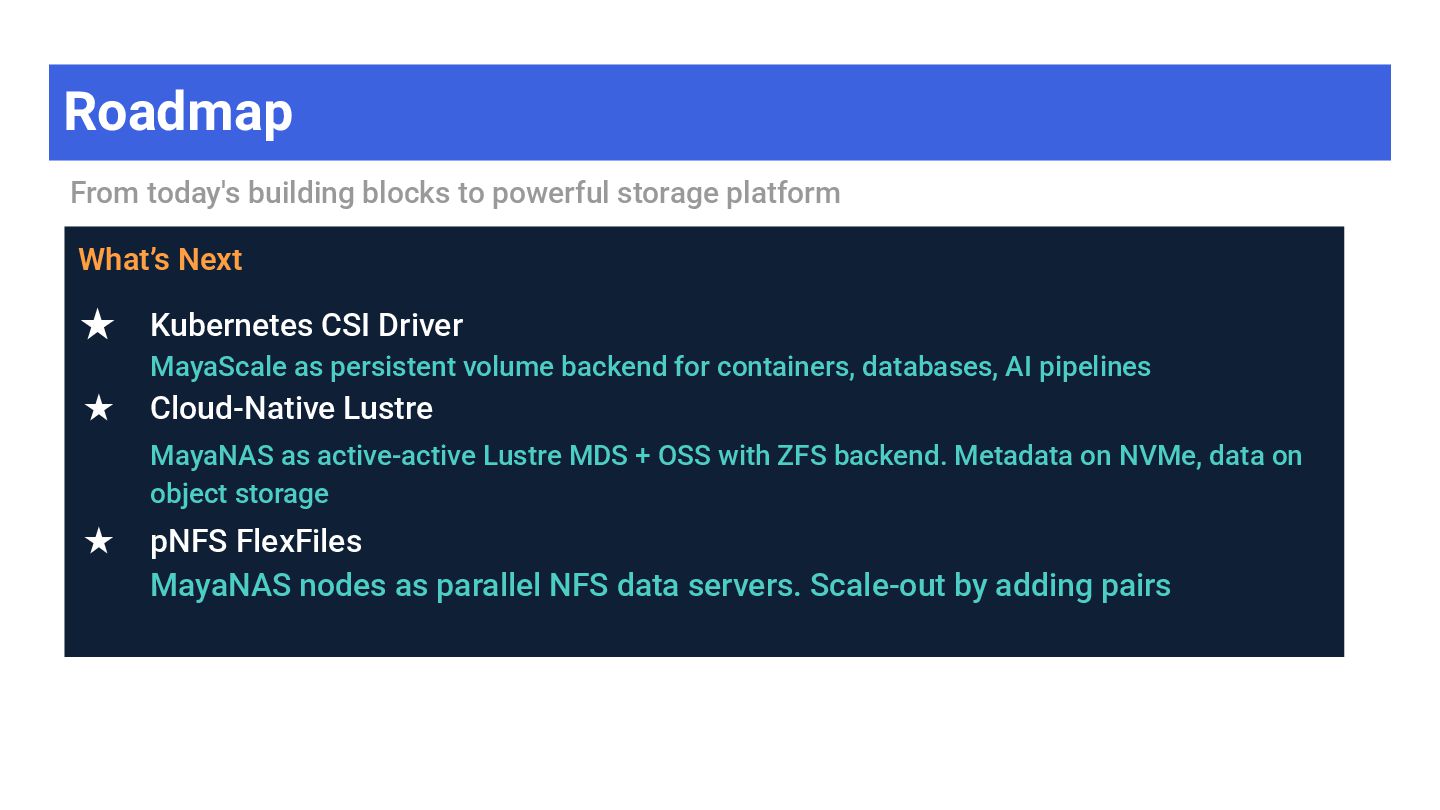
  17. Roadmap From today's building blocks to powerful storage platform What’s

    Next ★ Kubernetes CSI Driver MayaScale as persistent volume backend for containers, databases, AI pipelines ★ Cloud-Native Lustre MayaNAS as active-active Lustre MDS + OSS with ZFS backend. Metadata on NVMe, data on object storage ★ pNFS FlexFiles MayaNAS nodes as parallel NFS data servers. Scale-out by adding pairs