2010 • CSA & CoFounder @Codefuel • Aprendiendo SWIFT desde Junio 2014 Caracas Swift Meetup Who are we? • Systems Engineer • iOS Developer since 2010 • CSA & CoFounder @Codefuel • Learning SWIFT since Jun 2014 #ccsSwiftMeetup
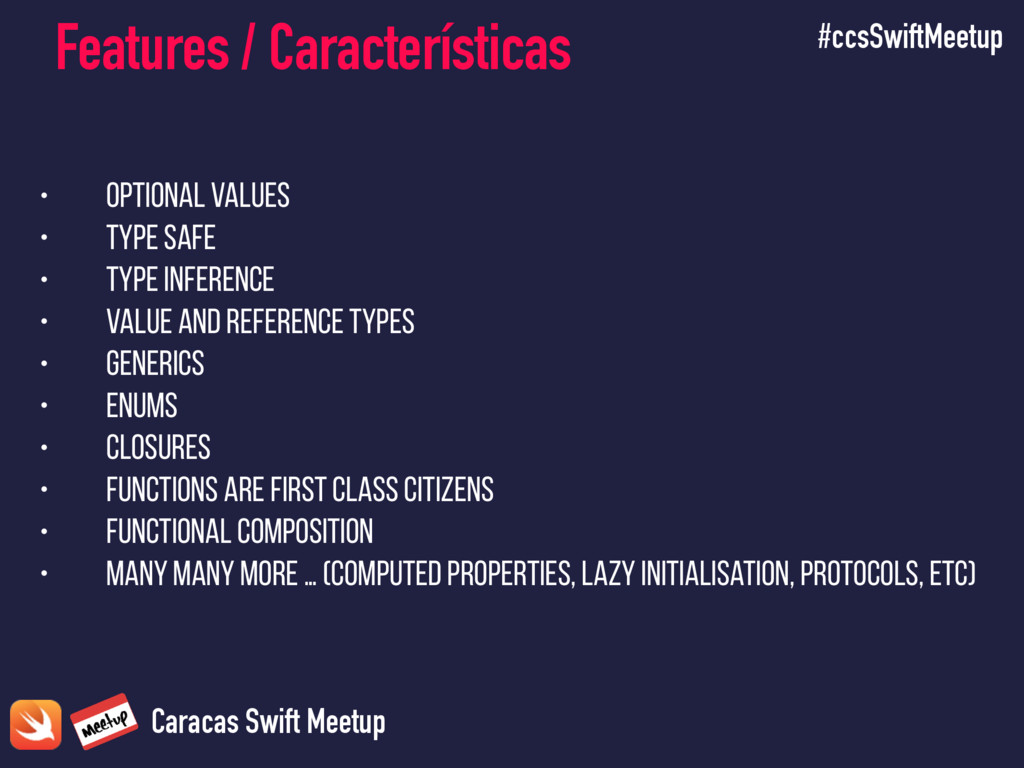
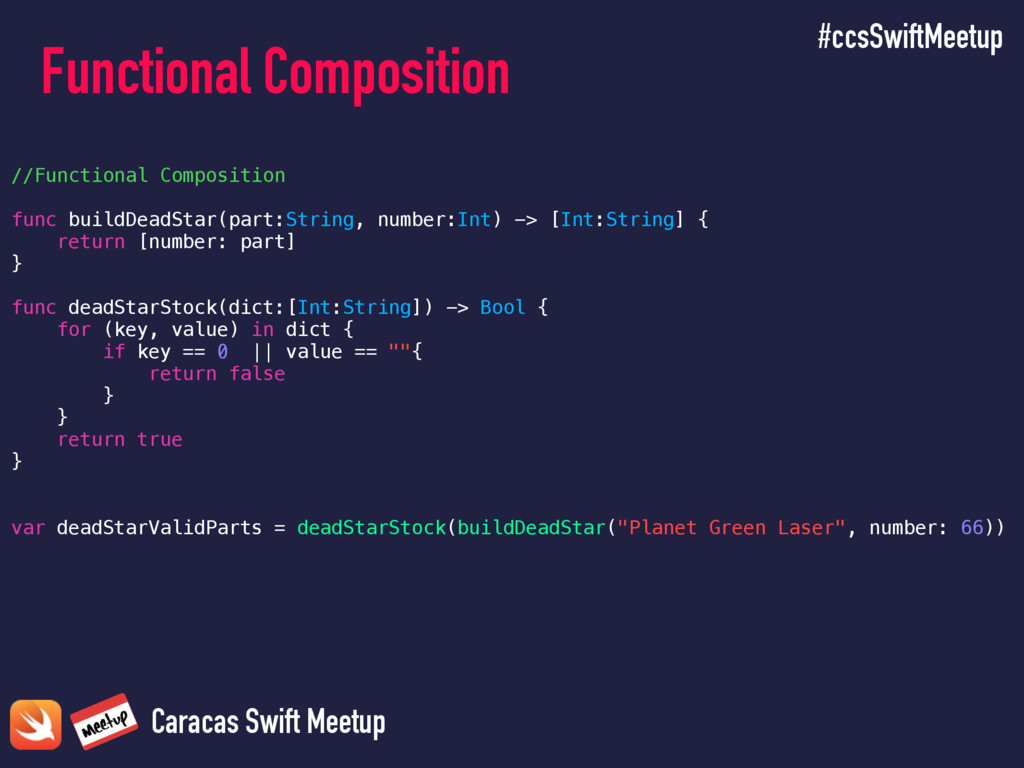
Type inference • Value and reference Types • Generics • Enums • Closures • Functions are First Class citizens • Functional Composition • Many Many More … (computed properties, lazy initialisation, protocols, etc) Caracas Swift Meetup #ccsSwiftMeetup
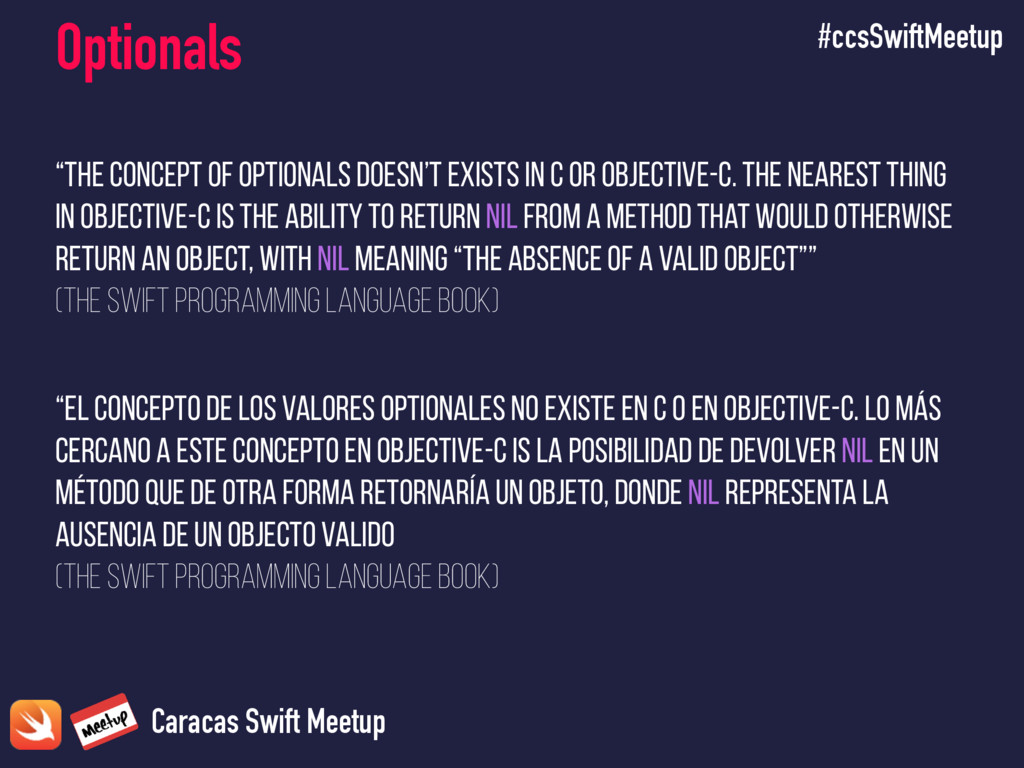
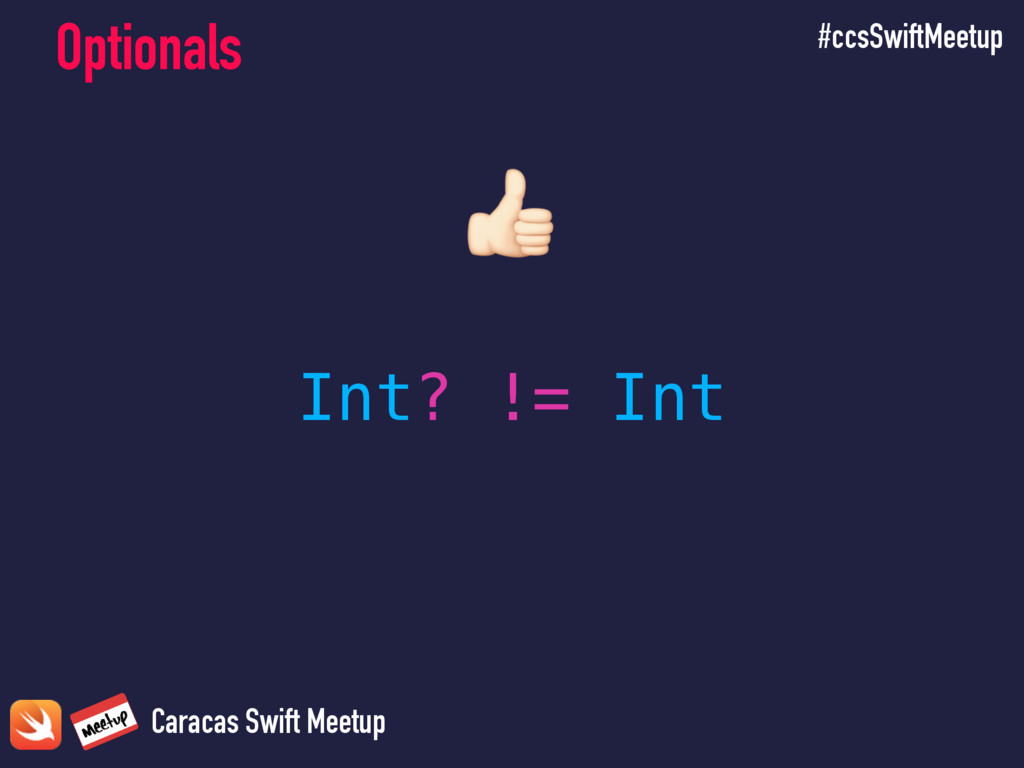
Objective-C. The nearest Thing in Objective-C is the ability to return nil from a method that would otherwise return an object, with nil meaning “the absence of a valid object”” (The Swift Programming Language BOOK) Caracas Swift Meetup “El concepto de los valores optionales No existe en C o en Objective-C. Lo más cercano a este concepto en objective-c is la posibilidad de devolver nil en un método que de otra forma retornaría un objeto, donde nil representa la ausencia de un objecto valido (The Swift Programming Language BOOK) #ccsSwiftMeetup
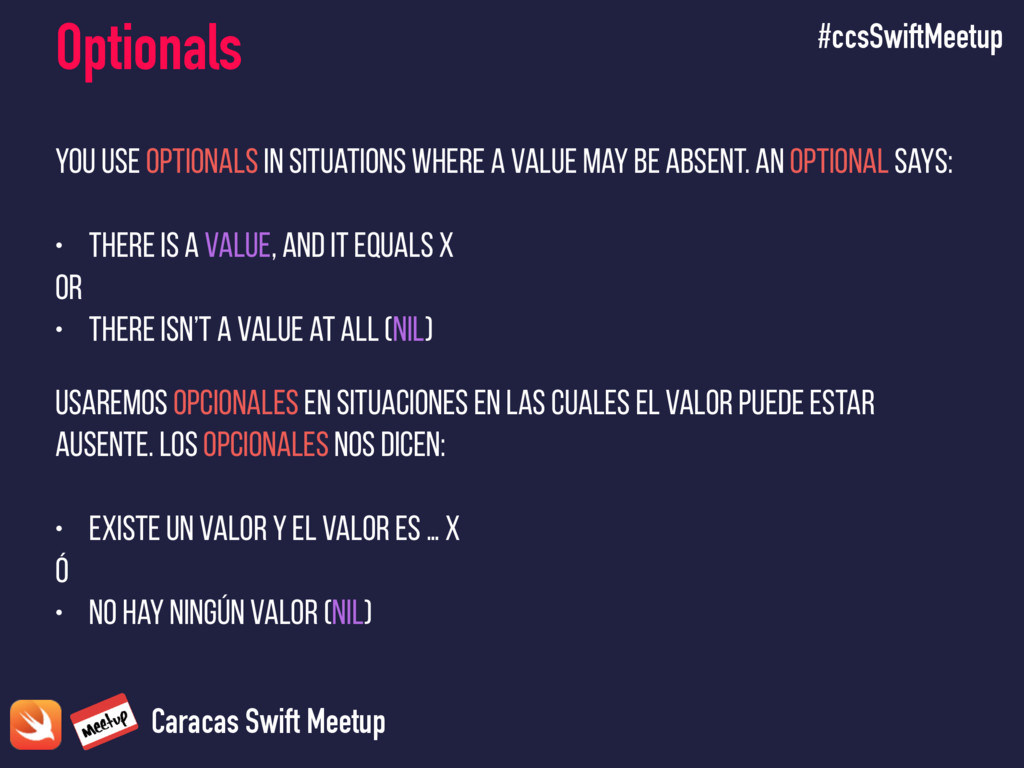
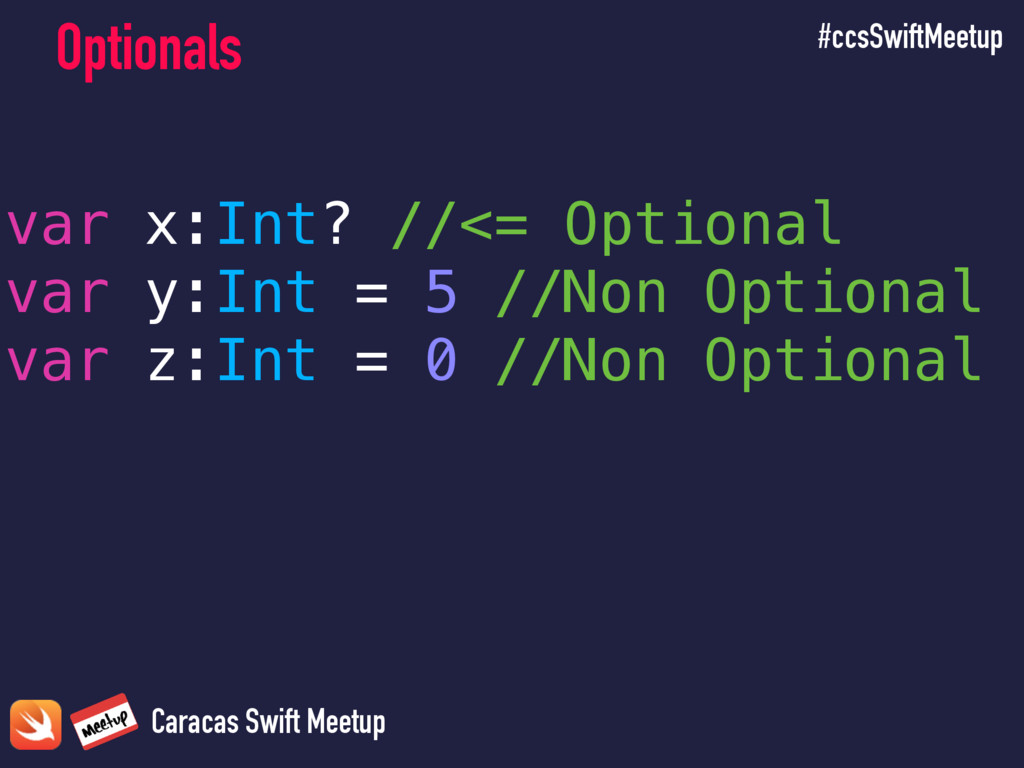
be absent. An optional says: • There is a value, and it equals x Or • There isn’t a value at all (nil) Caracas Swift Meetup usaremos opcionales en situaciones en las cuales el valor puede estar ausente. los opcionales nos dicen: • Existe un valor y el valor es … X ó • No hay ningún valor (nil) #ccsSwiftMeetup
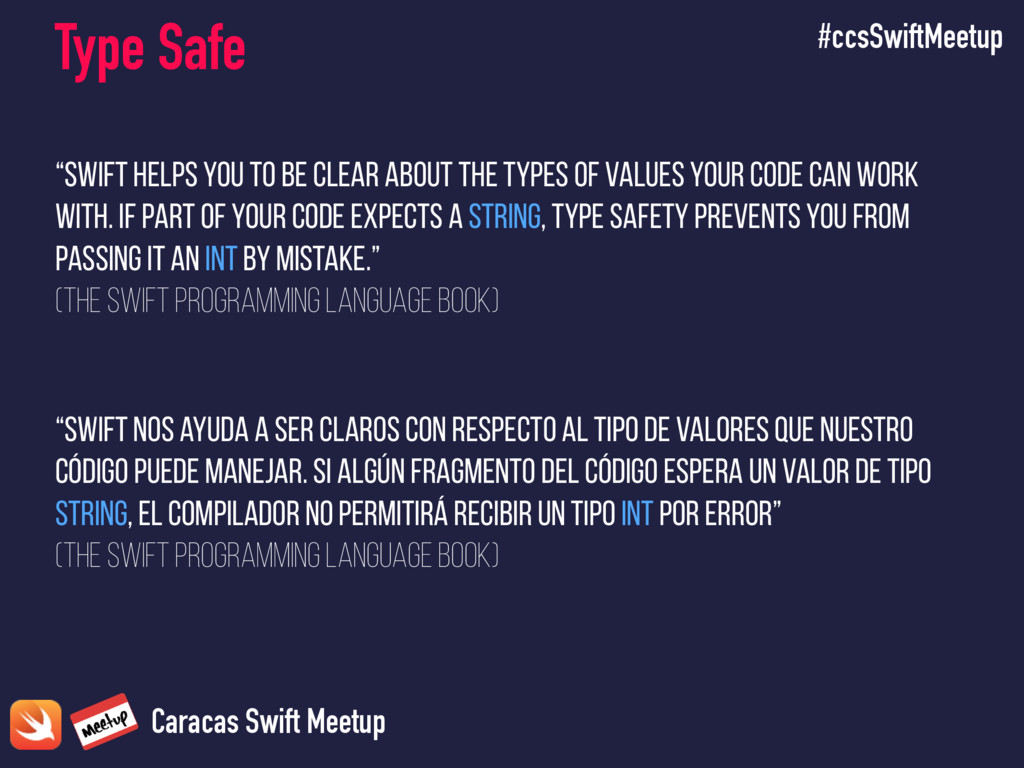
types of values your code can work with. If part of your code expects a String, type safety prevents you from passing it an Int by mistake.” (The Swift Programming Language BOOK) Caracas Swift Meetup “Swift nos ayuda a ser claros con respecto al tipo de valores que nuestro código puede manejar. si algún fragmento del código espera un valor de tipo String, el compilador no permitirá recibir un tipo INT por error” (The Swift Programming Language BOOK) #ccsSwiftMeetup
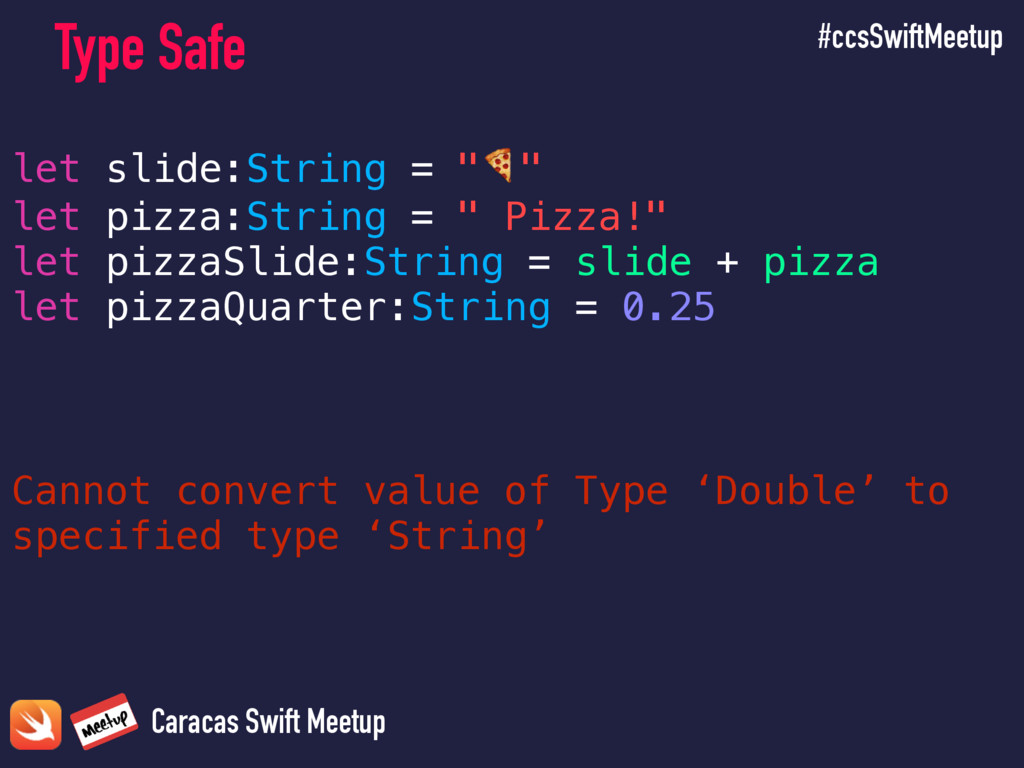
Pizza!" let pizzaSlide:String = slide + pizza let pizzaQuarter:String = 0.25 Caracas Swift Meetup Cannot convert value of Type ‘Double’ to specified type ‘String’ #ccsSwiftMeetup
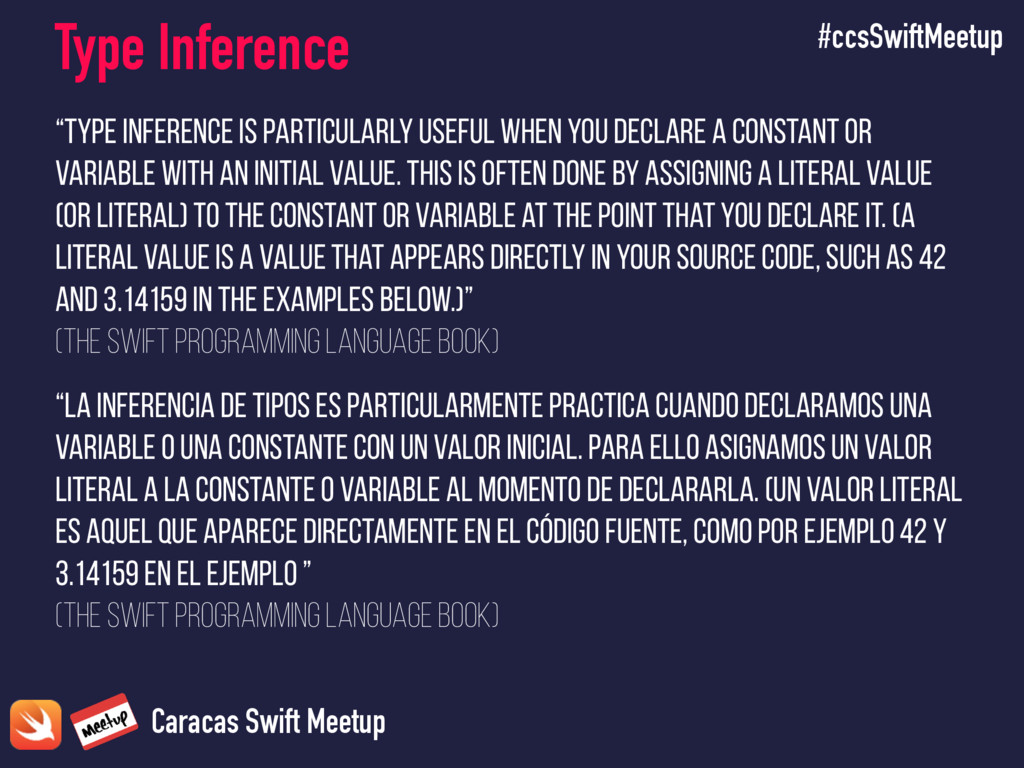
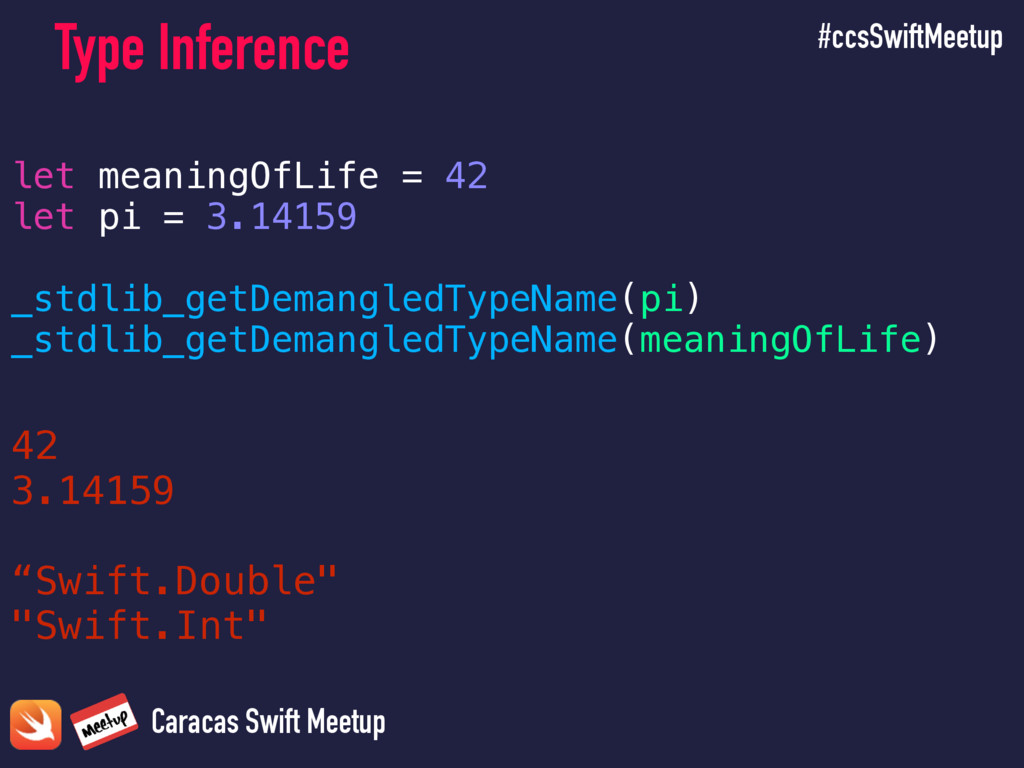
a constant or variable with an initial value. This is often done by assigning a literal value (or literal) to the constant or variable at the point that you declare it. (A literal value is a value that appears directly in your source code, such as 42 and 3.14159 in the examples below.)” (The Swift Programming Language BOOK) Caracas Swift Meetup “La inferencia de tipos es particularmente practica cuando declaramos una variable o una constante con un valor inicial. Para ello asignamos un valor literal a la constante o variable al momento de declararla. (un valor literal es aquel que aparece directamente en el código fuente, como por ejemplo 42 y 3.14159 en el ejemplo ” (The Swift Programming Language BOOK) #ccsSwiftMeetup
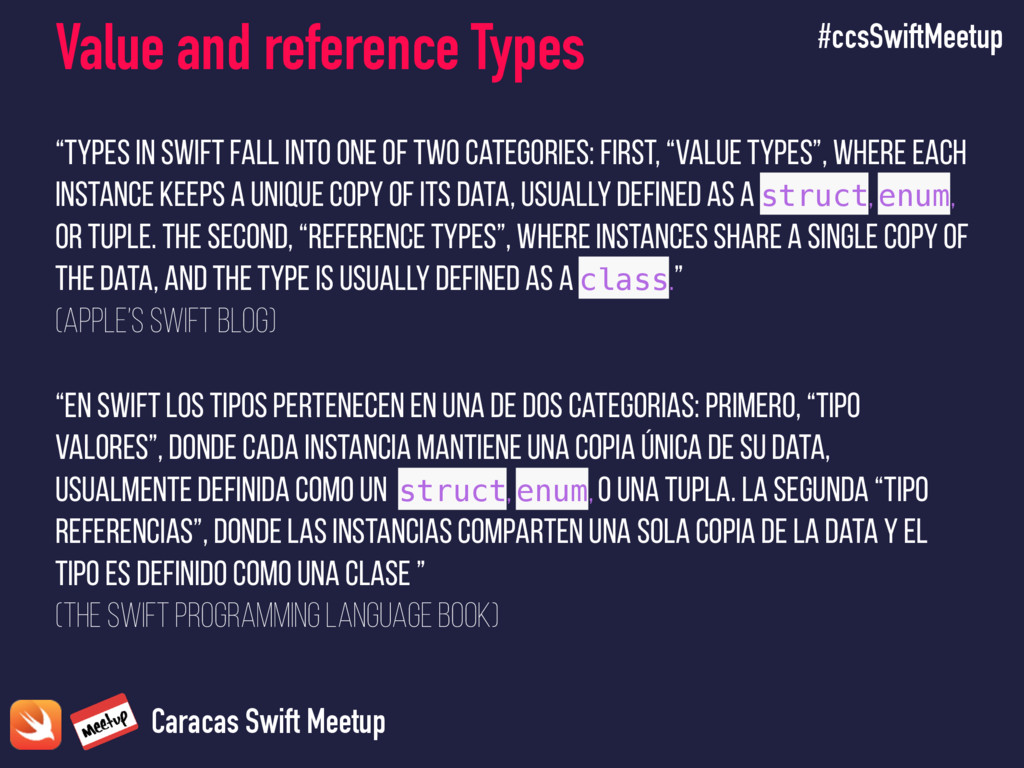
of two categories: first, “value types”, where each instance keeps a unique copy of its data, usually defined as a struct, enum, or tuple. The second, “reference types”, where instances share a single copy of the data, and the type is usually defined as a class.” (Apple’s swift blog) Caracas Swift Meetup “En SWIFT los tipos pertenecen en una de dos categorias: primero, “tipo Valores”, donde cada instancia mantiene una copia única de su data, usualmente definida como un struct, enum, o una tuplA. La segunda “Tipo referencias”, donde las instancias comparten una sola copia de la data y el tipo es definido como una clase ” (The Swift Programming Language BOOK) #ccsSwiftMeetup
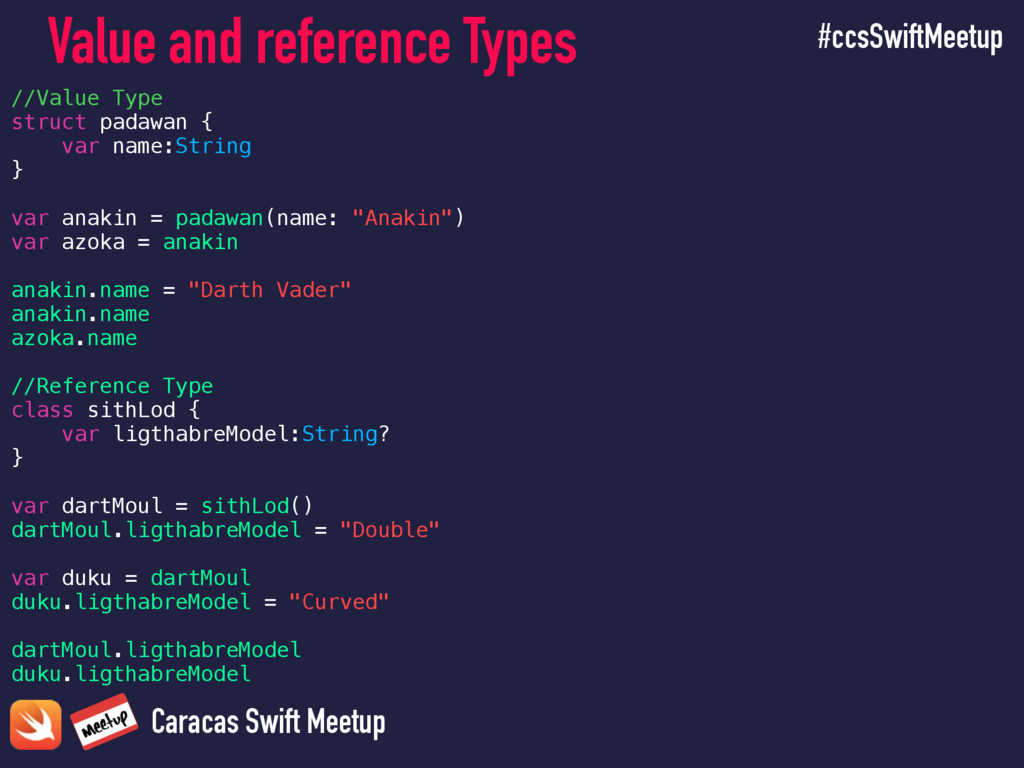
= padawan(name: "Anakin") var azoka = anakin anakin.name = "Darth Vader" anakin.name azoka.name //Reference Type class sithLod { var ligthabreModel:String? } var dartMoul = sithLod() dartMoul.ligthabreModel = "Double" var duku = dartMoul duku.ligthabreModel = "Curved" dartMoul.ligthabreModel duku.ligthabreModel Caracas Swift Meetup Value and reference Types #ccsSwiftMeetup
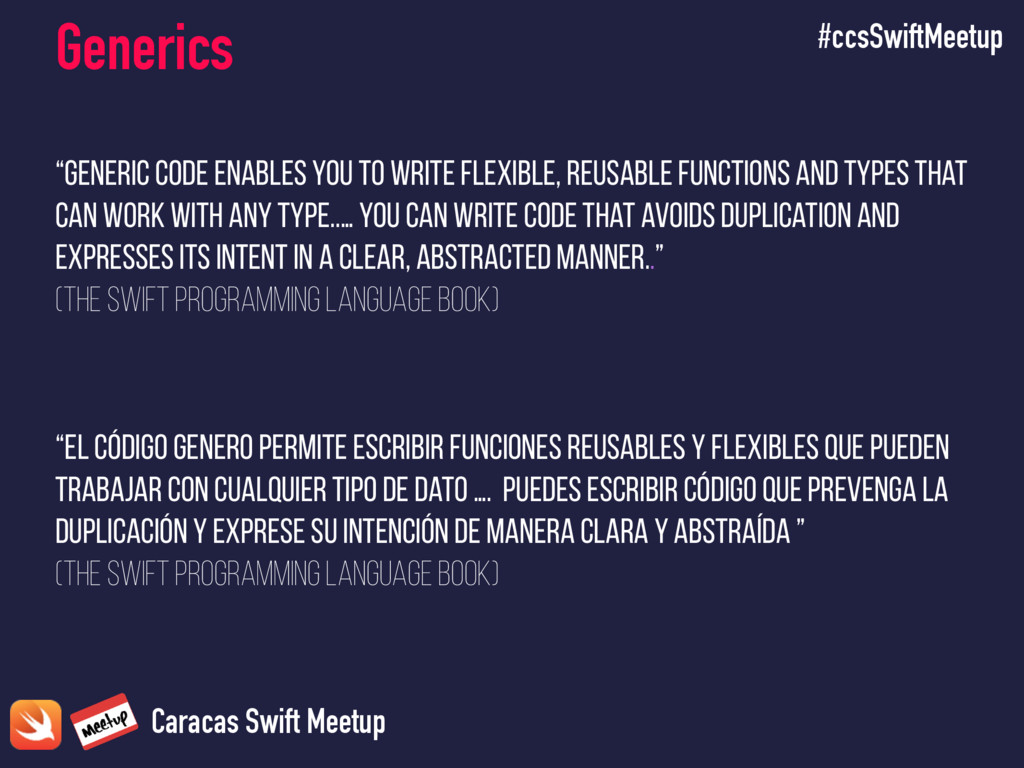
and types that can work with any type..… You can write code that avoids duplication and expresses its intent in a clear, abstracted manner..” (The Swift Programming Language BOOK) Caracas Swift Meetup “el código genero permite escribir funciones reusables y flexibles que pueden trabajar con cualquier tipo de dato …. puedes escribir código que prevenga la duplicación y exprese su intención de manera clara y abstraída ” (The Swift Programming Language BOOK) #ccsSwiftMeetup
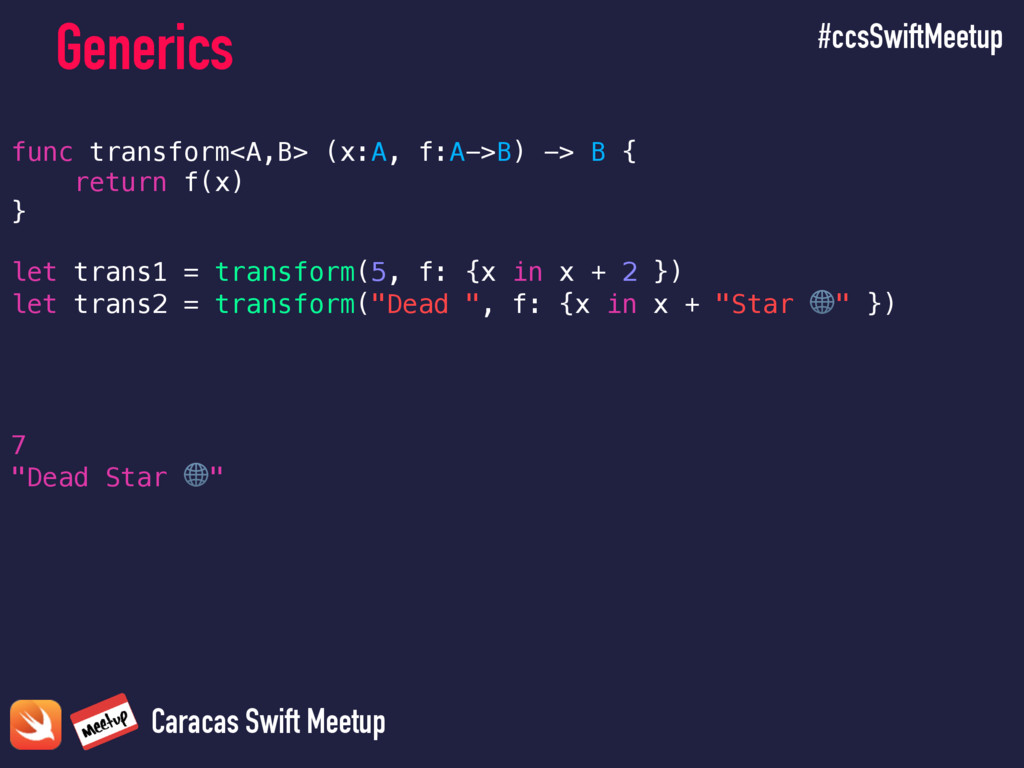
let trans1 = transform(5, f: {x in x + 2 }) let trans2 = transform("Dead ", f: {x in x + "Star " }) Caracas Swift Meetup Generics 7 "Dead Star " #ccsSwiftMeetup
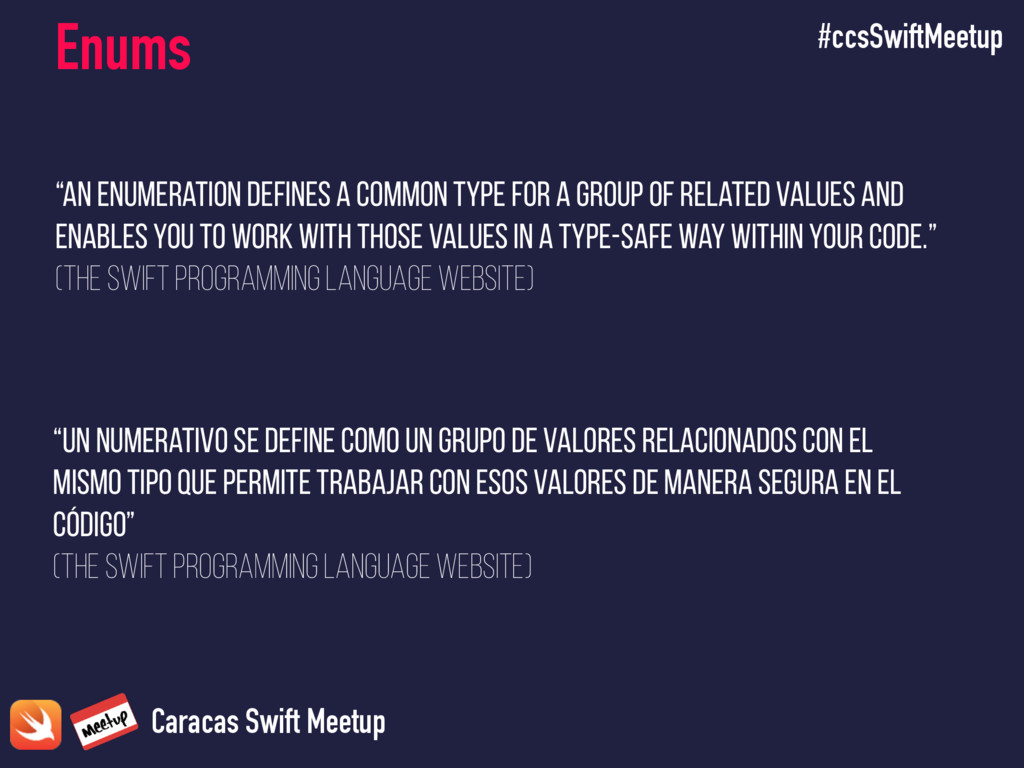
of related values and enables you to work with those values in a type-safe way within your code.” (The Swift Programming Language website) Caracas Swift Meetup “Un numerativo se define como un grupo de valores relacionados con el mismo tipo que permite trabajar con esos valores de manera segura en el código” (The Swift Programming Language website) #ccsSwiftMeetup
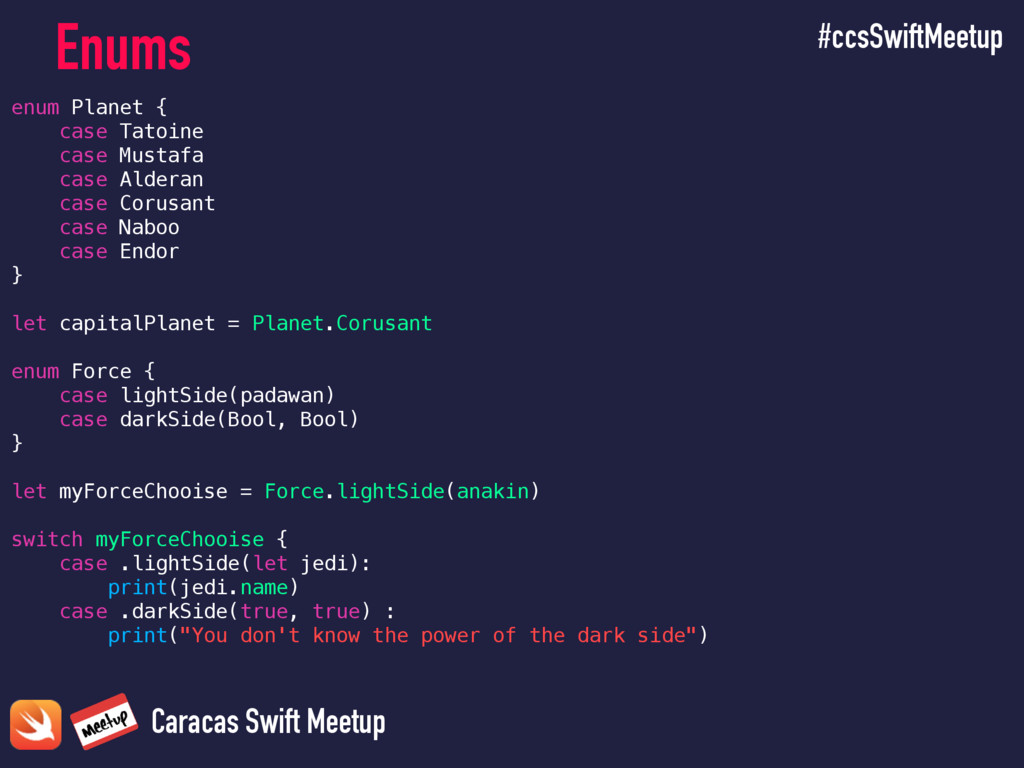
Corusant case Naboo case Endor } let capitalPlanet = Planet.Corusant enum Force { case lightSide(padawan) case darkSide(Bool, Bool) } let myForceChooise = Force.lightSide(anakin) switch myForceChooise { case .lightSide(let jedi): print(jedi.name) case .darkSide(true, true) : print("You don't know the power of the dark side") Caracas Swift Meetup Enums #ccsSwiftMeetup
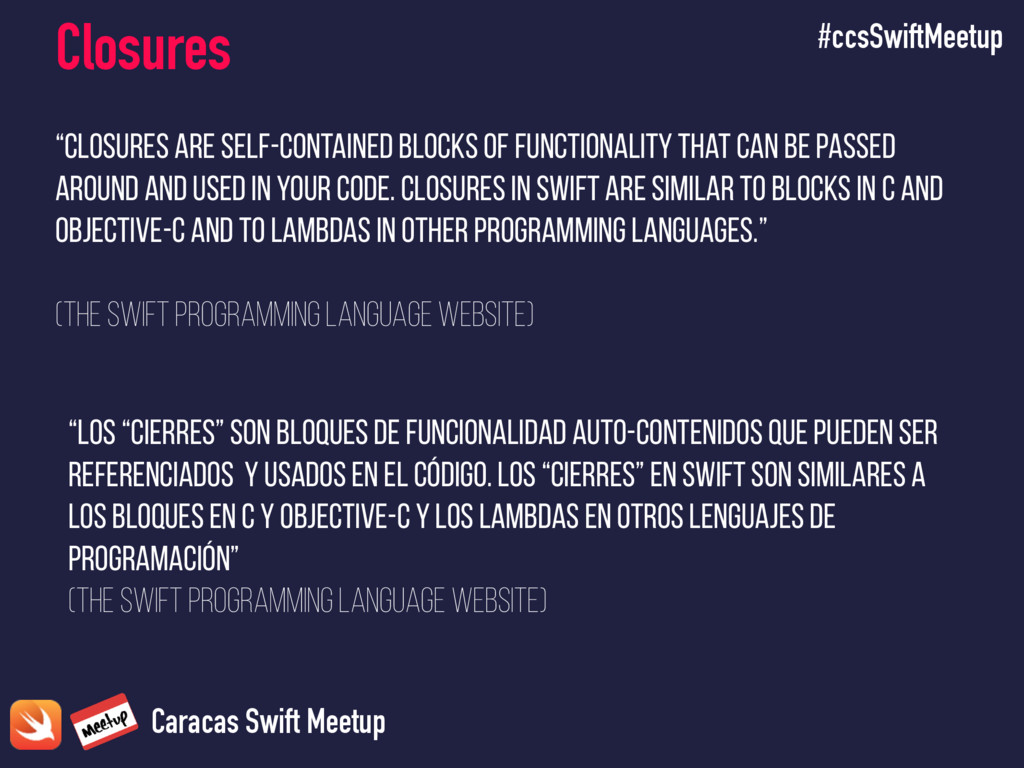
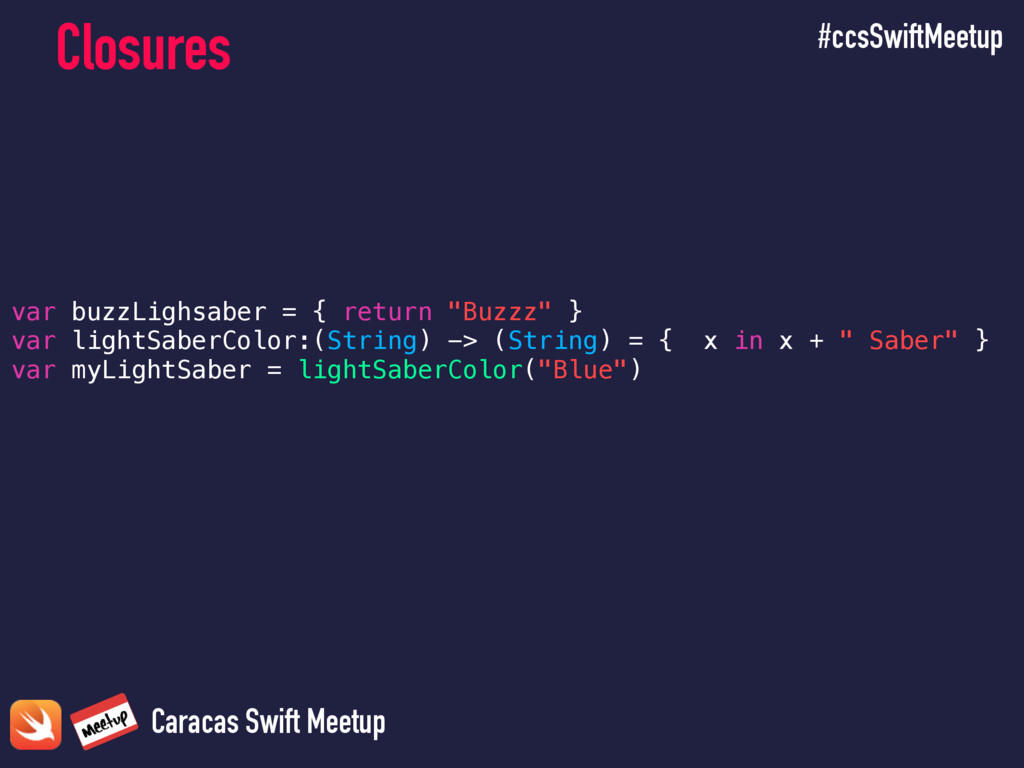
passed around and used in your code. Closures in Swift are similar to blocks in C and Objective-C and to lambdas in other programming languages.” (The Swift Programming Language website) Caracas Swift Meetup “Los “CIERRES” son bloques de funcionalidad auto-contenidos que pueden ser referenciados y usados en el código. los “cierres” en swift son similares a los bloques en c y objective-c y los lambdas en otros lenguajes de programación” (The Swift Programming Language website) #ccsSwiftMeetup
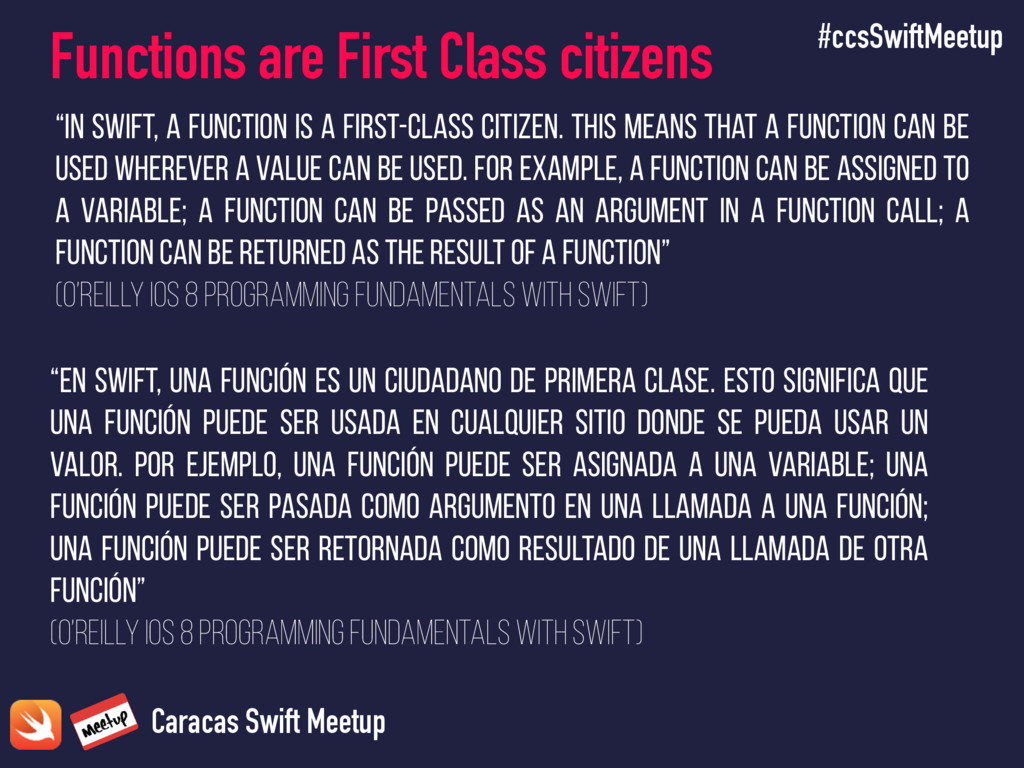
a first-class citizen. This means that a function can be used wherever a value can be used. for example, a function can be assigned to a variable; a function can be passed as an argument in a function call; a function can be returned as the result of a function” (o’reilly ios 8 Programming fundamentals with swift) Caracas Swift Meetup “en swift, una función es un ciudadano de primera clase. esto significa que una función puede ser usada en cualquier sitio donde se pueda usar un valor. por ejemplo, una función puede ser asignada a una variable; una función puede ser pasada como argumento en una llamada a una función; una función puede ser retornada como resultado de una llamada de otra función” (o’reilly ios 8 Programming fundamentals with swift) #ccsSwiftMeetup
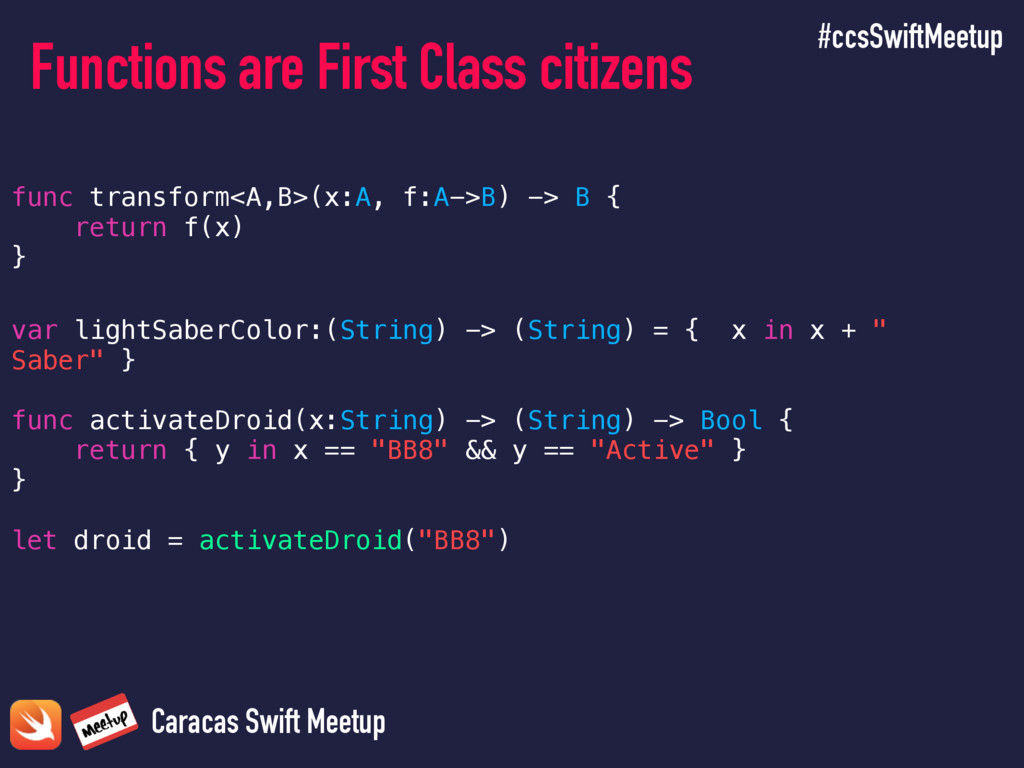
lightSaberColor:(String) -> (String) = { x in x + " Saber" } func activateDroid(x:String) -> (String) -> Bool { return { y in x == "BB8" && y == "Active" } } let droid = activateDroid("BB8") Caracas Swift Meetup Functions are First Class citizens #ccsSwiftMeetup


 optim
 falcon8823
 yuta_onishi_97
 minodriven
 kishida
 gonta
 drumath2237
 uyuki234
 koic
 kenjiyoneyama
 siroemk
 bluesmoon
 csswizardry
 deanohume
 inesmontani
 brettharned
 pauljervisheath
 sabderemane
 ryanjones
 axbom
 skipperchong
 rakko
 jnunemaker