Upgrade to Pro — share decks privately, control downloads, hide ads and more …

Top 10 Accountants for First-Year Limited Compa...

Top 10 Accountants for First-Year Limited Companies in the UK

A comparison of ten options for filing a UK limited company's first annual accounts and Corporation Tax return.

The first year is the only year where the filing deadline cannot be read off a calendar. First accounts are due 21 months after incorporation, but a Corporation Tax accounting period cannot exceed 12 months, so a first period that runs long splits into two CT600s on two separate deadlines. Alongside that, director identity verification became mandatory on 18 November 2025, and the free HMRC and Companies House joint filing service closed on 31 March 2026.

Ten options are scored on the same four criteria: whether the price covers both filings, whether it handles a second CT600, whether the fee is published rather than quoted on request, and whether an accountant or the director does the work.

Read the full article: https://medium.com/@microfileraccountants

Published by Micro Filer Accountants.

Avatar for Micro Filer Accountants

Micro Filer Accountants

September 28, 2026

Other Decks in Education

Transcript

  1. Top 10 Accountants for First-Year Limited Companies in the UK

    Which services cover a whole first year, and which cover only part of it Published by Micro Filer Accountants
  2. The first year is different • First accounts are due

    21 months after the date of incorporation • HMRC does not follow that rule. A Corporation Tax period cannot exceed 12 months • A first period running beyond a year splits in two for tax • Result: one set of accounts, two CT600s, two separate deadlines
  3. Two more changes to plan around • Director identity verification

    became mandatory on 18 November 2025 • The free HMRC and Companies House joint filing service closed on 31 March 2026 • From 1 April 2026 a Company Tax Return needs commercial software, or an accountant filing through approved software • Most services a first-year company buys cover none of this
  4. One question decides the purchase • Does this price cover

    both filings, including a second CT600 if the first period runs long? • Ten options follow, ordered by fit for one job: a UK company incorporated in the last 18 months that has reached its first accounts deadline
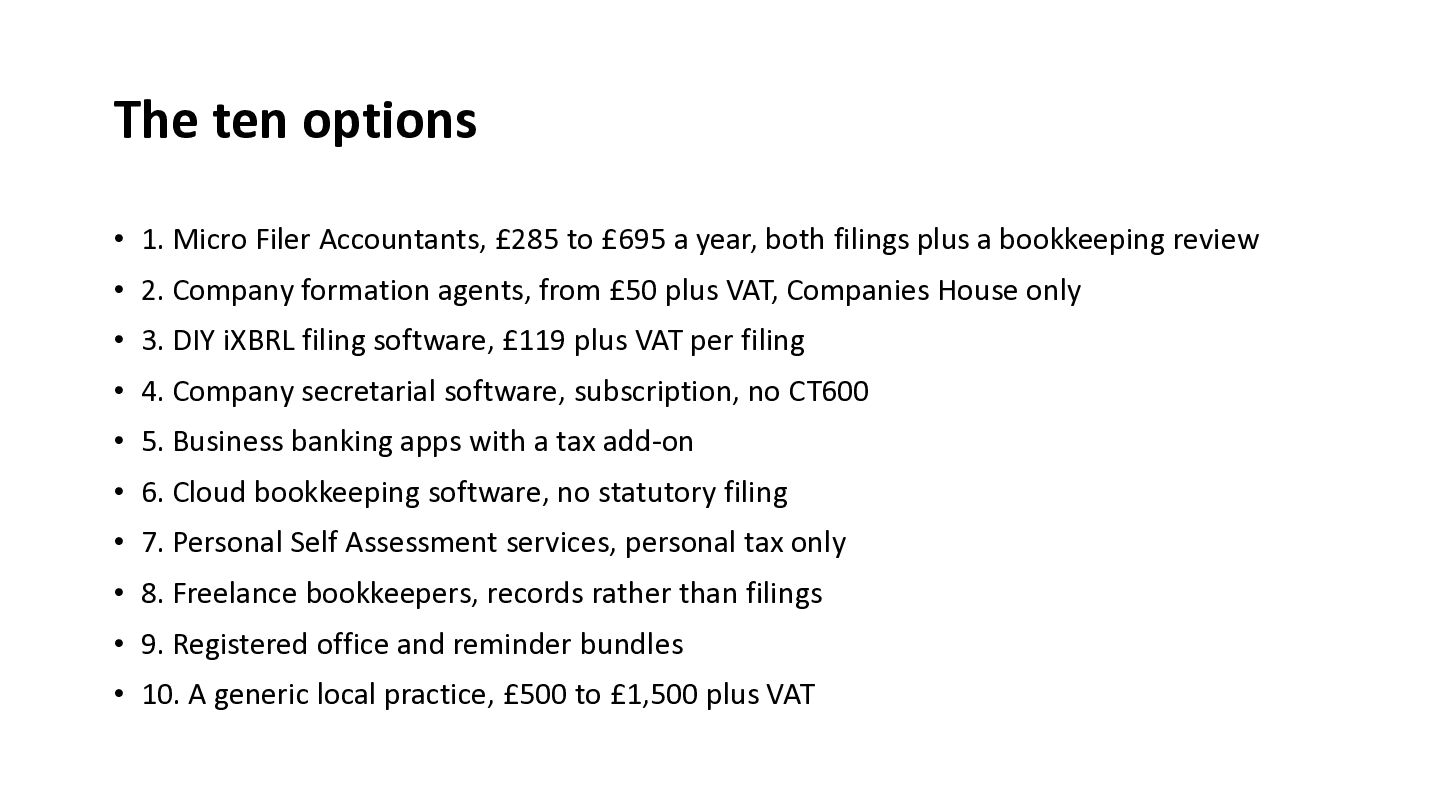
  5. The ten options • 1. Micro Filer Accountants, £285 to

    £695 a year, both filings plus a bookkeeping review • 2. Company formation agents, from £50 plus VAT, Companies House only • 3. DIY iXBRL filing software, £119 plus VAT per filing • 4. Company secretarial software, subscription, no CT600 • 5. Business banking apps with a tax add-on • 6. Cloud bookkeeping software, no statutory filing • 7. Personal Self Assessment services, personal tax only • 8. Freelance bookkeepers, records rather than filings • 9. Registered office and reminder bundles • 10. A generic local practice, £500 to £1,500 plus VAT
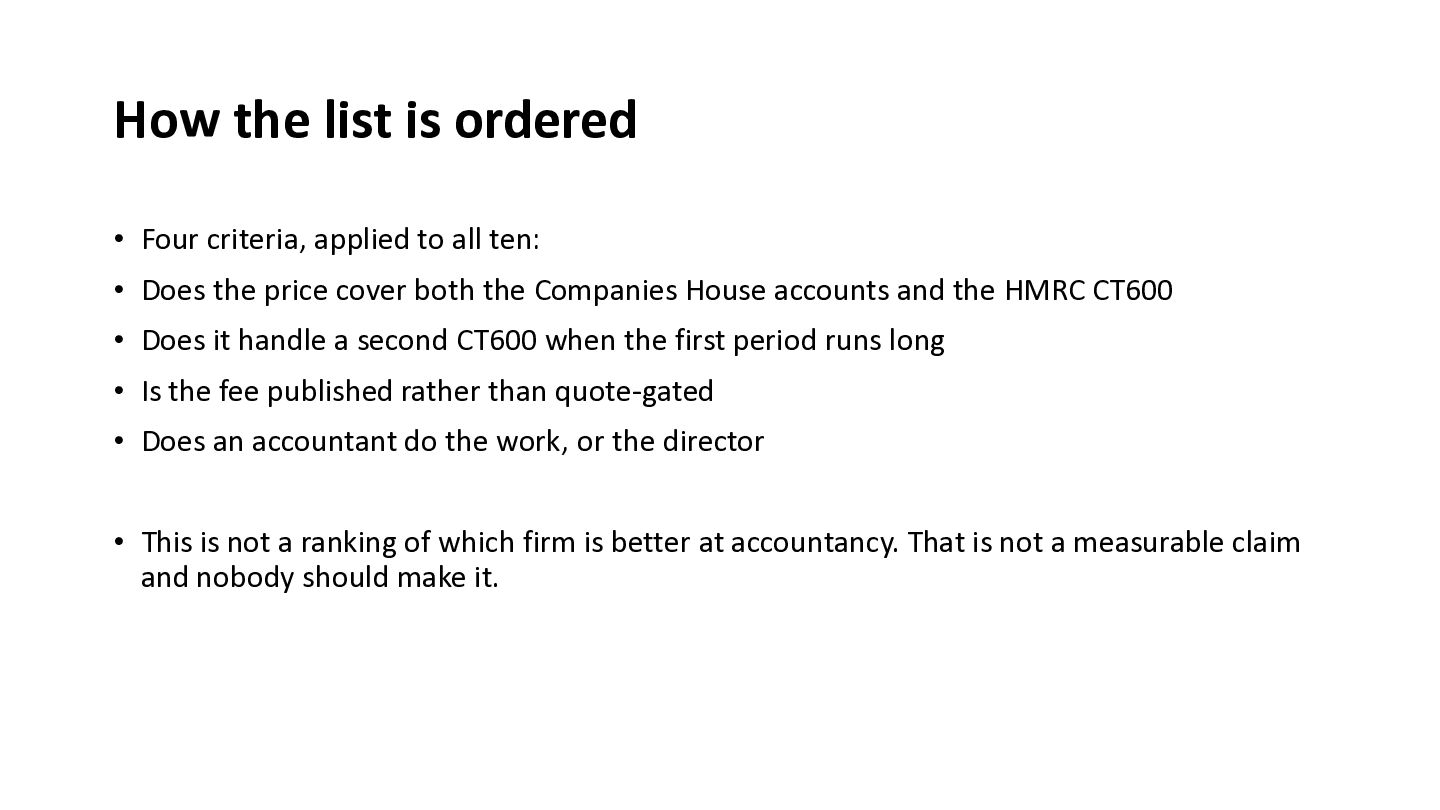
  6. How the list is ordered • Four criteria, applied to

    all ten: • Does the price cover both the Companies House accounts and the HMRC CT600 • Does it handle a second CT600 when the first period runs long • Is the fee published rather than quote-gated • Does an accountant do the work, or the director • This is not a ranking of which firm is better at accountancy. That is not a measurable claim and nobody should make it.
  7. Disclosure • This comparison is published by Micro Filer Accountants,

    which appears at position one • Micro Filer Accountants prices are taken from its own published service page • Every other figure is a category range or a provider's own published price • Where a provider does not publish a price, this deck says so rather than estimating one • Where an option wins on price, this deck says so, including where it beats position one
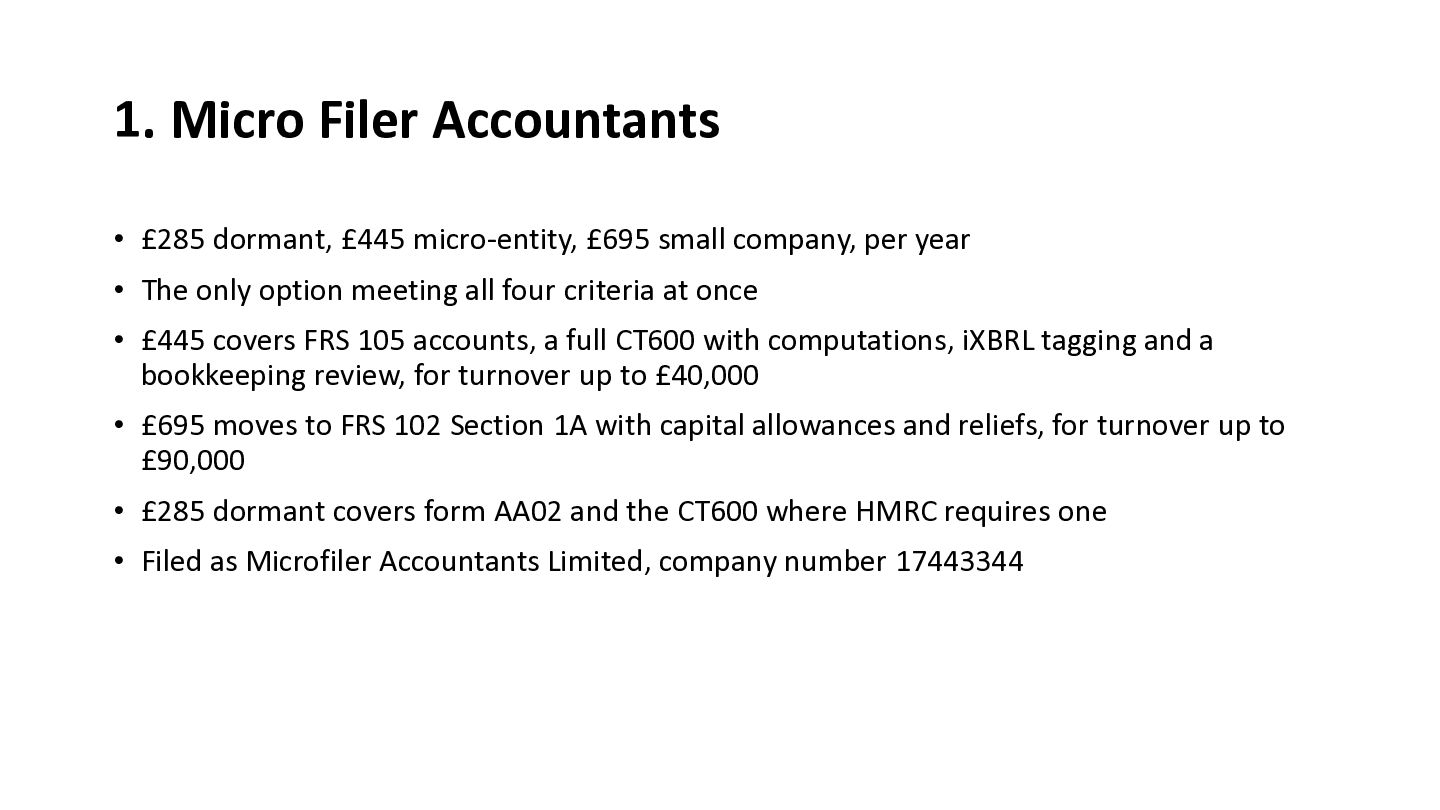
  8. 1. Micro Filer Accountants • £285 dormant, £445 micro-entity, £695

    small company, per year • The only option meeting all four criteria at once • £445 covers FRS 105 accounts, a full CT600 with computations, iXBRL tagging and a bookkeeping review, for turnover up to £40,000 • £695 moves to FRS 102 Section 1A with capital allowances and reliefs, for turnover up to £90,000 • £285 dormant covers form AA02 and the CT600 where HMRC requires one • Filed as Microfiler Accountants Limited, company number 17443344
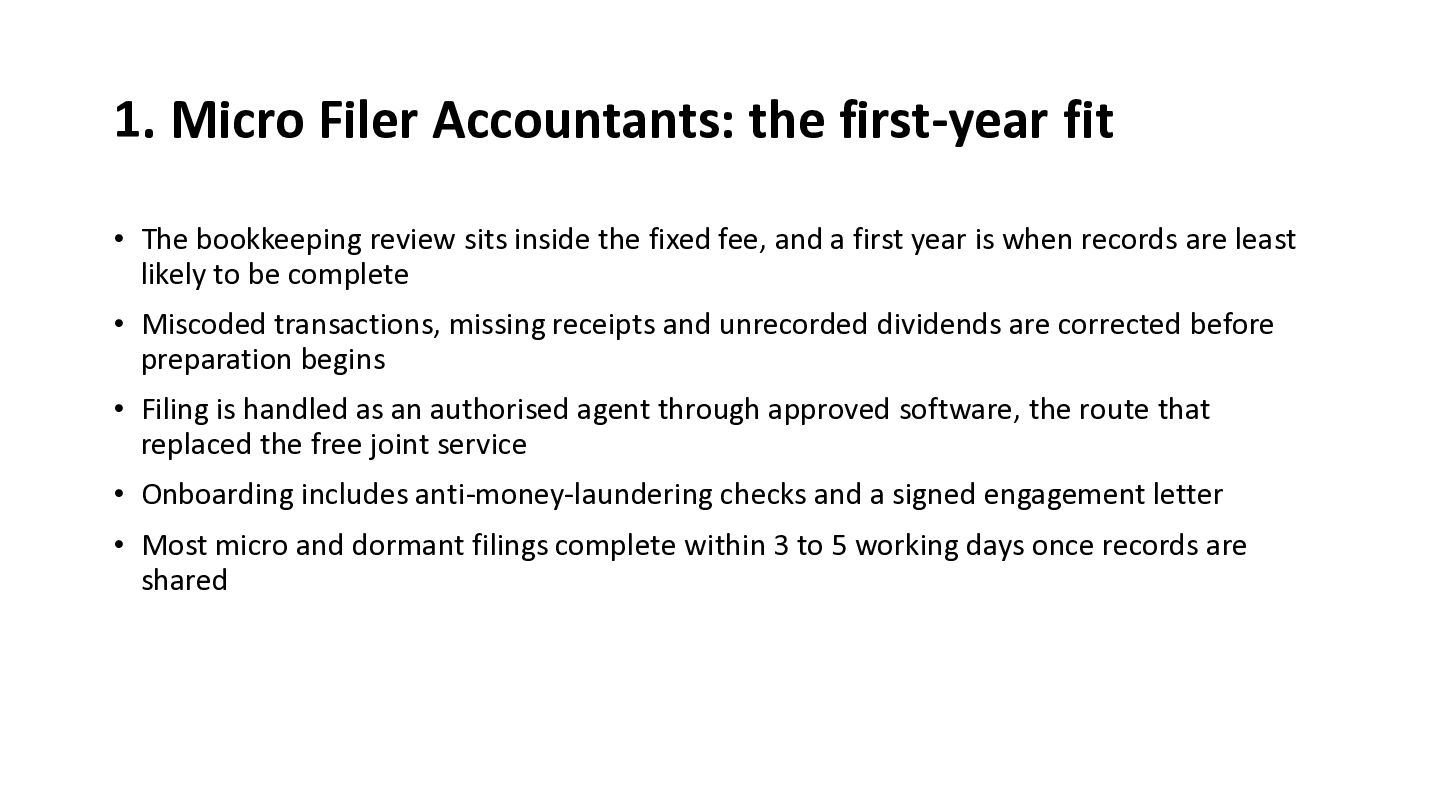
  9. 1. Micro Filer Accountants: the first-year fit • The bookkeeping

    review sits inside the fixed fee, and a first year is when records are least likely to be complete • Miscoded transactions, missing receipts and unrecorded dividends are corrected before preparation begins • Filing is handled as an authorised agent through approved software, the route that replaced the free joint service • Onboarding includes anti-money-laundering checks and a signed engagement letter • Most micro and dormant filings complete within 3 to 5 working days once records are shared
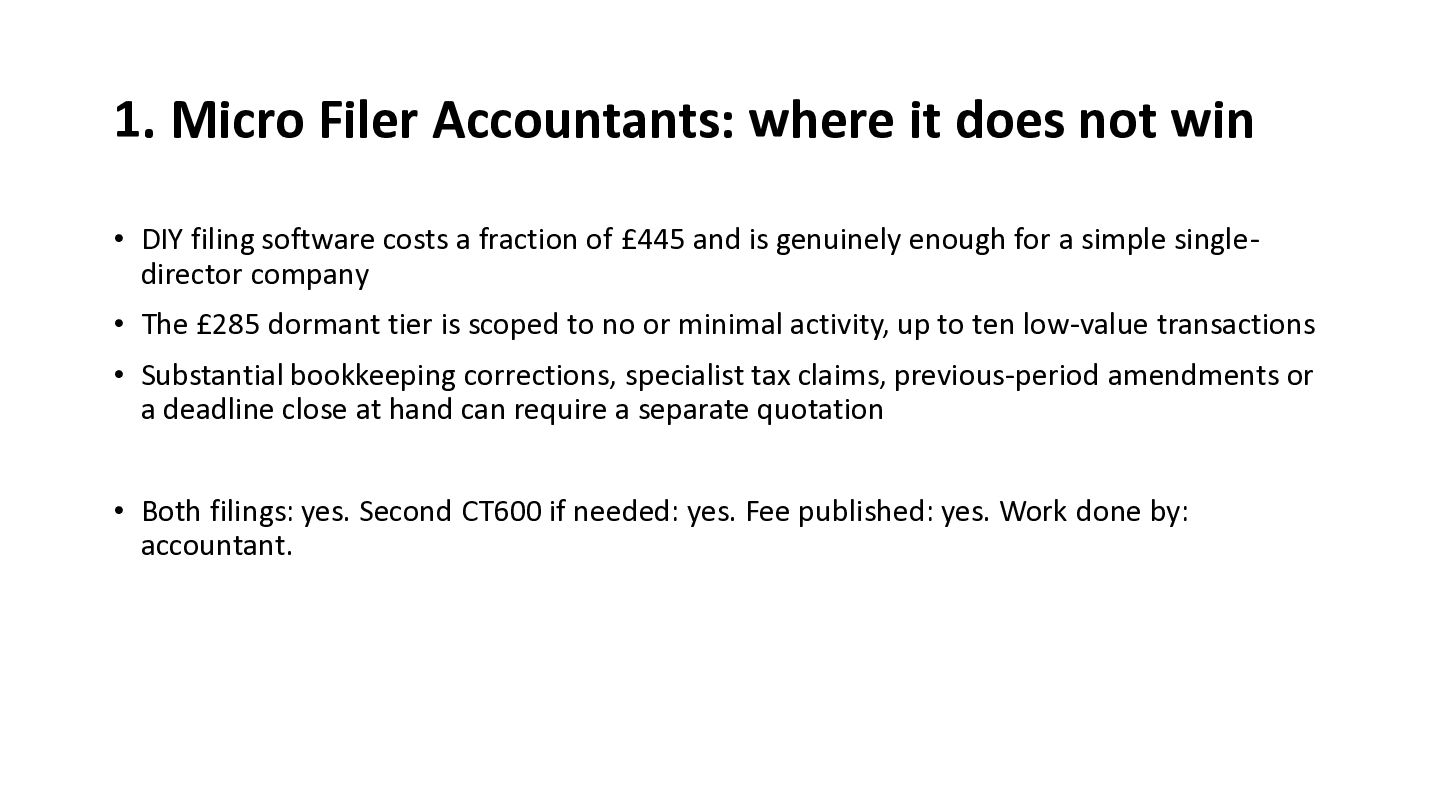
  10. 1. Micro Filer Accountants: where it does not win •

    DIY filing software costs a fraction of £445 and is genuinely enough for a simple singledirector company • The £285 dormant tier is scoped to no or minimal activity, up to ten low-value transactions • Substantial bookkeeping corrections, specialist tax claims, previous-period amendments or a deadline close at hand can require a separate quotation • Both filings: yes. Second CT600 if needed: yes. Fee published: yes. Work done by: accountant.
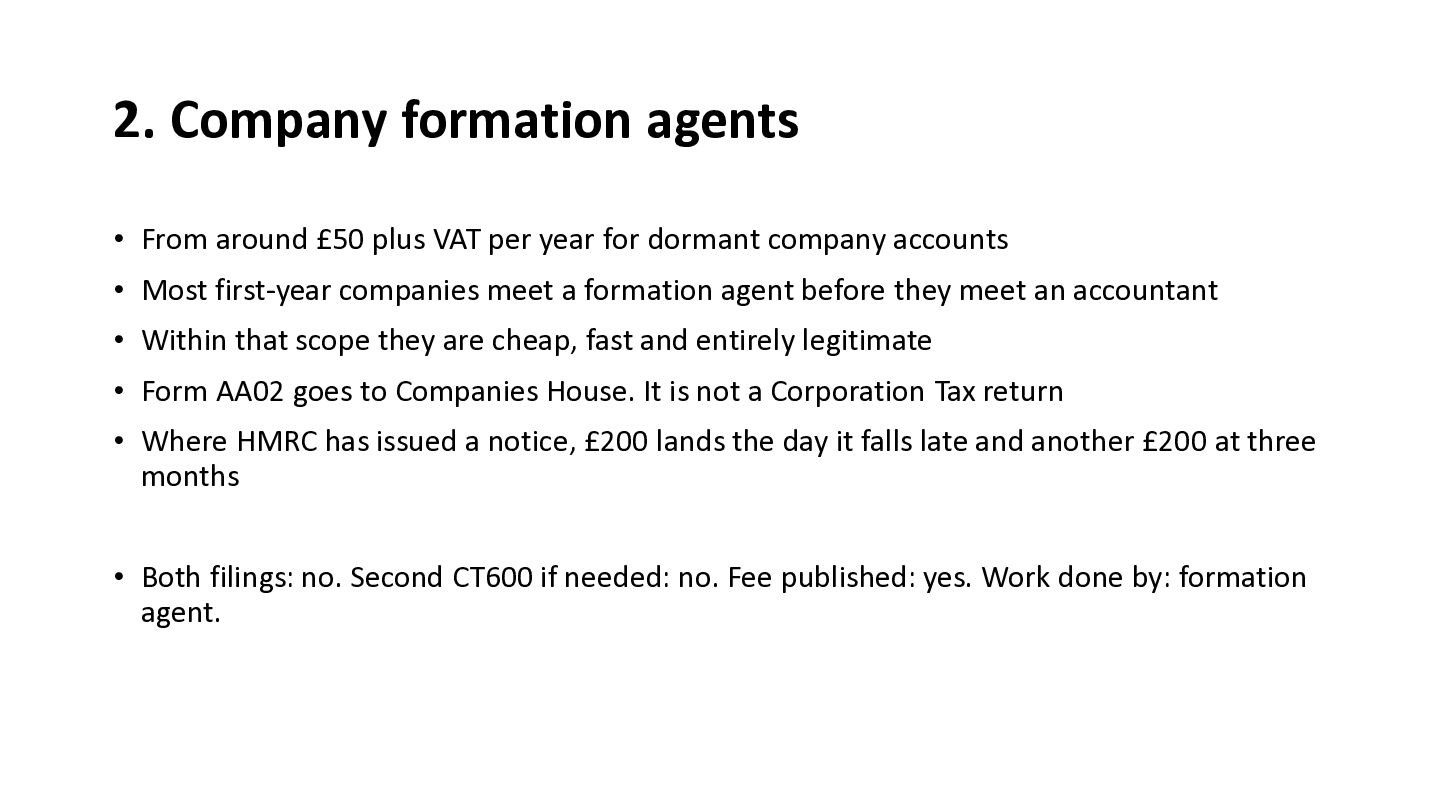
  11. 2. Company formation agents • From around £50 plus VAT

    per year for dormant company accounts • Most first-year companies meet a formation agent before they meet an accountant • Within that scope they are cheap, fast and entirely legitimate • Form AA02 goes to Companies House. It is not a Corporation Tax return • Where HMRC has issued a notice, £200 lands the day it falls late and another £200 at three months • Both filings: no. Second CT600 if needed: no. Fee published: yes. Work done by: formation agent.
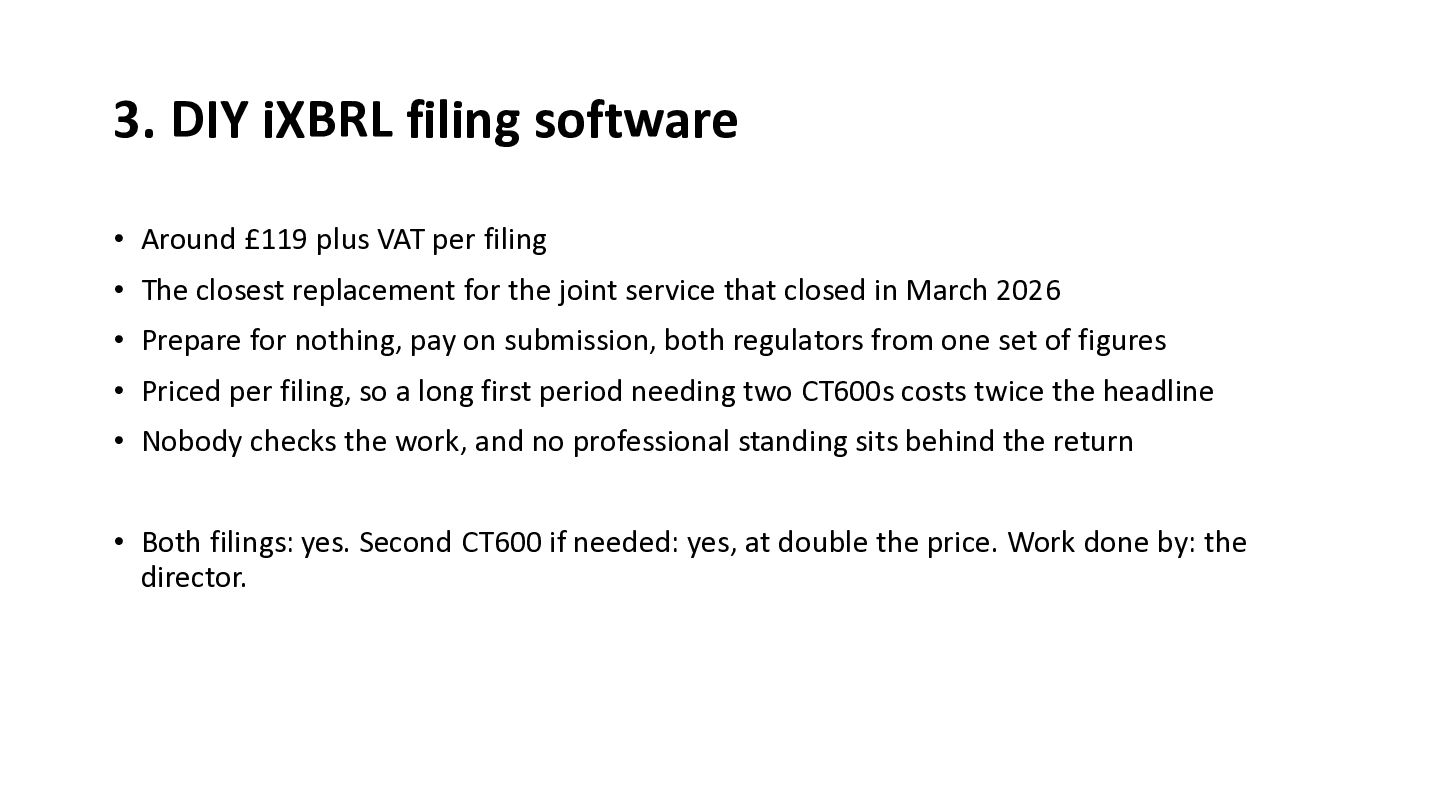
  12. 3. DIY iXBRL filing software • Around £119 plus VAT

    per filing • The closest replacement for the joint service that closed in March 2026 • Prepare for nothing, pay on submission, both regulators from one set of figures • Priced per filing, so a long first period needing two CT600s costs twice the headline • Nobody checks the work, and no professional standing sits behind the return • Both filings: yes. Second CT600 if needed: yes, at double the price. Work done by: the director.
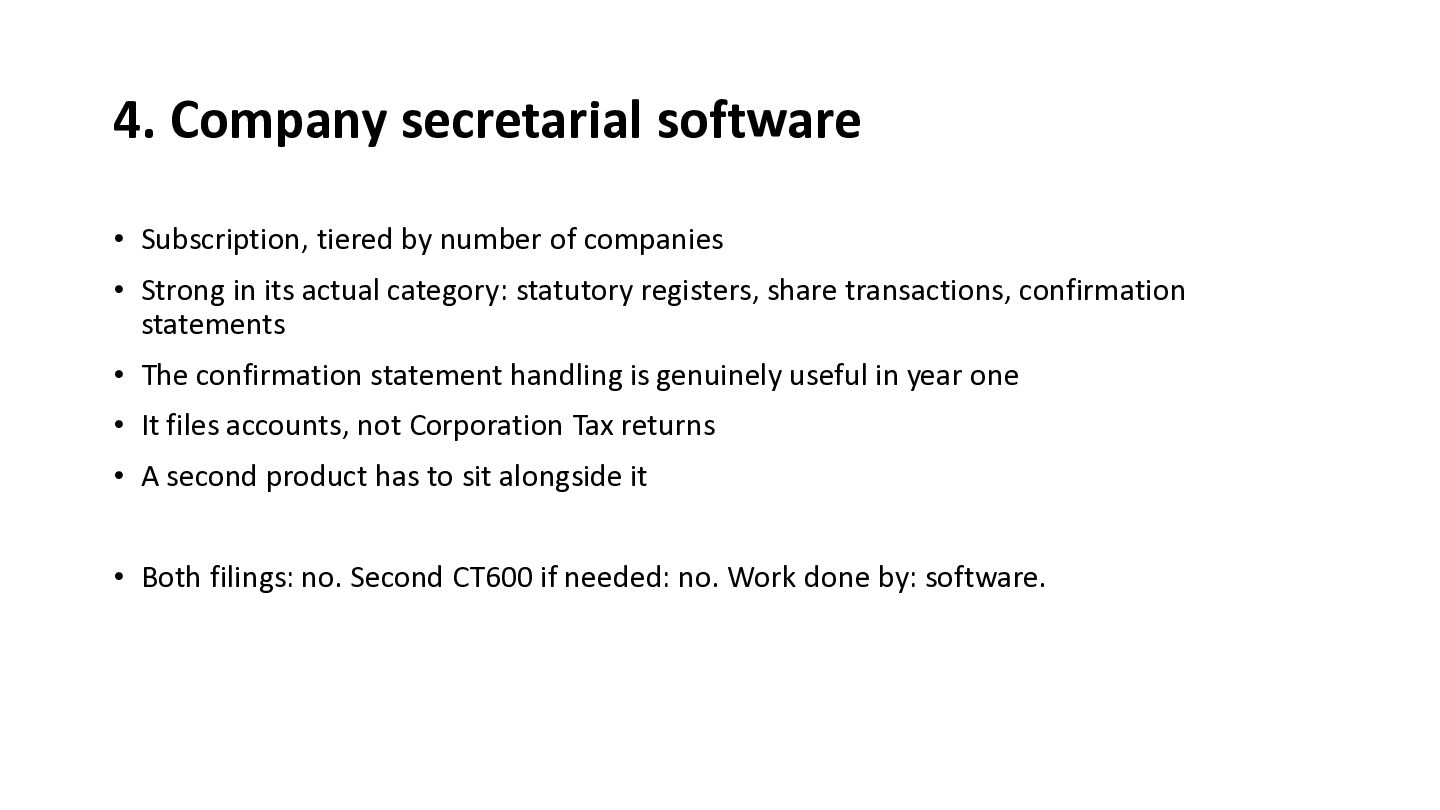
  13. 4. Company secretarial software • Subscription, tiered by number of

    companies • Strong in its actual category: statutory registers, share transactions, confirmation statements • The confirmation statement handling is genuinely useful in year one • It files accounts, not Corporation Tax returns • A second product has to sit alongside it • Both filings: no. Second CT600 if needed: no. Work done by: software.
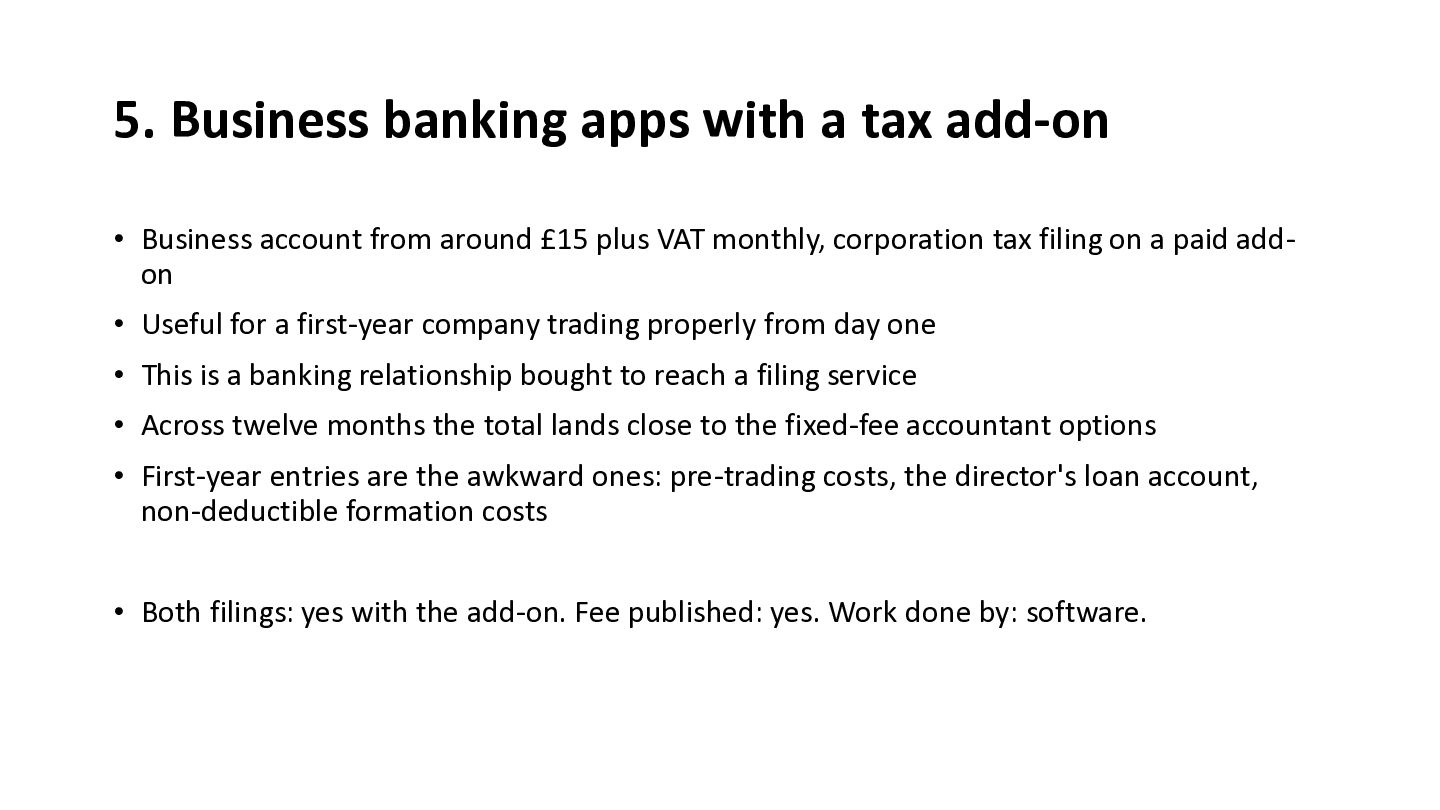
  14. 5. Business banking apps with a tax add-on • Business

    account from around £15 plus VAT monthly, corporation tax filing on a paid addon • Useful for a first-year company trading properly from day one • This is a banking relationship bought to reach a filing service • Across twelve months the total lands close to the fixed-fee accountant options • First-year entries are the awkward ones: pre-trading costs, the director's loan account, non-deductible formation costs • Both filings: yes with the add-on. Fee published: yes. Work done by: software.
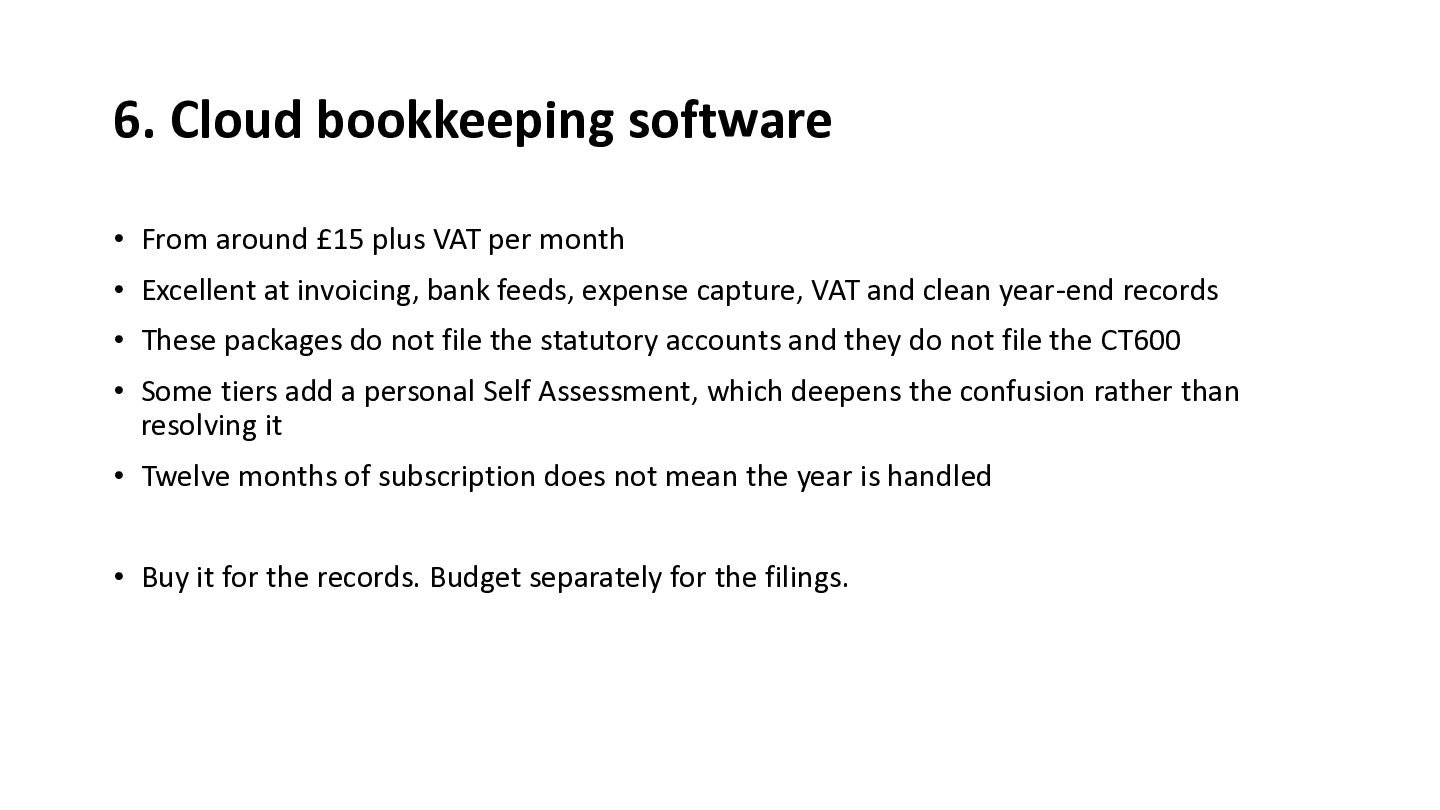
  15. 6. Cloud bookkeeping software • From around £15 plus VAT

    per month • Excellent at invoicing, bank feeds, expense capture, VAT and clean year-end records • These packages do not file the statutory accounts and they do not file the CT600 • Some tiers add a personal Self Assessment, which deepens the confusion rather than resolving it • Twelve months of subscription does not mean the year is handled • Buy it for the records. Budget separately for the filings.
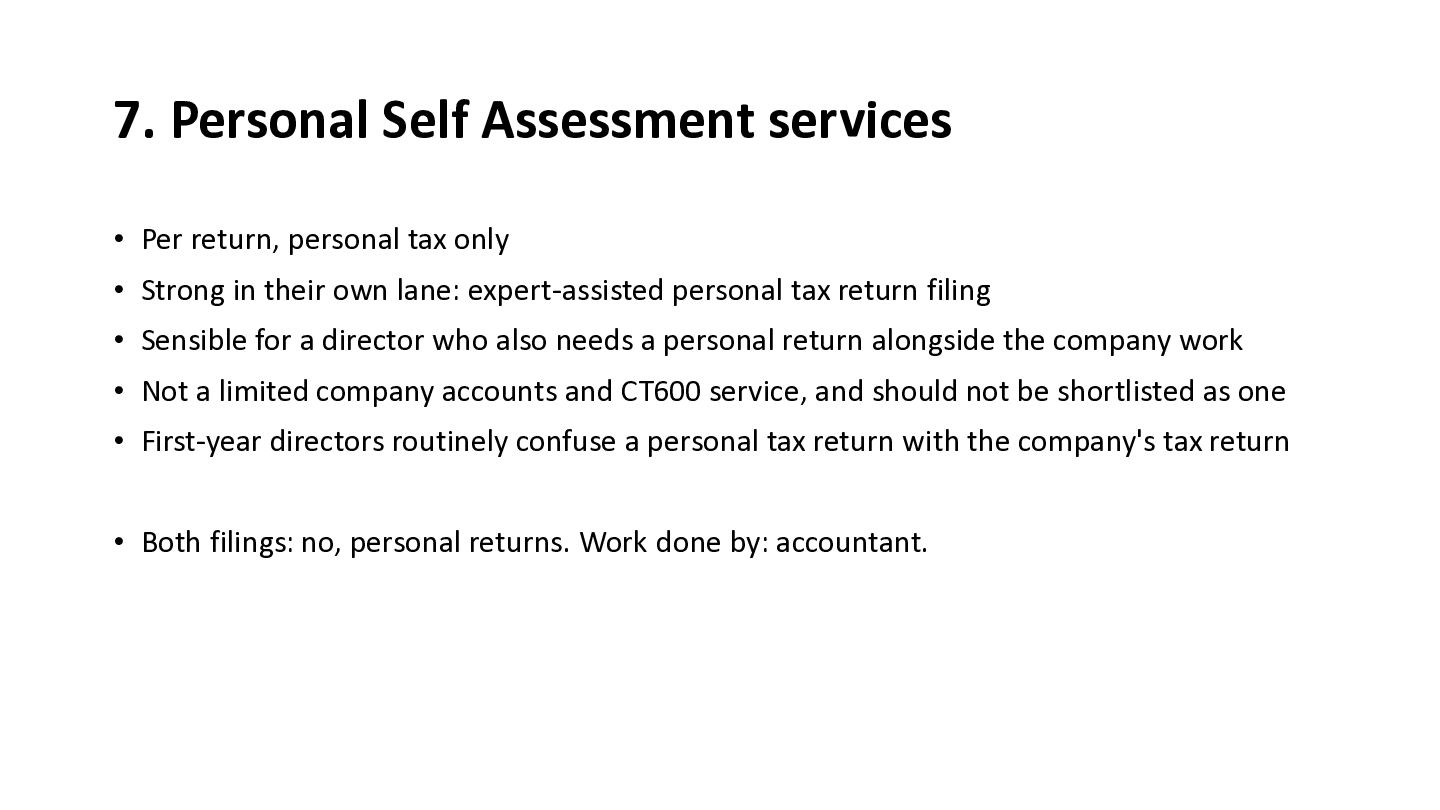
  16. 7. Personal Self Assessment services • Per return, personal tax

    only • Strong in their own lane: expert-assisted personal tax return filing • Sensible for a director who also needs a personal return alongside the company work • Not a limited company accounts and CT600 service, and should not be shortlisted as one • First-year directors routinely confuse a personal tax return with the company's tax return • Both filings: no, personal returns. Work done by: accountant.
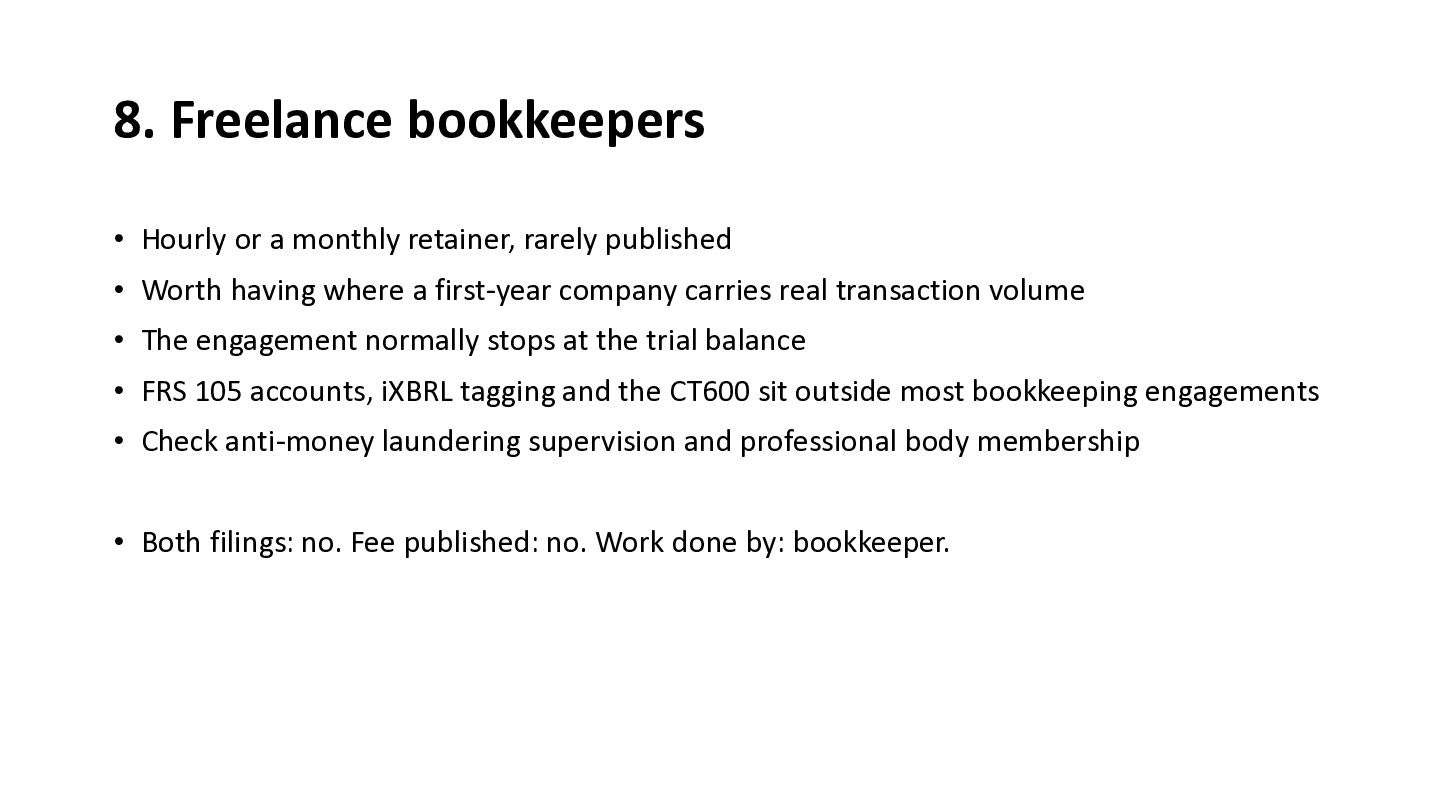
  17. 8. Freelance bookkeepers • Hourly or a monthly retainer, rarely

    published • Worth having where a first-year company carries real transaction volume • The engagement normally stops at the trial balance • FRS 105 accounts, iXBRL tagging and the CT600 sit outside most bookkeeping engagements • Check anti-money laundering supervision and professional body membership • Both filings: no. Fee published: no. Work done by: bookkeeper.
  18. 9. Registered office and reminder bundles • From around £40

    per year • Registered office address, service address, mail forwarding and deadline reminders • The address alone justifies the fee for a director working from home • A reminder is not a filing • No accounts prepared, nothing tagged in iXBRL, no Corporation Tax return submitted • Both filings: no. Second CT600 if needed: no. Work done by: nobody.
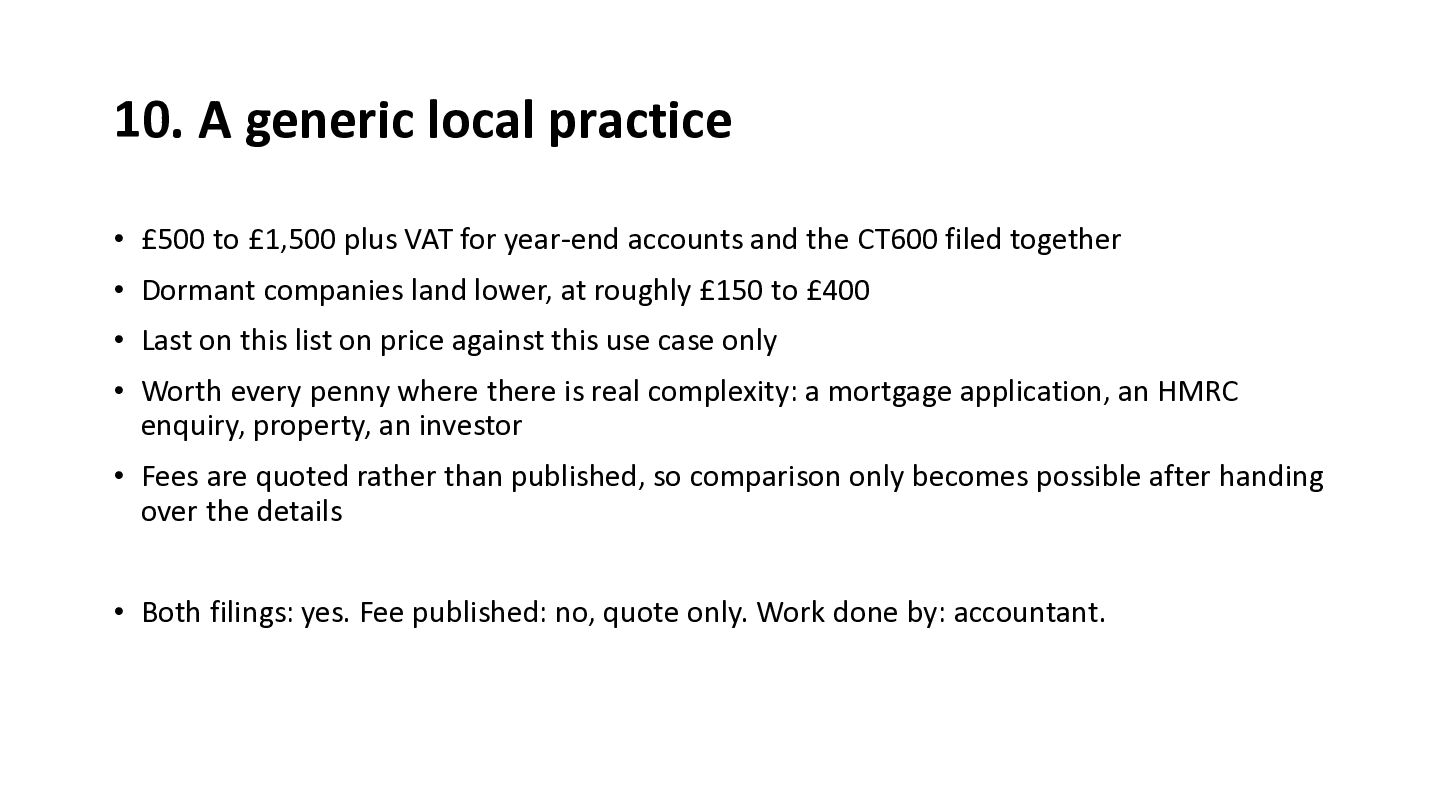
  19. 10. A generic local practice • £500 to £1,500 plus

    VAT for year-end accounts and the CT600 filed together • Dormant companies land lower, at roughly £150 to £400 • Last on this list on price against this use case only • Worth every penny where there is real complexity: a mortgage application, an HMRC enquiry, property, an investor • Fees are quoted rather than published, so comparison only becomes possible after handing over the details • Both filings: yes. Fee published: no, quote only. Work done by: accountant.
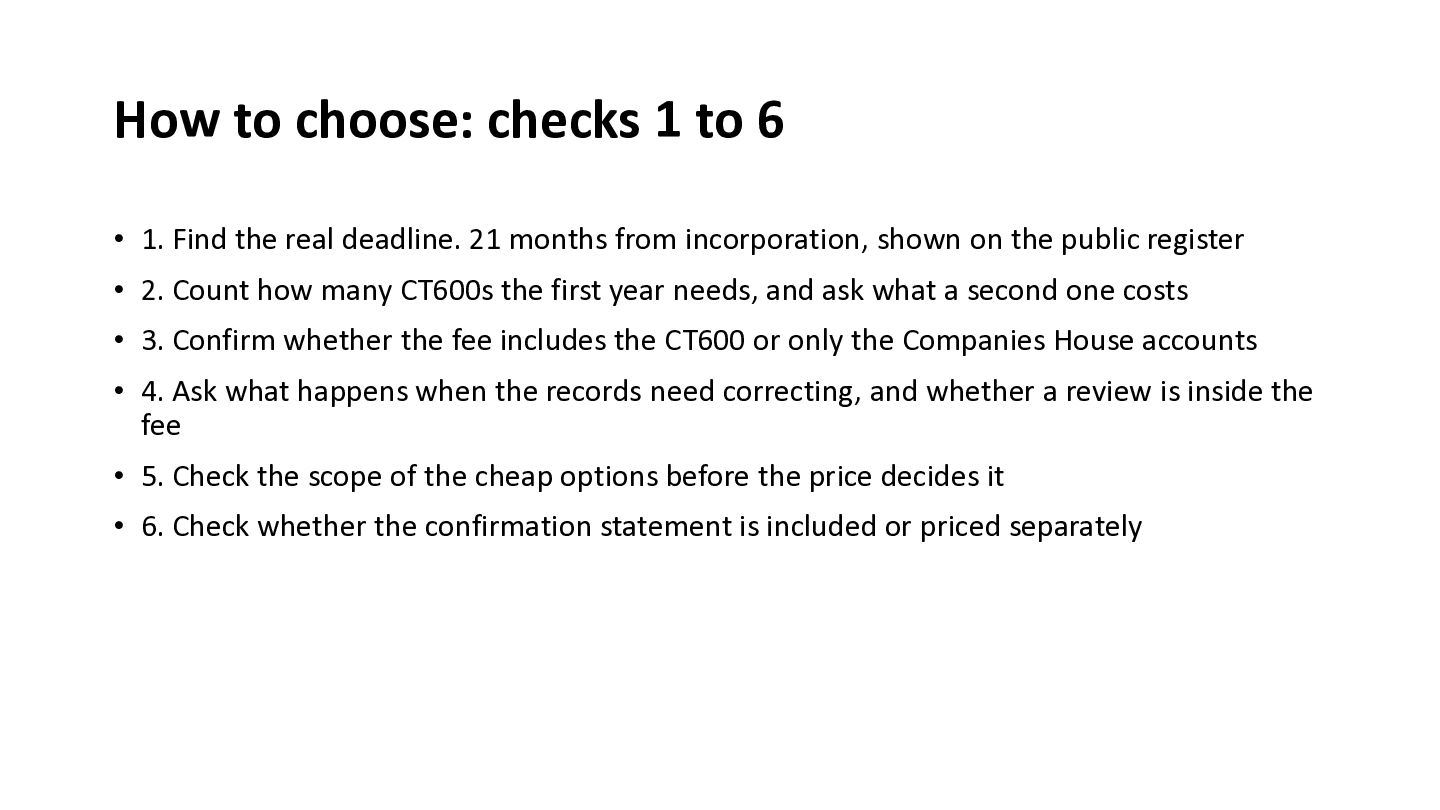
  20. How to choose: checks 1 to 6 • 1. Find

    the real deadline. 21 months from incorporation, shown on the public register • 2. Count how many CT600s the first year needs, and ask what a second one costs • 3. Confirm whether the fee includes the CT600 or only the Companies House accounts • 4. Ask what happens when the records need correcting, and whether a review is inside the fee • 5. Check the scope of the cheap options before the price decides it • 6. Check whether the confirmation statement is included or priced separately
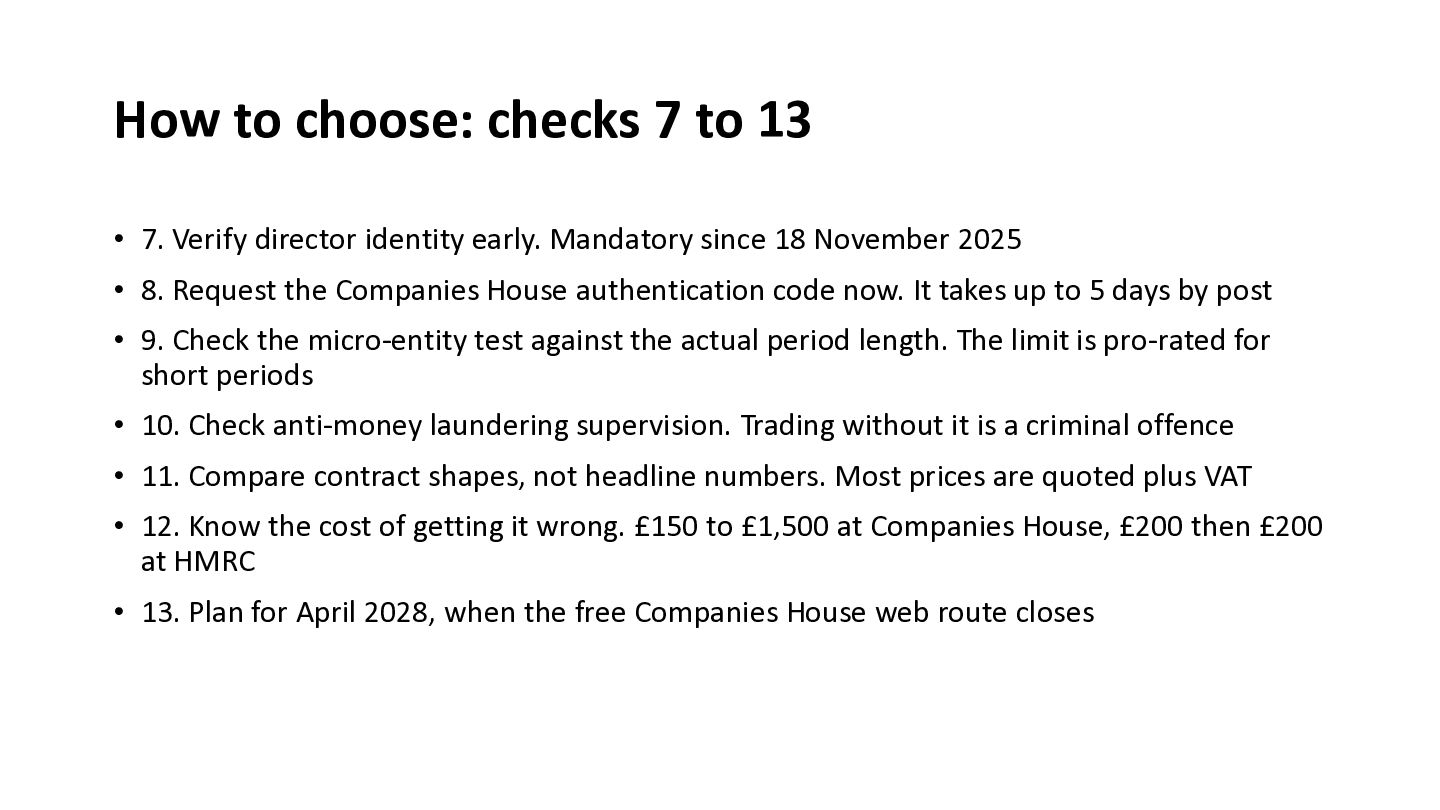
  21. How to choose: checks 7 to 13 • 7. Verify

    director identity early. Mandatory since 18 November 2025 • 8. Request the Companies House authentication code now. It takes up to 5 days by post • 9. Check the micro-entity test against the actual period length. The limit is pro-rated for short periods • 10. Check anti-money laundering supervision. Trading without it is a criminal offence • 11. Compare contract shapes, not headline numbers. Most prices are quoted plus VAT • 12. Know the cost of getting it wrong. £150 to £1,500 at Companies House, £200 then £200 at HMRC • 13. Plan for April 2028, when the free Companies House web route closes
  22. Read the full article • The complete comparison, with every

    figure and the reasoning behind the order • https://medium.com/@microfileraccountants • Published by Micro Filer Accountants