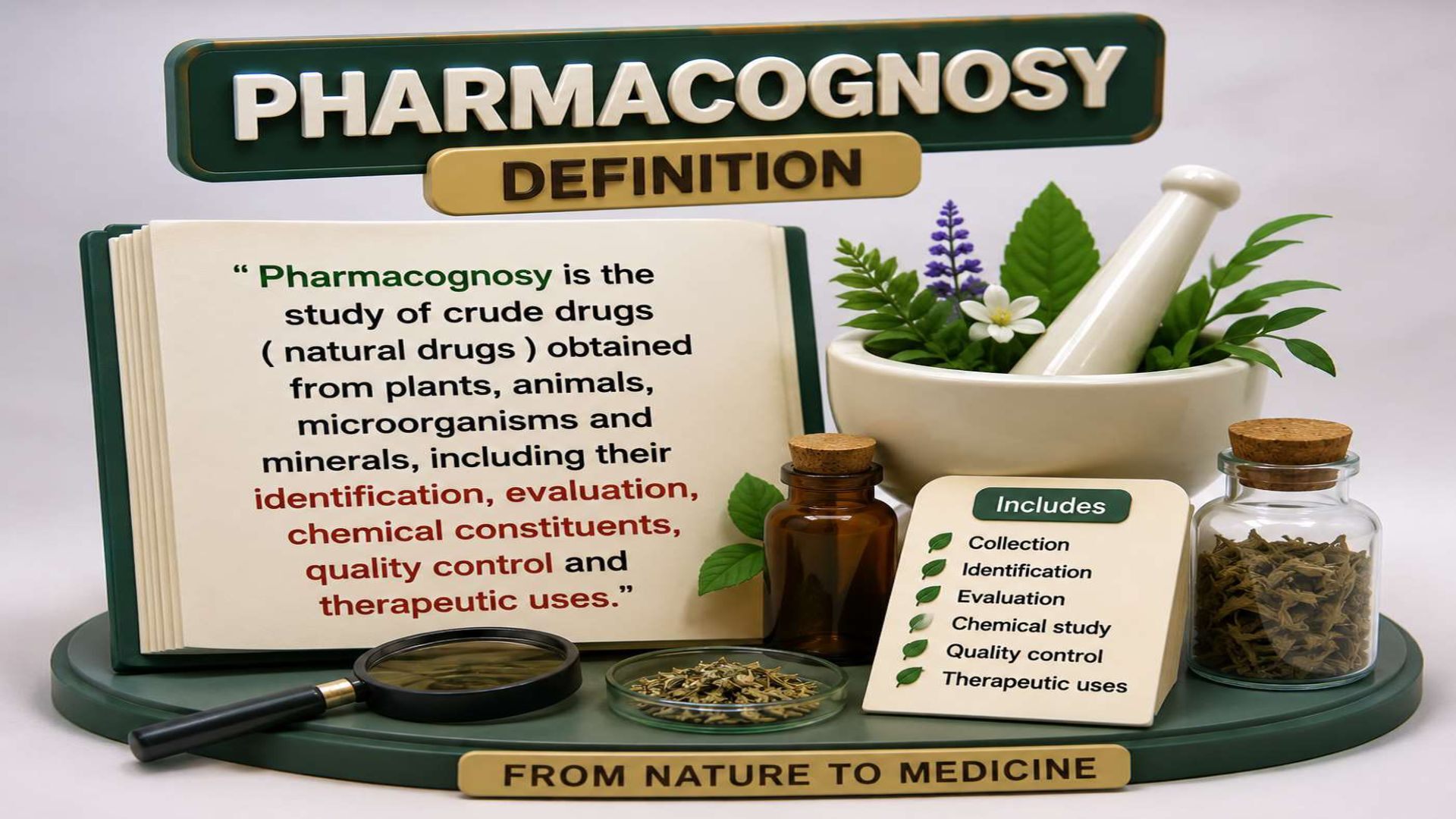
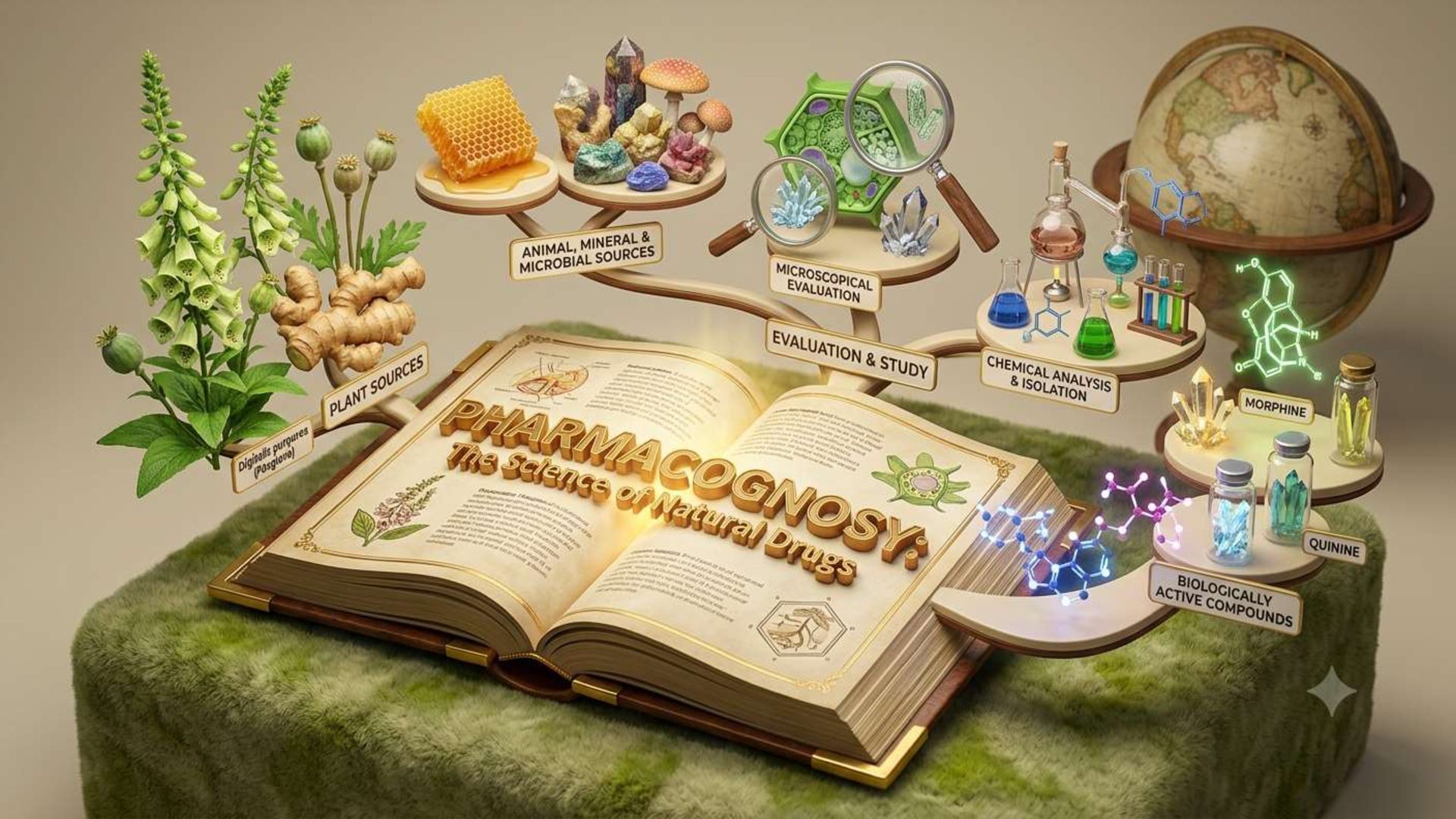
with the study of crude drugs obtained from natural sources such as plants, animals, microorganisms, and minerals. It includes their identification, cultivation, collection, processing, chemical constituents, evaluation, therapeutic uses, and quality control. Simple definition: Pharmacognosy is the scientific study of natural drugs and medicinal substances derived from plants, animals, microorganisms, and minerals. The word pharmacognosy comes from the Greek words: Pharmakon = drug or medicine Gnosis = knowledge So, pharmacognosy literally means "knowledge of drugs."
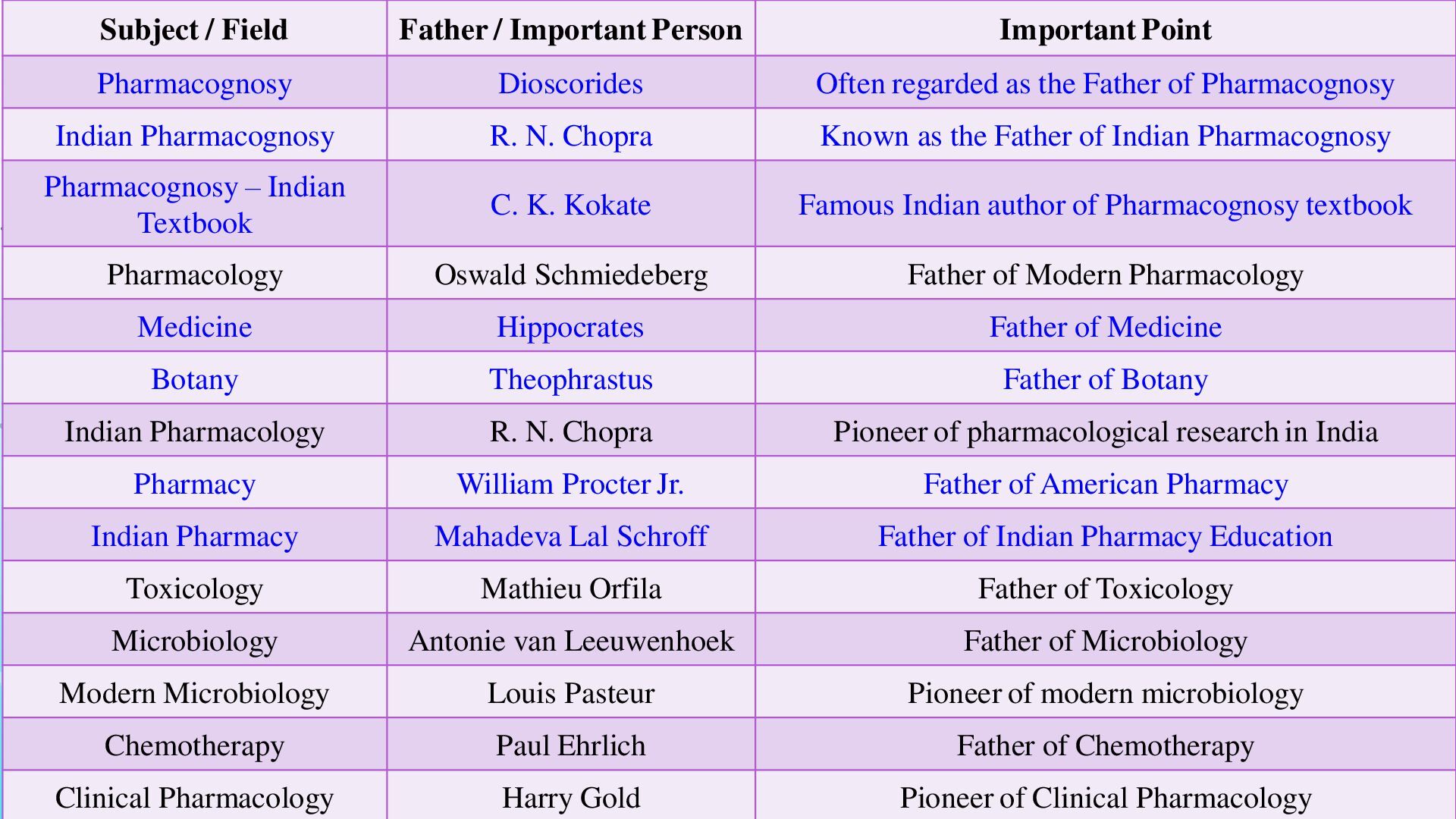
Dioscorides Often regarded as the Father of Pharmacognosy Indian Pharmacognosy R. N. Chopra Known as the Father of Indian Pharmacognosy Pharmacognosy – Indian Textbook C. K. Kokate Famous Indian author of Pharmacognosy textbook Pharmacology Oswald Schmiedeberg Father of Modern Pharmacology Medicine Hippocrates Father of Medicine Botany Theophrastus Father of Botany Indian Pharmacology R. N. Chopra Pioneer of pharmacological research in India Pharmacy William Procter Jr. Father of American Pharmacy Indian Pharmacy Mahadeva Lal Schroff Father of Indian Pharmacy Education Toxicology Mathieu Orfila Father of Toxicology Microbiology Antonie van Leeuwenhoek Father of Microbiology Modern Microbiology Louis Pasteur Pioneer of modern microbiology Chemotherapy Paul Ehrlich Father of Chemotherapy Clinical Pharmacology Harry Gold Pioneer of Clinical Pharmacology
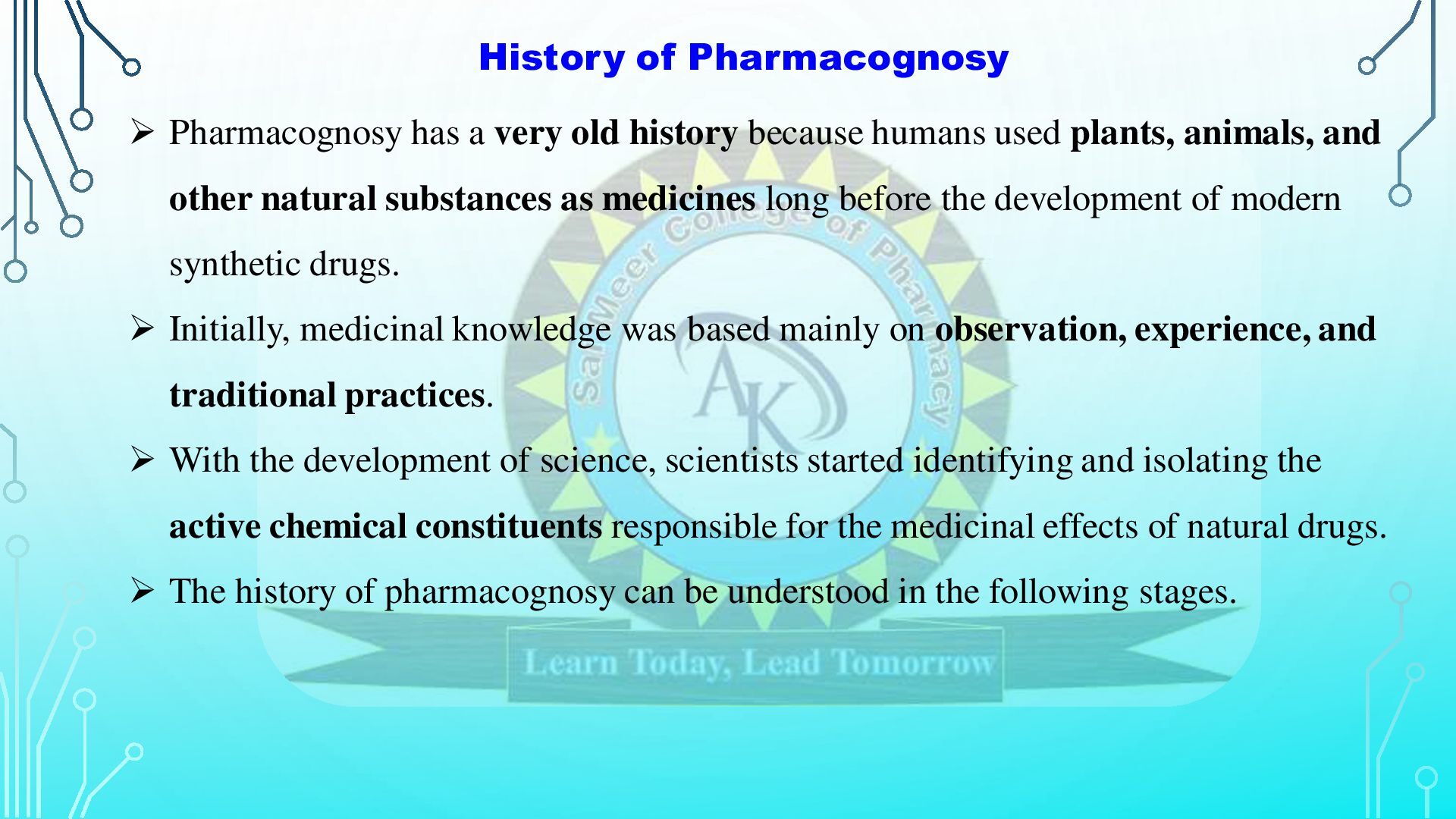
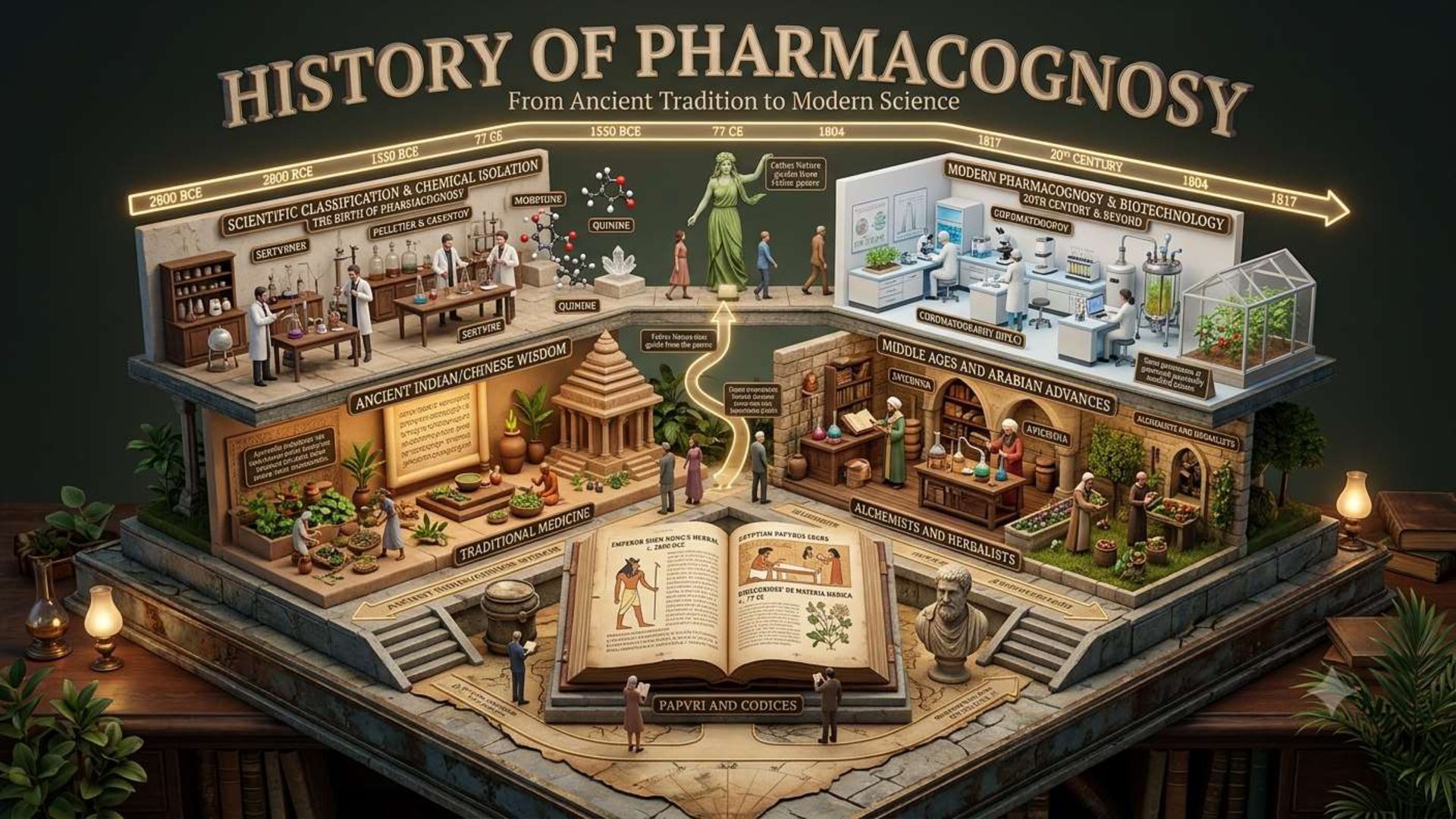
because humans used plants, animals, and other natural substances as medicines long before the development of modern synthetic drugs. Initially, medicinal knowledge was based mainly on observation, experience, and traditional practices. With the development of science, scientists started identifying and isolating the active chemical constituents responsible for the medicinal effects of natural drugs. The history of pharmacognosy can be understood in the following stages.
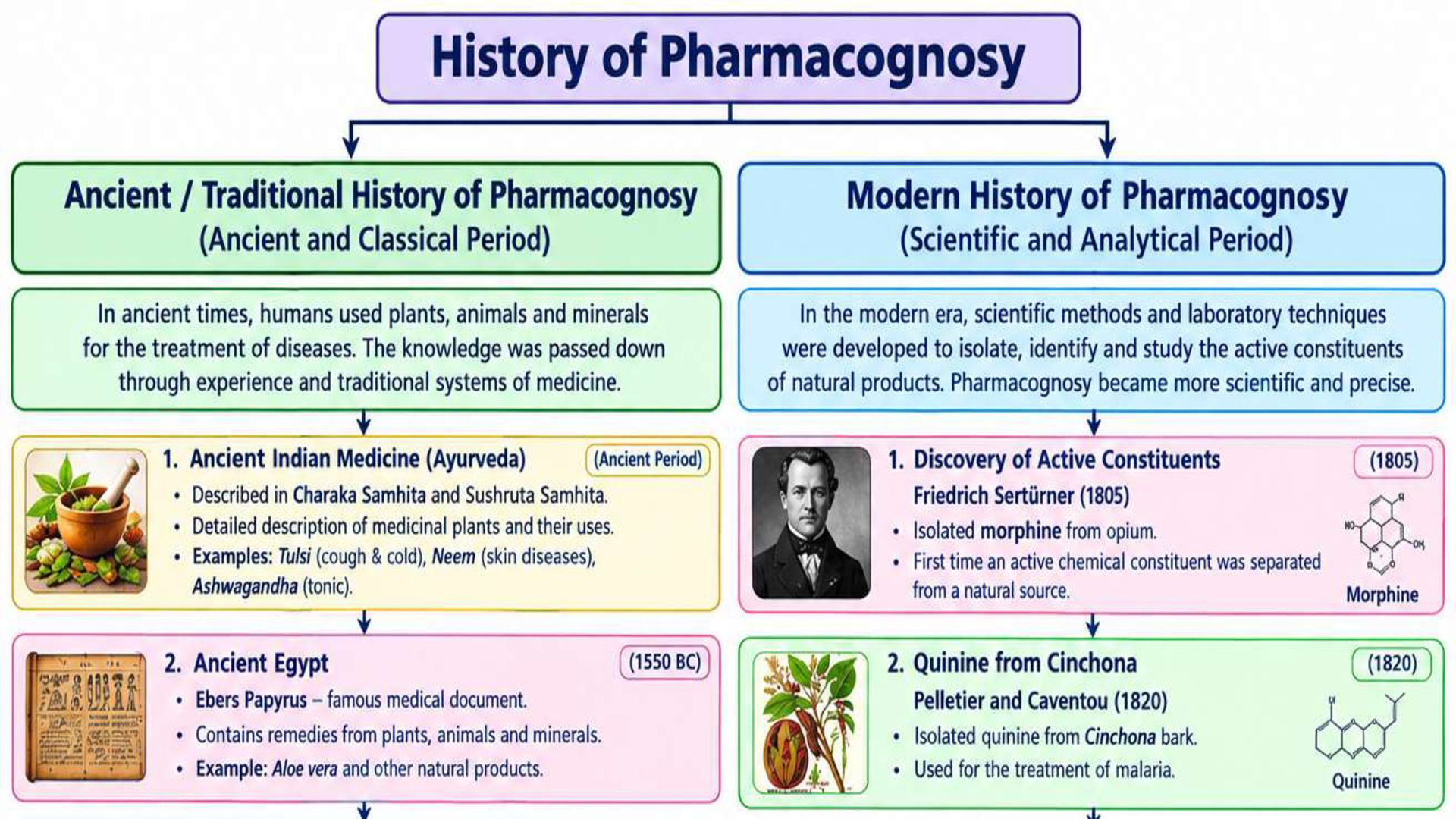
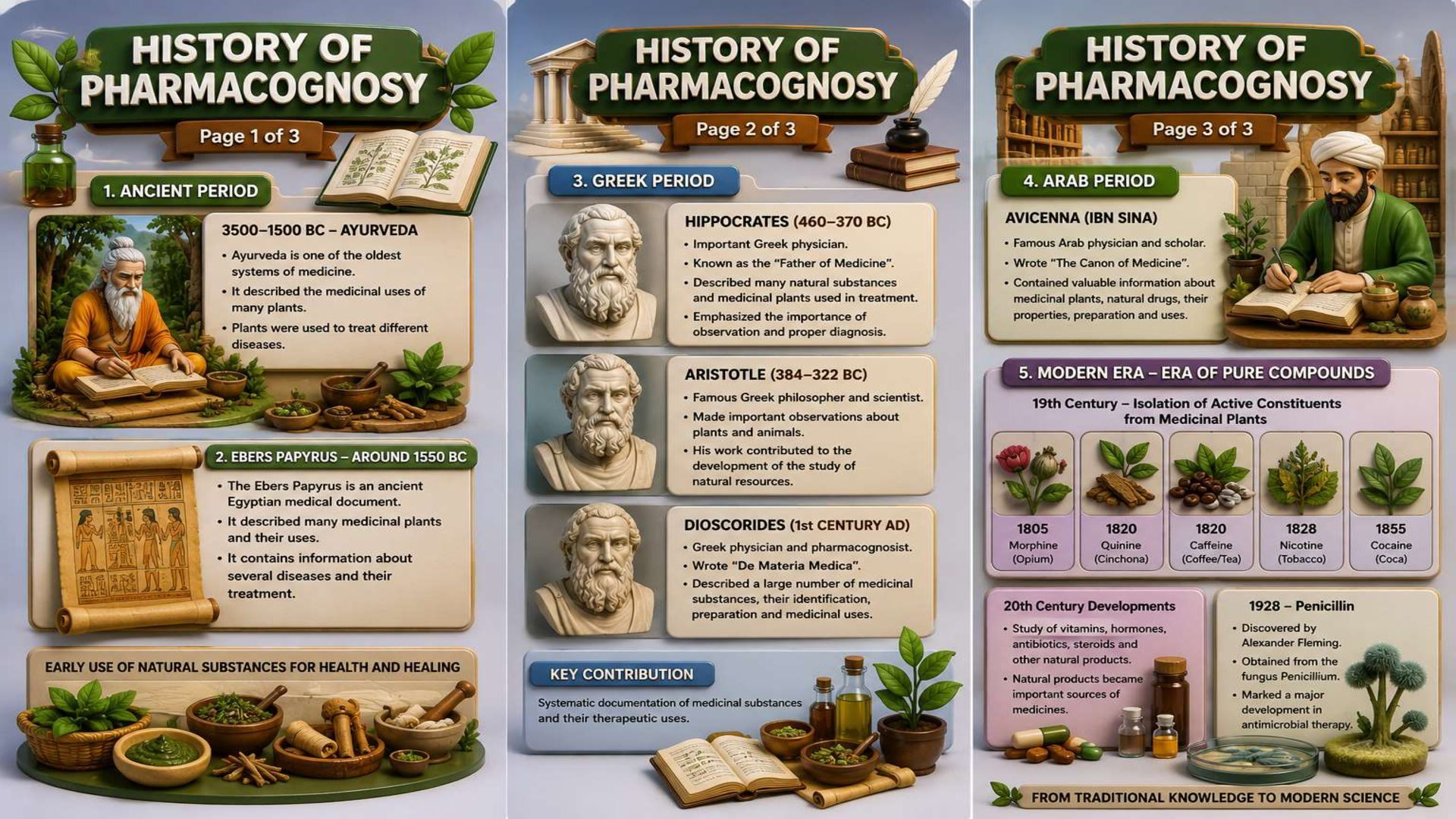
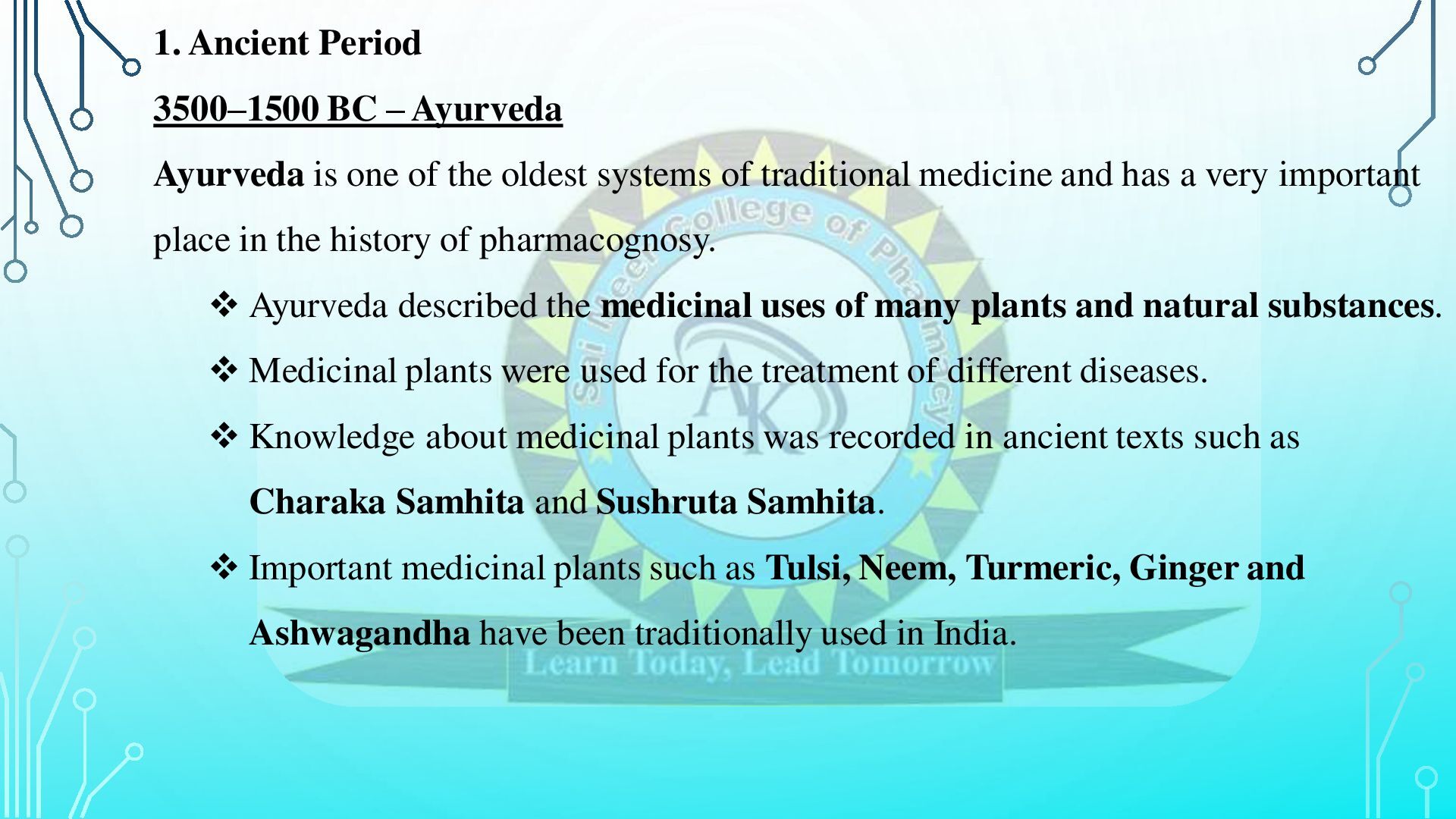
of the oldest systems of traditional medicine and has a very important place in the history of pharmacognosy. Ayurveda described the medicinal uses of many plants and natural substances. Medicinal plants were used for the treatment of different diseases. Knowledge about medicinal plants was recorded in ancient texts such as Charaka Samhita and Sushruta Samhita. Important medicinal plants such as Tulsi, Neem, Turmeric, Ginger and Ashwagandha have been traditionally used in India.
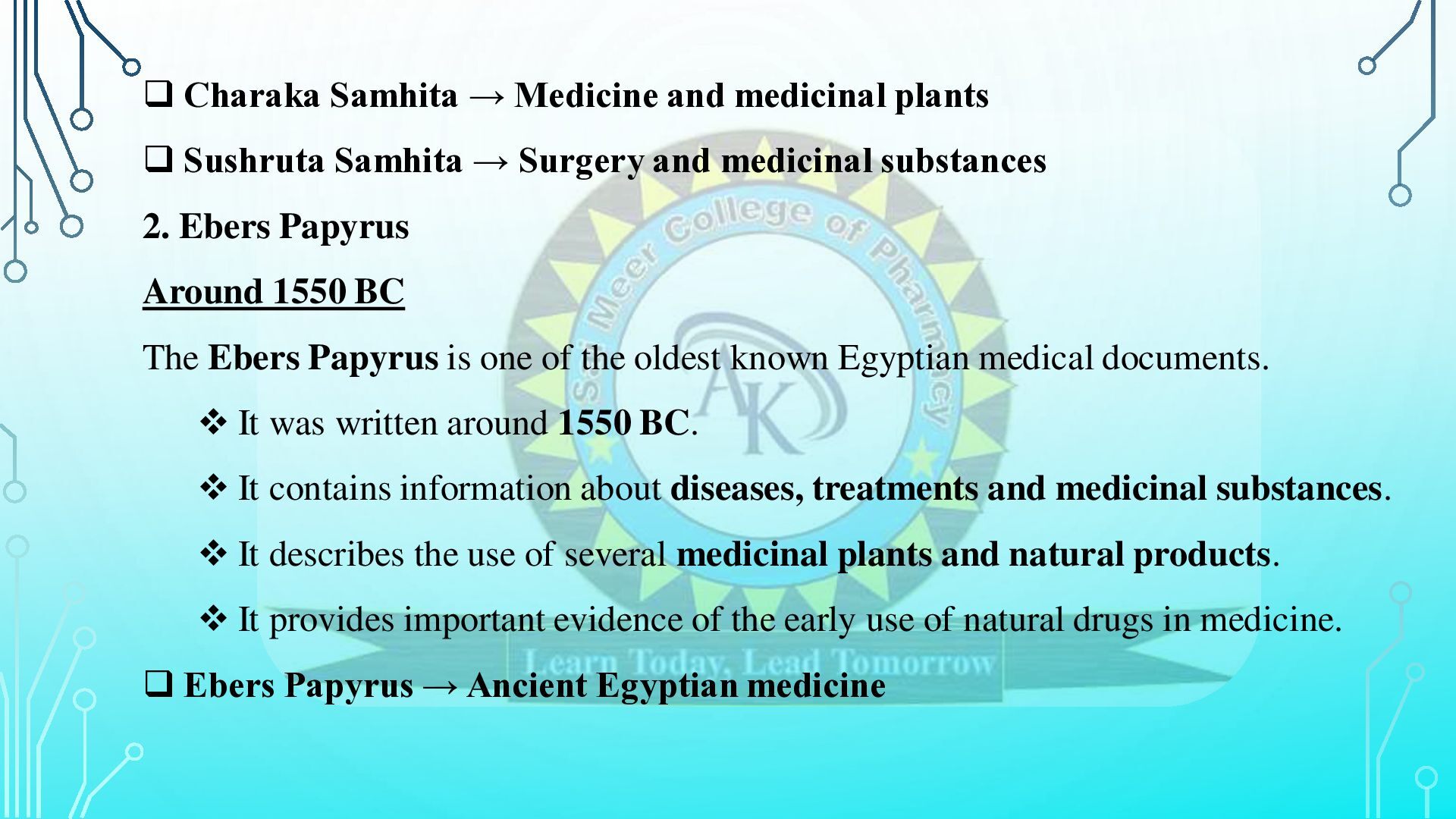
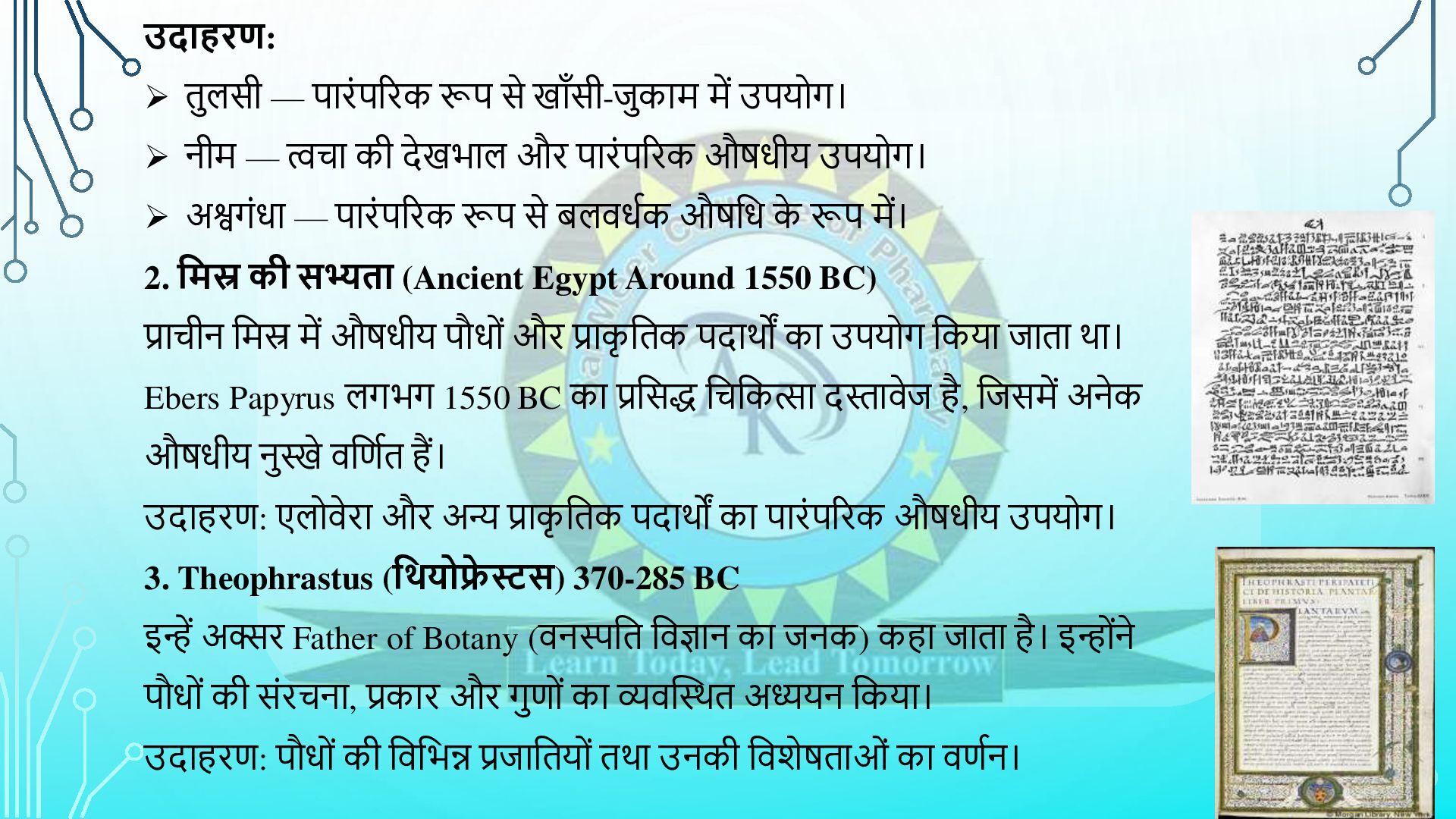
Samhita → Surgery and medicinal substances 2. Ebers Papyrus Around 1550 BC The Ebers Papyrus is one of the oldest known Egyptian medical documents. It was written around 1550 BC. It contains information about diseases, treatments and medicinal substances. It describes the use of several medicinal plants and natural products. It provides important evidence of the early use of natural drugs in medicine. Ebers Papyrus → Ancient Egyptian medicine
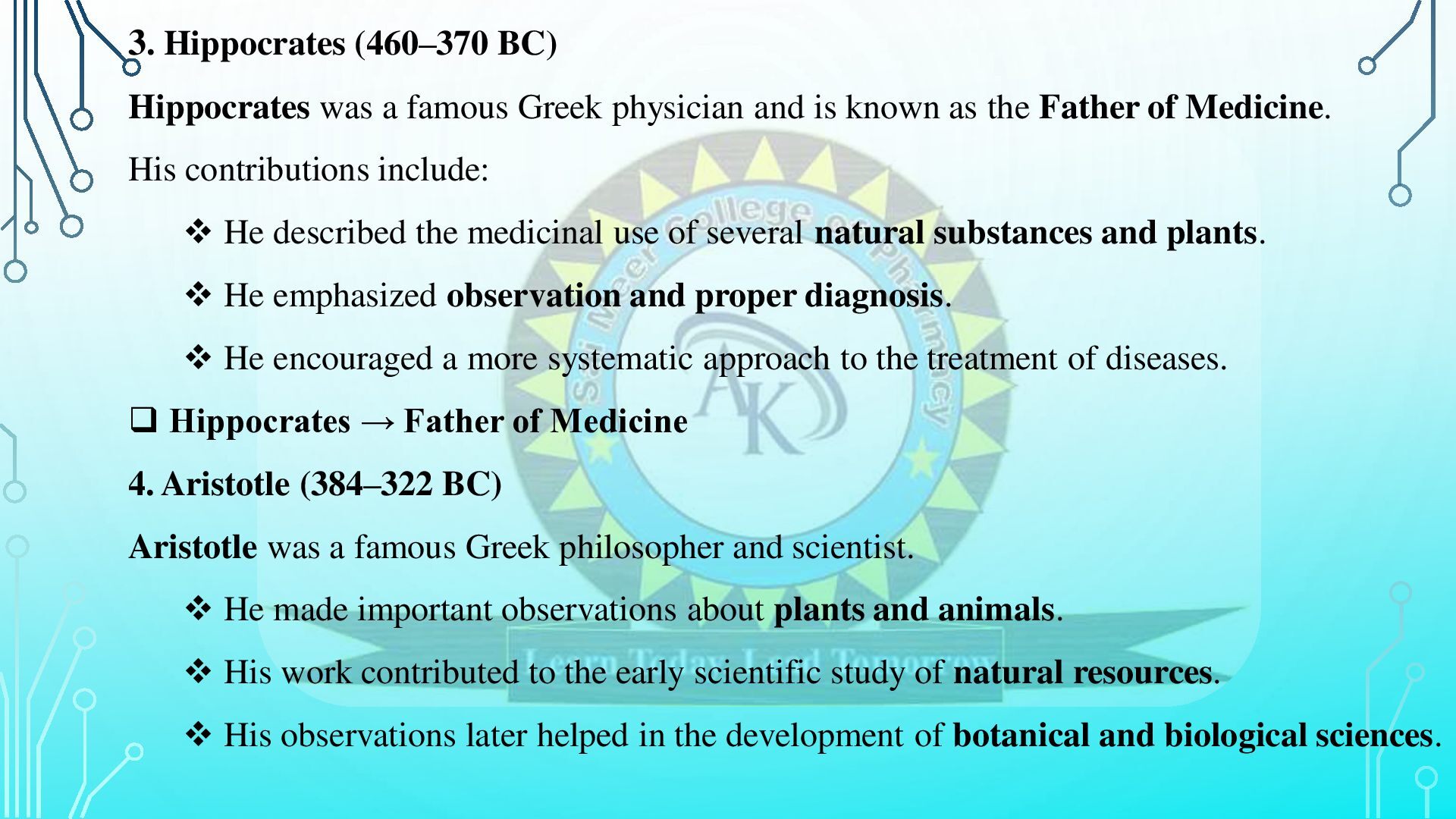
and is known as the Father of Medicine. His contributions include: He described the medicinal use of several natural substances and plants. He emphasized observation and proper diagnosis. He encouraged a more systematic approach to the treatment of diseases. Hippocrates → Father of Medicine 4. Aristotle (384–322 BC) Aristotle was a famous Greek philosopher and scientist. He made important observations about plants and animals. His work contributed to the early scientific study of natural resources. His observations later helped in the development of botanical and biological sciences.
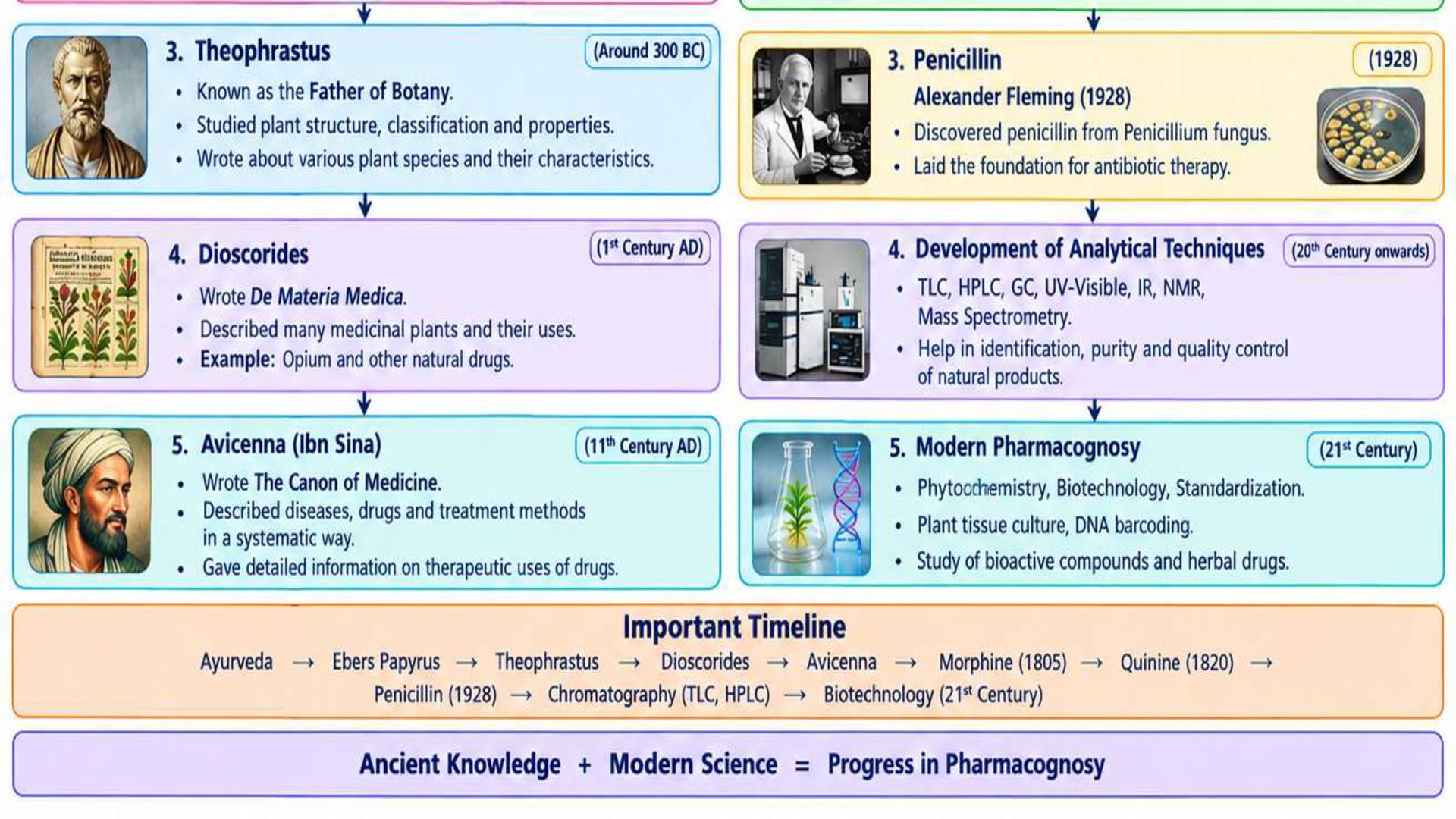
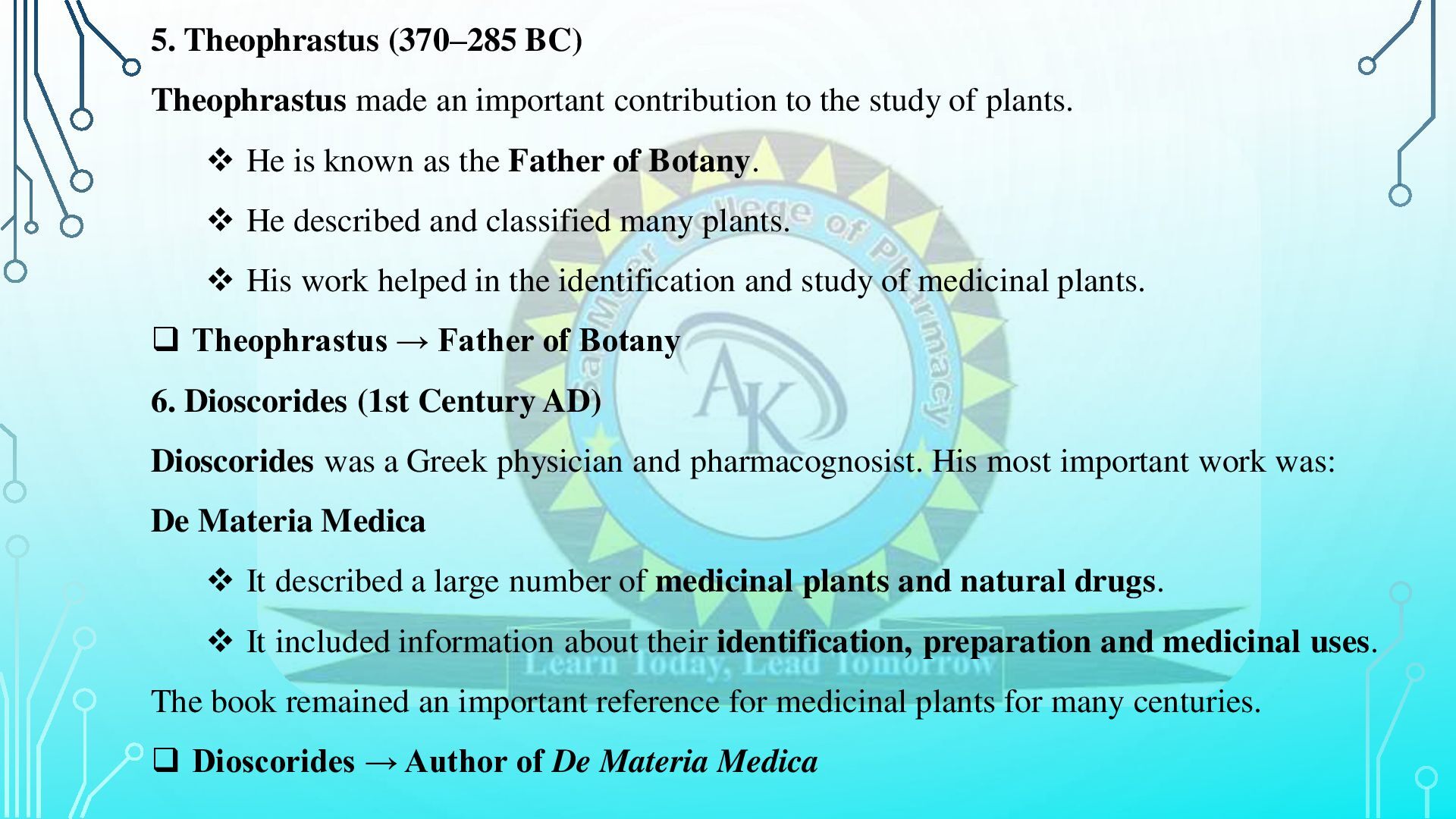
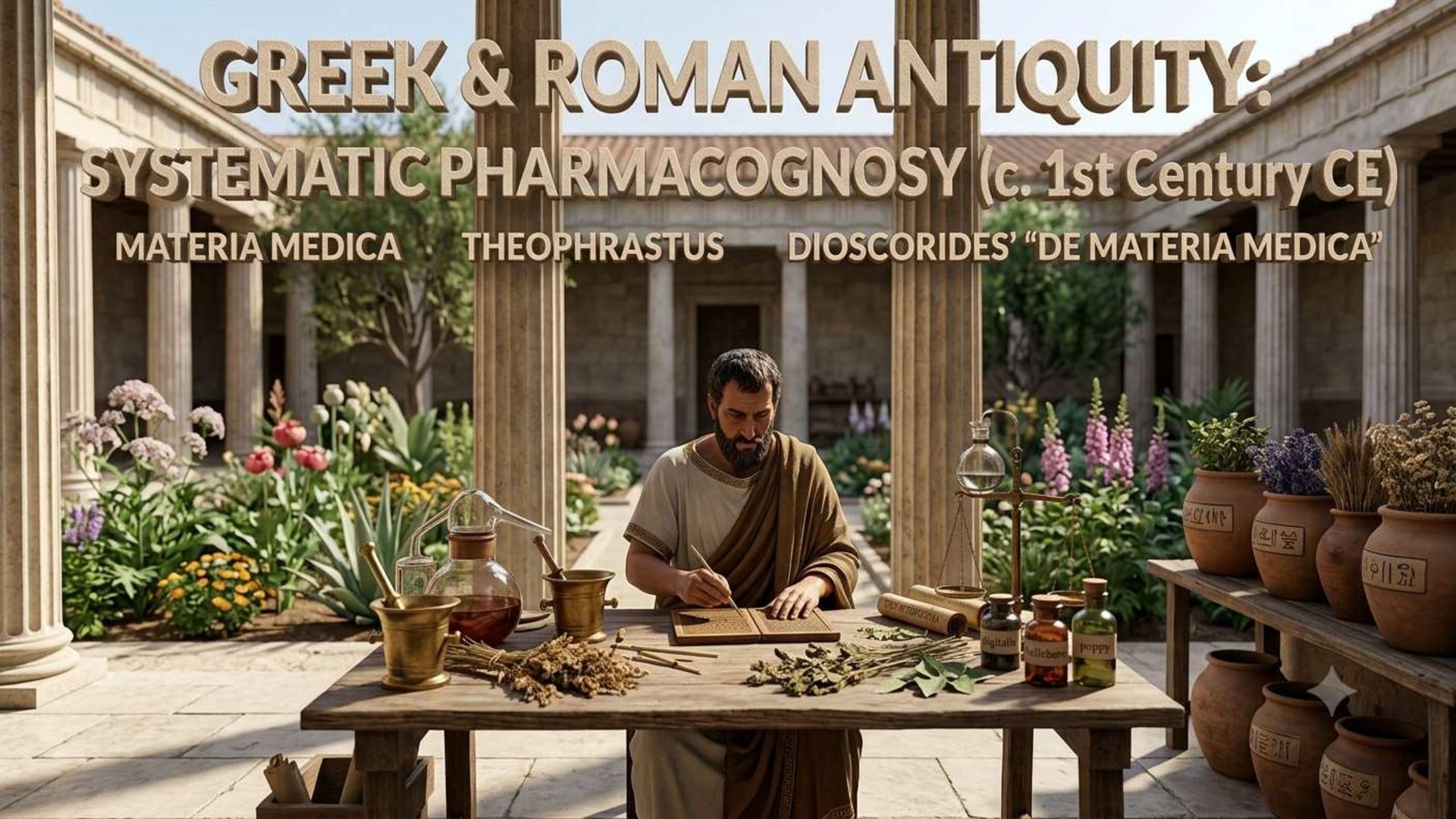
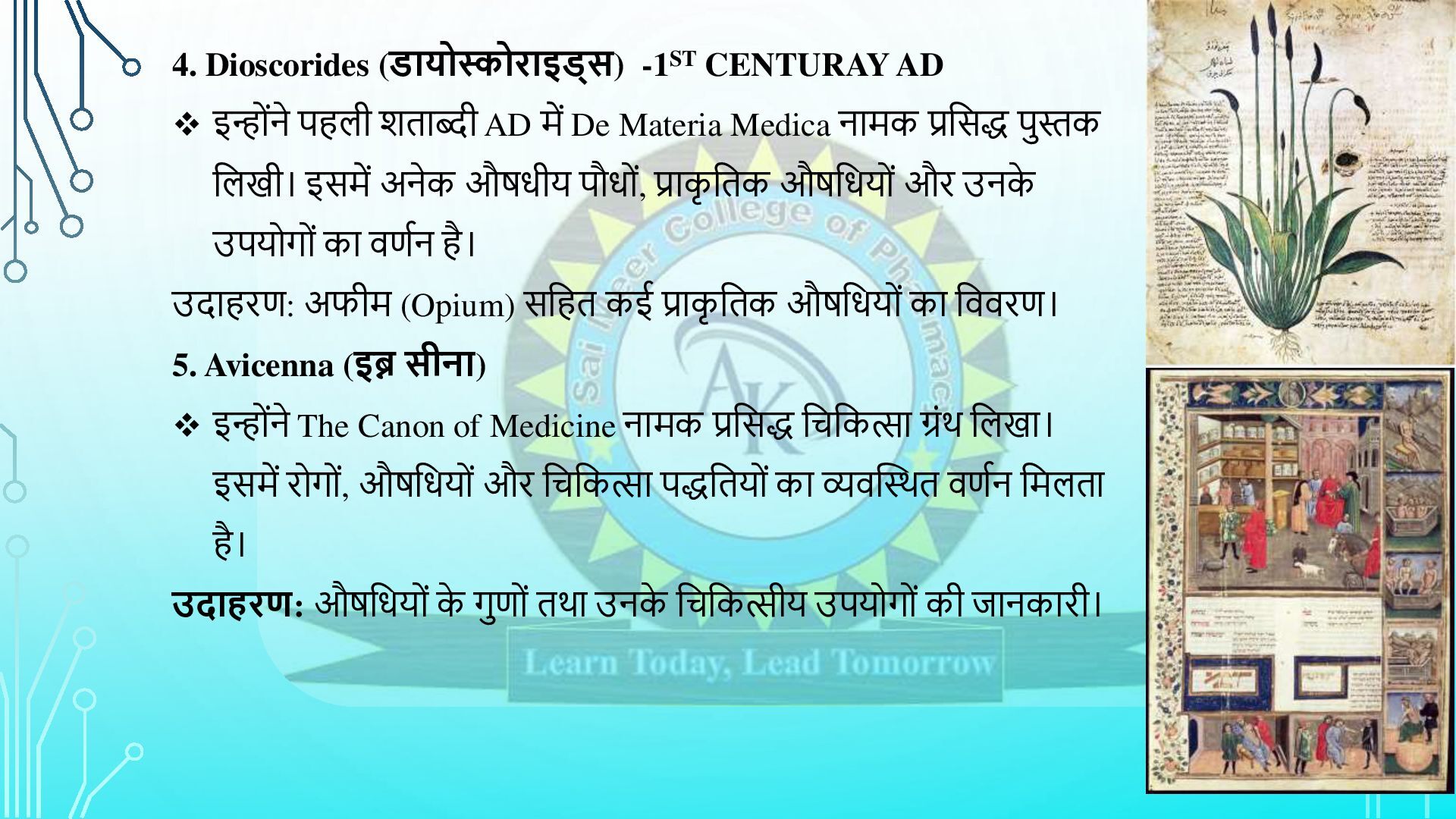
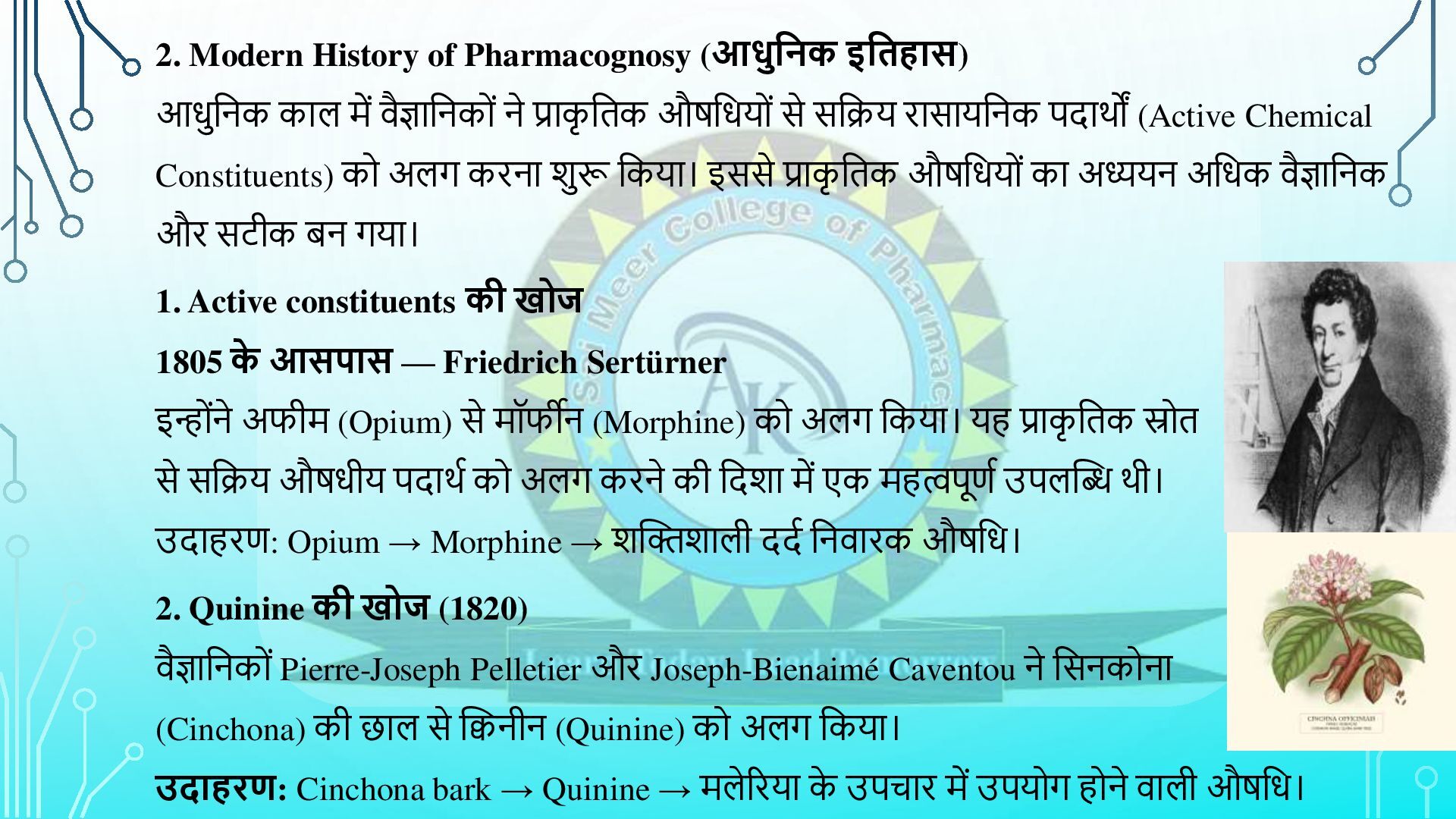
the study of plants. He is known as the Father of Botany. He described and classified many plants. His work helped in the identification and study of medicinal plants. Theophrastus → Father of Botany 6. Dioscorides (1st Century AD) Dioscorides was a Greek physician and pharmacognosist. His most important work was: De Materia Medica It described a large number of medicinal plants and natural drugs. It included information about their identification, preparation and medicinal uses. The book remained an important reference for medicinal plants for many centuries. Dioscorides → Author of De Materia Medica
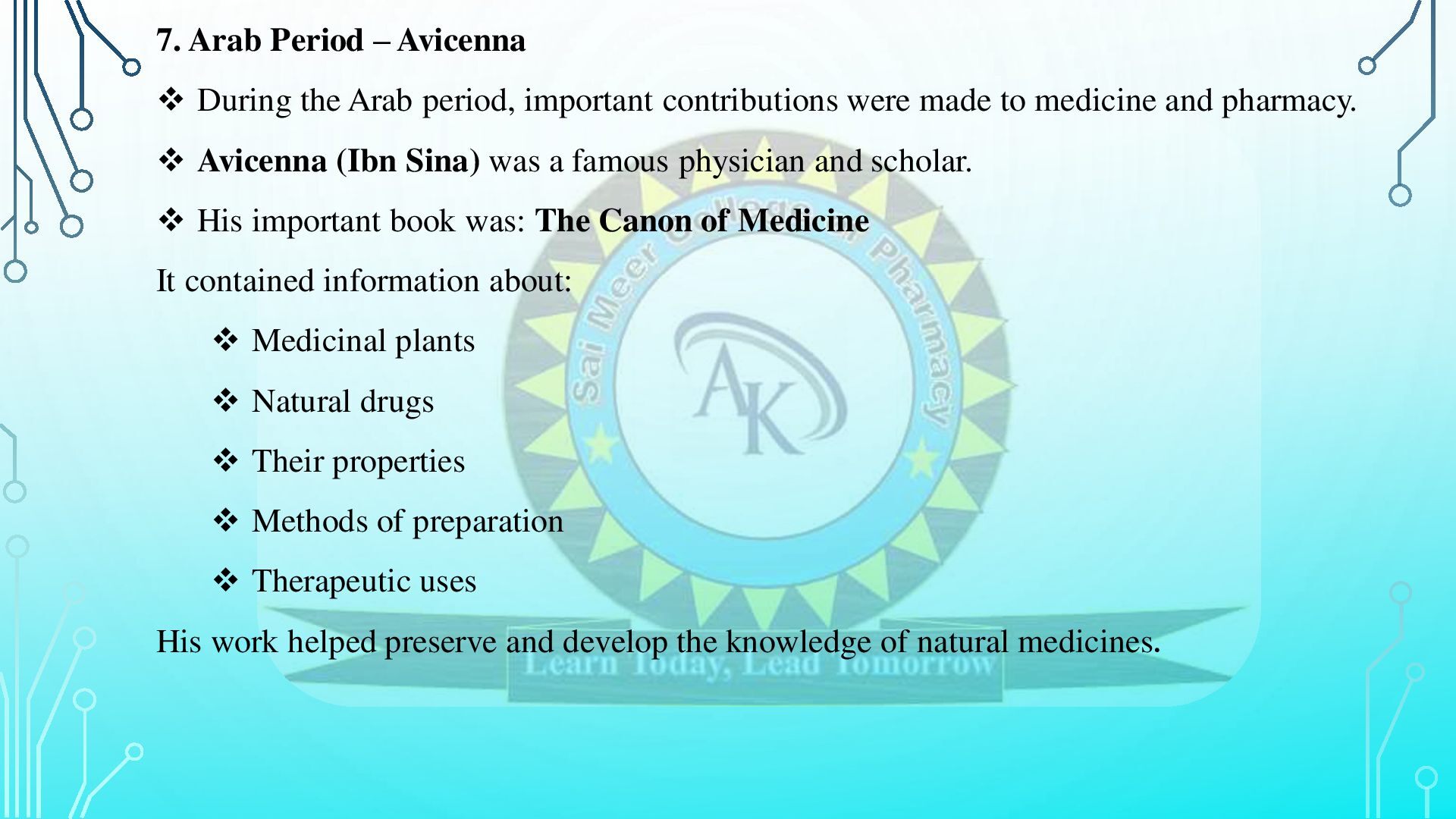
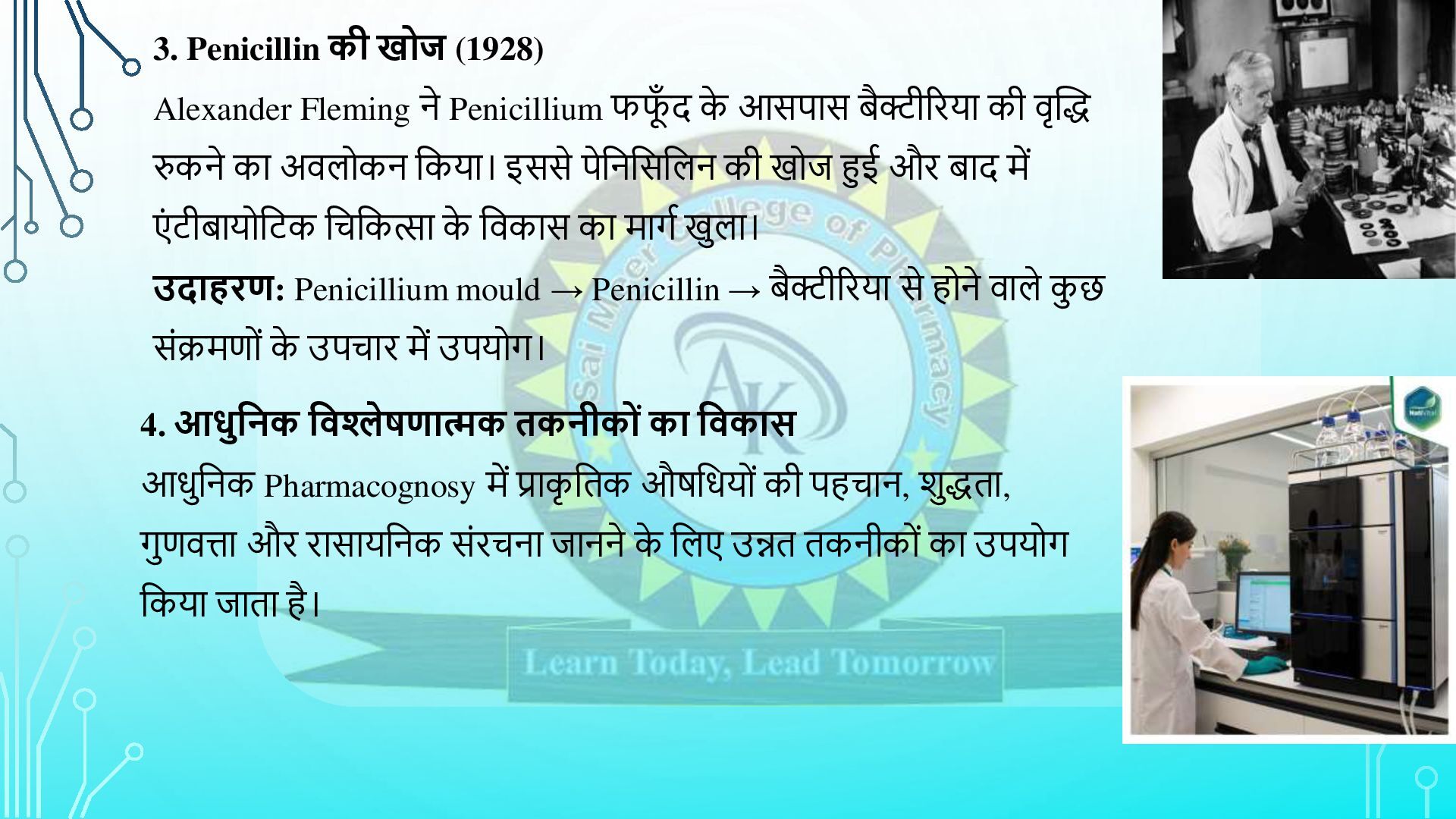
important contributions were made to medicine and pharmacy. Avicenna (Ibn Sina) was a famous physician and scholar. His important book was: The Canon of Medicine It contained information about: Medicinal plants Natural drugs Their properties Methods of preparation Therapeutic uses His work helped preserve and develop the knowledge of natural medicines.
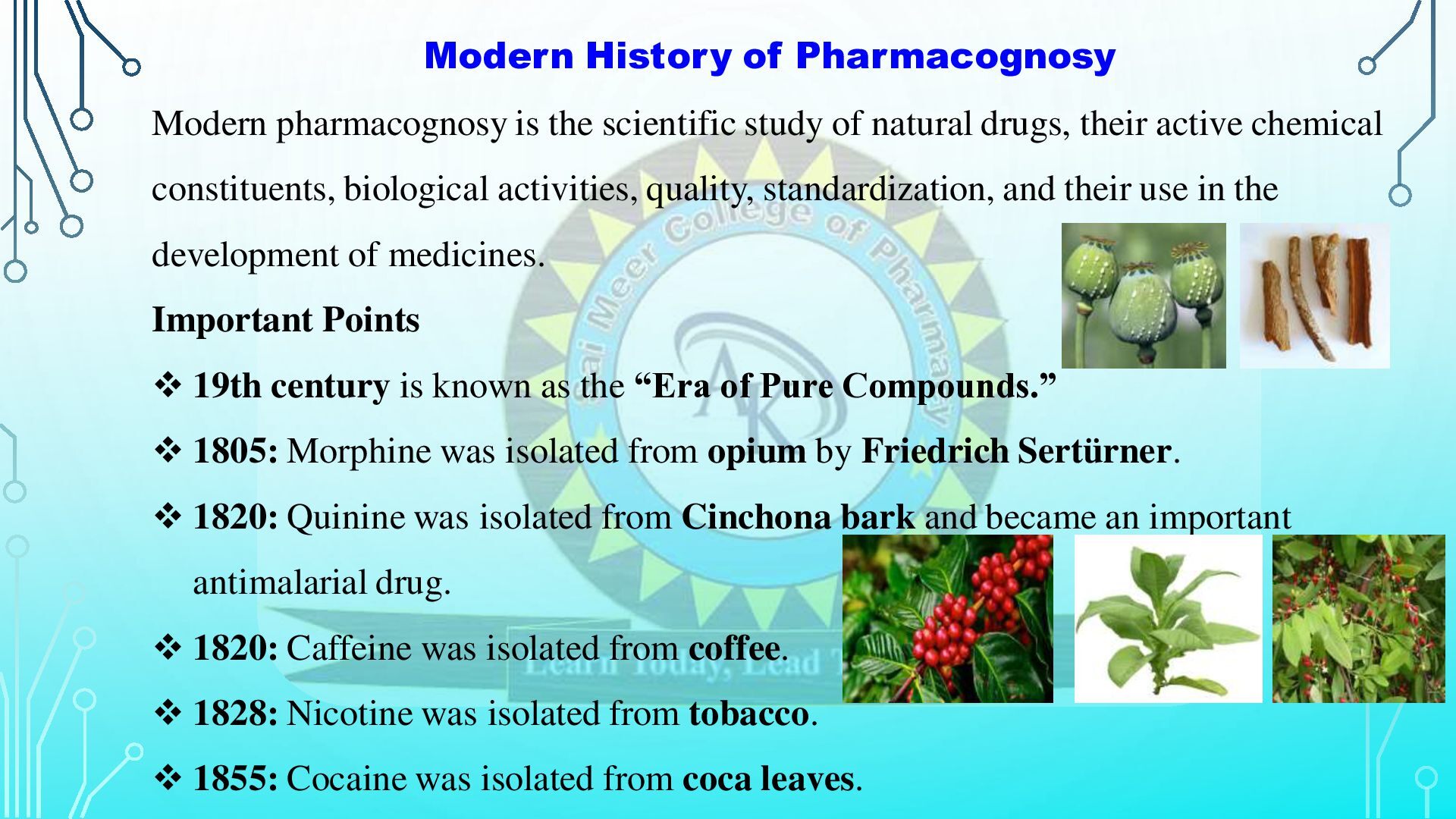
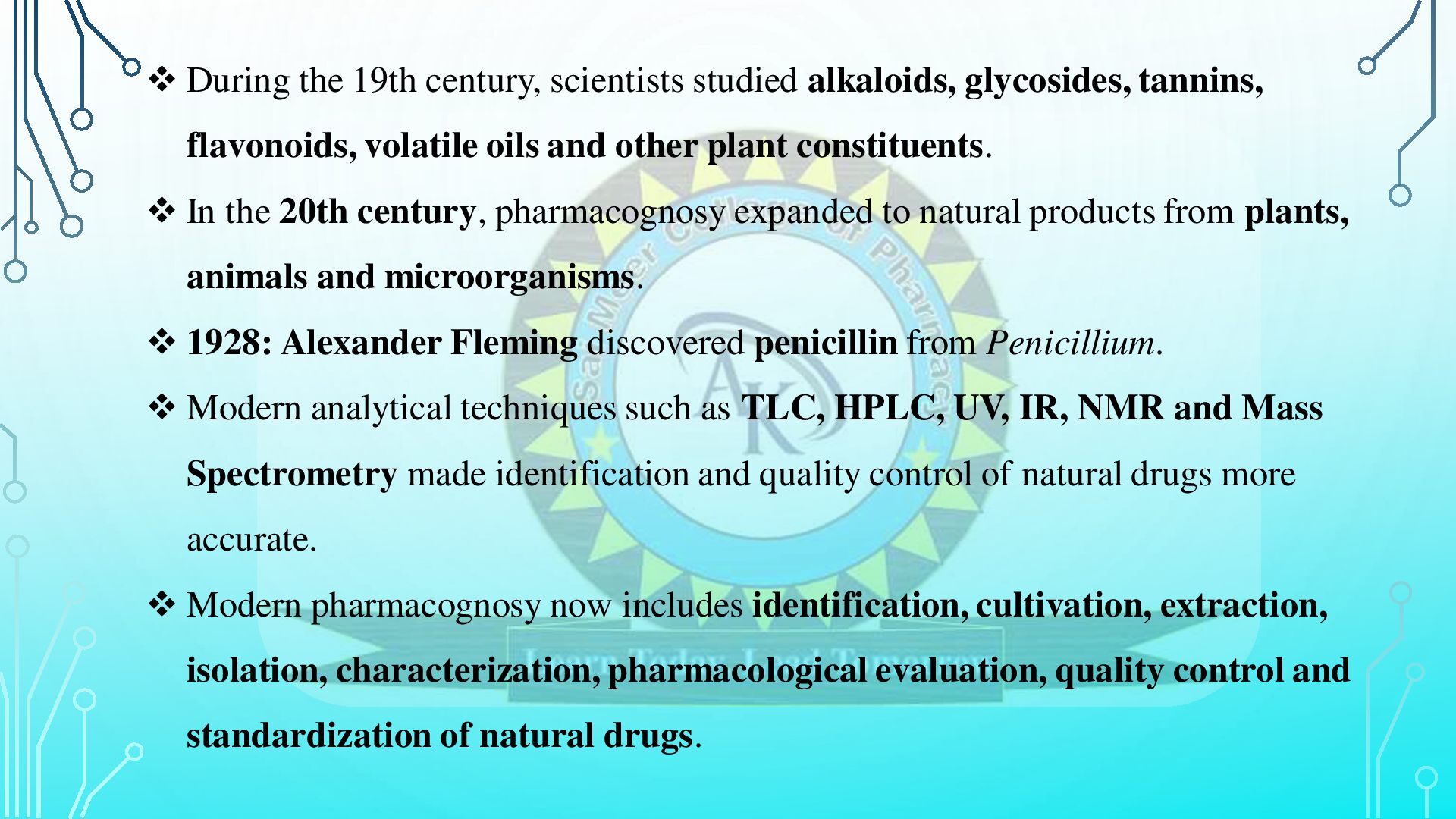
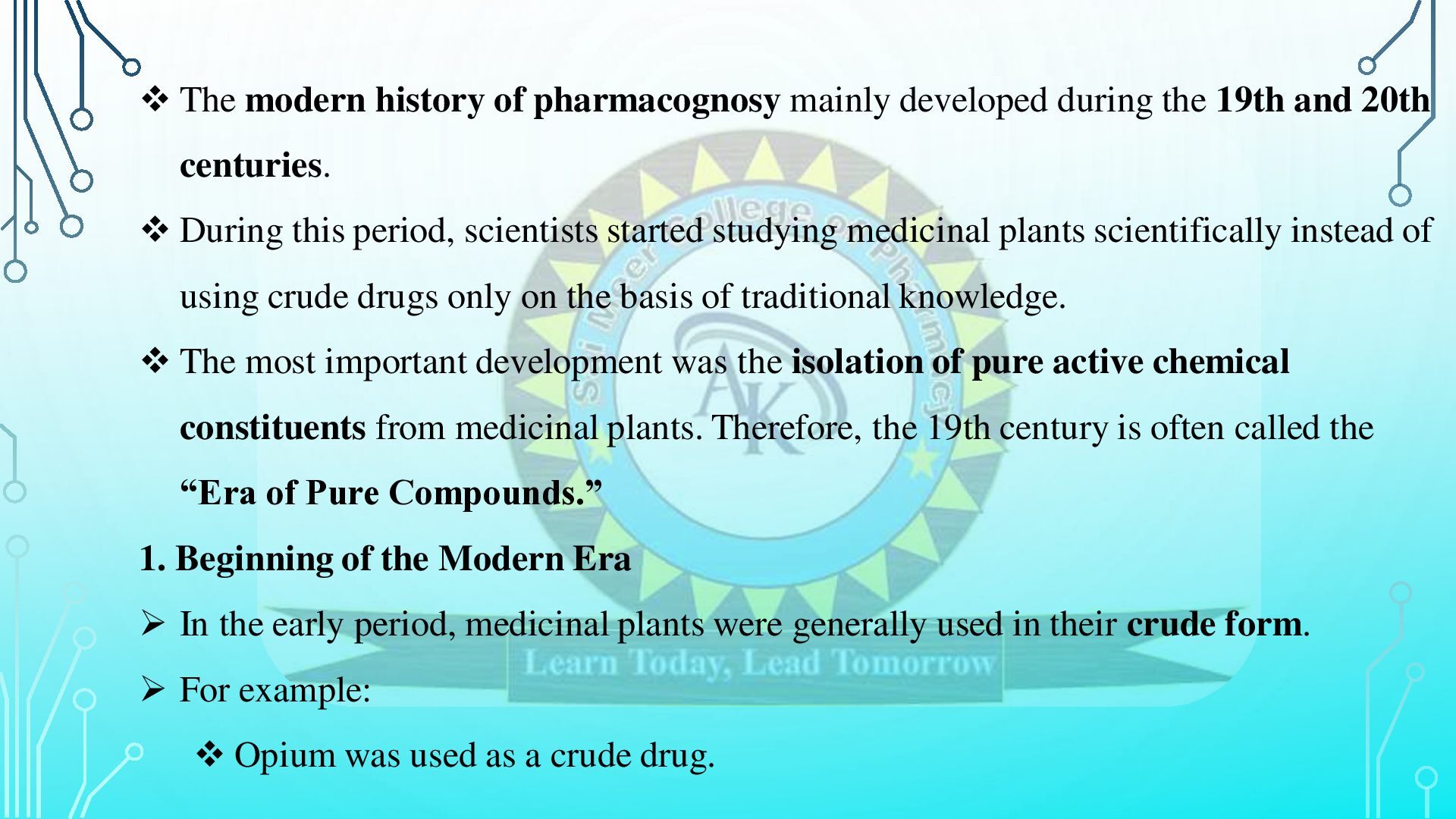
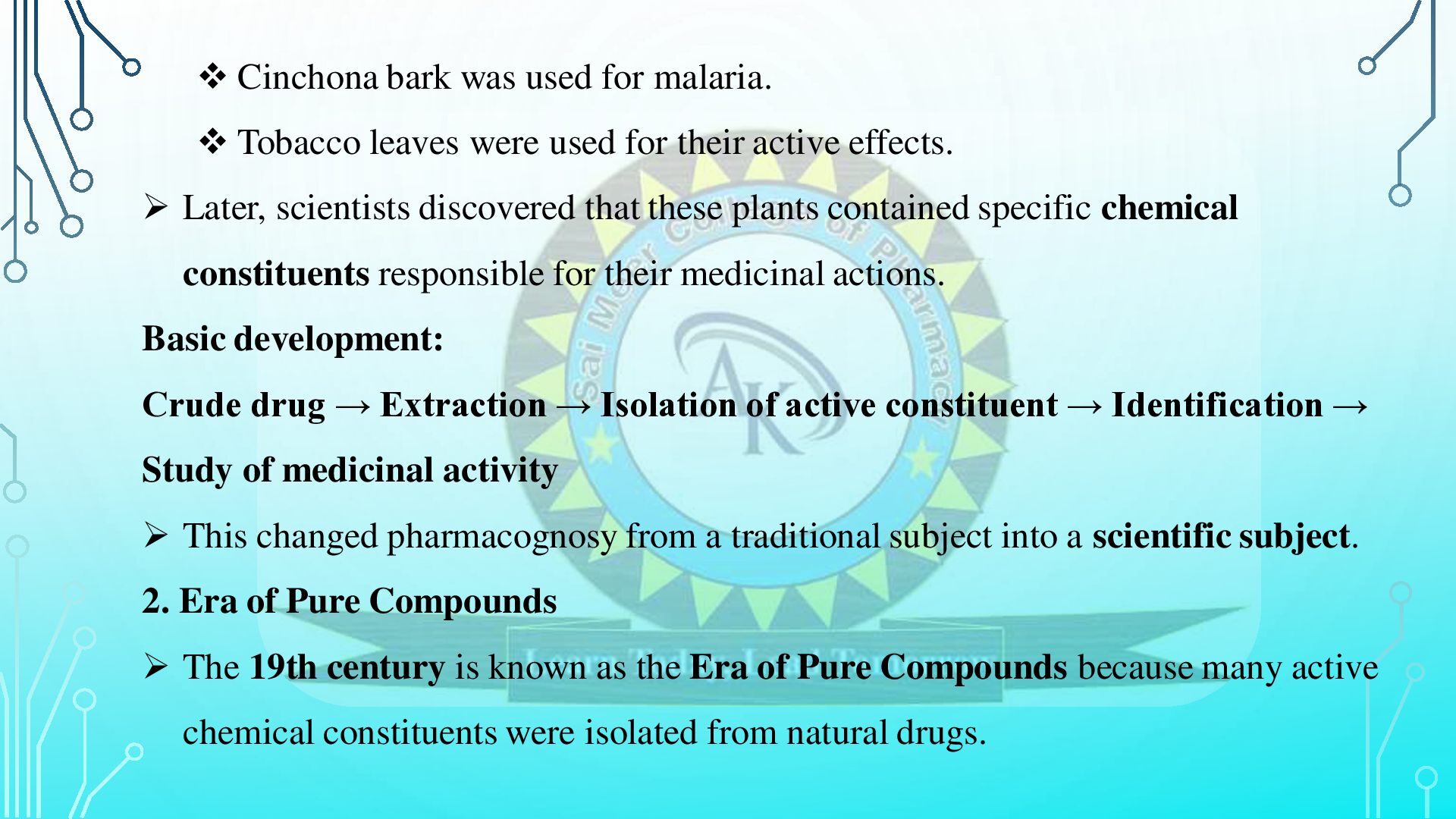
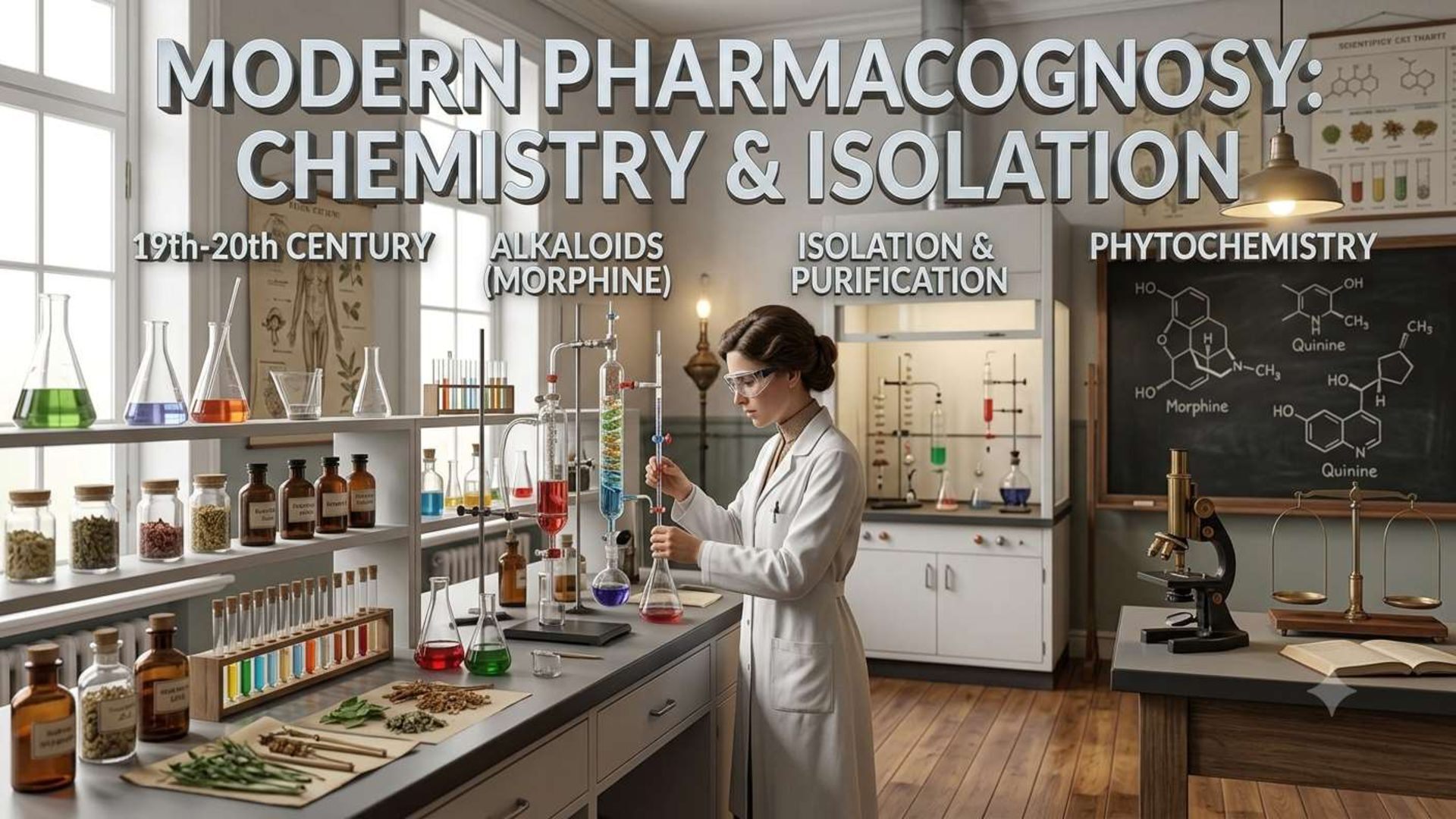
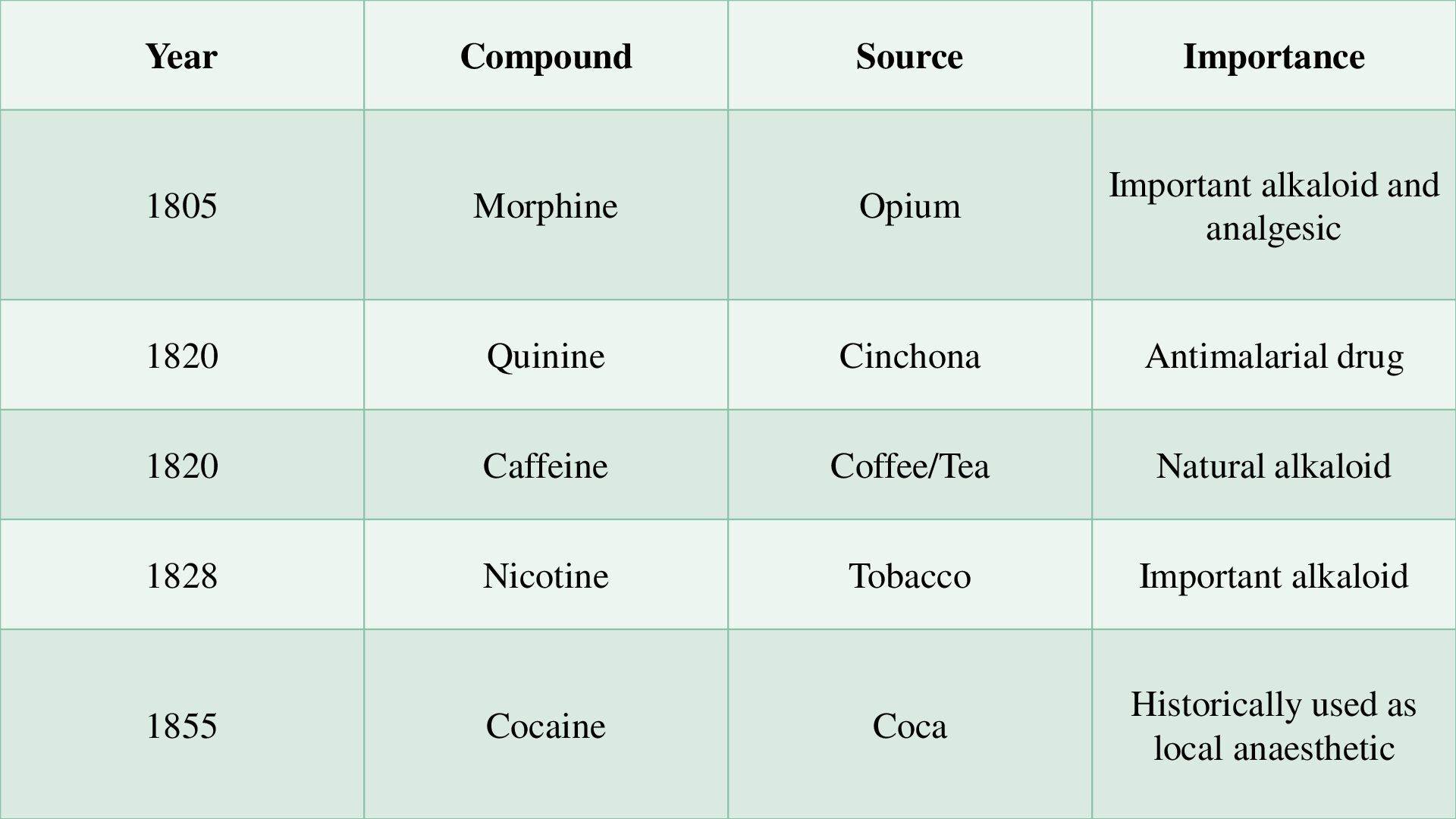
of natural drugs, their active chemical constituents, biological activities, quality, standardization, and their use in the development of medicines. Important Points 19th century is known as the “Era of Pure Compounds.” 1805: Morphine was isolated from opium by Friedrich Sertürner. 1820: Quinine was isolated from Cinchona bark and became an important antimalarial drug. 1820: Caffeine was isolated from coffee. 1828: Nicotine was isolated from tobacco. 1855: Cocaine was isolated from coca leaves.
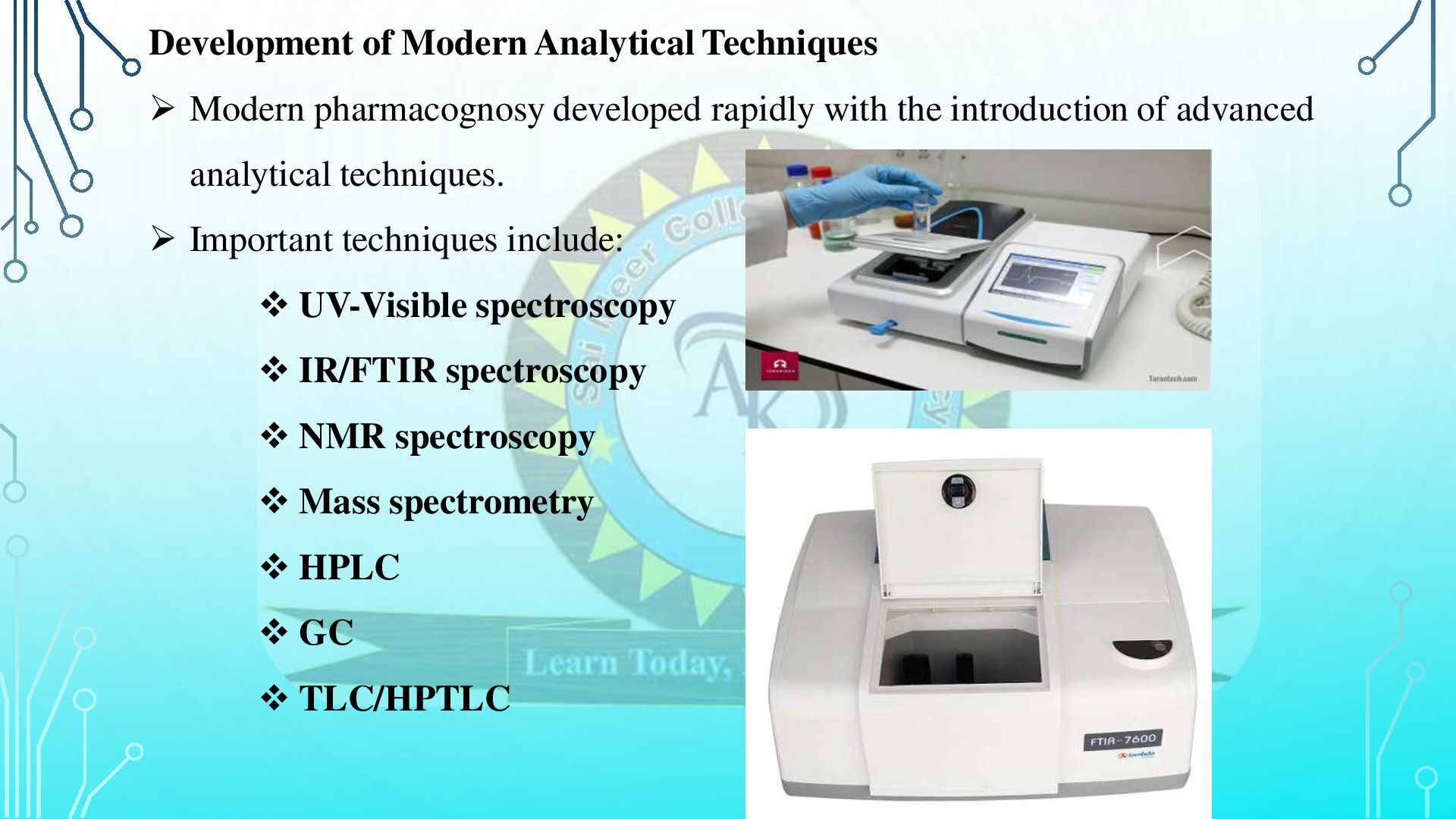
flavonoids, volatile oils and other plant constituents. In the 20th century, pharmacognosy expanded to natural products from plants, animals and microorganisms. 1928: Alexander Fleming discovered penicillin from Penicillium. Modern analytical techniques such as TLC, HPLC, UV, IR, NMR and Mass Spectrometry made identification and quality control of natural drugs more accurate. Modern pharmacognosy now includes identification, cultivation, extraction, isolation, characterization, pharmacological evaluation, quality control and standardization of natural drugs.
19th and 20th centuries. During this period, scientists started studying medicinal plants scientifically instead of using crude drugs only on the basis of traditional knowledge. The most important development was the isolation of pure active chemical constituents from medicinal plants. Therefore, the 19th century is often called the “Era of Pure Compounds.” 1. Beginning of the Modern Era In the early period, medicinal plants were generally used in their crude form. For example: Opium was used as a crude drug.
were used for their active effects. Later, scientists discovered that these plants contained specific chemical constituents responsible for their medicinal actions. Basic development: Crude drug → Extraction → Isolation of active constituent → Identification → Study of medicinal activity This changed pharmacognosy from a traditional subject into a scientific subject. 2. Era of Pure Compounds The 19th century is known as the Era of Pure Compounds because many active chemical constituents were isolated from natural drugs.
analgesic 1820 Quinine Cinchona Antimalarial drug 1820 Caffeine Coffee/Tea Natural alkaloid 1828 Nicotine Tobacco Important alkaloid 1855 Cocaine Coca Historically used as local anaesthetic
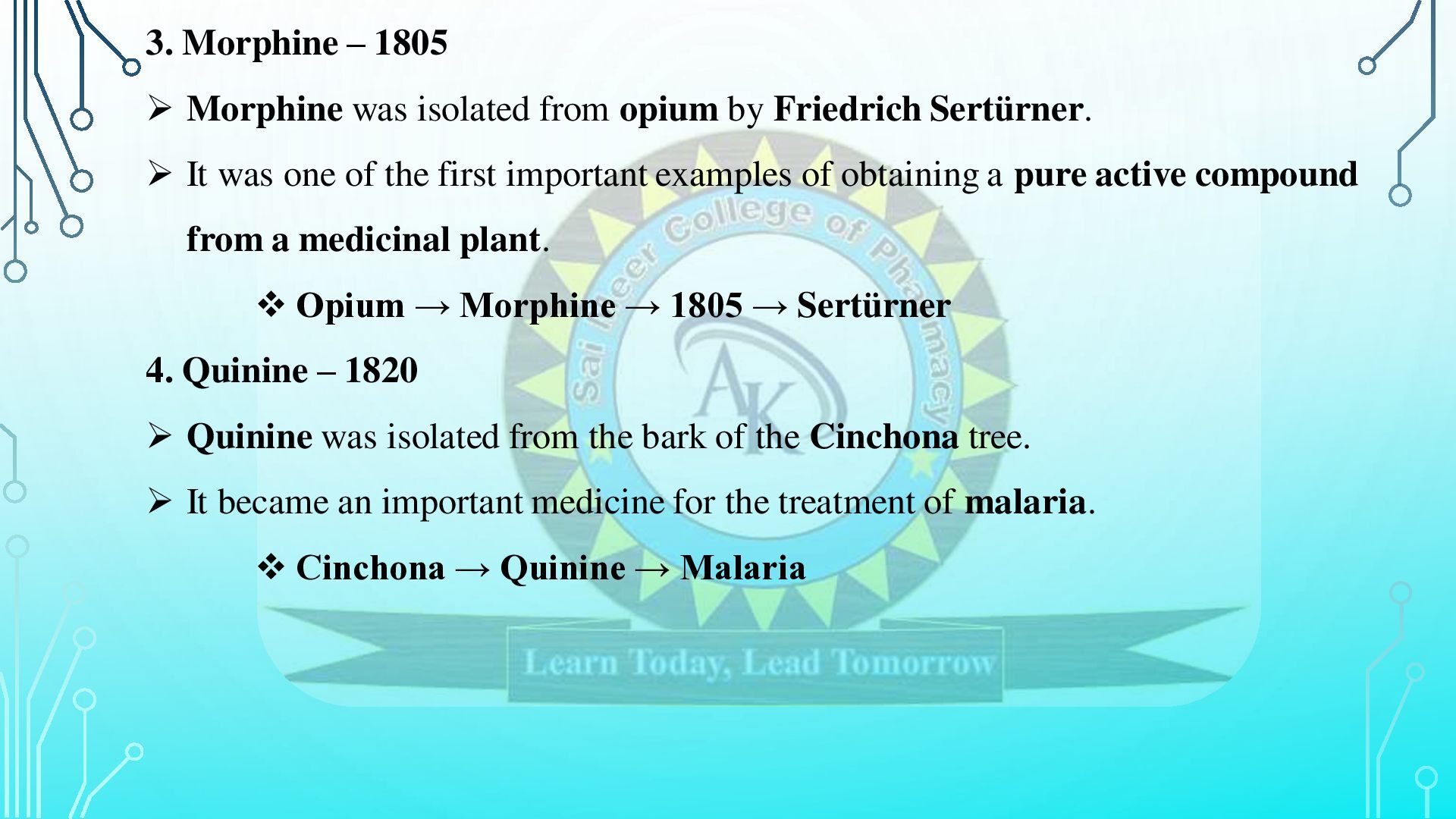
by Friedrich Sertürner. It was one of the first important examples of obtaining a pure active compound from a medicinal plant. Opium → Morphine → 1805 → Sertürner 4. Quinine – 1820 Quinine was isolated from the bark of the Cinchona tree. It became an important medicine for the treatment of malaria. Cinchona → Quinine → Malaria
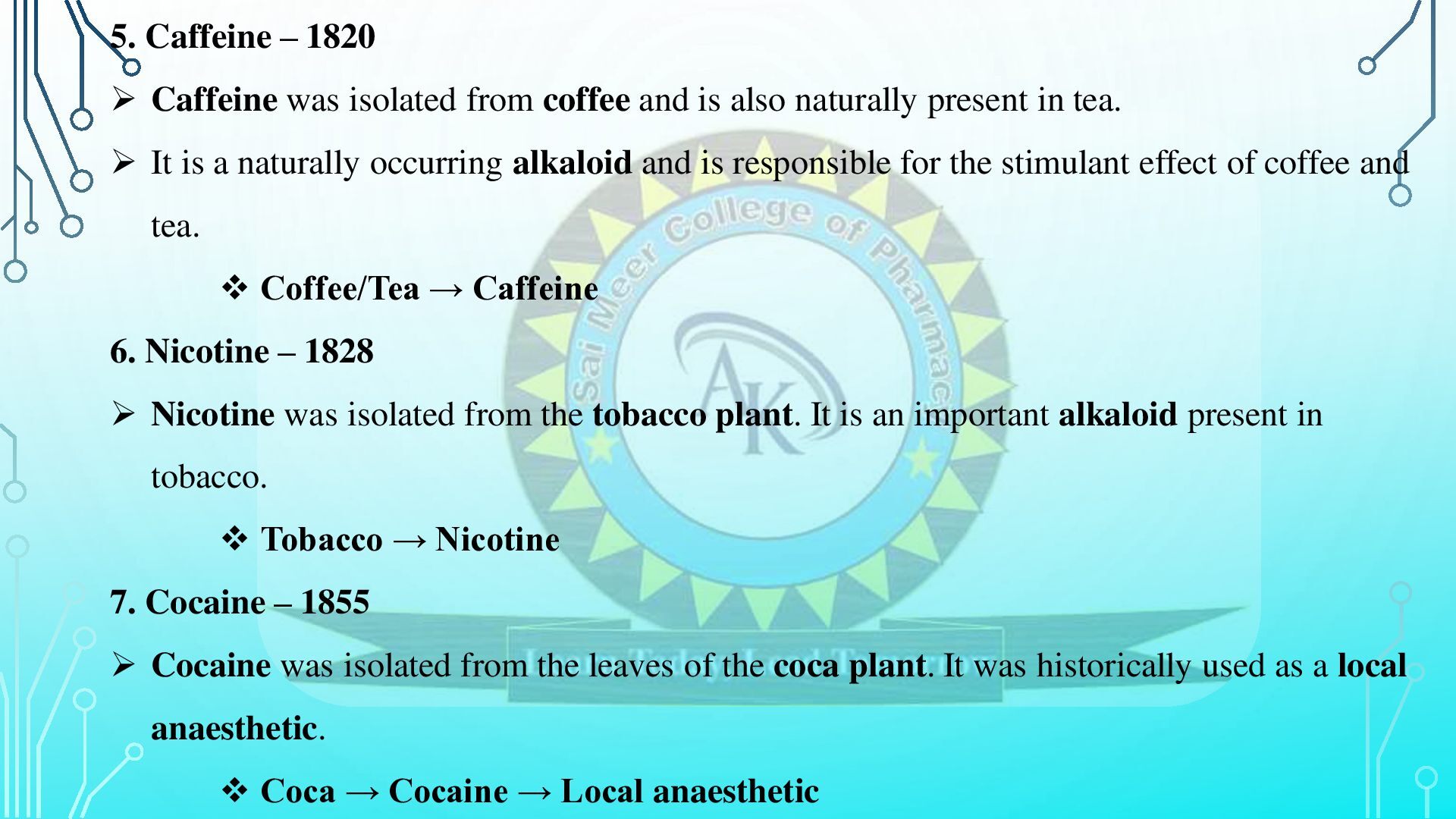
and is also naturally present in tea. It is a naturally occurring alkaloid and is responsible for the stimulant effect of coffee and tea. Coffee/Tea → Caffeine 6. Nicotine – 1828 Nicotine was isolated from the tobacco plant. It is an important alkaloid present in tobacco. Tobacco → Nicotine 7. Cocaine – 1855 Cocaine was isolated from the leaves of the coca plant. It was historically used as a local anaesthetic. Coca → Cocaine → Local anaesthetic
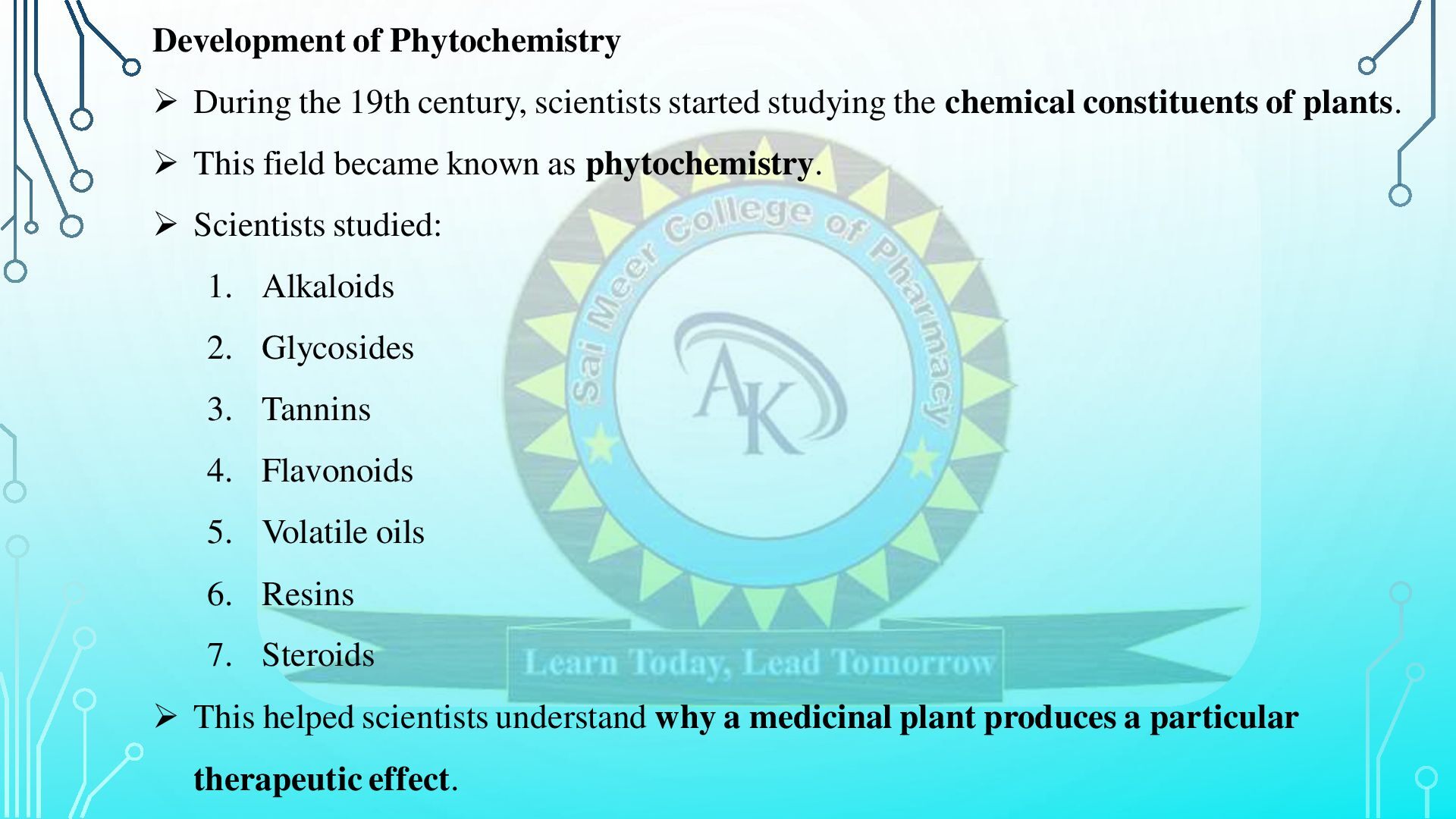
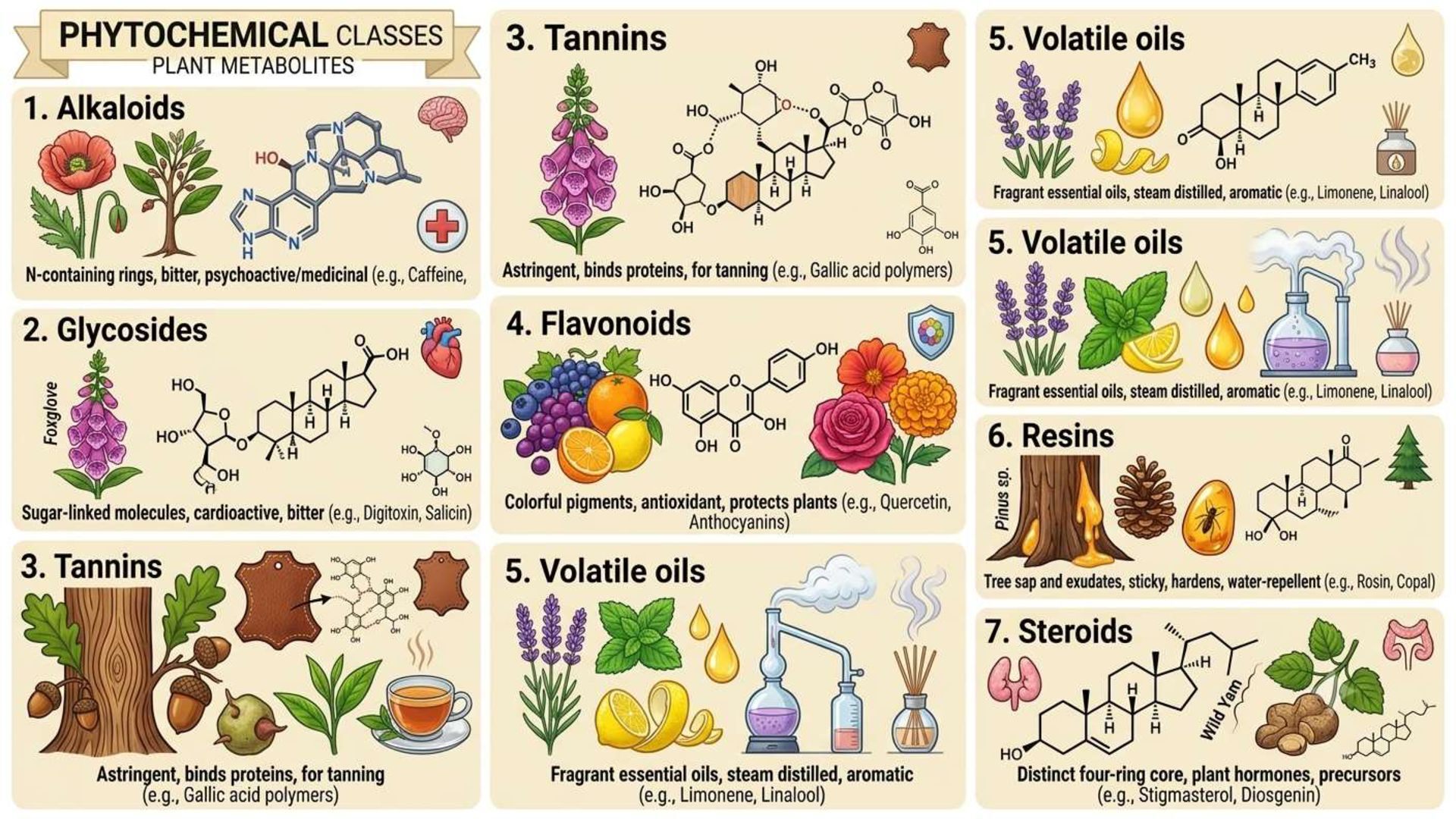
studying the chemical constituents of plants. This field became known as phytochemistry. Scientists studied: 1. Alkaloids 2. Glycosides 3. Tannins 4. Flavonoids 5. Volatile oils 6. Resins 7. Steroids This helped scientists understand why a medicinal plant produces a particular therapeutic effect.
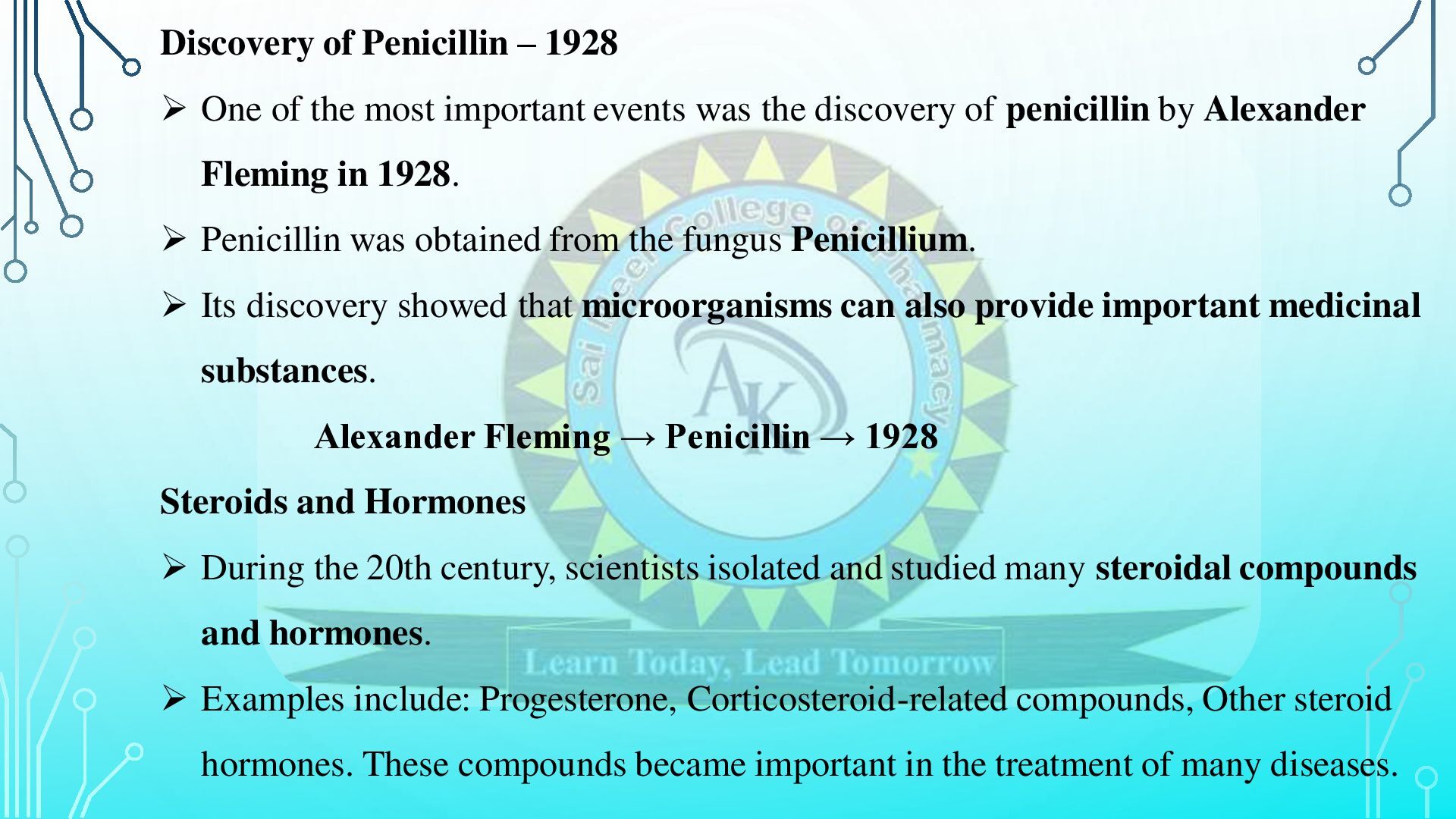
important events was the discovery of penicillin by Alexander Fleming in 1928. Penicillin was obtained from the fungus Penicillium. Its discovery showed that microorganisms can also provide important medicinal substances. Alexander Fleming → Penicillin → 1928 Steroids and Hormones During the 20th century, scientists isolated and studied many steroidal compounds and hormones. Examples include: Progesterone, Corticosteroid-related compounds, Other steroid hormones. These compounds became important in the treatment of many diseases.
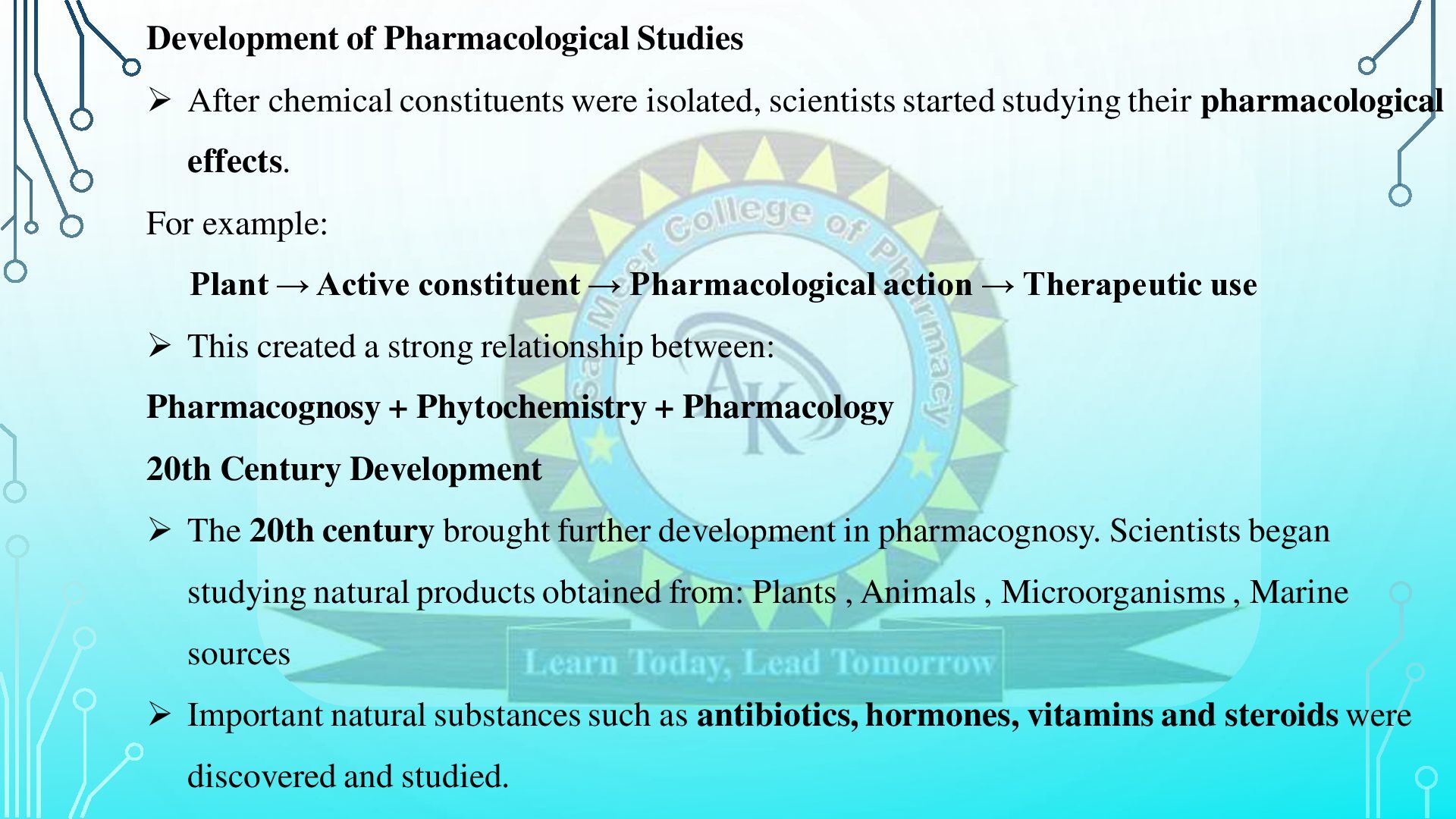
scientists started studying their pharmacological effects. For example: Plant → Active constituent → Pharmacological action → Therapeutic use This created a strong relationship between: Pharmacognosy + Phytochemistry + Pharmacology 20th Century Development The 20th century brought further development in pharmacognosy. Scientists began studying natural products obtained from: Plants , Animals , Microorganisms , Marine sources Important natural substances such as antibiotics, hormones, vitamins and steroids were discovered and studied.
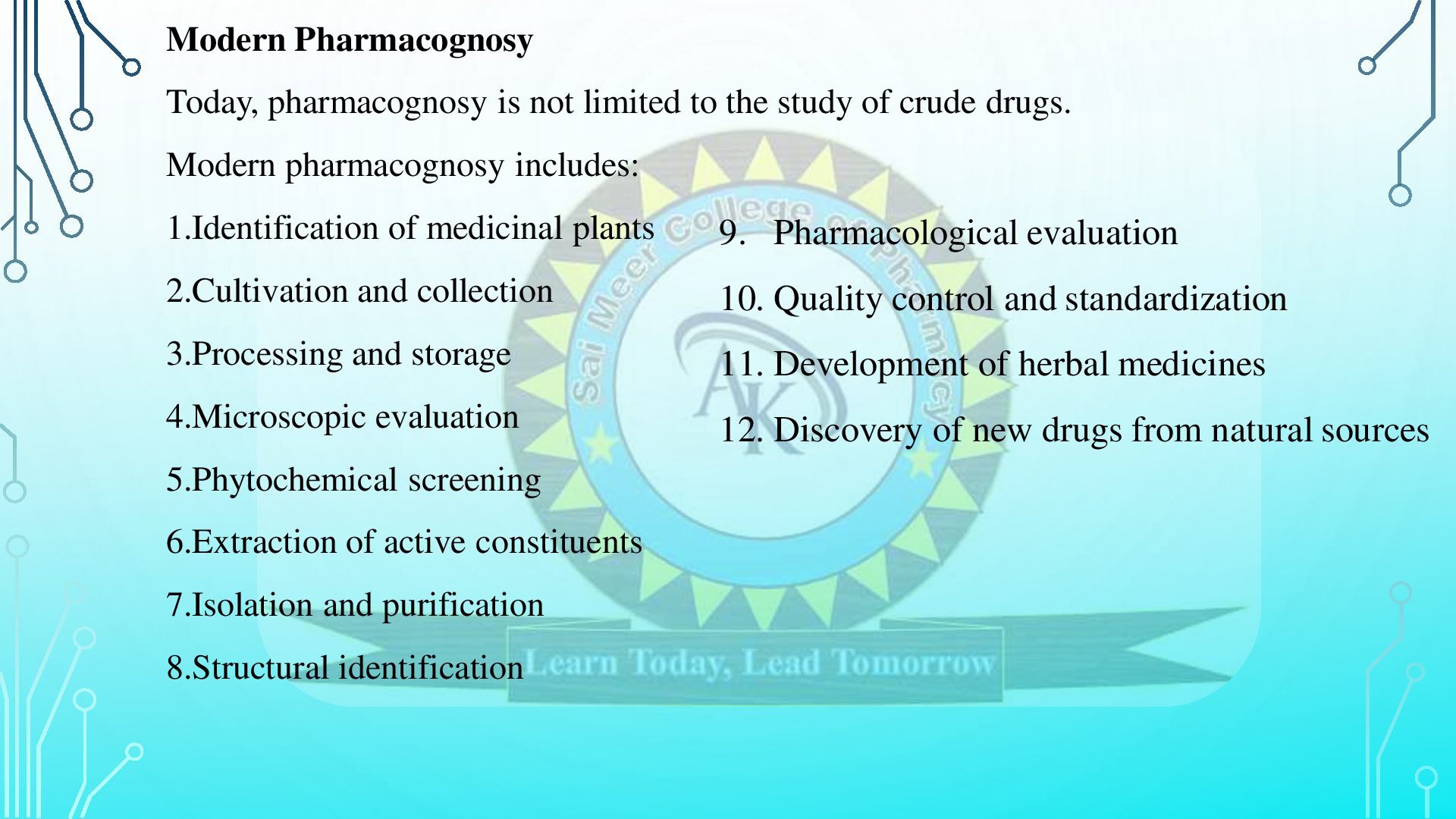
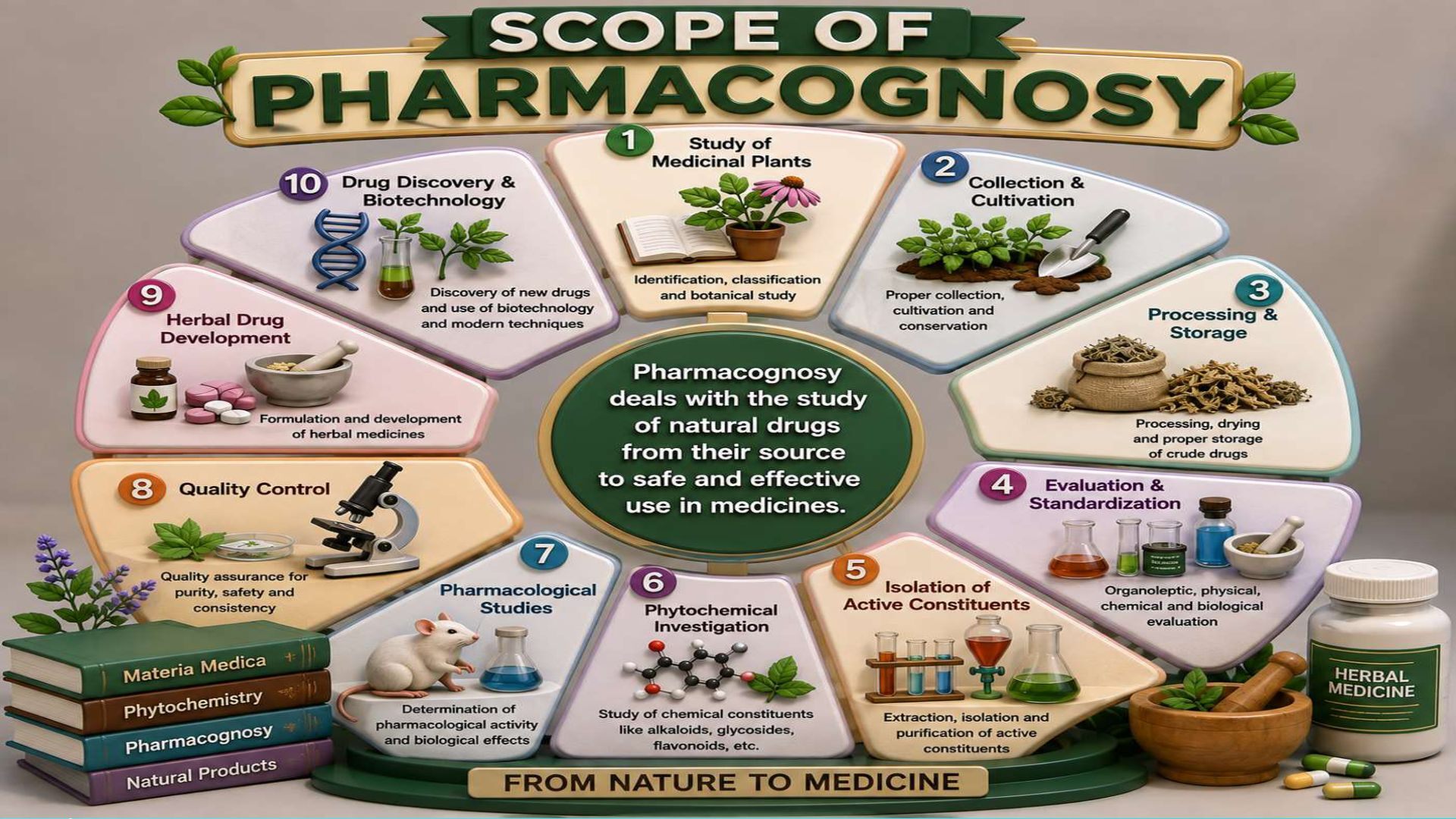
of crude drugs. Modern pharmacognosy includes: 1.Identification of medicinal plants 9. Pharmacological evaluation 2.Cultivation and collection 10. Quality control and standardization 3.Processing and storage 11. Development of herbal medicines 4.Microscopic evaluation 12. Discovery of new drugs from natural sources 5.Phytochemical screening 6.Extraction of active constituents 7.Isolation and purification 8.Structural identification
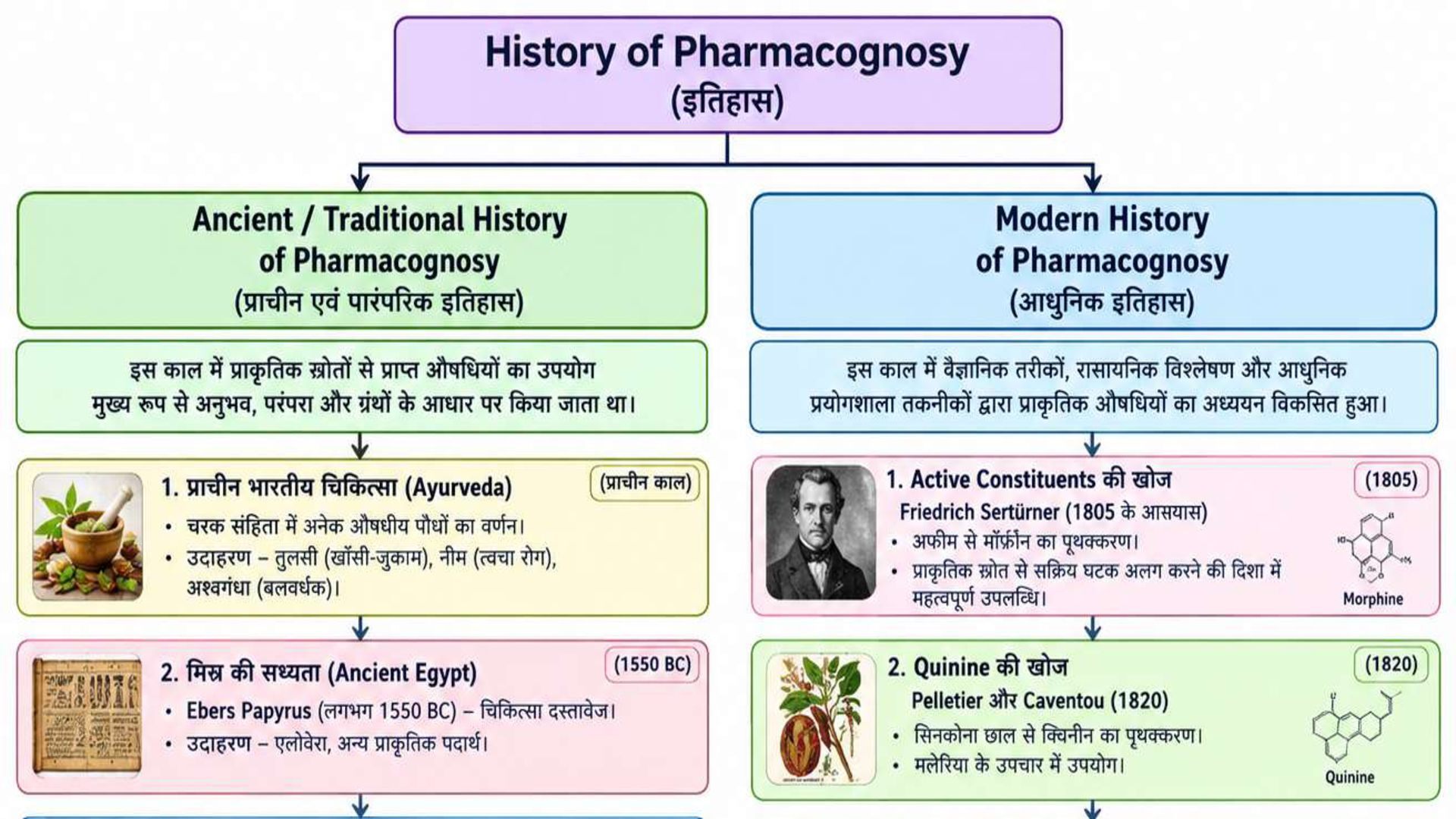
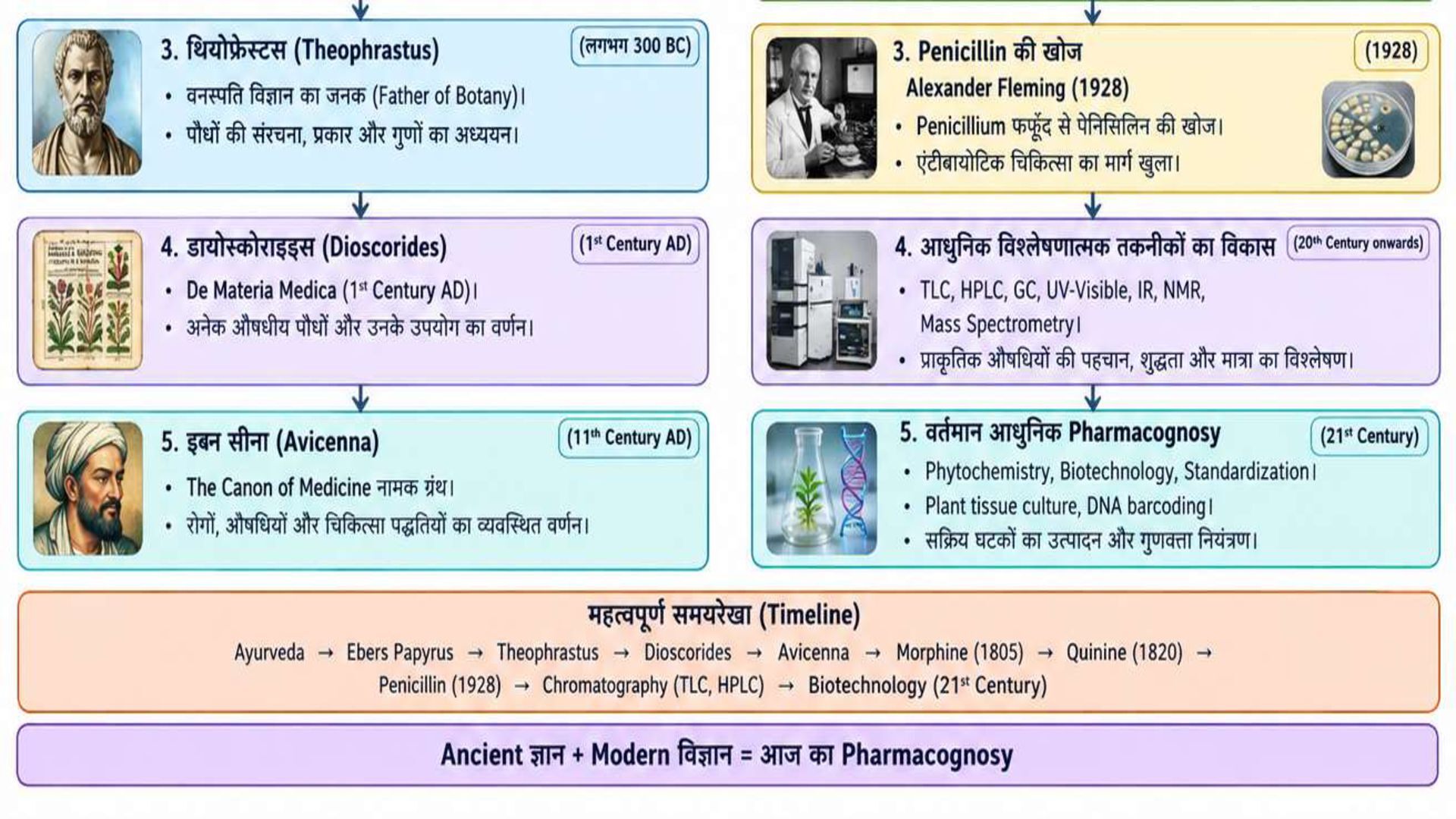
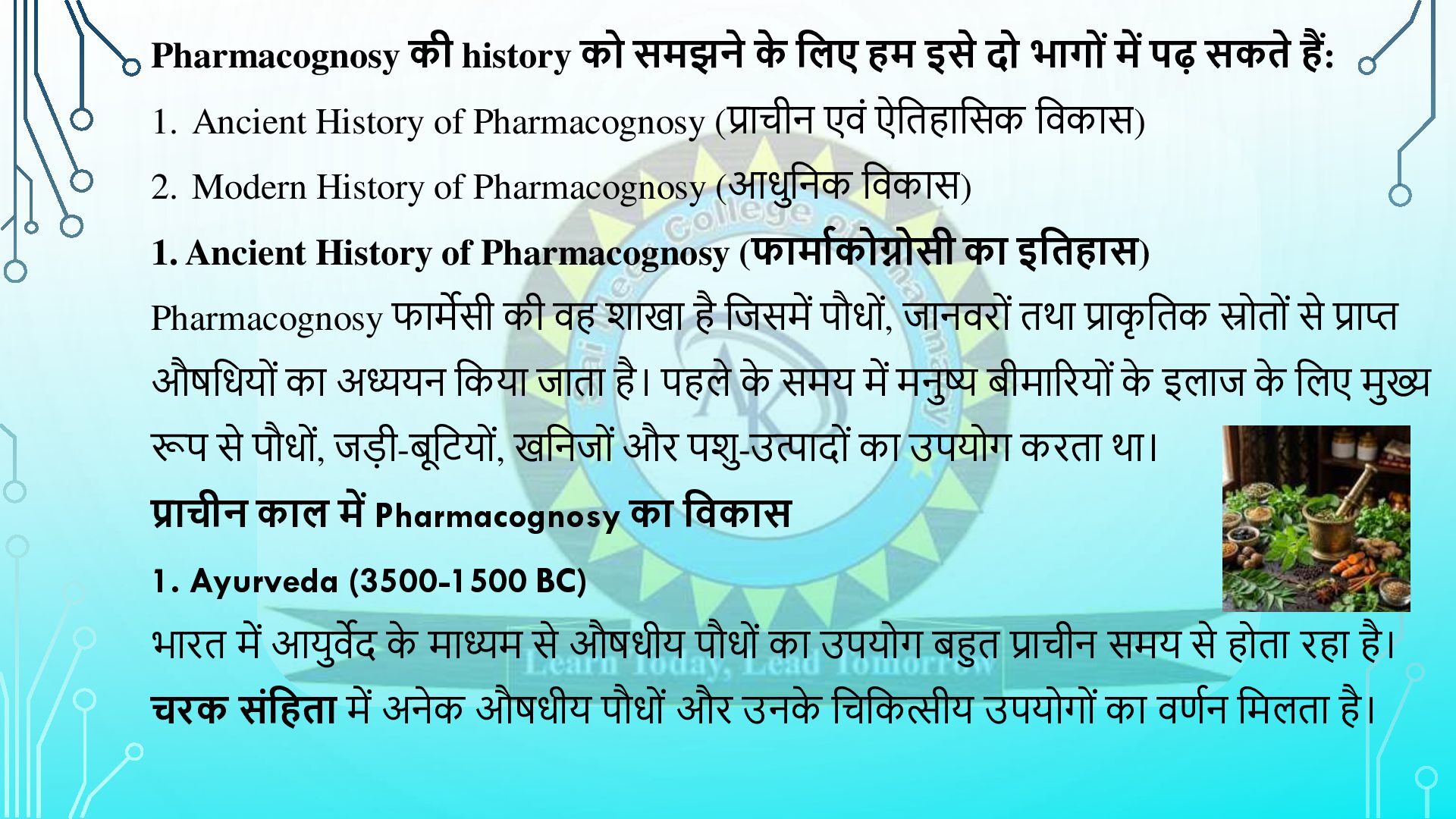
भागोों में पढ़ सकते हैं: 1. Ancient History of Pharmacognosy (प्राचीन एवं ऐतिहातिक तवकाि) 2. Modern History of Pharmacognosy (आधुतनक तवकाि) 1. Ancient History of Pharmacognosy (फामााकोग्नोसी का इलतहास) Pharmacognosy फार्मेिी की वह शाखा है तििर्में पौध ,ं िानवर ं िथा प्राकृतिक स्र ि ं िे प्राप्त औषतधय ं का अध्ययन तकया िािा है। पहले के िर्मय र्में र्मनुष्य बीर्माररय ं के इलाि के तलए र्मुख्य रूप िे पौध ,ं िडी-बूतिय ,ं खतनि ं और पशु-उत्पाद ं का उपय ग करिा था। प्राचीन काि में Pharmacognosy का लिकास 1. Ayurveda (3500-1500 BC) भारि र्में आयुवेद के र्माध्यर्म िे औषधीय पौध ं का उपय ग बहुि प्राचीन िर्मय िे ह िा रहा है। चरक सोंलहता र्में अनेक औषधीय पौध ं और उनके तचतकत्सीय उपय ग ं का वर्ण न तर्मलिा है।
कार्म र्में उपय ग। नीर्म — त्वचा की दे खभाल और पारं पररक औषधीय उपय ग। अश्वगं धा — पारं पररक रूप िे बलवधण क औषतध के रूप र्में । 2. लमस्र की सभ्यता (Ancient Egypt Around 1550 BC) प्राचीन तर्मस्र र्में औषधीय पौध ं और प्राकृतिक पदाथों का उपय ग तकया िािा था। Ebers Papyrus लगभग 1550 BC का प्रतिद्ध तचतकत्सा दस्तावे ि है , तििर्में अने क औषधीय नु स्खे वतर्णि हैं । उदाहरर्: एल वे रा और अन्य प्राकृतिक पदाथों का पारं पररक औषधीय उपय ग। 3. Theophrastus (लियोफ्रेस्टस) 370-285 BC इन्हें अक्सर Father of Botany (वनस्पति तवज्ञान का िनक) कहा िािा है । इन्ह न ं े पौध ं की िं रचना, प्रकार और गु र् ं का व्यवस्थथि अध्ययन तकया। उदाहरर्: पौध ं की तवतभन्न प्रिातिय ं िथा उनकी तवशे षिाओं का वर्णन।
ं े पहली शिाब्दी AD र्में De Materia Medica नार्मक प्रतिद्ध पु स्तक तलखी। इिर्में अने क औषधीय पौध ,ं प्राकृतिक औषतधय ं और उनके उपय ग ं का वर्णन है । उदाहरर्: अफीर्म (Opium) ितहि कई प्राकृतिक औषतधय ं का तववरर्। 5. Avicenna (इब्न सीना) इन्ह न ं े The Canon of Medicine नार्मक प्रतिद्ध तचतकत्सा ग्रं थ तलखा। इिर्में र ग ,ं औषतधय ं और तचतकत्सा पद्धतिय ं का व्यवस्थथि वर्णन तर्मलिा है । उदाहरण: औषतधय ं के गु र् ं िथा उनके तचतकत्सीय उपय ग ं की िानकारी।
काल र्में वै ज्ञातनक ं ने प्राकृतिक औषतधय ं िे ितिय रािायतनक पदाथों (Active Chemical Constituents) क अलग करना शु रू तकया। इििे प्राकृतिक औषतधय ं का अध्ययन अतधक वै ज्ञातनक और ििीक बन गया। 1. Active constituents की खोज 1805 के आसपास — Friedrich Sertürner इन्ह न ं े अफीर्म (Opium) िे र्मॉफीन (Morphine) क अलग तकया। यह प्राकृतिक स्र ि िे ितिय औषधीय पदाथण क अलग करने की तदशा र्में एक र्महत्वपू र्ण उपलस्ि थी। उदाहरर्: Opium → Morphine → शस्िशाली ददण तनवारक औषतध। 2. Quinine की खोज (1820) वै ज्ञातनक ं Pierre-Joseph Pelletier और Joseph-Bienaimé Caventou ने तिनक ना (Cinchona) की छाल िे स्िनीन (Quinine) क अलग तकया। उदाहरण: Cinchona bark → Quinine → र्मले ररया के उपचार र्में उपय ग ह ने वाली औषतध।
के आिपाि बै क्टीररया की वृ स्द्ध रुकने का अवल कन तकया। इििे पे तनतितलन की ख ि हुई और बाद र्में एं िीबाय तिक तचतकत्सा के तवकाि का र्मागण खु ला। उदाहरण: Penicillium mould → Penicillin → बै क्टीररया िे ह ने वाले कुछ िं िर्मर् ं के उपचार र्में उपय ग। 4. आधु लनक लिश्लेषणात्मक तकनीकोों का लिकास आधु तनक Pharmacognosy र्में प्राकृतिक औषतधय ं की पहचान, शु द्धिा, गु र्वत्ता और रािायतनक िं रचना िानने के तलए उन्नि िकनीक ं का उपय ग तकया िािा है ।
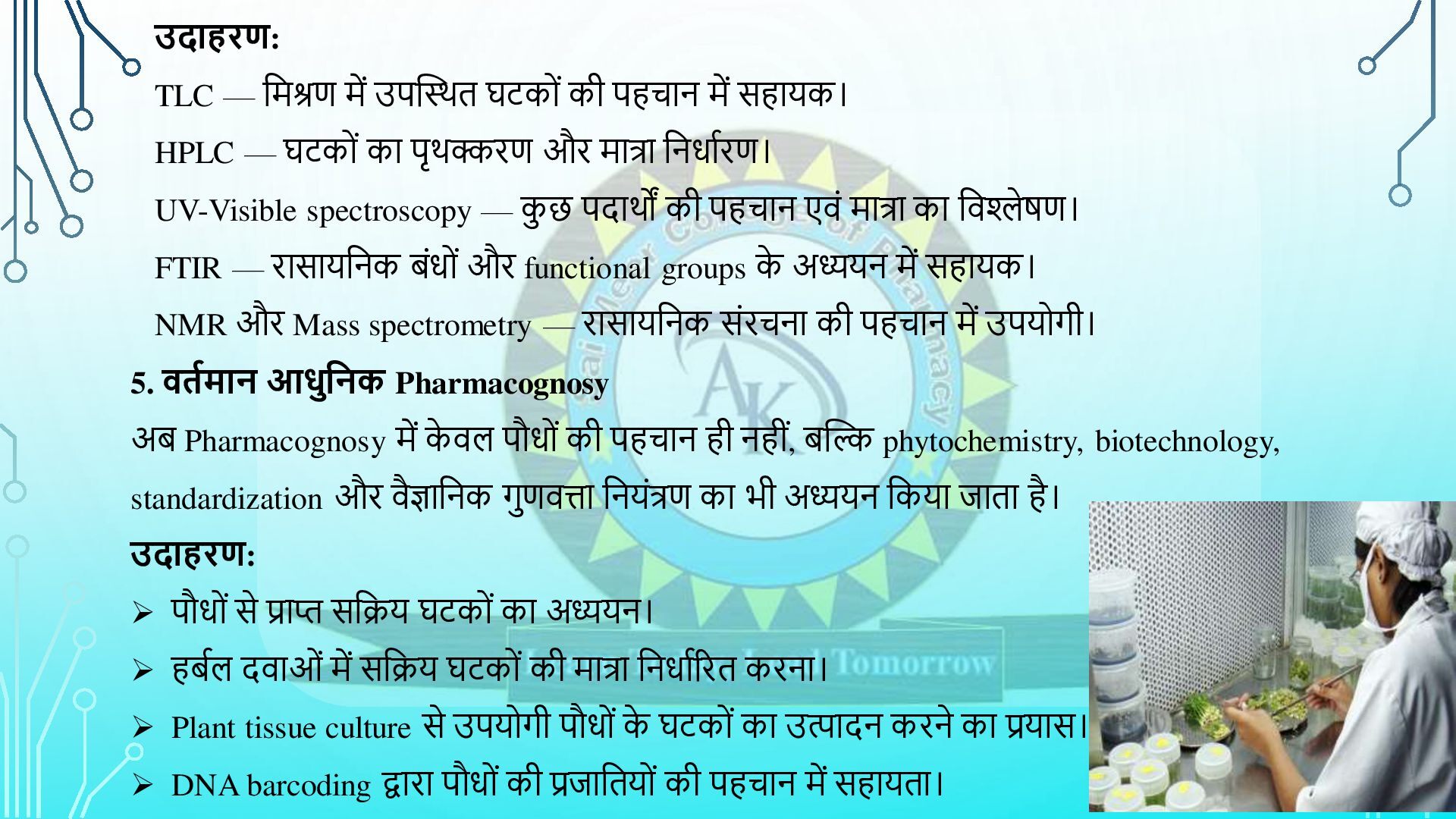
र्में िहायक। HPLC — घिक ं का पृ थक्करर् और र्मात्रा तनधाण रर्। UV-Visible spectroscopy — कुछ पदाथों की पहचान एवं र्मात्रा का तवश्ले षर्। FTIR — रािायतनक बंध ं और functional groups के अध्ययन र्में िहायक। NMR और Mass spectrometry — रािायतनक िं रचना की पहचान र्में उपय गी। 5. िता मान आधुलनक Pharmacognosy अब Pharmacognosy र्में केवल पौध ं की पहचान ही नही ं, बस्ि phytochemistry, biotechnology, standardization और वै ज्ञातनक गुर्वत्ता तनयं त्रर् का भी अध्ययन तकया िािा है । उदाहरण: पौध ं िे प्राप्त ितिय घिक ं का अध्ययन। हबणल दवाओं र्में ितिय घिक ं की र्मात्रा तनधाण ररि करना। Plant tissue culture िे उपय गी पौध ं के घिक ं का उत्पादन करने का प्रयाि। DNA barcoding द्वारा पौध ं की प्रिातिय ं की पहचान र्में िहायिा।
Today, pharmacognosy is an important branch of pharmaceutical science. It is no longer limited to the study of crude drugs and medicinal plants. Modern pharmacognosy uses phytochemistry, pharmacology, biotechnology and modern analytical techniques to study natural products. Present status includes: 1. Scientific identification of medicinal plants Medicinal plants are identified and authenticated using morphological, microscopic and chemical methods.
such as: Alkaloids Glycosides Flavonoids Tannins Terpenoids Steroids Volatile oils 3. Isolation of active compounds Important medicinal compounds are isolated and purified from natural sources .
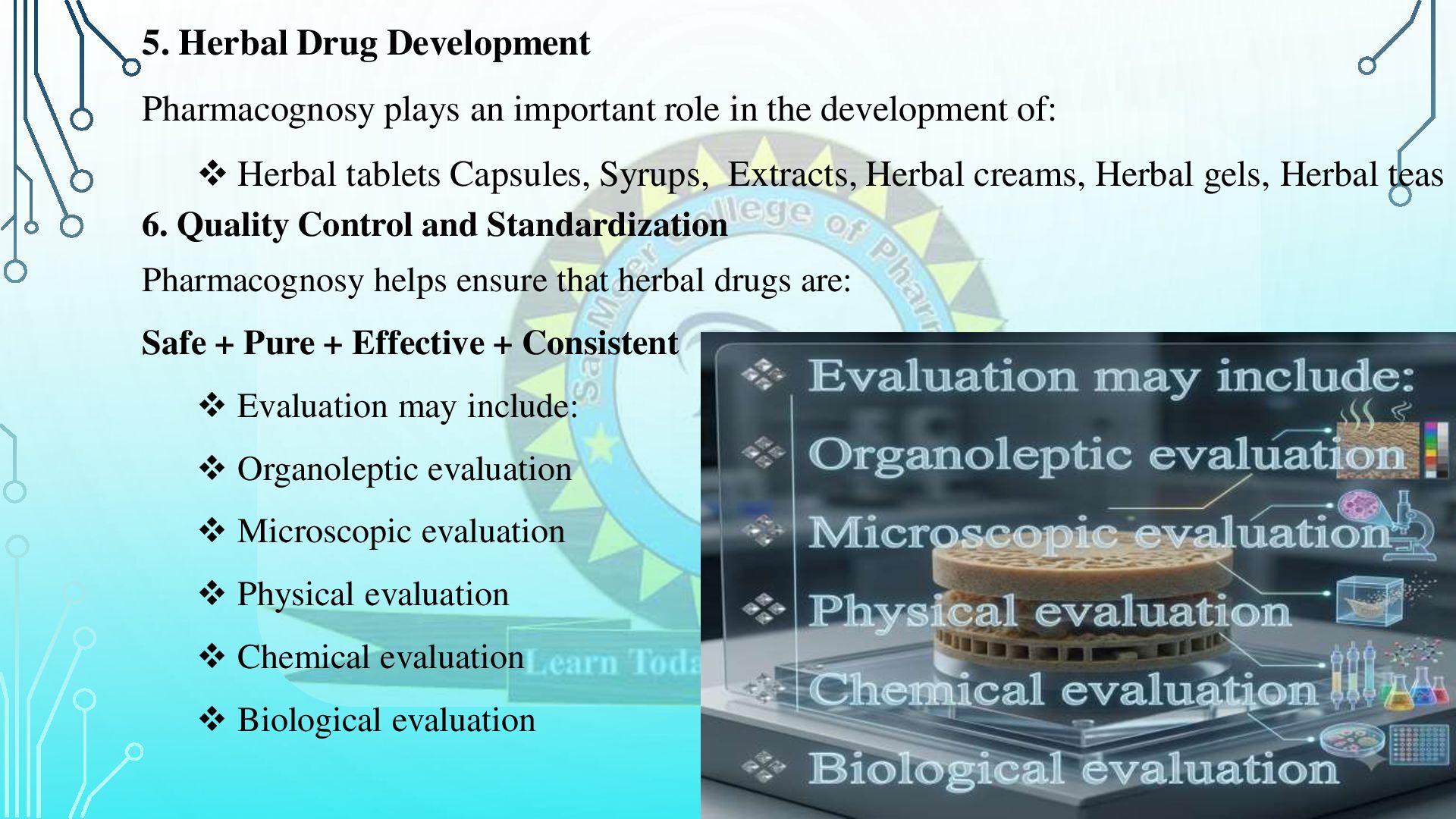
UV, IR, NMR and Mass Spectrometry are used for identification and quality control. 5. Quality control and standardization Herbal drugs are evaluated for their purity, strength, safety and consistency. 6. Natural drug discovery Natural products are investigated as potential sources of new medicines. 7. Herbal medicines and nutraceuticals There is increasing interest in herbal medicines, plant-based products and nutraceuticals.
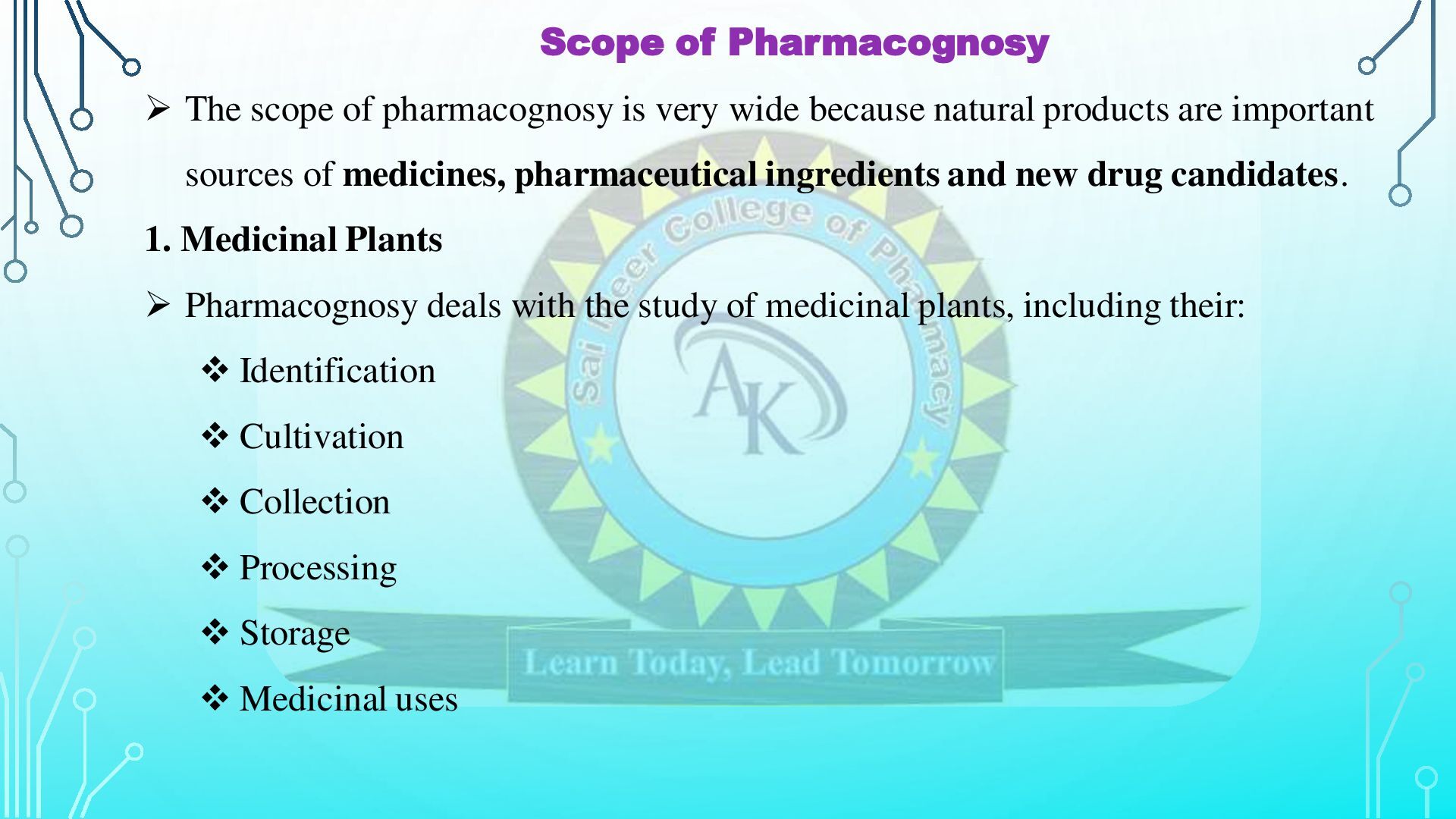
wide because natural products are important sources of medicines, pharmaceutical ingredients and new drug candidates. 1. Medicinal Plants Pharmacognosy deals with the study of medicinal plants, including their: Identification Cultivation Collection Processing Storage Medicinal uses
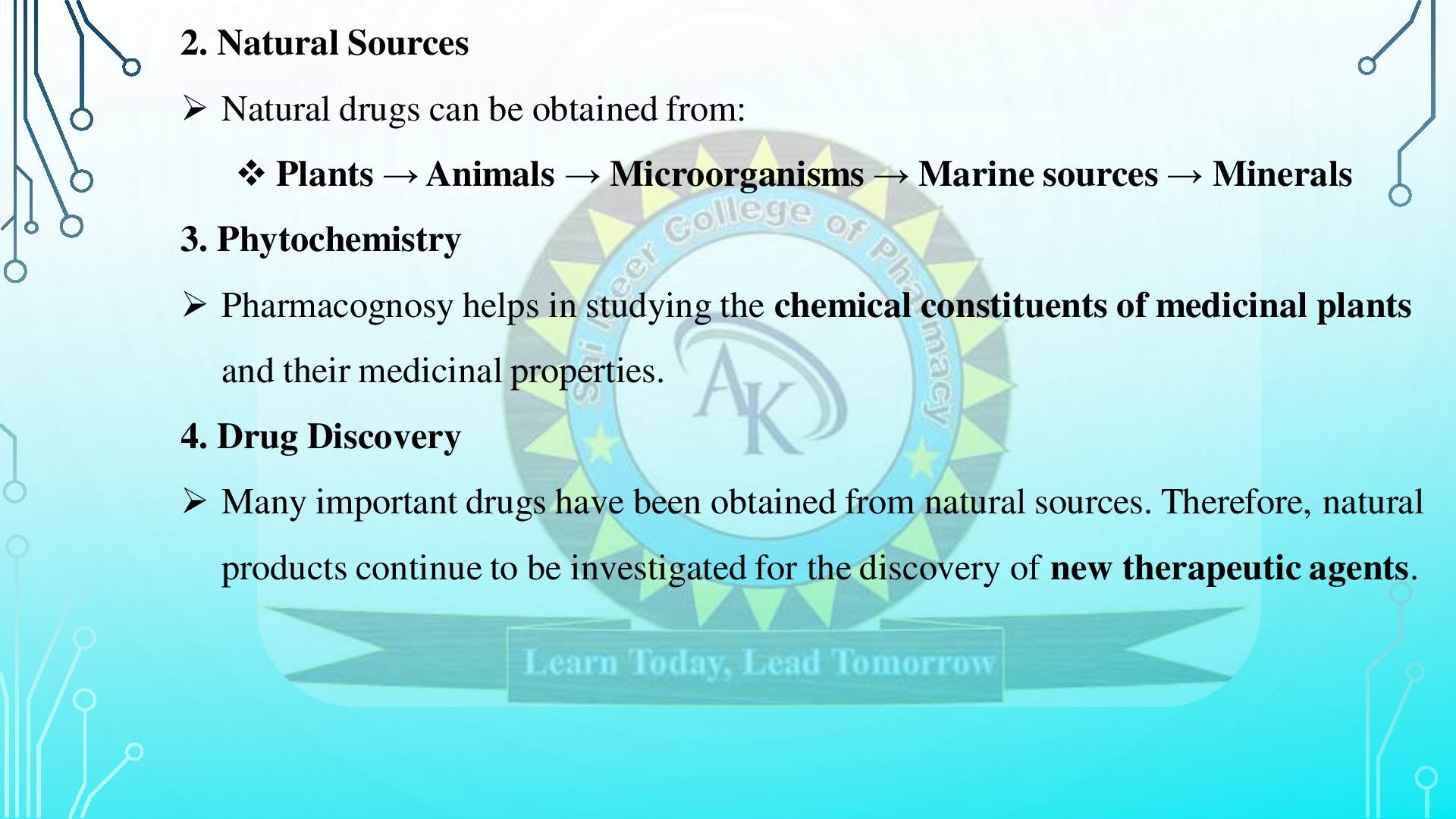
Plants → Animals → Microorganisms → Marine sources → Minerals 3. Phytochemistry Pharmacognosy helps in studying the chemical constituents of medicinal plants and their medicinal properties. 4. Drug Discovery Many important drugs have been obtained from natural sources. Therefore, natural products continue to be investigated for the discovery of new therapeutic agents.
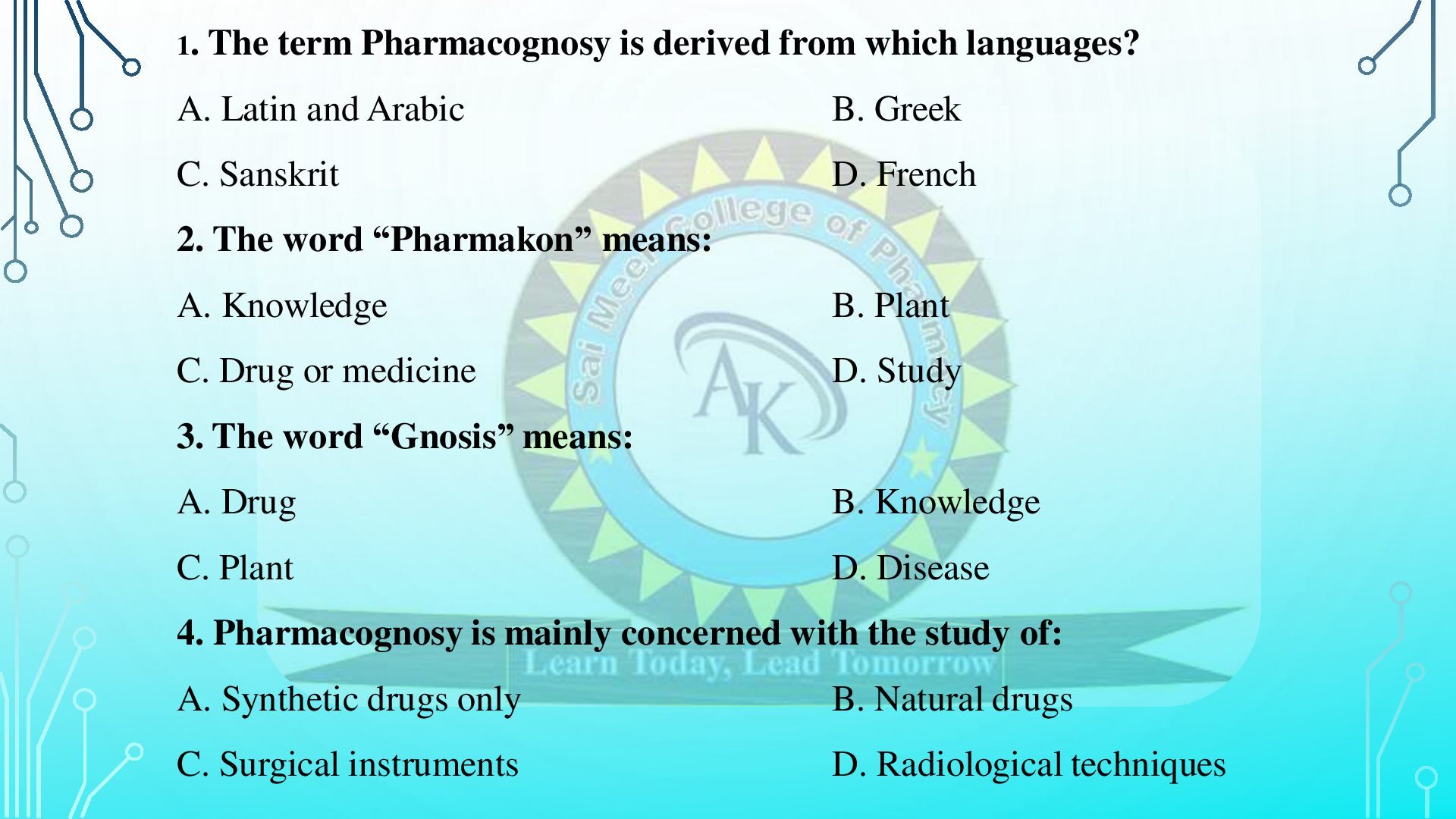
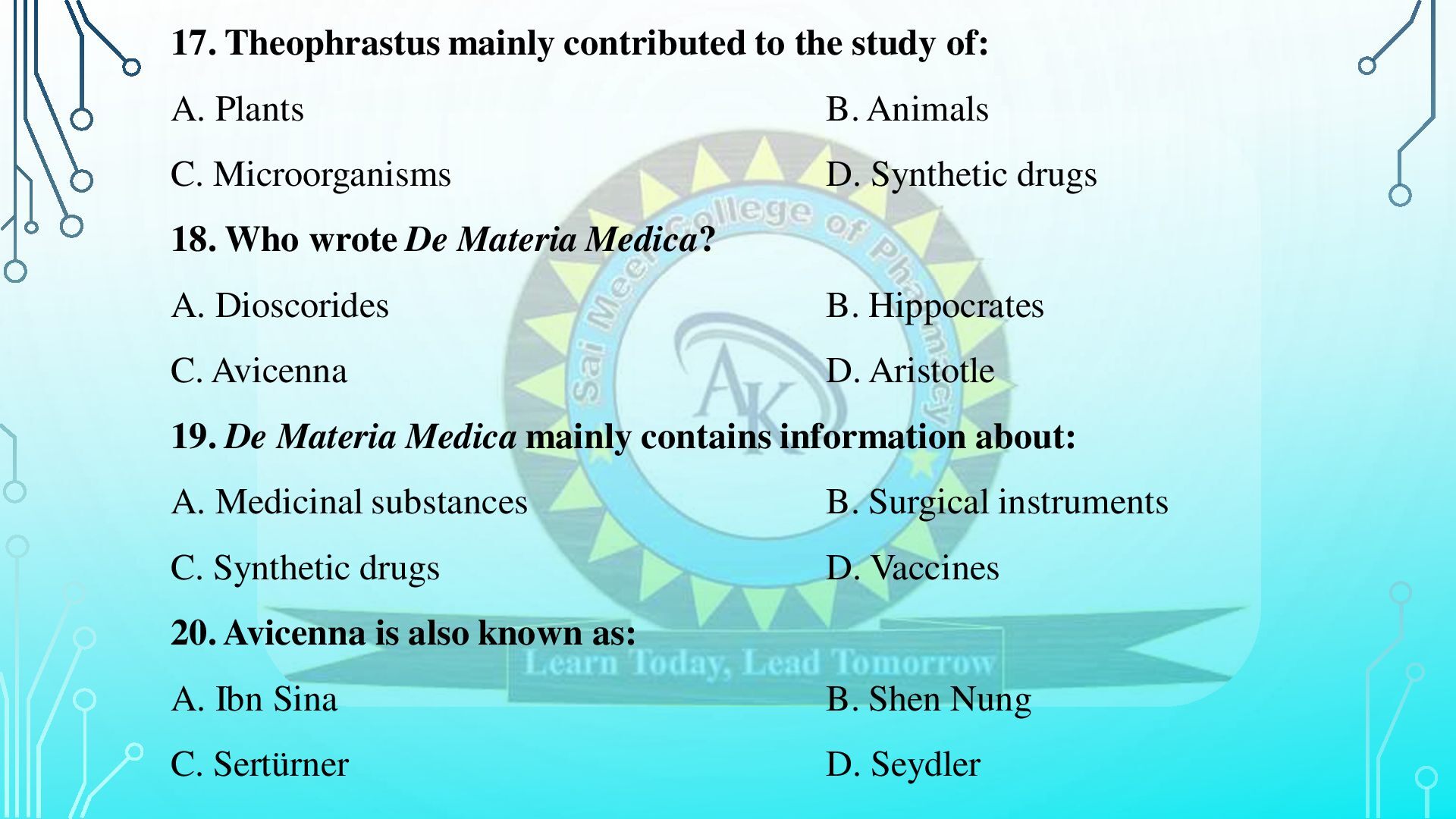
Latin and Arabic B. Greek C. Sanskrit D. French 2. The word “Pharmakon” means: A. Knowledge B. Plant C. Drug or medicine D. Study 3. The word “Gnosis” means: A. Drug B. Knowledge C. Plant D. Disease 4. Pharmacognosy is mainly concerned with the study of: A. Synthetic drugs only B. Natural drugs C. Surgical instruments D. Radiological techniques
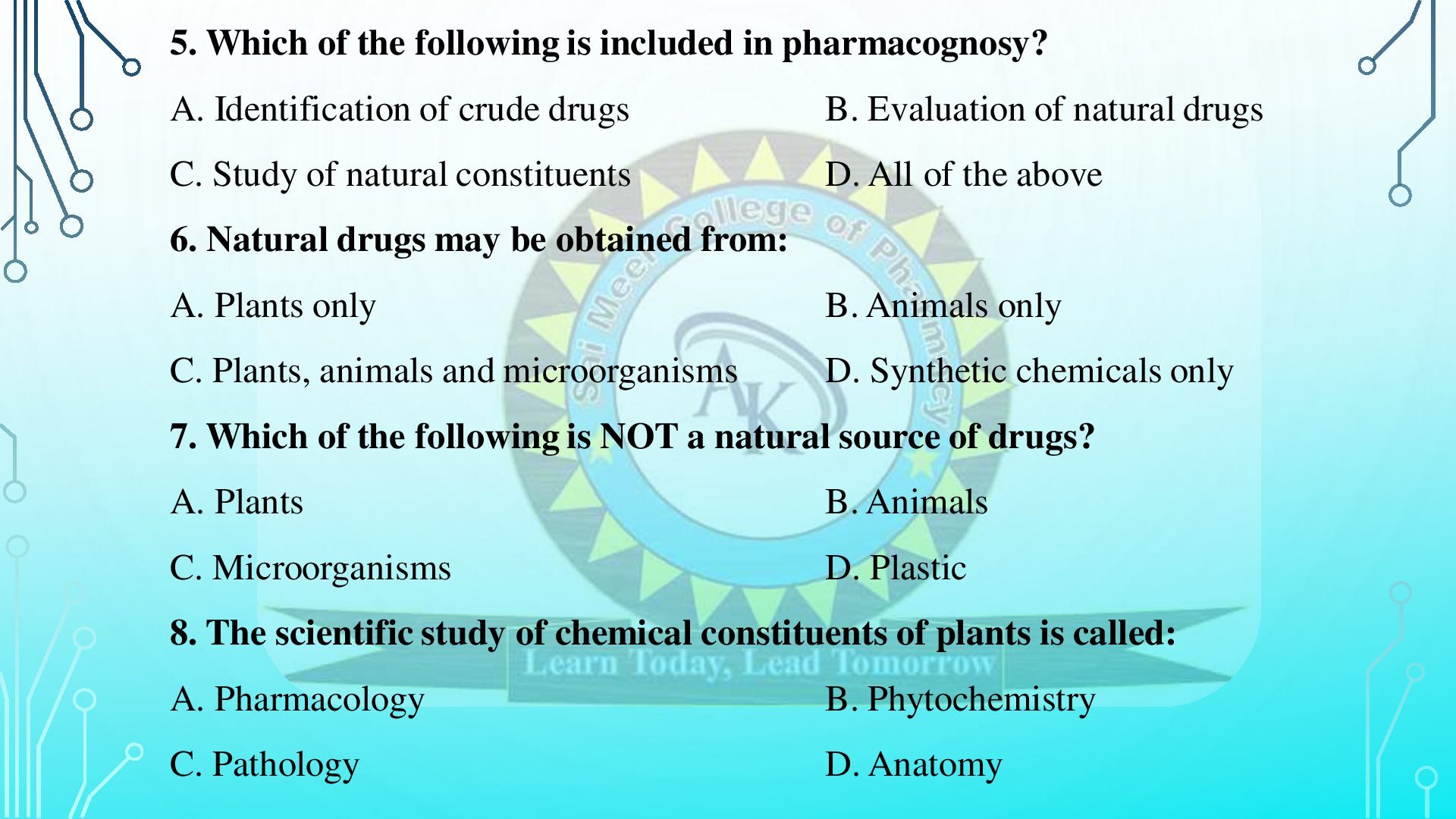
Identification of crude drugs B. Evaluation of natural drugs C. Study of natural constituents D. All of the above 6. Natural drugs may be obtained from: A. Plants only B. Animals only C. Plants, animals and microorganisms D. Synthetic chemicals only 7. Which of the following is NOT a natural source of drugs? A. Plants B. Animals C. Microorganisms D. Plastic 8. The scientific study of chemical constituents of plants is called: A. Pharmacology B. Phytochemistry C. Pathology D. Anatomy
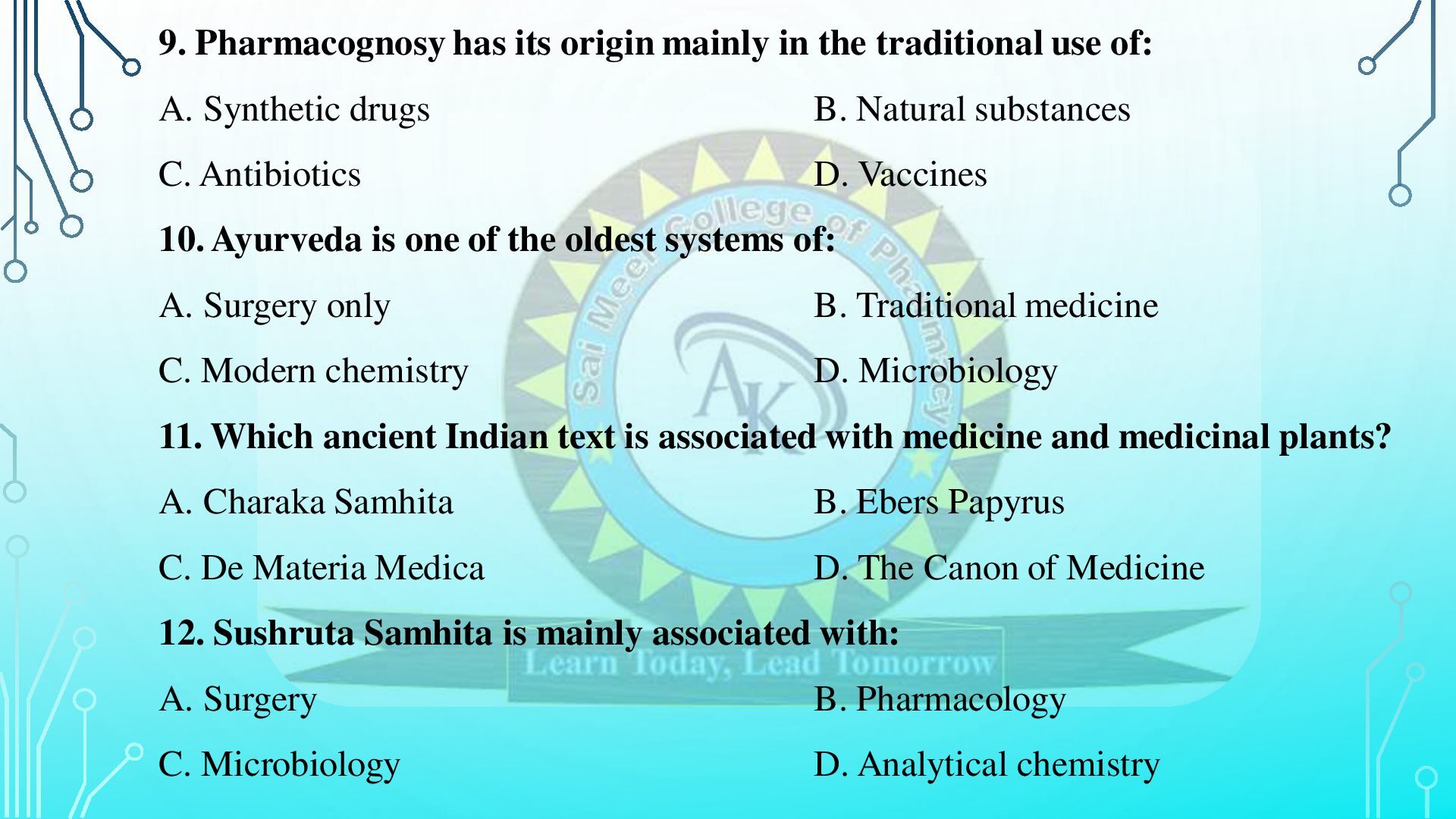
of: A. Synthetic drugs B. Natural substances C. Antibiotics D. Vaccines 10. Ayurveda is one of the oldest systems of: A. Surgery only B. Traditional medicine C. Modern chemistry D. Microbiology 11. Which ancient Indian text is associated with medicine and medicinal plants? A. Charaka Samhita B. Ebers Papyrus C. De Materia Medica D. The Canon of Medicine 12. Sushruta Samhita is mainly associated with: A. Surgery B. Pharmacology C. Microbiology D. Analytical chemistry
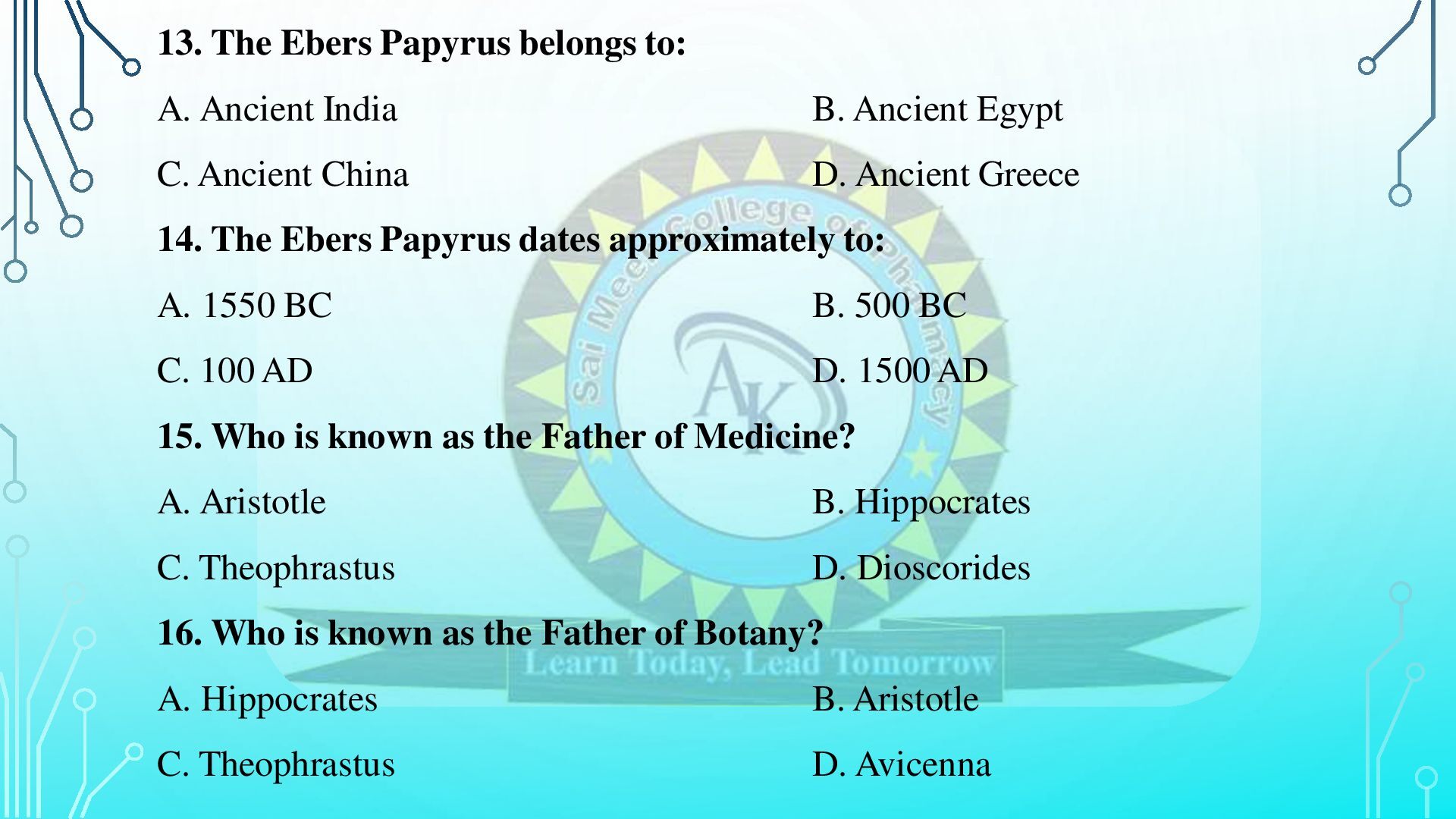
Ancient Egypt C. Ancient China D. Ancient Greece 14. The Ebers Papyrus dates approximately to: A. 1550 BC B. 500 BC C. 100 AD D. 1500 AD 15. Who is known as the Father of Medicine? A. Aristotle B. Hippocrates C. Theophrastus D. Dioscorides 16. Who is known as the Father of Botany? A. Hippocrates B. Aristotle C. Theophrastus D. Avicenna
B. Animals C. Microorganisms D. Synthetic drugs 18. Who wrote De Materia Medica? A. Dioscorides B. Hippocrates C. Avicenna D. Aristotle 19. De Materia Medica mainly contains information about: A. Medicinal substances B. Surgical instruments C. Synthetic drugs D. Vaccines 20. Avicenna is also known as: A. Ibn Sina B. Shen Nung C. Sertürner D. Seydler
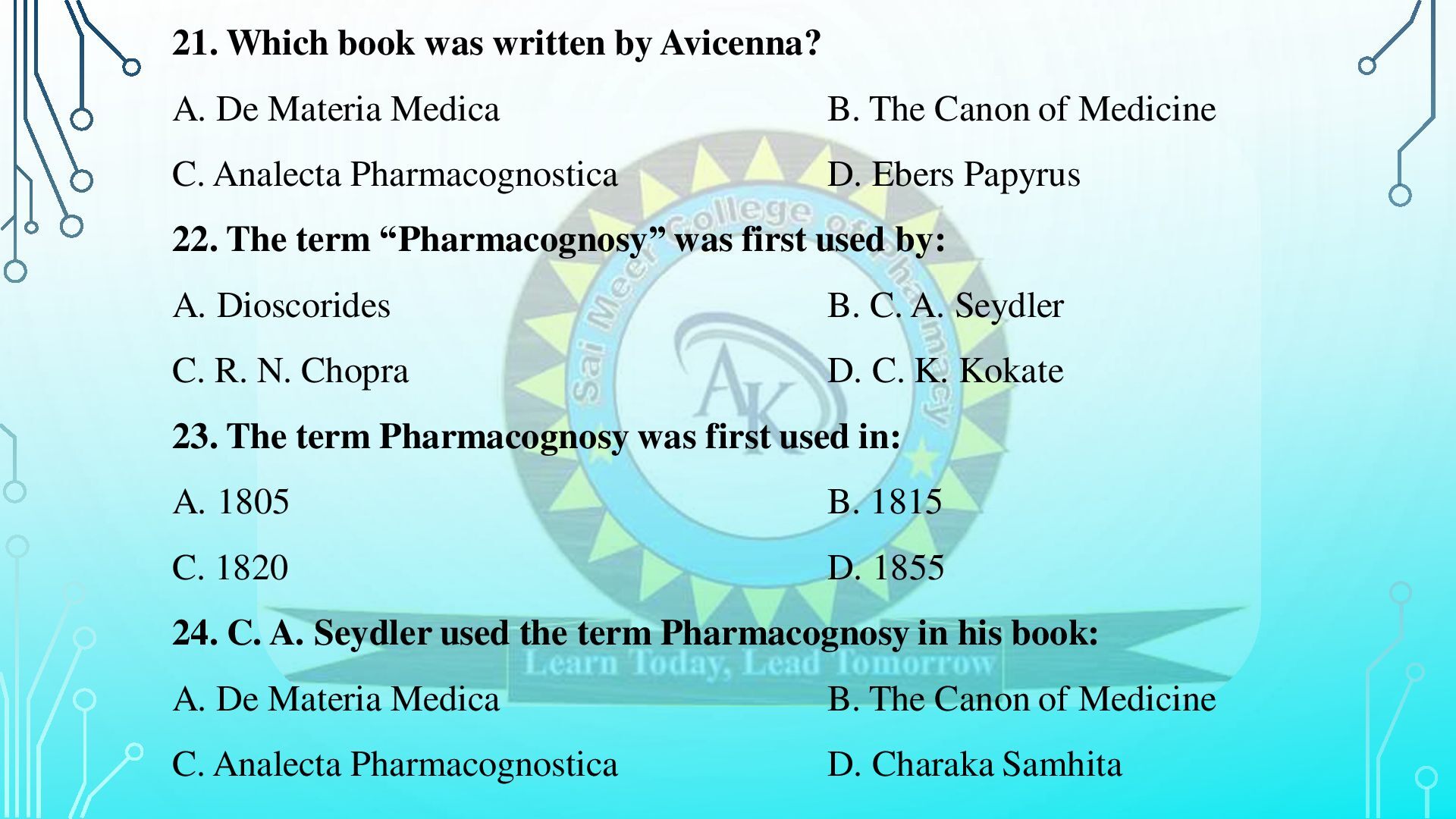
Medica B. The Canon of Medicine C. Analecta Pharmacognostica D. Ebers Papyrus 22. The term “Pharmacognosy” was first used by: A. Dioscorides B. C. A. Seydler C. R. N. Chopra D. C. K. Kokate 23. The term Pharmacognosy was first used in: A. 1805 B. 1815 C. 1820 D. 1855 24. C. A. Seydler used the term Pharmacognosy in his book: A. De Materia Medica B. The Canon of Medicine C. Analecta Pharmacognostica D. Charaka Samhita
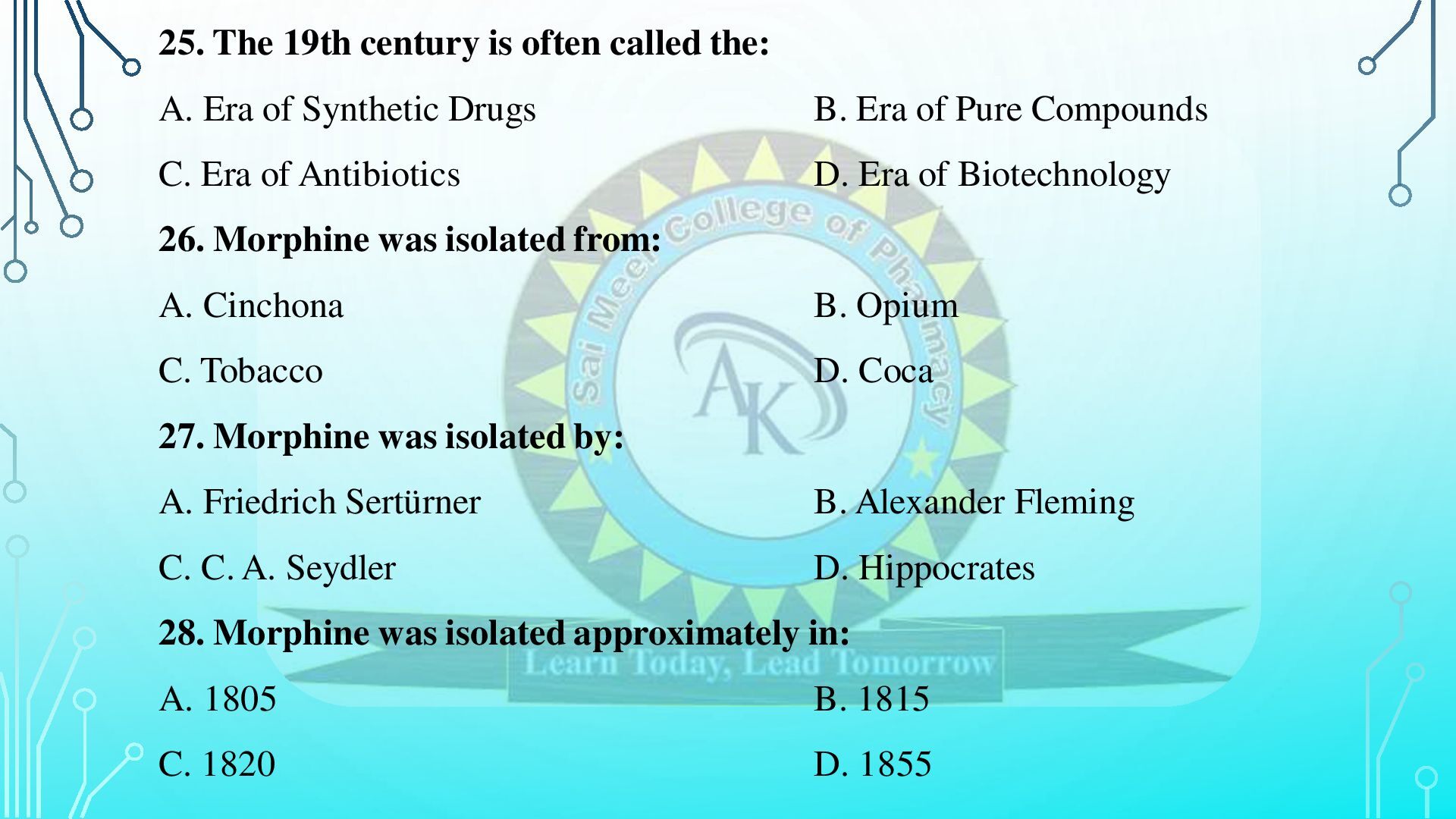
of Synthetic Drugs B. Era of Pure Compounds C. Era of Antibiotics D. Era of Biotechnology 26. Morphine was isolated from: A. Cinchona B. Opium C. Tobacco D. Coca 27. Morphine was isolated by: A. Friedrich Sertürner B. Alexander Fleming C. C. A. Seydler D. Hippocrates 28. Morphine was isolated approximately in: A. 1805 B. 1815 C. 1820 D. 1855
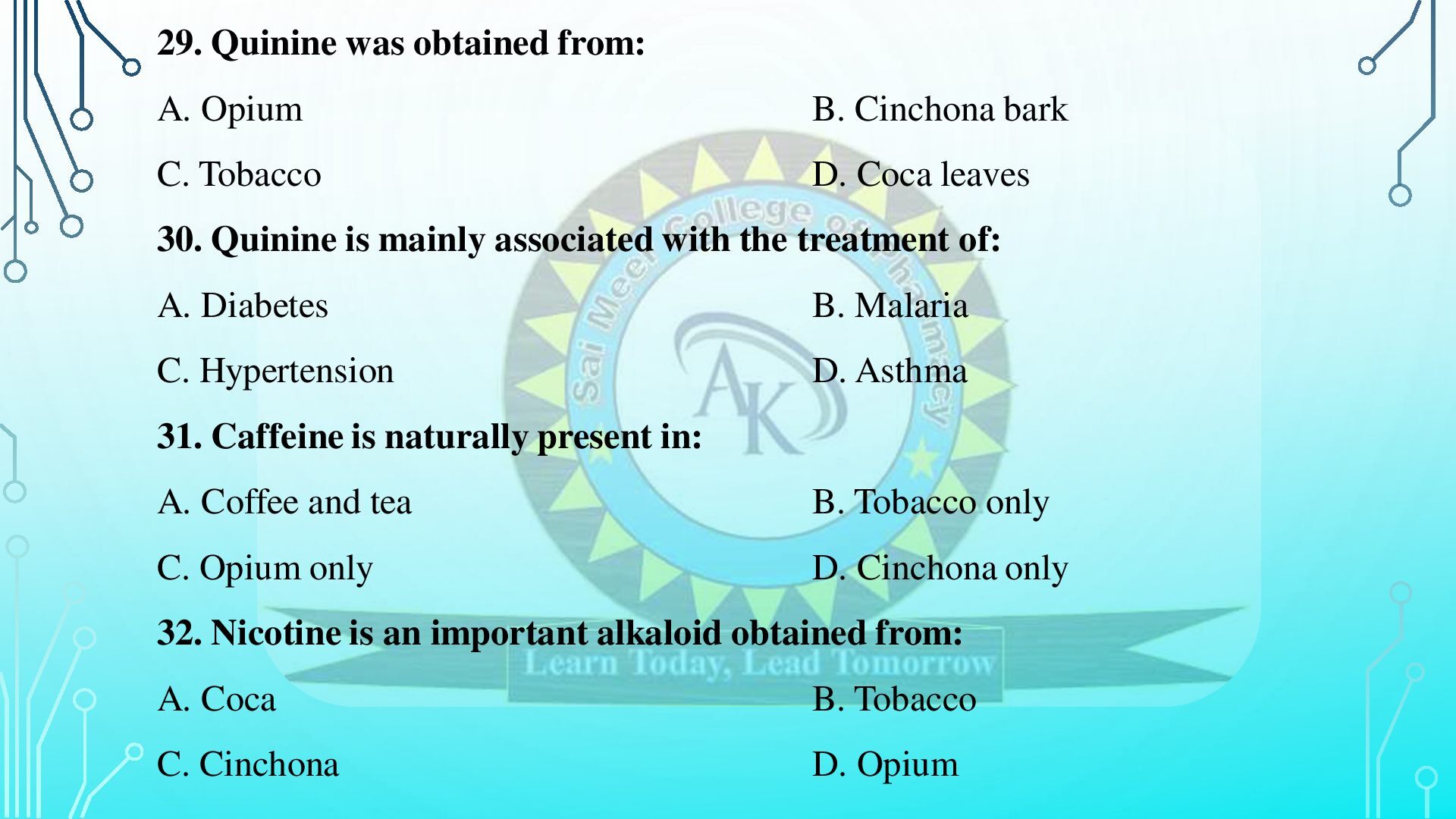
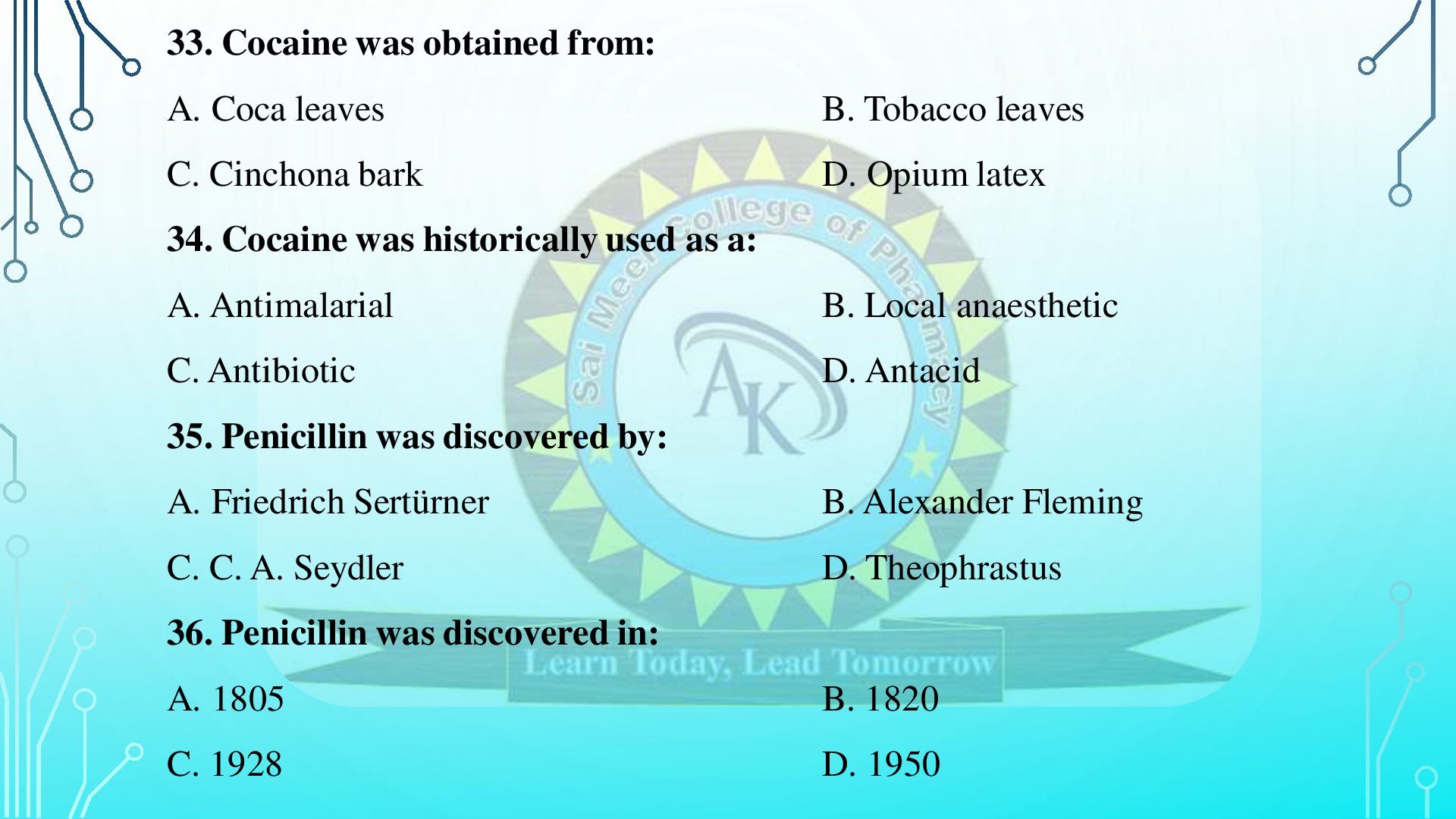
C. Tobacco D. Coca leaves 30. Quinine is mainly associated with the treatment of: A. Diabetes B. Malaria C. Hypertension D. Asthma 31. Caffeine is naturally present in: A. Coffee and tea B. Tobacco only C. Opium only D. Cinchona only 32. Nicotine is an important alkaloid obtained from: A. Coca B. Tobacco C. Cinchona D. Opium
leaves C. Cinchona bark D. Opium latex 34. Cocaine was historically used as a: A. Antimalarial B. Local anaesthetic C. Antibiotic D. Antacid 35. Penicillin was discovered by: A. Friedrich Sertürner B. Alexander Fleming C. C. A. Seydler D. Theophrastus 36. Penicillin was discovered in: A. 1805 B. 1820 C. 1928 D. 1950
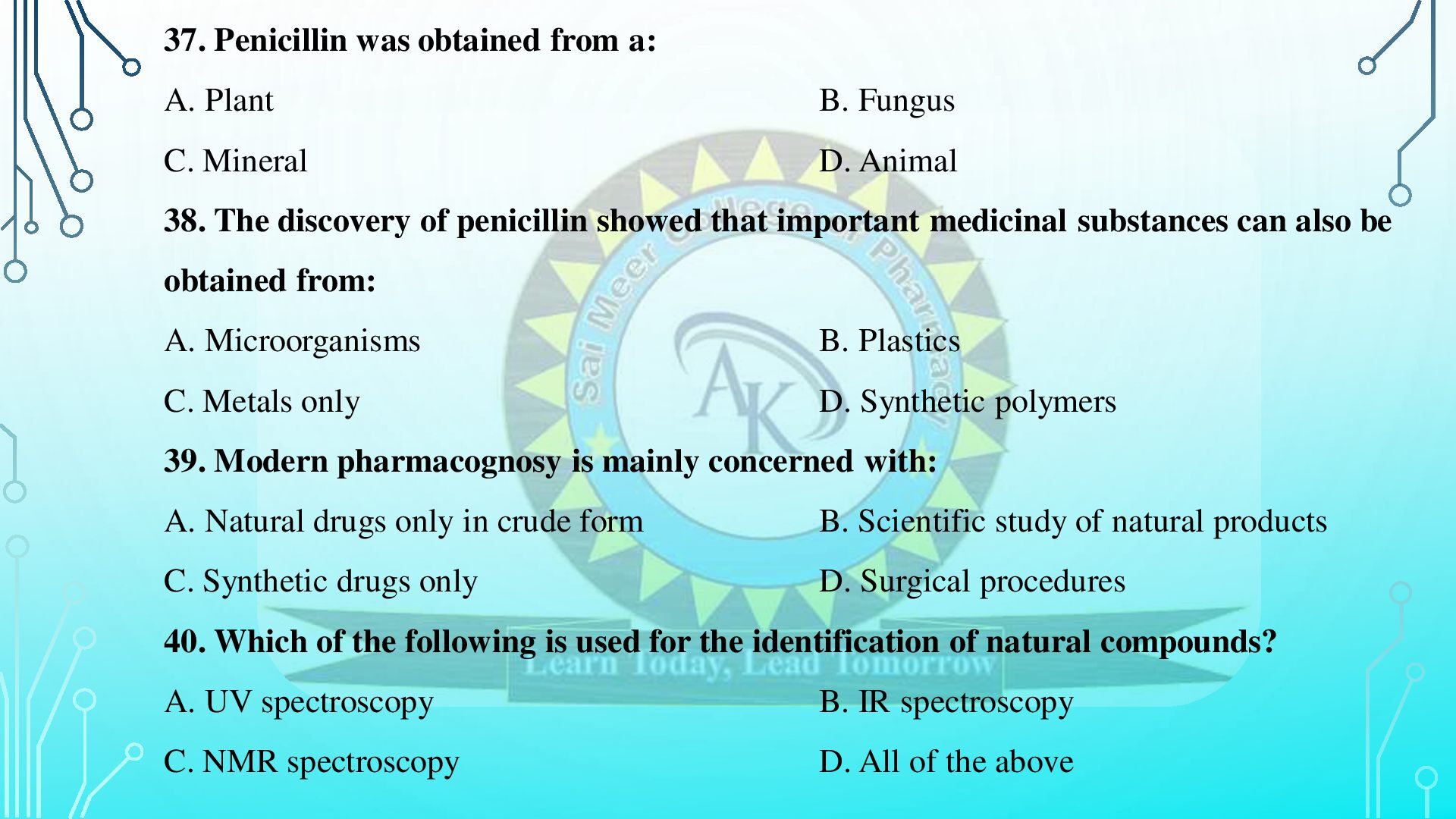
C. Mineral D. Animal 38. The discovery of penicillin showed that important medicinal substances can also be obtained from: A. Microorganisms B. Plastics C. Metals only D. Synthetic polymers 39. Modern pharmacognosy is mainly concerned with: A. Natural drugs only in crude form B. Scientific study of natural products C. Synthetic drugs only D. Surgical procedures 40. Which of the following is used for the identification of natural compounds? A. UV spectroscopy B. IR spectroscopy C. NMR spectroscopy D. All of the above
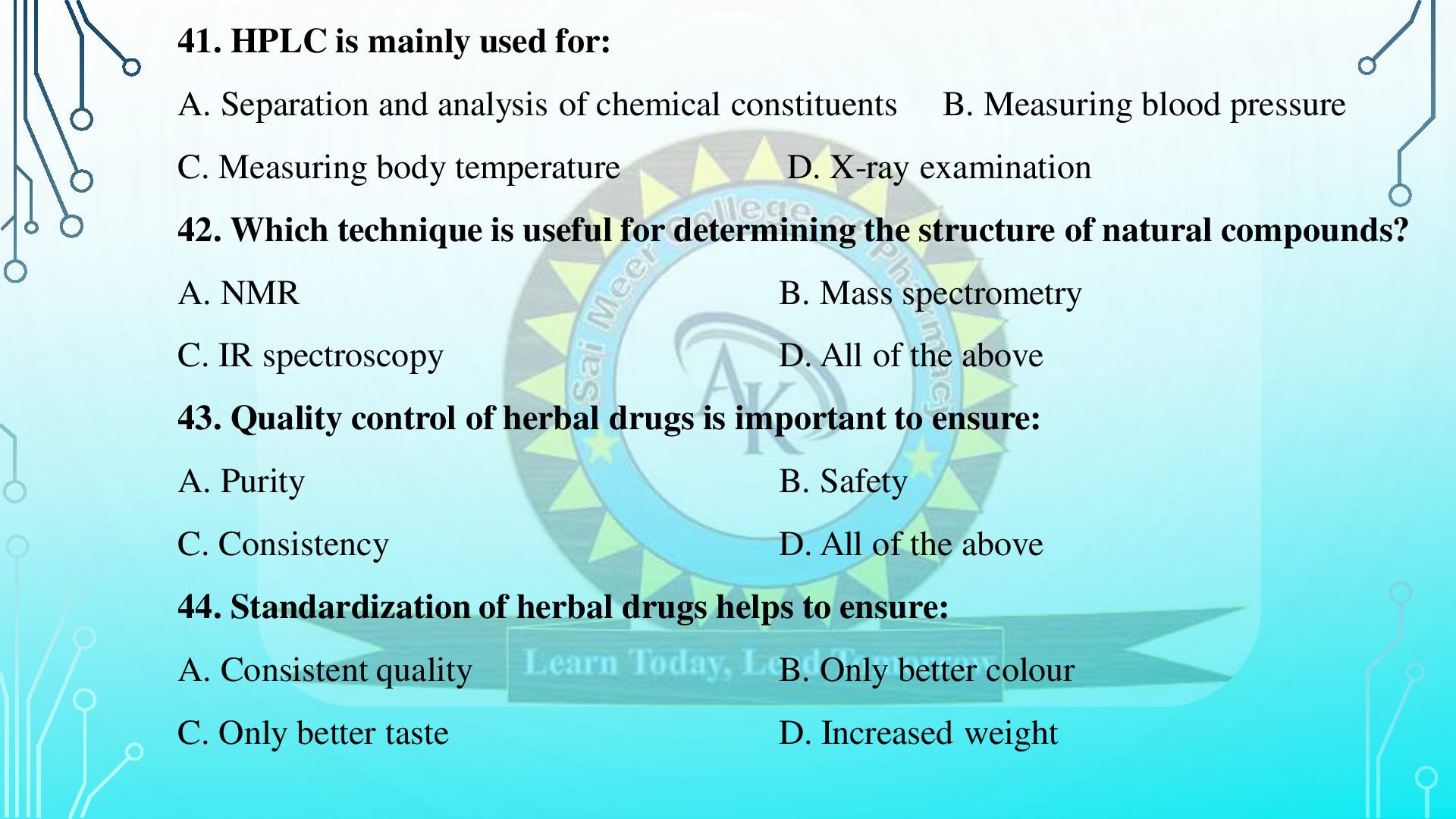
of chemical constituents C. Measuring body temperature B. Measuring blood pressure D. X-ray examination 42. Which technique is useful for determining the structure of natural compounds? A. NMR B. Mass spectrometry C. IR spectroscopy D. All of the above 43. Quality control of herbal drugs is important to ensure: A. Purity B. Safety C. Consistency D. All of the above 44. Standardization of herbal drugs helps to ensure: A. Consistent quality B. Only better colour C. Only better taste D. Increased weight
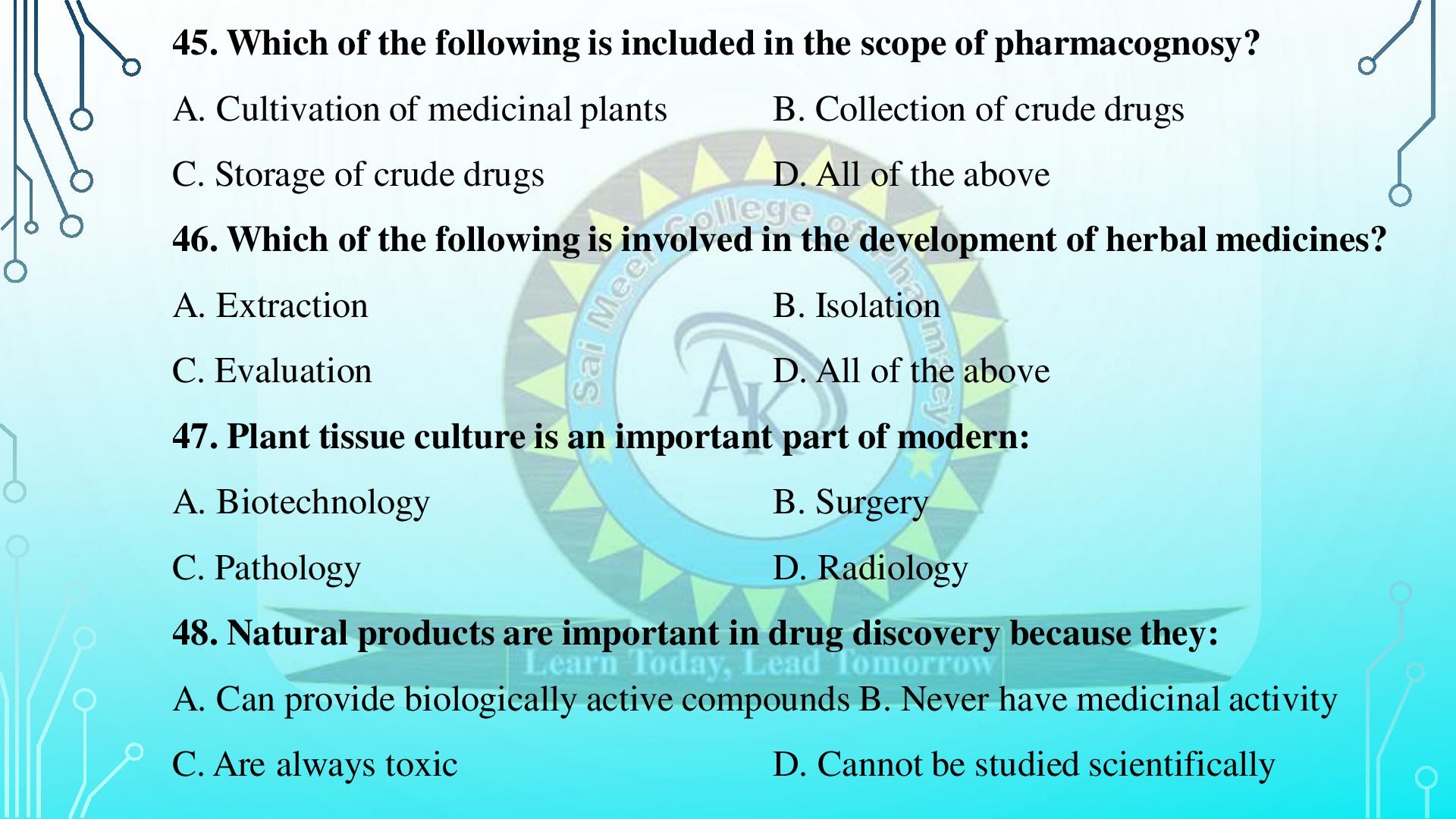
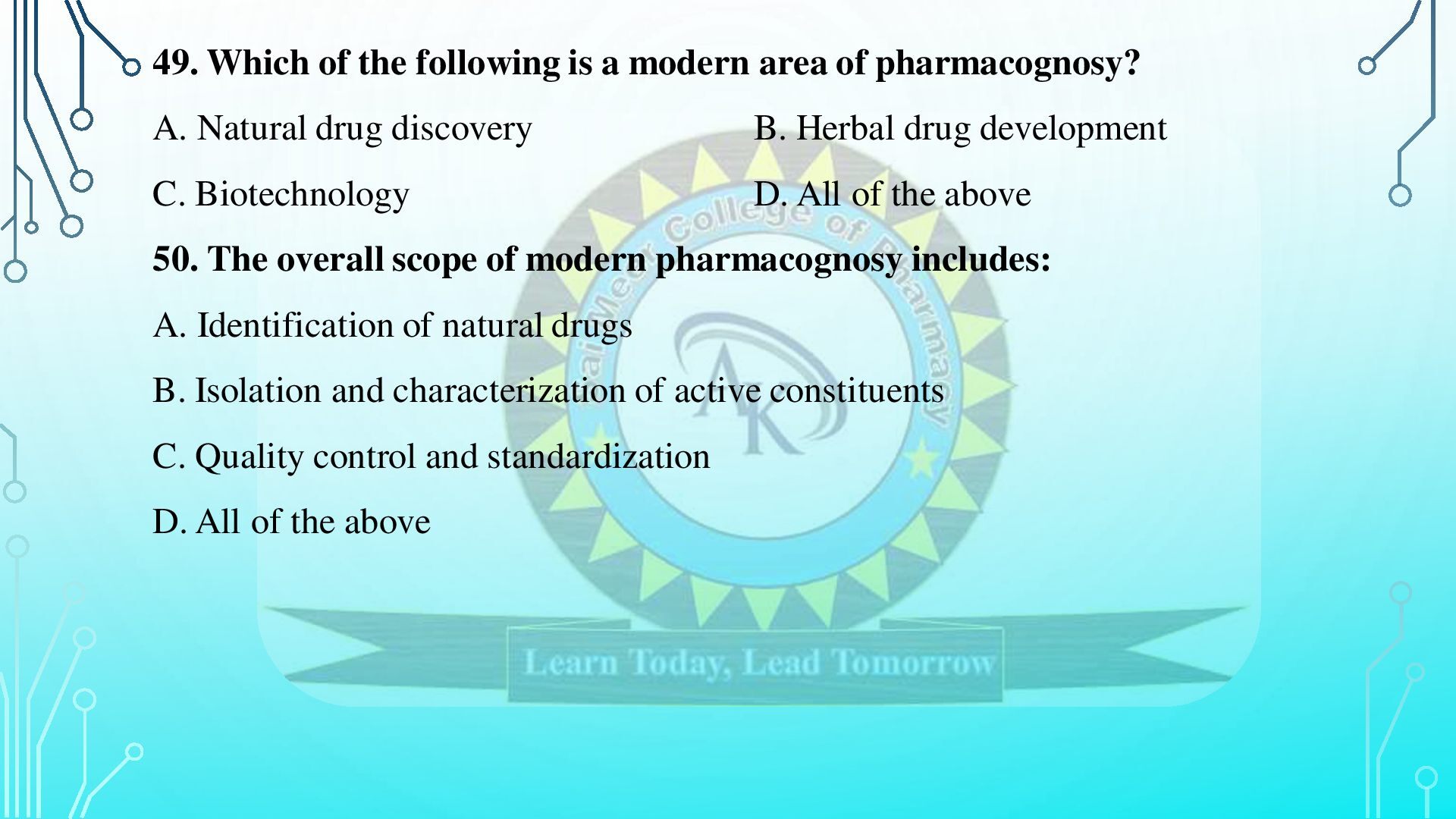
of pharmacognosy? A. Cultivation of medicinal plants B. Collection of crude drugs C. Storage of crude drugs D. All of the above 46. Which of the following is involved in the development of herbal medicines? A. Extraction B. Isolation C. Evaluation D. All of the above 47. Plant tissue culture is an important part of modern: A. Biotechnology B. Surgery C. Pathology D. Radiology 48. Natural products are important in drug discovery because they: A. Can provide biologically active compounds B. Never have medicinal activity C. Are always toxic D. Cannot be studied scientifically
pharmacognosy? A. Natural drug discovery B. Herbal drug development C. Biotechnology D. All of the above 50. The overall scope of modern pharmacognosy includes: A. Identification of natural drugs B. Isolation and characterization of active constituents C. Quality control and standardization D. All of the above
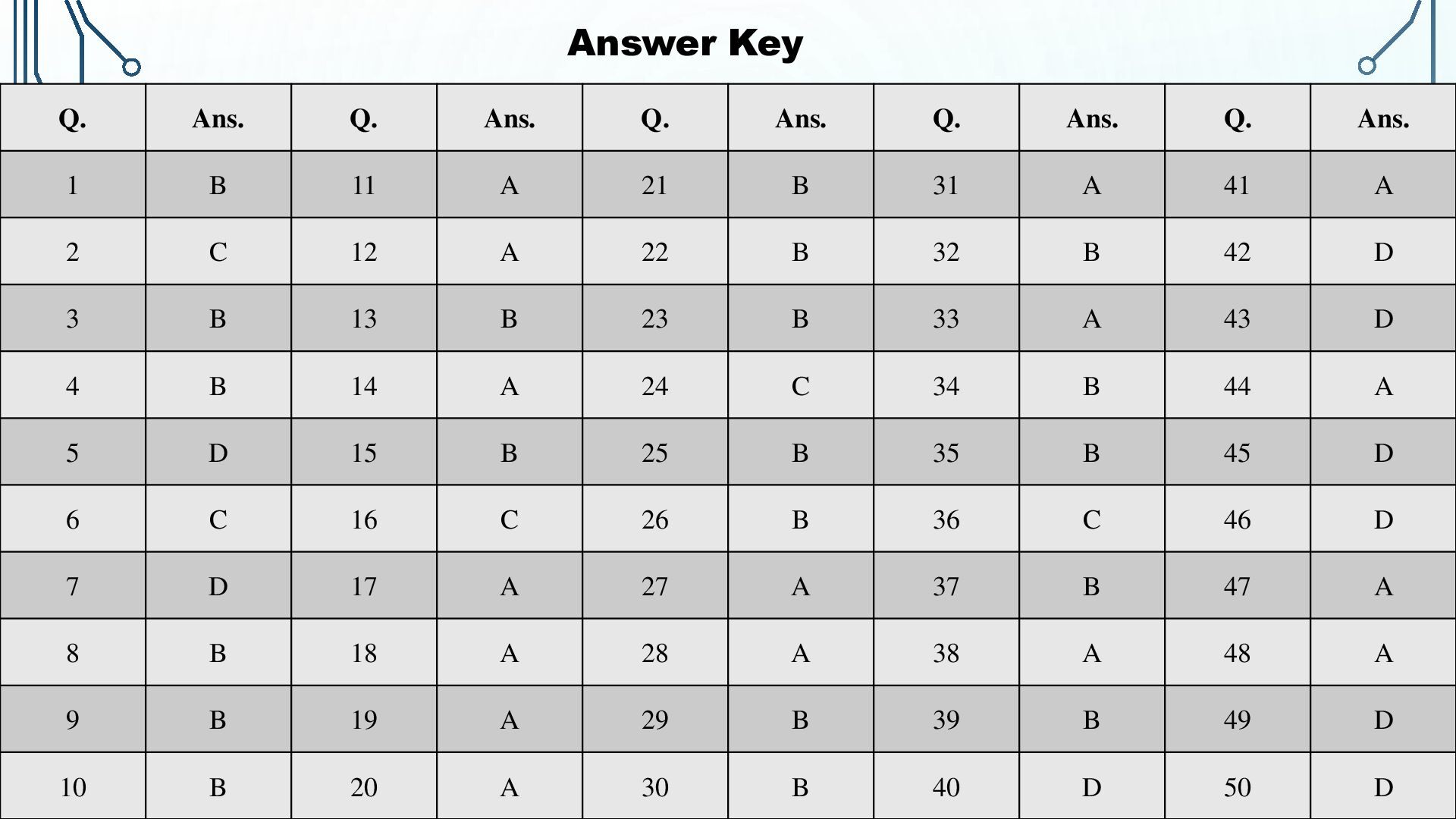
Q. Ans. 1 B 11 A 21 B 31 A 41 A 2 C 12 A 22 B 32 B 42 D 3 B 13 B 23 B 33 A 43 D 4 B 14 A 24 C 34 B 44 A 5 D 15 B 25 B 35 B 45 D 6 C 16 C 26 B 36 C 46 D 7 D 17 A 27 A 37 B 47 A 8 B 18 A 28 A 38 A 48 A 9 B 19 A 29 B 39 B 49 D 10 B 20 A 30 B 40 D 50 D


 yasslab
 pawan_pharm
 juanmartin2026
 terazawa
 soudai
 robintux
 akiraasano
 ainischool
 uranoken
 frievea
 bvr7352
 cassininazir
 matthewcrist
 tenderlove
 aleyda
 geshan
 khoart
 axbom
 reverentgeek
 portentint
 rasagy
 mraible
 wayneb77