Upgrade to Pro — share decks privately, control downloads, hide ads and more …

Biological Source, Chemical Constituents And Th...

Sponsored · Your Podcast. Everywhere. Effortlessly. Share. Educate. Inspire. Entertain. You do you. We'll handle the rest. →

Biological Source, Chemical Constituents And Therapeutic Efficacy

Antihypertensives lower high blood pressure; Rauwolfia (Rauwolfia serpentina, Apocynaceae) yields reserpine to treat hypertension, anxiety, and insanity. Antitussives suppress cough reflexes; Vasaka (Adhatoda vasica, Acanthaceae) contains vasicine for bronchitis and asthma, while Tolu Balsam (Myroxylon balsamum, Leguminosae) provides cinnamic and benzoic acids as an expectorant. Antirheumatics ease joint inflammation; Colchicum (Colchicum luteum, Liliaceae) supplies colchicine to relieve acute gout attacks. Antitumour drugs combat abnormal cell growth; Vinca (Catharanthus roseus, Apocynaceae) yields vincristine and vinblastine for leukaemia and lymphomas, while Podophyllum (Podophyllum hexandrum, Berberidaceae) yields podophyllotoxin to treat warts and produce etoposide.

Avatar for Pawan Kumar Sahu

Pawan Kumar Sahu

October 23, 2026

More Decks by Pawan Kumar Sahu

Other Decks in Education

Transcript

  1. Biological Source, Chemical Constituents And Therapeutic Efficacy of Crude Drug

    (Part-II) D E PA RT ME N T O F P H A RMA CY | PAWA N K U MA R S A H U , L E CT U RE R, RU D A U L I CO L L E G E O F P H A RMA CY, AY O D H YA ( U . P. )
  2. ASTRINGENT Astringents are medicinal substances that cause body tissues to

    contract or shrink. They work by precipitating proteins, which helps stop bleeding (arresting haemorrhages) and reduces the discharge of mucus and blood serum. DEPARTMENT OF PHARMACY | PAWAN KUMAR SAHU, LECTURER, RUDAULI COLLEGE OF PHARMACY, AYODHYA (U.P.)
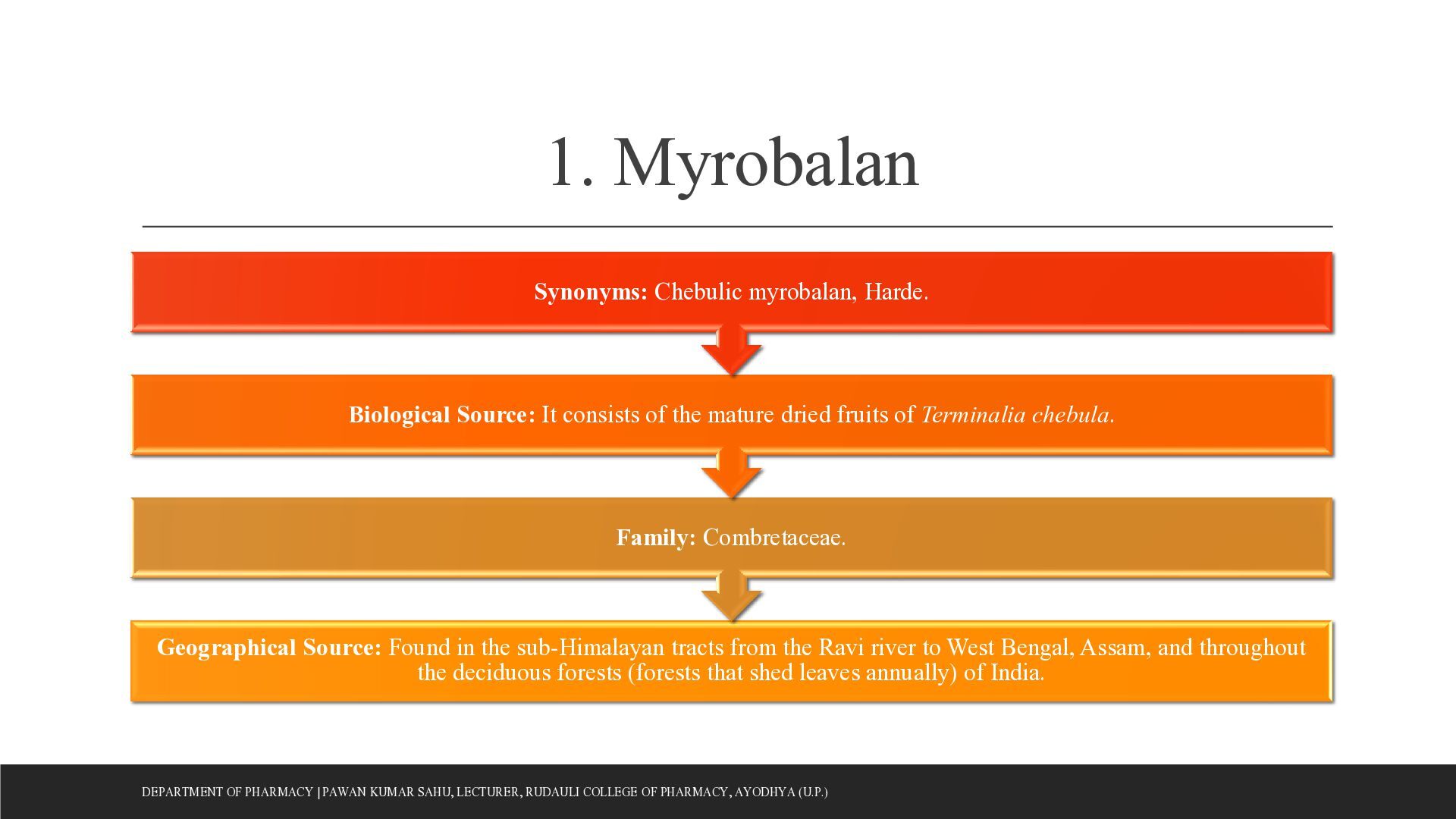
  3. 1. Myrobalan Synonyms: Chebulic myrobalan, Harde. Biological Source: It consists

    of the mature dried fruits of Terminalia chebula. Family: Combretaceae. Geographical Source: Found in the sub-Himalayan tracts from the Ravi river to West Bengal, Assam, and throughout the deciduous forests (forests that shed leaves annually) of India. DEPARTMENT OF PHARMACY | PAWAN KUMAR SAHU, LECTURER, RUDAULI COLLEGE OF PHARMACY, AYODHYA (U.P.)
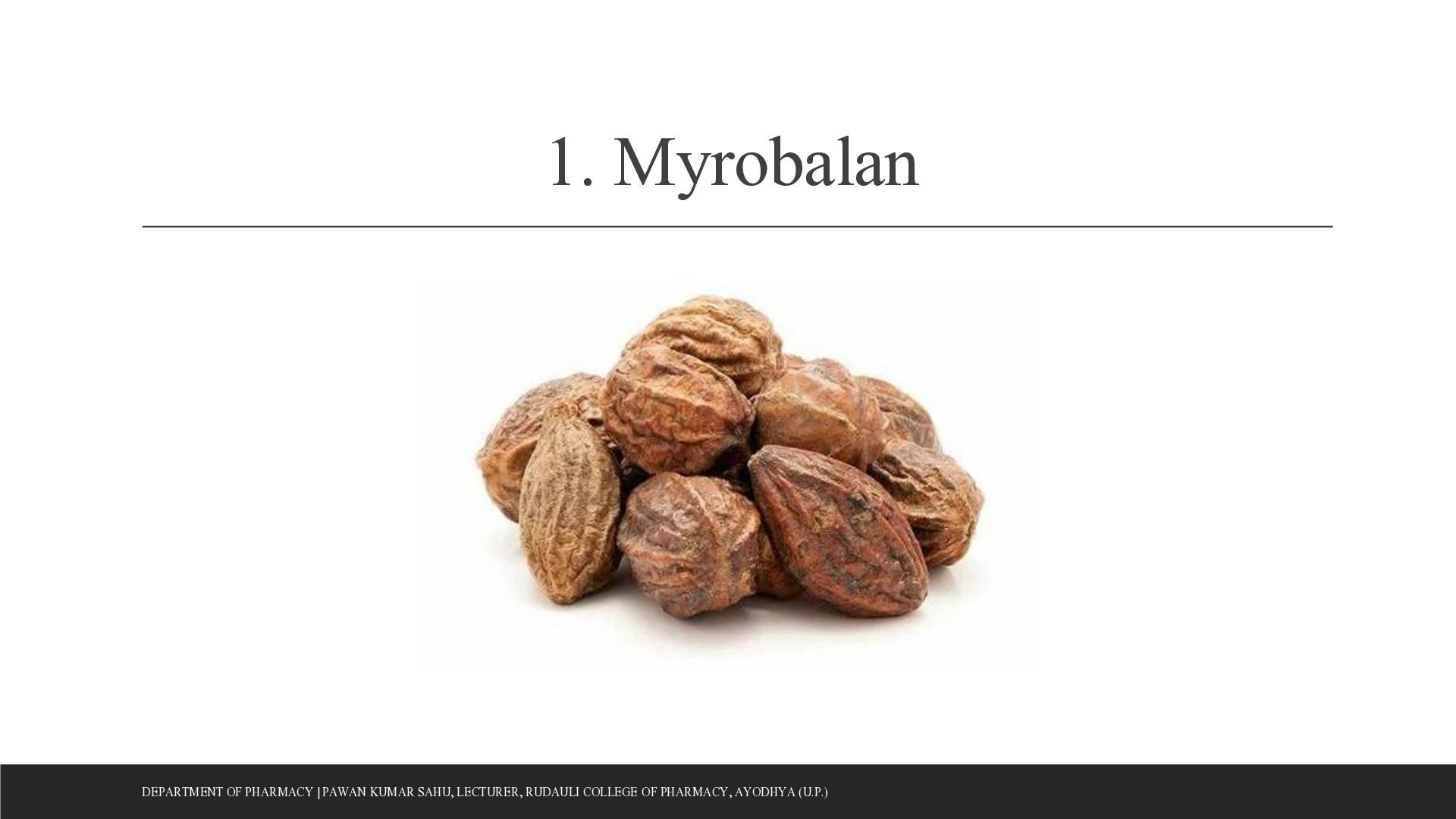
  4. 1. Myrobalan DEPARTMENT OF PHARMACY | PAWAN KUMAR SAHU, LECTURER,

    RUDAULI COLLEGE OF PHARMACY, AYODHYA (U.P.)
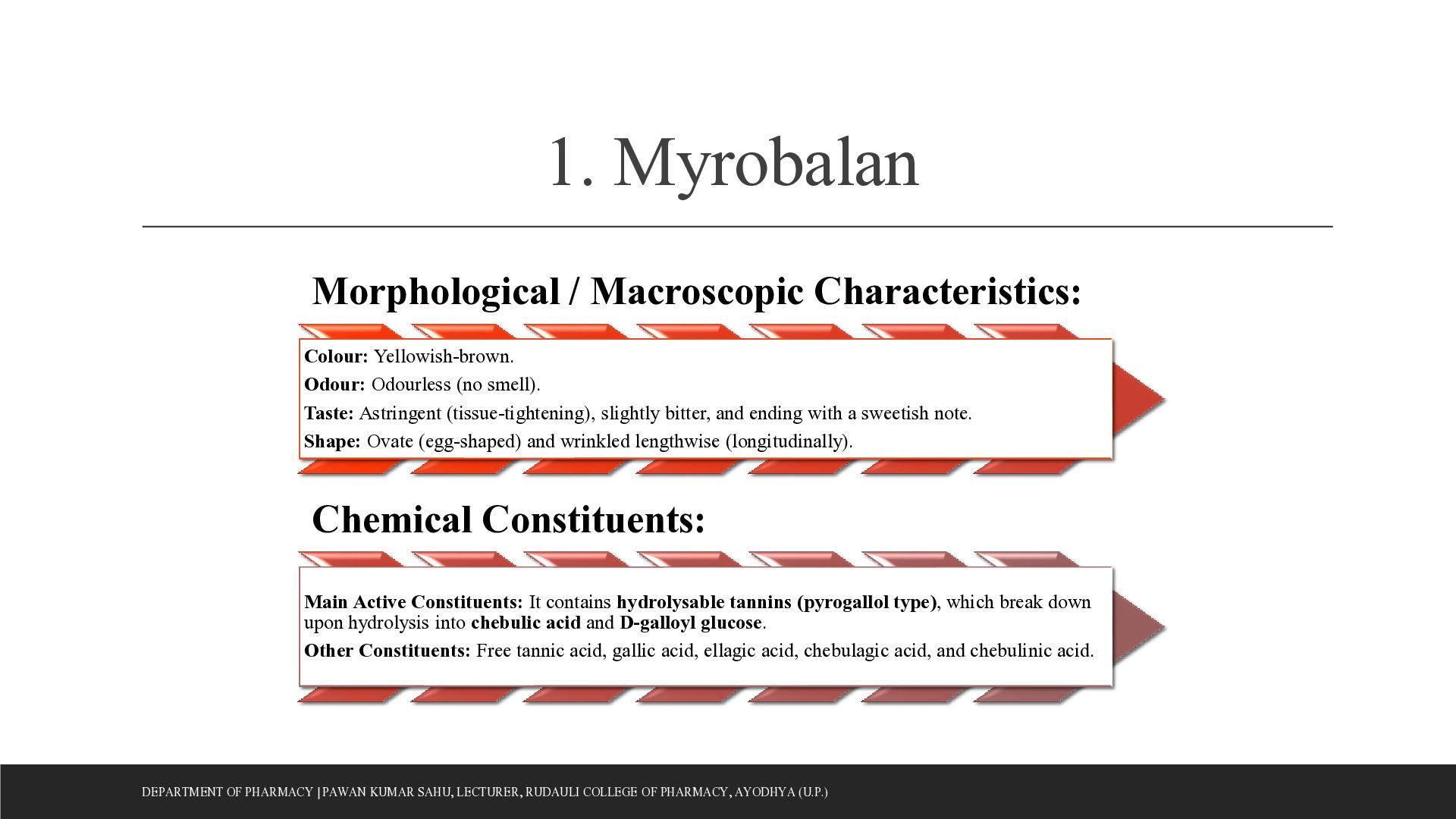
  5. 1. Myrobalan Morphological / Macroscopic Characteristics: Colour: Yellowish-brown. Odour: Odourless

    (no smell). Taste: Astringent (tissue-tightening), slightly bitter, and ending with a sweetish note. Shape: Ovate (egg-shaped) and wrinkled lengthwise (longitudinally). Chemical Constituents: Main Active Constituents: It contains hydrolysable tannins (pyrogallol type), which break down upon hydrolysis into chebulic acid and D-galloyl glucose. Other Constituents: Free tannic acid, gallic acid, ellagic acid, chebulagic acid, and chebulinic acid. DEPARTMENT OF PHARMACY | PAWAN KUMAR SAHU, LECTURER, RUDAULI COLLEGE OF PHARMACY, AYODHYA (U.P.)
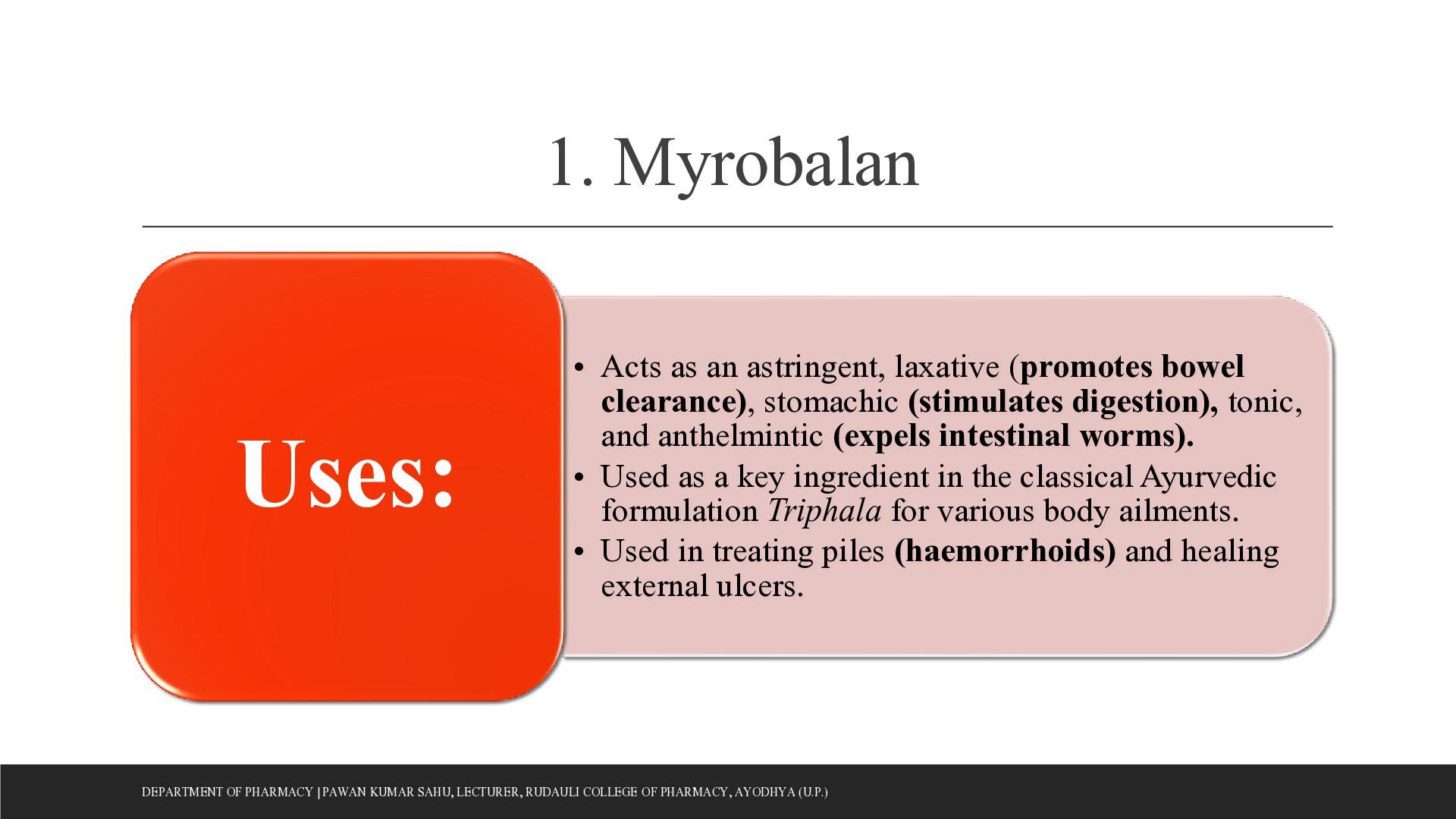
  6. 1. Myrobalan Uses: • Acts as an astringent, laxative (promotes

    bowel clearance), stomachic (stimulates digestion), tonic, and anthelmintic (expels intestinal worms). • Used as a key ingredient in the classical Ayurvedic formulation Triphala for various body ailments. • Used in treating piles (haemorrhoids) and healing external ulcers. DEPARTMENT OF PHARMACY | PAWAN KUMAR SAHU, LECTURER, RUDAULI COLLEGE OF PHARMACY, AYODHYA (U.P.)
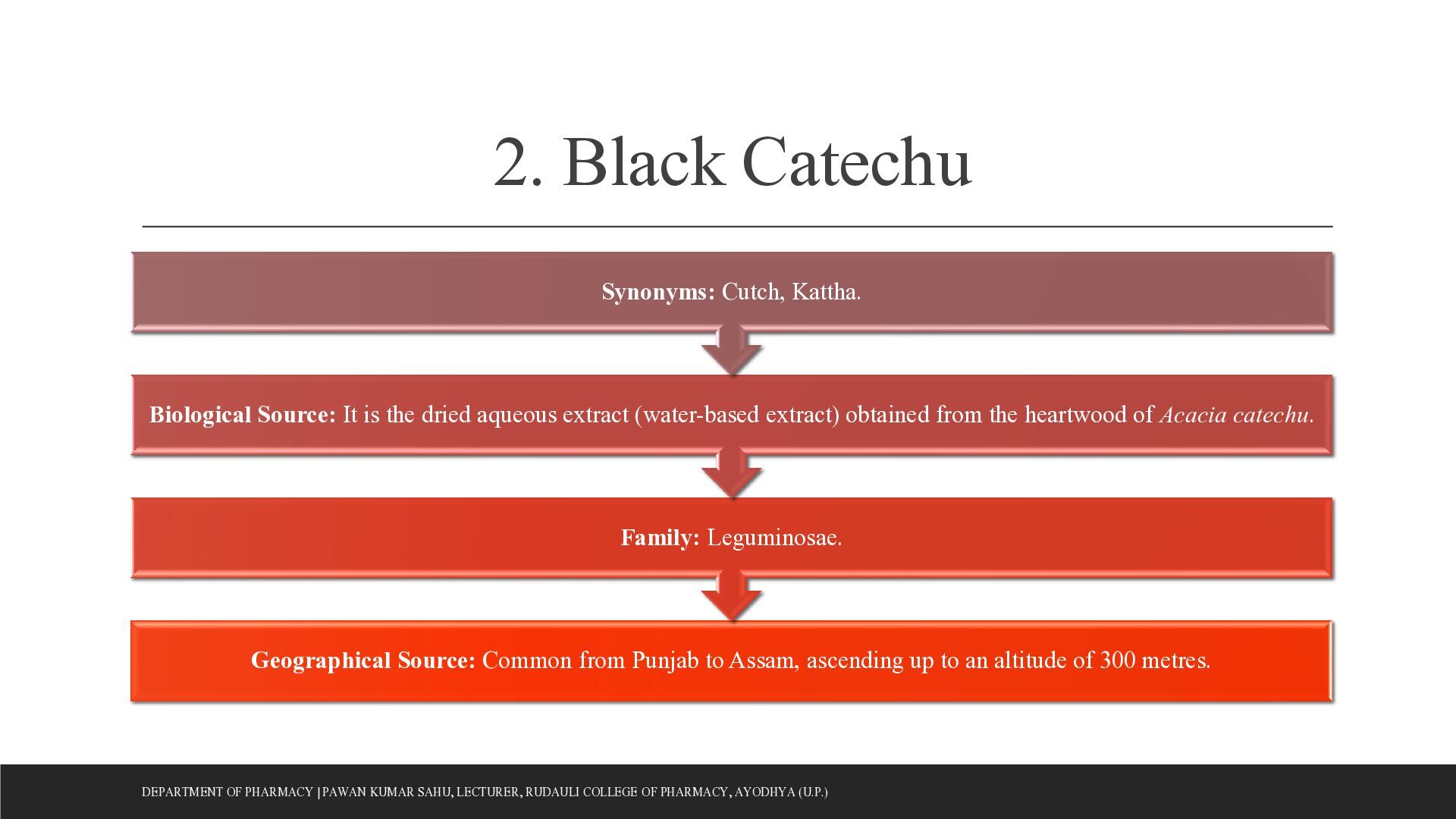
  7. 2. Black Catechu Synonyms: Cutch, Kattha. Biological Source: It is

    the dried aqueous extract (water-based extract) obtained from the heartwood of Acacia catechu. Family: Leguminosae. Geographical Source: Common from Punjab to Assam, ascending up to an altitude of 300 metres. DEPARTMENT OF PHARMACY | PAWAN KUMAR SAHU, LECTURER, RUDAULI COLLEGE OF PHARMACY, AYODHYA (U.P.)
  8. 2. Black Catechu DEPARTMENT OF PHARMACY | PAWAN KUMAR SAHU,

    LECTURER, RUDAULI COLLEGE OF PHARMACY, AYODHYA (U.P.)
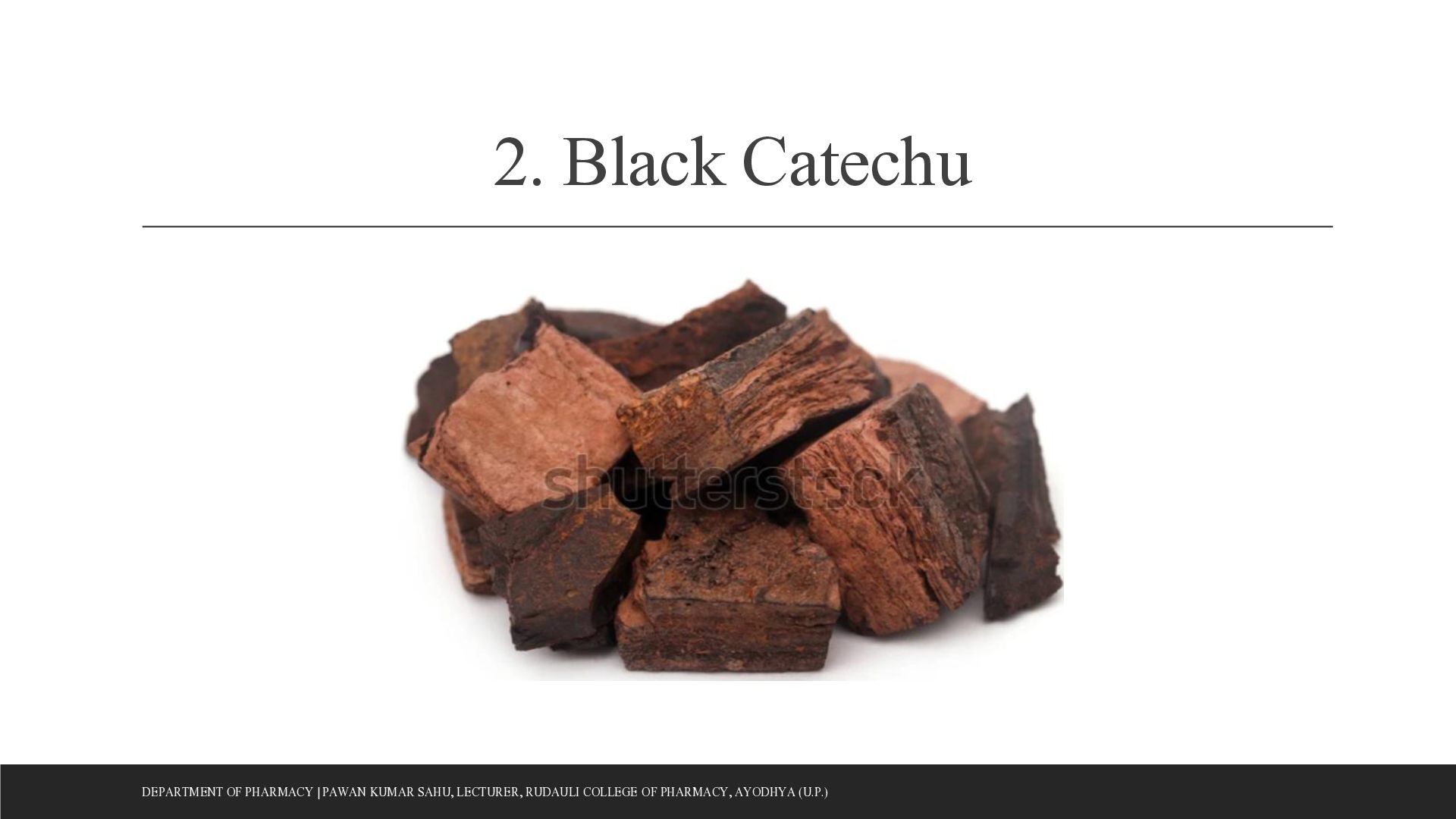
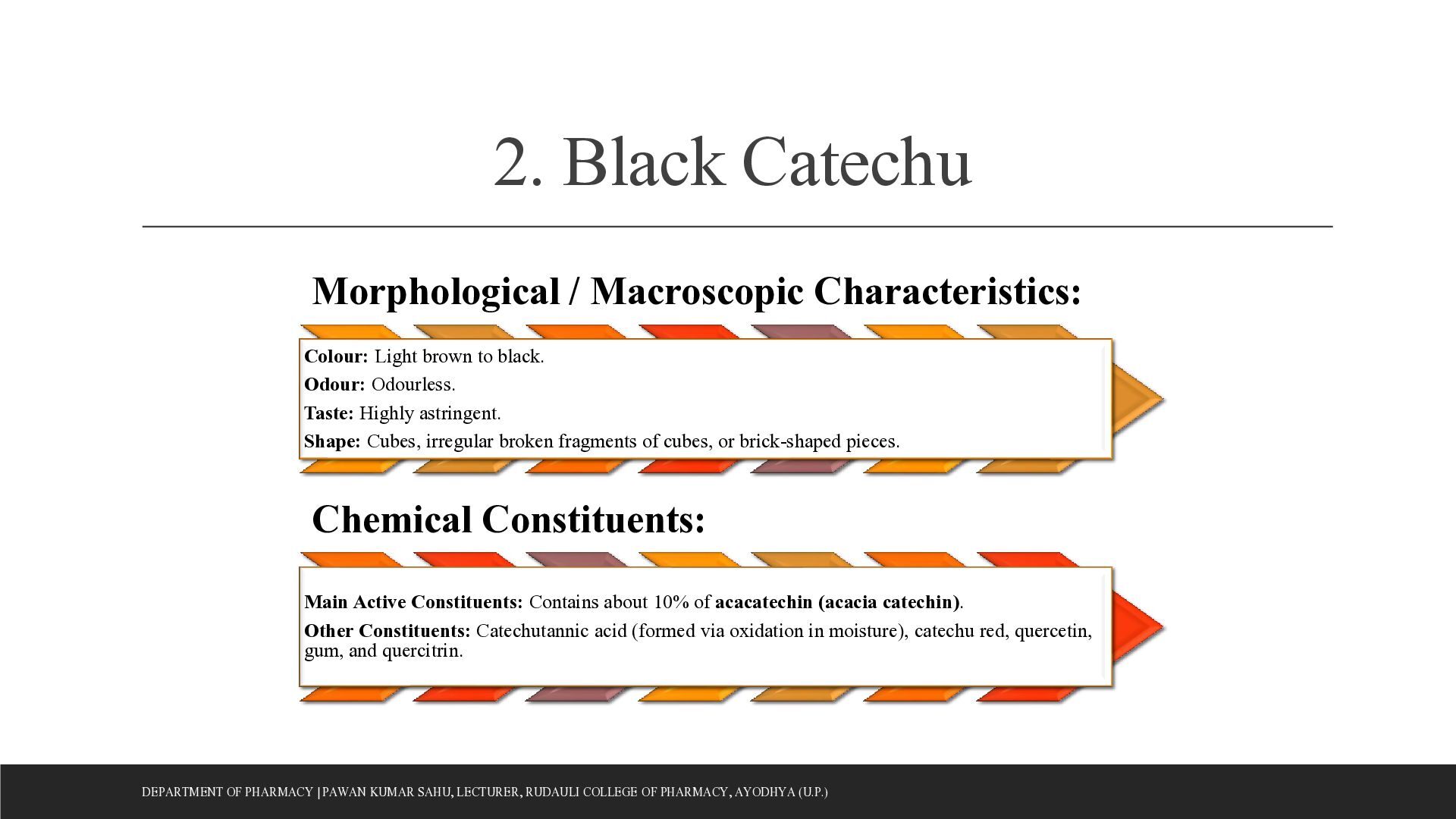
  9. 2. Black Catechu Morphological / Macroscopic Characteristics: Colour: Light brown

    to black. Odour: Odourless. Taste: Highly astringent. Shape: Cubes, irregular broken fragments of cubes, or brick-shaped pieces. Chemical Constituents: Main Active Constituents: Contains about 10% of acacatechin (acacia catechin). Other Constituents: Catechutannic acid (formed via oxidation in moisture), catechu red, quercetin, gum, and quercitrin. DEPARTMENT OF PHARMACY | PAWAN KUMAR SAHU, LECTURER, RUDAULI COLLEGE OF PHARMACY, AYODHYA (U.P.)
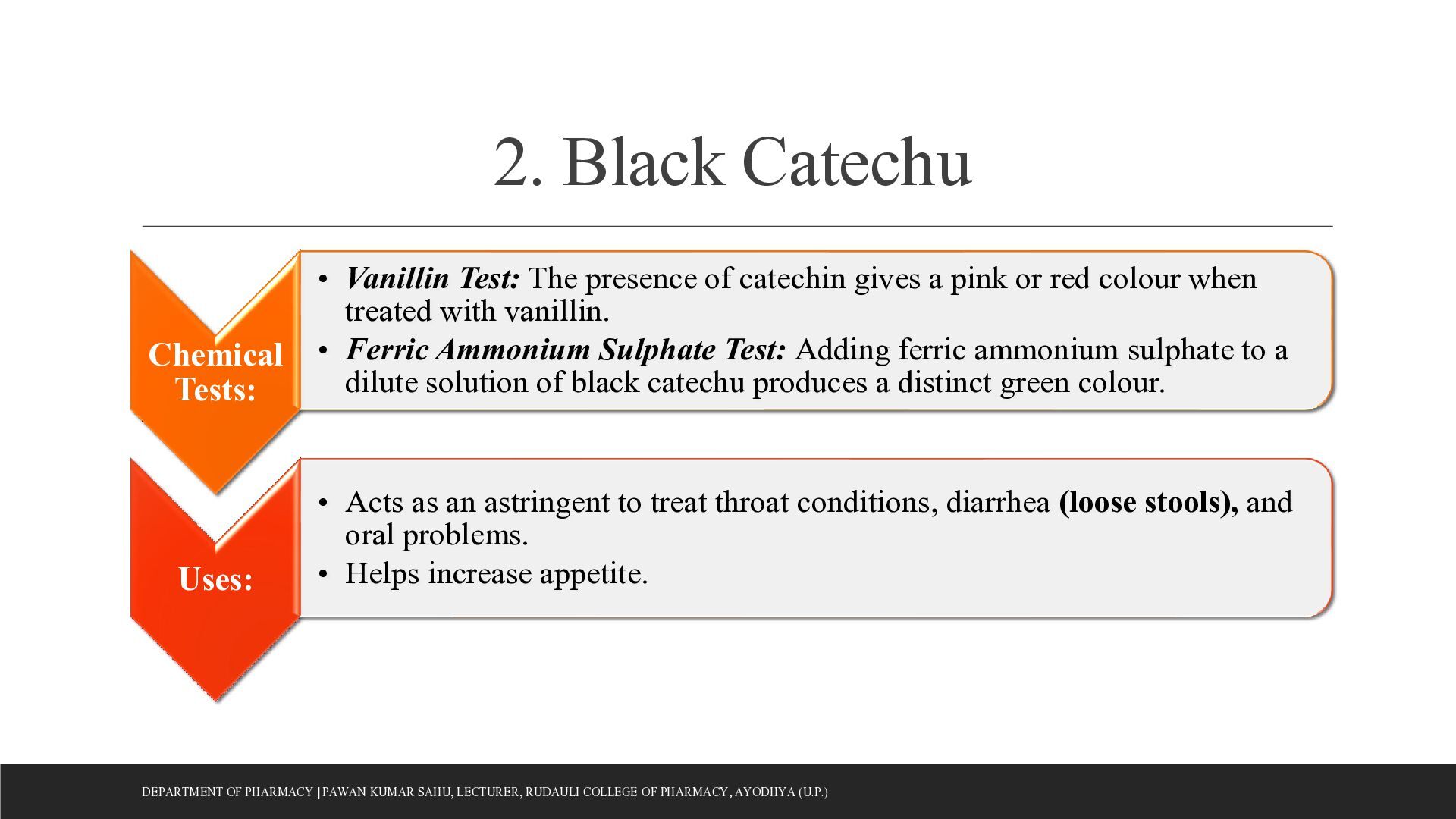
  10. 2. Black Catechu Chemical Tests: • Vanillin Test: The presence

    of catechin gives a pink or red colour when treated with vanillin. • Ferric Ammonium Sulphate Test: Adding ferric ammonium sulphate to a dilute solution of black catechu produces a distinct green colour. Uses: • Acts as an astringent to treat throat conditions, diarrhea (loose stools), and oral problems. • Helps increase appetite. DEPARTMENT OF PHARMACY | PAWAN KUMAR SAHU, LECTURER, RUDAULI COLLEGE OF PHARMACY, AYODHYA (U.P.)
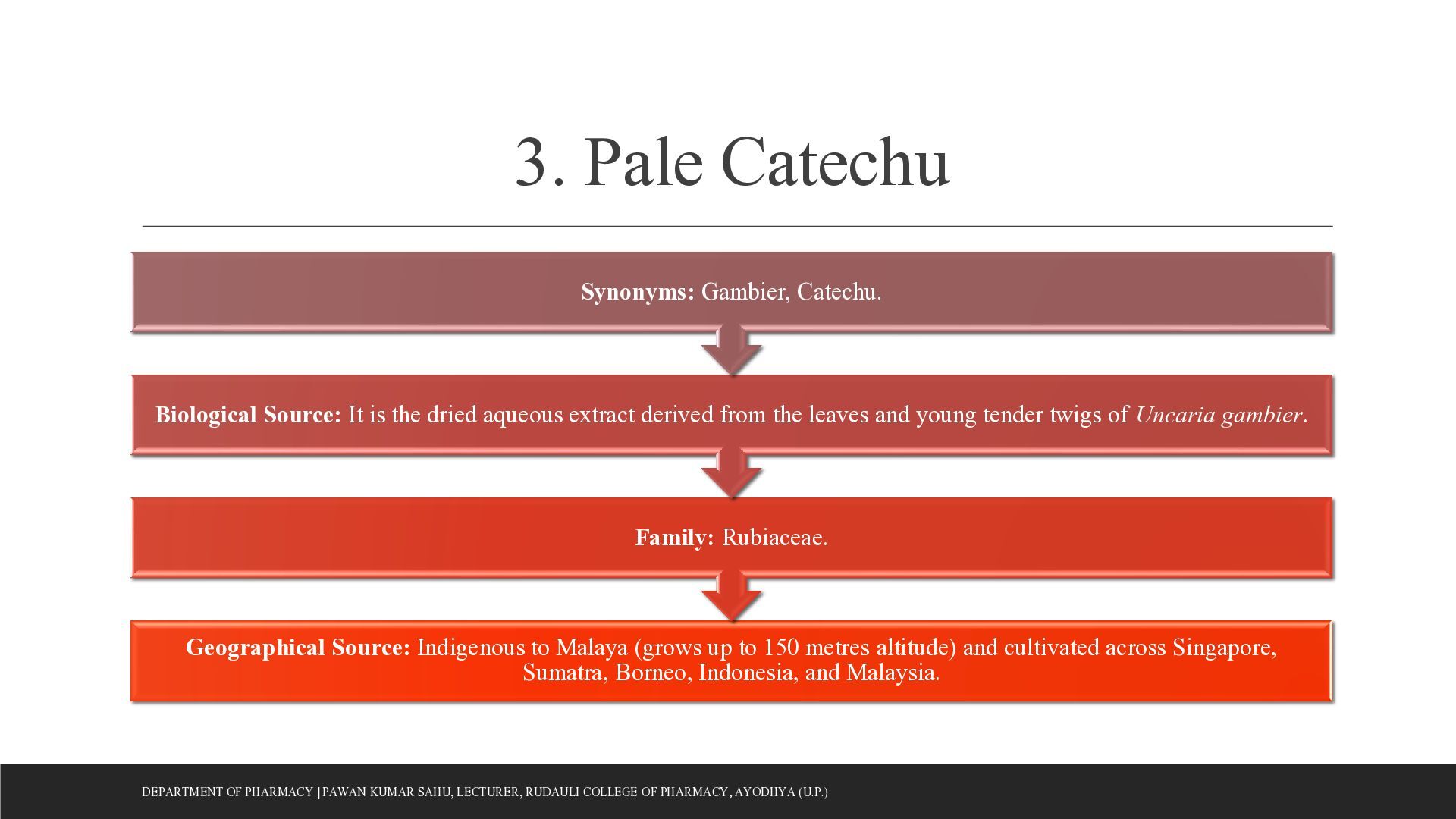
  11. 3. Pale Catechu Synonyms: Gambier, Catechu. Biological Source: It is

    the dried aqueous extract derived from the leaves and young tender twigs of Uncaria gambier. Family: Rubiaceae. Geographical Source: Indigenous to Malaya (grows up to 150 metres altitude) and cultivated across Singapore, Sumatra, Borneo, Indonesia, and Malaysia. DEPARTMENT OF PHARMACY | PAWAN KUMAR SAHU, LECTURER, RUDAULI COLLEGE OF PHARMACY, AYODHYA (U.P.)
  12. 3. Pale Catechu DEPARTMENT OF PHARMACY | PAWAN KUMAR SAHU,

    LECTURER, RUDAULI COLLEGE OF PHARMACY, AYODHYA (U.P.)
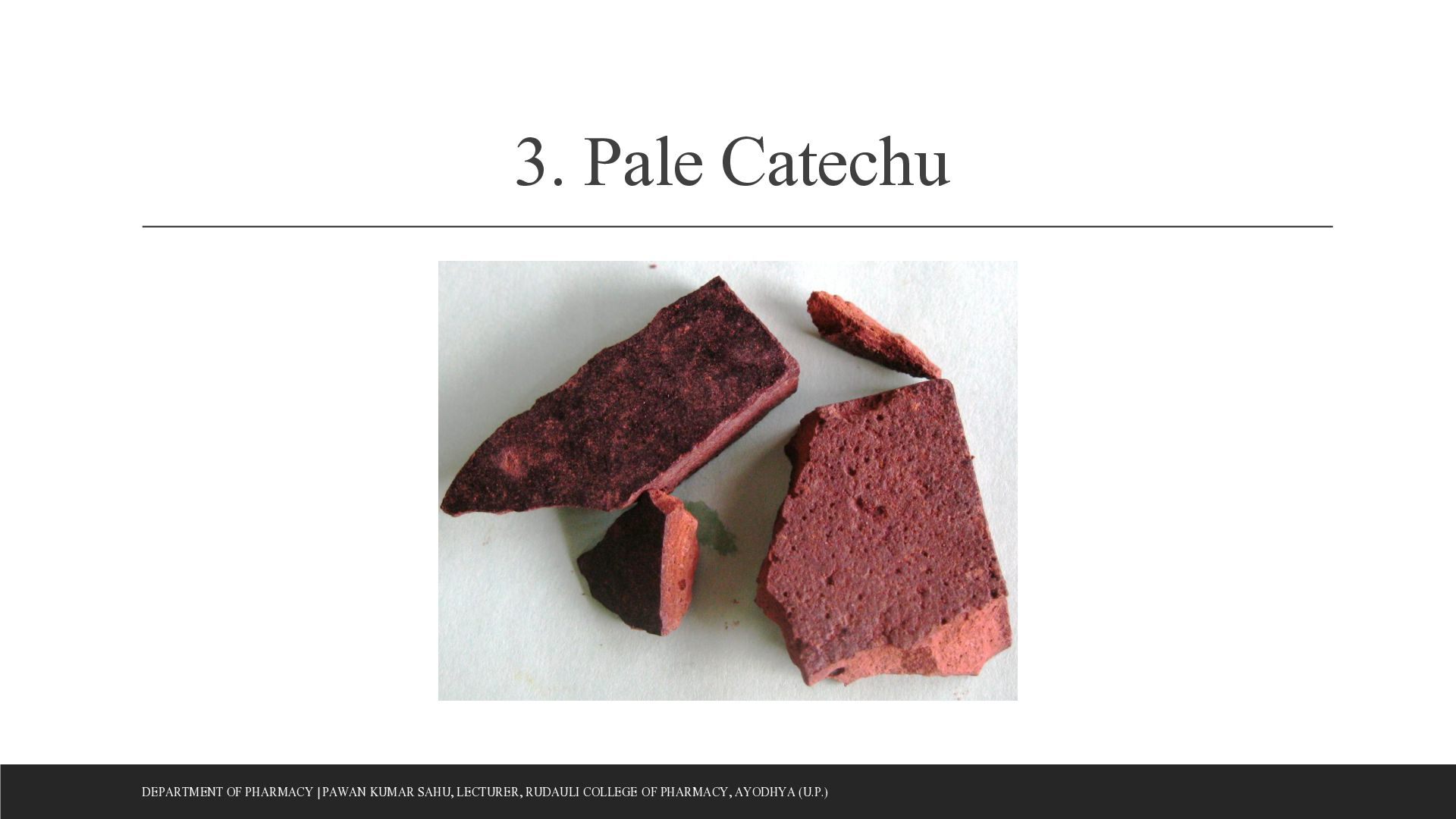
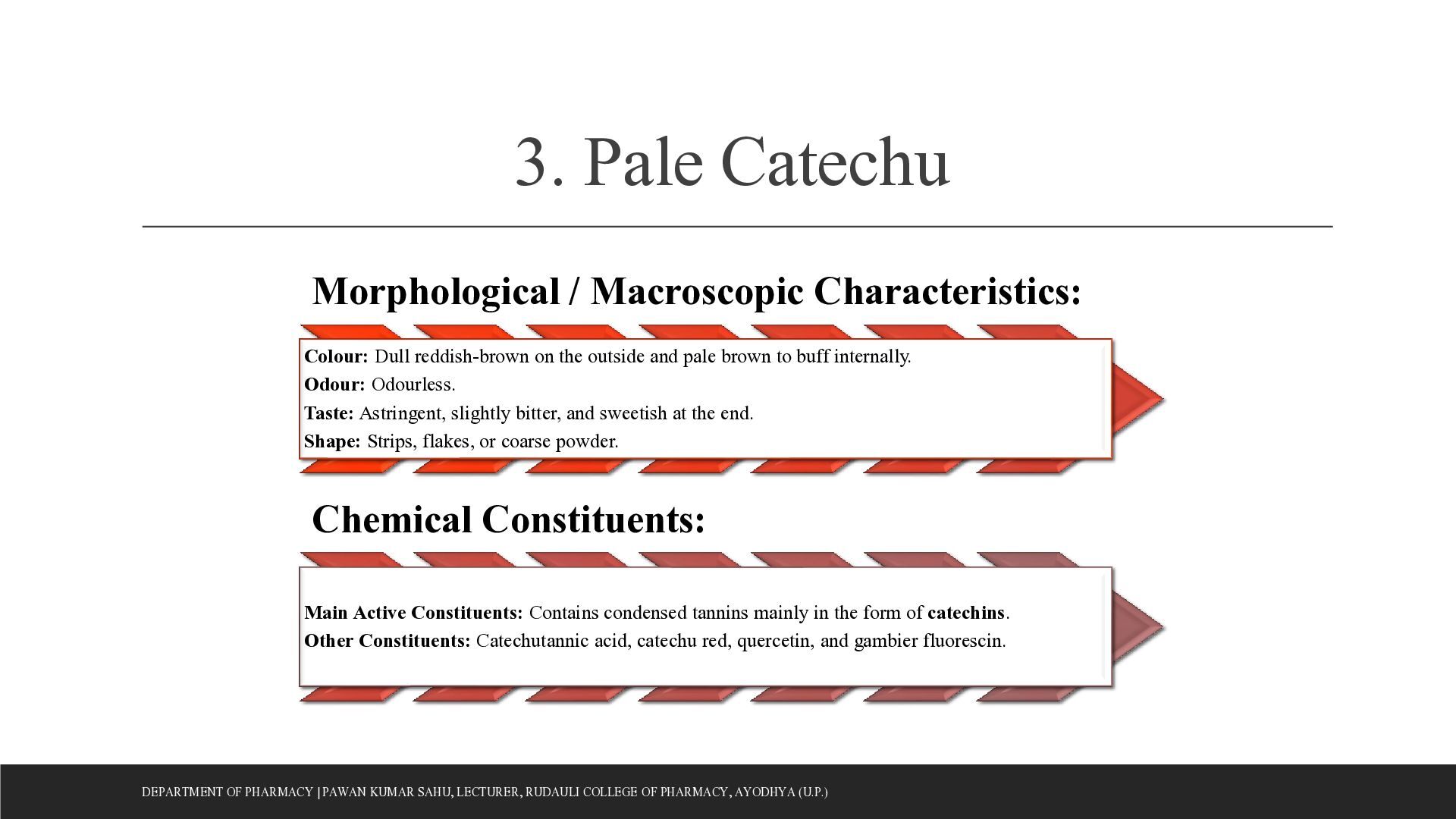
  13. 3. Pale Catechu Morphological / Macroscopic Characteristics: Colour: Dull reddish-brown

    on the outside and pale brown to buff internally. Odour: Odourless. Taste: Astringent, slightly bitter, and sweetish at the end. Shape: Strips, flakes, or coarse powder. Chemical Constituents: Main Active Constituents: Contains condensed tannins mainly in the form of catechins. Other Constituents: Catechutannic acid, catechu red, quercetin, and gambier fluorescin. DEPARTMENT OF PHARMACY | PAWAN KUMAR SAHU, LECTURER, RUDAULI COLLEGE OF PHARMACY, AYODHYA (U.P.)
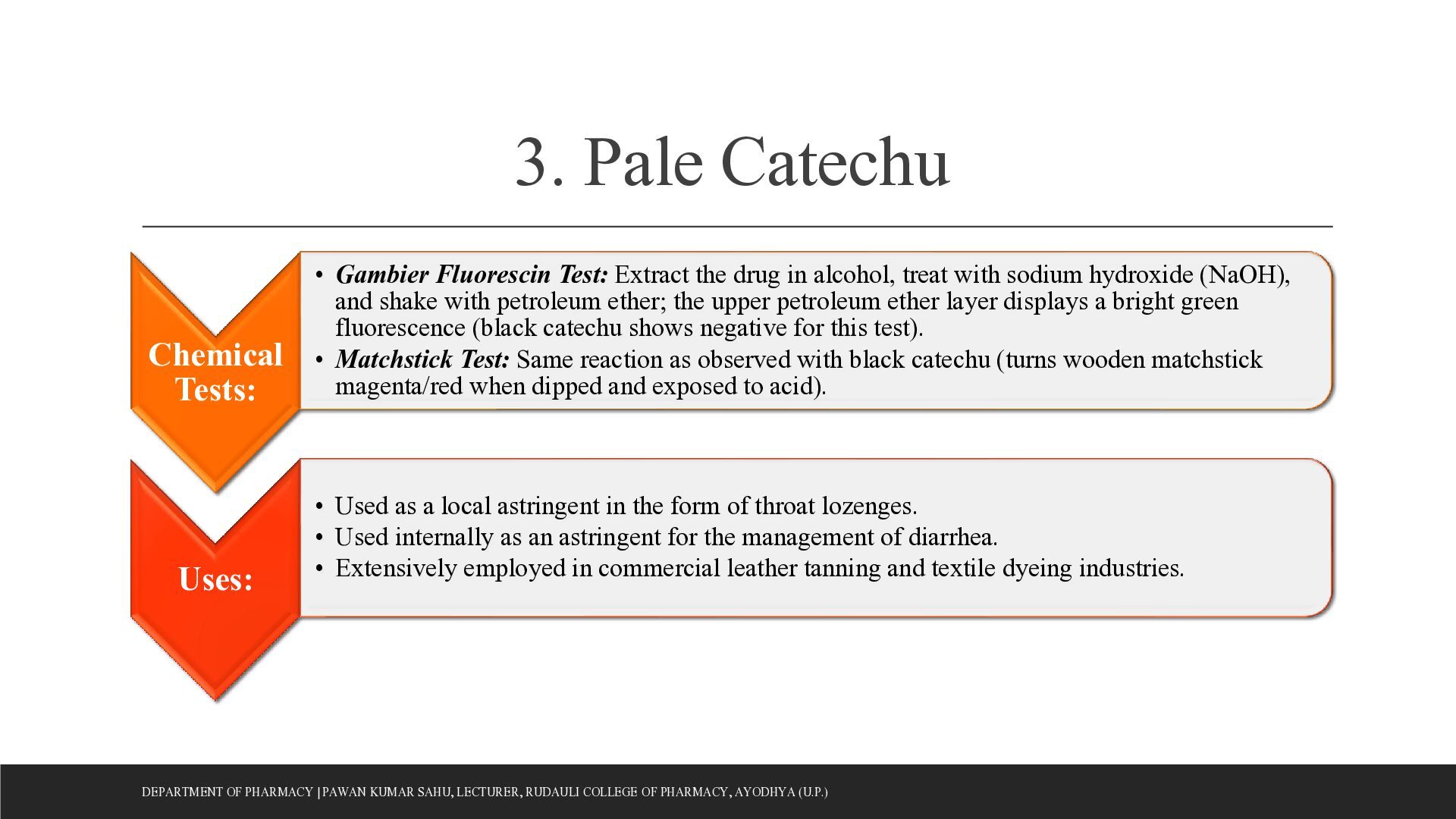
  14. 3. Pale Catechu • Gambier Fluorescin Test: Extract the drug

    in alcohol, treat with sodium hydroxide (NaOH), and shake with petroleum ether; the upper petroleum ether layer displays a bright green fluorescence (black catechu shows negative for this test). • Matchstick Test: Same reaction as observed with black catechu (turns wooden matchstick magenta/red when dipped and exposed to acid). NaOH Chemical Tests: Uses: • Used as a local astringent in the form of throat lozenges. • Used internally as an astringent for the management of diarrhea. • Extensively employed in commercial leather tanning and textile dyeing industries. DEPARTMENT OF PHARMACY | PAWAN KUMAR SAHU, LECTURER, RUDAULI COLLEGE OF PHARMACY, AYODHYA (U.P.)
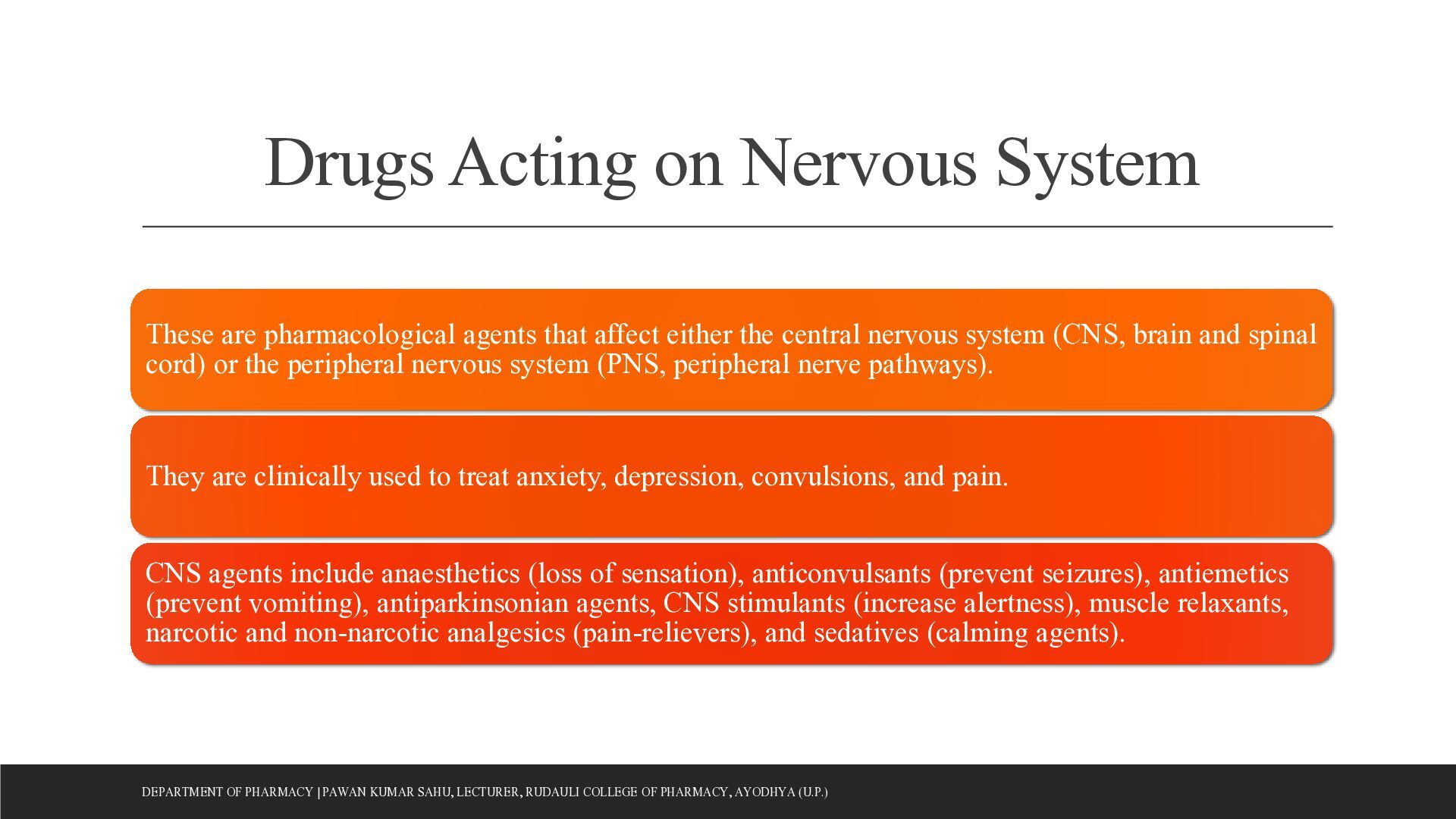
  15. Drugs Acting on Nervous System These are pharmacological agents that

    affect either the central nervous system (CNS, brain and spinal cord) or the peripheral nervous system (PNS, peripheral nerve pathways). They are clinically used to treat anxiety, depression, convulsions, and pain. CNS agents include anaesthetics (loss of sensation), anticonvulsants (prevent seizures), antiemetics (prevent vomiting), antiparkinsonian agents, CNS stimulants (increase alertness), muscle relaxants, narcotic and non-narcotic analgesics (pain-relievers), and sedatives (calming agents). DEPARTMENT OF PHARMACY | PAWAN KUMAR SAHU, LECTURER, RUDAULI COLLEGE OF PHARMACY, AYODHYA (U.P.)
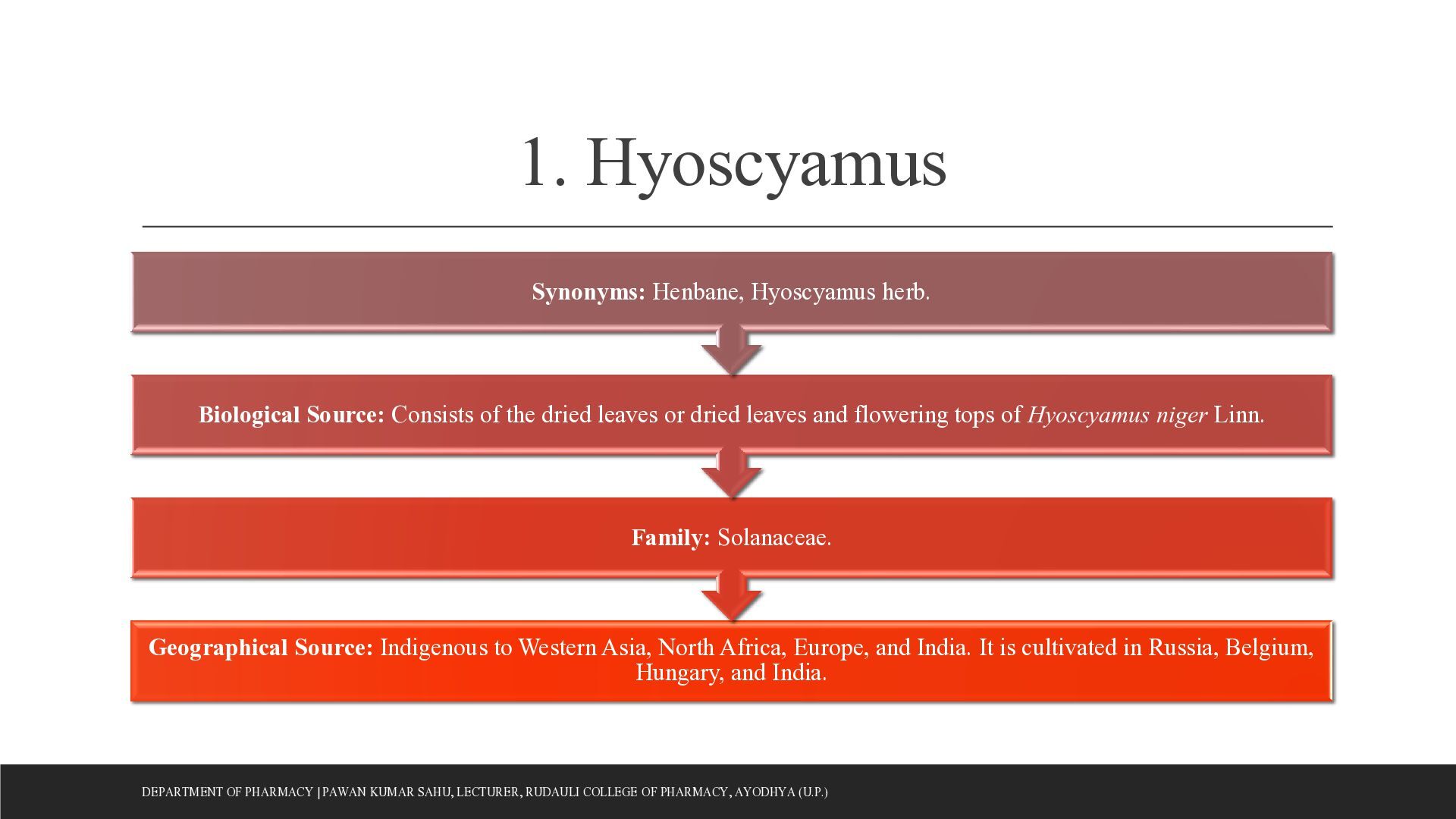
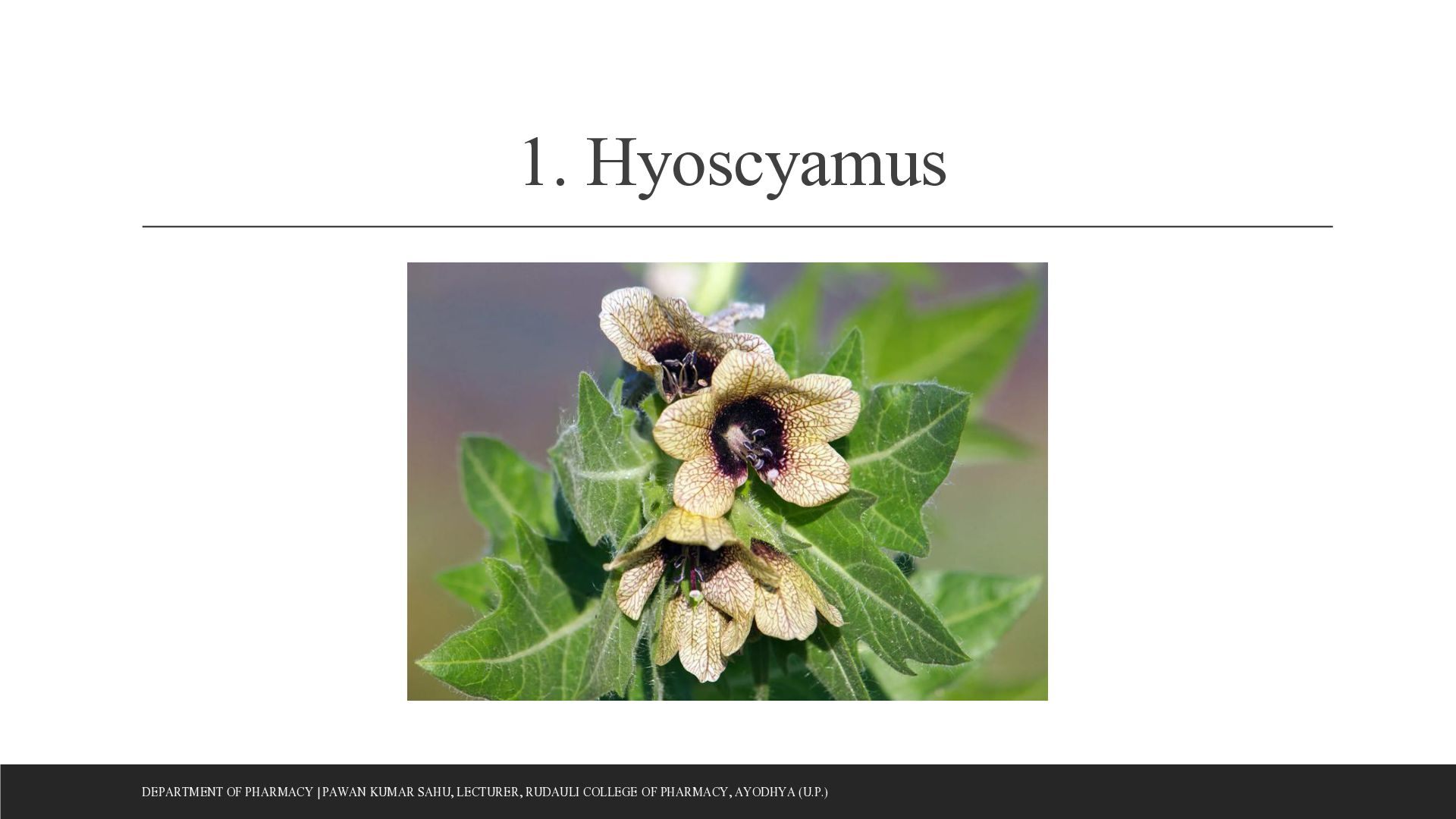
  16. 1. Hyoscyamus Synonyms: Henbane, Hyoscyamus herb. Biological Source: Consists of

    the dried leaves or dried leaves and flowering tops of Hyoscyamus niger Linn. Family: Solanaceae. Geographical Source: Indigenous to Western Asia, North Africa, Europe, and India. It is cultivated in Russia, Belgium, Hungary, and India. DEPARTMENT OF PHARMACY | PAWAN KUMAR SAHU, LECTURER, RUDAULI COLLEGE OF PHARMACY, AYODHYA (U.P.)
  17. 1. Hyoscyamus DEPARTMENT OF PHARMACY | PAWAN KUMAR SAHU, LECTURER,

    RUDAULI COLLEGE OF PHARMACY, AYODHYA (U.P.)
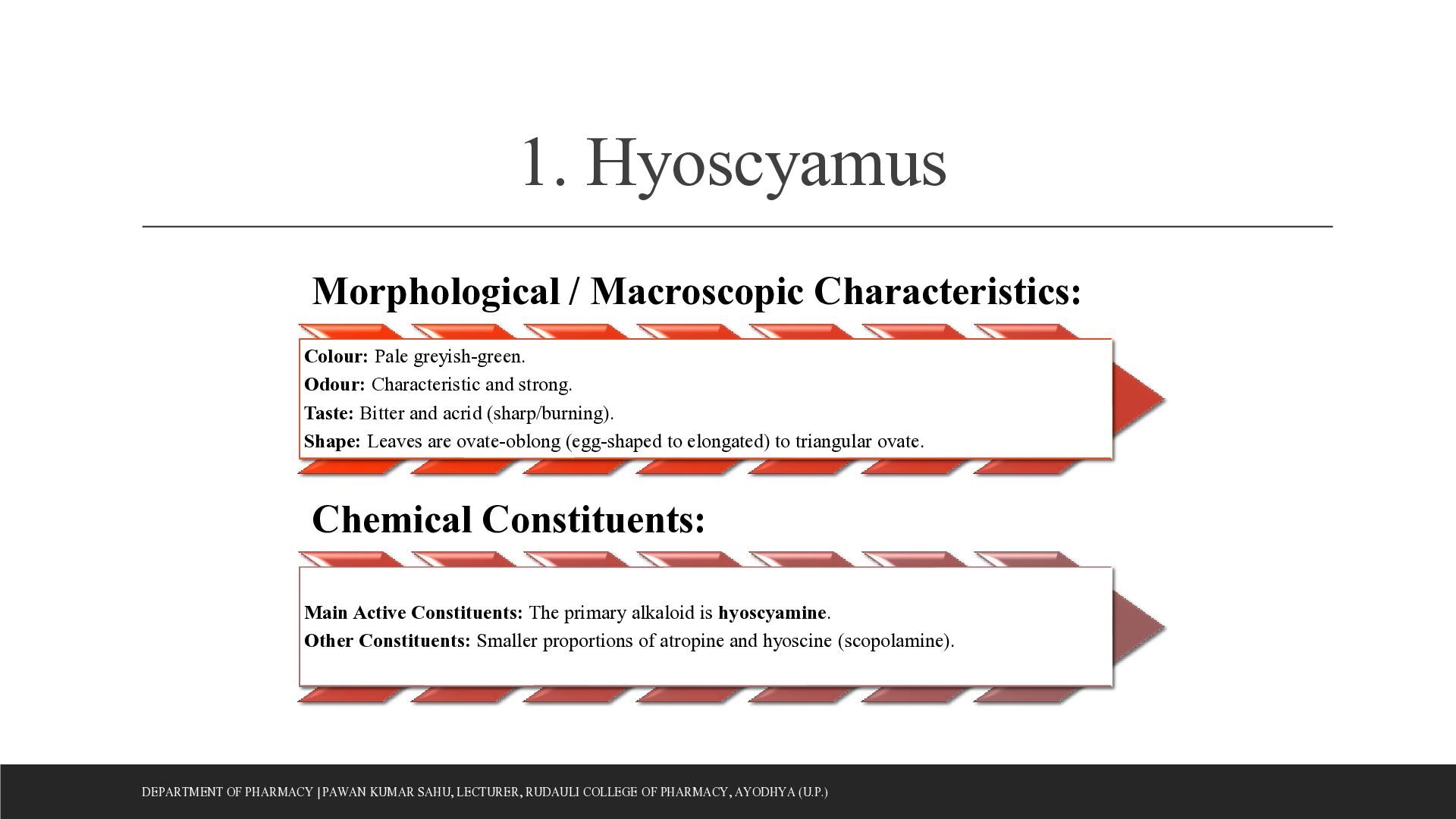
  18. 1. Hyoscyamus Morphological / Macroscopic Characteristics: Colour: Pale greyish-green. Odour:

    Characteristic and strong. Taste: Bitter and acrid (sharp/burning). Shape: Leaves are ovate-oblong (egg-shaped to elongated) to triangular ovate. Chemical Constituents: Main Active Constituents: The primary alkaloid is hyoscyamine. Other Constituents: Smaller proportions of atropine and hyoscine (scopolamine). DEPARTMENT OF PHARMACY | PAWAN KUMAR SAHU, LECTURER, RUDAULI COLLEGE OF PHARMACY, AYODHYA (U.P.)
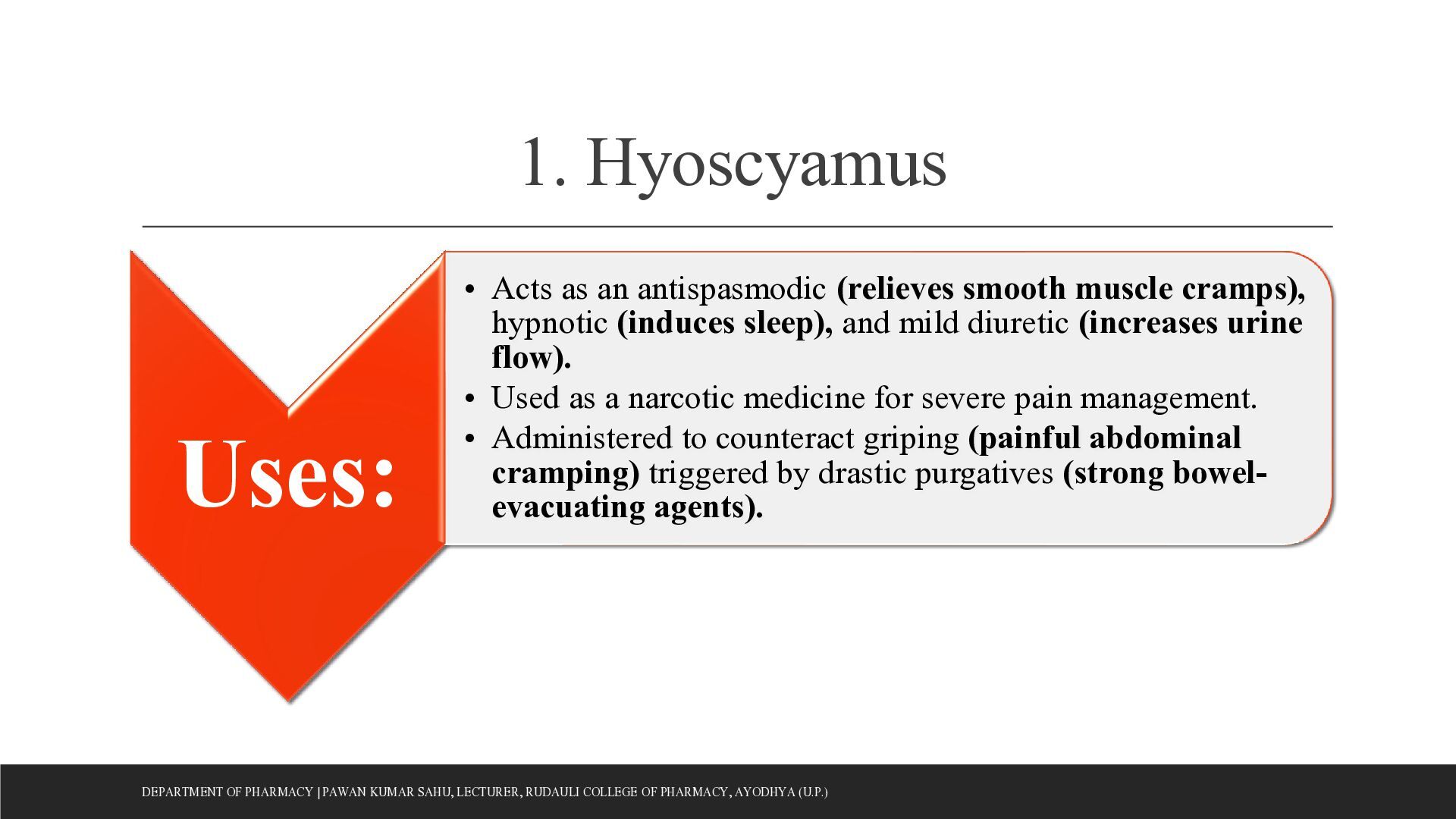
  19. 1. Hyoscyamus Uses: • Acts as an antispasmodic (relieves smooth

    muscle cramps), hypnotic (induces sleep), and mild diuretic (increases urine flow). • Used as a narcotic medicine for severe pain management. • Administered to counteract griping (painful abdominal cramping) triggered by drastic purgatives (strong bowelevacuating agents). DEPARTMENT OF PHARMACY | PAWAN KUMAR SAHU, LECTURER, RUDAULI COLLEGE OF PHARMACY, AYODHYA (U.P.)
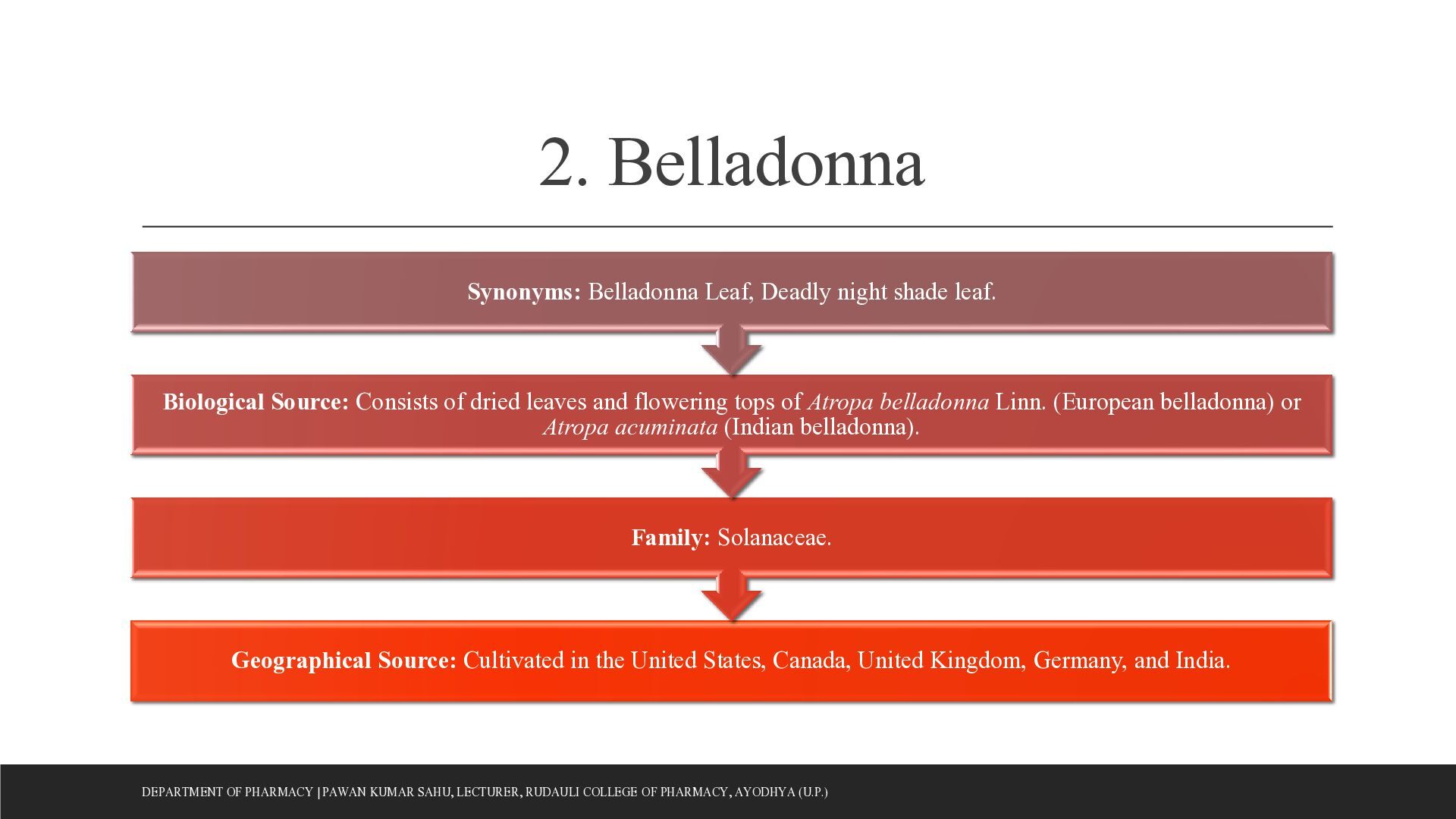
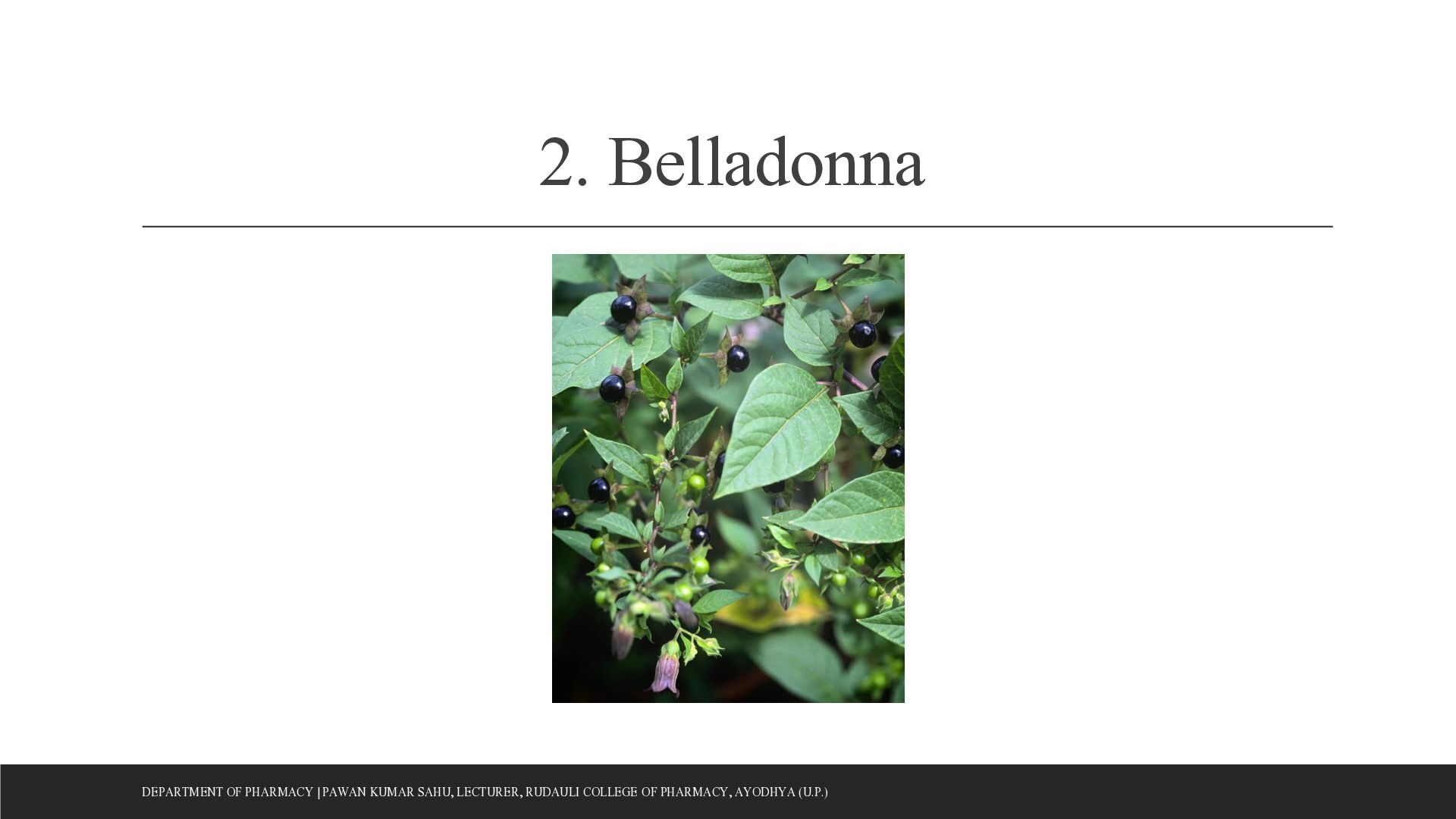
  20. 2. Belladonna Synonyms: Belladonna Leaf, Deadly night shade leaf. Biological

    Source: Consists of dried leaves and flowering tops of Atropa belladonna Linn. (European belladonna) or Atropa acuminata (Indian belladonna). Family: Solanaceae. Geographical Source: Cultivated in the United States, Canada, United Kingdom, Germany, and India. DEPARTMENT OF PHARMACY | PAWAN KUMAR SAHU, LECTURER, RUDAULI COLLEGE OF PHARMACY, AYODHYA (U.P.)
  21. 2. Belladonna DEPARTMENT OF PHARMACY | PAWAN KUMAR SAHU, LECTURER,

    RUDAULI COLLEGE OF PHARMACY, AYODHYA (U.P.)
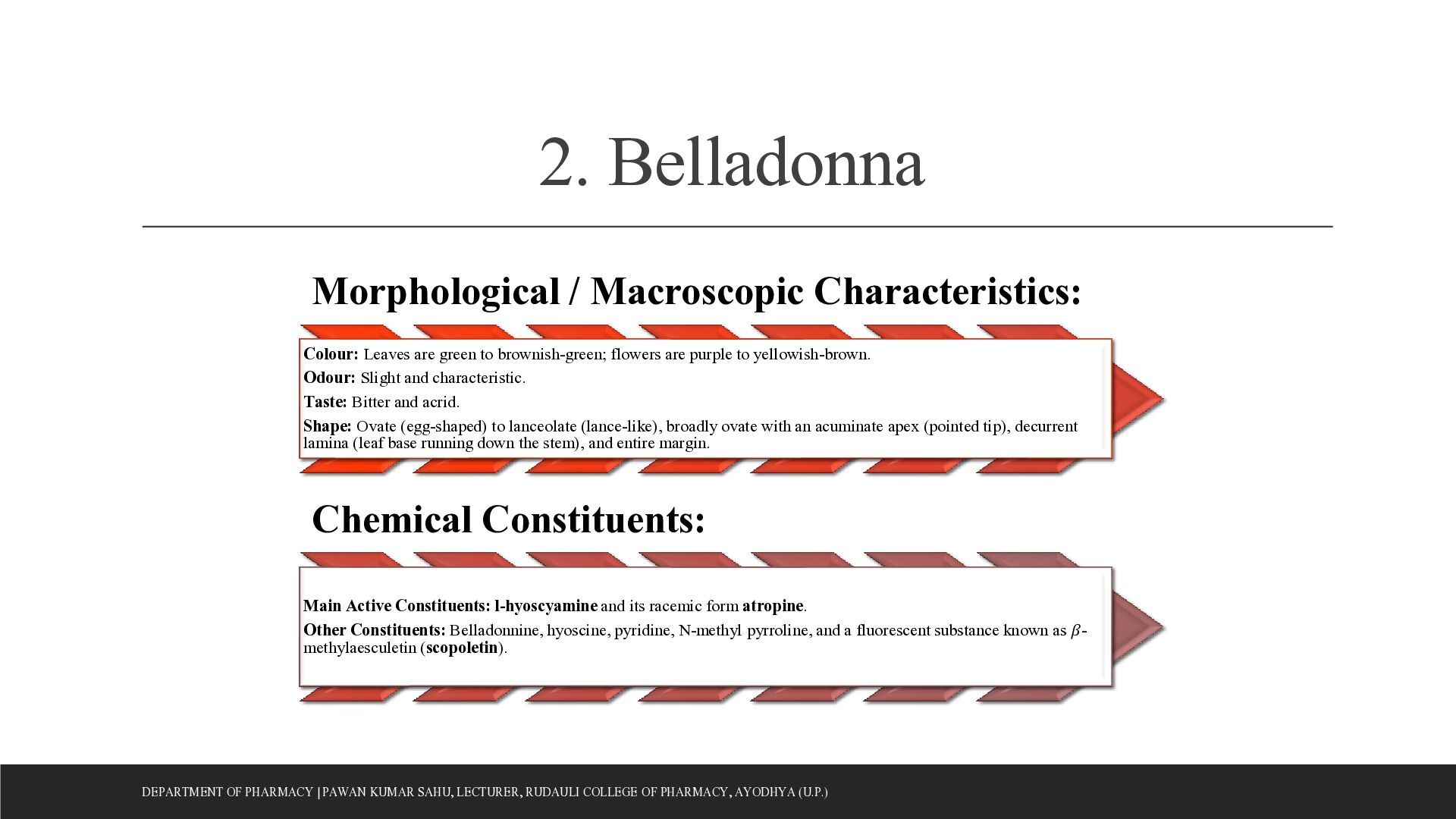
  22. 2. Belladonna Morphological / Macroscopic Characteristics: Colour: Leaves are green

    to brownish-green; flowers are purple to yellowish-brown. Odour: Slight and characteristic. Taste: Bitter and acrid. Shape: Ovate (egg-shaped) to lanceolate (lance-like), broadly ovate with an acuminate apex (pointed tip), decurrent lamina (leaf base running down the stem), and entire margin. Chemical Constituents: Main Active Constituents: l-hyoscyamine and its racemic form atropine. Other Constituents: Belladonnine, hyoscine, pyridine, N-methyl pyrroline, and a fluorescent substance known as 𝛽methylaesculetin (scopoletin). start equation beta DEPARTMENT OF PHARMACY | PAWAN KUMAR SAHU, LECTURER, RUDAULI COLLEGE OF PHARMACY, AYODHYA (U.P.)
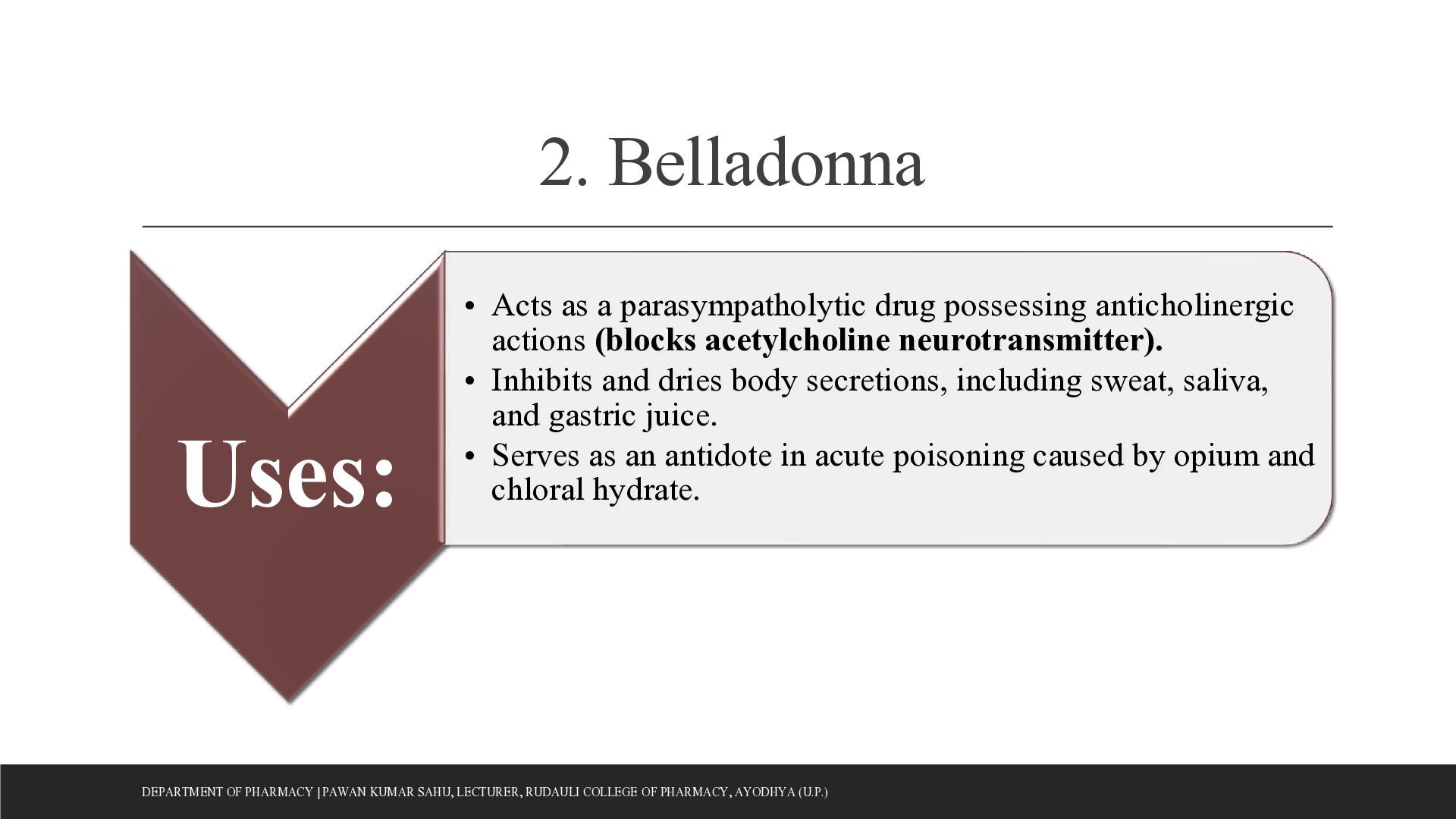
  23. 2. Belladonna Uses: • Acts as a parasympatholytic drug possessing

    anticholinergic actions (blocks acetylcholine neurotransmitter). • Inhibits and dries body secretions, including sweat, saliva, and gastric juice. • Serves as an antidote in acute poisoning caused by opium and chloral hydrate. DEPARTMENT OF PHARMACY | PAWAN KUMAR SAHU, LECTURER, RUDAULI COLLEGE OF PHARMACY, AYODHYA (U.P.)
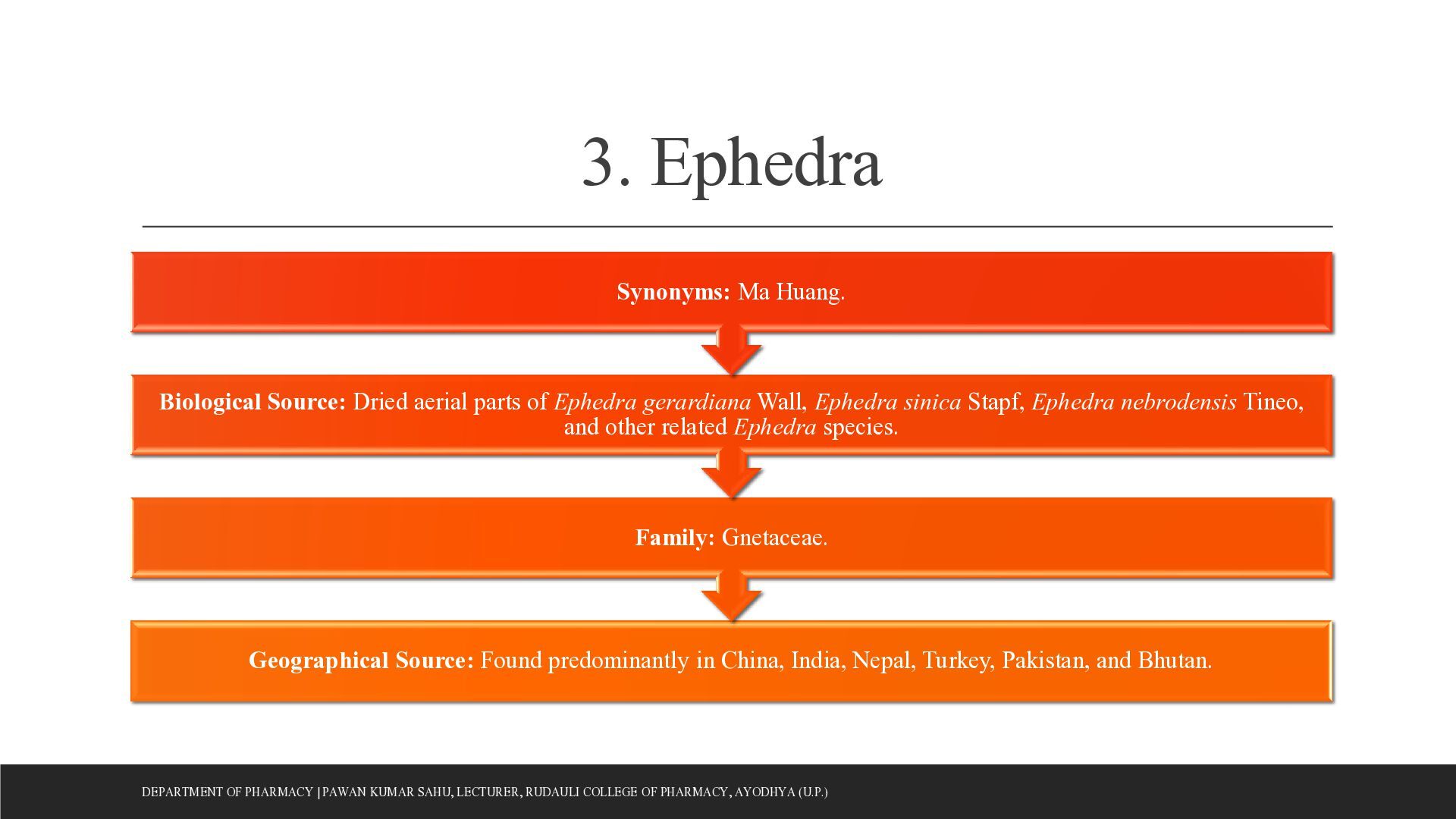
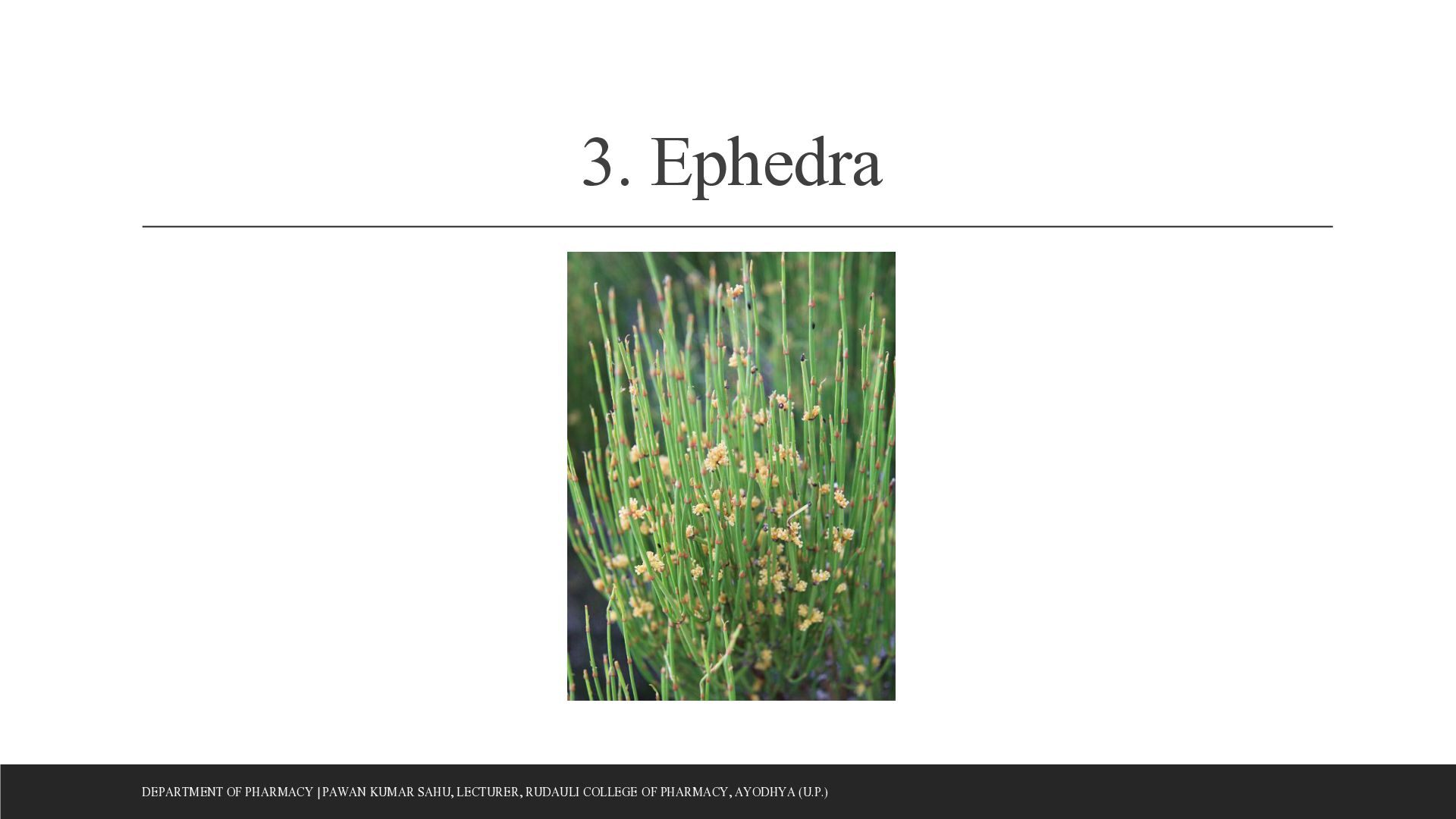
  24. 3. Ephedra Synonyms: Ma Huang. Biological Source: Dried aerial parts

    of Ephedra gerardiana Wall, Ephedra sinica Stapf, Ephedra nebrodensis Tineo, and other related Ephedra species. Family: Gnetaceae. Geographical Source: Found predominantly in China, India, Nepal, Turkey, Pakistan, and Bhutan. DEPARTMENT OF PHARMACY | PAWAN KUMAR SAHU, LECTURER, RUDAULI COLLEGE OF PHARMACY, AYODHYA (U.P.)
  25. 3. Ephedra DEPARTMENT OF PHARMACY | PAWAN KUMAR SAHU, LECTURER,

    RUDAULI COLLEGE OF PHARMACY, AYODHYA (U.P.)
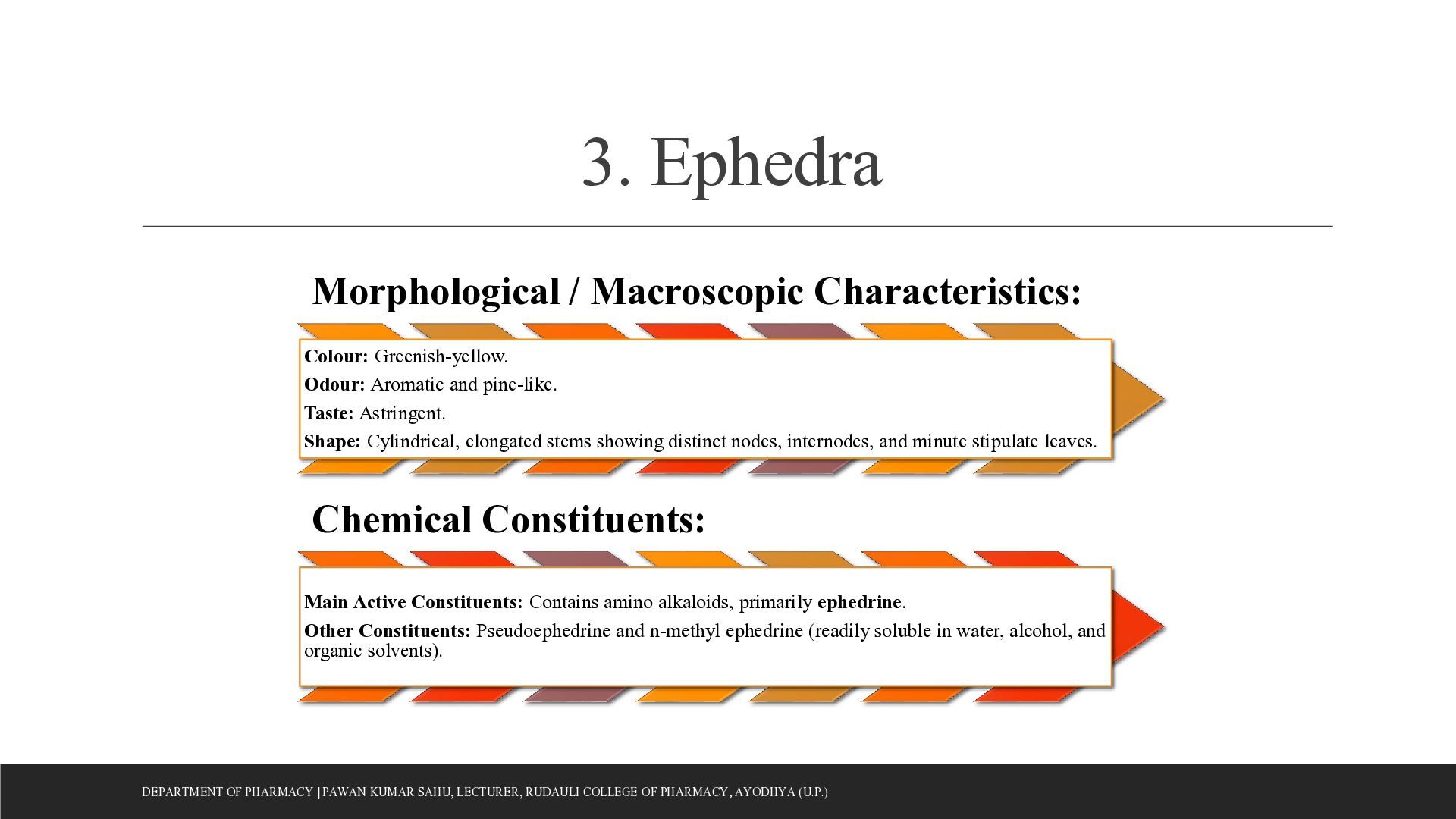
  26. 3. Ephedra Morphological / Macroscopic Characteristics: Colour: Greenish-yellow. Odour: Aromatic

    and pine-like. Taste: Astringent. Shape: Cylindrical, elongated stems showing distinct nodes, internodes, and minute stipulate leaves. Chemical Constituents: Main Active Constituents: Contains amino alkaloids, primarily ephedrine. Other Constituents: Pseudoephedrine and n-methyl ephedrine (readily soluble in water, alcohol, and organic solvents). DEPARTMENT OF PHARMACY | PAWAN KUMAR SAHU, LECTURER, RUDAULI COLLEGE OF PHARMACY, AYODHYA (U.P.)
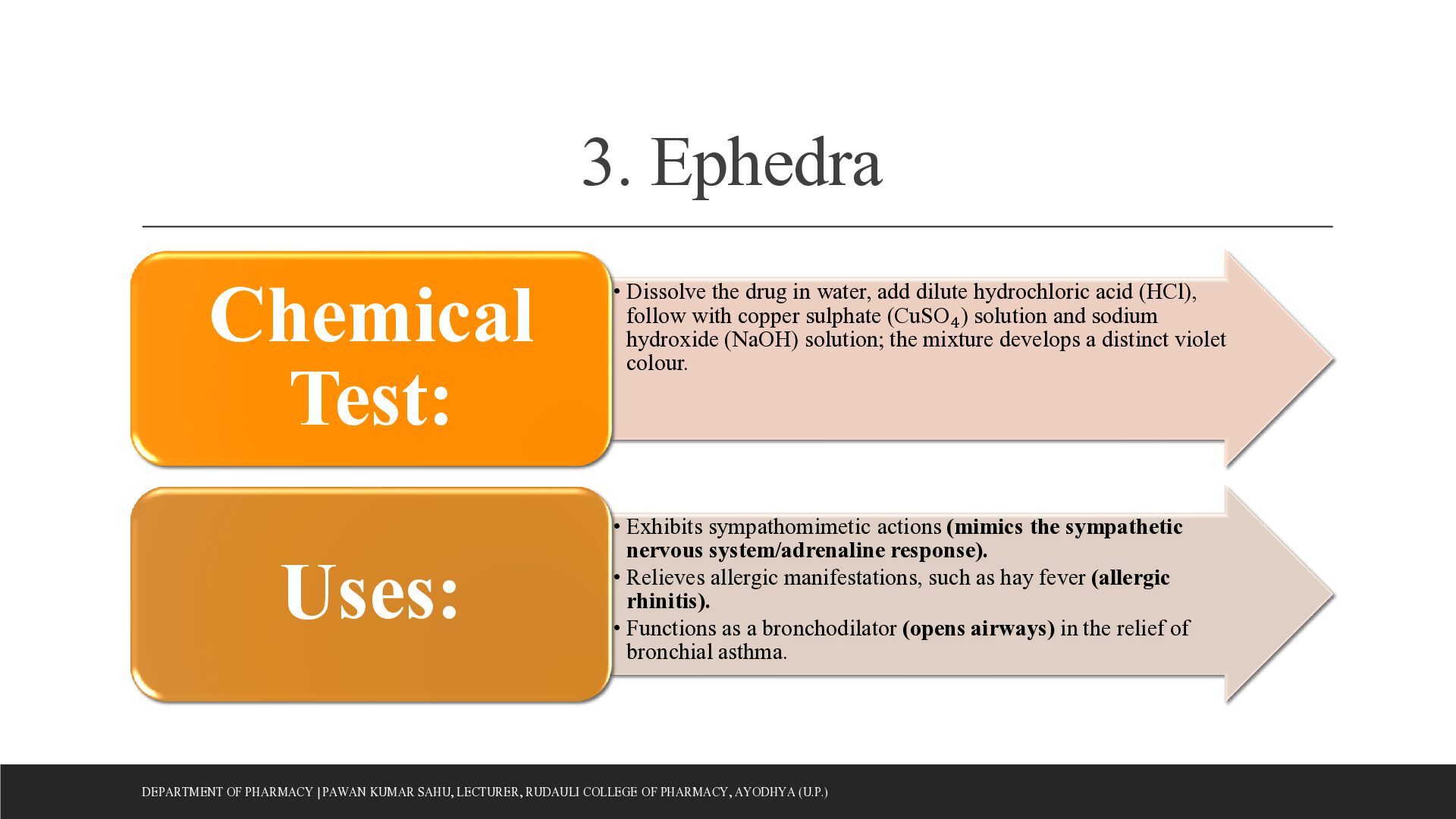
  27. 3. Ephedra Chemical Test: Uses: • Dissolve the drug in

    water, add dilute hydrochloric acid (HCl), follow with copper sulphate (CuSO4 ) solution and sodium hydroxide (NaOH) solution; the mixture develops a distinct violet colour. HCl subscript base , CuSO , end base , sub 4 NaOH • Exhibits sympathomimetic actions (mimics the sympathetic nervous system/adrenaline response). • Relieves allergic manifestations, such as hay fever (allergic rhinitis). • Functions as a bronchodilator (opens airways) in the relief of bronchial asthma. DEPARTMENT OF PHARMACY | PAWAN KUMAR SAHU, LECTURER, RUDAULI COLLEGE OF PHARMACY, AYODHYA (U.P.)
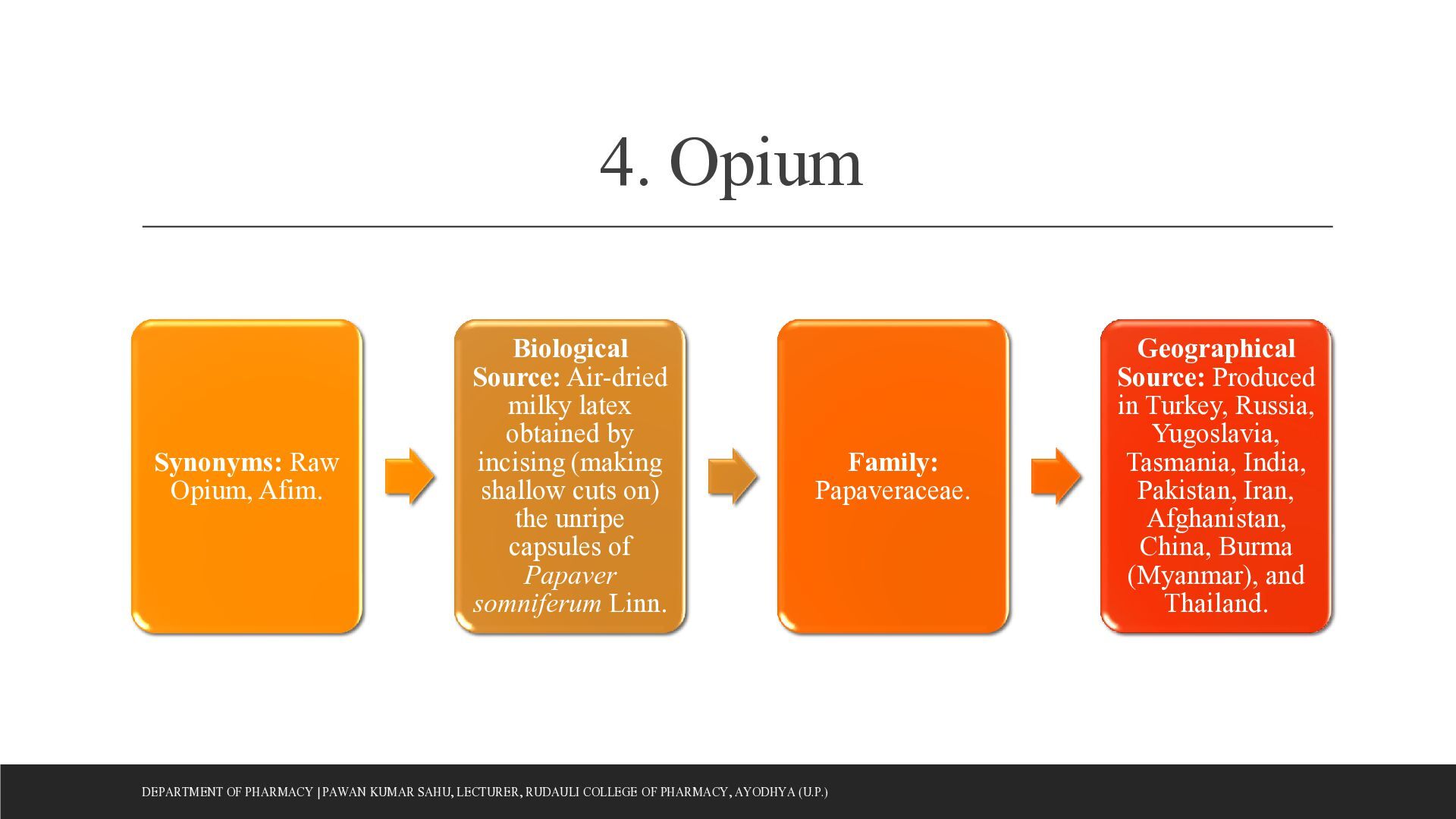
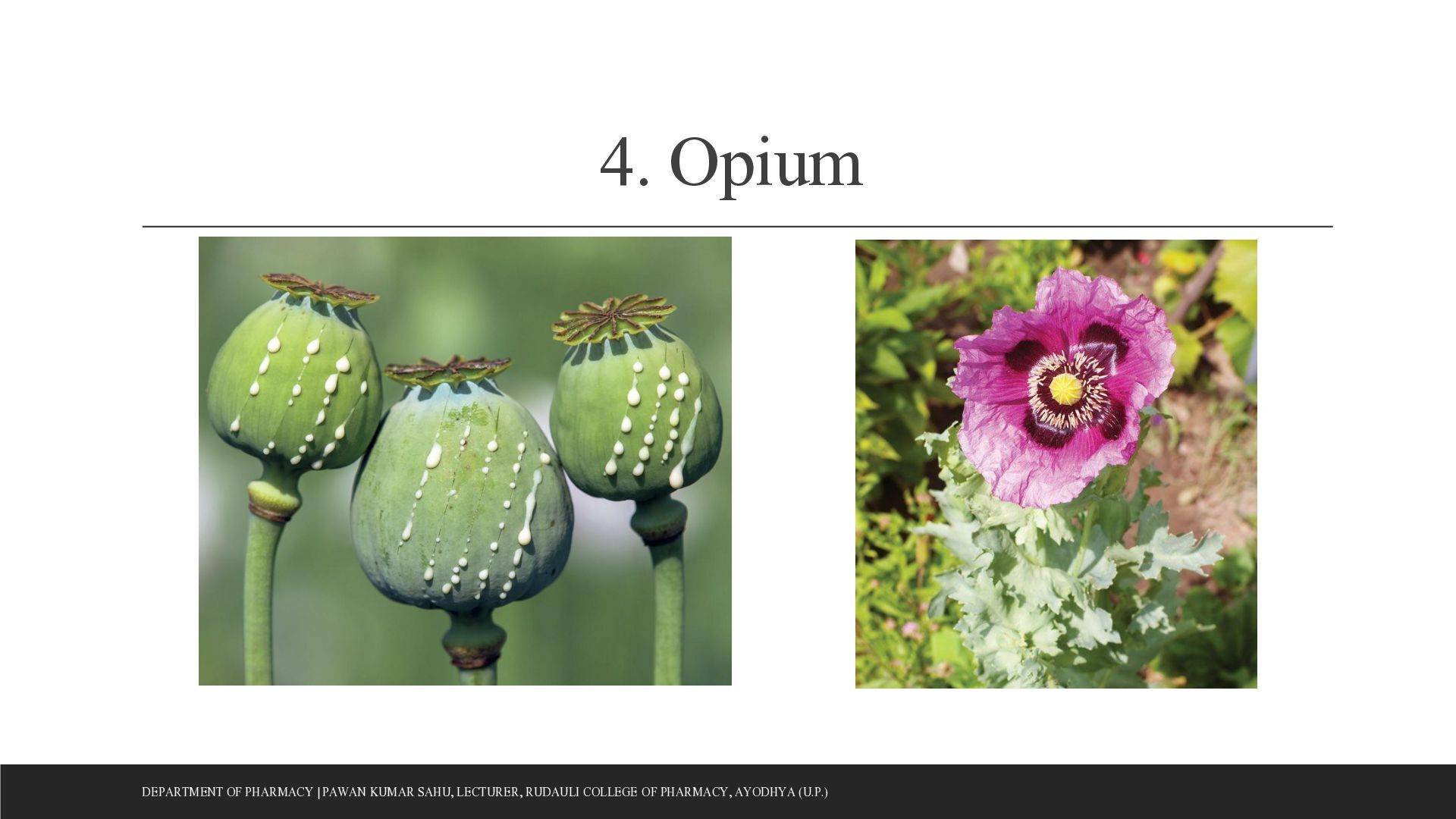
  28. 4. Opium Synonyms: Raw Opium, Afim. Biological Source: Air-dried milky

    latex obtained by incising (making shallow cuts on) the unripe capsules of Papaver somniferum Linn. Family: Papaveraceae. DEPARTMENT OF PHARMACY | PAWAN KUMAR SAHU, LECTURER, RUDAULI COLLEGE OF PHARMACY, AYODHYA (U.P.) Geographical Source: Produced in Turkey, Russia, Yugoslavia, Tasmania, India, Pakistan, Iran, Afghanistan, China, Burma (Myanmar), and Thailand.
  29. 4. Opium DEPARTMENT OF PHARMACY | PAWAN KUMAR SAHU, LECTURER,

    RUDAULI COLLEGE OF PHARMACY, AYODHYA (U.P.)
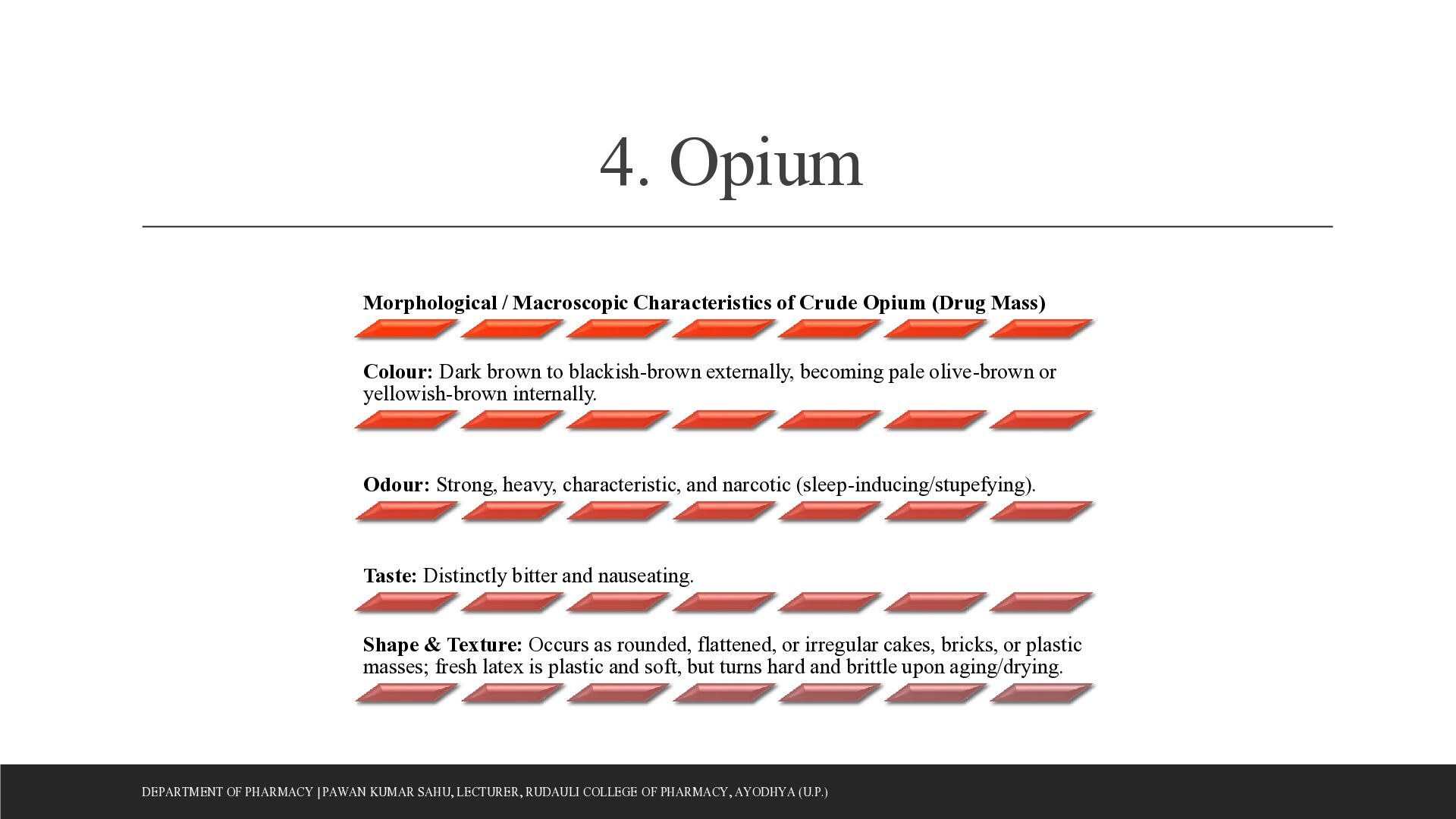
  30. 4. Opium Morphological / Macroscopic Characteristics of Crude Opium (Drug

    Mass) Colour: Dark brown to blackish-brown externally, becoming pale olive-brown or yellowish-brown internally. Odour: Strong, heavy, characteristic, and narcotic (sleep-inducing/stupefying). Taste: Distinctly bitter and nauseating. Shape & Texture: Occurs as rounded, flattened, or irregular cakes, bricks, or plastic masses; fresh latex is plastic and soft, but turns hard and brittle upon aging/drying. DEPARTMENT OF PHARMACY | PAWAN KUMAR SAHU, LECTURER, RUDAULI COLLEGE OF PHARMACY, AYODHYA (U.P.)
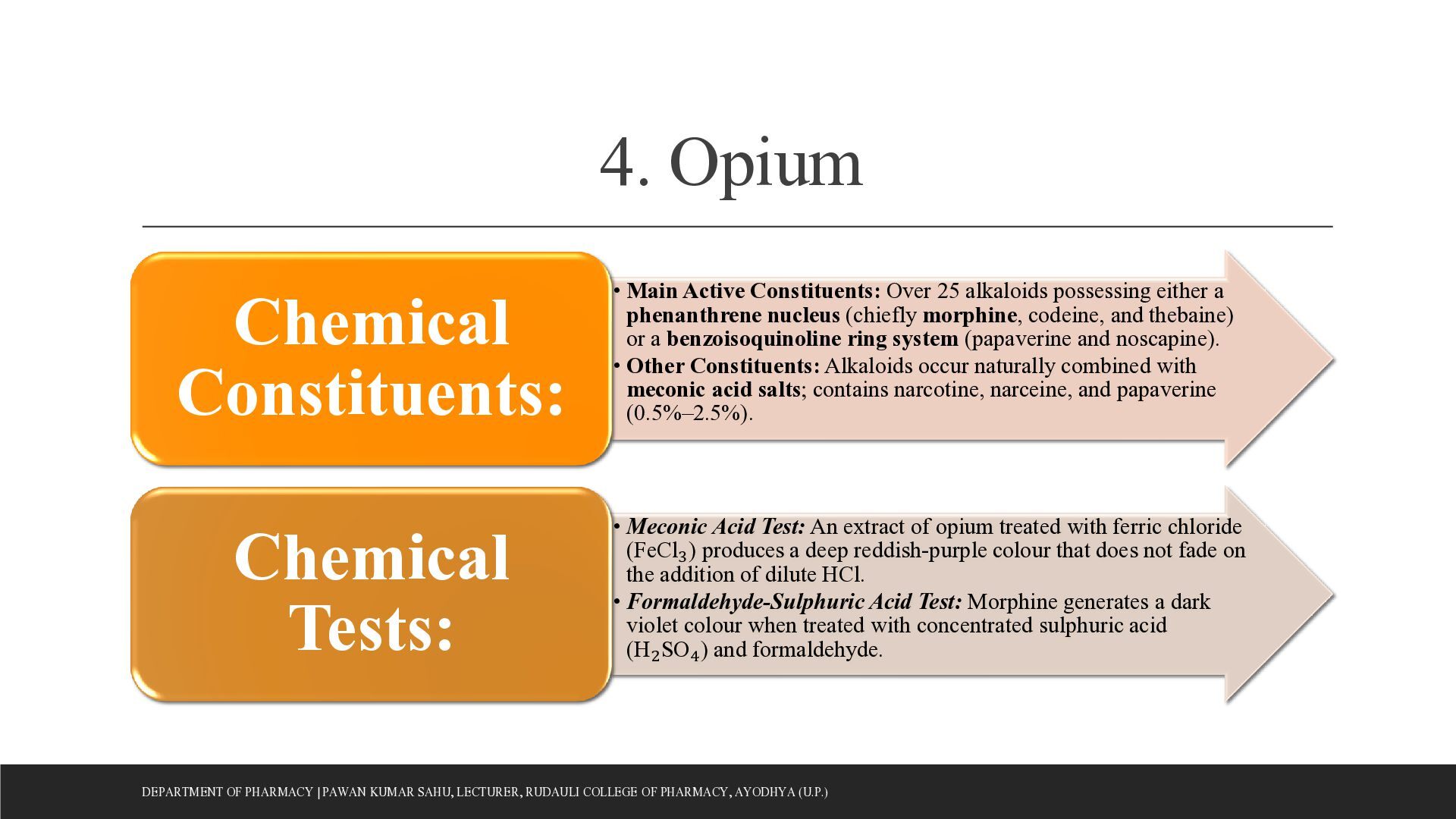
  31. 4. Opium Chemical Constituents: • Main Active Constituents: Over 25

    alkaloids possessing either a phenanthrene nucleus (chiefly morphine, codeine, and thebaine) or a benzoisoquinoline ring system (papaverine and noscapine). • Other Constituents: Alkaloids occur naturally combined with meconic acid salts; contains narcotine, narceine, and papaverine (0.5%–2.5%). Chemical Tests: • Meconic Acid Test: An extract of opium treated with ferric chloride (FeCl3 ) produces a deep reddish-purple colour that does not fade on the addition of dilute HCl. • Formaldehyde-Sulphuric Acid Test: Morphine generates a dark violet colour when treated with concentrated sulphuric acid (H2 SO4 ) and formaldehyde. subscript base , FeCl , end base , sub 3 HCl H sub 2 , subscript base , SO , end base , sub 4 DEPARTMENT OF PHARMACY | PAWAN KUMAR SAHU, LECTURER, RUDAULI COLLEGE OF PHARMACY, AYODHYA (U.P.)
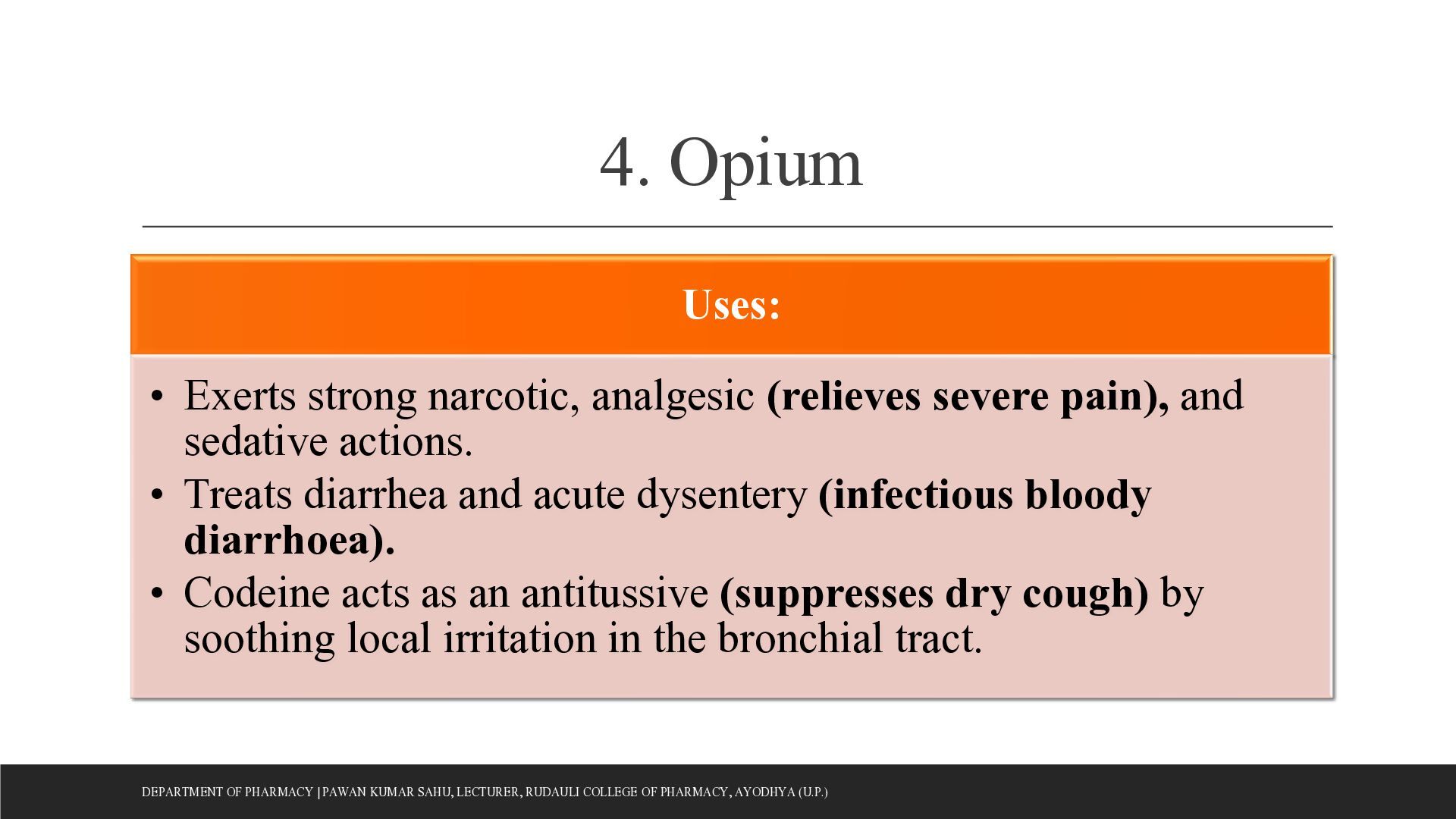
  32. 4. Opium Uses: • Exerts strong narcotic, analgesic (relieves severe

    pain), and sedative actions. • Treats diarrhea and acute dysentery (infectious bloody diarrhoea). • Codeine acts as an antitussive (suppresses dry cough) by soothing local irritation in the bronchial tract. DEPARTMENT OF PHARMACY | PAWAN KUMAR SAHU, LECTURER, RUDAULI COLLEGE OF PHARMACY, AYODHYA (U.P.)
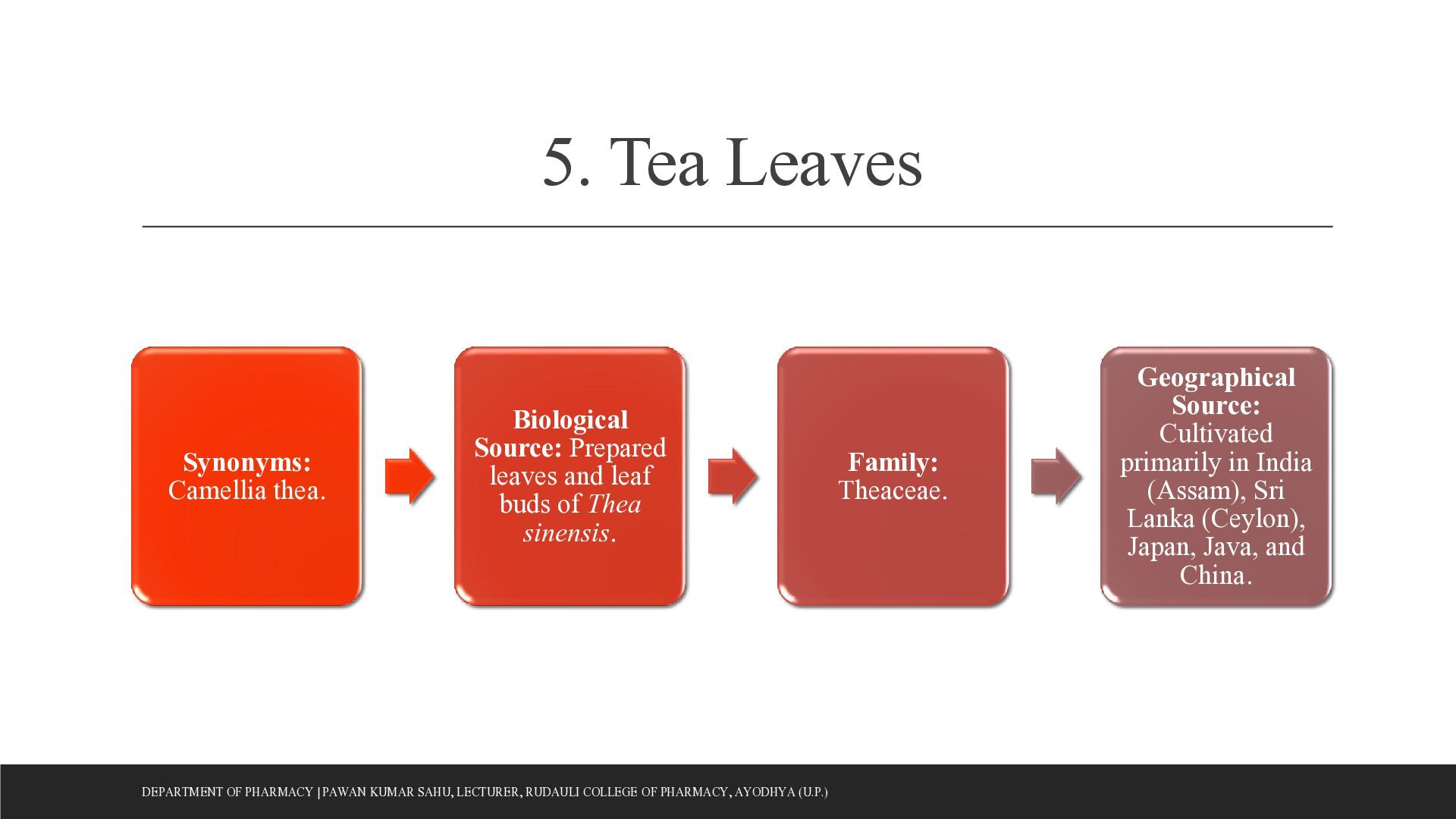
  33. 5. Tea Leaves Synonyms: Camellia thea. Biological Source: Prepared leaves

    and leaf buds of Thea sinensis. DEPARTMENT OF PHARMACY | PAWAN KUMAR SAHU, LECTURER, RUDAULI COLLEGE OF PHARMACY, AYODHYA (U.P.) Family: Theaceae. Geographical Source: Cultivated primarily in India (Assam), Sri Lanka (Ceylon), Japan, Java, and China.
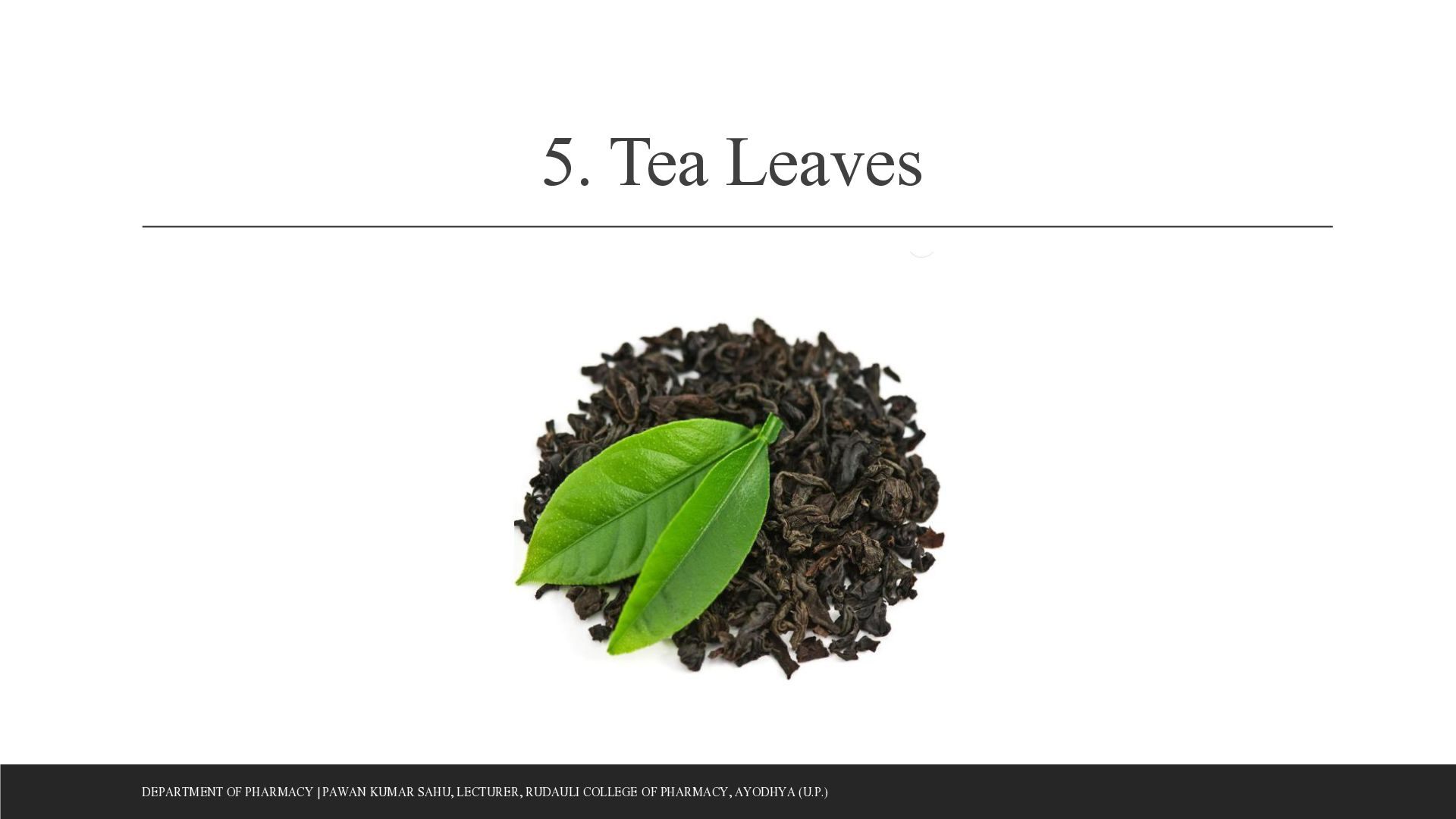
  34. 5. Tea Leaves DEPARTMENT OF PHARMACY | PAWAN KUMAR SAHU,

    LECTURER, RUDAULI COLLEGE OF PHARMACY, AYODHYA (U.P.)
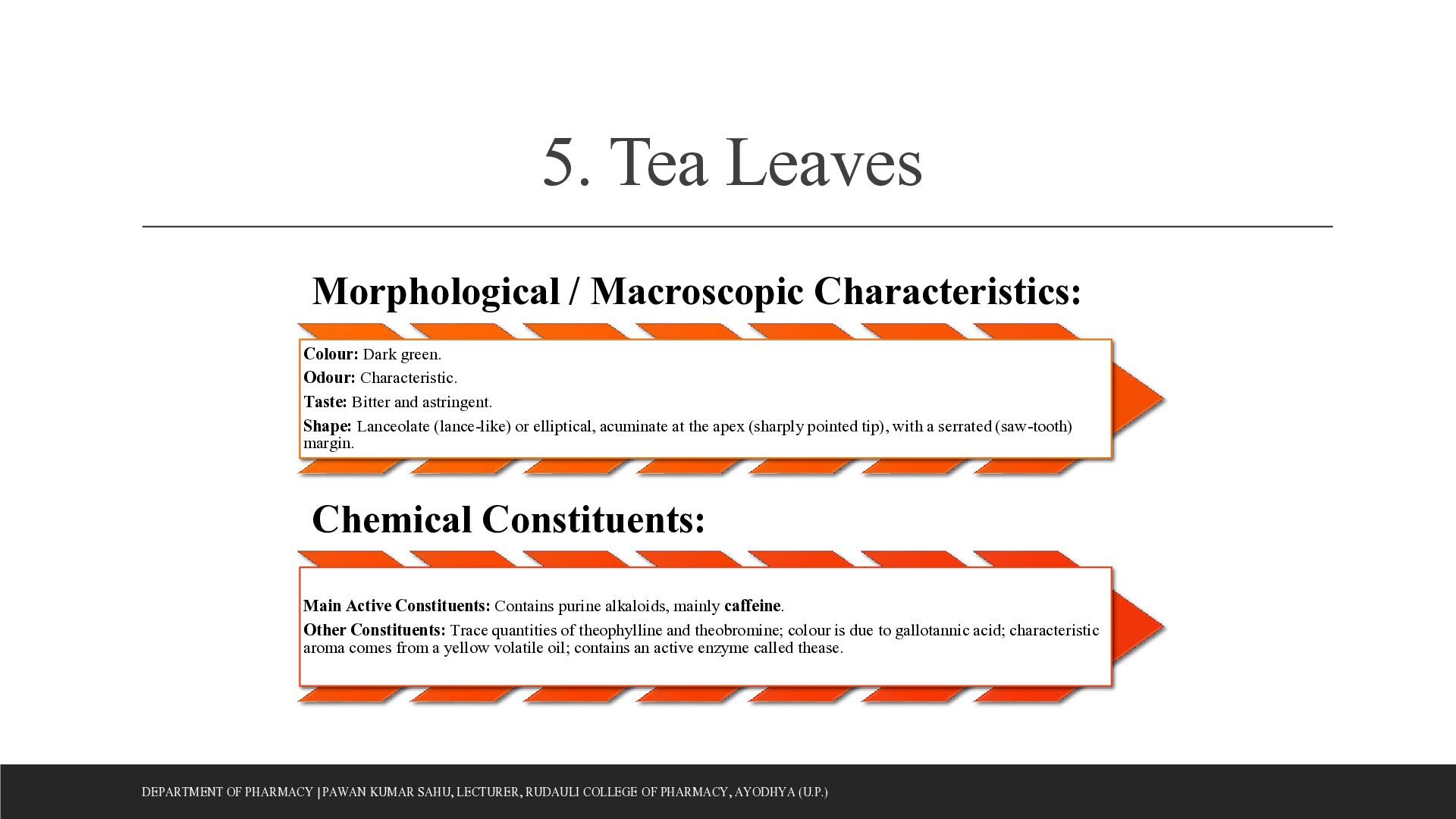
  35. 5. Tea Leaves Morphological / Macroscopic Characteristics: Colour: Dark green.

    Odour: Characteristic. Taste: Bitter and astringent. Shape: Lanceolate (lance-like) or elliptical, acuminate at the apex (sharply pointed tip), with a serrated (saw-tooth) margin. Chemical Constituents: Main Active Constituents: Contains purine alkaloids, mainly caffeine. Other Constituents: Trace quantities of theophylline and theobromine; colour is due to gallotannic acid; characteristic aroma comes from a yellow volatile oil; contains an active enzyme called thease. DEPARTMENT OF PHARMACY | PAWAN KUMAR SAHU, LECTURER, RUDAULI COLLEGE OF PHARMACY, AYODHYA (U.P.)
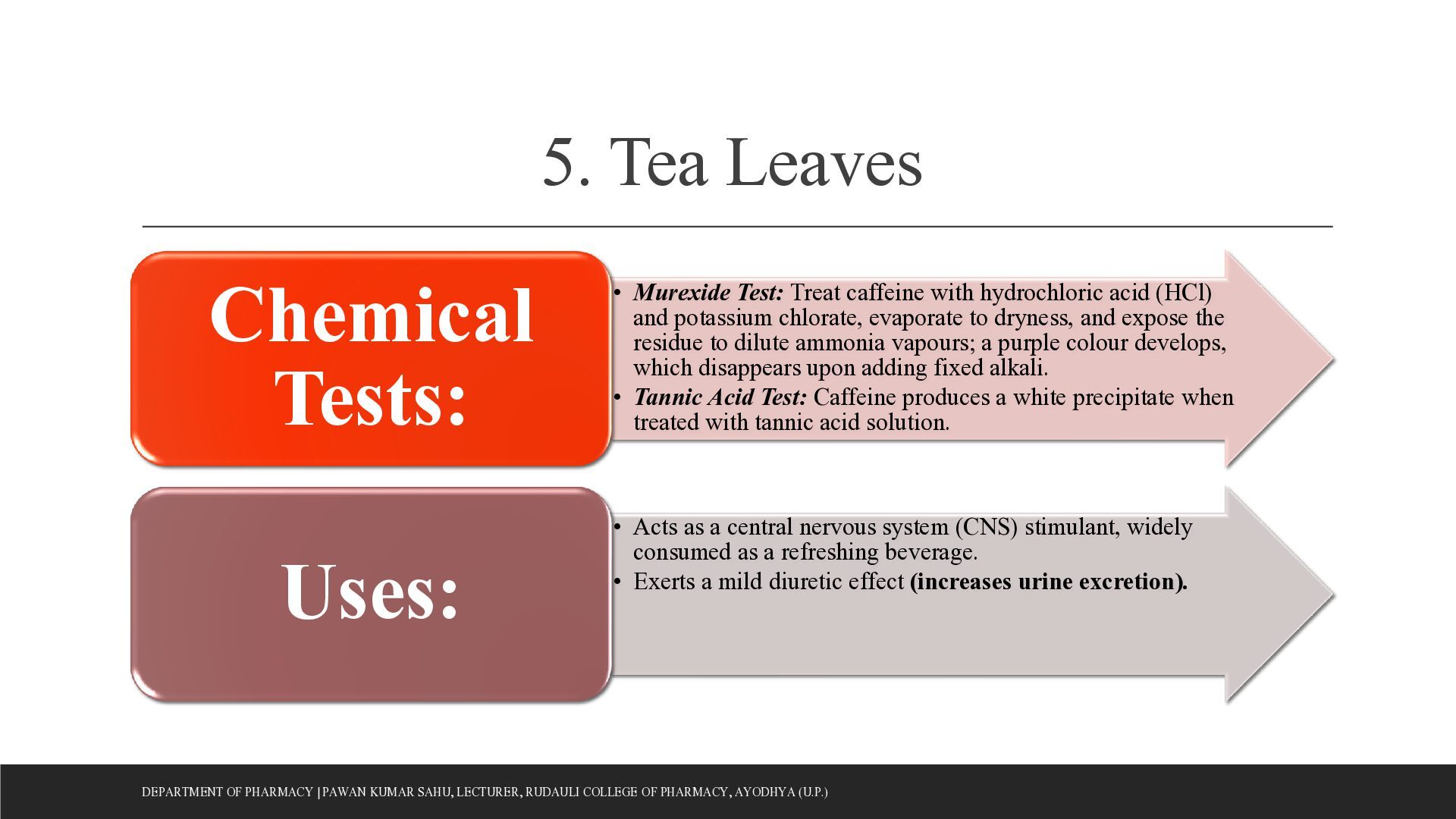
  36. 5. Tea Leaves Chemical Tests: Uses: • Murexide Test: Treat

    caffeine with hydrochloric acid (HCl) and potassium chlorate, evaporate to dryness, and expose the residue to dilute ammonia vapours; a purple colour develops, which disappears upon adding fixed alkali. • Tannic Acid Test: Caffeine produces a white precipitate when treated with tannic acid solution. HCl • Acts as a central nervous system (CNS) stimulant, widely consumed as a refreshing beverage. • Exerts a mild diuretic effect (increases urine excretion). DEPARTMENT OF PHARMACY | PAWAN KUMAR SAHU, LECTURER, RUDAULI COLLEGE OF PHARMACY, AYODHYA (U.P.)
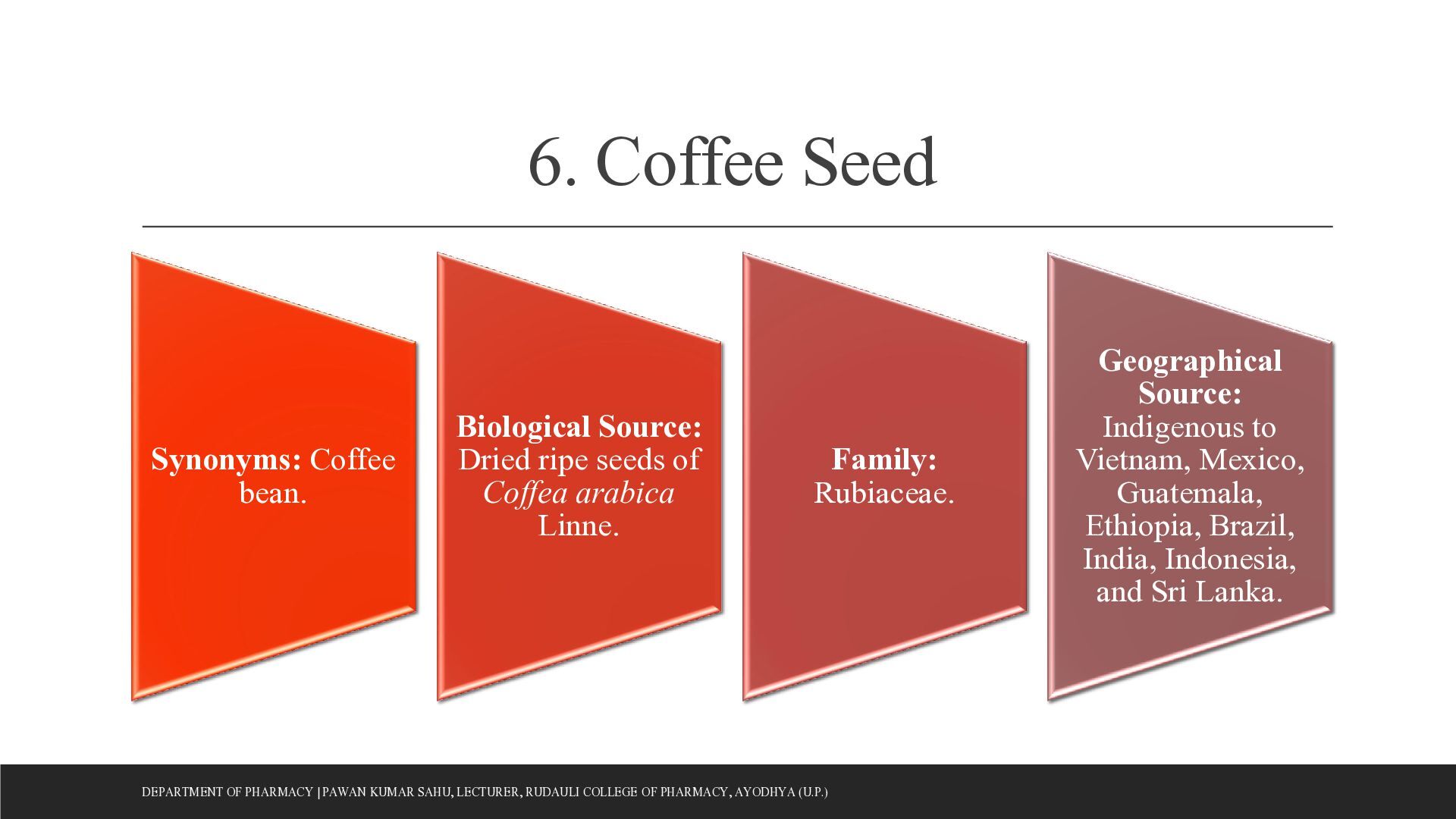
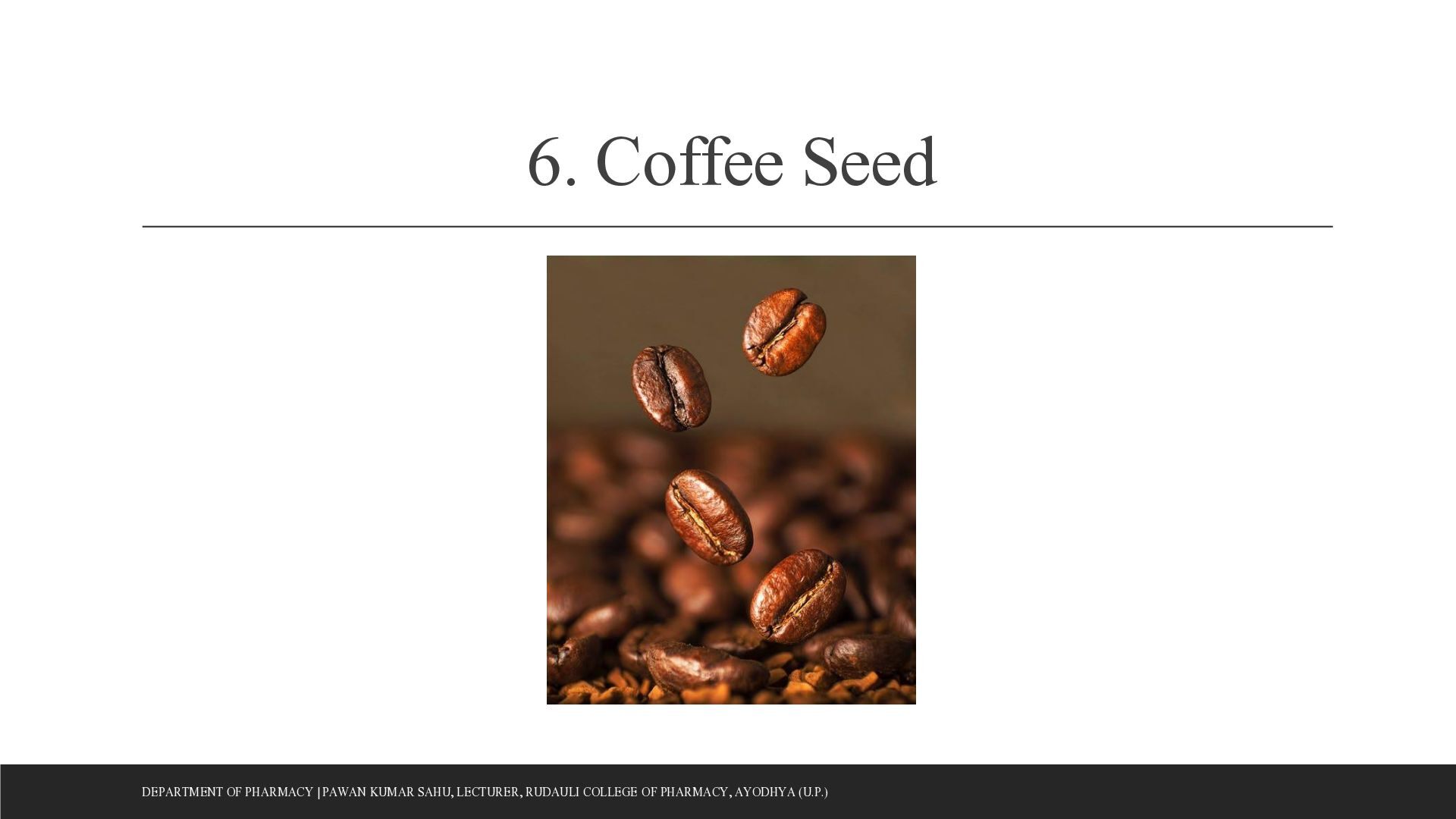
  37. 6. Coffee Seed Synonyms: Coffee bean. Biological Source: Dried ripe

    seeds of Coffea arabica Linne. Family: Rubiaceae. DEPARTMENT OF PHARMACY | PAWAN KUMAR SAHU, LECTURER, RUDAULI COLLEGE OF PHARMACY, AYODHYA (U.P.) Geographical Source: Indigenous to Vietnam, Mexico, Guatemala, Ethiopia, Brazil, India, Indonesia, and Sri Lanka.
  38. 6. Coffee Seed DEPARTMENT OF PHARMACY | PAWAN KUMAR SAHU,

    LECTURER, RUDAULI COLLEGE OF PHARMACY, AYODHYA (U.P.)
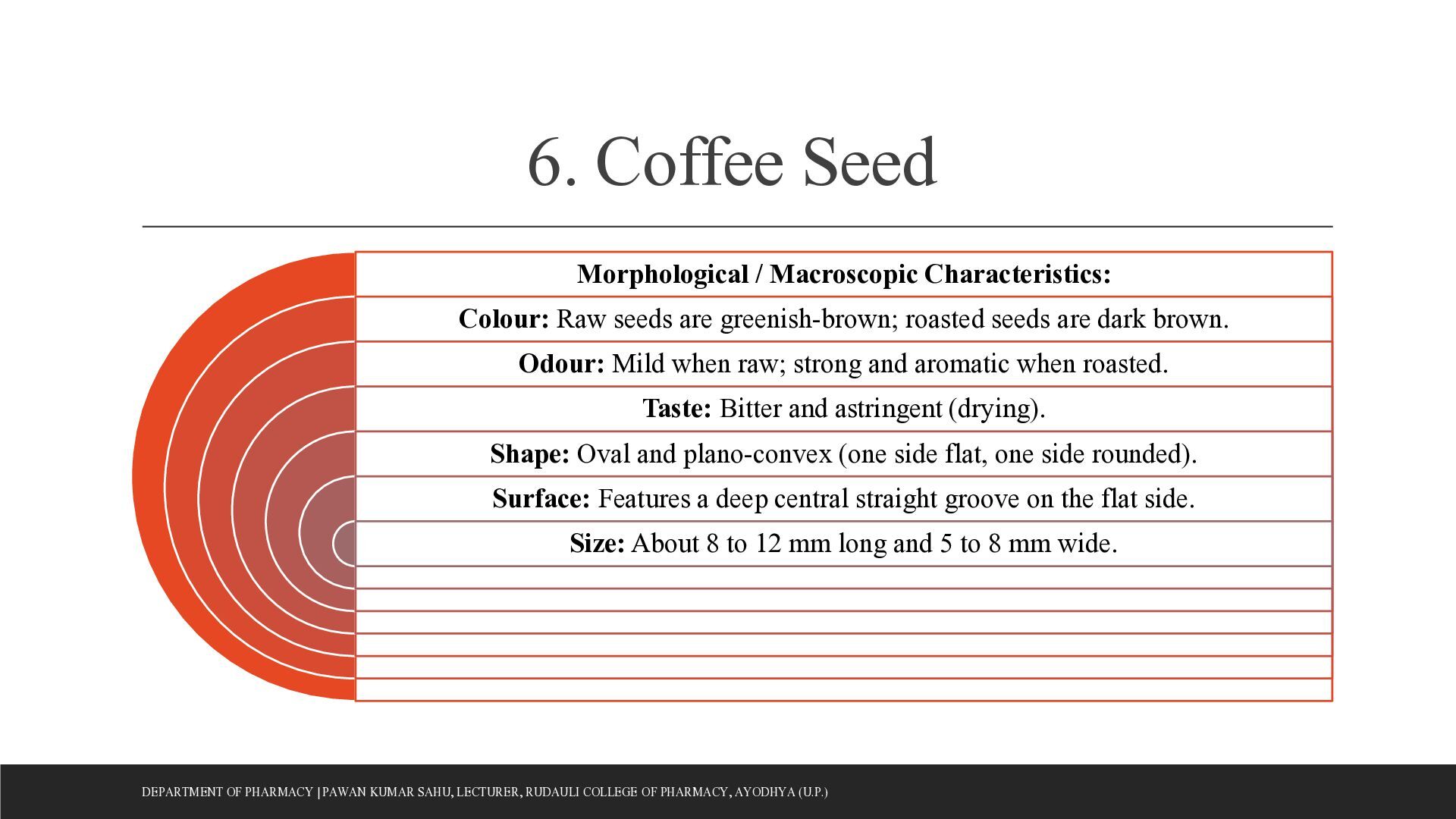
  39. 6. Coffee Seed Morphological / Macroscopic Characteristics: Colour: Raw seeds

    are greenish-brown; roasted seeds are dark brown. Odour: Mild when raw; strong and aromatic when roasted. Taste: Bitter and astringent (drying). Shape: Oval and plano-convex (one side flat, one side rounded). Surface: Features a deep central straight groove on the flat side. Size: About 8 to 12 mm long and 5 to 8 mm wide. DEPARTMENT OF PHARMACY | PAWAN KUMAR SAHU, LECTURER, RUDAULI COLLEGE OF PHARMACY, AYODHYA (U.P.)
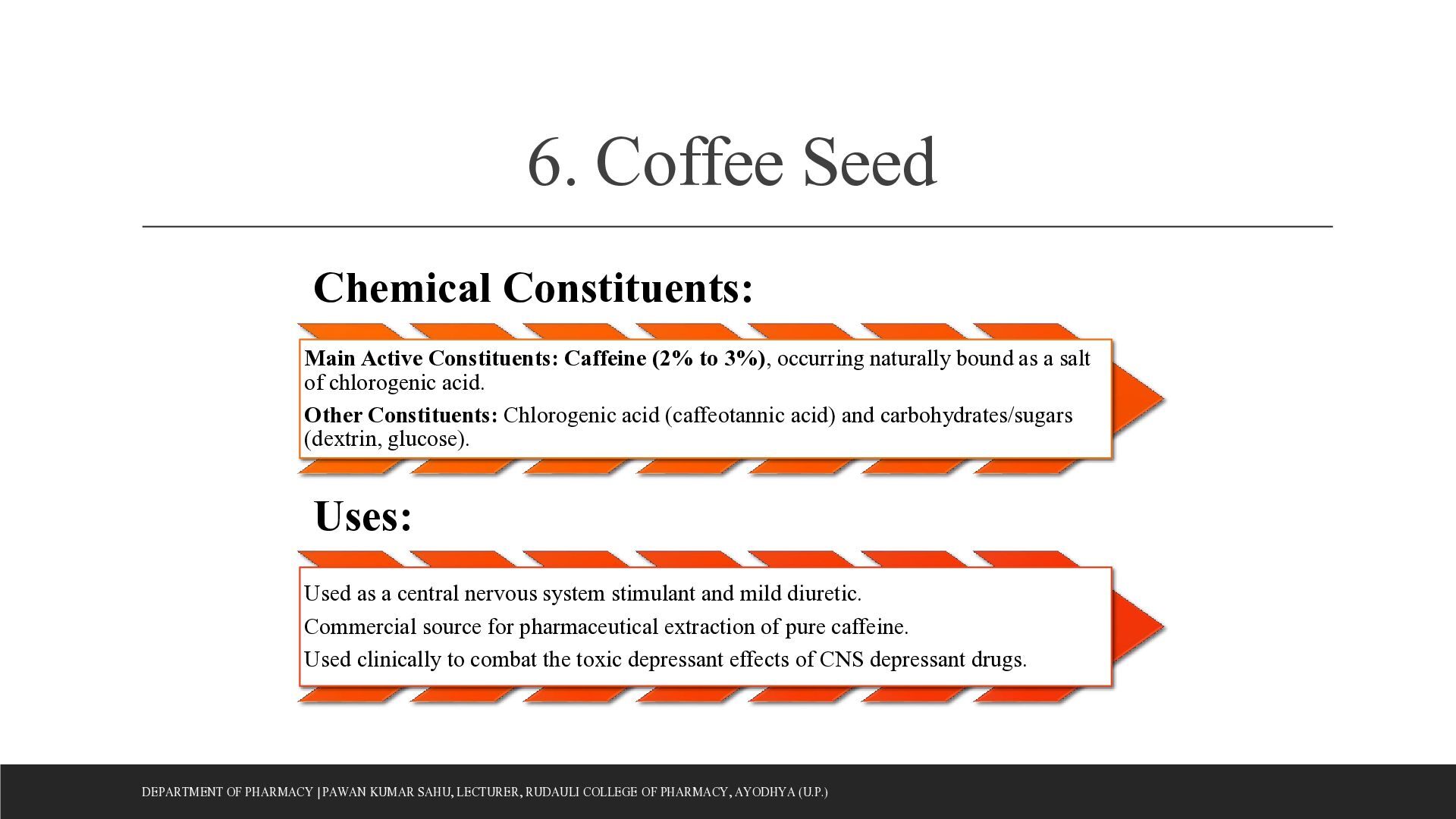
  40. 6. Coffee Seed Chemical Constituents: Main Active Constituents: Caffeine (2%

    to 3%), occurring naturally bound as a salt of chlorogenic acid. Other Constituents: Chlorogenic acid (caffeotannic acid) and carbohydrates/sugars (dextrin, glucose). Uses: Used as a central nervous system stimulant and mild diuretic. Commercial source for pharmaceutical extraction of pure caffeine. Used clinically to combat the toxic depressant effects of CNS depressant drugs. DEPARTMENT OF PHARMACY | PAWAN KUMAR SAHU, LECTURER, RUDAULI COLLEGE OF PHARMACY, AYODHYA (U.P.)
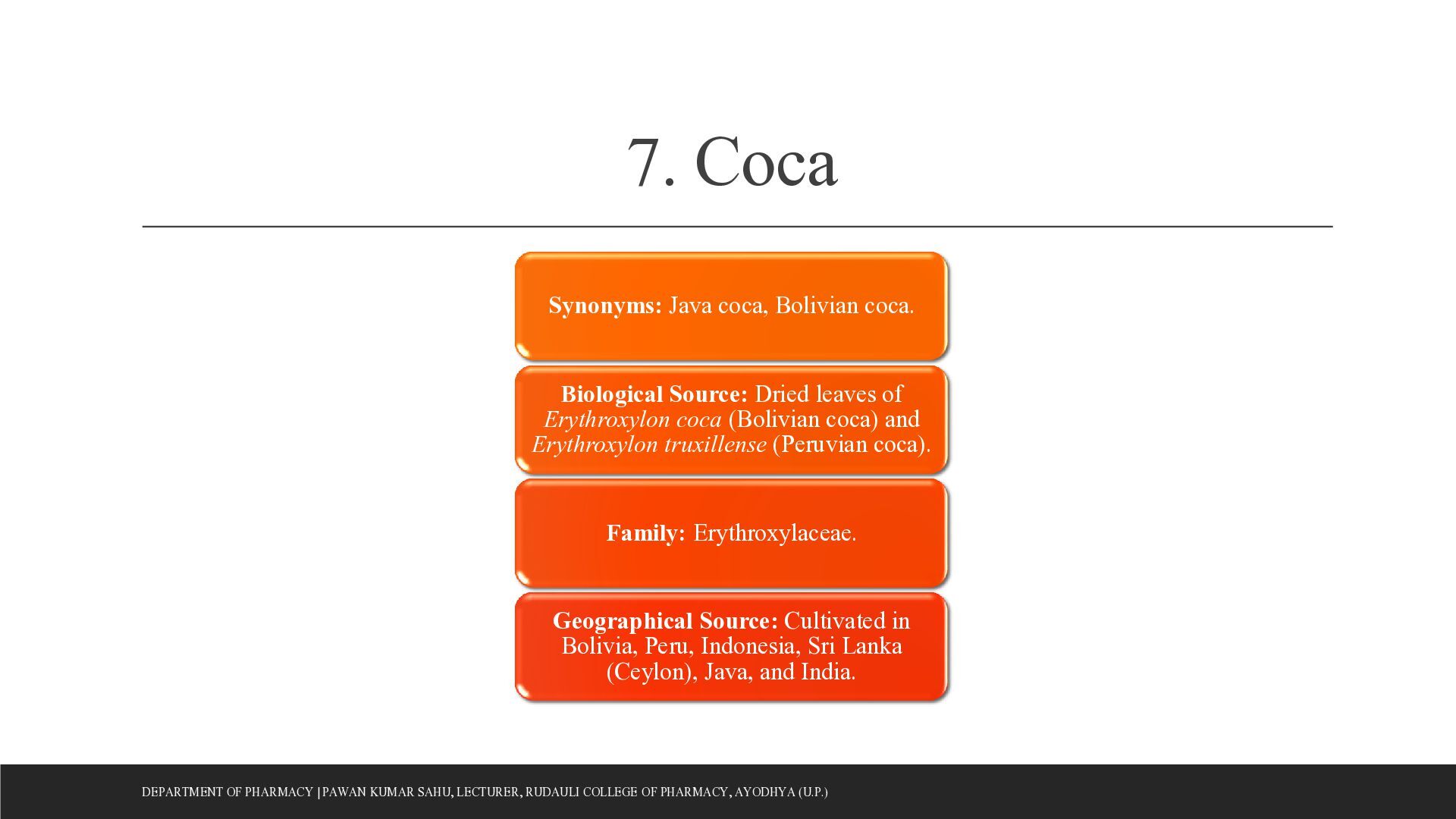
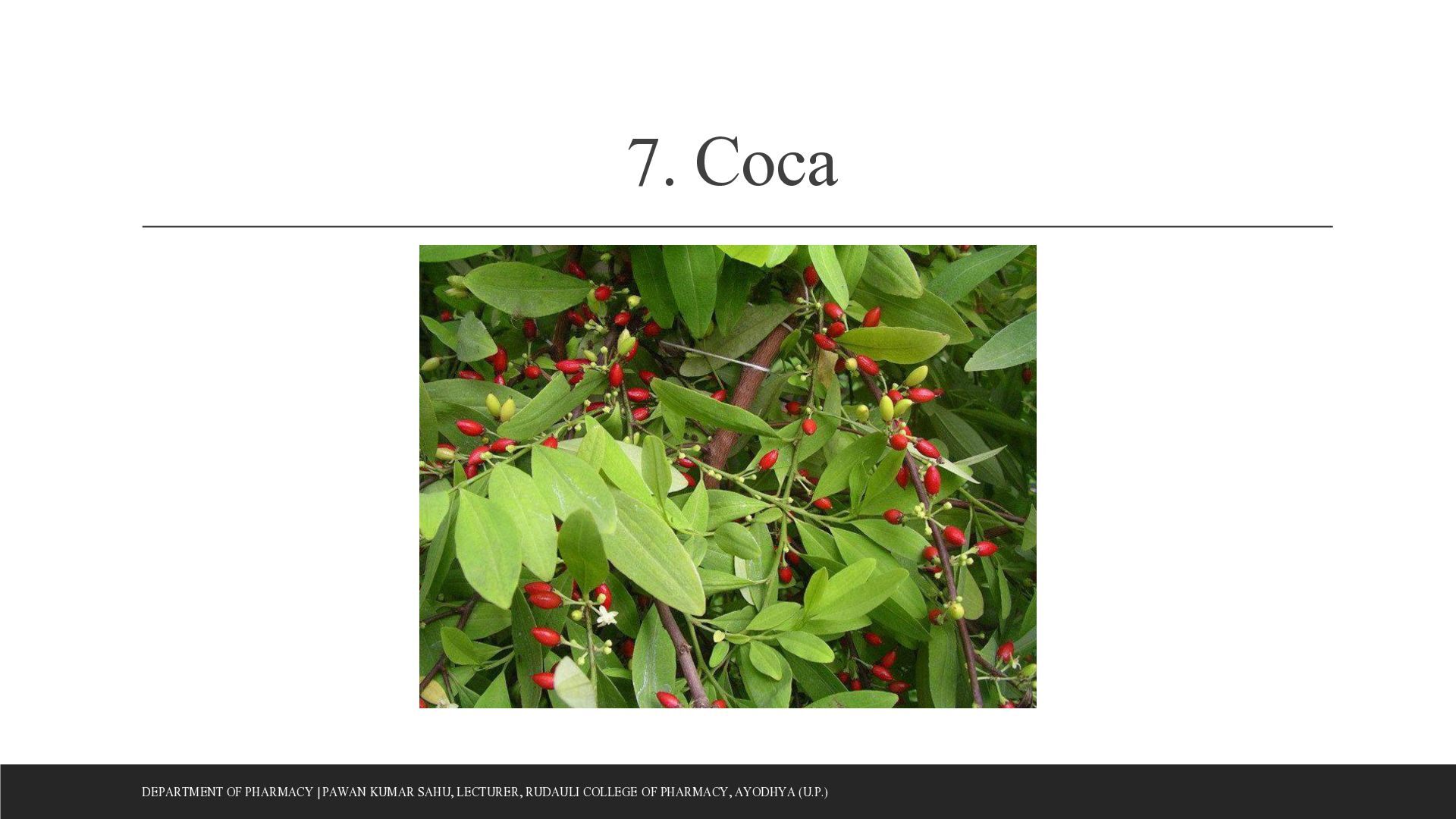
  41. 7. Coca Synonyms: Java coca, Bolivian coca. Biological Source: Dried

    leaves of Erythroxylon coca (Bolivian coca) and Erythroxylon truxillense (Peruvian coca). Family: Erythroxylaceae. Geographical Source: Cultivated in Bolivia, Peru, Indonesia, Sri Lanka (Ceylon), Java, and India. DEPARTMENT OF PHARMACY | PAWAN KUMAR SAHU, LECTURER, RUDAULI COLLEGE OF PHARMACY, AYODHYA (U.P.)
  42. 7. Coca DEPARTMENT OF PHARMACY | PAWAN KUMAR SAHU, LECTURER,

    RUDAULI COLLEGE OF PHARMACY, AYODHYA (U.P.)
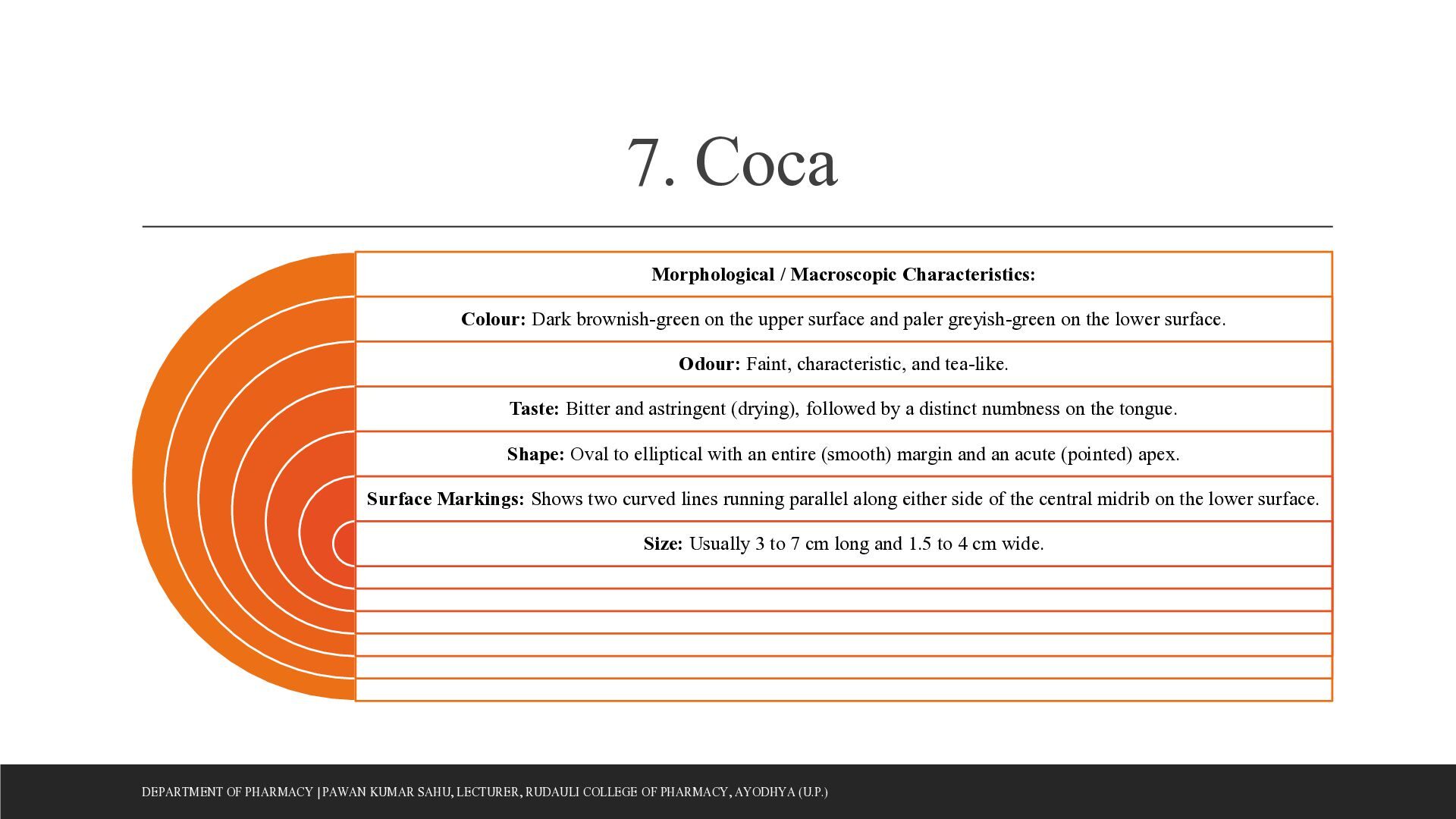
  43. 7. Coca Morphological / Macroscopic Characteristics: Colour: Dark brownish-green on

    the upper surface and paler greyish-green on the lower surface. Odour: Faint, characteristic, and tea-like. Taste: Bitter and astringent (drying), followed by a distinct numbness on the tongue. Shape: Oval to elliptical with an entire (smooth) margin and an acute (pointed) apex. Surface Markings: Shows two curved lines running parallel along either side of the central midrib on the lower surface. Size: Usually 3 to 7 cm long and 1.5 to 4 cm wide. DEPARTMENT OF PHARMACY | PAWAN KUMAR SAHU, LECTURER, RUDAULI COLLEGE OF PHARMACY, AYODHYA (U.P.)
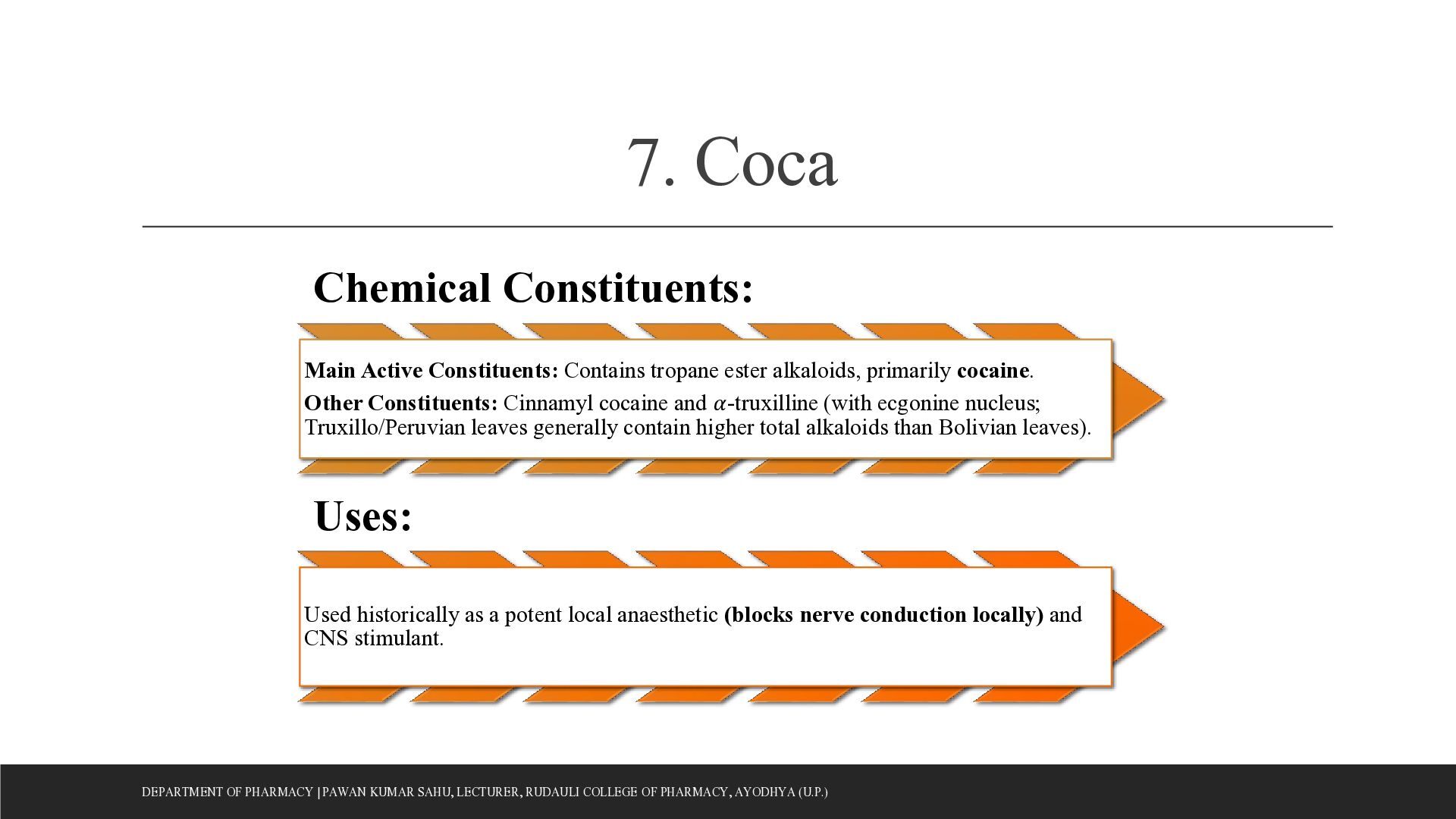
  44. 7. Coca Chemical Constituents: Main Active Constituents: Contains tropane ester

    alkaloids, primarily cocaine. Other Constituents: Cinnamyl cocaine and 𝛼-truxilline (with ecgonine nucleus; Truxillo/Peruvian leaves generally contain higher total alkaloids than Bolivian leaves). start equation alpha Uses: Used historically as a potent local anaesthetic (blocks nerve conduction locally) and CNS stimulant. DEPARTMENT OF PHARMACY | PAWAN KUMAR SAHU, LECTURER, RUDAULI COLLEGE OF PHARMACY, AYODHYA (U.P.)
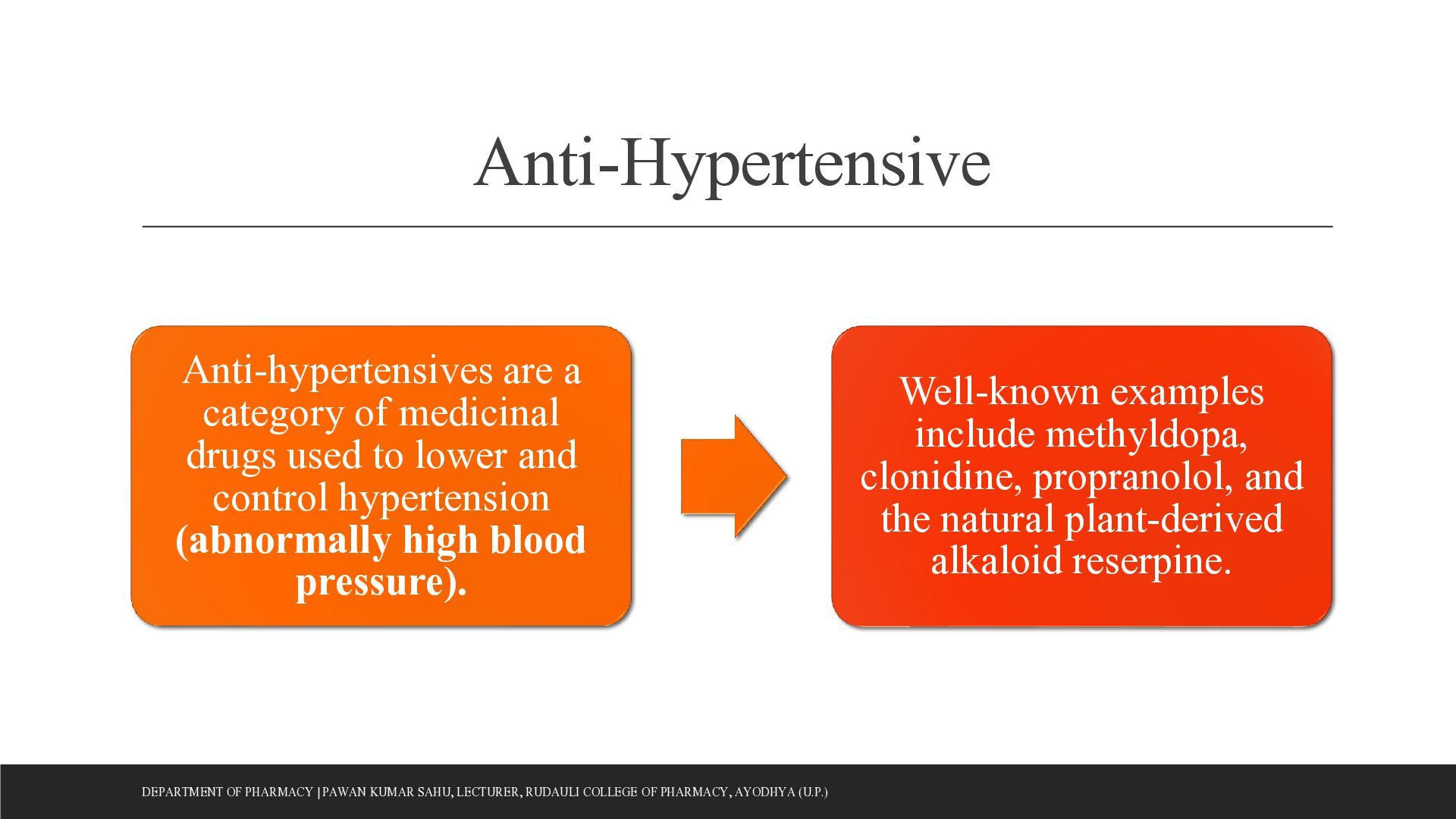
  45. Anti-Hypertensive Anti-hypertensives are a category of medicinal drugs used to

    lower and control hypertension (abnormally high blood pressure). DEPARTMENT OF PHARMACY | PAWAN KUMAR SAHU, LECTURER, RUDAULI COLLEGE OF PHARMACY, AYODHYA (U.P.) Well-known examples include methyldopa, clonidine, propranolol, and the natural plant-derived alkaloid reserpine.
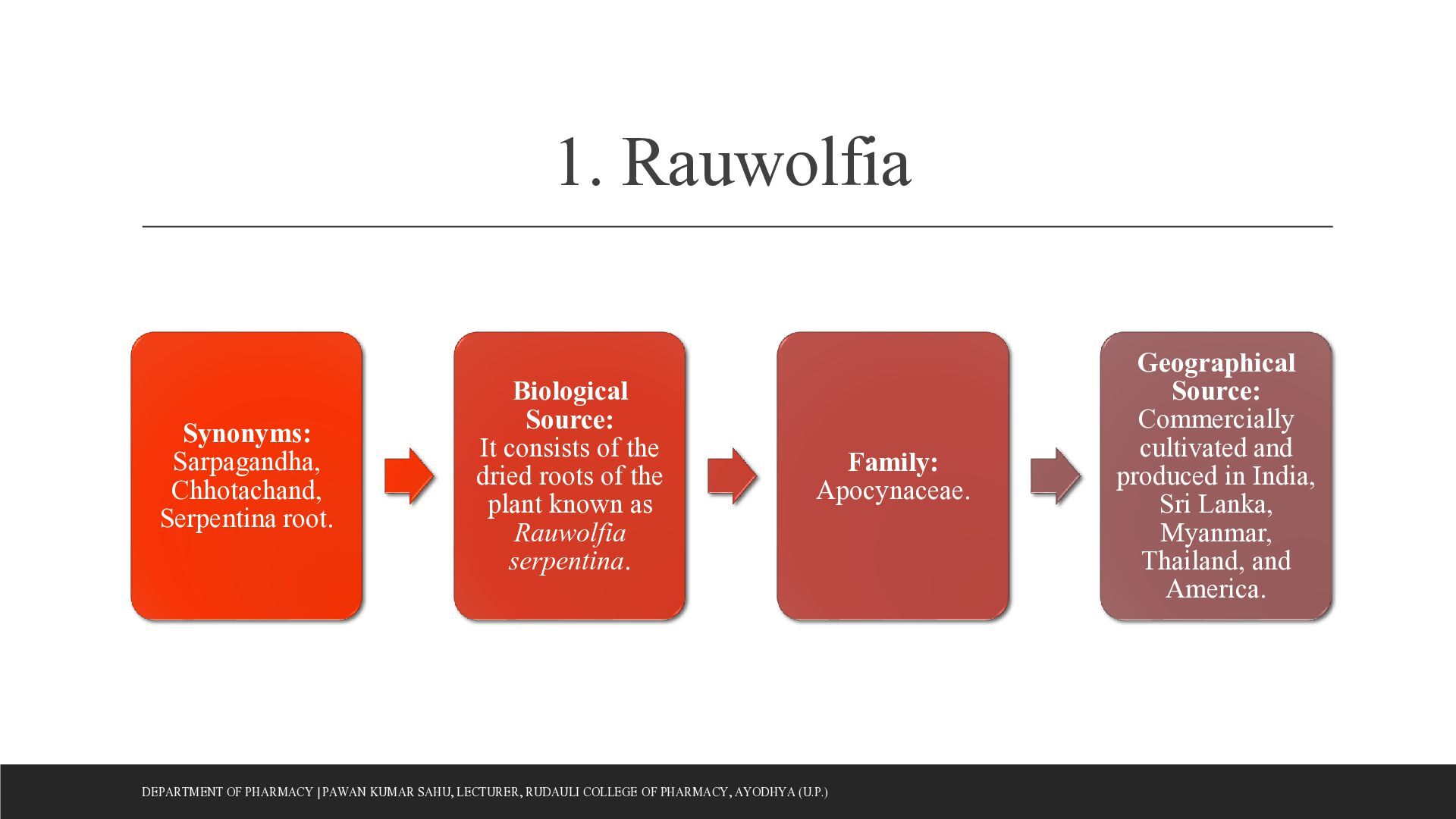
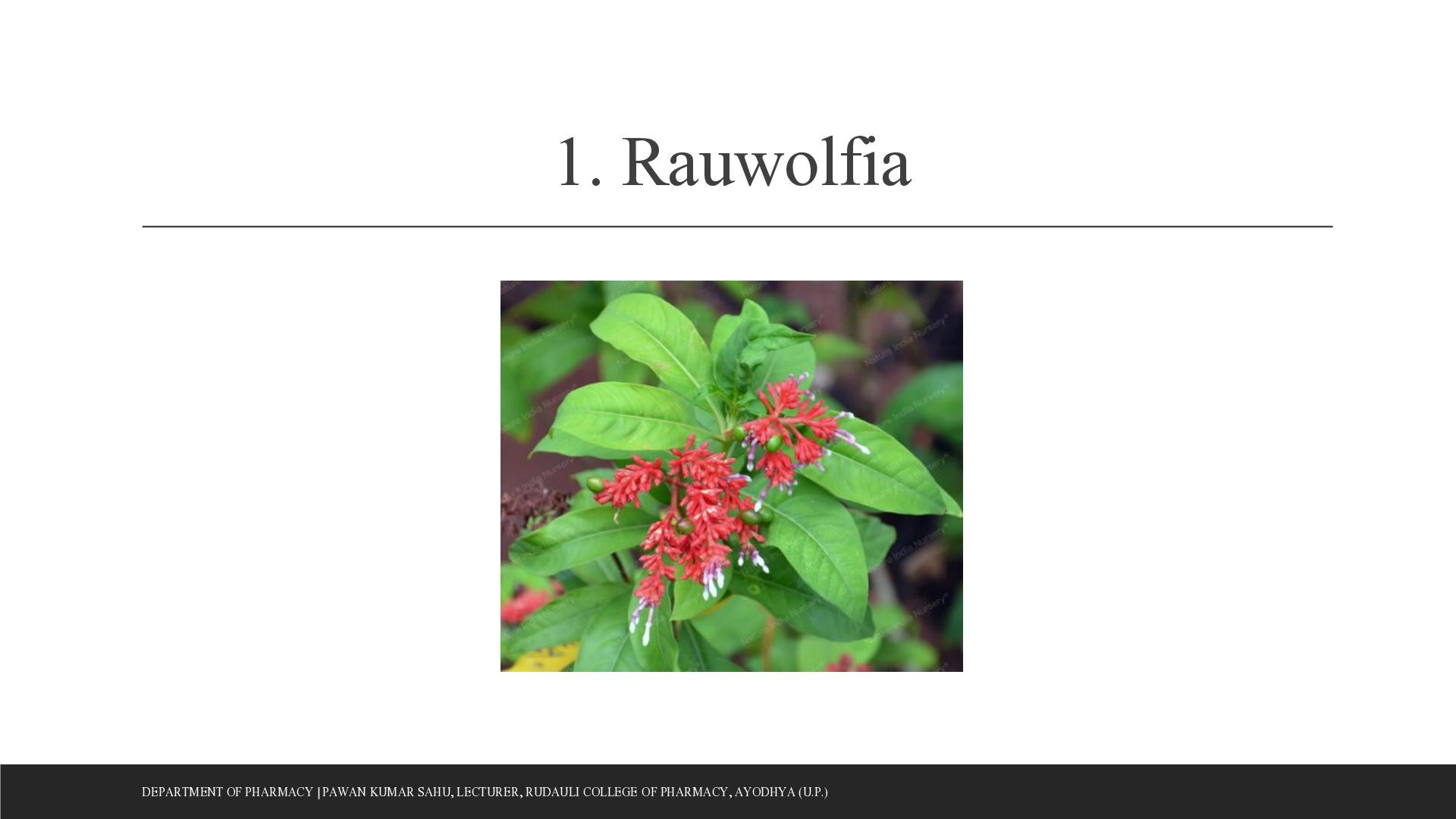
  46. 1. Rauwolfia Synonyms: Sarpagandha, Chhotachand, Serpentina root. Biological Source: It

    consists of the dried roots of the plant known as Rauwolfia serpentina. Family: Apocynaceae. DEPARTMENT OF PHARMACY | PAWAN KUMAR SAHU, LECTURER, RUDAULI COLLEGE OF PHARMACY, AYODHYA (U.P.) Geographical Source: Commercially cultivated and produced in India, Sri Lanka, Myanmar, Thailand, and America.
  47. 1. Rauwolfia DEPARTMENT OF PHARMACY | PAWAN KUMAR SAHU, LECTURER,

    RUDAULI COLLEGE OF PHARMACY, AYODHYA (U.P.)
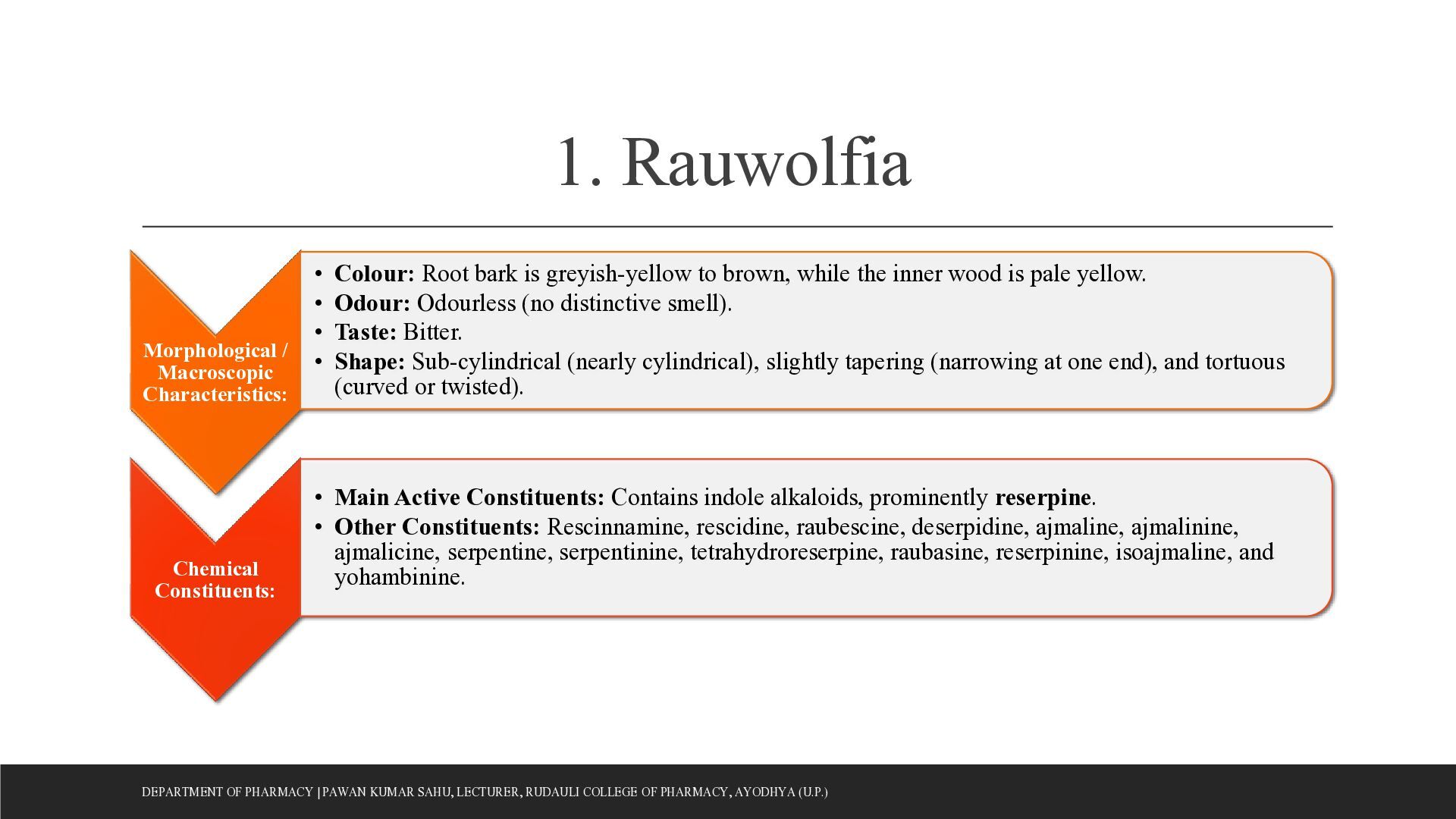
  48. 1. Rauwolfia Morphological / Macroscopic Characteristics: Chemical Constituents: • Colour:

    Root bark is greyish-yellow to brown, while the inner wood is pale yellow. • Odour: Odourless (no distinctive smell). • Taste: Bitter. • Shape: Sub-cylindrical (nearly cylindrical), slightly tapering (narrowing at one end), and tortuous (curved or twisted). • Main Active Constituents: Contains indole alkaloids, prominently reserpine. • Other Constituents: Rescinnamine, rescidine, raubescine, deserpidine, ajmaline, ajmalinine, ajmalicine, serpentine, serpentinine, tetrahydroreserpine, raubasine, reserpinine, isoajmaline, and yohambinine. DEPARTMENT OF PHARMACY | PAWAN KUMAR SAHU, LECTURER, RUDAULI COLLEGE OF PHARMACY, AYODHYA (U.P.)
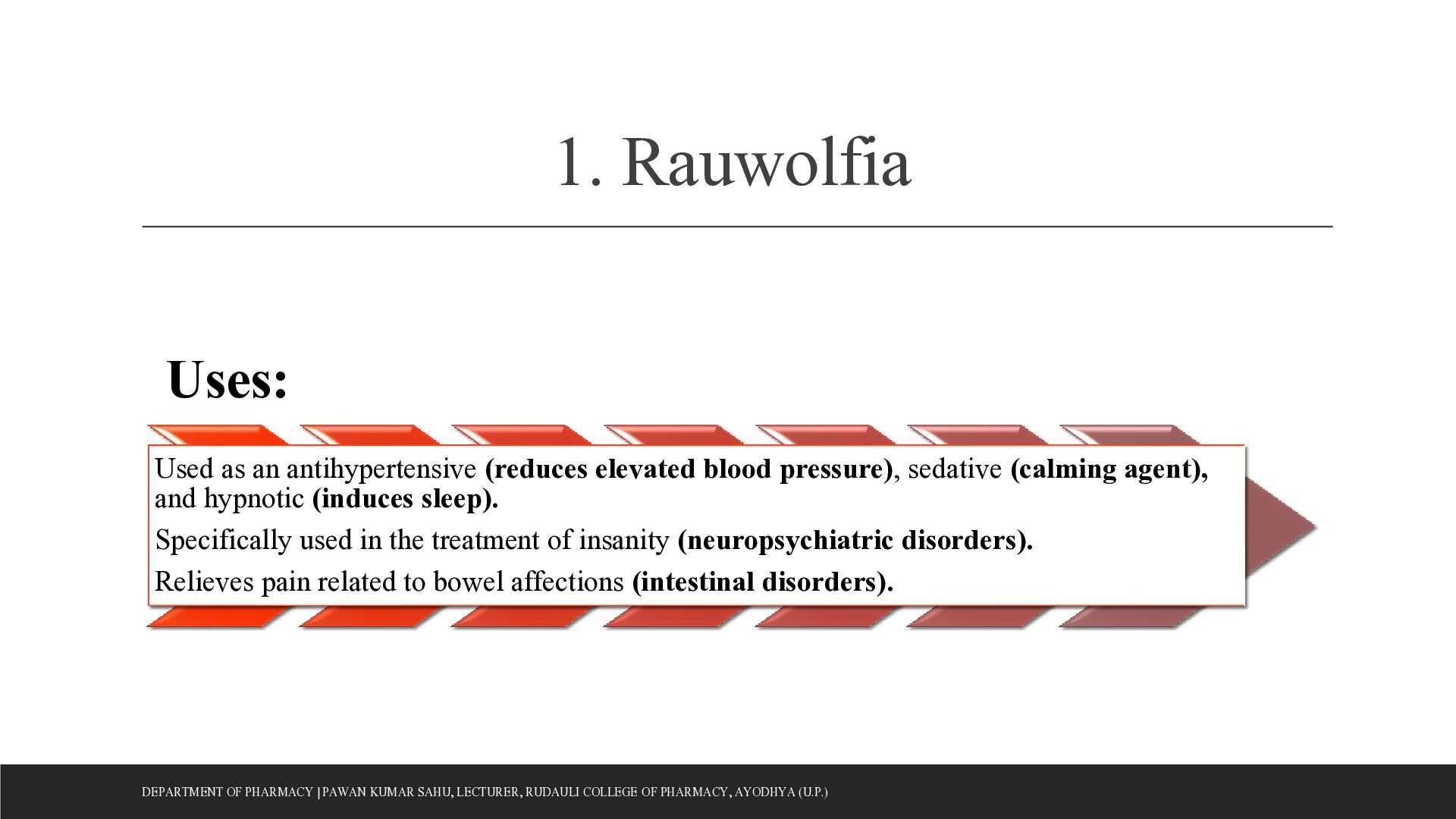
  49. 1. Rauwolfia Uses: Used as an antihypertensive (reduces elevated blood

    pressure), sedative (calming agent), and hypnotic (induces sleep). Specifically used in the treatment of insanity (neuropsychiatric disorders). Relieves pain related to bowel affections (intestinal disorders). DEPARTMENT OF PHARMACY | PAWAN KUMAR SAHU, LECTURER, RUDAULI COLLEGE OF PHARMACY, AYODHYA (U.P.)
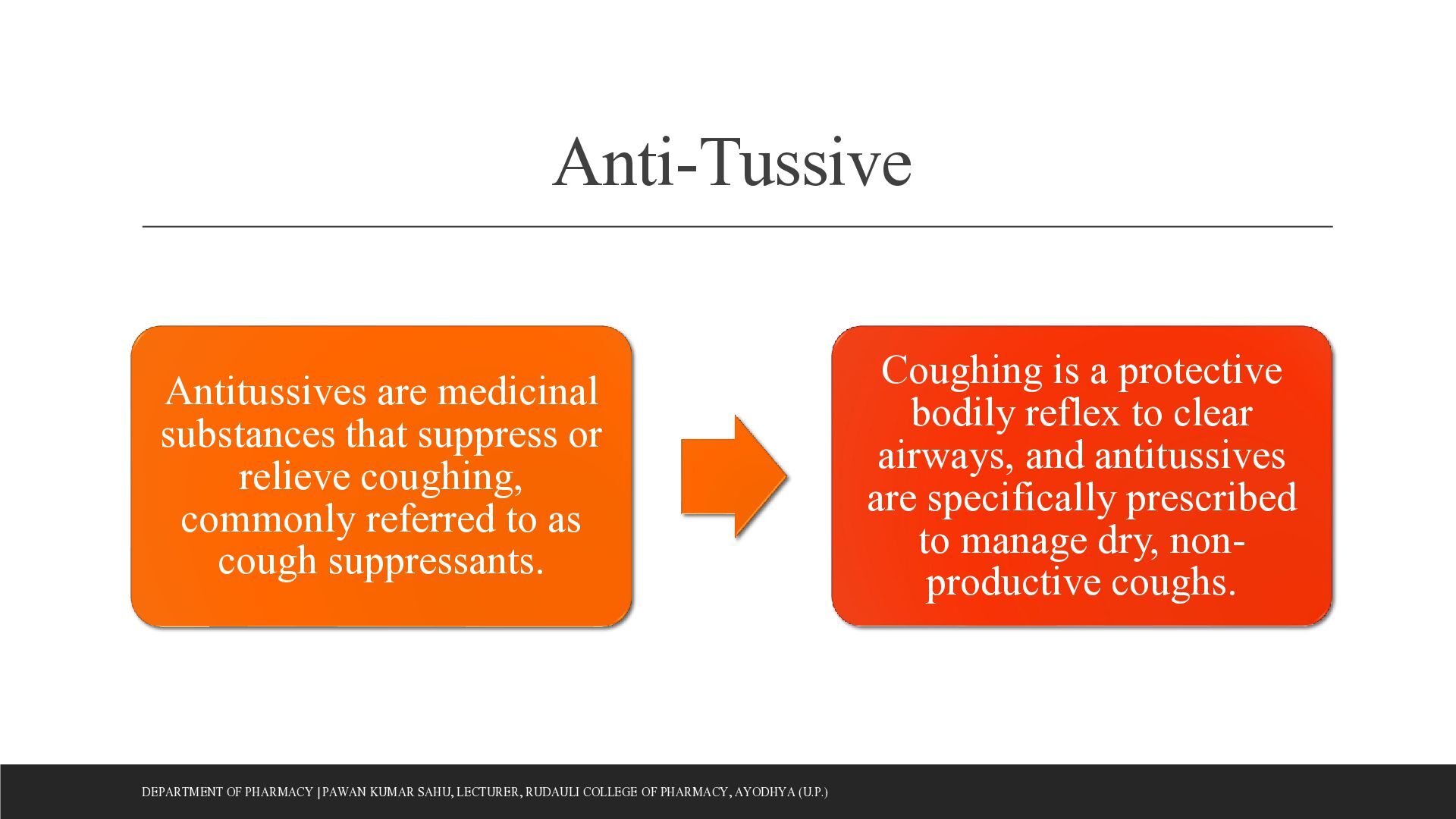
  50. Anti-Tussive Antitussives are medicinal substances that suppress or relieve coughing,

    commonly referred to as cough suppressants. DEPARTMENT OF PHARMACY | PAWAN KUMAR SAHU, LECTURER, RUDAULI COLLEGE OF PHARMACY, AYODHYA (U.P.) Coughing is a protective bodily reflex to clear airways, and antitussives are specifically prescribed to manage dry, nonproductive coughs.
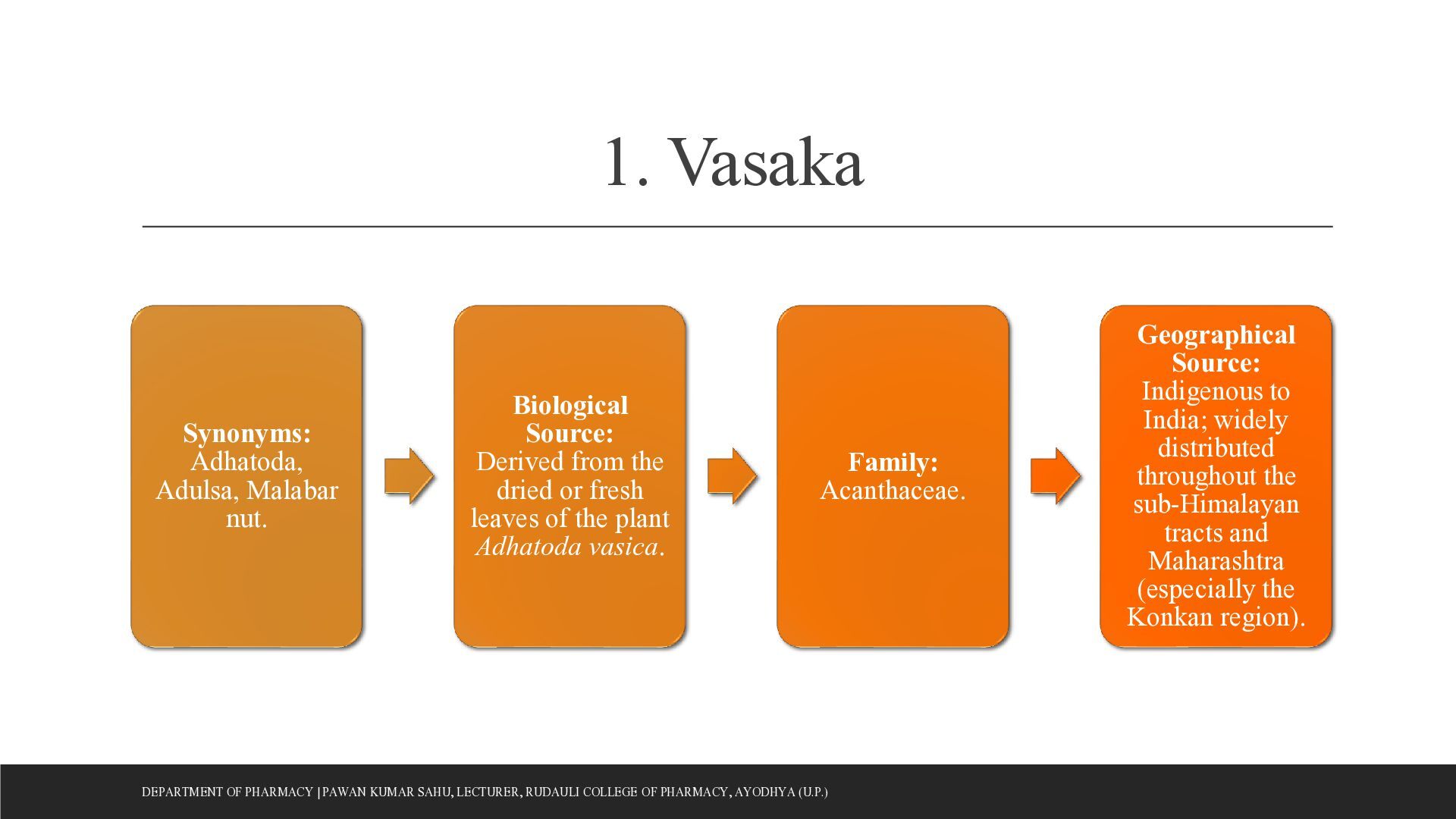
  51. 1. Vasaka Synonyms: Adhatoda, Adulsa, Malabar nut. Biological Source: Derived

    from the dried or fresh leaves of the plant Adhatoda vasica. Family: Acanthaceae. DEPARTMENT OF PHARMACY | PAWAN KUMAR SAHU, LECTURER, RUDAULI COLLEGE OF PHARMACY, AYODHYA (U.P.) Geographical Source: Indigenous to India; widely distributed throughout the sub-Himalayan tracts and Maharashtra (especially the Konkan region).
  52. 1. Vasaka DEPARTMENT OF PHARMACY | PAWAN KUMAR SAHU, LECTURER,

    RUDAULI COLLEGE OF PHARMACY, AYODHYA (U.P.)
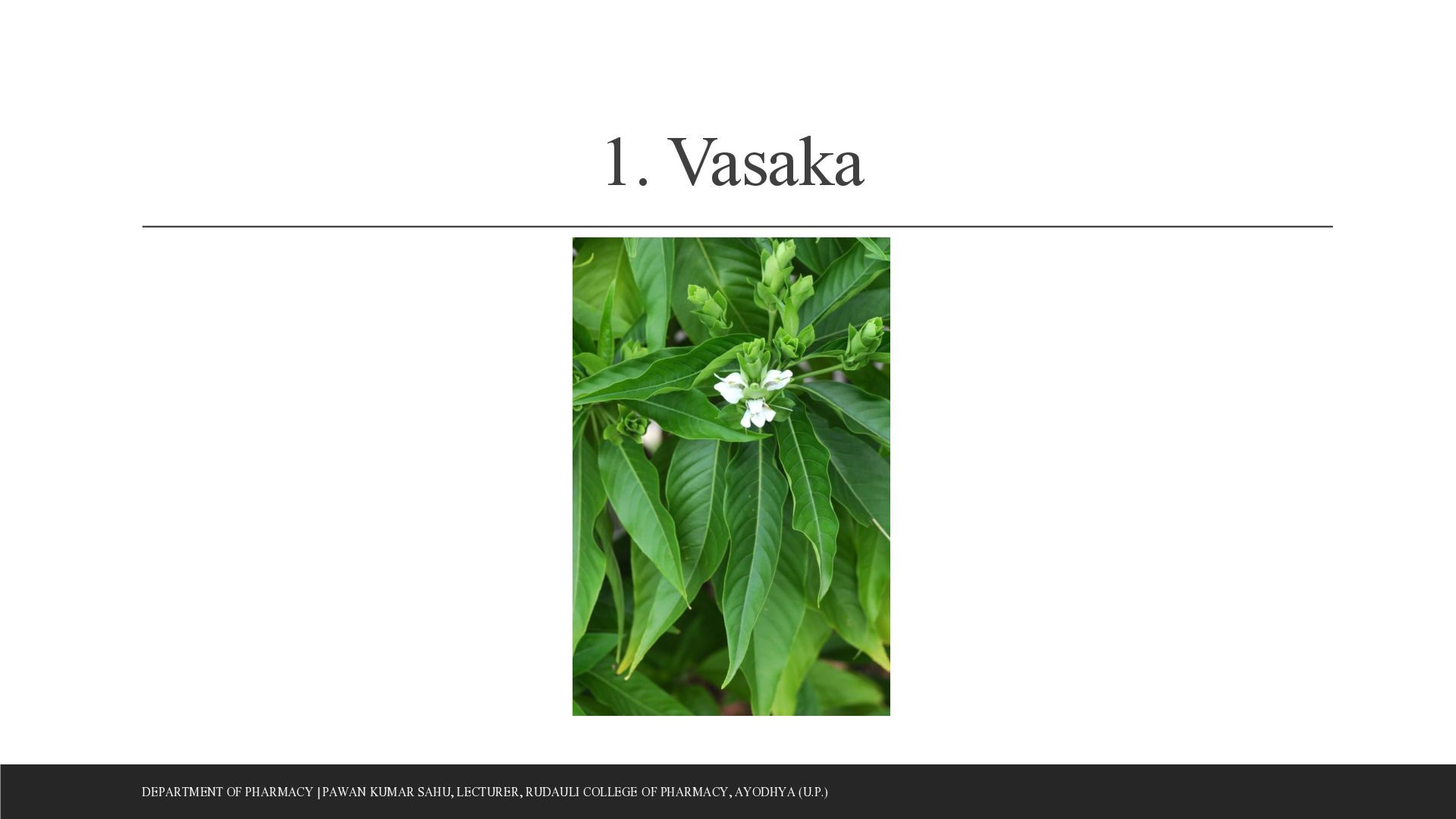
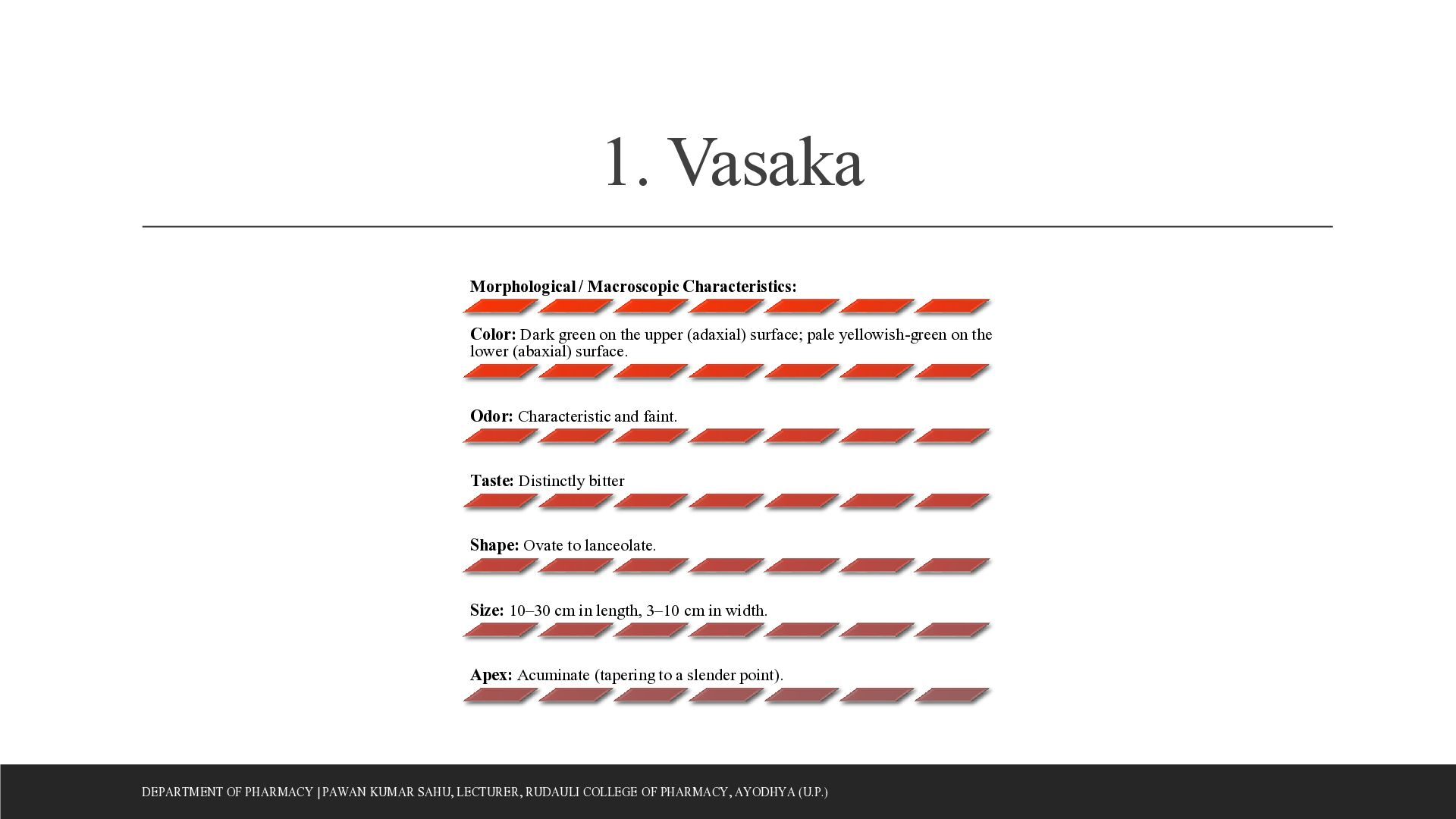
  53. 1. Vasaka Morphological / Macroscopic Characteristics: Color: Dark green on

    the upper (adaxial) surface; pale yellowish-green on the lower (abaxial) surface. Odor: Characteristic and faint. Taste: Distinctly bitter Shape: Ovate to lanceolate. Size: 10–30 cm in length, 3–10 cm in width. Apex: Acuminate (tapering to a slender point). DEPARTMENT OF PHARMACY | PAWAN KUMAR SAHU, LECTURER, RUDAULI COLLEGE OF PHARMACY, AYODHYA (U.P.)
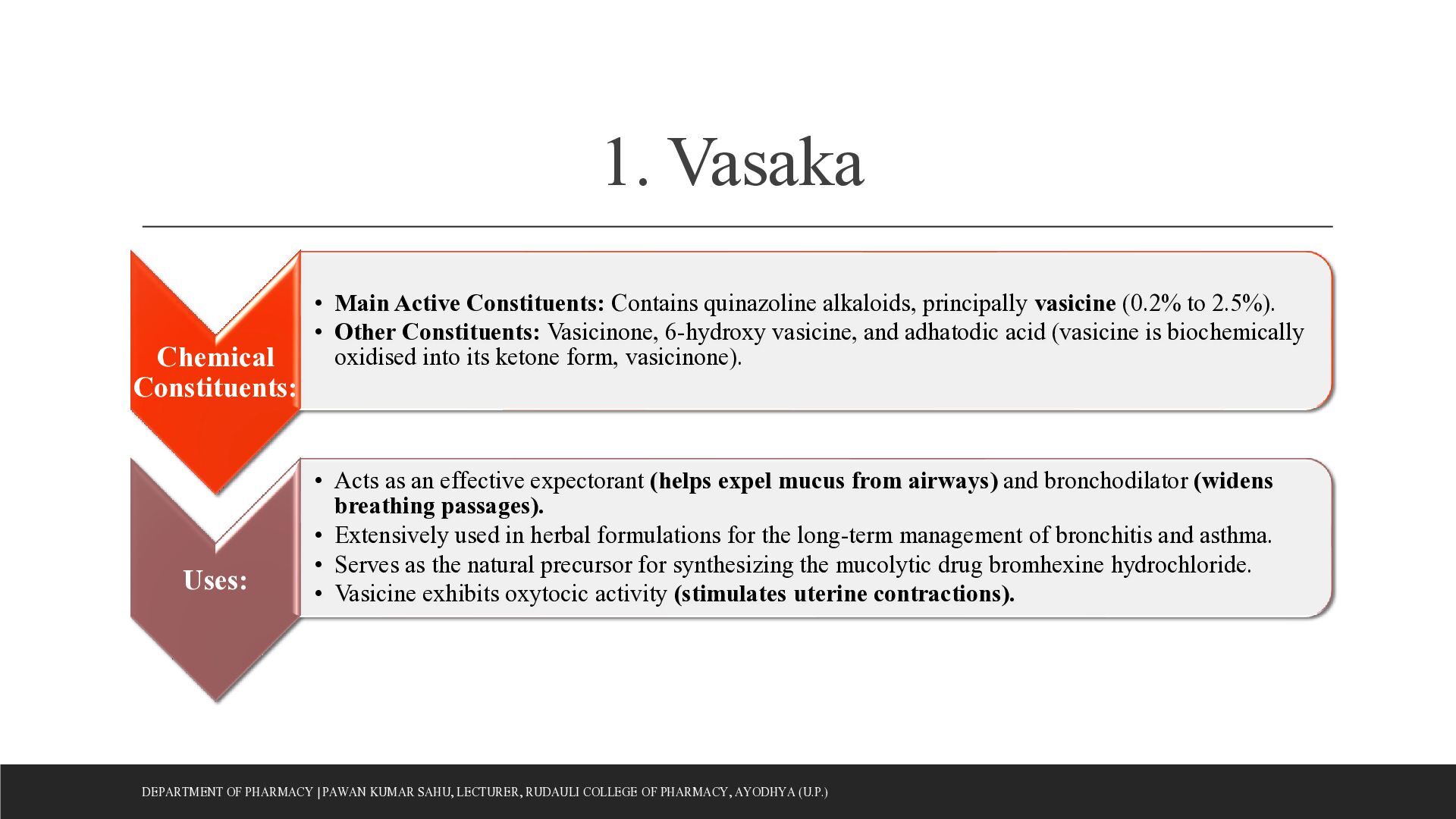
  54. 1. Vasaka Chemical Constituents: Uses: • Main Active Constituents: Contains

    quinazoline alkaloids, principally vasicine (0.2% to 2.5%). • Other Constituents: Vasicinone, 6-hydroxy vasicine, and adhatodic acid (vasicine is biochemically oxidised into its ketone form, vasicinone). • Acts as an effective expectorant (helps expel mucus from airways) and bronchodilator (widens breathing passages). • Extensively used in herbal formulations for the long-term management of bronchitis and asthma. • Serves as the natural precursor for synthesizing the mucolytic drug bromhexine hydrochloride. • Vasicine exhibits oxytocic activity (stimulates uterine contractions). DEPARTMENT OF PHARMACY | PAWAN KUMAR SAHU, LECTURER, RUDAULI COLLEGE OF PHARMACY, AYODHYA (U.P.)
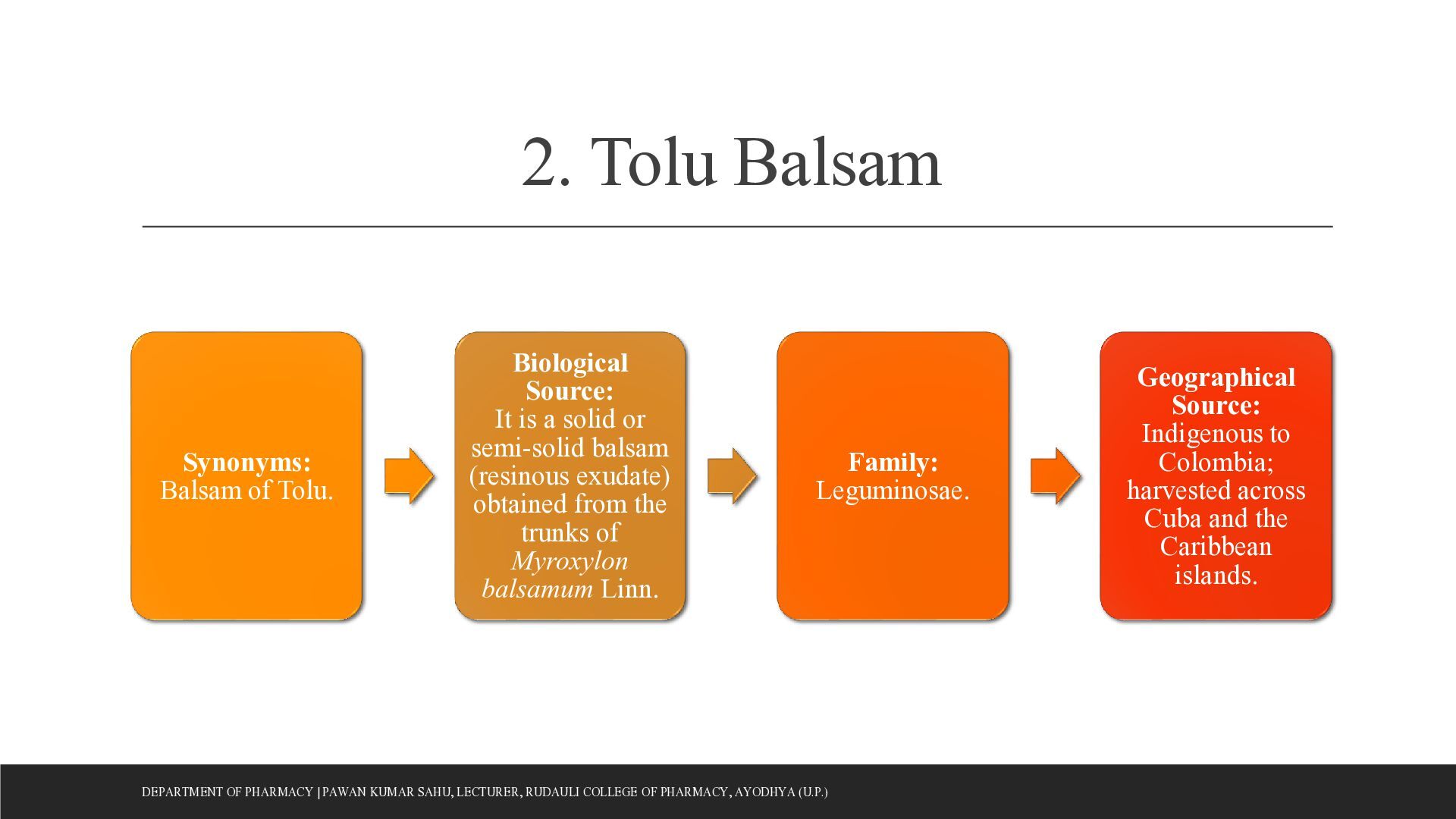
  55. 2. Tolu Balsam Synonyms: Balsam of Tolu. Biological Source: It

    is a solid or semi-solid balsam (resinous exudate) obtained from the trunks of Myroxylon balsamum Linn. Family: Leguminosae. DEPARTMENT OF PHARMACY | PAWAN KUMAR SAHU, LECTURER, RUDAULI COLLEGE OF PHARMACY, AYODHYA (U.P.) Geographical Source: Indigenous to Colombia; harvested across Cuba and the Caribbean islands.
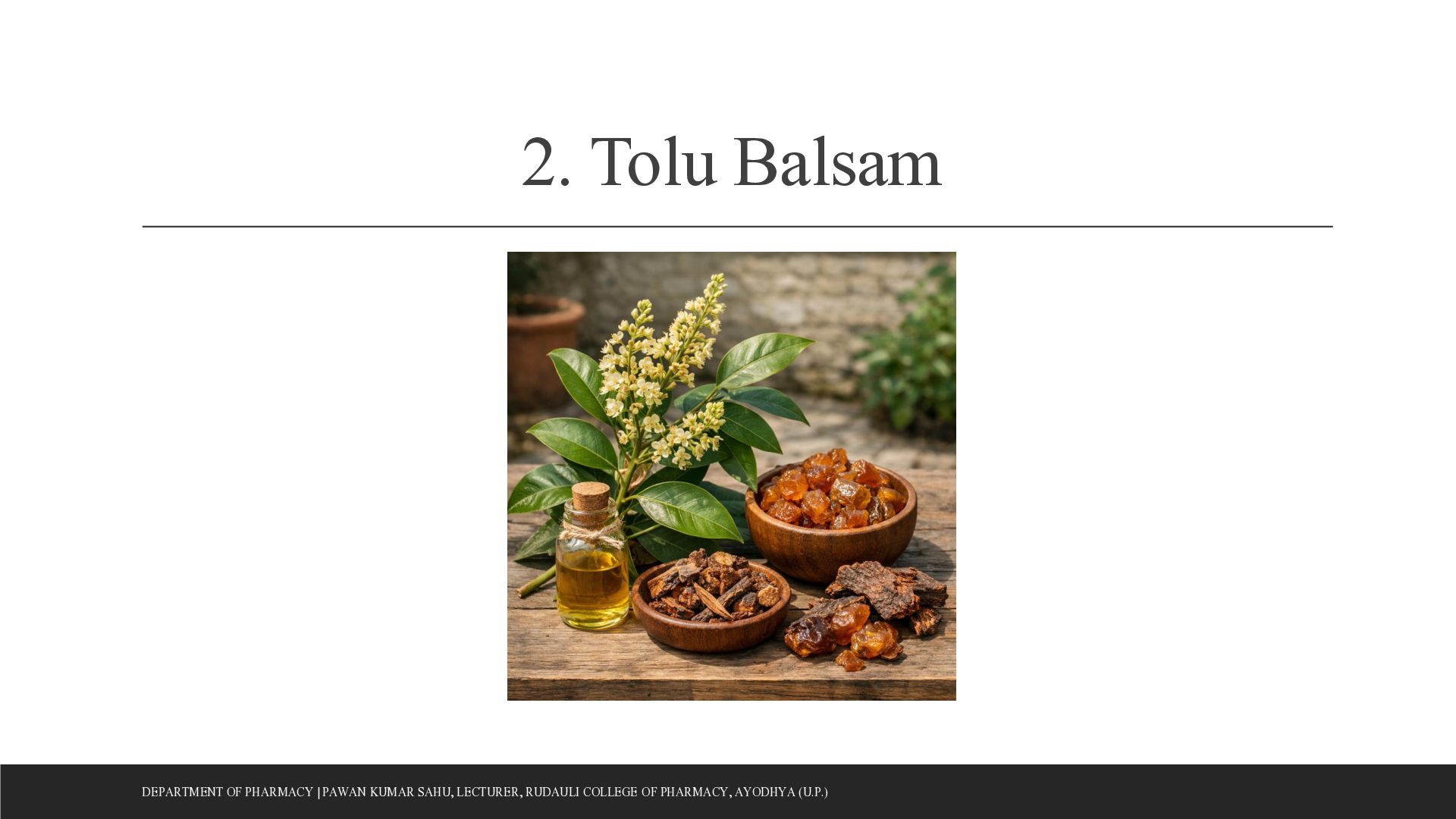
  56. 2. Tolu Balsam DEPARTMENT OF PHARMACY | PAWAN KUMAR SAHU,

    LECTURER, RUDAULI COLLEGE OF PHARMACY, AYODHYA (U.P.)
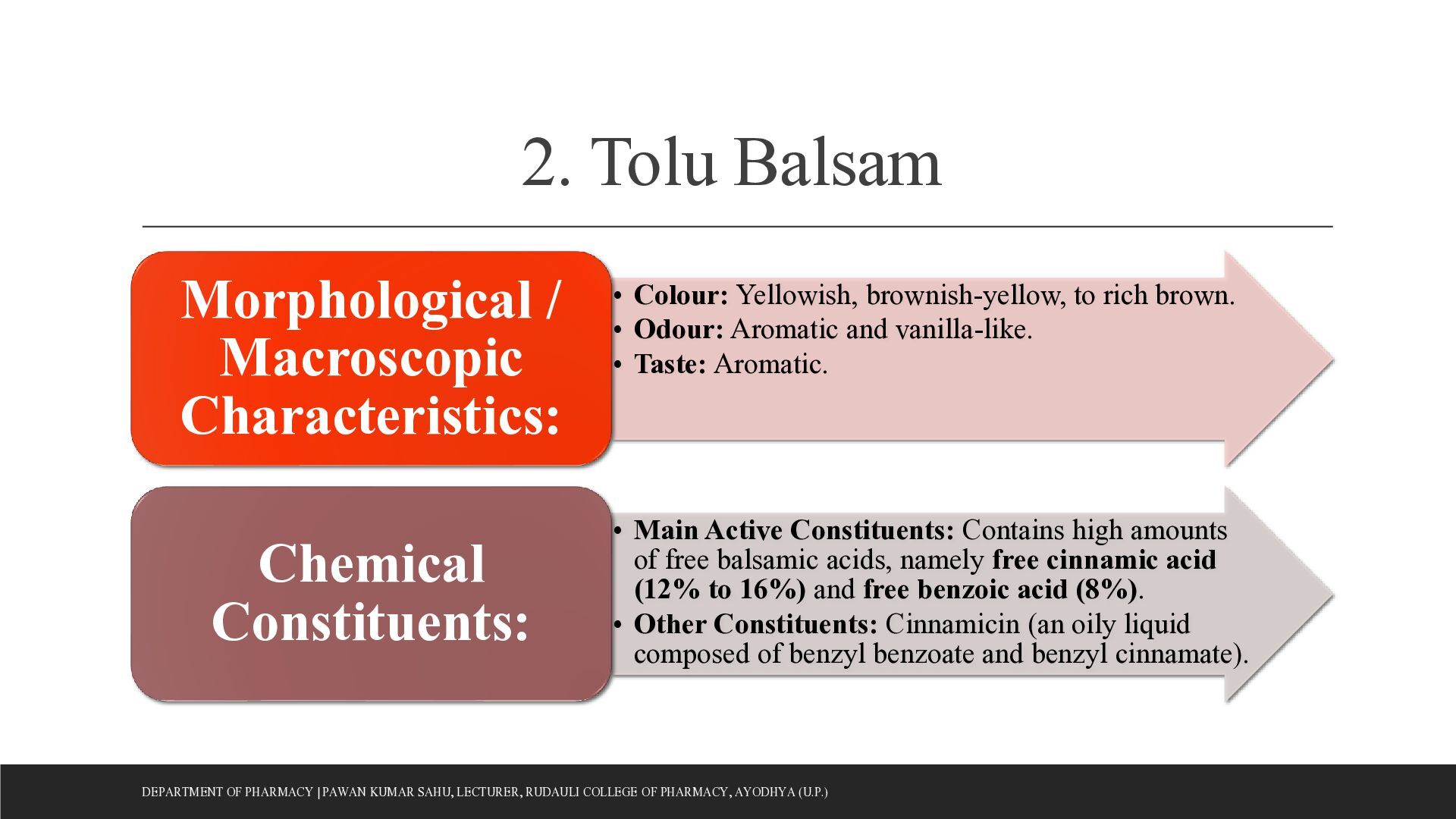
  57. 2. Tolu Balsam Morphological / Macroscopic Characteristics: Chemical Constituents: •

    Colour: Yellowish, brownish-yellow, to rich brown. • Odour: Aromatic and vanilla-like. • Taste: Aromatic. • Main Active Constituents: Contains high amounts of free balsamic acids, namely free cinnamic acid (12% to 16%) and free benzoic acid (8%). • Other Constituents: Cinnamicin (an oily liquid composed of benzyl benzoate and benzyl cinnamate). DEPARTMENT OF PHARMACY | PAWAN KUMAR SAHU, LECTURER, RUDAULI COLLEGE OF PHARMACY, AYODHYA (U.P.)
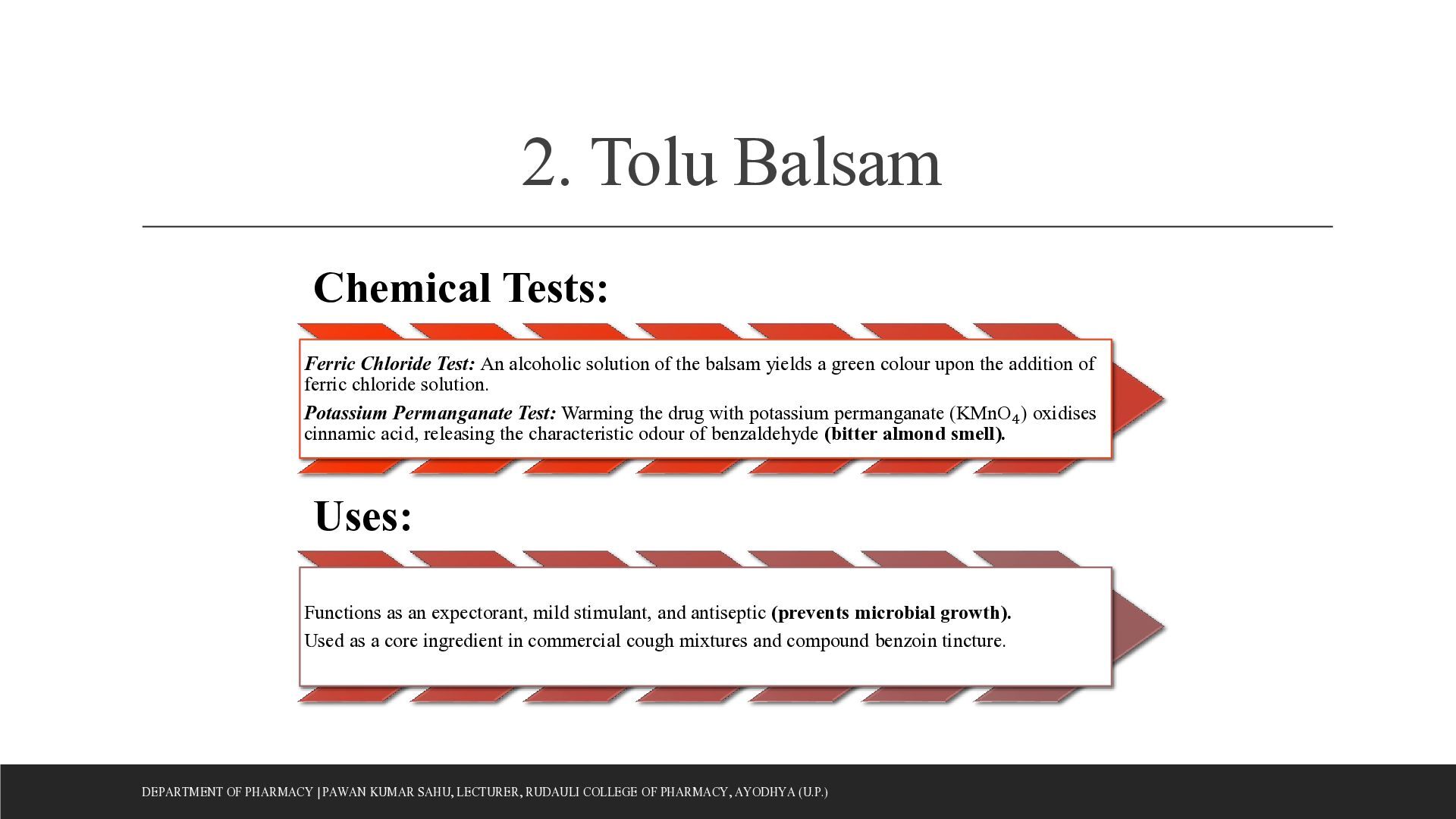
  58. 2. Tolu Balsam Chemical Tests: Ferric Chloride Test: An alcoholic

    solution of the balsam yields a green colour upon the addition of ferric chloride solution. Potassium Permanganate Test: Warming the drug with potassium permanganate (KMnO4 ) oxidises cinnamic acid, releasing the characteristic odour of benzaldehyde (bitter almond smell). subscript base , KMnO , end base , sub 4 Uses: Functions as an expectorant, mild stimulant, and antiseptic (prevents microbial growth). Used as a core ingredient in commercial cough mixtures and compound benzoin tincture. DEPARTMENT OF PHARMACY | PAWAN KUMAR SAHU, LECTURER, RUDAULI COLLEGE OF PHARMACY, AYODHYA (U.P.)
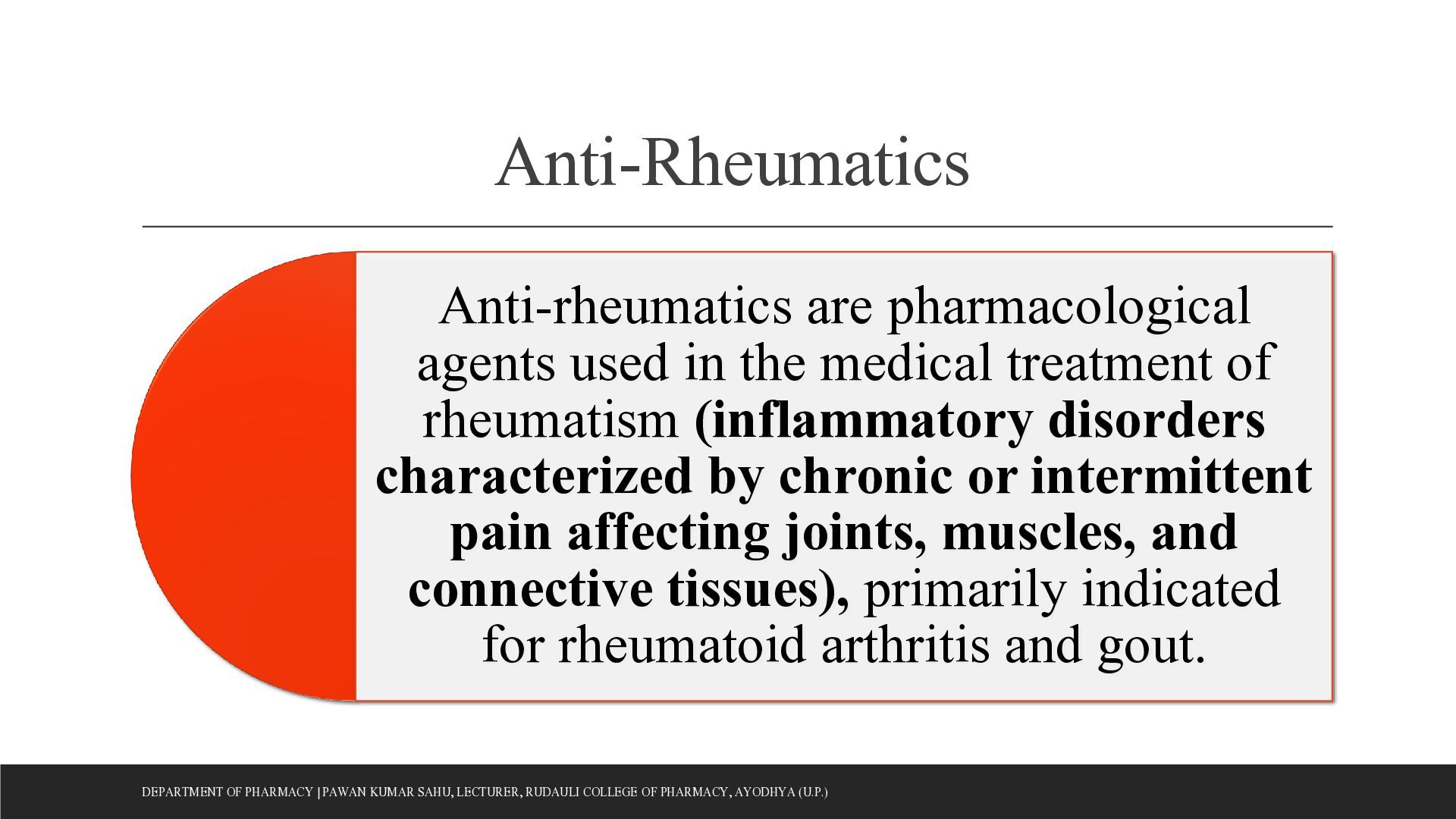
  59. Anti-Rheumatics Anti-rheumatics are pharmacological agents used in the medical treatment

    of rheumatism (inflammatory disorders characterized by chronic or intermittent pain affecting joints, muscles, and connective tissues), primarily indicated for rheumatoid arthritis and gout. DEPARTMENT OF PHARMACY | PAWAN KUMAR SAHU, LECTURER, RUDAULI COLLEGE OF PHARMACY, AYODHYA (U.P.)
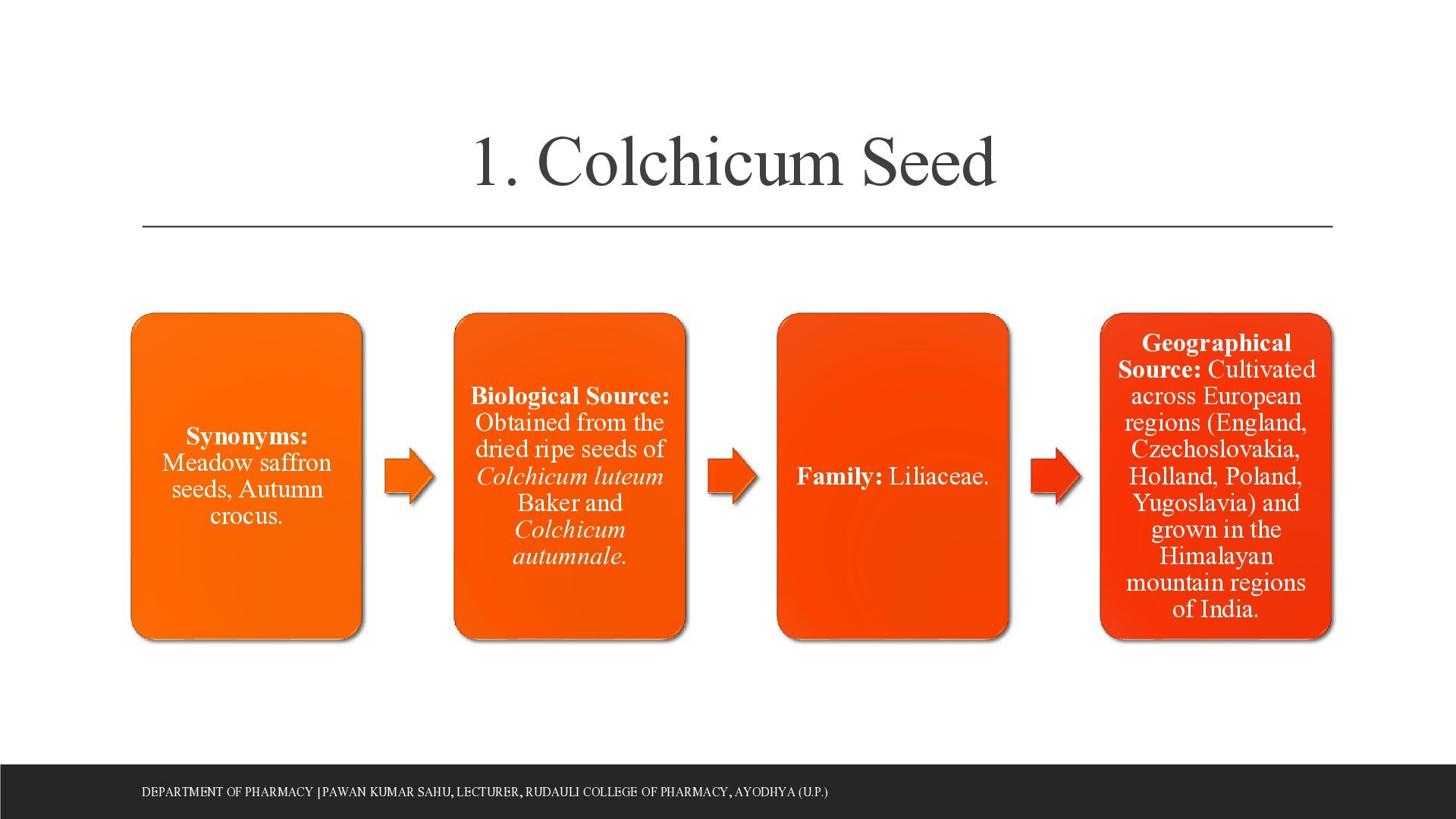
  60. 1. Colchicum Seed Synonyms: Meadow saffron seeds, Autumn crocus. Biological

    Source: Obtained from the dried ripe seeds of Colchicum luteum Baker and Colchicum autumnale. Family: Liliaceae. DEPARTMENT OF PHARMACY | PAWAN KUMAR SAHU, LECTURER, RUDAULI COLLEGE OF PHARMACY, AYODHYA (U.P.) Geographical Source: Cultivated across European regions (England, Czechoslovakia, Holland, Poland, Yugoslavia) and grown in the Himalayan mountain regions of India.
  61. 1. Colchicum Seed DEPARTMENT OF PHARMACY | PAWAN KUMAR SAHU,

    LECTURER, RUDAULI COLLEGE OF PHARMACY, AYODHYA (U.P.)
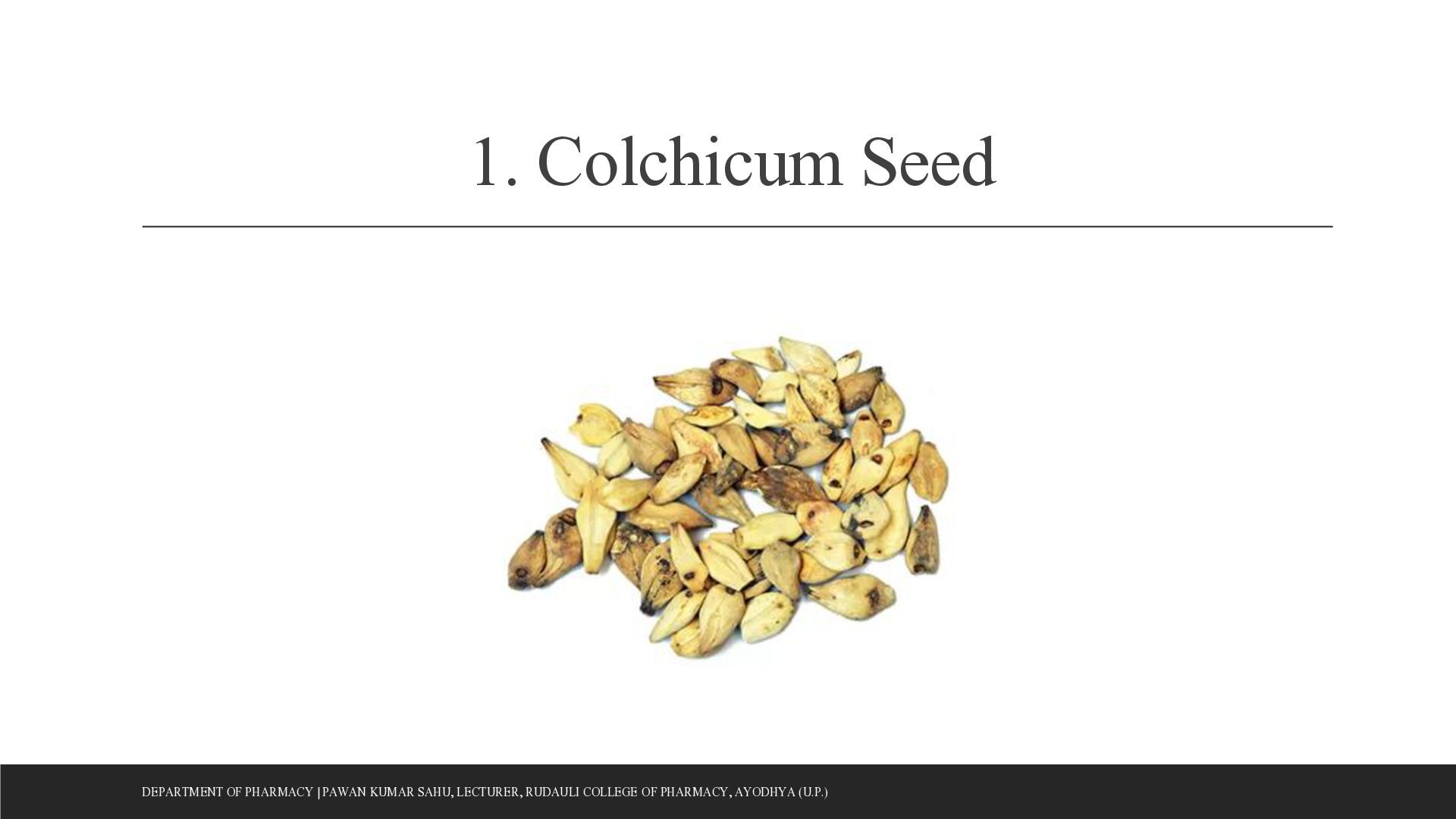
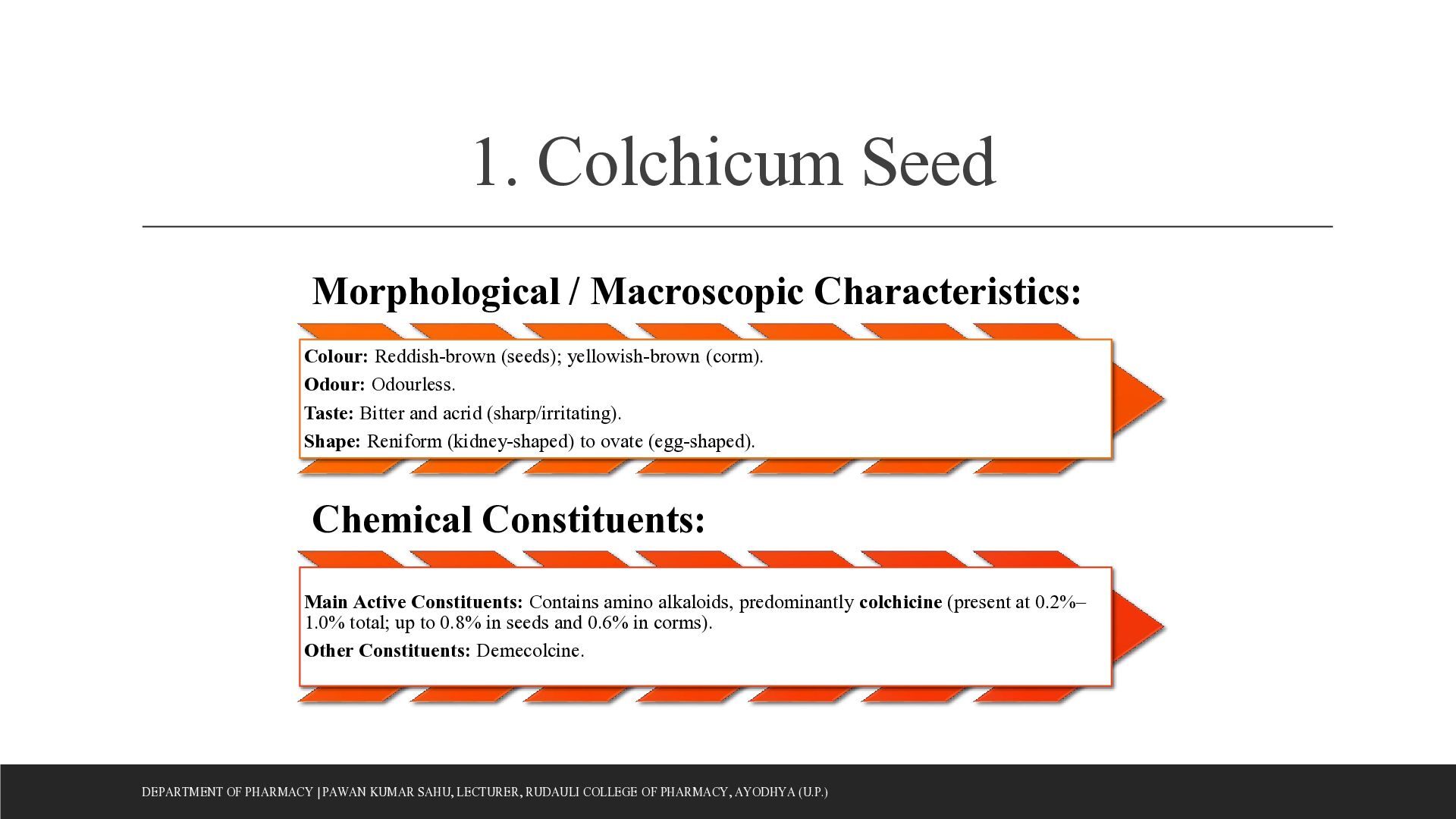
  62. 1. Colchicum Seed Morphological / Macroscopic Characteristics: Colour: Reddish-brown (seeds);

    yellowish-brown (corm). Odour: Odourless. Taste: Bitter and acrid (sharp/irritating). Shape: Reniform (kidney-shaped) to ovate (egg-shaped). Chemical Constituents: Main Active Constituents: Contains amino alkaloids, predominantly colchicine (present at 0.2%– 1.0% total; up to 0.8% in seeds and 0.6% in corms). Other Constituents: Demecolcine. DEPARTMENT OF PHARMACY | PAWAN KUMAR SAHU, LECTURER, RUDAULI COLLEGE OF PHARMACY, AYODHYA (U.P.)
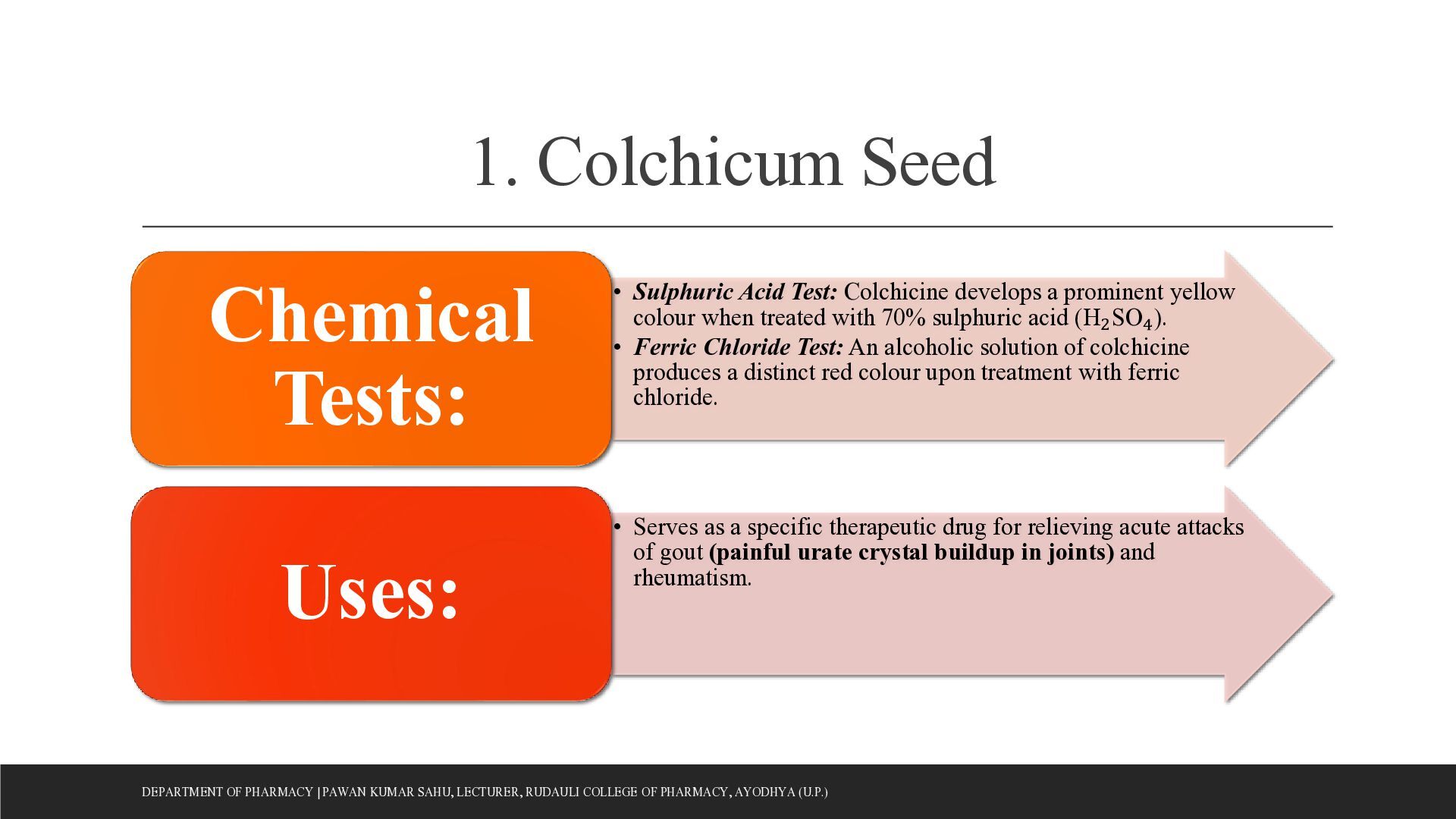
  63. 1. Colchicum Seed Chemical Tests: Uses: • Sulphuric Acid Test:

    Colchicine develops a prominent yellow colour when treated with 70% sulphuric acid (H2 SO4 ). • Ferric Chloride Test: An alcoholic solution of colchicine produces a distinct red colour upon treatment with ferric chloride. H sub 2 , subscript base , SO , end base , sub 4 • Serves as a specific therapeutic drug for relieving acute attacks of gout (painful urate crystal buildup in joints) and rheumatism. DEPARTMENT OF PHARMACY | PAWAN KUMAR SAHU, LECTURER, RUDAULI COLLEGE OF PHARMACY, AYODHYA (U.P.)
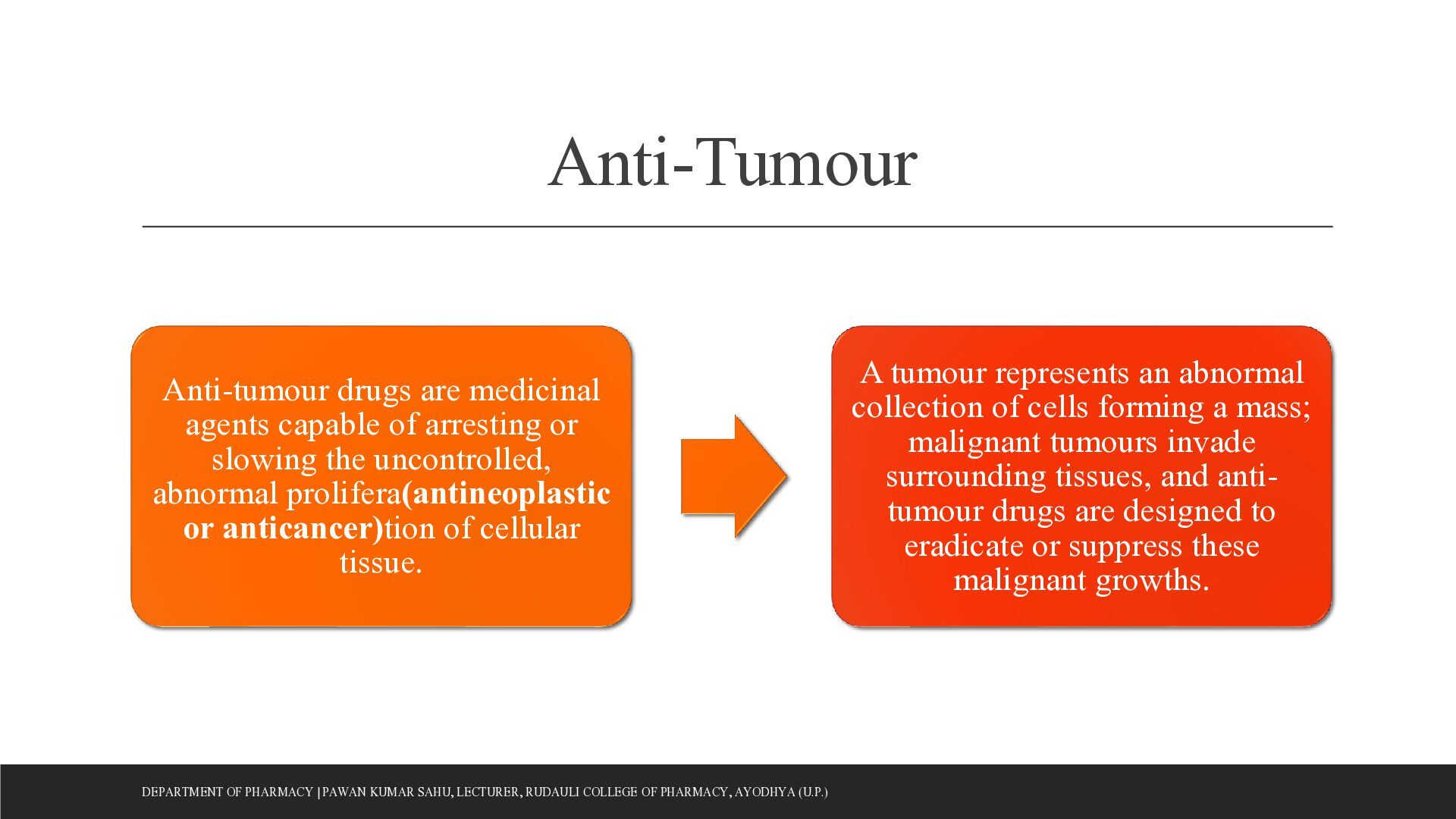
  64. Anti-Tumour Anti-tumour drugs are medicinal agents capable of arresting or

    slowing the uncontrolled, abnormal prolifera(antineoplastic or anticancer)tion of cellular tissue. DEPARTMENT OF PHARMACY | PAWAN KUMAR SAHU, LECTURER, RUDAULI COLLEGE OF PHARMACY, AYODHYA (U.P.) A tumour represents an abnormal collection of cells forming a mass; malignant tumours invade surrounding tissues, and antitumour drugs are designed to eradicate or suppress these malignant growths.
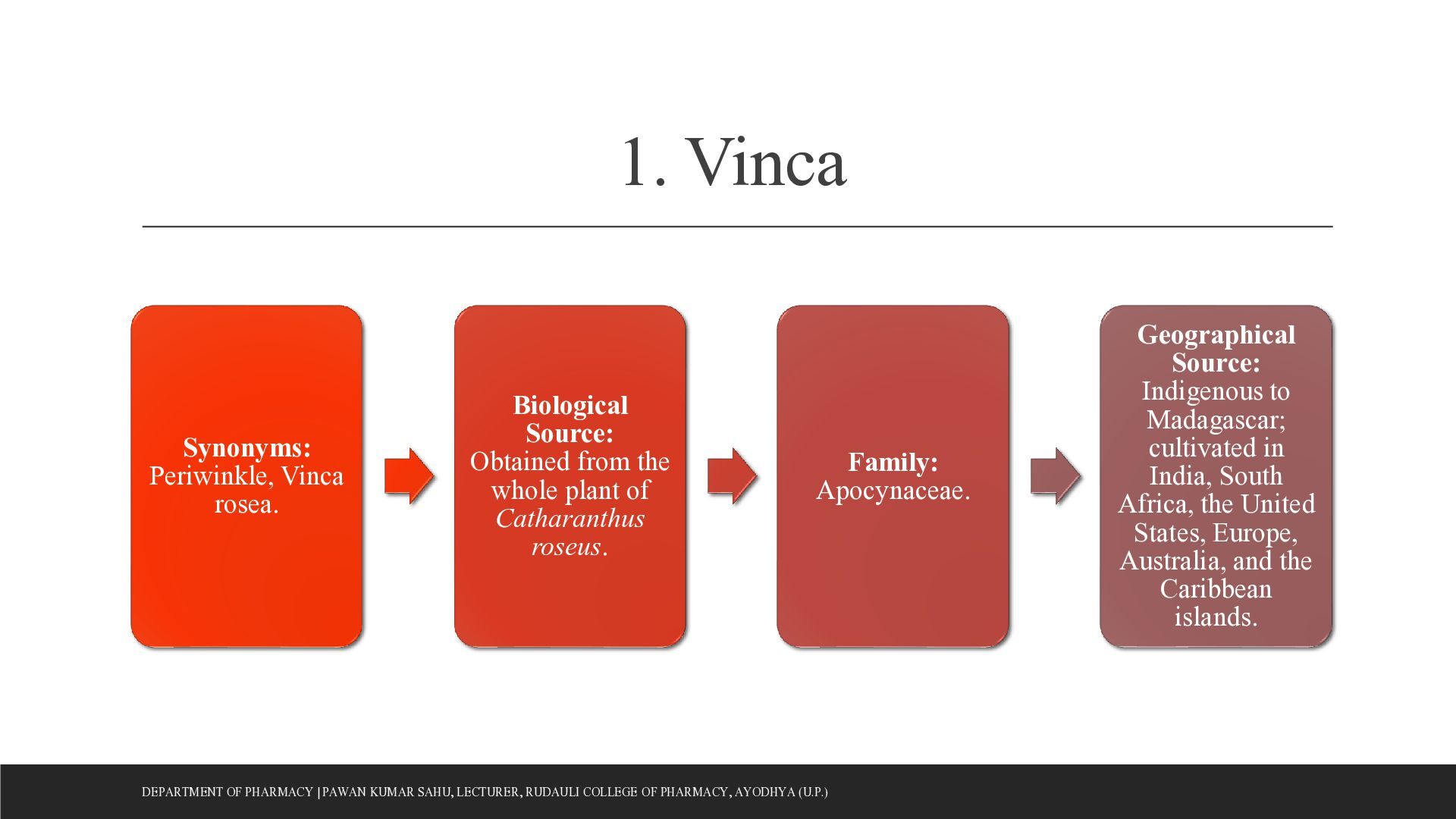
  65. 1. Vinca Synonyms: Periwinkle, Vinca rosea. Biological Source: Obtained from

    the whole plant of Catharanthus roseus. Family: Apocynaceae. DEPARTMENT OF PHARMACY | PAWAN KUMAR SAHU, LECTURER, RUDAULI COLLEGE OF PHARMACY, AYODHYA (U.P.) Geographical Source: Indigenous to Madagascar; cultivated in India, South Africa, the United States, Europe, Australia, and the Caribbean islands.
  66. 1. Vinca DEPARTMENT OF PHARMACY | PAWAN KUMAR SAHU, LECTURER,

    RUDAULI COLLEGE OF PHARMACY, AYODHYA (U.P.)
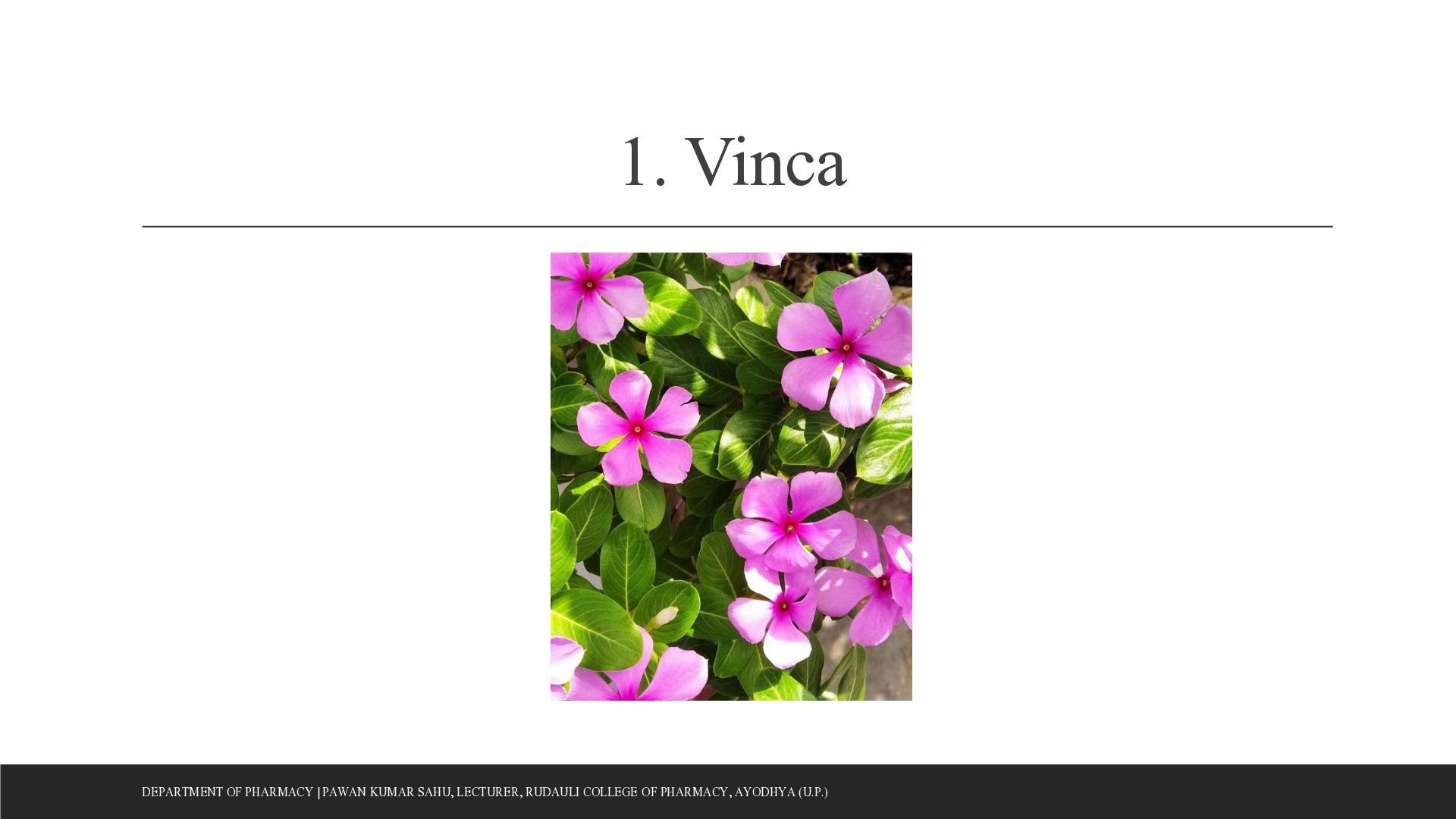
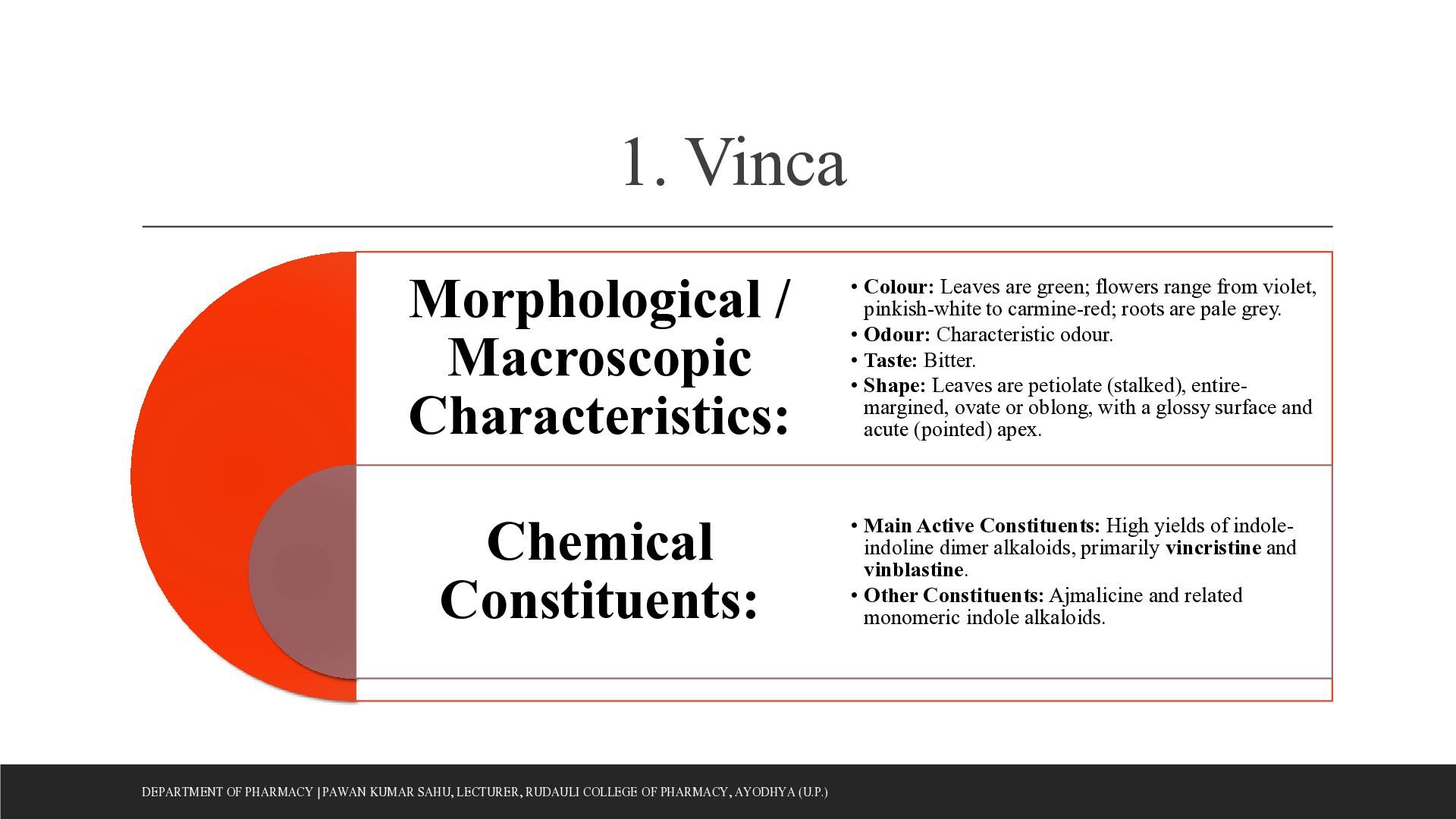
  67. 1. Vinca Morphological / Macroscopic Characteristics: • Colour: Leaves are

    green; flowers range from violet, pinkish-white to carmine-red; roots are pale grey. • Odour: Characteristic odour. • Taste: Bitter. • Shape: Leaves are petiolate (stalked), entiremargined, ovate or oblong, with a glossy surface and acute (pointed) apex. Chemical Constituents: • Main Active Constituents: High yields of indoleindoline dimer alkaloids, primarily vincristine and vinblastine. • Other Constituents: Ajmalicine and related monomeric indole alkaloids. DEPARTMENT OF PHARMACY | PAWAN KUMAR SAHU, LECTURER, RUDAULI COLLEGE OF PHARMACY, AYODHYA (U.P.)
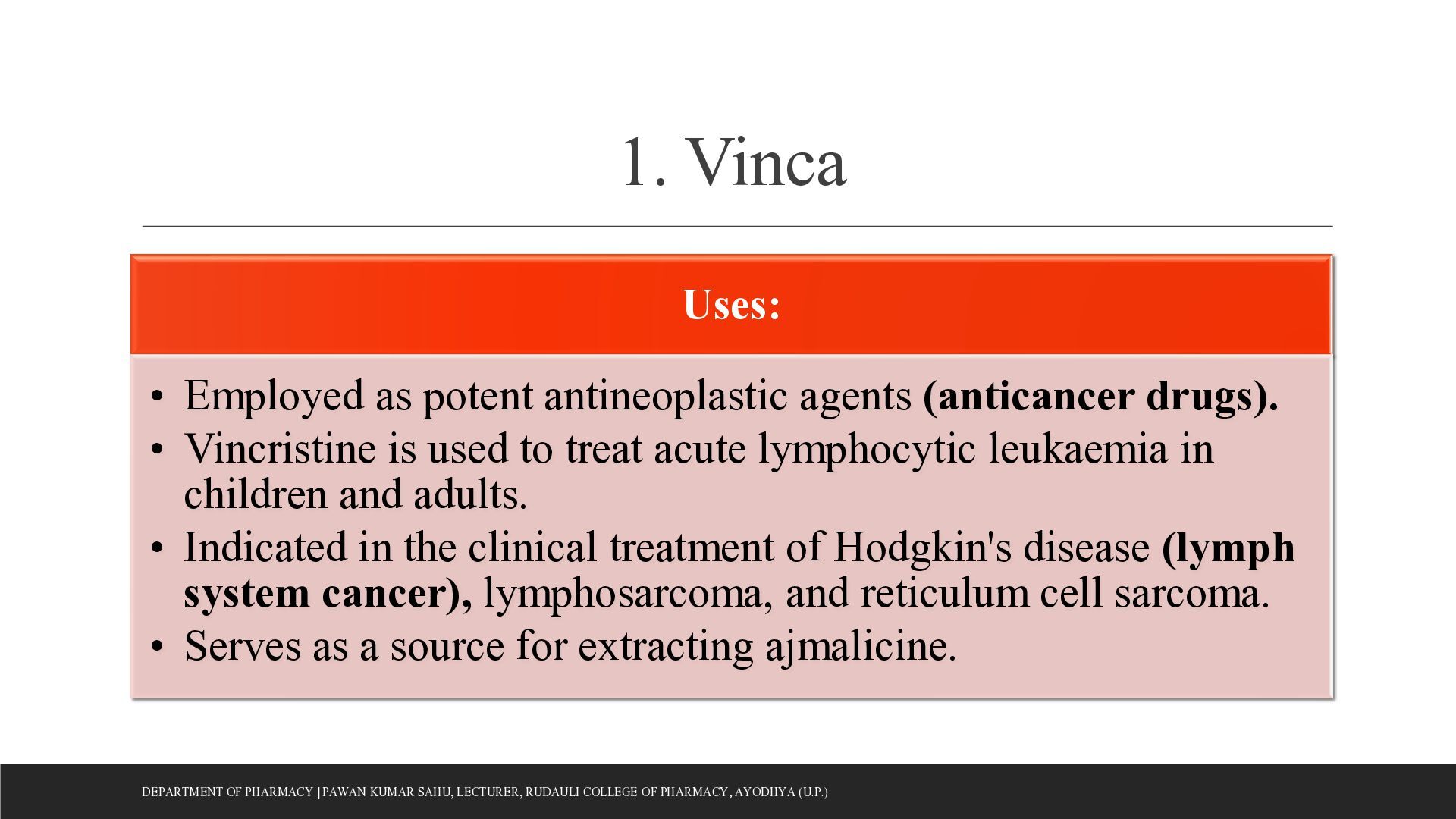
  68. 1. Vinca Uses: • Employed as potent antineoplastic agents (anticancer

    drugs). • Vincristine is used to treat acute lymphocytic leukaemia in children and adults. • Indicated in the clinical treatment of Hodgkin's disease (lymph system cancer), lymphosarcoma, and reticulum cell sarcoma. • Serves as a source for extracting ajmalicine. DEPARTMENT OF PHARMACY | PAWAN KUMAR SAHU, LECTURER, RUDAULI COLLEGE OF PHARMACY, AYODHYA (U.P.)
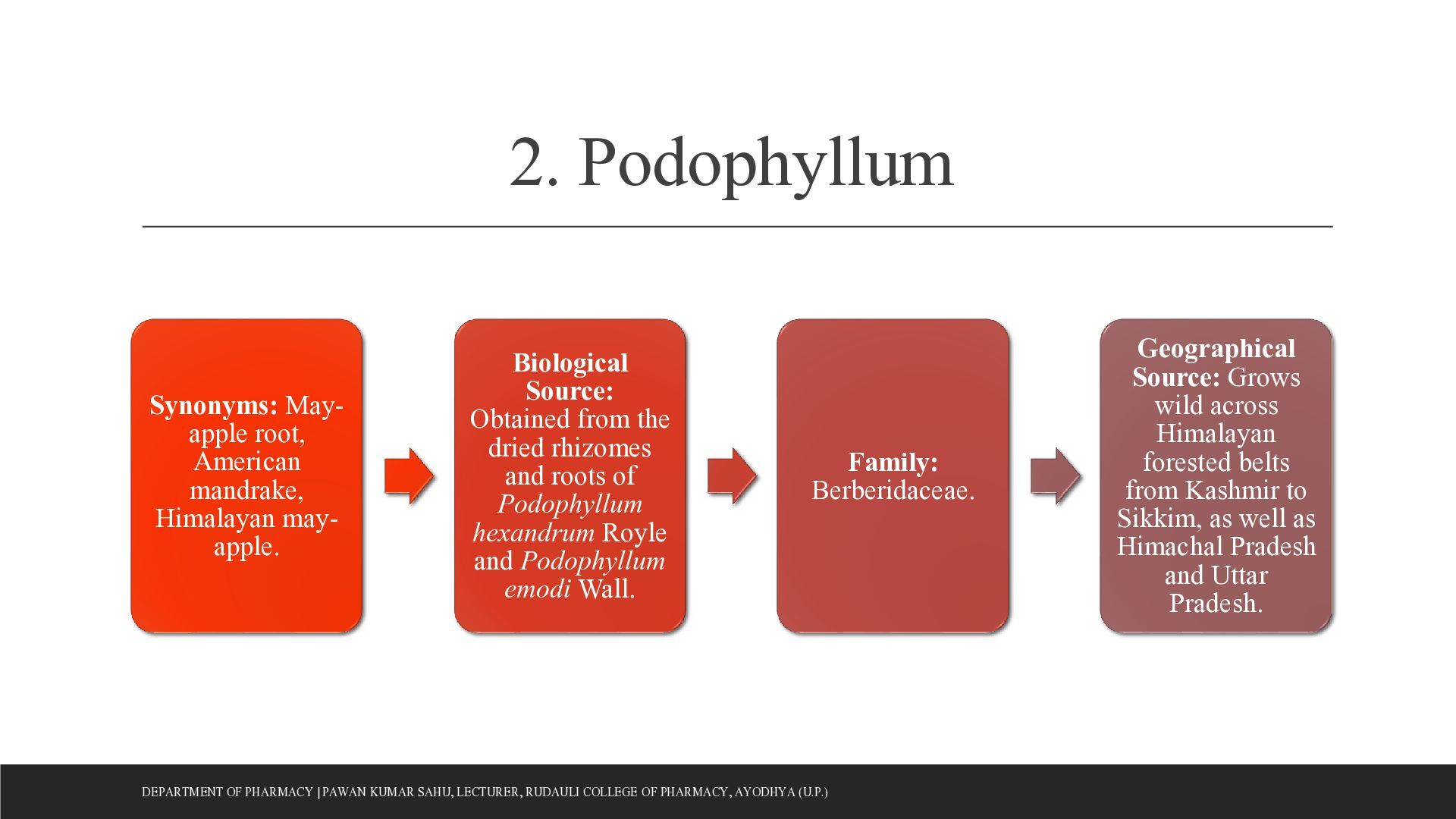
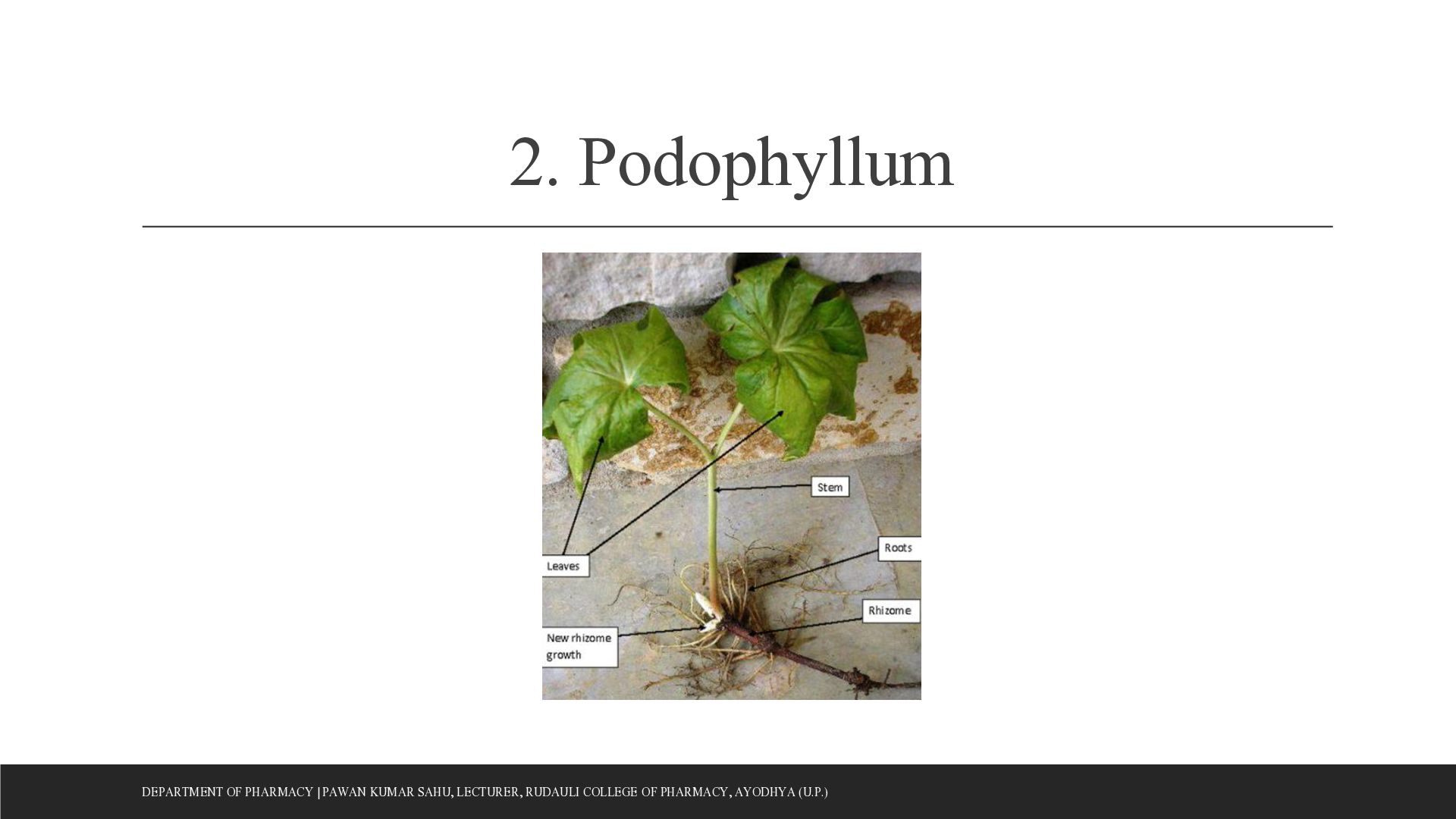
  69. 2. Podophyllum Synonyms: Mayapple root, American mandrake, Himalayan mayapple. Biological

    Source: Obtained from the dried rhizomes and roots of Podophyllum hexandrum Royle and Podophyllum emodi Wall. Family: Berberidaceae. DEPARTMENT OF PHARMACY | PAWAN KUMAR SAHU, LECTURER, RUDAULI COLLEGE OF PHARMACY, AYODHYA (U.P.) Geographical Source: Grows wild across Himalayan forested belts from Kashmir to Sikkim, as well as Himachal Pradesh and Uttar Pradesh.
  70. 2. Podophyllum DEPARTMENT OF PHARMACY | PAWAN KUMAR SAHU, LECTURER,

    RUDAULI COLLEGE OF PHARMACY, AYODHYA (U.P.)
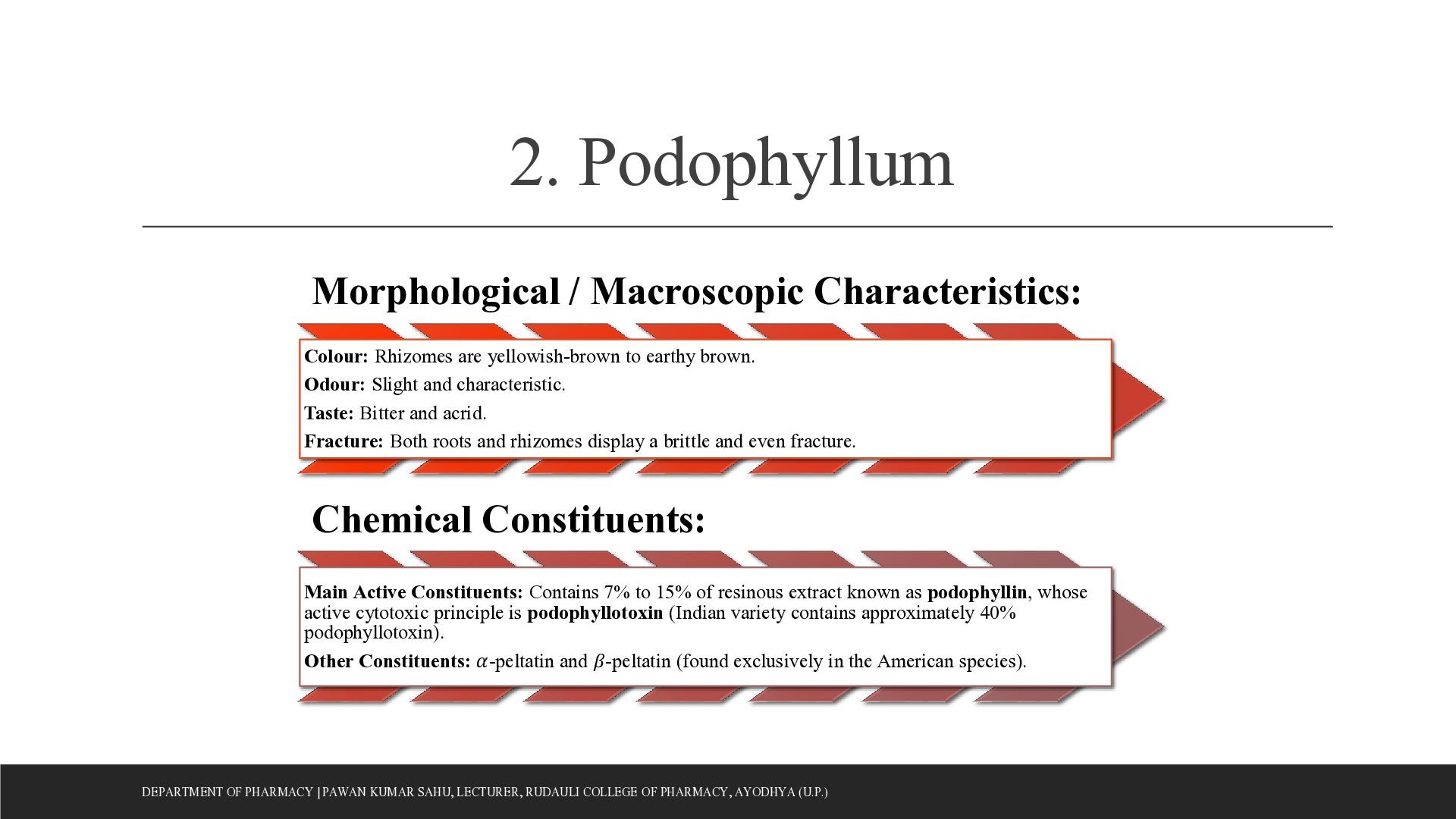
  71. 2. Podophyllum Morphological / Macroscopic Characteristics: Colour: Rhizomes are yellowish-brown

    to earthy brown. Odour: Slight and characteristic. Taste: Bitter and acrid. Fracture: Both roots and rhizomes display a brittle and even fracture. Chemical Constituents: Main Active Constituents: Contains 7% to 15% of resinous extract known as podophyllin, whose active cytotoxic principle is podophyllotoxin (Indian variety contains approximately 40% podophyllotoxin). Other Constituents: 𝛼-peltatin and 𝛽-peltatin (found exclusively in the American species). start equation alpha start equation beta DEPARTMENT OF PHARMACY | PAWAN KUMAR SAHU, LECTURER, RUDAULI COLLEGE OF PHARMACY, AYODHYA (U.P.)
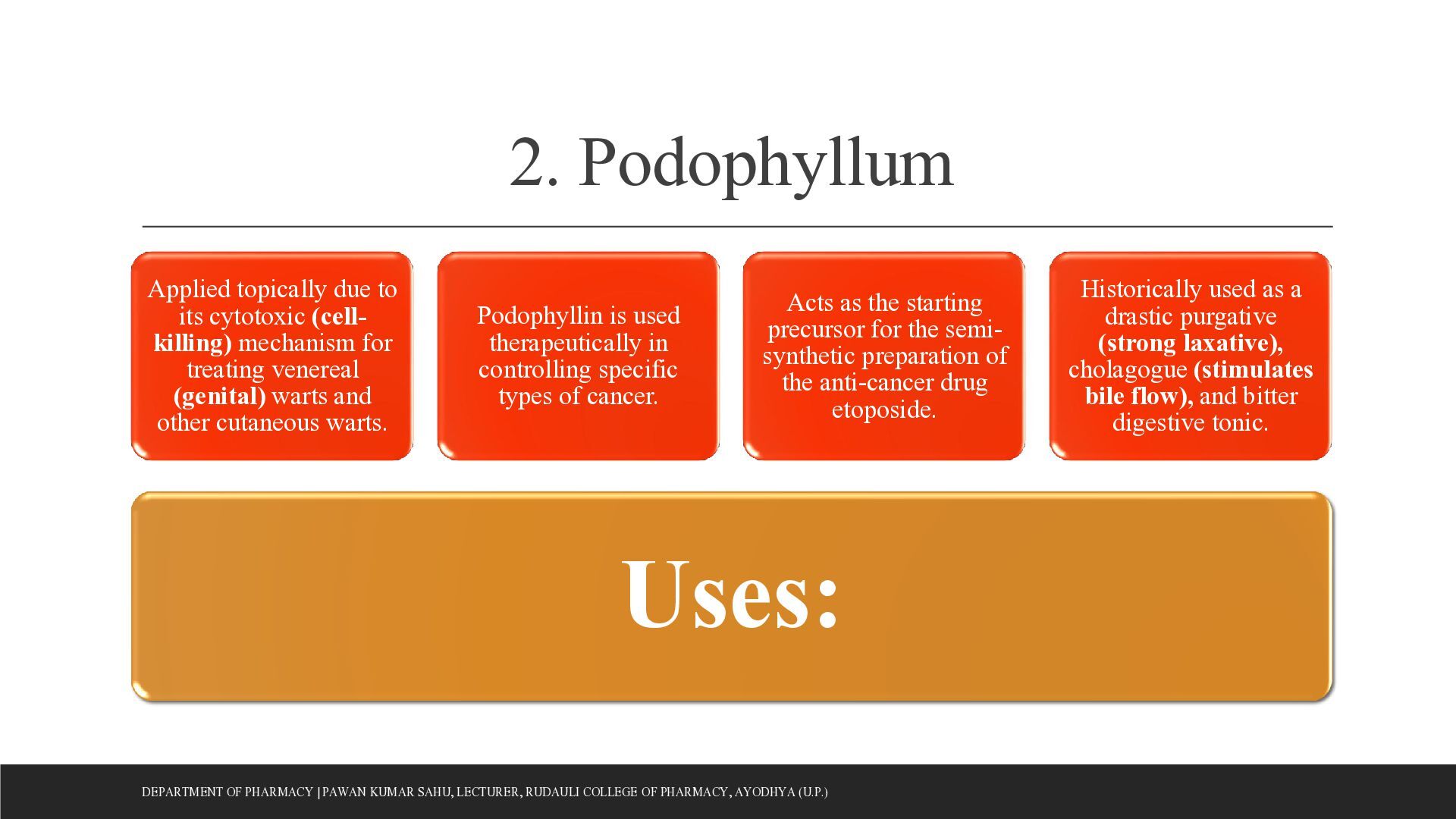
  72. 2. Podophyllum Applied topically due to its cytotoxic (cellkilling) mechanism

    for treating venereal (genital) warts and other cutaneous warts. Podophyllin is used therapeutically in controlling specific types of cancer. Acts as the starting precursor for the semisynthetic preparation of the anti-cancer drug etoposide. Uses: DEPARTMENT OF PHARMACY | PAWAN KUMAR SAHU, LECTURER, RUDAULI COLLEGE OF PHARMACY, AYODHYA (U.P.) Historically used as a drastic purgative (strong laxative), cholagogue (stimulates bile flow), and bitter digestive tonic.
  73. THANK YOU DEPARTMENT OF PHARMACY | PAWAN KUMAR SAHU, LECTURER,

    RUDAULI COLLEGE OF PHARMACY, AYODHYA (U.P.)