Upgrade to Pro — share decks privately, control downloads, hide ads and more …

QA & You

QA & You

How do QA and developers work together in a manner that is not combative, and delivers the highest quality product. I will explore this topic, and provide examples of how to best integrate the two teams together. While this is presented primarily from an Agile approach, I will also cover concepts that are generic to any sort of development environment. The goal is to develop a better working relationship between dev and QA teams within the software development industry.

Avatar for Jon Robinson

Jon Robinson

July 13, 2013

Other Decks in Programming

Transcript

  1. Agenda •  Introduction •  What are some of the challenges

    we are facing •  How did we solve these challenges •  Q & A / Feedback
  2. Introduction •  My Name: Jon Robinson (@jumpmancol) •  What I

    Do: QA Lead for Scripps WCM Platform •  My Background: Started as a consultant, and have worked for both Fortune 500 companies as well as small startups. Wide range of industry experience; Banking, Financial Services, Insurance, Retail, Media
  3. Project Overview •  Project has roughly ~60 people involved on

    a daily basis •  ~40 are directly related to development or QA •  ~20 are Project/Program level •  Mass CHAOS!!!!!!!
  4. Developer Challenges •  Very, very aggressive pace •  QA team

    is a separate unit •  Developers often work in isolation •  Need precise steps to recreate issues that QA finds
  5. QA Challenges •  Developers do not typically develop with QA

    in mind •  Dev teams have a tendency to say “Well it works on my system” •  A lot of valuable testing time is taken up in writing up the steps the dev teams need to recreate
  6. Leads Challenges •  The back and forth nature of issues

    bouncing between teams is a giant time suck •  A whole lot of “Hurry up and wait” happening •  Accurately determining the readiness of a feature can be difficult
  7. The Squad Approach •  A team of 2-3 people • 

    Typically 2 developers, and 1 QA •  Work in a pair programming approach •  No longer separate Dev & QA designations, but rather a single Delivery team •  Much more SCRUM-like •  Each Squad is part of a Team •  Teams have a daily standup
  8. Test Management •  Issues are tracked in JIRA •  Classified

    as Features, Change Requests, Bugs, & Tasks •  Acceptance Criteria/Test Cases written against Features & Change Requests •  AC must be reviewed and signed off on by Product owners •  Written before development begins
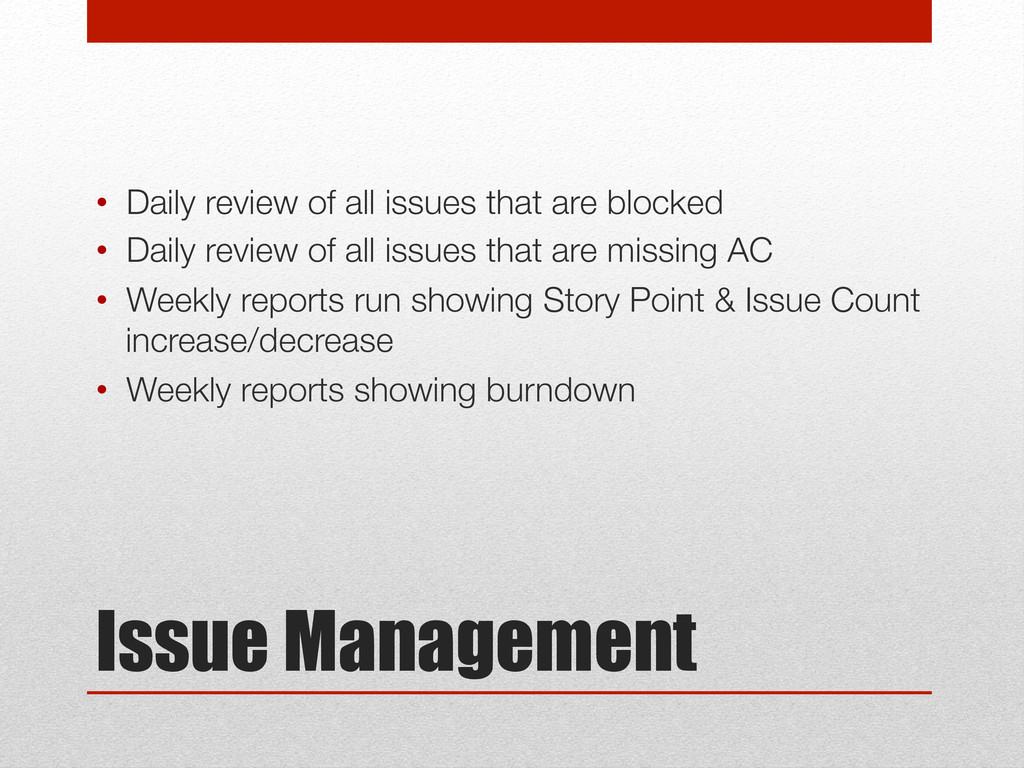
  9. Issue Management •  Daily review of all issues that are

    blocked •  Daily review of all issues that are missing AC •  Weekly reports run showing Story Point & Issue Count increase/decrease •  Weekly reports showing burndown
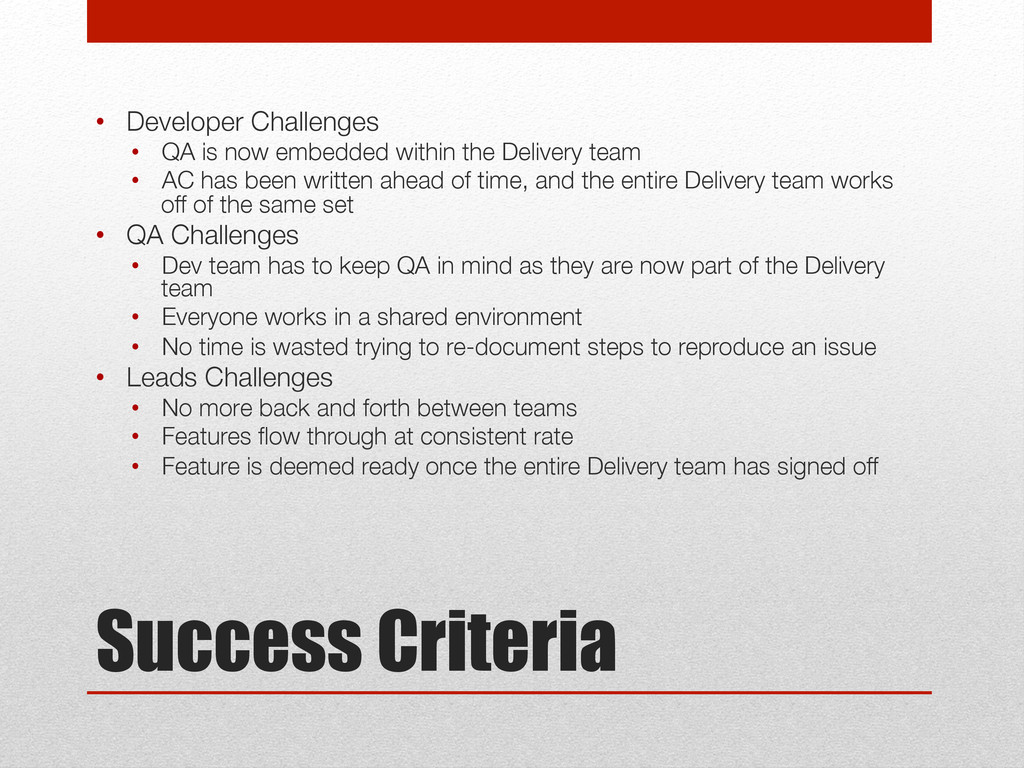
  10. Success Criteria •  Developer Challenges •  QA is now embedded

    within the Delivery team •  AC has been written ahead of time, and the entire Delivery team works off of the same set •  QA Challenges •  Dev team has to keep QA in mind as they are now part of the Delivery team •  Everyone works in a shared environment •  No time is wasted trying to re-document steps to reproduce an issue •  Leads Challenges •  No more back and forth between teams •  Features flow through at consistent rate •  Feature is deemed ready once the entire Delivery team has signed off