Share
Embed
Scala - A Tragedy in Two Parts
The tragedy being - we aren't using it all the time. A very quick look at Scala and some tools from a person that knows about 1% of what the language has to offer.
James Hughes
April 12, 2012
Transcript
34 slides
-
Scala e ~ a tragedy in two parts ~ the
tragedy being we aren’t using it all the time -
g If I were to pick a language to use
today other than Java, it would be Scala j g I can honestly say if someone had shown me the Programming in Scala ... I'd probably have never created Groovy. s Praise for Scala -
More Praise for Scala g I’written production apps in Haskell,
taught advanced FP and type theory, published a paper on category theory and still think that Scala is over-complicated, a bastard child of OO and FP with some XML thrown in for reasons unknown... vsz g ...Don't get me wrong, it's better than anything else you can get on the JVM... f -
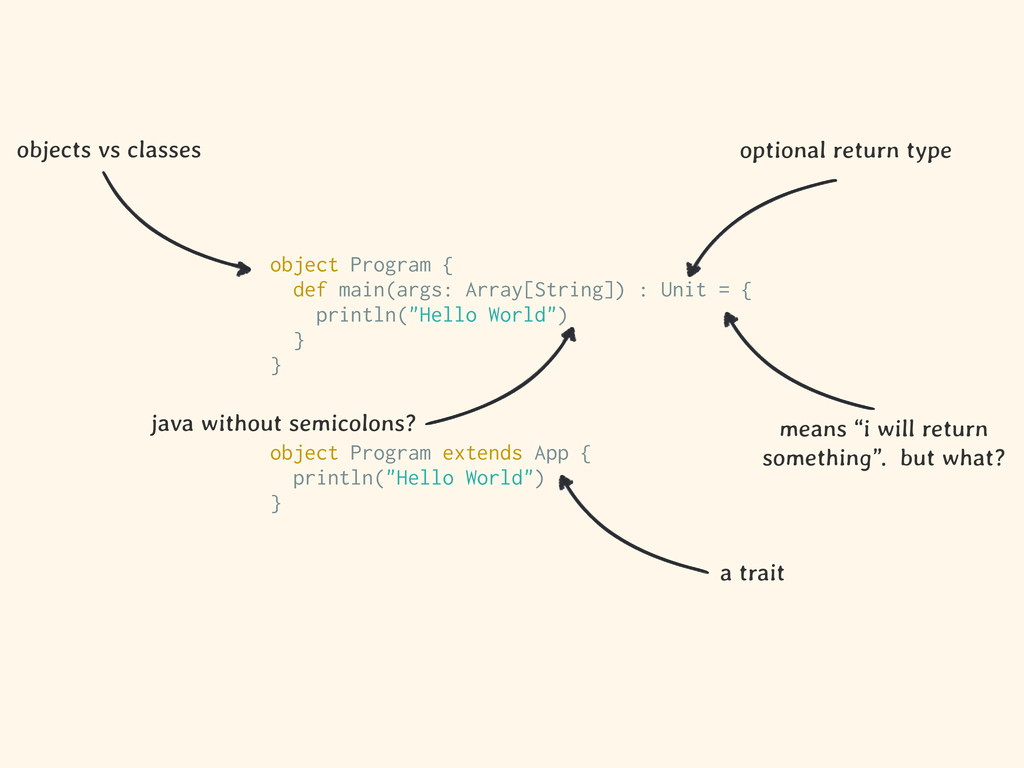
object Program { def main(args: Array[String]) : Unit = {
println("Hello World") } } object Program extends App { println("Hello World") } -
objects vs classes optional return type means “i will return
something”. but what? a trait java without semicolons? object Program { def main(args: Array[String]) : Unit = { println("Hello World") } } object Program extends App { println("Hello World") } -
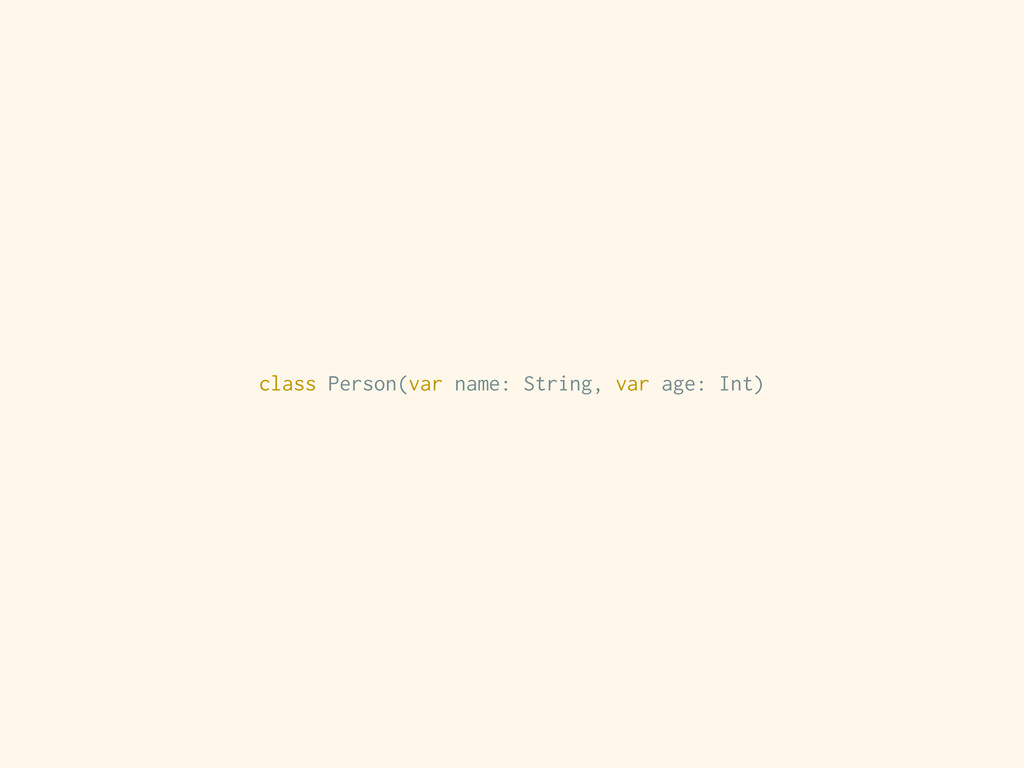
class definition constructor params and properties (FYI vars suck) class
Person(var name: String, var age: Int) -
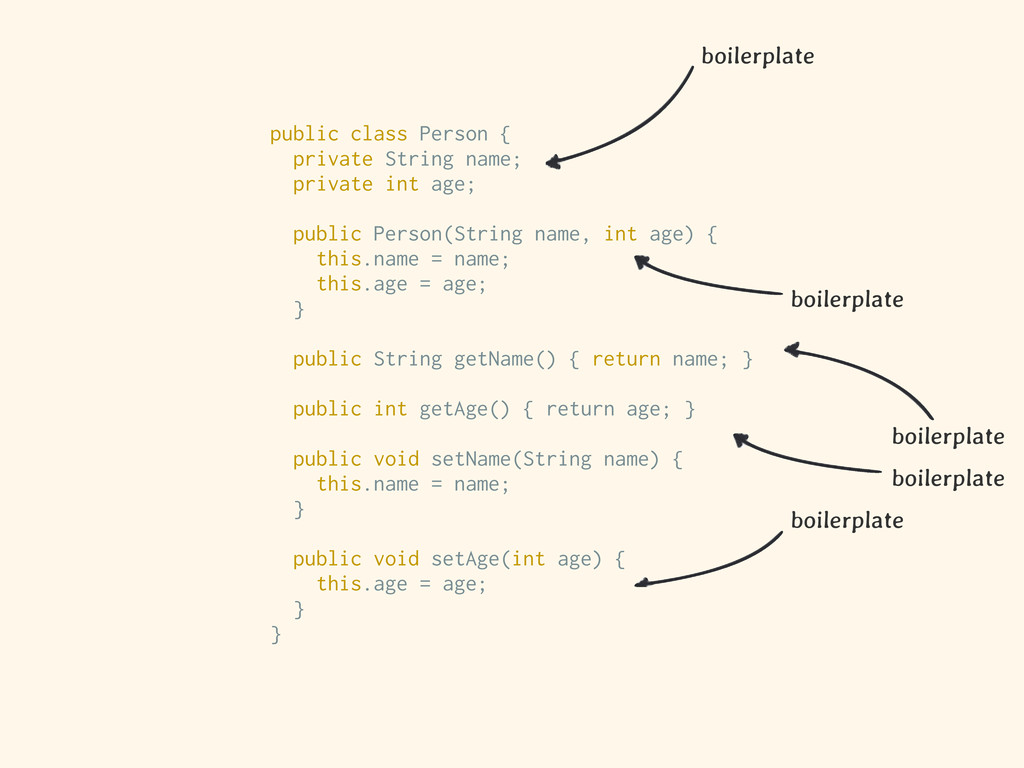
public class Person { private String name; private int age;
public Person(String name, int age) { this.name = name; this.age = age; } public String getName() { return name; } public int getAge() { return age; } public void setName(String name) { this.name = name; } public void setAge(int age) { this.age = age; } } -
public class Person { private String name; private int age;
public Person(String name, int age) { this.name = name; this.age = age; } public String getName() { return name; } public int getAge() { return age; } public void setName(String name) { this.name = name; } public void setAge(int age) { this.age = age; } } boilerplate boilerplate boilerplate boilerplate boilerplate -
val list1 = List(1,2,3,4) val list2 = 1 :: 2
:: 3 :: 4 :: Nil val list3 = 0 :: list1 list1.head list1.tail list1.isEmpty list1.map(_ + 10) list1.map(i => i + 10) // +100s more -
companion object crazy operators val is sorta final prepend brackets
schmakets! sweet sweet sugar but the tip of the iceberg true story val list1 = List(1,2,3,4) val list2 = 1 :: 2 :: 3 :: 4 :: Nil val list3 = 0 :: list1 list1.head list1.tail list1.isEmpty list1.map(_ + 10) list1.map(i => i + 10) // +100s more -
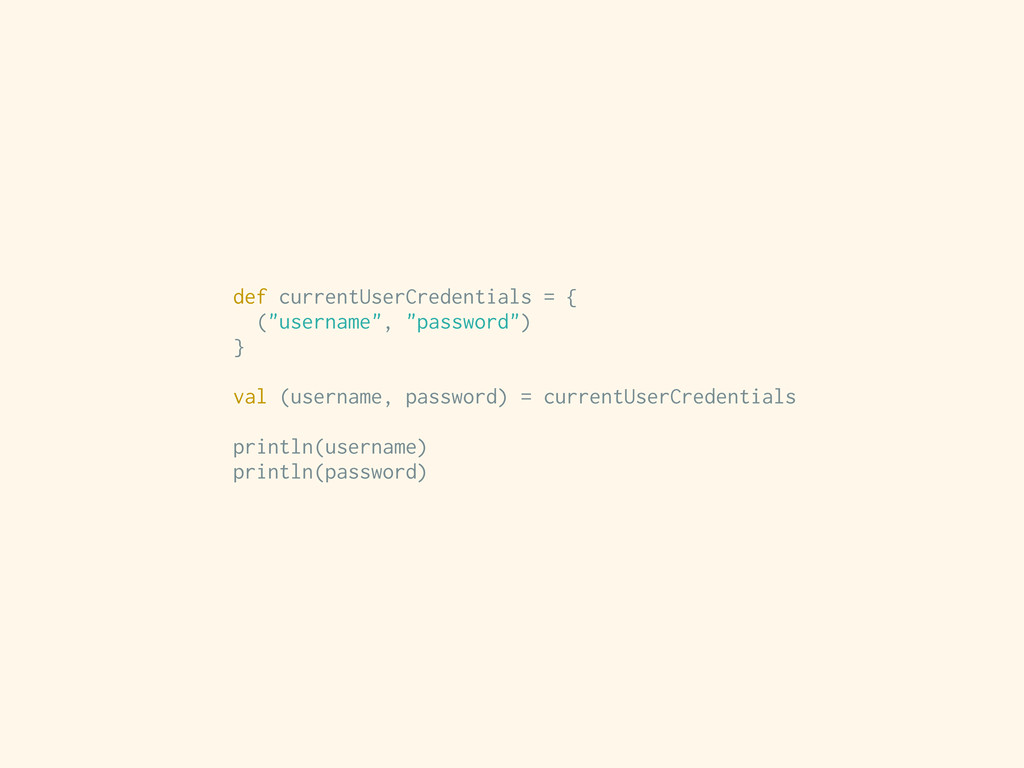
def currentUserCredentials = { ("username", "password") } val (username, password)
= currentUserCredentials println(username) println(password) -
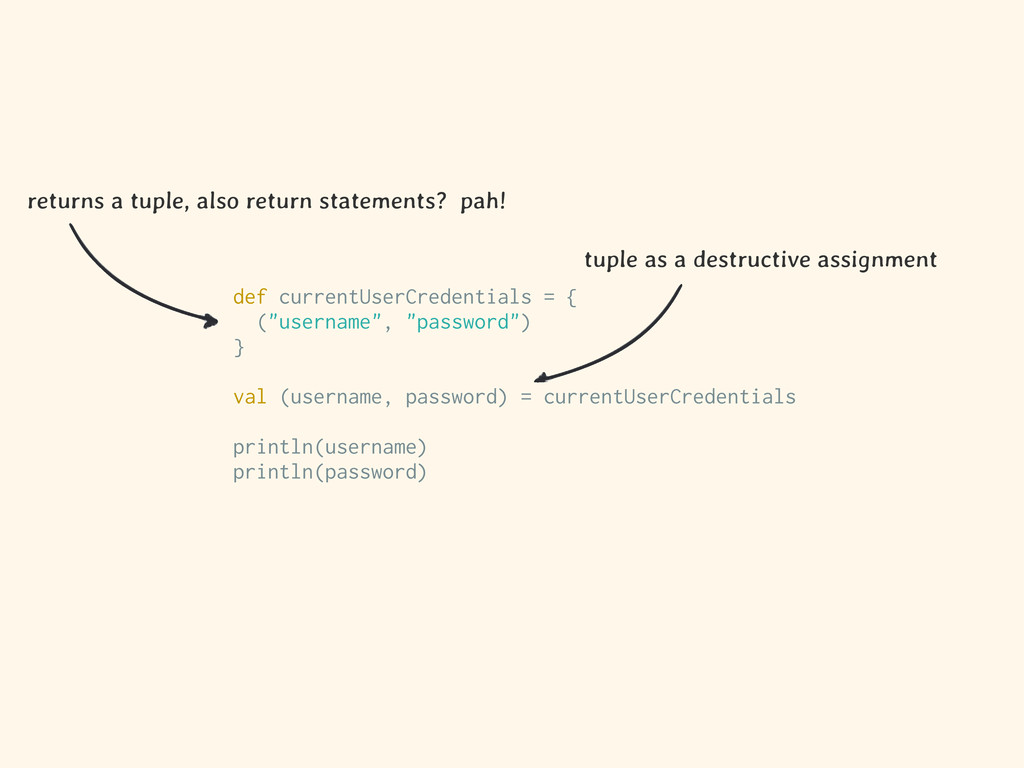
returns a tuple, also return statements? pah! tuple as a
destructive assignment def currentUserCredentials = { ("username", "password") } val (username, password) = currentUserCredentials println(username) println(password) -
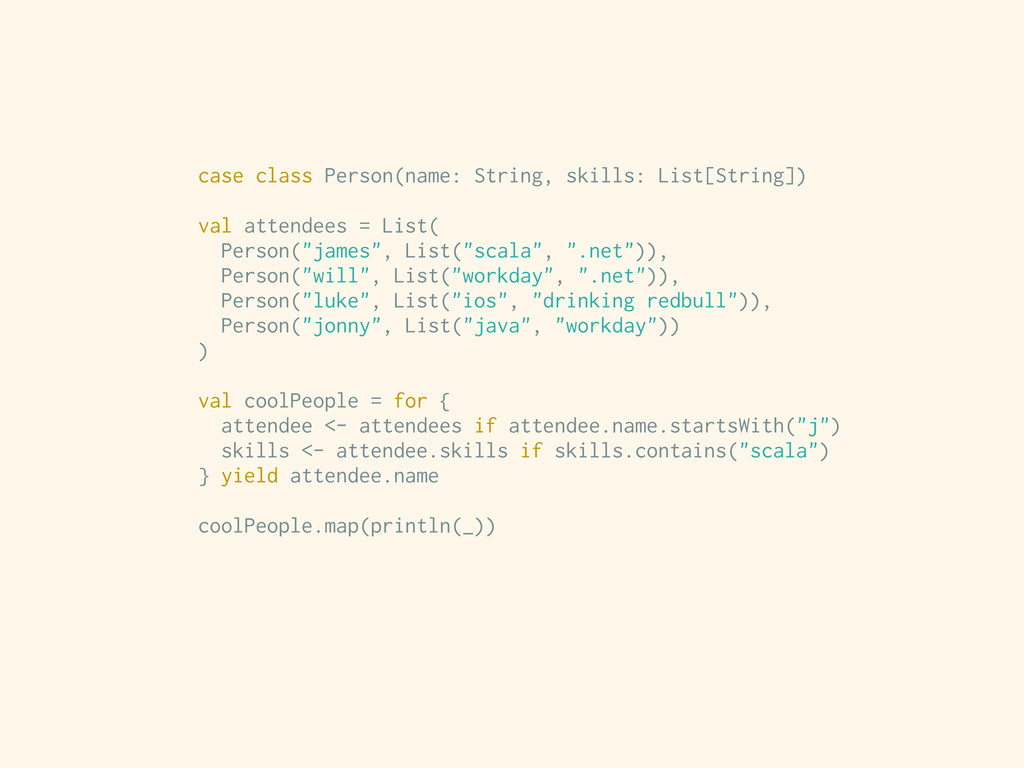
case class Person(name: String, skills: List[String]) val attendees = List(
Person("james", List("scala", ".net")), Person("will", List("workday", ".net")), Person("luke", List("ios", "drinking redbull")), Person("jonny", List("java", "workday")) ) val coolPeople = for { attendee <- attendees if attendee.name.startsWith("j") skills <- attendee.skills if skills.contains("scala") } yield attendee.name coolPeople.map(println(_)) -
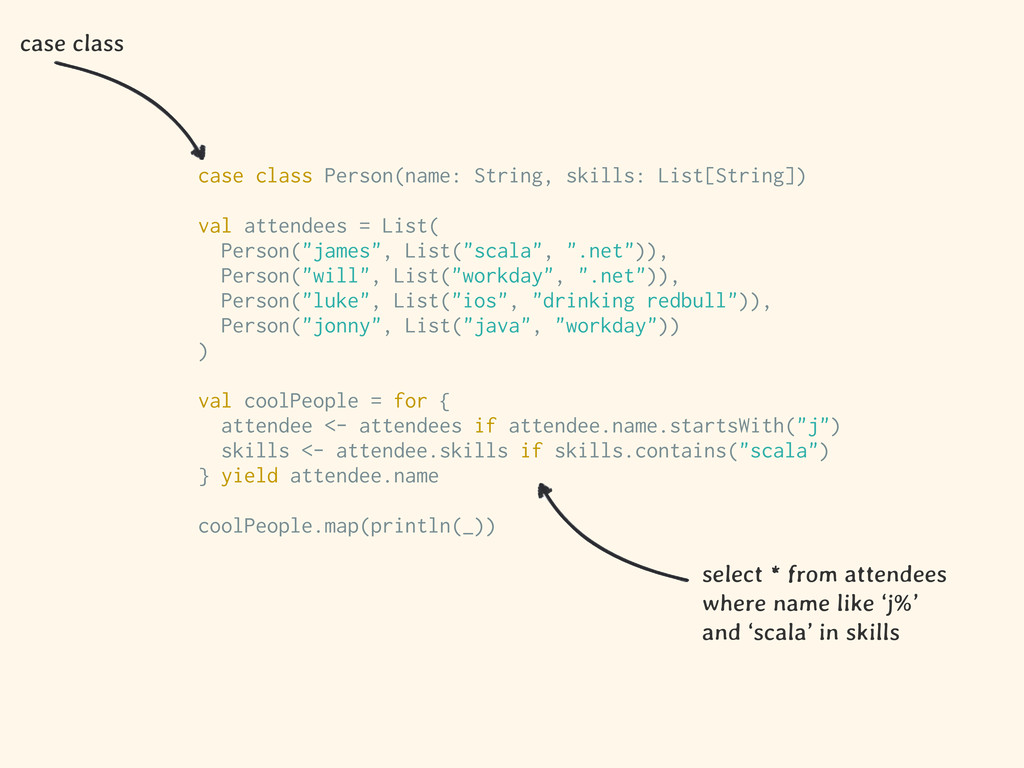
case class Person(name: String, skills: List[String]) val attendees = List(
Person("james", List("scala", ".net")), Person("will", List("workday", ".net")), Person("luke", List("ios", "drinking redbull")), Person("jonny", List("java", "workday")) ) val coolPeople = for { attendee <- attendees if attendee.name.startsWith("j") skills <- attendee.skills if skills.contains("scala") } yield attendee.name coolPeople.map(println(_)) select * from attendees where name like ‘j%’ and ‘scala’ in skills case class -
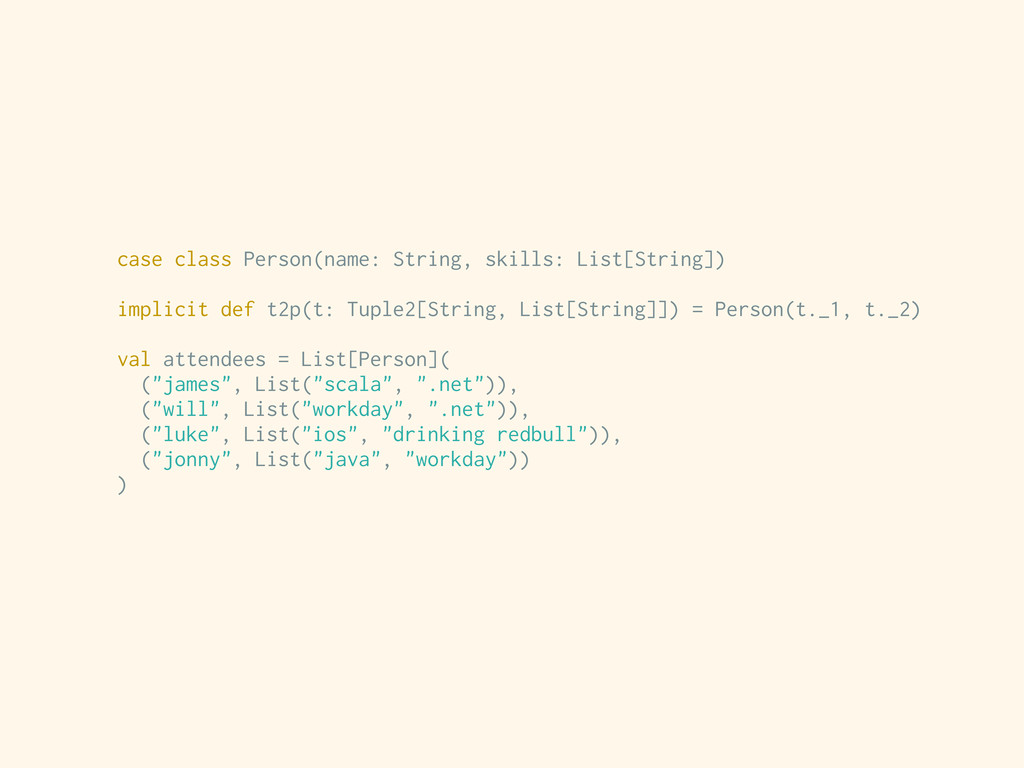
case class Person(name: String, skills: List[String]) implicit def t2p(t: Tuple2[String,
List[String]]) = Person(t._1, t._2) val attendees = List[Person]( ("james", List("scala", ".net")), ("will", List("workday", ".net")), ("luke", List("ios", "drinking redbull")), ("jonny", List("java", "workday")) ) -
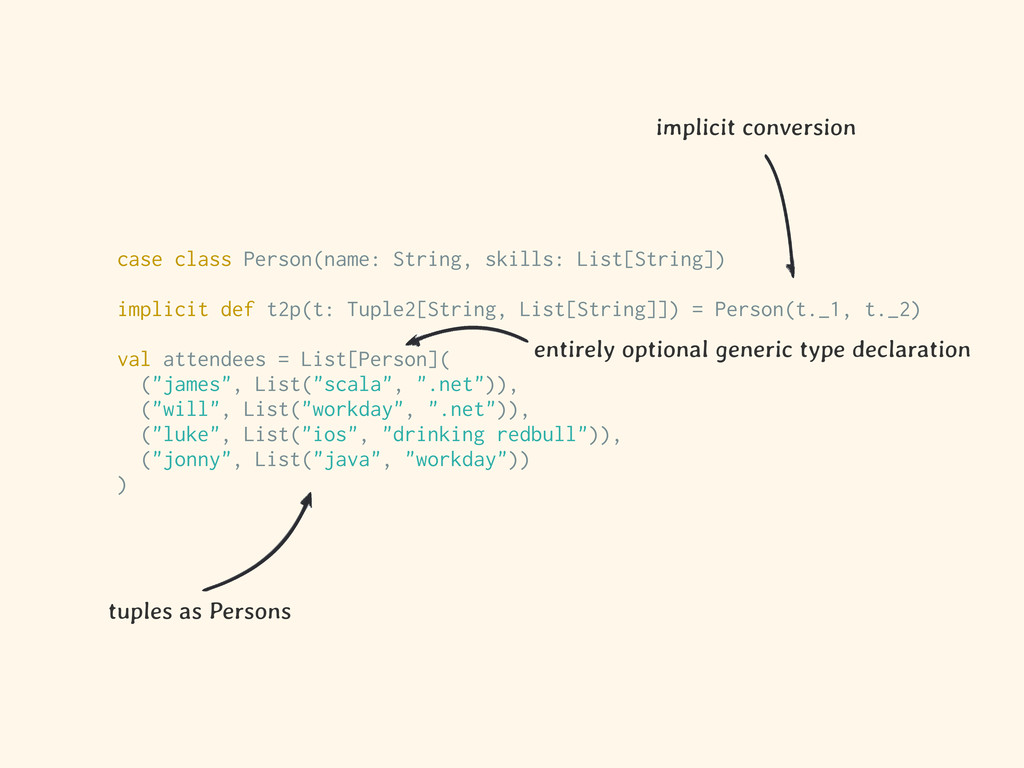
case class Person(name: String, skills: List[String]) implicit def t2p(t: Tuple2[String,
List[String]]) = Person(t._1, t._2) val attendees = List[Person]( ("james", List("scala", ".net")), ("will", List("workday", ".net")), ("luke", List("ios", "drinking redbull")), ("jonny", List("java", "workday")) ) implicit conversion tuples as Persons entirely optional generic type declaration -
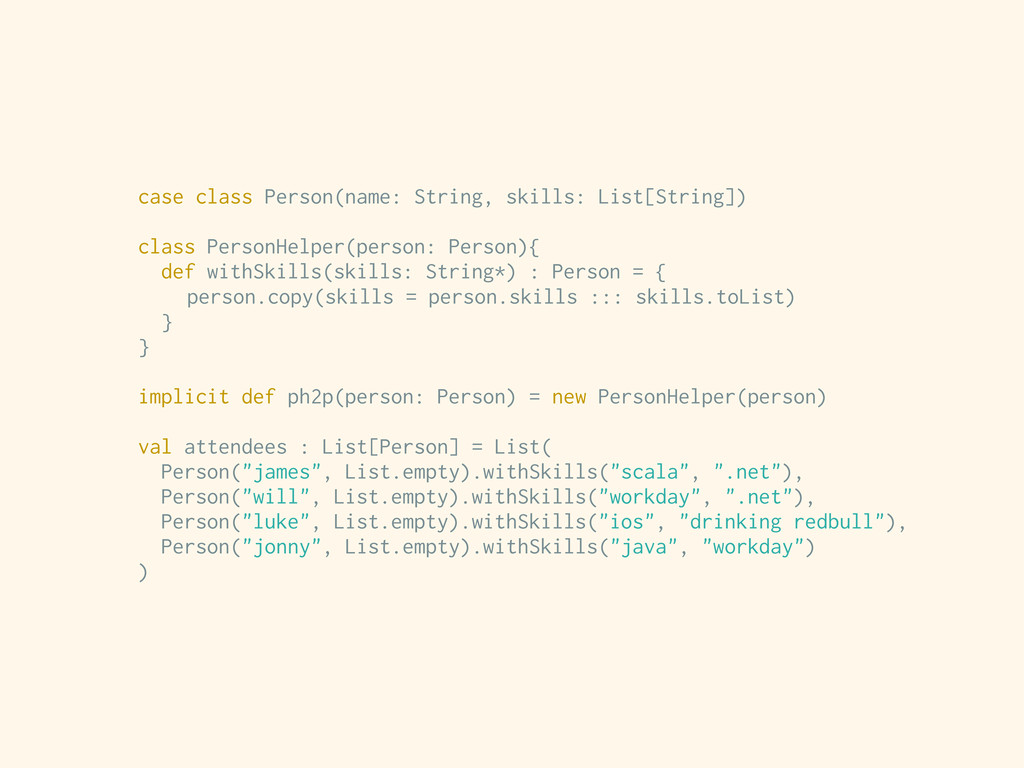
case class Person(name: String, skills: List[String]) class PersonHelper(person: Person){ def
withSkills(skills: String*) : Person = { person.copy(skills = person.skills ::: skills.toList) } } implicit def ph2p(person: Person) = new PersonHelper(person) val attendees : List[Person] = List( Person("james", List.empty).withSkills("scala", ".net"), Person("will", List.empty).withSkills("workday", ".net"), Person("luke", List.empty).withSkills("ios", "drinking redbull"), Person("jonny", List.empty).withSkills("java", "workday") ) -
case class Person(name: String, skills: List[String]) class PersonHelper(person: Person){ def
withSkills(skills: String*) : Person = { person.copy(skills = person.skills ::: skills.toList) } } implicit def ph2p(person: Person) = new PersonHelper(person) val attendees : List[Person] = List( Person("james", List.empty).withSkills("scala", ".net"), Person("will", List.empty).withSkills("workday", ".net"), Person("luke", List.empty).withSkills("ios", "drinking redbull"), Person("jonny", List.empty).withSkills("java", "workday") ) helper methods extension methods? opening classes? no ta! implicit conversion -
trait Logging { def log(msg: String) = println(msg) } trait
CleanerLogging extends Logging { override def log(msg: String) = println("[INFO] " + msg) } class SuperThing extends Thing with Logging { def doThing { log("doing my thing") } } object Program extends App { val thing1 = new SuperThing val thing2 = new SuperThing with CleanerLogging thing1.doThing thing2.doThing } -
trait Logging { def log(msg: String) = println(msg) } trait
CleanerLogging extends Logging { override def log(msg: String) = println("[INFO] " + msg) } class SuperThing extends Thing with Logging { def doThing { log("doing my thing") } } object Program extends App { val thing1 = new SuperThing val thing2 = new SuperThing with CleanerLogging thing1.doThing thing2.doThing } multiple inheritance static composition dynamic composition a trait -
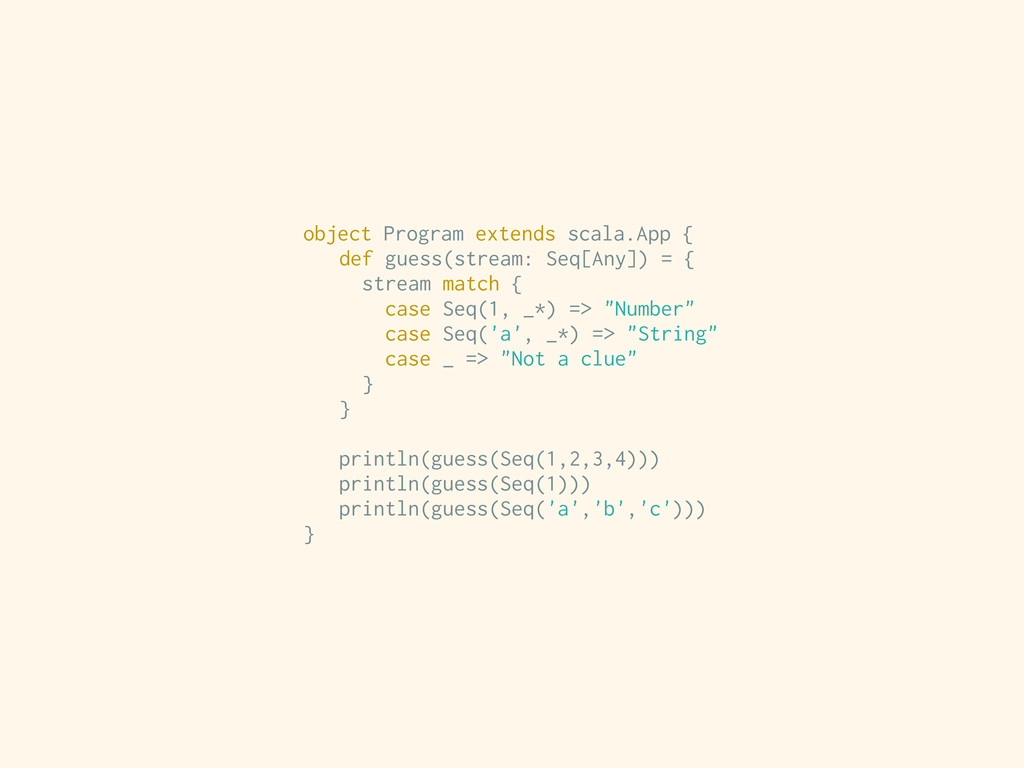
object Program extends scala.App { def guess(stream: Seq[Any]) = {
stream match { case Seq(1, _*) => "Number" case Seq('a', _*) => "String" case _ => "Not a clue" } } println(guess(Seq(1,2,3,4))) println(guess(Seq(1))) println(guess(Seq('a','b','c'))) } -
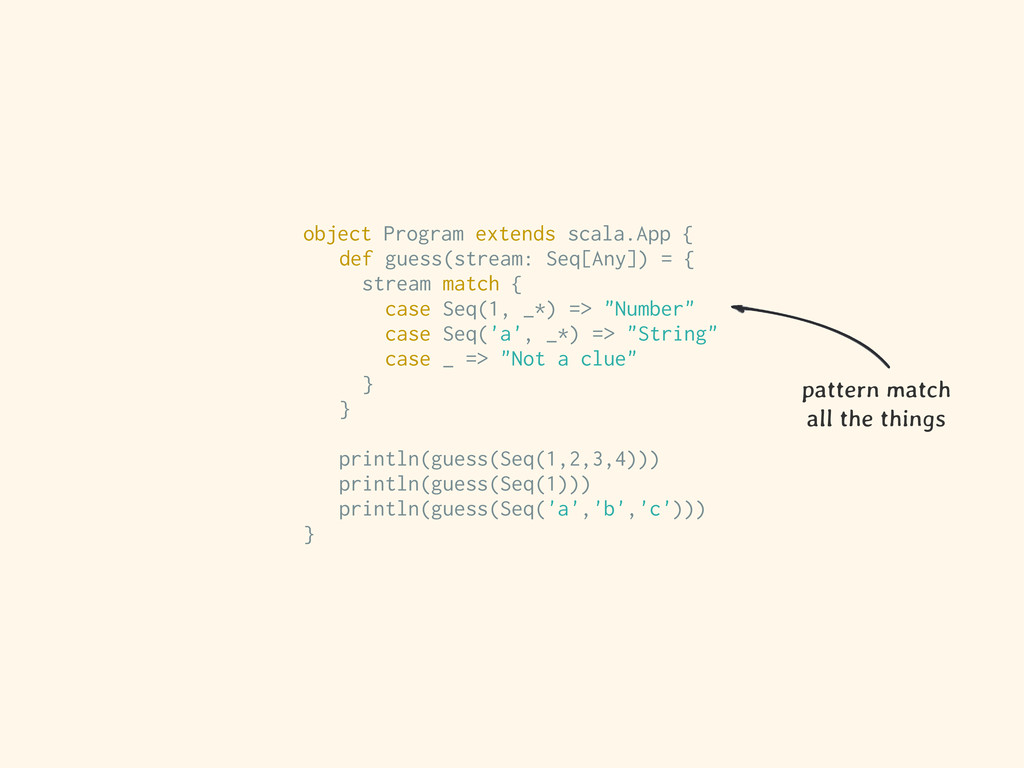
object Program extends scala.App { def guess(stream: Seq[Any]) = {
stream match { case Seq(1, _*) => "Number" case Seq('a', _*) => "String" case _ => "Not a clue" } } println(guess(Seq(1,2,3,4))) println(guess(Seq(1))) println(guess(Seq('a','b','c'))) } pattern match all the things -
class FamilyMember case class Mother(name: String) extends FamilyMember case class
Father(name: String, occupation: String) extends FamilyMember case class Child(name: String, siblings: Option[List[Child]]) extends FamilyMember object Program extends scala.App { def greet(person: FamilyMember) = { person match { case Mother(n) => "Hello Mrs. %s".format(n) case Father(n, o) => "Hello Mr. %s, hows the %sing industry?".format(n,o) case Child(n, s) => "Howdy %s, how are your %d siblings doing?".format(n, s.getOrElse(List.empty).size) case _ => "We dont take kindly to strangers here" } } println(greet(Mother("Emma"))) println(greet(Father("James", "Software Engineer"))) println(greet(Child("Ollie", Option(List(Child("Nathaniel", None)))))) } a terrible pattern matching example using cases classes -
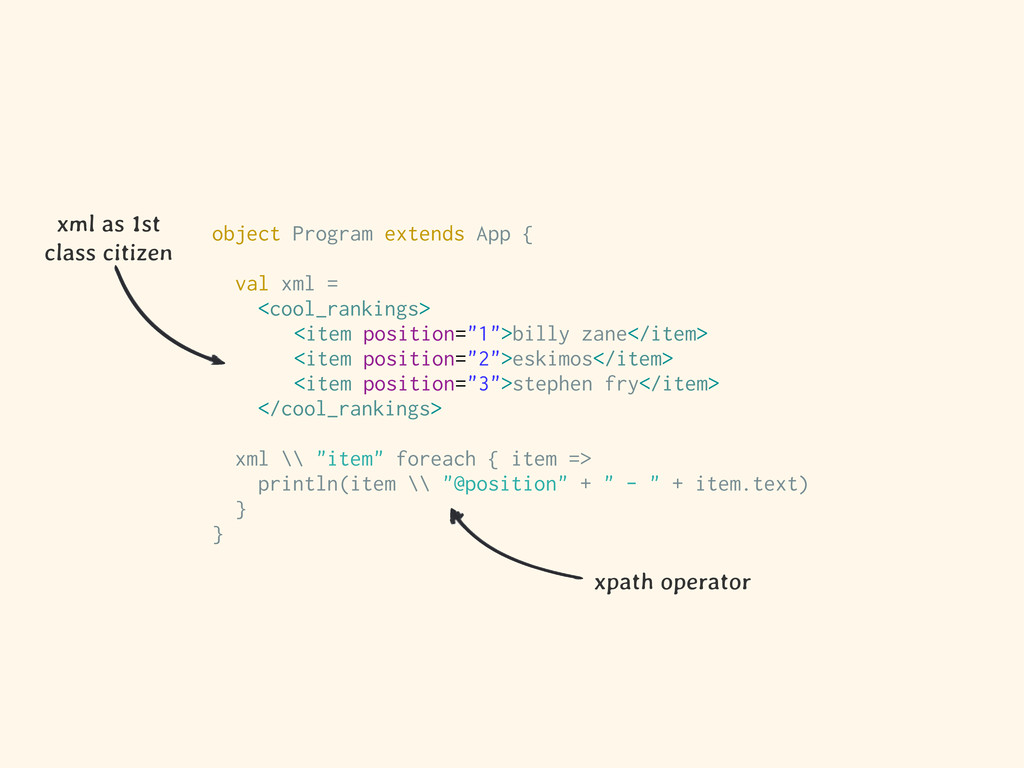
object Program extends App { val xml = <cool_rankings> <item
position="1">billy zane</item> <item position="2">eskimos</item> <item position="3">stephen fry</item> </cool_rankings> xml \\ "item" foreach { item => println(item \\ "@position" + " - " + item.text) } } -
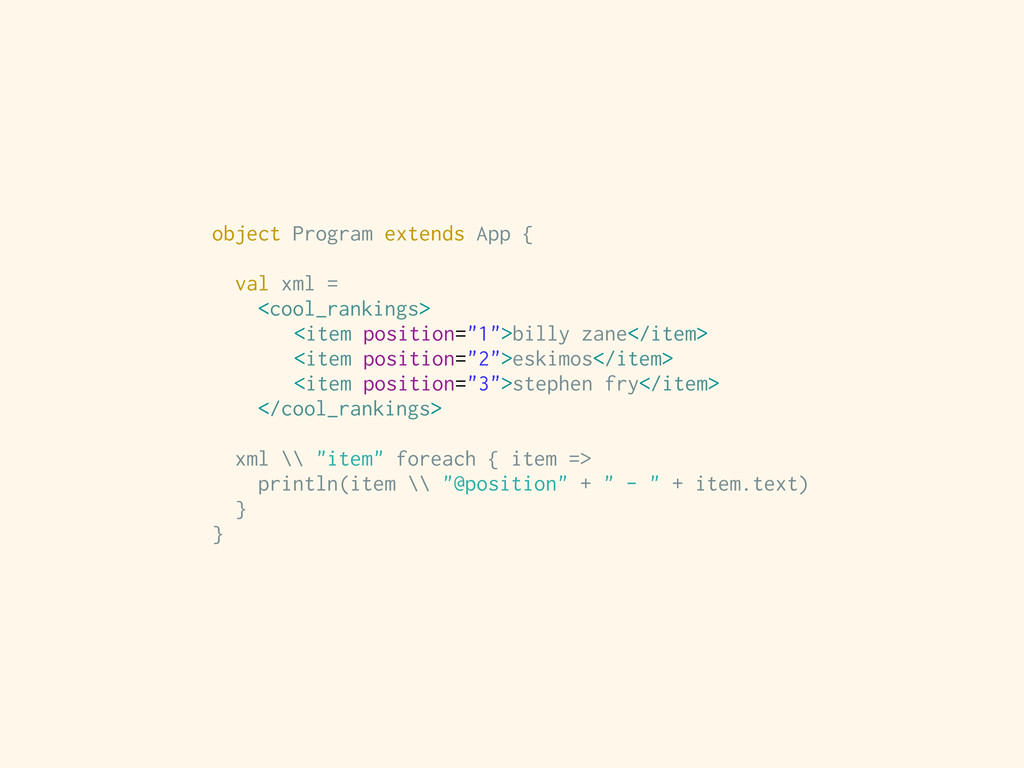
object Program extends App { val xml = <cool_rankings> <item
position="1">billy zane</item> <item position="2">eskimos</item> <item position="3">stephen fry</item> </cool_rankings> xml \\ "item" foreach { item => println(item \\ "@position" + " - " + item.text) } } xml as 1st class citizen xpath operator -
object SquareRoot extends Baysick { def main(args:Array[String]) = { 10
PRINT "Enter a number" 20 INPUT 'n 30 PRINT "Square root of " % "'n is " % SQRT('n) 40 END RUN } } g DSL HELL!!! here be dragons John 11:35 -
g IoC Containers & Dependency Injection are techniques for solving
problems you don’t have in Scala g Scala is complicated. but your code doesn’t need to be. See lift vs Play s j -
g Scala works with all your existing Javas, JRubies, Groovies
etc. j g Scala is as fast and often faster than its Java counterparts s