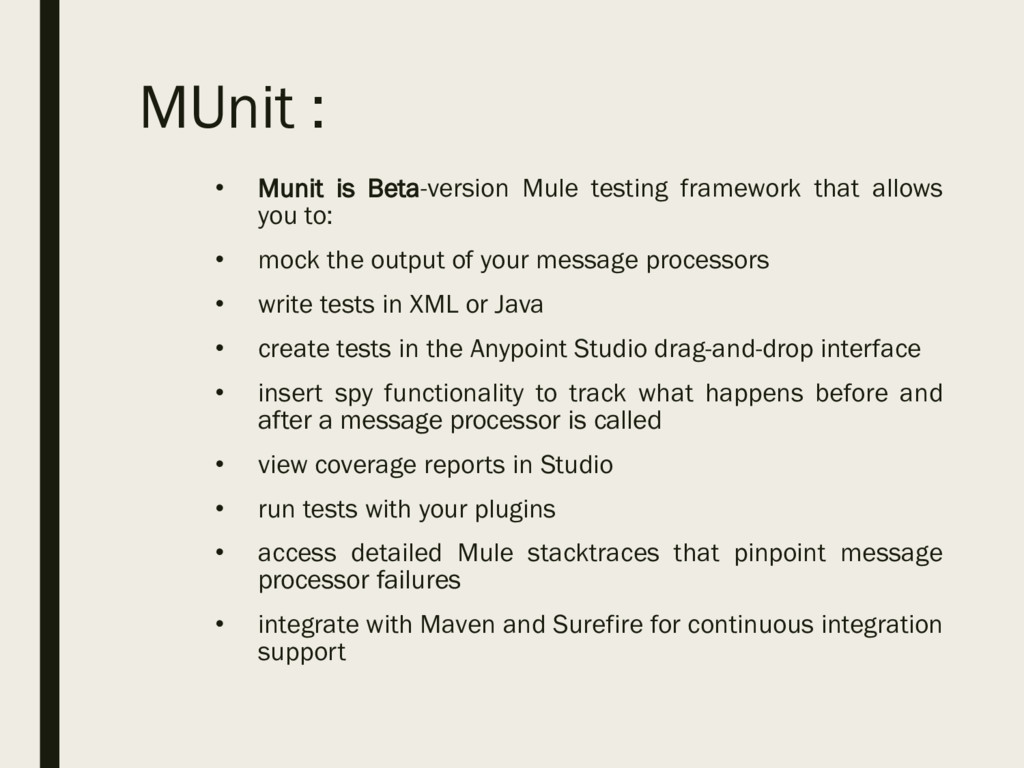
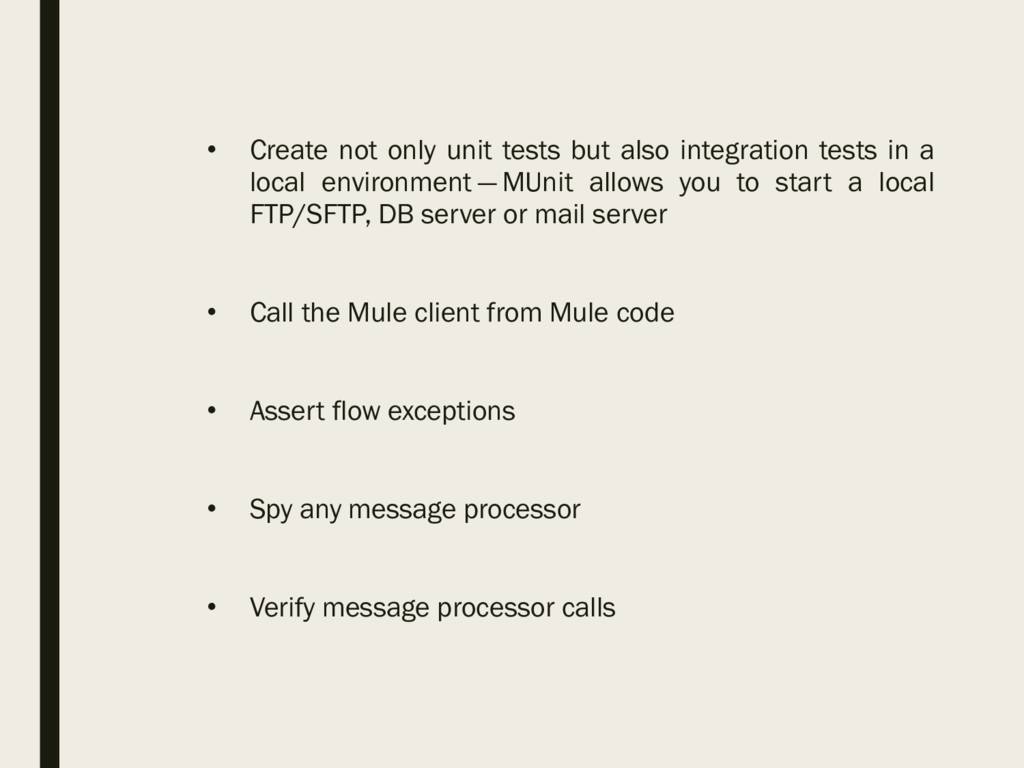
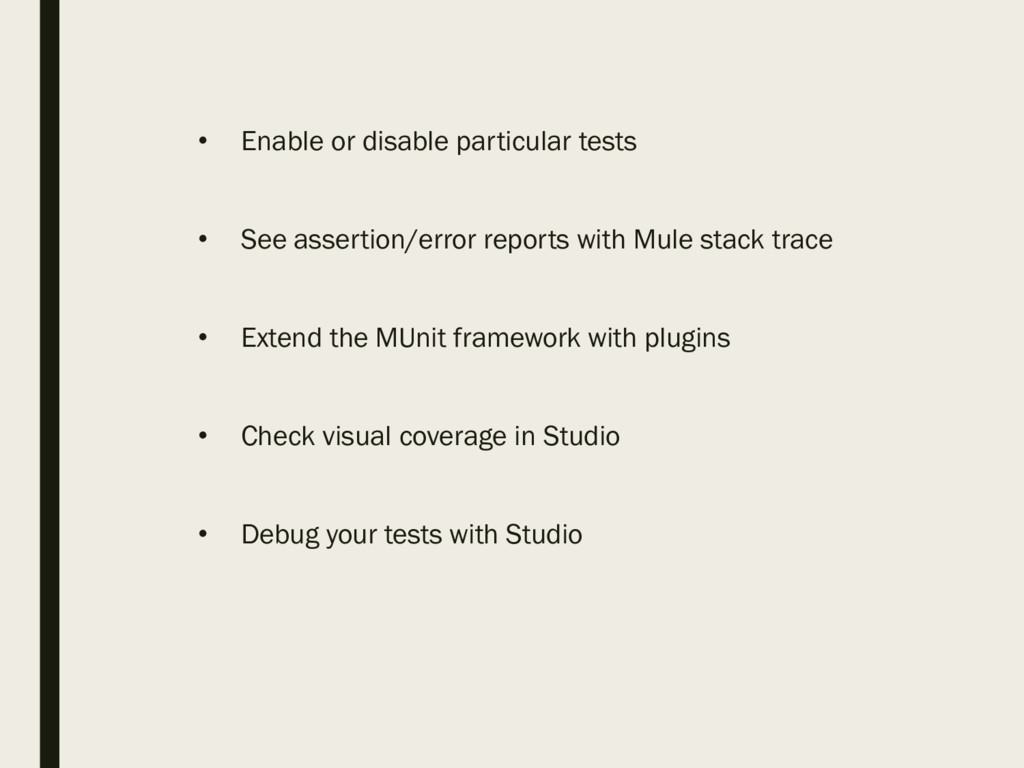
allows you to: • mock the output of your message processors • write tests in XML or Java • create tests in the Anypoint Studio drag-and-drop interface • insert spy functionality to track what happens before and after a message processor is called • view coverage reports in Studio • run tests with your plugins • access detailed Mule stacktraces that pinpoint message processor failures • integrate with Maven and Surefire for continuous integration support
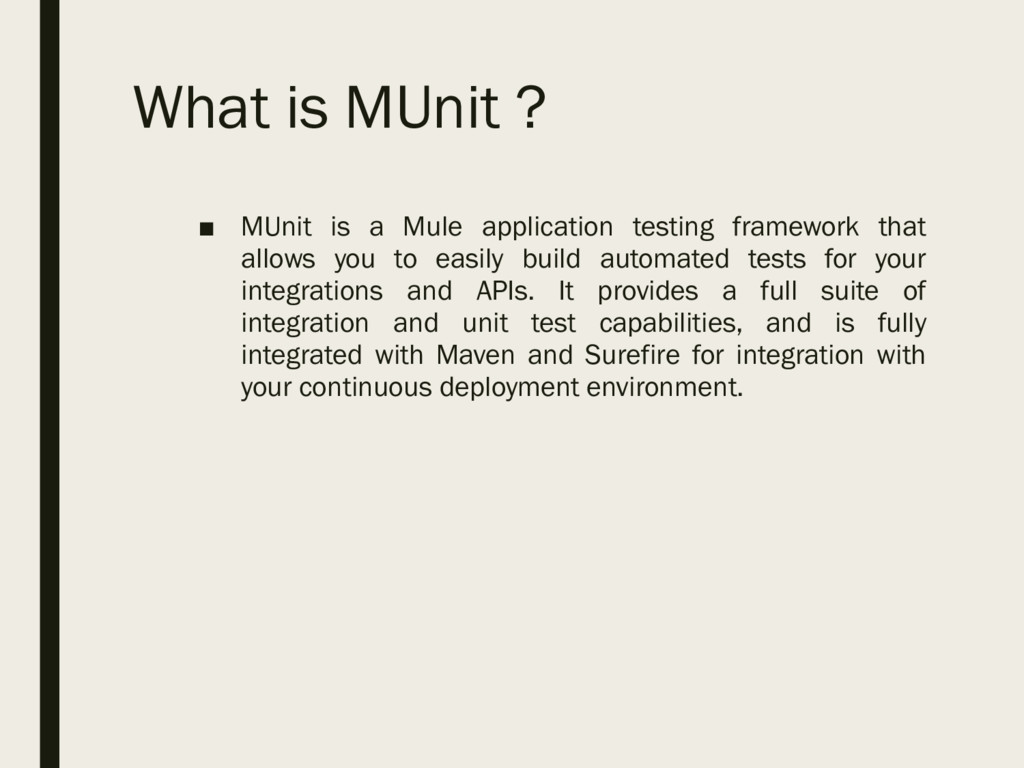
testing framework that allows you to easily build automated tests for your integrations and APIs. It provides a full suite of integration and unit test capabilities, and is fully integrated with Maven and Surefire for integration with your continuous deployment environment.
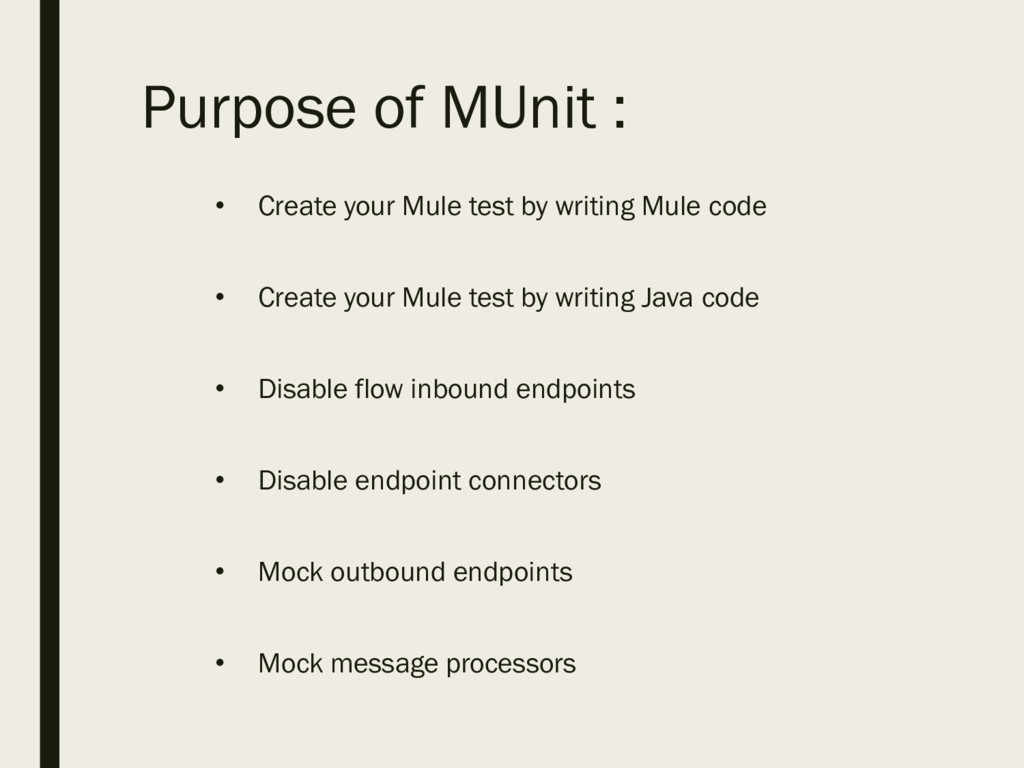
in a local environment — MUnit allows you to start a local FTP/SFTP, DB server or mail server • Call the Mule client from Mule code • Assert flow exceptions • Spy any message processor • Verify message processor calls
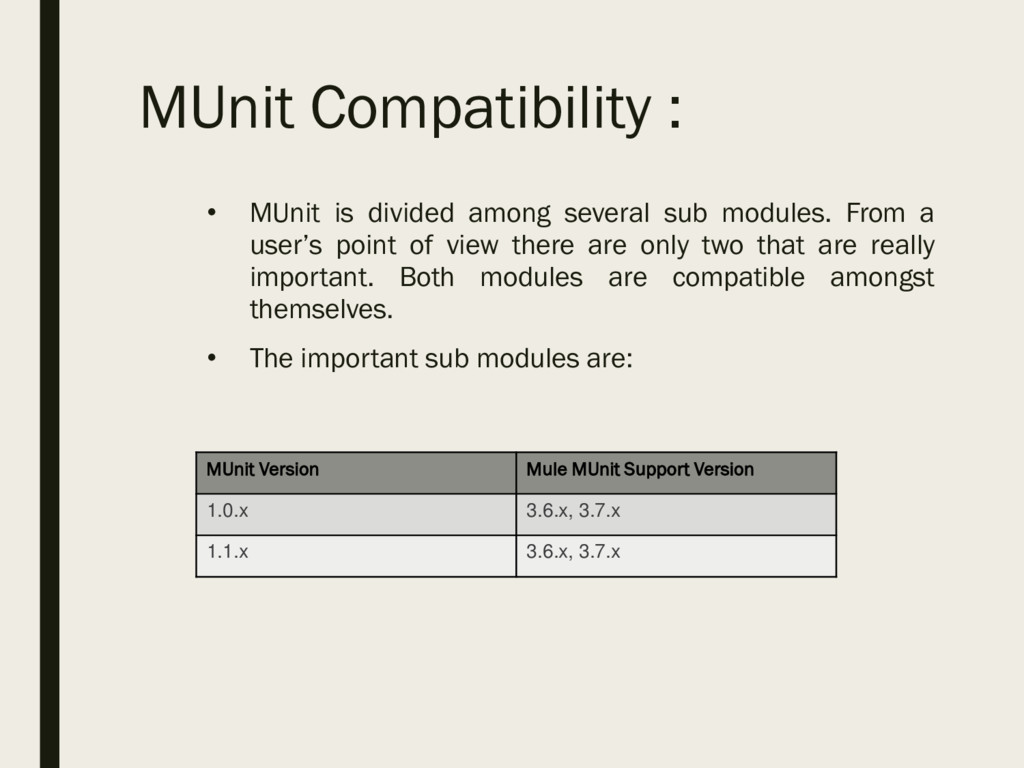
modules. From a user’s point of view there are only two that are really important. Both modules are compatible amongst themselves. • The important sub modules are: MUnit Version Mule MUnit Support Version 1.0.x 3.6.x, 3.7.x 1.1.x 3.6.x, 3.7.x
with Anypoint Studio, allowing you to create, design and run MUnit tests just like you would Mule applications. You can also use Anypoint Studio Visual Debugger to debug your MUnit tests.
with Anypoint Studio. You can use Studio’s graphical interface to: •Create and design MUnit tests •Run your tests •View test results and coverage •Debug your tests
consists of MUnit Test Suite files. • These files are the .xml files located under the src/test/munit folder in your Mule application’s folder structure. • Each MUnit Test Suite file is a collection of MUnit tests. • It is meant to work on its own, and should be able to run independently from any other MUnit test suite files.
suite file should contain any combination of the following components: • Imports • Bean Definitions • Before/After Suites • Before/After Tests • MUnit Tests


 ksuhas4455
 nao_randd
 lynnswap
 chobishiba
 optim
optim
 yukiny
 satoshi256kbyte
.jpg) yumnumm
yumnumm
 ivargrimstad
 rkaga
rkaga
 drumath2237
 palkan
 marcoroth
 aleyda
 cassininazir
 vanstee
 honzajavorek
 reverentgeek
 rocio
rocio
 sstephenson
 mkilby
 swwweet
 lara
lara
 mojombo
 mayunak