Upgrade to Pro — share decks privately, control downloads, hide ads and more …

Litigation Privilege Immunity for Presuit Commu...

Litigation Privilege Immunity for Presuit Communications

Litigation Privilege Immunity for Presuit Communications by Tampa Business Litigation Attorney - Jeffrey P. Lieser. Originally published on The Florida Bar Journal. Visit LiesrSkaff.com for more information about attorney Jeff Lieser.

Avatar for Lieser Skaff

Lieser Skaff

March 18, 2026

Other Decks in Business

Transcript

  1. Primary Goal: To ensure a "free adversarial atmosphere" where lawyers

    and witnesses can speak without fear of retaliatory defamation suits.
  2. The Resolution: Florida courts generally prioritize the "public interest" to

    ensure the administration of justice is not hampered by the threat of collateral litigation.
  3. Absolute Privilege: Applies to statements made during judicial proceedings (pleadings,

    hearings, trials). Immunity exists even if the statement was made with malice or knowledge of its falsity.
  4. Qualified Privilege: Often applies to presuit (pre-litigation) communications. Can be

    overcome if the plaintiff proves "express malice" (intent to injure).
  5. Mandatory Notices: If Florida law requires a notice or demand

    letter before filing a complaint, it is considered "necessarily preliminary" to a judicial proceeding.
  6. The Grey Area: Communications that are not required by law

    but are sent in anticipation of litigation.
  7. The Risk: Demand letters sent as "scare tactics" rather than

    good-faith attempts to resolve a dispute.
  8. Key Case: Trent v. Mortgage Electronic Registration Systems Court refused

    to extend absolute privilege to presuit letters that were not legally required.
  9. Express Malice: Defined as a primary motive to "gratify a

    feeling of ill-will" or "to injure the person as to whom the publication was made."
  10. Fact-Intensive: Whether a letter was sent in "good faith" is

    often a question for a jury, meaning you cannot always get these cases dismissed early.
  11. Consumer Protection: Courts are hesitant to apply the privilege to

    letters that violate the Florida Deceptive and Unfair Trade Practices Act (FDUTPA) or collection acts.
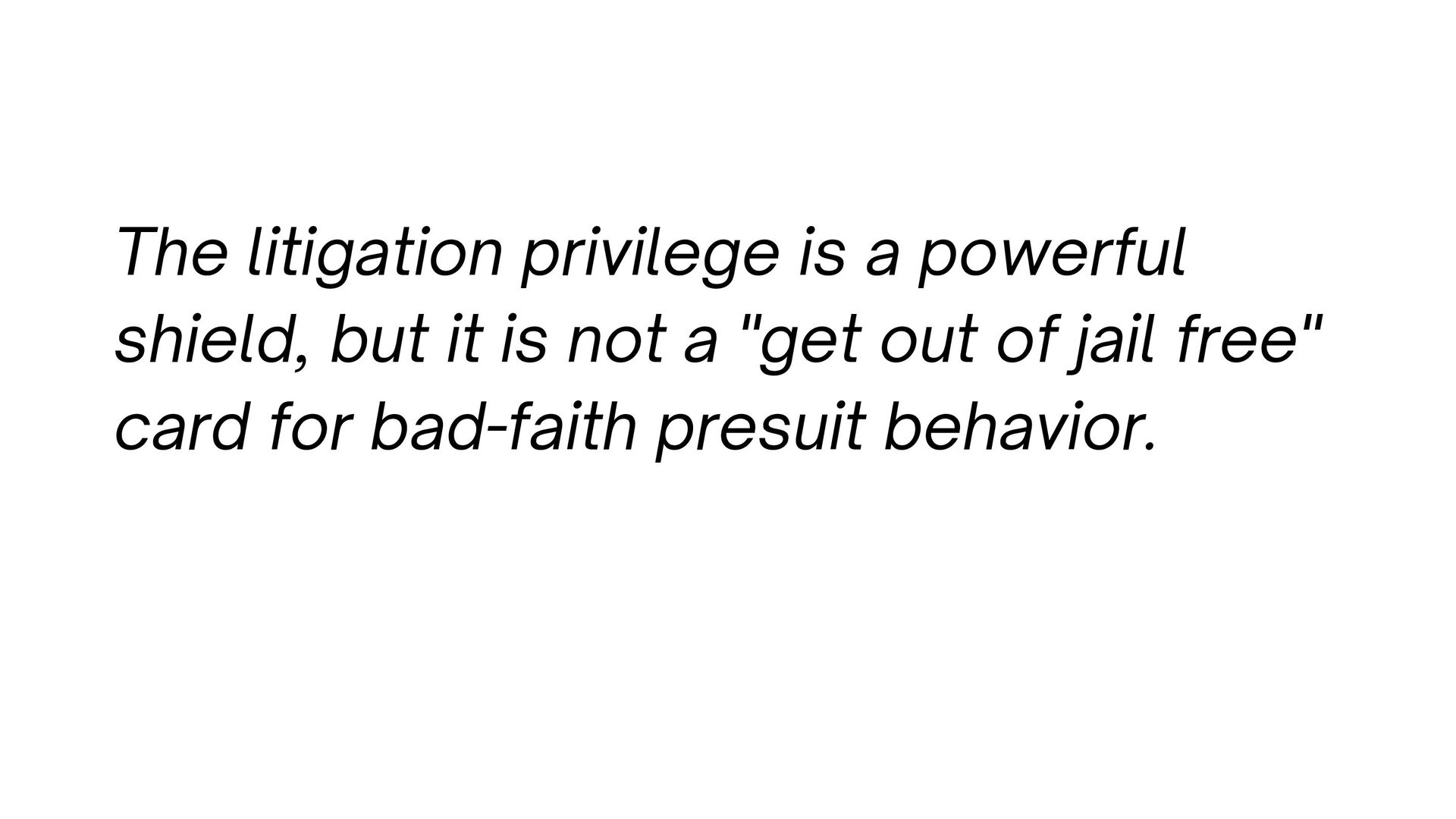
  12. The litigation privilege is a powerful shield, but it is

    not a "get out of jail free" card for bad-faith presuit behavior.
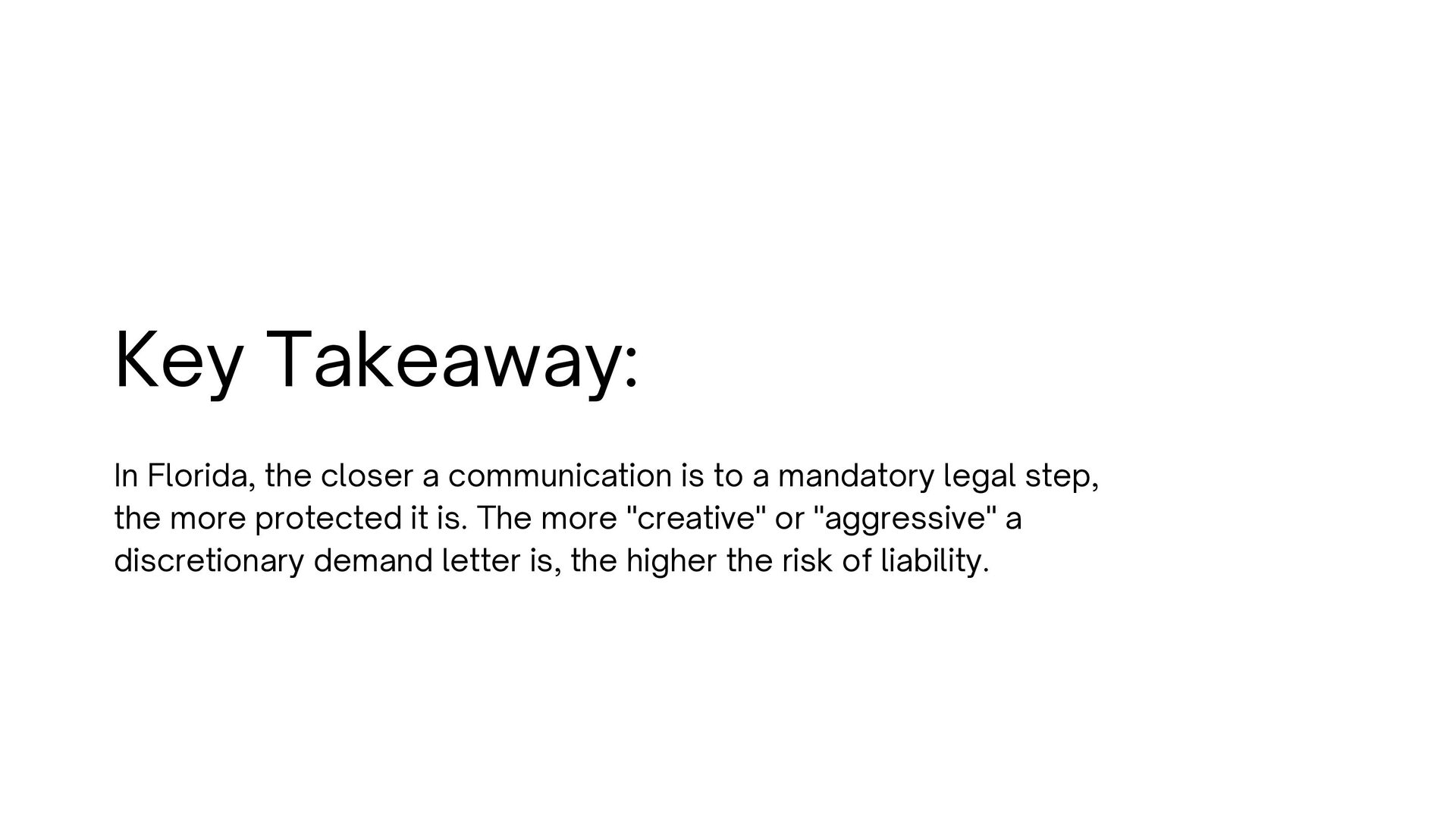
  13. Key Takeaway: In Florida, the closer a communication is to

    a mandatory legal step, the more protected it is. The more "creative" or "aggressive" a discretionary demand letter is, the higher the risk of liability.