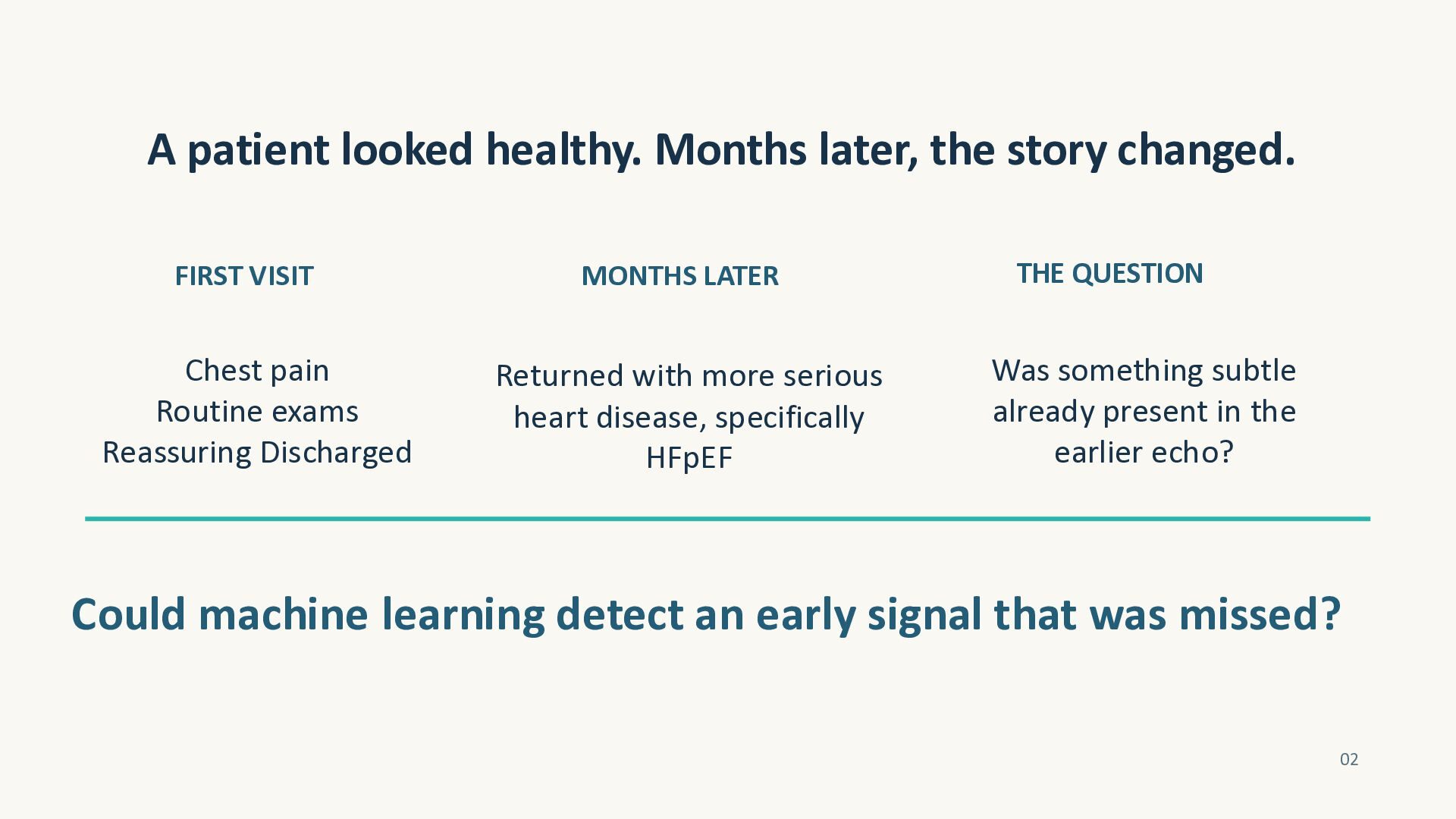
VISIT MONTHS LATER Chest pain Routine exams Reassuring Discharged Returned with more serious heart disease, specifically HFpEF THE QUESTION Was something subtle already present in the earlier echo? Could machine learning detect an early signal that was missed? 02
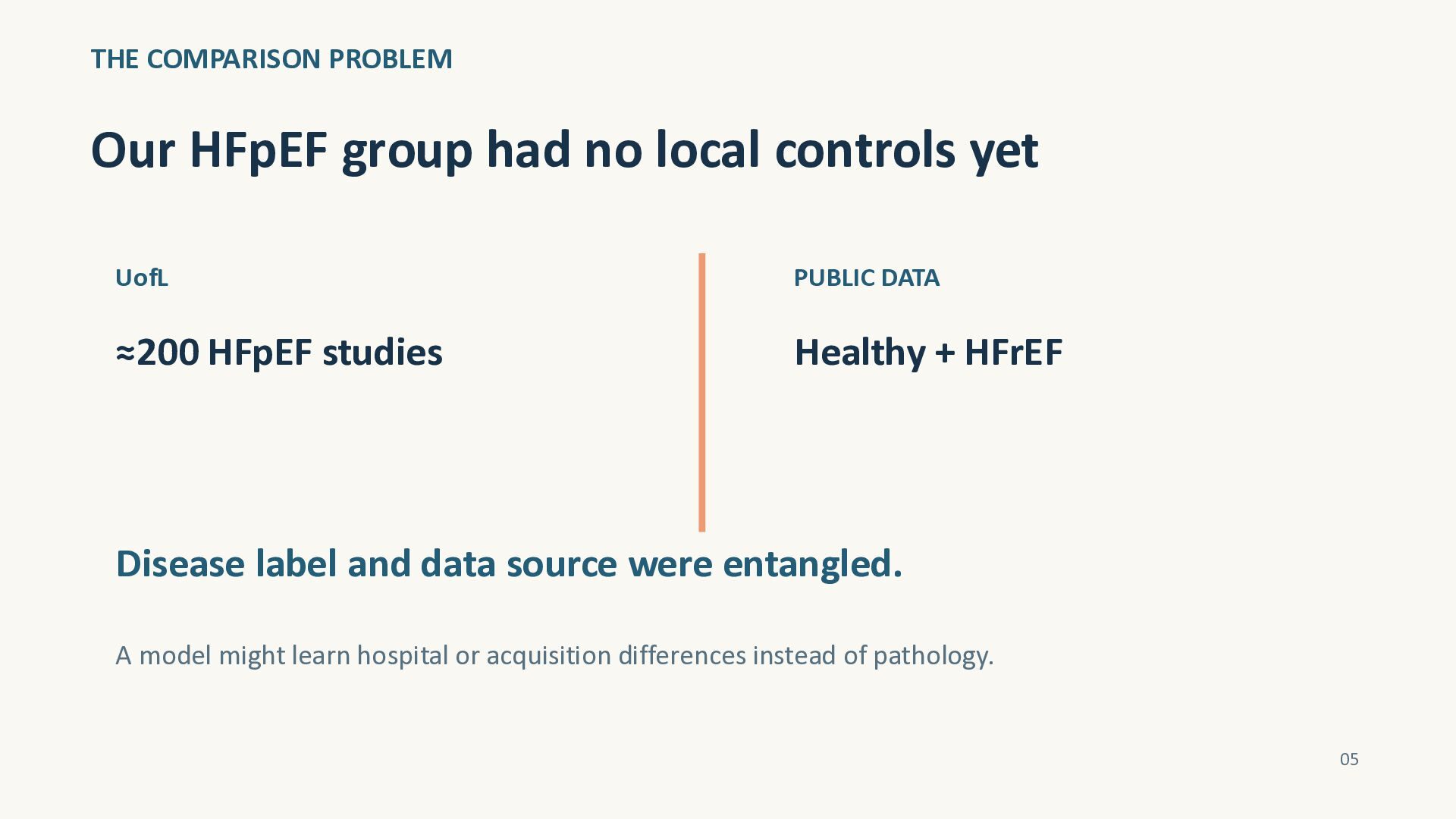
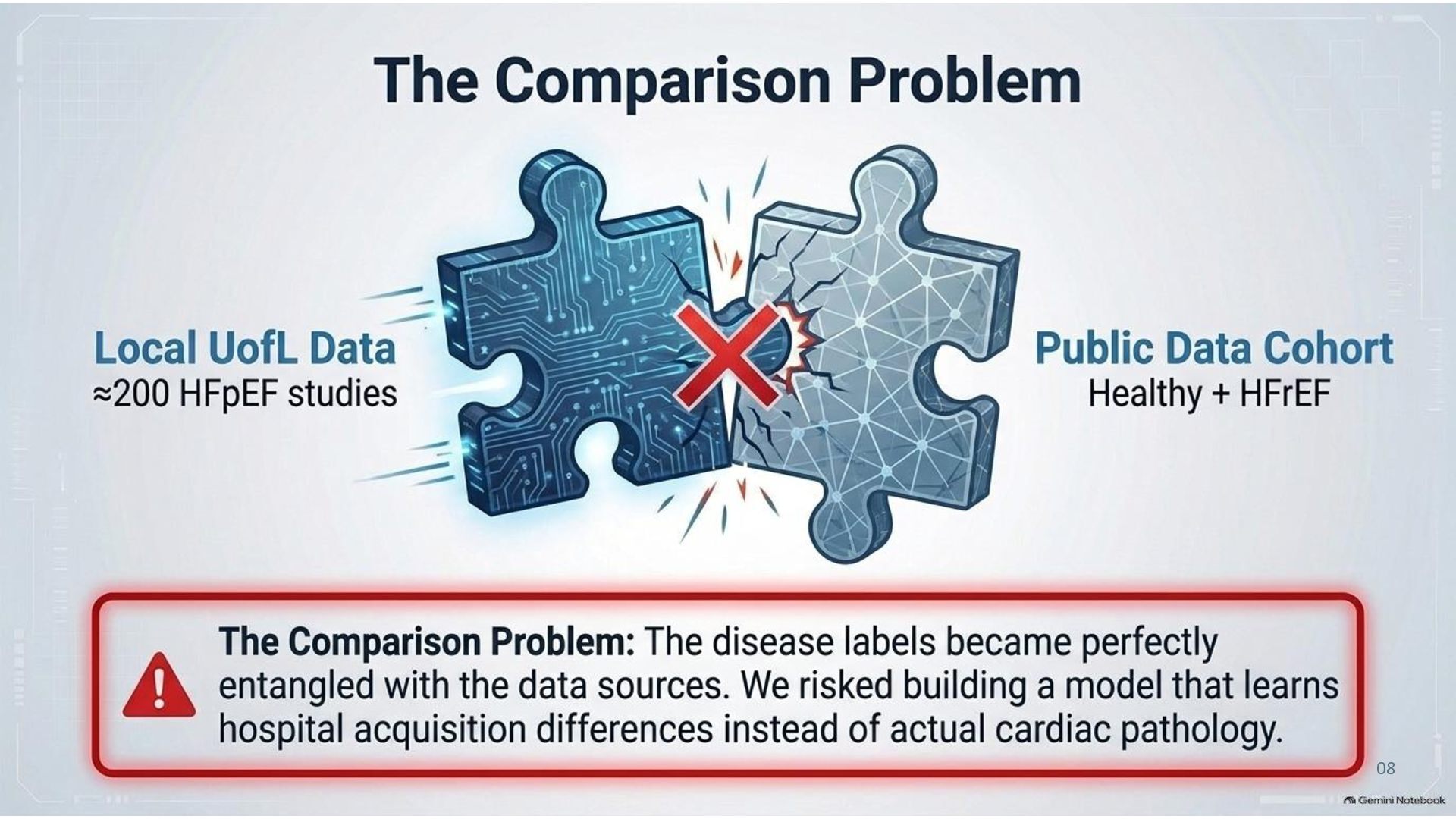
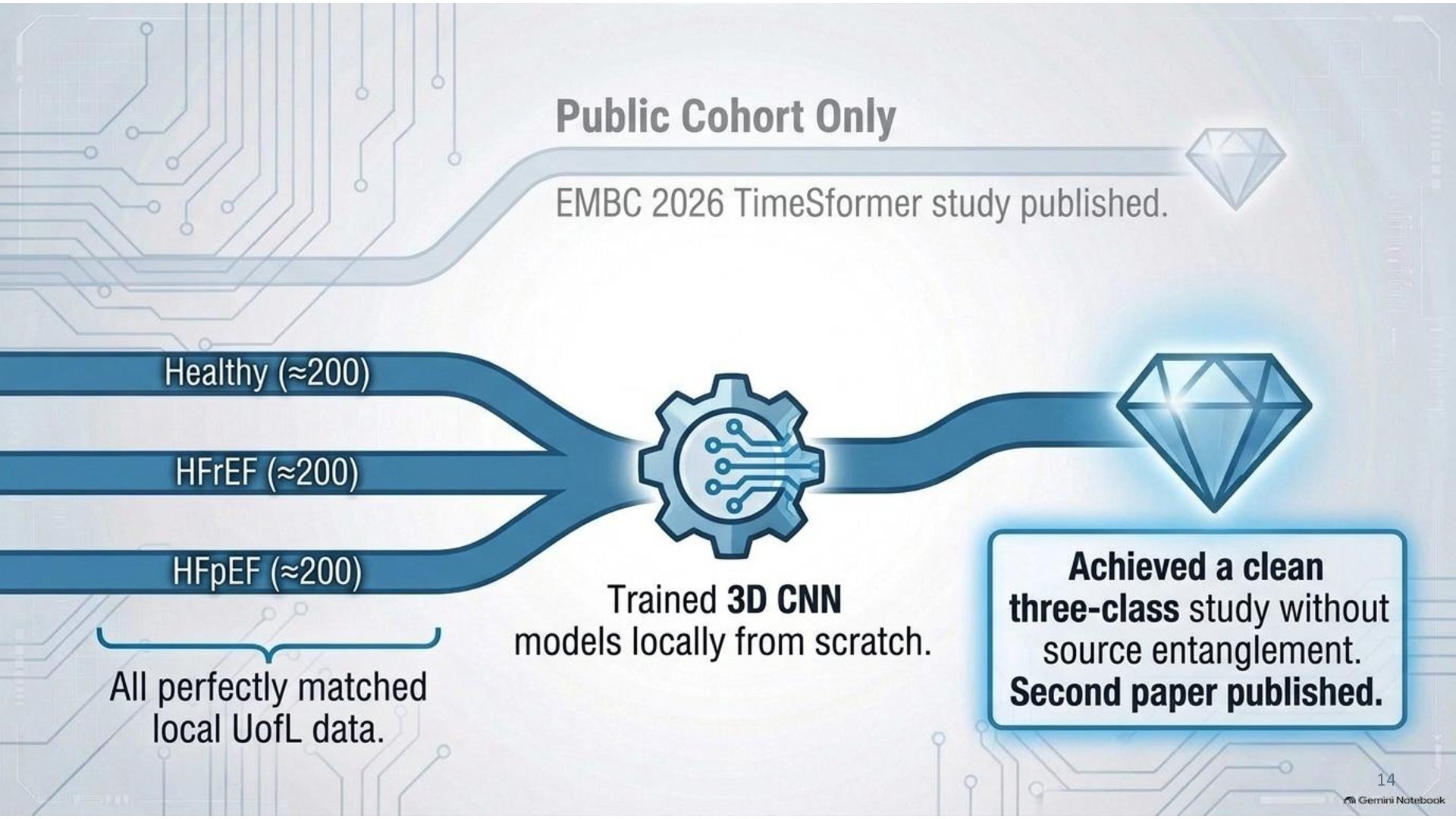
yet UofL PUBLIC DATA ≈200 HFpEF studies Healthy + HFrEF Disease label and data source were entangled. A model might learn hospital or acquisition differences instead of pathology. 05
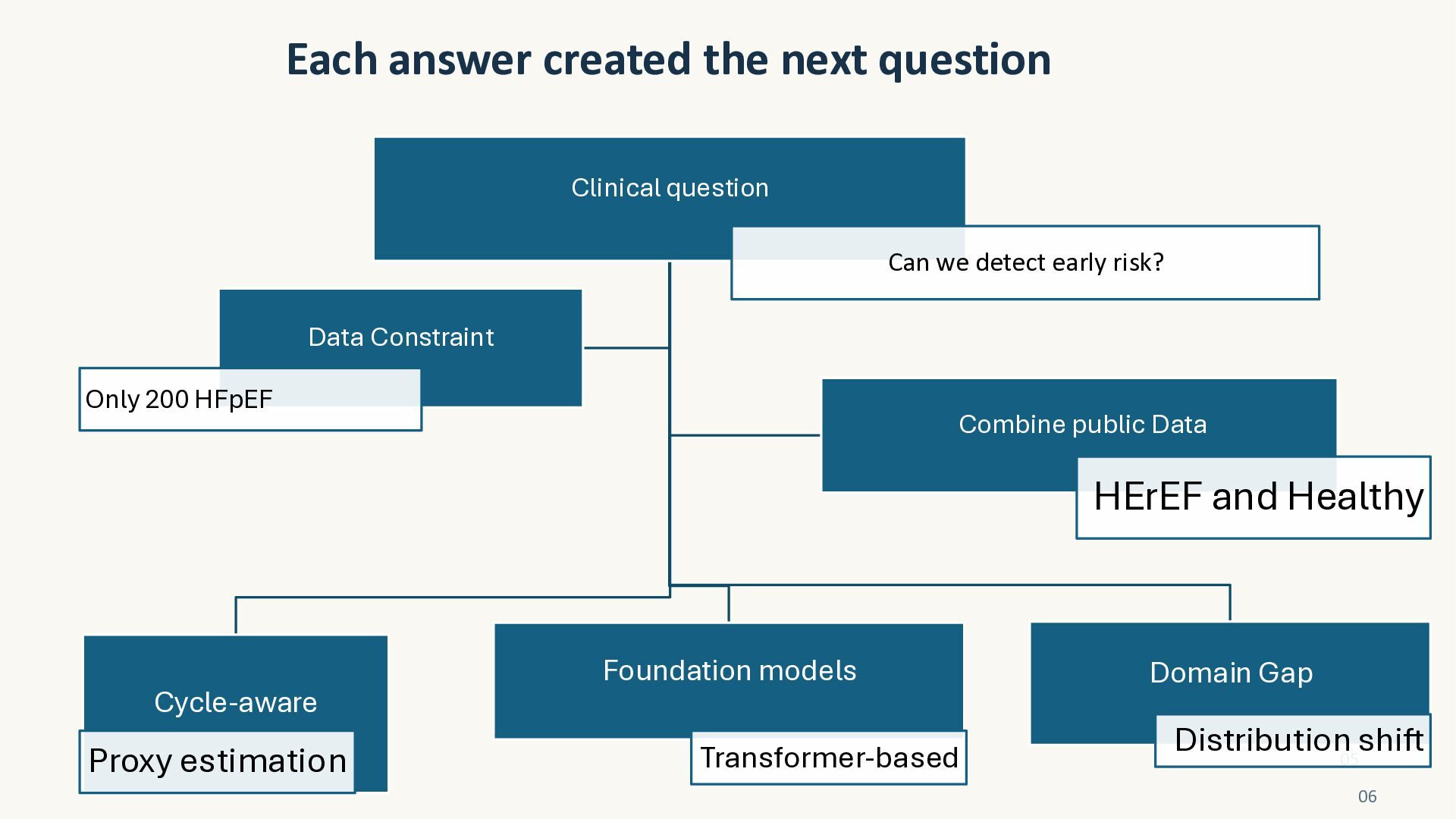
detect early risk? Data Constraint Only 200 HFpEF Combine public Data HErEF and Healthy Cycle-aware Proxy estimation Foundation models Transformer-based Domain Gap Distribution05shift 06
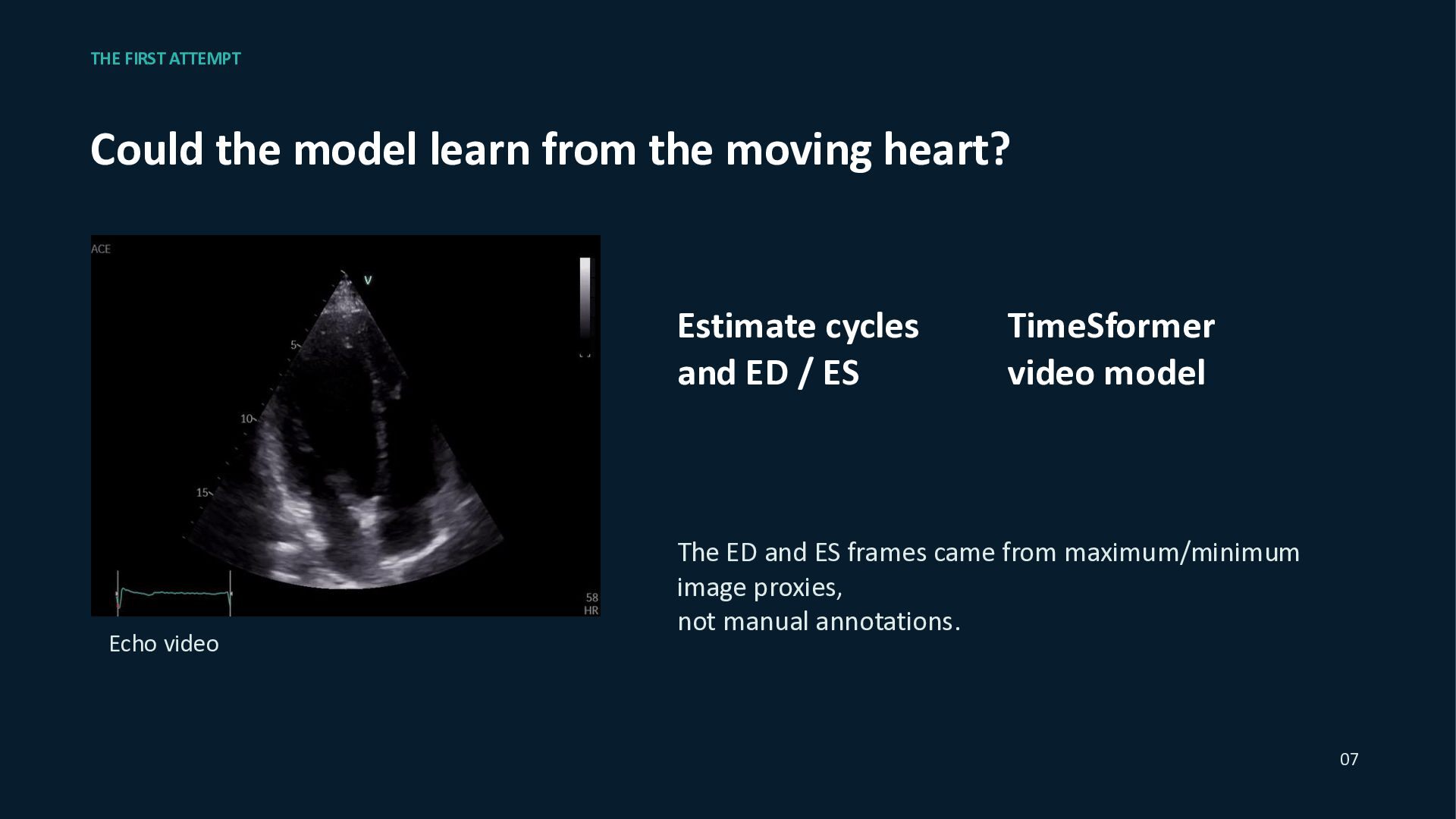
heart? Estimate cycles and ED / ES Echo video TimeSformer video model The ED and ES frames came from maximum/minimum image proxies, not manual annotations. 07
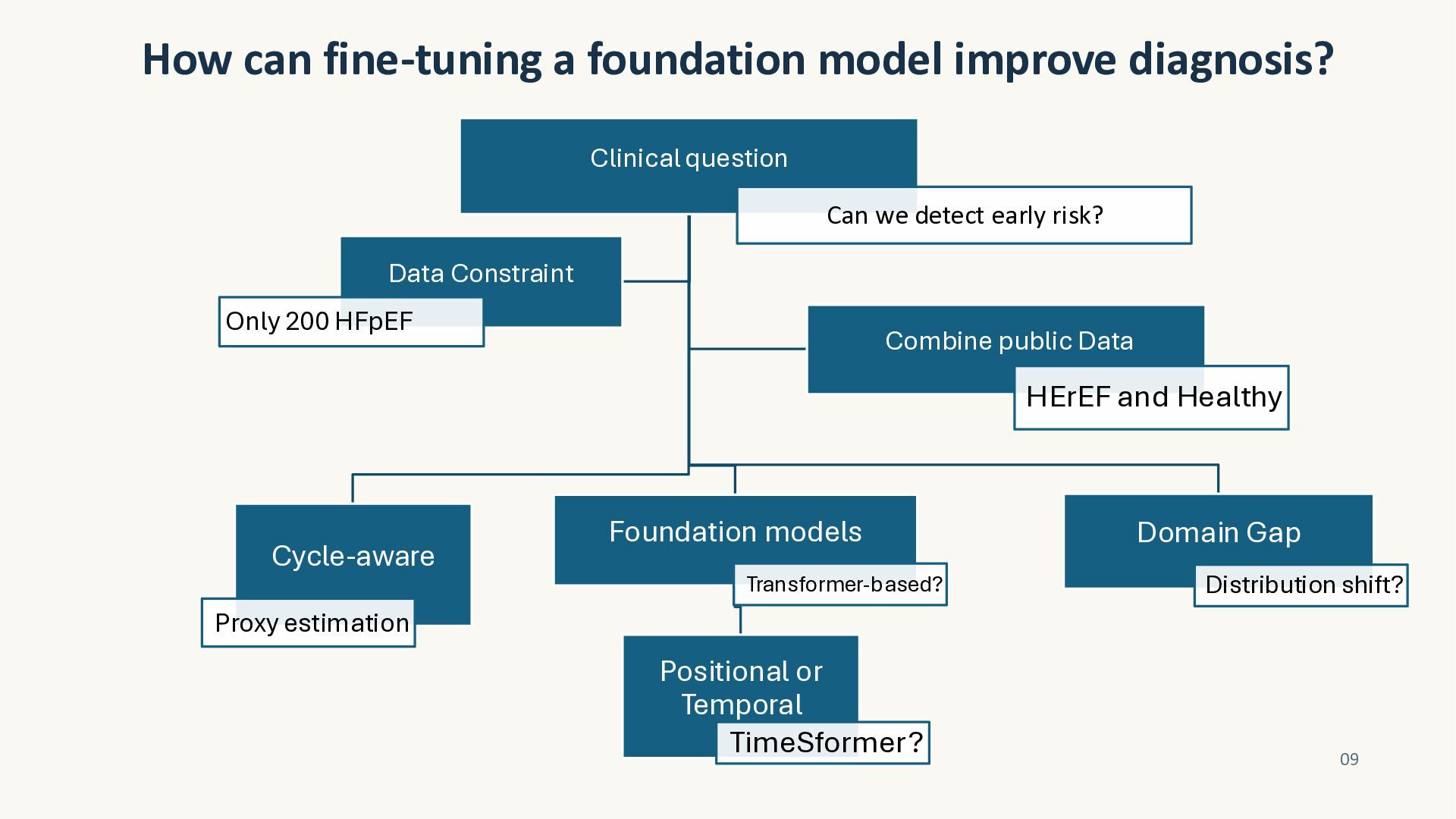
Can we detect early risk? Data Constraint Only 200 HFpEF Combine public Data HErEF and Healthy Cycle-aware Foundation models Transformer-based? Domain Gap Distribution shift? Proxy estimation Positional or Temporal TimeSformer? 09
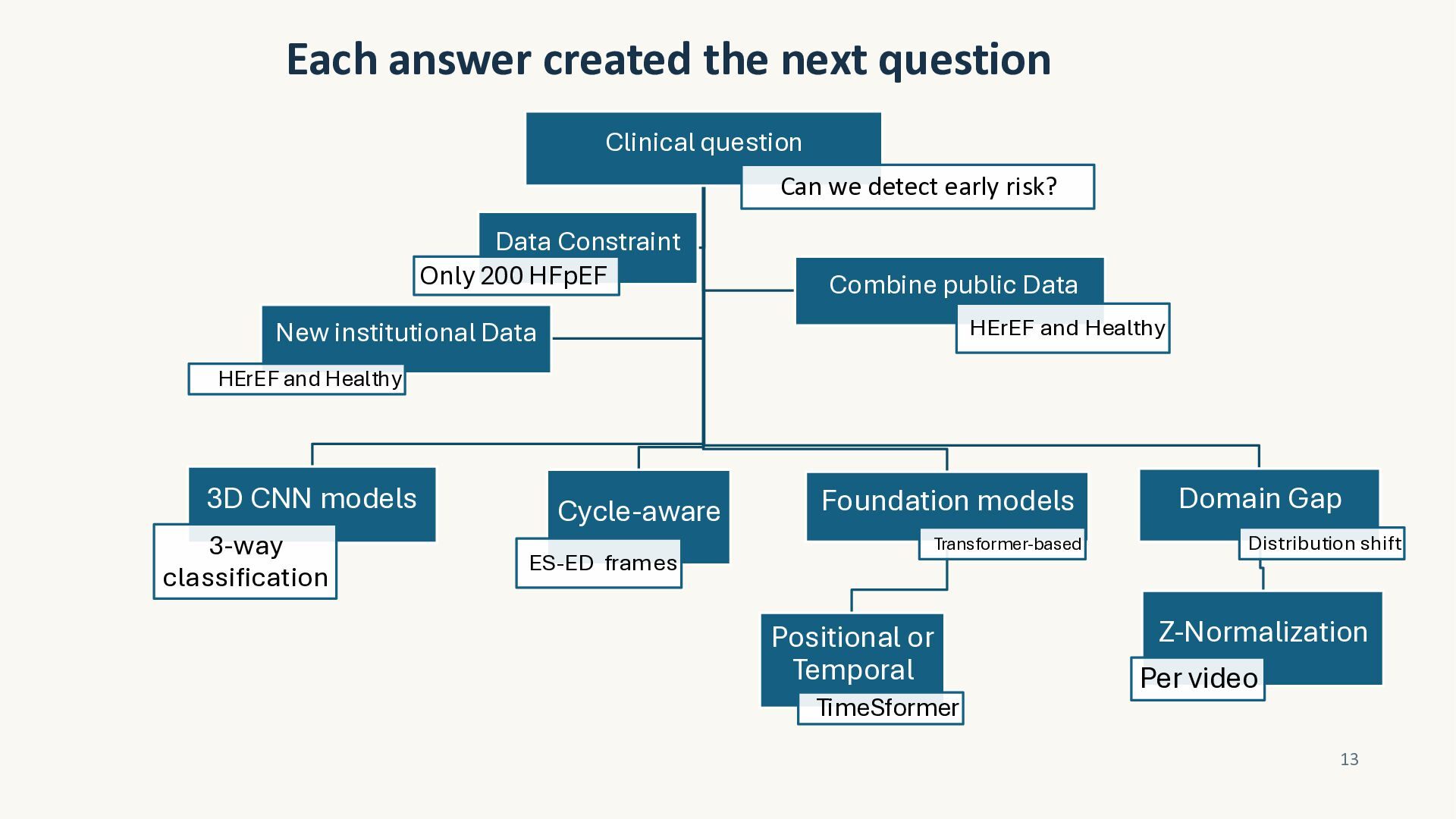
detect early risk? Data Constraint Only 200 HFpEF Combine public Data HErEF and Healthy New institutional Data HErEF and Healthy 3D CNN models 3-way classification Cycle-aware ES-ED frames Foundation models Transformer-based Positional or Temporal TimeSformer Domain Gap Distribution shift Z-Normalization Per video 13
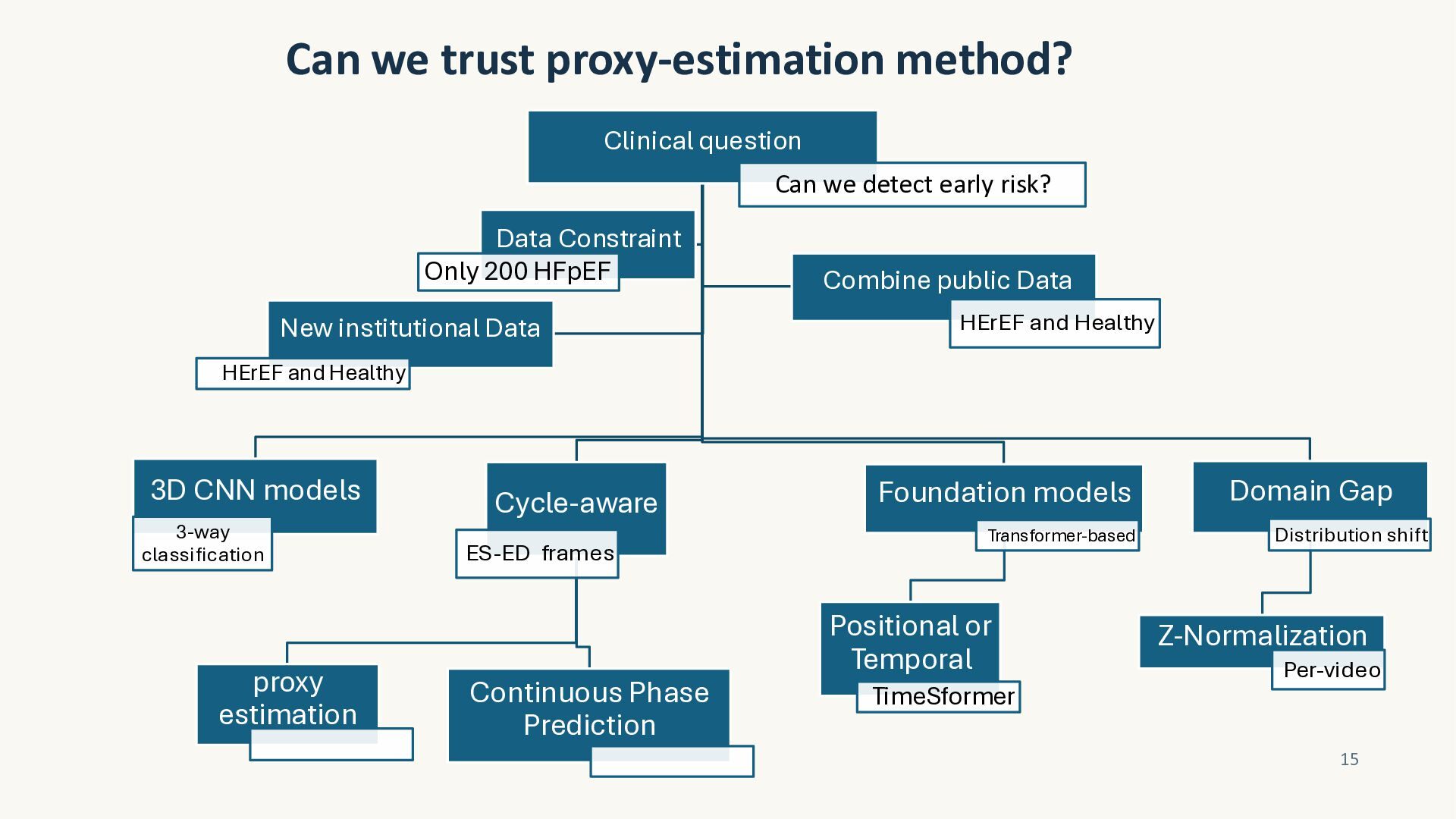
early risk? Data Constraint Only 200 HFpEF New institutional Data Combine public Data HErEF and Healthy HErEF and Healthy 3D CNN models 3-way classification proxy estimation Cycle-aware ES-ED frames Continuous Phase Prediction Foundation models Transformer-based Positional or Temporal TimeSformer Domain Gap Distribution shift Z-Normalization Per-video 15
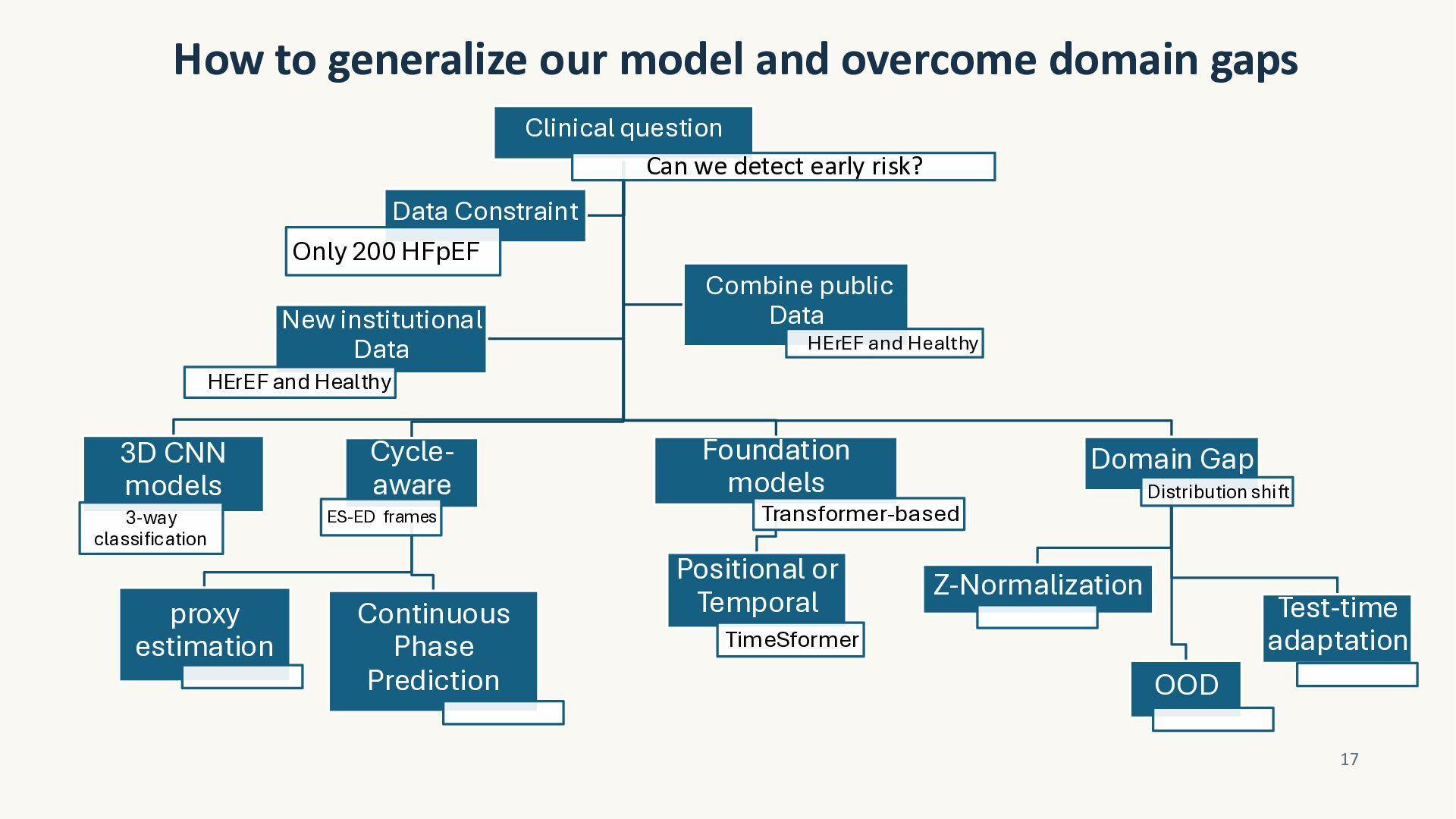
question Can we detect early risk? Data Constraint Only 200 HFpEF New institutional Data Combine public Data HErEF and Healthy HErEF and Healthy 3D CNN models 3-way classification proxy estimation Cycleaware ES-ED frames Continuous Phase Prediction Foundation models Domain Gap Transformer-based Positional or Temporal Distribution shift Z-Normalization Test-time adaptation TimeSformer OOD 17


 takehaya
 dk999
 analokmaus
 rikkabotan7
 fr0gger
 mickey_0226
 junkurihara
 stktu
 imai448
 beale
 junkashihara
 keathley
 konakalab
 techseoconnect
 rkaga
 mayunak
 emna__ayadi
 denniskardys
 chrisshort
 seathinner
 rasagy
 sabderemane
 minecr