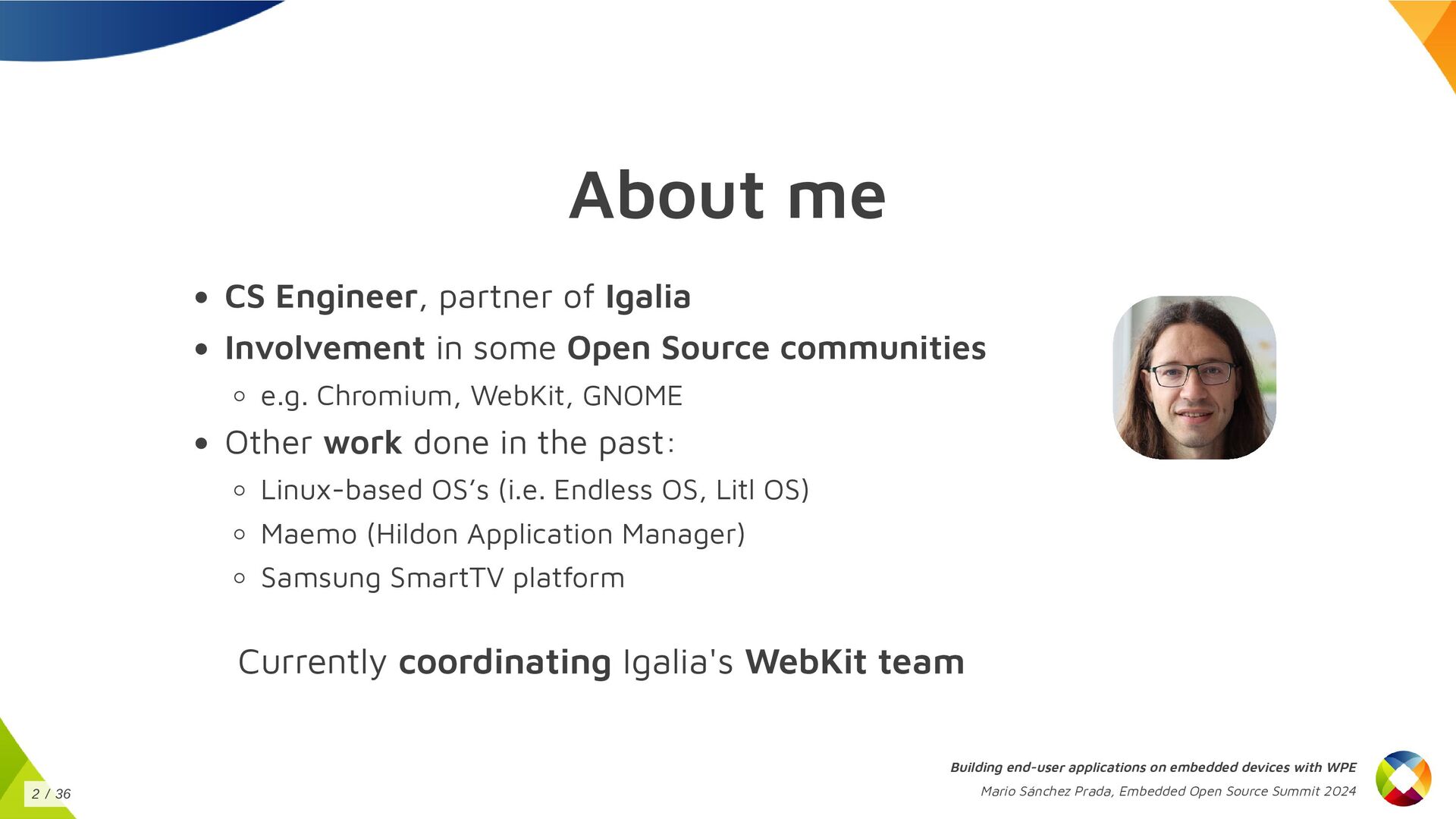
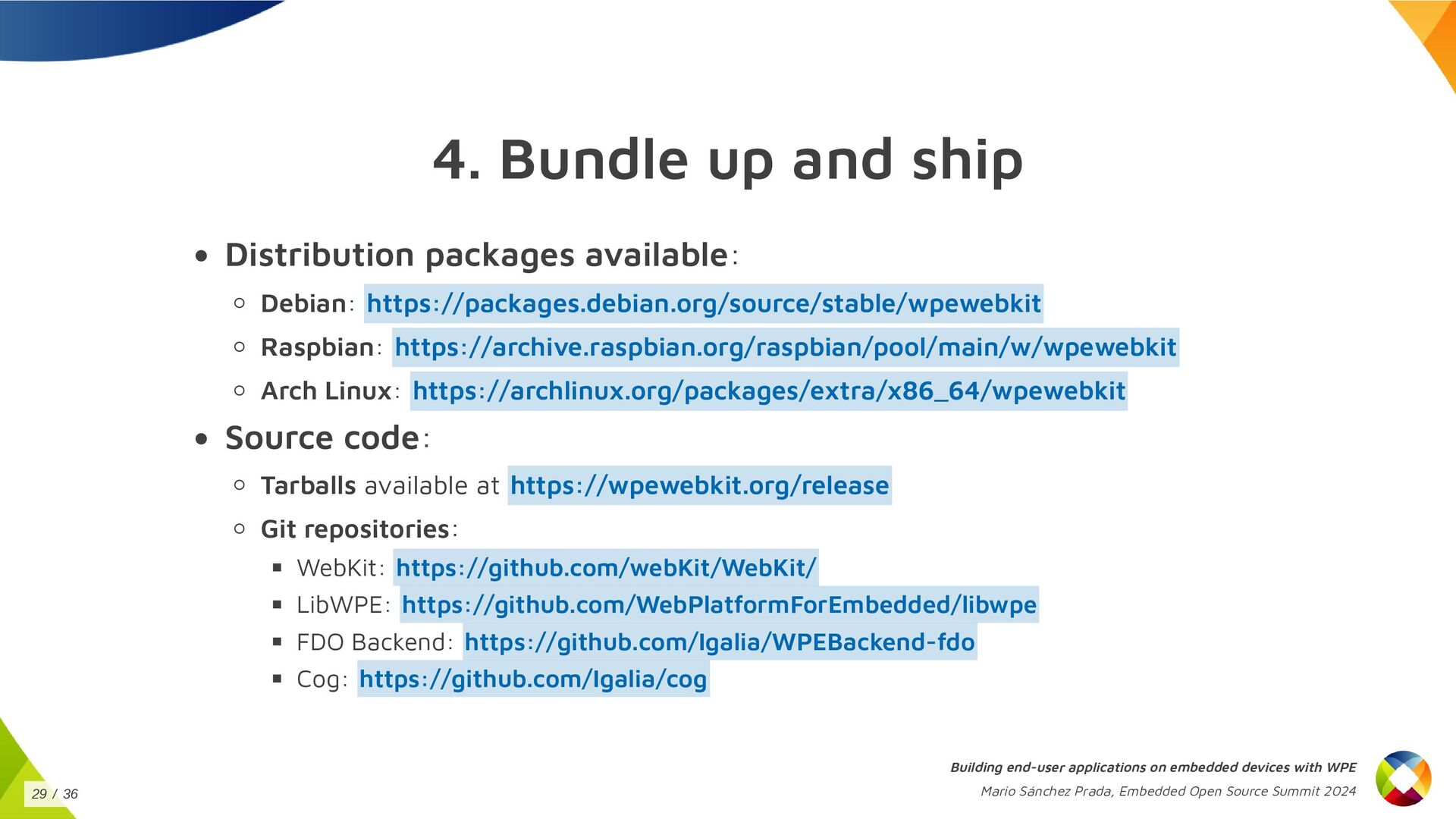
Open Source communities e.g. Chromium, WebKit, GNOME Other work done in the past: Linux-based OS’s (i.e. Endless OS, Litl OS) Maemo (Hildon Application Manager) Samsung SmartTV platform Currently coordinating Igalia's WebKit team Building end-user applications on embedded devices with WPE Mario Sánchez Prada, Embedded Open Source Summit 2024 2 / 36
remote, HQ in A Coruña (Spain). Flat structure. Top contributors to all the main Web Rendering Engines WebKit, Chromium, Gecko and Servo Active contributor to other areas and OSS projects V8, SpiderMonkey, JSC, LLVM, Node.js, GStreamer, Mesa, Linux Kernel... Members of several working groups: W3C, WHATWG, WPT, TC39, OpenJS, Test262, Khronos... Building end-user applications on embedded devices with WPE Mario Sánchez Prada, Embedded Open Source Summit 2024 3 / 36
Integrating WPE in your product Conclusion Building end-user applications on embedded devices with WPE Mario Sánchez Prada, Embedded Open Source Summit 2024 4 / 36
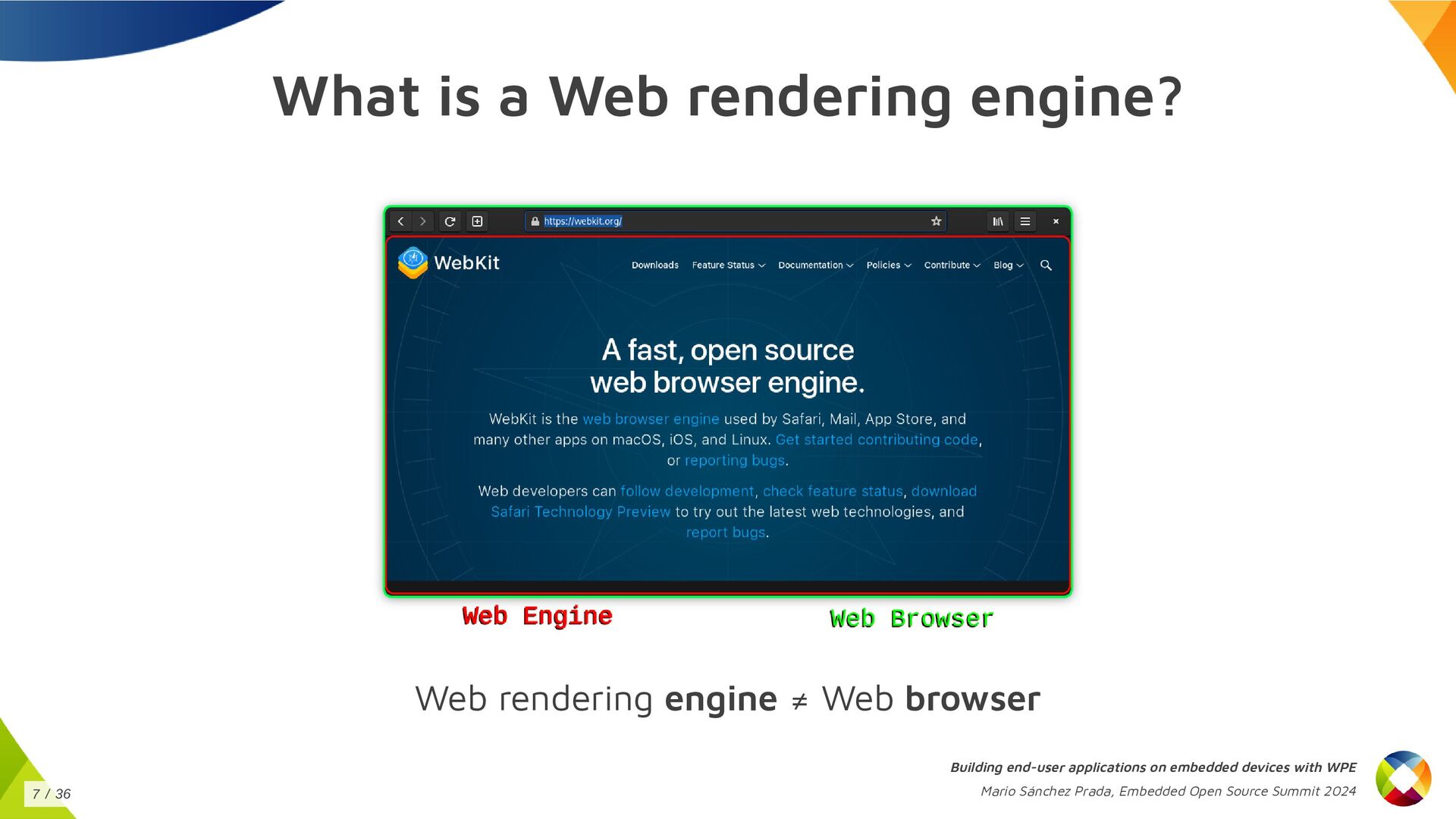
is the software component that enables you to leverage the power of the Web Platform in your product: Fetchs HTML/CSS/JavaScript content from multiple sources. Interprets the Web content to produce an internal representation. Produces a result that users can interact with. It's a extremely flexible platform. Some examples: Textual and non-textual content Multimedia playback Fully-fledge applications Building end-user applications on embedded devices with WPE Mario Sánchez Prada, Embedded Open Source Summit 2024 6 / 36
a fork of KHTML and KJS in 2001. Forked again become Blink in 2013. Main goals: Performance, portability, stability, compatibility, standards compliance, security, hackability and embeddability. Support for different platforms: Desktop & Mobile: Mac, iOS and Linux Embedded: set-top-boxes, video game consoles, smart home appliances, in-vehicle/inflight entertainment, GPS devices, digital signage... Building end-user applications on embedded devices with WPE Mario Sánchez Prada, Embedded Open Source Summit 2024 10 / 36
🔌 Embeddable as top priority 🧩 Flexible and modular architecture 🔒 Privacy and security by design 🚀 Performance and stability 🐧 Independent Linux-based flavours 👌 Not controlled by any big corporation Building end-user applications on embedded devices with WPE Mario Sánchez Prada, Embedded Open Source Summit 2024 11 / 36
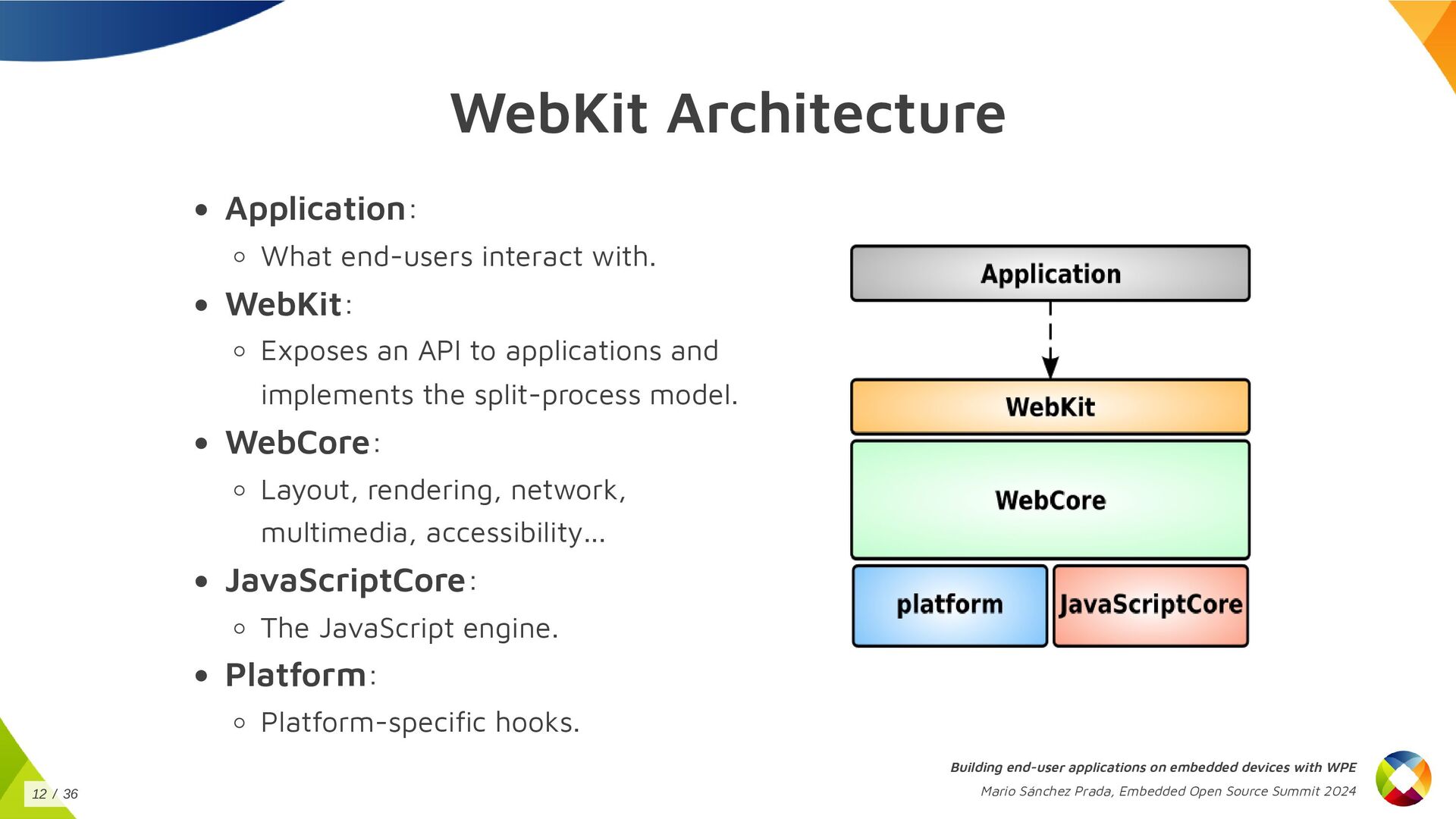
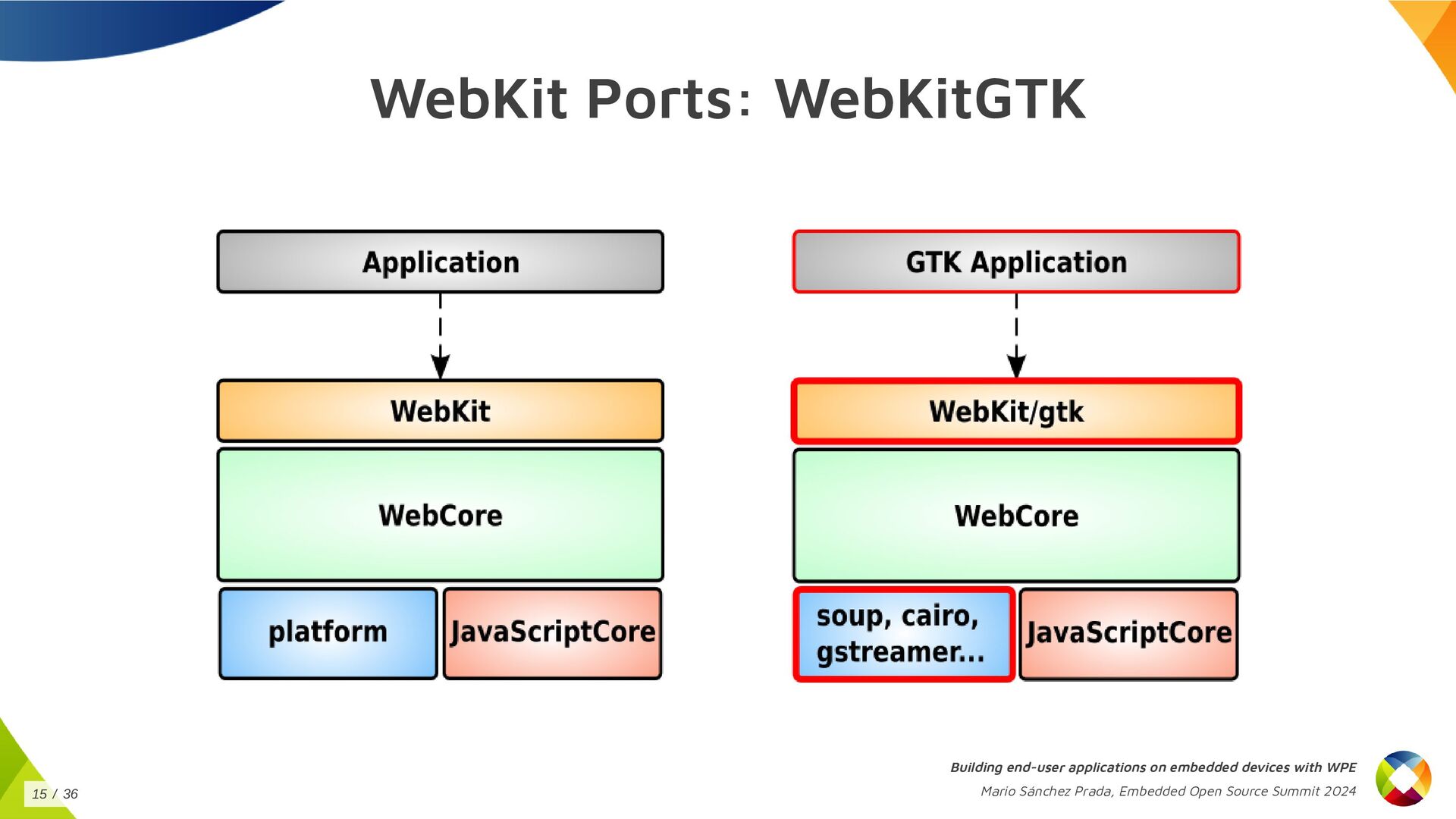
API to applications and implements the split-process model. WebCore: Layout, rendering, network, multimedia, accessibility... JavaScriptCore: The JavaScript engine. Platform: Platform-specific hooks. Building end-user applications on embedded devices with WPE Mario Sánchez Prada, Embedded Open Source Summit 2024 12 / 36
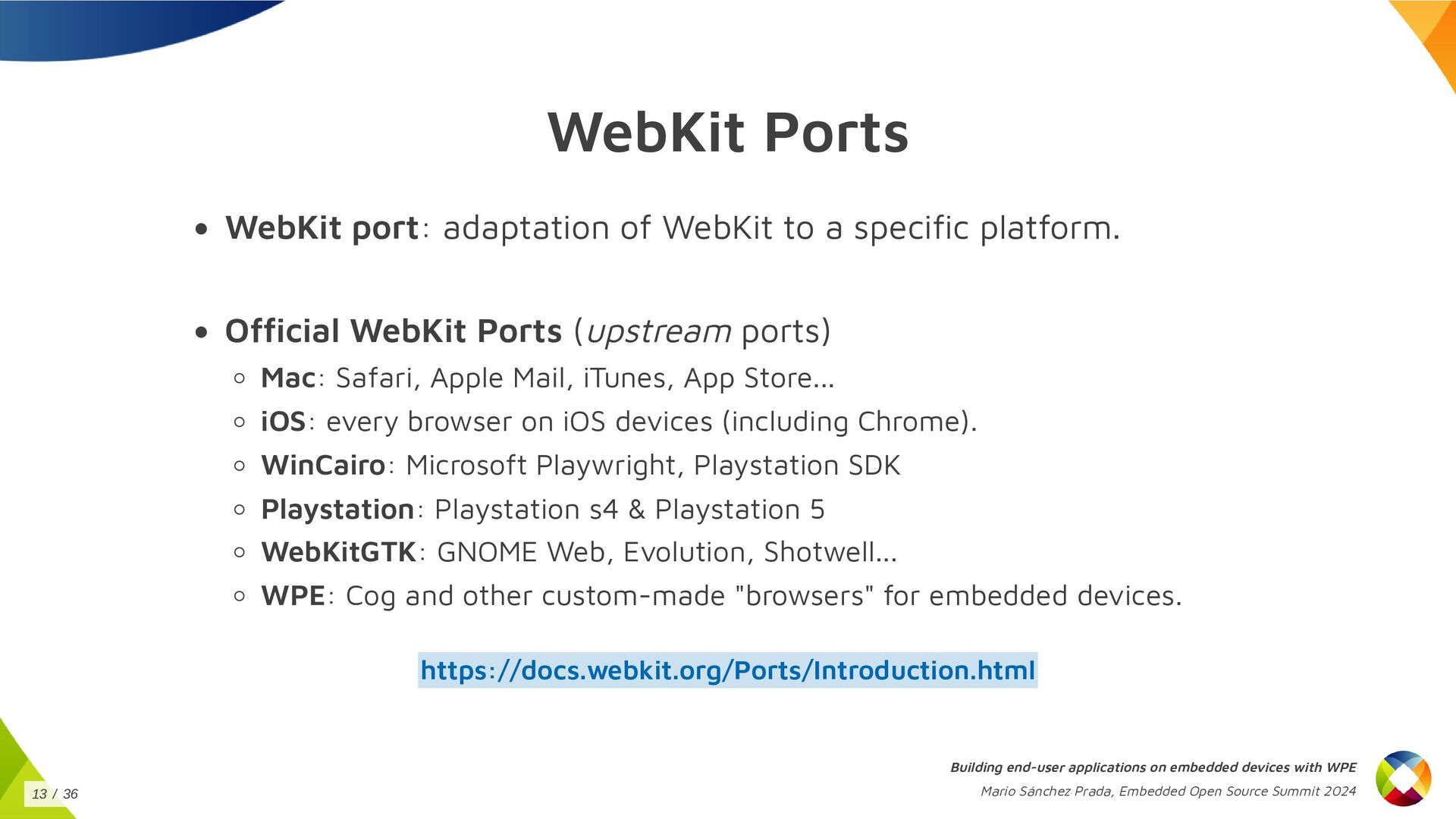
platform. Official WebKit Ports (upstream ports) Mac: Safari, Apple Mail, iTunes, App Store... iOS: every browser on iOS devices (including Chrome). WinCairo: Microsoft Playwright, Playstation SDK Playstation: Playstation s4 & Playstation 5 WebKitGTK: GNOME Web, Evolution, Shotwell... WPE: Cog and other custom-made "browsers" for embedded devices. https://docs.webkit.org/Ports/Introduction.html Building end-user applications on embedded devices with WPE Mario Sánchez Prada, Embedded Open Source Summit 2024 13 / 36
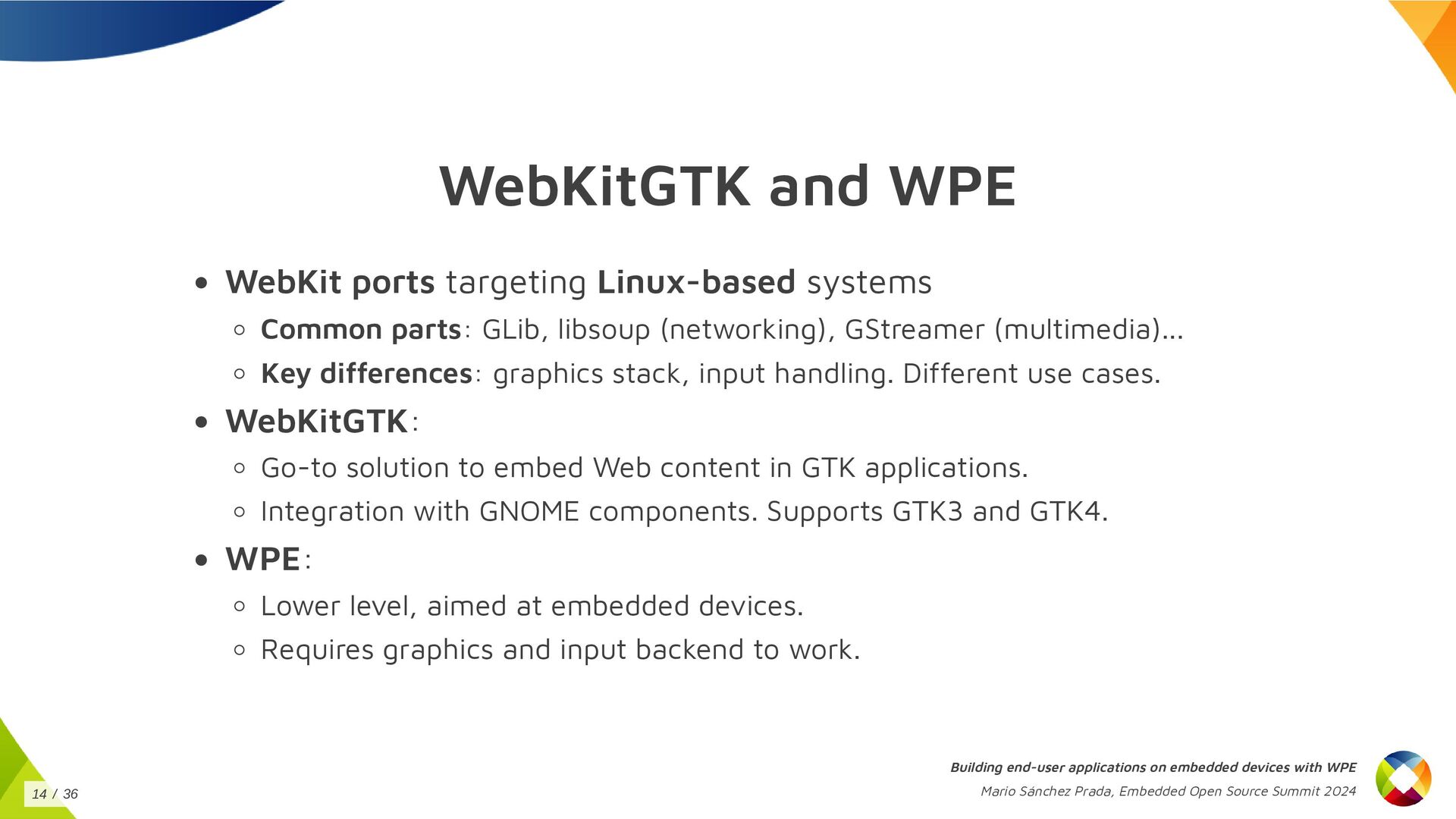
GLib, libsoup (networking), GStreamer (multimedia)... Key differences: graphics stack, input handling. Different use cases. WebKitGTK: Go-to solution to embed Web content in GTK applications. Integration with GNOME components. Supports GTK3 and GTK4. WPE: Lower level, aimed at embedded devices. Requires graphics and input backend to work. Building end-user applications on embedded devices with WPE Mario Sánchez Prada, Embedded Open Source Summit 2024 14 / 36
Fully operational JavaScript engine (64-bit, also 32bit). Focus on flexibility, security and performance. Minimal set of dependencies Backends-based architecture for input and output. Low memory and storage footprint. Support for HW-accelerated graphics and multimedia. ℹ️ https://wpewebkit.org/ Building end-user applications on embedded devices with WPE Mario Sánchez Prada, Embedded Open Source Summit 2024 17 / 36
Provides just the building blocks for Web-based applications. Doesn't implement all the APIs found on other WebKit ports. Does not rely on any particular UI Toolkit (i.e. backends). Can also be useful for less conventional use cases e.g. server-side rendering, headless mode... Building end-user applications on embedded devices with WPE Mario Sánchez Prada, Embedded Open Source Summit 2024 18 / 36
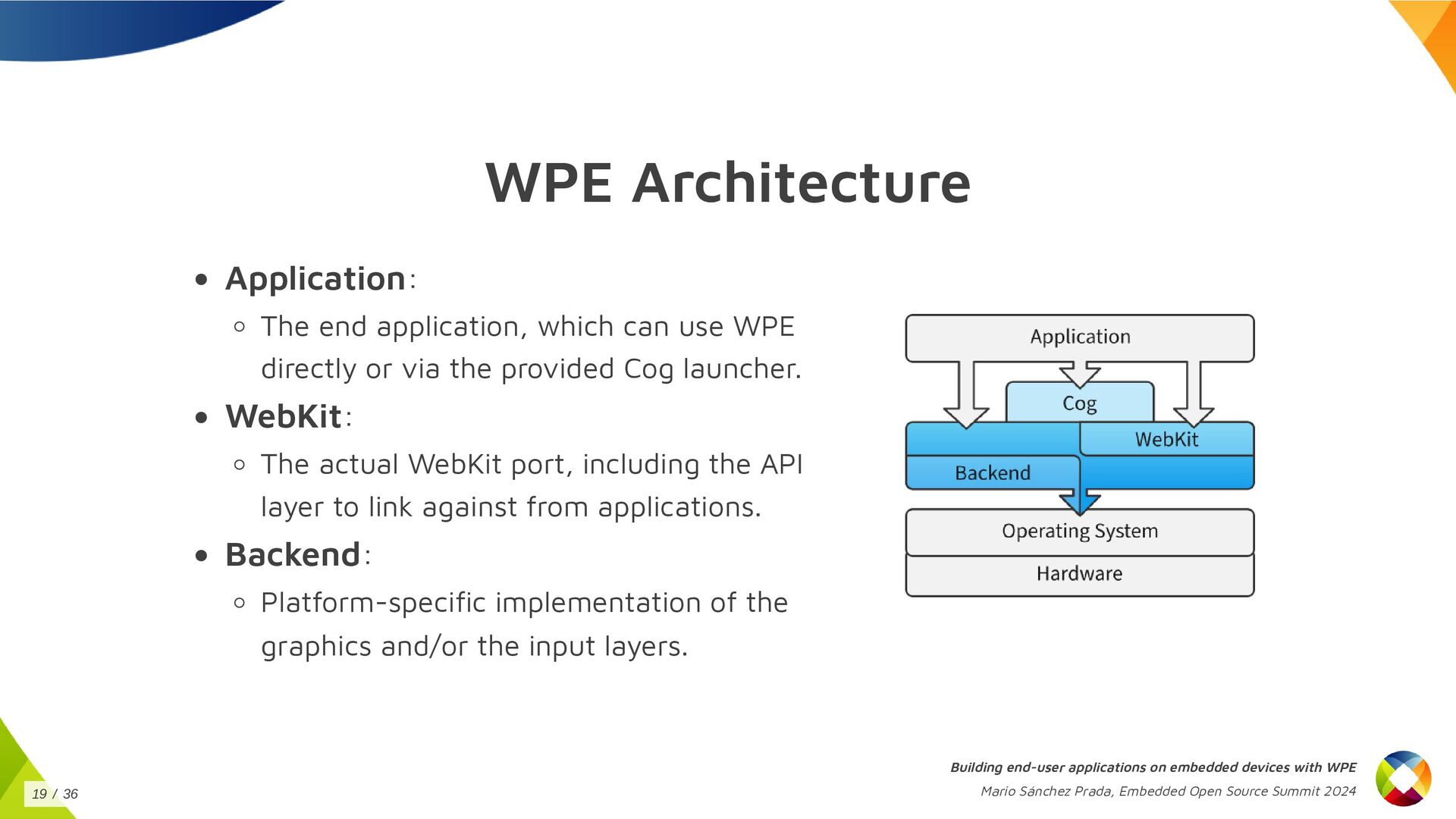
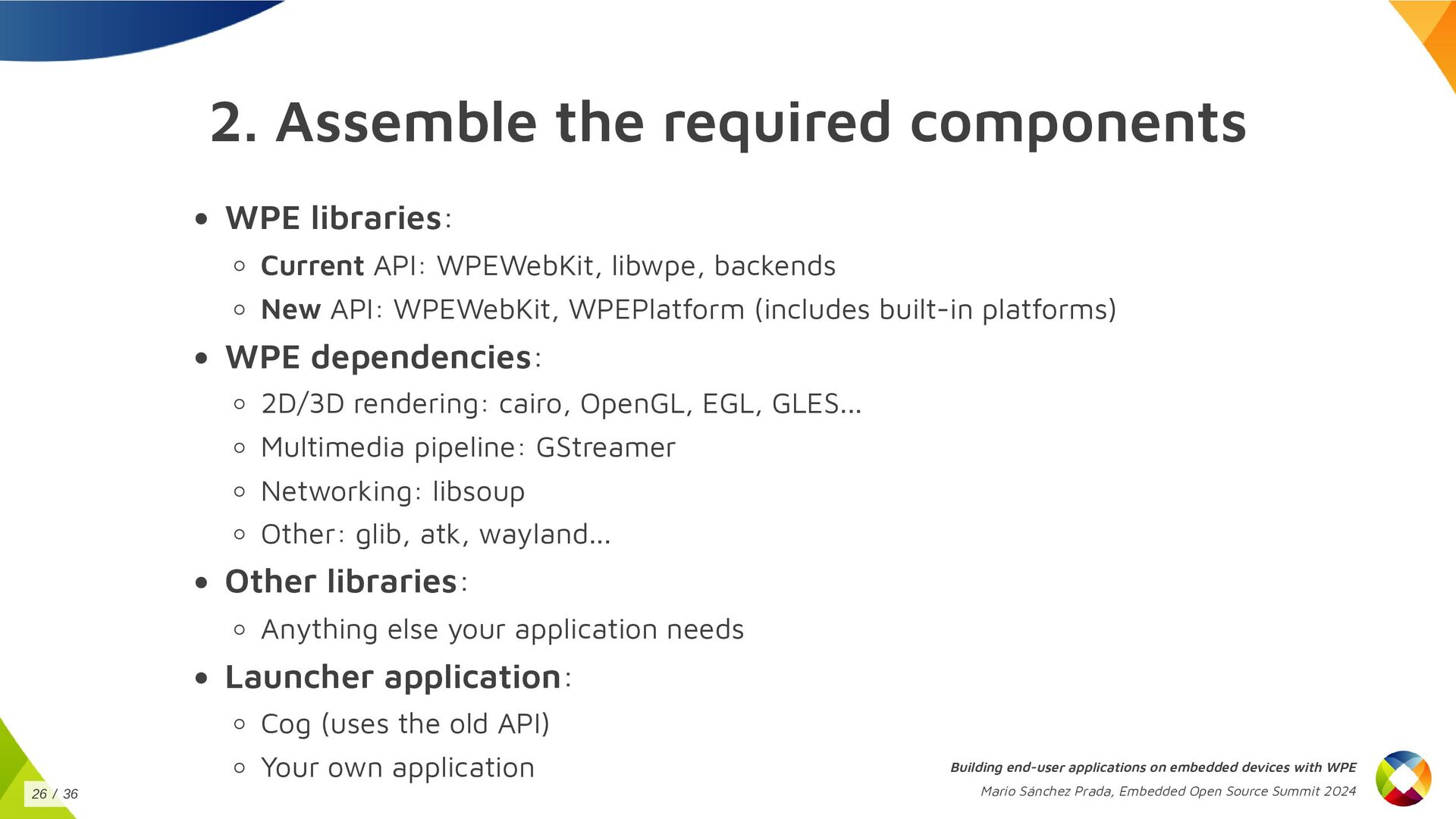
directly or via the provided Cog launcher. WebKit: The actual WebKit port, including the API layer to link against from applications. Backend: Platform-specific implementation of the graphics and/or the input layers. Building end-user applications on embedded devices with WPE Mario Sánchez Prada, Embedded Open Source Summit 2024 19 / 36
backends for page display and input. libwpe: Provides rendering-related callbacks implemented by the graphical backend. Allows the input backend to rely events from the application to WebKit. WPEBackend-FDO: The reference FreekDesktop.Org-based backend (i.e. Wayland). Supports several architectures plus regular PC architectures. Can be replaced by a device-specific backend Cog: Small single “window” launcher for WPE, with no user interface. Building end-user applications on embedded devices with WPE Mario Sánchez Prada, Embedded Open Source Summit 2024 20 / 36
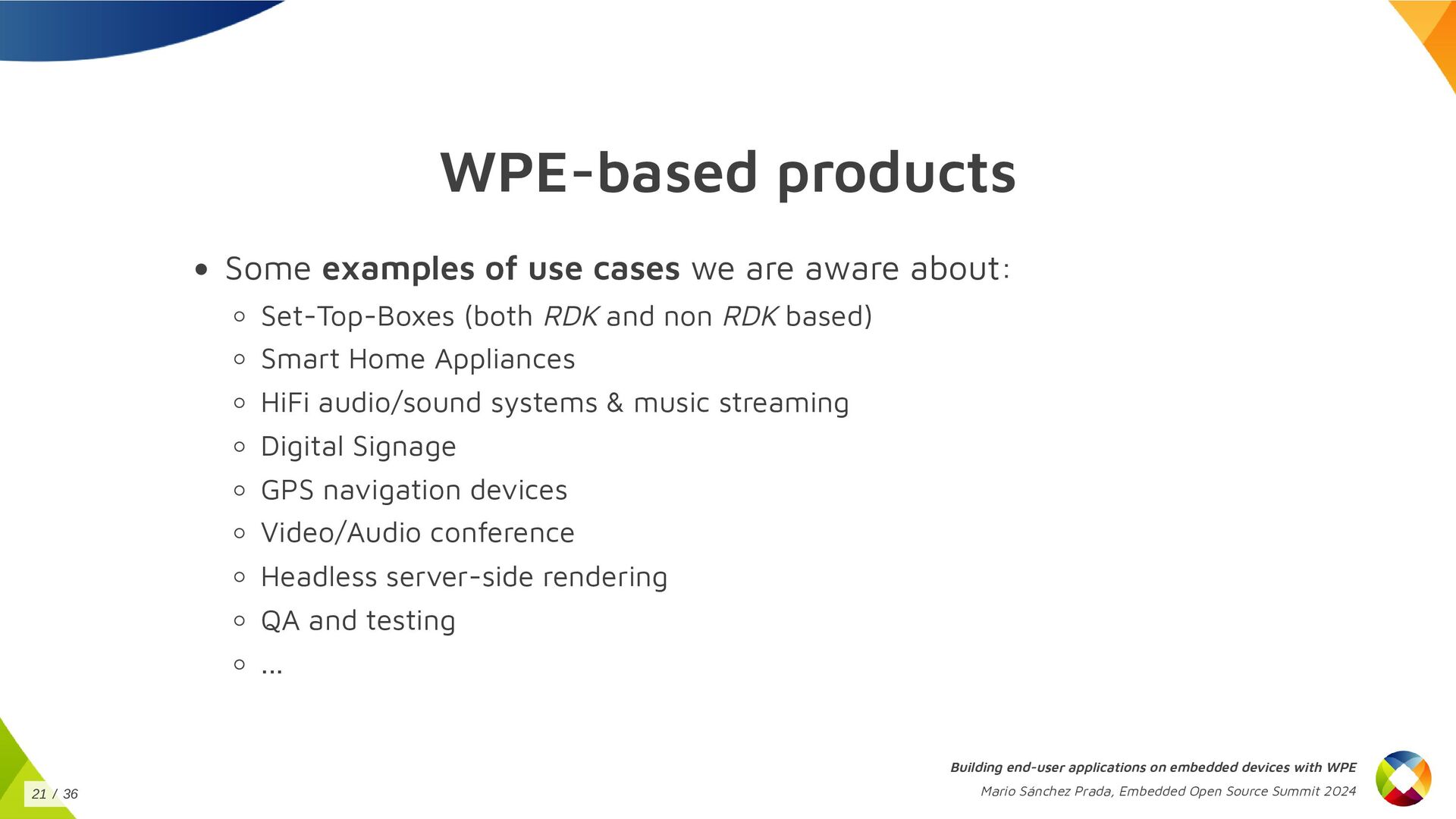
about: Set-Top-Boxes (both RDK and non RDK based) Smart Home Appliances HiFi audio/sound systems & music streaming Digital Signage GPS navigation devices Video/Audio conference Headless server-side rendering QA and testing ... Building end-user applications on embedded devices with WPE Mario Sánchez Prada, Embedded Open Source Summit 2024 21 / 36
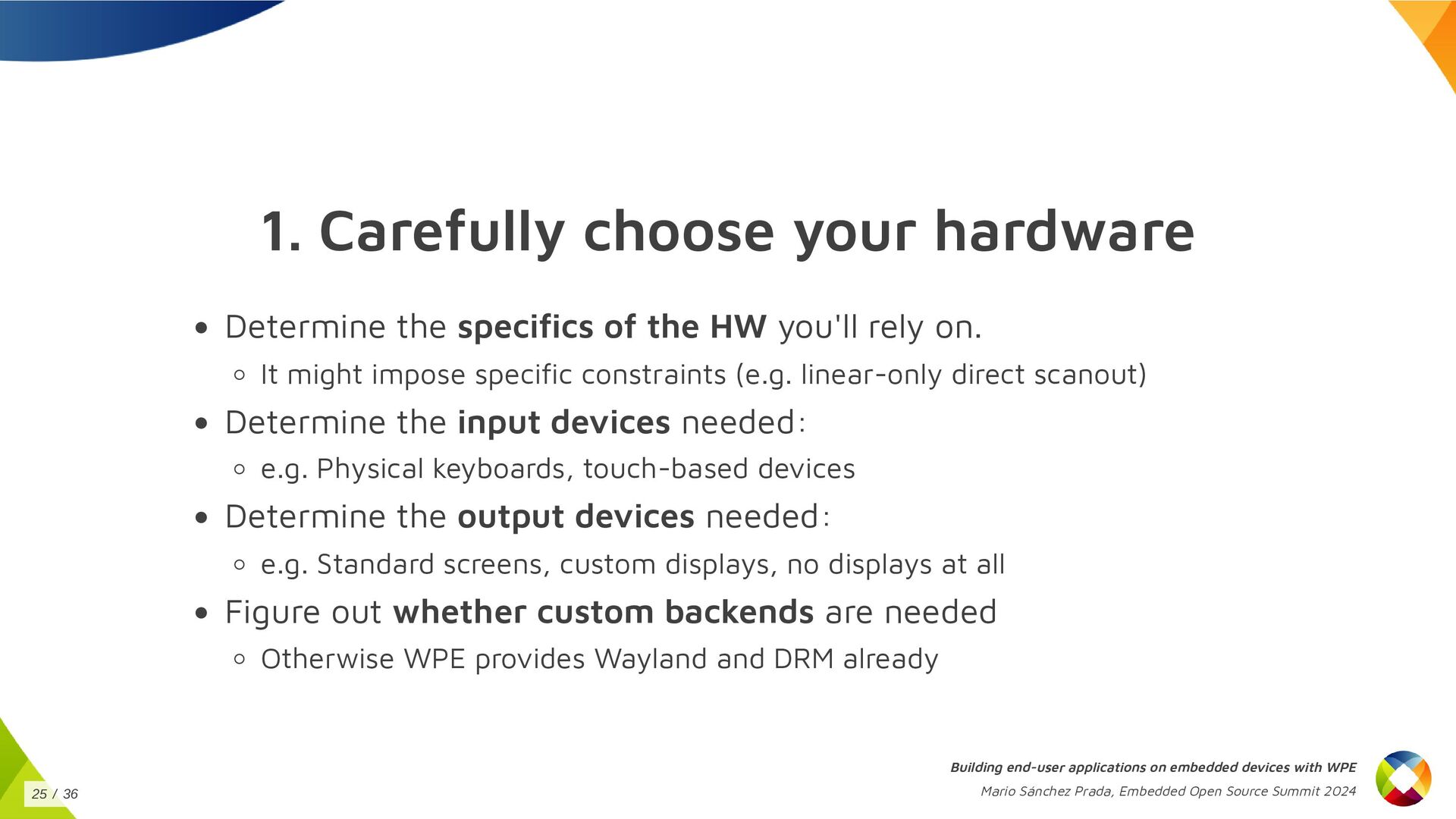
HW you'll rely on. It might impose specific constraints (e.g. linear-only direct scanout) Determine the input devices needed: e.g. Physical keyboards, touch-based devices Determine the output devices needed: e.g. Standard screens, custom displays, no displays at all Figure out whether custom backends are needed Otherwise WPE provides Wayland and DRM already Building end-user applications on embedded devices with WPE Mario Sánchez Prada, Embedded Open Source Summit 2024 25 / 36
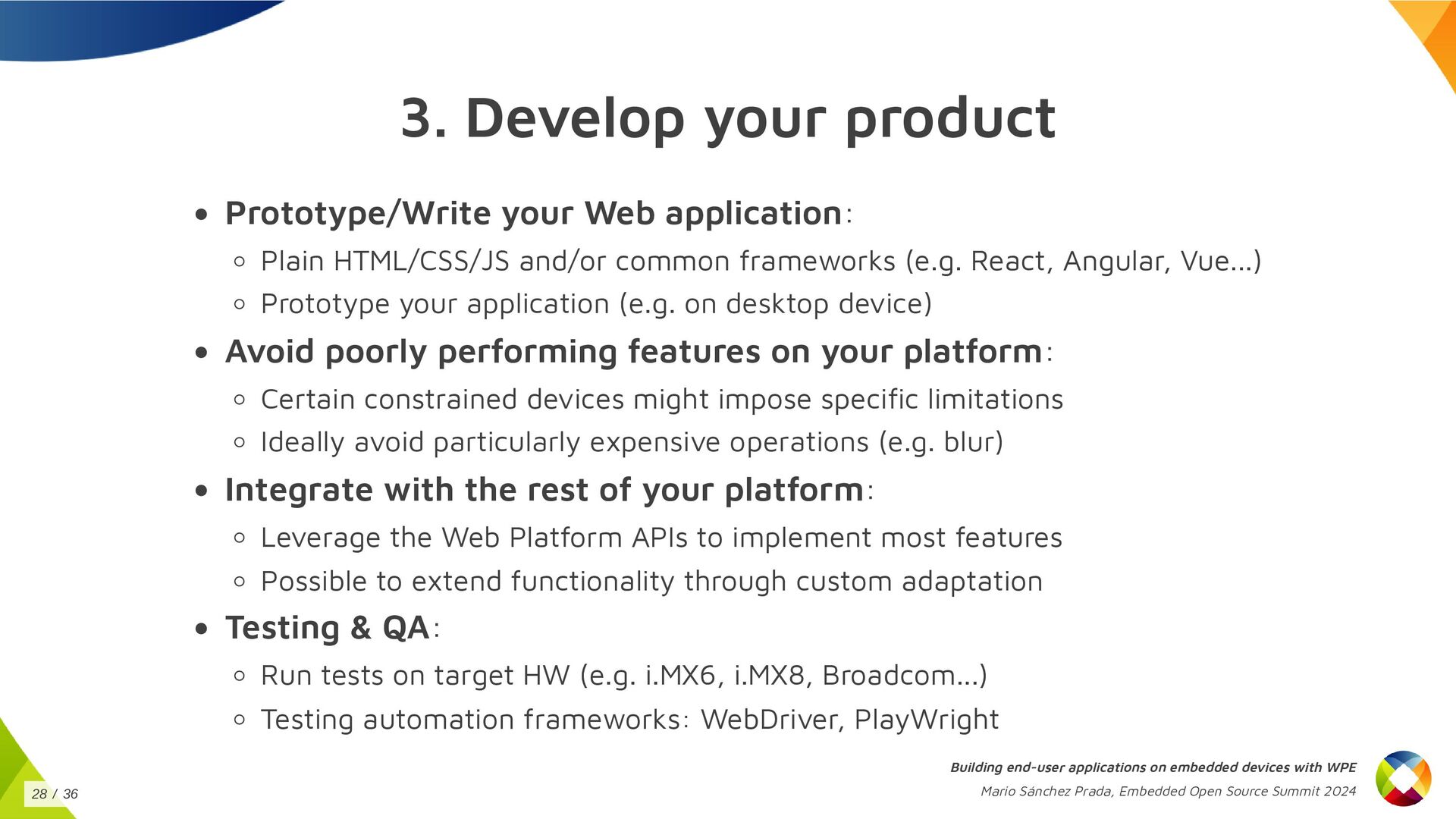
and/or common frameworks (e.g. React, Angular, Vue...) Prototype your application (e.g. on desktop device) Avoid poorly performing features on your platform: Certain constrained devices might impose specific limitations Ideally avoid particularly expensive operations (e.g. blur) Integrate with the rest of your platform: Leverage the Web Platform APIs to implement most features Possible to extend functionality through custom adaptation Testing & QA: Run tests on target HW (e.g. i.MX6, i.MX8, Broadcom...) Testing automation frameworks: WebDriver, PlayWright Building end-user applications on embedded devices with WPE Mario Sánchez Prada, Embedded Open Source Summit 2024 28 / 36
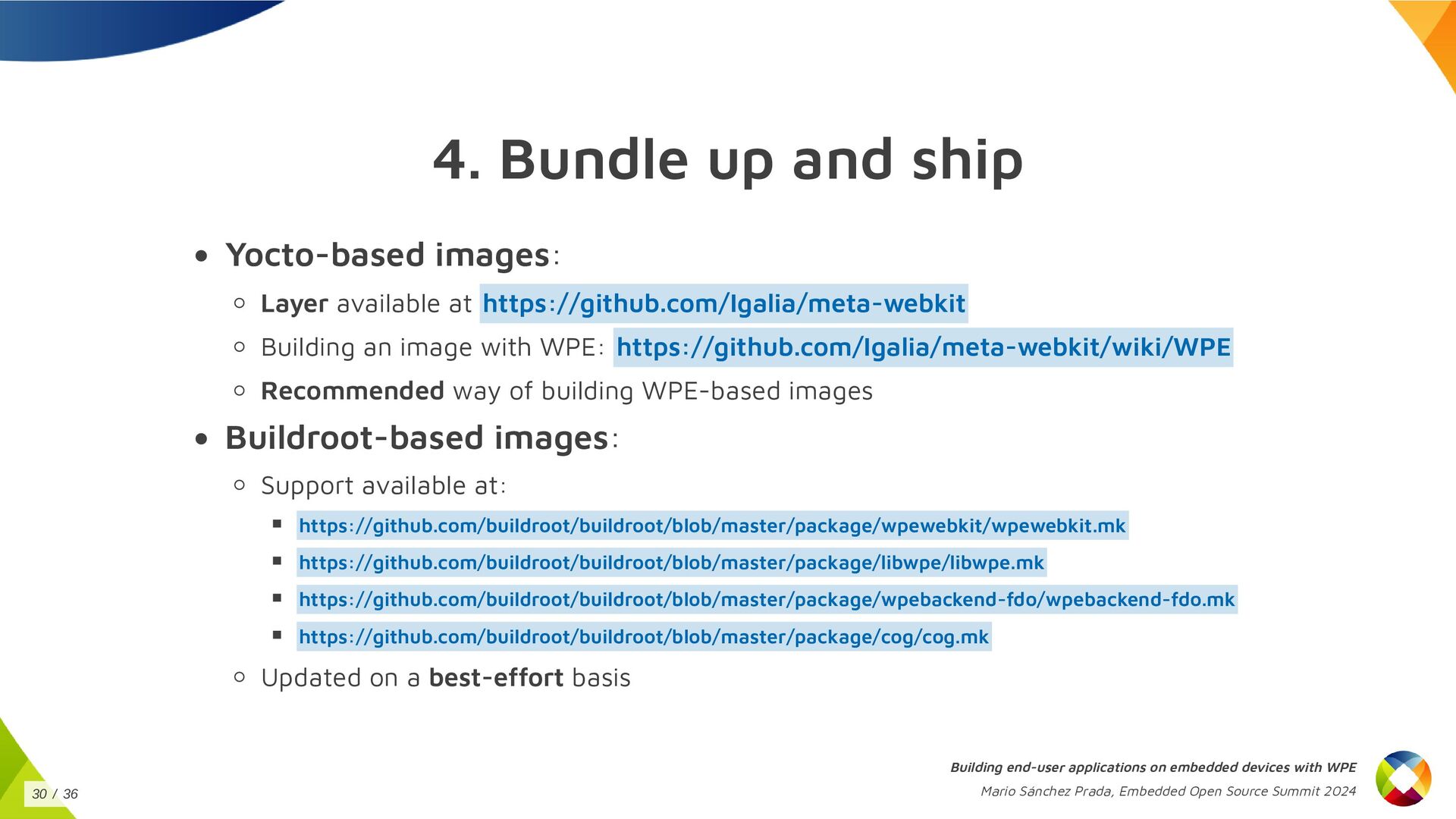
Building an image with WPE: Recommended way of building WPE-based images Buildroot-based images: Support available at: Updated on a best-effort basis https://github.com/Igalia/meta-webkit https://github.com/Igalia/meta-webkit/wiki/WPE https://github.com/buildroot/buildroot/blob/master/package/wpewebkit/wpewebkit.mk https://github.com/buildroot/buildroot/blob/master/package/libwpe/libwpe.mk https://github.com/buildroot/buildroot/blob/master/package/wpebackend-fdo/wpebackend-fdo.mk https://github.com/buildroot/buildroot/blob/master/package/cog/cog.mk Building end-user applications on embedded devices with WPE Mario Sánchez Prada, Embedded Open Source Summit 2024 30 / 36
WPE leverages WebKit's strengths and makes it ideal for embedded devices, providing the extra flexibility needed. Integrating WPE in your project requires carefully choosing your Hardware and assembling the required components. Products can be developed as regular Web applications, and adaptations are still possible thanks to WPE's modular design. WPE and WebKit fully Open Source, contributions are welcome! Building end-user applications on embedded devices with WPE Mario Sánchez Prada, Embedded Open Source Summit 2024 33 / 36


 mariospr
 kairim0
 tanakaseiya
 yohyamasaki
 ishiirikie
 odashinsuke
 iwatatomoya
 shreyas1009
 aoto
aoto
 nayuts
 sansantech
 yakumo
 ryotarai
 helmedeiros
 tammyeverts
 destraynor
 kimpetersen
 eileencodes
 cassininazir
 rocio
rocio
 smashingmag
 denniskardys
 nikkihalliwell
 samanthasiow
 coloredviolet