Upgrade to Pro — share decks privately, control downloads, hide ads and more …

The Web Platform on Linux devices with WebKit: ...

The Web Platform on Linux devices with WebKit: where are we now?

This presentation provides a comprehensive status update on WebKitGTK and WPE, the Open Source ports of the WebKit Web rendering engine that Igalia maintains for Linux devices. These ports are currently being used in millions of devices (e.g. phones, set-top boxes, smart home appliances...), leveraging the flexible architecture of WebKit to provide HW-accelerated graphics and multimedia capabilities with a minimal resource footprint (e.g., memory, binary size).

We will begin by providing some context on what WebKit is and how WebKitGTK and WPE bring the power of the Web Platform to Linux-based devices and distributions. After that, we will summarize the current status of these ports, detailing the latest and most important highlights of the work done in the past year, followed by a description of what the new developments will be focused on during 2026.

The Linux ports have experienced huge changes recently, including a massive refactoring of its graphics pipeline, the development of a new API for embedded devices, dma-buf support for zero-copy buffer sharing, a complete revamp of its QA infrastructure, and even adding support for Android. With all this in mind, this session should be useful for anyone interested in creating Web-based products on Linux devices, understanding the current state of these ports, and seeing where development is headed next.

FOSDEM 2026
January 31st, 2026
Brussels - Belgium
https://fosdem.org/2026

Avatar for Mario Sánchez Prada

Mario Sánchez Prada

February 01, 2026
Tweet

More Decks by Mario Sánchez Prada

Other Decks in Technology

Transcript

  1. The Web Platform on Linux devices with WebKit: where are

    we now? Mario Sánchez-Prada FOSDEM 2026 Brussels, January 31st 2026 [email protected] 1 / 35
  2. About Me Software Engineer and partner at Igalia. Open Source

    work: GNOME, Chromium/Blink, WebKit. Other: Maemo, Endless OS, Samsung Smart TV. Currently coordinating Igalia's WebKit team. The Web Platform on Linux devices with WebKit: where are we now? Mario Sánchez-Prada, FOSDEM 2026 2 / 35
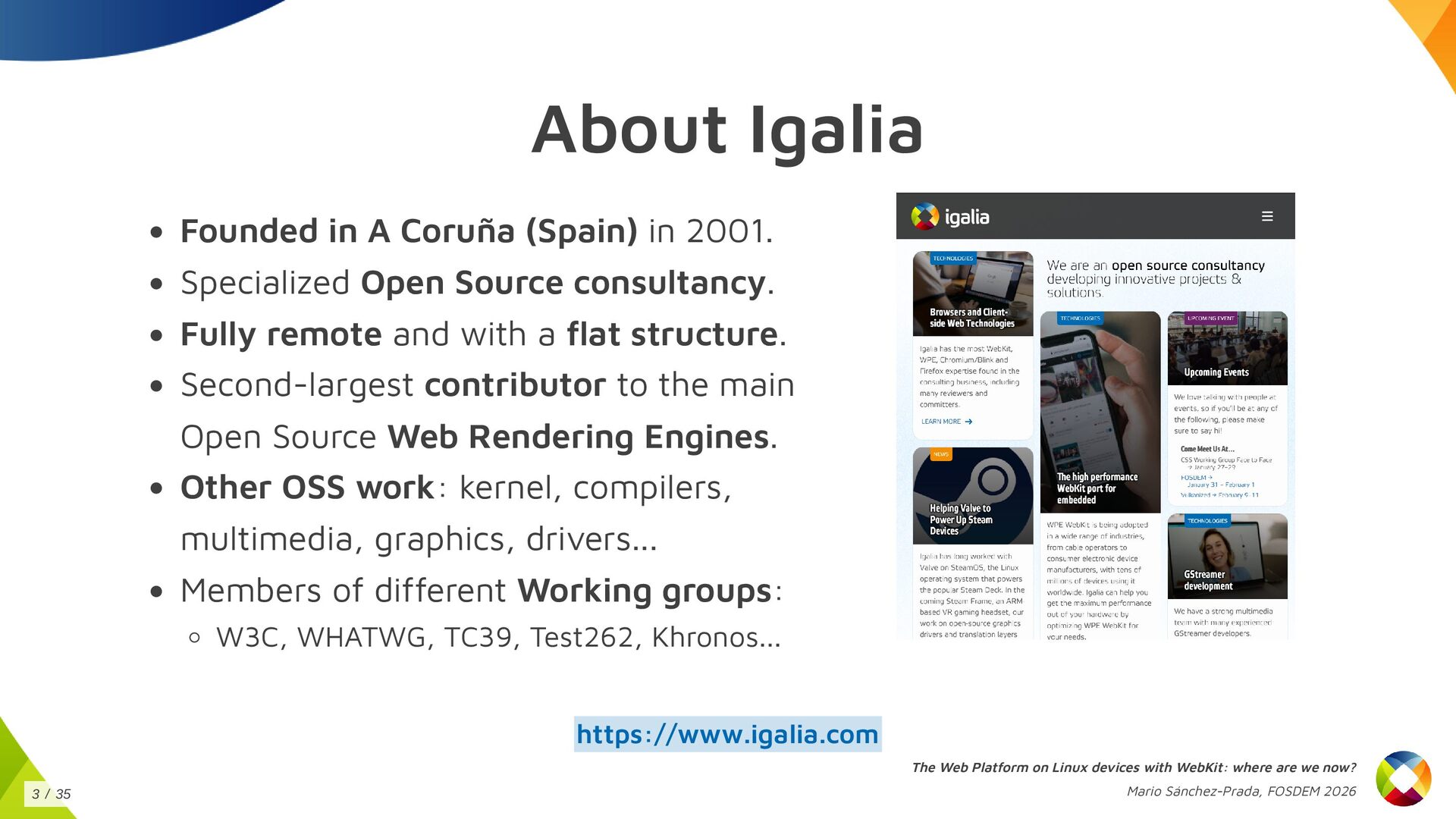
  3. About Igalia Founded in A Coruña (Spain) in 2001. Specialized

    Open Source consultancy. Fully remote and with a flat structure. Second-largest contributor to the main Open Source Web Rendering Engines. Other OSS work: kernel, compilers, multimedia, graphics, drivers... Members of different Working groups: W3C, WHATWG, TC39, Test262, Khronos... https://www.igalia.com The Web Platform on Linux devices with WebKit: where are we now? Mario Sánchez-Prada, FOSDEM 2026 3 / 35
  4. Outline 1. Web Rendering Engines 2. What is WebKit? 3.

    WebKitGTK & WPE WebKit 4. History of WebKitGTK & WPE WebKit 5. Latest updates 6. Next steps The Web Platform on Linux devices with WebKit: where are we now? Mario Sánchez-Prada, FOSDEM 2026 4 / 35
  5. Web Rendering Engines The Web Platform on Linux devices with

    WebKit: where are we now? Mario Sánchez-Prada, FOSDEM 2026 5 / 35
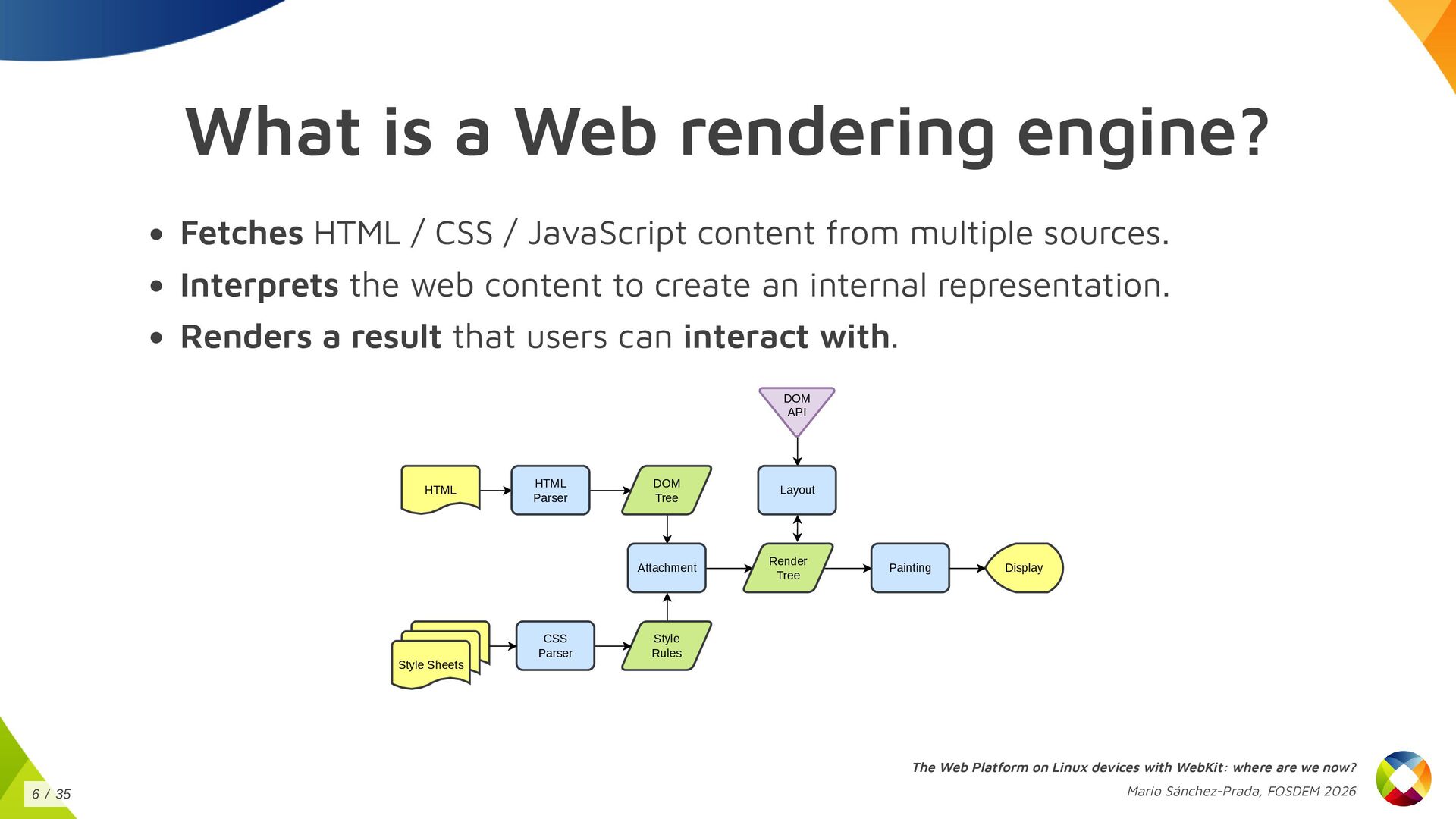
  6. What is a Web rendering engine? Fetches HTML / CSS

    / JavaScript content from multiple sources. Interprets the web content to create an internal representation. Renders a result that users can interact with. HTML HTML Parser DOM Tree Attachment Style Rules Display DOM API Style Sheets CSS Parser Layout Render Tree Painting The Web Platform on Linux devices with WebKit: where are we now? Mario Sánchez-Prada, FOSDEM 2026 6 / 35
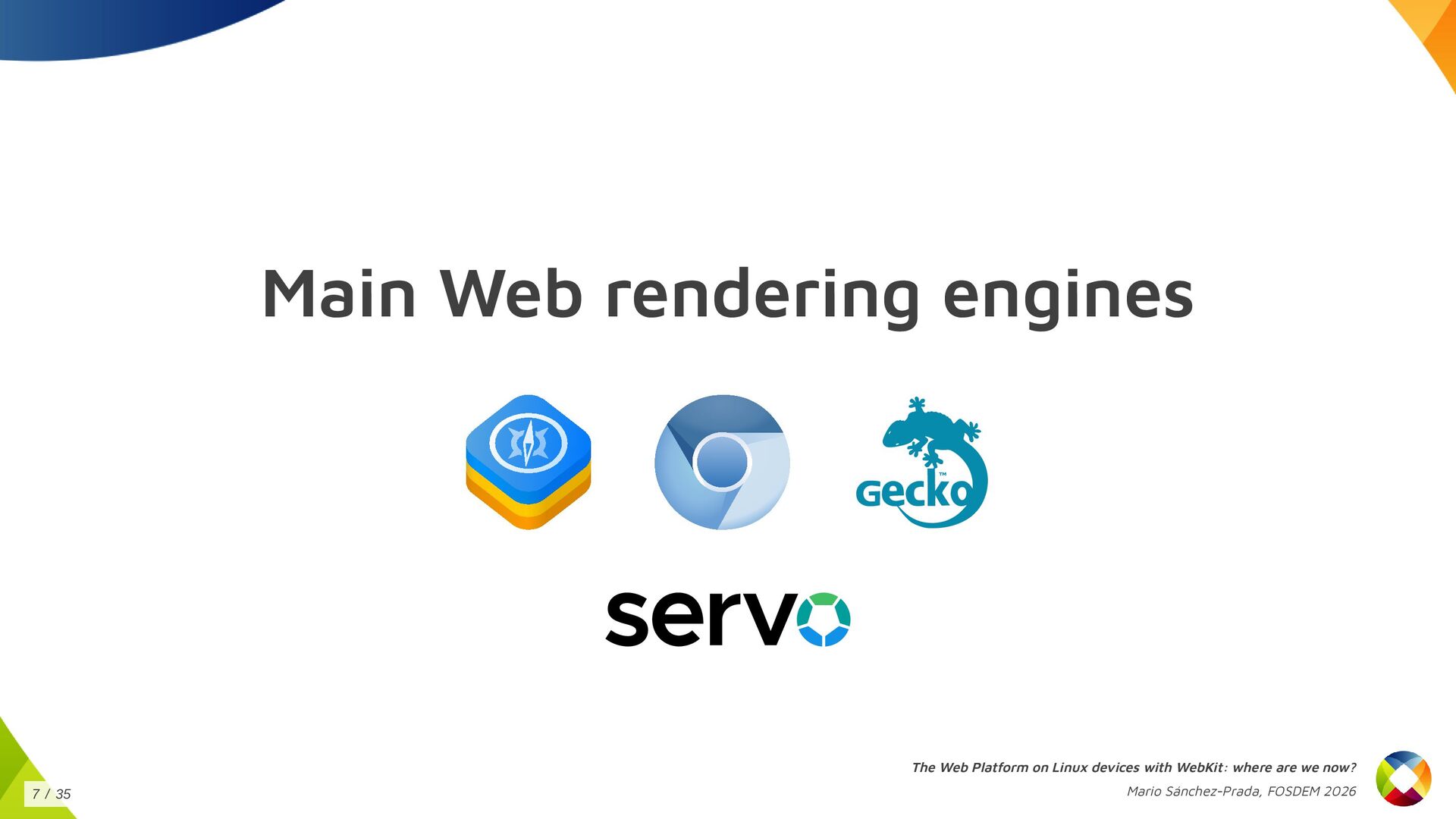
  7. Main Web rendering engines The Web Platform on Linux devices

    with WebKit: where are we now? Mario Sánchez-Prada, FOSDEM 2026 7 / 35
  8. What is WebKit? https://webkit.org The Web Platform on Linux devices

    with WebKit: where are we now? Mario Sánchez-Prada, FOSDEM 2026 8 / 35
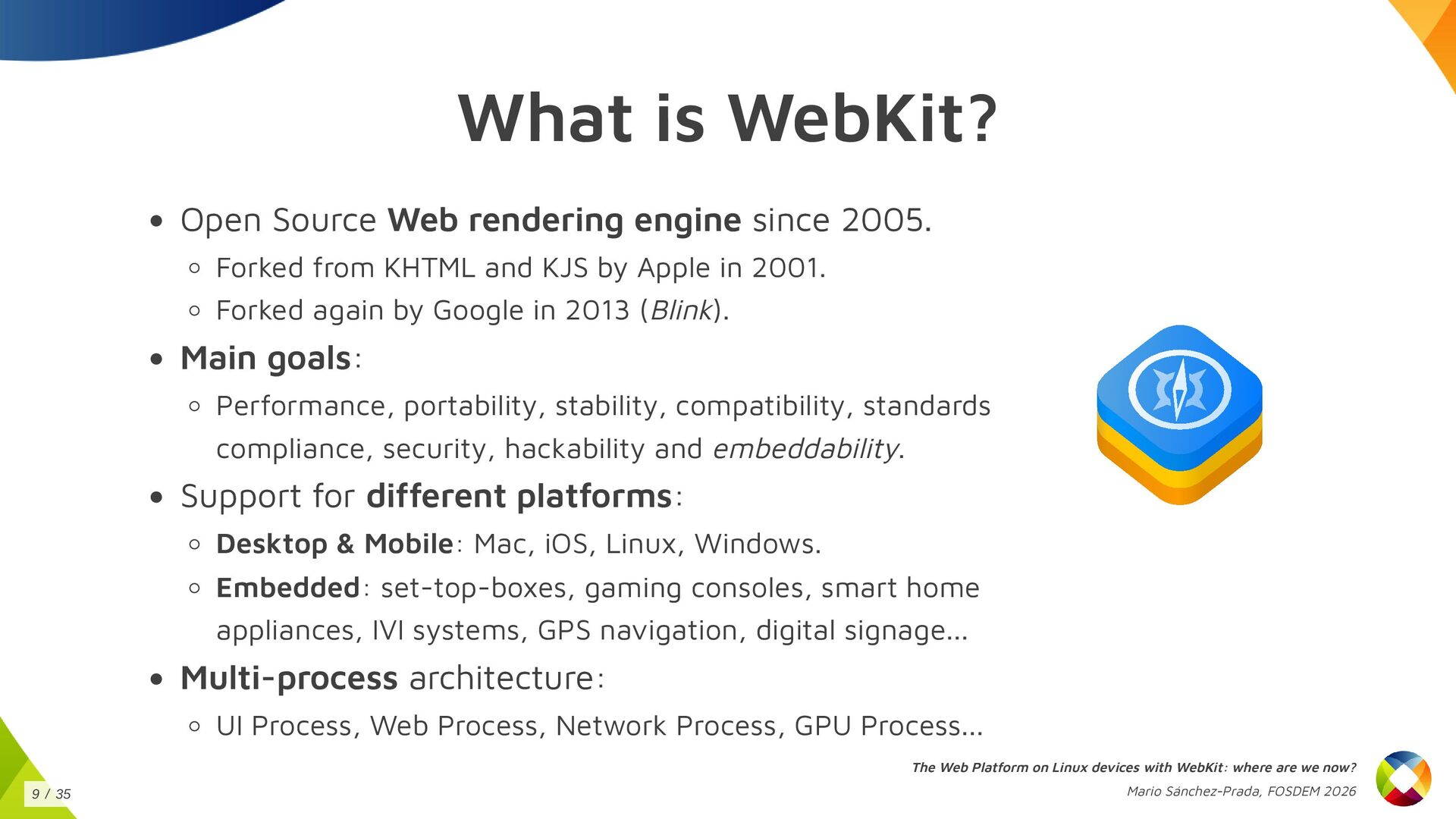
  9. What is WebKit? Open Source Web rendering engine since 2005.

    Forked from KHTML and KJS by Apple in 2001. Forked again by Google in 2013 (Blink). Main goals: Performance, portability, stability, compatibility, standards compliance, security, hackability and embeddability. Support for different platforms: Desktop & Mobile: Mac, iOS, Linux, Windows. Embedded: set-top-boxes, gaming consoles, smart home appliances, IVI systems, GPS navigation, digital signage... Multi-process architecture: UI Process, Web Process, Network Process, GPU Process... The Web Platform on Linux devices with WebKit: where are we now? Mario Sánchez-Prada, FOSDEM 2026 9 / 35
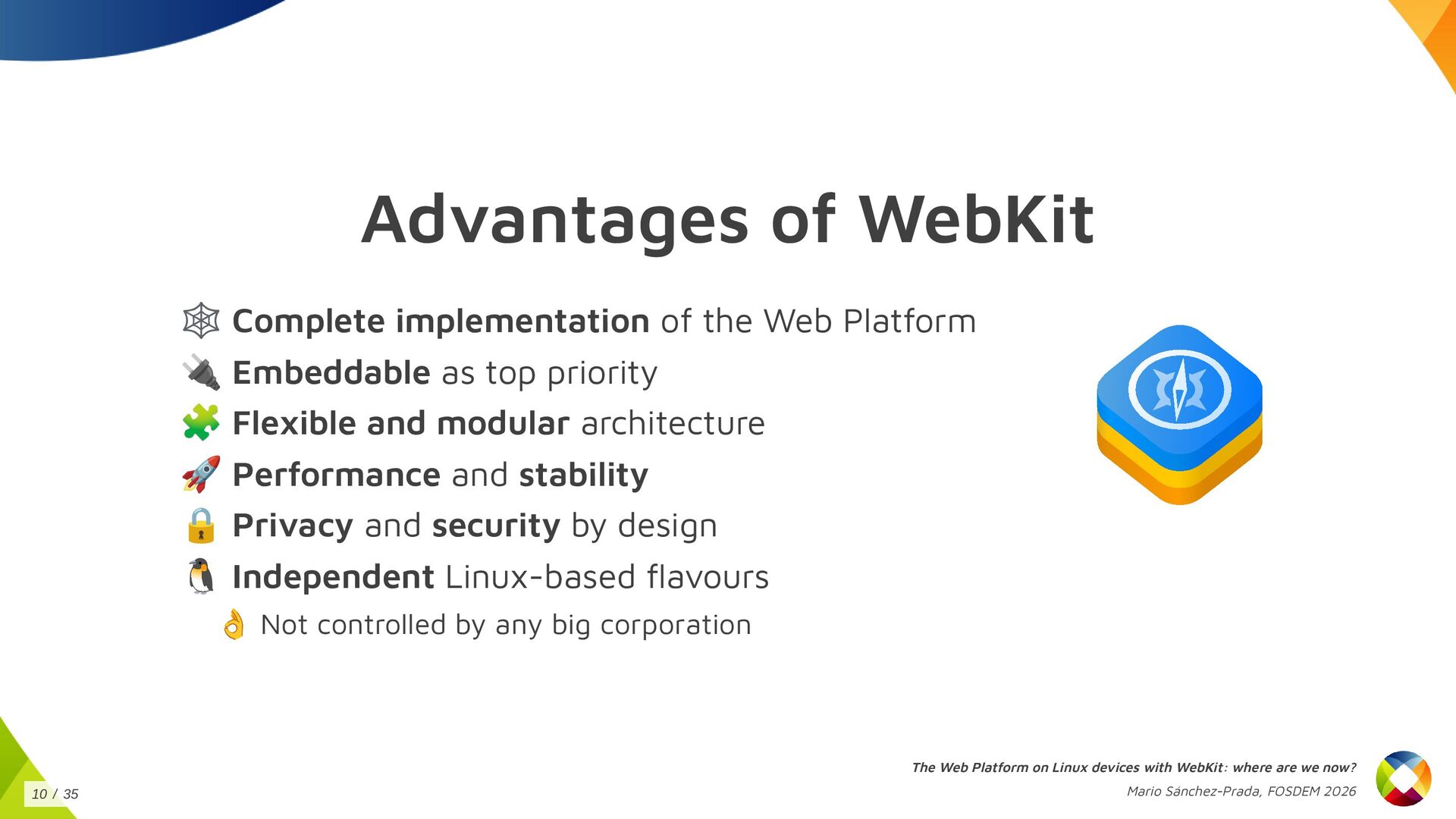
  10. Advantages of WebKit 🕸 Complete implementation of the Web Platform

    🔌 Embeddable as top priority 🧩 Flexible and modular architecture 🚀 Performance and stability 🔒 Privacy and security by design 🐧 Independent Linux-based flavours 👌 Not controlled by any big corporation The Web Platform on Linux devices with WebKit: where are we now? Mario Sánchez-Prada, FOSDEM 2026 10 / 35
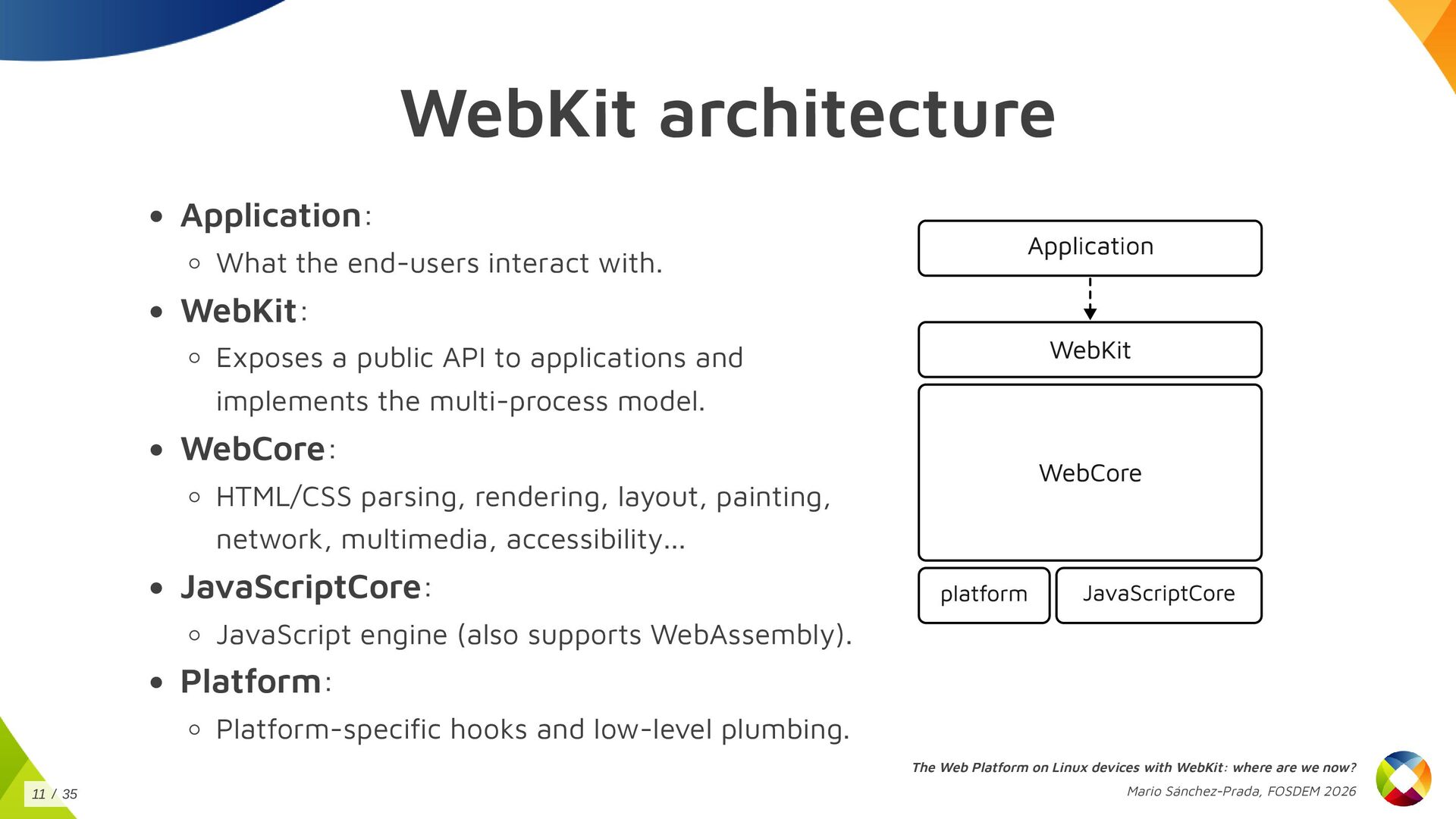
  11. WebKit architecture Application: What the end-users interact with. WebKit: Exposes

    a public API to applications and implements the multi-process model. WebCore: HTML/CSS parsing, rendering, layout, painting, network, multimedia, accessibility... JavaScriptCore: JavaScript engine (also supports WebAssembly). Platform: Platform-specific hooks and low-level plumbing. JavaScriptCore platform WebCore Application WebKit The Web Platform on Linux devices with WebKit: where are we now? Mario Sánchez-Prada, FOSDEM 2026 11 / 35
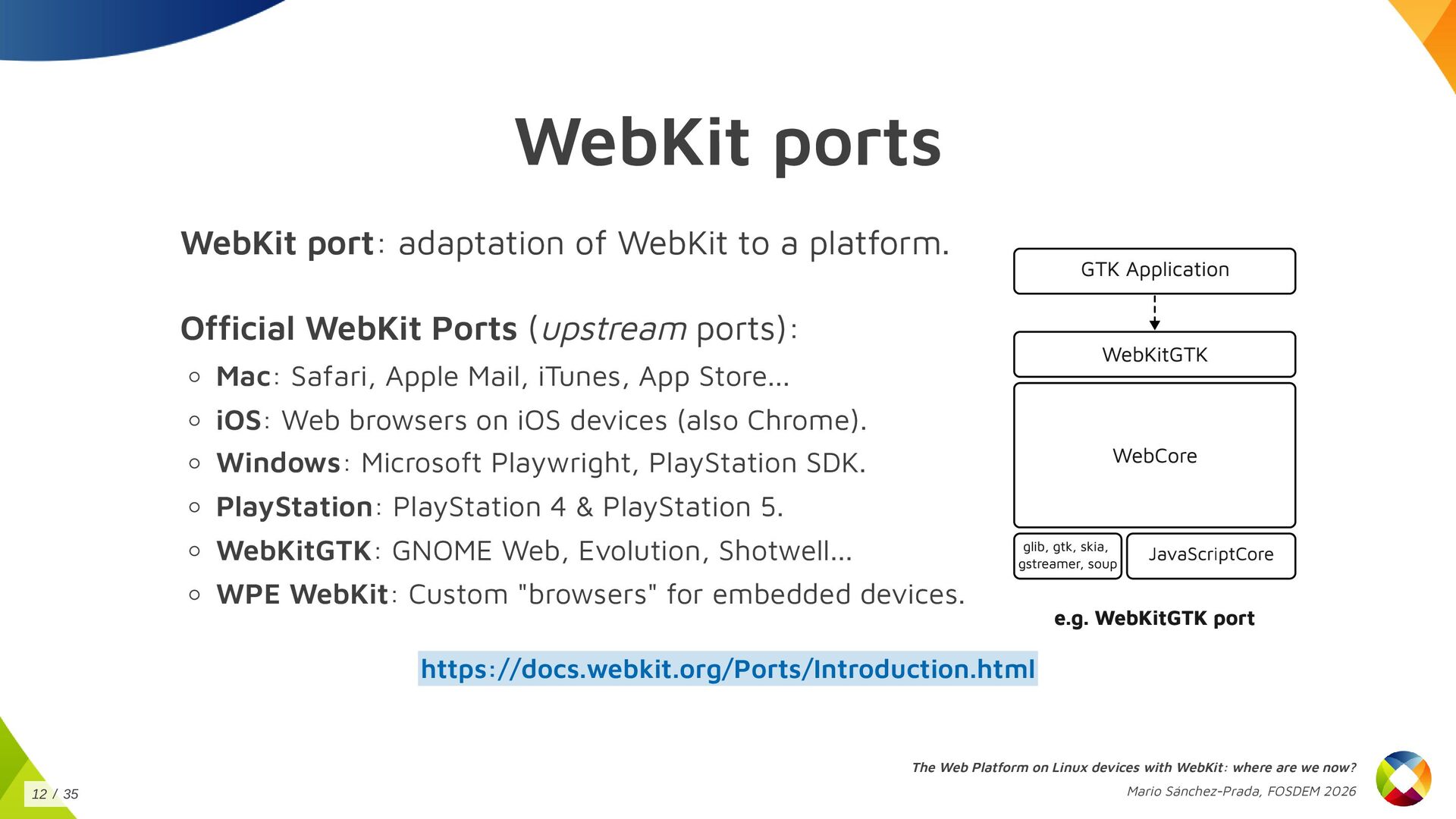
  12. WebKit ports WebKit port: adaptation of WebKit to a platform.

    Official WebKit Ports (upstream ports): Mac: Safari, Apple Mail, iTunes, App Store... iOS: Web browsers on iOS devices (also Chrome). Windows: Microsoft Playwright, PlayStation SDK. PlayStation: PlayStation 4 & PlayStation 5. WebKitGTK: GNOME Web, Evolution, Shotwell... WPE WebKit: Custom "browsers" for embedded devices. e.g. WebKitGTK port JavaScriptCore glib, gtk, skia, gstreamer, soup WebCore GTK Application WebKitGTK https://docs.webkit.org/Ports/Introduction.html The Web Platform on Linux devices with WebKit: where are we now? Mario Sánchez-Prada, FOSDEM 2026 12 / 35
  13. WebKitGTK & WPE WebKit The Web Platform on Linux devices

    with WebKit: where are we now? Mario Sánchez-Prada, FOSDEM 2026 13 / 35
  14. What is WebKitGTK? WebKitGTK: port of WebKit for Linux-based GTK

    applications. Fully-featured implementation of the Web Platform Support for HW-accelerated graphics and multimedia. Used in a wide variety of GTK applications: GNOME Web (browser), Evolution (mail client), GNOME Builder (IDE)... Provides a widget to be used in GTK applications: WebKitWebView Offers a public API to interact with the Web engine and respond to events. Platform-specific functionality is implemented on top of other components (e.g. Skia, OpenGL, EGL, GStreamer, libsoup, fontconfig, harfbuzz...). Fully operational JavaScript engine (JavaScriptCore) ℹ️ https://webkitgtk.org The Web Platform on Linux devices with WebKit: where are we now? Mario Sánchez-Prada, FOSDEM 2026 14 / 35
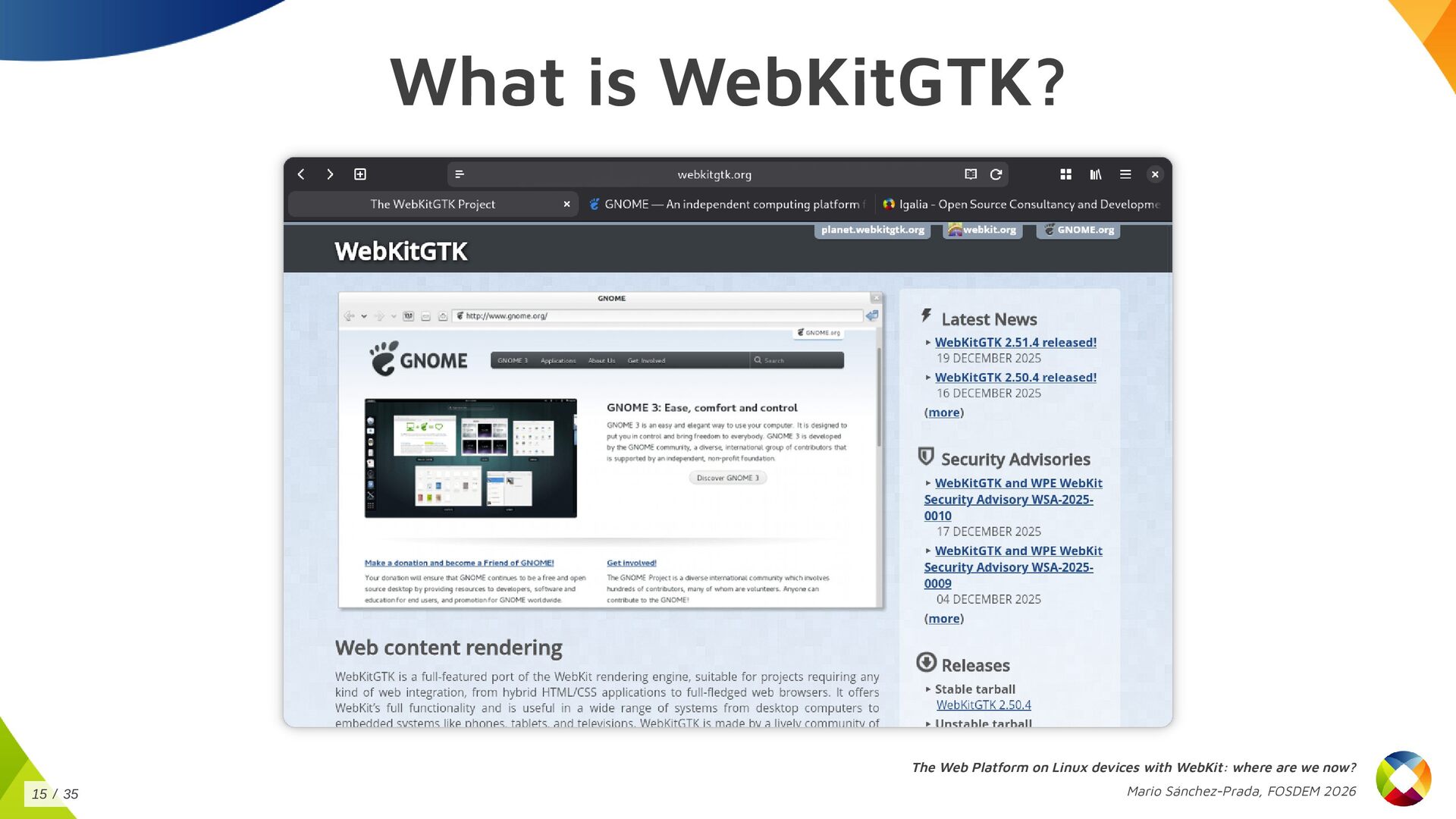
  15. What is WebKitGTK? The Web Platform on Linux devices with

    WebKit: where are we now? Mario Sánchez-Prada, FOSDEM 2026 15 / 35
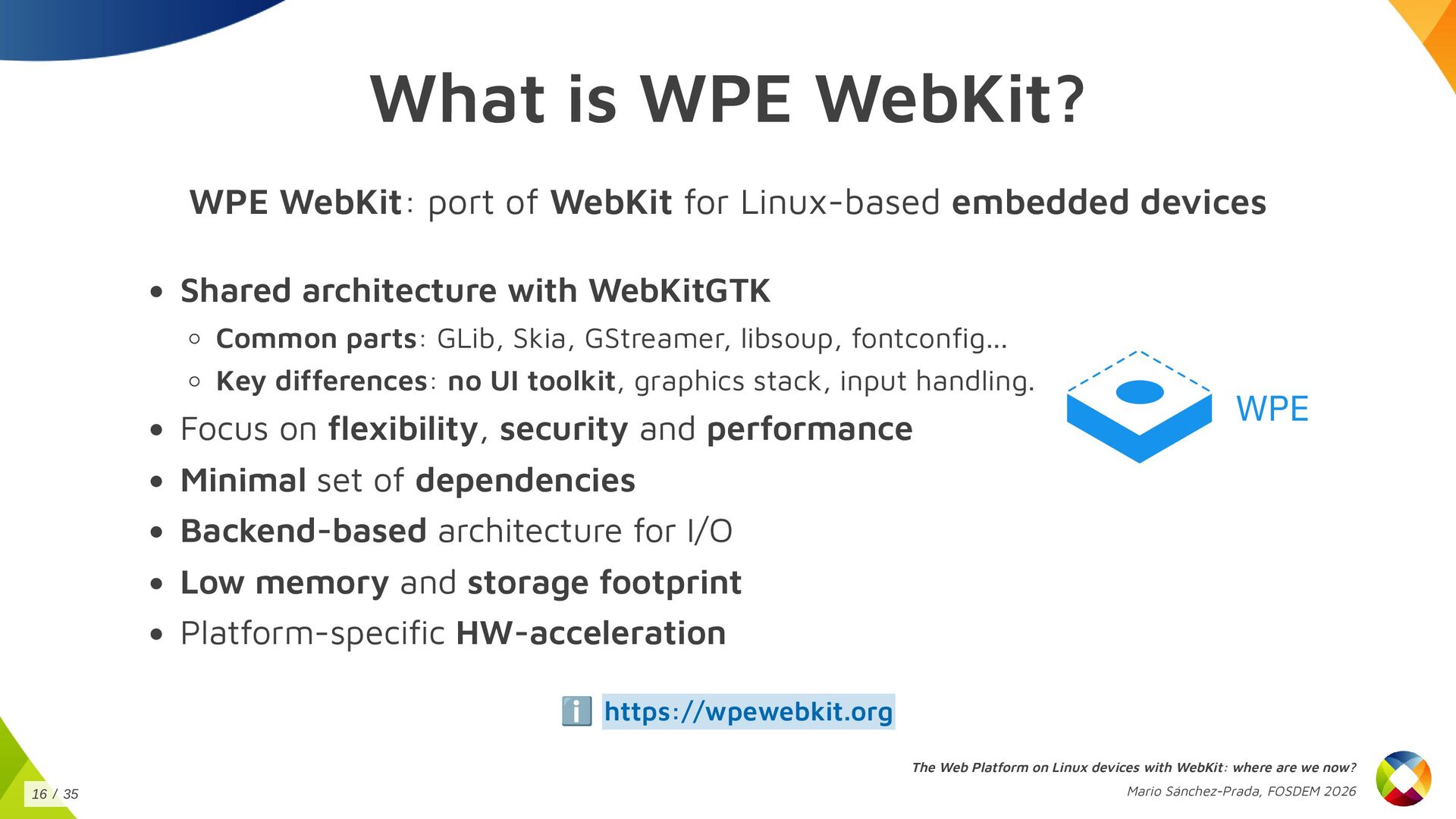
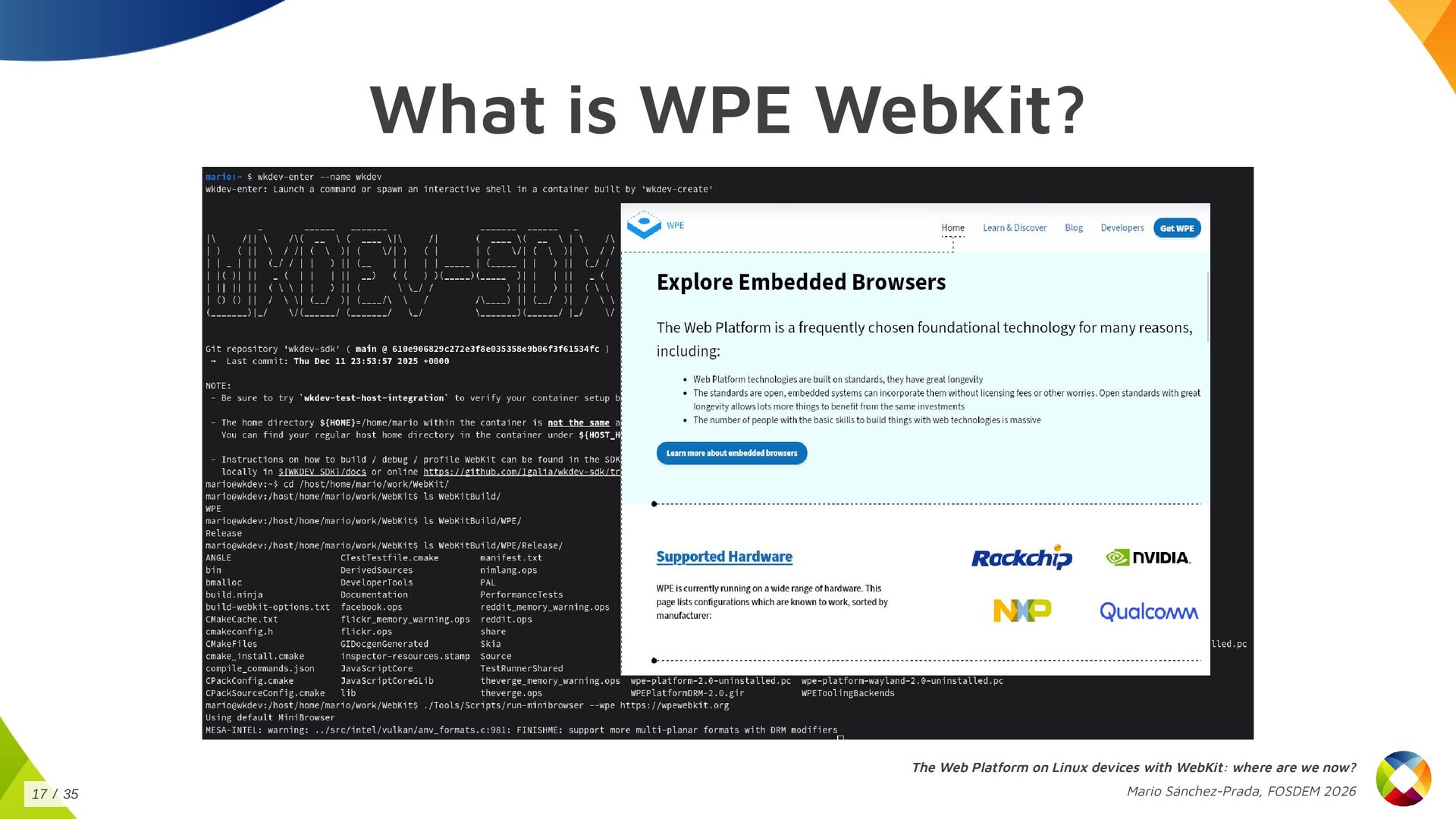
  16. What is WPE WebKit? WPE WebKit: port of WebKit for

    Linux-based embedded devices Shared architecture with WebKitGTK Common parts: GLib, Skia, GStreamer, libsoup, fontconfig... Key differences: no UI toolkit, graphics stack, input handling. Focus on flexibility, security and performance Minimal set of dependencies Backend-based architecture for I/O Low memory and storage footprint Platform-specific HW-acceleration ℹ️ https://wpewebkit.org The Web Platform on Linux devices with WebKit: where are we now? Mario Sánchez-Prada, FOSDEM 2026 16 / 35
  17. What is WPE WebKit? The Web Platform on Linux devices

    with WebKit: where are we now? Mario Sánchez-Prada, FOSDEM 2026 17 / 35
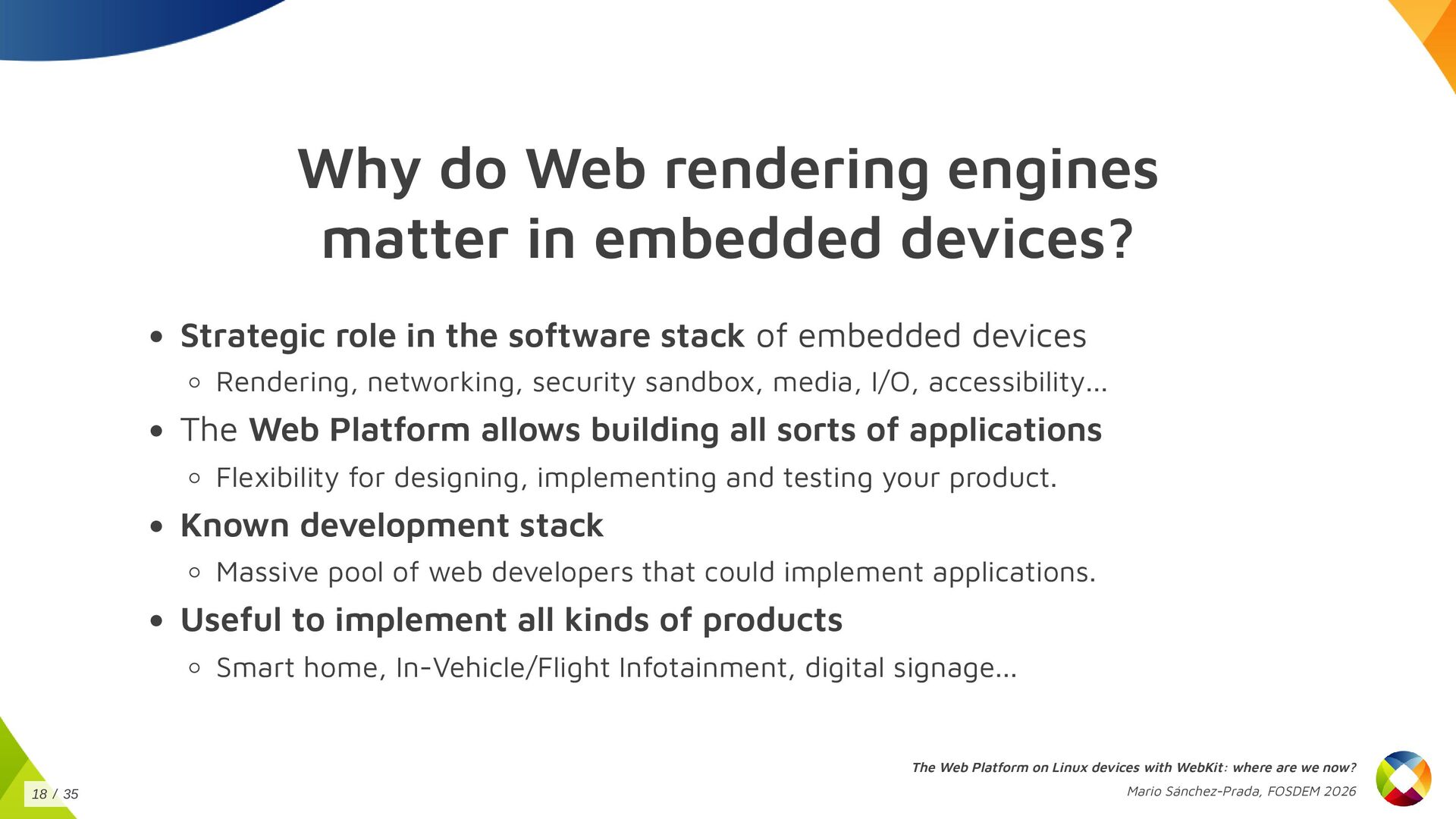
  18. Why do Web rendering engines matter in embedded devices? Strategic

    role in the software stack of embedded devices Rendering, networking, security sandbox, media, I/O, accessibility... The Web Platform allows building all sorts of applications Flexibility for designing, implementing and testing your product. Known development stack Massive pool of web developers that could implement applications. Useful to implement all kinds of products Smart home, In-Vehicle/Flight Infotainment, digital signage... The Web Platform on Linux devices with WebKit: where are we now? Mario Sánchez-Prada, FOSDEM 2026 18 / 35
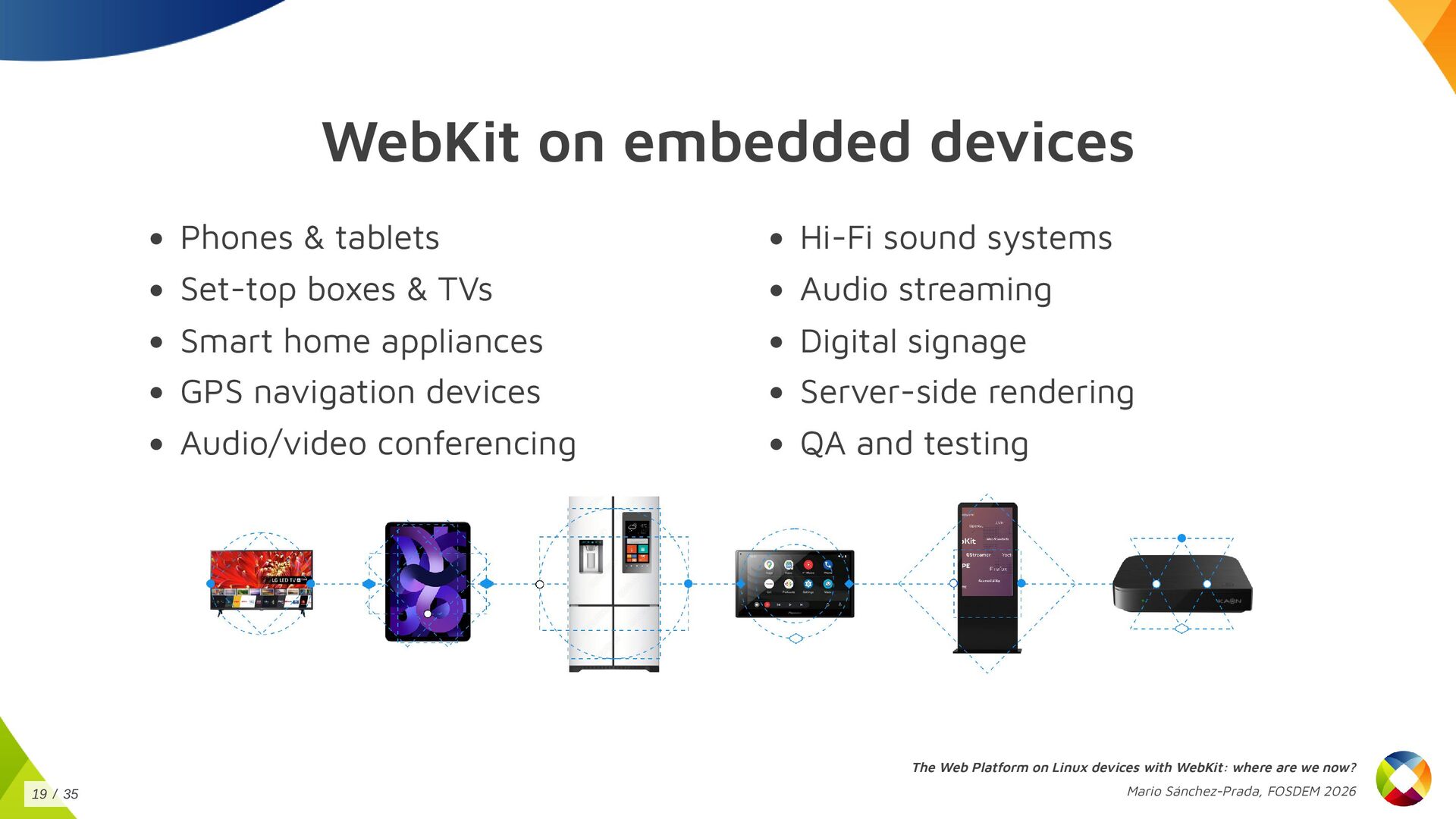
  19. WebKit on embedded devices Phones & tablets Set-top boxes &

    TVs Smart home appliances GPS navigation devices Audio/video conferencing Hi-Fi sound systems Audio streaming Digital signage Server-side rendering QA and testing The Web Platform on Linux devices with WebKit: where are we now? Mario Sánchez-Prada, FOSDEM 2026 19 / 35
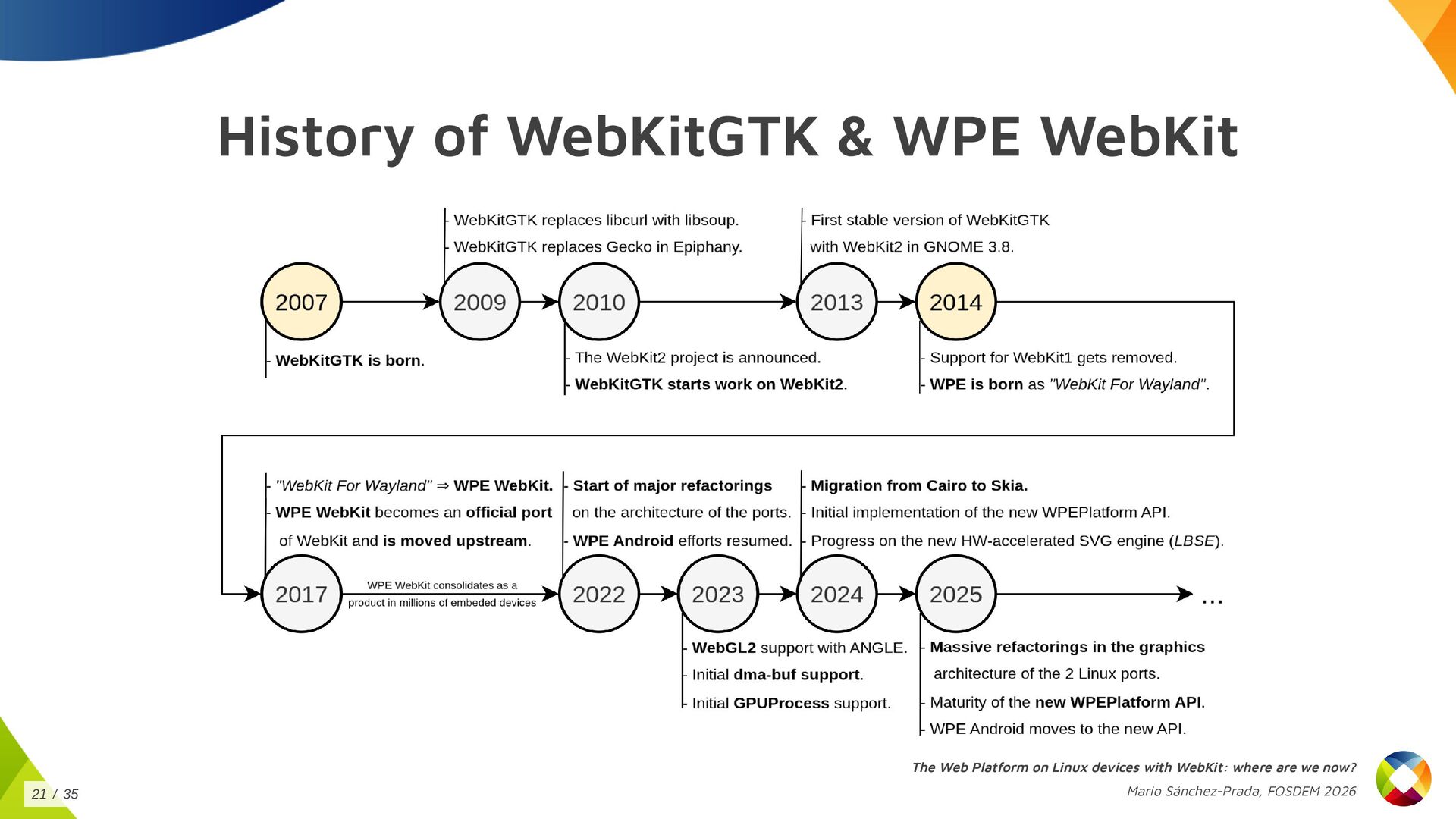
  20. History of WebKitGTK & WPE WebKit The Web Platform on

    Linux devices with WebKit: where are we now? Mario Sánchez-Prada, FOSDEM 2026 20 / 35
  21. History of WebKitGTK & WPE WebKit The Web Platform on

    Linux devices with WebKit: where are we now? Mario Sánchez-Prada, FOSDEM 2026 21 / 35
  22. Latest updates The Web Platform on Linux devices with WebKit:

    where are we now? Mario Sánchez-Prada, FOSDEM 2026 22 / 35
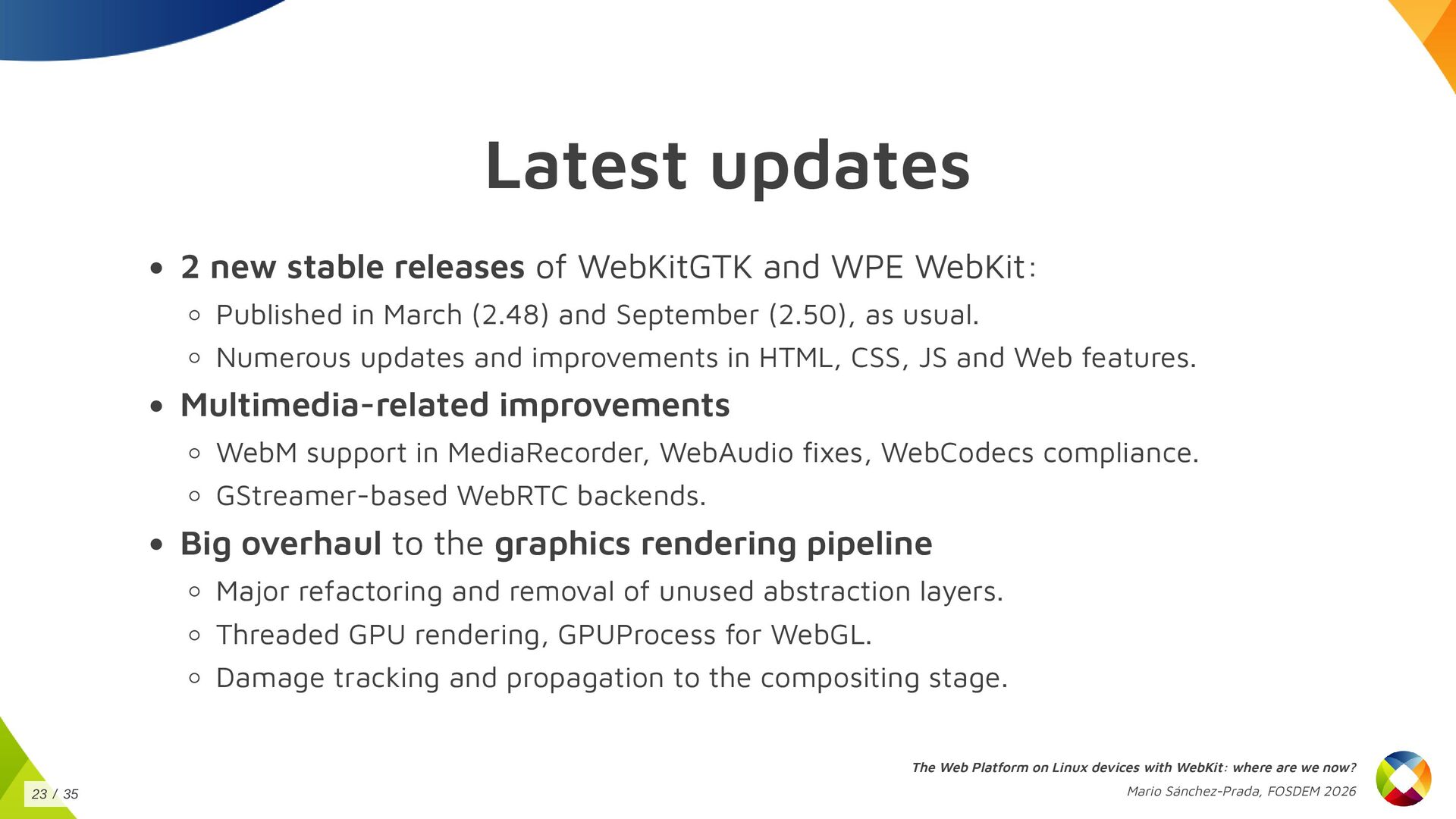
  23. Latest updates 2 new stable releases of WebKitGTK and WPE

    WebKit: Published in March (2.48) and September (2.50), as usual. Numerous updates and improvements in HTML, CSS, JS and Web features. Multimedia-related improvements WebM support in MediaRecorder, WebAudio fixes, WebCodecs compliance. GStreamer-based WebRTC backends. Big overhaul to the graphics rendering pipeline Major refactoring and removal of unused abstraction layers. Threaded GPU rendering, GPUProcess for WebGL. Damage tracking and propagation to the compositing stage. The Web Platform on Linux devices with WebKit: where are we now? Mario Sánchez-Prada, FOSDEM 2026 23 / 35
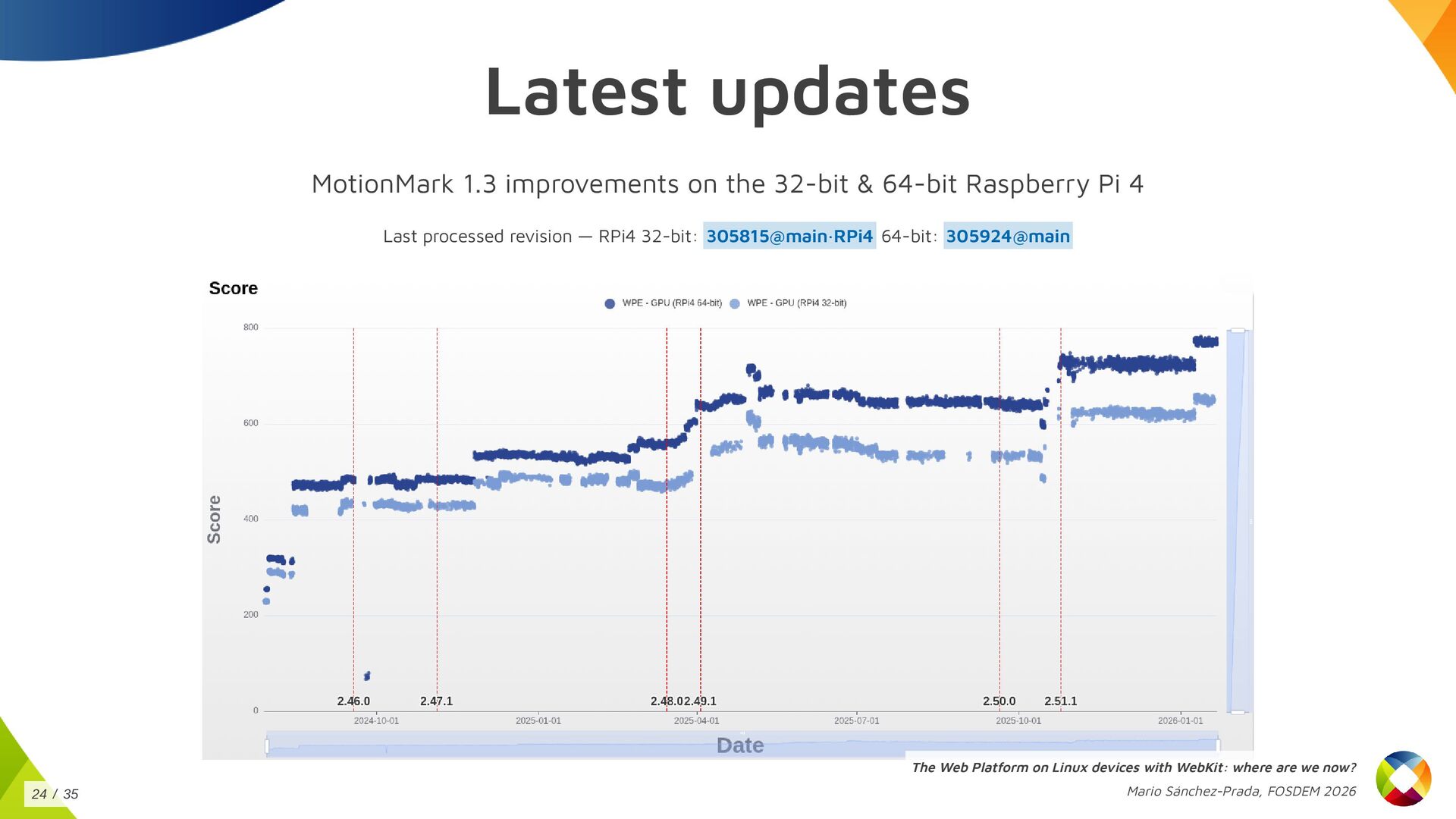
  24. Latest updates MotionMark 1.3 improvements on the 32-bit & 64-bit

    Raspberry Pi 4 Last processed revision — RPi4 32-bit: 64-bit: 305815@main·RPi4 305924@main The Web Platform on Linux devices with WebKit: where are we now? Mario Sánchez-Prada, FOSDEM 2026 24 / 35
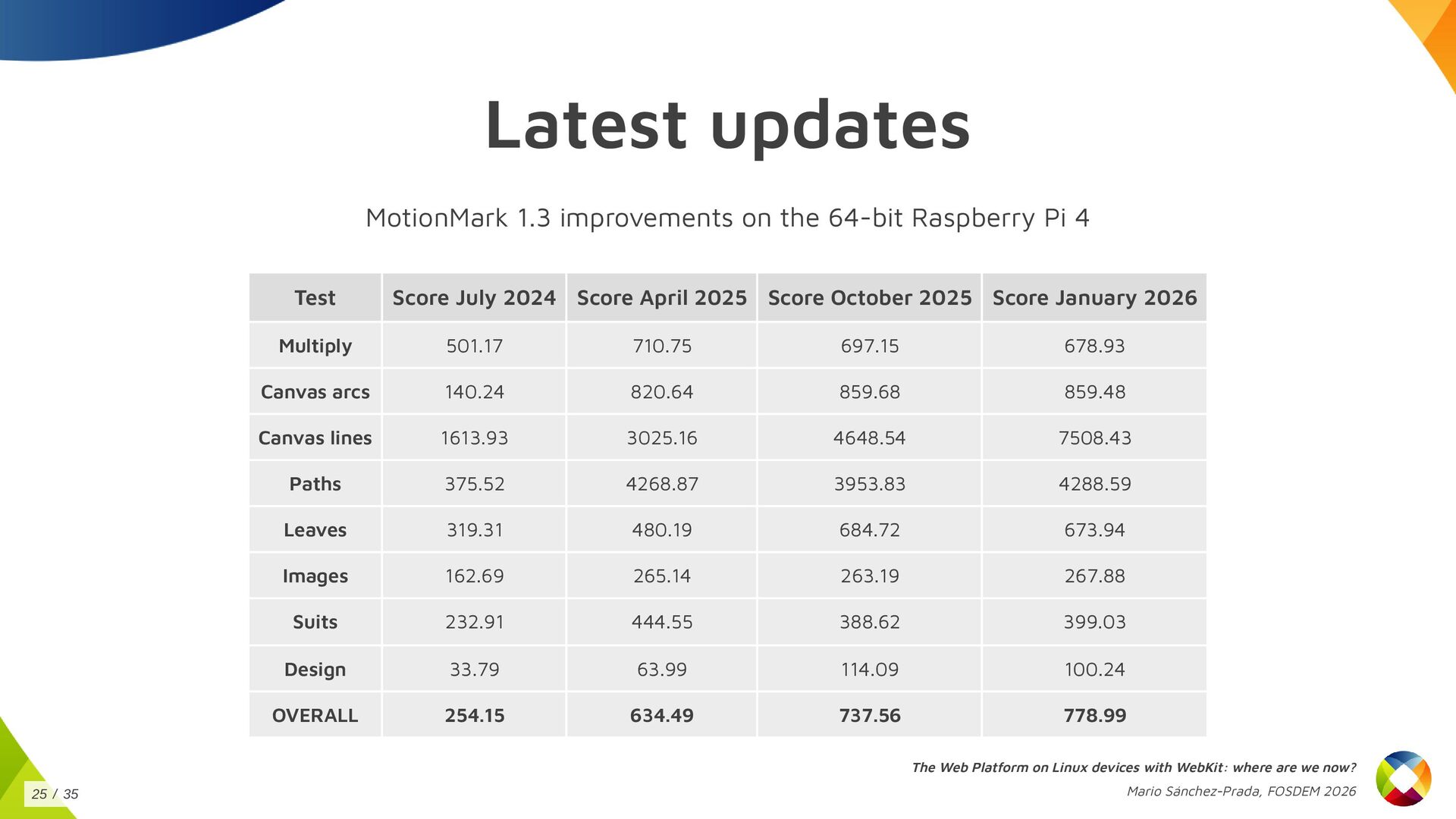
  25. Latest updates MotionMark 1.3 improvements on the 64-bit Raspberry Pi

    4 Test Score July 2024 Score April 2025 Score October 2025 Score January 2026 Multiply 501.17 710.75 697.15 678.93 Canvas arcs 140.24 820.64 859.68 859.48 Canvas lines 1613.93 3025.16 4648.54 7508.43 Paths 375.52 4268.87 3953.83 4288.59 Leaves 319.31 480.19 684.72 673.94 Images 162.69 265.14 263.19 267.88 Suits 232.91 444.55 388.62 399.03 Design 33.79 63.99 114.09 100.24 OVERALL 254.15 634.49 737.56 778.99 The Web Platform on Linux devices with WebKit: where are we now? Mario Sánchez-Prada, FOSDEM 2026 25 / 35
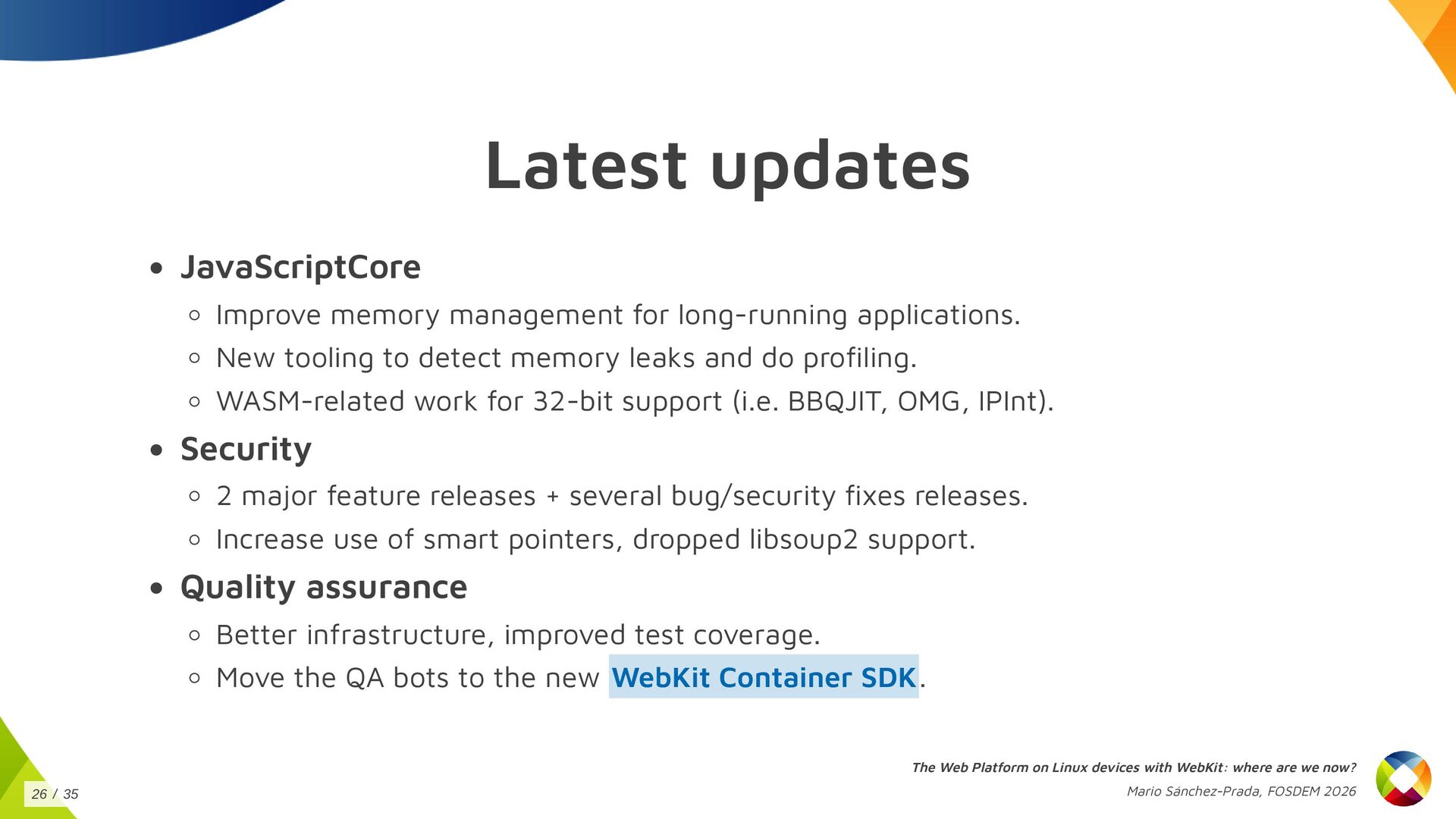
  26. Latest updates JavaScriptCore Improve memory management for long-running applications. New

    tooling to detect memory leaks and do profiling. WASM-related work for 32-bit support (i.e. BBQJIT, OMG, IPInt). Security 2 major feature releases + several bug/security fixes releases. Increase use of smart pointers, dropped libsoup2 support. Quality assurance Better infrastructure, improved test coverage. Move the QA bots to the new . WebKit Container SDK The Web Platform on Linux devices with WebKit: where are we now? Mario Sánchez-Prada, FOSDEM 2026 26 / 35
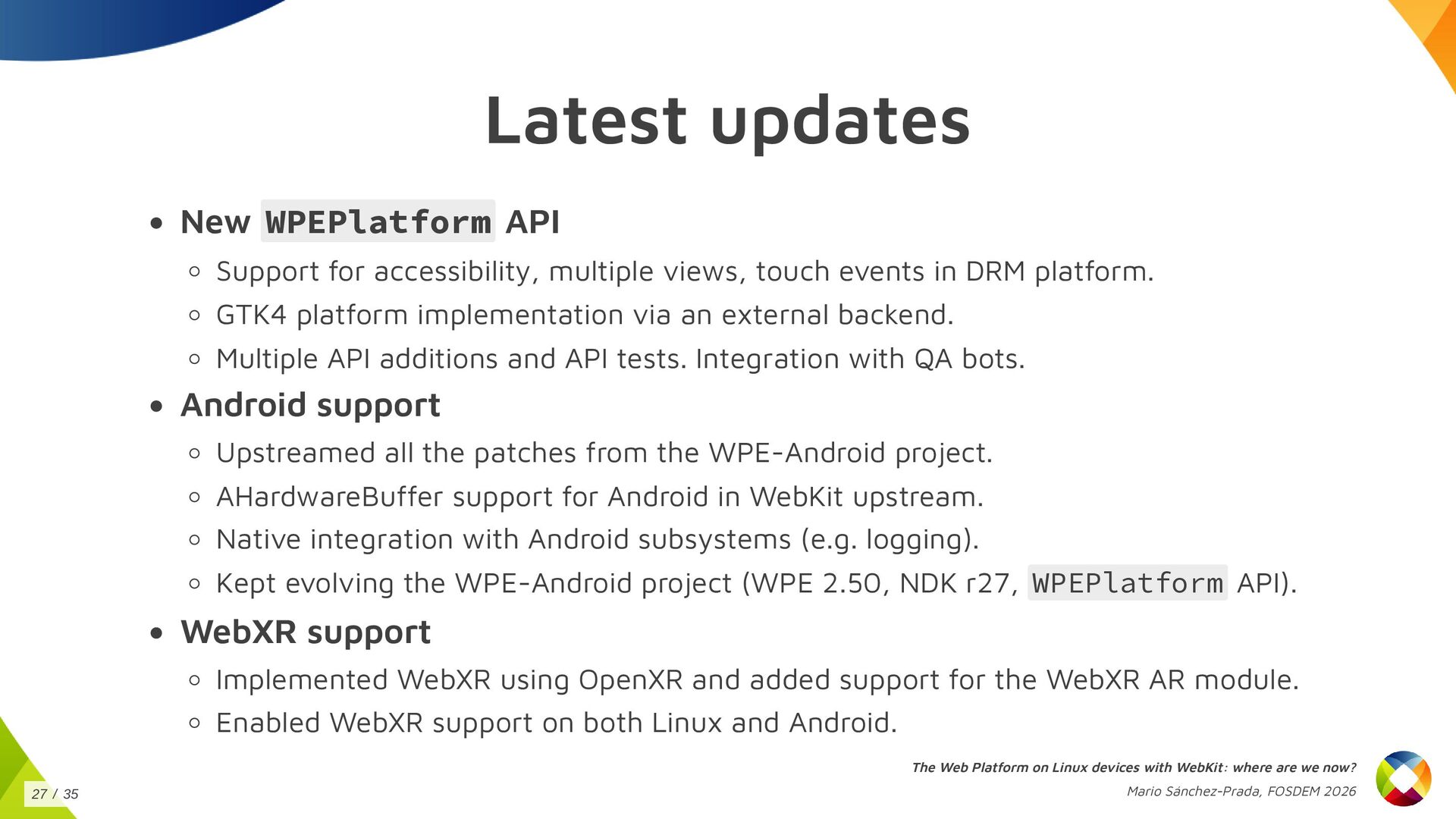
  27. Latest updates New WPEPlatform API Support for accessibility, multiple views,

    touch events in DRM platform. GTK4 platform implementation via an external backend. Multiple API additions and API tests. Integration with QA bots. Android support Upstreamed all the patches from the WPE-Android project. AHardwareBuffer support for Android in WebKit upstream. Native integration with Android subsystems (e.g. logging). Kept evolving the WPE-Android project (WPE 2.50, NDK r27, WPEPlatform API). WebXR support Implemented WebXR using OpenXR and added support for the WebXR AR module. Enabled WebXR support on both Linux and Android. The Web Platform on Linux devices with WebKit: where are we now? Mario Sánchez-Prada, FOSDEM 2026 27 / 35
  28. Next steps The Web Platform on Linux devices with WebKit:

    where are we now? Mario Sánchez-Prada, FOSDEM 2026 28 / 35
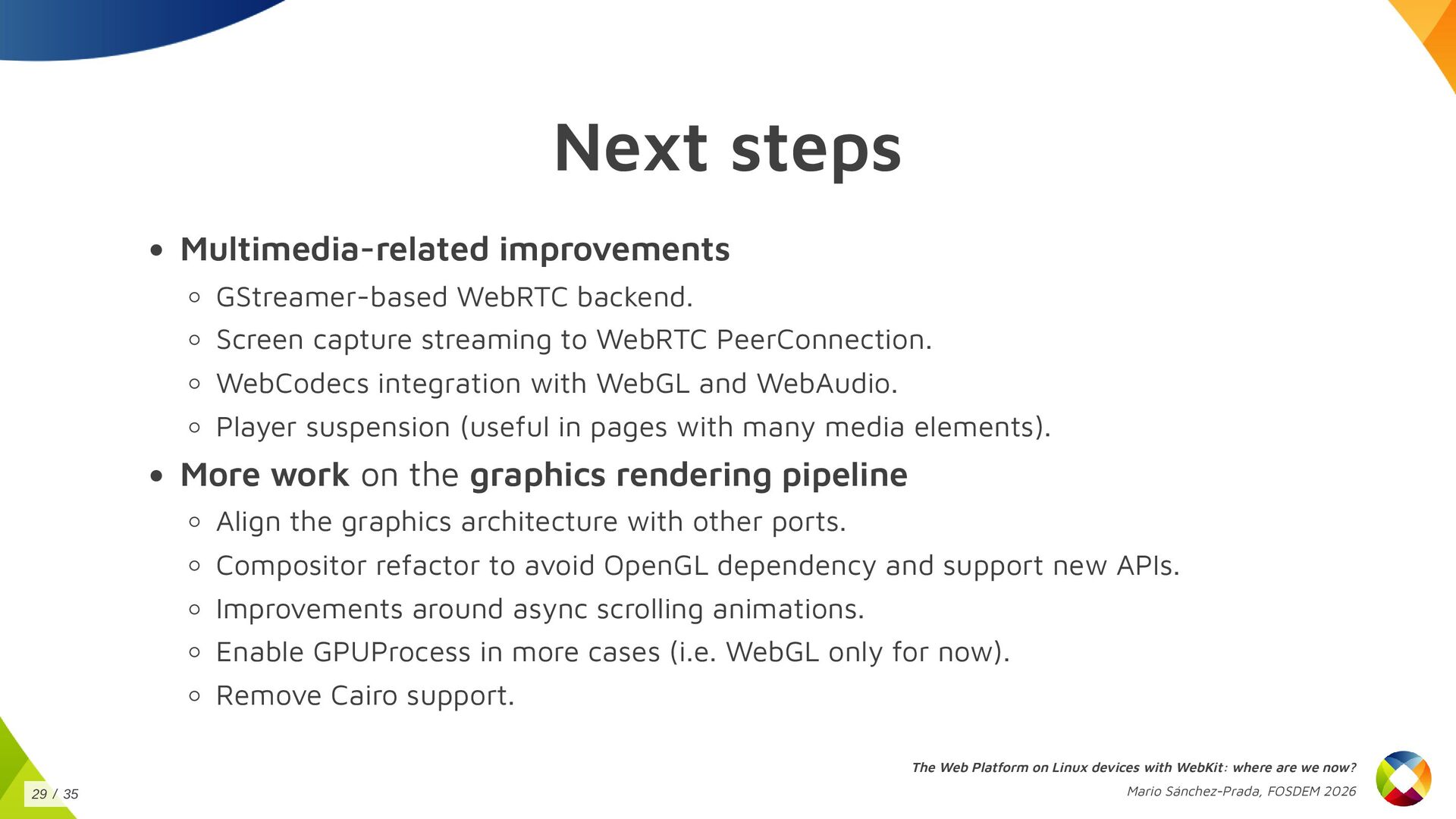
  29. Next steps Multimedia-related improvements GStreamer-based WebRTC backend. Screen capture streaming

    to WebRTC PeerConnection. WebCodecs integration with WebGL and WebAudio. Player suspension (useful in pages with many media elements). More work on the graphics rendering pipeline Align the graphics architecture with other ports. Compositor refactor to avoid OpenGL dependency and support new APIs. Improvements around async scrolling animations. Enable GPUProcess in more cases (i.e. WebGL only for now). Remove Cairo support. The Web Platform on Linux devices with WebKit: where are we now? Mario Sánchez-Prada, FOSDEM 2026 29 / 35
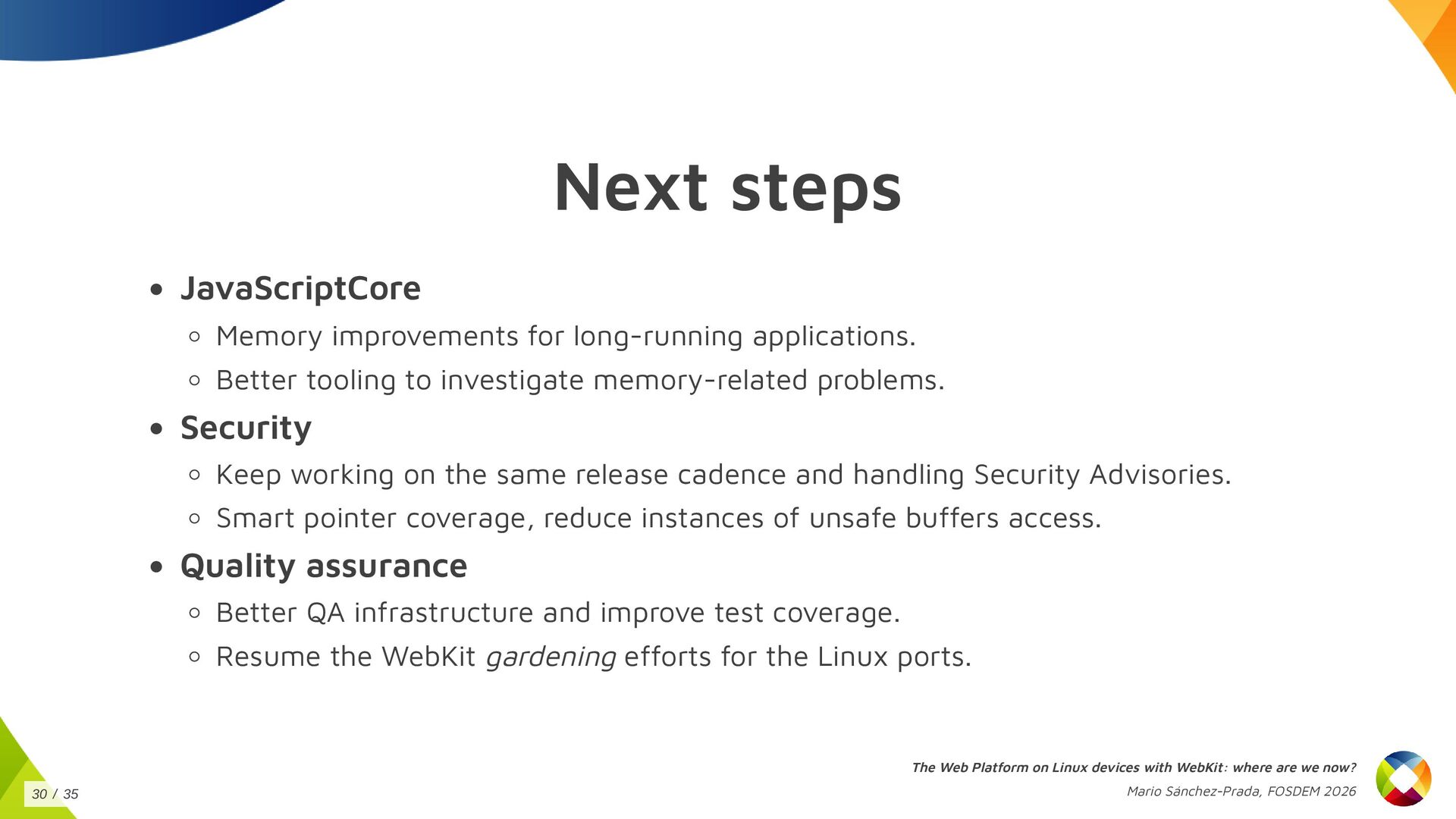
  30. Next steps JavaScriptCore Memory improvements for long-running applications. Better tooling

    to investigate memory-related problems. Security Keep working on the same release cadence and handling Security Advisories. Smart pointer coverage, reduce instances of unsafe buffers access. Quality assurance Better QA infrastructure and improve test coverage. Resume the WebKit gardening efforts for the Linux ports. The Web Platform on Linux devices with WebKit: where are we now? Mario Sánchez-Prada, FOSDEM 2026 30 / 35
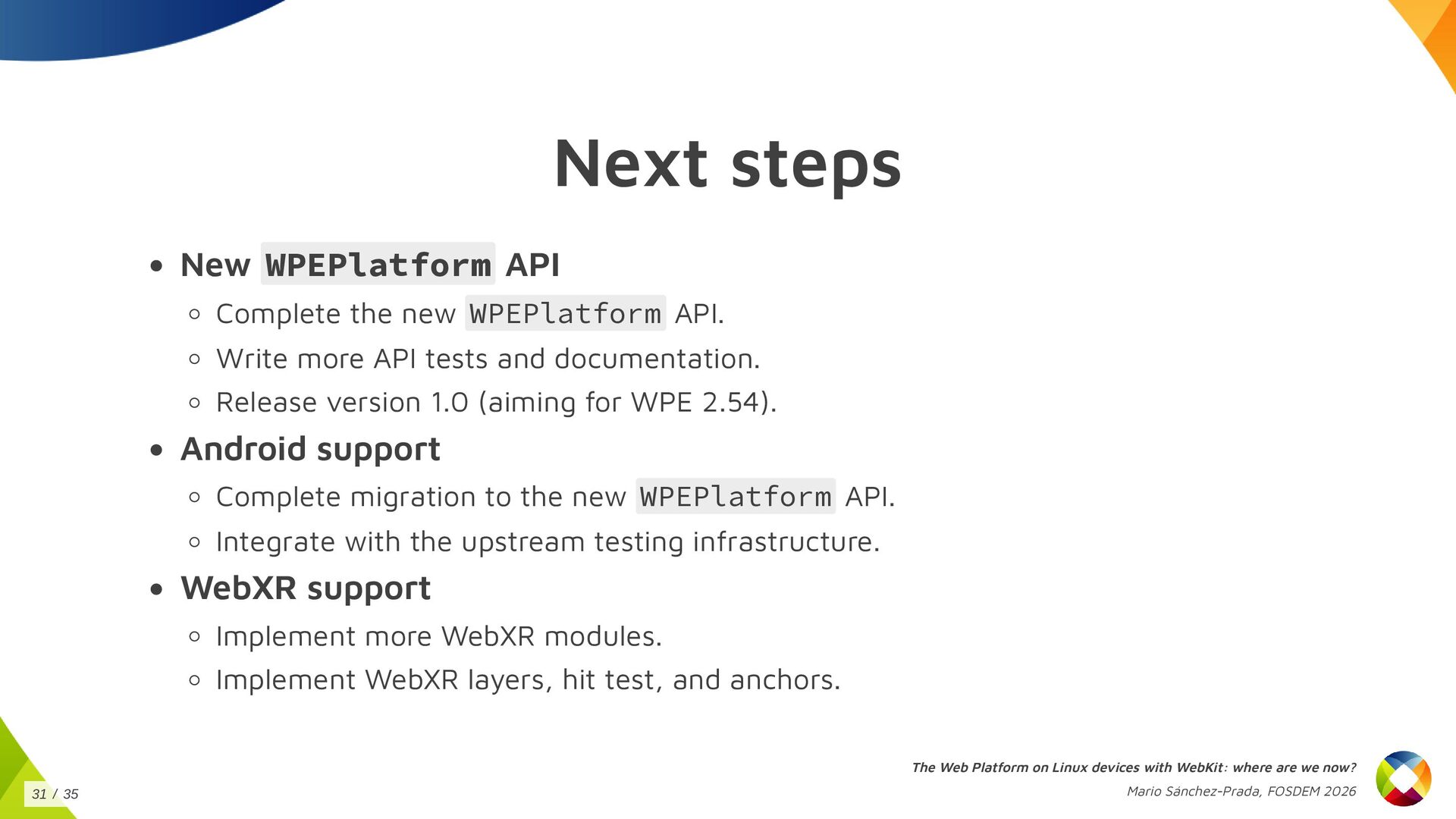
  31. Next steps New WPEPlatform API Complete the new WPEPlatform API.

    Write more API tests and documentation. Release version 1.0 (aiming for WPE 2.54). Android support Complete migration to the new WPEPlatform API. Integrate with the upstream testing infrastructure. WebXR support Implement more WebXR modules. Implement WebXR layers, hit test, and anchors. The Web Platform on Linux devices with WebKit: where are we now? Mario Sánchez-Prada, FOSDEM 2026 31 / 35
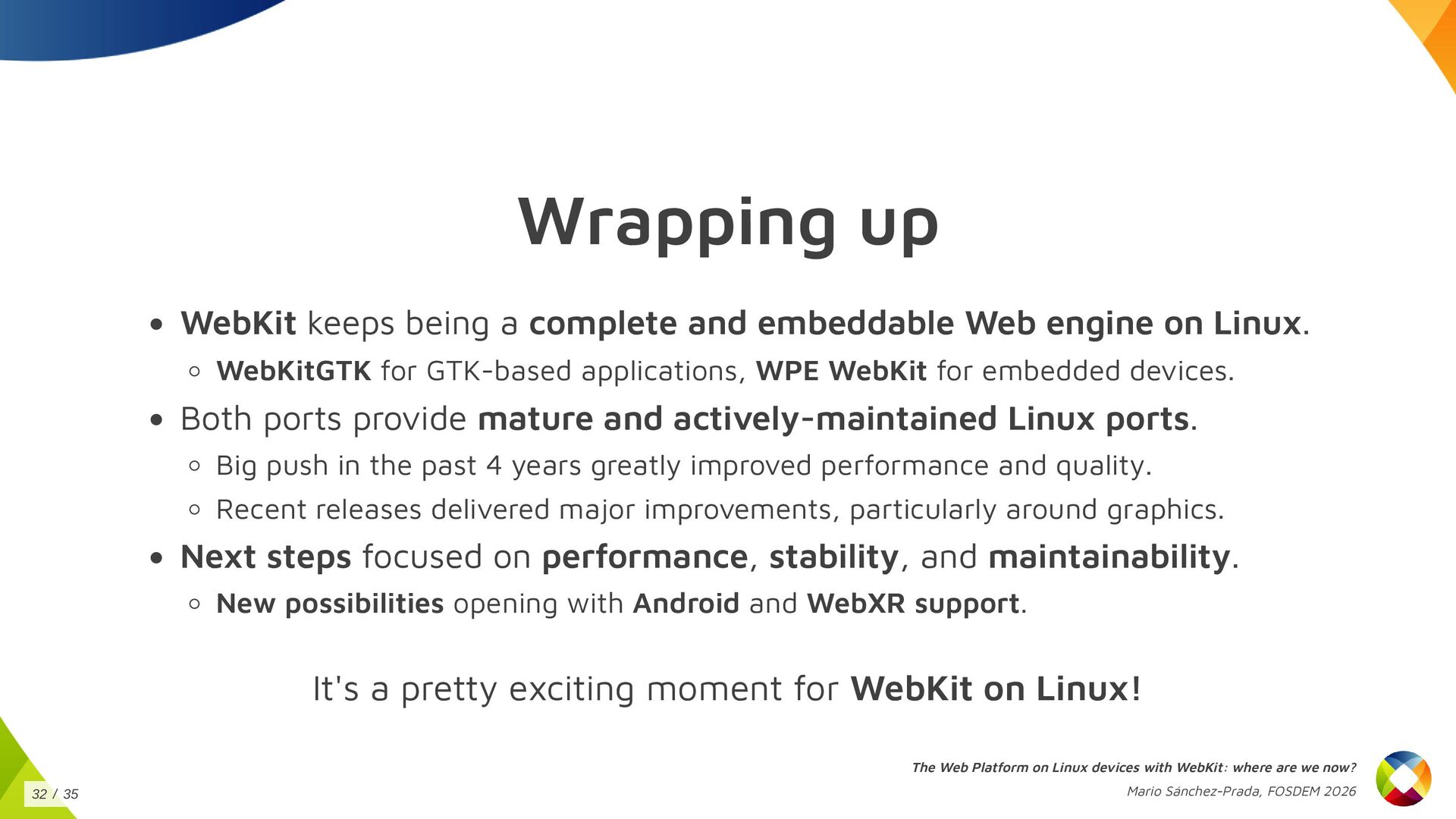
  32. Wrapping up WebKit keeps being a complete and embeddable Web

    engine on Linux. WebKitGTK for GTK-based applications, WPE WebKit for embedded devices. Both ports provide mature and actively-maintained Linux ports. Big push in the past 4 years greatly improved performance and quality. Recent releases delivered major improvements, particularly around graphics. Next steps focused on performance, stability, and maintainability. New possibilities opening with Android and WebXR support. It's a pretty exciting moment for WebKit on Linux! The Web Platform on Linux devices with WebKit: where are we now? Mario Sánchez-Prada, FOSDEM 2026 32 / 35
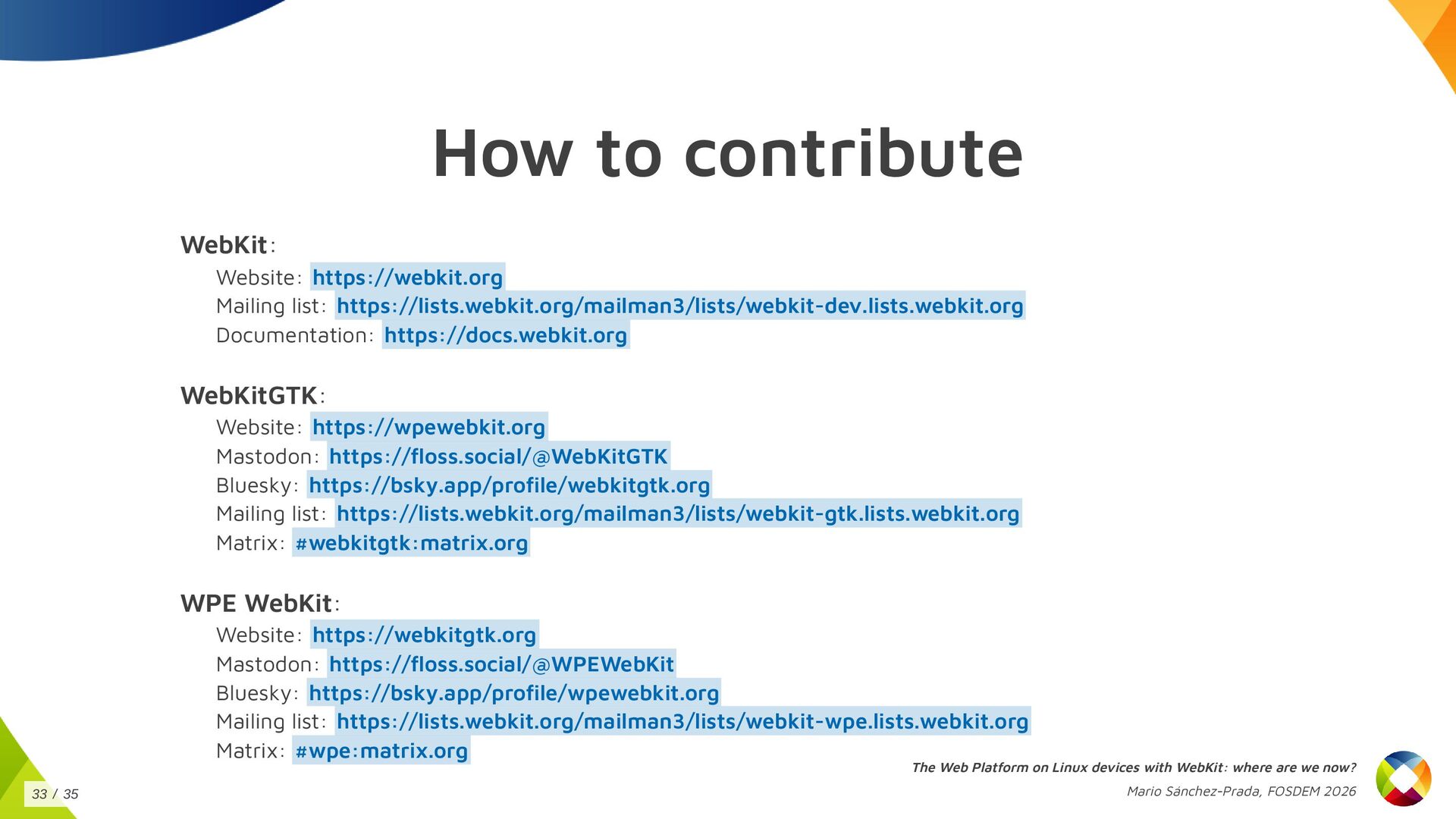
  33. How to contribute WebKit: Website: Mailing list: Documentation: WebKitGTK: Website:

    Mastodon: Bluesky: Mailing list: Matrix: WPE WebKit: Website: Mastodon: Bluesky: Mailing list: Matrix: https://webkit.org https://lists.webkit.org/mailman3/lists/webkit-dev.lists.webkit.org https://docs.webkit.org https://wpewebkit.org https://floss.social/@WebKitGTK https://bsky.app/profile/webkitgtk.org https://lists.webkit.org/mailman3/lists/webkit-gtk.lists.webkit.org #webkitgtk:matrix.org https://webkitgtk.org https://floss.social/@WPEWebKit https://bsky.app/profile/wpewebkit.org https://lists.webkit.org/mailman3/lists/webkit-wpe.lists.webkit.org #wpe:matrix.org The Web Platform on Linux devices with WebKit: where are we now? Mario Sánchez-Prada, FOSDEM 2026 33 / 35
  34. Questions? Mario Sánchez-Prada [email protected] The Web Platform on Linux devices

    with WebKit: where are we now? Mario Sánchez-Prada, FOSDEM 2026 34 / 35