AI Impact From trusted data sharing to AI-ready companies Anil Turkmayali Head of Research and Innovation Programs International Data Spaces Association (IDSA)
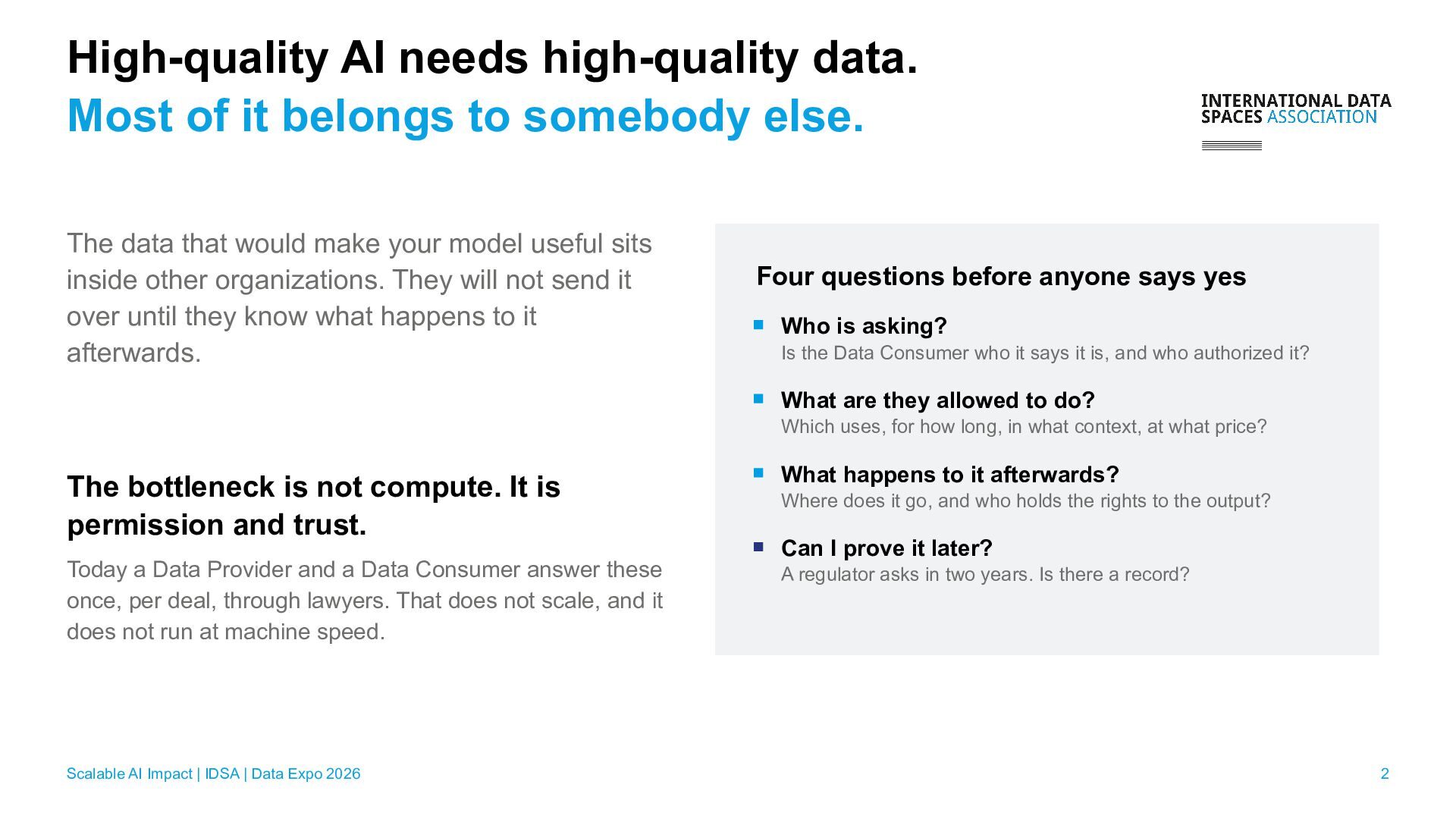
somebody else. The data that would make your model useful sits inside other organizations. They will not send it over until they know what happens to it afterwards. Four questions before anyone says yes Who is asking? Is the Data Consumer who it says it is, and who authorized it? What are they allowed to do? Which uses, for how long, in what context, at what price? The bottleneck is not compute. It is permission and trust. Today a Data Provider and a Data Consumer answer these once, per deal, through lawyers. That does not scale, and it does not run at machine speed. Scalable AI Impact | IDSA | Data Expo 2026 What happens to it afterwards? Where does it go, and who holds the rights to the output? Can I prove it later? A regulator asks in two years. Is there a record? 2
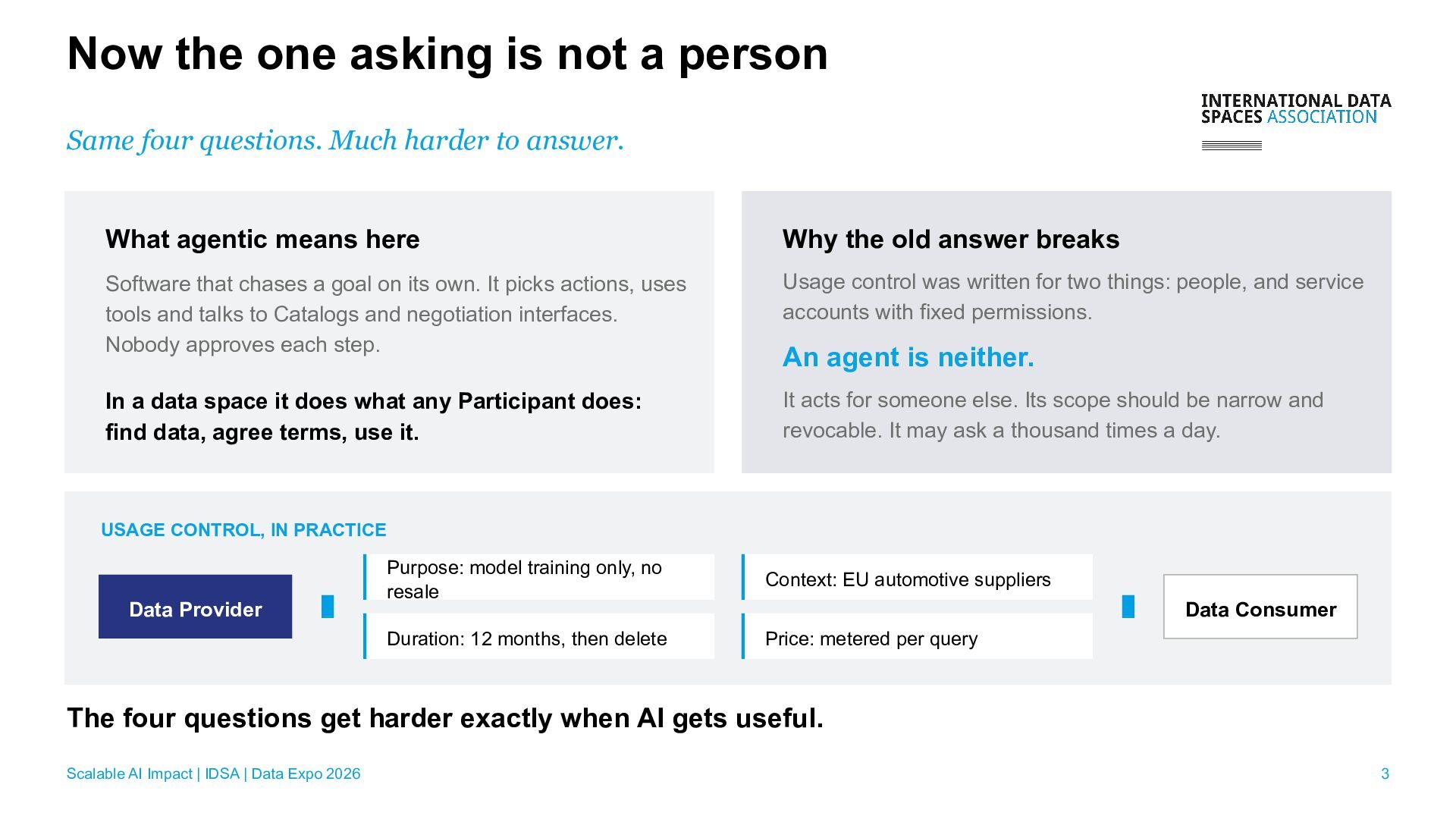
questions. Much harder to answer. What agentic means here Why the old answer breaks Software that chases a goal on its own. It picks actions, uses tools and talks to Catalogs and negotiation interfaces. Nobody approves each step. Usage control was written for two things: people, and service accounts with fixed permissions. In a data space it does what any Participant does: find data, agree terms, use it. It acts for someone else. Its scope should be narrow and revocable. It may ask a thousand times a day. An agent is neither. USAGE CONTROL, IN PRACTICE Data Provider Purpose: model training only, no resale Context: EU automotive suppliers Duration: 12 months, then delete Price: metered per query Data Consumer The four questions get harder exactly when AI gets useful. Scalable AI Impact | IDSA | Data Expo 2026 3
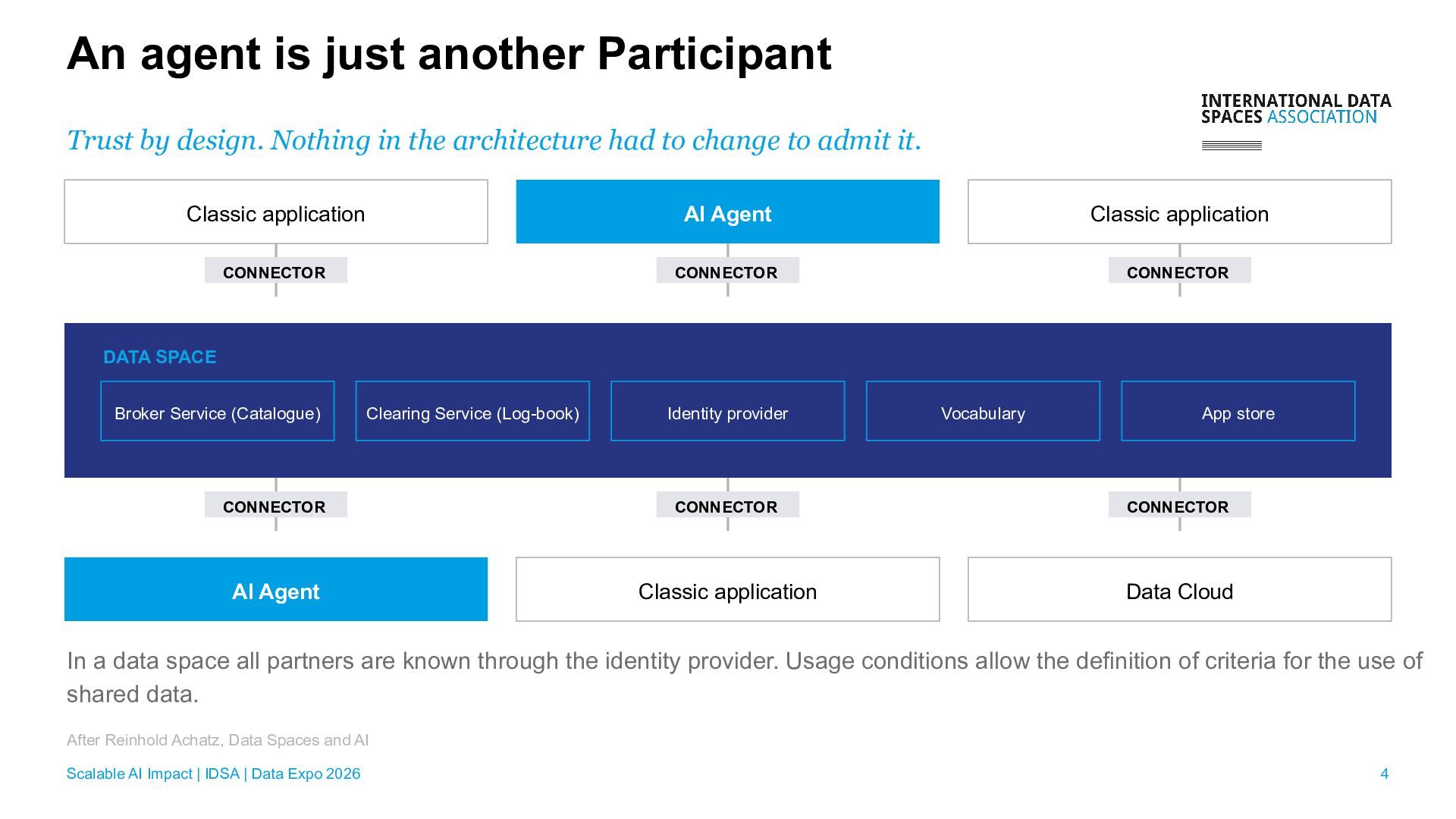
in the architecture had to change to admit it. Classic application AI Agent Classic application CONNECTOR CONNECTOR CONNECTOR DATA SPACE Broker Service (Catalogue) Clearing Service (Log-book) Identity provider Vocabulary App store CONNECTOR CONNECTOR CONNECTOR AI Agent Classic application Data Cloud In a data space all partners are known through the identity provider. Usage conditions allow the definition of criteria for the use of shared data. After Reinhold Achatz, Data Spaces and AI Scalable AI Impact | IDSA | Data Expo 2026 4
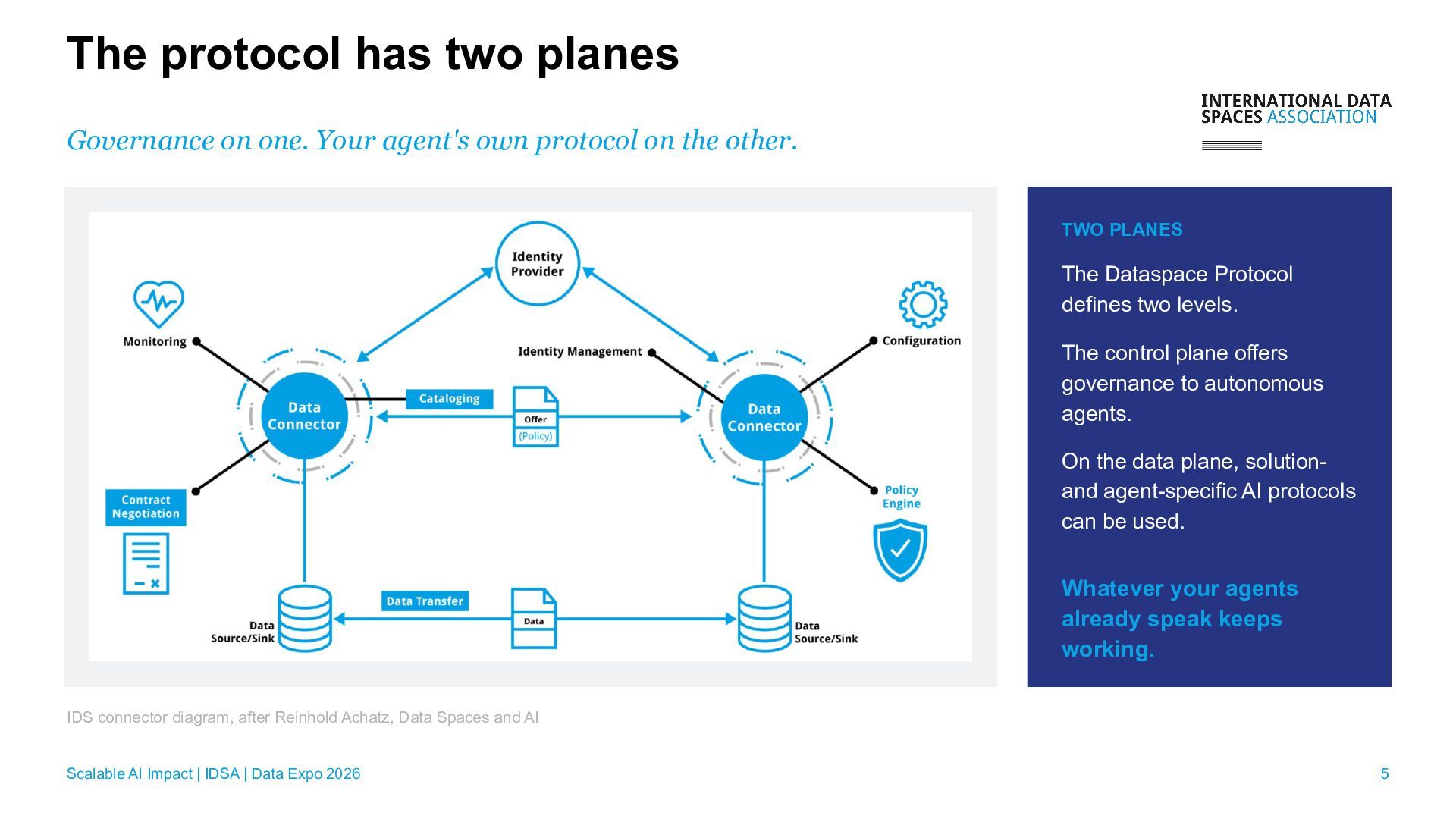
own protocol on the other. TWO PLANES The Dataspace Protocol defines two levels. The control plane offers governance to autonomous agents. On the data plane, solutionand agent-specific AI protocols can be used. Whatever your agents already speak keeps working. IDS connector diagram, after Reinhold Achatz, Data Spaces and AI Scalable AI Impact | IDSA | Data Expo 2026 5
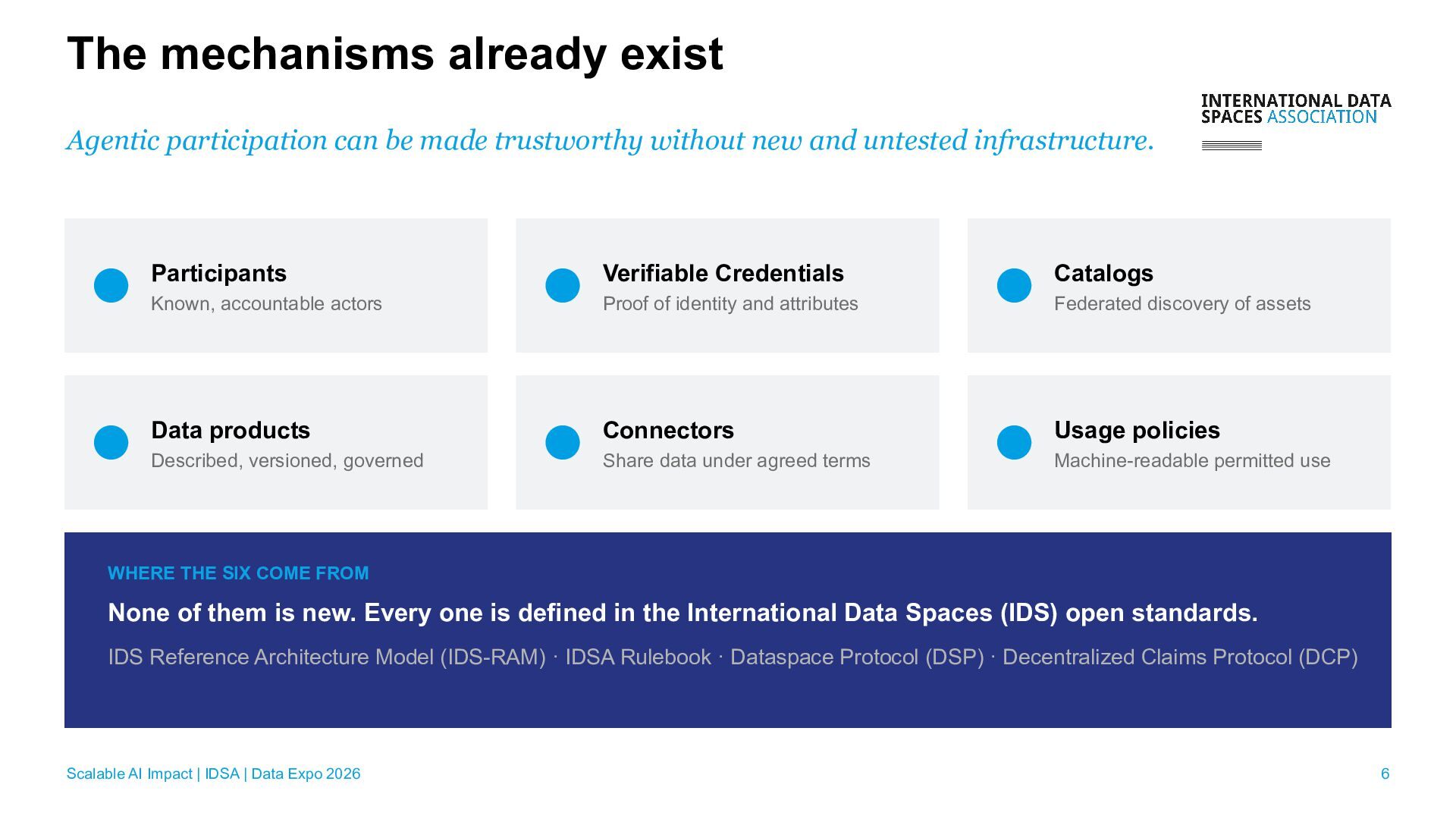
without new and untested infrastructure. Participants Verifiable Credentials Catalogs Known, accountable actors Proof of identity and attributes Federated discovery of assets Data products Connectors Usage policies Described, versioned, governed Share data under agreed terms Machine-readable permitted use WHERE THE SIX COME FROM None of them is new. Every one is defined in the International Data Spaces (IDS) open standards. IDS Reference Architecture Model (IDS-RAM) · IDSA Rulebook · Dataspace Protocol (DSP) · Decentralized Claims Protocol (DCP) Scalable AI Impact | IDSA | Data Expo 2026 6
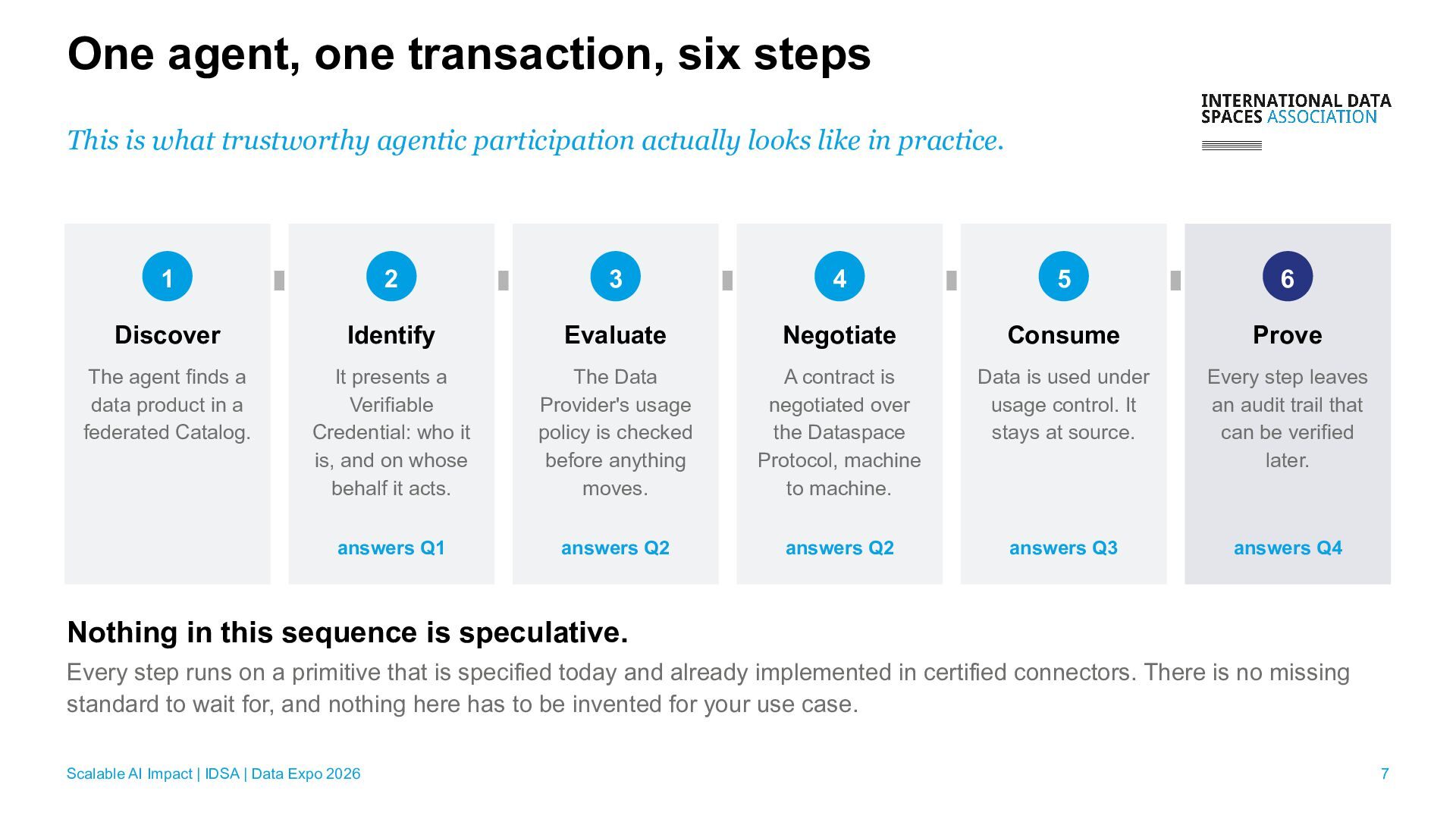
agentic participation actually looks like in practice. 1 2 3 4 5 6 Discover Identify Evaluate Negotiate Consume Prove The agent finds a data product in a federated Catalog. It presents a Verifiable Credential: who it is, and on whose behalf it acts. The Data Provider's usage policy is checked before anything moves. A contract is negotiated over the Dataspace Protocol, machine to machine. Data is used under usage control. It stays at source. Every step leaves an audit trail that can be verified later. answers Q1 answers Q2 answers Q2 answers Q3 answers Q4 Nothing in this sequence is speculative. Every step runs on a primitive that is specified today and already implemented in certified connectors. There is no missing standard to wait for, and nothing here has to be invented for your use case. Scalable AI Impact | IDSA | Data Expo 2026 7
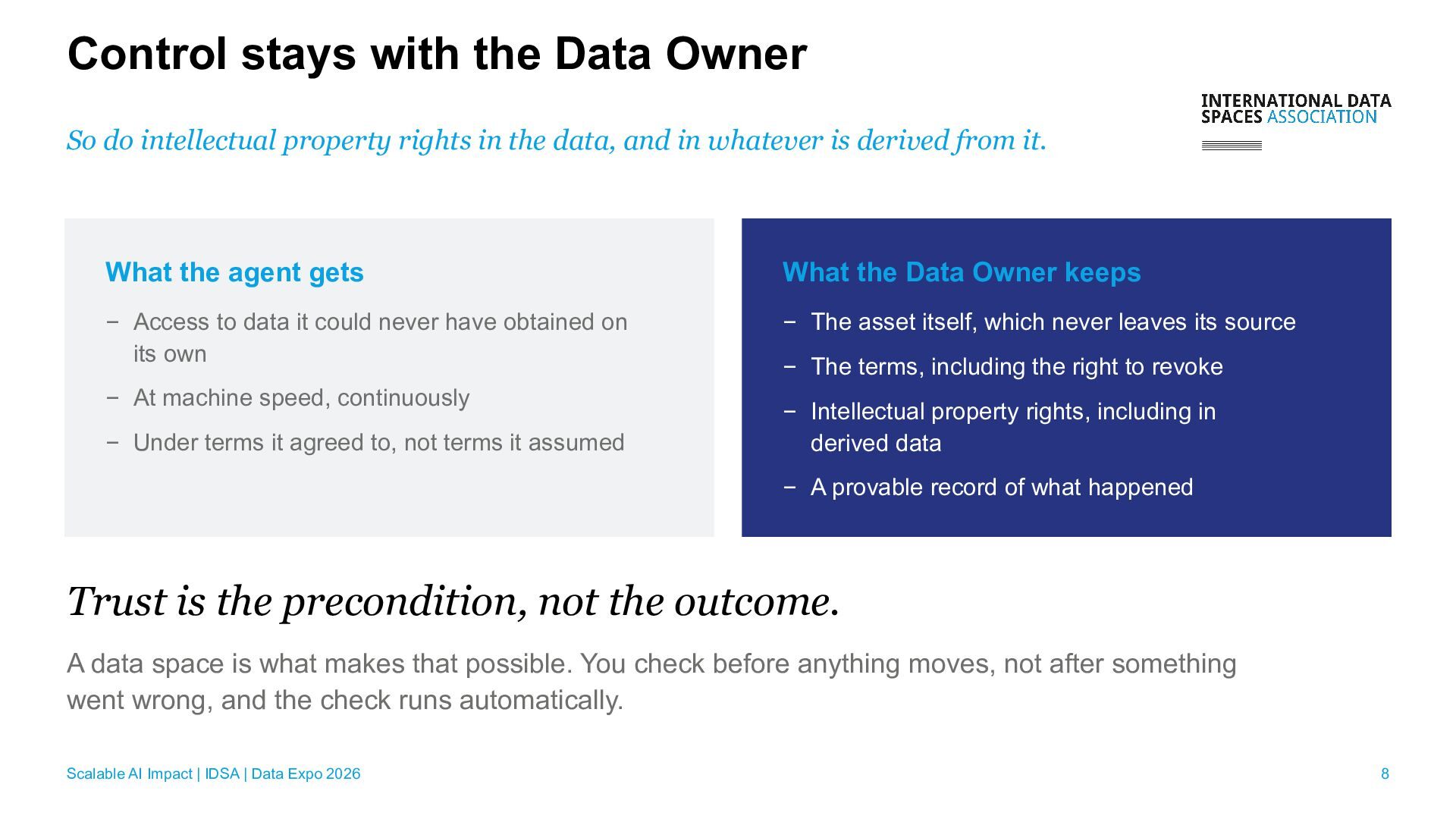
rights in the data, and in whatever is derived from it. What the agent gets What the Data Owner keeps − Access to data it could never have obtained on its own − The asset itself, which never leaves its source − At machine speed, continuously − Under terms it agreed to, not terms it assumed − The terms, including the right to revoke − Intellectual property rights, including in derived data − A provable record of what happened Trust is the precondition, not the outcome. A data space is what makes that possible. You check before anything moves, not after something went wrong, and the check runs automatically. Scalable AI Impact | IDSA | Data Expo 2026 8
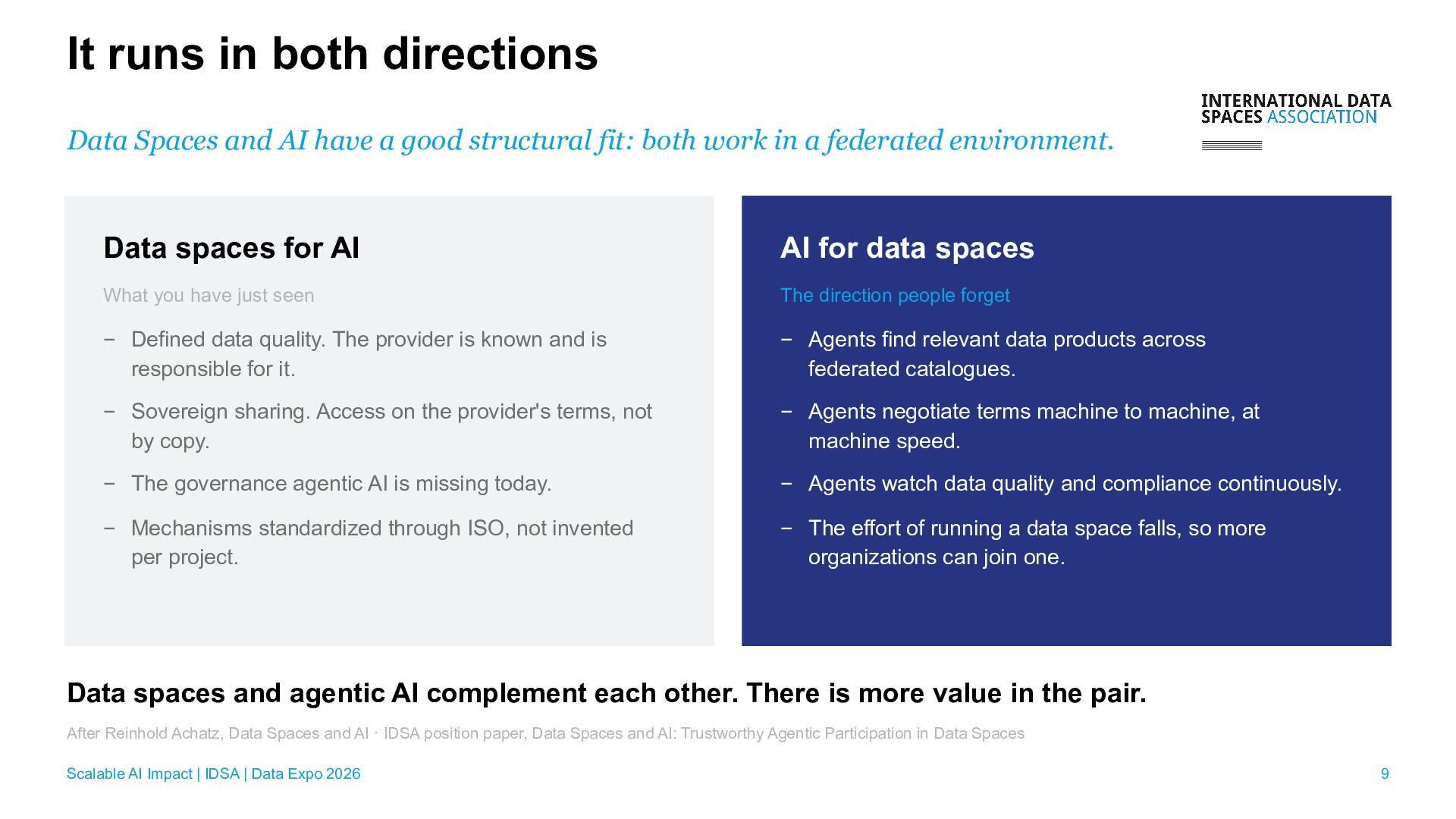
a good structural fit: both work in a federated environment. Data spaces for AI AI for data spaces What you have just seen The direction people forget − Defined data quality. The provider is known and is responsible for it. − Agents find relevant data products across federated catalogues. − Sovereign sharing. Access on the provider's terms, not by copy. − Agents negotiate terms machine to machine, at machine speed. − The governance agentic AI is missing today. − Agents watch data quality and compliance continuously. − Mechanisms standardized through ISO, not invented per project. − The effort of running a data space falls, so more organizations can join one. Data spaces and agentic AI complement each other. There is more value in the pair. After Reinhold Achatz, Data Spaces and AI · IDSA position paper, Data Spaces and AI: Trustworthy Agentic Participation in Data Spaces Scalable AI Impact | IDSA | Data Expo 2026 9
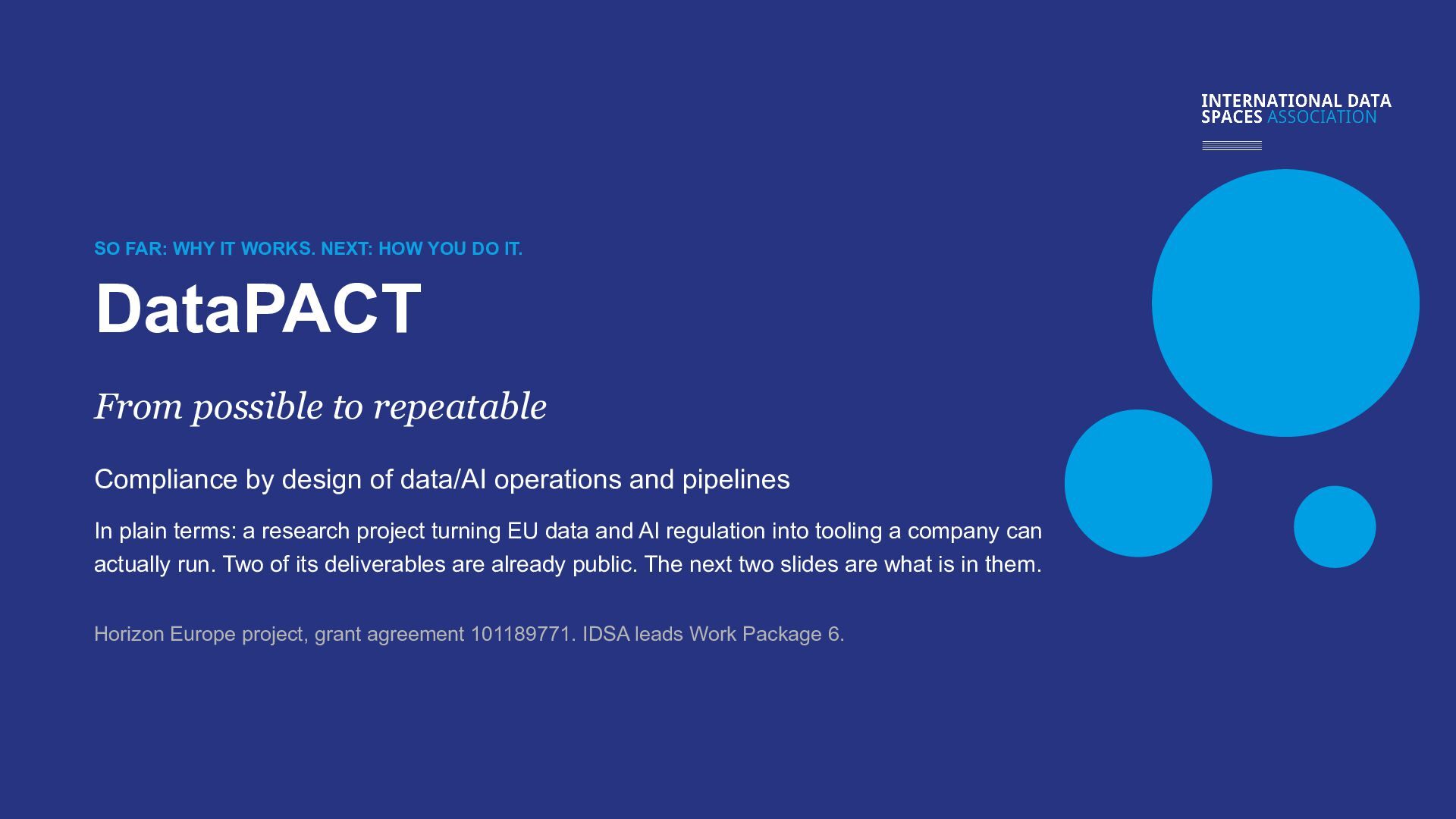
DataPACT From possible to repeatable Compliance by design of data/AI operations and pipelines In plain terms: a research project turning EU data and AI regulation into tooling a company can actually run. Two of its deliverables are already public. The next two slides are what is in them. Horizon Europe project, grant agreement 101189771. IDSA leads Work Package 6.
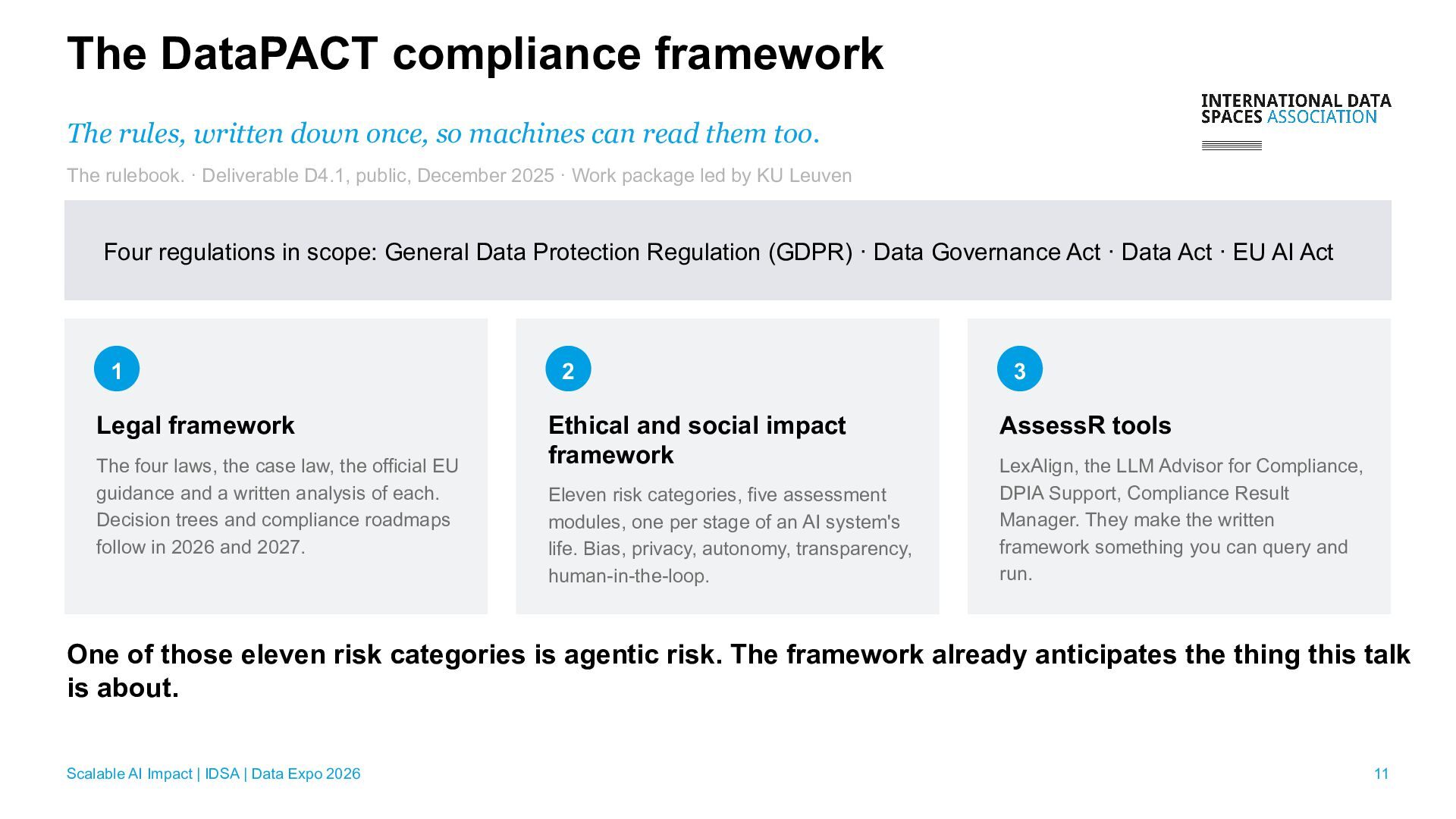
machines can read them too. The rulebook. · Deliverable D4.1, public, December 2025 · Work package led by KU Leuven Four regulations in scope: General Data Protection Regulation (GDPR) · Data Governance Act · Data Act · EU AI Act 1 2 3 Legal framework Ethical and social impact framework AssessR tools The four laws, the case law, the official EU guidance and a written analysis of each. Decision trees and compliance roadmaps follow in 2026 and 2027. Eleven risk categories, five assessment modules, one per stage of an AI system's life. Bias, privacy, autonomy, transparency, human-in-the-loop. LexAlign, the LLM Advisor for Compliance, DPIA Support, Compliance Result Manager. They make the written framework something you can query and run. One of those eleven risk categories is agentic risk. The framework already anticipates the thing this talk is about. Scalable AI Impact | IDSA | Data Expo 2026 11
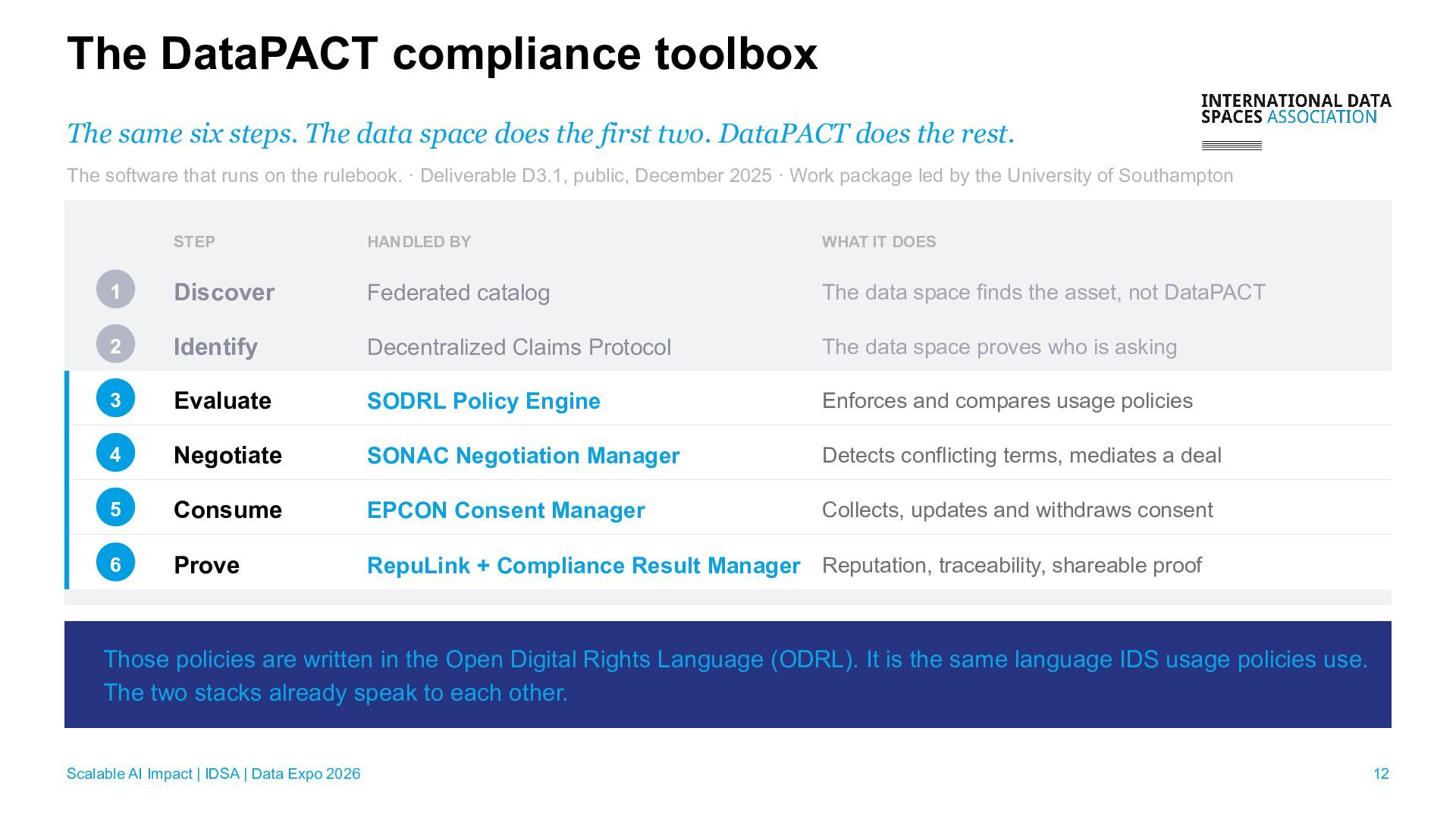
space does the first two. DataPACT does the rest. The software that runs on the rulebook. · Deliverable D3.1, public, December 2025 · Work package led by the University of Southampton STEP HANDLED BY WHAT IT DOES 1 Discover Federated catalog The data space finds the asset, not DataPACT 2 Identify Decentralized Claims Protocol The data space proves who is asking 3 Evaluate SODRL Policy Engine Enforces and compares usage policies 4 Negotiate SONAC Negotiation Manager Detects conflicting terms, mediates a deal 5 Consume EPCON Consent Manager Collects, updates and withdraws consent 6 Prove RepuLink + Compliance Result Manager Reputation, traceability, shareable proof Those policies are written in the Open Digital Rights Language (ODRL). It is the same language IDS usage policies use. The two stacks already speak to each other. Scalable AI Impact | IDSA | Data Expo 2026 12
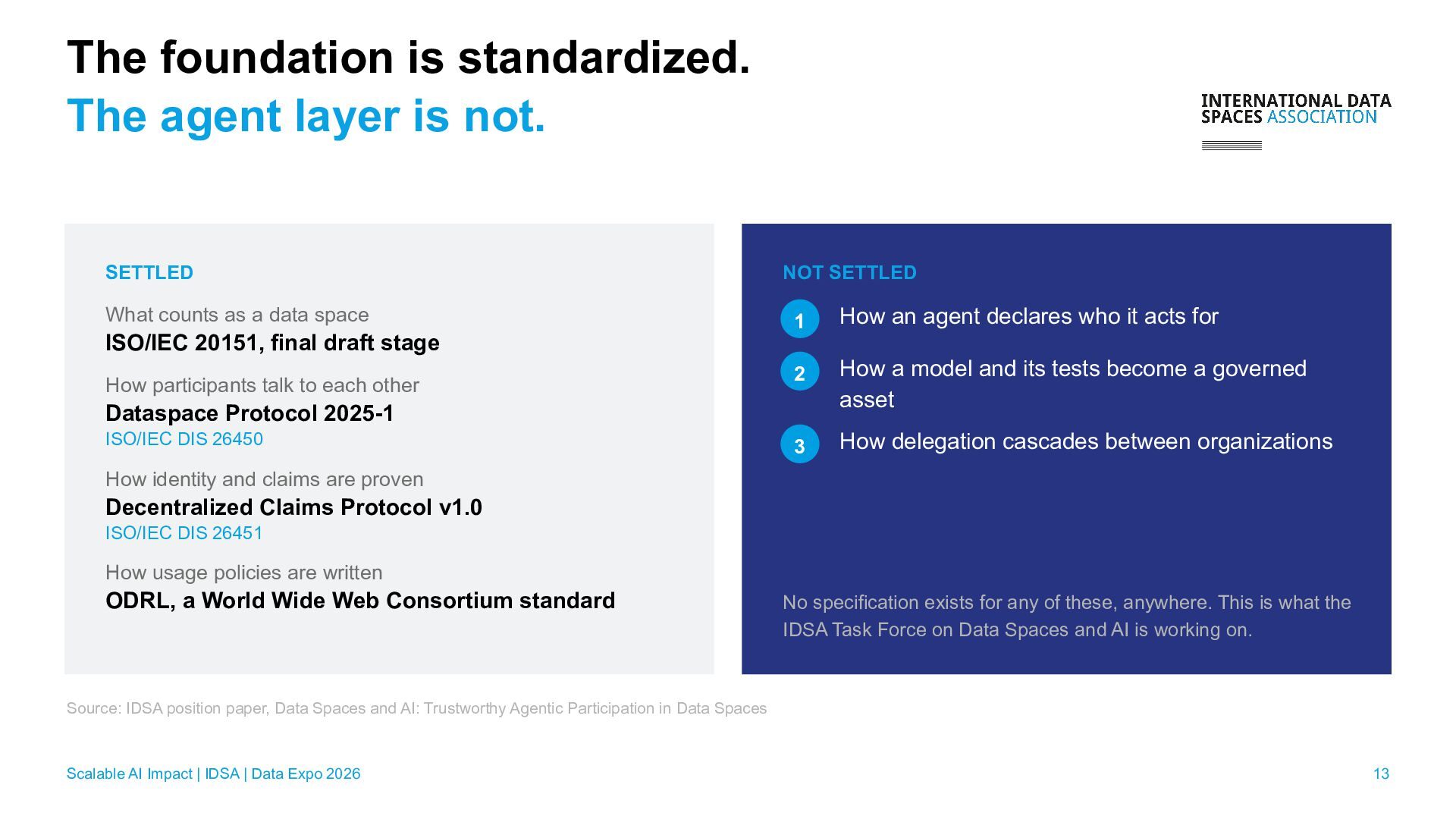
NOT SETTLED What counts as a data space 1 How an agent declares who it acts for 2 How a model and its tests become a governed asset 3 How delegation cascades between organizations ISO/IEC 20151, final draft stage How participants talk to each other Dataspace Protocol 2025-1 ISO/IEC DIS 26450 How identity and claims are proven Decentralized Claims Protocol v1.0 ISO/IEC DIS 26451 How usage policies are written ODRL, a World Wide Web Consortium standard No specification exists for any of these, anywhere. This is what the IDSA Task Force on Data Spaces and AI is working on. Source: IDSA position paper, Data Spaces and AI: Trustworthy Agentic Participation in Data Spaces Scalable AI Impact | IDSA | Data Expo 2026 13
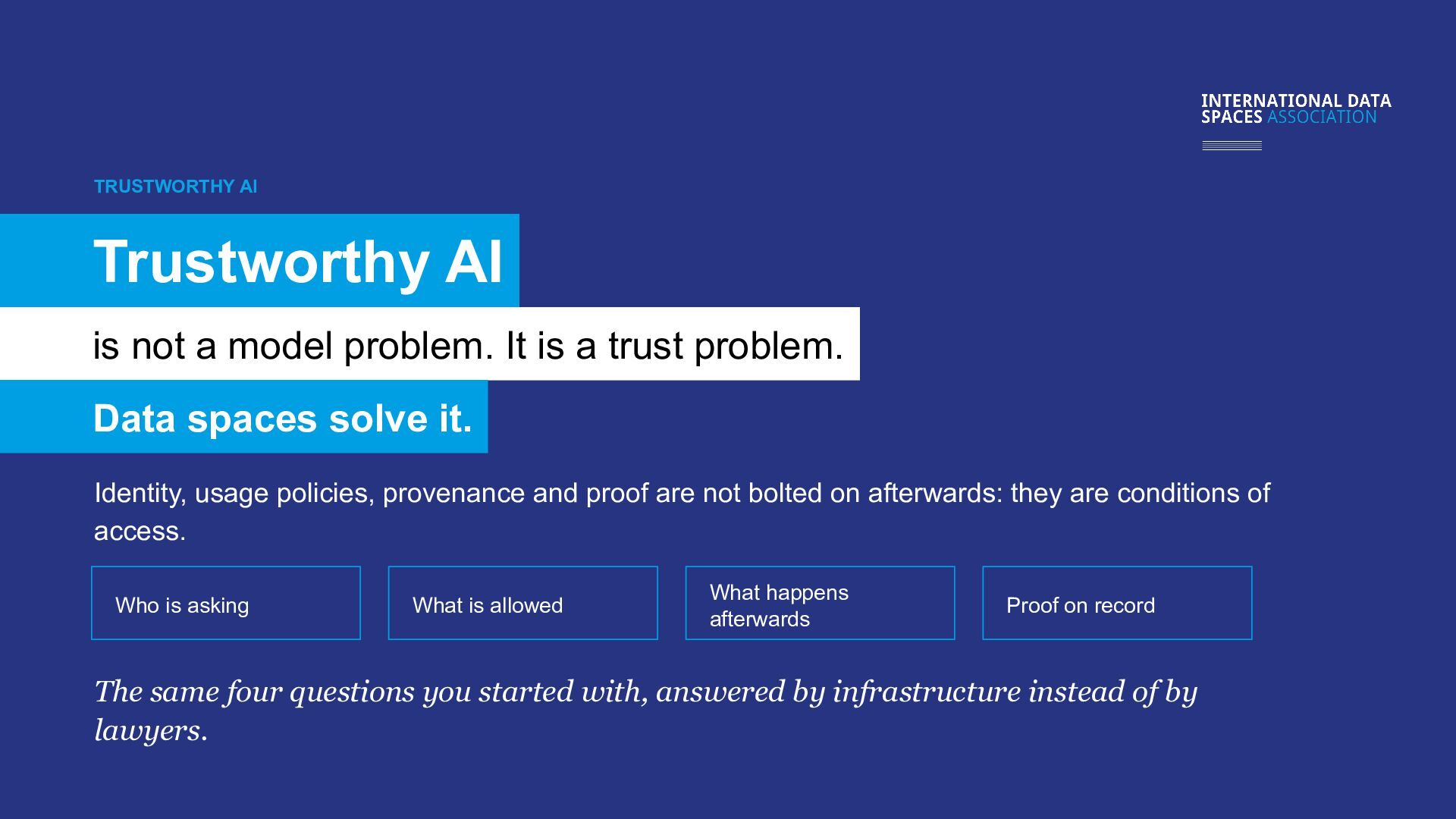
is a trust problem. Data spaces solve it. Identity, usage policies, provenance and proof are not bolted on afterwards: they are conditions of access. Who is asking What is allowed What happens afterwards Proof on record The same four questions you started with, answered by infrastructure instead of by lawyers.
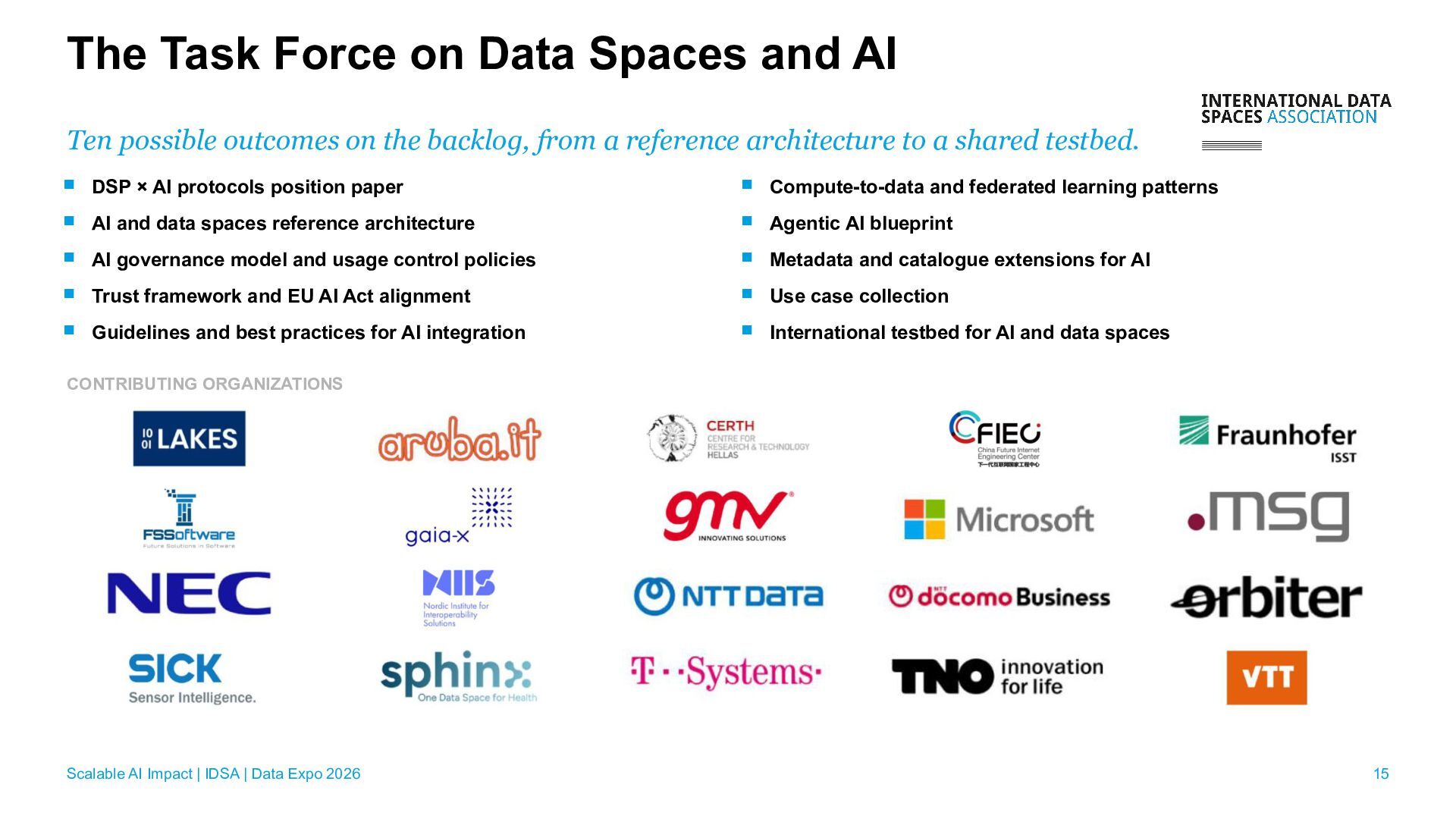
outcomes on the backlog, from a reference architecture to a shared testbed. DSP × AI protocols position paper Compute-to-data and federated learning patterns AI and data spaces reference architecture Agentic AI blueprint AI governance model and usage control policies Metadata and catalogue extensions for AI Trust framework and EU AI Act alignment Use case collection Guidelines and best practices for AI integration International testbed for AI and data spaces CONTRIBUTING ORGANIZATIONS Scalable AI Impact | IDSA | Data Expo 2026 15
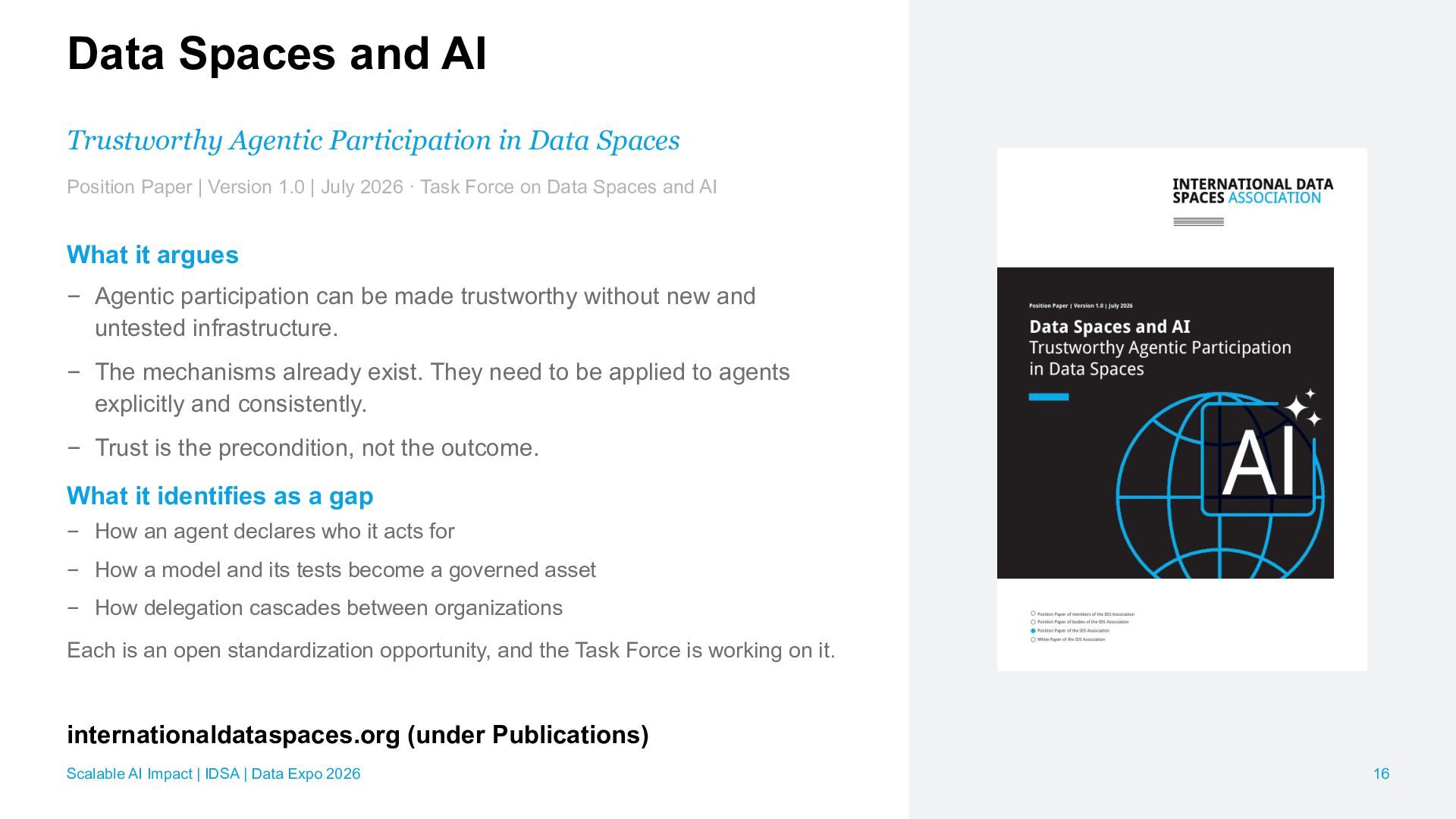
Position Paper | Version 1.0 | July 2026 · Task Force on Data Spaces and AI What it argues − Agentic participation can be made trustworthy without new and untested infrastructure. − The mechanisms already exist. They need to be applied to agents explicitly and consistently. − Trust is the precondition, not the outcome. What it identifies as a gap − How an agent declares who it acts for − How a model and its tests become a governed asset − How delegation cascades between organizations Each is an open standardization opportunity, and the Task Force is working on it. internationaldataspaces.org (under Publications) Scalable AI Impact | IDSA | Data Expo 2026 16
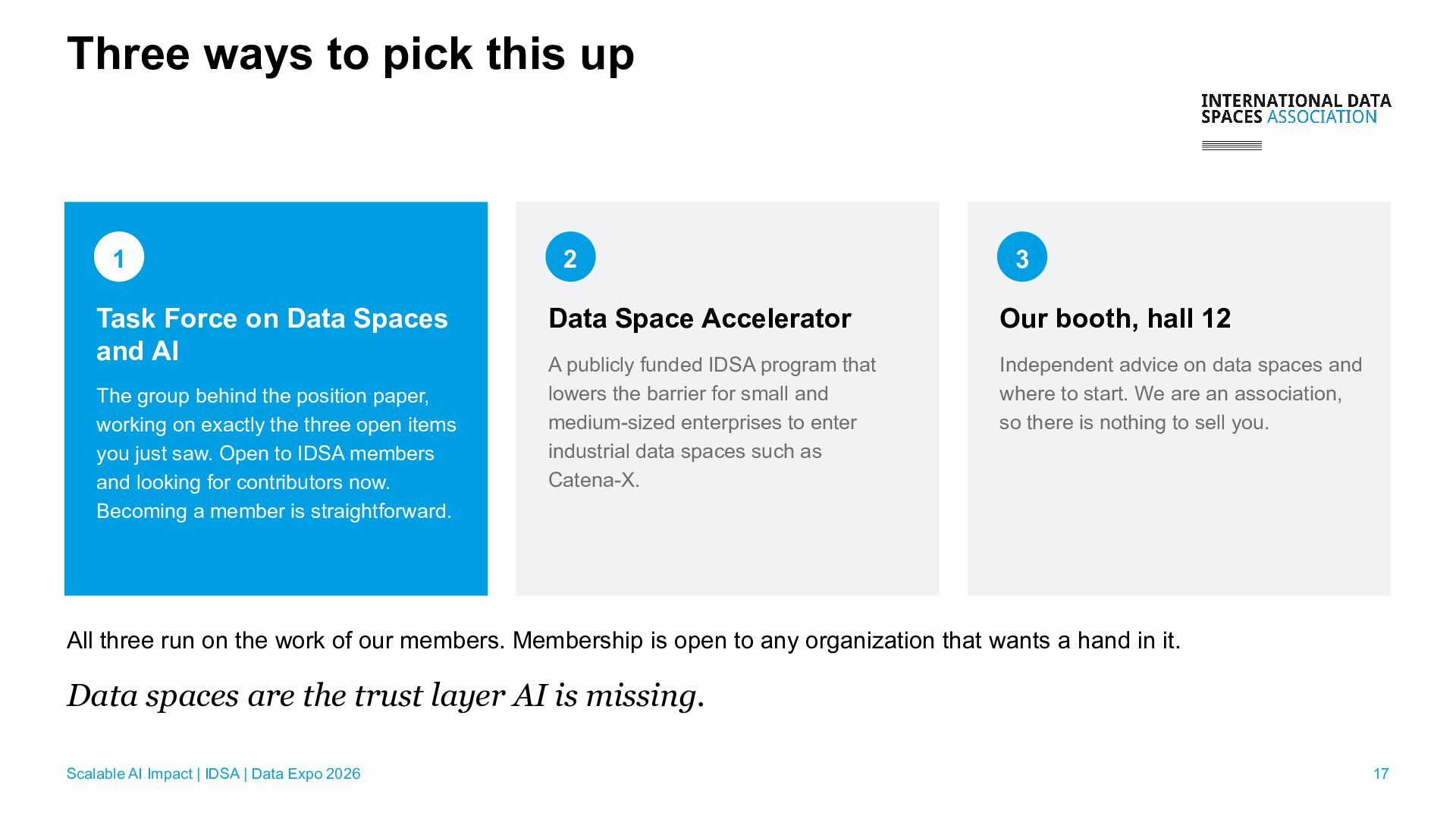
Force on Data Spaces and AI Data Space Accelerator Our booth, hall 12 A publicly funded IDSA program that lowers the barrier for small and medium-sized enterprises to enter industrial data spaces such as Catena-X. Independent advice on data spaces and where to start. We are an association, so there is nothing to sell you. The group behind the position paper, working on exactly the three open items you just saw. Open to IDSA members and looking for contributors now. Becoming a member is straightforward. All three run on the work of our members. Membership is open to any organization that wants a hand in it. Data spaces are the trust layer AI is missing. Scalable AI Impact | IDSA | Data Expo 2026 17
needs good data. Trusted sharing is how you get it. Data Spaces and AI: Trustworthy Agentic Participation in Data Spaces IDSA position paper [email protected] · Booth, hall 12


 mark3t1ng
 bkeepers
 tonyrice
 katarinadahlin
 palkan
 sergeychernyshev
 3n
3n
 raygrieselhuber
 techseoconnect
 sarafernandez
 jnunemaker
 tamaranovitovic