Upgrade to Pro — share decks privately, control downloads, hide ads and more …

I love async but I can't code like this

Sponsored · Ship Features Fearlessly Turn features on and off without deploys. Used by thousands of Ruby developers. →
masylum
August 09, 2012

I love async but I can't code like this

Writing javascript asynchronous programs can be a pain in the ass. I want to share some patterns that may help you.

masylum

August 09, 2012

Transcript

31 slides
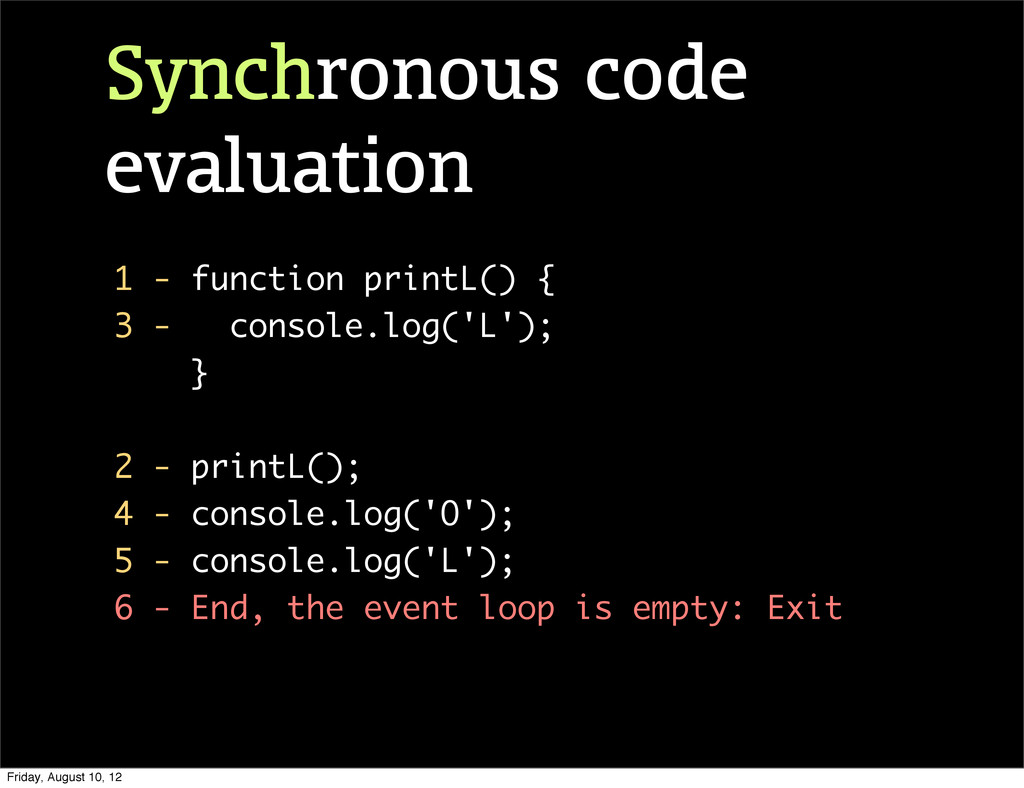
  1. Synchronous code evaluation 1 - function printL() { 3 -

    console.log('L'); } 2 - printL(); 4 - console.log('O'); 5 - console.log('L'); 6 - End, the event loop is empty: Exit Friday, August 10, 12
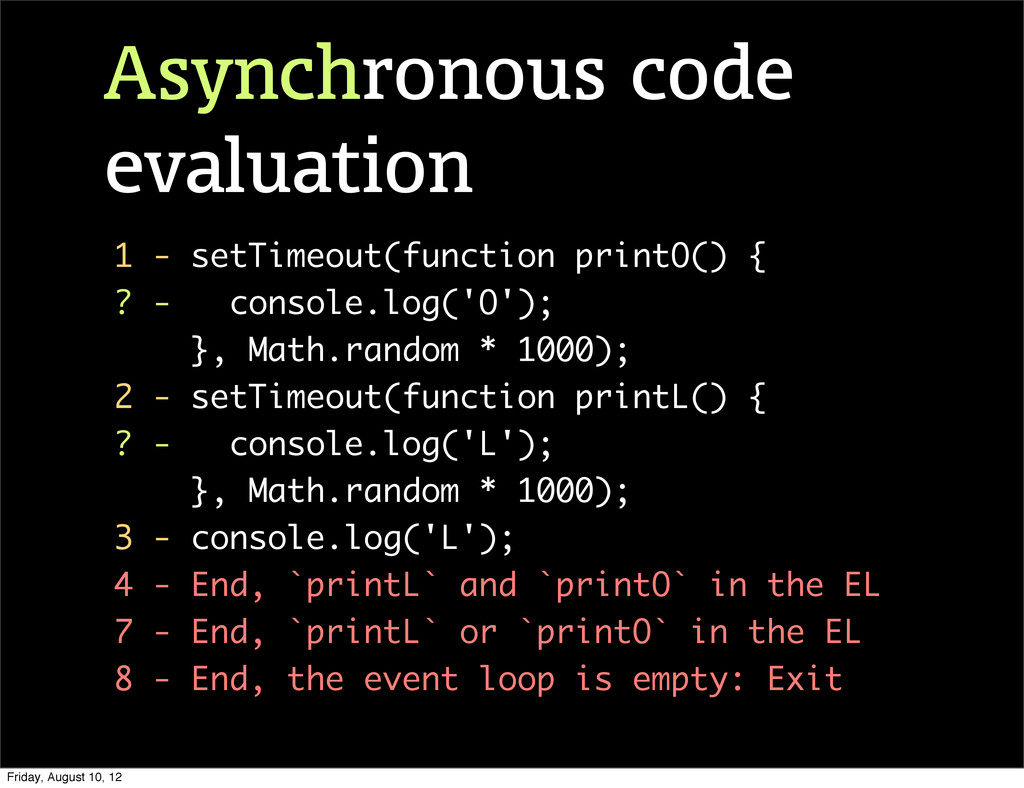
  2. Asynchronous code evaluation 1 - setTimeout(function printO() { ? -

    console.log('O'); }, Math.random * 1000); 2 - setTimeout(function printL() { ? - console.log('L'); }, Math.random * 1000); 3 - console.log('L'); 4 - End, `printL` and `printO` in the EL 7 - End, `printL` or `printO` in the EL 8 - End, the event loop is empty: Exit Friday, August 10, 12
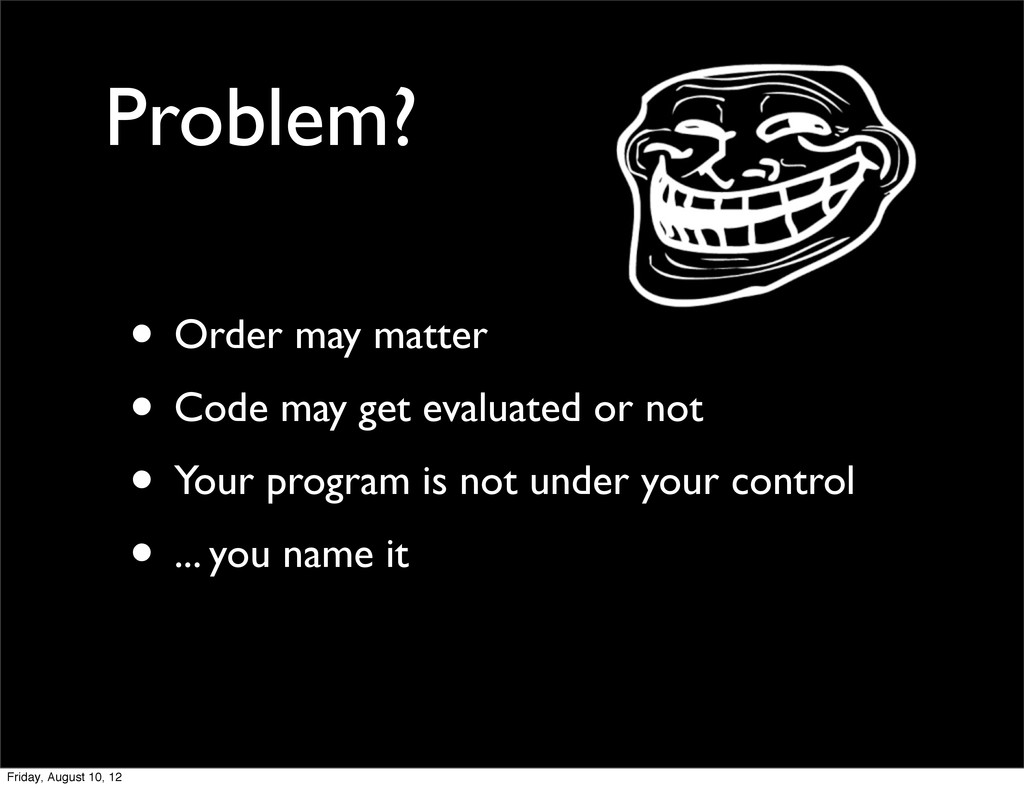
  3. Problem? • Order may matter • Code may get evaluated

    or not • Your program is not under your control • ... you name it Friday, August 10, 12
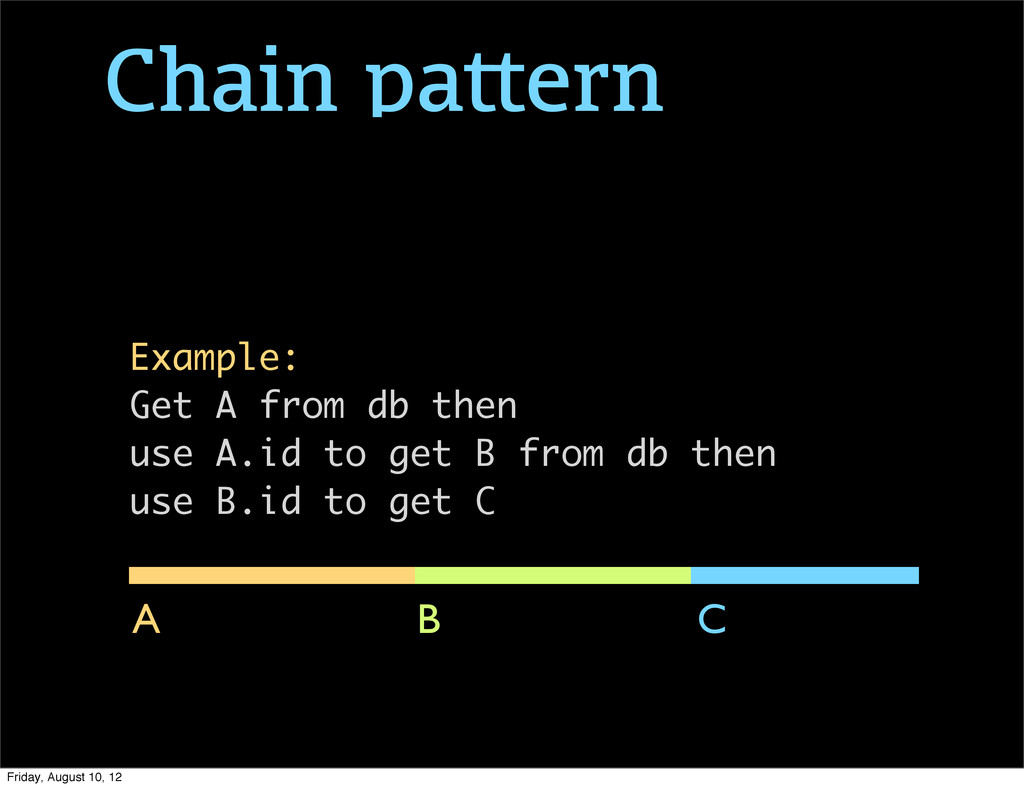
  4. Example: Get A from db then use A.id to get

    B from db then use B.id to get C A B C Chain pattern Friday, August 10, 12
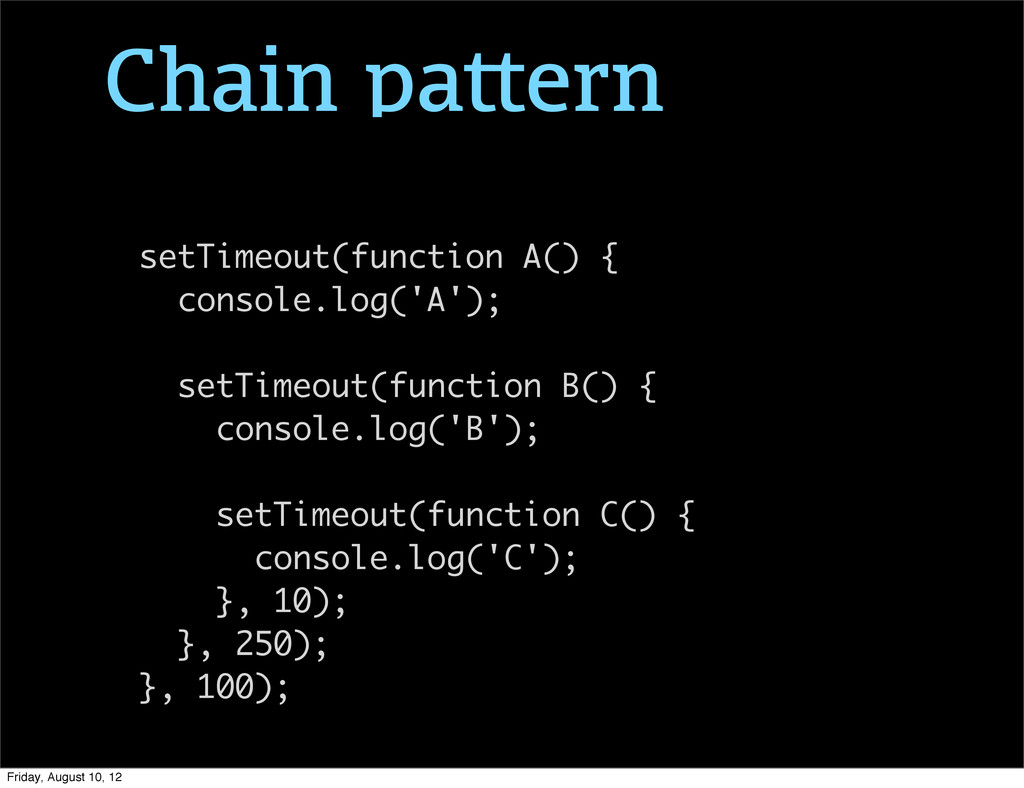
  5. Chain pattern setTimeout(function A() { console.log('A'); setTimeout(function B() { console.log('B');

    setTimeout(function C() { console.log('C'); }, 10); }, 250); }, 100); Friday, August 10, 12
  6. Imperative paradigm == How Do A, then do B, then

    you get C Friday, August 10, 12
  7. Imperative paradigm == How Example: To get an average you

    have to: Get the size of your dataset, then add your inputs and divide both results. Friday, August 10, 12
  8. Functional paradigm == Wat C is what you get from

    B once you did A Friday, August 10, 12
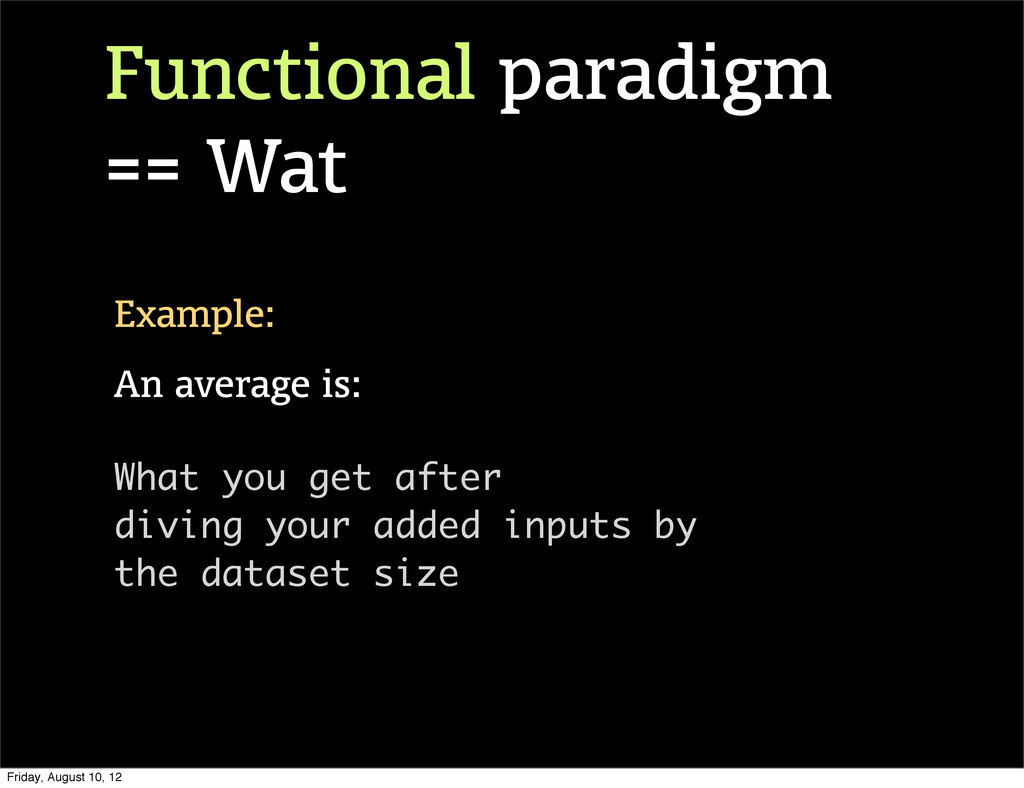
  9. Functional paradigm == Wat Example: An average is: What you

    get after diving your added inputs by the dataset size Friday, August 10, 12
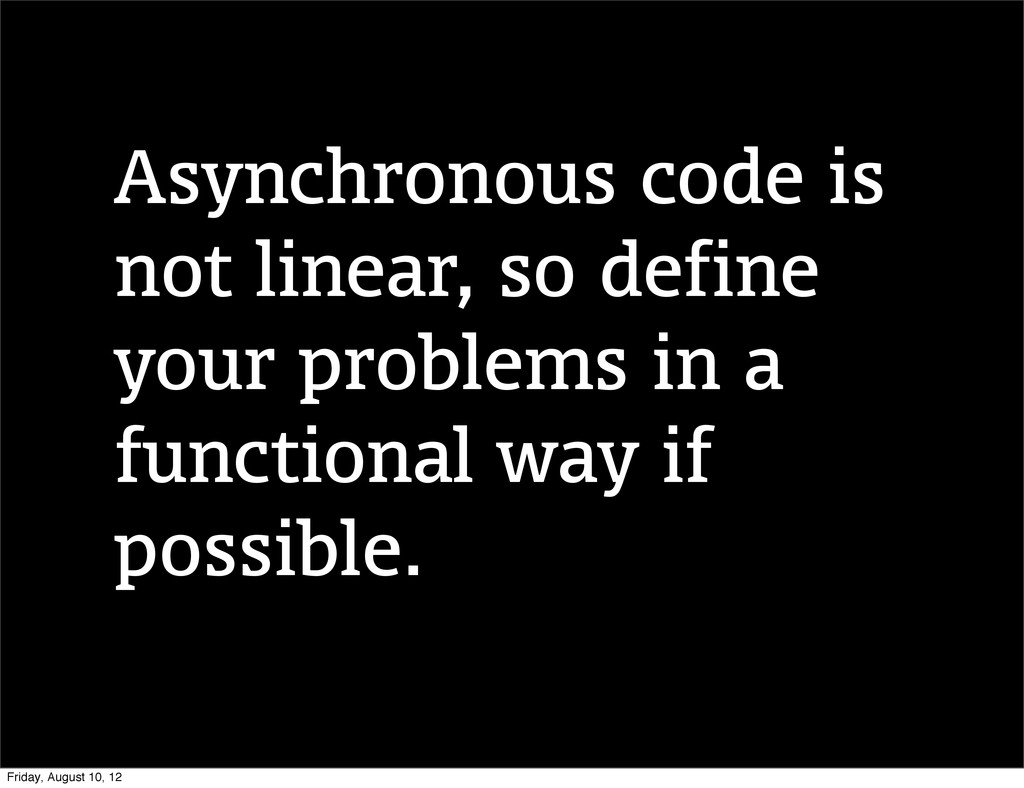
  10. Asynchronous code is not linear, so define your problems in

    a functional way if possible. Friday, August 10, 12
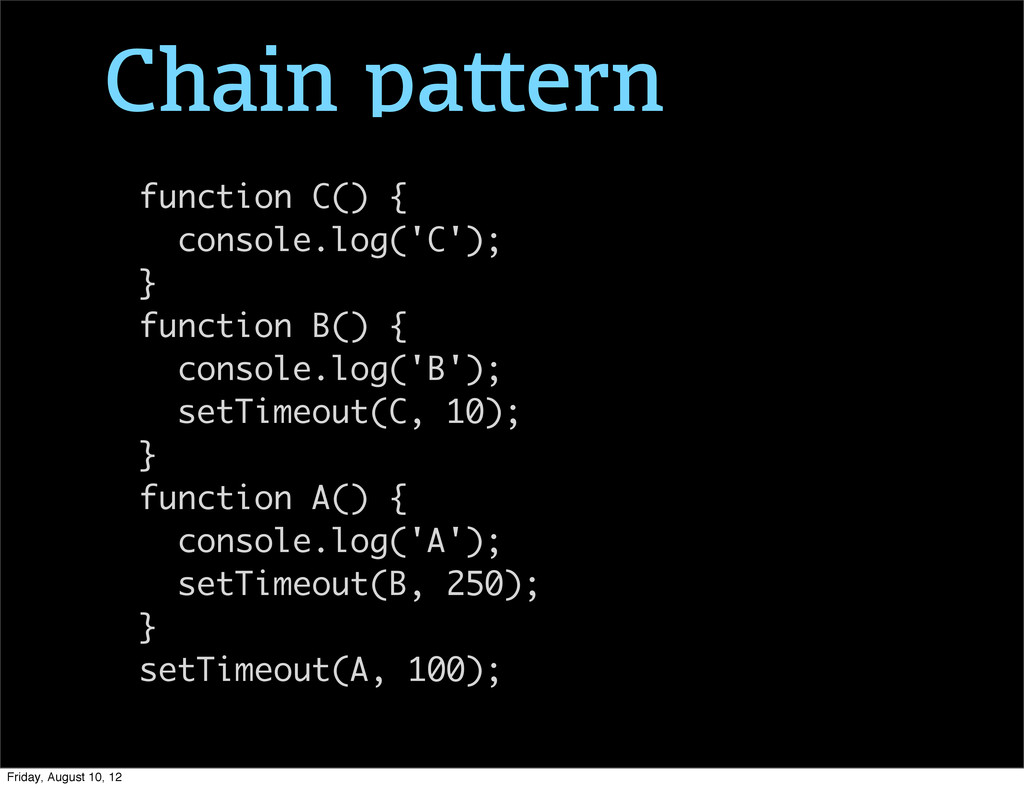
  11. Chain pattern function C() { console.log('C'); } function B() {

    console.log('B'); setTimeout(C, 10); } function A() { console.log('A'); setTimeout(B, 250); } setTimeout(A, 100); Friday, August 10, 12
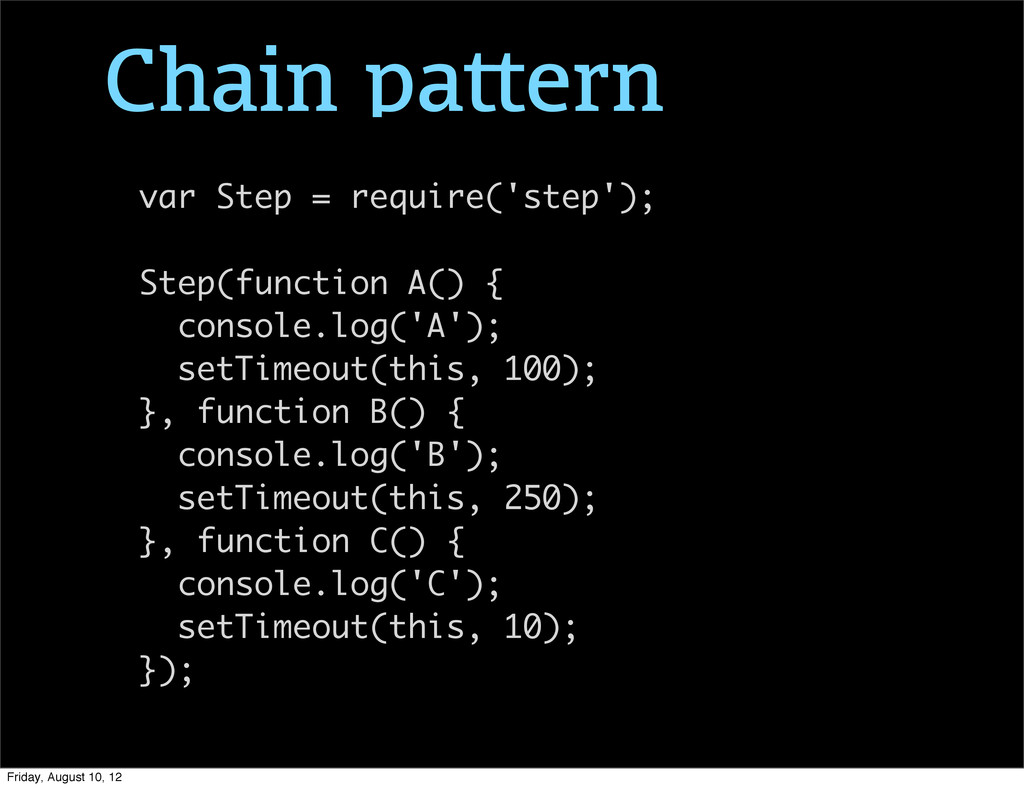
  12. Chain pattern var Step = require('step'); Step(function A() { console.log('A');

    setTimeout(this, 100); }, function B() { console.log('B'); setTimeout(this, 250); }, function C() { console.log('C'); setTimeout(this, 10); }); Friday, August 10, 12
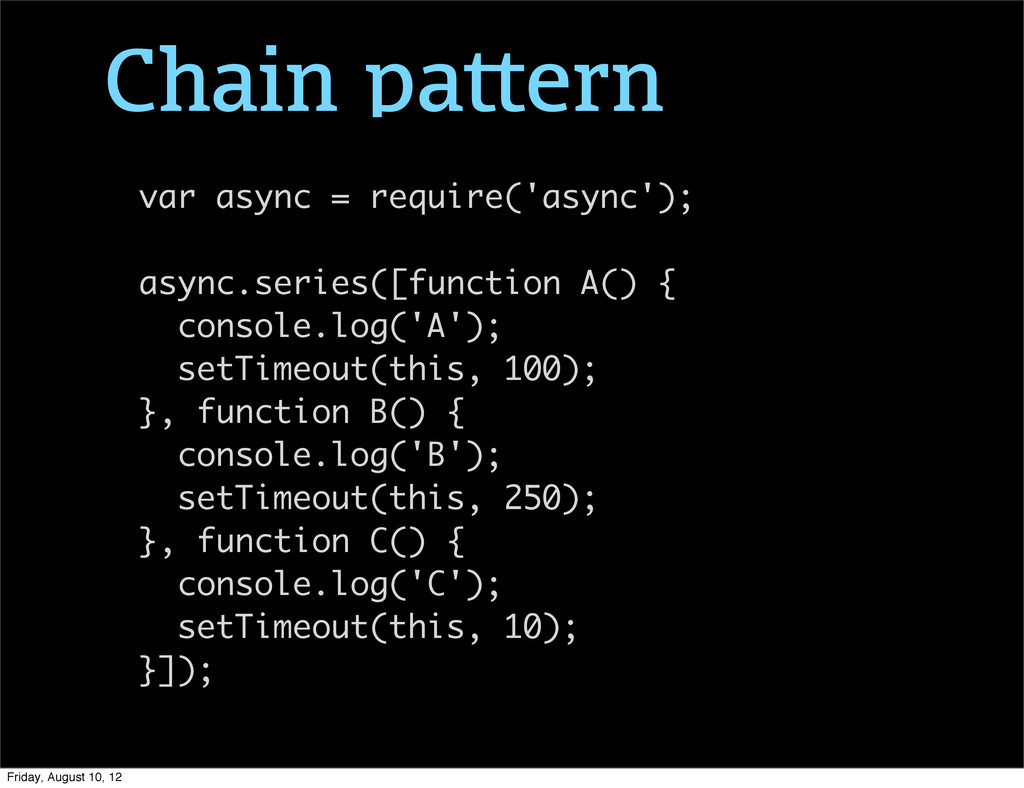
  13. Chain pattern var async = require('async'); async.series([function A() { console.log('A');

    setTimeout(this, 100); }, function B() { console.log('B'); setTimeout(this, 250); }, function C() { console.log('C'); setTimeout(this, 10); }]); Friday, August 10, 12
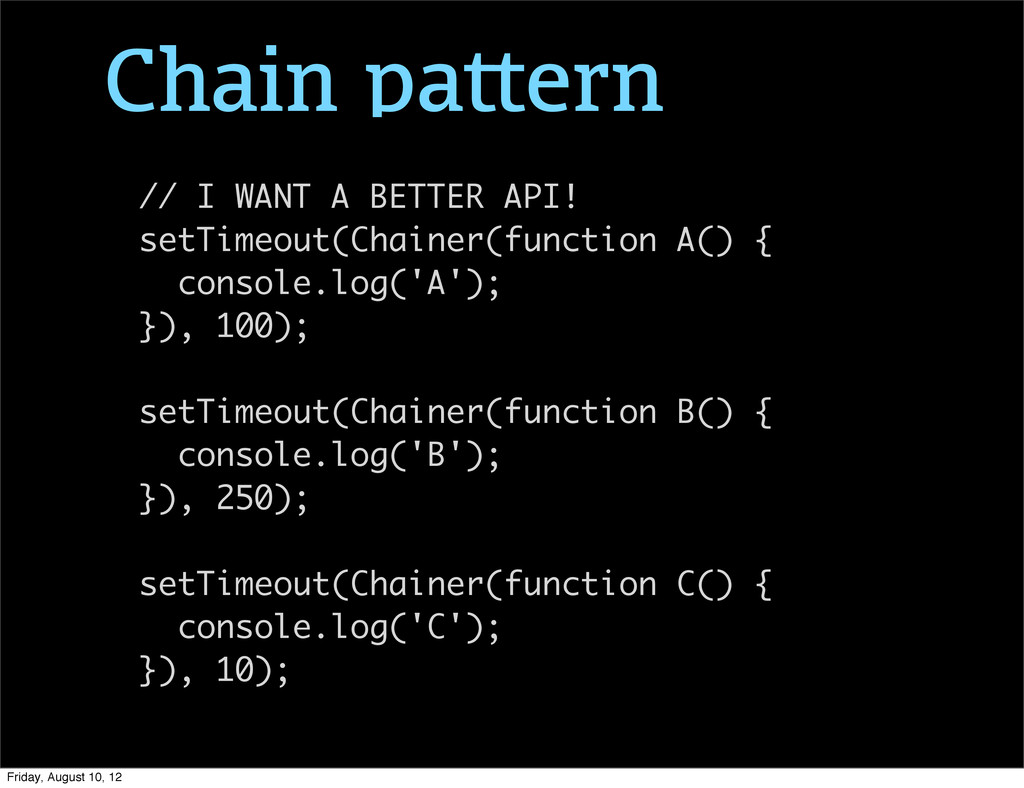
  14. Chain pattern // I WANT A BETTER API! setTimeout(Chainer(function A()

    { console.log('A'); }), 100); setTimeout(Chainer(function B() { console.log('B'); }), 250); setTimeout(Chainer(function C() { console.log('C'); }), 10); Friday, August 10, 12
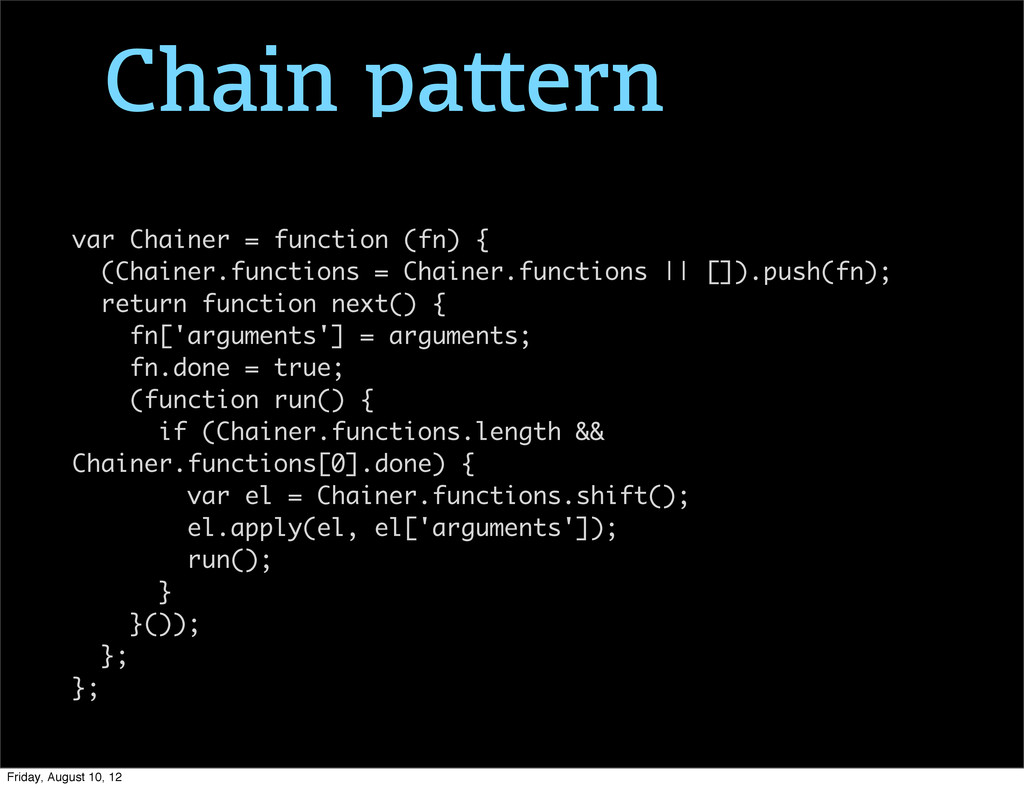
  15. Chain pattern var Chainer = function (fn) { (Chainer.functions =

    Chainer.functions || []).push(fn); return function next() { fn['arguments'] = arguments; fn.done = true; (function run() { if (Chainer.functions.length && Chainer.functions[0].done) { var el = Chainer.functions.shift(); el.apply(el, el['arguments']); run(); } }()); }; }; Friday, August 10, 12
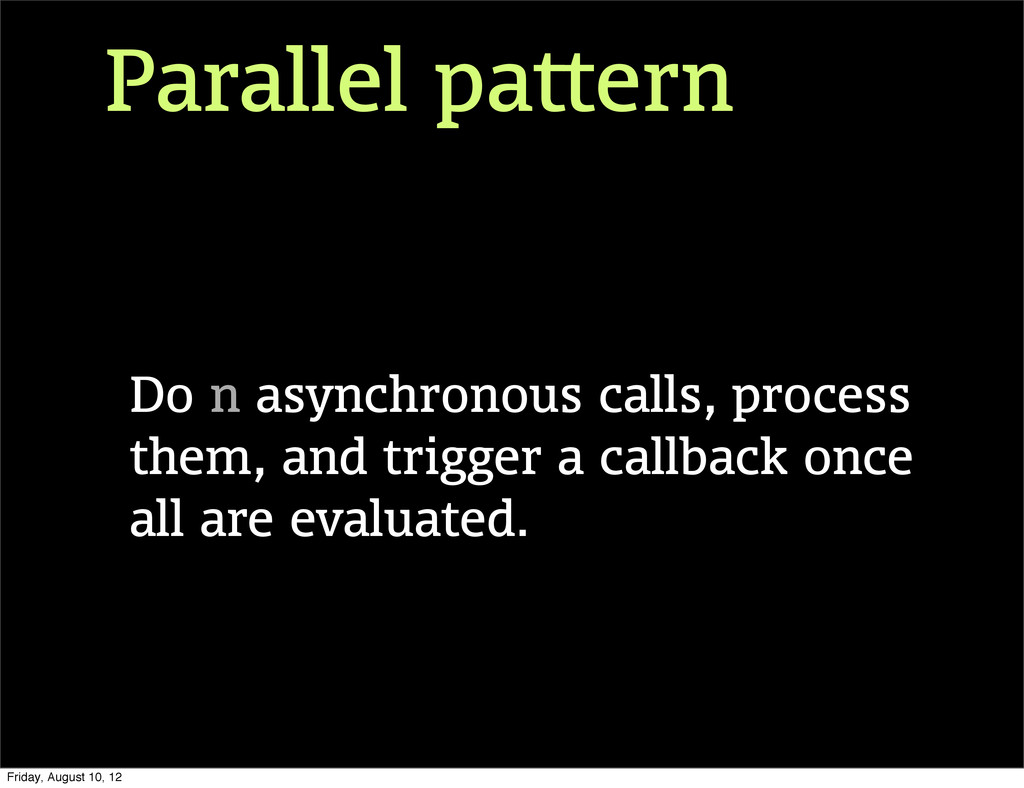
  16. Do n asynchronous calls, process them, and trigger a callback

    once all are evaluated. Parallel pattern Friday, August 10, 12
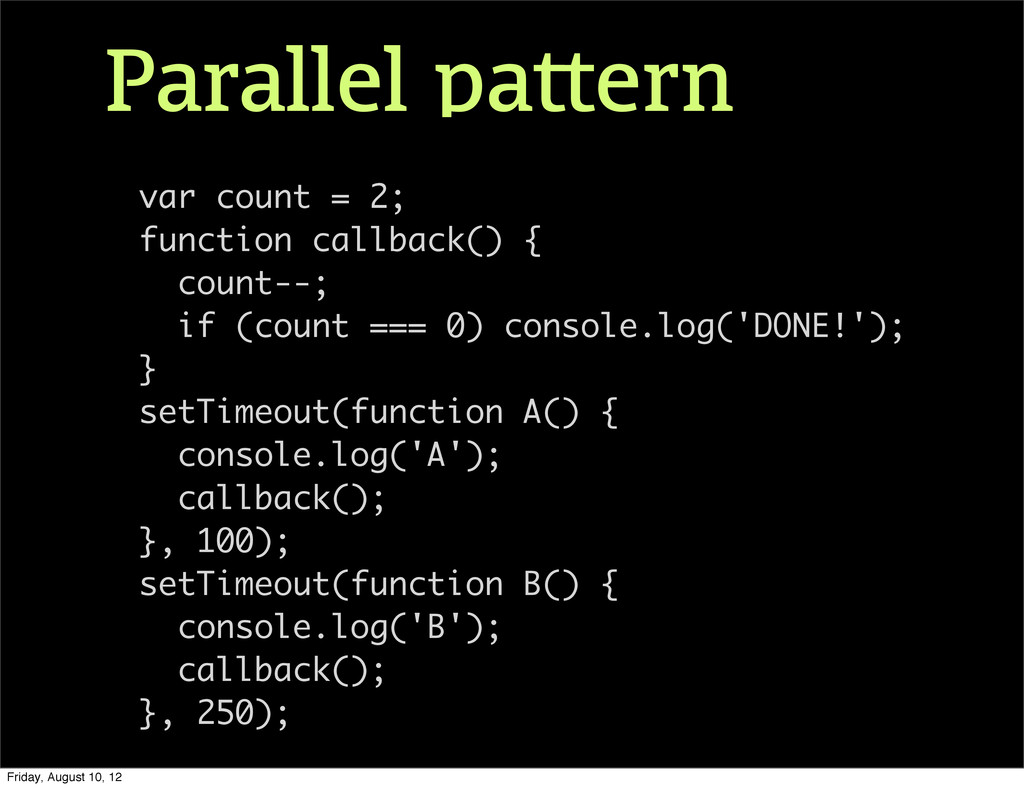
  17. Parallel pattern var count = 2; function callback() { count--;

    if (count === 0) console.log('DONE!'); } setTimeout(function A() { console.log('A'); callback(); }, 100); setTimeout(function B() { console.log('B'); callback(); }, 250); Friday, August 10, 12
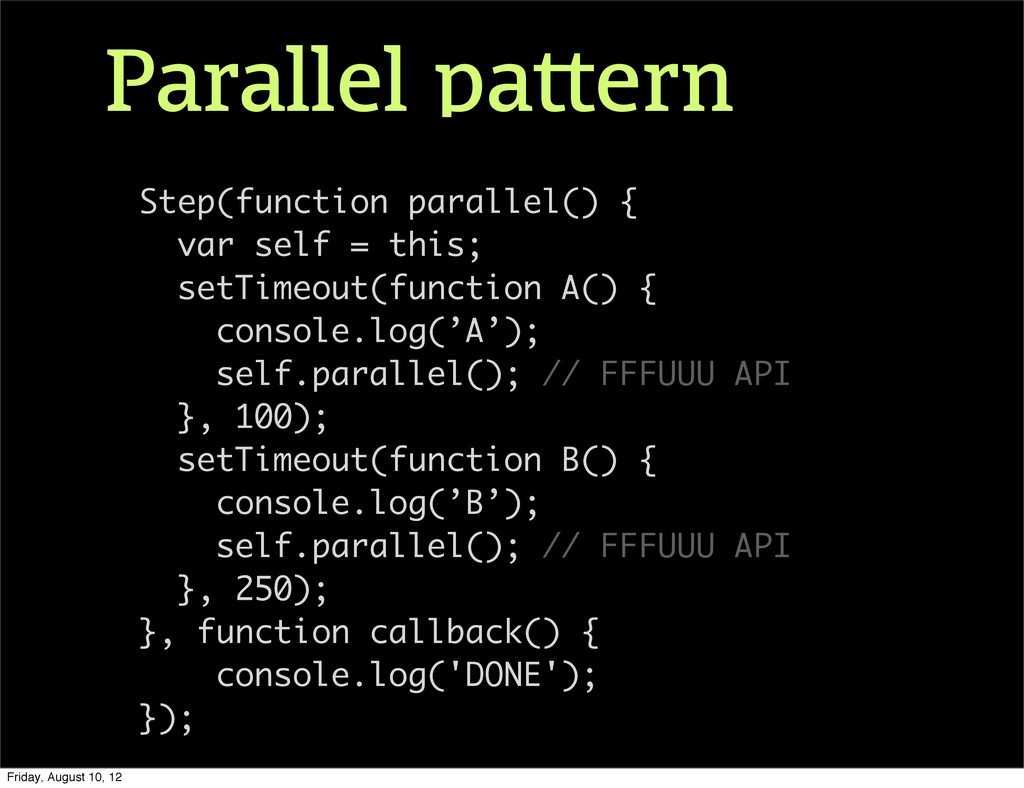
  18. Parallel pattern Step(function parallel() { var self = this; setTimeout(function

    A() { console.log(’A’); self.parallel(); // FFFUUU API }, 100); setTimeout(function B() { console.log(’B’); self.parallel(); // FFFUUU API }, 250); }, function callback() { console.log('DONE'); }); Friday, August 10, 12
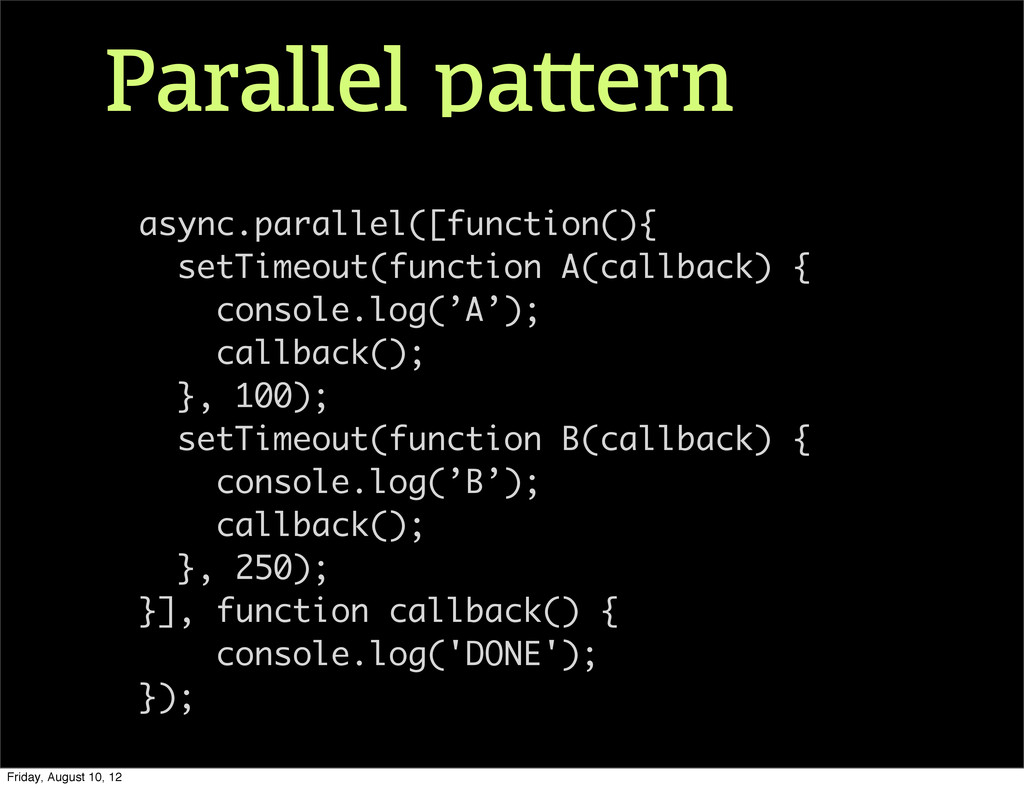
  19. Parallel pattern async.parallel([function(){ setTimeout(function A(callback) { console.log(’A’); callback(); }, 100);

    setTimeout(function B(callback) { console.log(’B’); callback(); }, 250); }], function callback() { console.log('DONE'); }); Friday, August 10, 12
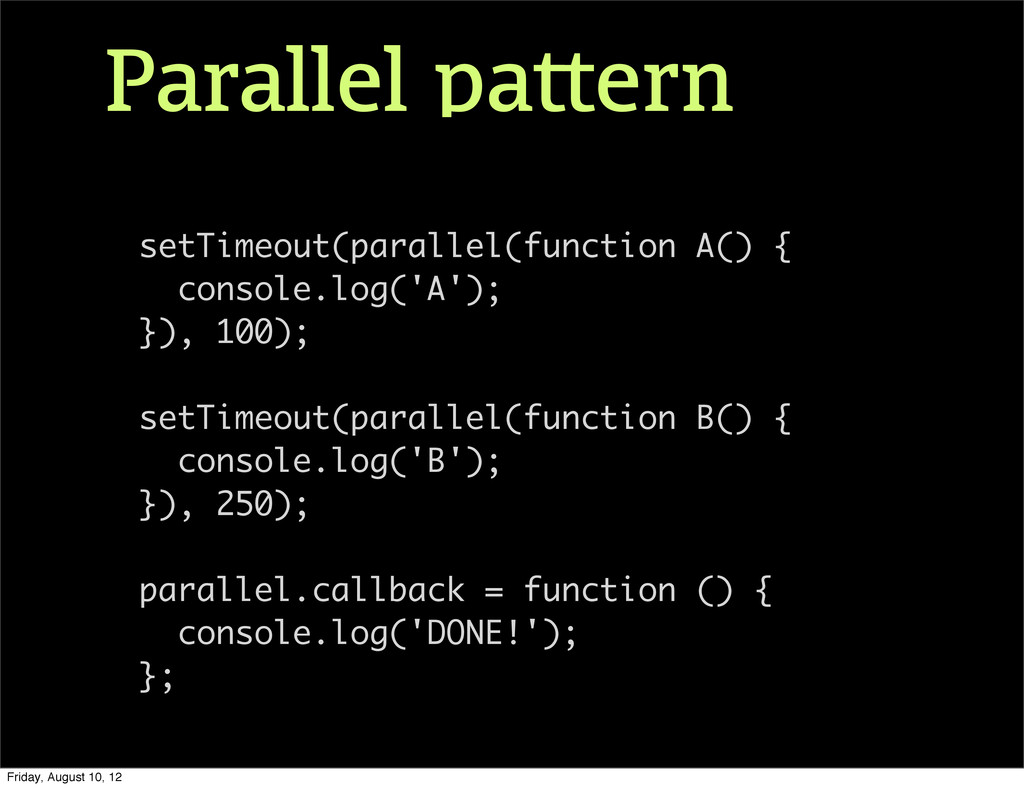
  20. Parallel pattern setTimeout(parallel(function A() { console.log('A'); }), 100); setTimeout(parallel(function B()

    { console.log('B'); }), 250); parallel.callback = function () { console.log('DONE!'); }; Friday, August 10, 12
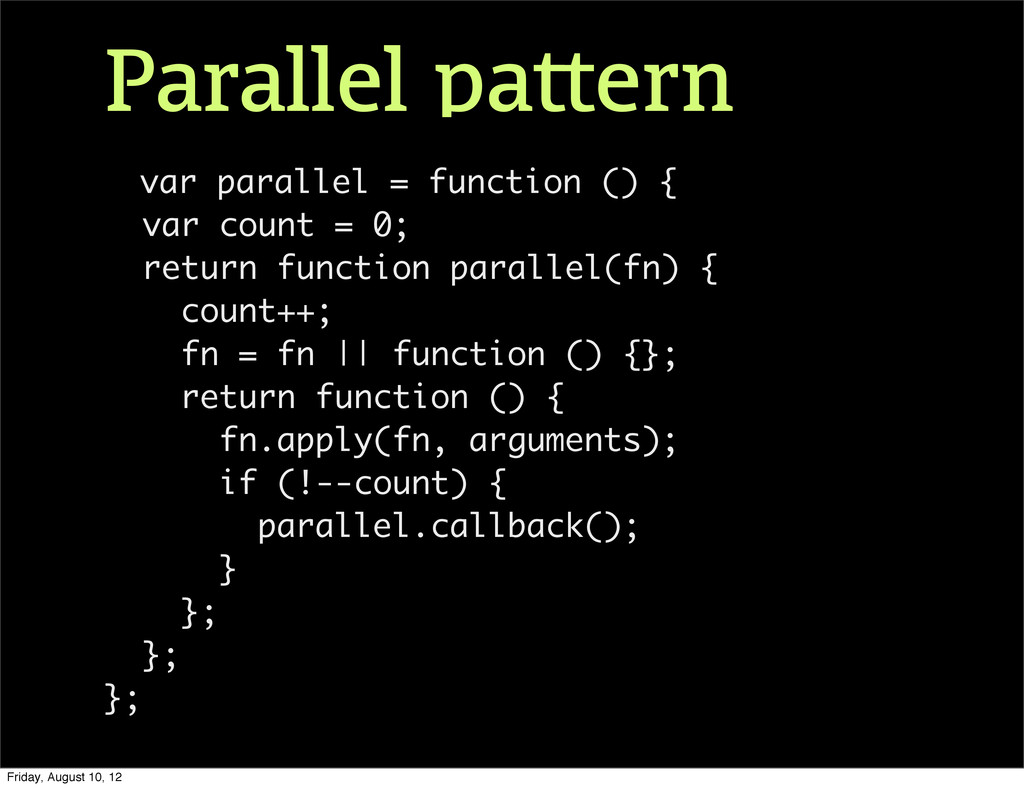
  21. Parallel pattern var parallel = function () { var count

    = 0; return function parallel(fn) { count++; fn = fn || function () {}; return function () { fn.apply(fn, arguments); if (!--count) { parallel.callback(); } }; }; }; Friday, August 10, 12
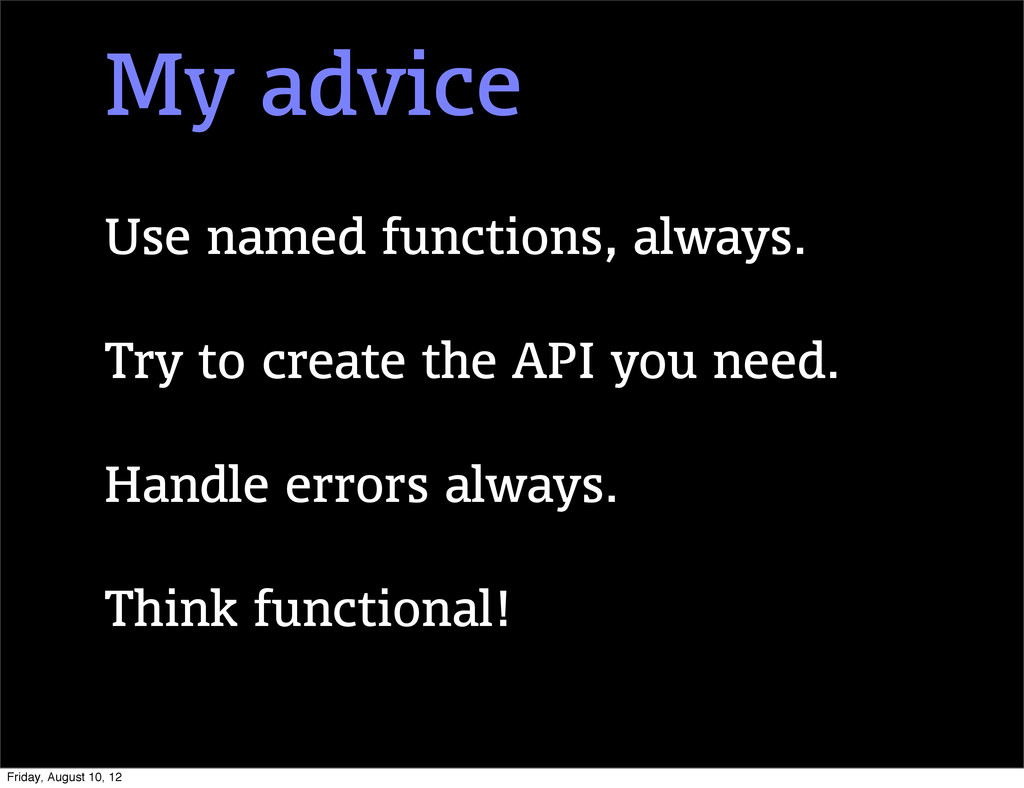
  22. Use named functions, always. Try to create the API you

    need. Handle errors always. Think functional! My advice Friday, August 10, 12

More Decks by masylum

Other Decks in Programming