Upgrade to Pro — share decks privately, control downloads, hide ads and more …

Student Attendance Percentage Guide: Formulas, ...

Avatar for Matteo Rossi Matteo Rossi
September 18, 2026

Student Attendance Percentage Guide: Formulas, Examples, and Quick Calculations

A comprehensive and practical 7-page educational guide designed for school, college, and university students to easily track, calculate, and manage their attendance percentages.

What’s inside this guide:
• Basic Attendance Formula: Simple step-by-step calculations explained clearly.
• Worked Examples: Real-world calculation scenarios (e.g., 18/20, 42/50, 72/80).
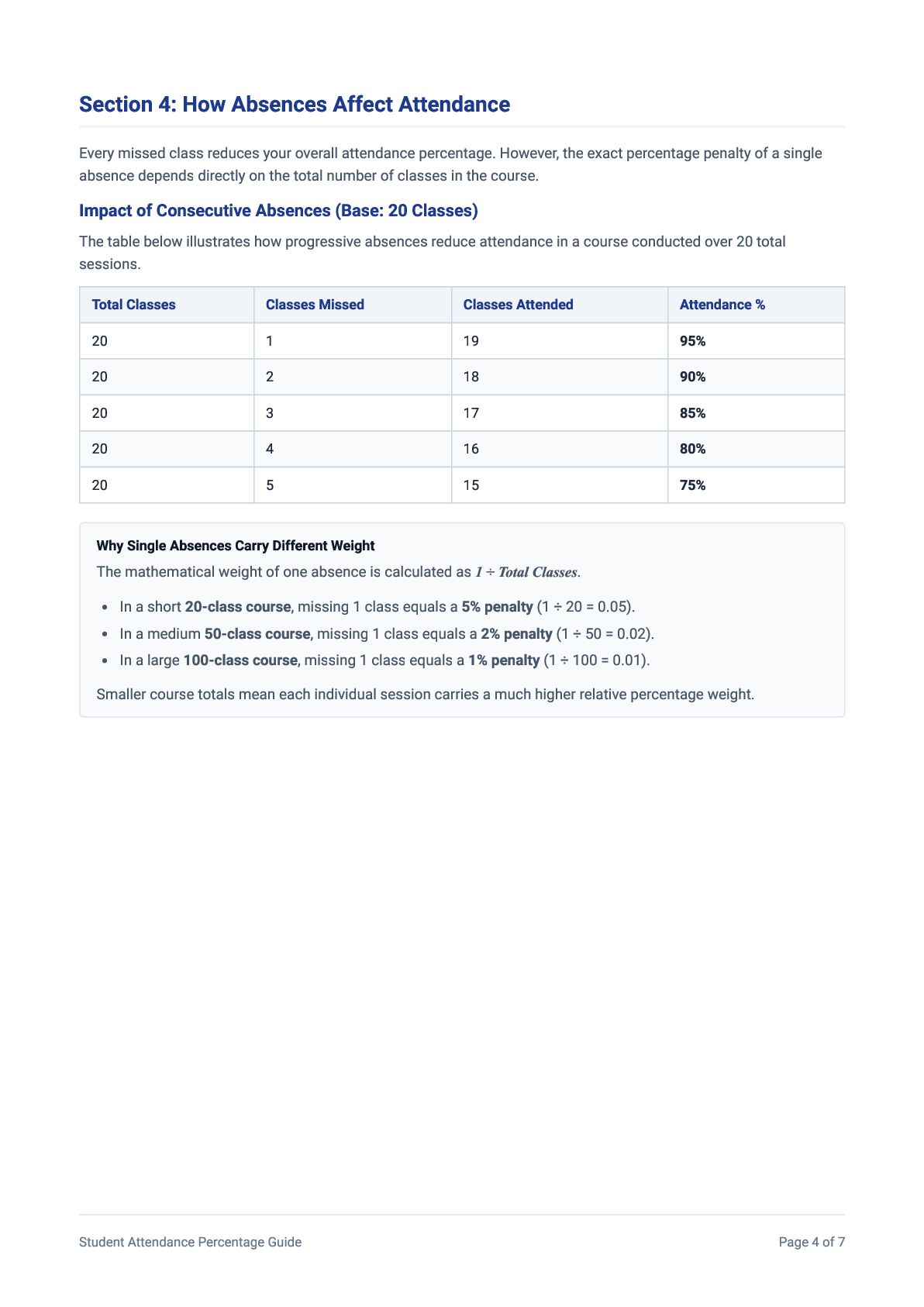
• Impact of Absences: Visual table showing how missed classes affect overall percentage.
• Threshold Planning: How to estimate maximum allowed absences for 75%, 80%, 85%, and 90% targets.
• Catch-up Calculations: Step-by-step formula to calculate how many upcoming classes you need to attend to reach your target percentage.
• Common Calculation Pitfalls: Avoid 6 frequent mistakes made when computing attendance.
• Quick Reference & Checklist: Handy summary page and printable action checklist.

Online Tool:
Need fast calculations? Use the online SBTET Attendance Calculator:
https://attendcalc.com/sbtet-attendance-calculator/

Suitable for students, educators, academic advisors, and institutional administration.

Avatar for Matteo Rossi

Matteo Rossi

September 18, 2026

Other Decks in Education

Transcript

  1. Student Attendance Percentage Guide Formulas, Examples, and Quick Calculations A

    comprehensive, practical academic reference manual designed to help school, college, and university students accurately compute, monitor, and plan their course attendance requirements. ACADEMIC REFERENCE SERIES Suitable for Self-Study, Academic Advising, & Registrar Compliance Student Attendance Percentage Guide Page 1 of 7
  2. Section 1: What Is Attendance Percentage? Attendance percentage represents the

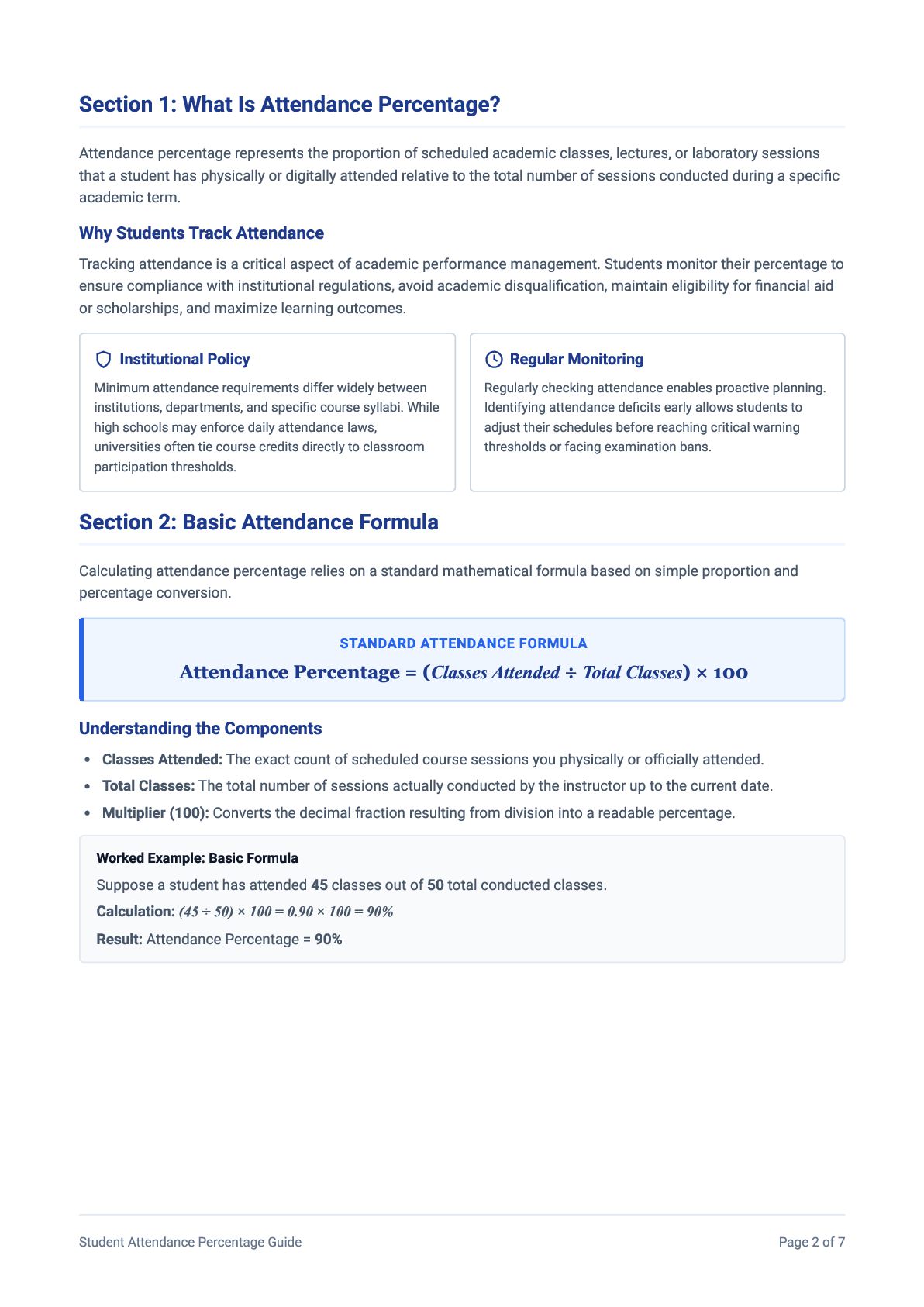
    proportion of scheduled academic classes, lectures, or laboratory sessions that a student has physically or digitally attended relative to the total number of sessions conducted during a specific academic term. Why Students Track Attendance Tracking attendance is a critical aspect of academic performance management. Students monitor their percentage to ensure compliance with institutional regulations, avoid academic disqualification, maintain eligibility for financial aid or scholarships, and maximize learning outcomes. Institutional Policy Regular Monitoring Minimum attendance requirements differ widely between Regularly checking attendance enables proactive planning. institutions, departments, and specific course syllabi. While Identifying attendance deficits early allows students to high schools may enforce daily attendance laws, adjust their schedules before reaching critical warning universities often tie course credits directly to classroom thresholds or facing examination bans. participation thresholds. Section 2: Basic Attendance Formula Calculating attendance percentage relies on a standard mathematical formula based on simple proportion and percentage conversion. STANDARD ATTENDANCE FORMULA Attendance Percentage = (Classes Attended ÷ Total Classes) × 100 Understanding the Components Classes Attended: The exact count of scheduled course sessions you physically or officially attended. Total Classes: The total number of sessions actually conducted by the instructor up to the current date. Multiplier (100): Converts the decimal fraction resulting from division into a readable percentage. Worked Example: Basic Formula Suppose a student has attended 45 classes out of 50 total conducted classes. Calculation: (45 ÷ 50) × 100 = 0.90 × 100 = 90% Result: Attendance Percentage = 90% Student Attendance Percentage Guide Page 2 of 7
  3. Section 3: Attendance Calculation Examples To master attendance calculations, review

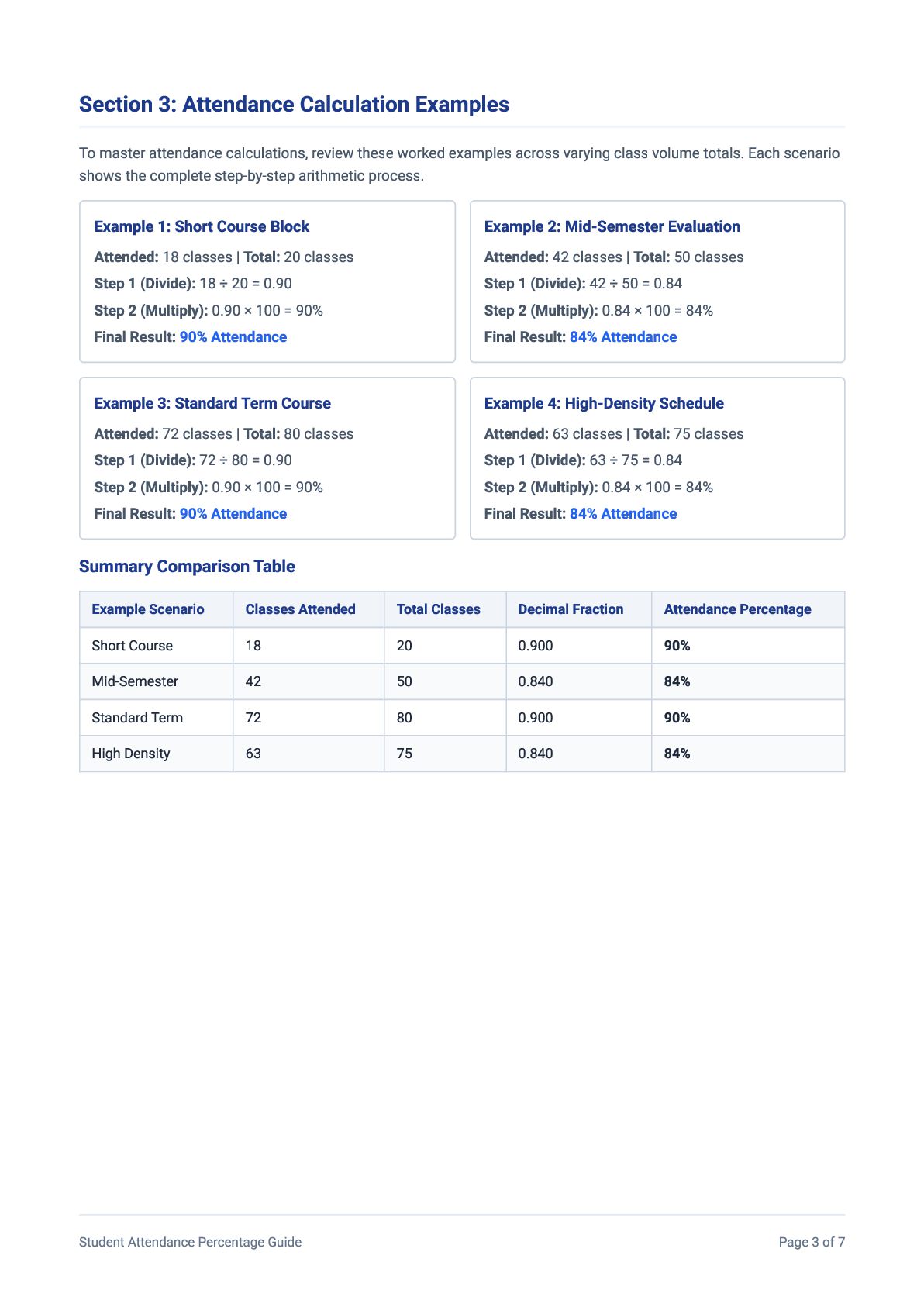
    these worked examples across varying class volume totals. Each scenario shows the complete step-by-step arithmetic process. Example 1: Short Course Block Example 2: Mid-Semester Evaluation Attended: 18 classes | Total: 20 classes Attended: 42 classes | Total: 50 classes Step 1 (Divide): 18 ÷ 20 = 0.90 Step 1 (Divide): 42 ÷ 50 = 0.84 Step 2 (Multiply): 0.90 × 100 = 90% Step 2 (Multiply): 0.84 × 100 = 84% Final Result: 90% Attendance Final Result: 84% Attendance Example 3: Standard Term Course Example 4: High-Density Schedule Attended: 72 classes | Total: 80 classes Attended: 63 classes | Total: 75 classes Step 1 (Divide): 72 ÷ 80 = 0.90 Step 1 (Divide): 63 ÷ 75 = 0.84 Step 2 (Multiply): 0.90 × 100 = 90% Step 2 (Multiply): 0.84 × 100 = 84% Final Result: 90% Attendance Final Result: 84% Attendance Summary Comparison Table Example Scenario Classes Attended Total Classes Decimal Fraction Attendance Percentage Short Course 18 20 0.900 90% Mid-Semester 42 50 0.840 84% Standard Term 72 80 0.900 90% High Density 63 75 0.840 84% Student Attendance Percentage Guide Page 3 of 7
  4. Section 4: How Absences Affect Attendance Every missed class reduces

    your overall attendance percentage. However, the exact percentage penalty of a single absence depends directly on the total number of classes in the course. Impact of Consecutive Absences (Base: 20 Classes) The table below illustrates how progressive absences reduce attendance in a course conducted over 20 total sessions. Total Classes Classes Missed Classes Attended Attendance % 20 1 19 95% 20 2 18 90% 20 3 17 85% 20 4 16 80% 20 5 15 75% Why Single Absences Carry Different Weight The mathematical weight of one absence is calculated as 1 ÷ Total Classes. In a short 20-class course, missing 1 class equals a 5% penalty (1 ÷ 20 = 0.05). In a medium 50-class course, missing 1 class equals a 2% penalty (1 ÷ 50 = 0.02). In a large 100-class course, missing 1 class equals a 1% penalty (1 ÷ 100 = 0.01). Smaller course totals mean each individual session carries a much higher relative percentage weight. Student Attendance Percentage Guide Page 4 of 7
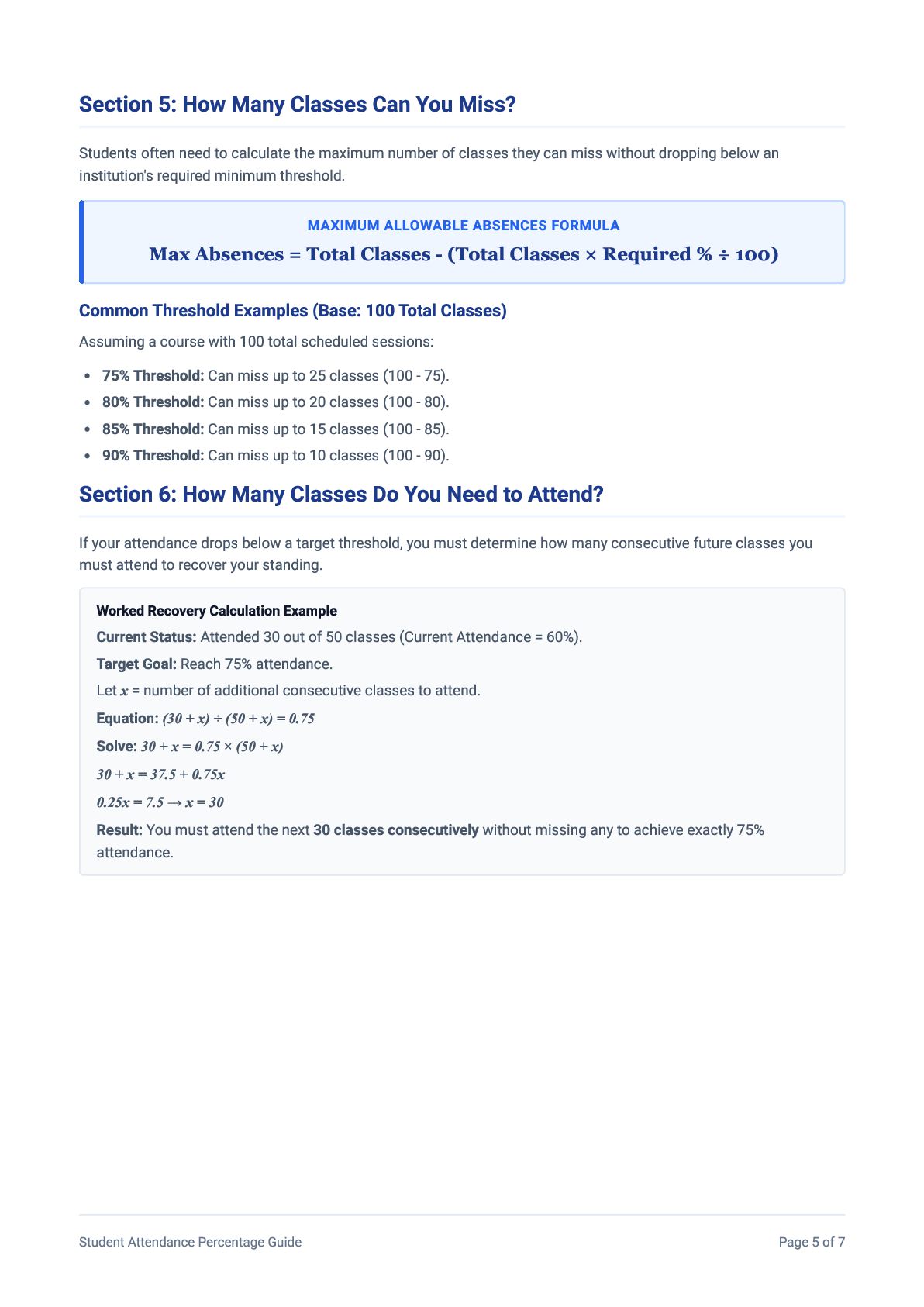
  5. Section 5: How Many Classes Can You Miss? Students often

    need to calculate the maximum number of classes they can miss without dropping below an institution's required minimum threshold. MAXIMUM ALLOWABLE ABSENCES FORMULA Max Absences = Total Classes - (Total Classes × Required % ÷ 100) Common Threshold Examples (Base: 100 Total Classes) Assuming a course with 100 total scheduled sessions: 75% Threshold: Can miss up to 25 classes (100 - 75). 80% Threshold: Can miss up to 20 classes (100 - 80). 85% Threshold: Can miss up to 15 classes (100 - 85). 90% Threshold: Can miss up to 10 classes (100 - 90). Section 6: How Many Classes Do You Need to Attend? If your attendance drops below a target threshold, you must determine how many consecutive future classes you must attend to recover your standing. Worked Recovery Calculation Example Current Status: Attended 30 out of 50 classes (Current Attendance = 60%). Target Goal: Reach 75% attendance. x = number of additional consecutive classes to attend. Equation: (30 + x) ÷ (50 + x) = 0.75 Solve: 30 + x = 0.75 × (50 + x) 30 + x = 37.5 + 0.75x 0.25x = 7.5 → x = 30 Let Result: You must attend the next 30 classes consecutively without missing any to achieve exactly 75% attendance. Student Attendance Percentage Guide Page 5 of 7
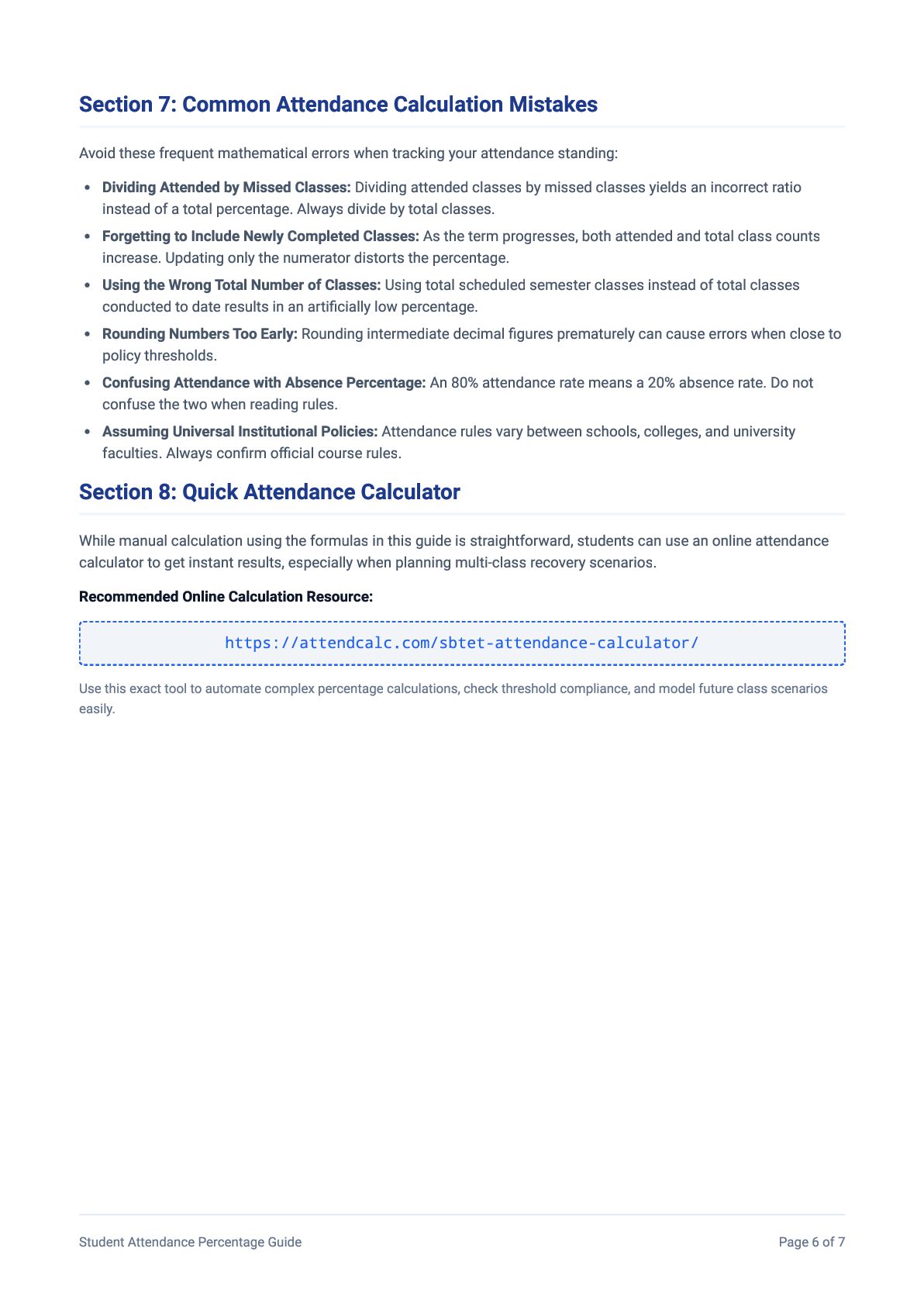
  6. Section 7: Common Attendance Calculation Mistakes Avoid these frequent mathematical

    errors when tracking your attendance standing: Dividing Attended by Missed Classes: Dividing attended classes by missed classes yields an incorrect ratio instead of a total percentage. Always divide by total classes. Forgetting to Include Newly Completed Classes: As the term progresses, both attended and total class counts increase. Updating only the numerator distorts the percentage. Using the Wrong Total Number of Classes: Using total scheduled semester classes instead of total classes conducted to date results in an artificially low percentage. Rounding Numbers Too Early: Rounding intermediate decimal figures prematurely can cause errors when close to policy thresholds. Confusing Attendance with Absence Percentage: An 80% attendance rate means a 20% absence rate. Do not confuse the two when reading rules. Assuming Universal Institutional Policies: Attendance rules vary between schools, colleges, and university faculties. Always confirm official course rules. Section 8: Quick Attendance Calculator While manual calculation using the formulas in this guide is straightforward, students can use an online attendance calculator to get instant results, especially when planning multi-class recovery scenarios. Recommended Online Calculation Resource: https://attendcalc.com/sbtet-attendance-calculator/ Use this exact tool to automate complex percentage calculations, check threshold compliance, and model future class scenarios easily. Student Attendance Percentage Guide Page 6 of 7
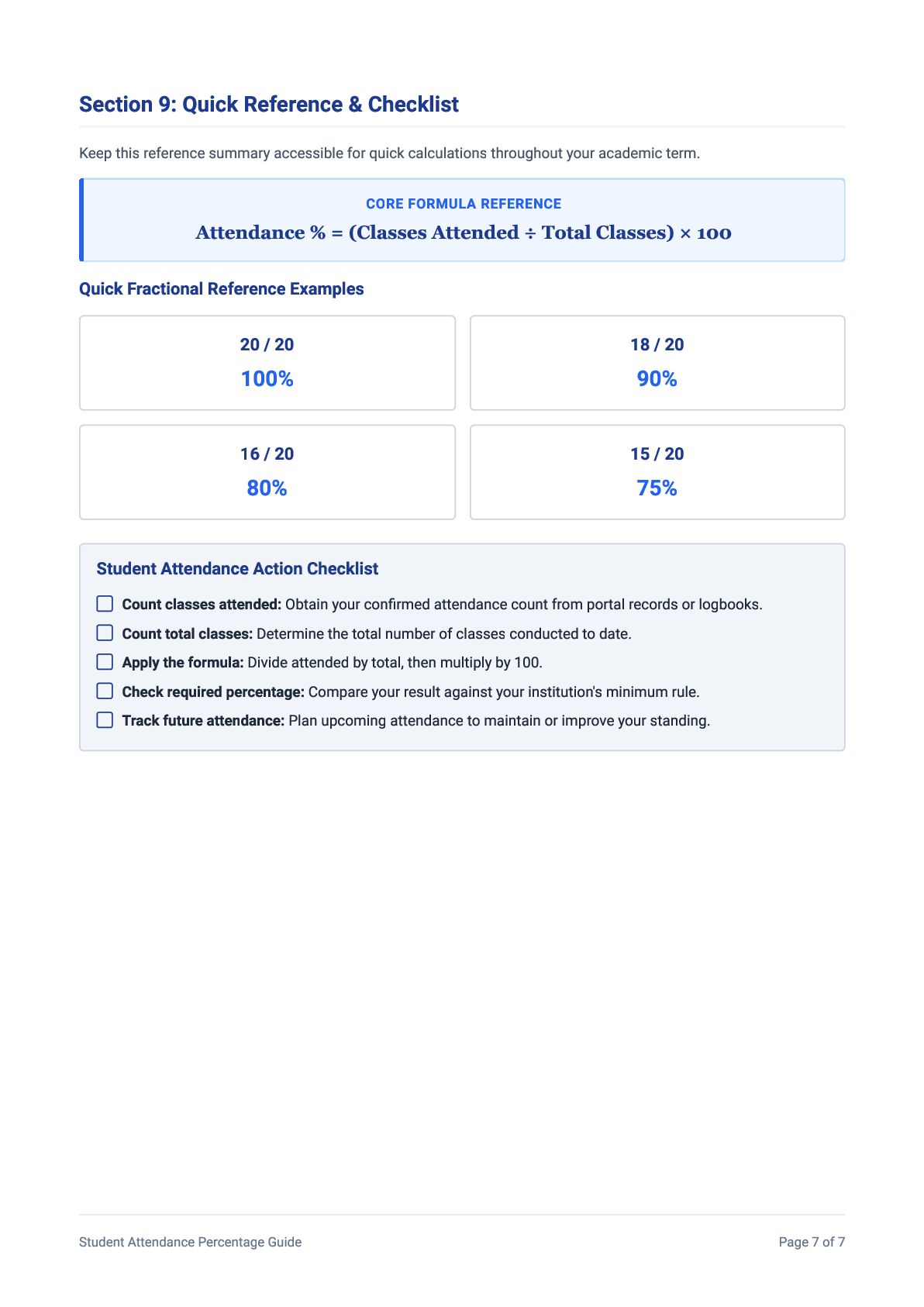
  7. Section 9: Quick Reference & Checklist Keep this reference summary

    accessible for quick calculations throughout your academic term. CORE FORMULA REFERENCE Attendance % = (Classes Attended ÷ Total Classes) × 100 Quick Fractional Reference Examples 20 / 20 18 / 20 100% 90% 16 / 20 15 / 20 80% 75% Student Attendance Action Checklist Count classes attended: Obtain your confirmed attendance count from portal records or logbooks. Count total classes: Determine the total number of classes conducted to date. Apply the formula: Divide attended by total, then multiply by 100. Check required percentage: Compare your result against your institution's minimum rule. Track future attendance: Plan upcoming attendance to maintain or improve your standing. Student Attendance Percentage Guide Page 7 of 7