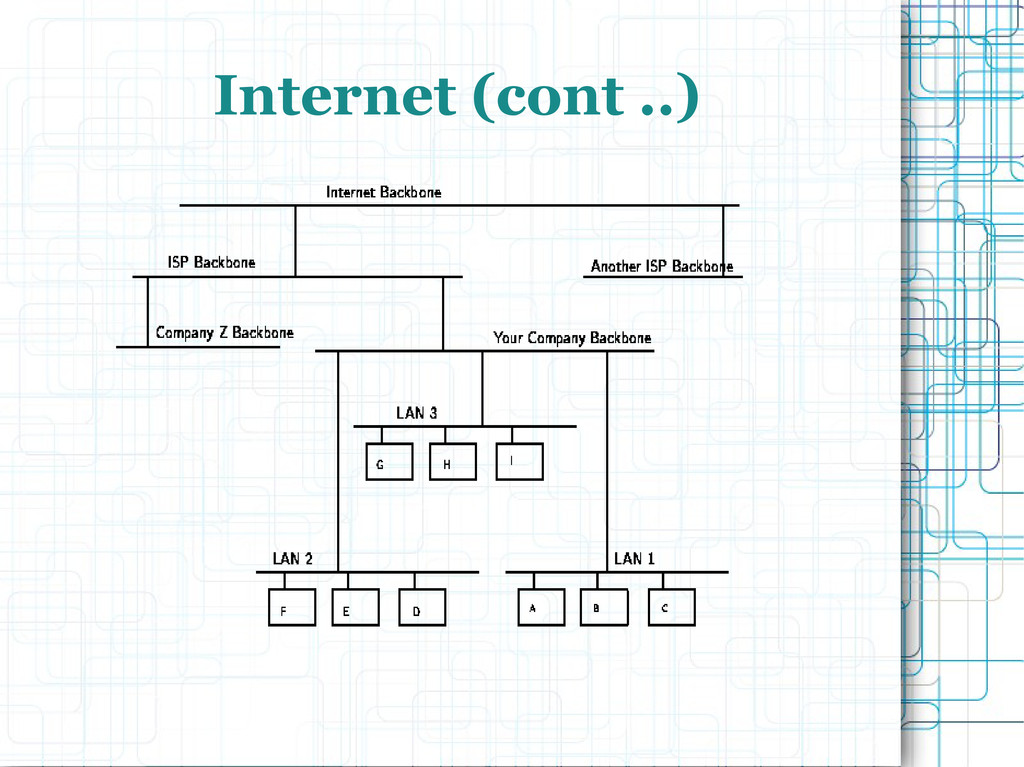
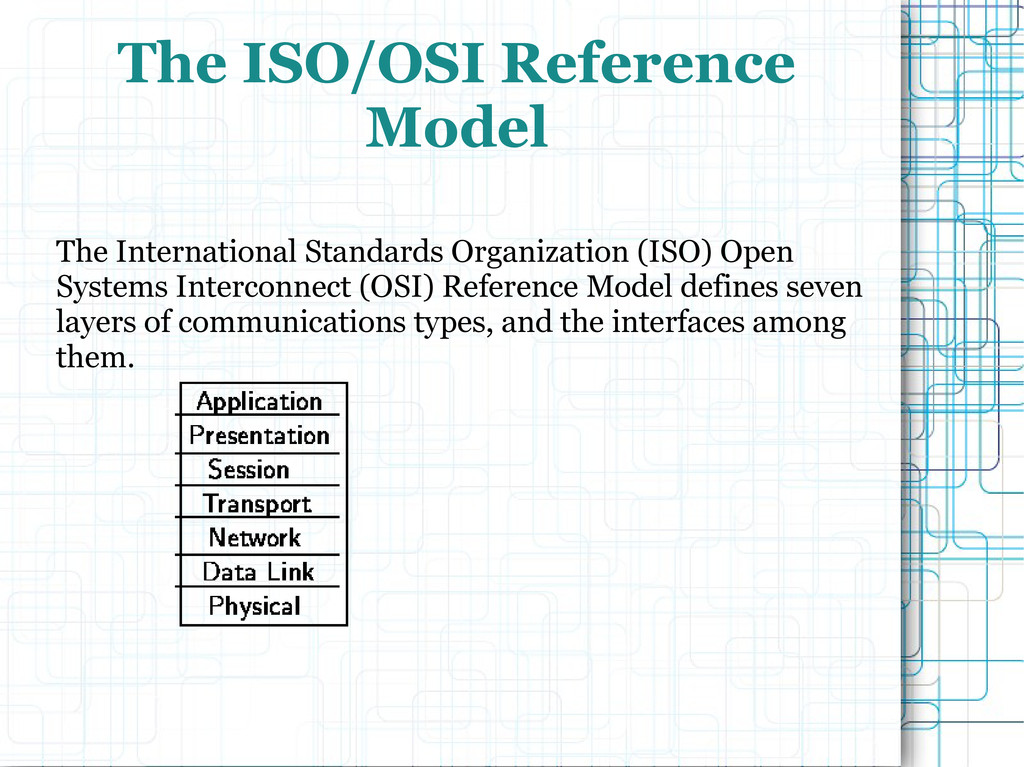
. When you want to access the resources offered by the Internet, you don't really connect to the Internet; you connect to a network that is eventually connected to the Internet backbone , a network of extremely fast (and incredibly overloaded!) network components. This is an important point: the Internet is a network of networks -- not a network of hosts.
interlinking lines resembling a net, a network of roads || an interconnected system, a network of alliances. A computer network is simply a system of interconnected computers.
Protocol) is the “language” of the Internet. Anything that can learn to “speak TCP/IP” can play on the Internet. This is functionality that occurs at the Network (IP) and Transport (TCP) layers in the ISO/OSI Reference Model. Consequently, a host that has TCP/IP functionality (such as Unix, MacOS, or Windows ) can easily support applications (such as internet browsers) that uses the network.
layer that allows the hosts to actually “talk” to each other. Such things as carrying datagrams, mapping the Internet address (such as 10.2.3.4) to a physical network address (such as 08:00:69:0a:ca:8f), and routing, which takes care of making sure that all of the devices that have Internet connectivity can find the way to each other.

 Your Podcast. Everywhere. Effortlessly.


 mazharul
 marktimemedia
 geoffreycrofte
 keathley
 mkilby
 keithpitt
 lcolladotor
 marcduiker
 auna
 geshan
 destraynor
 rkendrick25
 palkan