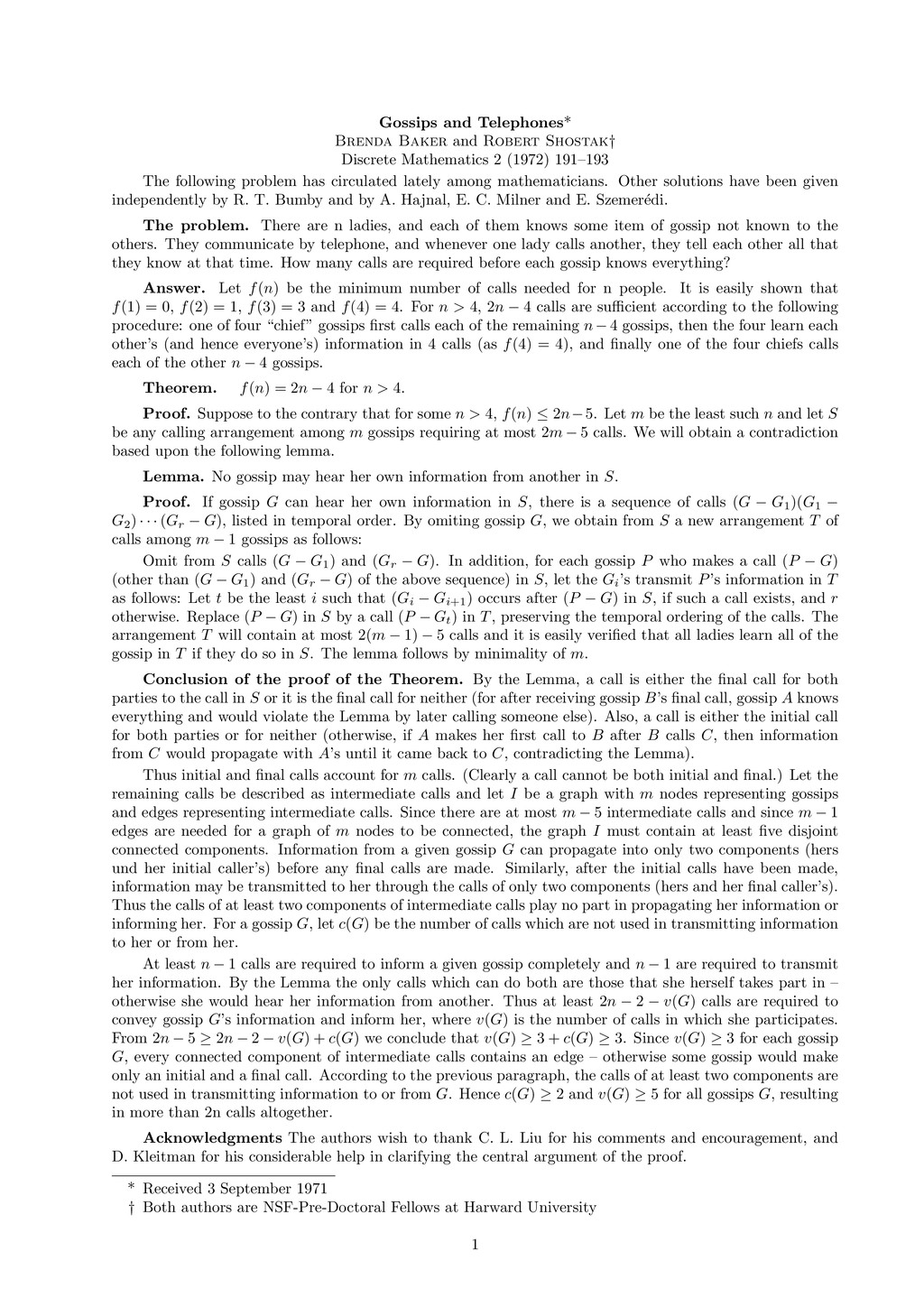
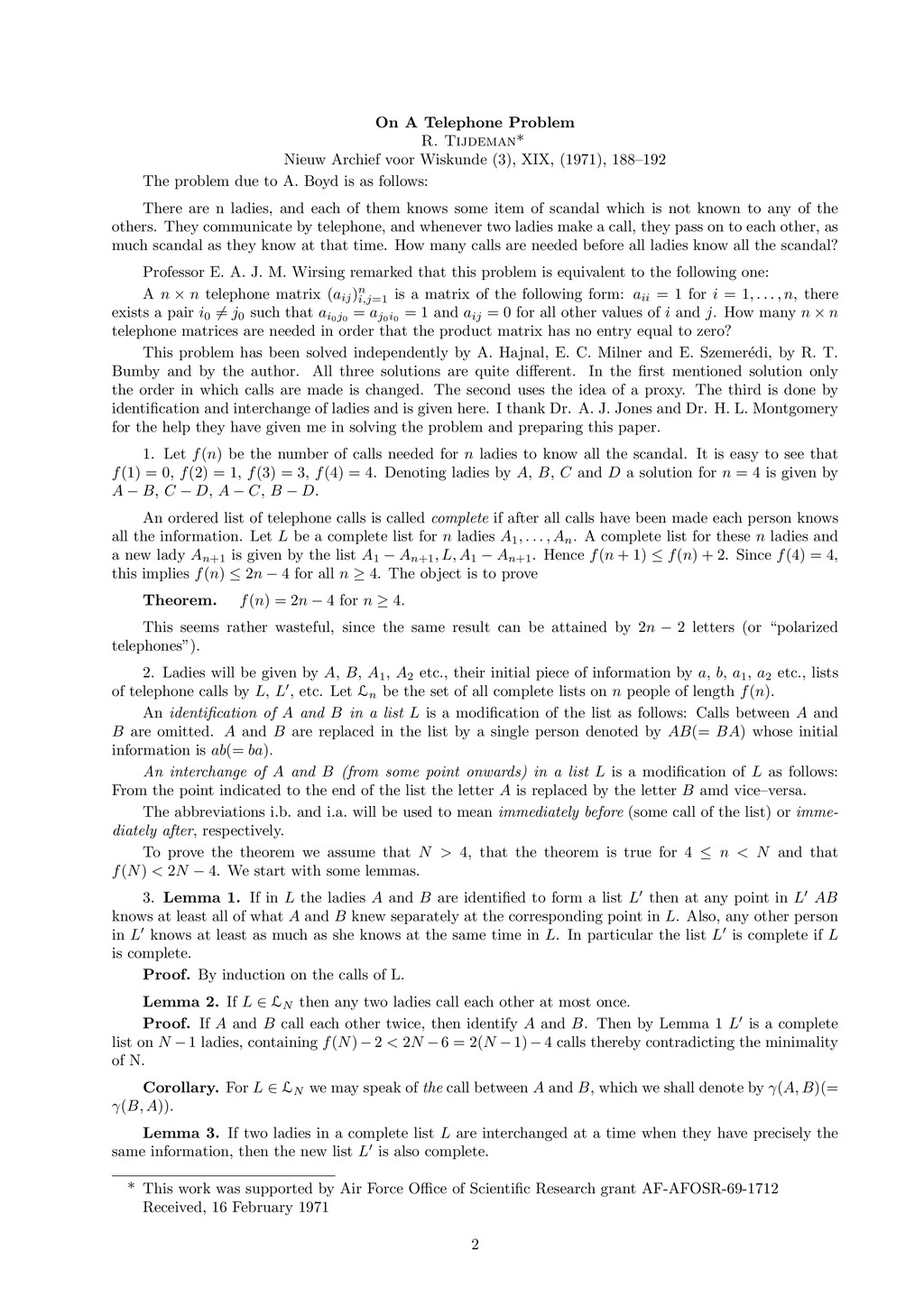
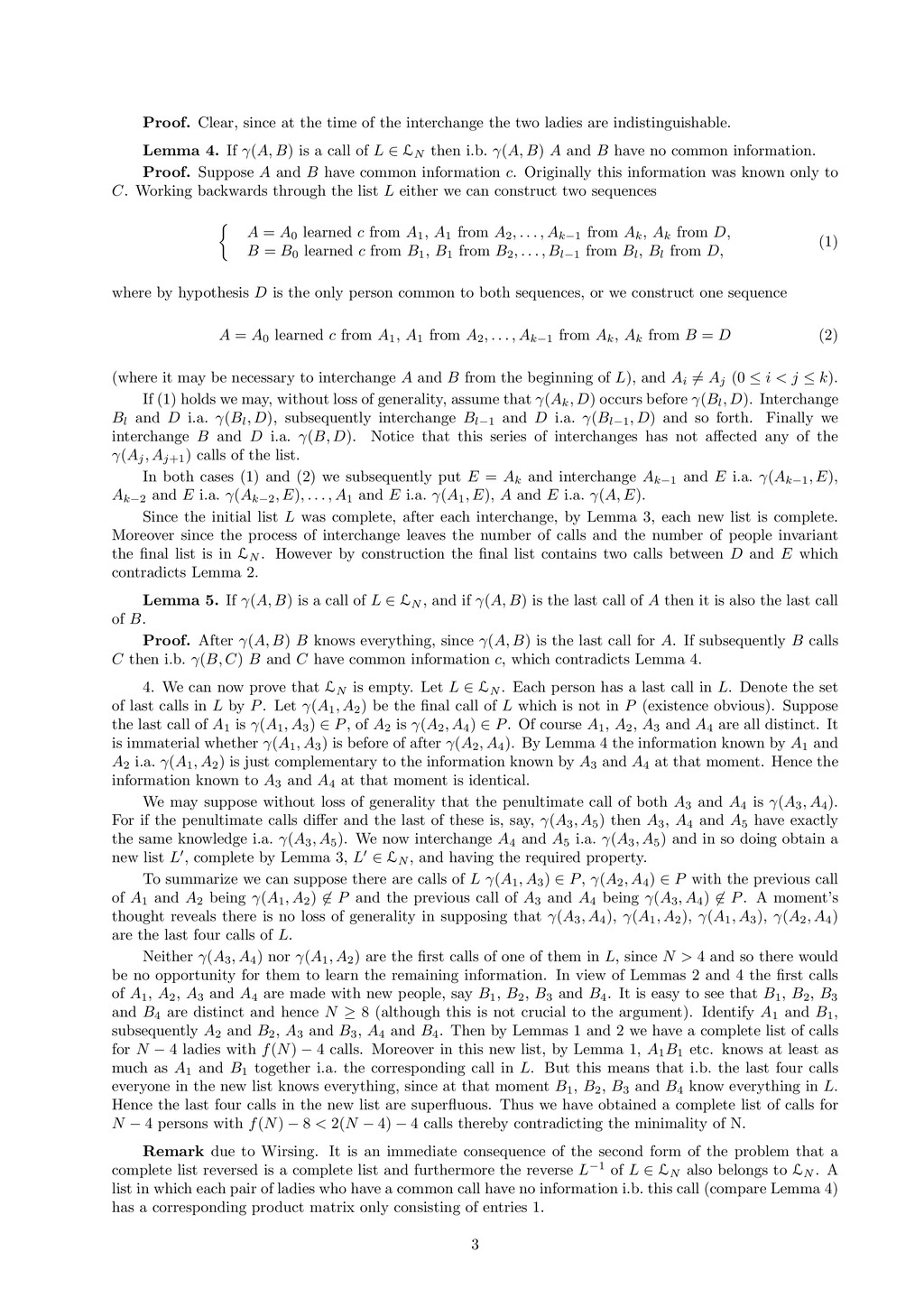
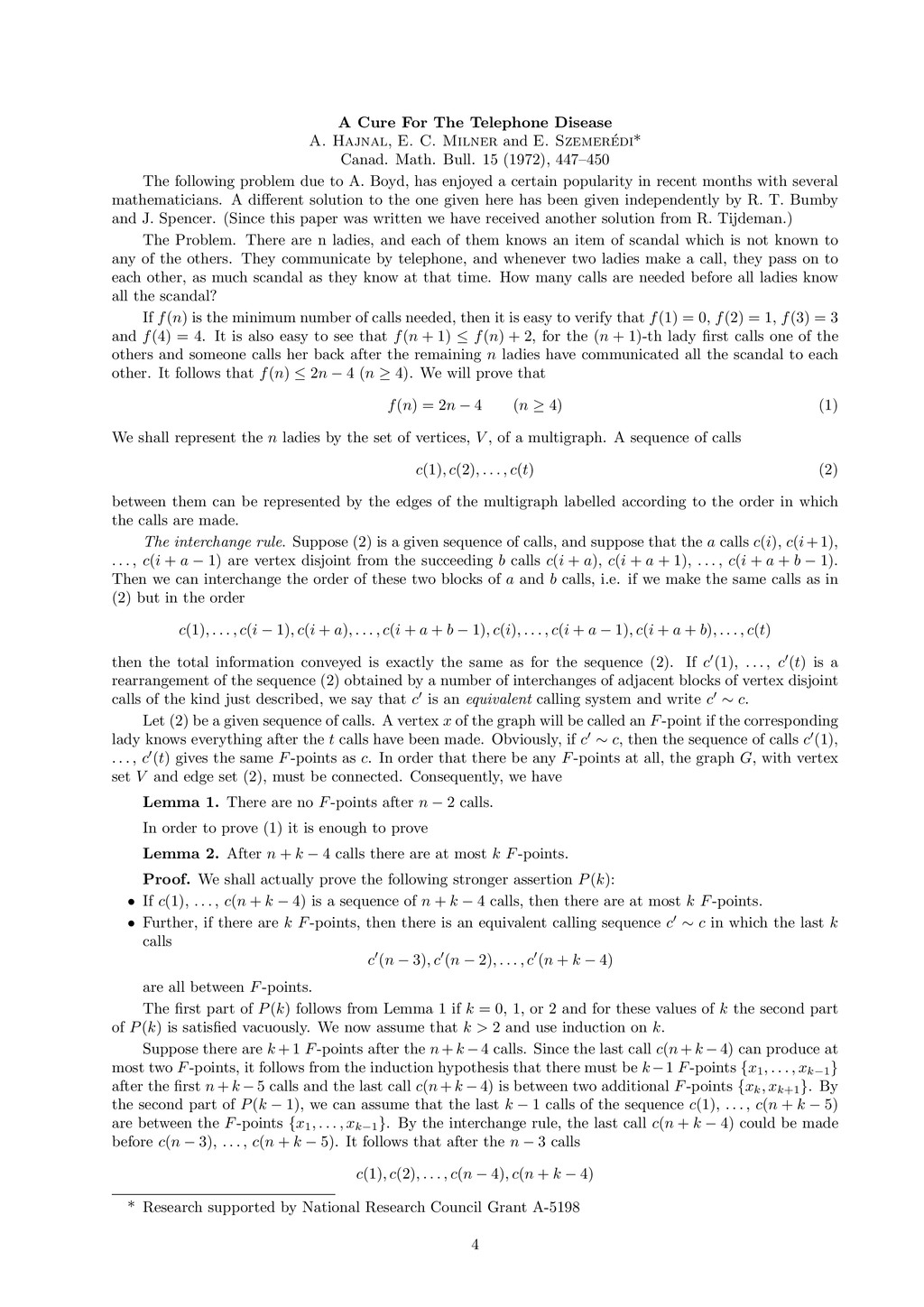
two ladies are indistinguishable. Lemma 4. If γ(A, B) is a call of L ∈ LN then i.b. γ(A, B) A and B have no common information. Proof. Suppose A and B have common information c. Originally this information was known only to C. Working backwards through the list L either we can construct two sequences A = A0 learned c from A1 , A1 from A2 , . . . , Ak−1 from Ak , Ak from D, B = B0 learned c from B1 , B1 from B2 , . . . , Bl−1 from Bl , Bl from D, (1) where by hypothesis D is the only person common to both sequences, or we construct one sequence A = A0 learned c from A1 , A1 from A2 , . . . , Ak−1 from Ak , Ak from B = D (2) (where it may be necessary to interchange A and B from the beginning of L), and Ai = Aj (0 ≤ i < j ≤ k). If (1) holds we may, without loss of generality, assume that γ(Ak , D) occurs before γ(Bl , D). Interchange Bl and D i.a. γ(Bl , D), subsequently interchange Bl−1 and D i.a. γ(Bl−1 , D) and so forth. Finally we interchange B and D i.a. γ(B, D). Notice that this series of interchanges has not affected any of the γ(Aj , Aj+1 ) calls of the list. In both cases (1) and (2) we subsequently put E = Ak and interchange Ak−1 and E i.a. γ(Ak−1 , E), Ak−2 and E i.a. γ(Ak−2 , E), . . . , A1 and E i.a. γ(A1 , E), A and E i.a. γ(A, E). Since the initial list L was complete, after each interchange, by Lemma 3, each new list is complete. Moreover since the process of interchange leaves the number of calls and the number of people invariant the final list is in LN . However by construction the final list contains two calls between D and E which contradicts Lemma 2. Lemma 5. If γ(A, B) is a call of L ∈ LN , and if γ(A, B) is the last call of A then it is also the last call of B. Proof. After γ(A, B) B knows everything, since γ(A, B) is the last call for A. If subsequently B calls C then i.b. γ(B, C) B and C have common information c, which contradicts Lemma 4. 4. We can now prove that LN is empty. Let L ∈ LN . Each person has a last call in L. Denote the set of last calls in L by P. Let γ(A1 , A2 ) be the final call of L which is not in P (existence obvious). Suppose the last call of A1 is γ(A1 , A3 ) ∈ P, of A2 is γ(A2 , A4 ) ∈ P. Of course A1 , A2 , A3 and A4 are all distinct. It is immaterial whether γ(A1 , A3 ) is before of after γ(A2 , A4 ). By Lemma 4 the information known by A1 and A2 i.a. γ(A1 , A2 ) is just complementary to the information known by A3 and A4 at that moment. Hence the information known to A3 and A4 at that moment is identical. We may suppose without loss of generality that the penultimate call of both A3 and A4 is γ(A3 , A4 ). For if the penultimate calls differ and the last of these is, say, γ(A3 , A5 ) then A3 , A4 and A5 have exactly the same knowledge i.a. γ(A3 , A5 ). We now interchange A4 and A5 i.a. γ(A3 , A5 ) and in so doing obtain a new list L , complete by Lemma 3, L ∈ LN , and having the required property. To summarize we can suppose there are calls of L γ(A1 , A3 ) ∈ P, γ(A2 , A4 ) ∈ P with the previous call of A1 and A2 being γ(A1 , A2 ) ∈ P and the previous call of A3 and A4 being γ(A3 , A4 ) ∈ P. A moment’s thought reveals there is no loss of generality in supposing that γ(A3 , A4 ), γ(A1 , A2 ), γ(A1 , A3 ), γ(A2 , A4 ) are the last four calls of L. Neither γ(A3 , A4 ) nor γ(A1 , A2 ) are the first calls of one of them in L, since N > 4 and so there would be no opportunity for them to learn the remaining information. In view of Lemmas 2 and 4 the first calls of A1 , A2 , A3 and A4 are made with new people, say B1 , B2 , B3 and B4 . It is easy to see that B1 , B2 , B3 and B4 are distinct and hence N ≥ 8 (although this is not crucial to the argument). Identify A1 and B1 , subsequently A2 and B2 , A3 and B3 , A4 and B4 . Then by Lemmas 1 and 2 we have a complete list of calls for N − 4 ladies with f(N) − 4 calls. Moreover in this new list, by Lemma 1, A1 B1 etc. knows at least as much as A1 and B1 together i.a. the corresponding call in L. But this means that i.b. the last four calls everyone in the new list knows everything, since at that moment B1 , B2 , B3 and B4 know everything in L. Hence the last four calls in the new list are superfluous. Thus we have obtained a complete list of calls for N − 4 persons with f(N) − 8 < 2(N − 4) − 4 calls thereby contradicting the minimality of N. Remark due to Wirsing. It is an immediate consequence of the second form of the problem that a complete list reversed is a complete list and furthermore the reverse L−1 of L ∈ LN also belongs to LN . A list in which each pair of ladies who have a common call have no information i.b. this call (compare Lemma 4) has a corresponding product matrix only consisting of entries 1. 3


 gam0022
 satoshi256kbyte
 ivargrimstad
 kaityo256
 uyuki234
 lef237
 nao_randd
 colorful12
 rshindo
 sylph01
 hschwentner
 optim
 popppiees
 tammyeverts
 gr2m
 rkendrick25
 thekraken
 techseoconnect
 sabderemane
 addyosmani
 codingconduct
 nmsamuel
 deanohume