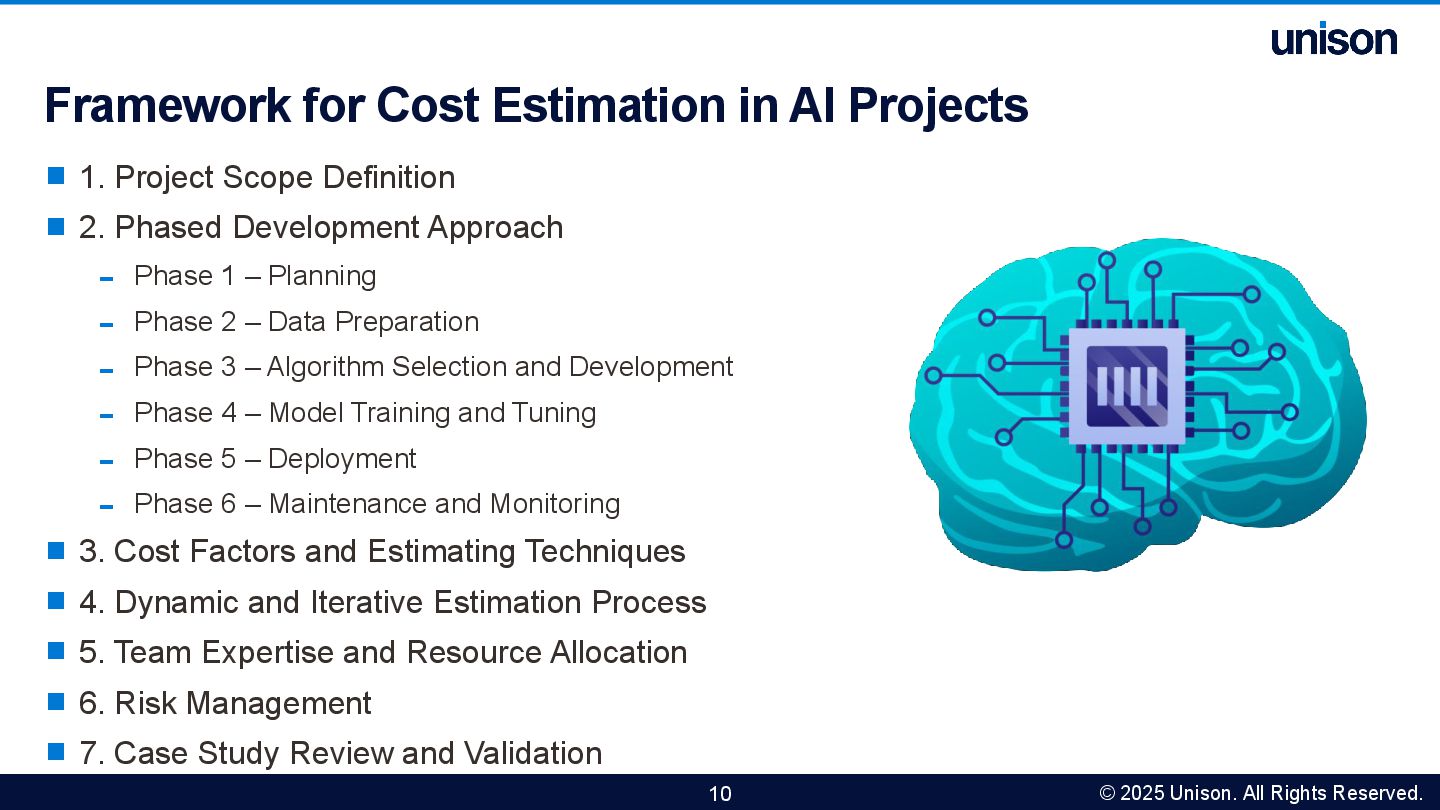
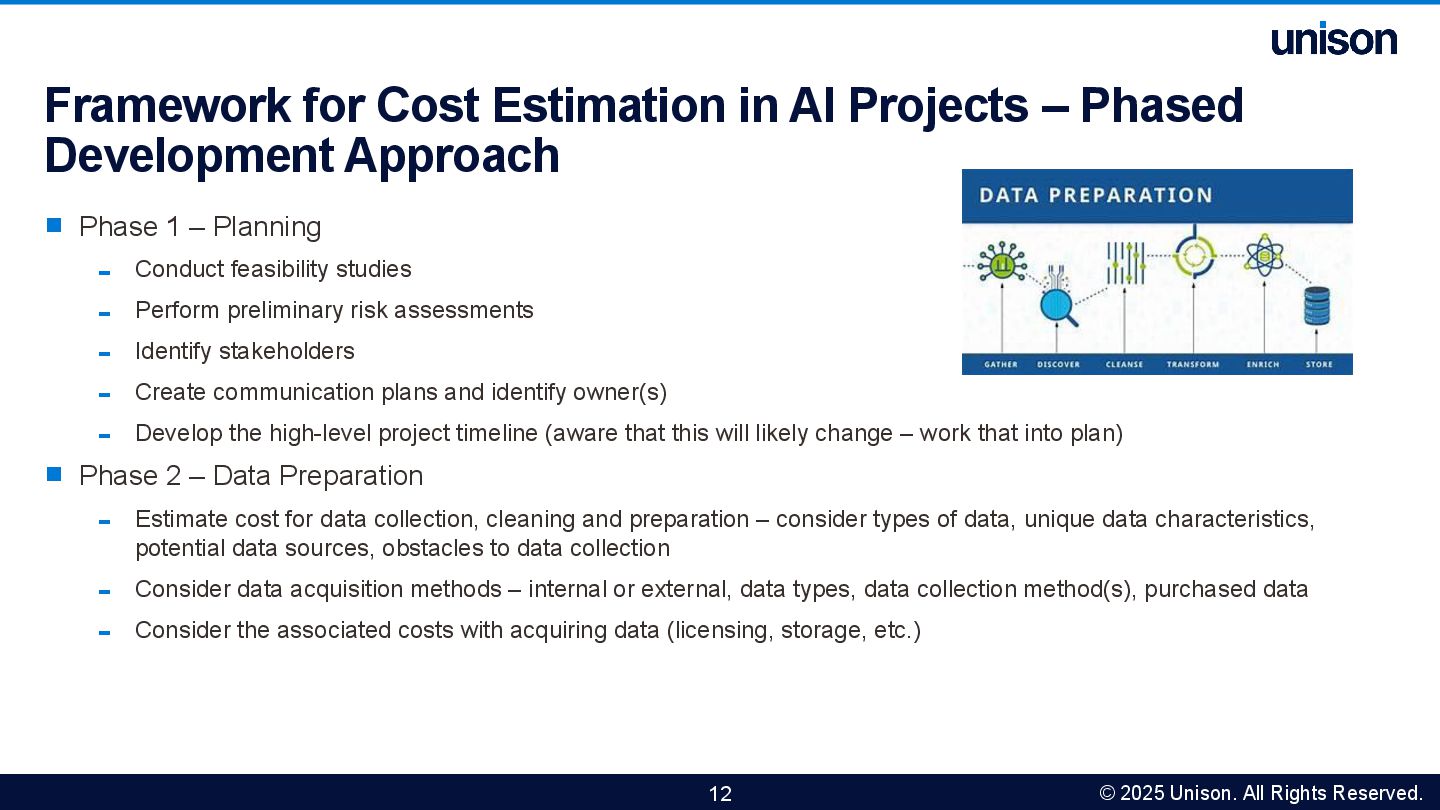
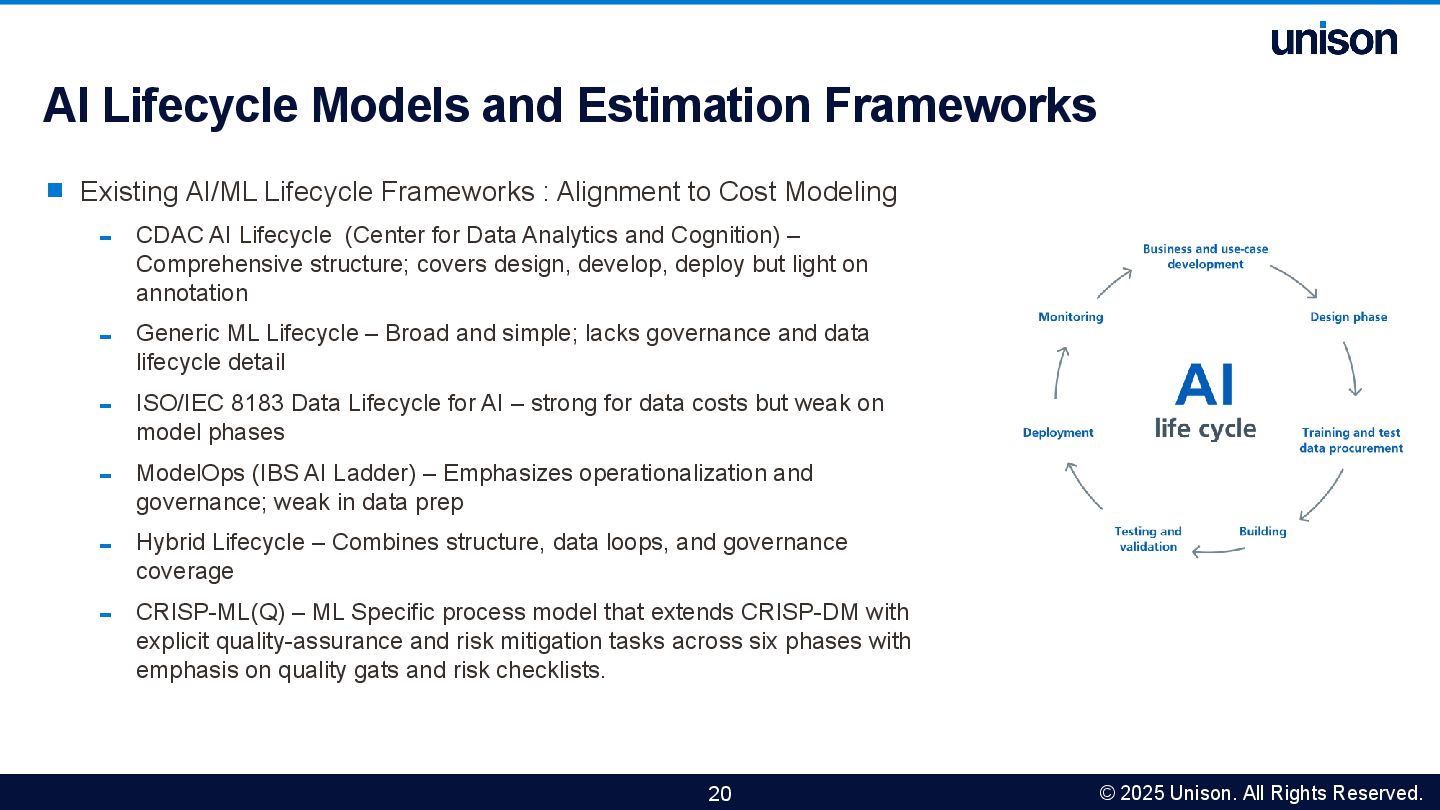
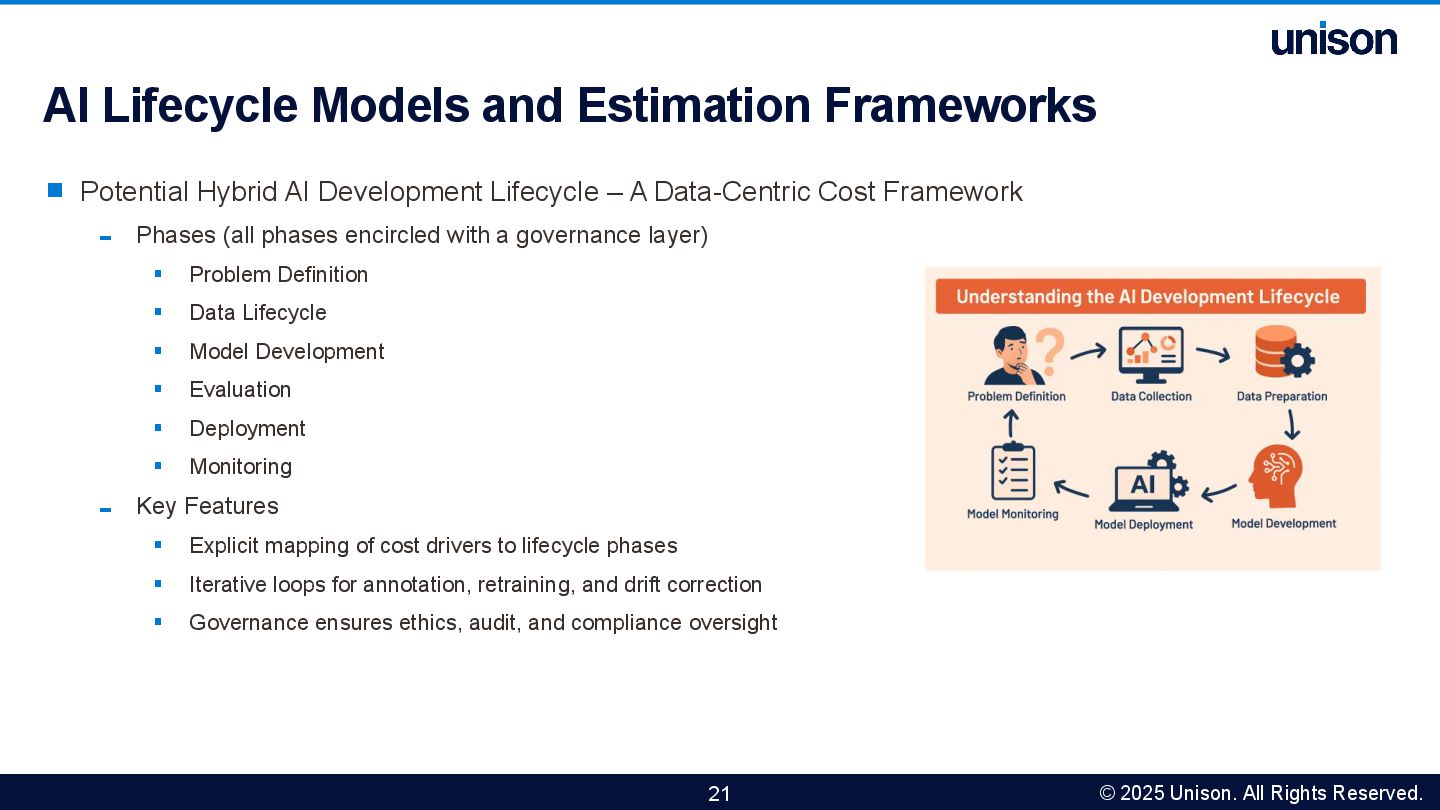
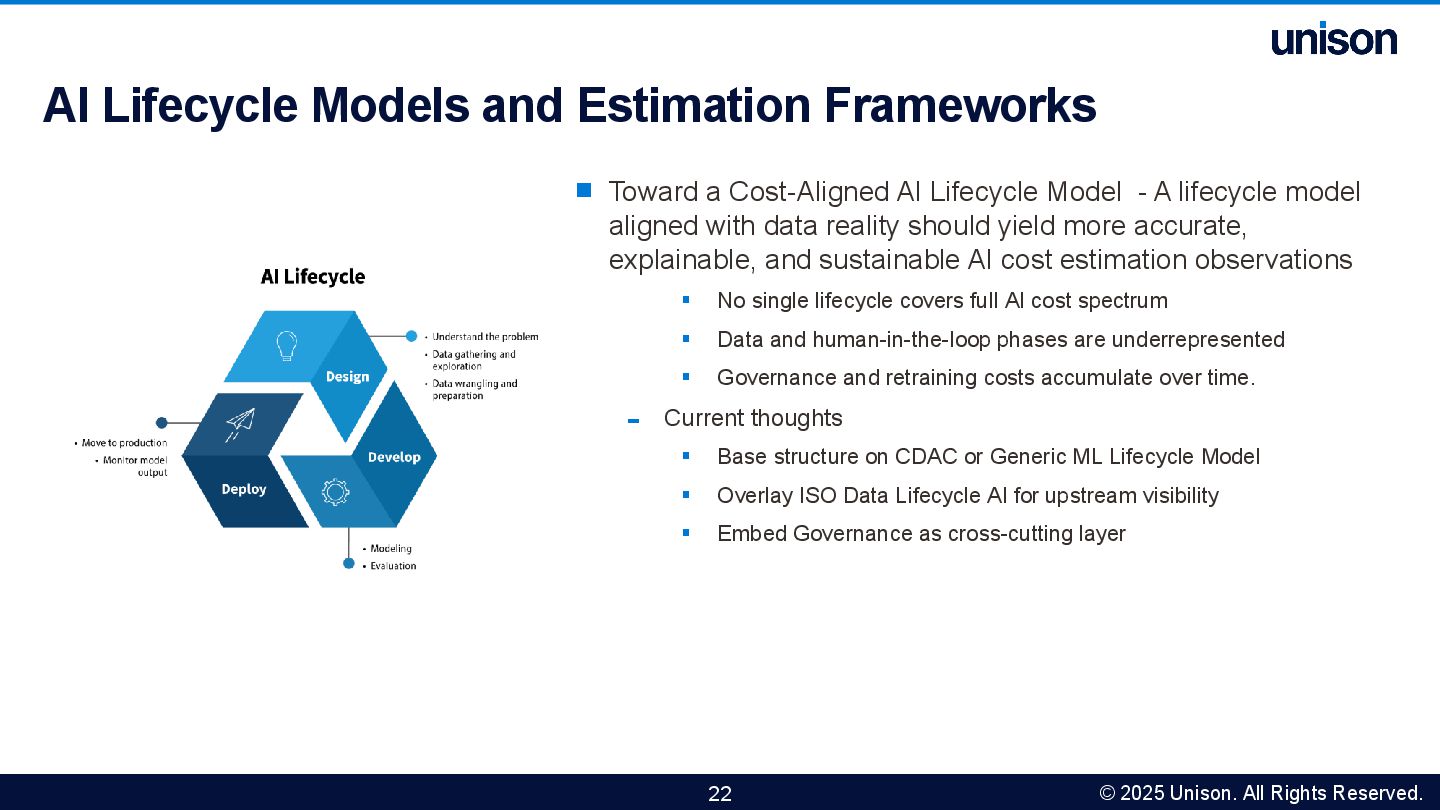
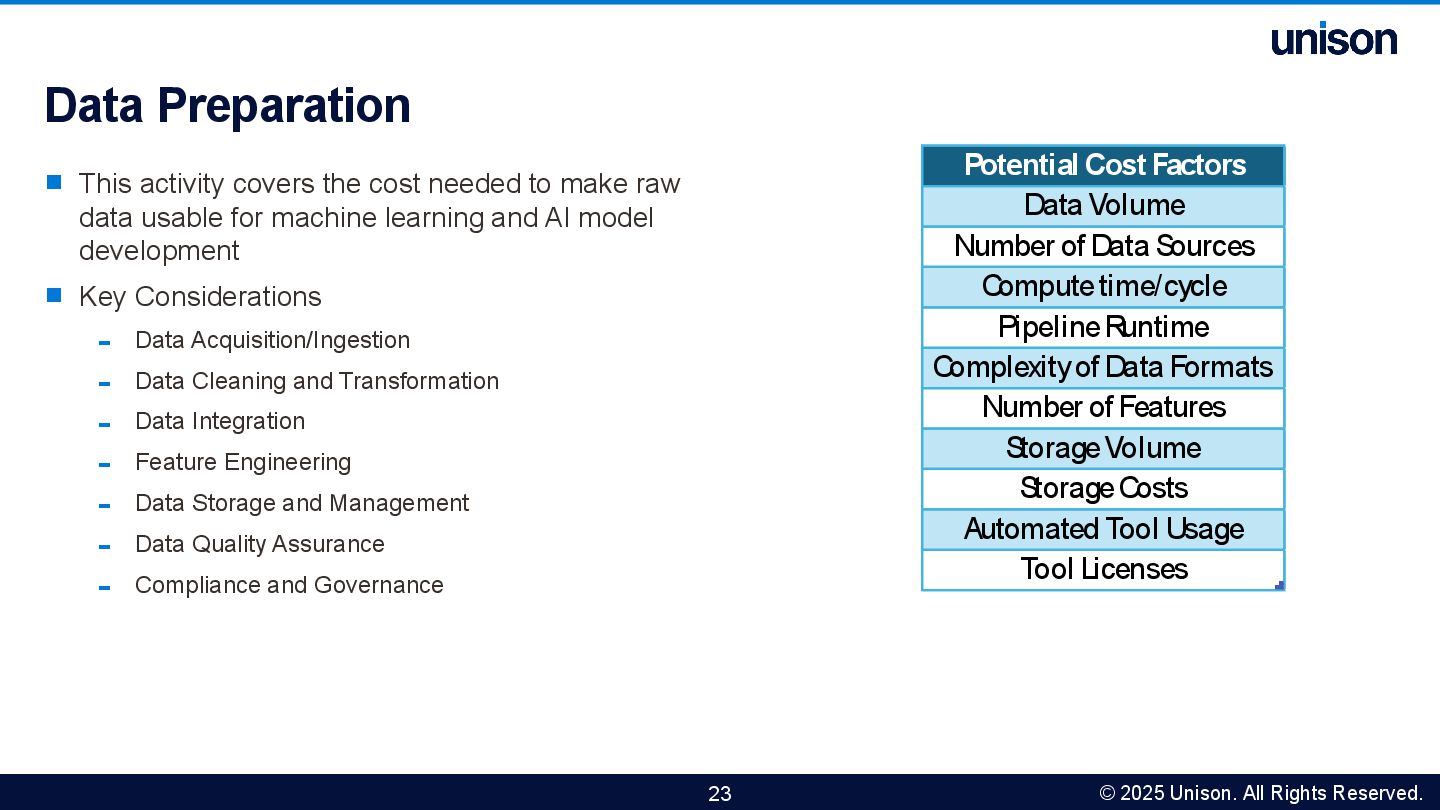
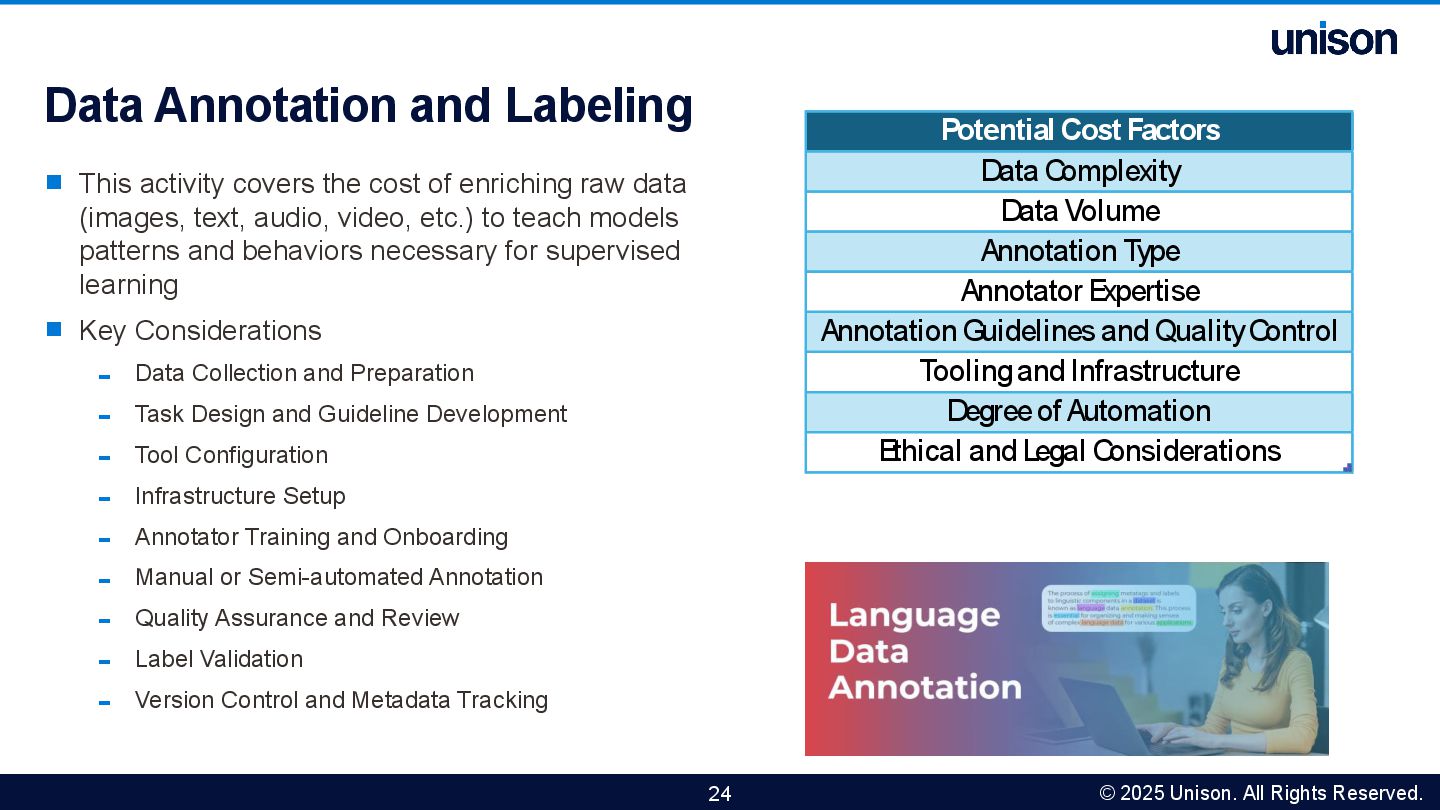
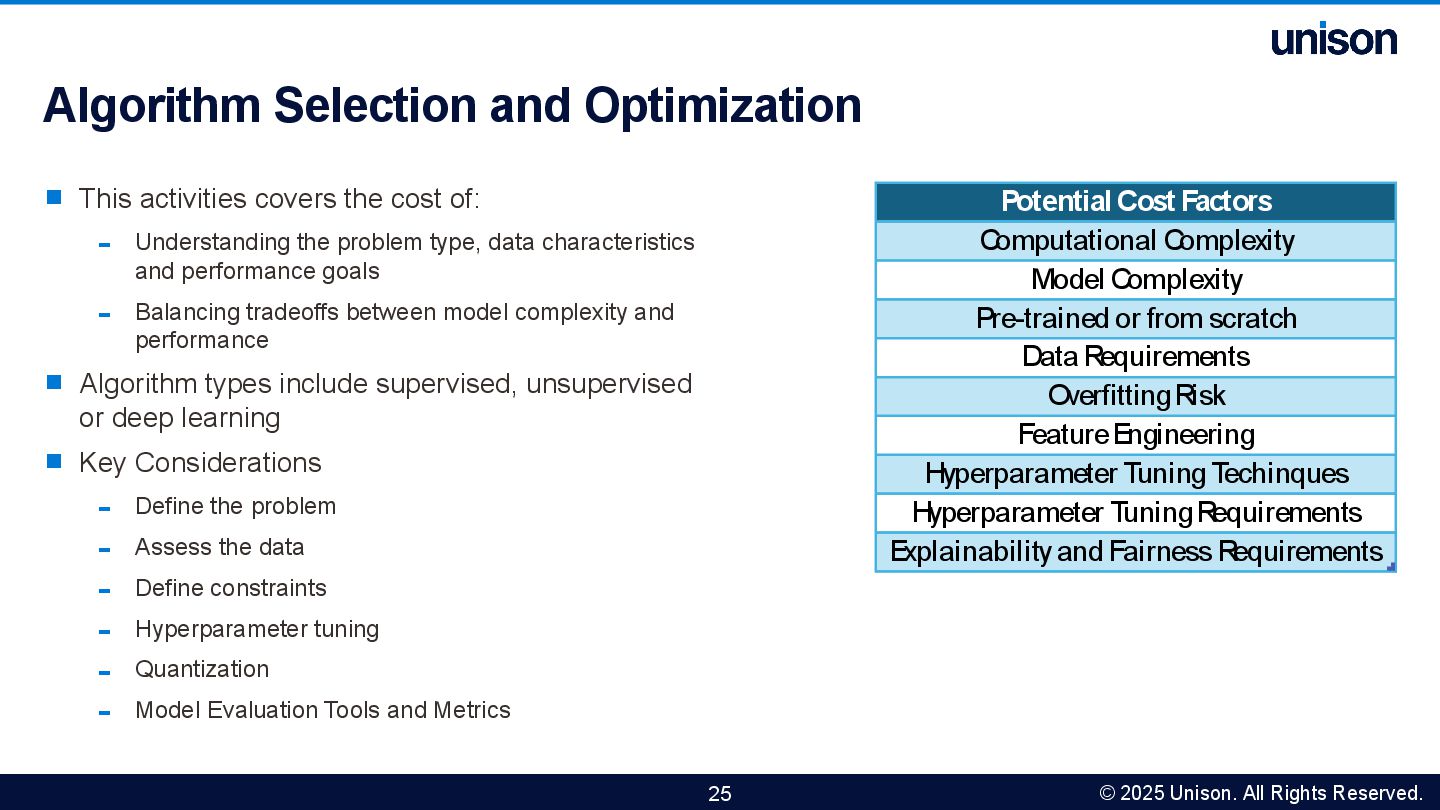
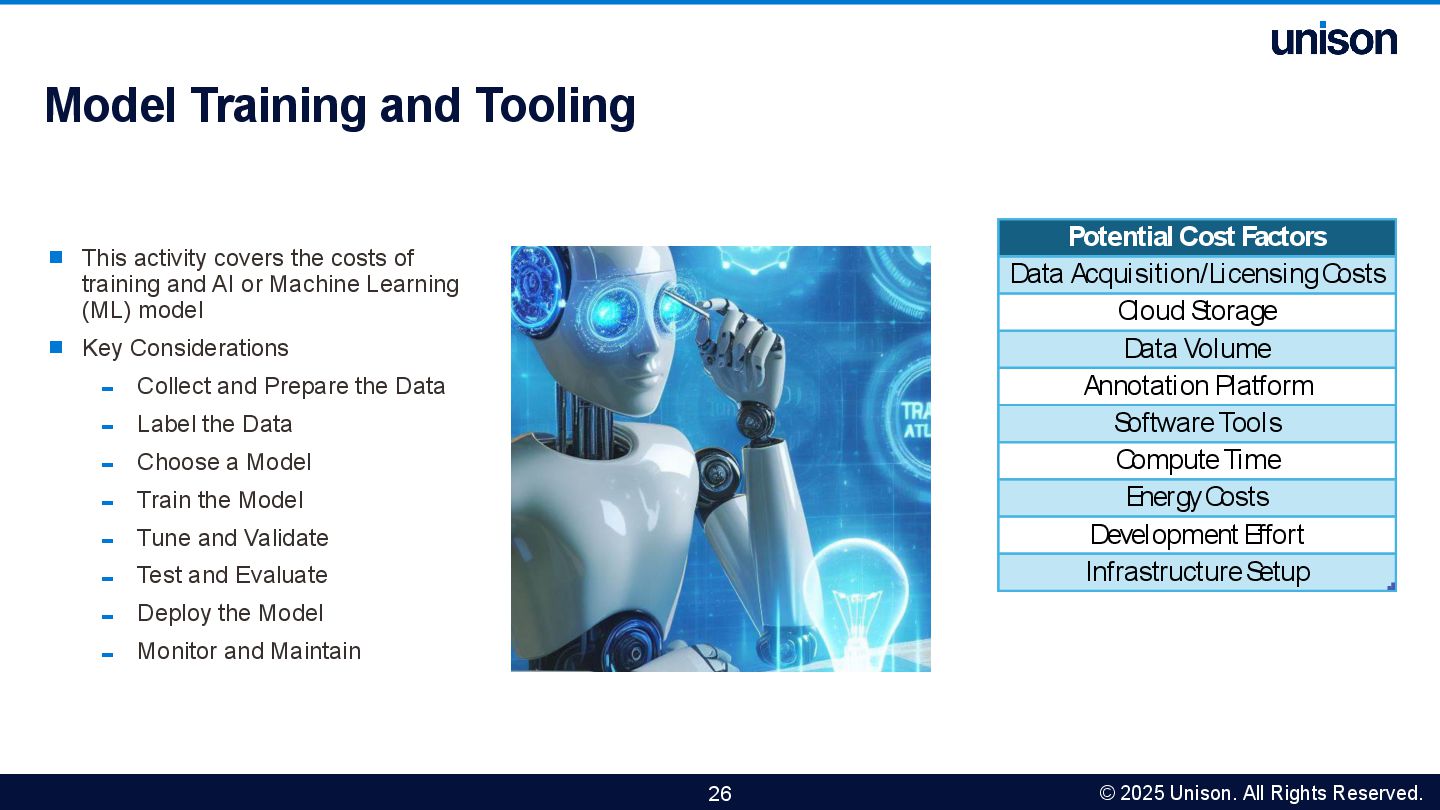
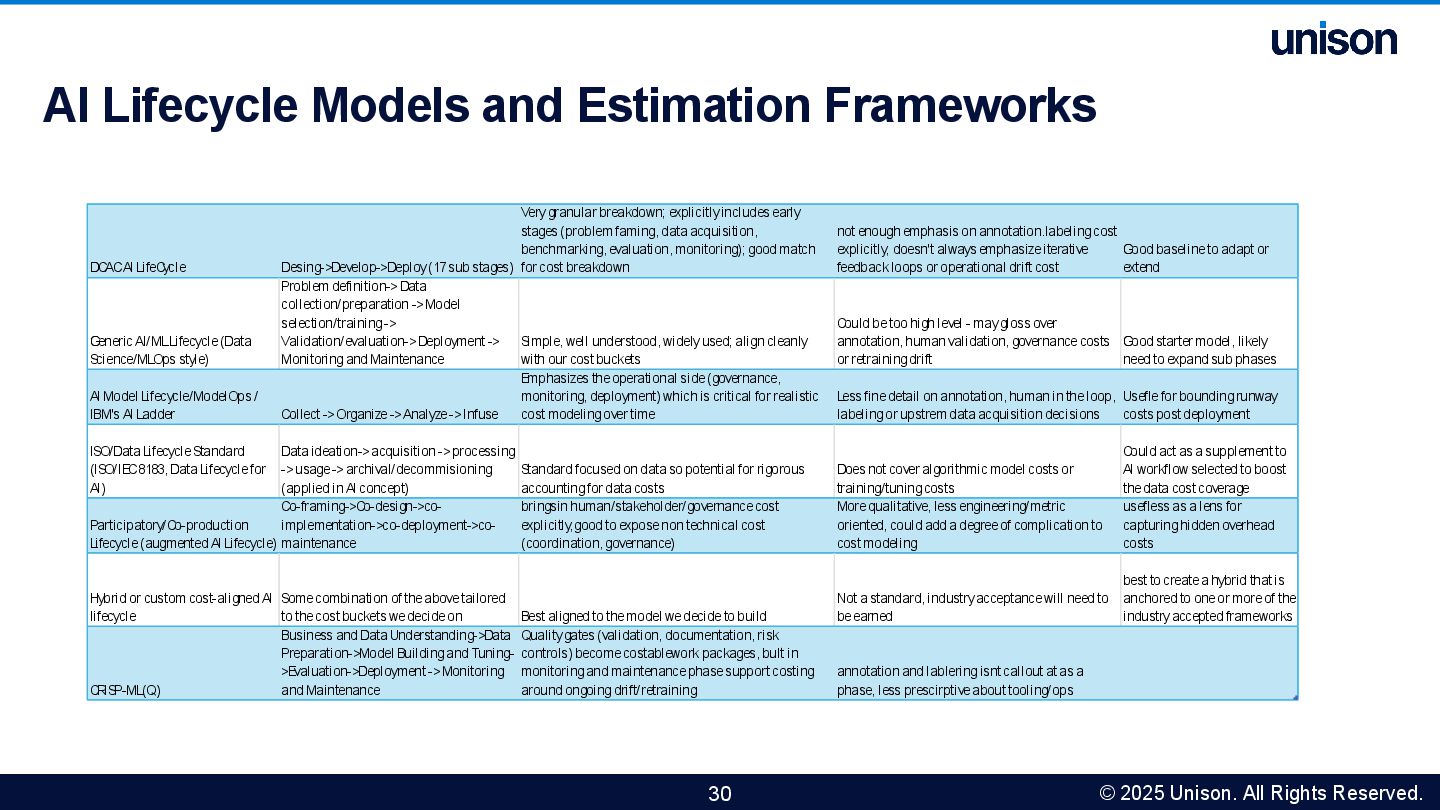
and Estimation Frameworks DCAC AI LifeCycle Desing->Develop->Deploy (17 sub stages) Very granular breakdown; explicitly includes early stages (problem faming, data acquisition, benchmarking, evaluation, monitoring); good match for cost breakdown not enough emphasis on annotation.labeling cost explicitly; doesn't always emphasize iterative feedback loops or operational drift cost Good baseline to adapt or extend Generic AI/ML Lifecycle (Data S cience/MLOps style) Problem definition-> Data collection/preparation -> Model selection/training -> Validation/evaluation-> Deployment -> Monitoring and Maintenance S imple, well understood, widely used; align cleanly with our cost buckets Could be too high level - may gloss over annotation, human validation, governance costs or retraining drift Good starter model, likely need to expand sub phases AI Model Lifecycle/ModelOps / IBM's AI Ladder Collect -> Organize -> Analyze -> Infuse E mphasizes the operational side (governance, monitoring, deployment) which is critical for realistic cost modeling over time Less fine detail on annotation, human in the loop, labeling or upstrem data acquisition decisions Usefle for bounding runway costs post deployment IS O/Data Lifecycle S tandard (IS O/IE C 8183, Data Lifecycle for AI) Data ideation-> acquisition -> processing -> usage -> archival/decommisioning (applied in AI concept) S tandard focused on data so potential for rigorous accounting for data costs Does not cover algorithmic model costs or training/tuning costs Could act as a supplement to AI workflow selected to boost the data cost coverage Participatory/Co-production Lifecycle (augmented AI Lifecycle) Co-framing->Co-design->co- implementation->co-deployment->co- maintenance bringsin human/stakeholder/governance cost explicitly;good to expose non technical cost (coordination, governance) More qualitative, less engineering/metric oriented, could add a degree of complication to cost modeling usefless as a lens for capturing hidden overhead costs Hybrid or custom cost-aligned AI lifecycle S ome combination of the above tailored to the cost buckets we decide on Best aligned to the model we decide to build Not a standard, industry acceptance will need to be earned best to create a hybrid that is anchored to one or more of the industry accepted frameworks CRIS P-ML(Q) Business and Data Understanding->Data Preparation->Model Building and Tuning- >E valuation->Deployment -> Monitoring and Maintenance Quality gates (validation, documentation, risk controls) become costablework packages, bult in monitoring and maintenance phase support costing around ongoing drift/retraining annotation and lablering isnt callout at as a phase, less prescirptive about tooling/ops


 nesmaoffice
 katarinadahlin
 inesmontani
 addyosmani
 eileencodes
 helenjbeal
 cassininazir
 chriscoyier
 sarafernandez
 marcelosomers
 aleyda
 techseoconnect
 reverentgeek