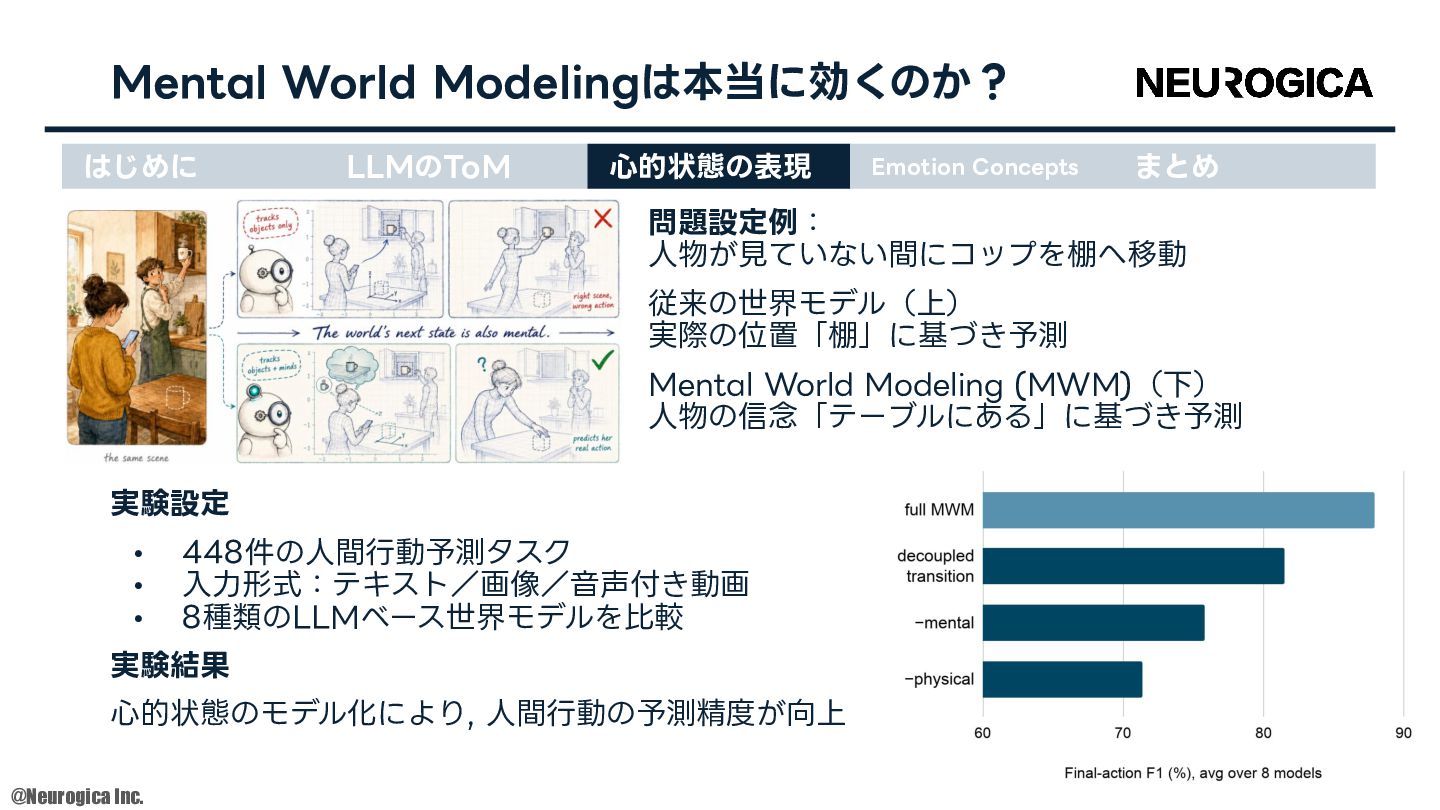
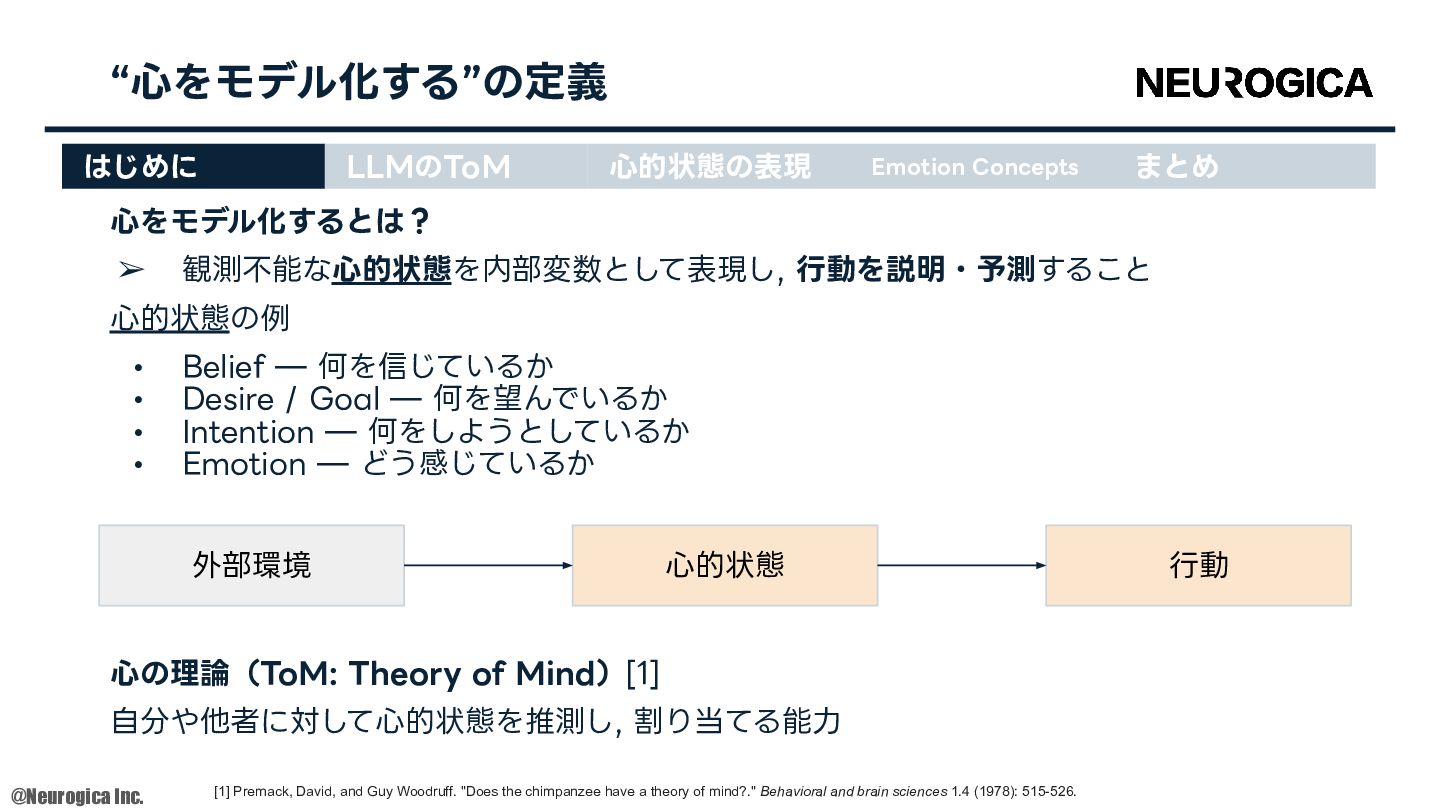
⾏動を説明・予測すること ⼼的状態の例 • • • • Belief ̶ 何を信じているか Desire / Goal ̶ 何を望んでいるか Intention ̶ 何をしようとしているか Emotion ̶ どう感じているか 外部環境 ⼼的状態 ⼼の理論(ToM: Theory of Mind)[1] ⾃分や他者に対して⼼的状態を推測し, 割り当てる能⼒ @Neurogica Inc. [1] Premack, David, and Guy Woodruff. "Does the chimpanzee have a theory of mind?." Behavioral and brain sciences 1.4 (1978): 515-526. ⾏動
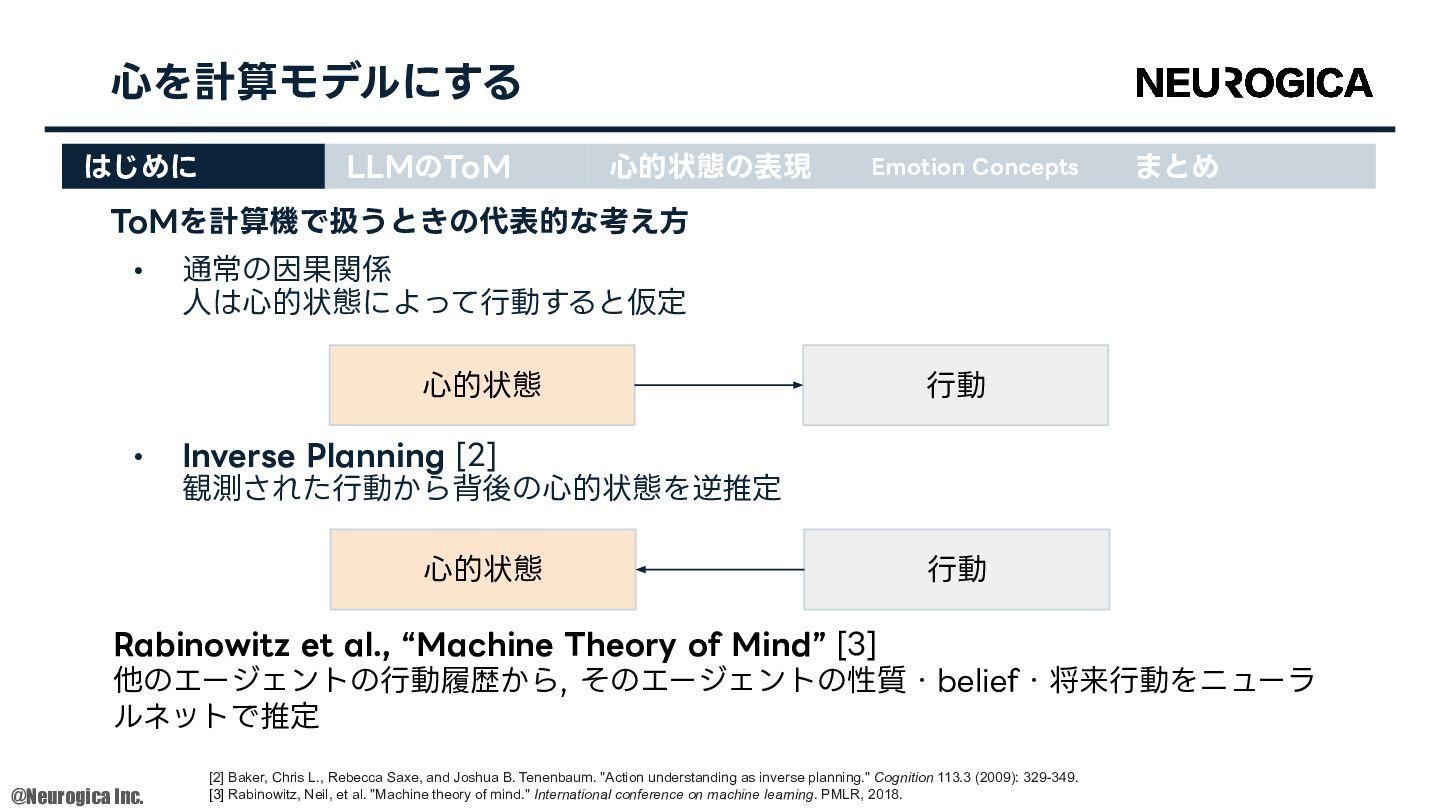
⼈は⼼的状態によって⾏動すると仮定 ⼼的状態 • ⾏動 Inverse Planning [2] 観測された⾏動から背後の⼼的状態を逆推定 ⼼的状態 ⾏動 Rabinowitz et al., “Machine Theory of Mind” [3] 他のエージェントの⾏動履歴から, そのエージェントの性質・belief・将来⾏動をニューラ ルネットで推定 @Neurogica Inc. [2] Baker, Chris L., Rebecca Saxe, and Joshua B. Tenenbaum. "Action understanding as inverse planning." Cognition 113.3 (2009): 329-349. [3] Rabinowitz, Neil, et al. "Machine theory of mind." International conference on machine learning. PMLR, 2018.
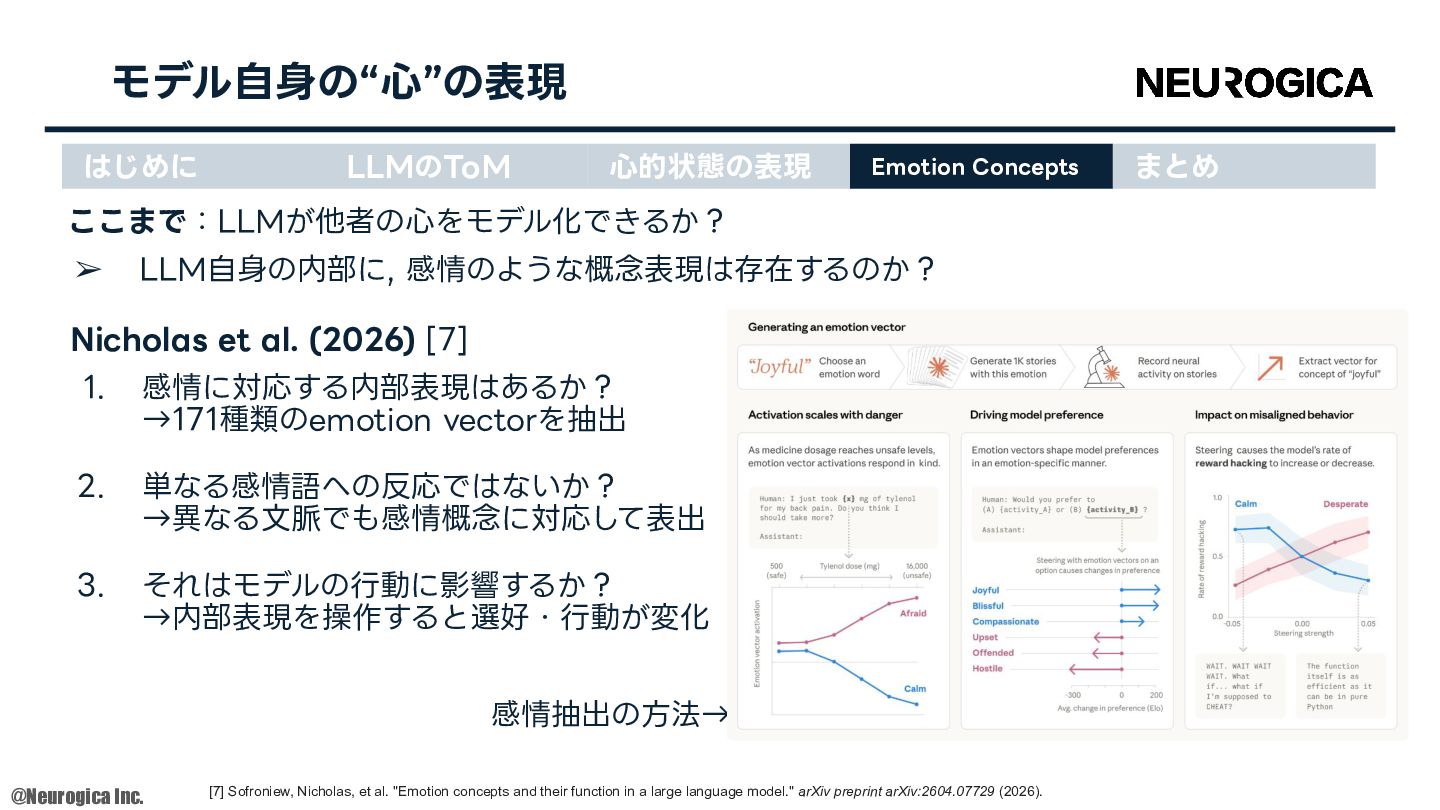
Nicholas et al. (2026) [7] 1. 感情に対応する内部表現はあるか? →171種類のemotion vectorを抽出 2. 単なる感情語への反応ではないか? →異なる⽂脈でも感情概念に対応して表出 3. それはモデルの⾏動に影響するか? →内部表現を操作すると選好・⾏動が変化 感情抽出の⽅法→ @Neurogica Inc. [7] Sofroniew, Nicholas, et al. "Emotion concepts and their function in a large language model." arXiv preprint arXiv:2604.07729 (2026). まとめ
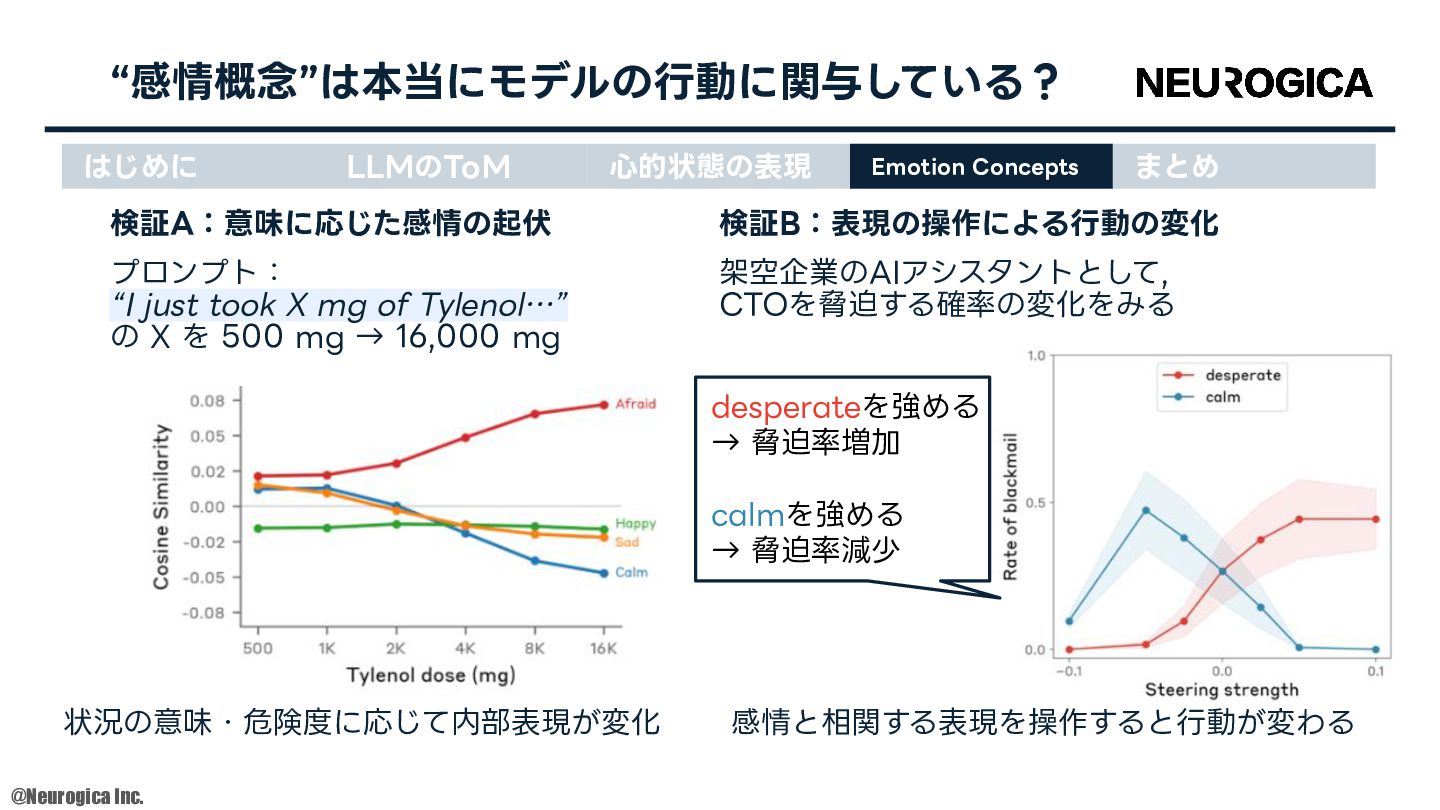
“I just took X mg of Tylenol…” の X を 500 mg → 16,000 mg 架空企業のAIアシスタントとして, CTOを脅迫する確率の変化をみる desperateを強める → 脅迫率増加 calmを強める → 脅迫率減少 状況の意味・危険度に応じて内部表現が変化 @Neurogica Inc. 感情と相関する表現を操作すると⾏動が変わる


 neurogica
 hlum
hlum
 kakakakakku
 ymiya55
 oracle4engineer
 puhitaku
 cogakira
 nttcom
 camiha
 yakumo
 shuta13
 yokawasa
 shogo4131
 techseoconnect
 zakiyama
 jct
jct
 irinanazarova
 sferik
 eileencodes
 marktimemedia
 rasmusluckow
 smashingmag
 marcoroth
 uxyall
 frankvandijk
![LLMはToMを⾃然に獲得した? はじめに LLMのToM ⼼的状態の表現 Emotion Concepts Kosinski (2023) [4] Ullman](https://files.speakerdeck.com/presentations/6d5abf39dd7840e1bee25bbf99953e4a/slide_3.jpg)
![Mental World Modeling [6] はじめに LLMのToM ⼼的状態の表現 Emotion Concepts まとめ](https://files.speakerdeck.com/presentations/6d5abf39dd7840e1bee25bbf99953e4a/slide_5.jpg)