Upgrade to Pro — share decks privately, control downloads, hide ads and more …

Software Project Management - The thing you don...

Sponsored · SiteGround - Reliable hosting with speed, security, and support you can count on. →

Software Project Management - The thing you don't want to hear

Project management is one of the most vital practices in any sort of organisation but the least thing that is considered important in many. Hundreds of projects fail yearly and incur billion of monetary losses because of bad management at all levels of a company. In the Mauritian context, many companies enforce project management in their day-to-day business operations to comply with standards but few do it to optimise or gain something from it. Just like big corporations who spend millions of dollars to optimise their workflows and make their business processes more efficient, startups also can easily achieve that using the right set of tools. As an engineer and post graduate (MSc) student, I’ll be demystifying the different myths of project management in Mauritian context, how to integrate proper project management in a company, the shift and culture.

Avatar for Nirvan Pagooah

Nirvan Pagooah

April 13, 2019

Other Decks in Technology

Transcript

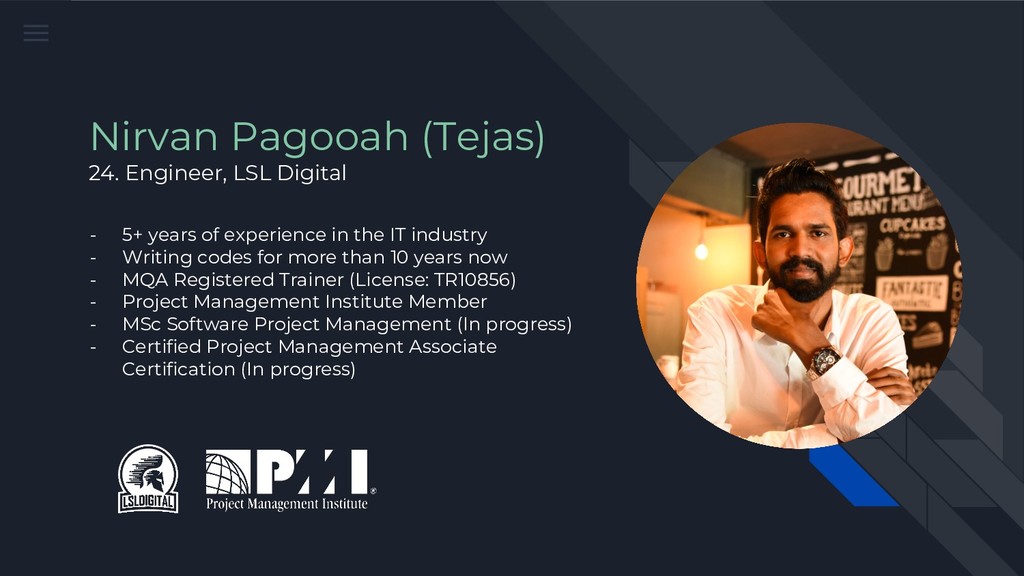
  1. Nirvan Pagooah (Tejas) 24. Engineer, LSL Digital - 5+ years

    of experience in the IT industry - Writing codes for more than 10 years now - MQA Registered Trainer (License: TR10856) - Project Management Institute Member - MSc Software Project Management (In progress) - Certified Project Management Associate Certification (In progress)
  2. Agenda • Project management for newbies • Why do Software

    Projects fail? • Agile Project Management • Requirements Prioritisation Techniques • Project Management Institute
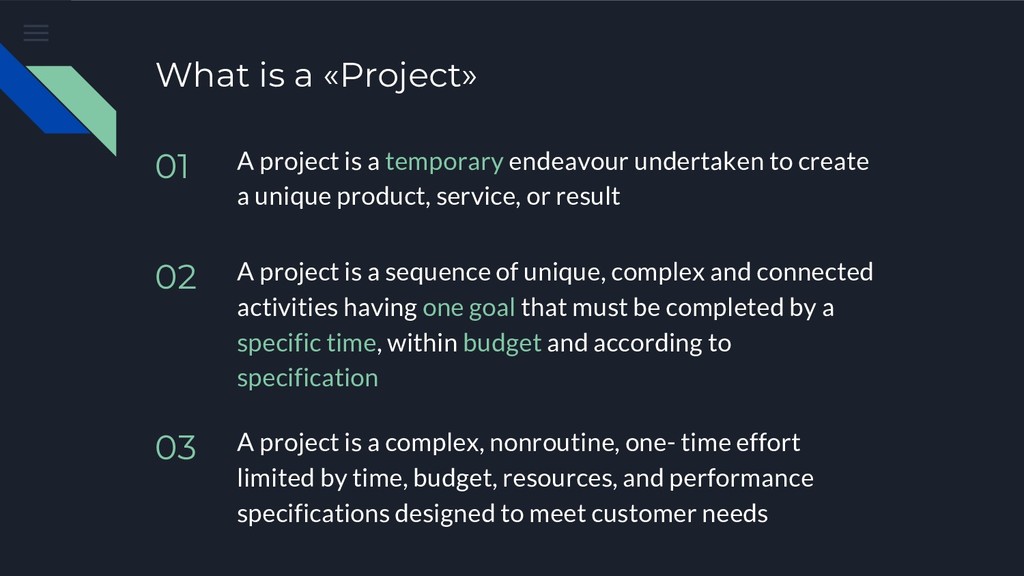
  3. What is a «Project» 01 A project is a temporary

    endeavour undertaken to create a unique product, service, or result 02 A project is a sequence of unique, complex and connected activities having one goal that must be completed by a specific time, within budget and according to specification 03 A project is a complex, nonroutine, one- time effort limited by time, budget, resources, and performance specifications designed to meet customer needs
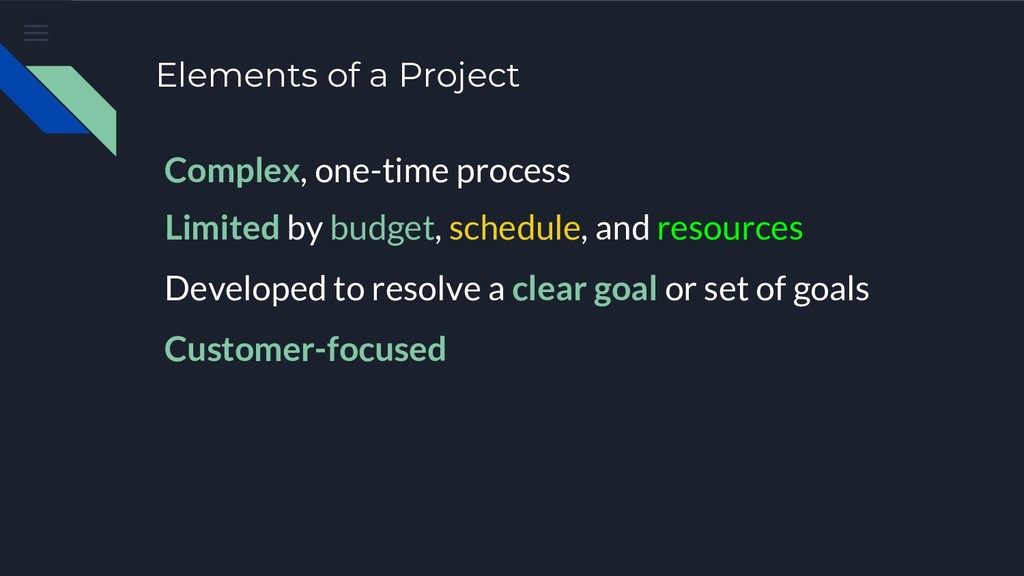
  4. Elements of a Project Complex, one-time process Limited by budget,

    schedule, and resources Developed to resolve a clear goal or set of goals Customer-focused
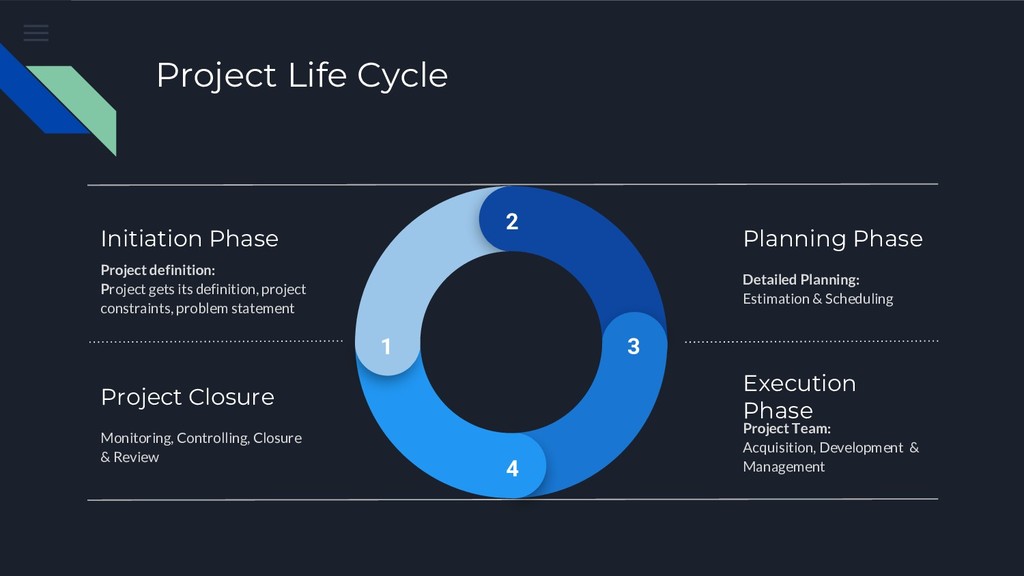
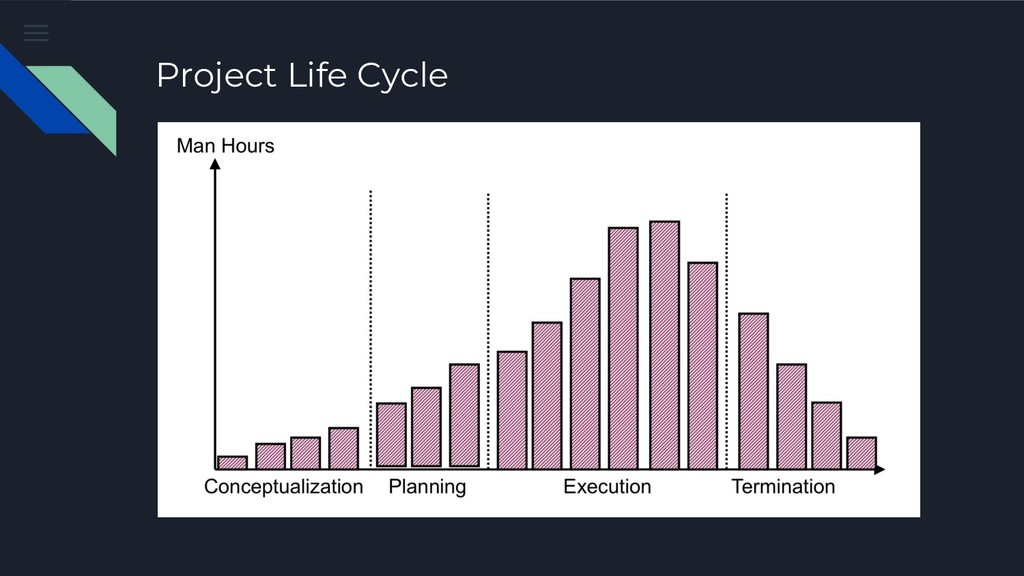
  5. Project Life Cycle Initiation Phase Project definition: Project gets its

    definition, project constraints, problem statement Project Closure Monitoring, Controlling, Closure & Review Planning Phase Detailed Planning: Estimation & Scheduling Execution Phase Project Team: Acquisition, Development & Management 1 4 3 2
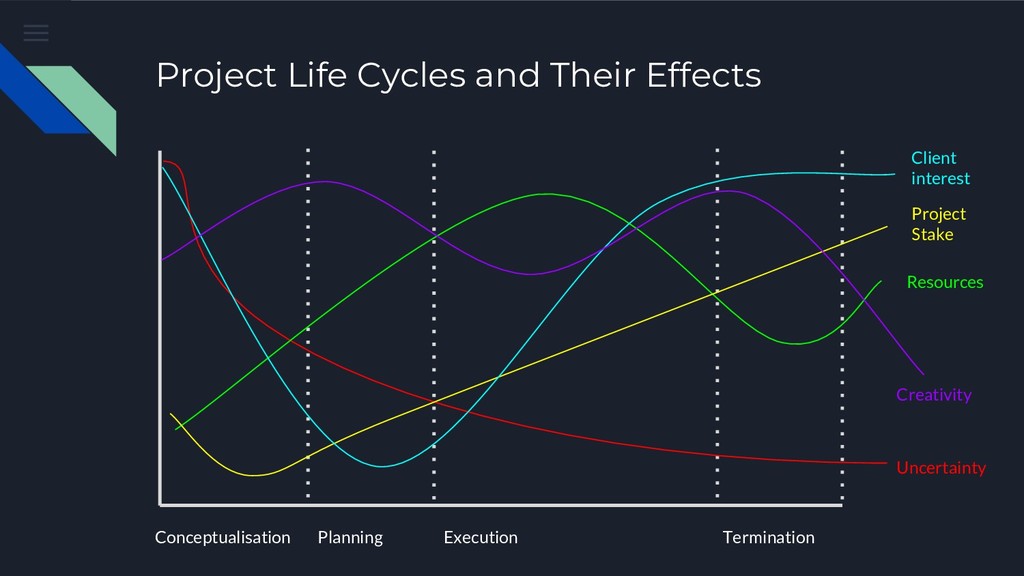
  6. Project Life Cycles and Their Effects Conceptualisation Planning Execution Termination

    Uncertainty Resources Project Stake Client interest Creativity
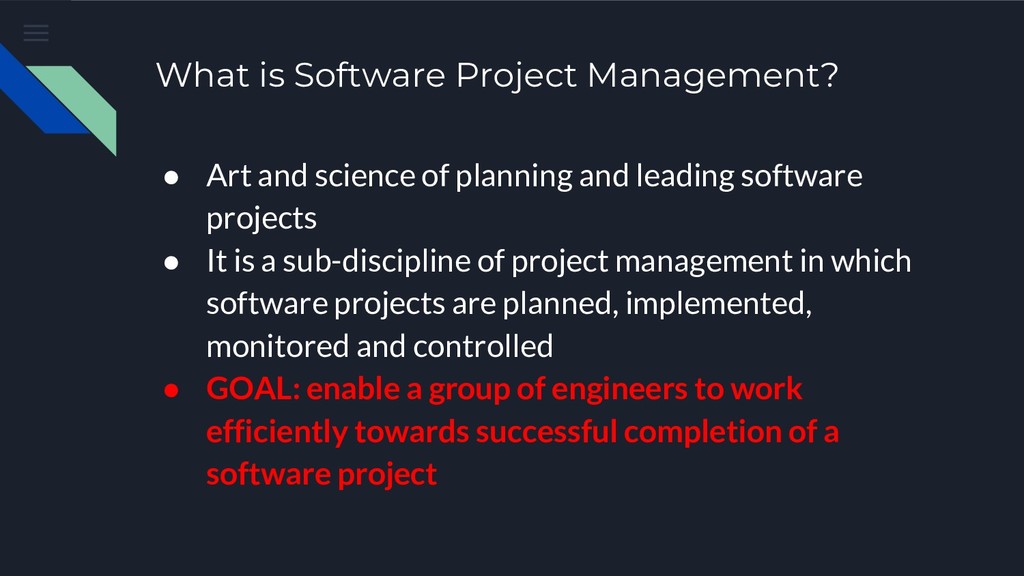
  7. What is Software Project Management? • Art and science of

    planning and leading software projects • It is a sub-discipline of project management in which software projects are planned, implemented, monitored and controlled • GOAL: enable a group of engineers to work efficiently towards successful completion of a software project
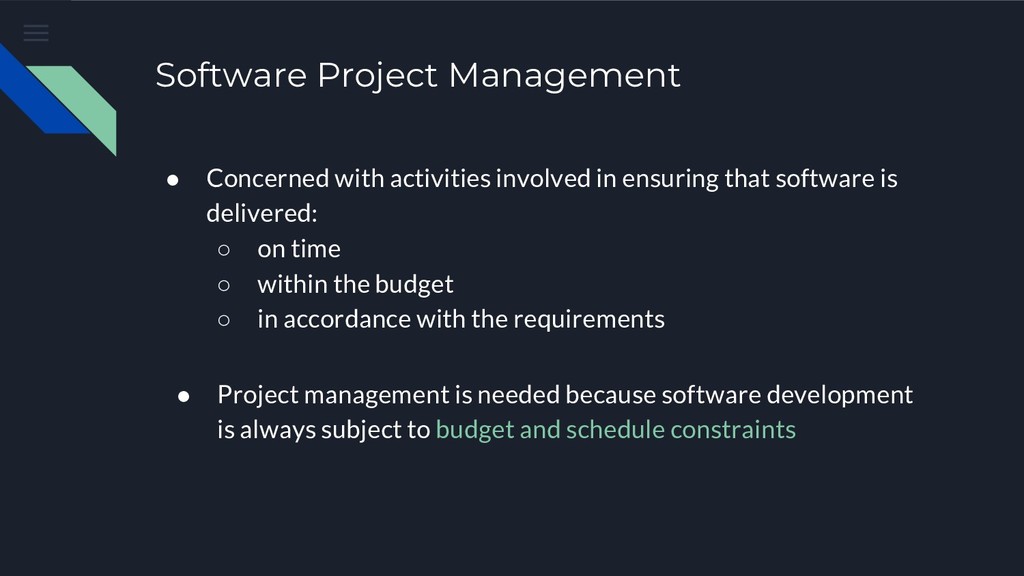
  8. Software Project Management • Concerned with activities involved in ensuring

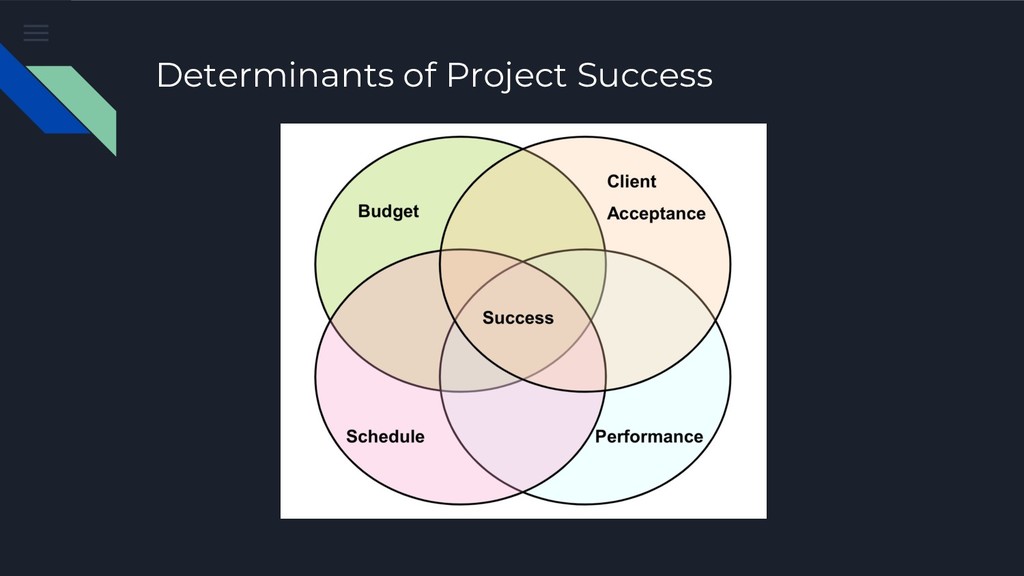
    that software is delivered: ◦ on time ◦ within the budget ◦ in accordance with the requirements • Project management is needed because software development is always subject to budget and schedule constraints
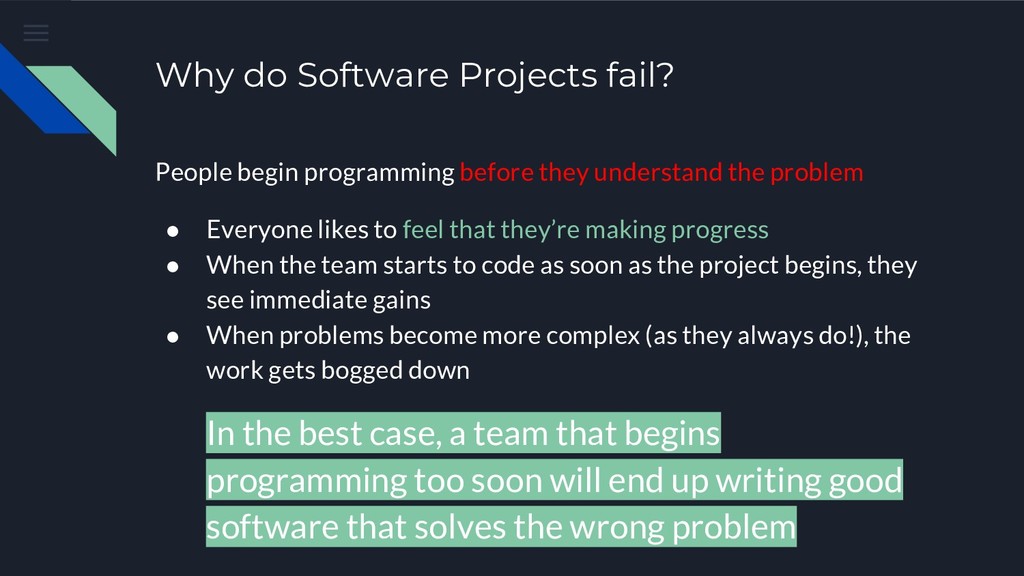
  9. Why do Software Projects fail? People begin programming before they

    understand the problem • Everyone likes to feel that they’re making progress • When the team starts to code as soon as the project begins, they see immediate gains • When problems become more complex (as they always do!), the work gets bogged down In the best case, a team that begins programming too soon will end up writing good software that solves the wrong problem
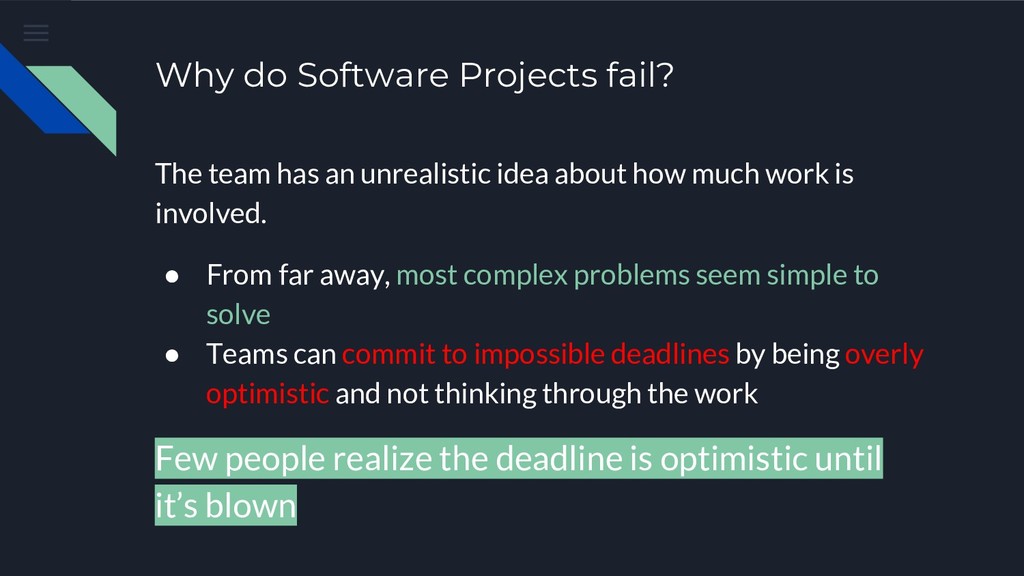
  10. Why do Software Projects fail? The team has an unrealistic

    idea about how much work is involved. • From far away, most complex problems seem simple to solve • Teams can commit to impossible deadlines by being overly optimistic and not thinking through the work Few people realize the deadline is optimistic until it’s blown
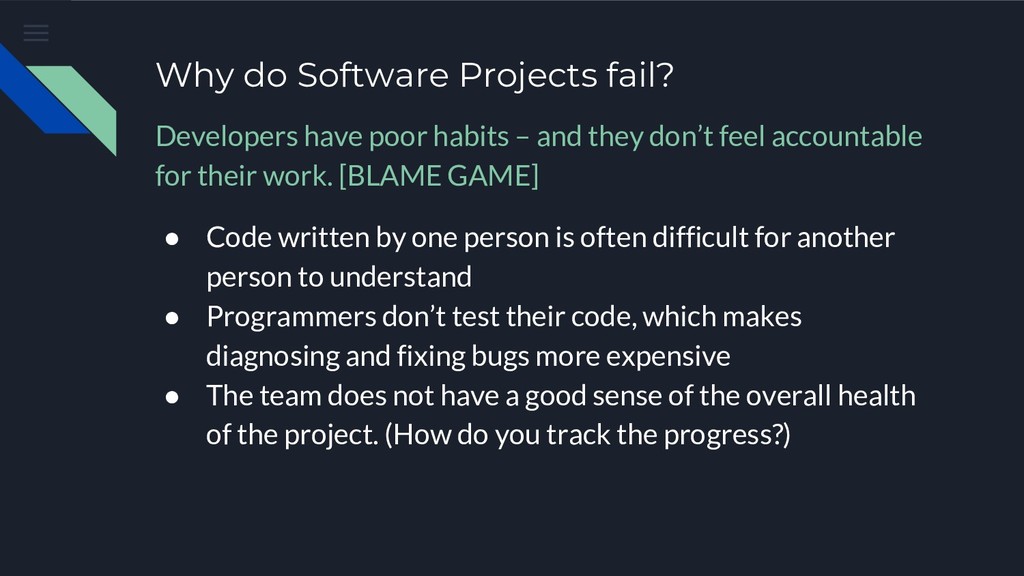
  11. Why do Software Projects fail? Developers have poor habits –

    and they don’t feel accountable for their work. [BLAME GAME] • Code written by one person is often difficult for another person to understand • Programmers don’t test their code, which makes diagnosing and fixing bugs more expensive • The team does not have a good sense of the overall health of the project. (How do you track the progress?)
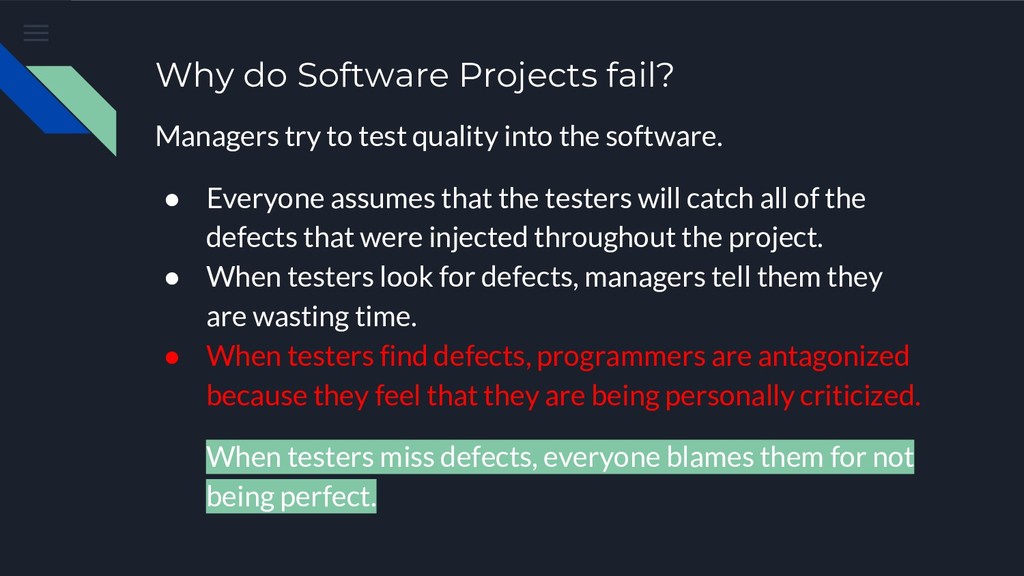
  12. Why do Software Projects fail? Managers try to test quality

    into the software. • Everyone assumes that the testers will catch all of the defects that were injected throughout the project. • When testers look for defects, managers tell them they are wasting time. • When testers find defects, programmers are antagonized because they feel that they are being personally criticized. When testers miss defects, everyone blames them for not being perfect.
  13. What is Agile? Agile is simply about removing the barriers

    that stand between where you are now and where you want to be. It’s about understanding what stands between you and achieving your purpose quickly and effectively, and responding in the most appropriate way to move forward.
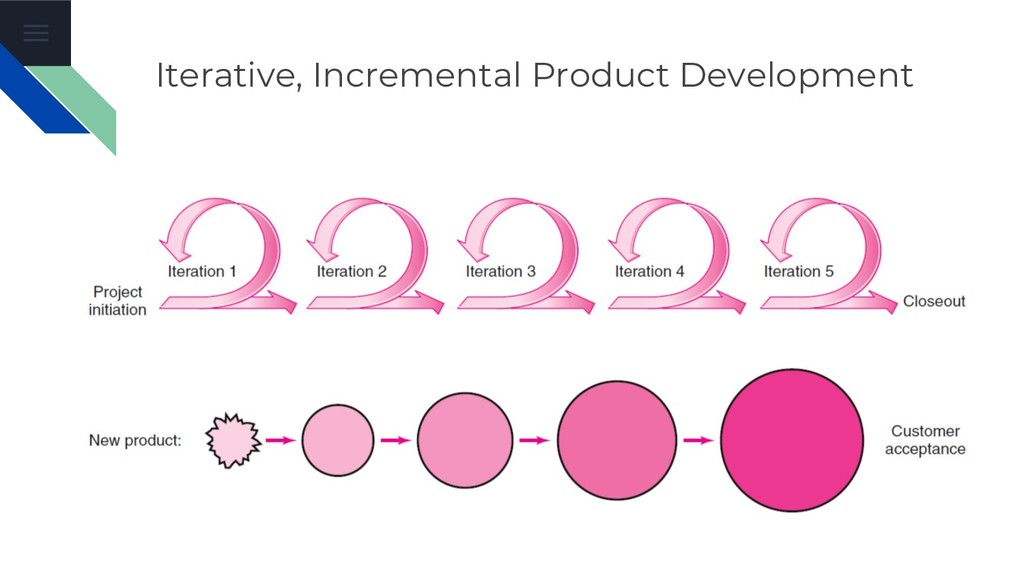
  14. What is Agile Software Project Management? • Relies on incremental,

    iterative development cycles to complete less-predictable projects. • Is ideal for exploratory projects in which requirements need to be discovered and new technology tested. • Active collaboration between the project team and customer representatives.
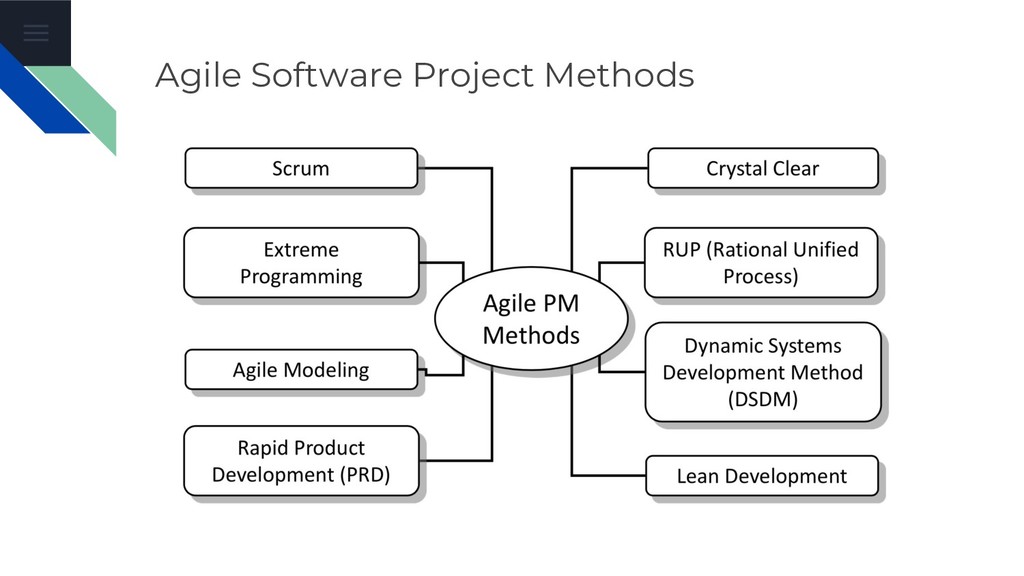
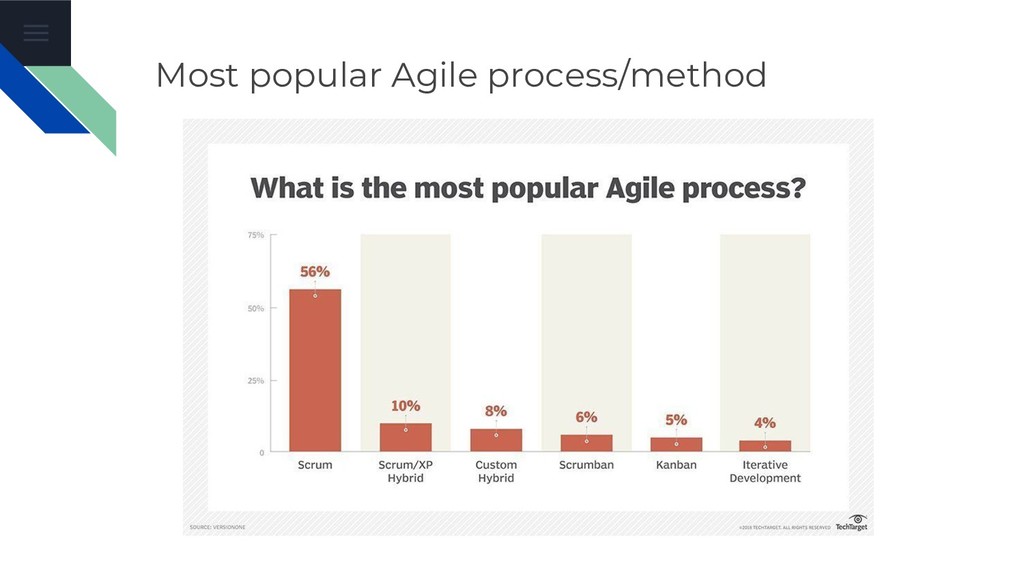
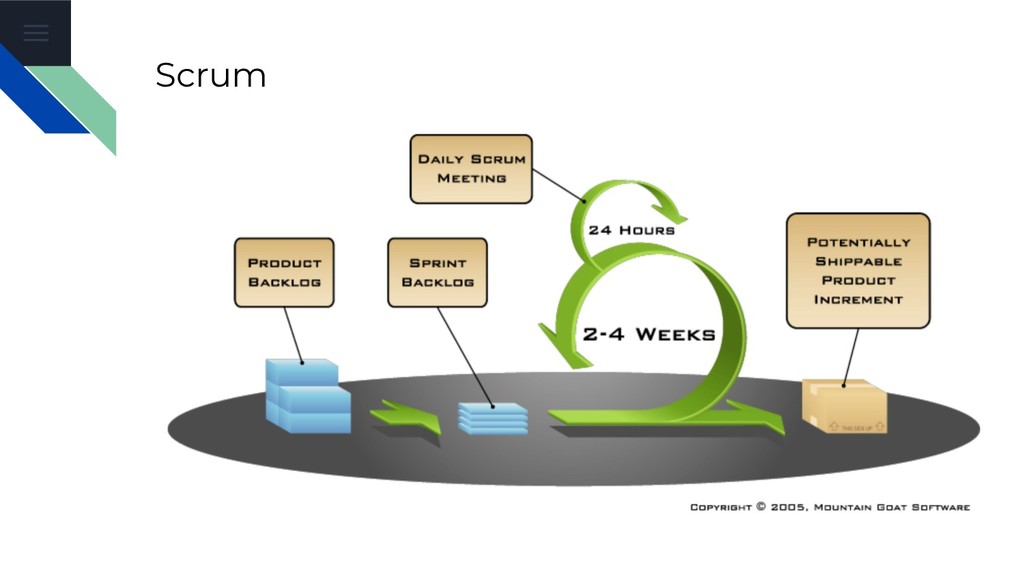
  15. Scrum Scrum allows us to focus on delivering the highest

    business value in the shortest time • It allows us to rapidly and repeatedly inspect actual working software (every two weeks to one month). • Teams self-organize to determine the best way to deliver the highest priority features. • Every two weeks to a month anyone can see real working software and decide to release it as is or continue to enhance it for another sprint.
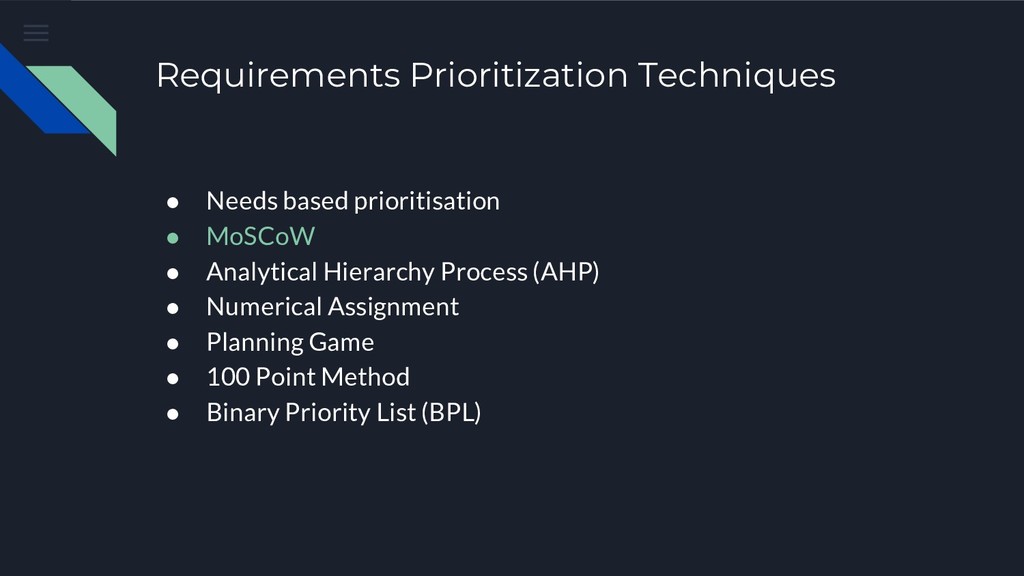
  16. Requirements Prioritization Techniques • Needs based prioritisation • MoSCoW •

    Analytical Hierarchy Process (AHP) • Numerical Assignment • Planning Game • 100 Point Method • Binary Priority List (BPL)
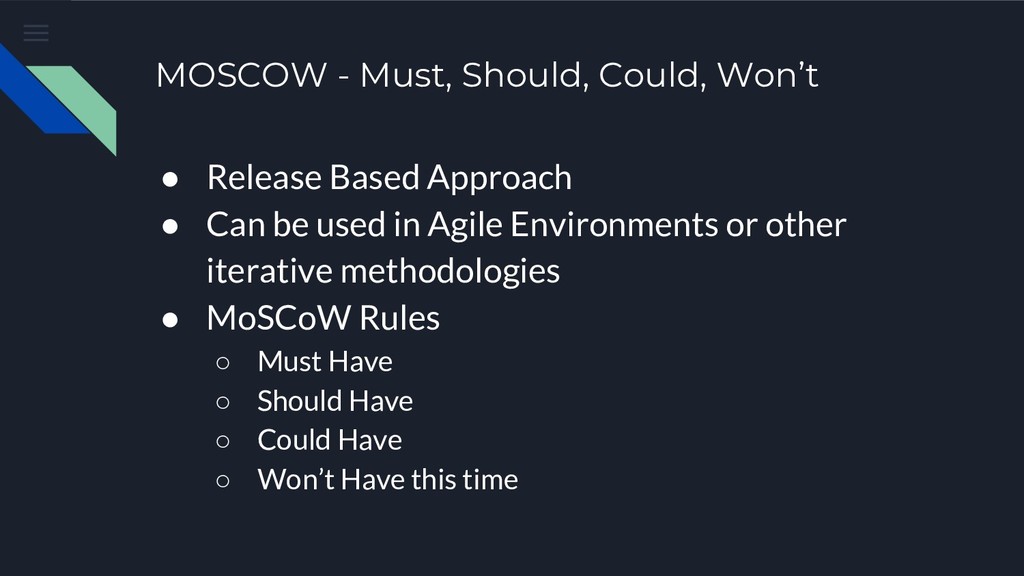
  17. MOSCOW - Must, Should, Could, Won’t • Release Based Approach

    • Can be used in Agile Environments or other iterative methodologies • MoSCoW Rules ◦ Must Have ◦ Should Have ◦ Could Have ◦ Won’t Have this time
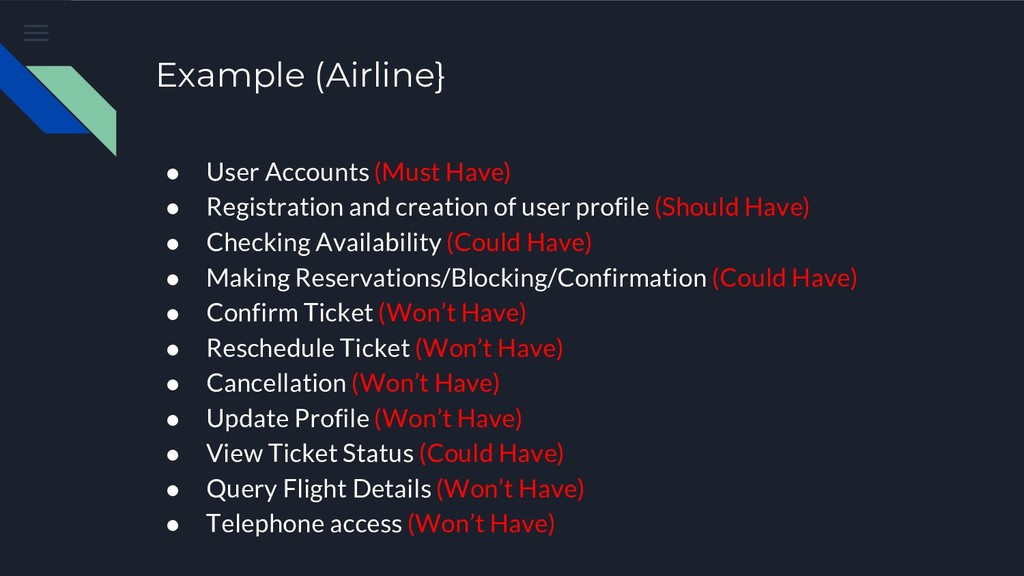
  18. Example (Airline} • User Accounts (Must Have) • Registration and

    creation of user profile (Should Have) • Checking Availability (Could Have) • Making Reservations/Blocking/Confirmation (Could Have) • Confirm Ticket (Won’t Have) • Reschedule Ticket (Won’t Have) • Cancellation (Won’t Have) • Update Profile (Won’t Have) • View Ticket Status (Could Have) • Query Flight Details (Won’t Have) • Telephone access (Won’t Have)
  19. Q&A