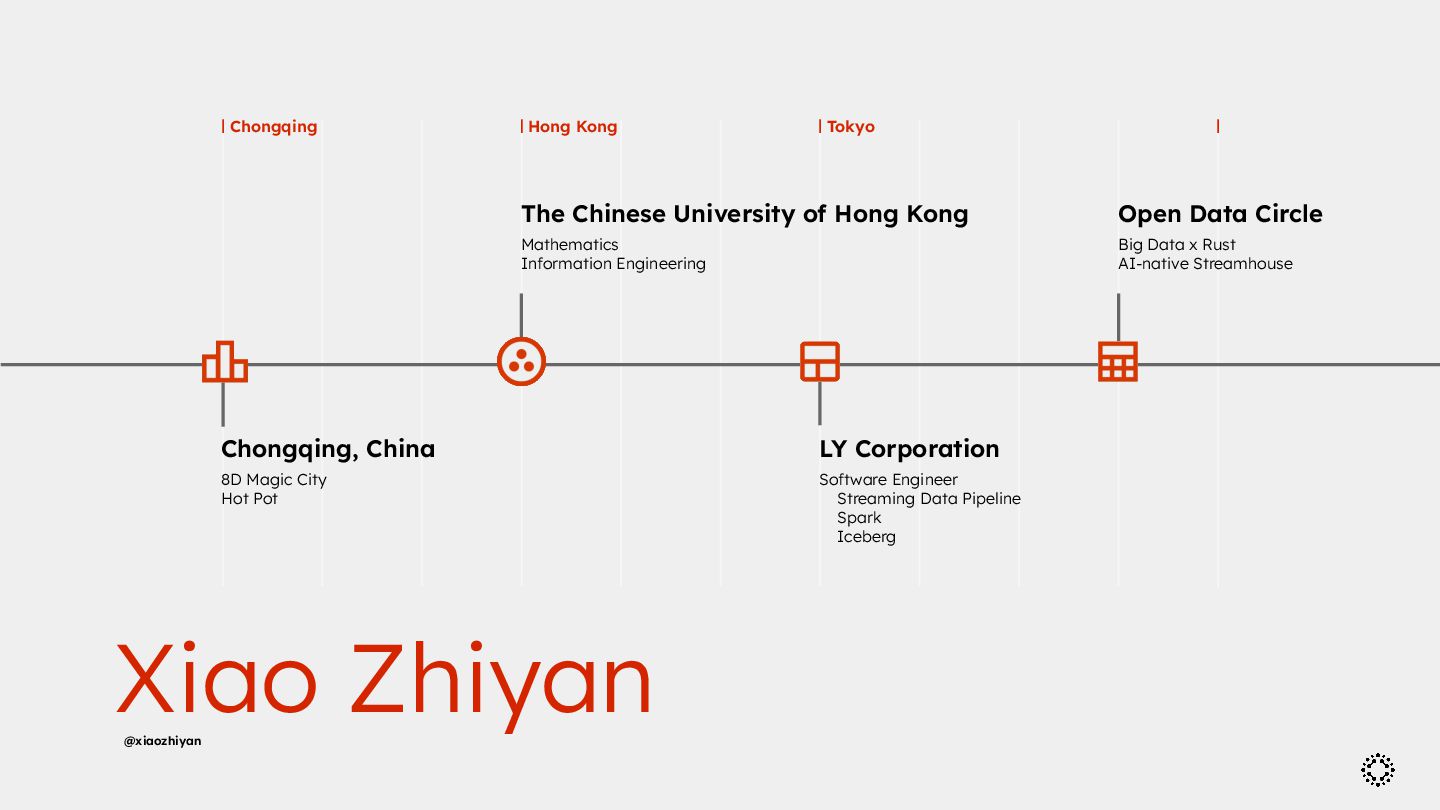
of Hong Kong Mathematics Information Engineering LY Corporation Software Engineer Streaming Data Pipeline Spark Iceberg Open Data Circle Big Data x Rust AI-native Streamhouse Chongqing Hong Kong Tokyo Xiao Zhiyan @xiaozhiyan
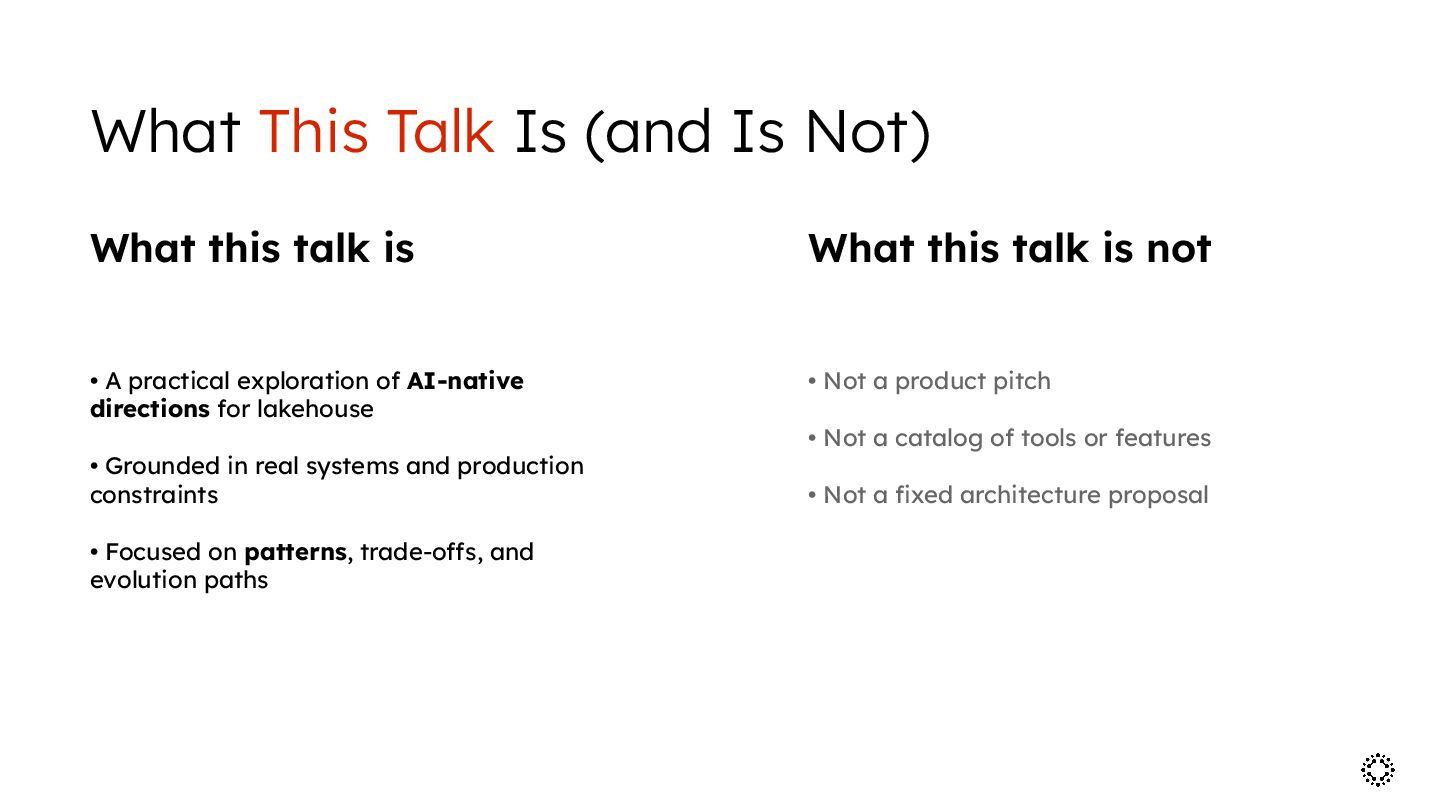
tools or features • Not a fixed architecture proposal • A practical exploration of AI-native directions for lakehouse • Grounded in real systems and production constraints • Focused on patterns, trade-offs, and evolution paths What this talk is What this talk is not What This Talk Is (and Is Not)
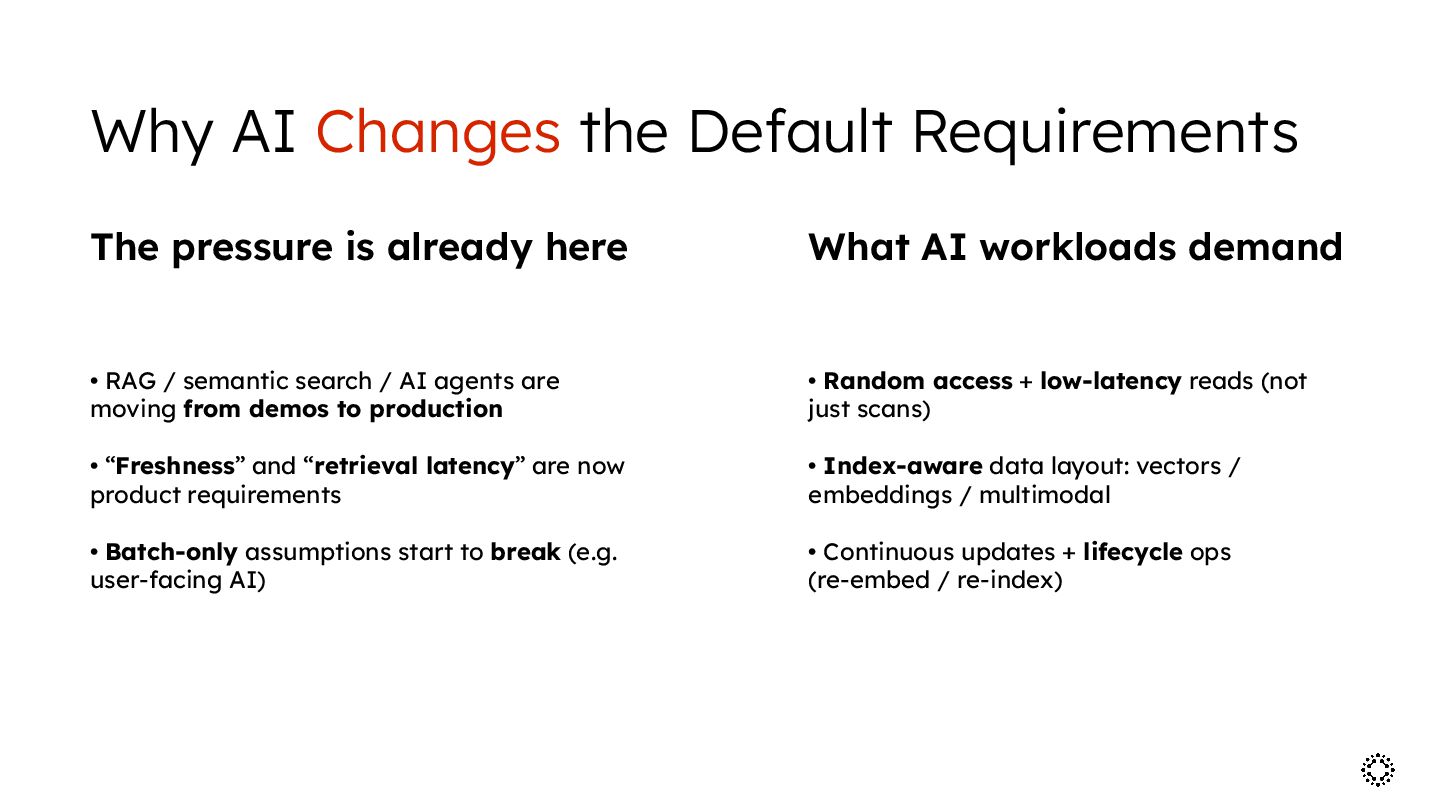
search / AI agents are moving from demos to production • “Freshness” and “retrieval latency” are now product requirements • Batch-only assumptions start to break (e.g. user-facing AI) • Random access + low-latency reads (not just scans) • Index-aware data layout: vectors / embeddings / multimodal • Continuous updates + lifecycle ops (re-embed / re-index) The pressure is already here What AI workloads demand
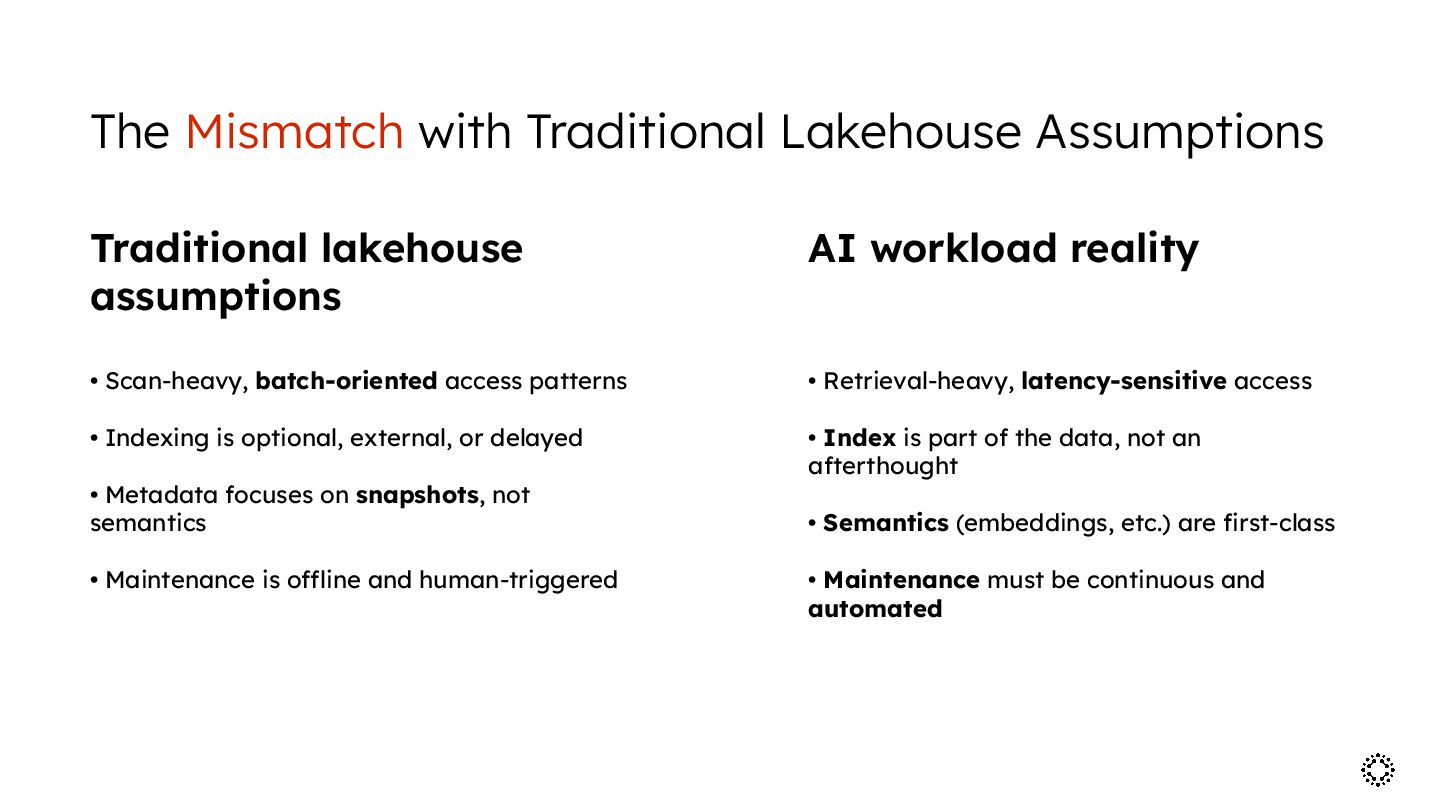
patterns • Indexing is optional, external, or delayed • Metadata focuses on snapshots, not semantics • Maintenance is offline and human-triggered • Retrieval-heavy, latency-sensitive access • Index is part of the data, not an afterthought • Semantics (embeddings, etc.) are first-class • Maintenance must be continuous and automated Traditional lakehouse assumptions AI workload reality
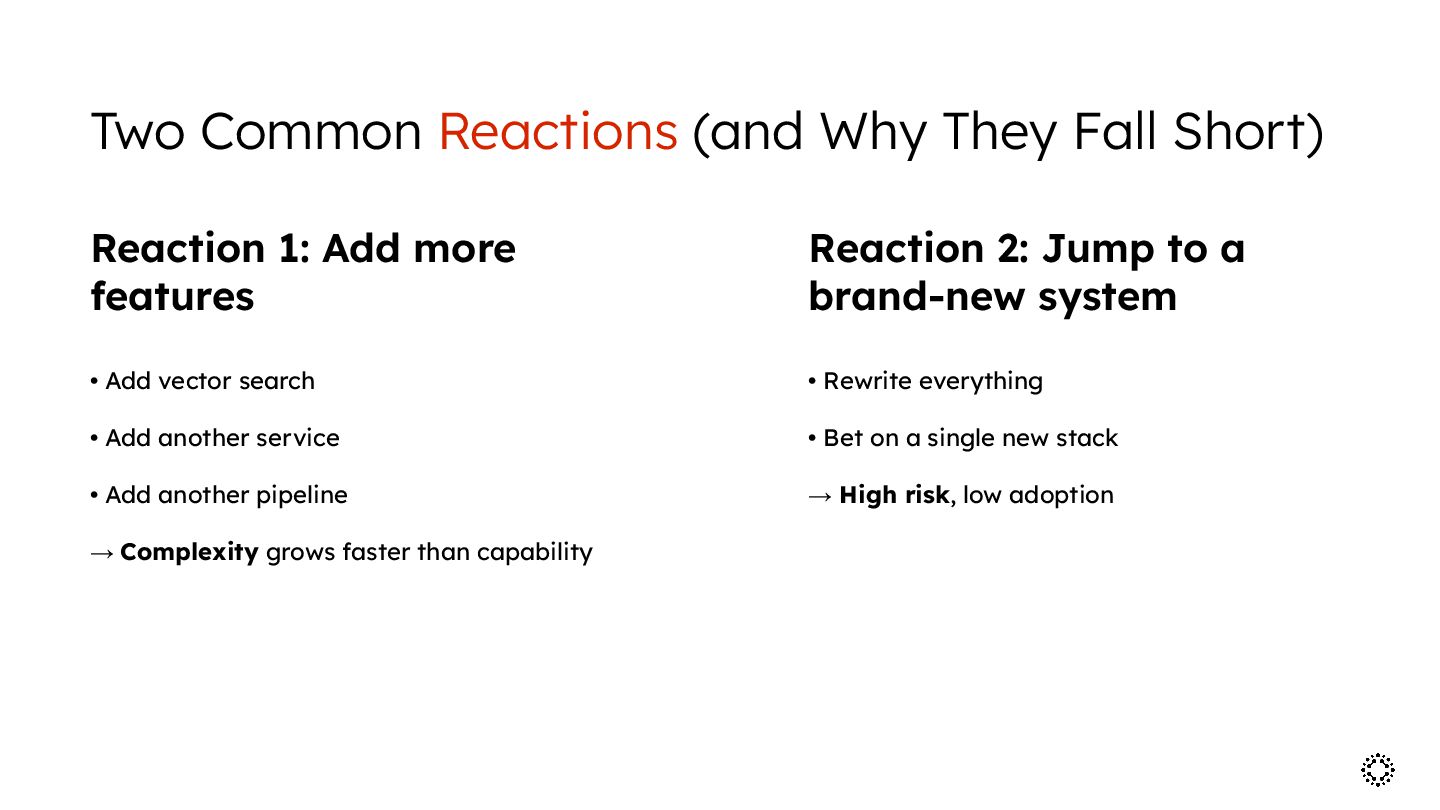
vector search • Add another service • Add another pipeline → Complexity grows faster than capability • Rewrite everything • Bet on a single new stack → High risk, low adoption Reaction 1: Add more features Reaction 2: Jump to a brand-new system
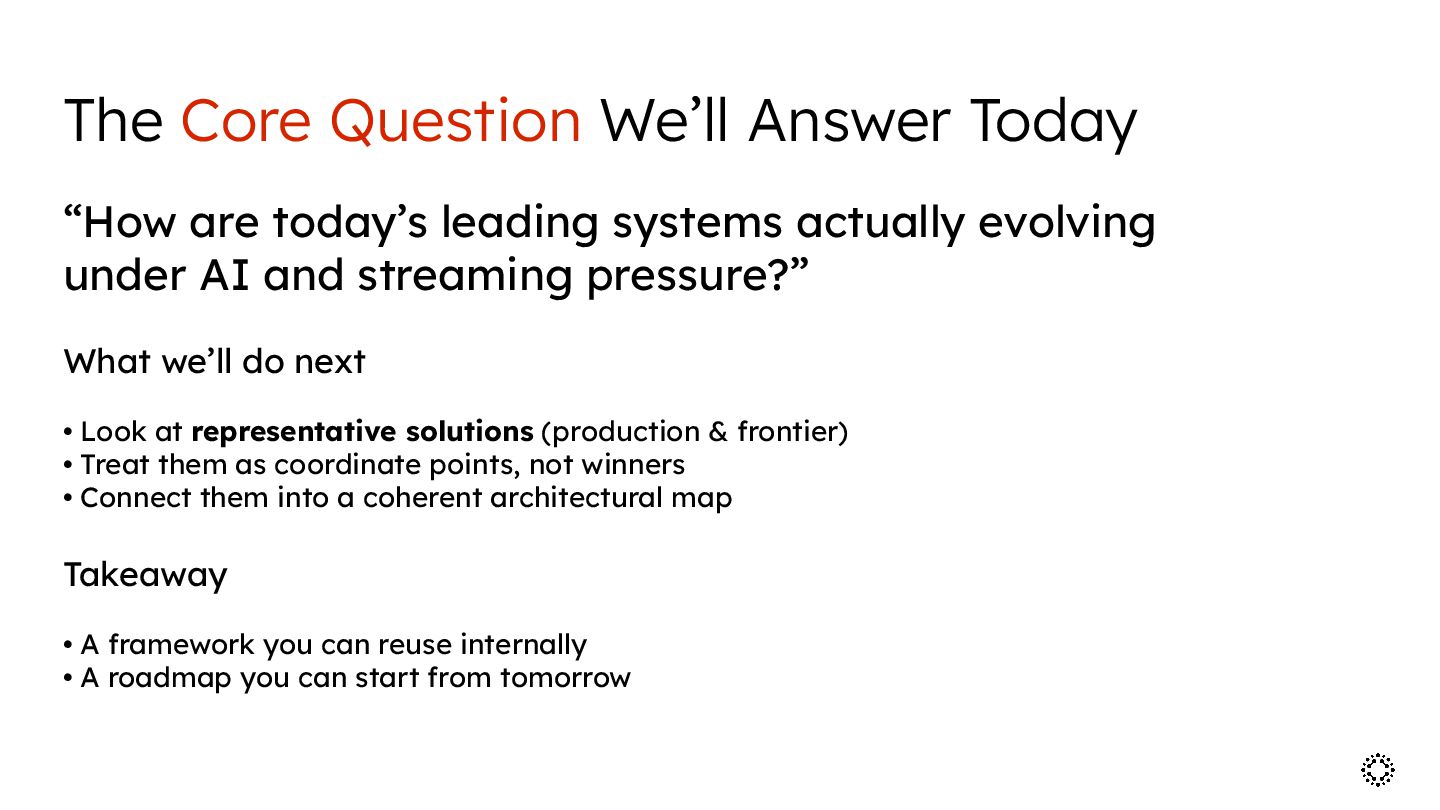
systems actually evolving under AI and streaming pressure?” What we’ll do next • Look at representative solutions (production & frontier) • Treat them as coordinate points, not winners • Connect them into a coherent architectural map Takeaway • A framework you can reuse internally • A roadmap you can start from tomorrow
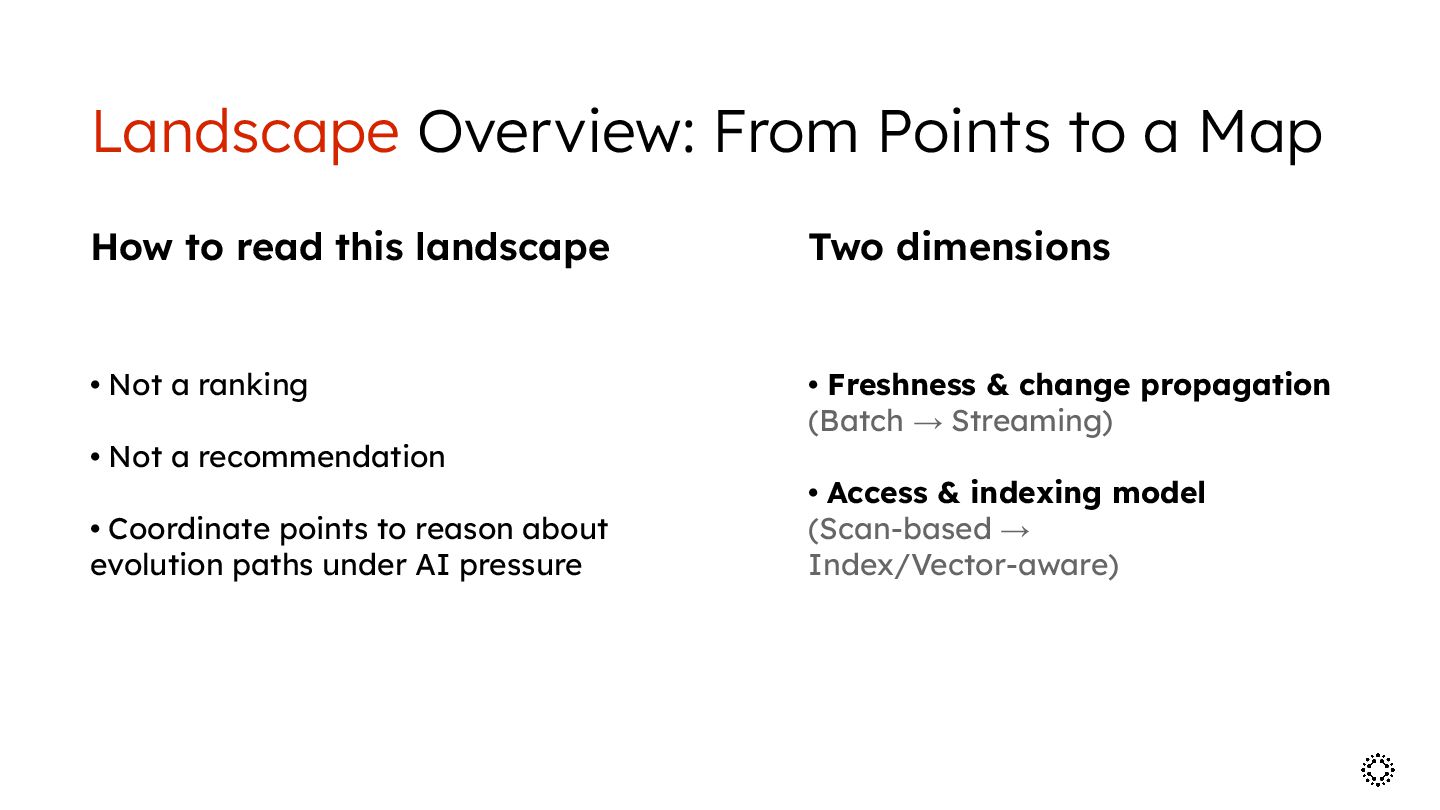
change propagation (Batch → Streaming) • Access & indexing model (Scan-based → Index/Vector-aware) • Not a ranking • Not a recommendation • Coordinate points to reason about evolution paths under AI pressure How to read this landscape Two dimensions
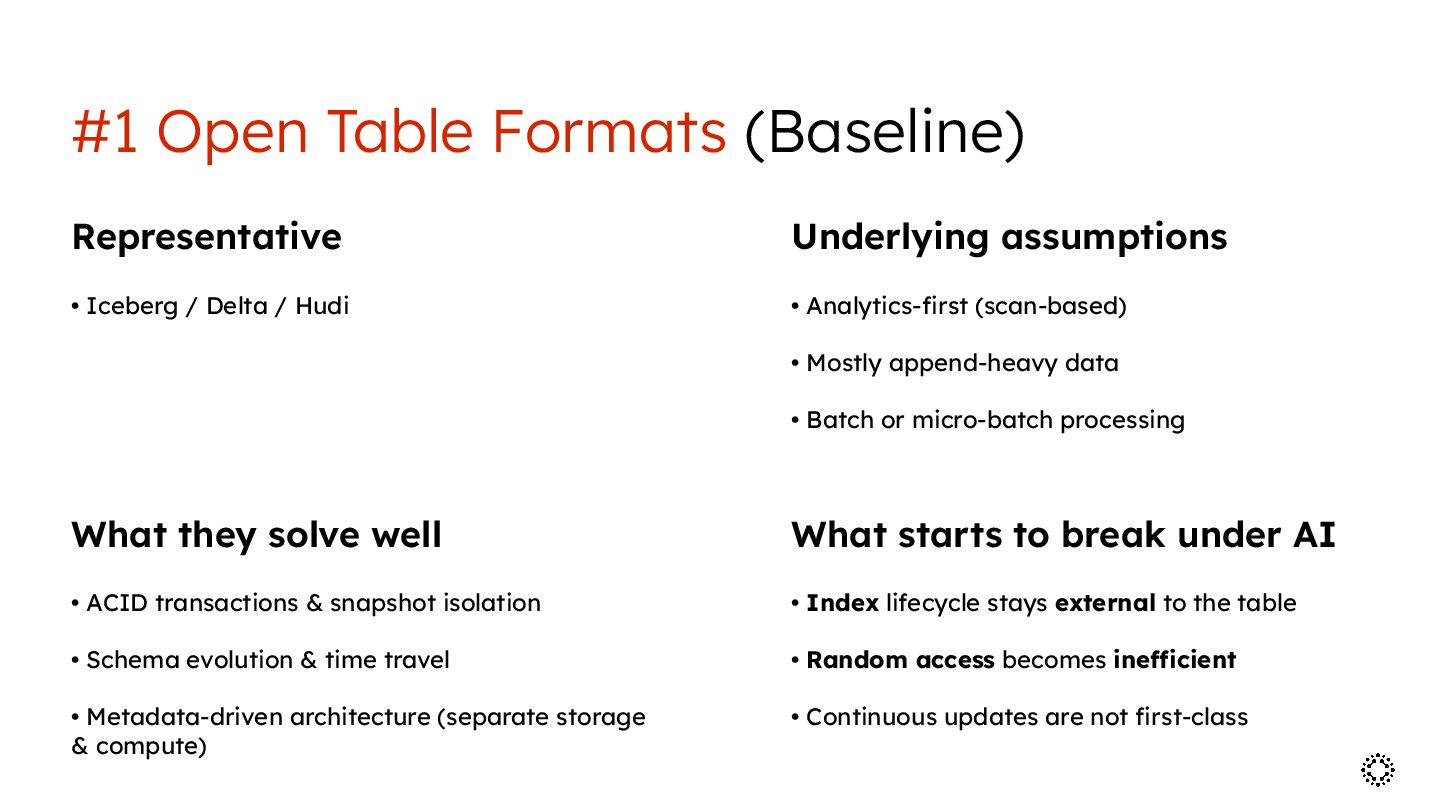
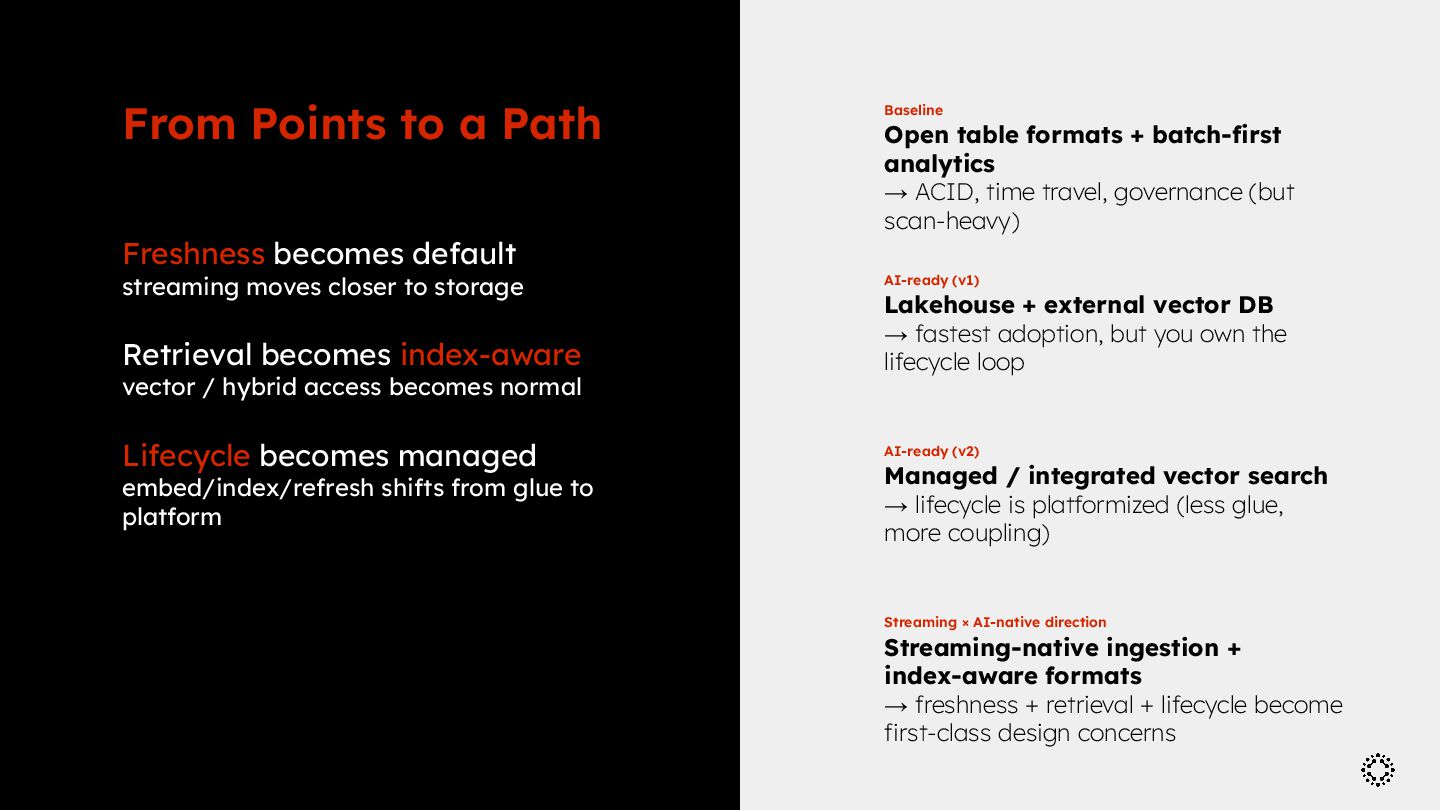
Mostly append-heavy data • Batch or micro-batch processing Underlying assumptions What they solve well • ACID transactions & snapshot isolation • Schema evolution & time travel • Metadata-driven architecture (separate storage & compute) • Index lifecycle stays external to the table • Random access becomes inefficient • Continuous updates are not first-class #1 Open Table Formats (Baseline) Representative What starts to break under AI
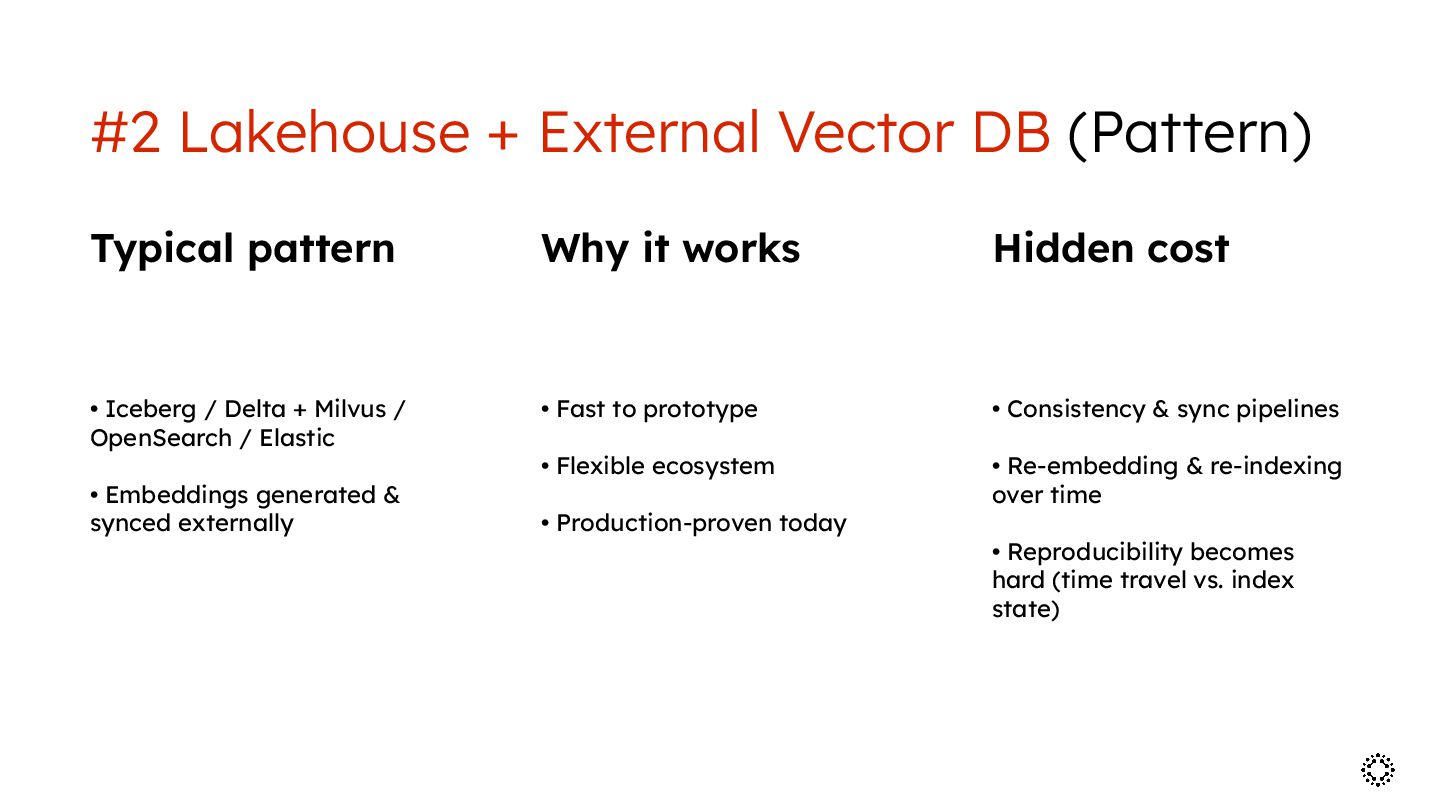
• Embeddings generated & synced externally • Fast to prototype • Flexible ecosystem • Production-proven today • Consistency & sync pipelines • Re-embedding & re-indexing over time • Reproducibility becomes hard (time travel vs. index state) Typical pattern Hidden cost Why it works #2 Lakehouse + External Vector DB (Pattern)
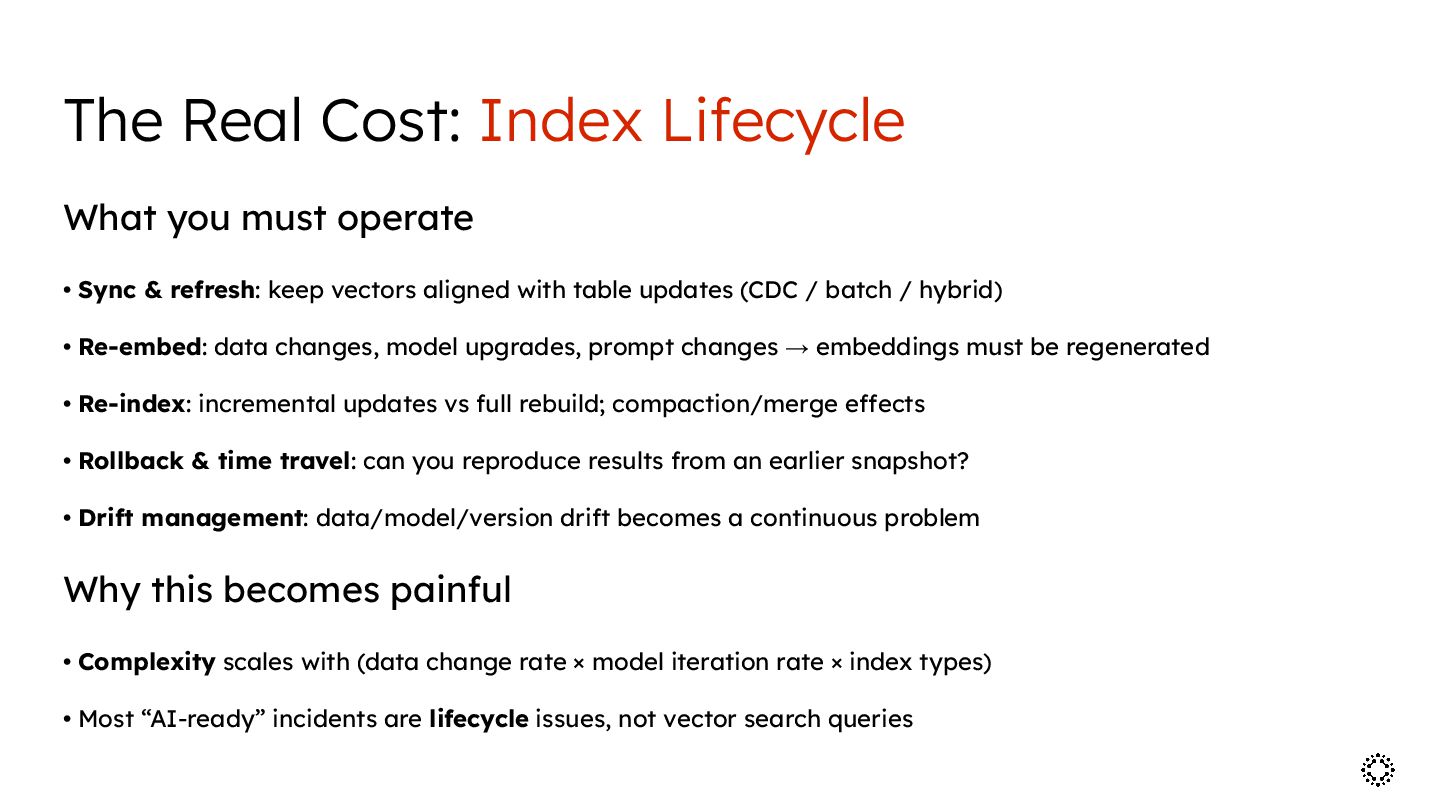
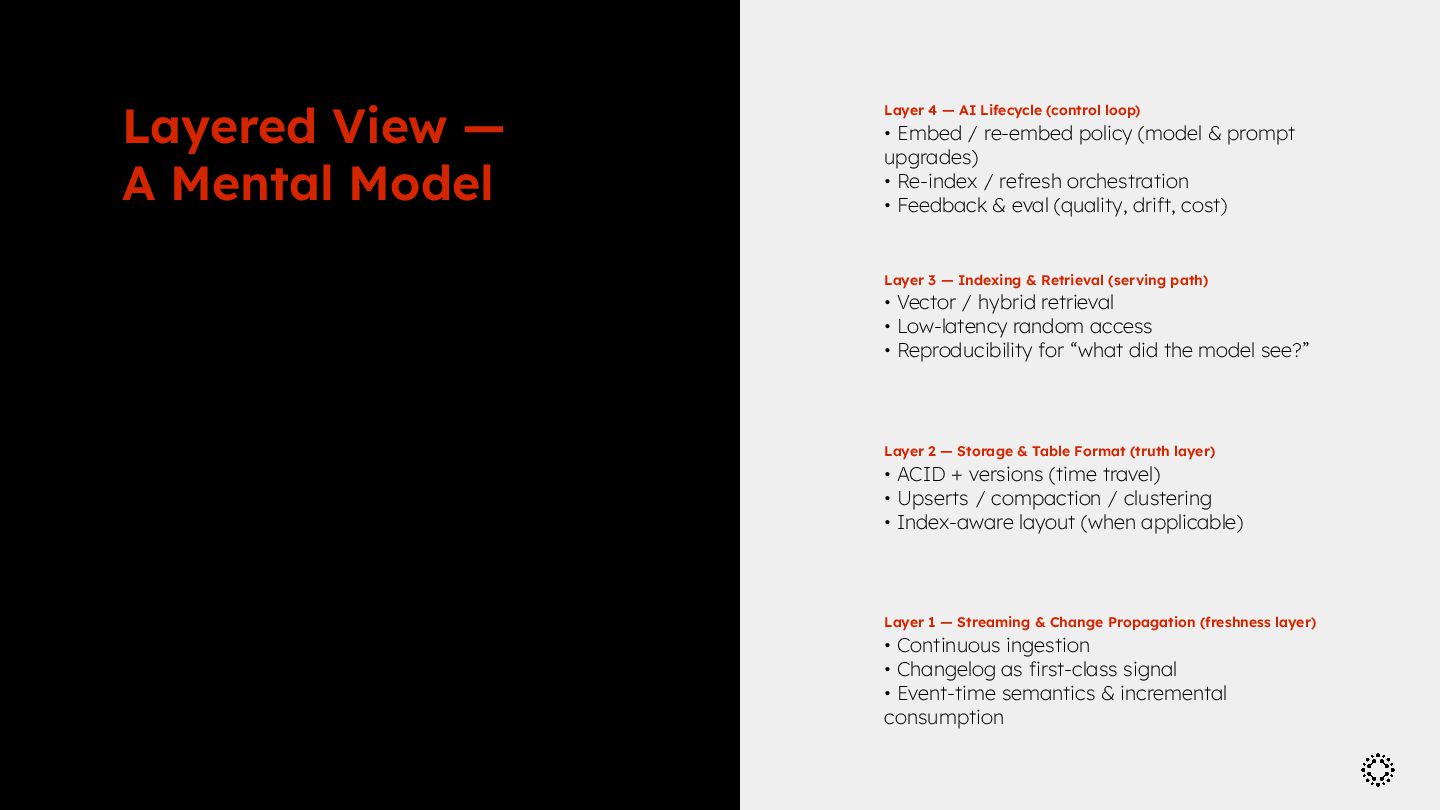
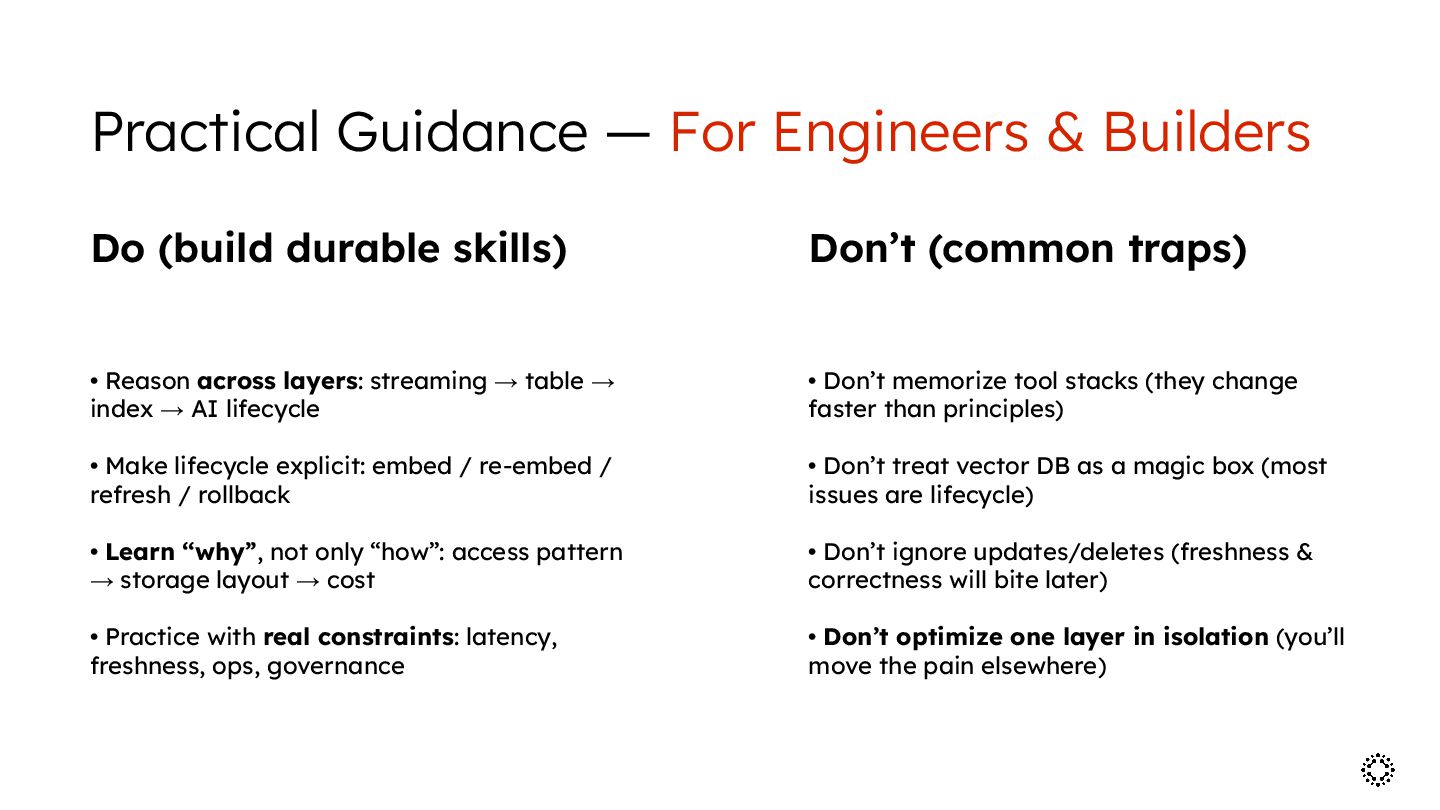
aligned with table updates (CDC / batch / hybrid) • Re-embed: data changes, model upgrades, prompt changes → embeddings must be regenerated • Re-index: incremental updates vs full rebuild; compaction/merge effects • Rollback & time travel: can you reproduce results from an earlier snapshot? • Drift management: data/model/version drift becomes a continuous problem Why this becomes painful • Complexity scales with (data change rate × model iteration rate × index types) • Most “AI-ready” incidents are lifecycle issues, not vector search queries The Real Cost: Index Lifecycle
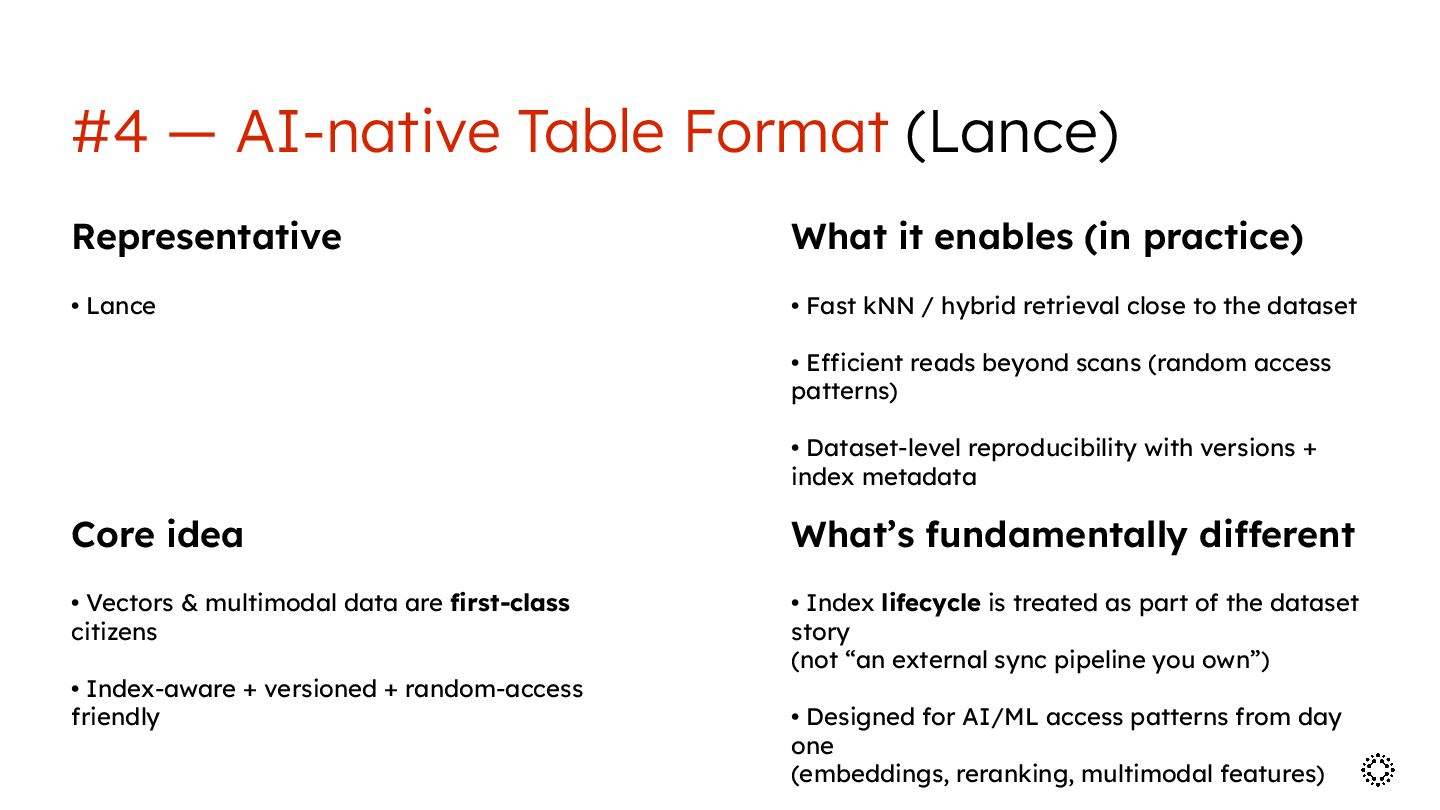
the dataset • Efficient reads beyond scans (random access patterns) • Dataset-level reproducibility with versions + index metadata • Vectors & multimodal data are first-class citizens • Index-aware + versioned + random-access friendly • Index lifecycle is treated as part of the dataset story (not “an external sync pipeline you own”) • Designed for AI/ML access patterns from day one (embeddings, reranking, multimodal features) #4 — AI-native Table Format (Lance) Representative What it enables (in practice) What’s fundamentally different Core idea
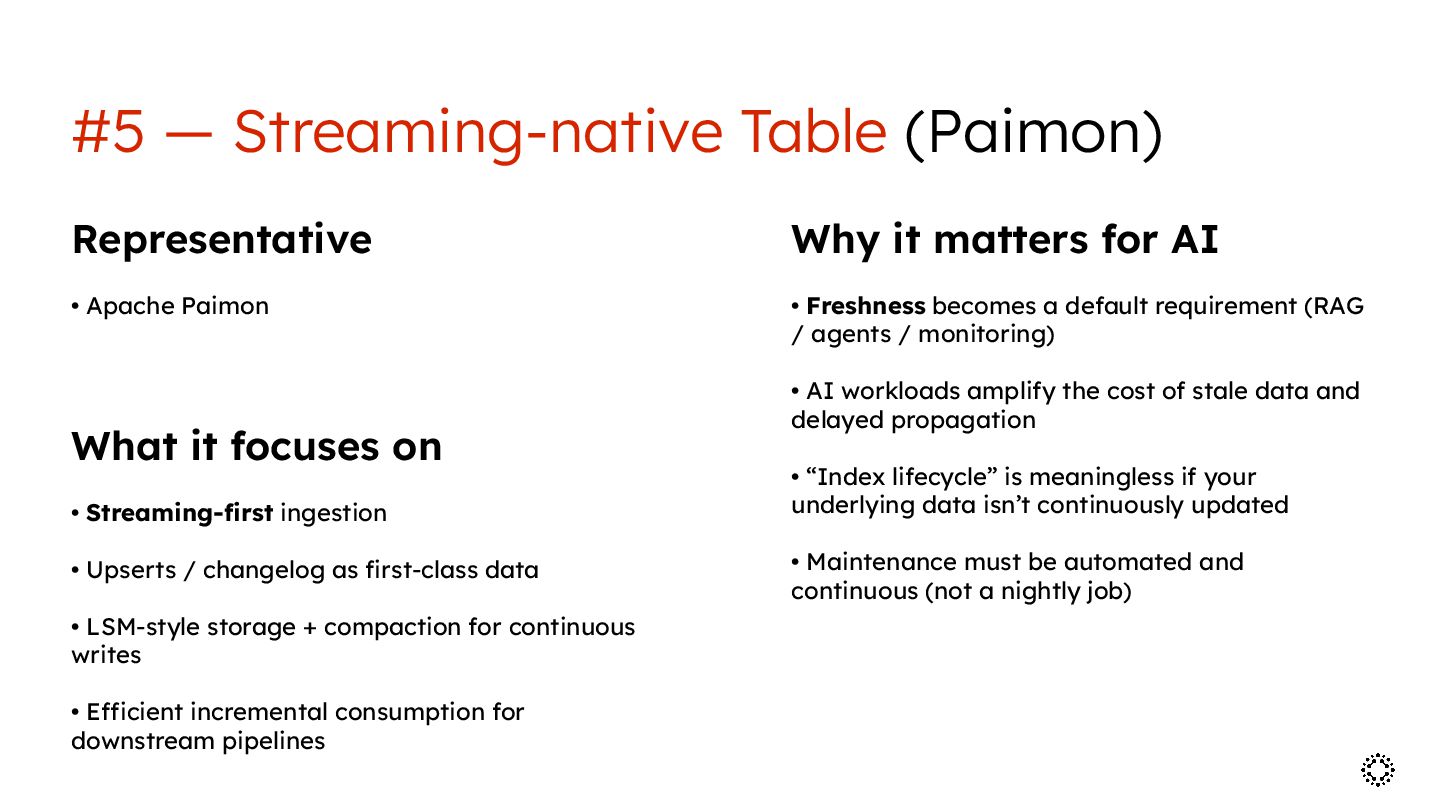
/ agents / monitoring) • AI workloads amplify the cost of stale data and delayed propagation • “Index lifecycle” is meaningless if your underlying data isn’t continuously updated • Maintenance must be automated and continuous (not a nightly job) • Streaming-first ingestion • Upserts / changelog as first-class data • LSM-style storage + compaction for continuous writes • Efficient incremental consumption for downstream pipelines #5 — Streaming-native Table (Paimon) Representative Why it matters for AI What it focuses on
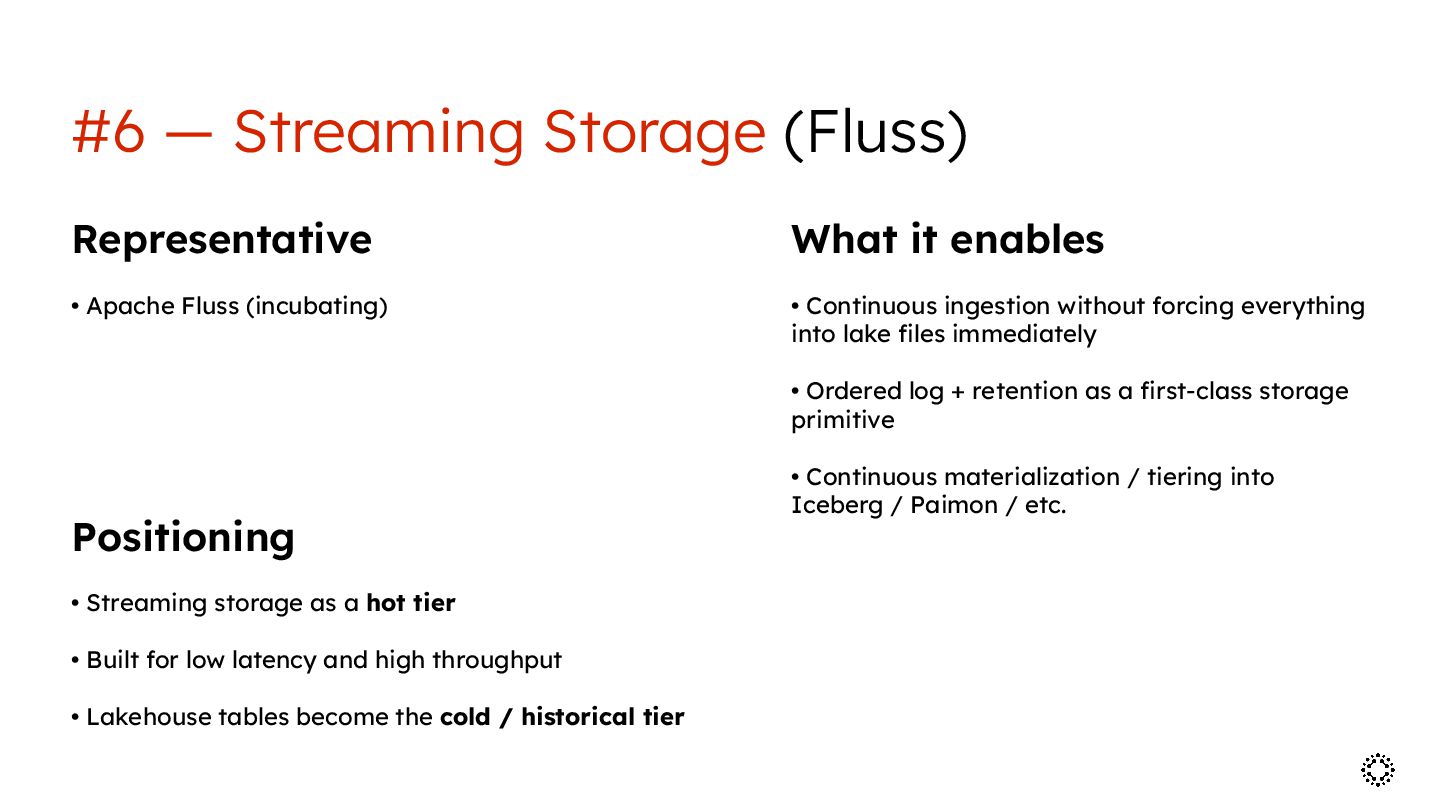
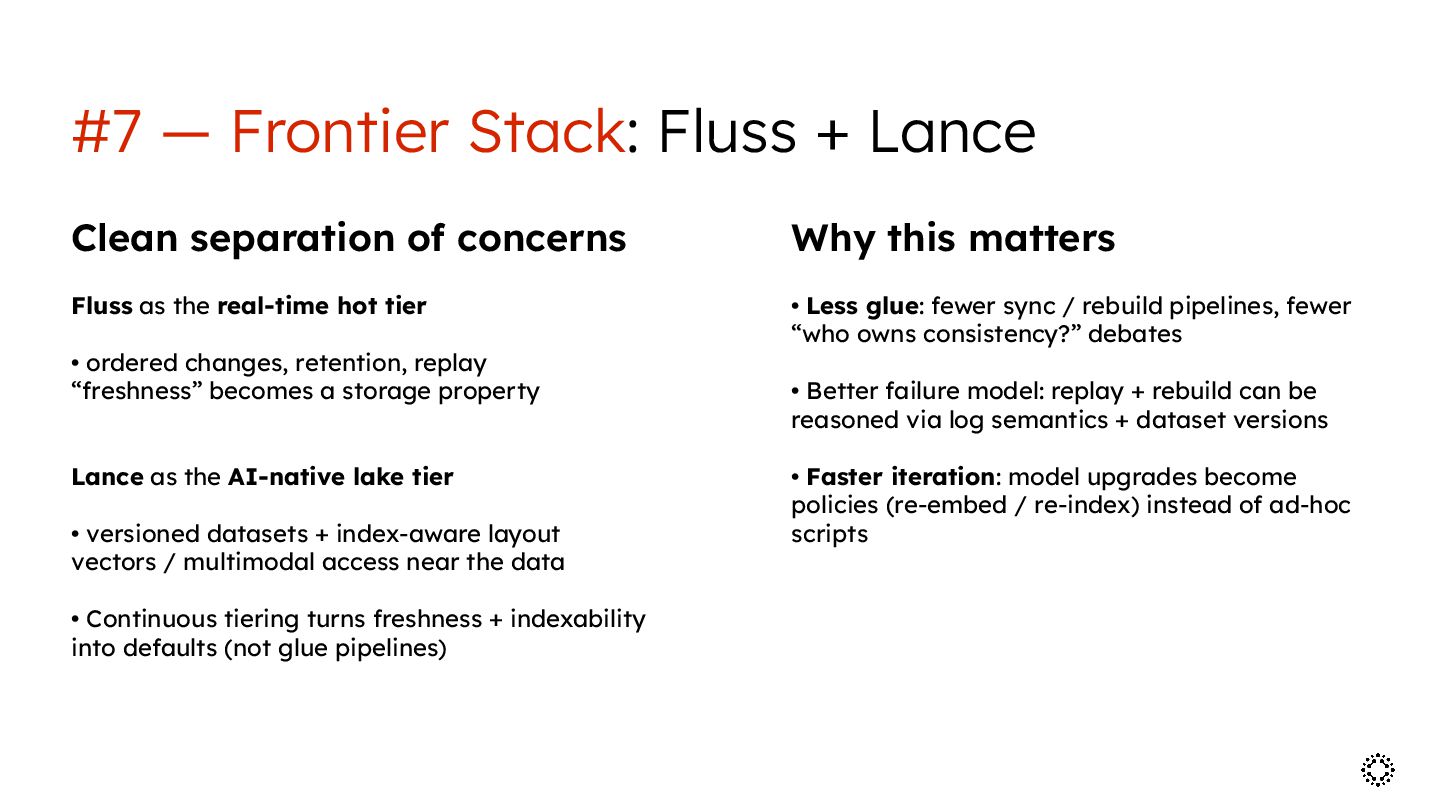
into lake files immediately • Ordered log + retention as a first-class storage primitive • Continuous materialization / tiering into Iceberg / Paimon / etc. • Streaming storage as a hot tier • Built for low latency and high throughput • Lakehouse tables become the cold / historical tier #6 — Streaming Storage (Fluss) Representative What it enables Positioning
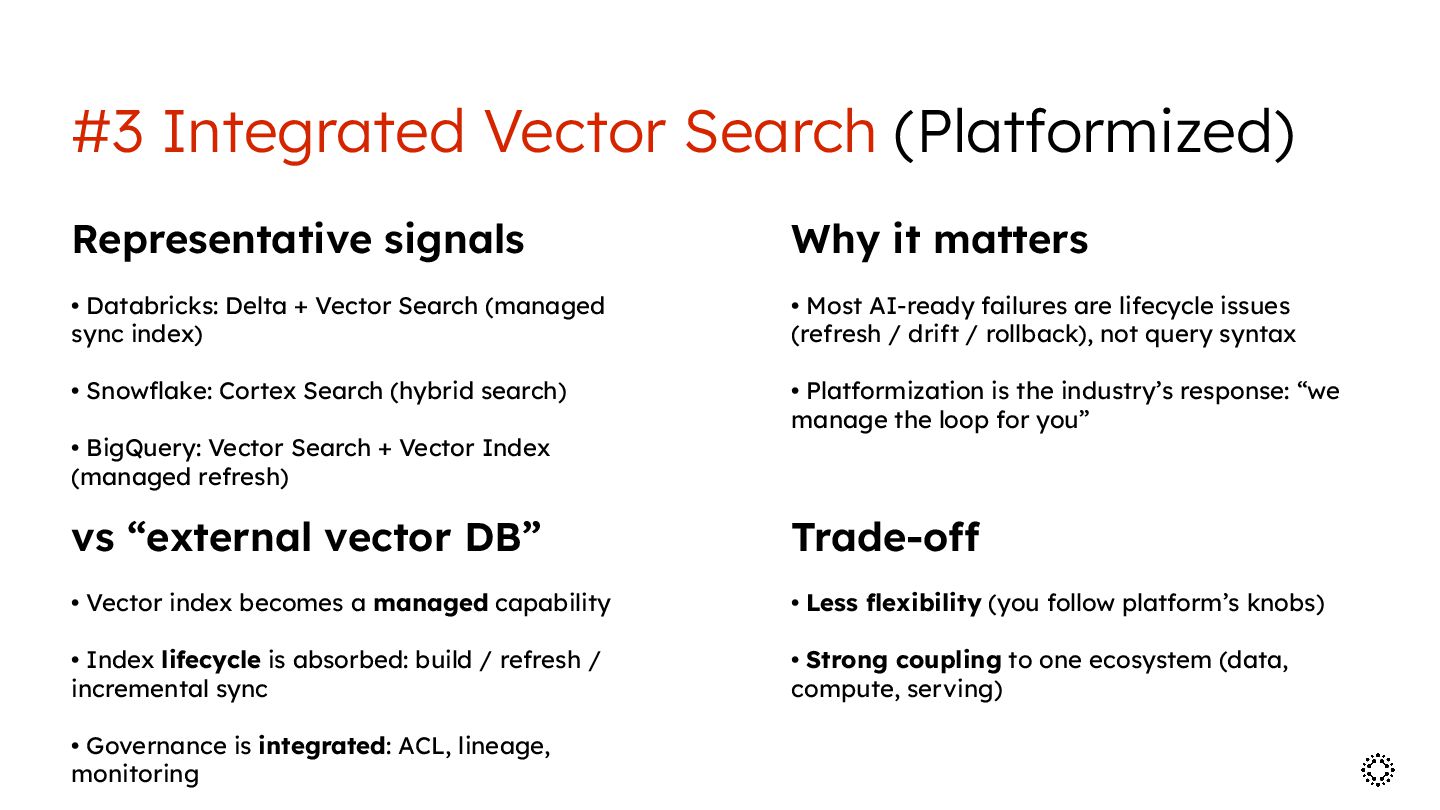
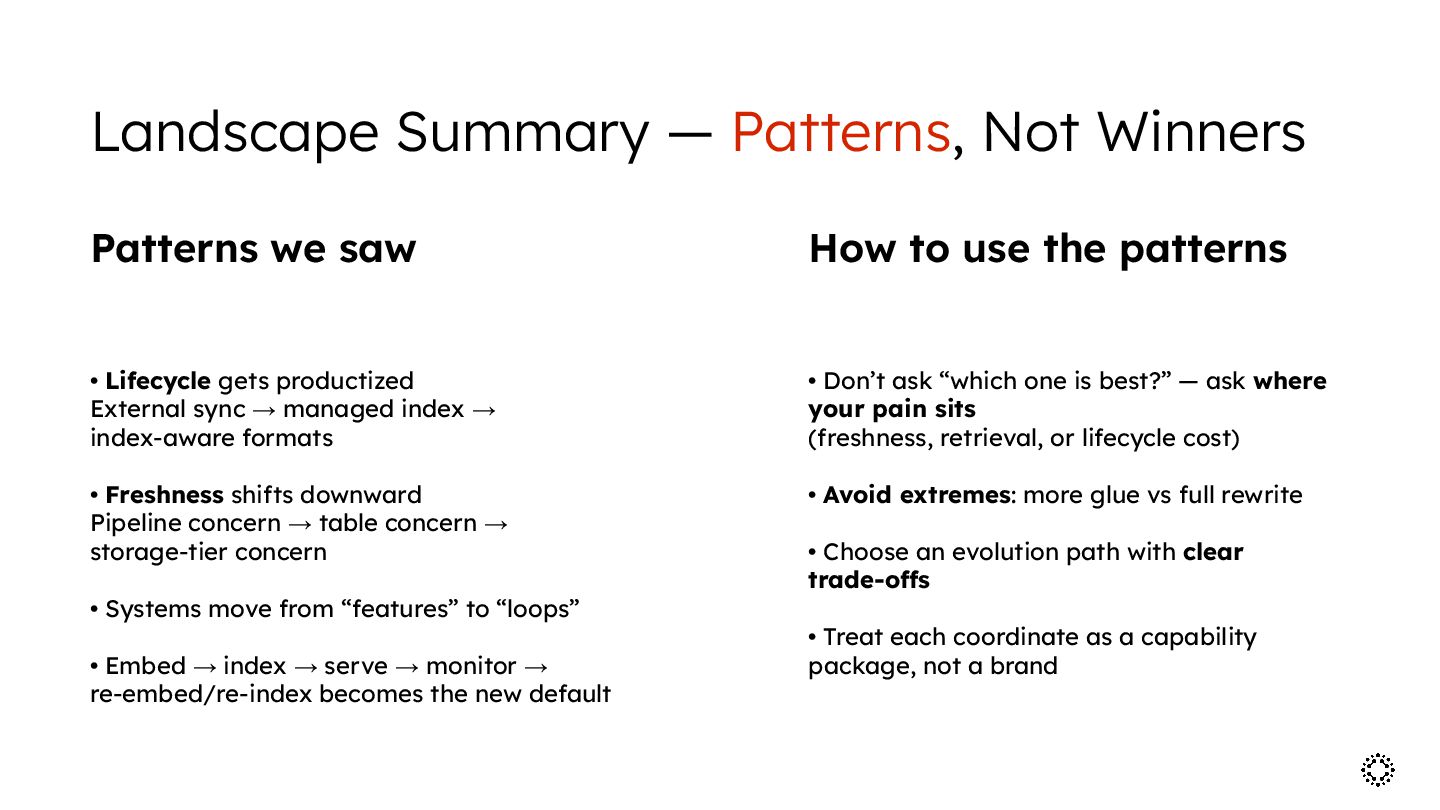
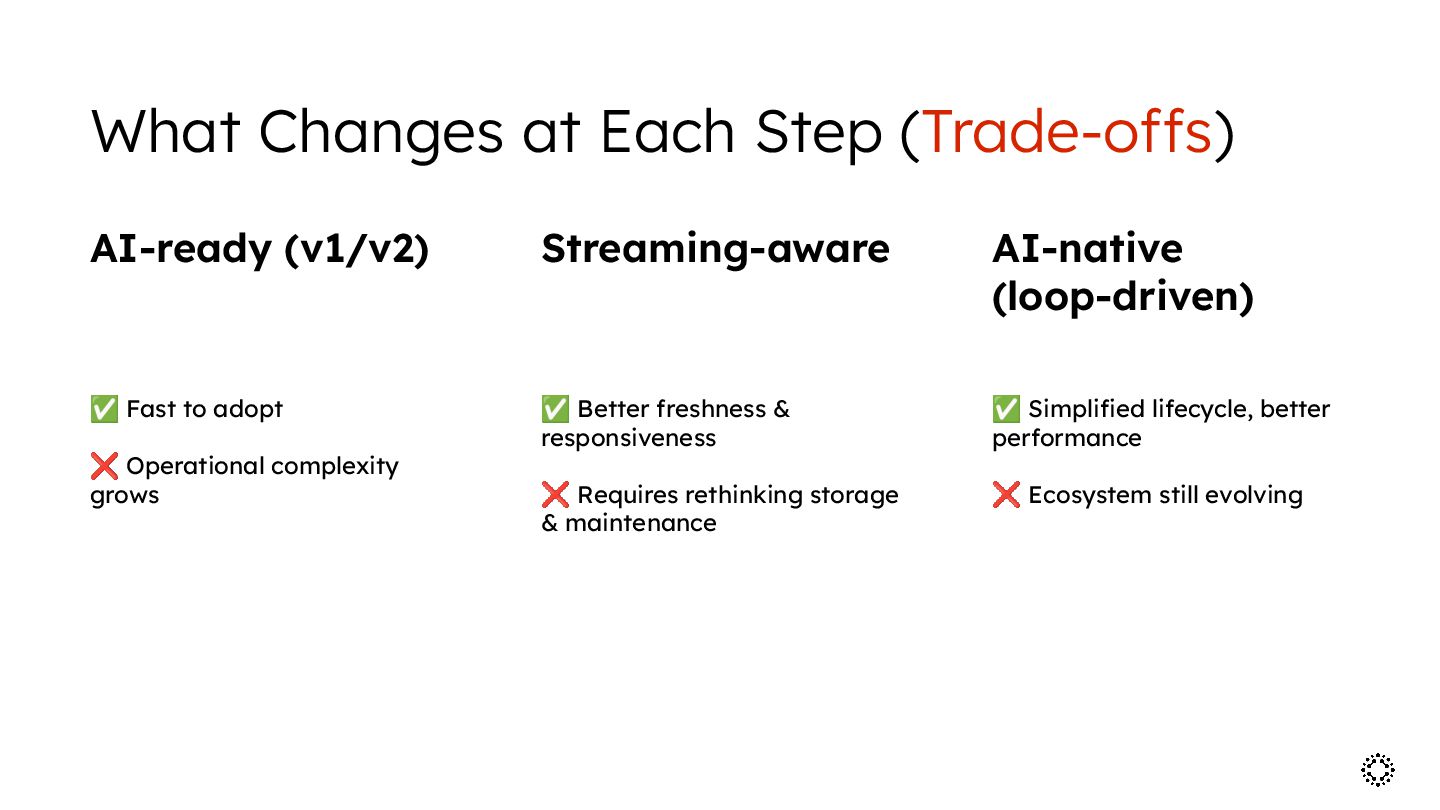
index-aware formats • Freshness shifts downward Pipeline concern → table concern → storage-tier concern • Systems move from “features” to “loops” • Embed → index → serve → monitor → re-embed/re-index becomes the new default • Don’t ask “which one is best?” — ask where your pain sits (freshness, retrieval, or lifecycle cost) • Avoid extremes: more glue vs full rewrite • Choose an evolution path with clear trade-offs • Treat each coordinate as a capability package, not a brand Patterns we saw How to use the patterns Landscape Summary — Patterns, Not Winners
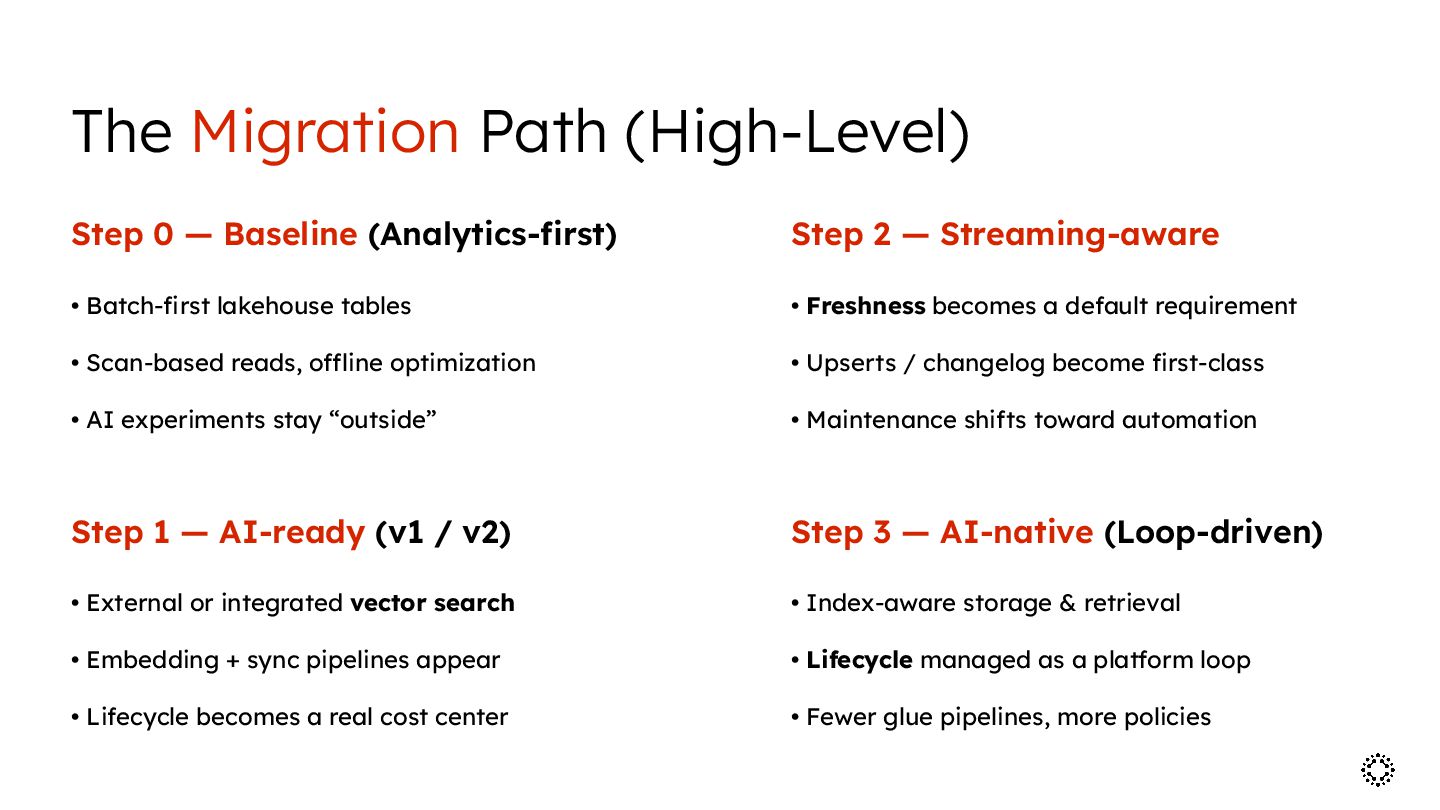
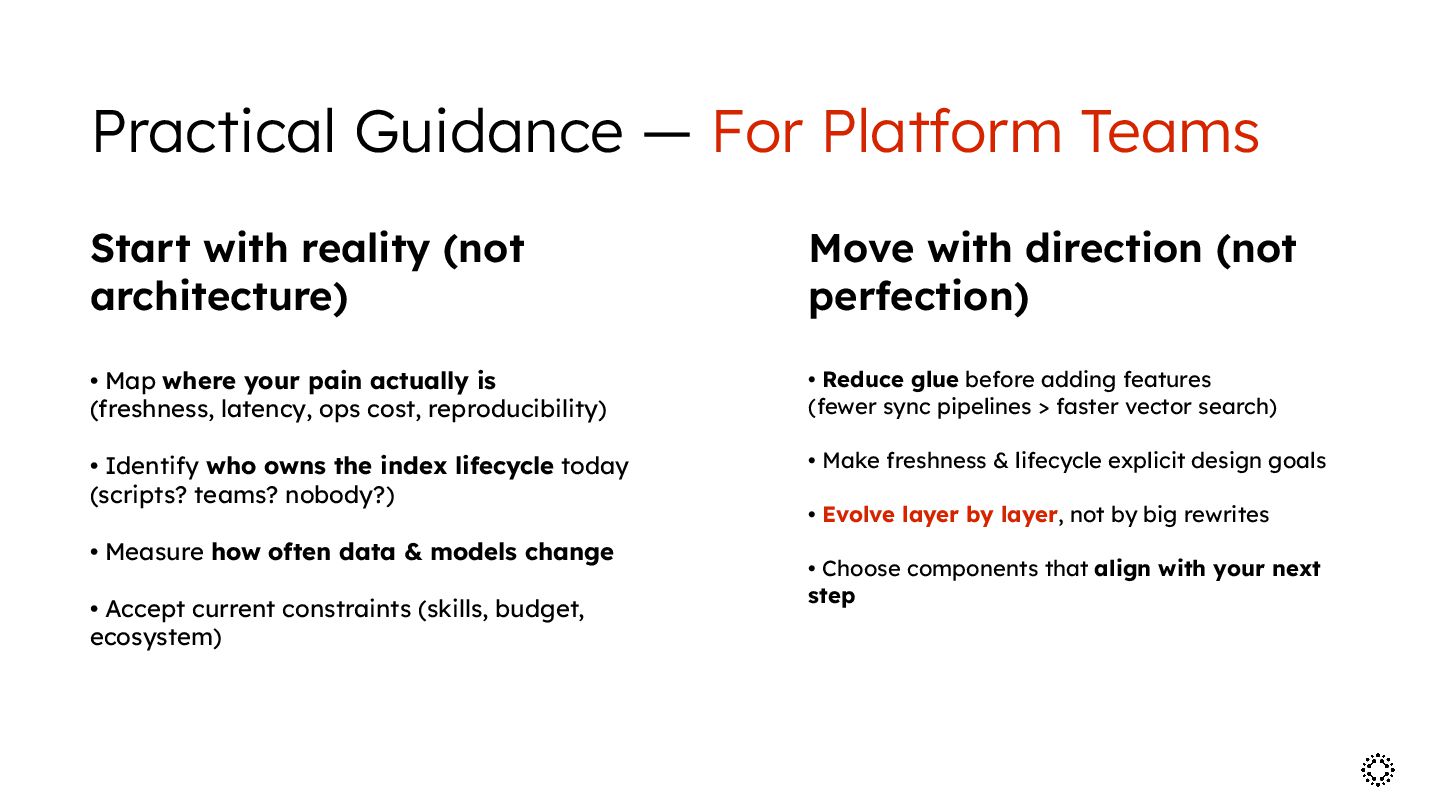
cost, reproducibility) • Identify who owns the index lifecycle today (scripts? teams? nobody?) • Measure how often data & models change • Accept current constraints (skills, budget, ecosystem) • Reduce glue before adding features (fewer sync pipelines > faster vector search) • Make freshness & lifecycle explicit design goals • Evolve layer by layer, not by big rewrites • Choose components that align with your next step Start with reality (not architecture) Practical Guidance — For Platform Teams Move with direction (not perfection)
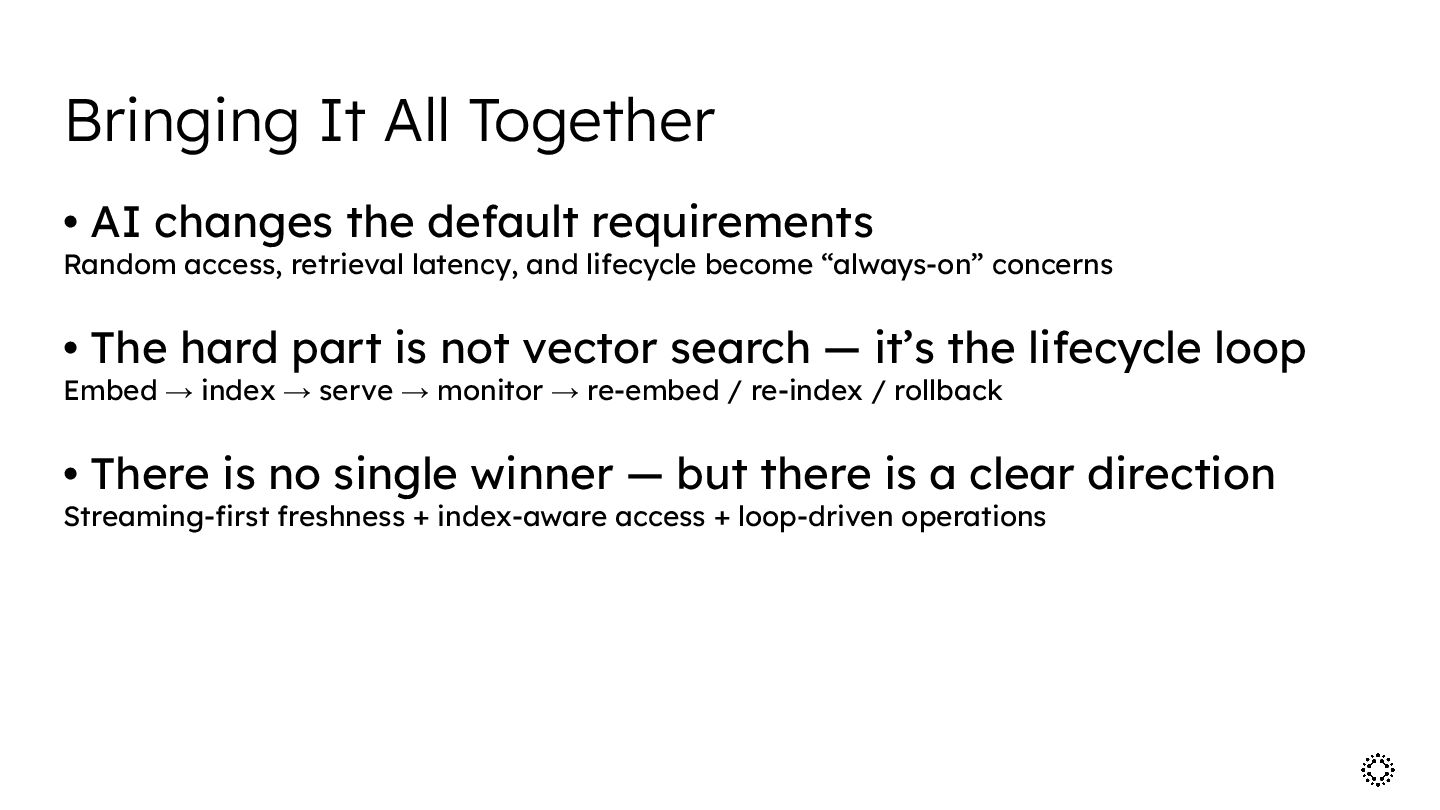
Random access, retrieval latency, and lifecycle become “always-on” concerns • The hard part is not vector search — it’s the lifecycle loop Embed → index → serve → monitor → re-embed / re-index / rollback • There is no single winner — but there is a clear direction Streaming-first freshness + index-aware access + loop-driven operations
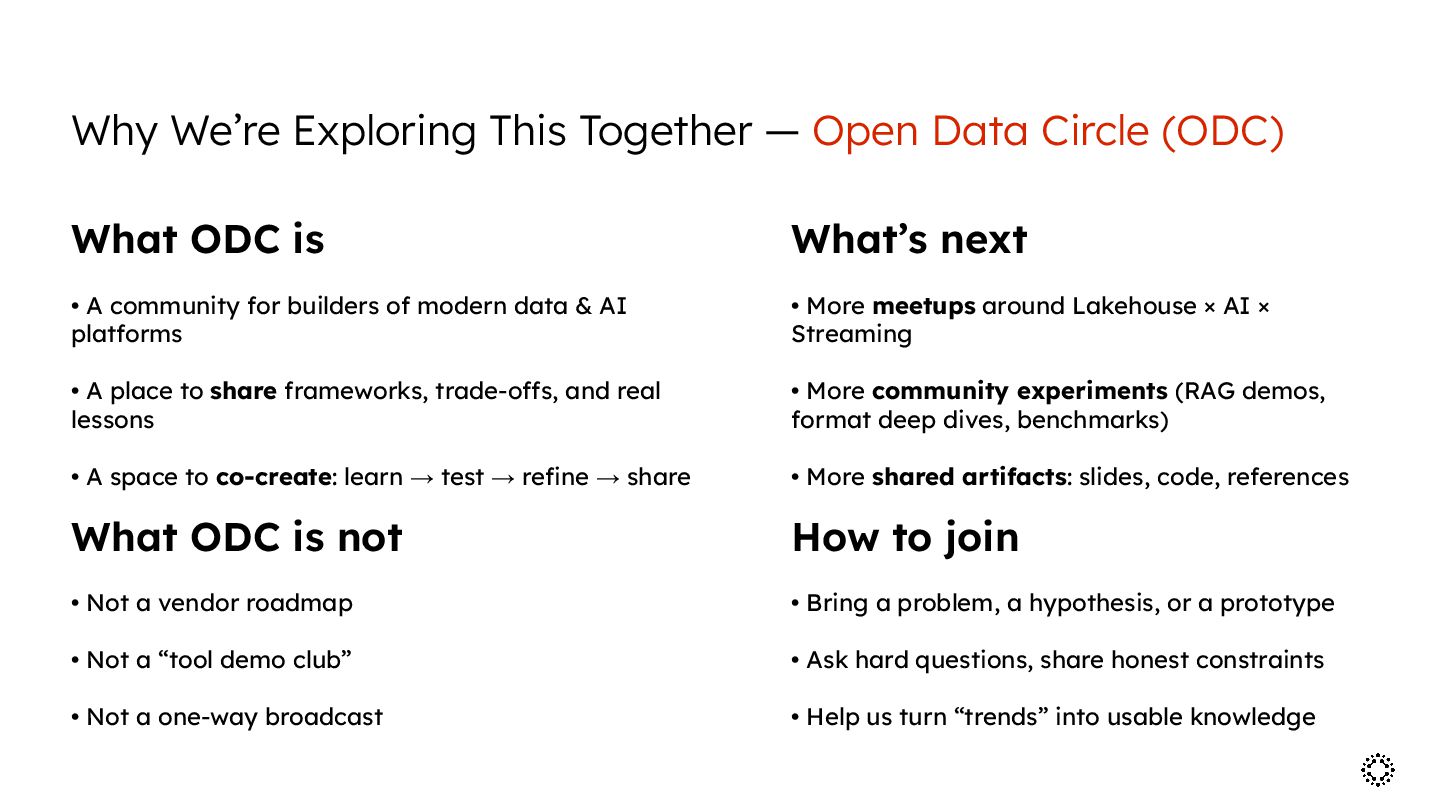
More community experiments (RAG demos, format deep dives, benchmarks) • More shared artifacts: slides, code, references • A community for builders of modern data & AI platforms • A place to share frameworks, trade-offs, and real lessons • A space to co-create: learn → test → refine → share What’s next What ODC is not • Not a vendor roadmap • Not a “tool demo club” • Not a one-way broadcast • Bring a problem, a hypothesis, or a prototype • Ask hard questions, share honest constraints • Help us turn “trends” into usable knowledge Why We’re Exploring This Together — Open Data Circle (ODC) What ODC is How to join


 opendatacircle
 junkifurukawa
 kmiya84377
 vivion
 yakumo
 pauli
pauli
 dada4386
 ishiirikie
 shreyas1009
 kameitomohiro
 tatamiya
 ennael
 torumakabe
 ammeep
 marktimemedia
 62gerente
 philnash
 kimpetersen
 greggifford
 letsgokoyo
.png) helenjbeal
helenjbeal
 inesmontani
 mongodb
 axbom
axbom
 brettharned