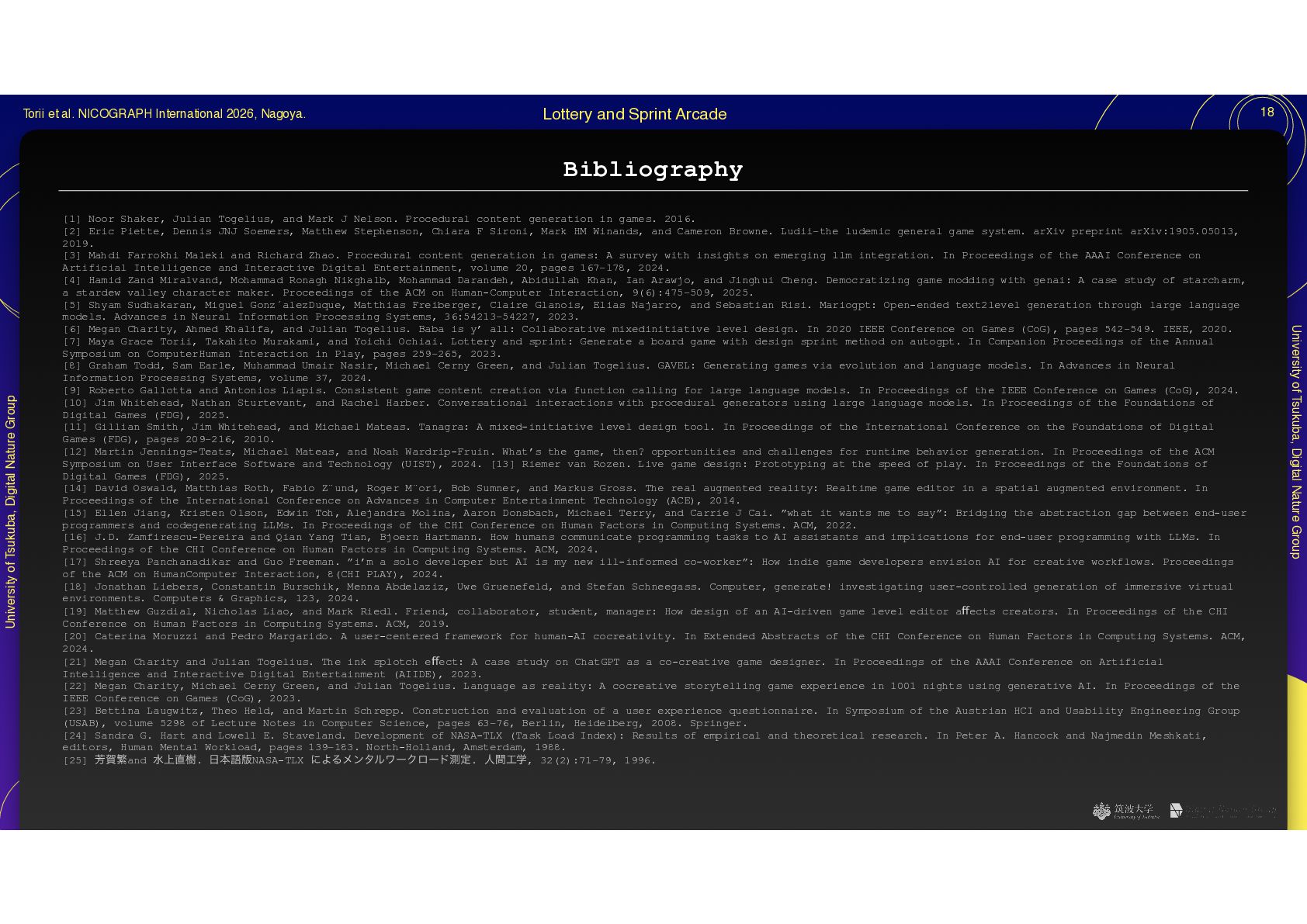
Nagoya. University of Tsukuba, Digital Nature Group University of Tsukuba, Digital Nature Group [1] Noor Shaker, Julian Togelius, and Mark J Nelson. Procedural content generation in games. 2016. [2] Eric Piette, Dennis JNJ Soemers, Matthew Stephenson, Chiara F Sironi, Mark HM Winands, and Cameron Browne. Ludii–the ludemic general game system. arXiv preprint arXiv:1905.05013, 2019. [3] Mahdi Farrokhi Maleki and Richard Zhao. Procedural content generation in games: A survey with insights on emerging llm integration. In Proceedings of the AAAI Conference on Artificial Intelligence and Interactive Digital Entertainment, volume 20, pages 167–178, 2024. [4] Hamid Zand Miralvand, Mohammad Ronagh Nikghalb, Mohammad Darandeh, Abidullah Khan, Ian Arawjo, and Jinghui Cheng. Democratizing game modding with genai: A case study of starcharm, a stardew valley character maker. Proceedings of the ACM on Human-Computer Interaction, 9(6):475–509, 2025. [5] Shyam Sudhakaran, Miguel Gonz´alezDuque, Matthias Freiberger, Claire Glanois, Elias Najarro, and Sebastian Risi. Mariogpt: Open-ended text2level generation through large language models. Advances in Neural Information Processing Systems, 36:54213–54227, 2023. [6] Megan Charity, Ahmed Khalifa, and Julian Togelius. Baba is y’ all: Collaborative mixedinitiative level design. In 2020 IEEE Conference on Games (CoG), pages 542–549. IEEE, 2020. [7] Maya Grace Torii, Takahito Murakami, and Yoichi Ochiai. Lottery and sprint: Generate a board game with design sprint method on autogpt. In Companion Proceedings of the Annual Symposium on ComputerHuman Interaction in Play, pages 259–265, 2023. [8] Graham Todd, Sam Earle, Muhammad Umair Nasir, Michael Cerny Green, and Julian Togelius. GAVEL: Generating games via evolution and language models. In Advances in Neural Information Processing Systems, volume 37, 2024. [9] Roberto Gallotta and Antonios Liapis. Consistent game content creation via function calling for large language models. In Proceedings of the IEEE Conference on Games (CoG), 2024. [10] Jim Whitehead, Nathan Sturtevant, and Rachel Harber. Conversational interactions with procedural generators using large language models. In Proceedings of the Foundations of Digital Games (FDG), 2025. [11] Gillian Smith, Jim Whitehead, and Michael Mateas. Tanagra: A mixed-initiative level design tool. In Proceedings of the International Conference on the Foundations of Digital Games (FDG), pages 209–216, 2010. [12] Martin Jennings-Teats, Michael Mateas, and Noah Wardrip-Fruin. What’s the game, then? opportunities and challenges for runtime behavior generation. In Proceedings of the ACM Symposium on User Interface Software and Technology (UIST), 2024. [13] Riemer van Rozen. Live game design: Prototyping at the speed of play. In Proceedings of the Foundations of Digital Games (FDG), 2025. [14] David Oswald, Matthias Roth, Fabio Z¨und, Roger M¨ori, Bob Sumner, and Markus Gross. The real augmented reality: Realtime game editor in a spatial augmented environment. In Proceedings of the International Conference on Advances in Computer Entertainment Technology (ACE), 2014. [15] Ellen Jiang, Kristen Olson, Edwin Toh, Alejandra Molina, Aaron Donsbach, Michael Terry, and Carrie J Cai. ”what it wants me to say”: Bridging the abstraction gap between end-user programmers and codegenerating LLMs. In Proceedings of the CHI Conference on Human Factors in Computing Systems. ACM, 2022. [16] J.D. Zamfirescu-Pereira and Qian Yang Tian, Bjoern Hartmann. How humans communicate programming tasks to AI assistants and implications for end-user programming with LLMs. In Proceedings of the CHI Conference on Human Factors in Computing Systems. ACM, 2024. [17] Shreeya Panchanadikar and Guo Freeman. ”i’m a solo developer but AI is my new ill-informed co-worker”: How indie game developers envision AI for creative workflows. Proceedings of the ACM on HumanComputer Interaction, 8(CHI PLAY), 2024. [18] Jonathan Liebers, Constantin Burschik, Menna Abdelaziz, Uwe Gruenefeld, and Stefan Schneegass. Computer, generate! investigating user-controlled generation of immersive virtual environments. Computers & Graphics, 123, 2024. [19] Matthew Guzdial, Nicholas Liao, and Mark Riedl. Friend, collaborator, student, manager: How design of an AI-driven game level editor a ects creators. In Proceedings of the CHI Conference on Human Factors in Computing Systems. ACM, 2019. [20] Caterina Moruzzi and Pedro Margarido. A user-centered framework for human-AI cocreativity. In Extended Abstracts of the CHI Conference on Human Factors in Computing Systems. ACM, 2024. [21] Megan Charity and Julian Togelius. The ink splotch e ff ect: A case study on ChatGPT as a co-creative game designer. In Proceedings of the AAAI Conference on Artificial Intelligence and Interactive Digital Entertainment (AIIDE), 2023. [22] Megan Charity, Michael Cerny Green, and Julian Togelius. Language as reality: A cocreative storytelling game experience in 1001 nights using generative AI. In Proceedings of the IEEE Conference on Games (CoG), 2023. [23] Bettina Laugwitz, Theo Held, and Martin Schrepp. Construction and evaluation of a user experience questionnaire. In Symposium of the Austrian HCI and Usability Engineering Group (USAB), volume 5298 of Lecture Notes in Computer Science, pages 63–76, Berlin, Heidelberg, 2008. Springer. [24] Sandra G. Hart and Lowell E. Staveland. Development of NASA-TLX (Task Load Index): Results of empirical and theoretical research. In Peter A. Hancock and Najmedin Meshkati, editors, Human Mental Workload, pages 139–183. North-Holland, Amsterdam, 1988. [25] ๕լൟand ਫ্थ. ຊޠ൛NASA-TLX ʹΑΔϝϯλϧϫʔΫϩʔυଌఆ. ਓֶؒ, 32(2):71–79, 1996. Bibliography 18

 Your Podcast. Everywhere. Effortlessly.


 eumesy
 institutdelelevage
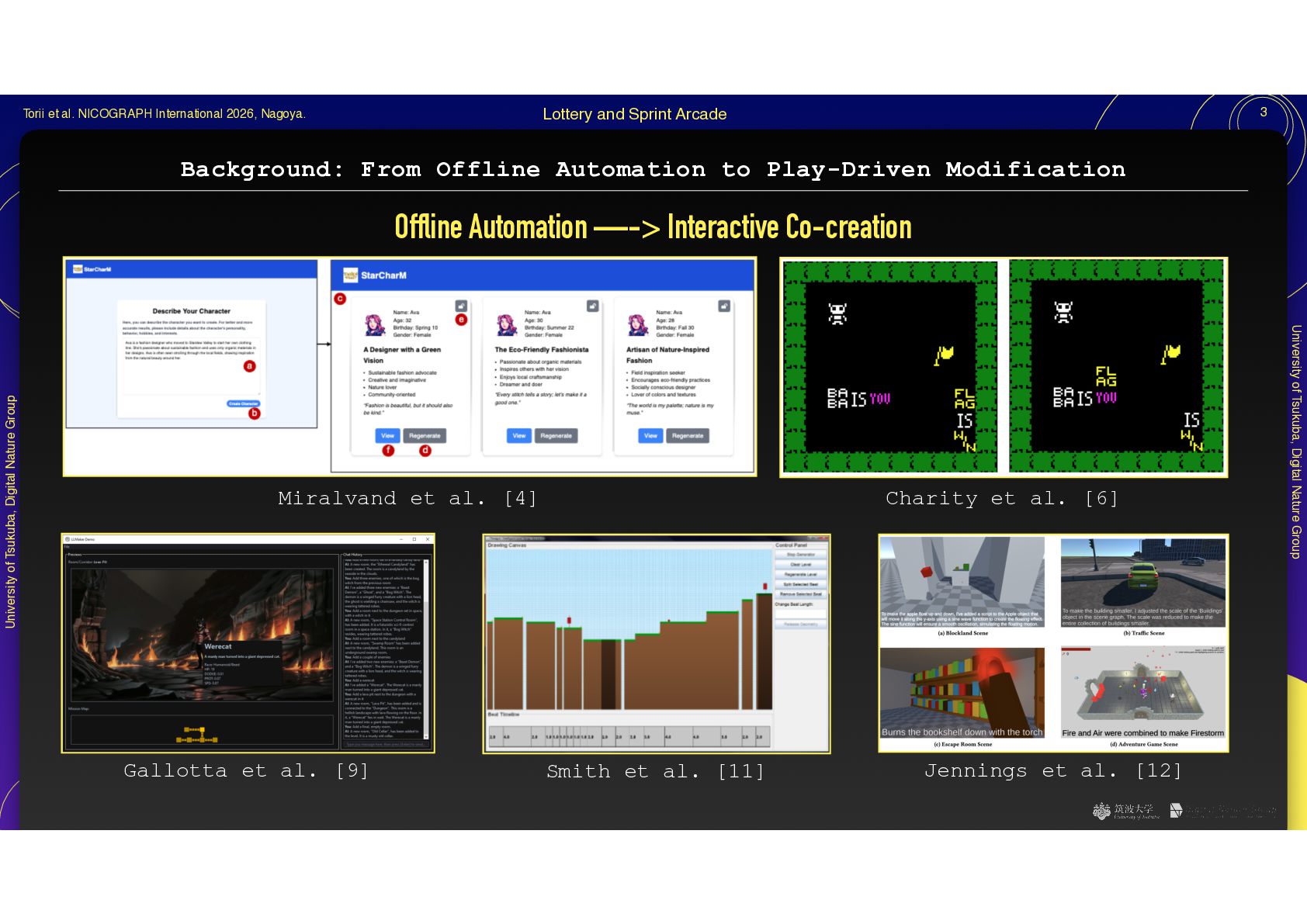
 kzmssk
 tattaka
 hisaokatsumi
 pman0214
 shibuiwilliam
 koide3
 kogoro
 murakawatakuya
 gurzu
gurzu
 brad_frost
 wjessup
 samanthasiow
 addyosmani
 dugsong
 tmiket
 speakerdeck
 reverentgeek
 chriscoyier
 chikuwait
 cassininazir