Upgrade to Pro — share decks privately, control downloads, hide ads and more …

Why you should code your servers

Why you should code your servers

The benefits of developing cookbooks for your app and for it's dependencies. Presenting chef, vagrant, berkshelf, opsworks, logstash and kibana

Avatar for Pedro Axelrud

Pedro Axelrud

April 04, 2014
Tweet

Other Decks in Technology

Transcript

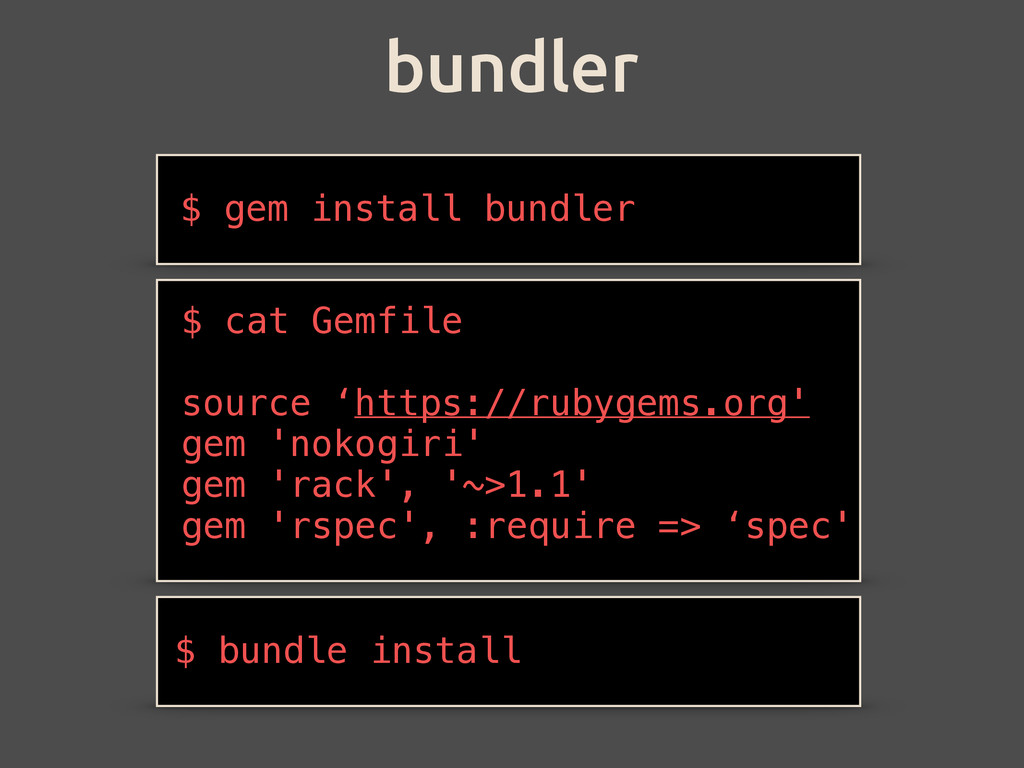
  1. bundler $ gem install bundler $ cat Gemfile ! source

    ‘https://rubygems.org' gem 'nokogiri' gem 'rack', '~>1.1' gem 'rspec', :require => ‘spec' $ bundle install
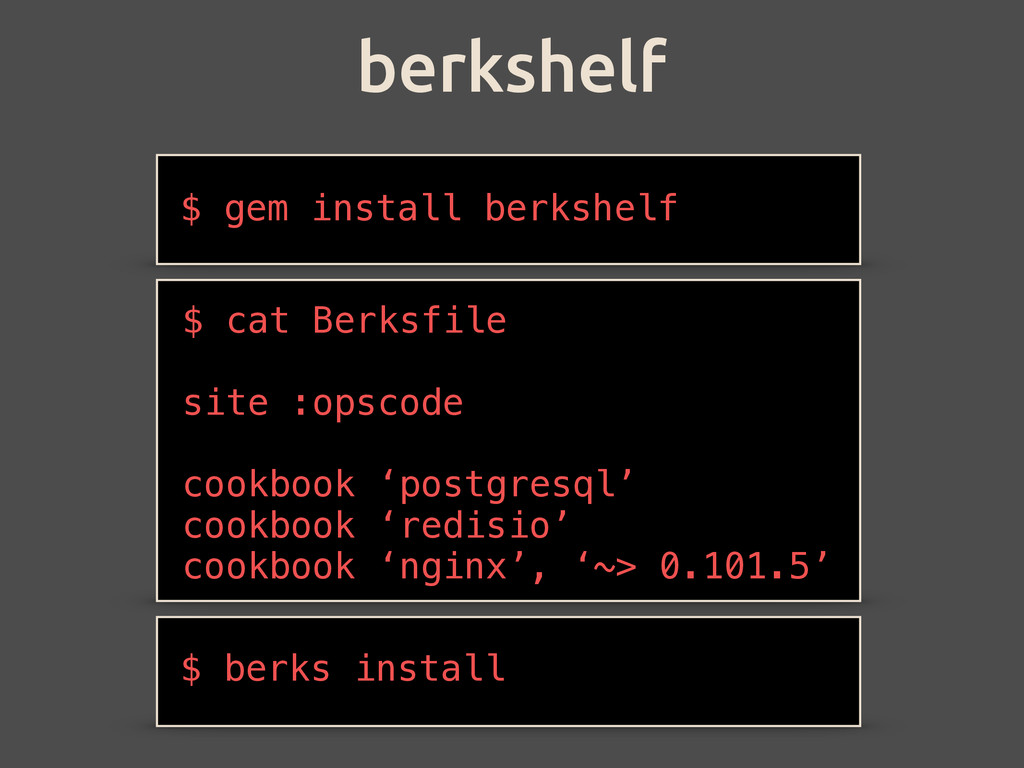
  2. berkshelf $ gem install berkshelf $ cat Berksfile ! site

    :opscode ! cookbook ‘postgresql’ cookbook ‘redisio’ cookbook ‘nginx’, ‘~> 0.101.5’ $ berks install
  3. metadata.rb name 'maileed' maintainer 'Pedro Axelrud' maintainer_email '[email protected]' license 'All

    rights reserved' description 'Installs/Configures maileed' long_description IO.read(File.join(File.dirname(__FILE__), 'README.md')) version '0.1.0' ! depends 'git' depends 'python', '~> 1.4.6' depends 'redisio', '~> 1.7.1' depends 'dnsmasq', '~> 0.2.0'
  4. recipe case node['platform_family'] when 'debian' include_recipe "apt" repo = 'http://ppa.launchpad.net/chris-lea/node.js/ubuntu'

    packages = %w{ nodejs } apt_repository 'node.js' do uri repo distribution node['lsb']['codename'] components ['main'] keyserver "hkp://keyserver.ubuntu.com:80" key "C7917B12" action :add end when 'rhel' include_recipe 'yum-epel' packages = %w{ nodejs nodejs-devel npm } when 'fedora' packages = %w{ nodejs nodejs-devel npm } when 'smartos' packages = %w{ nodejs } end ! packages.each do |node_pkg| package node_pkg end
  5. recipe package 'postfix' ! file ::File.join(node['postfix']['base_dir'], 'main.cf') do content main_cf.erb

    user 'root' group 0 mode 0644 end ! directory ::File.join(node['postfix']['base_dir'], 'tables') do owner "root" group "root" mode 00755 action :create end ! service 'postfix' do action :start end
  6. attributes default['postgresql']['config']['data_directory'] = "/var/lib/postgresql/ #{node['postgresql']['version']}/main" default['postgresql']['config']['hba_file'] = "/etc/postgresql/ #{node['postgresql']['version']}/main/pg_hba.conf" default['postgresql']['config']['ident_file']

    = "/etc/postgresql/ #{node['postgresql']['version']}/main/pg_ident.conf" default['postgresql']['config']['external_pid_file'] = "/var/run/ postgresql/#{node['postgresql']['version']}-main.pid" default['postgresql']['config']['listen_addresses'] = 'localhost' default['postgresql']['config']['port'] = 5432 default['postgresql']['config']['max_connections'] = 100 default['postgresql']['config']['unix_socket_directory'] = '/var/run/ postgresql' if node['postgresql']['version'].to_f < 9.3 default['postgresql']['config']['unix_socket_directories'] = '/var/run/ postgresql' if node['postgresql']['version'].to_f >= 9.3 default['postgresql']['config']['shared_buffers'] = '24MB' default['postgresql']['config']['max_fsm_pages'] = 153600 if node['postgresql']['version'].to_f < 8.4 default['postgresql']['config']['log_line_prefix'] = '%t ' default['postgresql']['config']['datestyle'] = 'iso, mdy' default['postgresql']['config']['default_text_search_config'] = 'pg_catalog.english' default['postgresql']['config']['ssl'] = true
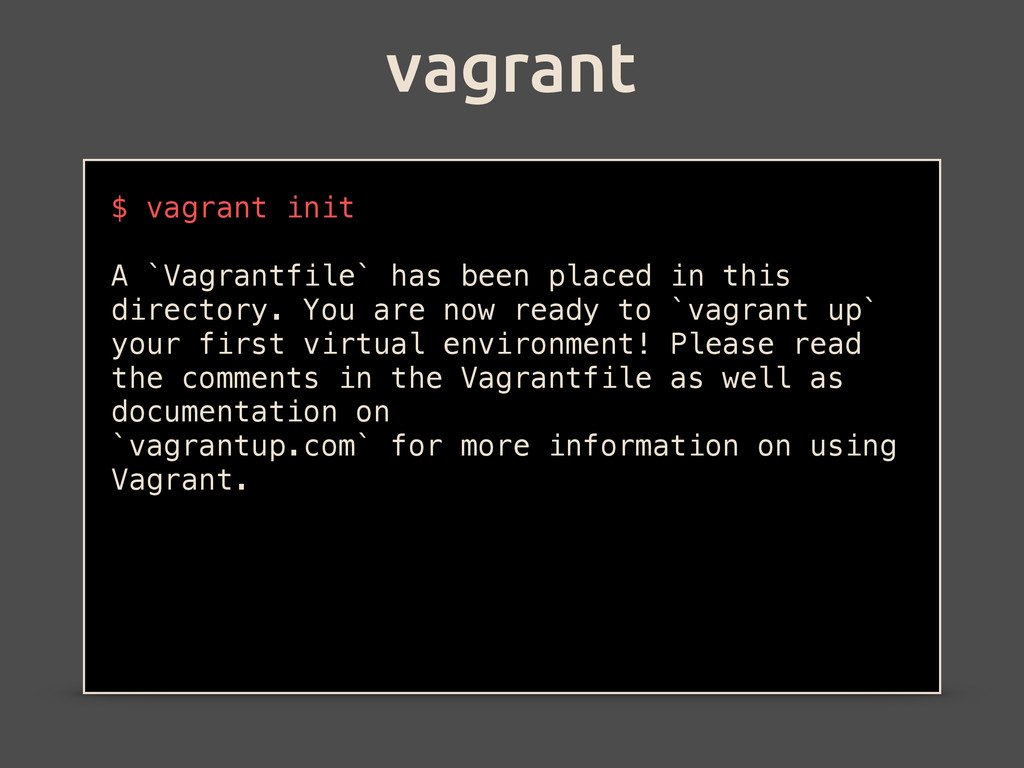
  7. vagrant $ vagrant init ! A `Vagrantfile` has been placed

    in this directory. You are now ready to `vagrant up` your first virtual environment! Please read the comments in the Vagrantfile as well as documentation on `vagrantup.com` for more information on using Vagrant. !
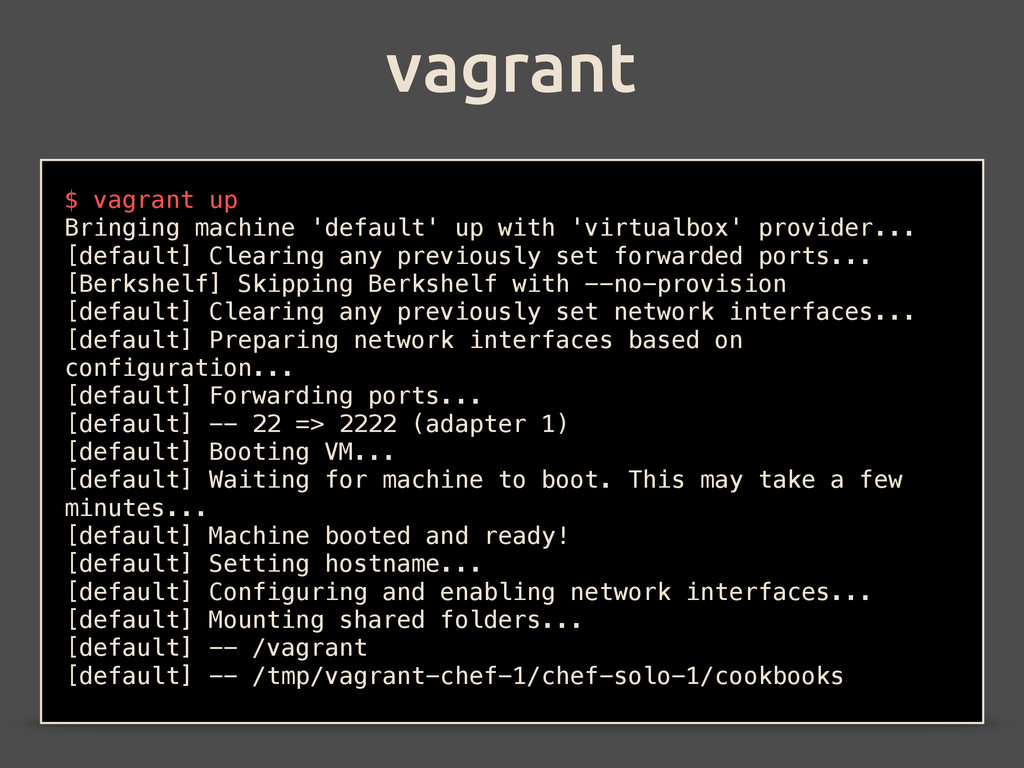
  8. vagrant $ vagrant up Bringing machine 'default' up with 'virtualbox'

    provider... [default] Clearing any previously set forwarded ports... [Berkshelf] Skipping Berkshelf with --no-provision [default] Clearing any previously set network interfaces... [default] Preparing network interfaces based on configuration... [default] Forwarding ports... [default] -- 22 => 2222 (adapter 1) [default] Booting VM... [default] Waiting for machine to boot. This may take a few minutes... [default] Machine booted and ready! [default] Setting hostname... [default] Configuring and enabling network interfaces... [default] Mounting shared folders... [default] -- /vagrant [default] -- /tmp/vagrant-chef-1/chef-solo-1/cookbooks
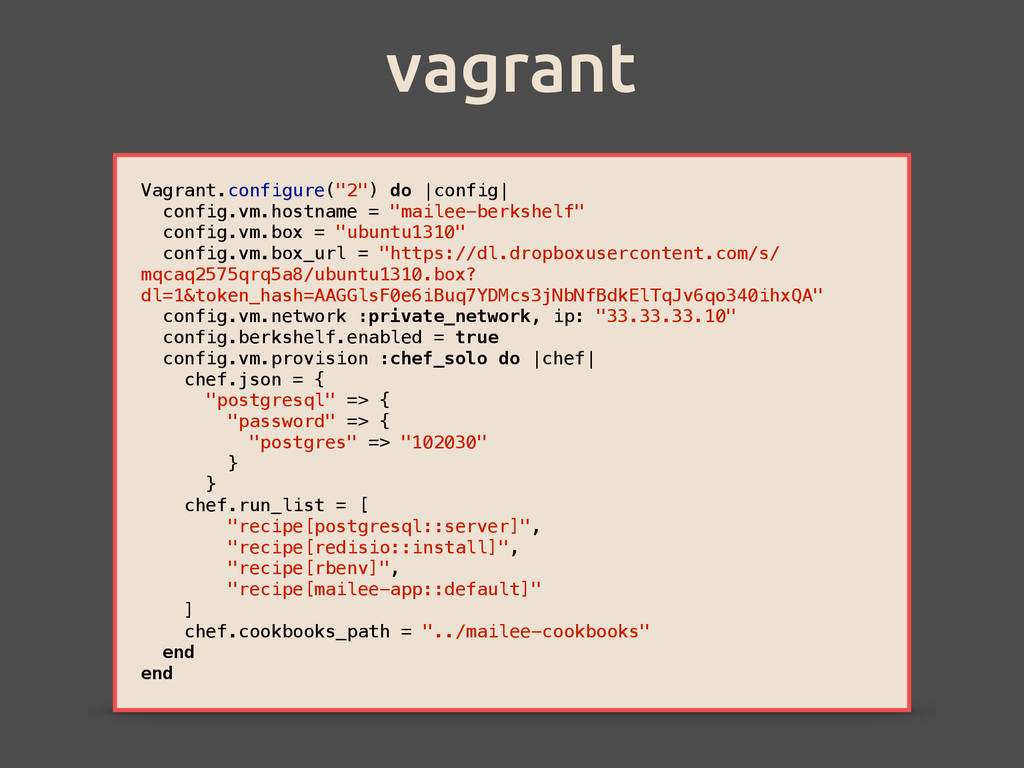
  9. vagrant Vagrant.configure("2") do |config| config.vm.hostname = "mailee-berkshelf" config.vm.box = "ubuntu1310"

    config.vm.box_url = "https://dl.dropboxusercontent.com/s/ mqcaq2575qrq5a8/ubuntu1310.box? dl=1&token_hash=AAGGlsF0e6iBuq7YDMcs3jNbNfBdkElTqJv6qo340ihxQA" config.vm.network :private_network, ip: "33.33.33.10" config.berkshelf.enabled = true config.vm.provision :chef_solo do |chef| chef.json = { "postgresql" => { "password" => { "postgres" => "102030" } } chef.run_list = [ "recipe[postgresql::server]", "recipe[redisio::install]", "recipe[rbenv]", "recipe[mailee-app::default]" ] chef.cookbooks_path = "../mailee-cookbooks" end end
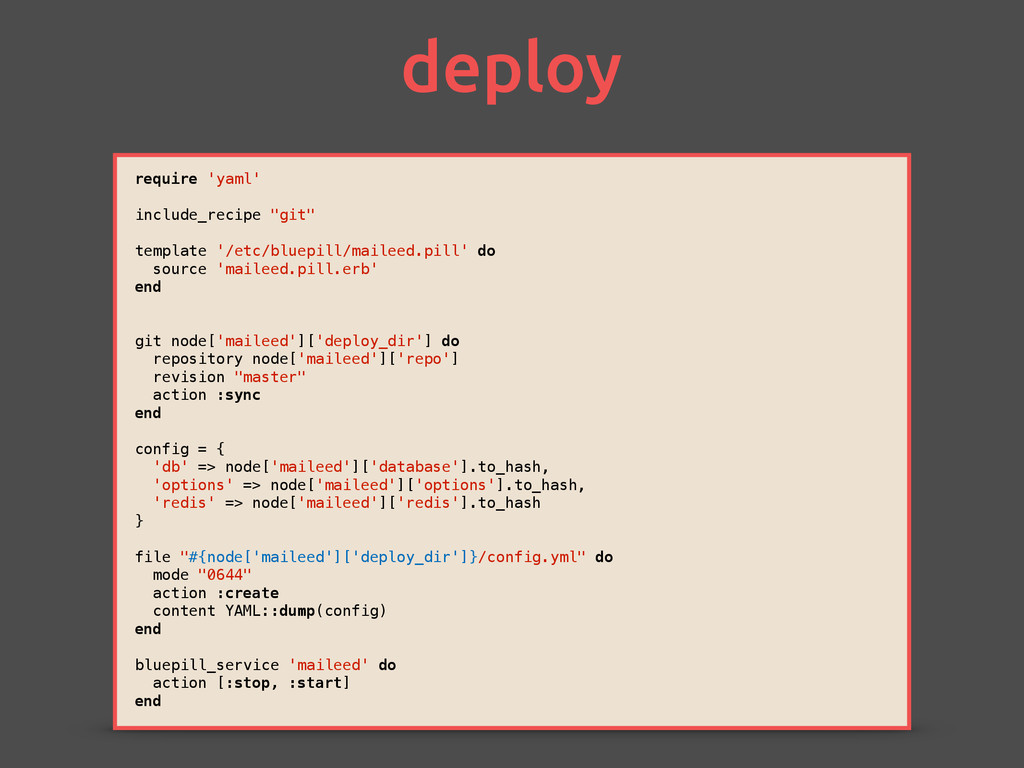
  10. deploy require 'yaml' ! include_recipe "git" ! template '/etc/bluepill/maileed.pill' do

    source 'maileed.pill.erb' end ! ! git node['maileed']['deploy_dir'] do repository node['maileed']['repo'] revision "master" action :sync end ! config = { 'db' => node['maileed']['database'].to_hash, 'options' => node['maileed']['options'].to_hash, 'redis' => node['maileed']['redis'].to_hash } ! file "#{node['maileed']['deploy_dir']}/config.yml" do mode "0644" action :create content YAML::dump(config) end ! bluepill_service 'maileed' do action [:stop, :start] end
  11. when one uses 'ps | grep' instead of pgrep in

    scripts devopsreactions.tumblr.com