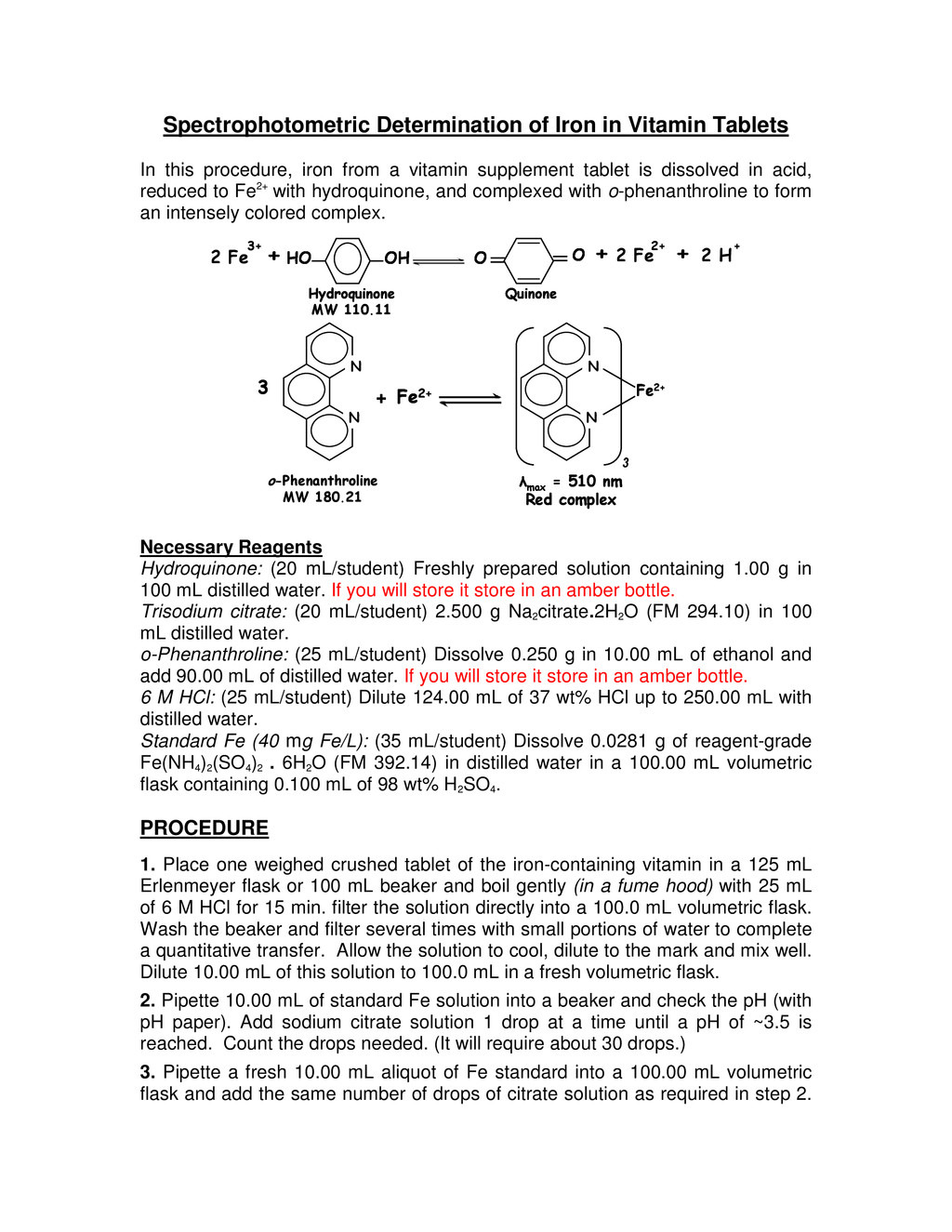
iron from a vitamin supplement tablet is dissolved in acid, reduced to Fe2+ with hydroquinone, and complexed with o-phenanthroline to form an intensely colored complex. Necessary Reagents Hydroquinone: (20 mL/student) Freshly prepared solution containing 1.00 g in 100 mL distilled water. If you will store it store in an amber bottle. Trisodium citrate: (20 mL/student) 2.500 g Na2 citrate.2H2 O (FM 294.10) in 100 mL distilled water. o-Phenanthroline: (25 mL/student) Dissolve 0.250 g in 10.00 mL of ethanol and add 90.00 mL of distilled water. If you will store it store in an amber bottle. 6 M HCl: (25 mL/student) Dilute 124.00 mL of 37 wt% HCl up to 250.00 mL with distilled water. Standard Fe (40 mg Fe/L): (35 mL/student) Dissolve 0.0281 g of reagent-grade Fe(NH4 )2 (SO4 )2 . 6H2 O (FM 392.14) in distilled water in a 100.00 mL volumetric flask containing 0.100 mL of 98 wt% H2 SO4 . PROCEDURE 1. Place one weighed crushed tablet of the iron-containing vitamin in a 125 mL Erlenmeyer flask or 100 mL beaker and boil gently (in a fume hood) with 25 mL of 6 M HCl for 15 min. filter the solution directly into a 100.0 mL volumetric flask. Wash the beaker and filter several times with small portions of water to complete a quantitative transfer. Allow the solution to cool, dilute to the mark and mix well. Dilute 10.00 mL of this solution to 100.0 mL in a fresh volumetric flask. 2. Pipette 10.00 mL of standard Fe solution into a beaker and check the pH (with pH paper). Add sodium citrate solution 1 drop at a time until a pH of ~3.5 is reached. Count the drops needed. (It will require about 30 drops.) 3. Pipette a fresh 10.00 mL aliquot of Fe standard into a 100.00 mL volumetric flask and add the same number of drops of citrate solution as required in step 2. N N N N Fe2+ + Fe2+ λ max = 510 nm Red complex o-Phenanthroline MW 180.21 3 3 N N N N Fe2+ + Fe2+ N N N N N N N N Fe2+ + Fe2+ λ max = 510 nm Red complex o-Phenanthroline MW 180.21 3 3 2 Fe 3+ + OH HO O = = = = = = = = O + 2 Fe2+ + 2 H+ Hydroquinone MW 110.11 Quinone + OH HO OH HO O = = = = = = = = O O = = = = = = = = O + + Hydroquinone MW 110.11 Quinone 2 Fe 3+ + OH HO OH HO O = = = = = = = = O O = = = = = = = = O + 2 Fe2+ + 2 H+ Hydroquinone MW 110.11 Quinone + OH HO OH HO O = = = = = = = = O O = = = = = = = = O + + Hydroquinone MW 110.11 Quinone
o-phenanthroline solution dilute to the mark with water, and mix well. 4. Prepare three more solutions from 5.00, 2.00, and 1.00 mL of Fe standard and prepare a blank containing no Fe. Use sodium citrate solution in proportion to the volume of Fe solution. 5. Determine how many drops of citrate solution are needed to bring 10.00 mL of the iron tablet solution from step 1 to pH 3.5. 6. Transfer 10.00 mL of solution from step 1 to a 100.0 mL volumetric flask. Add the required amount of citrate solution determined in step 5. Then add 2.00 mL of hydroquinone solution and 3.00 mL of o-phenanthroline solution. Dilute to the mark and mix well. Prepare 2 or 3 more samples the same way. 7. Allow the solutions to stand for at least 10 min. (for the sample 10 min is not enough for the color to show, so leave it overnight). Then measure the absorbance of each solution at 510 nm in a 1-cm cell. (The color is stable, so all solutions may be prepared and all the absorbencies measured at once.) Use distilled water in the reference cuvette and subtract the absorbance of the blank from the absorbance of the Fe standards. 8. Make a graph of absorbance versus mg of Fe in the standards. Find the slope and intercept (and standard deviations) by the method of least squares. Calculate the molarity of Fe(o-phenanthroline)3 2+ in each solution and find the average molar absorptivity (ε in Beer's law) from the four absorbencies. (Remember that all the iron has been converted to the phenanthroline complex.) 9. Using the calibration curve, find the number of milligrams of Fe in the tablet. 10. Get the information from the instructor and compare your results to student t values. 11. Find another technique and write a procedure for a method to determine iron in a tablet. 12. Compare the F values to the table’s ones and determine which method which method would you recommend.


 auctria
 juanmartin2026
 uranoken
 robintux
 naoji_taniguchi_ksk_0827
 frievea
 doratex
 terazawa
 terasawat
 yasslab
 2720japanoke
 spring_aki
 ipullrank
 sonatard
 morganepeng
 techseoconnect
 hatefulcrawdad
 holman
 reverentgeek
 bluesmoon
 scottboms
 marktimemedia
 keathley
 kneath