at Corvinus University in Budapest, October 2016 University of South Africa Universiteit van Suid-Afrika CCRDS research group (CCRDS2712) Computability, Complexity and Randomness in Decision Sciences
IFR 2011041500051 and the EU project COMPUTAL as well as the University of South Africa’s College of Economic and Management Sciences Research Committee. All opinions expressed in this work are the author’s and in not necessarily endorsed or supported by his present, future or past employer(s) and/or funder(s). 1
since there exist computable functions without computable fixed points. Examples of Orevkov and Baigger imply that there is no procedure for finding the fixed point in general by giving an example of a computable function which does not fix any computable point. We discuss this and some illustrative examples. Most of the material can also be found in arXiv:0804.3199 where some of the details are not yet correct. 2
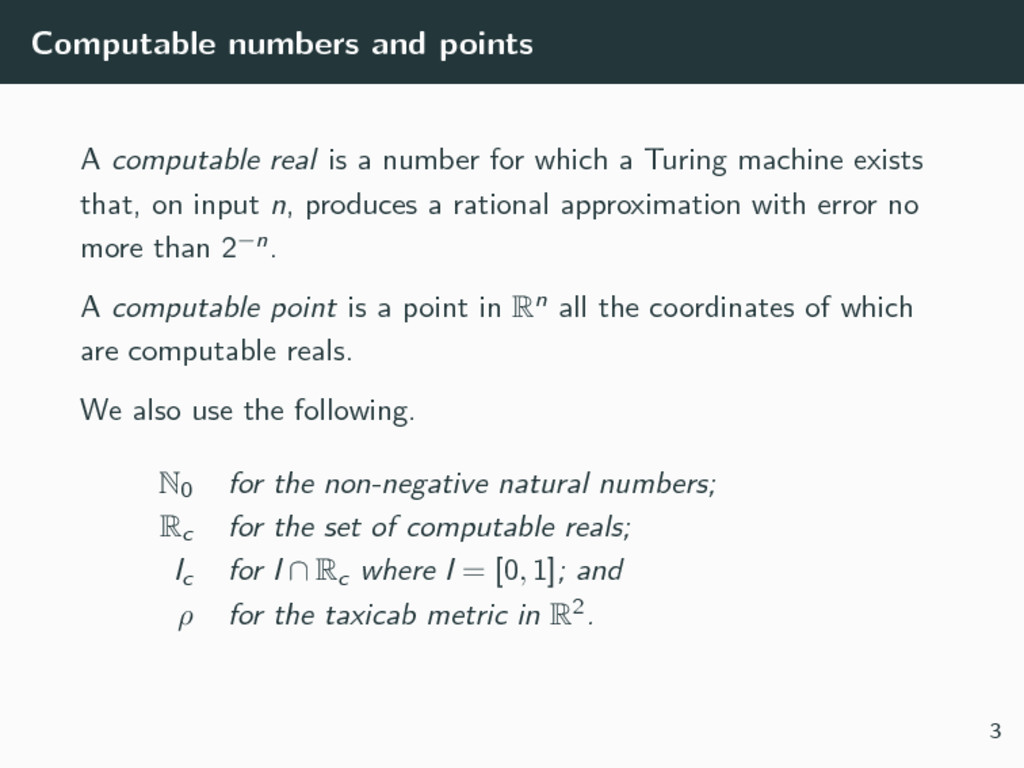
for which a Turing machine exists that, on input n, produces a rational approximation with error no more than 2−n. A computable point is a point in Rn all the coordinates of which are computable reals. We also use the following. N0 for the non-negative natural numbers; Rc for the set of computable reals; Ic for I ∩ Rc where I = [0, 1]; and ρ for the taxicab metric in R2. 3
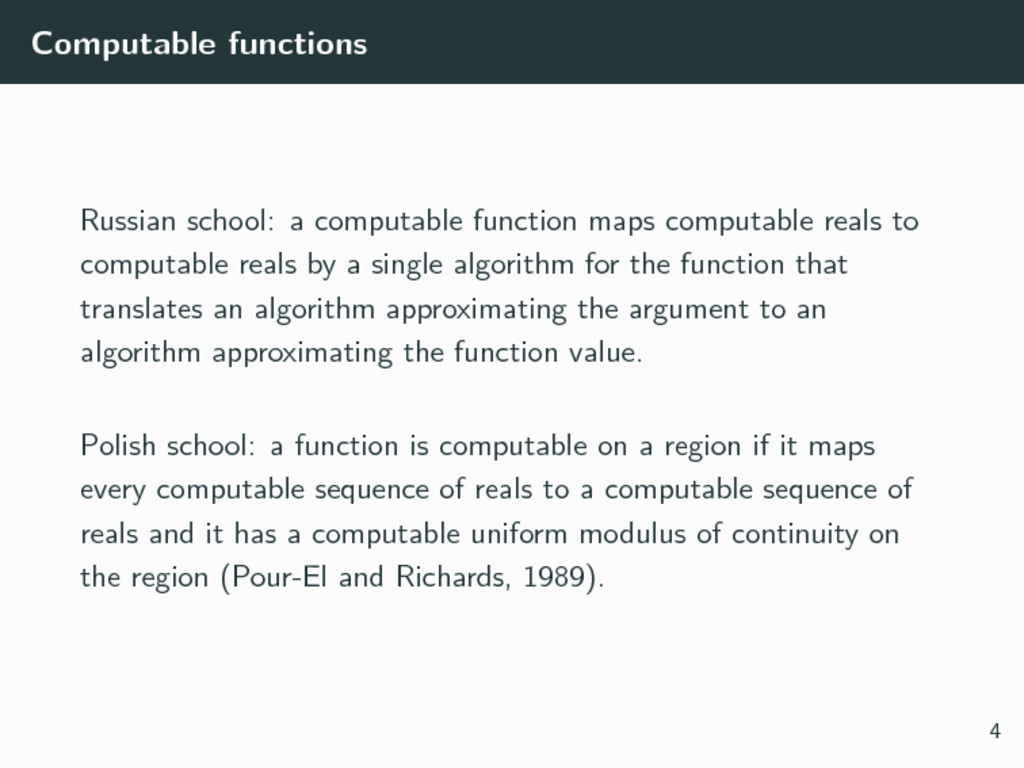
to computable reals by a single algorithm for the function that translates an algorithm approximating the argument to an algorithm approximating the function value. Polish school: a function is computable on a region if it maps every computable sequence of reals to a computable sequence of reals and it has a computable uniform modulus of continuity on the region (Pour-El and Richards, 1989). 4
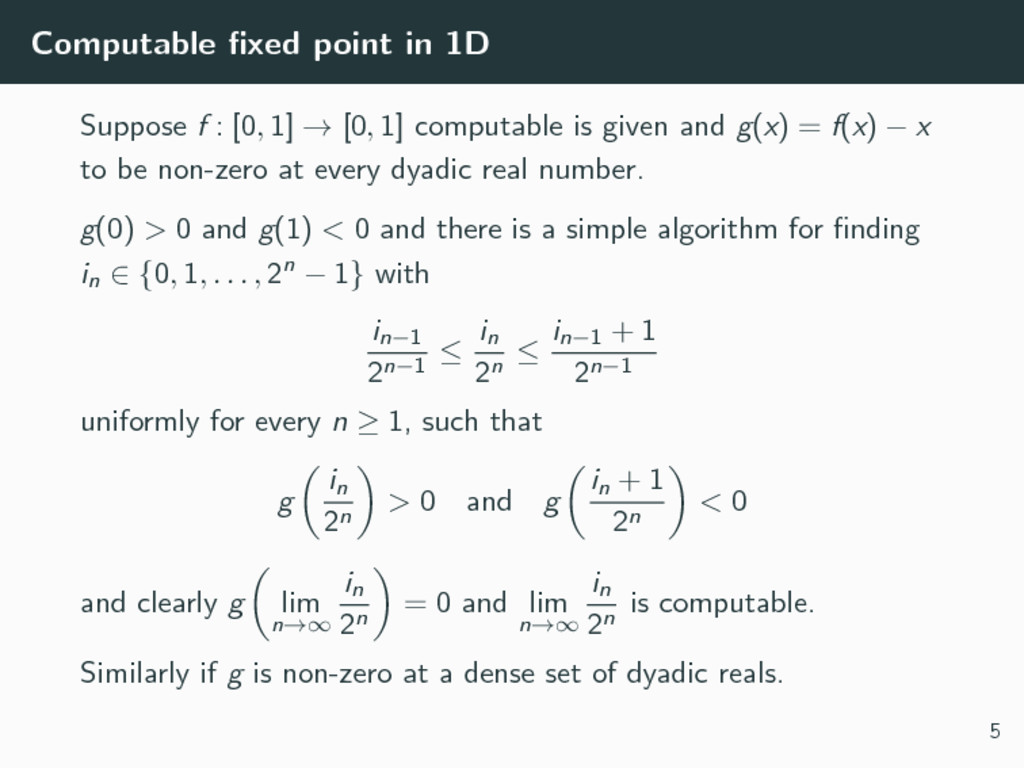
→ [0, 1] computable is given and g(x) = f(x) − x to be non-zero at every dyadic real number. g(0) > 0 and g(1) < 0 and there is a simple algorithm for finding in ∈ {0, 1, . . . , 2n − 1} with in−1 2n−1 ≤ in 2n ≤ in−1 + 1 2n−1 uniformly for every n ≥ 1, such that g ( in 2n ) > 0 and g ( in + 1 2n ) < 0 and clearly g ( lim n→∞ in 2n ) = 0 and lim n→∞ in 2n is computable. Similarly if g is non-zero at a dense set of dyadic reals. 5
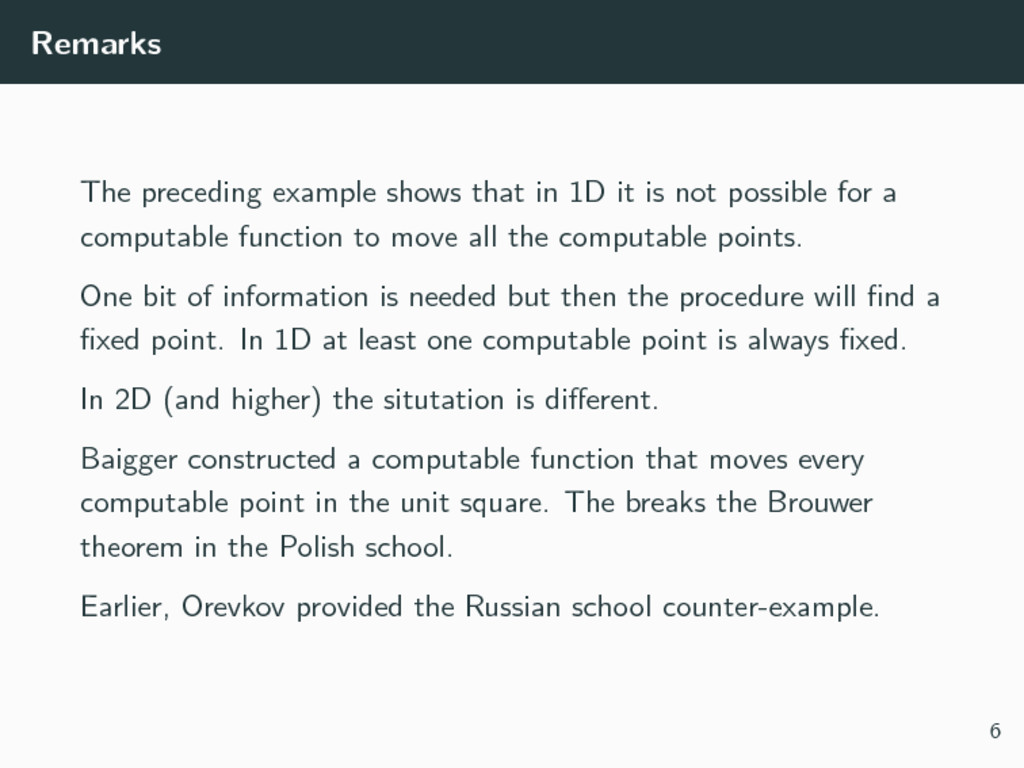
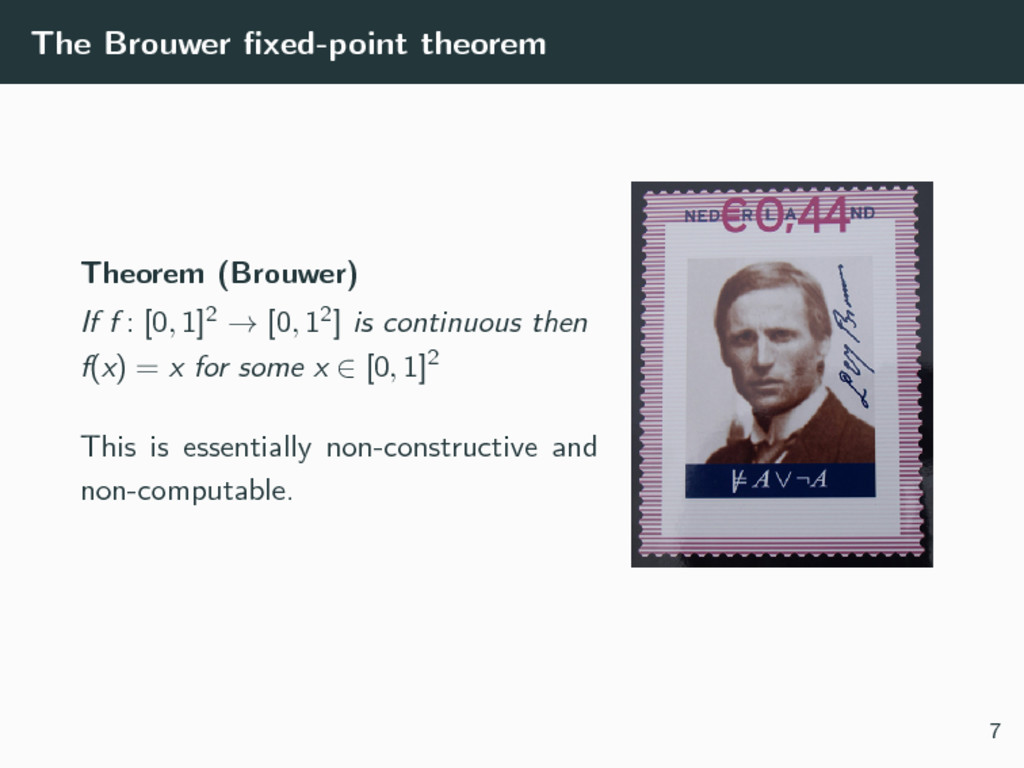
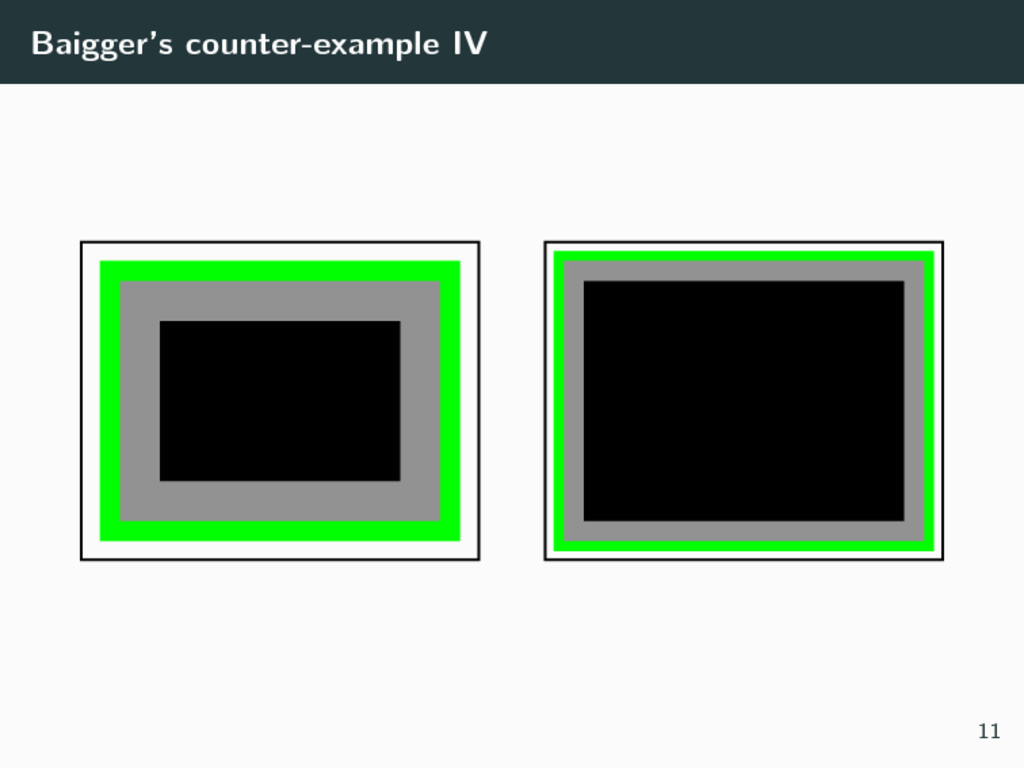
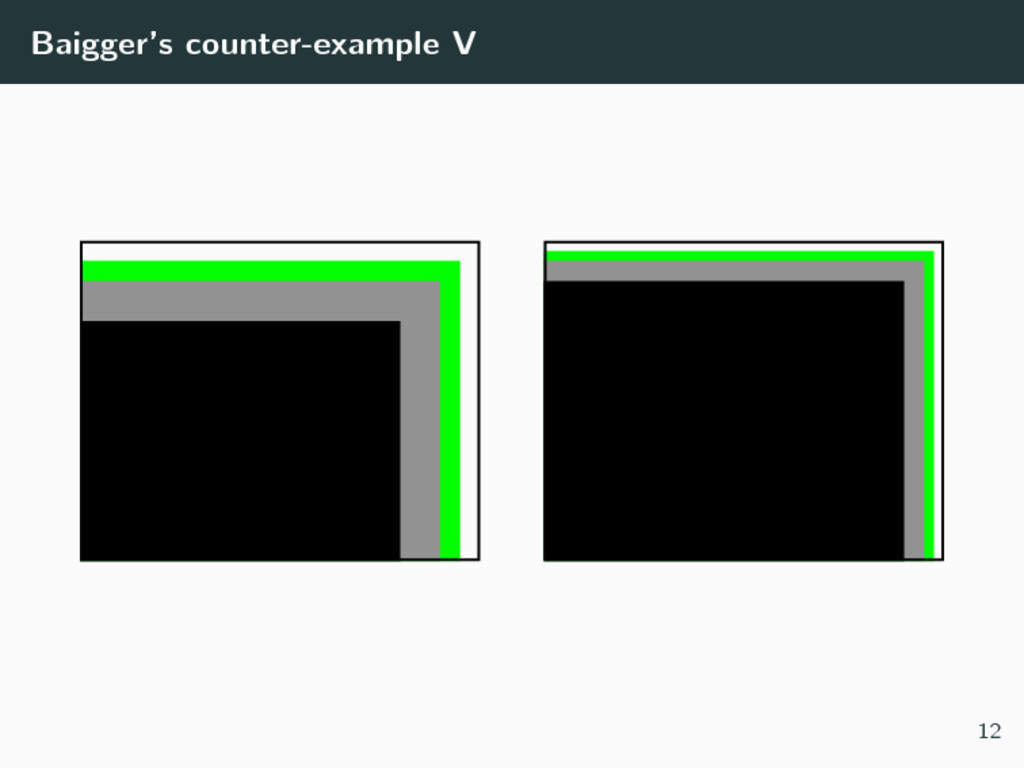
not possible for a computable function to move all the computable points. One bit of information is needed but then the procedure will find a fixed point. In 1D at least one computable point is always fixed. In 2D (and higher) the situtation is different. Baigger constructed a computable function that moves every computable point in the unit square. The breaks the Brouwer theorem in the Polish school. Earlier, Orevkov provided the Russian school counter-example. 6
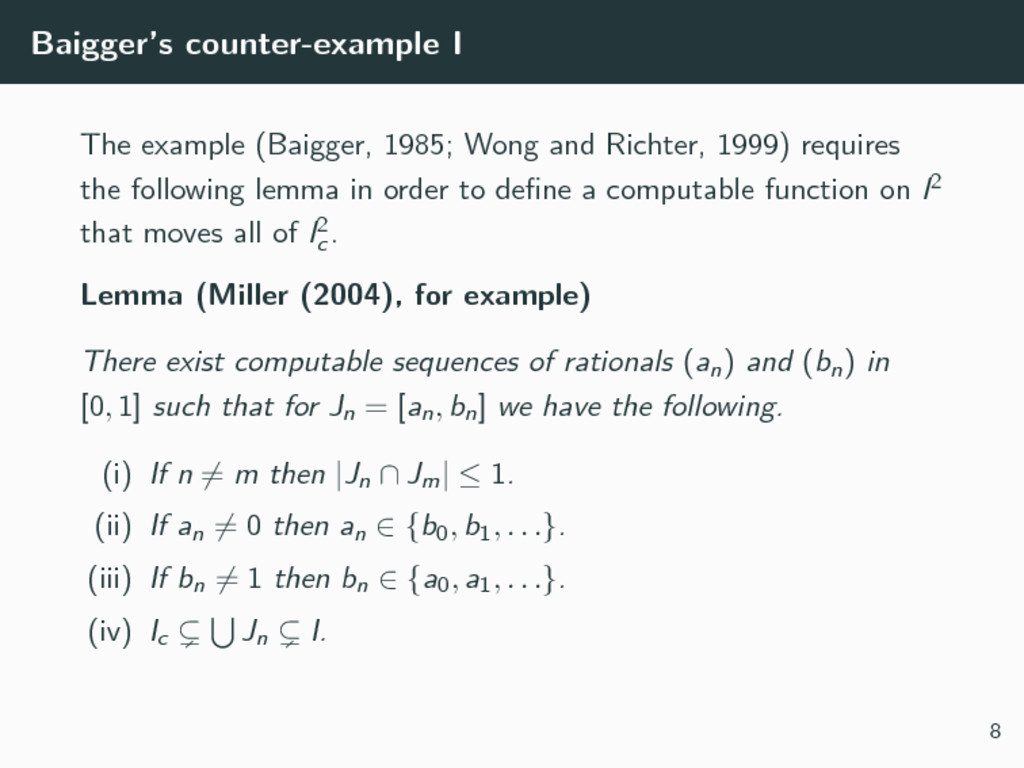
1999) requires the following lemma in order to define a computable function on I2 that moves all of I2 c . Lemma (Miller (2004), for example) There exist computable sequences of rationals (an) and (bn) in [0, 1] such that for Jn = [an, bn] we have the following. (i) If n ̸= m then |Jn ∩ Jm| ≤ 1. (ii) If an ̸= 0 then an ∈ {b0, b1, . . .}. (iii) If bn ̸= 1 then bn ∈ {a0, a1, . . .}. (iv) Ic ⊊ ∪ Jn ⊊ I. 8
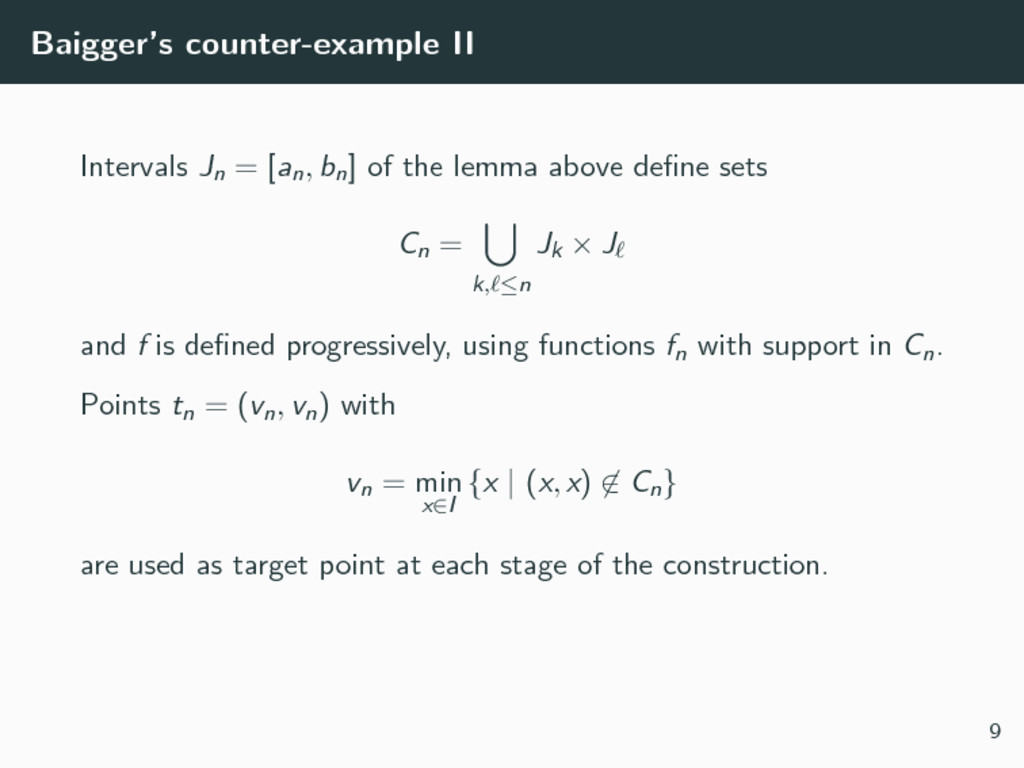
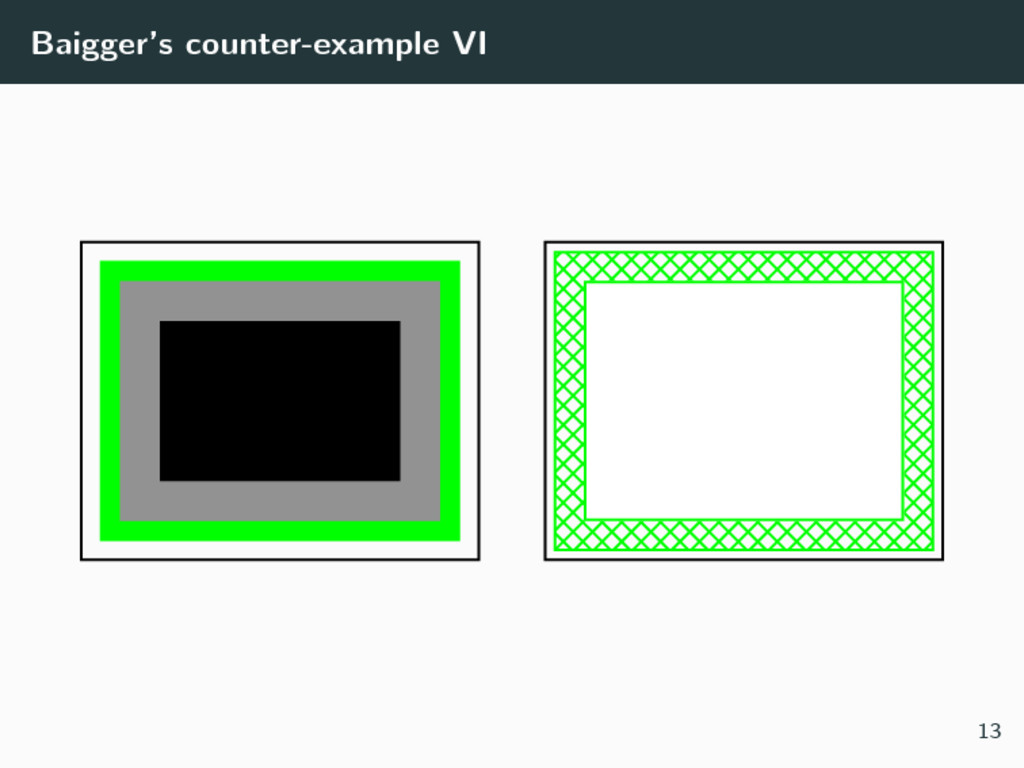
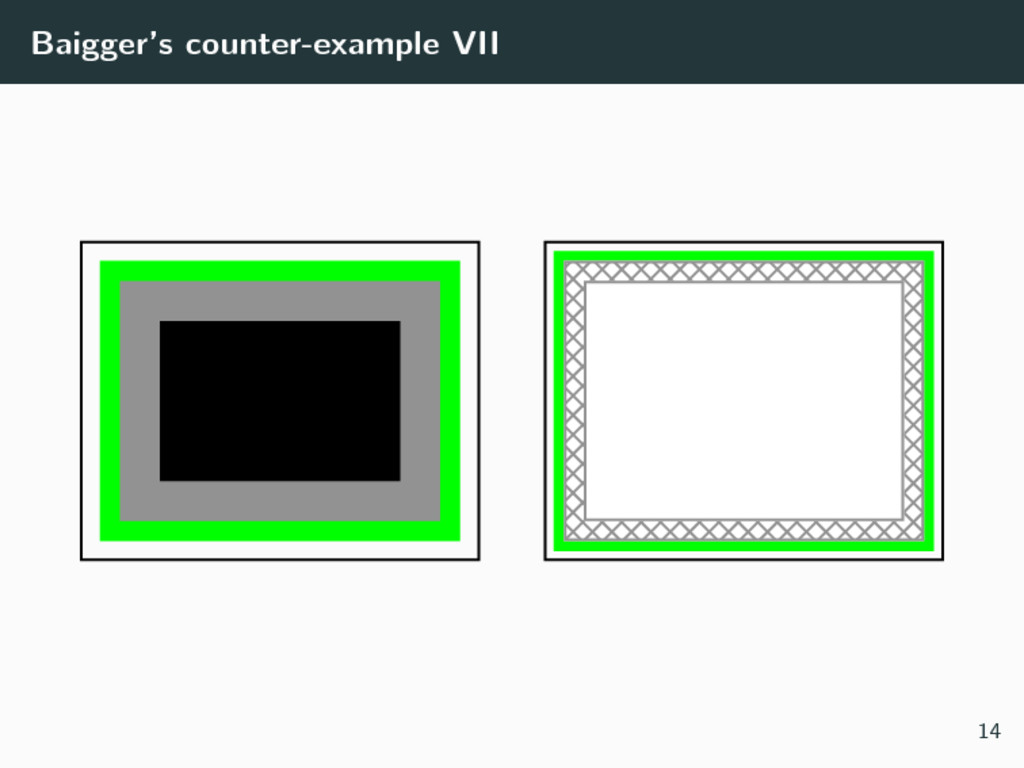
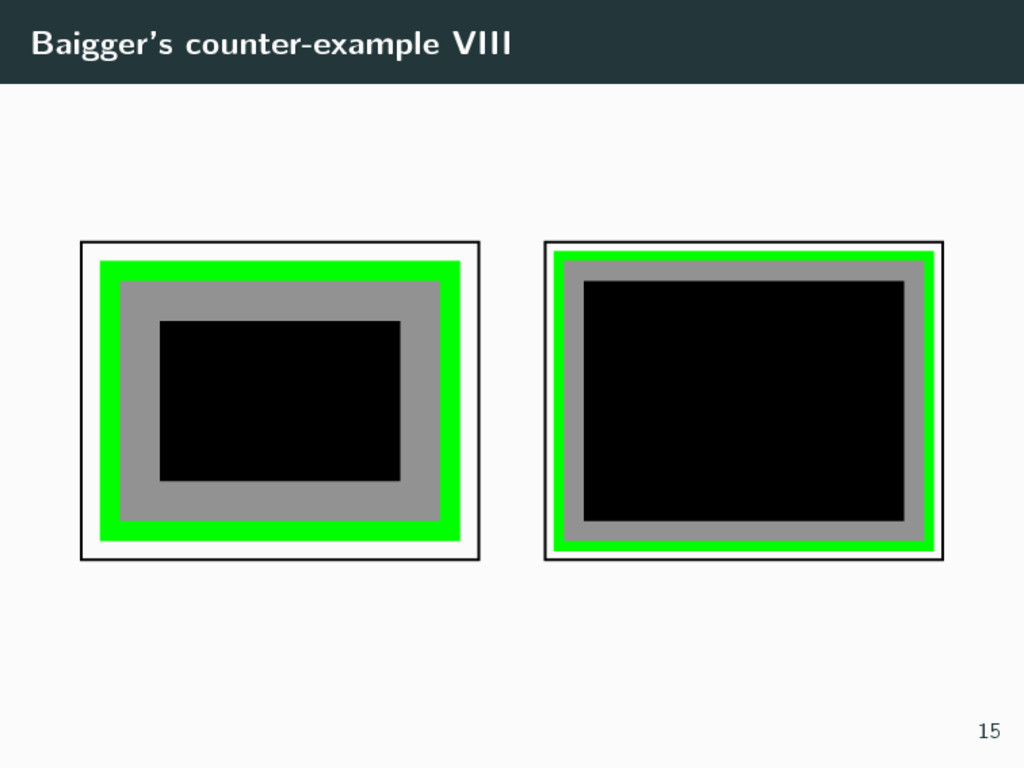
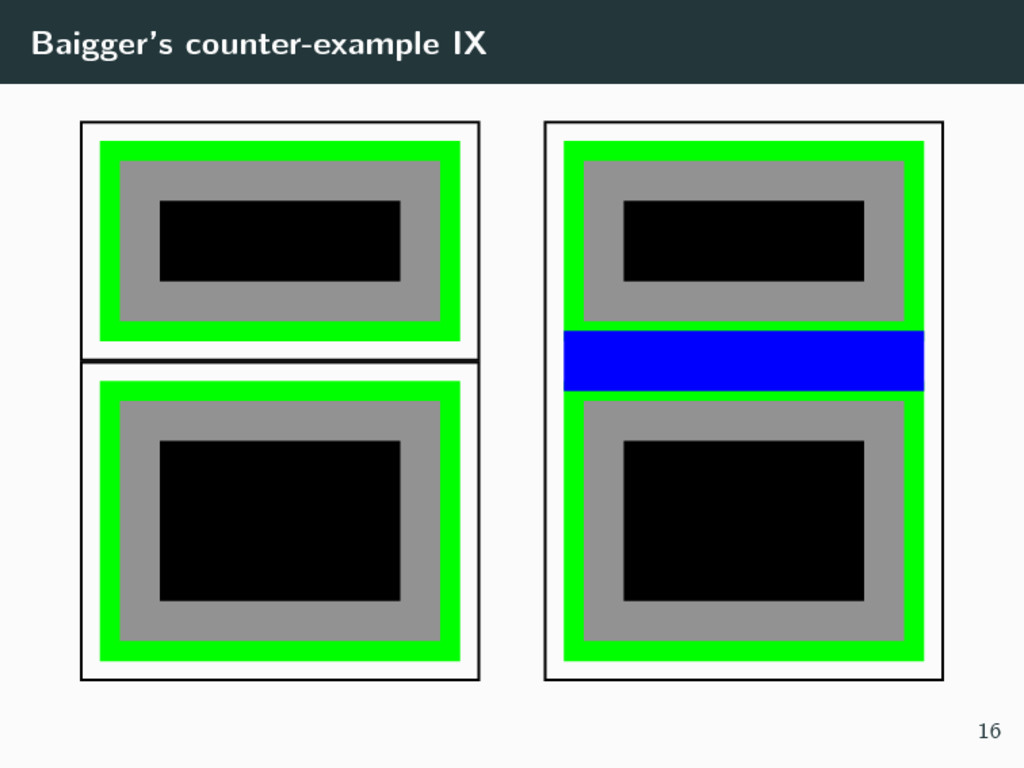
lemma above define sets Cn = ∪ k,ℓ≤n Jk × Jℓ and f is defined progressively, using functions fn with support in Cn . Points tn = (vn, vn) with vn = min x∈I {x | (x, x) ̸∈ Cn} are used as target point at each stage of the construction. 9
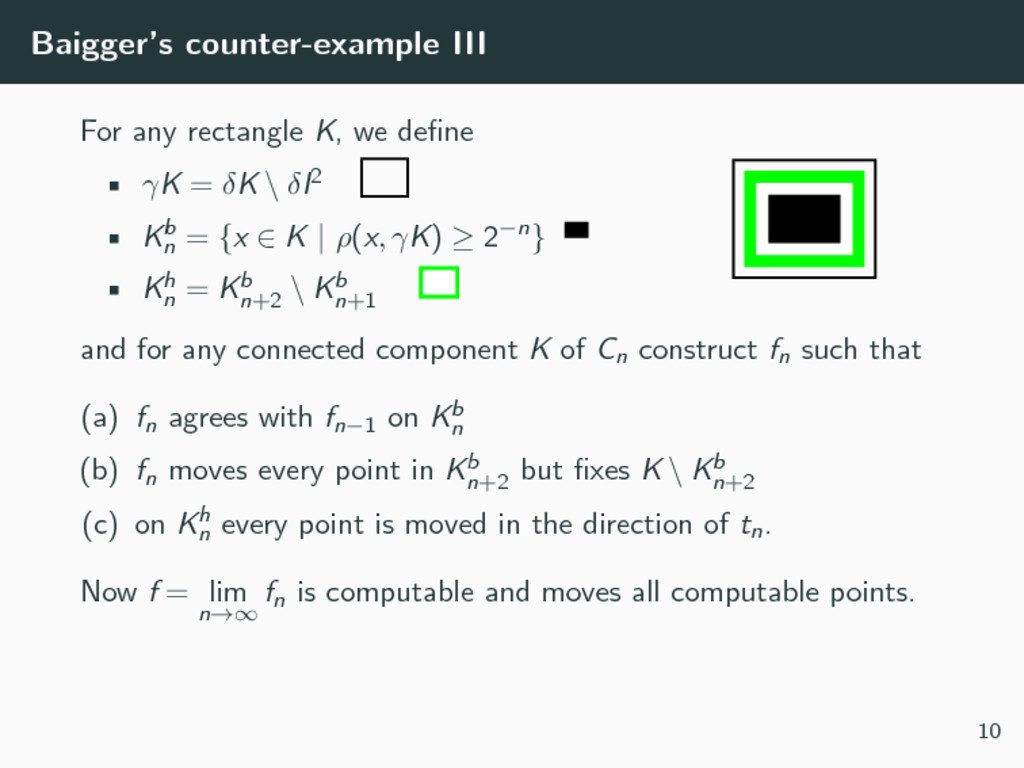
γK = δK \ δI2 • Kb n = {x ∈ K | ρ(x, γK) ≥ 2−n} • Kh n = Kb n+2 \ Kb n+1 and for any connected component K of Cn construct fn such that (a) fn agrees with fn−1 on Kb n (b) fn moves every point in Kb n+2 but fixes K \ Kb n+2 (c) on Kh n every point is moved in the direction of tn . Now f = lim n→∞ fn is computable and moves all computable points. 10
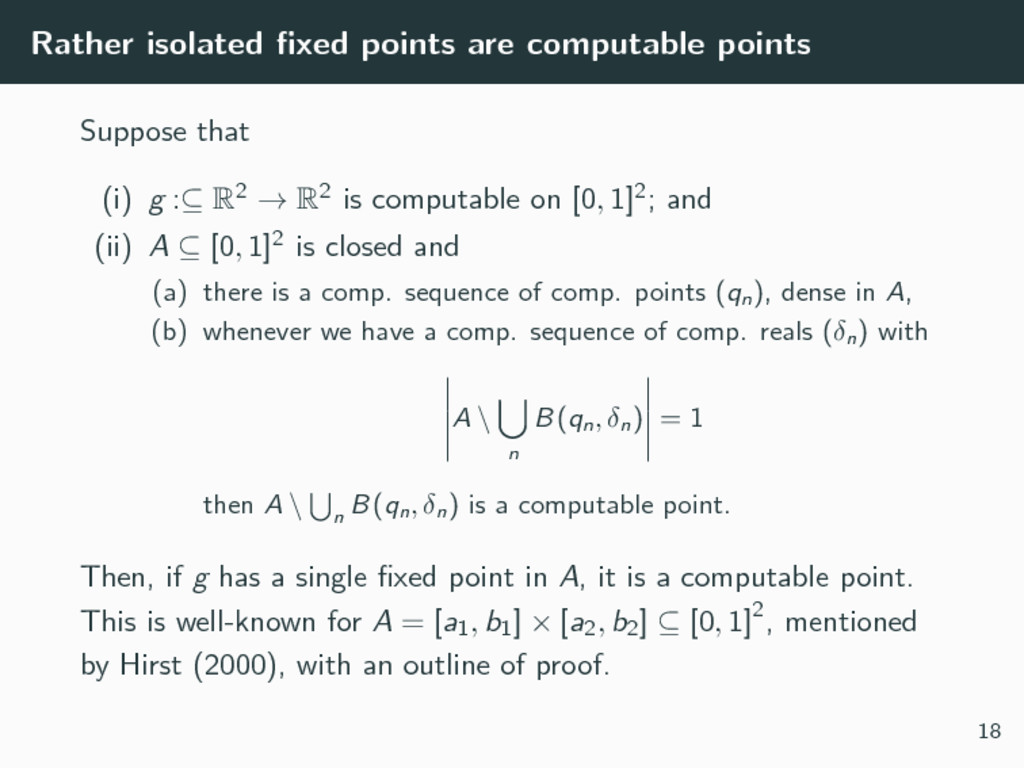
g :⊆ R2 → R2 is computable on [0, 1]2; and (ii) A ⊆ [0, 1]2 is closed and (a) there is a comp. sequence of comp. points (qn), dense in A, (b) whenever we have a comp. sequence of comp. reals (δn) with A \ ∪ n B (qn, δn) = 1 then A \ ∪ n B (qn, δn) is a computable point. Then, if g has a single fixed point in A, it is a computable point. This is well-known for A = [a1, b1] × [a2, b2] ⊆ [0, 1]2, mentioned by Hirst (2000), with an outline of proof. 18
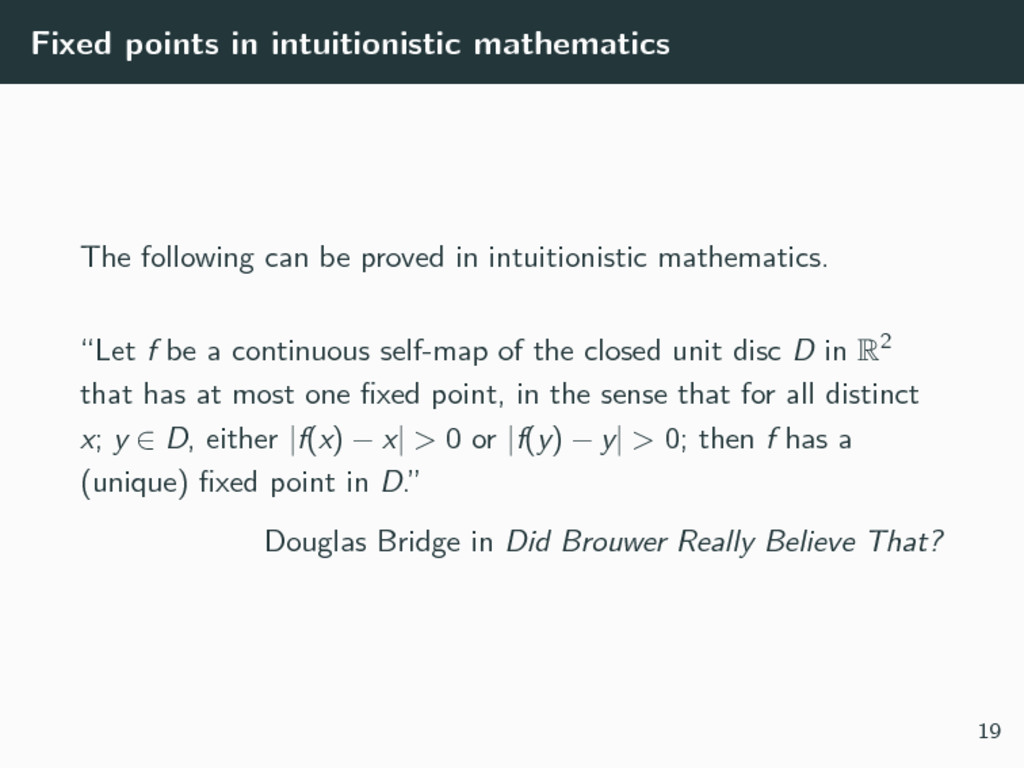
in intuitionistic mathematics. “Let f be a continuous self-map of the closed unit disc D in R2 that has at most one fixed point, in the sense that for all distinct x; y ∈ D, either |f(x) − x| > 0 or |f(y) − y| > 0; then f has a (unique) fixed point in D.” Douglas Bridge in Did Brouwer Really Believe That? 19
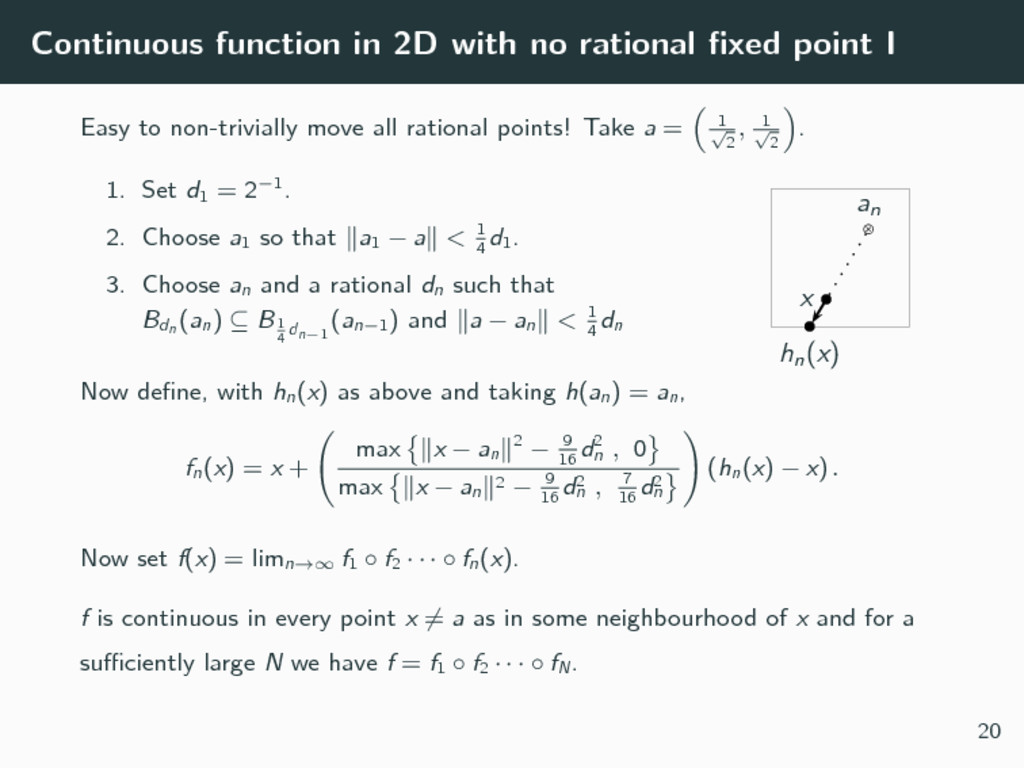
Easy to non-trivially move all rational points! Take a = ( 1 √ 2 , 1 √ 2 ) . 1. Set d1 = 2−1. 2. Choose a1 so that ∥a1 − a∥ < 1 4 d1 . 3. Choose an and a rational dn such that Bdn (an) ⊆ B1 4 dn−1 (an−1) and ∥a − an∥ < 1 4 dn ⊗ an x hn(x) Now define, with hn(x) as above and taking h(an) = an , fn(x) = x + ( max { ∥x − an∥2 − 9 16 d2 n , 0 } max { ∥x − an∥2 − 9 16 d2 n , 7 16 d2 n } ) (hn(x) − x) . Now set f(x) = limn→∞ f1 ◦ f2 · · · ◦ fn(x). f is continuous in every point x ̸= a as in some neighbourhood of x and for a sufficiently large N we have f = f1 ◦ f2 · · · ◦ fN . 20
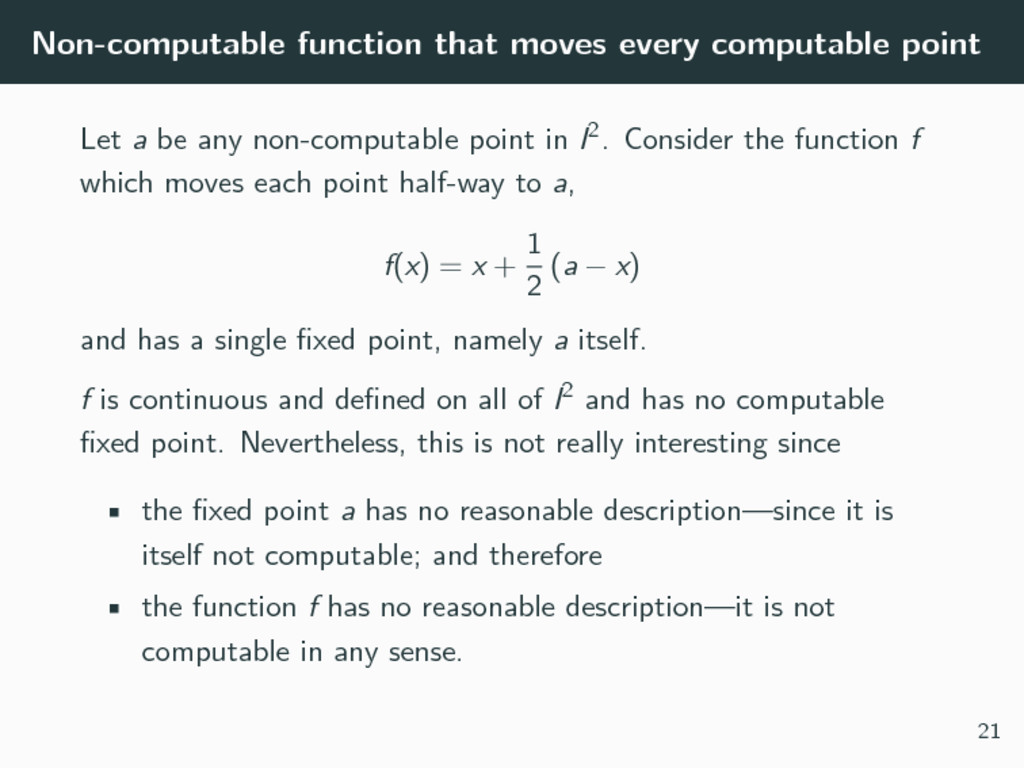
any non-computable point in I2. Consider the function f which moves each point half-way to a, f(x) = x + 1 2 (a − x) and has a single fixed point, namely a itself. f is continuous and defined on all of I2 and has no computable fixed point. Nevertheless, this is not really interesting since • the fixed point a has no reasonable description—since it is itself not computable; and therefore • the function f has no reasonable description—it is not computable in any sense. 21
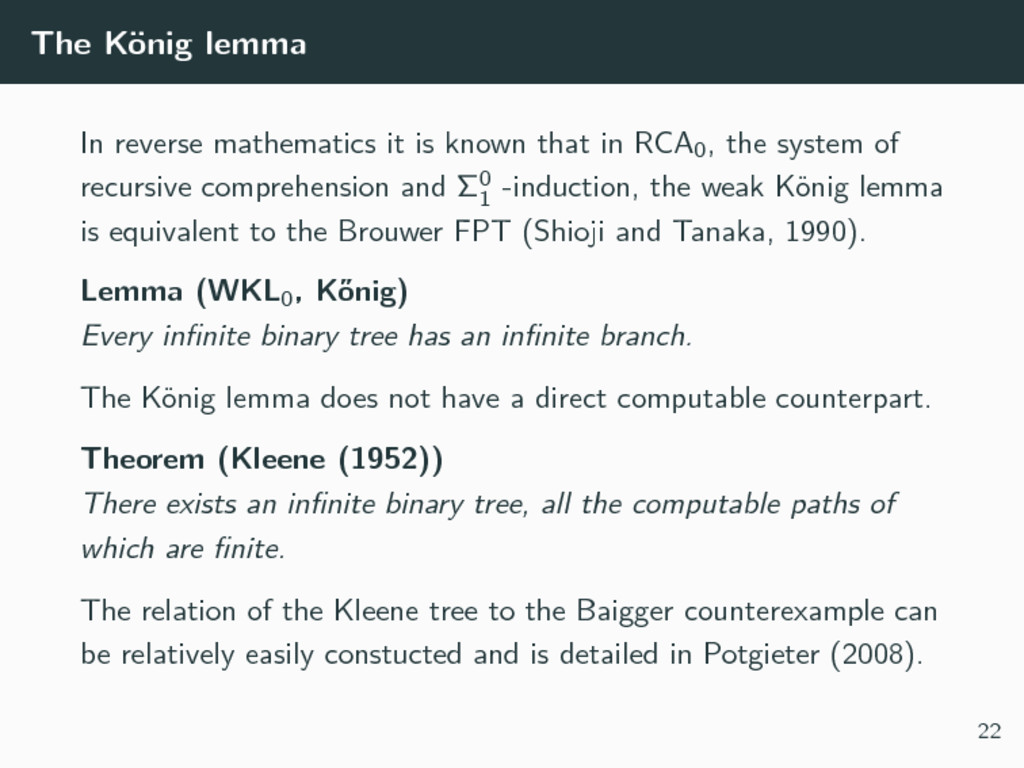
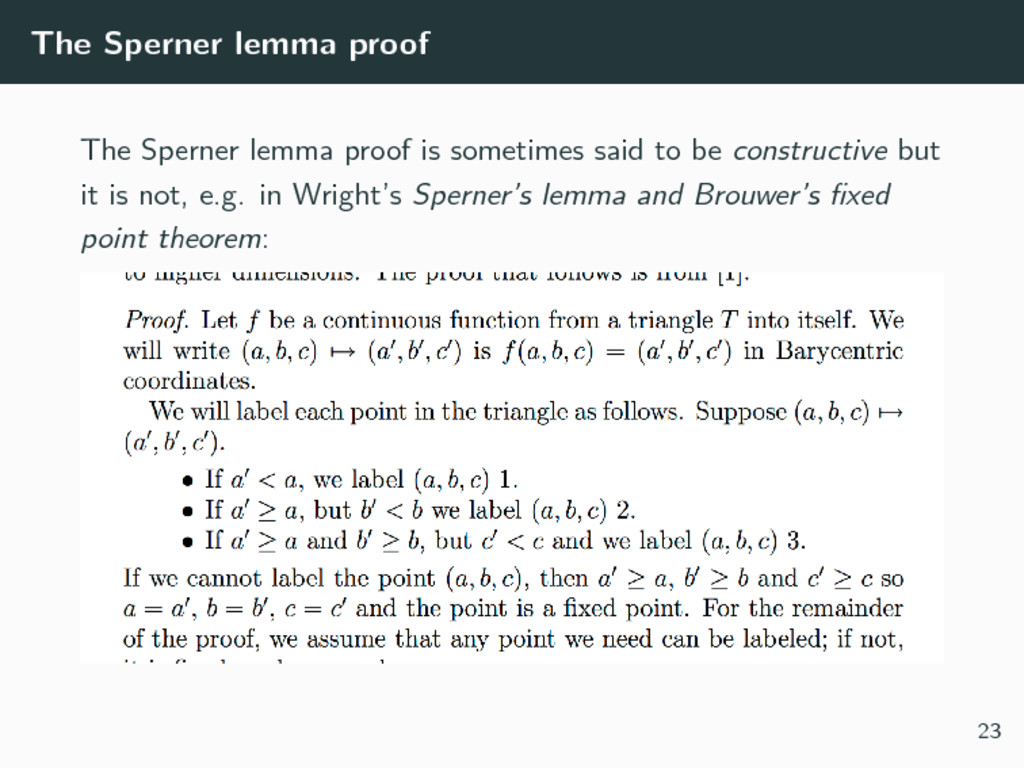
in RCA0 , the system of recursive comprehension and Σ0 1 -induction, the weak König lemma is equivalent to the Brouwer FPT (Shioji and Tanaka, 1990). Lemma (WKL0 , Kőnig) Every infinite binary tree has an infinite branch. The König lemma does not have a direct computable counterpart. Theorem (Kleene (1952)) There exists an infinite binary tree, all the computable paths of which are finite. The relation of the Kleene tree to the Baigger counterexample can be relatively easily constucted and is detailed in Potgieter (2008). 22
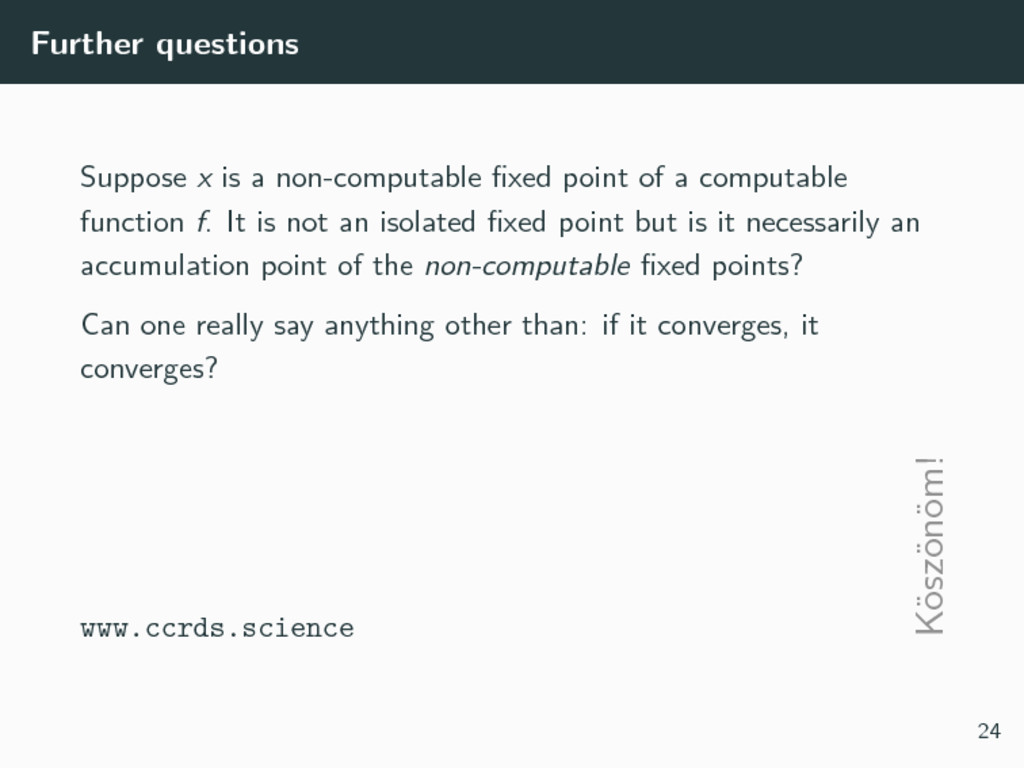
a computable function f. It is not an isolated fixed point but is it necessarily an accumulation point of the non-computable fixed points? Can one really say anything other than: if it converges, it converges? www.ccrds.science Köszönöm! 24
Mathematische Logik und Grundlagenforschung, 25(3-4):183–188, 1985. ISSN 0003-9268. V. Brattka, S. Le Roux, and A. Pauly. Connected Choice and the Brouwer Fixed Point Theorem. June 2012. arXiv:1206.4809B. Jeffry L. Hirst. Notes on Reverse Mathematics and Brouwer’s Fixed Point Theorem. Available online:- http://www.mathsci.appstate.edu/~jlh/snp/pdfslides/bfp.pdf, 2000. S. C Kleene. Recursive functions and intuitionistic mathematics. pages 679–685, Providence, R. I., 1952. Amer. Math. Soc. Joseph S. Miller. Degrees of unsolvability of continuous functions. The Journal of Symbolic Logic, 69(2):555–584, 2004. ISSN 0022-4812. Petrus H. Potgieter. Computable counter-examples to the Brouwer fixed-point theorem, 2008. arXiv:0804.3199. Marian B. Pour-El and J. Ian Richards. Computability in analysis and physics. Perspectives in Mathematical Logic. Springer-Verlag, Berlin, 1989. ISBN 3-540-50035-9. Naoki Shioji and Kazuyuki Tanaka. Fixed point theory in weak second-order arithmetic. Annals of Pure and Applied Logic, 47(2):167–188, 1990. ISSN 0168-0072. Kam-Chau Wong and Marcel K. Richter. Non-computability of competitive equilibrium. Economic Theory, 14(1): 1–27, 1999. 25


 trycycle
 institutdelelevage
 brainpadpr
 michielstock
 martinlippert
 miyayou
 estie
 okana2ki
 masakiokuda
 tagtag
 davidcarrasco
 soysaucechin
 3n
 sugarenia
 aki_iinuma
 skoyamalab
 jeffersonlam
 tomoyanonymous
 matthewcrist
 davetheseo
 techseoconnect
 aarron