Capsulite Retractile
Sponsored
·
 Your Podcast. Everywhere. Effortlessly.
Share. Educate. Inspire. Entertain. You do you. We'll handle the rest.
→
Your Podcast. Everywhere. Effortlessly.
Share. Educate. Inspire. Entertain. You do you. We'll handle the rest.
→

Share
Embed
Capsulite Retractile

Olivier H
April 15, 2012
Transcript
94 slides
-
Directeur de Thèse: Dr Nicolas Amoretti Président du Jury: Pr
Bernard Padovani Jurés: Pr Serge Arfi Pr Hervé Deramond Dr Virginie Lesbats Arthrodilatation de l‘Epaule et Echographie dans la Capsulite Rétractile: Technique, Faisabilité, Résultats Thèse soutenue à la Faculté de Médecine de Nice le 20 novembre 2009 par Nicolas Poussange -
« Entité clinique définie par l’apparition progressive d’une douleur et
d’une limitation des amplitudes articulaires de l’épaule évoluant sur 2 ans environ selon 3 phases successives» INTRODUCTION Reeves B. The natural history of the frozen shoulder syndrome. Scand J Rheumatol. 1975;4(4):193-6.! Shaffer B, Tibone JE, Kerlan RK. Frozen shoulder. A long-term follow-up. J Bone Joint Surg Am. 1992 Jun;74(5):738-46. -
« Entité clinique définie par l’apparition progressive d’une douleur et
d’une limitation des amplitudes articulaires de l’épaule évoluant sur 2 ans environ selon 3 phases successives» INTRODUCTION 1. Phase douloureuse: 2-6 mois 2. Phase d’enraidissement: 4-12 mois 3. Phase de récupération: 12-24 mois Reeves B. The natural history of the frozen shoulder syndrome. Scand J Rheumatol. 1975;4(4):193-6.! Shaffer B, Tibone JE, Kerlan RK. Frozen shoulder. A long-term follow-up. J Bone Joint Surg Am. 1992 Jun;74(5):738-46. -
« Entité clinique définie par l’apparition progressive d’une douleur et
d’une limitation des amplitudes articulaires de l’épaule évoluant sur 2 ans environ selon 3 phases successives» INTRODUCTION 1. Phase douloureuse: 2-6 mois 2. Phase d’enraidissement: 4-12 mois 3. Phase de récupération: 12-24 mois 45-65 ans Reeves B. The natural history of the frozen shoulder syndrome. Scand J Rheumatol. 1975;4(4):193-6.! Shaffer B, Tibone JE, Kerlan RK. Frozen shoulder. A long-term follow-up. J Bone Joint Surg Am. 1992 Jun;74(5):738-46. -
« Entité clinique définie par l’apparition progressive d’une douleur et
d’une limitation des amplitudes articulaires de l’épaule évoluant sur 2 ans environ selon 3 phases successives» INTRODUCTION 1. Phase douloureuse: 2-6 mois 2. Phase d’enraidissement: 4-12 mois 3. Phase de récupération: 12-24 mois 45-65 ans Femmes +++ Reeves B. The natural history of the frozen shoulder syndrome. Scand J Rheumatol. 1975;4(4):193-6.! Shaffer B, Tibone JE, Kerlan RK. Frozen shoulder. A long-term follow-up. J Bone Joint Surg Am. 1992 Jun;74(5):738-46. -
« Entité clinique définie par l’apparition progressive d’une douleur et
d’une limitation des amplitudes articulaires de l’épaule évoluant sur 2 ans environ selon 3 phases successives» INTRODUCTION 1. Phase douloureuse: 2-6 mois 2. Phase d’enraidissement: 4-12 mois 3. Phase de récupération: 12-24 mois 45-65 ans Femmes +++ Une évolution spontanément favorable en 2 ans? Reeves B. The natural history of the frozen shoulder syndrome. Scand J Rheumatol. 1975;4(4):193-6.! Shaffer B, Tibone JE, Kerlan RK. Frozen shoulder. A long-term follow-up. J Bone Joint Surg Am. 1992 Jun;74(5):738-46. -
๏ Diabète +++: Incidence de 20 à 30% ๏ Pathologies
locorégionales: Tendinopathies - Bursites - Traumatismes - Chirurgie ๏ Maladie de Dupuytren ๏ Pathologies endocriniennes, neurologiques, cardiaques... ๏ Médicaments: barbituriques, isoniazide, antiprotéases... INTRO: Antécédents Pal B, Anderson J, Dick WC, Griffiths ID. Limitation of joint mobility and shoulder capsulitis in insulin- and non-insulin-dependent diabetes mellitus. Br J Rheumatol. 1986 May;25(2):147-51. Tighe CB, Oakley WS, Jr. The prevalence of a diabetic condition and adhesive capsulitis of the shoulder. South Med J. 2008 Jun;101(6):591-5. Smith SP, Devaraj VS, Bunker TD. The association between frozen shoulder and Dupuytren's disease. J Shoulder Elbow Surg. 2001 Mar-Apr;10(2): 149-51. -
๏ Diabète +++: Incidence de 20 à 30% ๏ Pathologies
locorégionales: Tendinopathies - Bursites - Traumatismes - Chirurgie ๏ Maladie de Dupuytren ๏ Pathologies endocriniennes, neurologiques, cardiaques... ๏ Médicaments: barbituriques, isoniazide, antiprotéases... INTRO: Antécédents Pal B, Anderson J, Dick WC, Griffiths ID. Limitation of joint mobility and shoulder capsulitis in insulin- and non-insulin-dependent diabetes mellitus. Br J Rheumatol. 1986 May;25(2):147-51. Tighe CB, Oakley WS, Jr. The prevalence of a diabetic condition and adhesive capsulitis of the shoulder. South Med J. 2008 Jun;101(6):591-5. Smith SP, Devaraj VS, Bunker TD. The association between frozen shoulder and Dupuytren's disease. J Shoulder Elbow Surg. 2001 Mar-Apr;10(2): 149-51. Idiopathique ou secondaire -
๏ Observation: Bras en adduction, rotation interne ๏ Palpation: Amyotrophie
๏ Etude de la Mobilité: Réduction des amplitudes actives et passives INTRO: Examen Clinique Reeves B. The natural history of the frozen shoulder syndrome. Scand J Rheumatol. 1975;4(4):193-6. Rizk TE, Pinals RS. Frozen shoulder. Semin Arthritis Rheum. 1982 May;11(4):440-52. Amoretti N, Grimaud A, Brocq O, Roux C, Dausse F, Fournol M, et al. Shoulder distension arthrography in adhesive capsulitis. Clinical Imaging. 2006;30(4):254-6. -
๏ Observation: Bras en adduction, rotation interne ๏ Palpation: Amyotrophie
๏ Etude de la Mobilité: Réduction des amplitudes actives et passives INTRO: Examen Clinique Reeves B. The natural history of the frozen shoulder syndrome. Scand J Rheumatol. 1975;4(4):193-6. Rizk TE, Pinals RS. Frozen shoulder. Semin Arthritis Rheum. 1982 May;11(4):440-52. Amoretti N, Grimaud A, Brocq O, Roux C, Dausse F, Fournol M, et al. Shoulder distension arthrography in adhesive capsulitis. Clinical Imaging. 2006;30(4):254-6. 100° pour lʼabduction 30° pour la rotation externe 120° pour lʼantépulsion -
๏ Observation: Bras en adduction, rotation interne ๏ Palpation: Amyotrophie
๏ Etude de la Mobilité: Réduction des amplitudes actives et passives INTRO: Examen Clinique Reeves B. The natural history of the frozen shoulder syndrome. Scand J Rheumatol. 1975;4(4):193-6. Rizk TE, Pinals RS. Frozen shoulder. Semin Arthritis Rheum. 1982 May;11(4):440-52. Amoretti N, Grimaud A, Brocq O, Roux C, Dausse F, Fournol M, et al. Shoulder distension arthrography in adhesive capsulitis. Clinical Imaging. 2006;30(4):254-6. 100° pour lʼabduction 30° pour la rotation externe 120° pour lʼantépulsion Rotation externe +++ -
๏ Radiographies standards: ๏ Arthrographies: INTRO: Imagerie - Douleur -
Résistance - Effacement des récessus - Aspect Frangé -
๏ IRM et Arthro IRM INTRO: Imagerie Connell D, Padmanabhan
R, Buchbinder R. Adhesive capsulitis: role of MR imaging in differential diagnosis. Eur Radiol. 2002 Aug;12(8):2100-6. Jung J-Y, Jee W-H, Chun HJ, Kim Y-S, Chung YG, Kim J-M. Adhesive capsulitis of the shoulder: evaluation with MR arthrography. European Radiology. 2006;16(4):791-6. Etude de la capsule articulaire au niveau des replis synoviaux -
๏ IRM et Arthro IRM INTRO: Imagerie Connell D, Padmanabhan
R, Buchbinder R. Adhesive capsulitis: role of MR imaging in differential diagnosis. Eur Radiol. 2002 Aug;12(8):2100-6. Jung J-Y, Jee W-H, Chun HJ, Kim Y-S, Chung YG, Kim J-M. Adhesive capsulitis of the shoulder: evaluation with MR arthrography. European Radiology. 2006;16(4):791-6. Arthro IRM Etude de la capsule articulaire au niveau des replis synoviaux -
๏ IRM et Arthro IRM INTRO: Imagerie Connell D, Padmanabhan
R, Buchbinder R. Adhesive capsulitis: role of MR imaging in differential diagnosis. Eur Radiol. 2002 Aug;12(8):2100-6. Jung J-Y, Jee W-H, Chun HJ, Kim Y-S, Chung YG, Kim J-M. Adhesive capsulitis of the shoulder: evaluation with MR arthrography. European Radiology. 2006;16(4):791-6. Arthro IRM IRM + Gadolinium Etude de la capsule articulaire au niveau des replis synoviaux -
๏ IRM et Arthro IRM INTRO: Imagerie Mengiardi B, Pfirrmann
CWA, Gerber C, Hodler J, Zanetti M. Frozen shoulder: MR arthrographic findings. Radiology. 2004;233(2):486-92. Etude de l’intervalle des rotateurs Comblement Triangle graisseux sous coracoïdien: Sens. 32% Spéc. 100% -
๏ IRM et Arthro IRM INTRO: Imagerie Mengiardi B, Pfirrmann
CWA, Gerber C, Hodler J, Zanetti M. Frozen shoulder: MR arthrographic findings. Radiology. 2004;233(2):486-92. Etude de l’intervalle des rotateurs Ligament Coraco Huméral (LCH) Comblement Triangle graisseux sous coracoïdien: Sens. 32% Spéc. 100% Epaississement (4mm) du LCH Sens. 59% Spéc. 95% -
๏ Echographie INTRO: Imagerie Homsi, M. B-R, J. JDS, X.
S. Intérêt de l'étude échographique du ligament coraco- huméral dans les rétractions capsulaires. GEL-GETROA,2005. Lee JC, Sykes C, Saifuddin A, Connell D. Adhesive capsulitis: sonographic changes in the rotator cuff interval with arthroscopic correlation. Skeletal Radiol. 2005 Sep;34(9):522- 7. Etude de «Lee» Analyse de l’intervalle des rotateurs -
๏ Echographie INTRO: Imagerie Homsi, M. B-R, J. JDS, X.
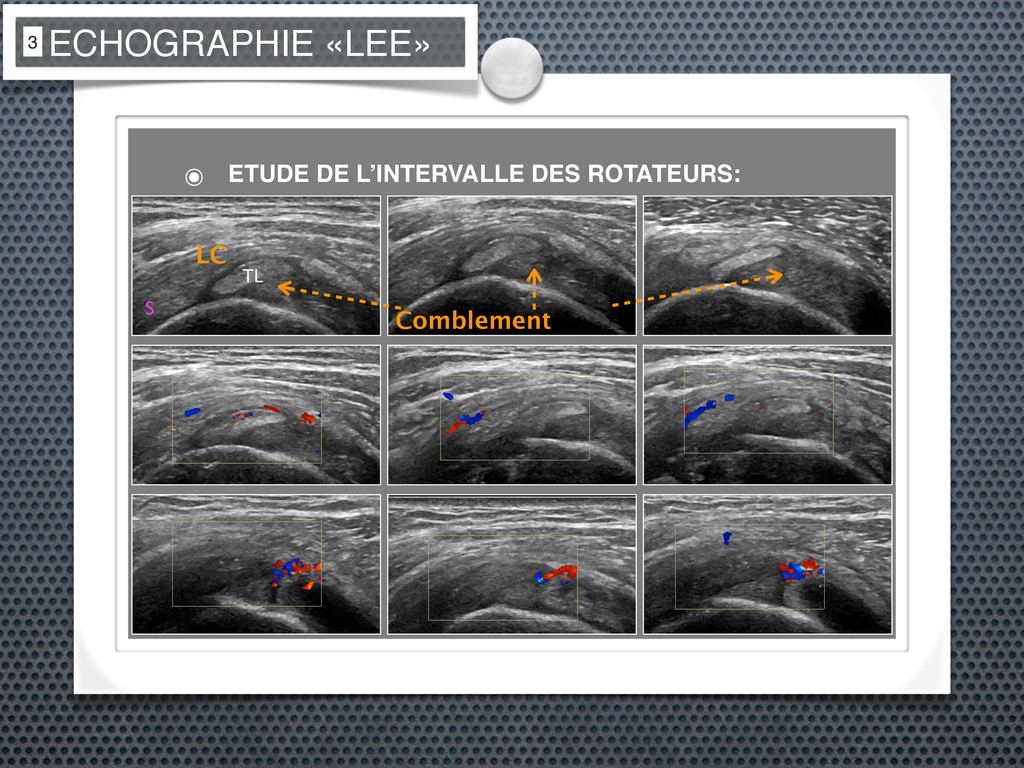
S. Intérêt de l'étude échographique du ligament coraco- huméral dans les rétractions capsulaires. GEL-GETROA,2005. Lee JC, Sykes C, Saifuddin A, Connell D. Adhesive capsulitis: sonographic changes in the rotator cuff interval with arthroscopic correlation. Skeletal Radiol. 2005 Sep;34(9):522- 7. Etude de «Lee» Analyse de l’intervalle des rotateurs Comblement tissulaire Sens: 97% Spécif: 100% Hyperhémie Doppler Sens: 87% Spécif: 100% -
๏ Echographie INTRO: Imagerie Homsi, M. B-R, J. JDS, X.
S. Intérêt de l'étude échographique du ligament coraco- huméral dans les rétractions capsulaires. GEL-GETROA,2005. Lee JC, Sykes C, Saifuddin A, Connell D. Adhesive capsulitis: sonographic changes in the rotator cuff interval with arthroscopic correlation. Skeletal Radiol. 2005 Sep;34(9):522- 7. Etude de «Lee» Analyse de l’intervalle des rotateurs Etude de «Homsi» Analyse du ligament coraco-huméral Groupe capsulite rétractile 3mm +/- 0,85 Groupe témoin 1,34mm +/- 0,32 Comblement tissulaire Sens: 97% Spécif: 100% Hyperhémie Doppler Sens: 87% Spécif: 100% -
๏ Echographie INTRO: Imagerie Homsi, M. B-R, J. JDS, X.
S. Intérêt de l'étude échographique du ligament coraco- huméral dans les rétractions capsulaires. GEL-GETROA,2005. Lee JC, Sykes C, Saifuddin A, Connell D. Adhesive capsulitis: sonographic changes in the rotator cuff interval with arthroscopic correlation. Skeletal Radiol. 2005 Sep;34(9):522- 7. Etude de «Lee» Analyse de l’intervalle des rotateurs Etude de «Homsi» Analyse du ligament coraco-huméral Groupe capsulite rétractile 3mm +/- 0,85 Groupe témoin 1,34mm +/- 0,32 Limites: Zones de chevauchement Comblement tissulaire Sens: 97% Spécif: 100% Hyperhémie Doppler Sens: 87% Spécif: 100% -
๏ Abstention Thérapeutique: ๏ Traitements médicamenteux: Antalgiques, AINS, Corticoïdes ๏
Infiltration de Corticoïdes: ๏ Kinésithérapie: INTRO: Traitements Binder AI, Bulgen DY, Hazleman BL, Roberts S. Frozen shoulder: a long-term prospective study. Ann Rheum Dis. 1984 Jun;43(3):361-4. Binder A, Hazleman BL, Parr G, Roberts S. A controlled study of oral prednisolone in frozen shoulder. Br J Rheumatol. 1986 Aug;25(3):288-92. Buchbinder R, Hoving JL, Green S, Hall S, Forbes A, Nash P. Short course prednisolone for adhesive capsulitis (frozen shoulder or stiff painful shoulder): a randomised, double blind, placebo controlled trial. Ann Rheum Dis. 2004 Nov;63(11):1460-9. Buchbinder R, Green S, Youd JM, Johnston RV. Oral steroids for adhesive capsulitis. Cochrane Database Syst Rev. 2006(4):CD006189. 36.! Ryans I, Montgomery A, Galway R, Kernohan WG, McKane R. A randomized controlled trial of intra-articular triamcinolone and/or physiotherapy in shoulder capsulitis. Rheumatology (Oxford). 2005 Apr;44(4):529-35. Buchbinder R, Green S, Youd JM. Corticosteroid injections for shoulder pain. Cochrane Database Syst Rev. 2003(1):CD004016. 38.!Lee PN, Lee M, Haq AM, Longton EB, Wright V. Periarthritis of the shoulder. Trial of treatments investigated by multivariate analysis. Ann Rheum Dis. 1974 Mar;33(2):116-9. Green S, Buchbinder R, Hetrick S. Physiotherapy interventions for shoulder pain. Cochrane Database Syst Rev. 2003(2):CD004258. -
๏ Abstention Thérapeutique: ๏ Traitements médicamenteux: Antalgiques, AINS, Corticoïdes ๏
Infiltration de Corticoïdes: ๏ Kinésithérapie: INTRO: Traitements Binder AI, Bulgen DY, Hazleman BL, Roberts S. Frozen shoulder: a long-term prospective study. Ann Rheum Dis. 1984 Jun;43(3):361-4. Binder A, Hazleman BL, Parr G, Roberts S. A controlled study of oral prednisolone in frozen shoulder. Br J Rheumatol. 1986 Aug;25(3):288-92. Buchbinder R, Hoving JL, Green S, Hall S, Forbes A, Nash P. Short course prednisolone for adhesive capsulitis (frozen shoulder or stiff painful shoulder): a randomised, double blind, placebo controlled trial. Ann Rheum Dis. 2004 Nov;63(11):1460-9. Buchbinder R, Green S, Youd JM, Johnston RV. Oral steroids for adhesive capsulitis. Cochrane Database Syst Rev. 2006(4):CD006189. 36.! Ryans I, Montgomery A, Galway R, Kernohan WG, McKane R. A randomized controlled trial of intra-articular triamcinolone and/or physiotherapy in shoulder capsulitis. Rheumatology (Oxford). 2005 Apr;44(4):529-35. Buchbinder R, Green S, Youd JM. Corticosteroid injections for shoulder pain. Cochrane Database Syst Rev. 2003(1):CD004016. 38.!Lee PN, Lee M, Haq AM, Longton EB, Wright V. Periarthritis of the shoulder. Trial of treatments investigated by multivariate analysis. Ann Rheum Dis. 1974 Mar;33(2):116-9. Green S, Buchbinder R, Hetrick S. Physiotherapy interventions for shoulder pain. Cochrane Database Syst Rev. 2003(2):CD004258. Evolution favorable sur environ 2 ans MAIS pathologie invalidante -
๏ Abstention Thérapeutique: ๏ Traitements médicamenteux: Antalgiques, AINS, Corticoïdes ๏
Infiltration de Corticoïdes: ๏ Kinésithérapie: INTRO: Traitements Binder AI, Bulgen DY, Hazleman BL, Roberts S. Frozen shoulder: a long-term prospective study. Ann Rheum Dis. 1984 Jun;43(3):361-4. Binder A, Hazleman BL, Parr G, Roberts S. A controlled study of oral prednisolone in frozen shoulder. Br J Rheumatol. 1986 Aug;25(3):288-92. Buchbinder R, Hoving JL, Green S, Hall S, Forbes A, Nash P. Short course prednisolone for adhesive capsulitis (frozen shoulder or stiff painful shoulder): a randomised, double blind, placebo controlled trial. Ann Rheum Dis. 2004 Nov;63(11):1460-9. Buchbinder R, Green S, Youd JM, Johnston RV. Oral steroids for adhesive capsulitis. Cochrane Database Syst Rev. 2006(4):CD006189. 36.! Ryans I, Montgomery A, Galway R, Kernohan WG, McKane R. A randomized controlled trial of intra-articular triamcinolone and/or physiotherapy in shoulder capsulitis. Rheumatology (Oxford). 2005 Apr;44(4):529-35. Buchbinder R, Green S, Youd JM. Corticosteroid injections for shoulder pain. Cochrane Database Syst Rev. 2003(1):CD004016. 38.!Lee PN, Lee M, Haq AM, Longton EB, Wright V. Periarthritis of the shoulder. Trial of treatments investigated by multivariate analysis. Ann Rheum Dis. 1974 Mar;33(2):116-9. Green S, Buchbinder R, Hetrick S. Physiotherapy interventions for shoulder pain. Cochrane Database Syst Rev. 2003(2):CD004258. Evolution favorable sur environ 2 ans MAIS pathologie invalidante Action uniquement sur la Douleur ET de Courte Durée -
๏ Abstention Thérapeutique: ๏ Traitements médicamenteux: Antalgiques, AINS, Corticoïdes ๏
Infiltration de Corticoïdes: ๏ Kinésithérapie: INTRO: Traitements Binder AI, Bulgen DY, Hazleman BL, Roberts S. Frozen shoulder: a long-term prospective study. Ann Rheum Dis. 1984 Jun;43(3):361-4. Binder A, Hazleman BL, Parr G, Roberts S. A controlled study of oral prednisolone in frozen shoulder. Br J Rheumatol. 1986 Aug;25(3):288-92. Buchbinder R, Hoving JL, Green S, Hall S, Forbes A, Nash P. Short course prednisolone for adhesive capsulitis (frozen shoulder or stiff painful shoulder): a randomised, double blind, placebo controlled trial. Ann Rheum Dis. 2004 Nov;63(11):1460-9. Buchbinder R, Green S, Youd JM, Johnston RV. Oral steroids for adhesive capsulitis. Cochrane Database Syst Rev. 2006(4):CD006189. 36.! Ryans I, Montgomery A, Galway R, Kernohan WG, McKane R. A randomized controlled trial of intra-articular triamcinolone and/or physiotherapy in shoulder capsulitis. Rheumatology (Oxford). 2005 Apr;44(4):529-35. Buchbinder R, Green S, Youd JM. Corticosteroid injections for shoulder pain. Cochrane Database Syst Rev. 2003(1):CD004016. 38.!Lee PN, Lee M, Haq AM, Longton EB, Wright V. Periarthritis of the shoulder. Trial of treatments investigated by multivariate analysis. Ann Rheum Dis. 1974 Mar;33(2):116-9. Green S, Buchbinder R, Hetrick S. Physiotherapy interventions for shoulder pain. Cochrane Database Syst Rev. 2003(2):CD004258. Evolution favorable sur environ 2 ans MAIS pathologie invalidante Action uniquement sur la Douleur ET de Courte Durée Bénéfice essentiellement sur la Douleur -
๏ Abstention Thérapeutique: ๏ Traitements médicamenteux: Antalgiques, AINS, Corticoïdes ๏
Infiltration de Corticoïdes: ๏ Kinésithérapie: INTRO: Traitements Binder AI, Bulgen DY, Hazleman BL, Roberts S. Frozen shoulder: a long-term prospective study. Ann Rheum Dis. 1984 Jun;43(3):361-4. Binder A, Hazleman BL, Parr G, Roberts S. A controlled study of oral prednisolone in frozen shoulder. Br J Rheumatol. 1986 Aug;25(3):288-92. Buchbinder R, Hoving JL, Green S, Hall S, Forbes A, Nash P. Short course prednisolone for adhesive capsulitis (frozen shoulder or stiff painful shoulder): a randomised, double blind, placebo controlled trial. Ann Rheum Dis. 2004 Nov;63(11):1460-9. Buchbinder R, Green S, Youd JM, Johnston RV. Oral steroids for adhesive capsulitis. Cochrane Database Syst Rev. 2006(4):CD006189. 36.! Ryans I, Montgomery A, Galway R, Kernohan WG, McKane R. A randomized controlled trial of intra-articular triamcinolone and/or physiotherapy in shoulder capsulitis. Rheumatology (Oxford). 2005 Apr;44(4):529-35. Buchbinder R, Green S, Youd JM. Corticosteroid injections for shoulder pain. Cochrane Database Syst Rev. 2003(1):CD004016. 38.!Lee PN, Lee M, Haq AM, Longton EB, Wright V. Periarthritis of the shoulder. Trial of treatments investigated by multivariate analysis. Ann Rheum Dis. 1974 Mar;33(2):116-9. Green S, Buchbinder R, Hetrick S. Physiotherapy interventions for shoulder pain. Cochrane Database Syst Rev. 2003(2):CD004258. Evolution favorable sur environ 2 ans MAIS pathologie invalidante Action uniquement sur la Douleur ET de Courte Durée Bénéfice essentiellement sur la Douleur Difficile à mettre en place isolément -
๏ Arthrodilatation capsulaire seule INTRO: Traitements Nombreuses études MAIS interprétation
difficile: - Protocoles variables (corticoïdes, volume injecté...) - Faibles effectifs et hétérogénéité de la population - Utilisation d’échelles complexes associant douleur et mobilité notamment - Répétition ou non de l’intervention Buchbinder R, Green S, Youd JM, Johnston RV, Cumpston M. Arthrographic distension for adhesive capsulitis (frozen shoulder). Cochrane Database Syst Rev. 2008(1):CD007005. Boyer, Bard H. Traitement des capsulites de l'épaule. GEL-GETROA, editor2005. -
๏ Arthrodilatation capsulaire seule INTRO: Traitements Nombreuses études MAIS interprétation
difficile: - Protocoles variables (corticoïdes, volume injecté...) - Faibles effectifs et hétérogénéité de la population - Utilisation d’échelles complexes associant douleur et mobilité notamment - Répétition ou non de l’intervention Buchbinder R, Green S, Youd JM, Johnston RV, Cumpston M. Arthrographic distension for adhesive capsulitis (frozen shoulder). Cochrane Database Syst Rev. 2008(1):CD007005. Boyer, Bard H. Traitement des capsulites de l'épaule. GEL-GETROA, editor2005. Conclusion de 2 méta-analyses discordantes -
๏ Arthrodilatation capsulaire et kinésithérapie: INTRO: Traitements - Bénéfices sur
la douleur mais aussi sur la mobilité - Amélioration significative en terme de douleurs et de mobilité chez 85% des patients à 5 jours et à 45 jours. Amoretti N, Grimaud A, Brocq O, Roux C, Dausse F, Fournol M, et al. Shoulder distension arthrography in adhesive capsulitis. Clinical Imaging. 2006;30(4):254-6. -
๏ Arthrodilatation capsulaire et kinésithérapie: INTRO: Traitements - Bénéfices sur
la douleur mais aussi sur la mobilité - Amélioration significative en terme de douleurs et de mobilité chez 85% des patients à 5 jours et à 45 jours. Amoretti N, Grimaud A, Brocq O, Roux C, Dausse F, Fournol M, et al. Shoulder distension arthrography in adhesive capsulitis. Clinical Imaging. 2006;30(4):254-6. Traitements isolés: Kinésithérapie, Infiltrations, Arthrodilatations Peu ou pas efficaces -
๏ Arthrodilatation capsulaire et kinésithérapie: INTRO: Traitements - Bénéfices sur
la douleur mais aussi sur la mobilité - Amélioration significative en terme de douleurs et de mobilité chez 85% des patients à 5 jours et à 45 jours. Amoretti N, Grimaud A, Brocq O, Roux C, Dausse F, Fournol M, et al. Shoulder distension arthrography in adhesive capsulitis. Clinical Imaging. 2006;30(4):254-6. Intérêt d’un traitement combiné+++ Traitements isolés: Kinésithérapie, Infiltrations, Arthrodilatations Peu ou pas efficaces -
Objectifs de l’Etude ๏ Objectifs principaux: ✓ Evaluer lʼamélioration sur
le plan de la douleur et de la mobilité à J1, J5 et J30 après réalisation dʼune arthrodilatation combinée avec une physiothérapie ✓ Evaluer la faisabilité et lʼintérêt de lʼéchographie dans le diagnostic de capsulite rétractile -
Objectifs de l’Etude ๏ Objectifs principaux: ✓ Evaluer lʼamélioration sur
le plan de la douleur et de la mobilité à J1, J5 et J30 après réalisation dʼune arthrodilatation combinée avec une physiothérapie ✓ Evaluer la faisabilité et lʼintérêt de lʼéchographie dans le diagnostic de capsulite rétractile ๏ Objectifs secondaires: ✓ Préciser lʼimpact de la date de la prise en charge thérapeutique par rapport au début des symptômes ✓ Préciser les éventuels échecs du traitement -
๏ Etude prospective, monocentrique sur une série de 17 patients
consécutifs. Matériel et Méthode -
๏ Données démographiques: Age, Sexe ๏ Antécédents: ✓ Diabète -
Hypothyroïdie - VIH - Pathologies d’épaule - Pathologies Cardiaques - Antécédente de Capsulite Rétractile - Algodystrophie: ✓ «Primitive ou Secondaire» ๏ Description et Histoire de l’épisode: ✓ Epaule atteinte ✓ Date de début des symptômes ✓ Traitement de l’épisode M&M: Interrogatoire -
๏ Douleur selon l’Echelle Visuelle Analogique (EVA) ๏ Mesure des
Amplitudes Articulaires ✓ Abduction ✓ Rotation externe ✓ Antépulsion ✓ Rotation interne ๏ Score de Mobilité de Constant (40 pts) M&M: Clinique -
๏ Evaluation de l’amélioration clinique: 2 méthodes M&M: Evaluation Selon
la mesure des amplitudes articulaires: 3 groupes • Groupe «amélioration SATISFAISANTE»: Récupération des 3 amplitudes • Groupe «amélioration MODÉRÉMENT SATISFAISANTE»: Récupération de 2 amplitudes sur 3 • Groupe «amélioration NON SATISFAISANTE»: Récupération n’excédant pas 1 amplitude articulaire 100° pour lʼabduction 30° pour la rotation externe 120° pour lʼantépulsion -
๏ Evaluation de l’amélioration clinique: 2 méthodes M&M: Evaluation Selon
le score de mobilité de Constant: 2 groupes • Groupe «amélioration SATISFAISANTE»: Constant ≥ 30 • Groupe «amélioration NON SATISFAISANTE»: Constant < 30 -
๏ Constitution d’un groupe témoin ✓ 20 personnes (40 épaules)
✓ Tranche d’âge de survenue habituelle de la capsulite rétractile (45-65) ๏ Méthodologie et déroulement de l’examen ✓ Etude bilatérale et comparative M&M: Echographie Méthode de «Lee» Analyse de l’intervalle des rotateurs: - Plan Sagittal Oblique avec visulalisation Tendons SSc, SE et TLB - Recherche comblement tissulaire - Recherche Hyperhémie à l’étude Doppler Méthode de «Homsi» Mesure du Ligament Coraco-Huméral - Plan Transversal Oblique passant par la Coracoïde -
๏ Techniques: 5 produits 1. Xylocaïne 1%: Anesthésie locale 2.
10 ml de produit de contraste iodé 3. 10 ml de Xylocaïne 0,5% réfrigérée 4. 1 ml de corticostéroïde 5. 10 ml de sérum physiologique M&M: Arthrodilatation 31 ml intra-articulaire -
๏ Prise en Charge intensive pendant une semaine ✓ Dans
l’heure suivant l’arthrodilatation ✓ 3 principes ✓ 3 techniques M&M: Physiothérapie -! Pas de mobilisation dans le secteur douloureux -! Mobilisation exclusivement passive -! Séances de mobilisation pluriquotidiennes -! Mobilisation manuelle et Automobilisation -! Arthromoteur -! Balnéothérapie -
RÉSULTATS DESCRIPTION DE LA POPULATION ARTHRODILATATION - KINÉSITHÉRAPIE ECHOGRAPHIE 1
2 3 CASUISTIQUE DES ECHECS 4 -
๏ 17 patients inclus consécutivement ๏ Sex Ratio 6 vs
11 en faveur des FEMMES ๏ Age moyen: 60 ans POPULATION 1 -
POPULATION 0 % 15 % 30 % 45 % 60
% Di Dy Tr Ch Te Cr Al 17,7% (3) 11,8% (2) 5,9% (1) 47,1% (8) 11,8 (2) 5,9% (1) 58,8% (10) Diabète (Di) Dysthyroïdie (Dy) ATCD Capsulite (Cr) Traumatisme (Tr) Chirurgie (Ch) Tendinopathie (Te) Algodystrophie (Al) Pathologies d’épaule: 82,4% (14) 1 A n t é c é d e n t s -
POPULATION 0 % 15 % 30 % 45 % 60
% Di Dy Tr Ch Te Cr Al 17,7% (3) 11,8% (2) 5,9% (1) 47,1% (8) 11,8 (2) 5,9% (1) 58,8% (10) Diabète (Di) Dysthyroïdie (Dy) ATCD Capsulite (Cr) Traumatisme (Tr) Chirurgie (Ch) Tendinopathie (Te) Algodystrophie (Al) Pathologies d’épaule: 82,4% (14) 82,4 % 1 A n t é c é d e n t s -
๏ LATÉRALISATION: Tableau de contingence (%) POPULATION 1 Côté dominant
Côté non dominant Epaule droite Epaule gauche 11,7 17,7 29,4 17,7 52,9 70,6 29,4 70,6 -
๏ LATÉRALISATION: Tableau de contingence (%) POPULATION 1 Côté dominant
Côté non dominant Epaule droite Epaule gauche 11,7 17,7 29,4 17,7 52,9 70,6 29,4 70,6 -
๏ DÉLAI DE PRISE EN CHARGE (mois) POPULATION 1 Moyenne
Ecart type Minimum Médiane Maximum Délai 6 5 2 4 24 -
๏ DÉLAI DE PRISE EN CHARGE (mois) POPULATION 1 Moyenne
Ecart-type Minimum Médiane Maximum Délai 6 5 2 4 24 GROUPE DE PRISE EN CHARGE «PRECOCE» = ANTÉRIEURE au 4ème mois (n=8) GROUPE DE PRISE EN CHARGE «TARDIVE» = POSTÉRIEURE au 4ème mois (n=9) -
๏ AMPLITUDES ARTICULAIRES À J0 (degrés) POPULATION 1 Moyenne Moyenne
Médiane Médiane Actif Passif Actif Passif Abduction Rotation Externe Antépulsion Rotation Interne 67 77 65 75 20 23 10 15 81 93 80 90 1,6 1,6 2 2 CONSTANT 16 pts (40%) 16 pts (40%) 16 pts (40%) 16 pts (40%) 100° pour lʼabduction 30° pour la rotation externe 120° pour lʼantépulsion -
๏ AMPLITUDES ARTICULAIRES À J0 (degrés) POPULATION 1 Moyenne Moyenne
Médiane Médiane Actif Passif Actif Passif Abduction Rotation Externe Antépulsion Rotation Interne 67 77 65 75 20 23 10 15 81 93 80 90 1,6 1,6 2 2 CONSTANT 16 pts (40%) 16 pts (40%) 16 pts (40%) 16 pts (40%) ROTATION EXTERNE +++ RÉDUCTION PARALLÈLE DES AMPLITUDES ARTICULAIRES ACTIVES ET PASSIVES +++ 100° pour lʼabduction 30° pour la rotation externe 120° pour lʼantépulsion -
๏ EVALUATION DE LA DOULEUR À J0 (EVA) POPULATION 1
Moyenne Médiane Ecart-type Minimum Maximum EVA 5,5 6 2,1 2 10 -
๏ EVALUATION DE LA DOULEUR À J0 (EVA) POPULATION 1
Moyenne Médiane Ecart-type Minimum Maximum EVA 5,5 6 2,1 2 10 -
๏ EVALUATION DE LA DOULEUR À J0 (EVA) POPULATION 1
EVA < 4: n=3 EVA ≥ 4: n=14 Moyenne Médiane Ecart-type Minimum Maximum EVA 5,5 6 2,1 2 10 -
ARTHRODILATATION 2 0 % 25 % 50 % 75 %
100 % Rés Dou Fra Réc Rup Al 75,5% (13) 94,1% (16) 58,8% (10) 94,1% (16) 100% (17) Résistance Douleur Rupture capsulaire Aspect frangé Effacement d’au moins 1 récessus Interruption ou complication 0% (0) Com A r t h r o d i l a t a t i o n -
ARTHRODILATATION 2 0 % 25 % 50 % 75 %
100 % Rés Dou Fra Réc Rup Al 75,5% (13) 94,1% (16) 58,8% (10) 94,1% (16) 100% (17) Résistance Douleur Rupture capsulaire Aspect frangé Effacement d’au moins 1 récessus Interruption ou complication 0% (0) Com A r t h r o d i l a t a t i o n -
ARTHRODILATATION 2 Amplitudes de J0 à J30 0° 30° 60°
90° 120° 150° J0 J1 J5 J30 Abduction Rotation Externe Antépulsion Rotation Interne RE An RI Ab Ab Ab Ab RE RE RE An An An RI RI RI 90 75 100 120 90 110 110 130 2 2 4 4 15 30 30 45 -
ARTHRODILATATION 2 Amplitudes de J0 à J30 0° 30° 60°
90° 120° 150° J0 J1 J5 J30 Abduction Rotation Externe Antépulsion Rotation Interne RE An RI Ab Ab Ab Ab RE RE RE An An An RI RI RI 90 75 100 120 90 110 110 130 2 2 4 4 15 30 30 45 Abduction > 100° Rotation externe > 30° Antépulsion > 120° -
ARTHRODILATATION 2 G a i n A m p l
i t u d e s RI 4 +0° +10° +20° +30° +40° +50° J0-J1 J0-J5 J0-J30 Di Dy Tr Ch Te Cr Al Abduction Rotation Externe Antépulsion Rotation Interne + 46° + 2,4 + 38° + 23° -
ARTHRODILATATION 2 Constant de J0 à J30 0 10 20
30 40 31 Pts 25 Pts 21 Pts 16 Pts J0 J1 J5 J30 -
๏ EVALUATION DE l’AMÉLIORATION CLINIQUE: SELON «AMPLITUDES» SELON «AMPLITUDES» SELON
«CONSTANT» SELON «CONSTANT» Satisfaisant 82,3% (14) Satisfaisant 76,5 % (13) Modérément Satisfaisant 5,9% (1) Non Satisfaisant 23,5 % (4) Non Satisfaisant 11,8% (2) Non Satisfaisant 23,5 % (4) ARTHRODILATATION 2 -
ARTHRODILATATION 2 E VA d e J 0 à J
3 0 J0 J1 J5 J30 1 2 3 4 5 6 7 8 9 10 2,5 3,2 4,4 6,2 J0 J1 J5 J30 -
๏ FACTEURS PRÉDICTIFS: SELON CONSTANT À J5 SELON CONSTANT À
J5 Moyenne Médiane Récupération Moyenne Médiane Groupe «Satisfaisant à J30» (n=13) Groupe «Non Satisfaisant à J30» (n=4) 27,2 18,5 28 20 SELON DÉLAI DE PRISE EN CHARGE SELON DÉLAI DE PRISE EN CHARGE Antérieure au 4ème mois Postérieure au 4ème mois Satisfaisante: 8/8 5/9: Satisfaisante RUPTURE CAPSULAIRE RUPTURE CAPSULAIRE Oui (n=10) Non (n=7) 31,8 30,3 31 32 ARTHRODILATATION 2 -
๏ FACTEURS PRÉDICTIFS: SELON CONSTANT À J5 SELON CONSTANT À
J5 Moyenne Médiane Récupération Moyenne Médiane Groupe «Satisfaisant à J30» (n=13) Groupe «Non Satisfaisant à J30» (n=4) 27,2 18,5 28 20 SELON DÉLAI DE PRISE EN CHARGE SELON DÉLAI DE PRISE EN CHARGE Antérieure au 4ème mois Postérieure au 4ème mois Satisfaisante: 8/8 5/9: Satisfaisante RUPTURE CAPSULAIRE RUPTURE CAPSULAIRE Oui (n=10) Non (n=7) 31,8 30,3 31 32 ARTHRODILATATION 2 Constant > 25 associé à amélioration satisfaisante -
๏ FACTEURS PRÉDICTIFS: SELON CONSTANT À J5 SELON CONSTANT À
J5 Moyenne Médiane Récupération Moyenne Médiane Groupe «Satisfaisant à J30» (n=13) Groupe «Non Satisfaisant à J30» (n=4) 27,2 18,5 28 20 SELON DÉLAI DE PRISE EN CHARGE SELON DÉLAI DE PRISE EN CHARGE Antérieure au 4ème mois Postérieure au 4ème mois Satisfaisante: 8/8 5/9: Satisfaisante RUPTURE CAPSULAIRE RUPTURE CAPSULAIRE Oui (n=10) Non (n=7) 31,8 30,3 31 32 ARTHRODILATATION 2 Constant > 25 associé à amélioration satisfaisante Pas d’échec dans le groupe «PEC Précoce» -
๏ FACTEURS PRÉDICTIFS: SELON CONSTANT À J5 SELON CONSTANT À
J5 Moyenne Médiane Récupération Moyenne Médiane Groupe «Satisfaisant à J30» (n=13) Groupe «Non Satisfaisant à J30» (n=4) 27,2 18,5 28 20 SELON DÉLAI DE PRISE EN CHARGE SELON DÉLAI DE PRISE EN CHARGE Antérieure au 4ème mois Postérieure au 4ème mois Satisfaisante: 8/8 5/9: Satisfaisante RUPTURE CAPSULAIRE RUPTURE CAPSULAIRE Oui (n=10) Non (n=7) 31,8 30,3 31 32 ARTHRODILATATION 2 Constant > 25 associé à amélioration satisfaisante Pas d’échec dans le groupe «PEC Précoce» Rupture: Pas de bénéfice? -
๏ ETUDE DE L’INTERVALLE DES ROTATEURS: ECHOGRAPHIE 3 Anatomie LC
LG SS TL Co T S TL SS S TH LG LC Coupe par la Coracoïde LCH + LGH --> Poulie TLB -
ECHOGRAPHIE «LEE» ๏ ETUDE DE L’INTERVALLE DES ROTATEURS: 3 Aspect
Echo Normal 1 2 3 4 5 6 7 4 5 -
ECHOGRAPHIE «LEE» ๏ ETUDE DE L’INTERVALLE DES ROTATEURS: 3 LC
S TL Comblement -
ECHOGRAPHIE «LEE» ๏ ETUDE DE L’INTERVALLE DES ROTATEURS: 3 Résultats
/ groupe témoin Comblement Tissulaire Sensibilité Spécificité Sensibilité Spécificité 94,1 % 97,6 % Hyperhémie Doppler 76,5 % 100 % -
๏ ETUDE DU LIGAMENT CORACO-HUMÉRAL: LAC C A ECHOGRAPHIE «HOMSI»
3 RECHERCHE Coracoide LAC -
๏ ETUDE DU LIGAMENT CORACO-HUMÉRAL: LAC C A ECHOGRAPHIE «HOMSI»
3 RECHERCHE Coracoide LCH LCH C TH -
ECHOGRAPHIE «HOMSI» ๏ ETUDE DU LIGAMENT CORACO-HUMÉRAL: ✓ Correctement analysable?
★ Epaule «Capsulite Rétractile»: 12 / 17 ★ Epaule «Controlatérale»: 14 / 17 ★ Epaule «Groupe témoin»: 32 / 42 ✓ Variabilité intra-individuelle «Groupe témoin»: 3 RECHERCHE 76 % Moyenne Médiane Ecart-type Minimum Maximum ≠ (mm) 0,1 0,1 0,1 0 0,4 -
ECHOGRAPHIE «HOMSI» ๏ ETUDE DU LIGAMENT CORACO-HUMÉRAL: ✓ Correctement analysable?
★ Epaule «Capsulite Rétractile»: 12 / 17 ★ Epaule «Controlatérale»: 14 / 17 ★ Epaule «Groupe témoin»: 32 / 42 ✓ Variabilité intra-individuelle «Groupe témoin»: 3 RECHERCHE 76 % Moyenne Médiane Ecart-type Minimum Maximum ≠ (mm) 0,1 0,1 0,1 0 0,4 Pas de différence significative entre les côtés droit et gauche -
ECHOGRAPHIE «HOMSI» ๏ ETUDE DU LIGAMENT CORACO-HUMÉRAL: ✓ Groupe «TÉMOIN»
(mm): ✓ Groupe «CAPSULITE RÉTRACTILE» (mm): 3 RECHERCHE Moyenne Médiane Ecart-type Minimum Maximum Epaisseur 1,6 1,6 0,4 1 2,2 Moyenne Médiane Ecart-type Minimum Maximum Epaisseur Epaisseur EPAULE ATTEINTE EPAULE ATTEINTE EPAULE ATTEINTE EPAULE ATTEINTE EPAULE ATTEINTE 2,8 2,6 0,7 2 4 EPAULE CONTROLATÉRALE EPAULE CONTROLATÉRALE EPAULE CONTROLATÉRALE EPAULE CONTROLATÉRALE EPAULE CONTROLATÉRALE 1,5 1,6 0,3 1,2 2 ≠ 1,3 1,5 0,5 0,7 2,4 -
ECHOGRAPHIE «HOMSI» ๏ ETUDE DU LIGAMENT CORACO-HUMÉRAL: ✓ Groupe «TÉMOIN»
(mm): ✓ Groupe «CAPSULITE RÉTRACTILE» (mm): 3 RECHERCHE Moyenne Médiane Ecart-type Minimum Maximum Epaisseur 1,6 1,6 0,4 1 2,2 Moyenne Médiane Ecart-type Minimum Maximum Epaisseur Epaisseur EPAULE ATTEINTE EPAULE ATTEINTE EPAULE ATTEINTE EPAULE ATTEINTE EPAULE ATTEINTE 2,8 2,6 0,7 2 4 EPAULE CONTROLATÉRALE EPAULE CONTROLATÉRALE EPAULE CONTROLATÉRALE EPAULE CONTROLATÉRALE EPAULE CONTROLATÉRALE 1,5 1,6 0,3 1,2 2 ≠ 1,3 1,5 0,5 0,7 2,4 Intérêt de la comparaison -
ECHOGRAPHIE «HOMSI» 3 Côté pathologique Côté sain RECHERCHE Coracoïde Coracoïde
Coracoïde Coracoïde Coracoïde Coracoïde 2,6 mm 2,8 mm 3,4 mm 1,8 mm 1,6 mm 1,4 mm -
TI fat sat T2 FFE T1 TSE T1 TSE T1
TSE T1 TSE CASUISTIQUE «ECHECS» 4 RUPTURE TENDINEUSE: LIMITE L’EFFET MECANIQUE? -
CASUISTIQUE «ECHECS» 4 NÉCESSITÉ DE 2 ARTHRODILATATIONS 1ère Arthrodilatation 2ème
Arthrodilatation Rupture 1ère Echographie Echographie avant 2ème arthrodilatation Epaississement LCH 3,4 mm Hyperhémie Plus d’Hyperhémie LCH Rupture -
CASUISTIQUE «ECHECS» 4 2 PATIENTS DIABÉTIQUES VUS À 12 et
24 MOIS 3 mm 1,6 mm Mesure LCH capsulite Mesure LCH épaule controlatérale -
DISCUSSION ๏ UNE POPULATION COMPARABLE A LA LITTÉRATURE RECHERCHE 60
ans Femmes Côté non dominant Patho épaule -
DISCUSSION ๏ UNE POPULATION COMPARABLE A LA LITTÉRATURE RECHERCHE 60
ans Femmes Côté non dominant Patho épaule > 3 amplitudes / 4 Passive + Active Douleur ๏ LE RETENTISSEMENT CLINIQUE -
DISCUSSION ๏ UNE POPULATION COMPARABLE A LA LITTÉRATURE RECHERCHE 60
ans Femmes Côté non dominant Patho épaule > 3 amplitudes / 4 Passive + Active Douleur 76,5 à 82,3 % Satisfaisante 1 EVA ≥ 4 ๏ LE RETENTISSEMENT CLINIQUE ๏ EVOLUTION À J30 -
DISCUSSION ๏ UNE POPULATION COMPARABLE A LA LITTÉRATURE RECHERCHE 60
ans Femmes Côté non dominant Patho épaule > 3 amplitudes / 4 Passive + Active Douleur 76,5 à 82,3 % Satisfaisante 1 EVA ≥ 4 Rupture Capsulaire Prise en charge précoce Constant à J5 > 25 ๏ LE RETENTISSEMENT CLINIQUE ๏ EVOLUTION À J30 ๏ FACTEURS PRÉDICTIFS -
DISCUSSION - ECHO ๏ MÉTHODE DE LEE ๏ MÉTHODE DE
HOMSI RECHERCHE Bonne sensibilité / spécificité Simple Subjectif Courbe d’apprentissage Objectif Intérêt comparaison -
DISCUSSION - LIMITES ๏ POPULATION LIMITÉE (17 patients) ๏ ETUDE
NON CONTRÔLÉE ๏ RECRUTEMENT HOSPITALIER ✓ Atteinte plus sévère? ๏ ETUDE ECHOGRAPHIQUE: ✓ Diagnostic connu ✓ Variabilité inter-observateur non évaluée RECHERCHE -
CONCLUSION ๏ «UNE» PLACE DU RADIOLOGUE DANS LA PRISE EN
CHARGE DE LA CAPSULITE RÉTRACTILE ✓ DIAGNOSTIC ECHOGRAPHIQUE: ★ Méthode de Lee «simple et diffusable» ★ Méthode de Homsi «objective mais difficile» ✓ EFFICACITÉ DE LA PRISE EN CHARGE ASSOCIANT ARTHRODILATATION ET KINÉSITHÉRAPIE ★ Même lorsque la prise en charge est précoce ★ Régression quasi constante de la douleur ๏ A CONFIRMER SUR UNE POPULATION ELARGIE RECHERCHE
 pixelmixture
 bcantrill
 pauljervisheath
 lauravandoore
 inesmontani
 oripsolob
 coloredviolet
 chriscoyier
 mfonobong
 kevinliebholz
 kastner
 geshan