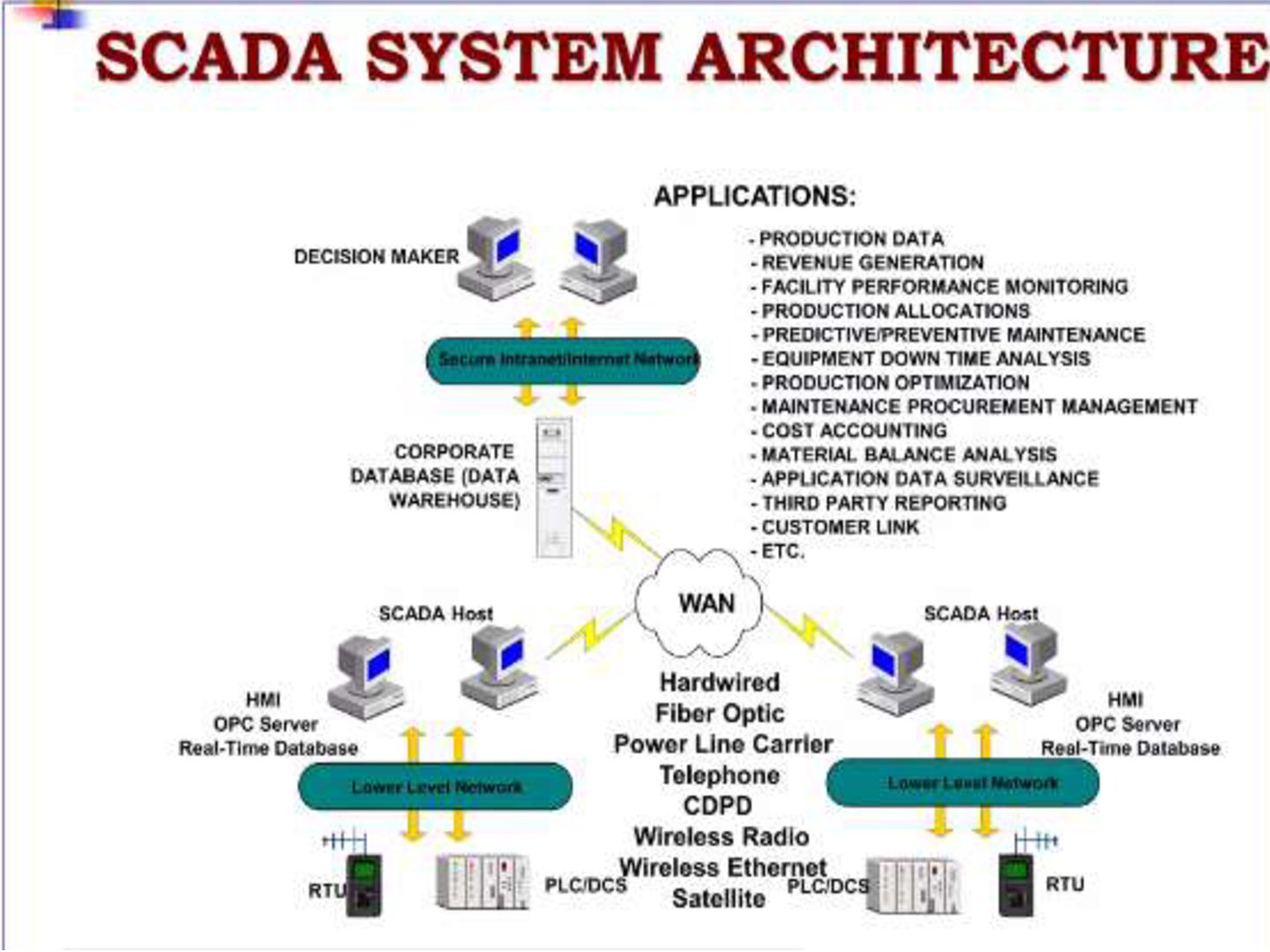
Data Acquisition. As the name indicates, it is not a full control system, but rather focuses on the supervisory level. It is a software package that is positioned on top of hardware to which it is interfaced, in general via Programmable Logic Controllers (PLCs), or other commercial hardware modules. Systems similar to SCADA systems are routinely seen in factories, treatment plants etc. These are often referred to as Distributed Control Systems (DCS). They have similar functions to SCADA systems, but the field data gathering or control units are usually located within a more confined area. Communications may be via a local area network (LAN), and will normally be reliable and high speed. Basically, SCADA is a computer system for gathering and analyzing real time data.
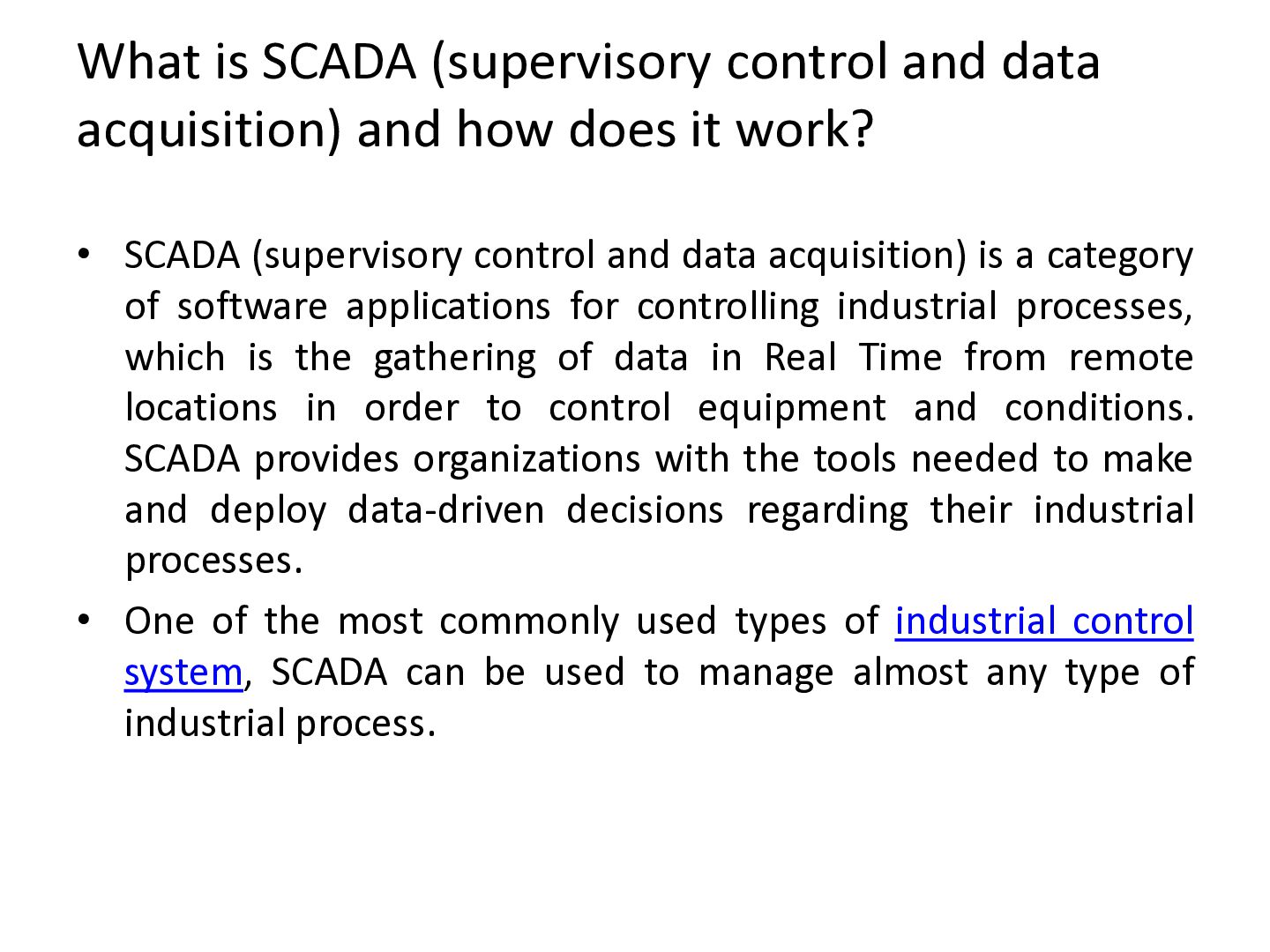
does it work? • SCADA (supervisory control and data acquisition) is a category of software applications for controlling industrial processes, which is the gathering of data in Real Time from remote locations in order to control equipment and conditions. SCADA provides organizations with the tools needed to make and deploy data-driven decisions regarding their industrial processes. • One of the most commonly used types of industrial control system, SCADA can be used to manage almost any type of industrial process.
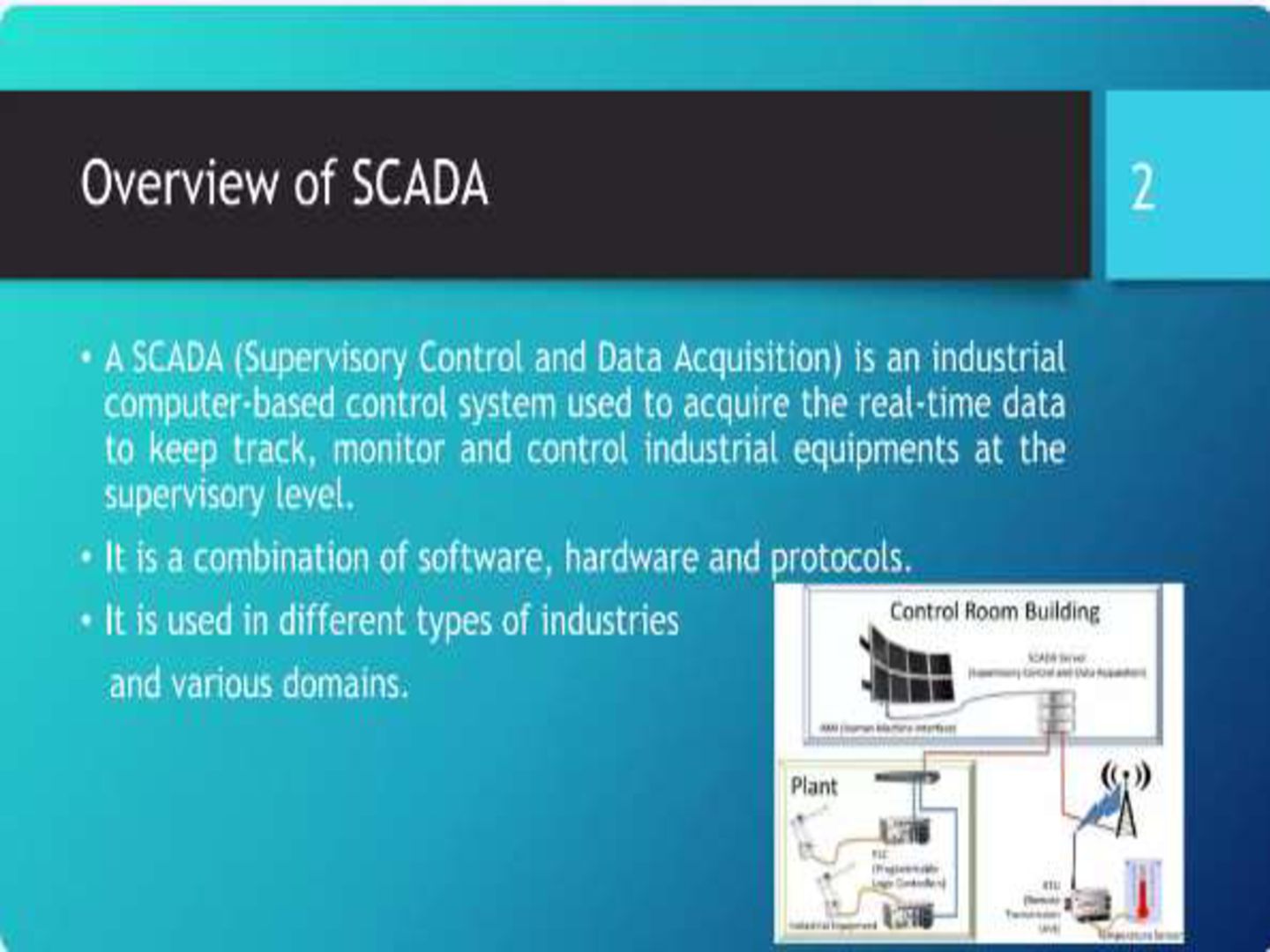
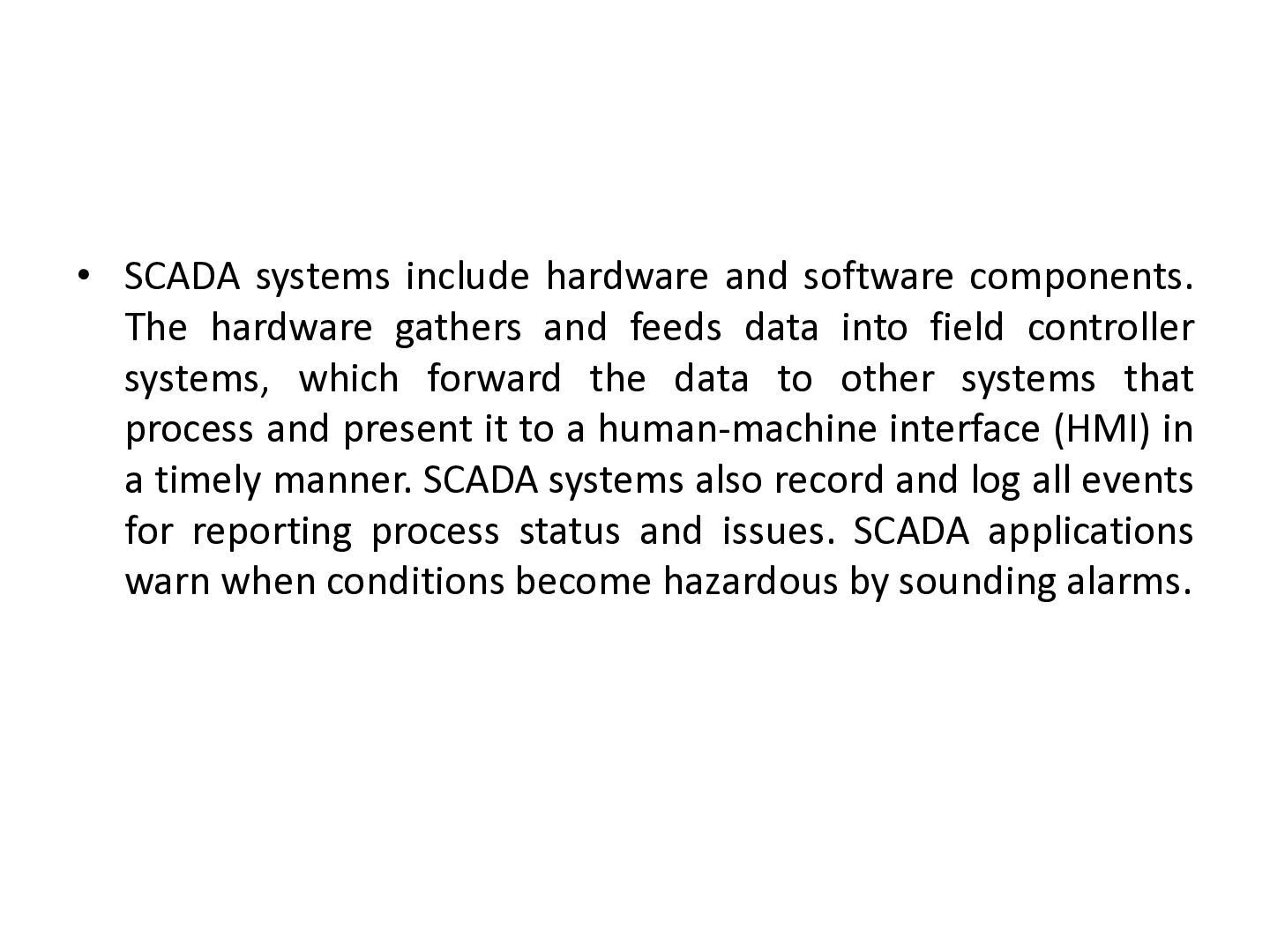
gathers and feeds data into field controller systems, which forward the data to other systems that process and present it to a human-machine interface (HMI) in a timely manner. SCADA systems also record and log all events for reporting process status and issues. SCADA applications warn when conditions become hazardous by sounding alarms.
deployed in the field to gather real-time data, as well as related systems to enable data collection and enhance Industrial automation. SCADA components include the following: 1. Sensors and actuators. A sensor is a feature of a device or system that detects inputs from industrial processes. An actuator is a feature of the device or system that controls the mechanism of the process. In simple terms, a sensor functions like a gauge or meter, which displays the status of a machine; an actuator acts like a switch, dial or control valve that can be used to control a device. Both sensors and actuators are controlled and monitored by SCADA field controllers.
actuators. There are two categories of field controllers: – Remote telemetry units, also called remote terminal units (RTUs), interface with sensors to collect telemetry data and forward it to a primary system for further action. – Programmable logic controllers (PLCs) interface with actuators to control industrial processes, usually based on current telemetry collected by RTUs and the standards set for the processes.
are used to gather data from field devices and to send commands to those devices to control industrial processes. 4. HMI software. This provides a system that consolidates and presents data from SCADA field devices and enables operators to understand and, if needed, modify the status of SCADAcontrolled processes.
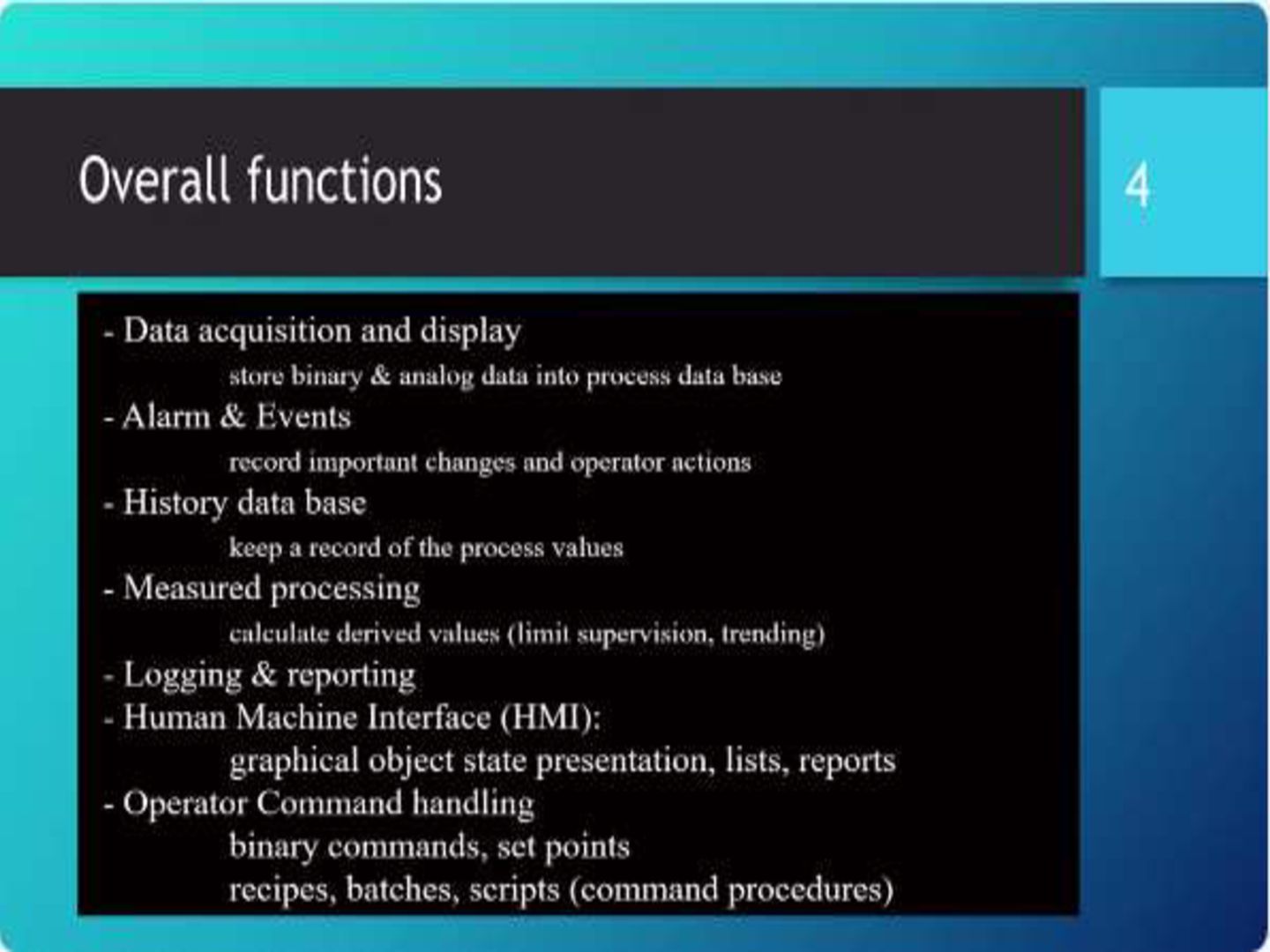
for specific industries or applications, most systems support the following features: • Data acquisition is a foundation of SCADA systems; sensors collect data and deliver it to field controllers, which, in turn, feed data to the SCADA computers. • Remote control is achieved through the control of field actuators, based on the data acquired from field sensors.
from sensors must be transmitted to SCADA field controllers, which, in turn, communicate with the SCADA supervisory computers; remote control commands are transmitted back to actuators from the SCADA supervisory computers. • Data presentation is achieved through HMIs, which represent current and historical data to the operators running the SCADA system. • Real-time and historical data are both important parts of the SCADA system, as they enable users to track current performance against historical trends.
the system. Alerts can be configured to notify operators when processes are blocked, when systems are failing, or when other aspects of SCADA processes need to be stopped, started or adjusted. • Reporting on SCADA system operations can include reports on system status, process performance and reports customized to specific uses.
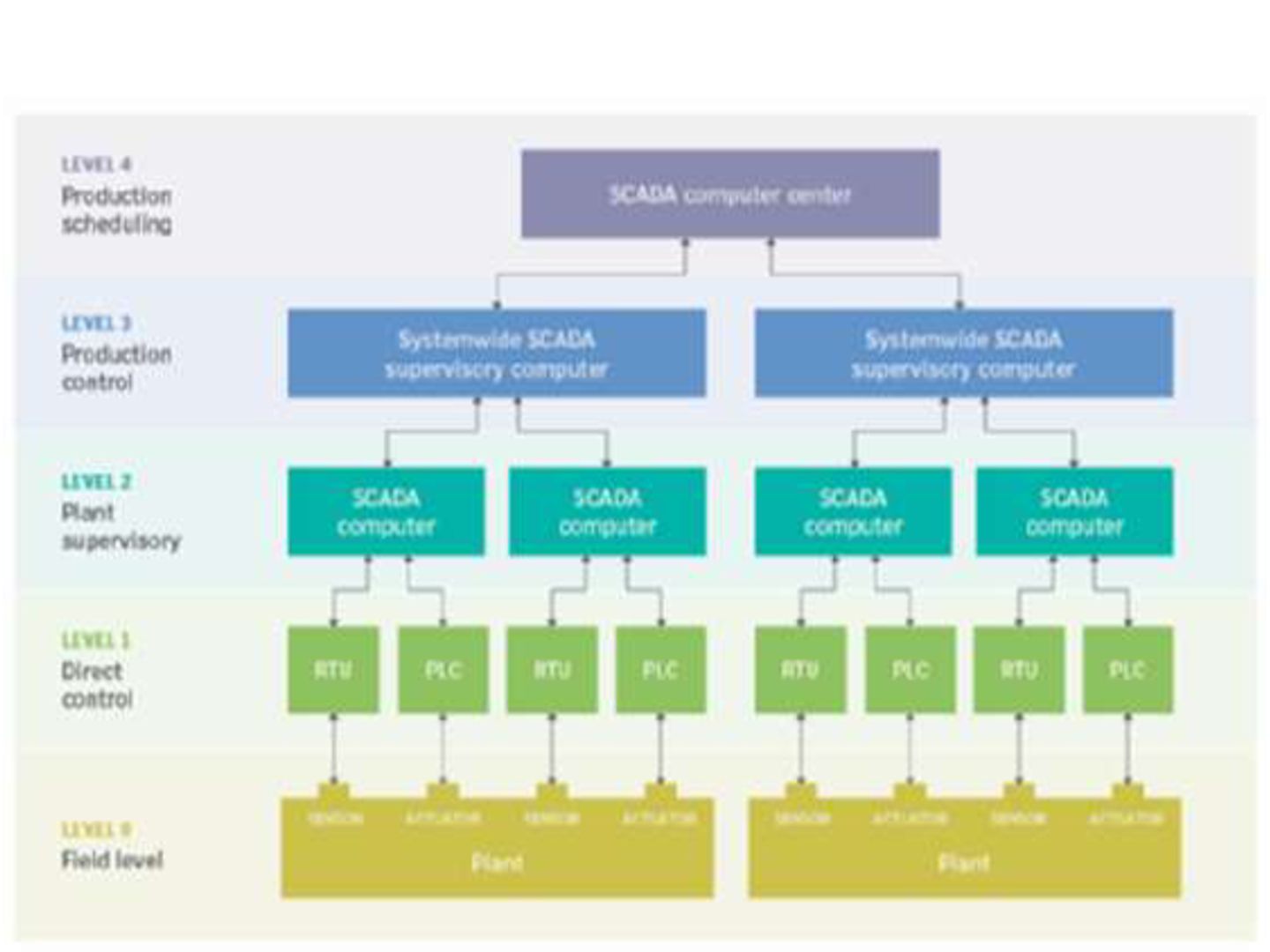
levels defined in the Purdue Enterprise Reference Architecture for enterprise integration: • Level 0. The field level includes field devices, such as sensors, used to forward data relating to field processes and actuators used to control processes. • Level 1. The direct control level includes local controllers, such as PLCs and RTUs, that interface directly with field devices, including accepting data inputs from sensors and sending commands to field device actuators. • Level 2. The plant supervisory level includes local supervisory systems that aggregate data from level controllers and issue commands for those controllers to carry out.
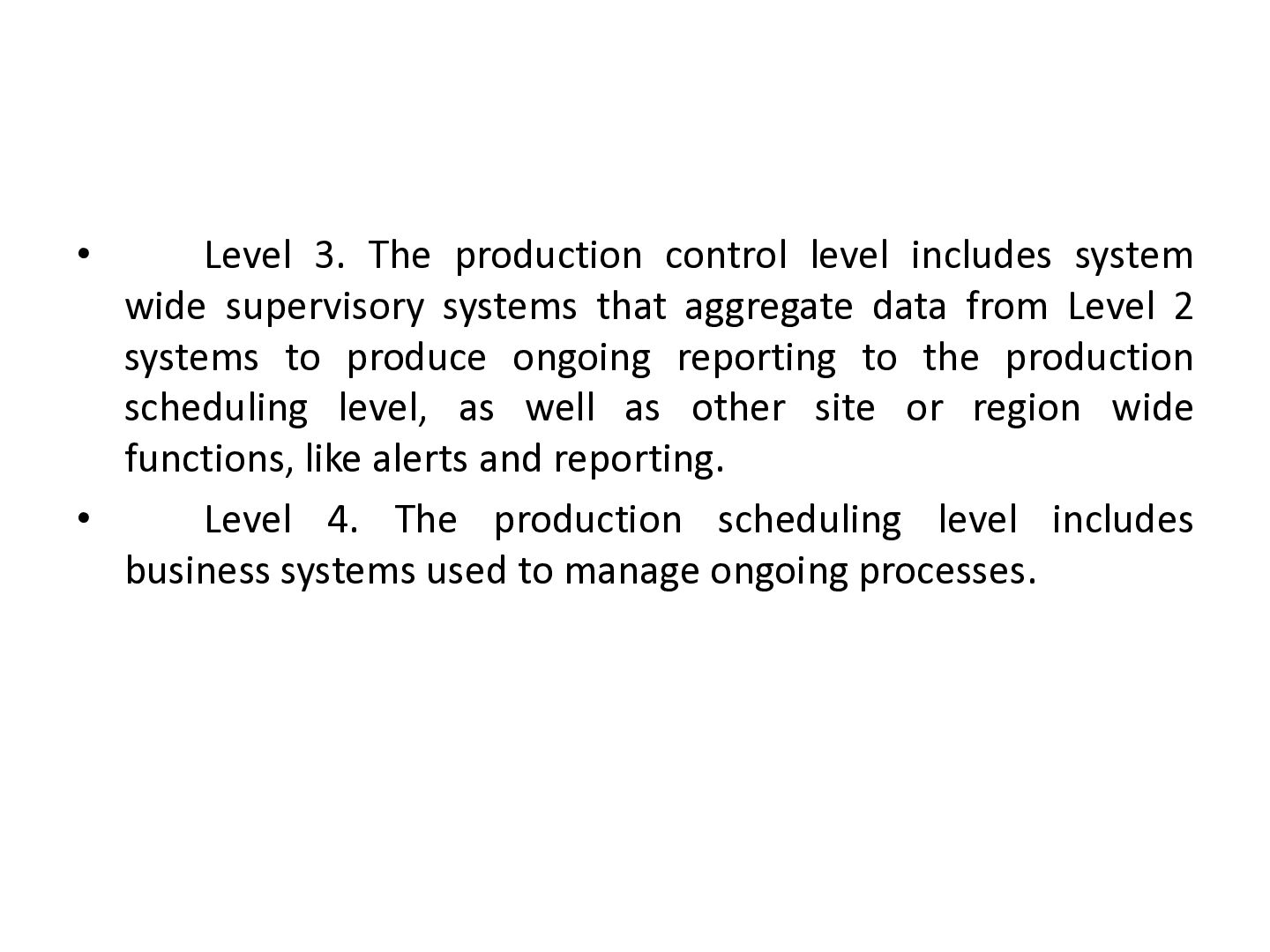
supervisory systems that aggregate data from Level 2 systems to produce ongoing reporting to the production scheduling level, as well as other site or region wide functions, like alerts and reporting. • Level 4. The production scheduling level includes business systems used to manage ongoing processes.
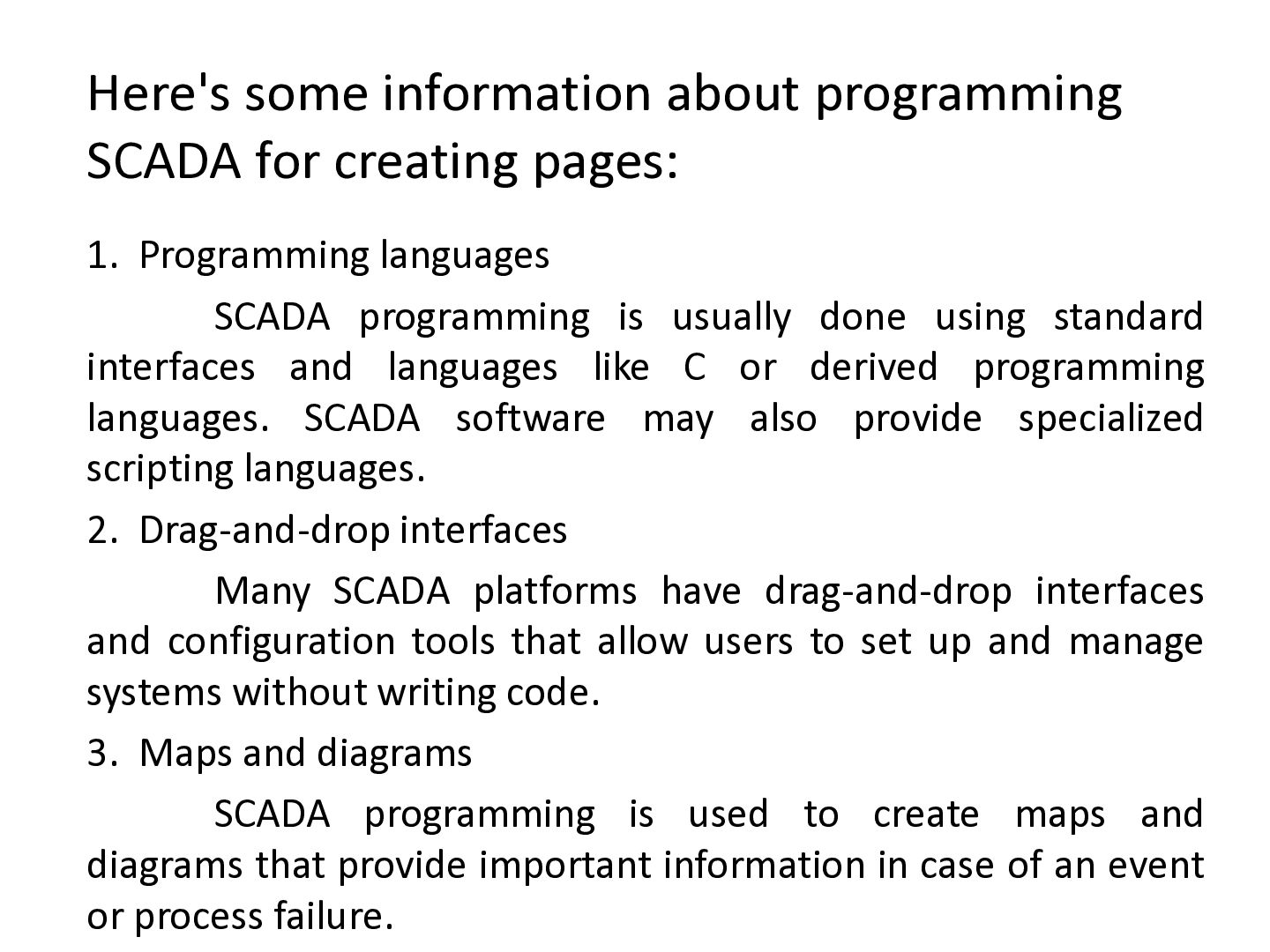
Programming languages SCADA programming is usually done using standard interfaces and languages like C or derived programming languages. SCADA software may also provide specialized scripting languages. 2. Drag-and-drop interfaces Many SCADA platforms have drag-and-drop interfaces and configuration tools that allow users to set up and manage systems without writing code. 3. Maps and diagrams SCADA programming is used to create maps and diagrams that provide important information in case of an event or process failure.
technology that can be used with SCADA systems. In REST, a client communicates with a server using a set of basic commands, including GET and POST. 5. SCADA software platforms Some examples of SCADA software platforms include Siemens WinCC, Wonderware, and Ignition.
graphics that display data collected from machinery and equipment: 1. Data collection: Data is collected from Remote Telemetry Units (RTUs) and converted into signals. 2. Data processing: The data is processed and organized by programmable logic controllers (PLCs). 3. Data presentation: The data is displayed on screens and dashboards as animated graphs, diagrams, and images.
trend and analysis work. 5. Data visualization: Data is visualized in the SCADA software to help operators monitor and control systems. 6. Data integration: Data is integrated with ERP or MMS systems for streamlined operations. 7. Data automation: Python scripts can be used to automate data collection, report generation, and system performance monitoring.
and to generate reports on that data: 1. 2. 3. 4. 5. Data storage - Historians store data from the SCADA system, allowing operators to view historical data and compare it to current performance. Reporting - Historians can generate reports on system status, process performance, and other custom reports. These reports can be manual or automated, and can show what happened at a plant over a specified period of time. Data interfaces - Historians can have easy-to-use interfaces that allow operators to create trend displays, tabular data displays, and export data. External data connectivity - Historians can connect to third-party software to allow enterprise systems to use external data for reporting, maintenance management, and analysis. Data storage location - Operators can set the storage location property to save data to a location other than the default folder.
is alarm handling. The system monitors whether certain alarm conditions are satisfied, to determine when an alarm event has occurred. Once an alarm event has been detected, one or more actions are taken (such as the activation of one or more alarm indicators, and perhaps the generation of email or text messages so that management or remote SCADA operators are informed). In many cases, a SCADA operator may have to acknowledge the alarm event; this may deactivate some alarm indicators, whereas other indicators remain active until the alarm conditions are cleared.
is a digital status point that has either the value NORMAL or ALARM that is calculated by a formula based on the values in other analogue and digital points—or implicit: the SCADA system might automatically monitor whether the value in an analogue point lies outside high and low- limit values associated with that point. • Examples of alarm indicators include a siren, a pop-up box on a screen, or a coloured or flashing area on a screen (that might act in a similar way to the "fuel tank empty" light in a car); in each case, the role of the alarm indicator is to draw the operator's attention to the part of the system 'in alarm' so that appropriate action can be taken.
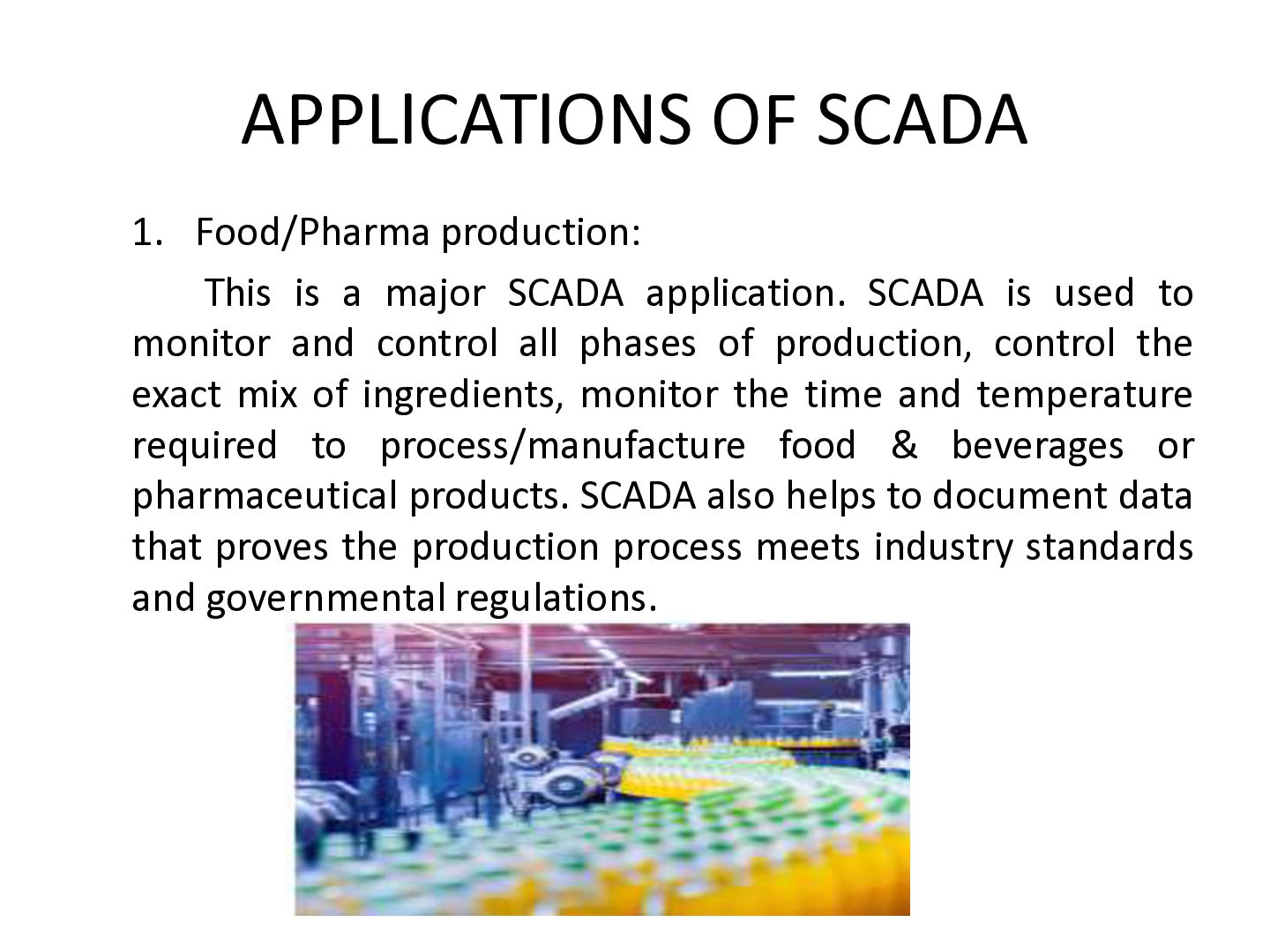
SCADA application. SCADA is used to monitor and control all phases of production, control the exact mix of ingredients, monitor the time and temperature required to process/manufacture food & beverages or pharmaceutical products. SCADA also helps to document data that proves the production process meets industry standards and governmental regulations.
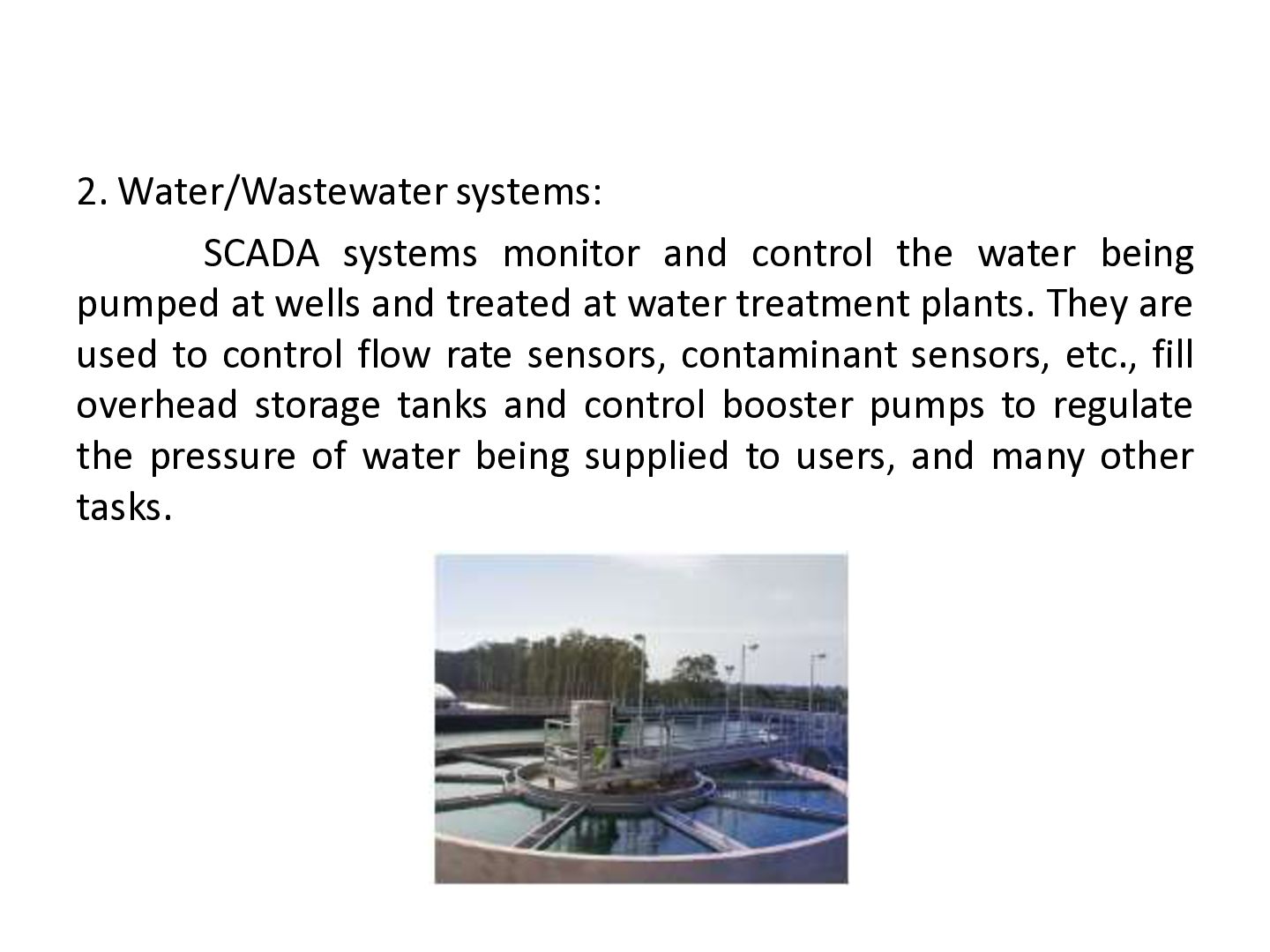
being pumped at wells and treated at water treatment plants. They are used to control flow rate sensors, contaminant sensors, etc., fill overhead storage tanks and control booster pumps to regulate the pressure of water being supplied to users, and many other tasks.
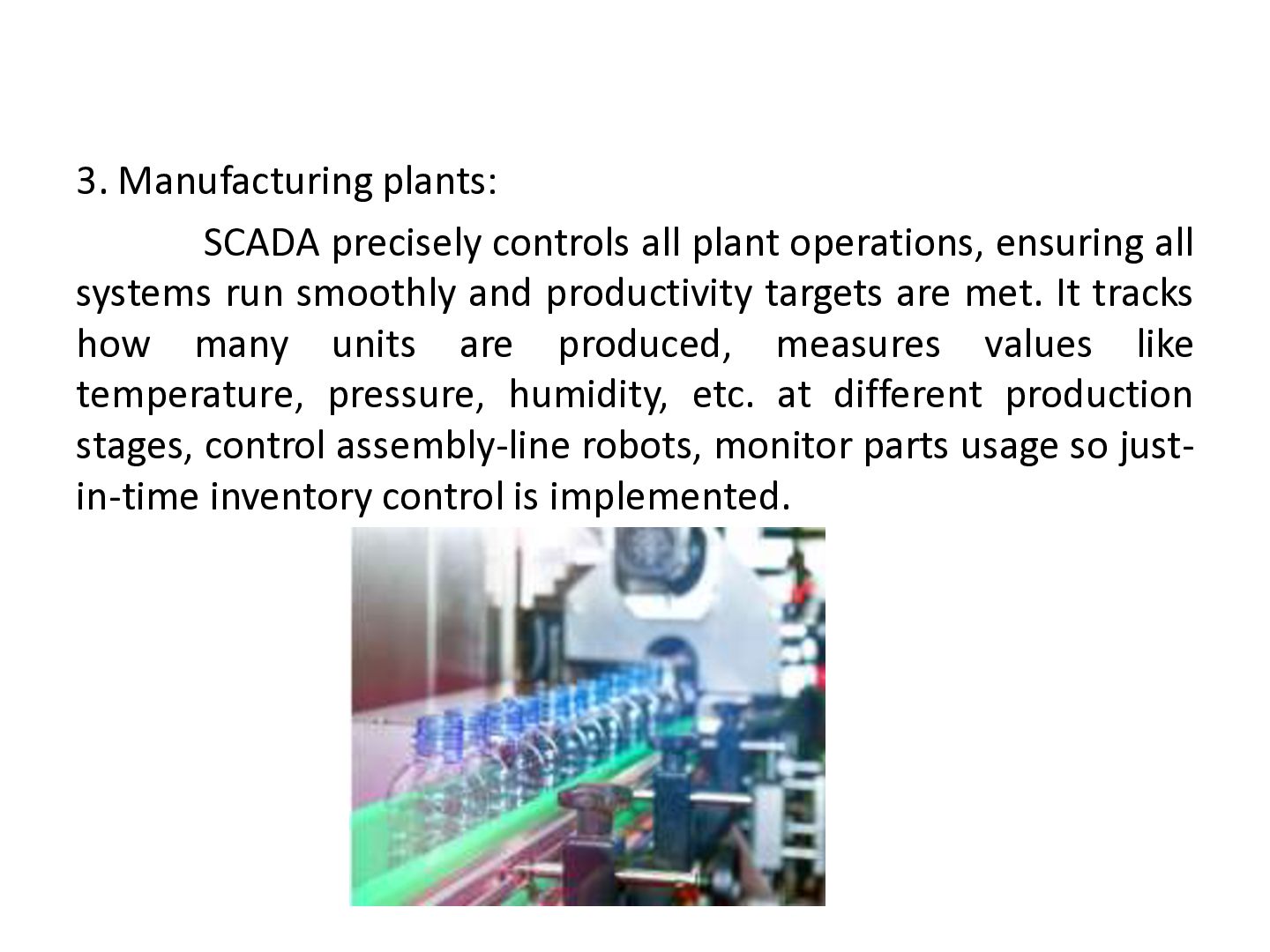
all systems run smoothly and productivity targets are met. It tracks how many units are produced, measures values like temperature, pressure, humidity, etc. at different production stages, control assembly-line robots, monitor parts usage so justin-time inventory control is implemented.
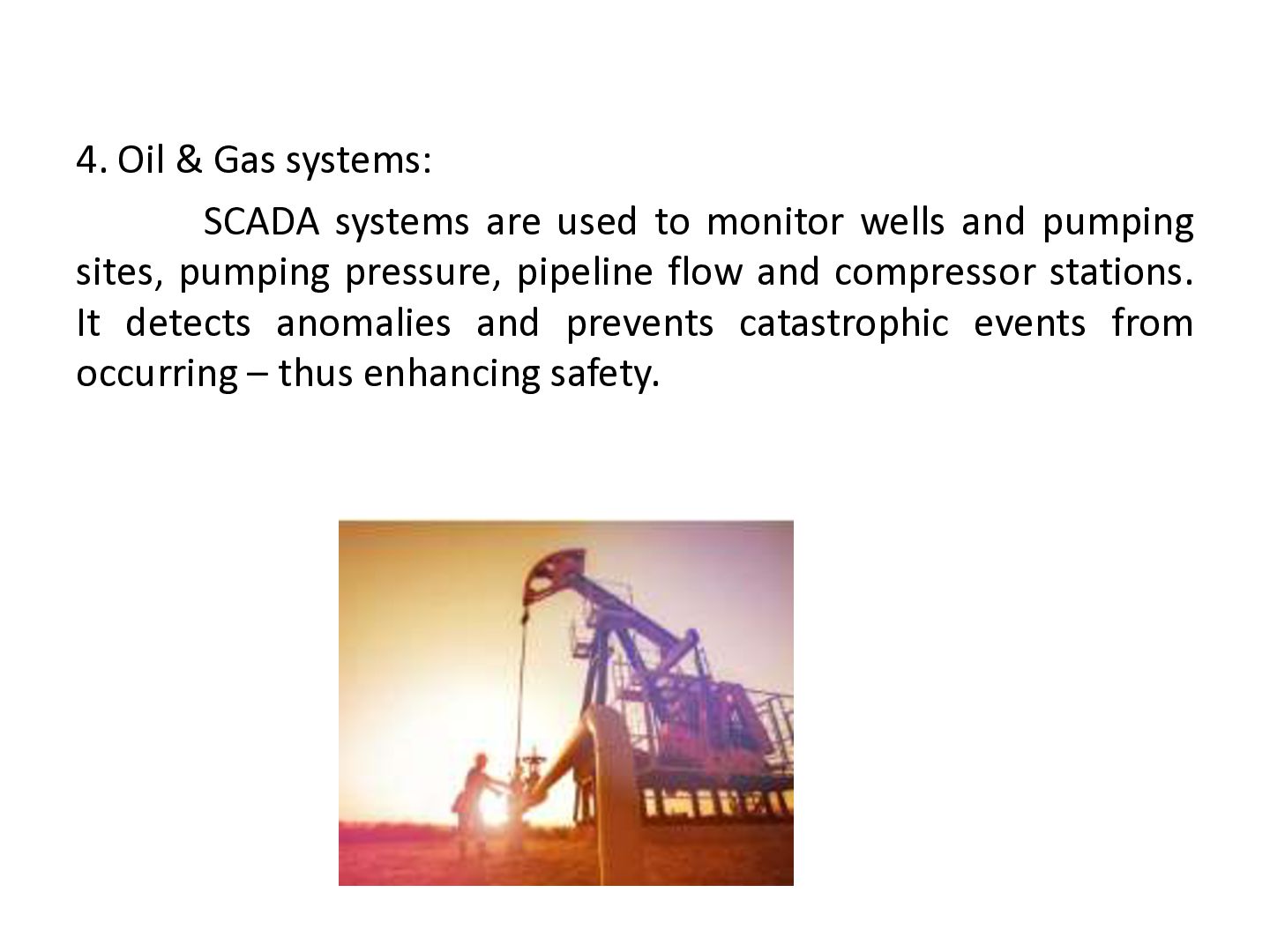
monitor wells and pumping sites, pumping pressure, pipeline flow and compressor stations. It detects anomalies and prevents catastrophic events from occurring – thus enhancing safety.
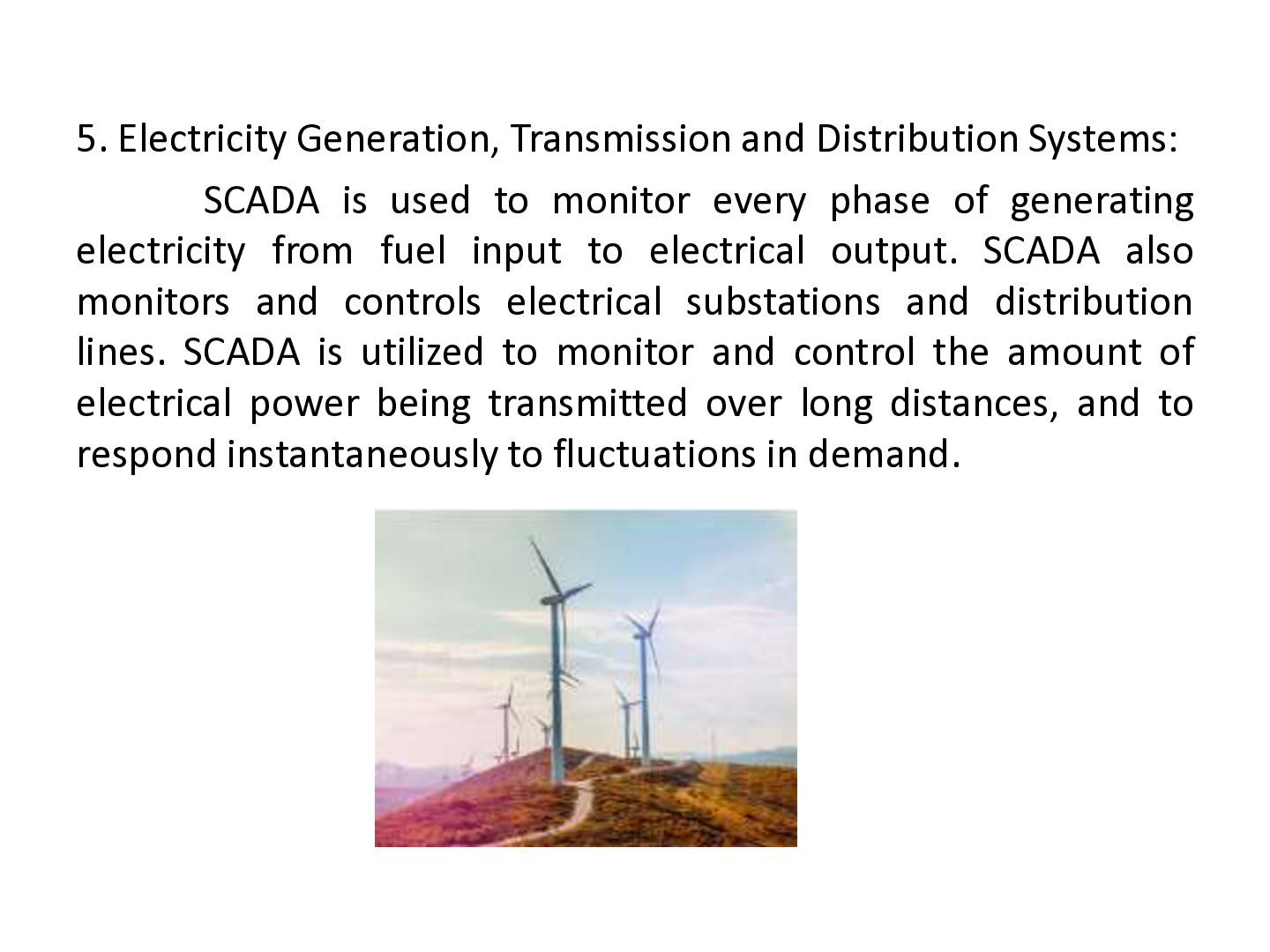
to monitor every phase of generating electricity from fuel input to electrical output. SCADA also monitors and controls electrical substations and distribution lines. SCADA is utilized to monitor and control the amount of electrical power being transmitted over long distances, and to respond instantaneously to fluctuations in demand.
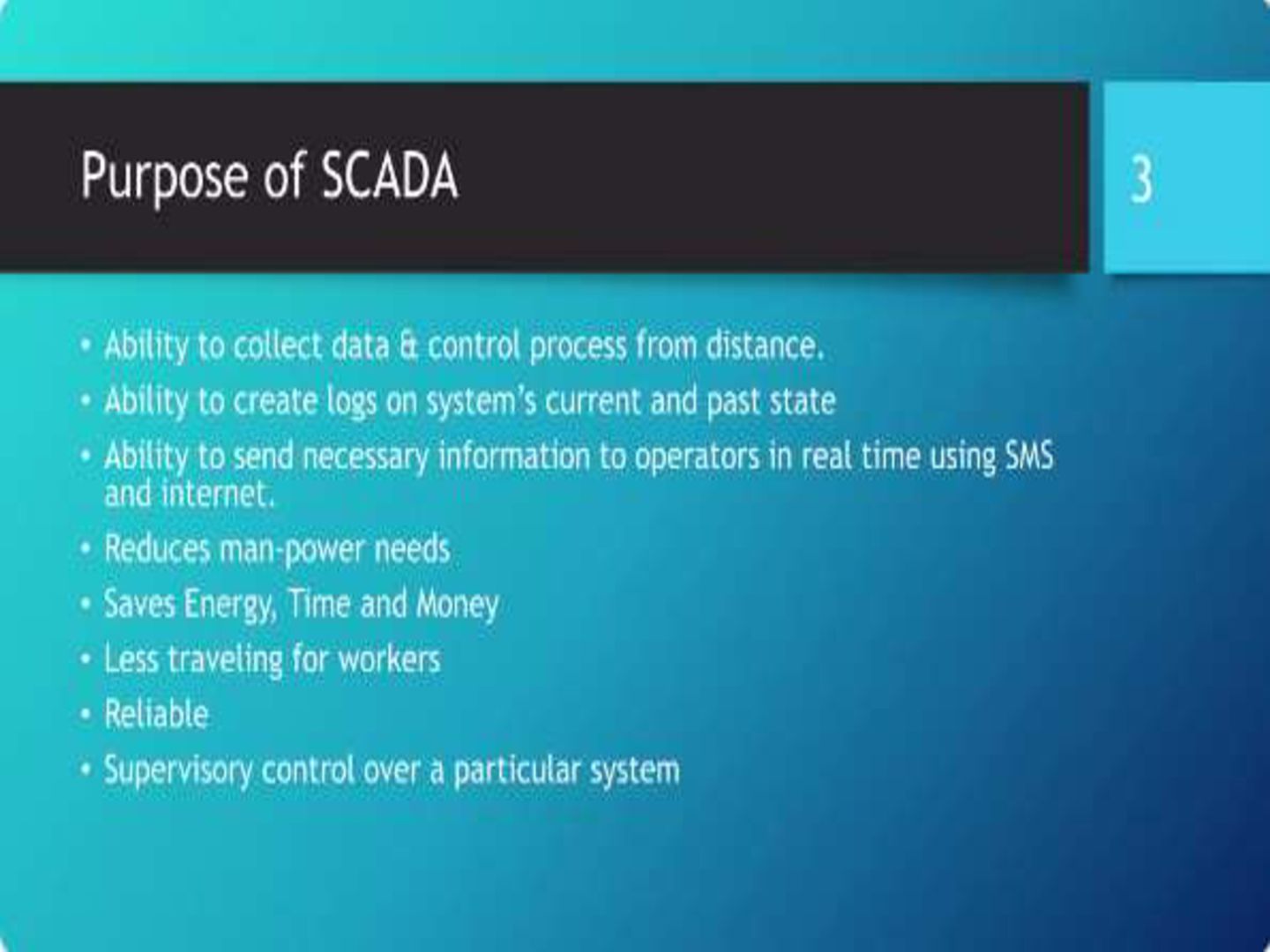
systems are used for monitoring, controlling, and analyzing industrial processes and devices. They are useful in many industries, including electricity generation, oil and gas, transportation, and water and waste control. SCADA systems are needed for a number of reasons, including: 1. Automation • SCADA systems can automate routine tasks, which can increase productivity. 2. Remote control • SCADA systems can be used to remotely control and monitor processes, which can reduce waste and improve efficiency.
which can help workers react to problems and make changes. 4. Trend analysis • SCADA systems can track trends and detect early failures, which can help priorities maintenance and improve safety.
by tracking system performance and responding to critical issues quickly. 6. Smart cities • SCADA systems can help monitor and optimize resources in smart cities, such as traffic light patterns and public power consumption.
and Data Acquisition (SCADA) systems, including: 1. Ladder logic A visual programming language that's often used for simple control tasks. It's based on electrical ladder diagrams and is used to program PLCs. 2. Structured text A good choice for handling complex logic and data processing. 3. C/C++ A good choice for real-time applications and hardware integration because of its performance.
for integrating advanced technologies into SCADA systems. In Ignition SCADA software, Jython, a flavor of Python, is used instead of the standard CPython. • The best programming language to use for a SCADA project depends on the system's complexity, the application's requirements, and the development team's expertise. It's often best to use a combination of languages, each with its own strengths.


 poojamagdum6288
 akosma
 pauljervisheath
 geshan
 katarinadahlin
 marktimemedia
 lara
 inesmontani
 bluesmoon
 mayatellez
 jonoalderson
 twada
 katiecoart