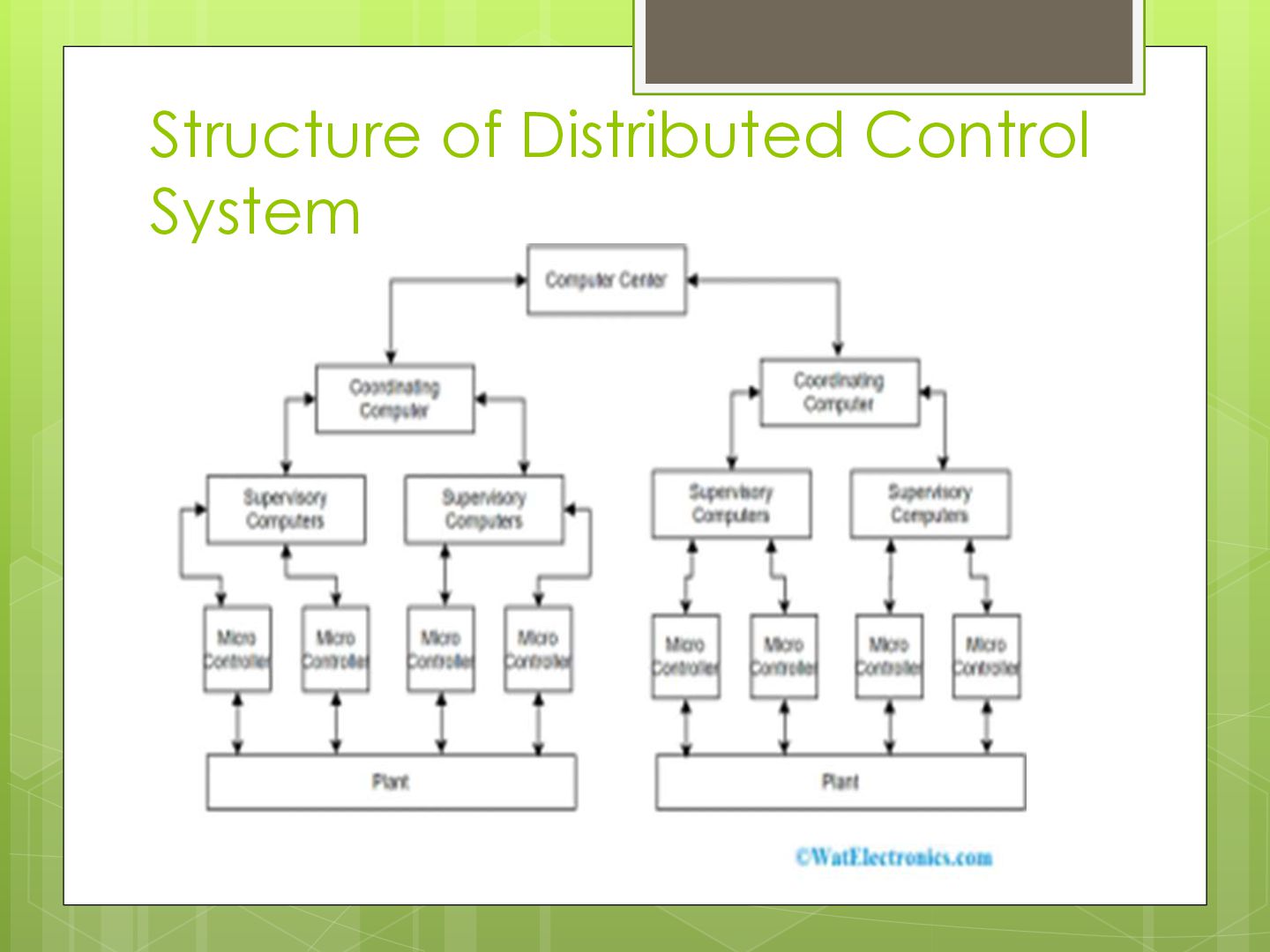
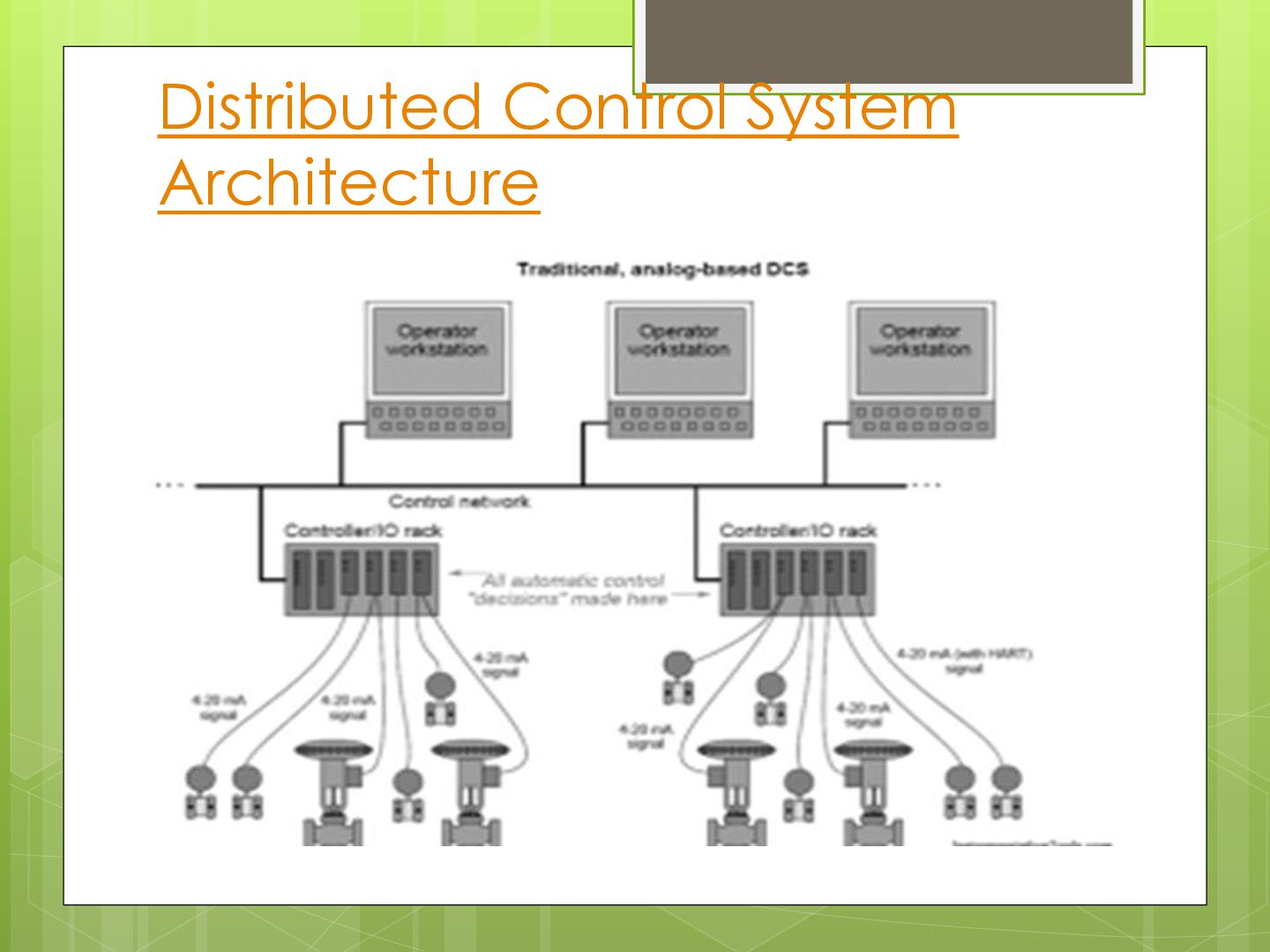
where all there are in a distributed format all across the plant. Every element in the system performs its own functionality like data attainment and management, process management along with the graphical display, and data accumulation. The communication between each element in the plant is done through a centralized computer which is also termed a controlling network. The crucial component of the plant is the “Distribution Control System” where is utilized for automated decision-making depending on the production updates as per reality all across the plant.
are operated to receive data and process the information, and transfers the data to the local input/output modules where the actuators are also connected to these I/O modules. With this connection, the process parameters are exactly managed. From here, the received data is collected and sent to the process controlling section through a field bus. In the case of smart field appliances, the sensed data will get directly transmitted to the process controlling section, and the gathered data is again processed, evaluated, and generates the result depending on the control logic that is executed in the controller.
through the field bus. The distributed control system alignment, authorization, and execution of control logic function at the engineering level. And the operator has the ability to look at and transmit the control actions at the functional locations.
with field equipment like final control components like control valves, temperature sensors, and flow elements. Level 1 – This level includes technologically advanced I/O modules and their related distributed type of electronic processors. Level 2 – Here, regulatory computers assist in collecting data from the processor nodes present in the system and then offer the operator managed screens. Level
it is not directly related in controlling the process but involved in examining production and monitoring targets. Level 4 – This is termed the production scheduling phase. Level 1 and Level 2 are considered as the operational phases of the general type of DCS where all the components come under integrated systems of a single manufacturing person. Whereas level 3 and level 4 manages to control and scheduling activities. Level
are: 1. Engineering Workspace For the DCS, these elements function as the supervisory controller. This can be a computer device or any personal computer which has consistent engineering software like the ABB freelance type of DCS for control builder F engineering workspace. This element provides controlling configuration tools that permit the user to operate engineering activities like the development of new loops, forming multiple I/O points, altering control and sequential logics, the configuration of multiple devices, and formulating documentation for every I/O component and many others.
for functionality, monitoring, and managing plant parameters. This can also be any monitoring equipment or personal computer which has a distinct software tool where the user can look at process factor values and correspondingly performs functionality. These HMI units can be of multiple or single units where single units are responsible for performing activities like alarming value and trend displays. Whereas multiple units are responsible for performing a few PC display factors, data acquisition and logging, and for trend records.
this element is termed the local controlling unit, processing unit, or distribution controller. A DCS might have one or more PC units that can be expanded using multiple kinds of I/O units. The process control unit is included with a potent CPU section, a communication unit having extended field bus ability, and remotely connected I/Os. The field equipment such as actuators and sensors are connected to I/O components for this unit. Few of the field equipment can have a direct connection to the field bus without connecting to the I/O module. The device which has this type of connection is called a smart field device.
multiple sensors through the input section, examine and handle the received input depending on the control logic that is executed, and transmits the output through the output section in order to have regulation on relays and actuators.
crucial role in the DCS. This connects the engineering workspace, process unit, operating section, and smart devices. This transmits the data across the stations. The common type of communication protocols that are utilized in the DCS consists of Profibus, DeviceNet, Ethernet, Foundation Field Bus, and others.
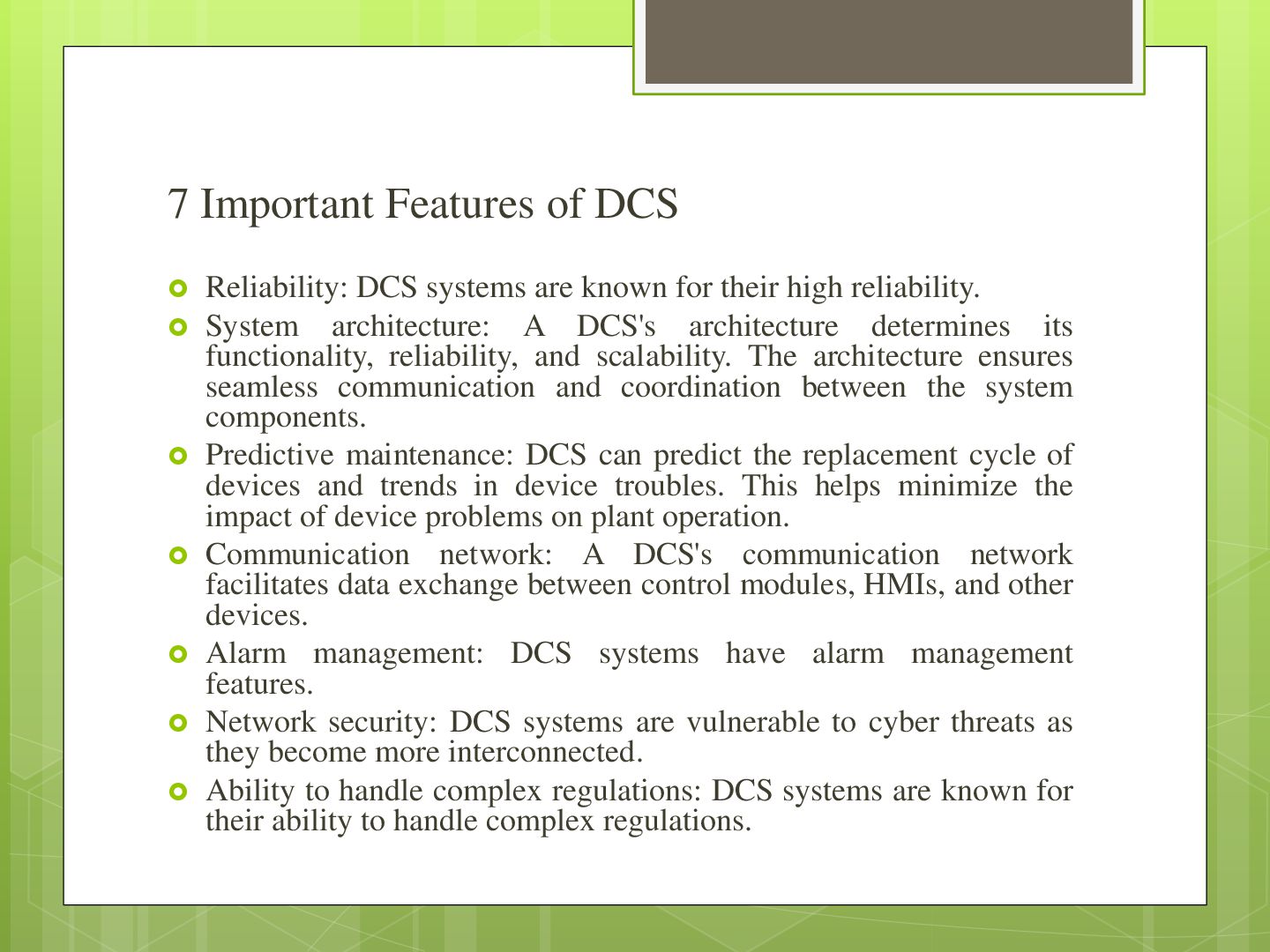
known for their high reliability. System architecture: A DCS's architecture determines its functionality, reliability, and scalability. The architecture ensures seamless communication and coordination between the system components. Predictive maintenance: DCS can predict the replacement cycle of devices and trends in device troubles. This helps minimize the impact of device problems on plant operation. Communication network: A DCS's communication network facilitates data exchange between control modules, HMIs, and other devices. Alarm management: DCS systems have alarm management features. Network security: DCS systems are vulnerable to cyber threats as they become more interconnected. Ability to handle complex regulations: DCS systems are known for their ability to handle complex regulations.
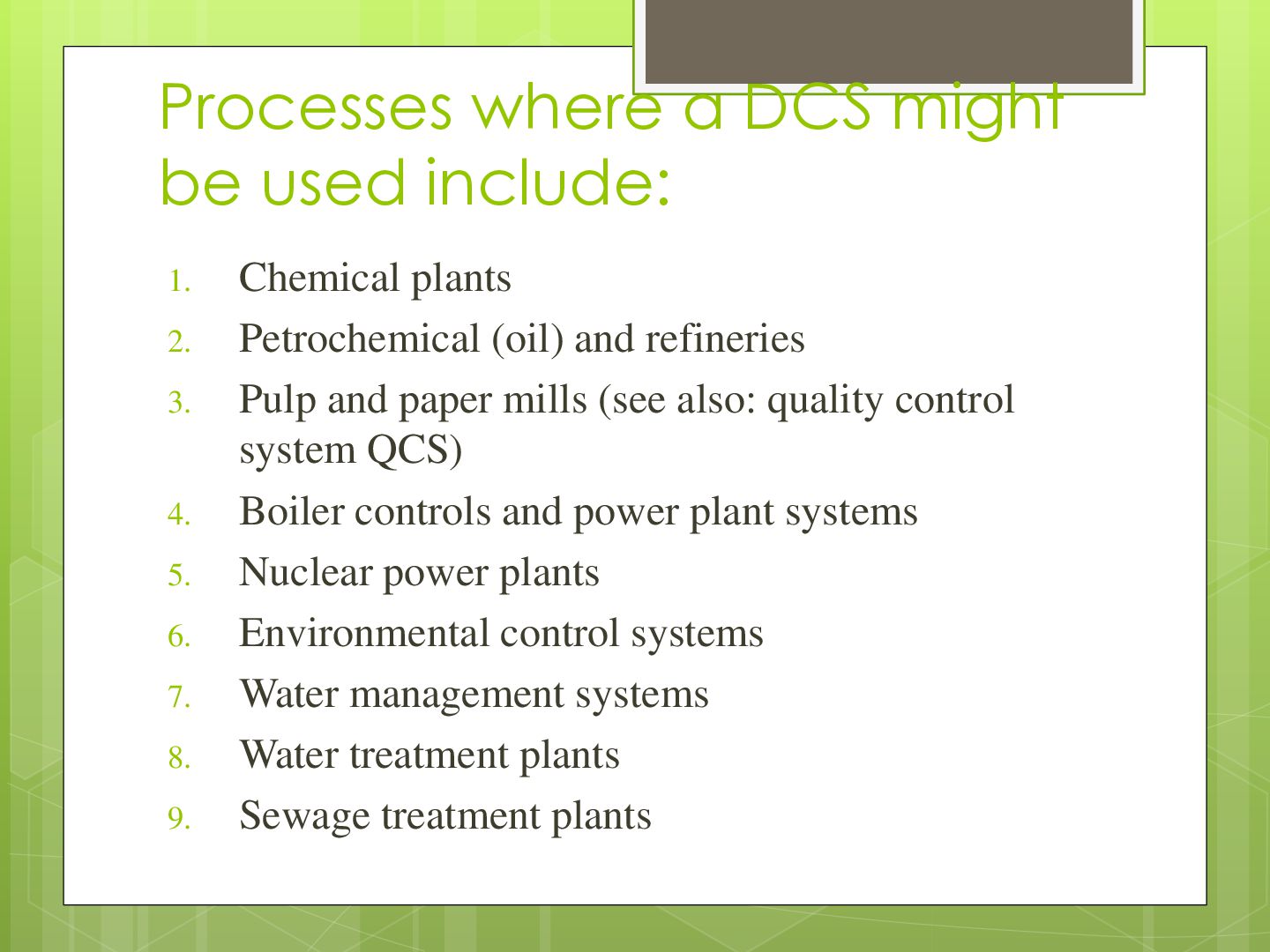
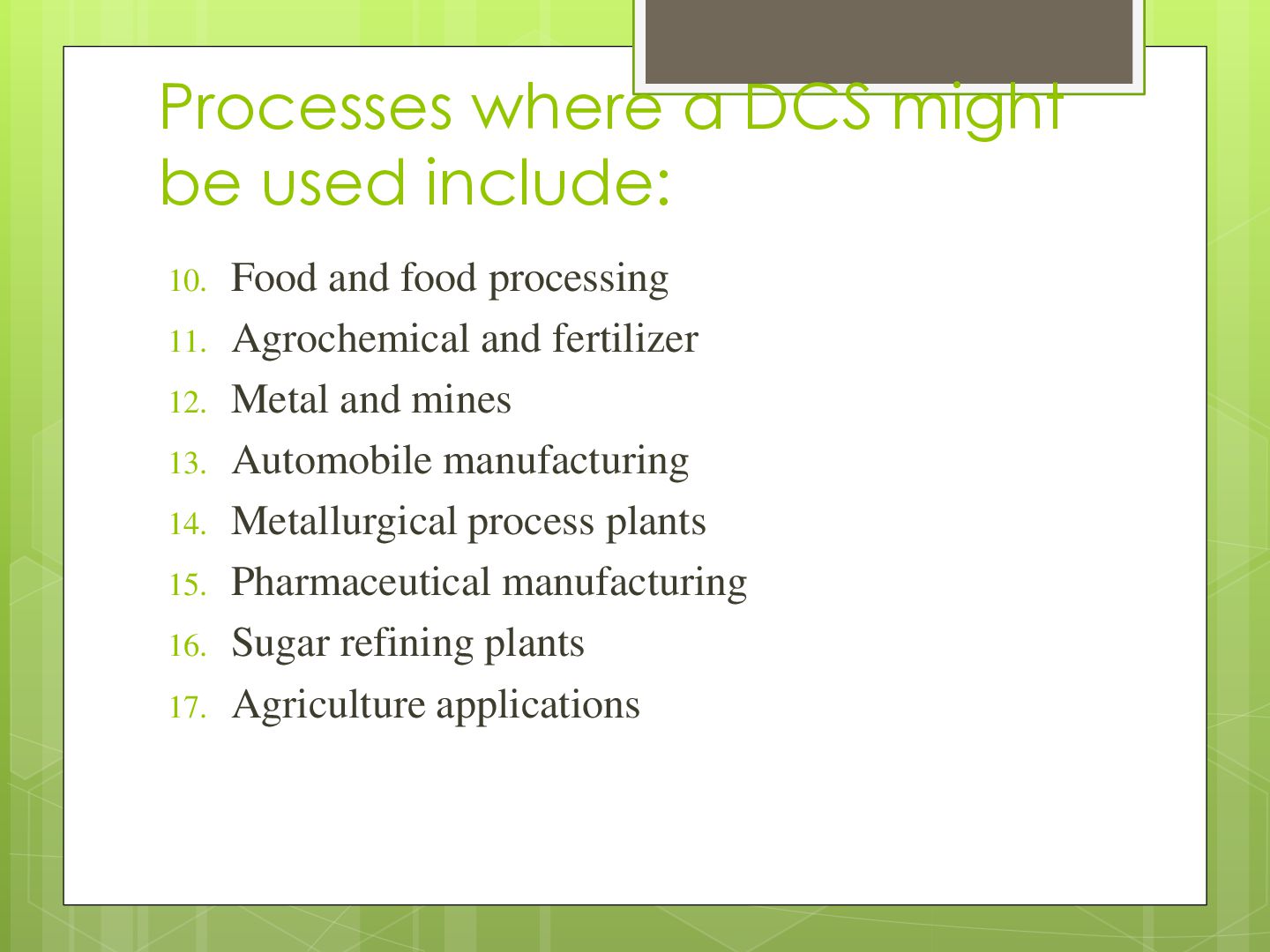
3. 4. 5. 6. 7. 8. 9. Chemical plants Petrochemical (oil) and refineries Pulp and paper mills (see also: quality control system QCS) Boiler controls and power plant systems Nuclear power plants Environmental control systems Water management systems Water treatment plants Sewage treatment plants
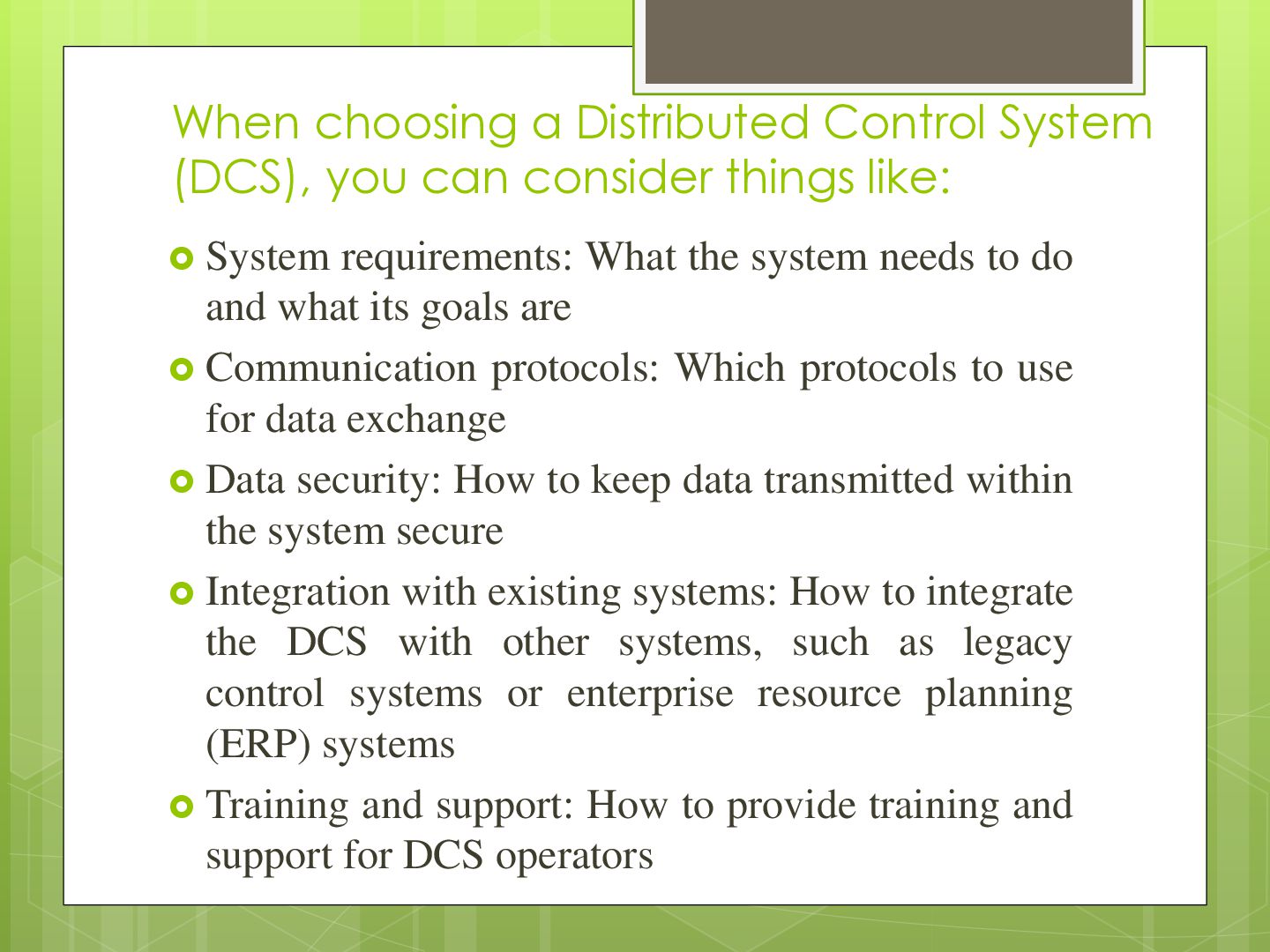
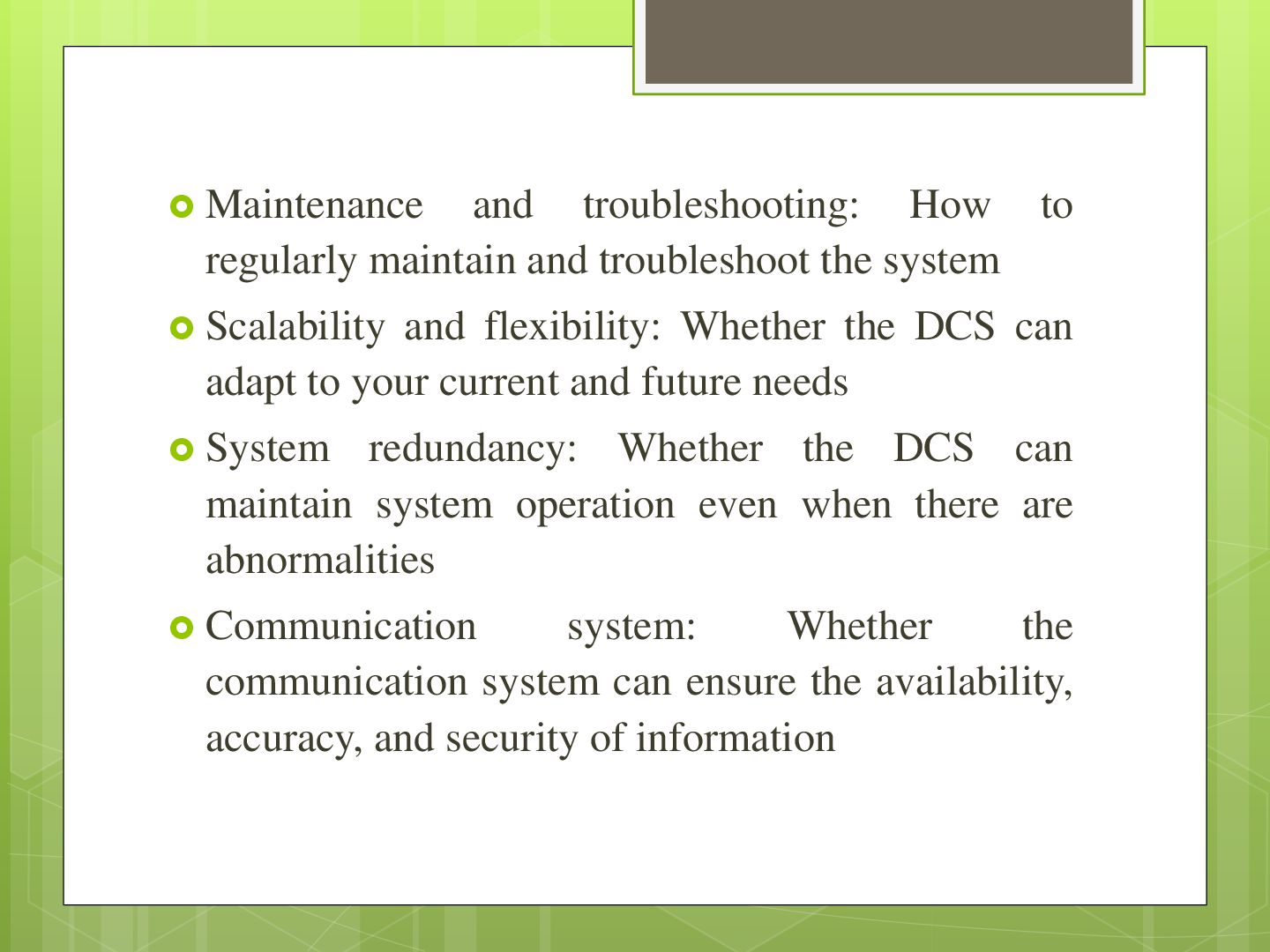
things like: System requirements: What the system needs to do and what its goals are Communication protocols: Which protocols to use for data exchange Data security: How to keep data transmitted within the system secure Integration with existing systems: How to integrate the DCS with other systems, such as legacy control systems or enterprise resource planning (ERP) systems Training and support: How to provide training and support for DCS operators
the system Scalability and flexibility: Whether the DCS can adapt to your current and future needs System redundancy: Whether the DCS can maintain system operation even when there are abnormalities Communication system: Whether the communication system can ensure the availability, accuracy, and security of information
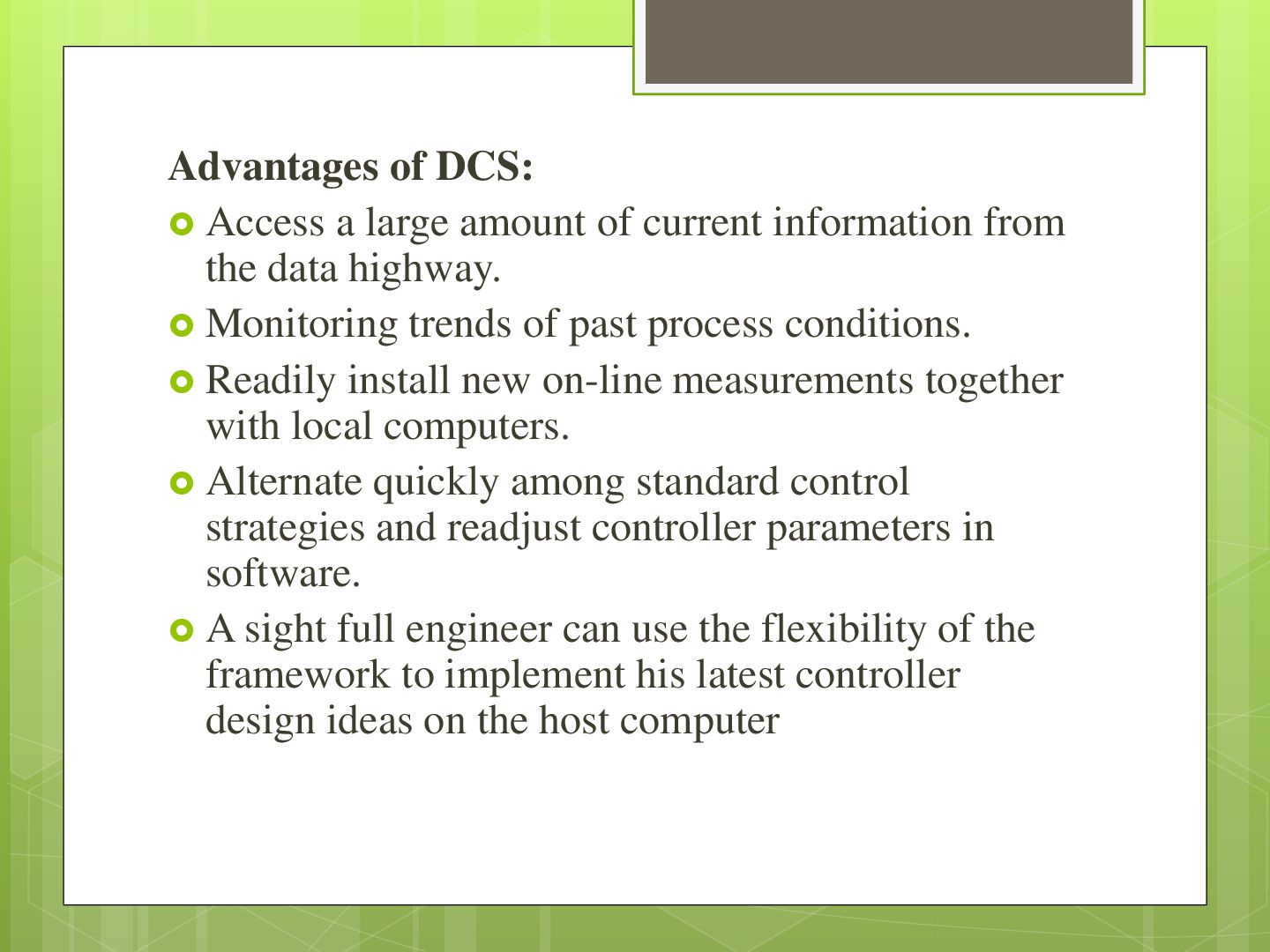
information from the data highway. Monitoring trends of past process conditions. Readily install new on-line measurements together with local computers. Alternate quickly among standard control strategies and readjust controller parameters in software. A sight full engineer can use the flexibility of the framework to implement his latest controller design ideas on the host computer
loop system where one loop can perform several control processes. Serves as a substitute for manual and automatic control devices that are separated into a unit so that it is easier to maintain and use Data collection and processing facilities to obtain the right process output
optical interfaces Complexity of managing and provisioning across large numbers of DCSs Migration of services from TDM to packet Number of equipment layers in the network Amount of floor space required
Systems (DCS) plays a vital role in manufacturing, production industries as they are used to control and manage the processes. DCS tends to be used on large continuous process plants where high reliability and security is important, and the control room is not geographically remote.


 poojamagdum6288
 suisan
 yatabe
 signer
 cbtlibrary
 ssmedikasda
 sciencetokyo
 pawan_pharm
 rashwhitman
 hiola
 mutomasa
 pauljervisheath
 mkilby
 tanoku
 elsirapls
 malarkey
 jacobian
 gr2m
 tessaabrams
 addyosmani
 samtorres
 danielanewman
 samanthasiow