Upgrade to Pro — share decks privately, control downloads, hide ads and more …

Data Analytics: Unlocking the Power of Information

Data Analytics: Unlocking the Power of Information

data analyst acts like an explorer, uncovering hidden stories and treasures within data. They demonstrate the process of transforming messy data into clear, organized information to help make better decisions. The content also highlights the essential skills required for the role, such as a love for numbers and puzzles, as well as the ability to communicate findings clearly.

Avatar for ashwin pps

ashwin pps

August 29, 2025

Other Decks in Education

Transcript

  1. Why Data Analytics Has Become the Backbone of Successful Organizations:

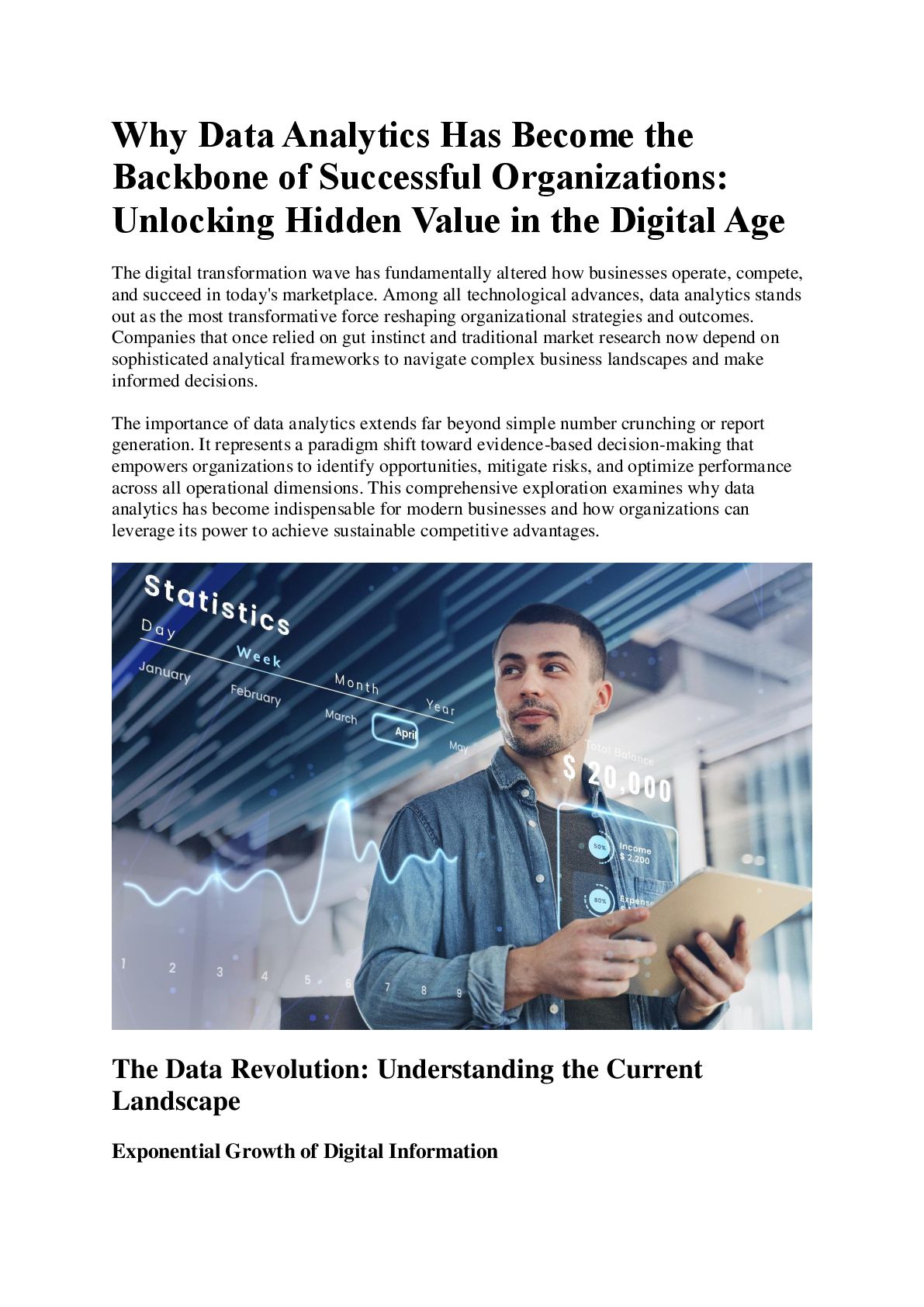
    Unlocking Hidden Value in the Digital Age The digital transformation wave has fundamentally altered how businesses operate, compete, and succeed in today's marketplace. Among all technological advances, data analytics stands out as the most transformative force reshaping organizational strategies and outcomes. Companies that once relied on gut instinct and traditional market research now depend on sophisticated analytical frameworks to navigate complex business landscapes and make informed decisions. The importance of data analytics extends far beyond simple number crunching or report generation. It represents a paradigm shift toward evidence-based decision-making that empowers organizations to identify opportunities, mitigate risks, and optimize performance across all operational dimensions. This comprehensive exploration examines why data analytics has become indispensable for modern businesses and how organizations can leverage its power to achieve sustainable competitive advantages. The Data Revolution: Understanding the Current Landscape Exponential Growth of Digital Information
  2. Every day, organizations worldwide generate approximately 2.5 quintillion bytes of

    data through various channels including customer interactions, operational processes, market transactions, and digital communications. This unprecedented volume of information creates both immense opportunities and significant challenges for businesses attempting to extract meaningful insights. The sources of organizational data have diversified dramatically over the past decade. Traditional structured data from enterprise resource planning systems and customer relationship management platforms now combines with unstructured information from social media interactions, sensor networks, mobile applications, and Internet of Things devices. This rich data ecosystem provides comprehensive visibility into business operations, customer behaviors, and market dynamics. The Competitive Necessity of Data-Driven Strategies Organizations that fail to embrace data analytics risk falling behind competitors who leverage analytical insights for strategic advantage. Market leaders across industries consistently demonstrate superior performance through data-driven approaches to product development, customer engagement, operational optimization, and financial management. Consider how technology giants like Amazon and Google built their dominance through sophisticated analytical capabilities. These companies use predictive algorithms to anticipate customer needs, optimize supply chains, personalize user experiences, and identify emerging market opportunities before competitors recognize them. Core Components of Effective Data Analytics 1. Data Collection and Integration Successful analytics initiatives begin with comprehensive data collection strategies that capture relevant information from multiple sources. Organizations must establish robust systems for gathering, cleaning, and integrating diverse data types while ensuring accuracy, completeness, and consistency. Key elements of effective data collection include:  Multi-source Integration: Combining internal operational data with external market intelligence and customer feedback  Real-time Capture: Implementing systems that collect and process information as events occur  Quality Assurance: Establishing validation procedures to ensure data accuracy and reliability  Standardization Protocols: Creating consistent formats and definitions across different data sources 2. Advanced Analytical Techniques Modern data analytics employs sophisticated statistical methods, machine learning algorithms, and artificial intelligence technologies to extract insights from complex datasets.
  3. These techniques enable organizations to identify patterns, predict future trends,

    and optimize decision-making processes. Primary analytical approaches include:  Statistical Analysis: Using mathematical models to understand relationships between variables and test hypotheses  Machine Learning: Implementing algorithms that automatically improve performance through experience and data exposure  Predictive Modeling: Developing forecasts based on historical patterns and current trends  Data Mining: Discovering hidden patterns and relationships within large datasets 3. Visualization and Communication Effective analytics programs translate complex findings into clear, actionable insights that stakeholders can easily understand and apply. Data visualization tools and storytelling techniques help communicate analytical results to diverse audiences with varying technical backgrounds. Essential visualization components include:  Interactive Dashboards: Real-time displays of key performance indicators and operational metrics  Executive Summaries: High-level overviews of analytical findings and strategic recommendations  Detailed Reports: Comprehensive documentation of methodologies, results, and implications  Visual Storytelling: Using charts, graphs, and infographics to communicate complex insights effectively Strategic Applications of Data Analytics Customer Experience Enhancement Data analytics enables organizations to develop deep understanding of customer preferences, behaviors, and needs through comprehensive analysis of interaction data across multiple touchpoints. This insight drives personalization strategies, improves service quality, and increases customer satisfaction levels. Customer analytics applications include: 1. Behavioral Segmentation: Grouping customers based on purchasing patterns, engagement levels, and demographic characteristics 2. Journey Mapping: Analyzing customer interactions across various channels to identify optimization opportunities 3. Sentiment Analysis: Monitoring social media and feedback channels to understand customer perceptions and emotions
  4. 4. Churn Prediction: Identifying customers at risk of defection and

    implementing targeted retention strategies 5. Personalization Engines: Delivering customized content, recommendations, and offers based on individual preferences Operational Excellence and Efficiency Organizations leverage data analytics to optimize internal processes, reduce waste, improve resource allocation, and enhance overall operational performance. Analytical insights help identify bottlenecks, streamline workflows, and implement continuous improvement initiatives. Operational analytics focus areas:  Process Optimization: Analyzing workflow patterns to eliminate inefficiencies and reduce cycle times  Resource Planning: Using demand forecasting to optimize staffing, inventory, and capacity allocation  Quality Management: Monitoring production metrics to identify defects and implement corrective measures  Supply Chain Analytics: Optimizing procurement, logistics, and distribution through predictive insights  Performance Monitoring: Tracking key operational indicators to ensure consistent service delivery Financial Planning and Risk Management Data analytics provides crucial support for financial decision-making by offering detailed insights into revenue patterns, cost structures, profitability drivers, and risk factors. Organizations use analytical tools to improve budgeting accuracy, optimize pricing strategies, and enhance financial controls. Financial analytics applications: 1. Revenue Forecasting: Predicting future income based on historical trends and market conditions 2. Cost Analysis: Identifying expense drivers and optimization opportunities across business units 3. Profitability Assessment: Evaluating product, customer, and channel profitability to guide resource allocation 4. Risk Modeling: Quantifying various risk exposures and developing mitigation strategies 5. Investment Analysis: Evaluating potential investments and capital allocation decisions using data-driven models Industry-Specific Data Analytics Applications Manufacturing Sector Transformation
  5. Manufacturing organizations implement data analytics to optimize production processes, improve

    quality control, reduce maintenance costs, and enhance supply chain efficiency. Industrial Internet of Things sensors provide real-time visibility into equipment performance and operational conditions. Manufacturing analytics use cases:  Predictive Maintenance: Analyzing equipment sensor data to predict failures and schedule maintenance proactively  Quality Control: Using statistical process control to identify variations and maintain product standards  Production Optimization: Optimizing manufacturing schedules based on demand forecasts and resource availability  Energy Management: Monitoring energy consumption patterns to identify conservation opportunities  Supplier Performance: Evaluating vendor performance metrics to optimize procurement decisions Healthcare Industry Innovation Healthcare organizations leverage data analytics to improve patient outcomes, optimize treatment protocols, reduce costs, and enhance operational efficiency. Electronic health records and medical imaging systems generate vast amounts of data that support clinical decision-making and research initiatives. Healthcare analytics applications: 1. Clinical Decision Support: Providing evidence-based recommendations to healthcare providers 2. Population Health Management: Analyzing community health trends to develop targeted interventions 3. Drug Discovery: Using analytical models to identify promising pharmaceutical compounds 4. Resource Optimization: Optimizing staff schedules, bed utilization, and equipment allocation 5. Fraud Detection: Identifying suspicious billing patterns and insurance claim anomalies Retail and Consumer Goods Evolution Retail organizations use data analytics to understand consumer behavior, optimize merchandise planning, improve marketing effectiveness, and enhance customer experiences across multiple channels. Retail analytics focus areas:  Demand Forecasting: Predicting product demand to optimize inventory levels and reduce stockouts  Price Optimization: Implementing dynamic pricing strategies based on market conditions and competitive intelligence
  6.  Marketing Attribution: Measuring the effectiveness of various marketing channels

    and campaigns  Assortment Planning: Selecting optimal product mixes for different store locations and customer segments  Location Analytics: Analyzing foot traffic patterns and demographic data to optimize store locations Overcoming Data Analytics Implementation Challenges Technical Infrastructure Requirements Successful data analytics implementation requires robust technical infrastructure capable of handling large data volumes, complex processing requirements, and diverse analytical workloads. Organizations must invest in scalable platforms, secure storage systems, and high- performance computing resources. Infrastructure considerations include:  Cloud vs. On-Premise: Evaluating deployment options based on security, scalability, and cost requirements  Data Storage Solutions: Implementing appropriate storage architectures for different data types and access patterns  Processing Capabilities: Ensuring sufficient computational power for complex analytical workloads  Network Infrastructure: Providing reliable connectivity for data movement and real-time processing  Security Framework: Implementing comprehensive protection measures for sensitive analytical data Organizational Change Management Data analytics success depends heavily on organizational culture, leadership support, and employee engagement. Companies must address resistance to change, provide adequate training, and establish governance frameworks that promote data-driven decision-making. Change management strategies: 1. Leadership Commitment: Securing executive sponsorship and visible support for analytics initiatives 2. Cultural Transformation: Fostering a data-driven mindset throughout the organization 3. Training Programs: Developing comprehensive education curricula for different skill levels and roles 4. Governance Structure: Establishing clear policies and procedures for data management and analytics use 5. Success Communication: Sharing analytics successes and benefits across the organization Data Quality and Governance Challenges
  7. Poor data quality represents one of the most significant obstacles

    to successful analytics implementation. Organizations must establish comprehensive data governance programs that ensure accuracy, consistency, completeness, and reliability across all analytical processes. Data governance components:  Data Standards: Defining consistent formats, definitions, and quality criteria  Quality Monitoring: Implementing automated systems to detect and correct data issues  Access Controls: Establishing appropriate permissions and security measures for sensitive information  Lineage Tracking: Documenting data sources, transformations, and usage patterns  Privacy Protection: Ensuring compliance with data protection regulations and ethical guidelines Emerging Trends and Future Directions Artificial Intelligence Integration The convergence of artificial intelligence and data analytics creates powerful capabilities for automated insight generation, pattern recognition, and decision optimization. Machine learning algorithms can process vast datasets, identify complex relationships, and provide recommendations without human intervention. AI-driven analytics trends: 1. Automated Insights: AI systems that automatically identify significant patterns and anomalies 2. Natural Language Processing: Converting unstructured text data into actionable insights 3. Computer Vision: Analyzing visual content for business intelligence applications 4. Conversational Analytics: Using chatbots and voice interfaces for data exploration 5. Augmented Decision-Making: AI systems that support human decision-makers with data-driven recommendations Real-Time and Edge Analytics Organizations increasingly require immediate insights for time-sensitive decisions and operational responses. Edge computing and real-time processing capabilities enable analytics at the point of data generation, reducing latency and improving responsiveness. Real-time analytics applications:  Fraud Detection: Identifying suspicious transactions as they occur  Dynamic Pricing: Adjusting prices in response to market conditions and demand fluctuations  Operational Monitoring: Tracking system performance and responding to issues immediately
  8.  Customer Personalization: Delivering tailored experiences based on current behavior

     Supply Chain Optimization: Responding to disruptions and changes in real-time Democratization of Analytics Self-service analytics platforms empower business users to explore data, create visualizations, and generate insights without extensive technical expertise. This democratization expands analytical capabilities throughout organizations and reduces dependence on specialized data science teams. Self-service analytics features:  Intuitive Interfaces: User-friendly tools that require minimal technical training  Automated Preparation: Systems that clean and prepare data automatically  Guided Analysis: Step-by-step workflows that help users perform complex analyses  Collaborative Features: Platforms that enable team-based analysis and insight sharing  Mobile Accessibility: Analytics capabilities available on smartphones and tablets Measuring Data Analytics Success Key Performance Indicators Organizations must establish clear metrics for evaluating the success and impact of their data analytics initiatives. These measurements should align with business objectives and demonstrate tangible value creation. Primary success metrics include: 1. Decision Speed: Time required to make data-driven decisions 2. Accuracy Improvements: Enhanced precision in forecasting and predictions 3. Cost Reduction: Operational savings achieved through analytical insights 4. Revenue Growth: Incremental income generated from analytics-driven initiatives 5. Customer Satisfaction: Improvements in customer experience and loyalty metrics Return on Investment Analysis Calculating the return on investment for data analytics initiatives requires comprehensive assessment of costs, benefits, and long-term value creation. Organizations should consider both quantitative financial impacts and qualitative strategic advantages. ROI evaluation components:  Implementation Costs: Technology, personnel, and training expenses  Operational Benefits: Efficiency gains, cost savings, and productivity improvements  Strategic Value: Competitive advantages, market positioning, and innovation capabilities  Risk Mitigation: Value of avoided losses through better risk management
  9.  Future Options: Enhanced capabilities for future analytical initiatives Continuous

    Improvement Framework Successful analytics programs require ongoing refinement, optimization, and expansion based on lessons learned and changing business requirements. Organizations should establish systematic approaches for evaluating performance and implementing improvements. Improvement strategies:  Regular Assessment: Periodic evaluation of analytical processes and outcomes  User Feedback: Collecting input from stakeholders and end-users  Technology Updates: Staying current with emerging tools and capabilities  Skill Development: Continuous learning and capability building for analytics teams  Best Practice Sharing: Disseminating successful approaches across the organization Building Analytical Capabilities for Long-Term Success Talent Development and Retention The growing demand for data analytics expertise has created intense competition for skilled professionals. Organizations must develop comprehensive strategies for attracting, developing, and retaining analytical talent while building internal capabilities. Talent management approaches: 1. Recruitment Strategy: Identifying and attracting top analytical talent from diverse backgrounds 2. Career Development: Creating clear advancement paths for analytics professionals 3. Cross-Training: Developing analytical skills among existing business professionals 4. University Partnerships: Establishing relationships with academic institutions for talent pipeline development 5. Compensation Strategy: Offering competitive packages that recognize the value of analytical expertise Technology Investment Strategy Strategic technology investments form the foundation of successful analytics programs. Organizations must balance current needs with future requirements while considering factors such as scalability, integration capabilities, and total cost of ownership. Technology selection criteria:  Functionality: Comprehensive capabilities for diverse analytical requirements  Scalability: Ability to handle growing data volumes and user bases  Integration: Compatibility with existing systems and data sources  Usability: Intuitive interfaces that support both technical and business users  Support: Vendor capabilities for implementation, training, and ongoing assistance
  10. Strategic Partnerships and Collaboration Many organizations benefit from partnerships with

    technology vendors, consulting firms, and academic institutions that provide specialized expertise, accelerate implementation timelines, and reduce risks associated with analytics initiatives. Partnership opportunities:  Technology Vendors: Collaborating with software providers for platform implementation and optimization  Consulting Services: Leveraging external expertise for strategy development and execution  Academic Institutions: Accessing research capabilities and emerging analytical techniques  Industry Associations: Participating in knowledge sharing and best practice development  Peer Organizations: Learning from similar companies' experiences and approaches Final Thoughts The importance of data analytics in modern business environments cannot be understated. Organizations that successfully harness analytical capabilities gain significant competitive advantages through improved decision-making, operational efficiency, customer understanding, and strategic insight. As data volumes continue growing and analytical technologies advance, the gap between analytics leaders and laggards will likely widen further.
  11. The journey toward analytical maturity requires sustained commitment, strategic investment,

    and organizational transformation. Companies must address technical challenges, cultural barriers, and skill gaps while building robust analytical capabilities that support long-term success. The most successful organizations view data analytics not as a separate function but as an integral component of their overall business strategy. Looking ahead, the integration of artificial intelligence, real-time processing capabilities, and democratized analytics tools will further expand the potential impact of data-driven approaches. Organizations that begin building these capabilities today position themselves for sustained success in an increasingly complex and competitive marketplace. For businesses embarking on this transformational journey, investing in the best data analytics training becomes crucial for developing the necessary skills and competencies. Educational partnerships with specialized providers like Immak Softech can accelerate capability development and ensure organizations maximize the value of their analytical investments while building sustainable competitive advantages through data-driven excellence.