Share
Embed
Liburd and Stoll Farrell "Copyright Essentials From A to AI: A 2026 Training Series, Session Six: Licensing & Market Power"
This presentation was given by Willa Liburd, Legal Knowledge Management Consultant and Scholarly Communication Professional, and Karen Stoll Farrell, Director, Scholarly Communication and Open Publishing Associate, both of Indiana University Bloomington for the sixth session of the NISO training series "Copyright Essentials From A to AI." Session Six, "Licensing & Market Power," was held November 5, 2026.
National Information Standards Organization
November 09, 2026
Transcript
24 slides
-
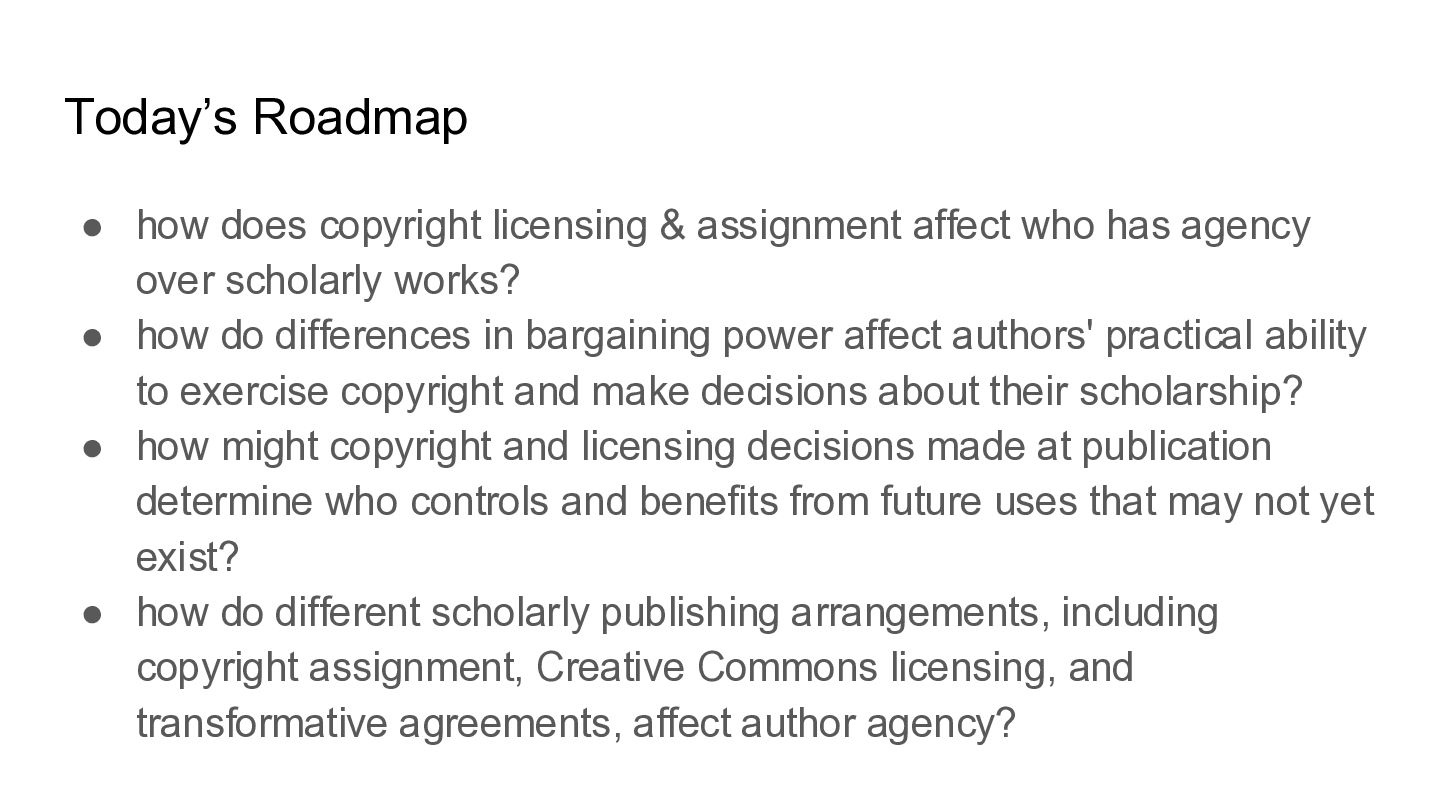
Today’s Roadmap • how does copyright licensing & assignment affect
who has agency over scholarly works? • how do differences in bargaining power affect authors' practical ability to exercise copyright and make decisions about their scholarship? • how might copyright and licensing decisions made at publication determine who controls and benefits from future uses that may not yet exist? • how do different scholarly publishing arrangements, including copyright assignment, Creative Commons licensing, and transformative agreements, affect author agency? -
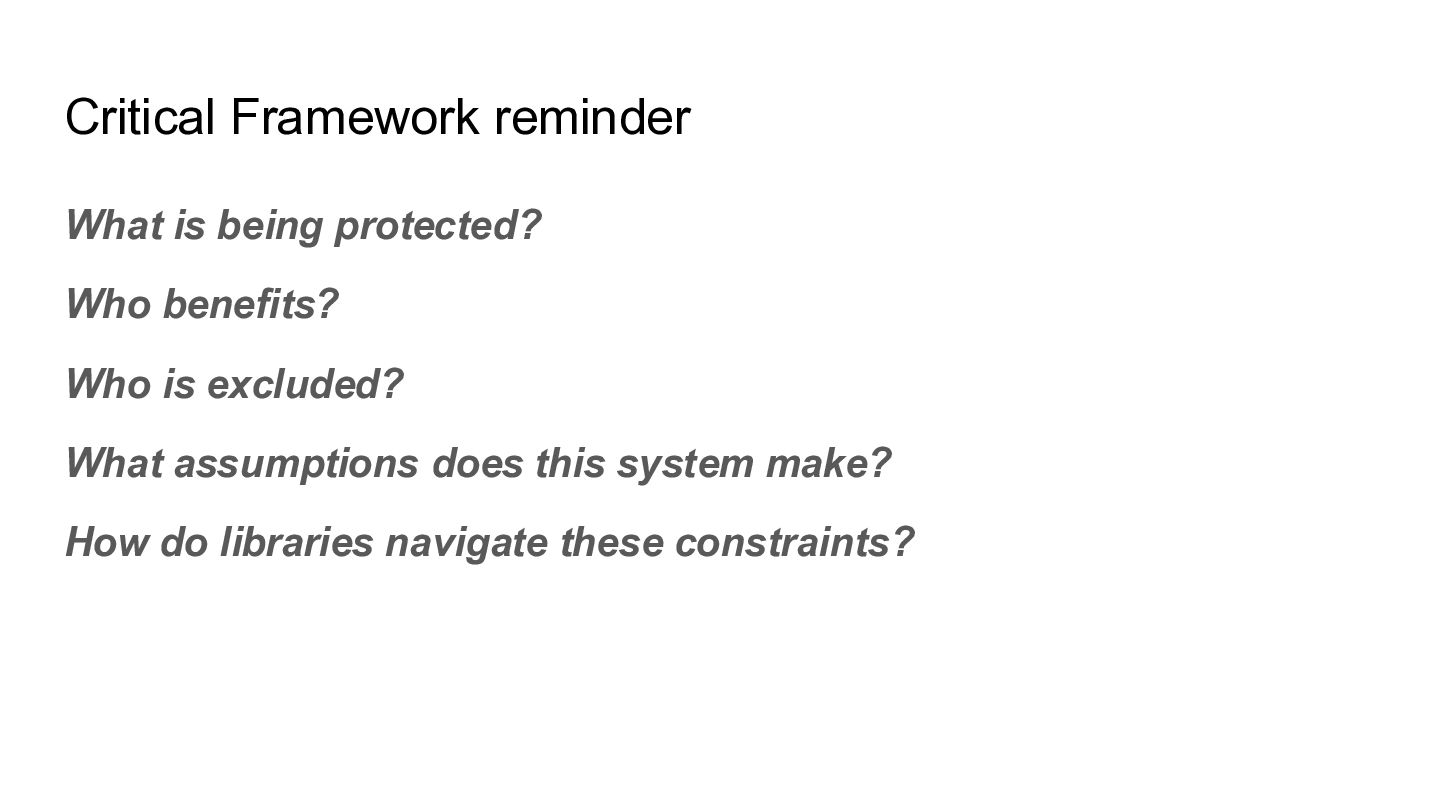
Critical Framework reminder What is being protected? Who benefits? Who
is excluded? What assumptions does this system make? How do libraries navigate these constraints? -
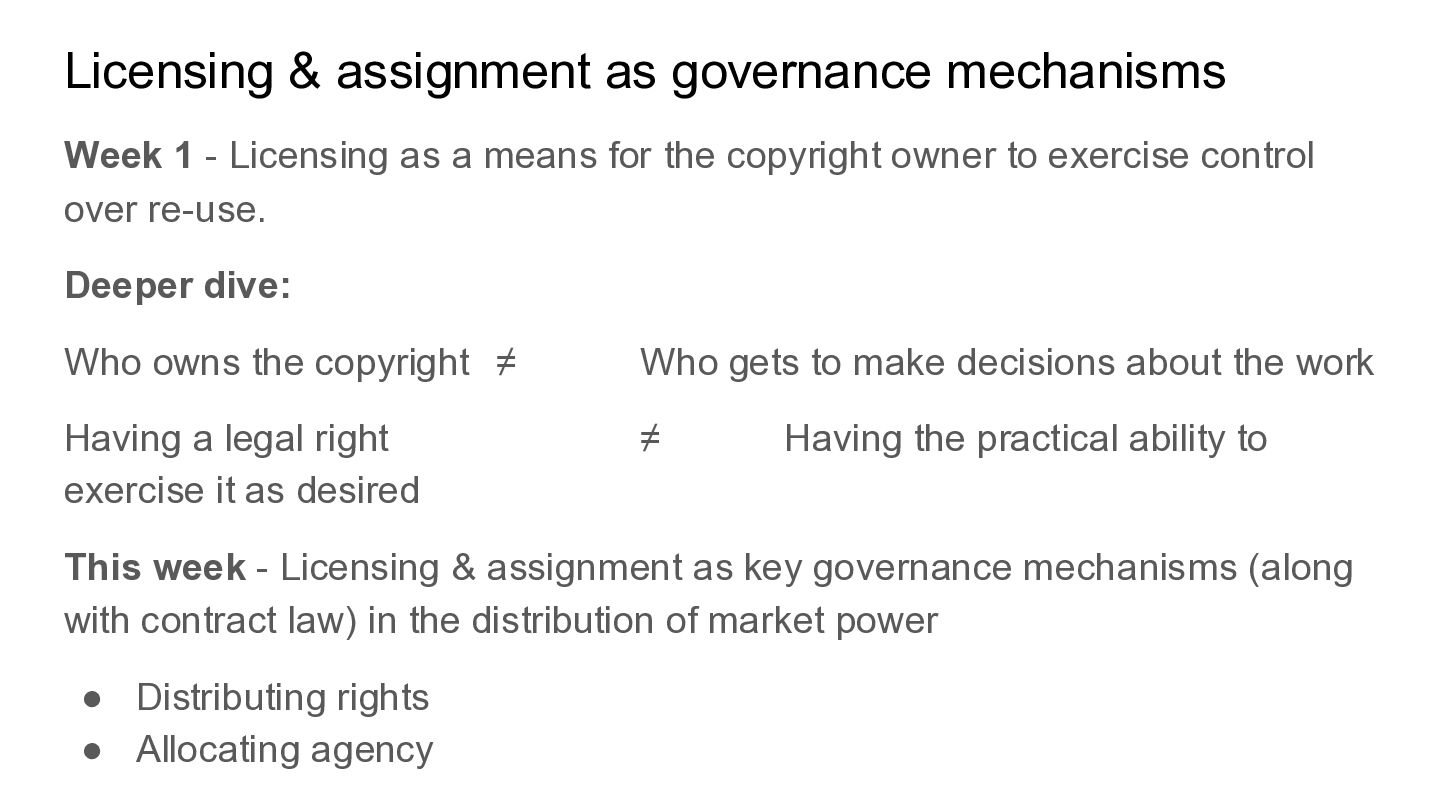
Licensing & assignment as governance mechanisms Week 1 - Licensing
as a means for the copyright owner to exercise control over re-use. Deeper dive: Who owns the copyright ≠ Who gets to make decisions about the work Having a legal right exercise it as desired ≠ Having the practical ability to This week - Licensing & assignment as key governance mechanisms (along with contract law) in the distribution of market power • Distributing rights • Allocating agency -
Author Story: Dr. Whitney Houston-Rivera The year is 2016 Recent
graduate - PhD in Epidemiology Native of Colombia but employed in the US at major university hospital Preparing her first major article and knows that publishing in a prestigious journal could affect promotion, funding, and visibility. For the first time, she must decide where to publish, what rights to grant, and how her work may be reused. Right now, her priority is simple: get the article completed and published. -
Stage 1 - Creation Dr. Rivera completes the article. At
this point she owns copyright in her scholarly work. She wants to publish her work in a venue that people in underresourced communities, including her home country will be able to read, as her work involves important breakthroughs that can improve public health responses and possibly outcomes. What is being protected by copyright at this stage? What mechanisms can an author use to let someone else publish their work? -
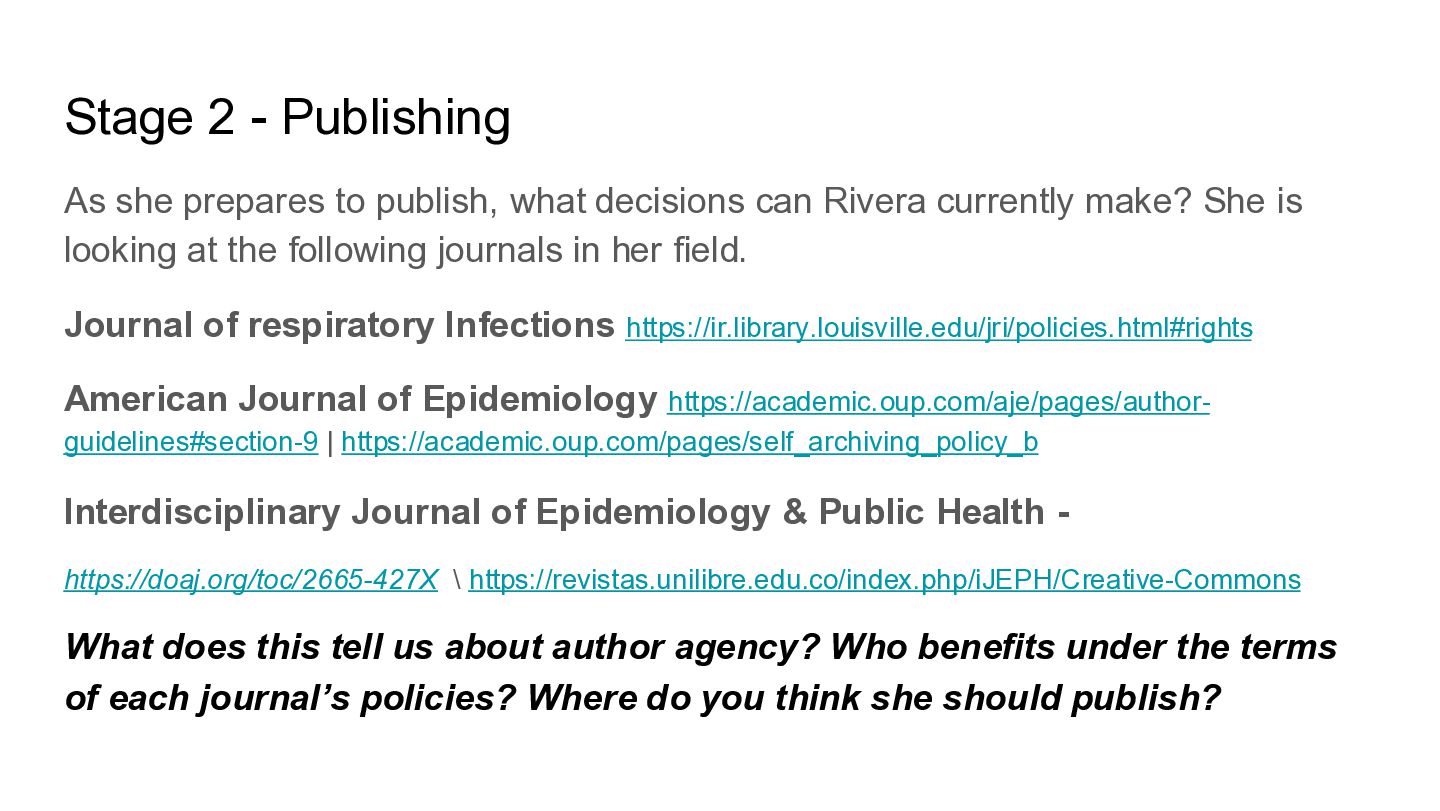
Stage 2 - Publishing As she prepares to publish, what
decisions can Rivera currently make? She is looking at the following journals in her field. Journal of respiratory Infections https://ir.library.louisville.edu/jri/policies.html#rights American Journal of Epidemiology https://academic.oup.com/aje/pages/authorguidelines#section-9 | https://academic.oup.com/pages/self_archiving_policy_b Interdisciplinary Journal of Epidemiology & Public Health https://doaj.org/toc/2665-427X \ https://revistas.unilibre.edu.co/index.php/iJEPH/Creative-Commons What does this tell us about author agency? Who benefits under the terms of each journal’s policies? Where do you think she should publish? -
Stage 2 - Publishing Dr. Rivera wants to publish in
the Interdisciplinary Journal of Epidemiology & Public Health, a bi-lingual open access journal that does not charge for open access publishing, however when she mentions this in a department meeting, her department chair advises 1 - She must publish in the American Journal of Epidemiology if she wants to be successful on the tenure track 2 -The journal has an OA publishing option but this will cost over $5,000, and department does not have funding for OA publication -
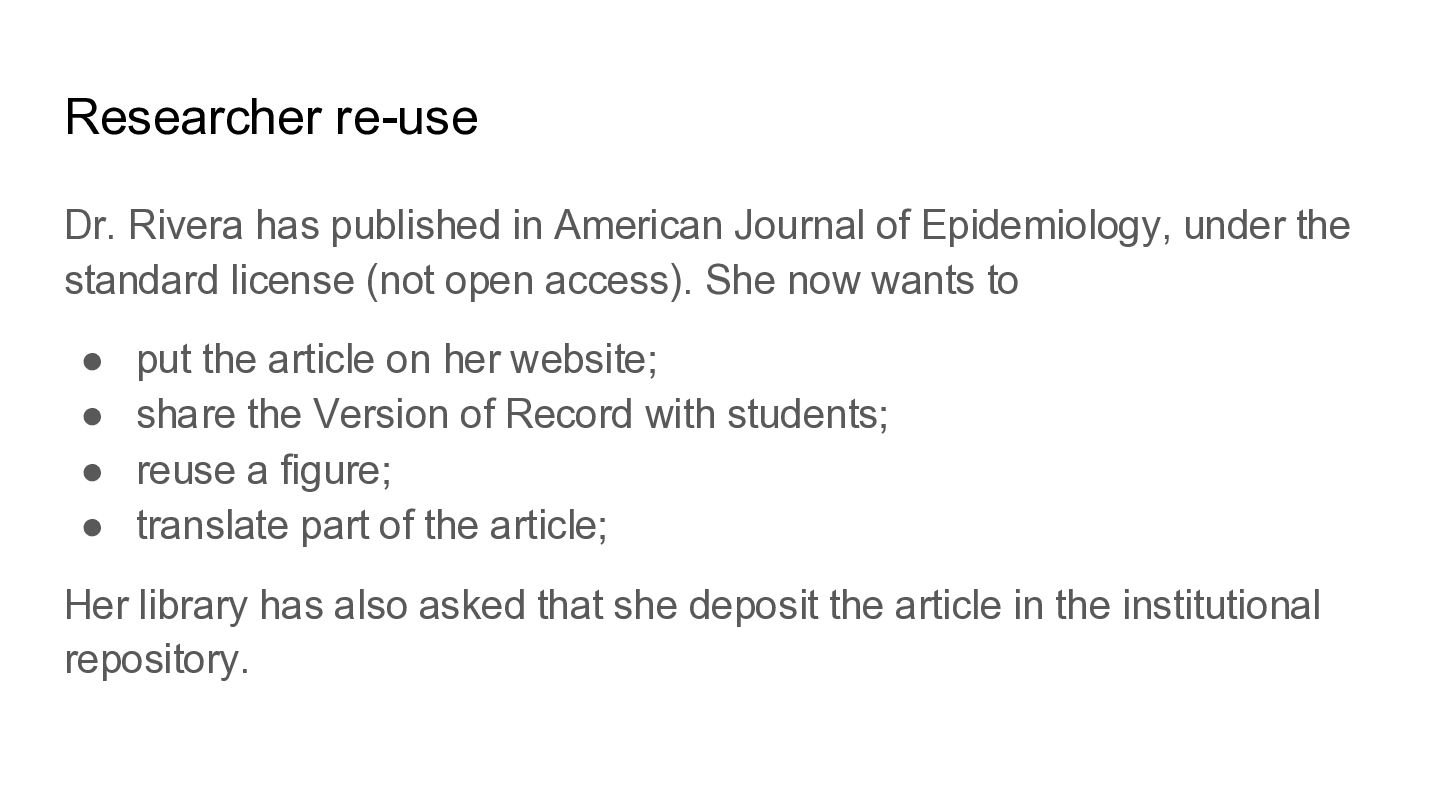
Researcher re-use Dr. Rivera has published in American Journal of
Epidemiology, under the standard license (not open access). She now wants to • • • • put the article on her website; share the Version of Record with students; reuse a figure; translate part of the article; Her library has also asked that she deposit the article in the institutional repository. -
Critical Review What is being protected? Who is excluded? What
assumptions does this system make? Who benefits? -
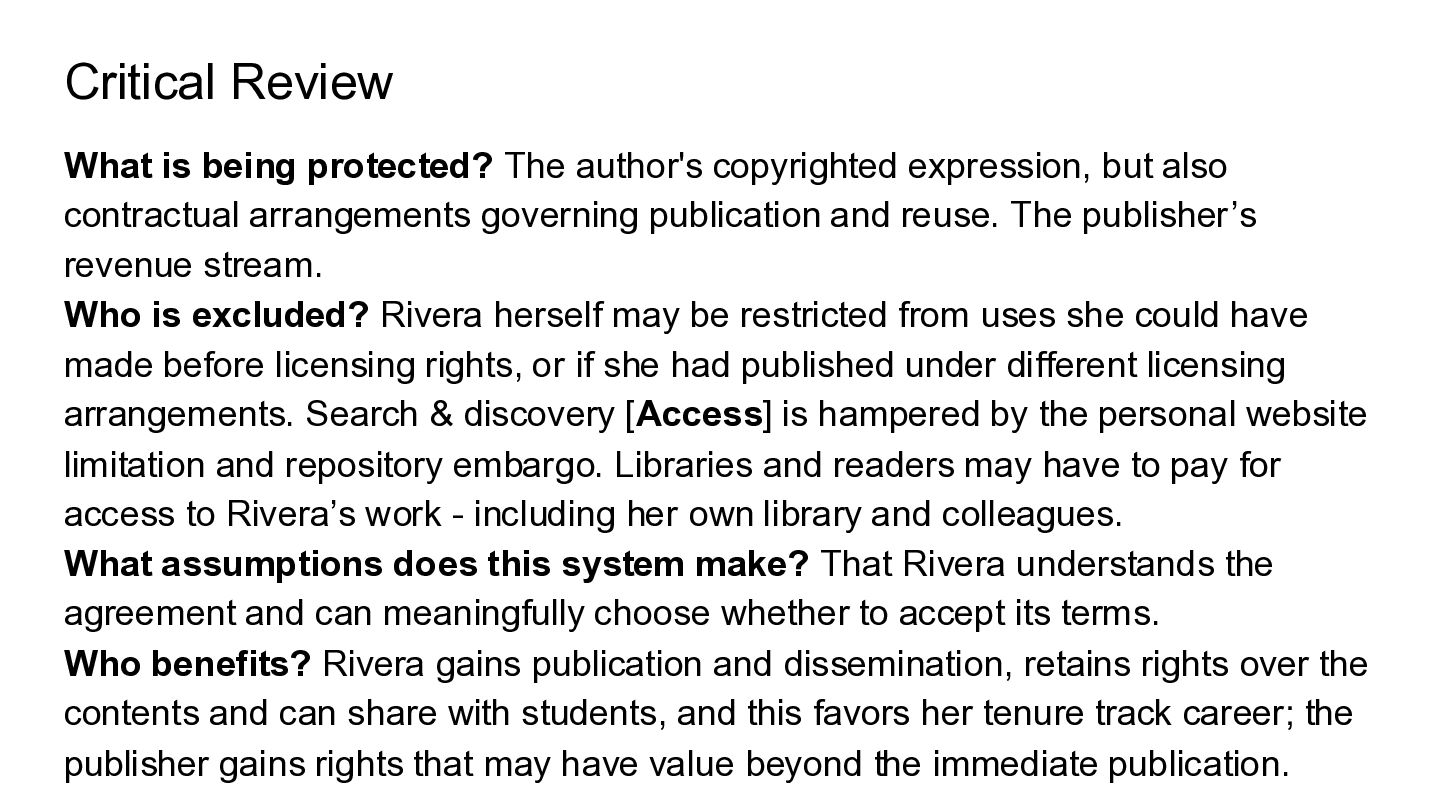
Critical Review What is being protected? The author's copyrighted expression,
but also contractual arrangements governing publication and reuse. The publisher’s revenue stream. Who is excluded? Rivera herself may be restricted from uses she could have made before licensing rights, or if she had published under different licensing arrangements. Search & discovery [Access] is hampered by the personal website limitation and repository embargo. Libraries and readers may have to pay for access to Rivera’s work - including her own library and colleagues. What assumptions does this system make? That Rivera understands the agreement and can meaningfully choose whether to accept its terms. Who benefits? Rivera gains publication and dissemination, retains rights over the contents and can share with students, and this favors her tenure track career; the publisher gains rights that may have value beyond the immediate publication. -
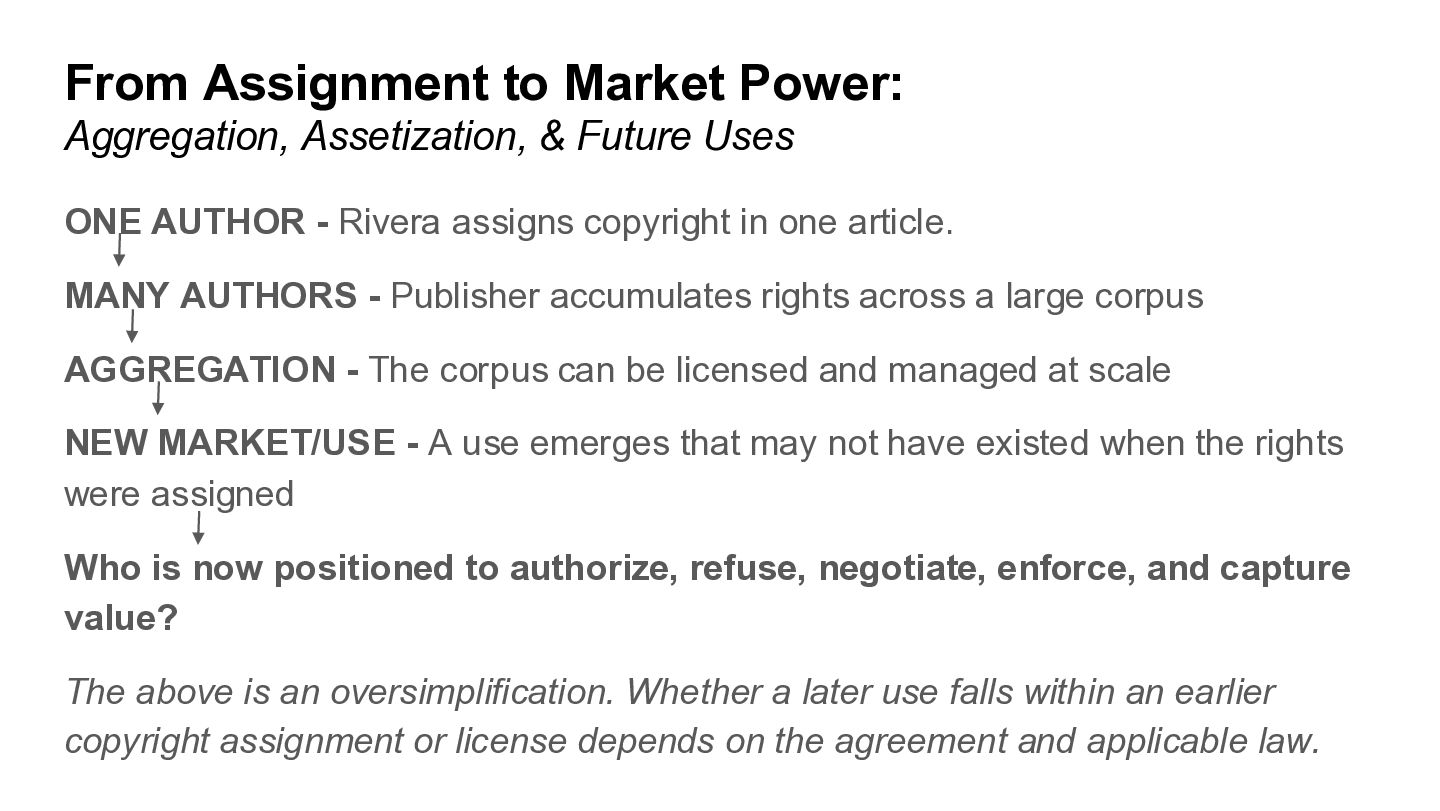
From Assignment to Market Power: Aggregation, Assetization, & Future Uses
ONE AUTHOR - Rivera assigns copyright in one article. MANY AUTHORS - Publisher accumulates rights across a large corpus AGGREGATION - The corpus can be licensed and managed at scale NEW MARKET/USE - A use emerges that may not have existed when the rights were assigned Who is now positioned to authorize, refuse, negotiate, enforce, and capture value? The above is an oversimplification. Whether a later use falls within an earlier copyright assignment or license depends on the agreement and applicable law. -
Stage 3 - Emergence of New Markets The year is
2026. Let’s consider these questions: • What new markets have emerged? • Was there an identifiable market for these uses at the time Dr. Rivera assigned her copyright? • Who has the right to restrict re-use, and exploit Dr. Rivera’s article? -
It is now 2026. Was there an identifiable market for
this use at the time Dr. Rivera assigned her copyright? -
It is now 2026. Who has the right to restrict
re-use and exploit Dr. Rivera’s article? -
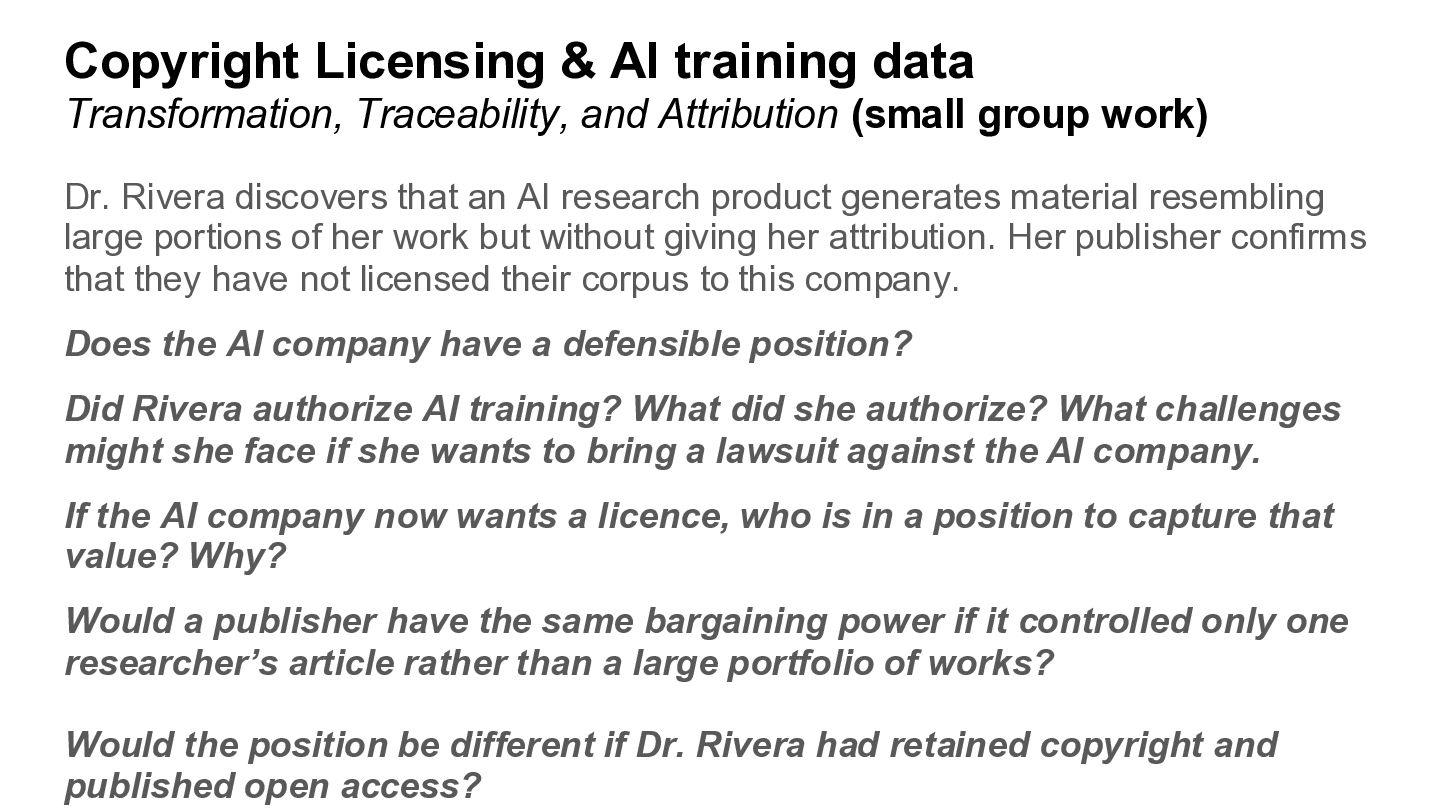
Copyright Licensing & AI training data Transformation, Traceability, and Attribution
(small group work) Dr. Rivera discovers that an AI research product generates material resembling large portions of her work but without giving her attribution. Her publisher confirms that they have not licensed their corpus to this company. Does the AI company have a defensible position? Did Rivera authorize AI training? What did she authorize? What challenges might she face if she wants to bring a lawsuit against the AI company. If the AI company now wants a licence, who is in a position to capture that value? Why? Would a publisher have the same bargaining power if it controlled only one researcher’s article rather than a large portfolio of works? Would the position be different if Dr. Rivera had retained copyright and published open access? -
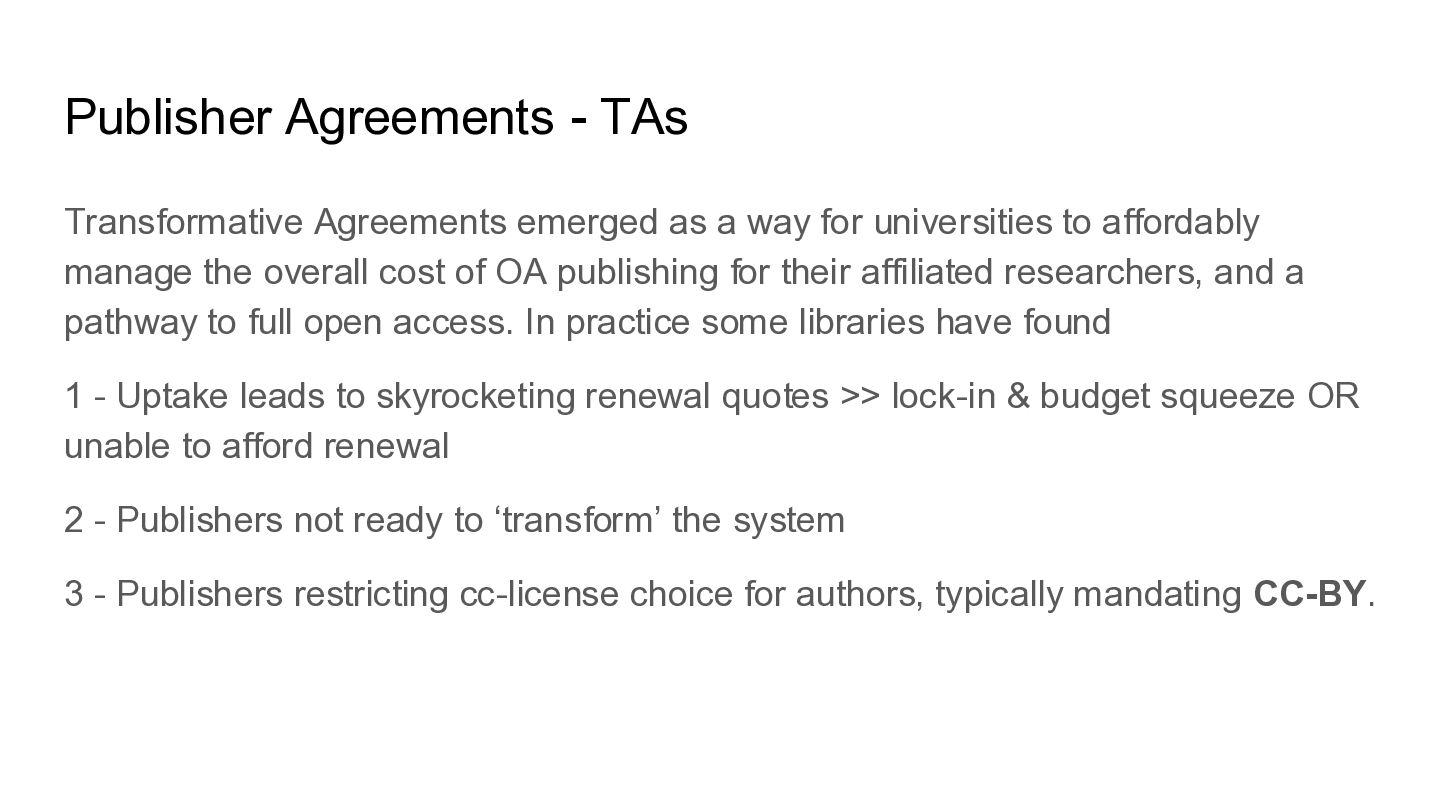
Publisher Agreements - TAs Transformative Agreements emerged as a way
for universities to affordably manage the overall cost of OA publishing for their affiliated researchers, and a pathway to full open access. In practice some libraries have found 1 - Uptake leads to skyrocketing renewal quotes >> lock-in & budget squeeze OR unable to afford renewal 2 - Publishers not ready to ‘transform’ the system 3 - Publishers restricting cc-license choice for authors, typically mandating CC-BY. -
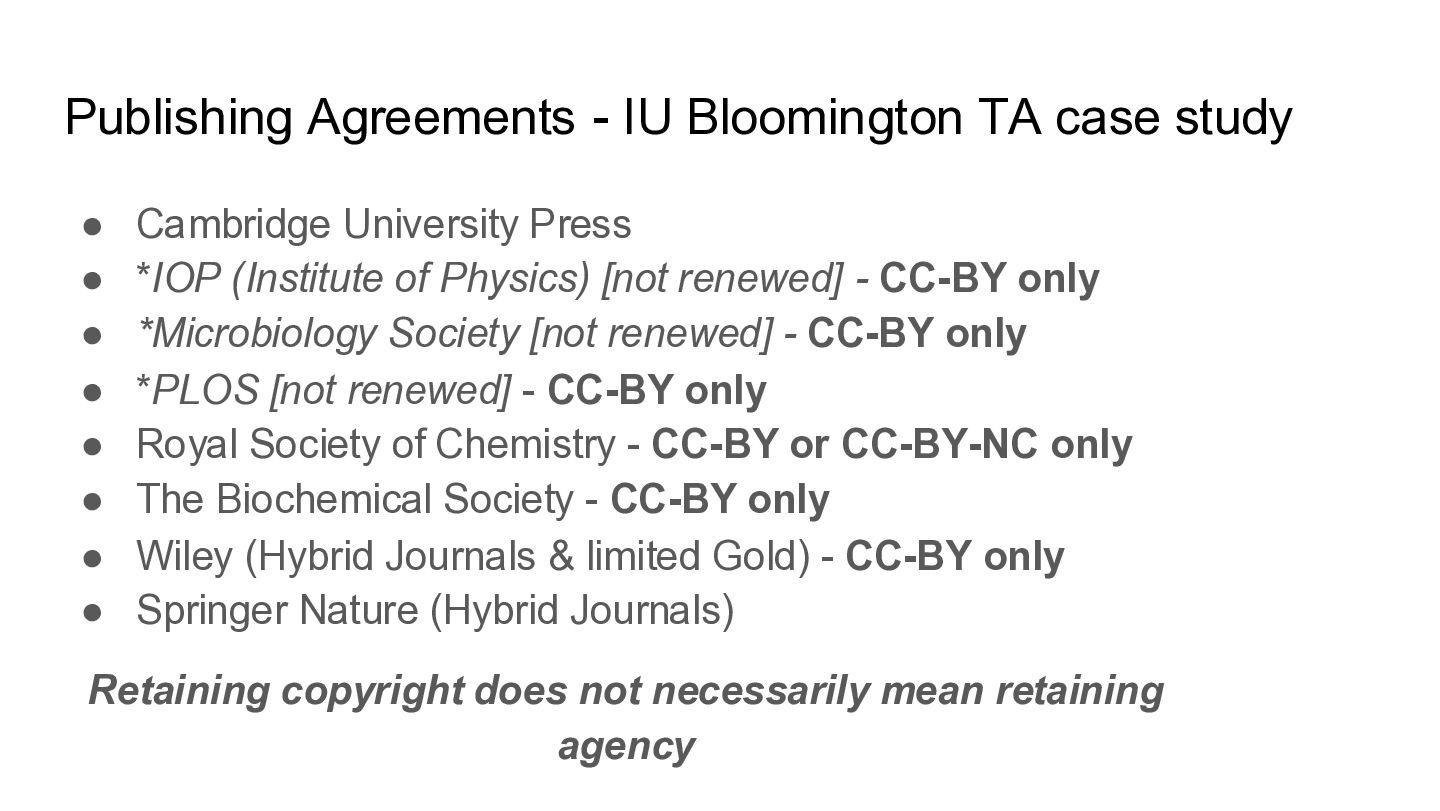
Publishing Agreements - IU Bloomington TA case study • •
• • • • • • Cambridge University Press *IOP (Institute of Physics) [not renewed] - CC-BY only *Microbiology Society [not renewed] - CC-BY only *PLOS [not renewed] - CC-BY only Royal Society of Chemistry - CC-BY or CC-BY-NC only The Biochemical Society - CC-BY only Wiley (Hybrid Journals & limited Gold) - CC-BY only Springer Nature (Hybrid Journals) Retaining copyright does not necessarily mean retaining agency -
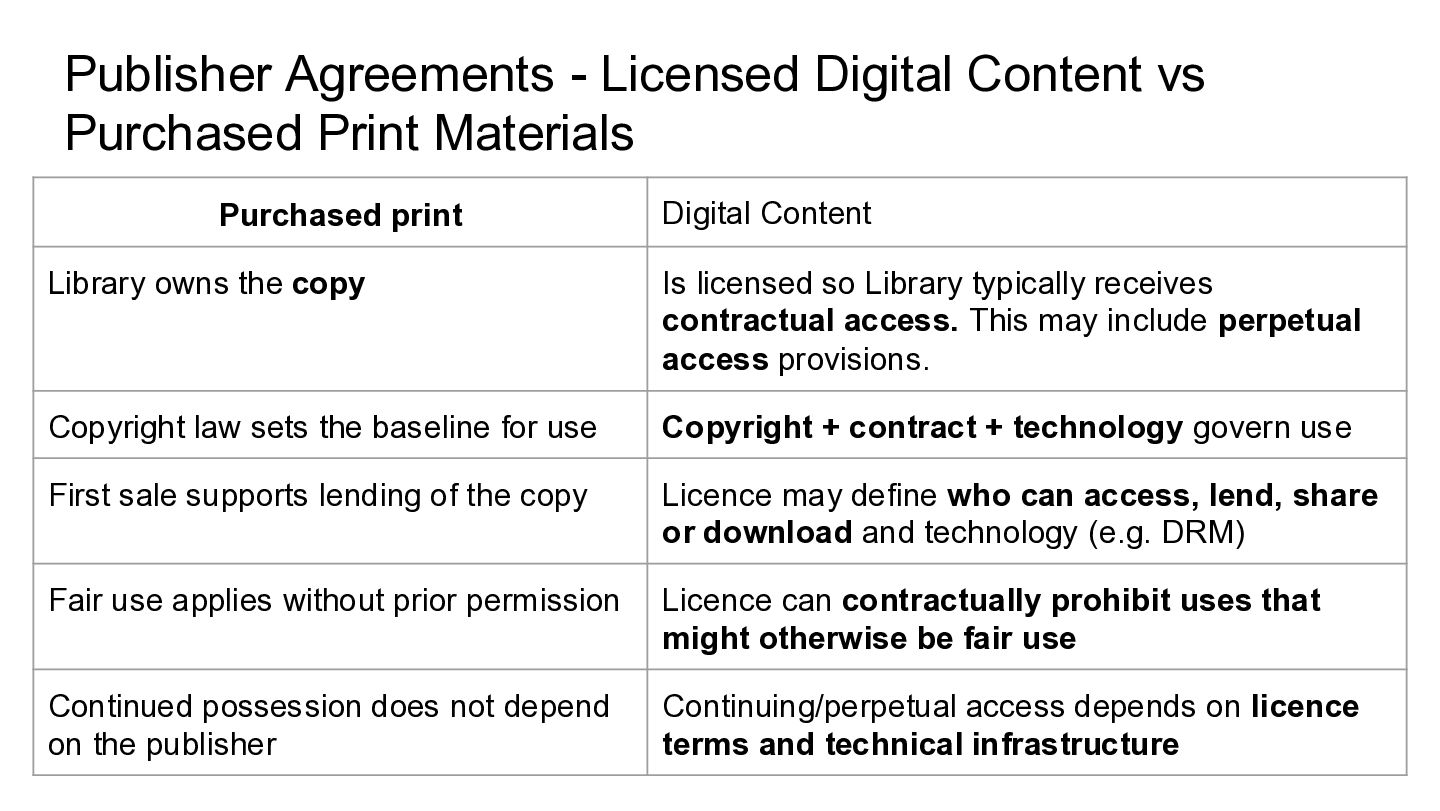
Publisher Agreements - Licensed Digital Content vs Purchased Print Materials
Purchased print Digital Content Library owns the copy Is licensed so Library typically receives contractual access. This may include perpetual access provisions. Copyright law sets the baseline for use Copyright + contract + technology govern use First sale supports lending of the copy Licence may define who can access, lend, share or download and technology (e.g. DRM) Fair use applies without prior permission Licence can contractually prohibit uses that might otherwise be fair use Continued possession does not depend on the publisher Continuing/perpetual access depends on licence terms and technical infrastructure -
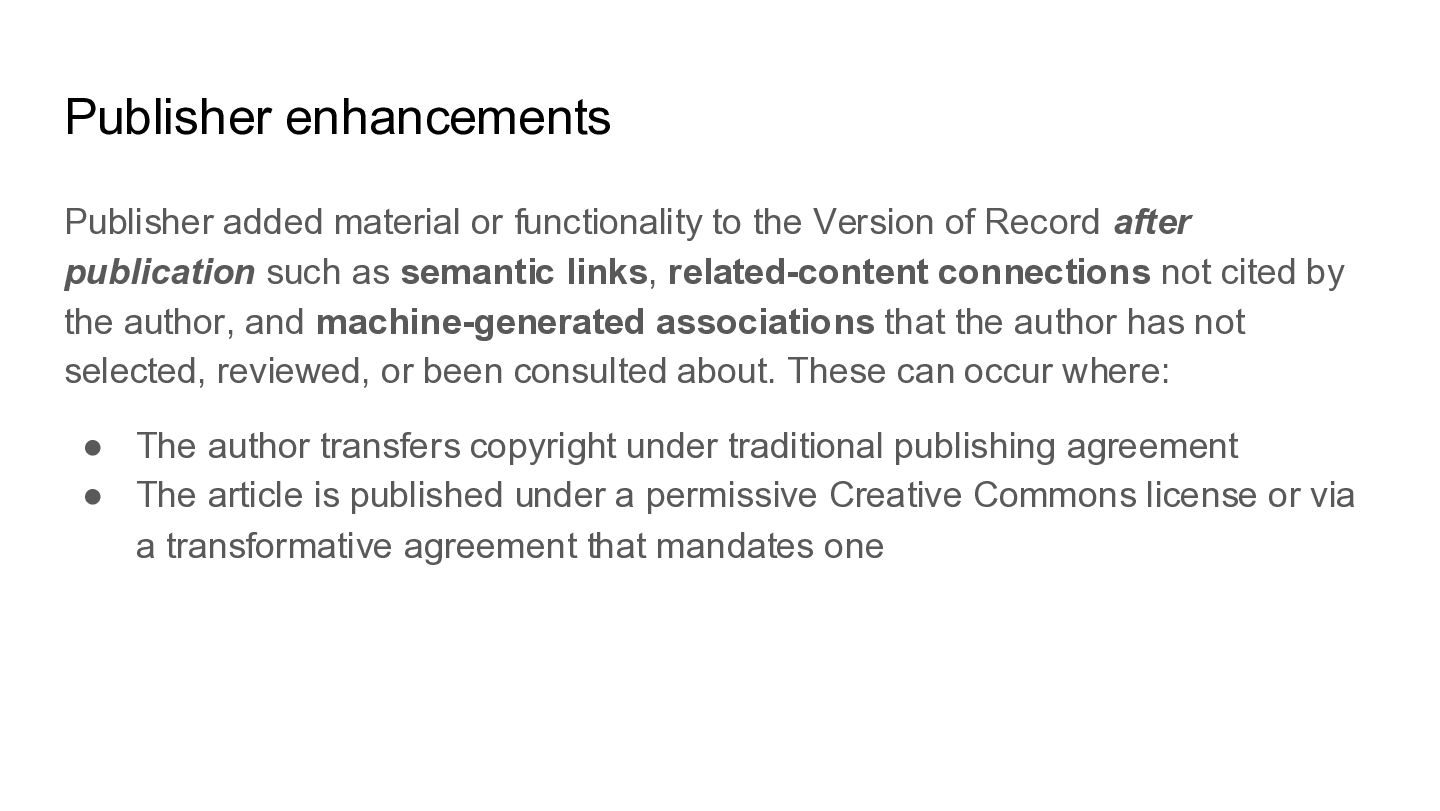
Publisher enhancements Publisher added material or functionality to the Version
of Record after publication such as semantic links, related-content connections not cited by the author, and machine-generated associations that the author has not selected, reviewed, or been consulted about. These can occur where: • The author transfers copyright under traditional publishing agreement • The article is published under a permissive Creative Commons license or via a transformative agreement that mandates one -
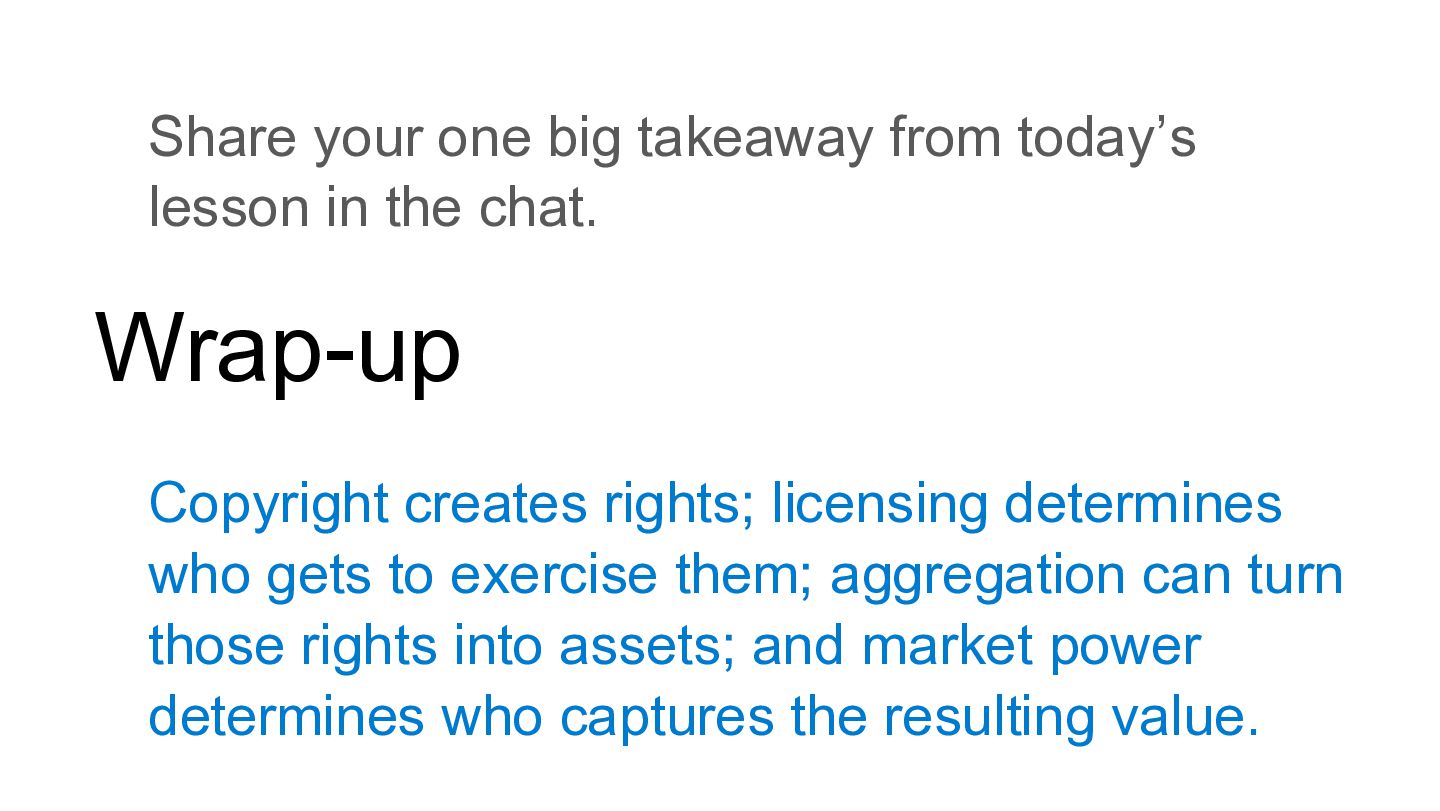
Share your one big takeaway from today’s lesson in the
chat. Wrap-up Copyright creates rights; licensing determines who gets to exercise them; aggregation can turn those rights into assets; and market power determines who captures the resulting value.