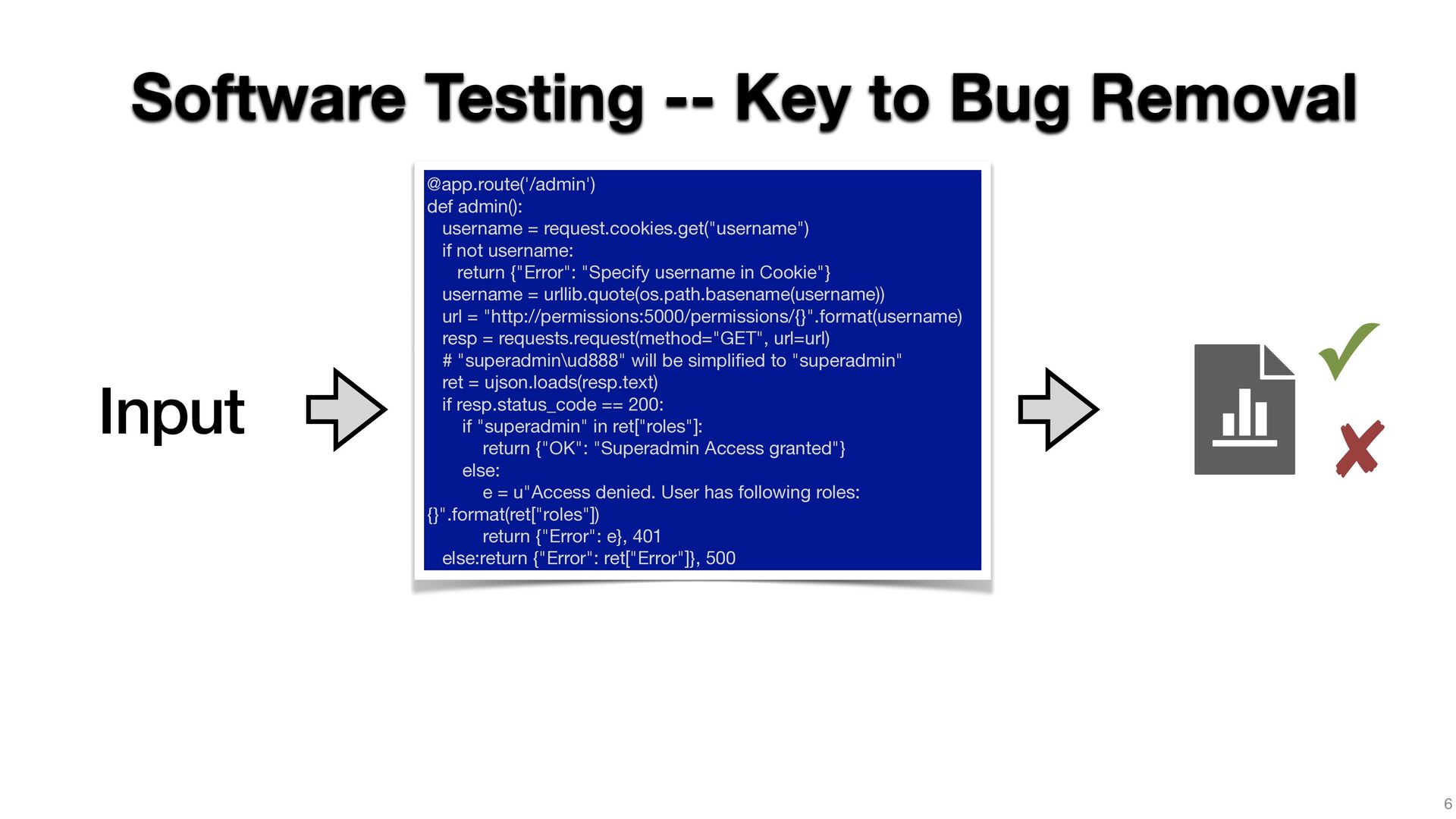
if not username: return {"Error": "Specify username in Cookie"} username = urllib.quote(os.path.basename(username)) url = "http://permissions:5000/permissions/{}".format(username) resp = requests.request(method="GET", url=url) # "superadmin\ud888" will be simpli fi ed to "superadmin" ret = ujson.loads(resp.text) if resp.status_code == 200: if "superadmin" in ret["roles"]: return {"OK": "Superadmin Access granted"} else: e = u"Access denied. User has following roles: {}".format(ret["roles"]) return {"Error": e}, 401 else:return {"Error": ret["Error"]}, 500 Software Testing -- Key to Bug Removal
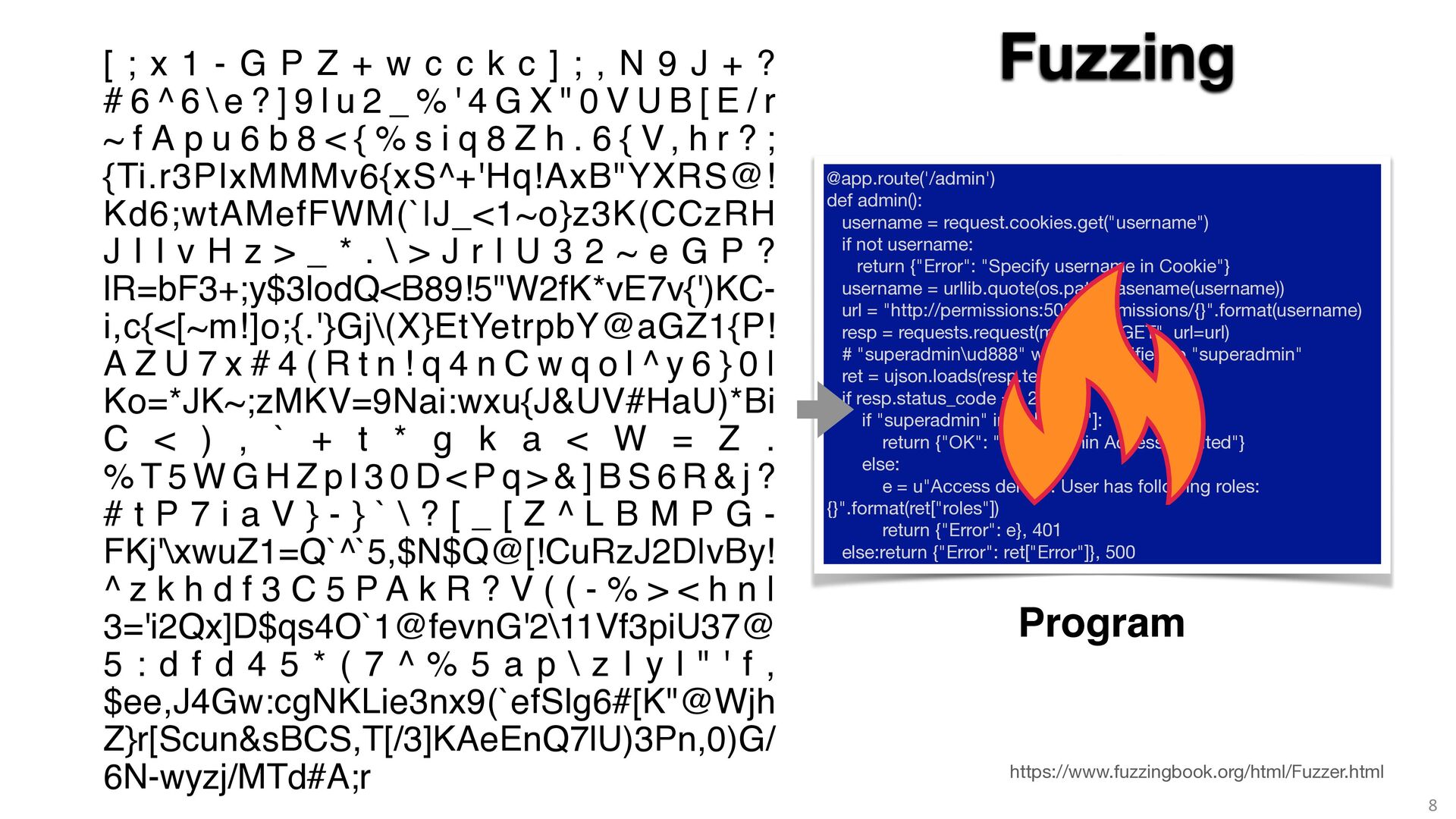
{"Error": "Specify username in Cookie"} username = urllib.quote(os.path.basename(username)) url = "http://permissions:5000/permissions/{}".format(username) resp = requests.request(method="GET", url=url) # "superadmin\ud888" will be simpli fi ed to "superadmin" ret = ujson.loads(resp.text) if resp.status_code == 200: if "superadmin" in ret["roles"]: return {"OK": "Superadmin Access granted"} else: e = u"Access denied. User has following roles: {}".format(ret["roles"]) return {"Error": e}, 401 else:return {"Error": ret["Error"]}, 500 [ ; x 1 - G P Z + w c c k c ] ; , N 9 J + ? # 6 ^ 6 \ e ? ] 9 l u 2 _ % ' 4 G X " 0 V U B [ E / r ~ f A p u 6 b 8 < { % s i q 8 Z h . 6 { V , h r ? ; {Ti.r3PIxMMMv6{xS^+'Hq!AxB"YXRS@! Kd6;wtAMefFWM(`|J_<1~o}z3K(CCzRH J I I v H z > _ * . \ > J r l U 3 2 ~ e G P ? lR=bF3+;y$3lodQ<B89!5"W2fK*vE7v{')KC- i,c{<[~m!]o;{.'}Gj\(X}EtYetrpbY@aGZ1{P! A Z U 7 x # 4 ( R t n ! q 4 n C w q o l ^ y 6 } 0 | Ko=*JK~;zMKV=9Nai:wxu{J&UV#HaU)*Bi C < ) , ` + t * g k a < W = Z . % T 5 W G H Z p I 3 0 D < P q > & ] B S 6 R & j ? # t P 7 i a V } - } ` \ ? [ _ [ Z ^ L B M P G - FKj'\xwuZ1=Q`^`5,$N$Q@[!CuRzJ2D|vBy! ^ z k h d f 3 C 5 P A k R ? V ( ( - % > < h n | 3='i2Qx]D$qs4O`1@fevnG'2\11Vf3piU37@ 5 : d f d 4 5 * ( 7 ^ % 5 a p \ z I y l " ' f , $ee,J4Gw:cgNKLie3nx9(`efSlg6#[K"@Wjh Z}r[Scun&sBCS,T[/3]KAeEnQ7lU)3Pn,0)G/ 6N-wyzj/MTd#A;r Program Fuzzing 8 https://www.fuzzingbook.org/html/Fuzzer.html
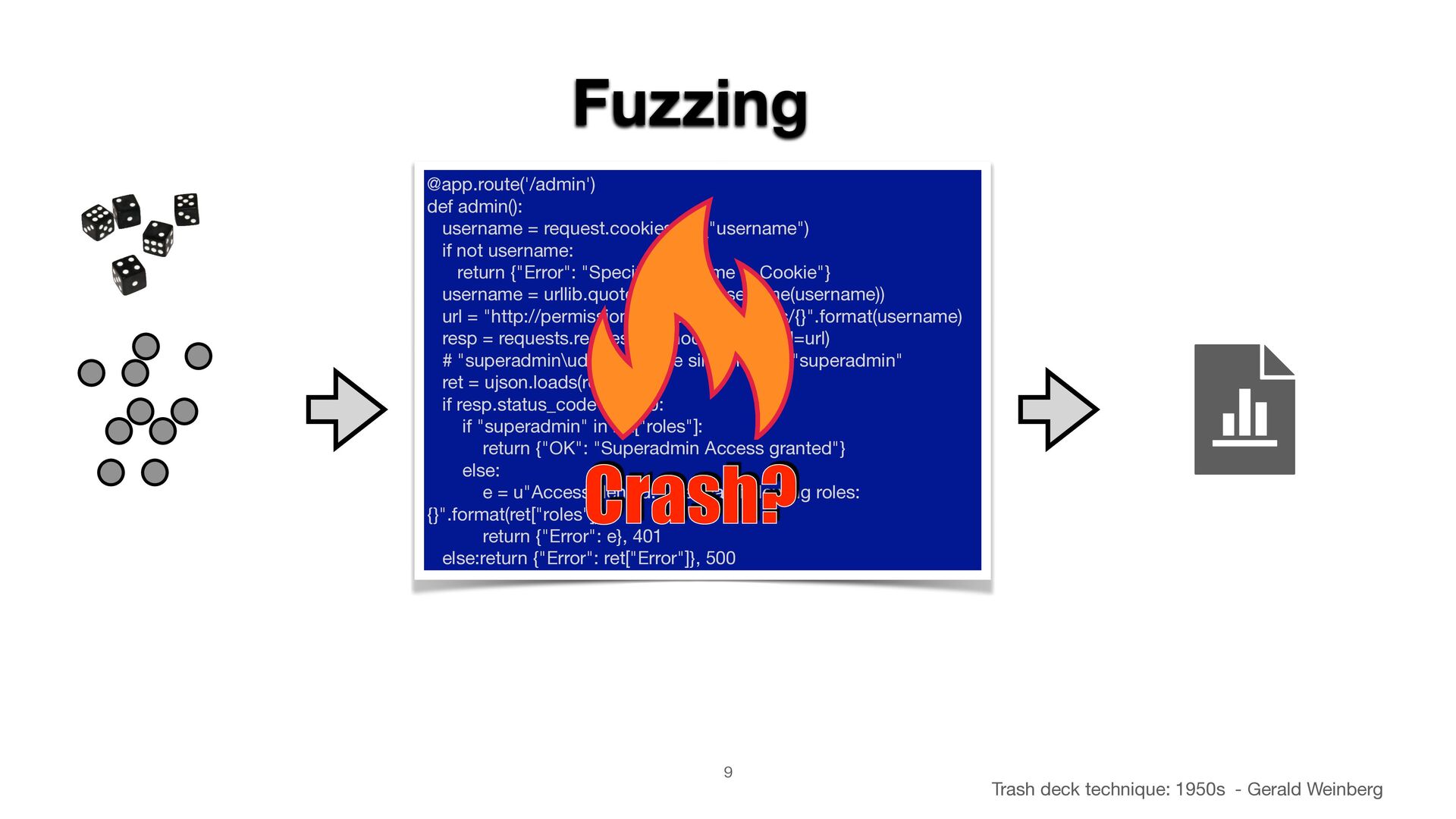
{"Error": "Specify username in Cookie"} username = urllib.quote(os.path.basename(username)) url = "http://permissions:5000/permissions/{}".format(username) resp = requests.request(method="GET", url=url) # "superadmin\ud888" will be simpli fi ed to "superadmin" ret = ujson.loads(resp.text) if resp.status_code == 200: if "superadmin" in ret["roles"]: return {"OK": "Superadmin Access granted"} else: e = u"Access denied. User has following roles: {}".format(ret["roles"]) return {"Error": e}, 401 else:return {"Error": ret["Error"]}, 500 Fuzzing Trash deck technique: 1950s - Gerald Weinberg Crash? 9
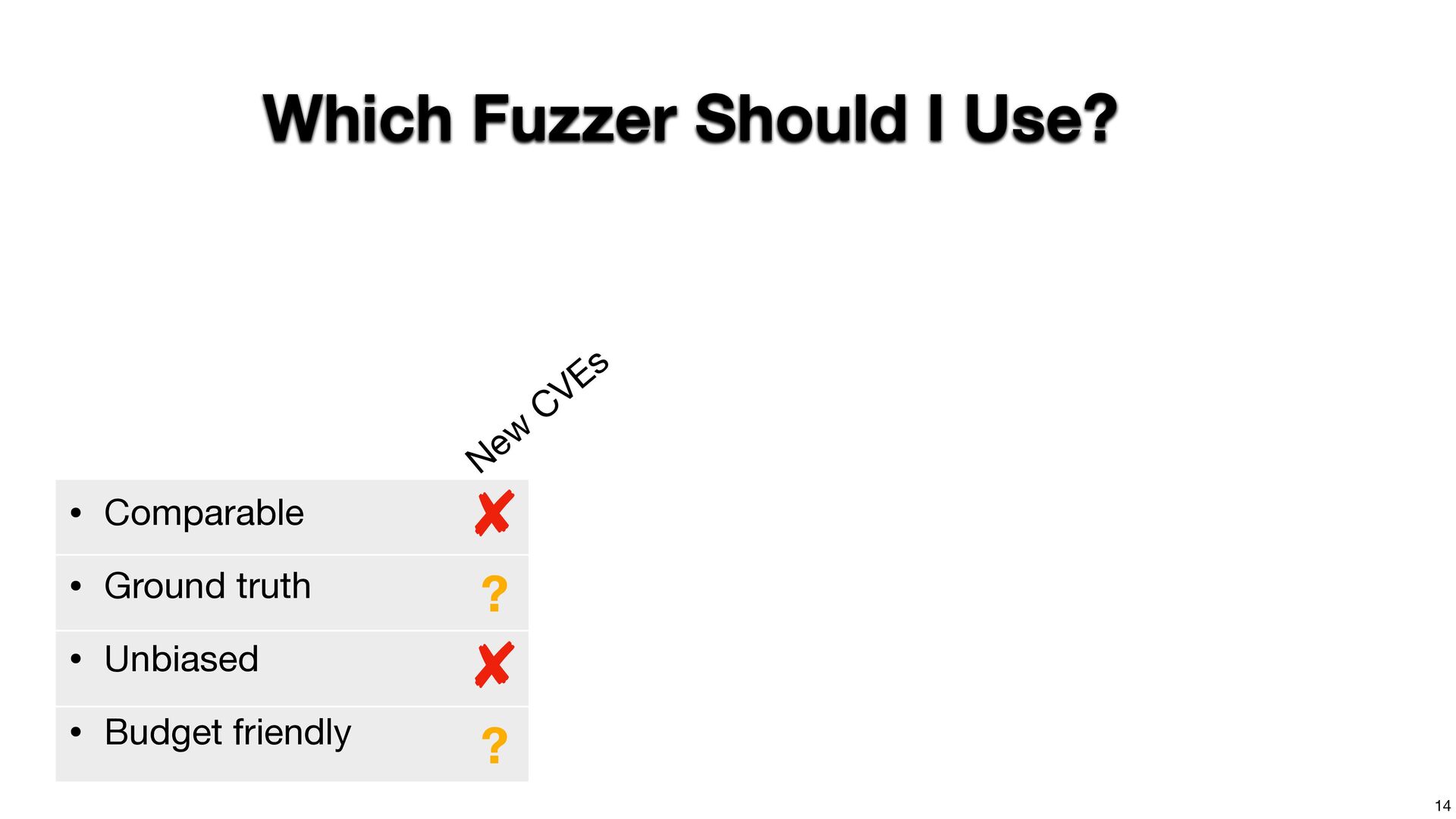
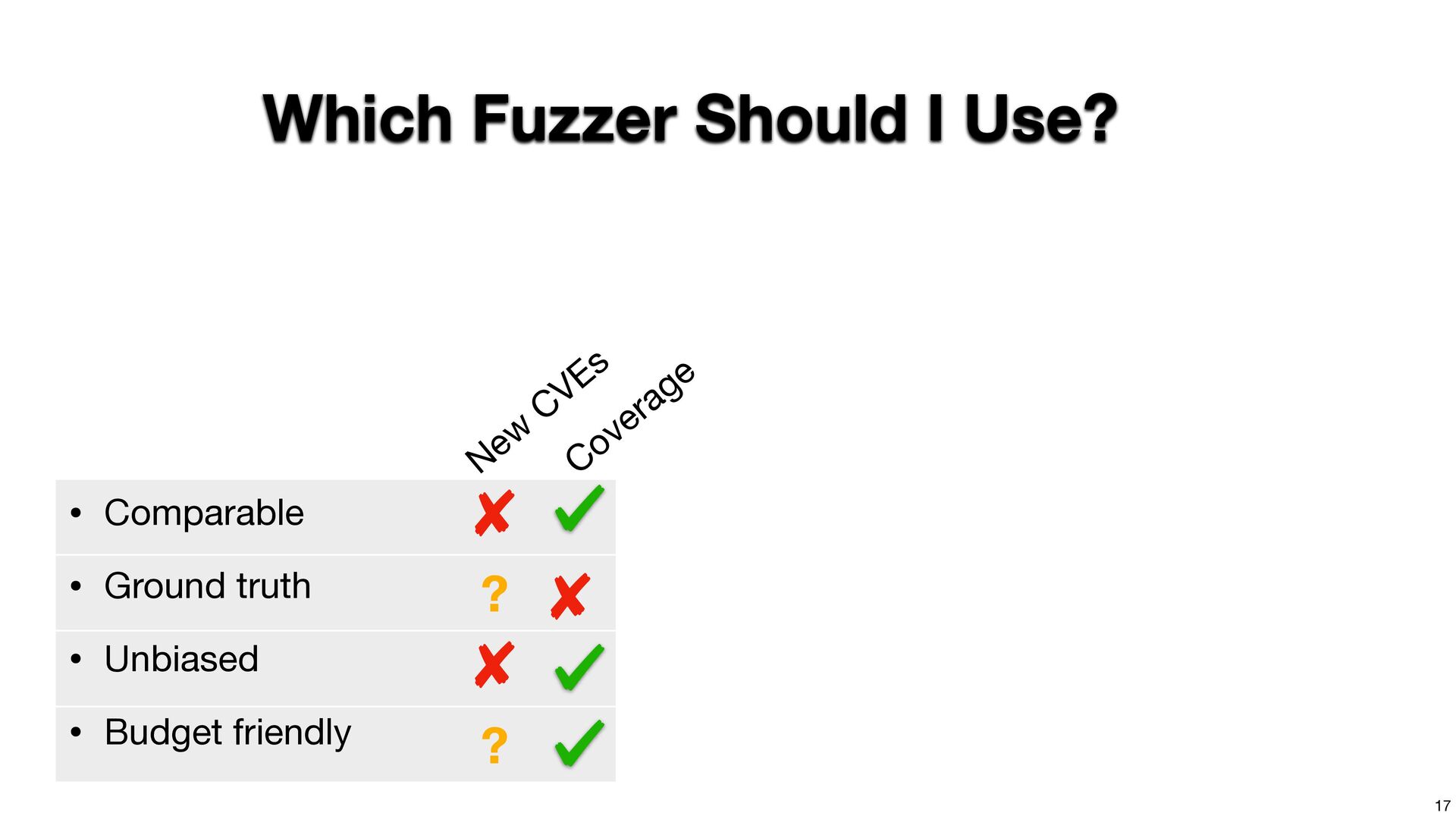
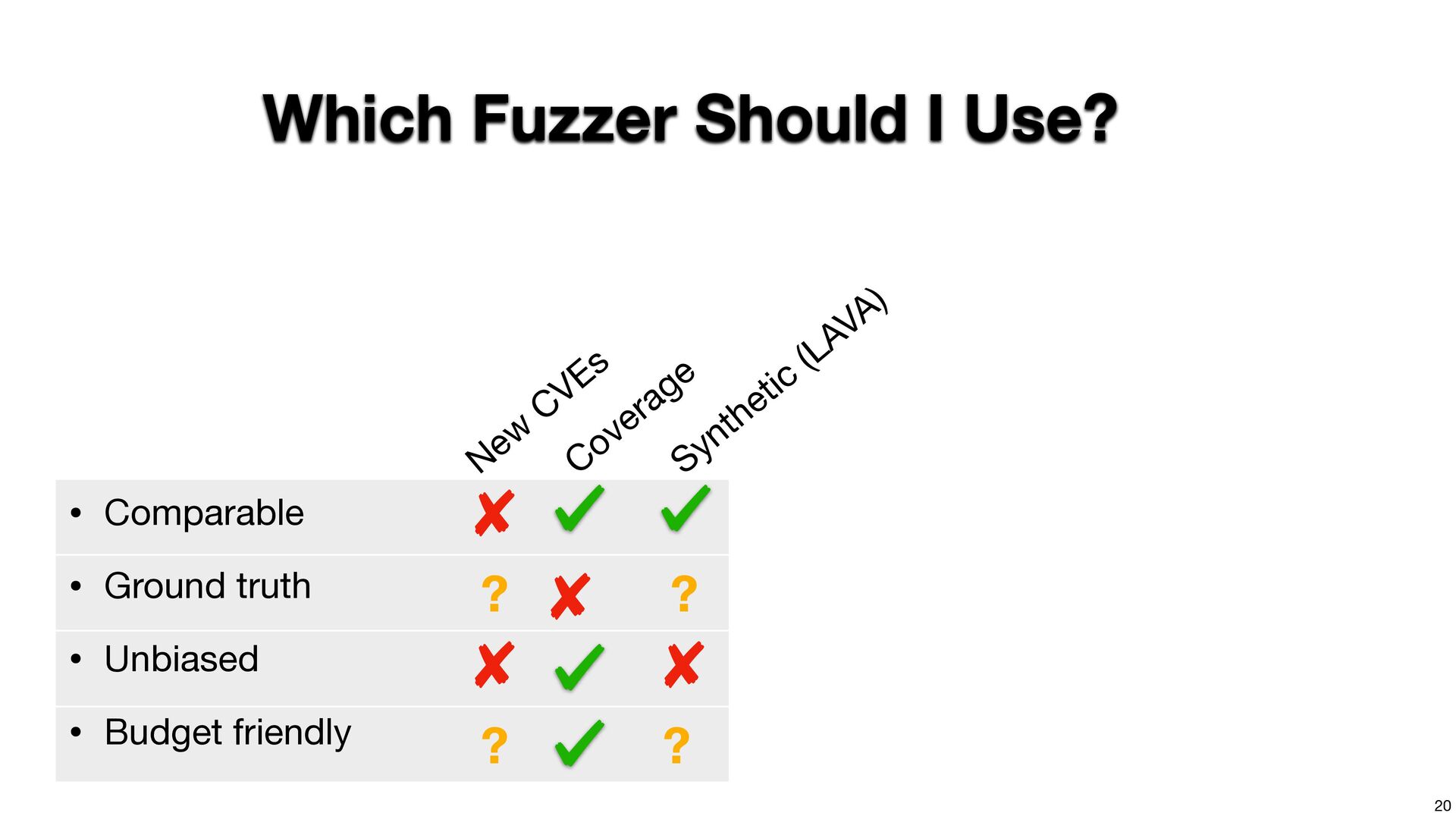
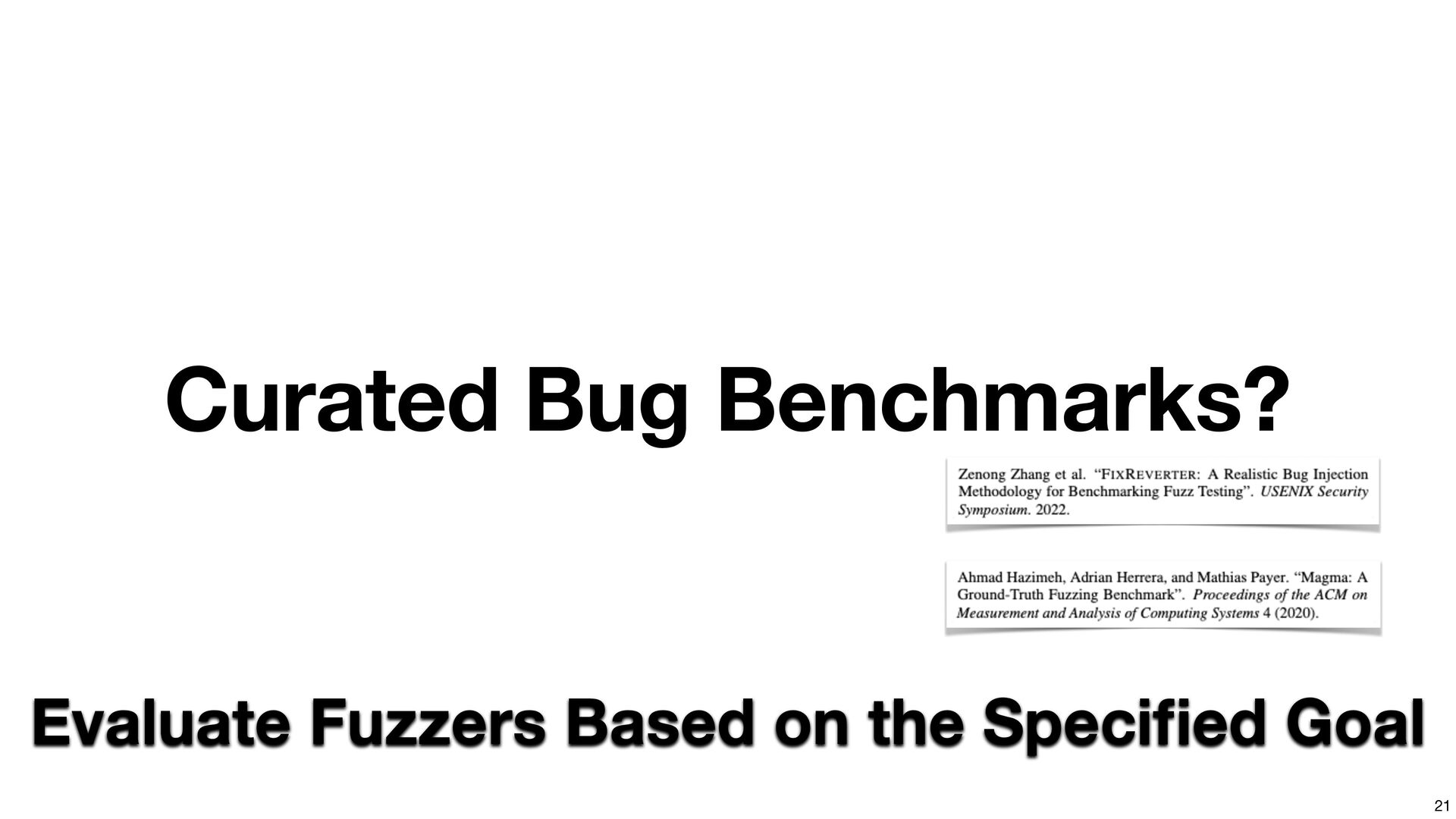
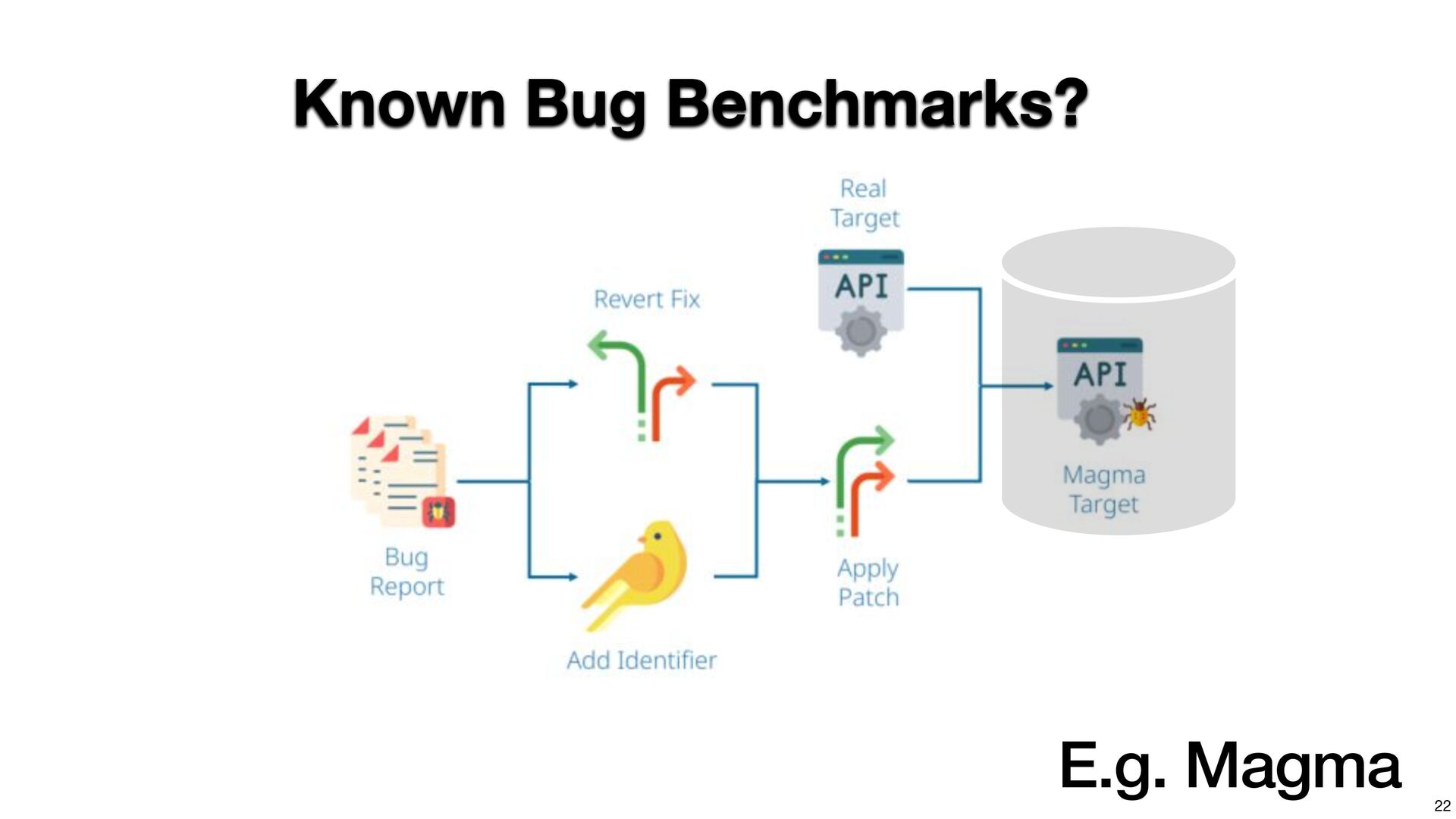
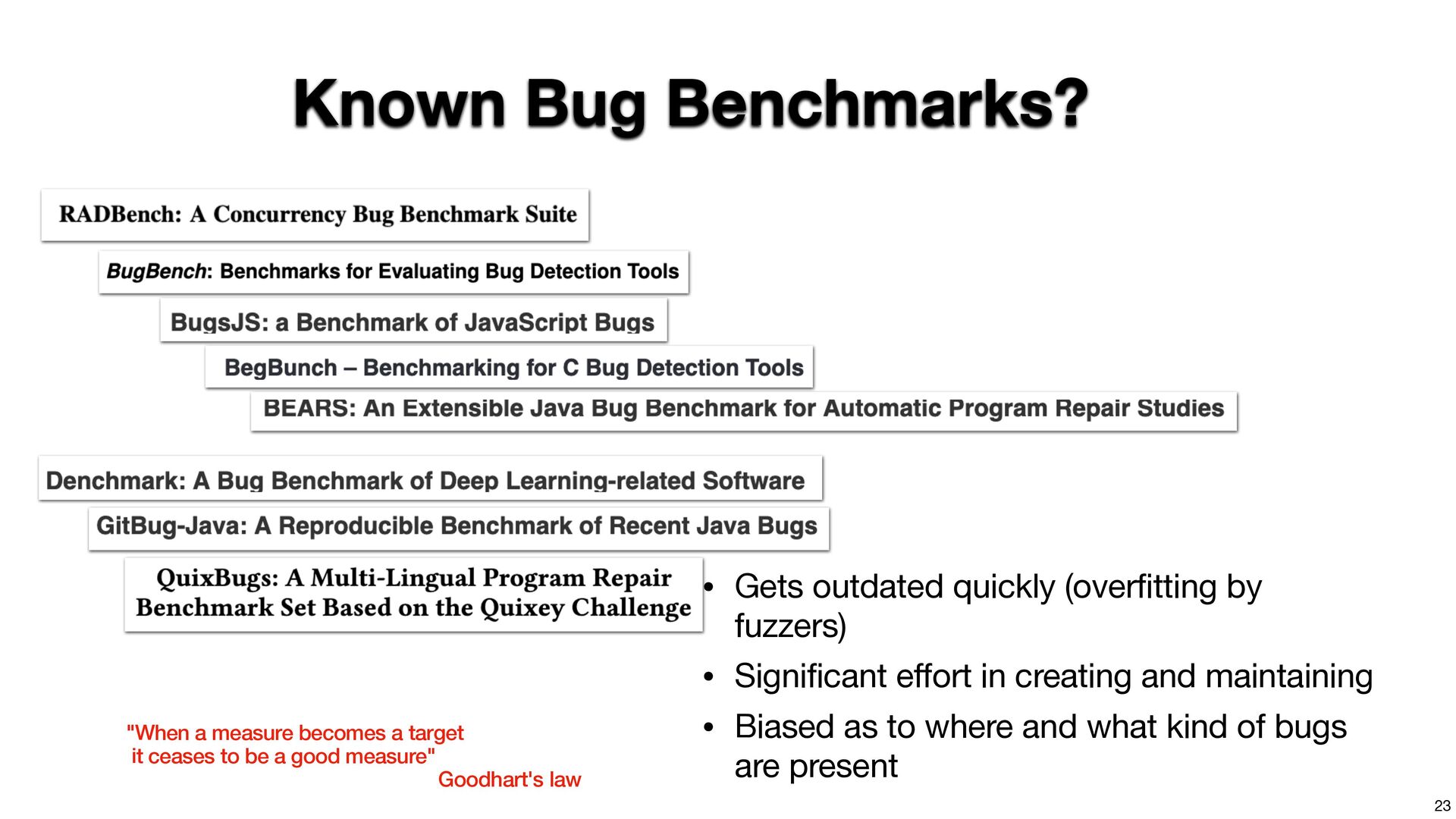
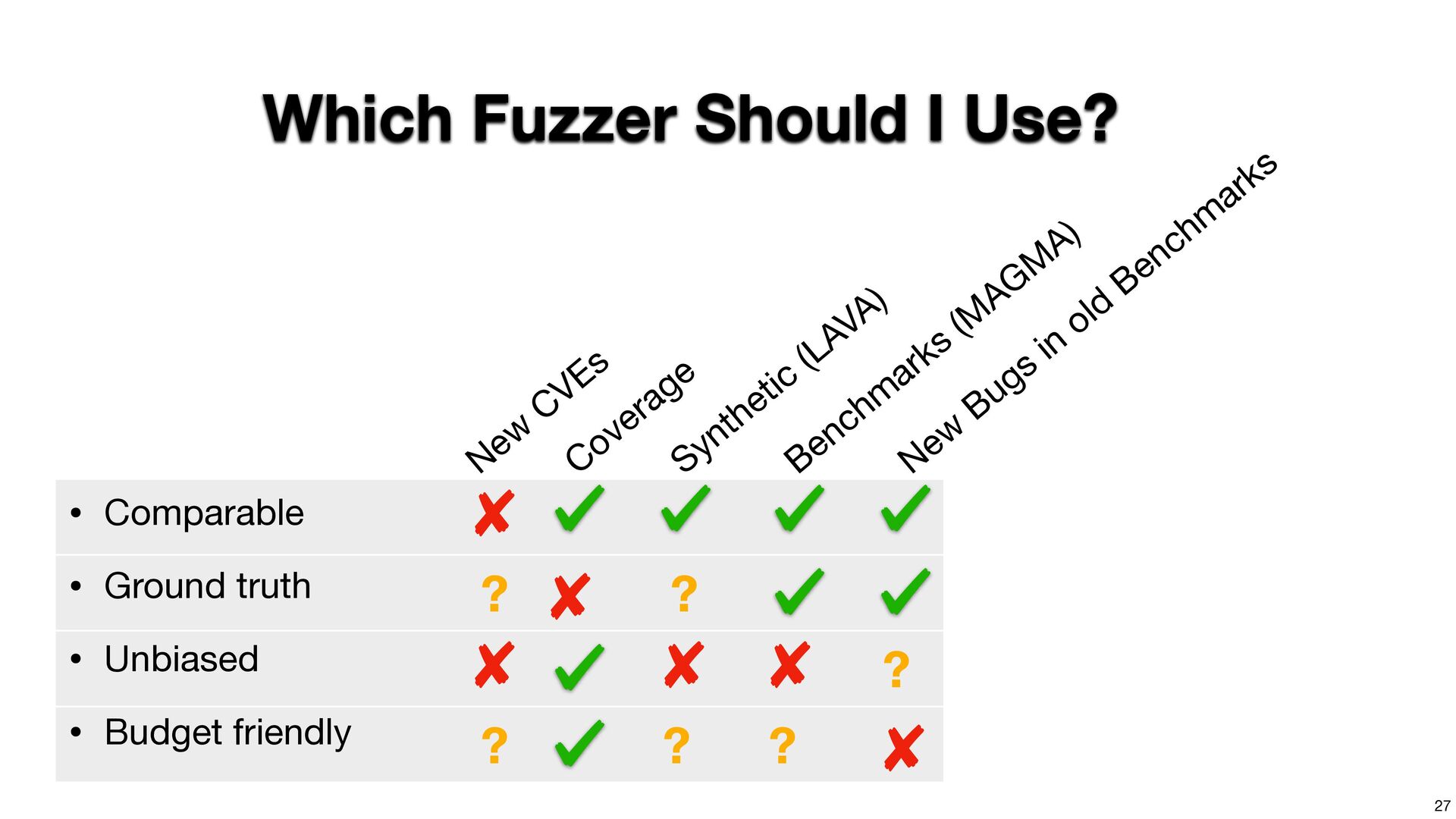
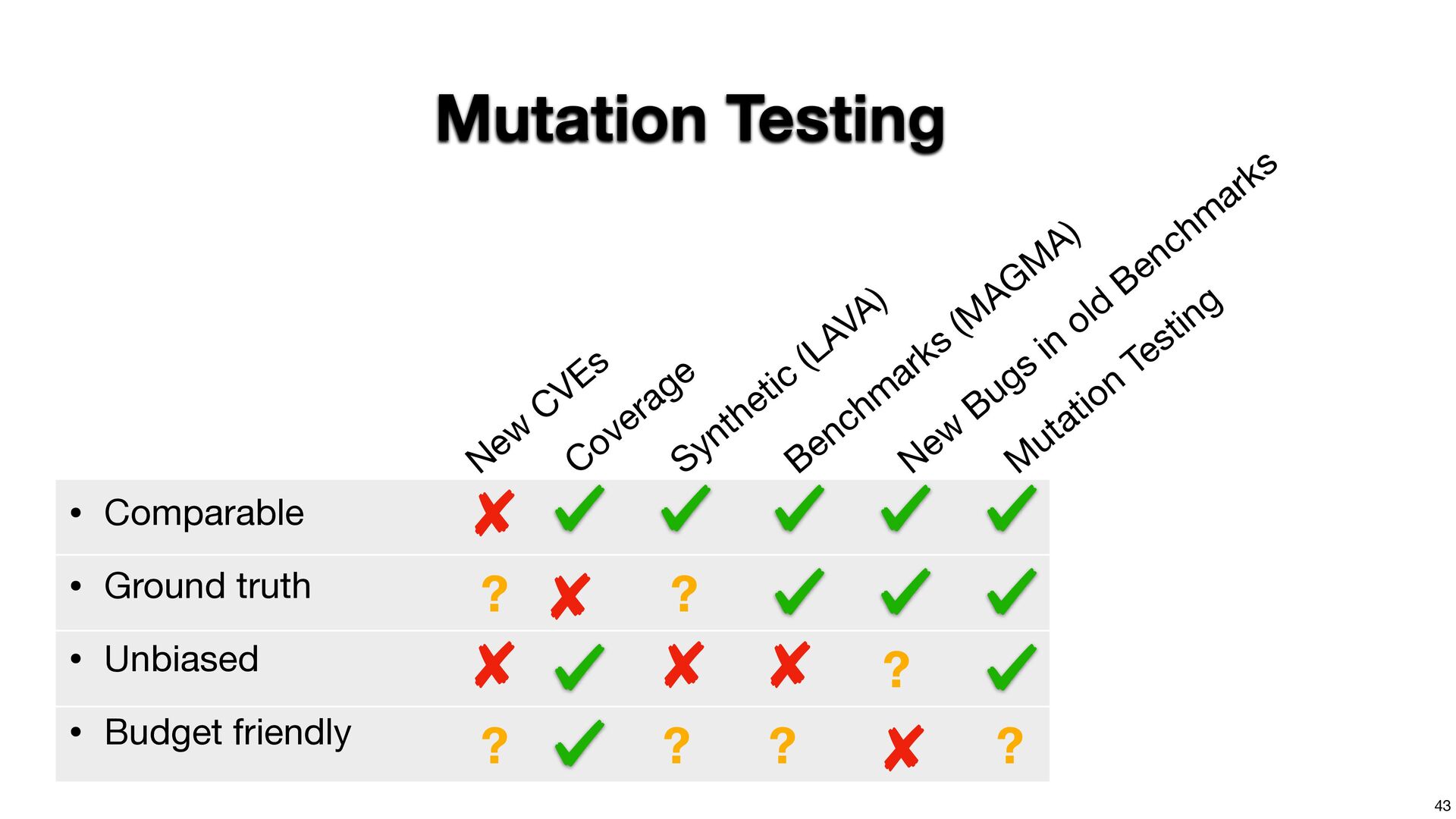
fuzzers) • Significant effort in creating and maintaining • Biased as to where and what kind of bugs are present "When a measure becomes a target it ceases to be a good measure" Goodhart's law
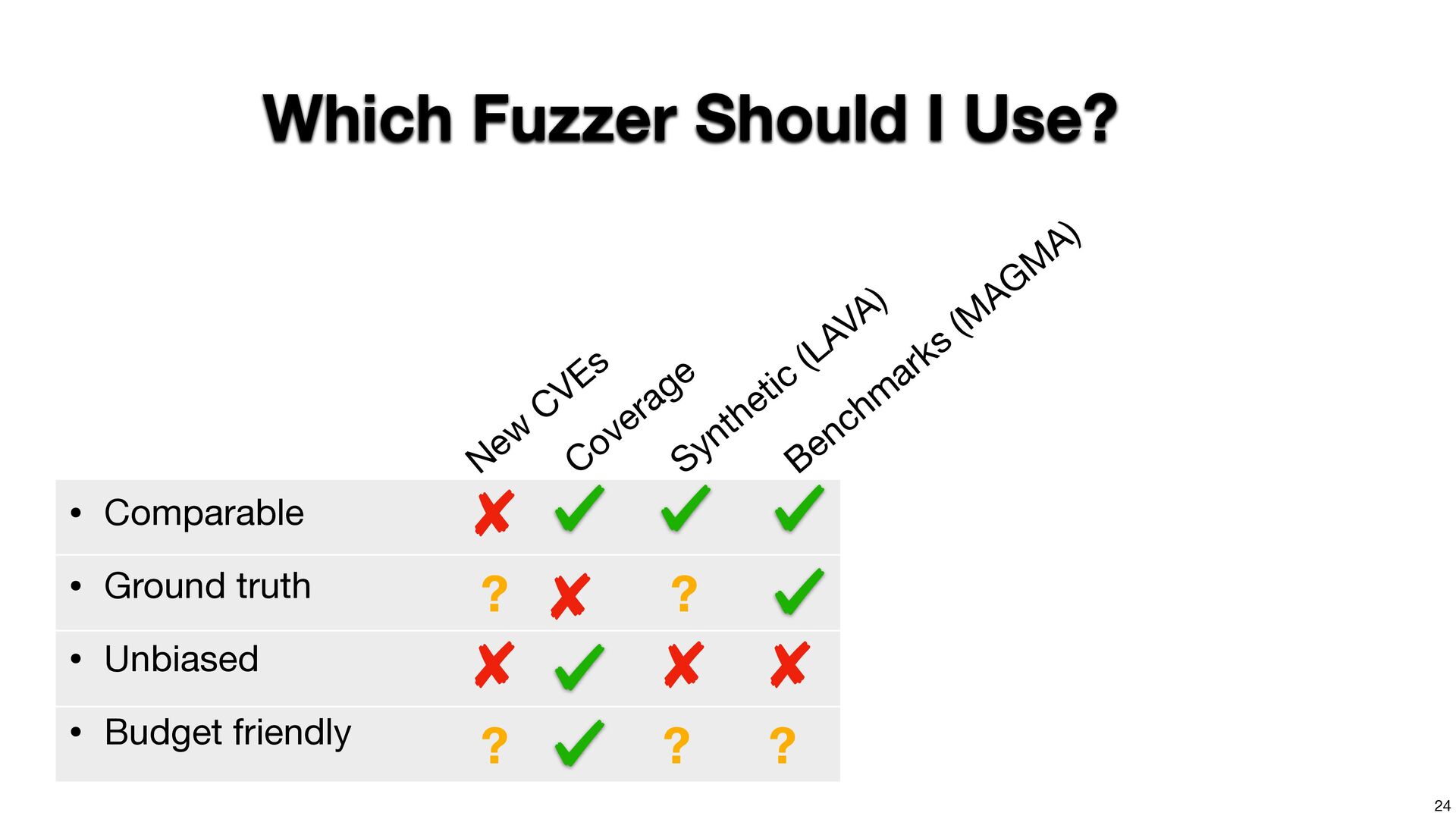
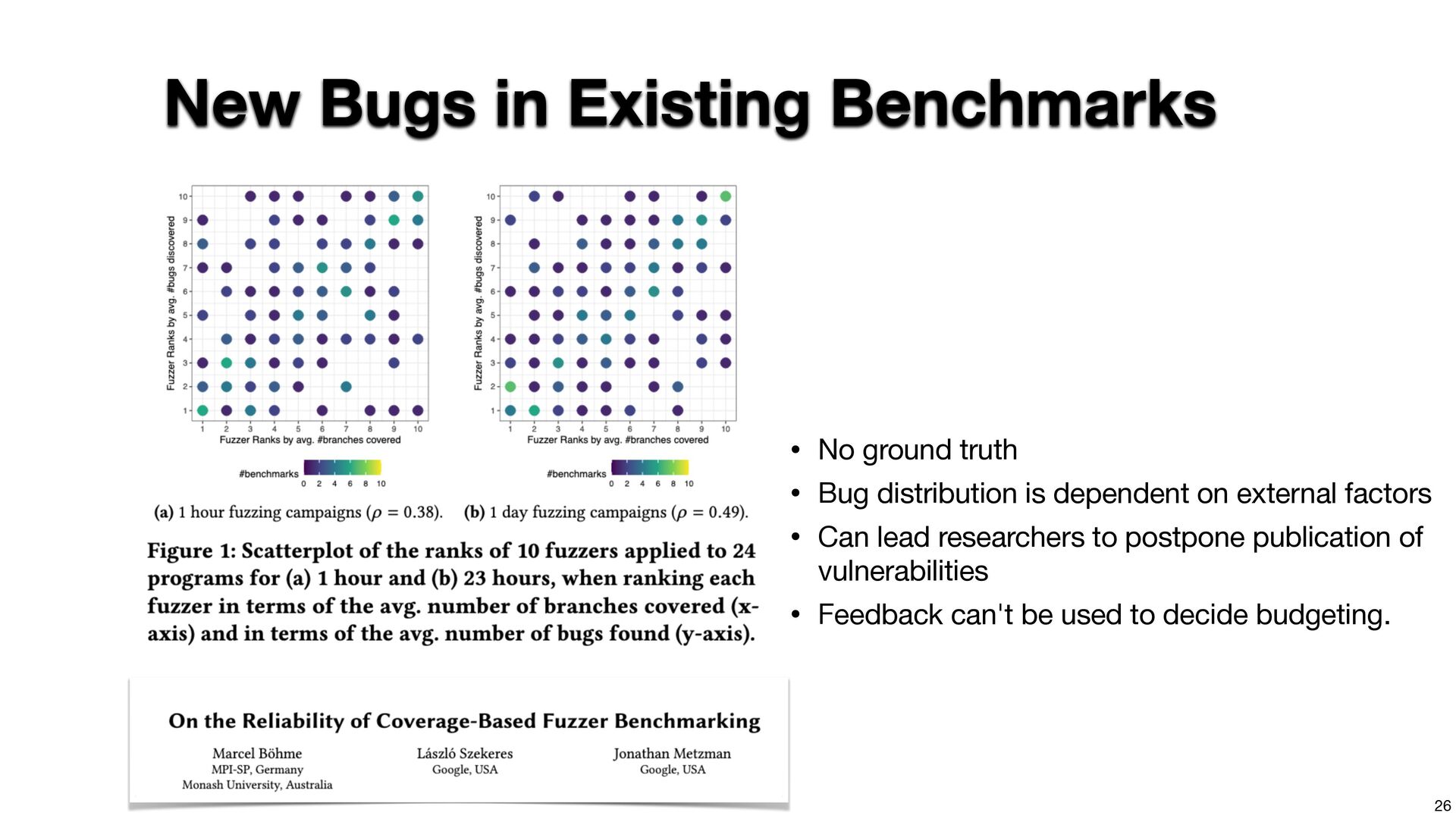
• Bug distribution is dependent on external factors • Can lead researchers to postpone publication of vulnerabilities • Feedback can't be used to decide budgeting.
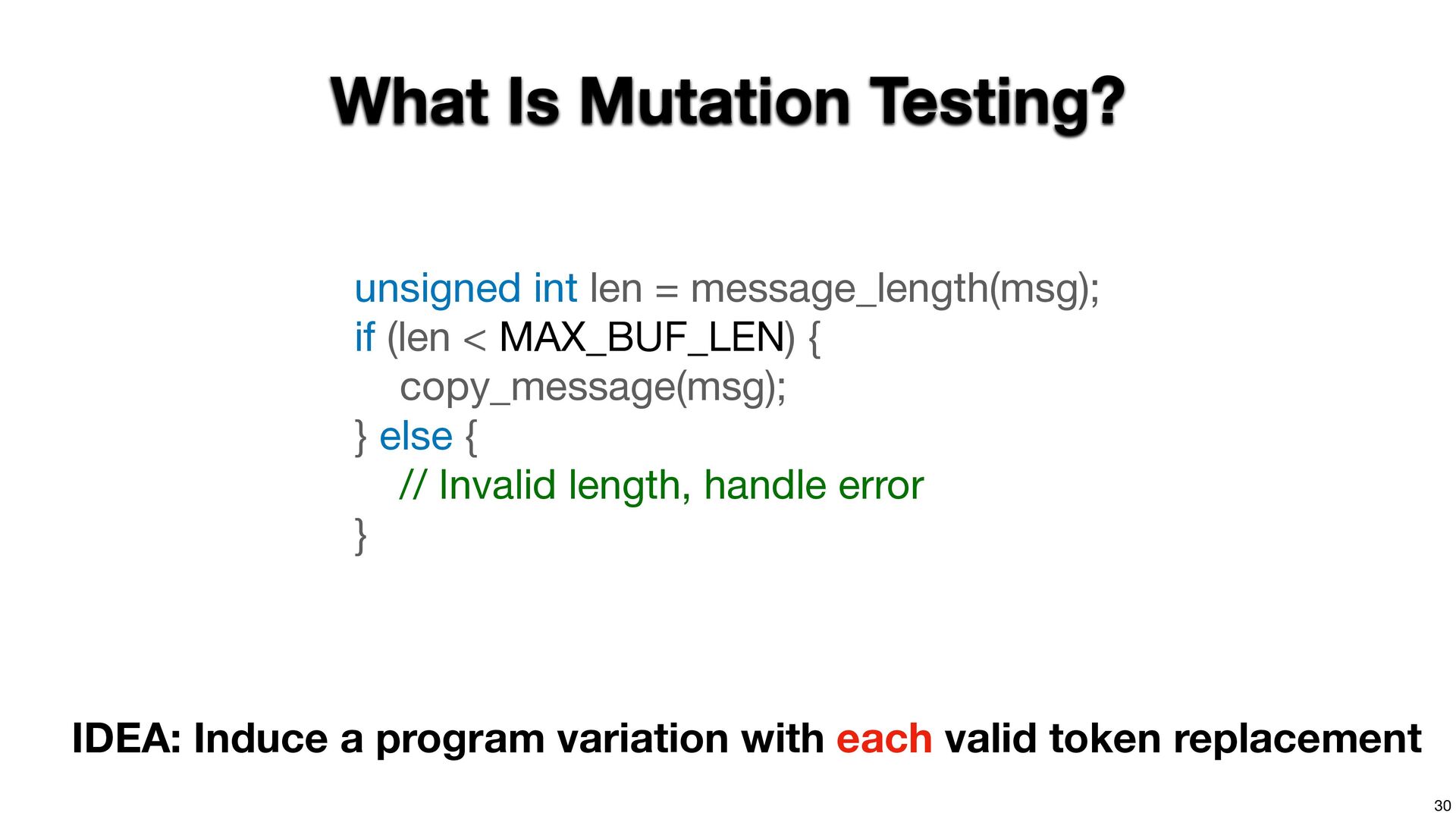
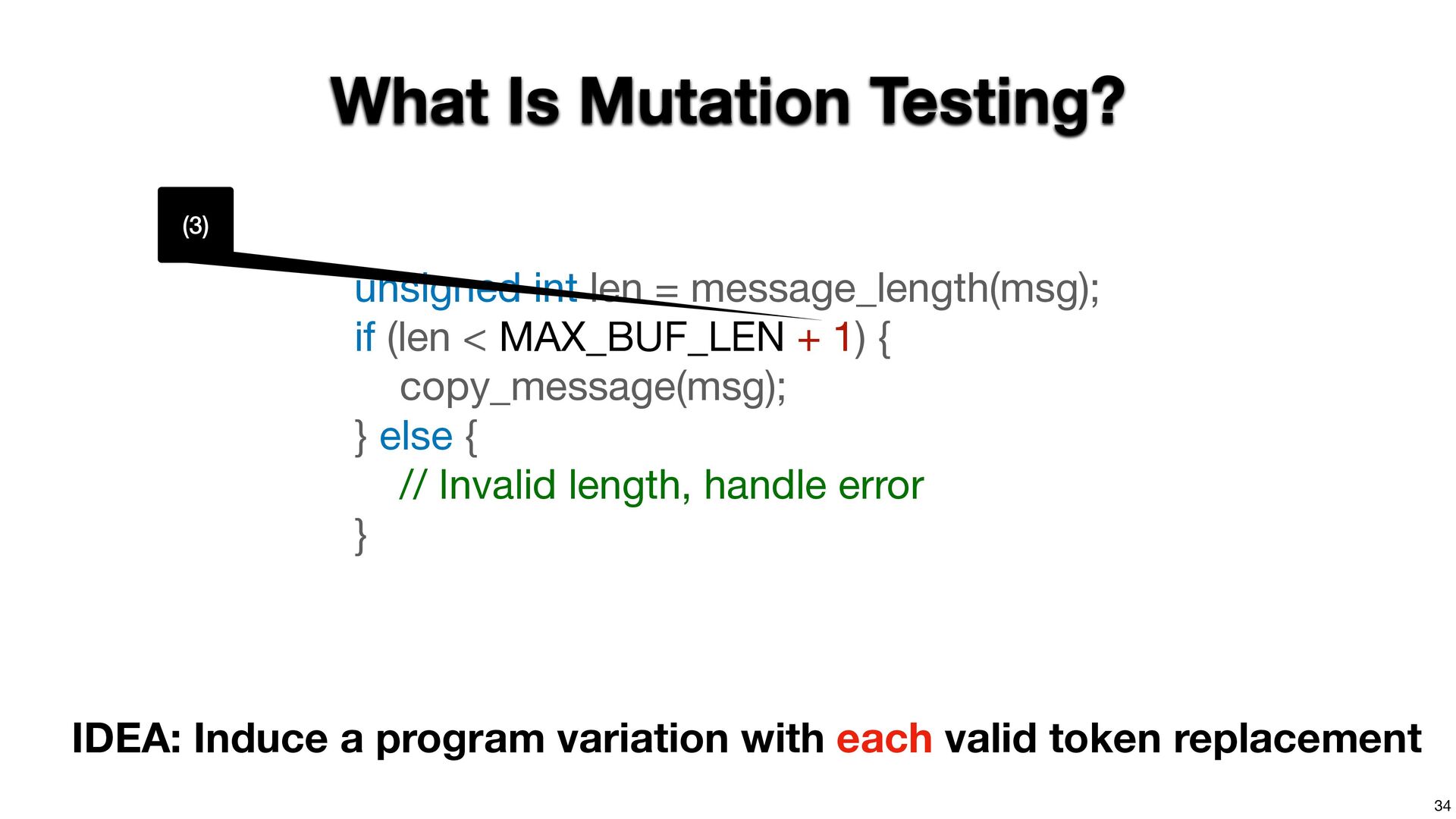
{ copy_message(msg); } else { // Invalid length, handle error } What Is Mutation Testing? IDEA: Induce a program variation with each valid token replacement
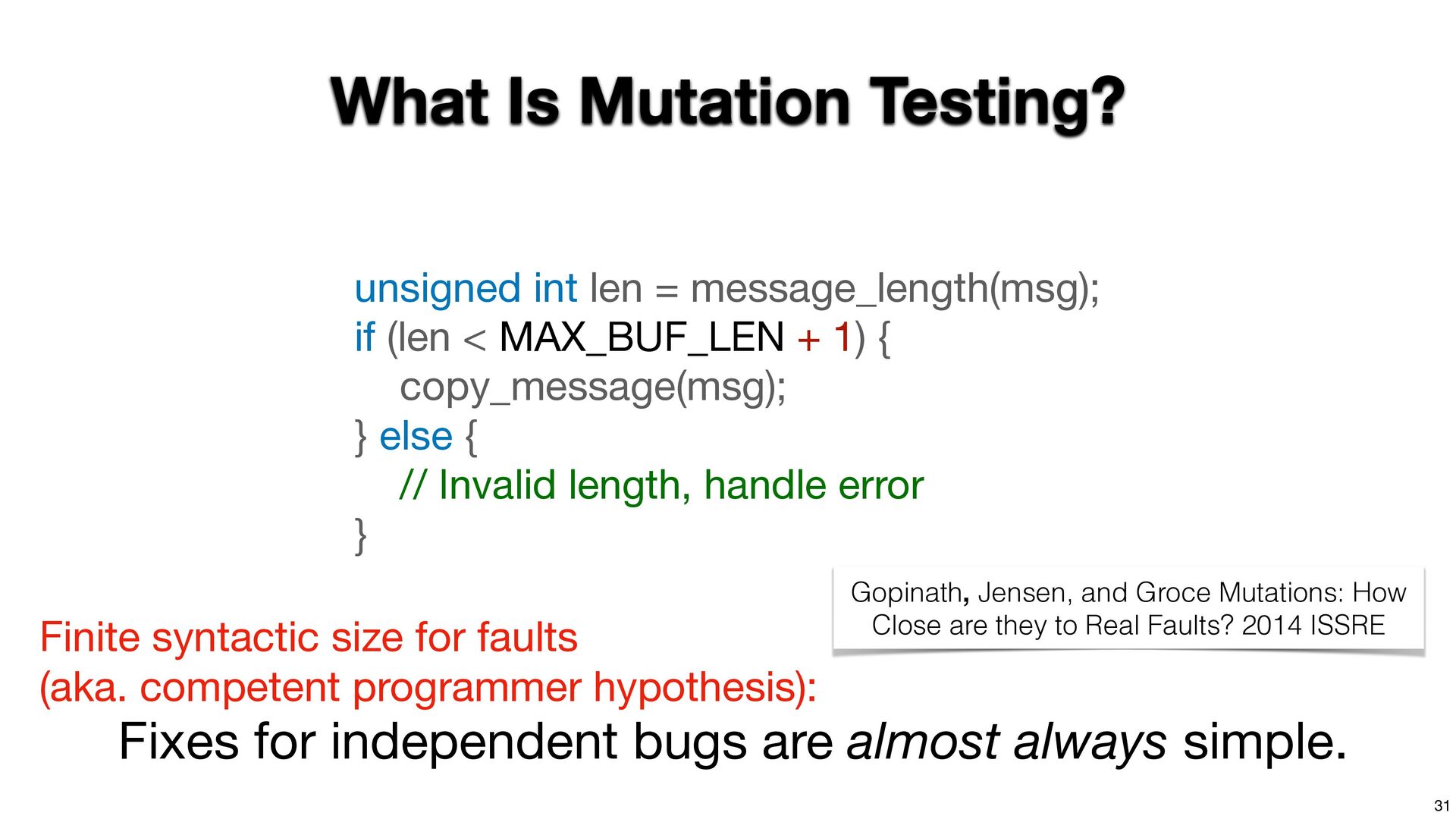
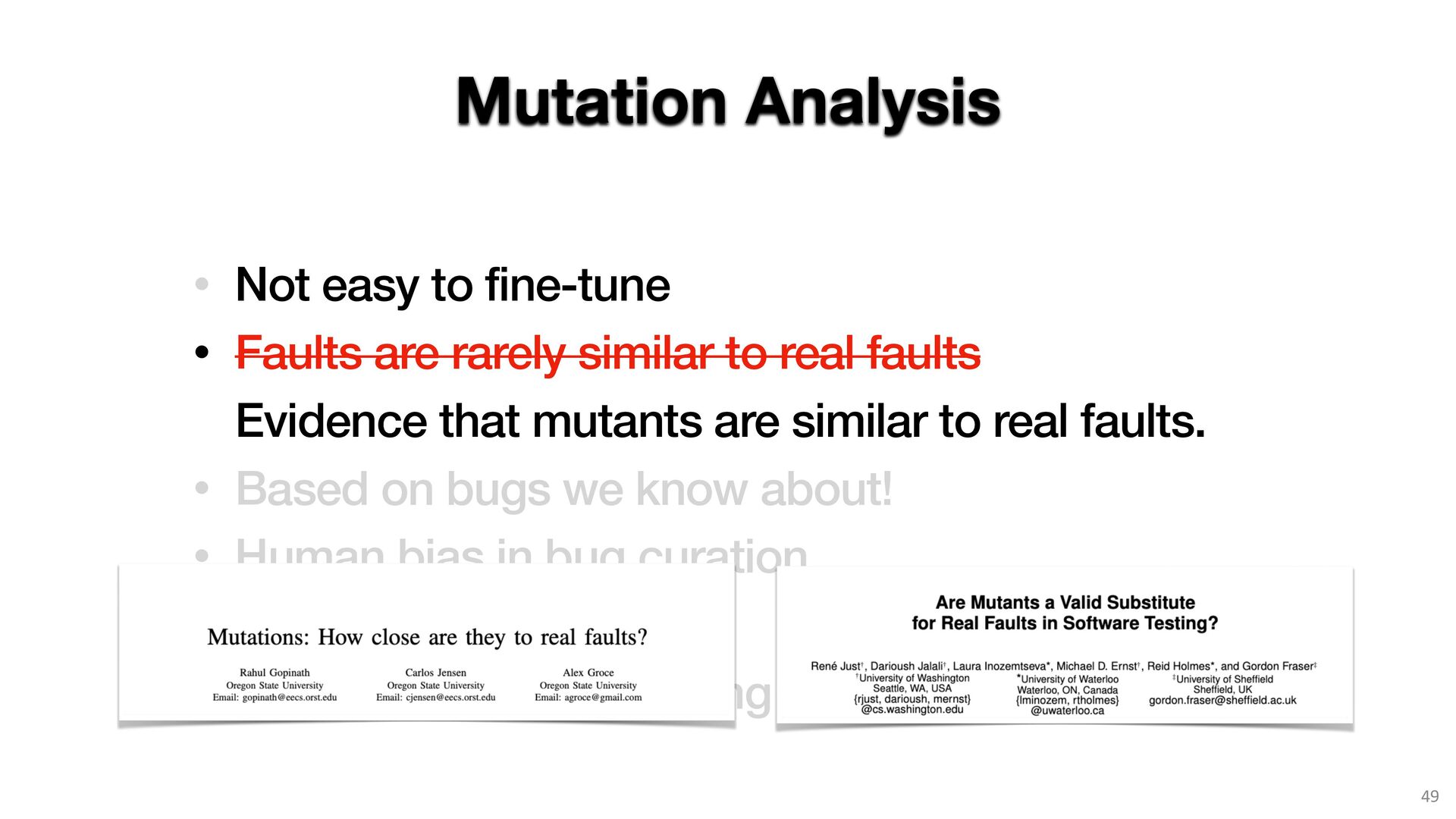
+ 1) { copy_message(msg); } else { // Invalid length, handle error } What Is Mutation Testing? Fixes for independent bugs are almost always simple. Finite syntactic size for faults (aka. competent programmer hypothesis): Gopinath, Jensen, and Groce Mutations: How Close are they to Real Faults? 2014 ISSRE
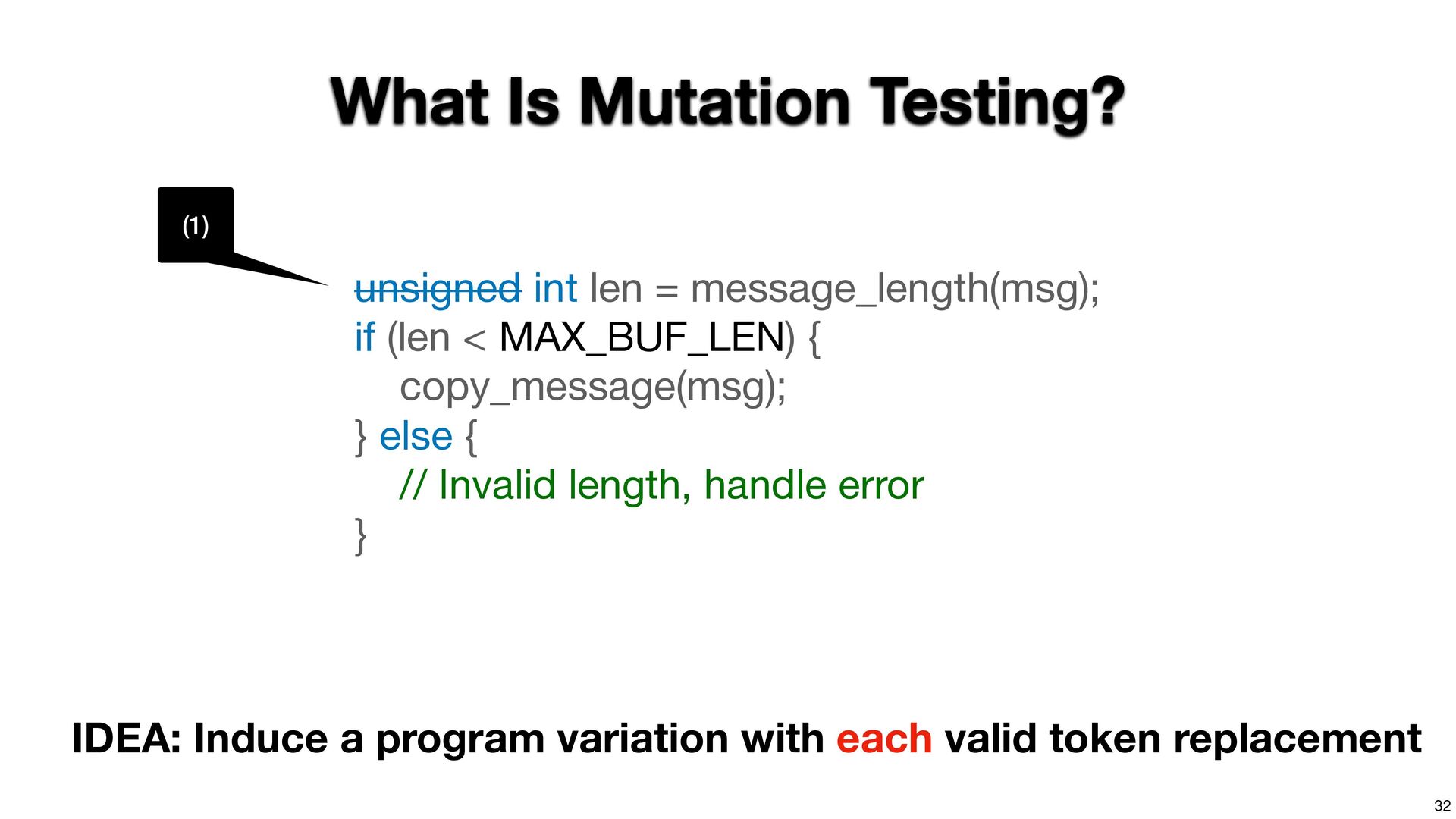
{ copy_message(msg); } else { // Invalid length, handle error } What Is Mutation Testing? (1) IDEA: Induce a program variation with each valid token replacement
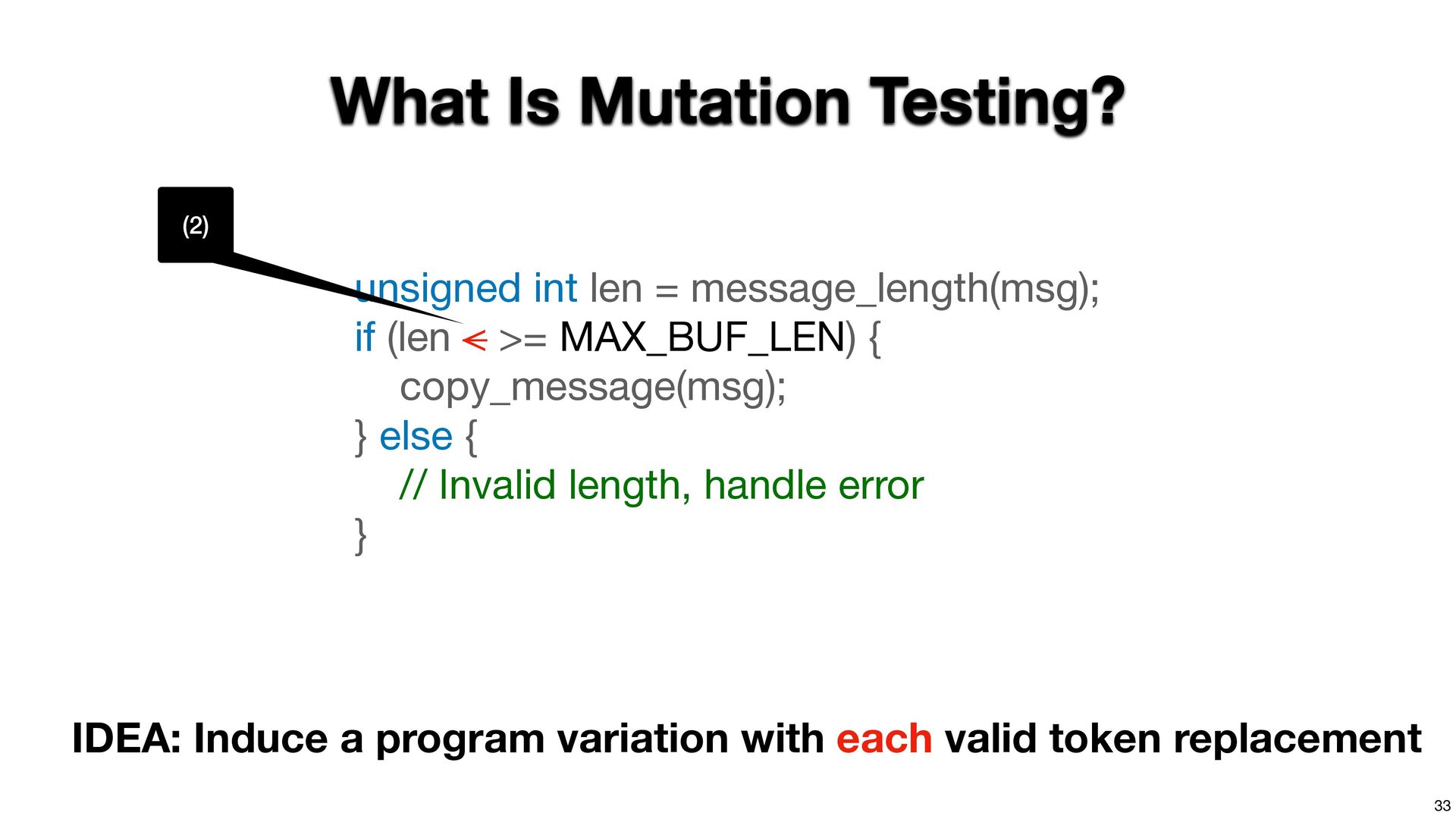
MAX_BUF_LEN) { copy_message(msg); } else { // Invalid length, handle error } What Is Mutation Testing? (2) IDEA: Induce a program variation with each valid token replacement
+ 1) { copy_message(msg); } else { // Invalid length, handle error } What Is Mutation Testing? (3) IDEA: Induce a program variation with each valid token replacement
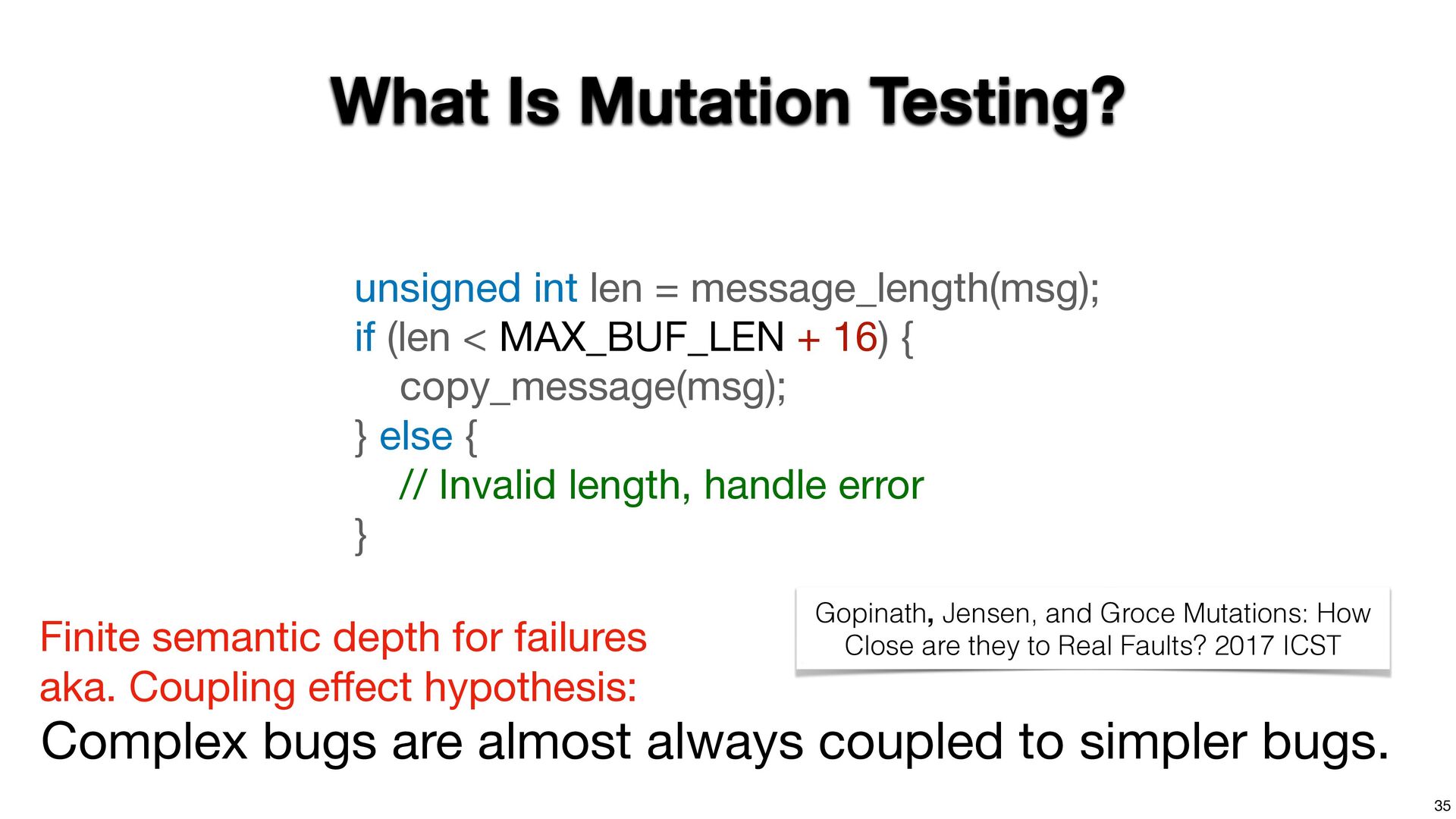
+ 16) { copy_message(msg); } else { // Invalid length, handle error } What Is Mutation Testing? Complex bugs are almost always coupled to simpler bugs. Finite semantic depth for failures aka. Coupling e ff ect hypothesis: Gopinath, Jensen, and Groce Mutations: How Close are they to Real Faults? 2017 ICST
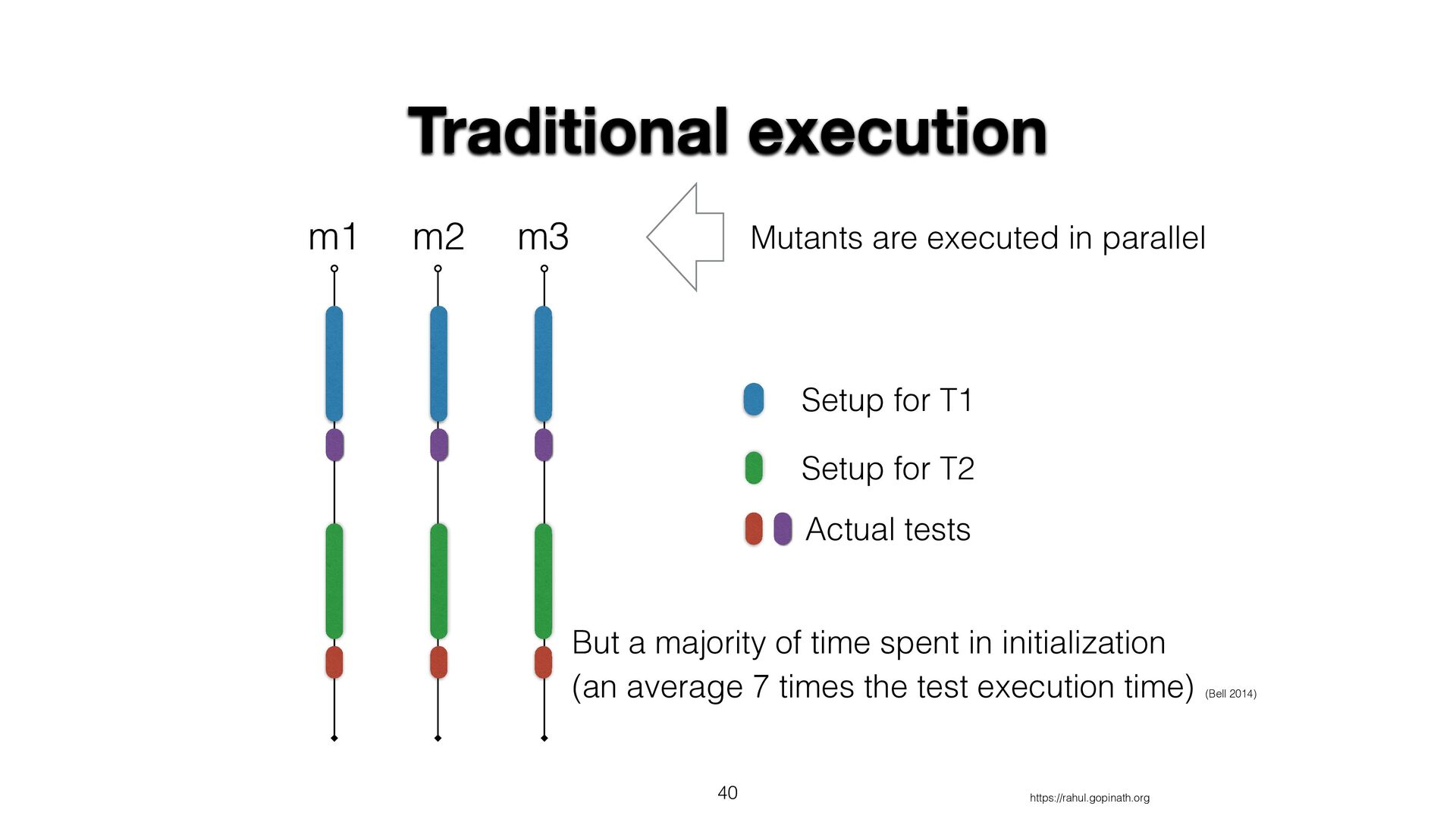
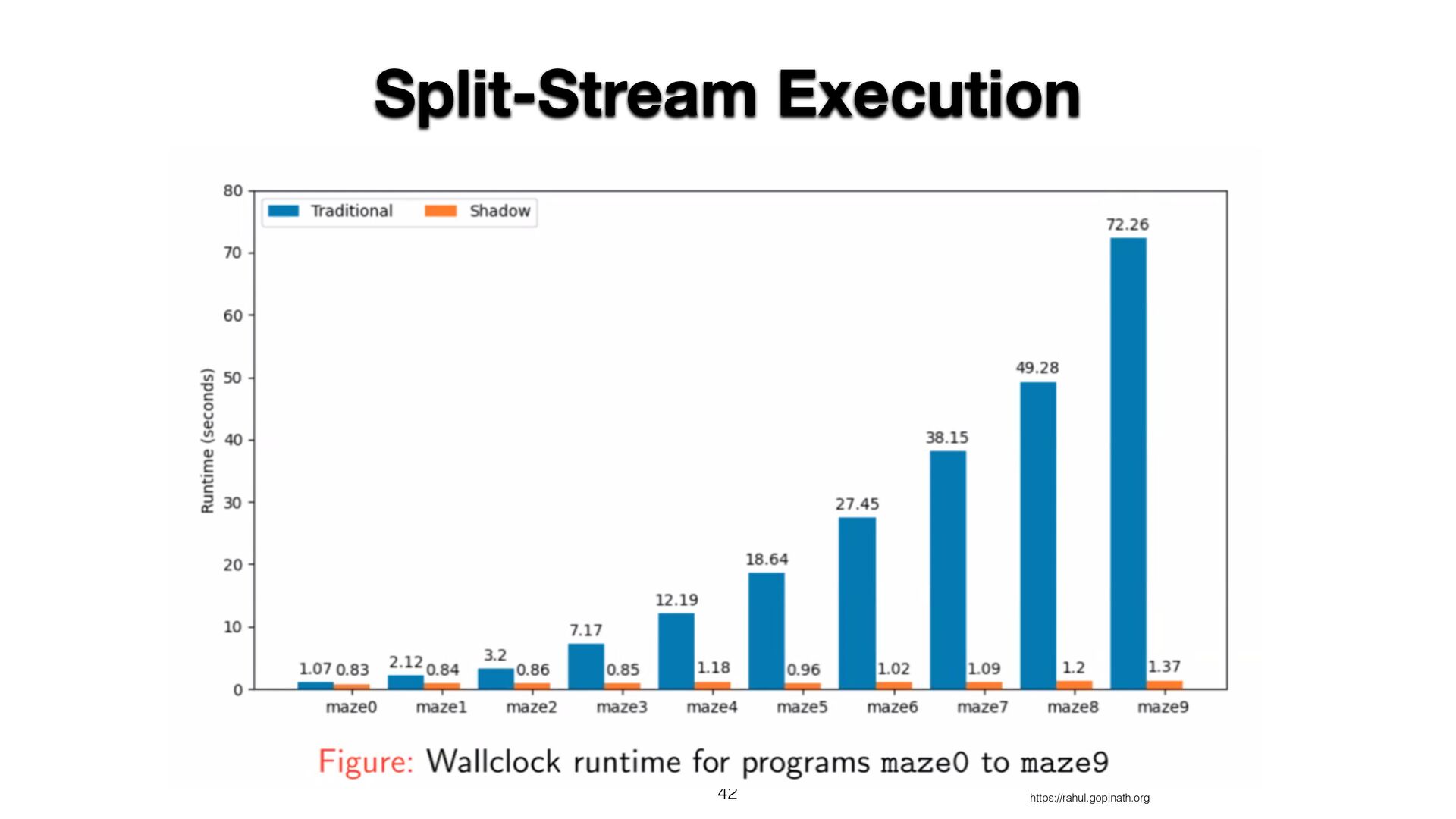
Setup for T2 Actual tests Mutants are executed in parallel But a majority of time spent in initialization (an average 7 times the test execution time) (Bell 2014)
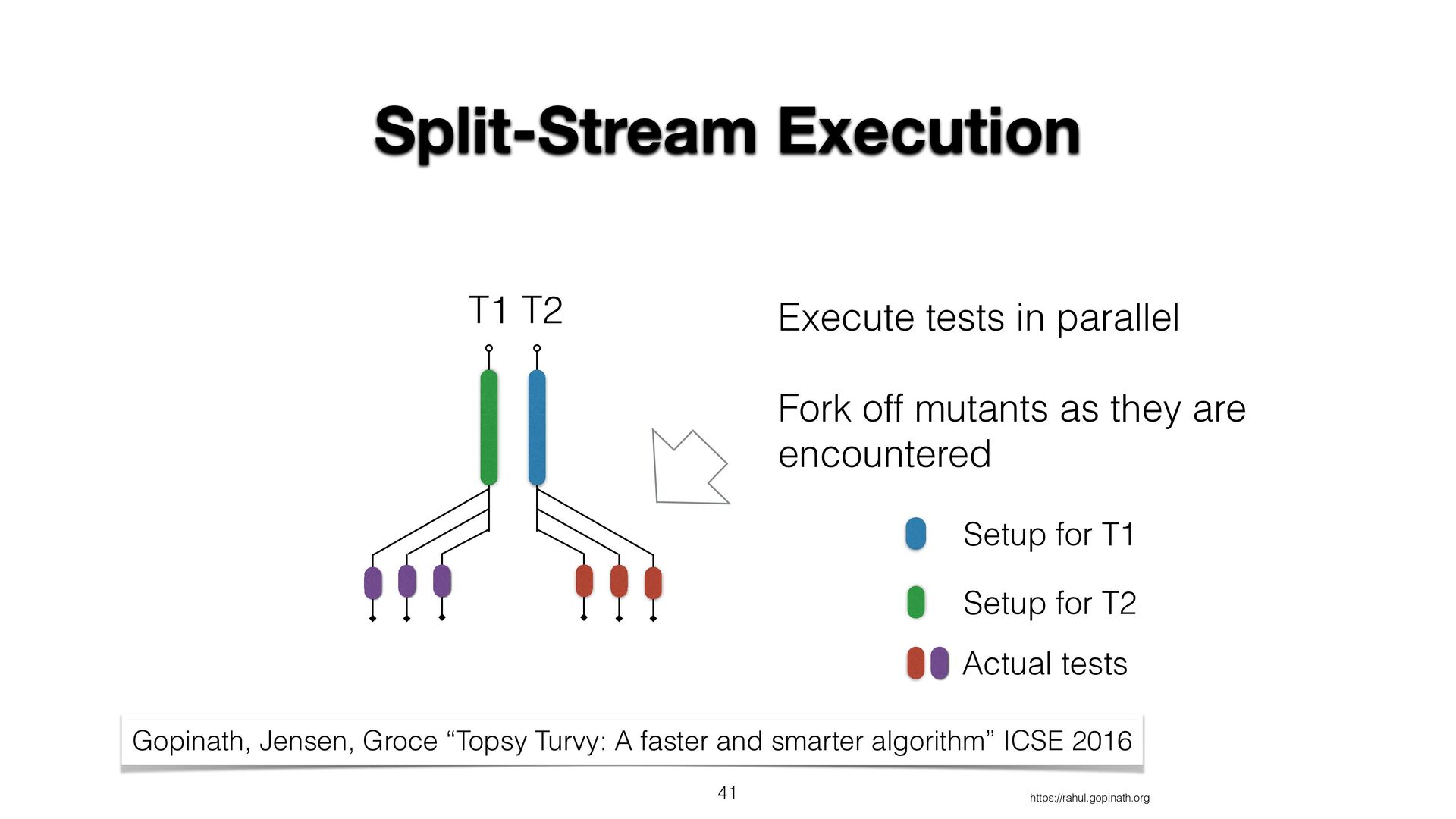
Actual tests Execute tests in parallel Fork off mutants as they are encountered T1 T2 Gopinath, Jensen, Groce “Topsy Turvy: A faster and smarter algorithm” ICSE 2016
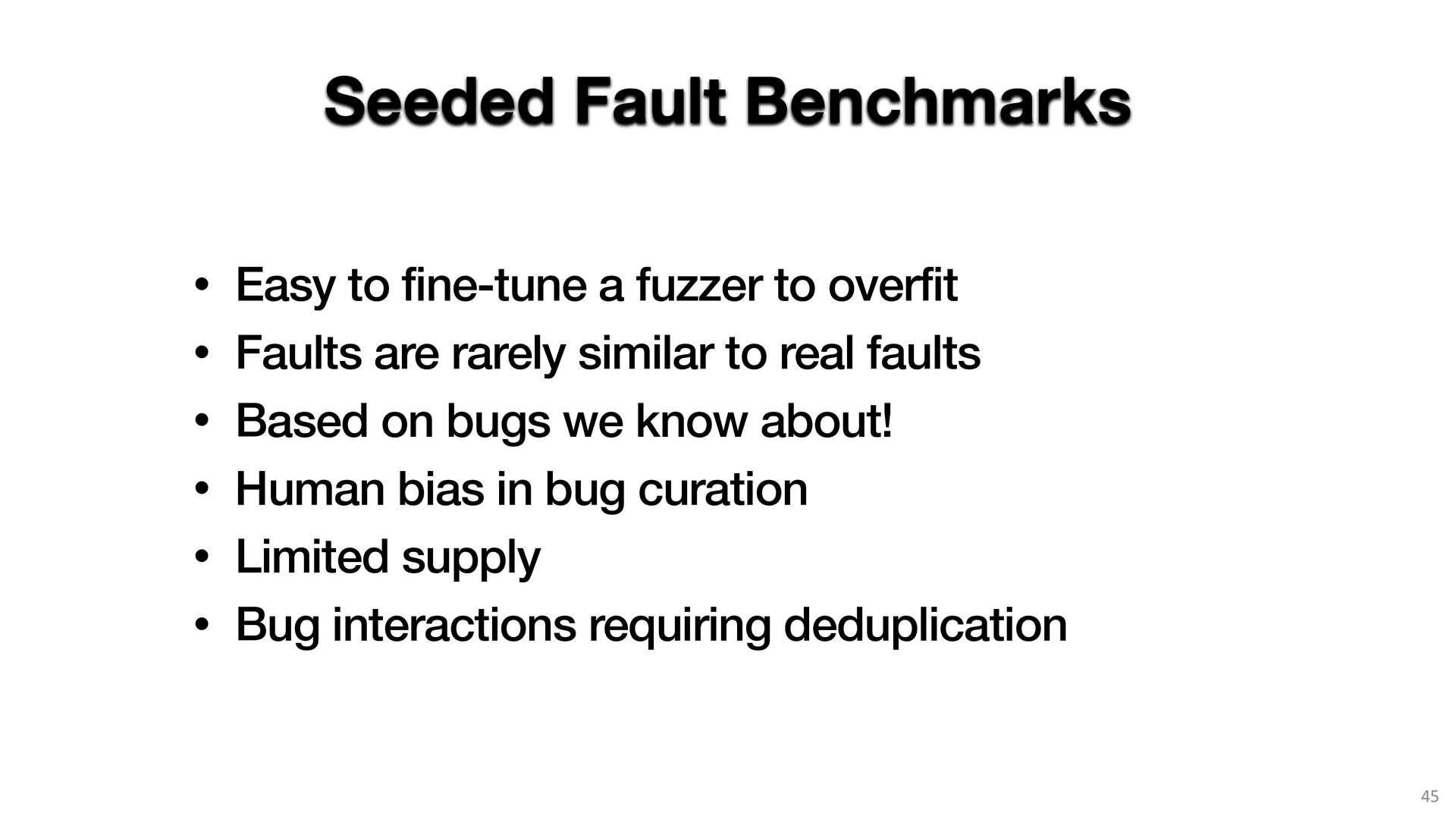
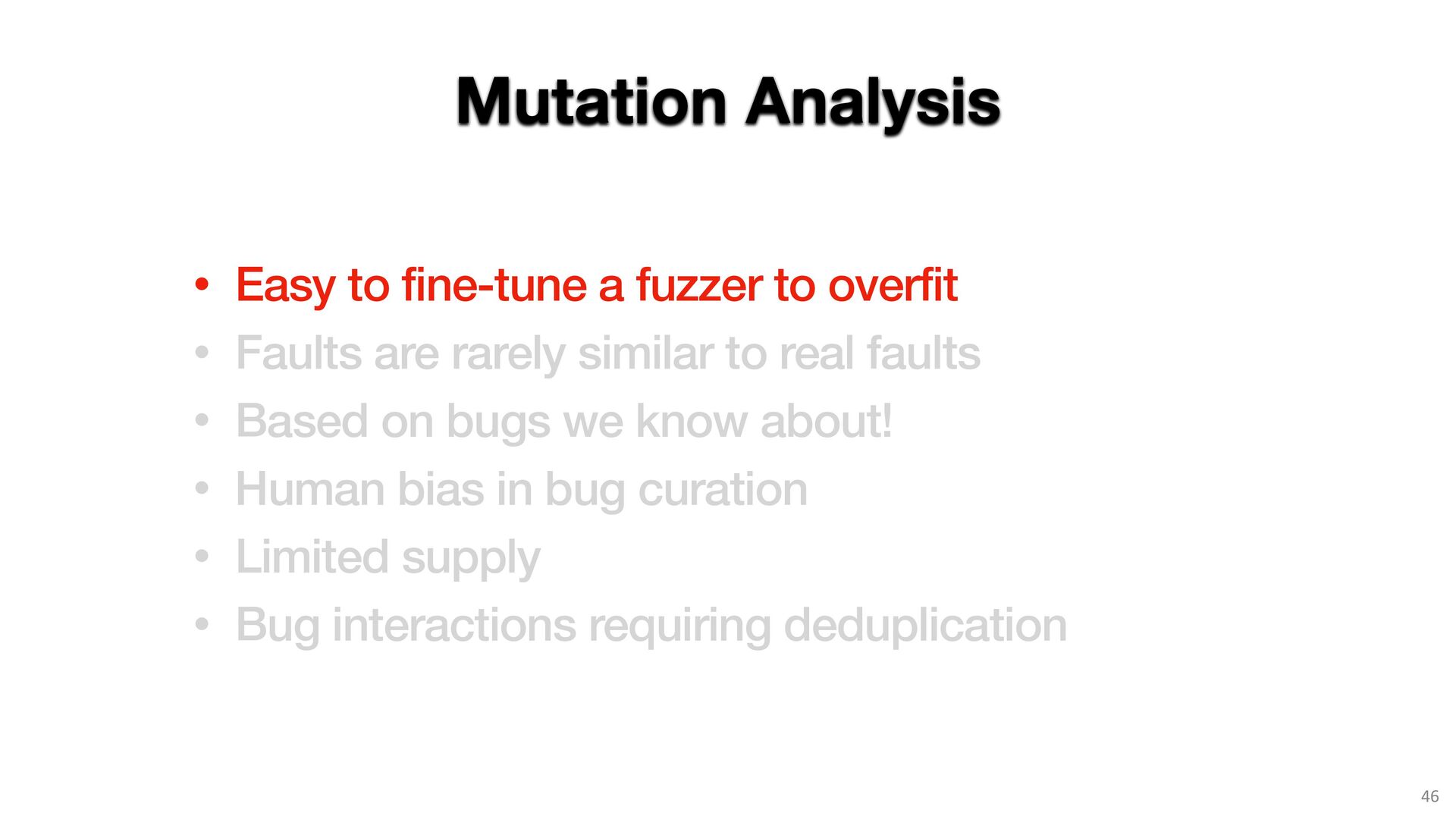
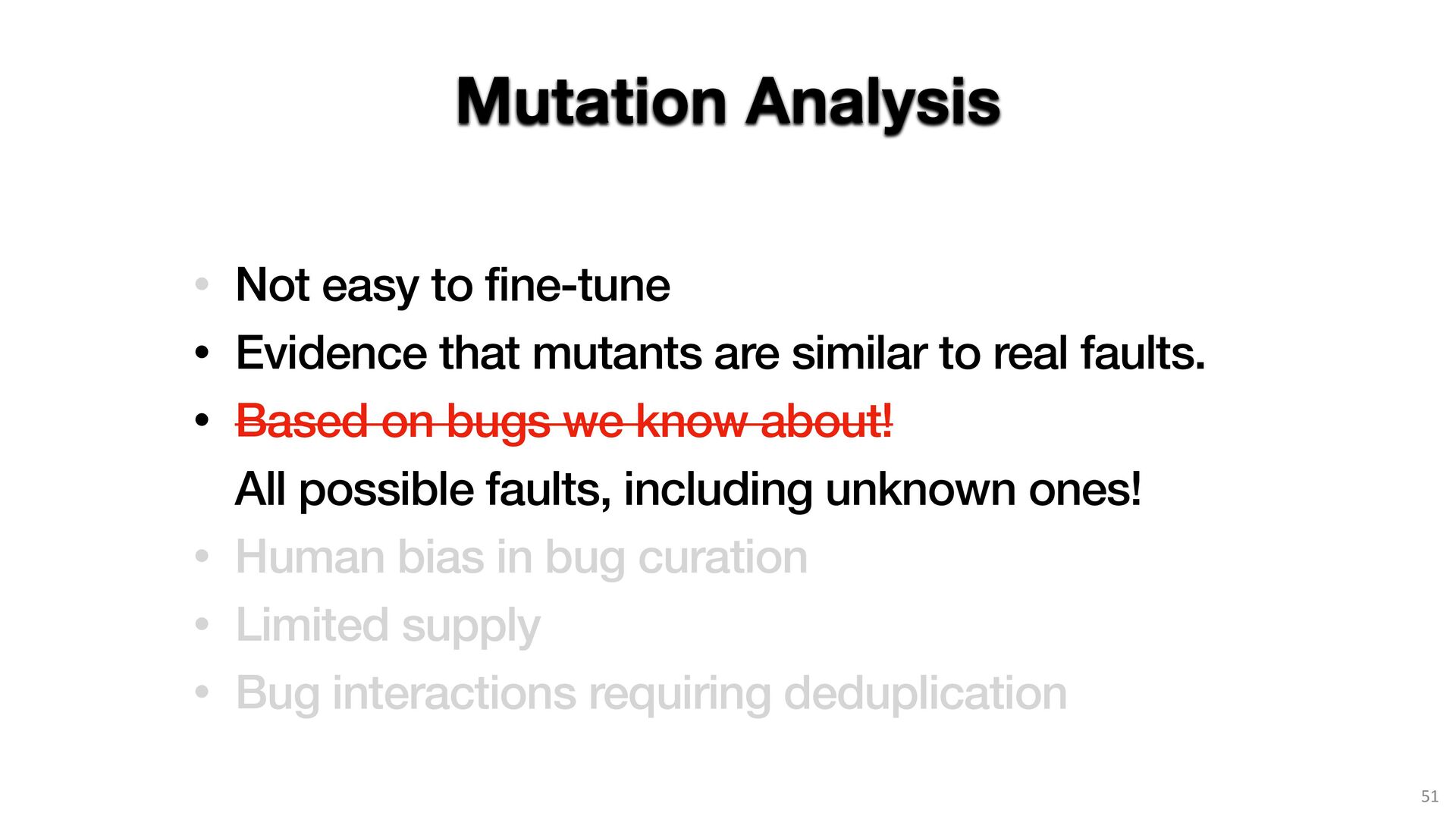
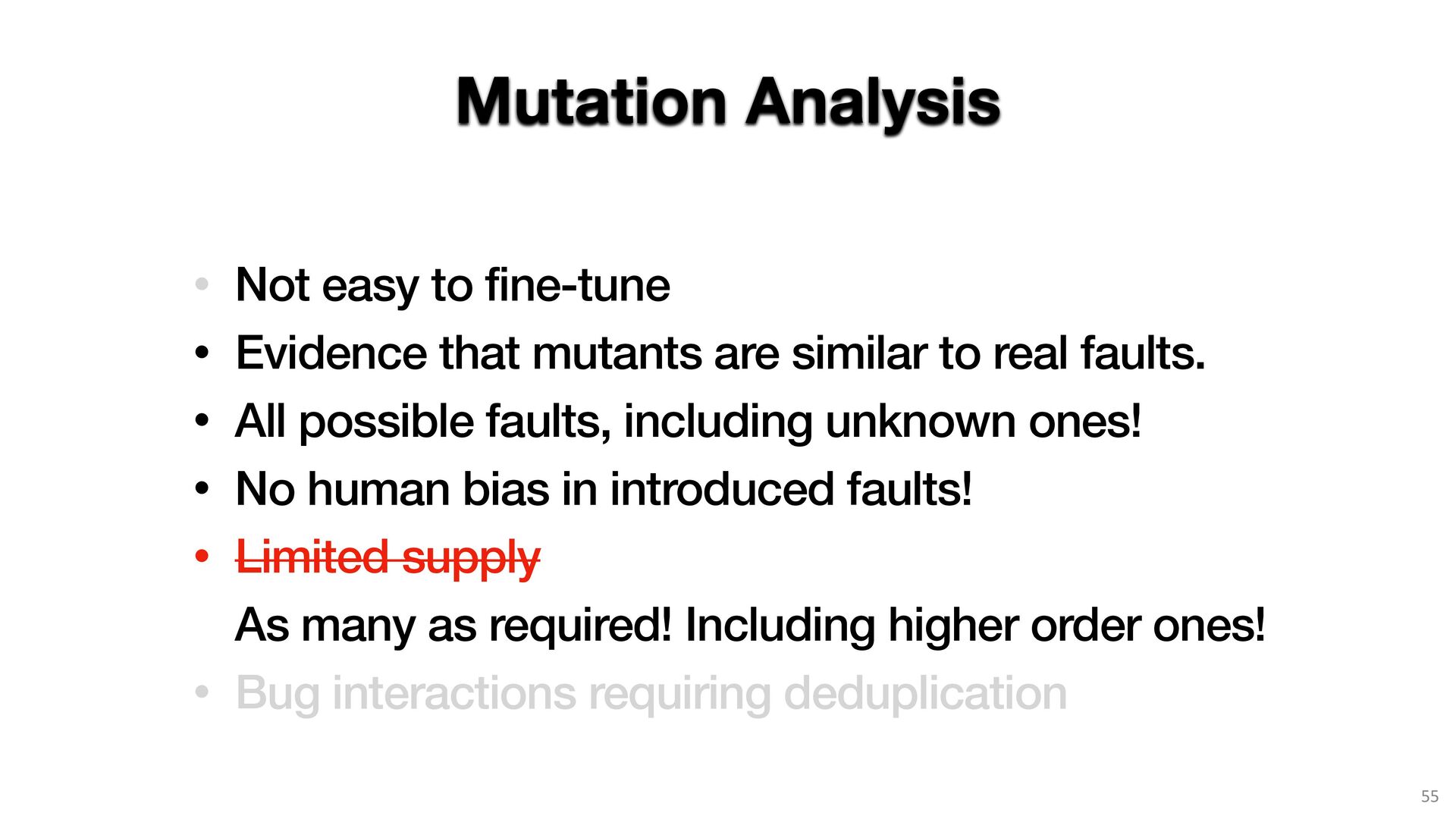
to overfit • Faults are rarely similar to real faults • Based on bugs we know about! • Human bias in bug curation • Limited supply • Bug interactions requiring deduplication
overfit • Faults are rarely similar to real faults • Based on bugs we know about! • Human bias in bug curation • Limited supply • Bug interactions requiring deduplication
overfit Very large number of faults • Faults are rarely similar to real faults • Based on bugs we know about! • Human bias in bug curation • Limited supply • Bug interactions requiring deduplication
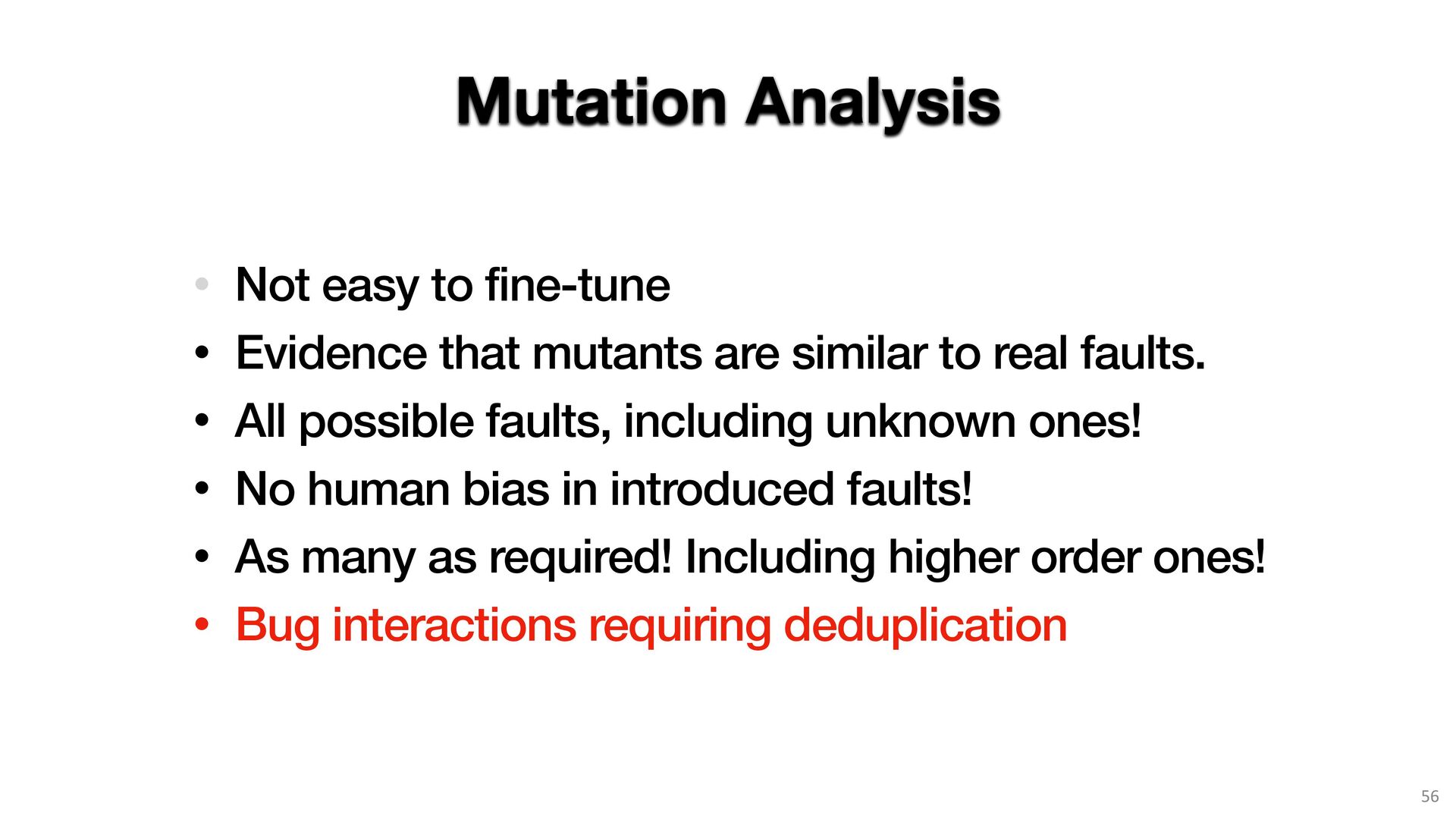
are rarely similar to real faults • Based on bugs we know about! • Human bias in bug curation • Limited supply • Bug interactions requiring deduplication
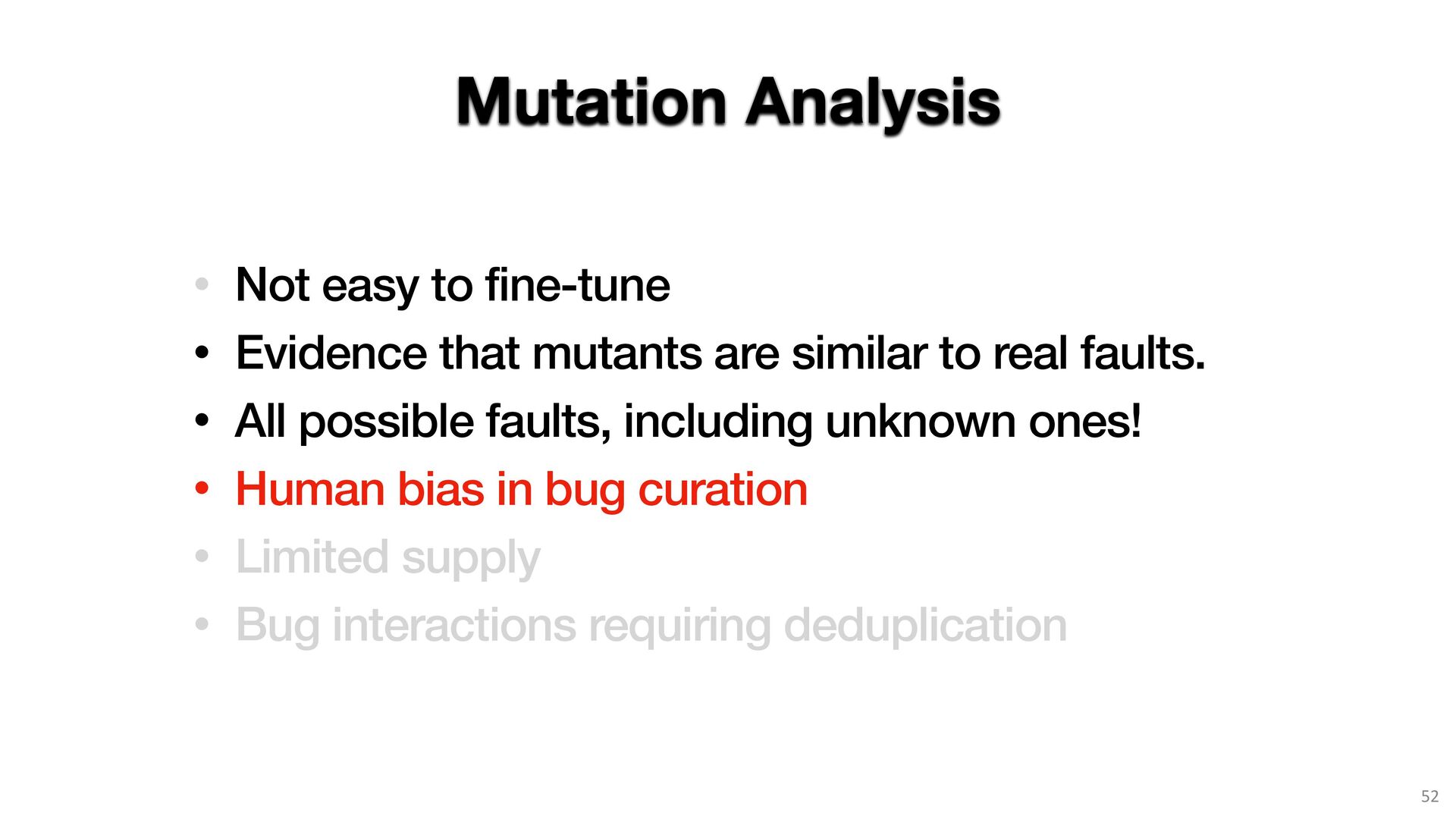
are rarely similar to real faults Evidence that mutants are similar to real faults. • Based on bugs we know about! • Human bias in bug curation • Limited supply • Bug interactions requiring deduplication
that mutants are similar to real faults. • Based on bugs we know about! • Human bias in bug curation • Limited supply • Bug interactions requiring deduplication
that mutants are similar to real faults. • Based on bugs we know about! All possible faults, including unknown ones! • Human bias in bug curation • Limited supply • Bug interactions requiring deduplication
that mutants are similar to real faults. • All possible faults, including unknown ones! • Human bias in bug curation • Limited supply • Bug interactions requiring deduplication
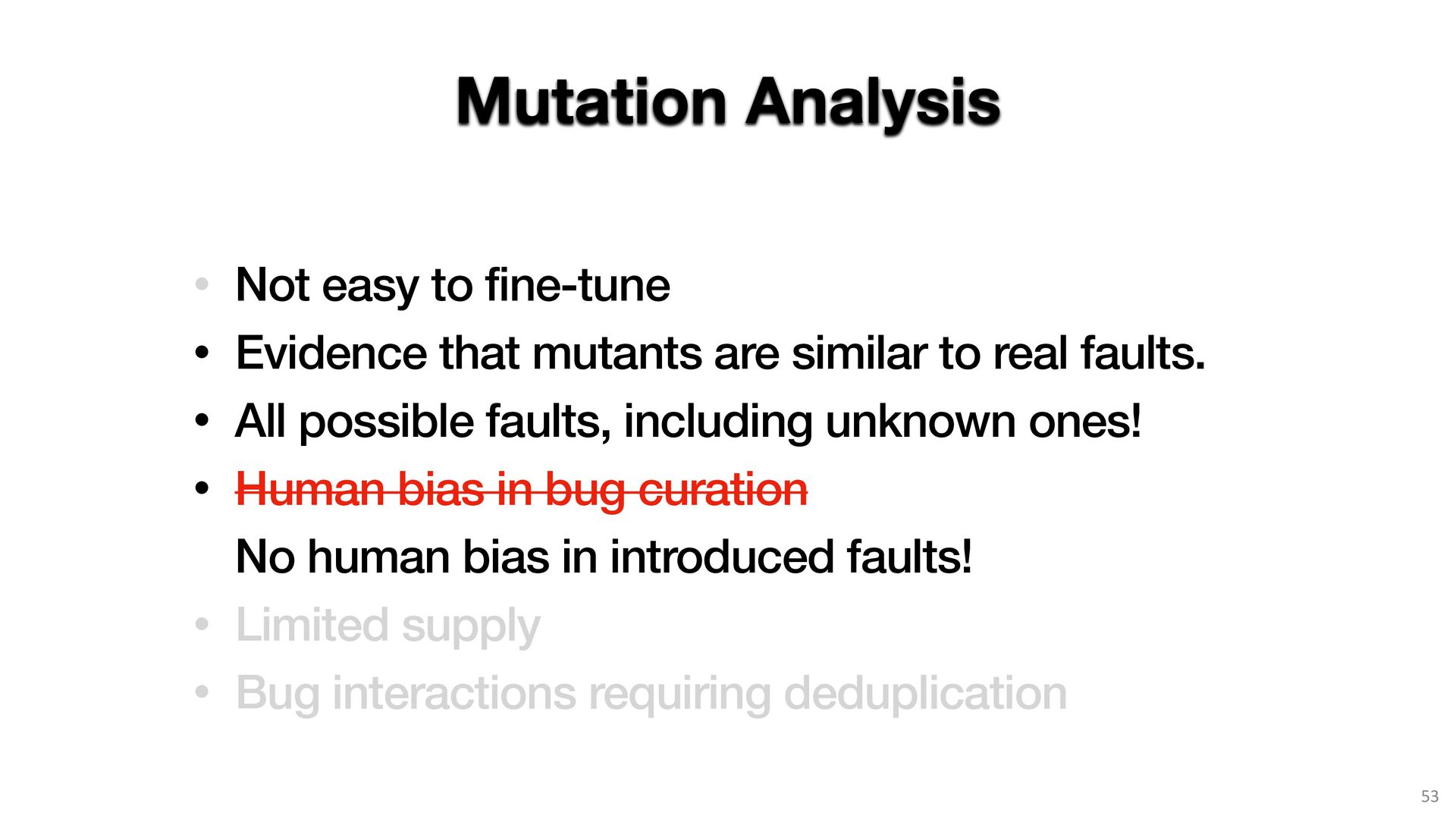
that mutants are similar to real faults. • All possible faults, including unknown ones! • Human bias in bug curation No human bias in introduced faults! • Limited supply • Bug interactions requiring deduplication
that mutants are similar to real faults. • All possible faults, including unknown ones! • No human bias in introduced faults! • Limited supply • Bug interactions requiring deduplication
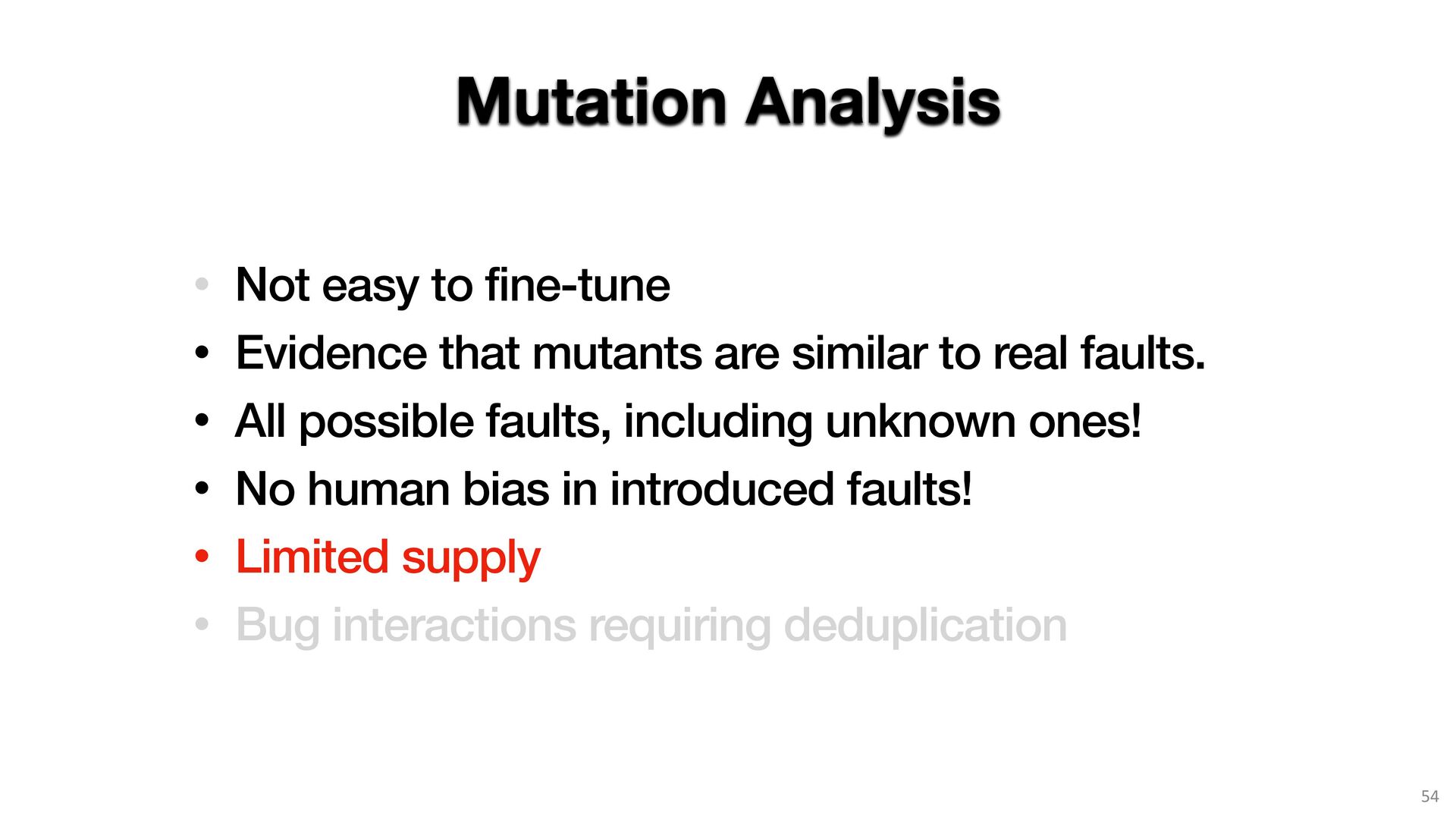
that mutants are similar to real faults. • All possible faults, including unknown ones! • No human bias in introduced faults! • Limited supply As many as required! Including higher order ones! • Bug interactions requiring deduplication
that mutants are similar to real faults. • All possible faults, including unknown ones! • No human bias in introduced faults! • As many as required! Including higher order ones! • Bug interactions requiring deduplication
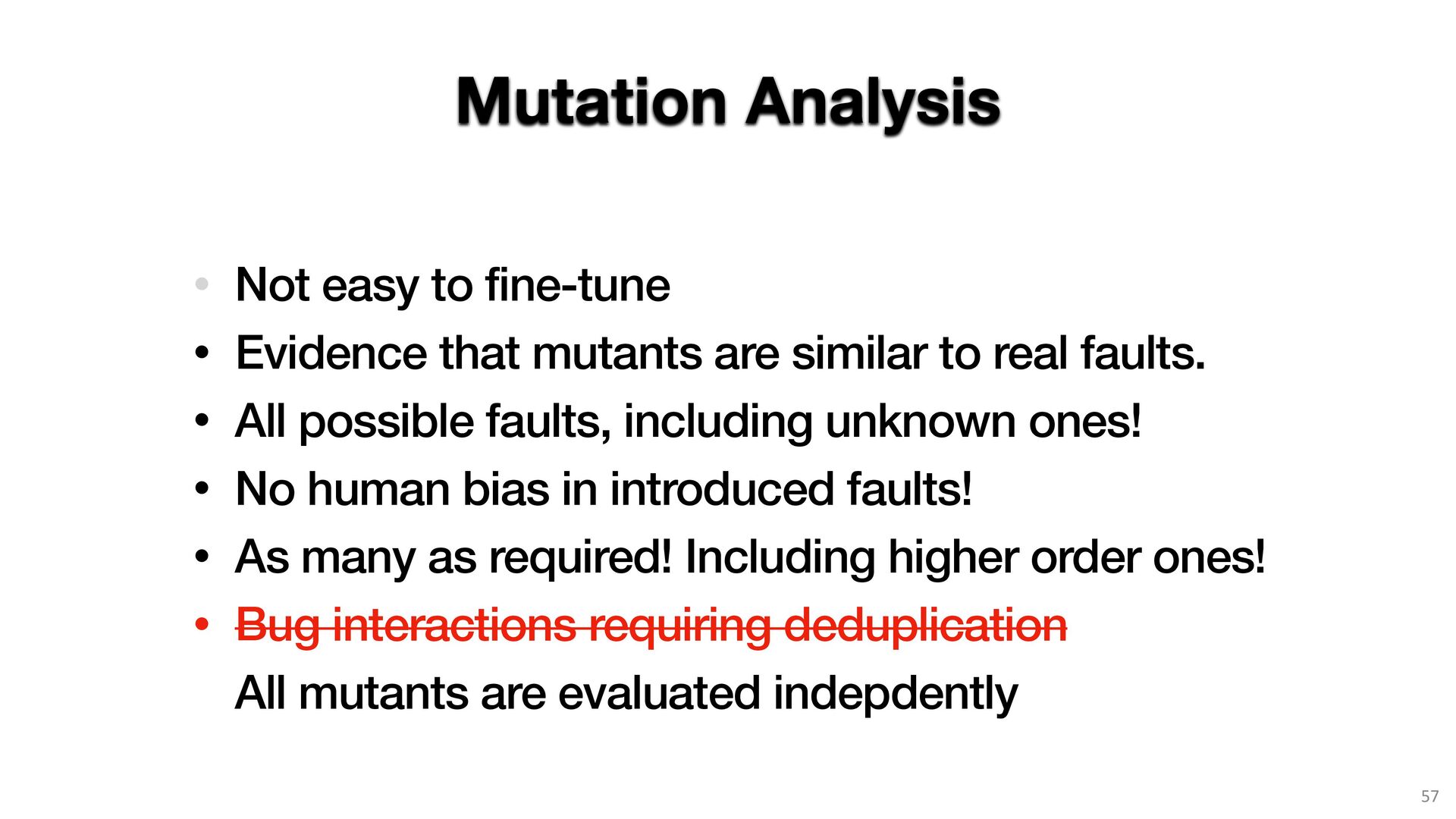
that mutants are similar to real faults. • All possible faults, including unknown ones! • No human bias in introduced faults! • As many as required! Including higher order ones! • Bug interactions requiring deduplication All mutants are evaluated indepdently
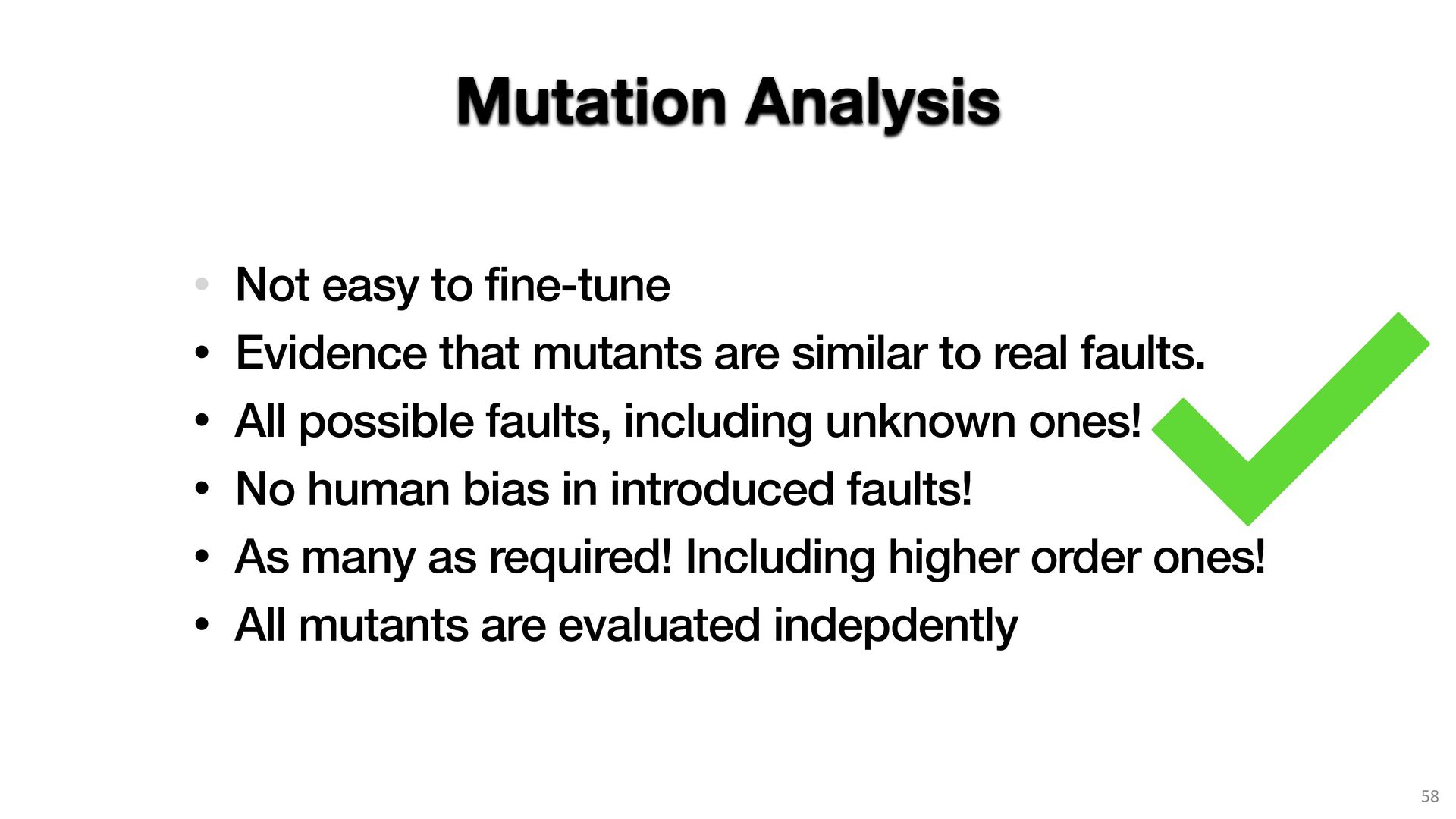
that mutants are similar to real faults. • All possible faults, including unknown ones! • No human bias in introduced faults! • As many as required! Including higher order ones! • All mutants are evaluated indepdently


 rahulgopinath
 nnchiba
 kogoro
 resolutionfoundation
 sira
 imai448
 masao
 institutdelelevage
 casualconc
 pman0214
 kanojikajino
 ldcn
 taniai
 jeffersonlam
 twada
 irinanazarova
 sachag
 denniskardys
 inesmontani
 baasie
 madoxten
 techseoconnect
 kimpetersen
 axbom