Share
Embed
Fuzzing Without Specifications: Learning Structure from Behaviour Part I

Rahul Gopinath
June 04, 2025
Transcript
84 slides
-
Fuzzing Without Speci fi cations: Learning Structure from Behaviour Part
I Rahul Gopinath 1 -
Fuzzing Without Speci fi cations: Learning Structure from Behaviour Part
I Rahul Gopinath 2 -
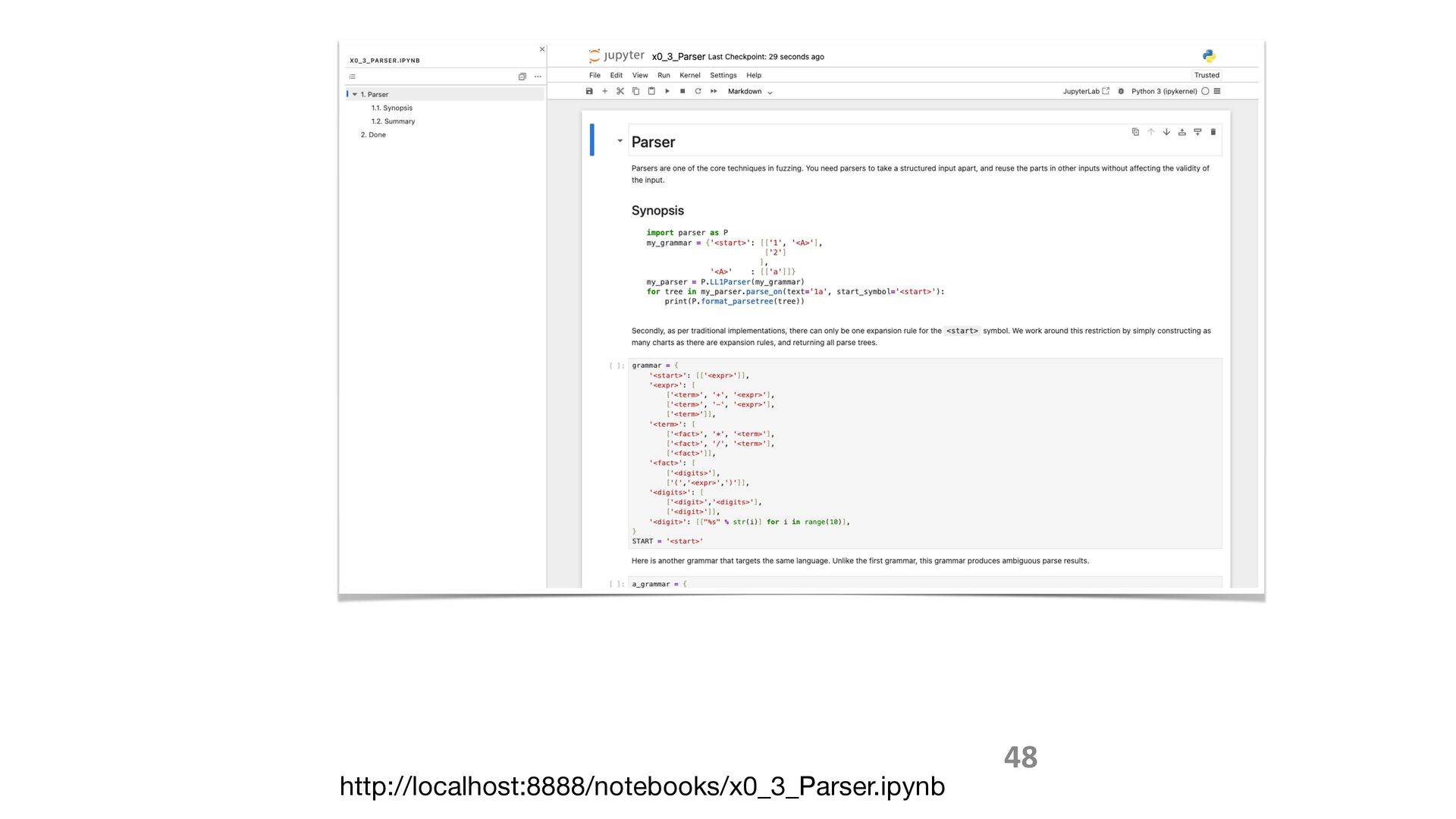
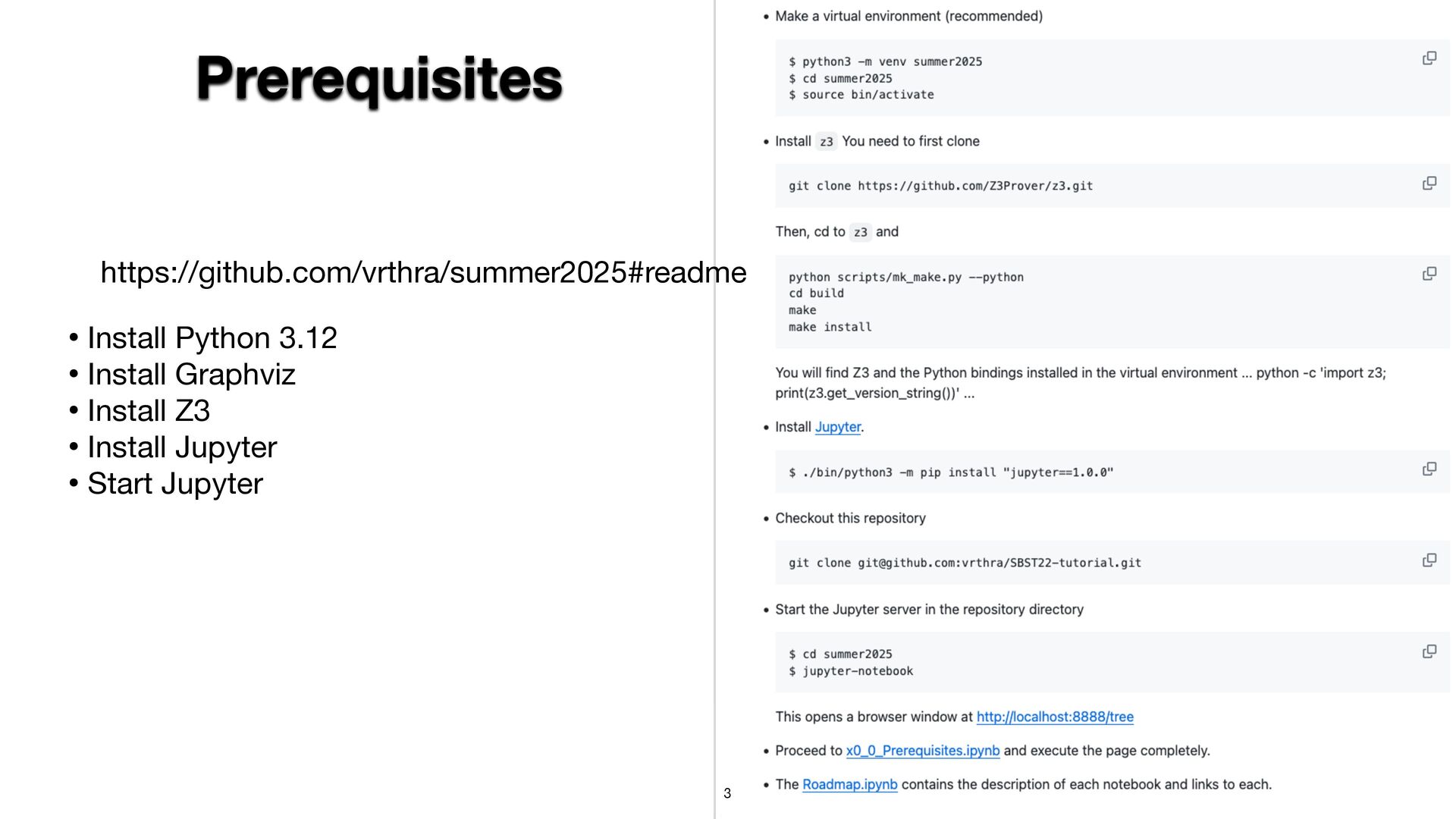
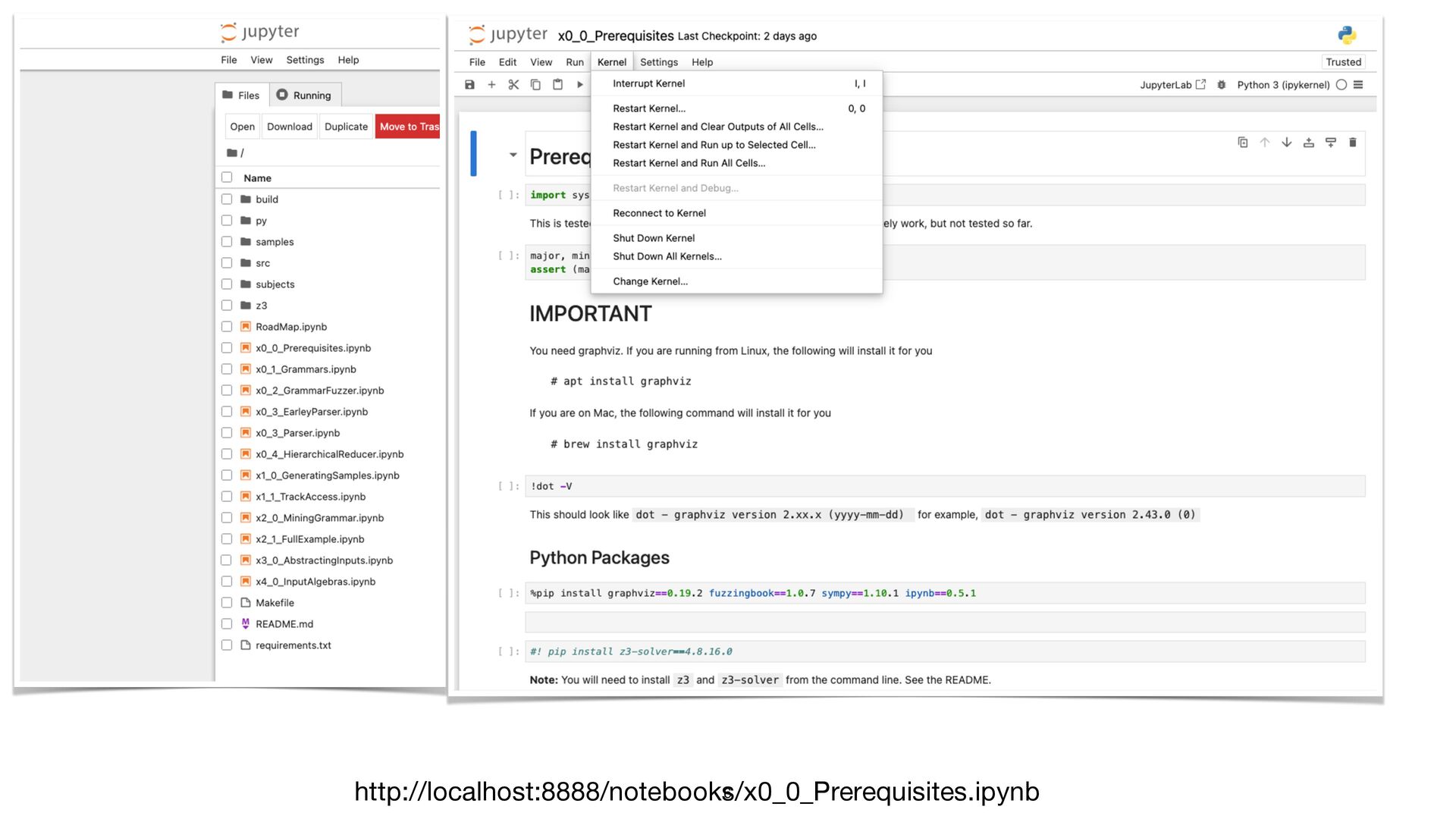
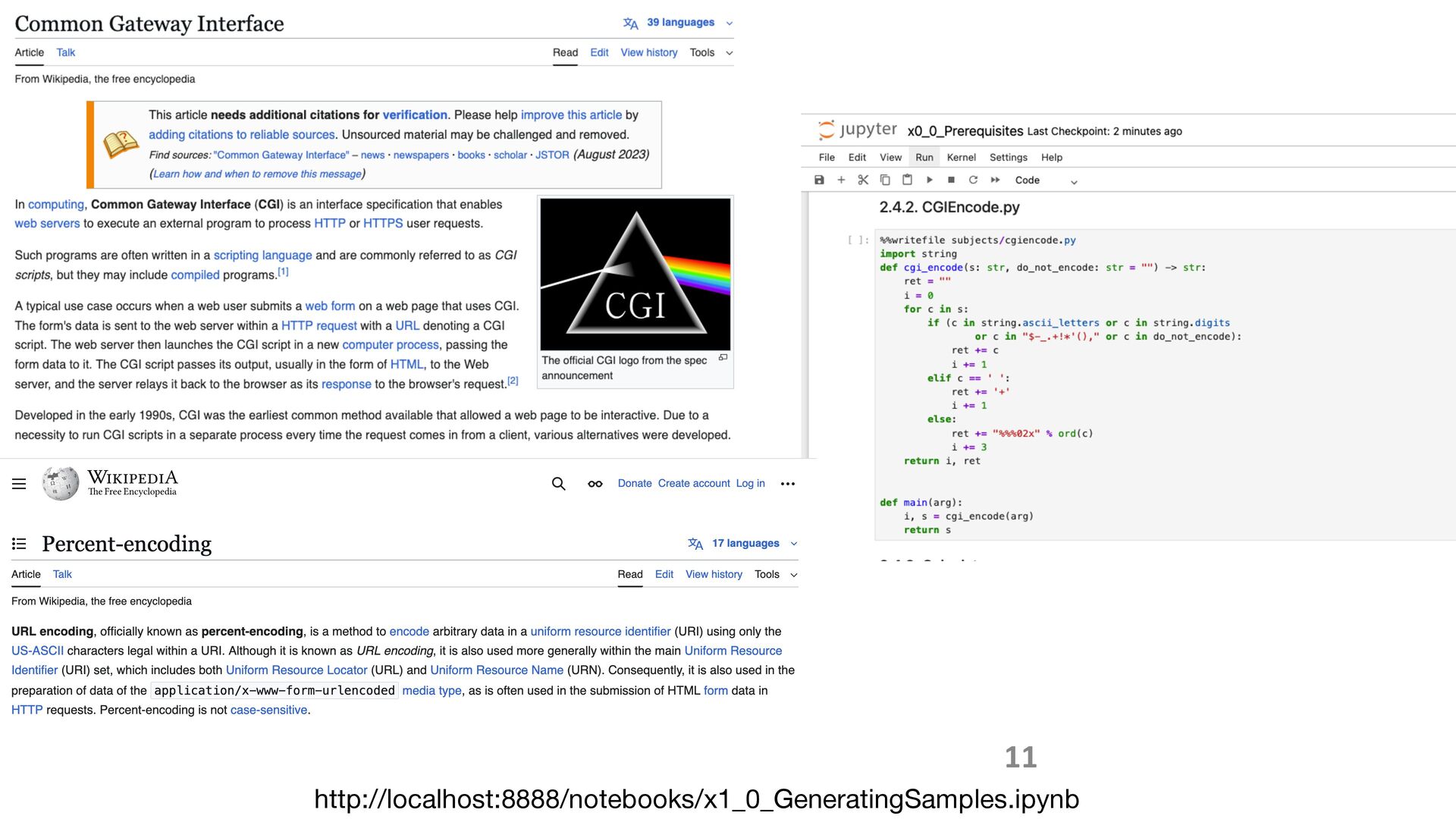
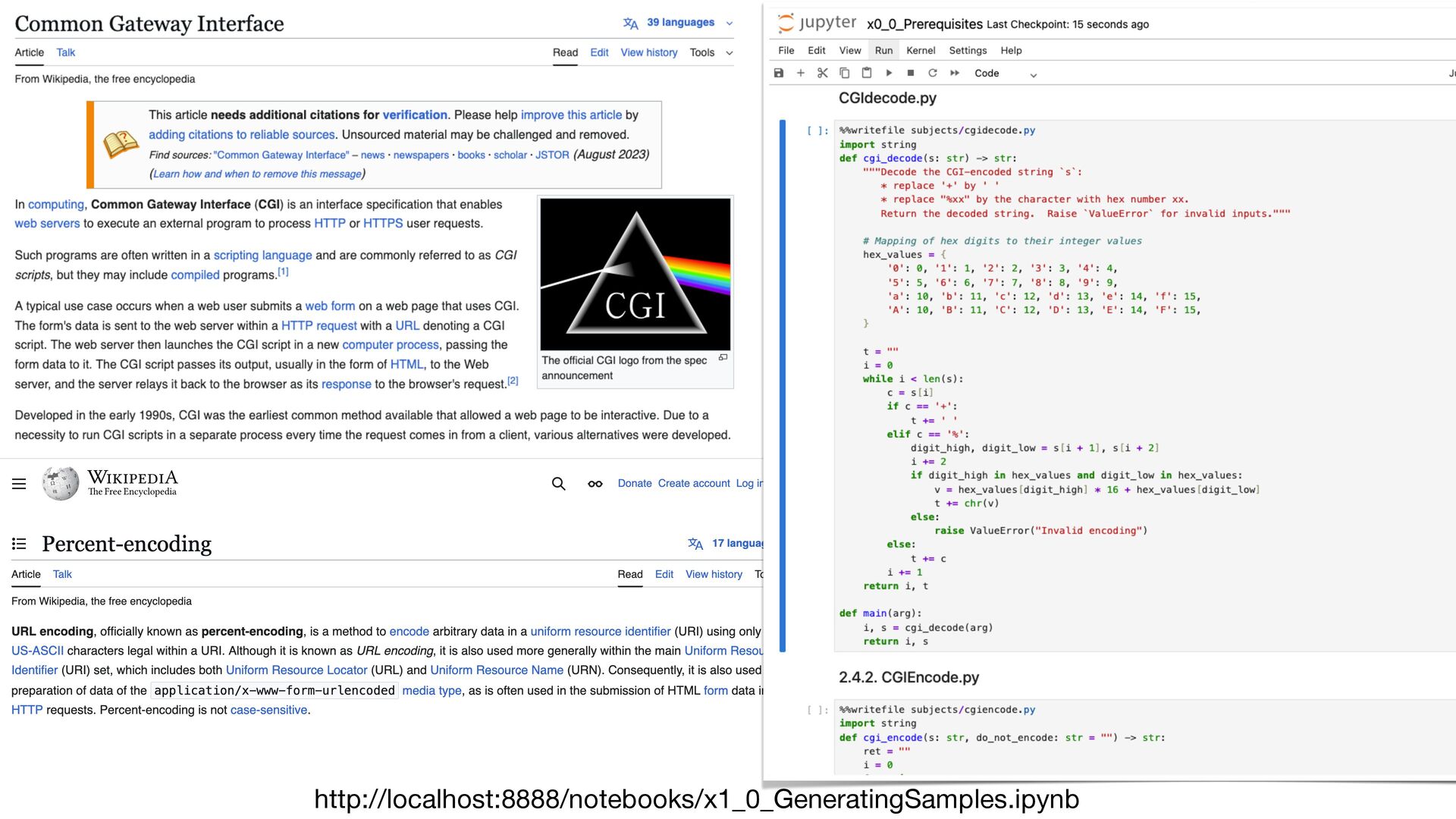
Prerequisites https://github.com/vrthra/summer2025#readme • Install Python 3.12 • Install Graphviz •
Install Z3 • Install Jupyter • Start Jupyter 3 -
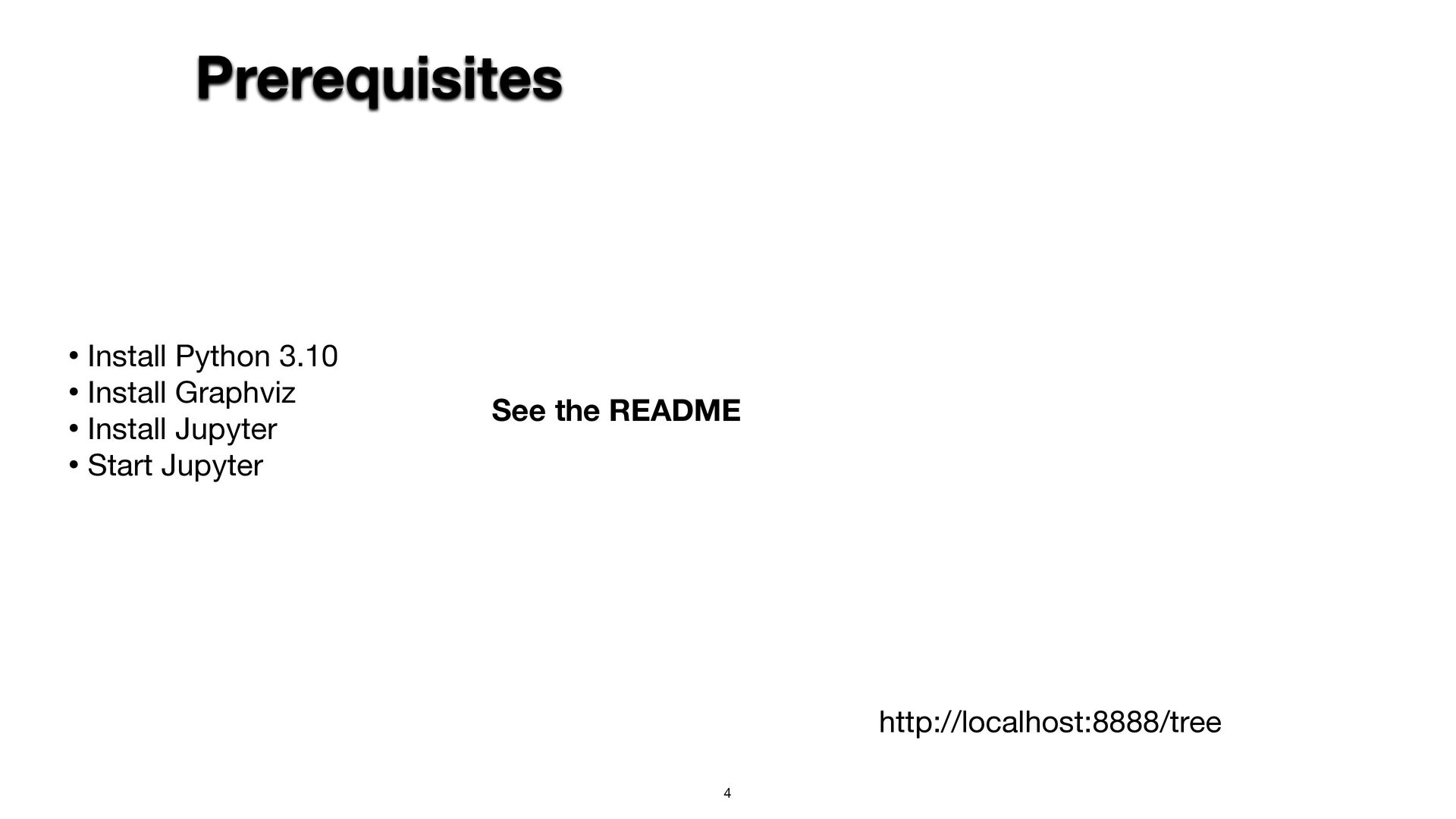
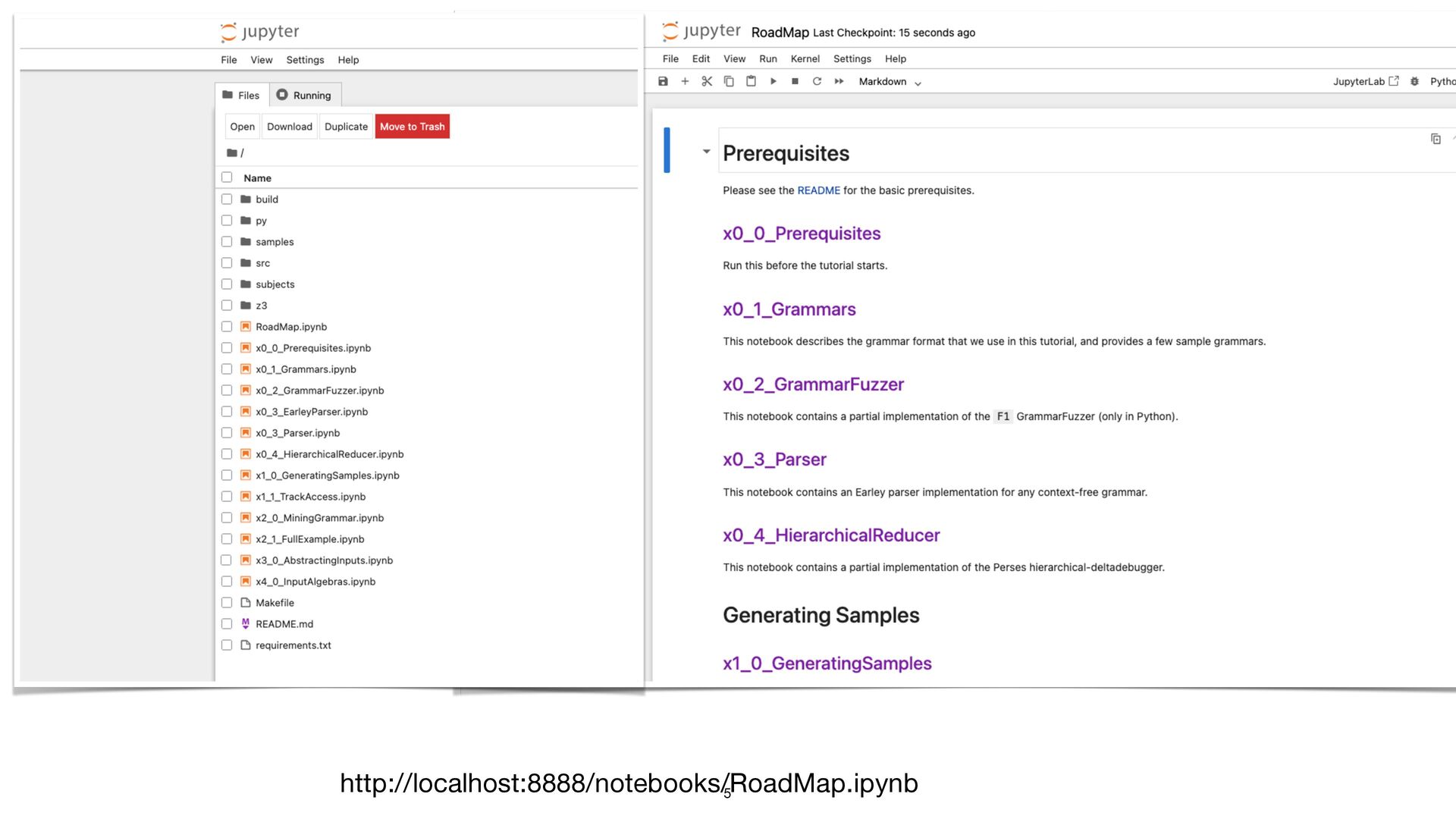
Prerequisites http://localhost:8888/tree • Install Python 3.10 • Install Graphviz •
Install Jupyter • Start Jupyter 4 See the README -
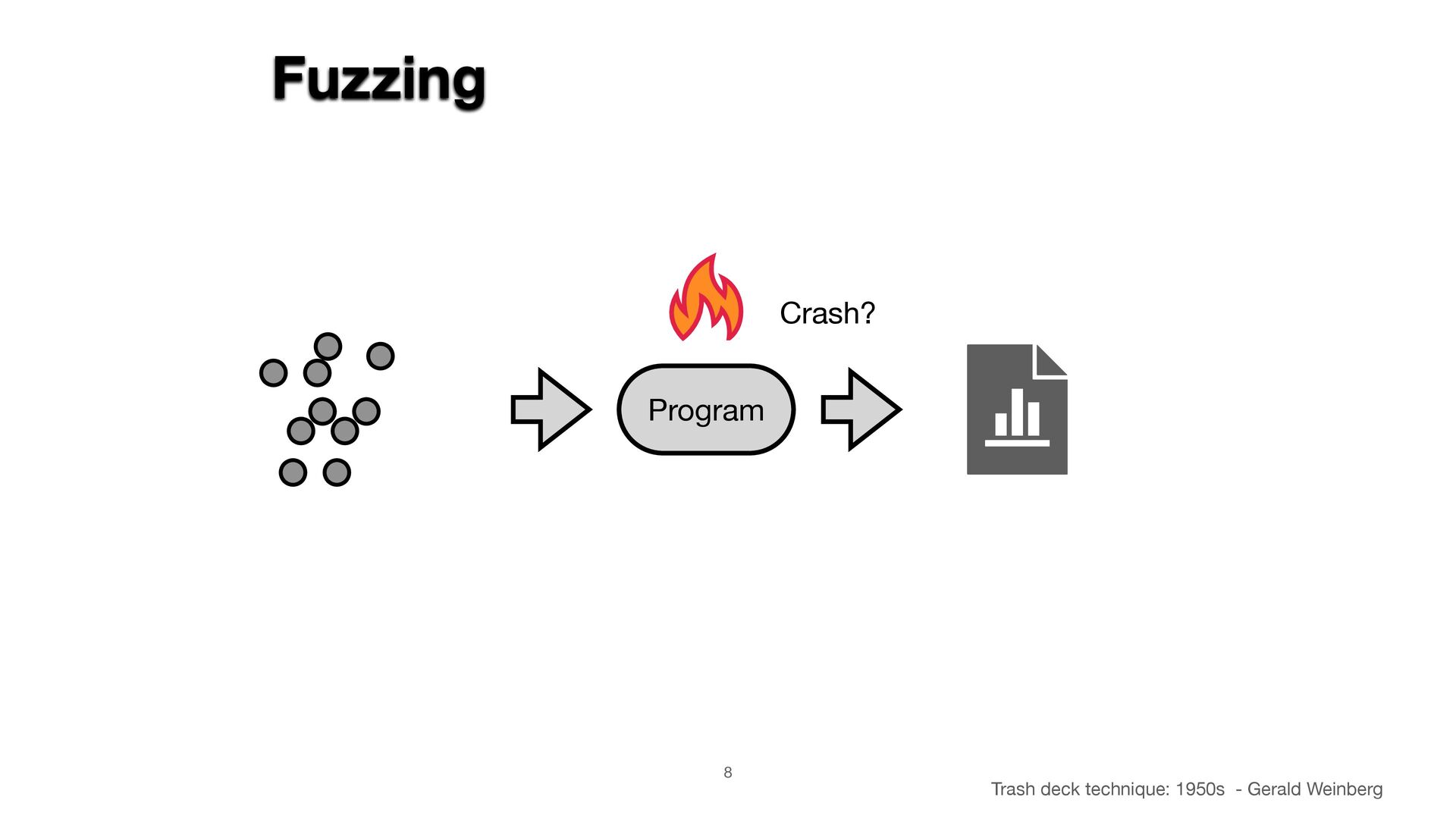
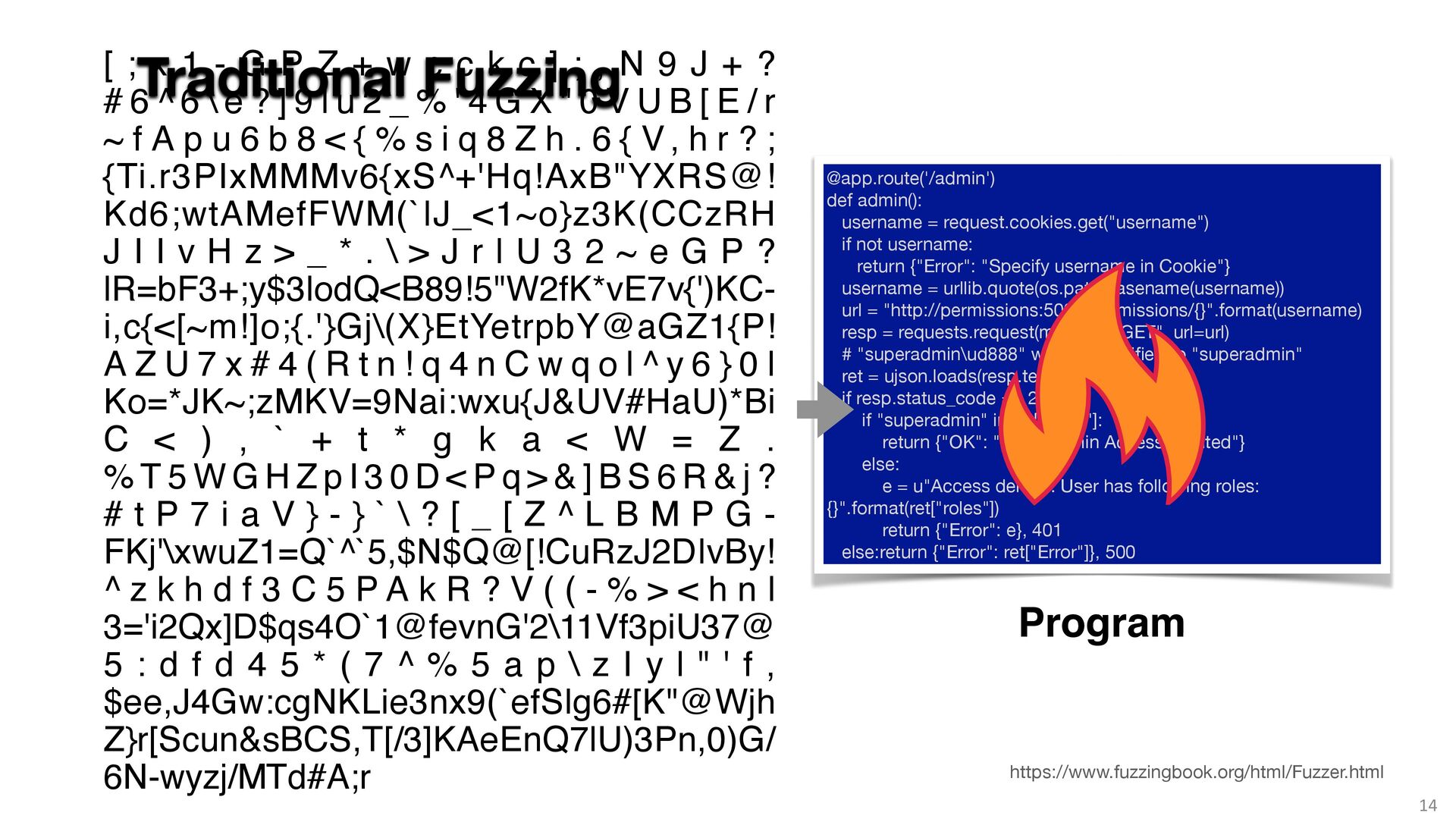
9 $ ./fuzz [;x1-GPZ+wcckc];,N9J+?#6^6\e?]9lu 2_%'4GX"0VUB[E/r ~fApu6b8<{%siq8Z h.6{V,hr?;{Ti.r3PIxMMMv6{xS^+'Hq! AxB"YXRS@!Kd6;wtAMefFWM(`|J_<1~o} z3K(CCzRH JIIvHz>_*.\>JrlU32~eGP?
lR=bF3+;y$3lodQ<B89!5"W2fK*vE7v{' )KC-i,c{<[~m!]o;{.'}Gj\(X}EtYetrp bY@aGZ1{P!AZU7x#4(Rtn!q4nCwqol^y6 }0|Ko=*JK~;zMKV=9Nai:wxu{J&UV#HaU )*BiC<),`+t*gka<W=Z.%T5WGHZpI30D< Pq>&]BS6R&j?#tP7iaV}-}`\?[_[Z^LBM PG-FKj'\xwuZ1=Q`^`5,$N$Q@[!CuRzJ2 D|vBy!^zkhdf3C5PAkR?V((-%><hn|3=' i2Qx]D$qs4O`1@fevnG'2\11Vf3piU37@ 5:dfd45*(7^%5ap\zIyl"'f,$ee,J4Gw: cgNKLie3nx9(`efSlg6#[K"@WjhZ}r[Sc un&sBCS,T[/3]KAeEnQ7lU)3Pn,0)G/6N -wyzj/MTd#A;r*(ds./df3r8Odaf?/<#r Program ✘ Random Fuzzing -
@app.route('/admin') def admin(): username = request.cookies.get("username") if not username: return
{"Error": "Specify username in Cookie"} username = urllib.quote(os.path.basename(username)) url = "http://permissions:5000/permissions/{}".format(username) resp = requests.request(method="GET", url=url) # "superadmin\ud888" will be simpli fi ed to "superadmin" ret = ujson.loads(resp.text) if resp.status_code == 200: if "superadmin" in ret["roles"]: return {"OK": "Superadmin Access granted"} else: e = u"Access denied. User has following roles: {}".format(ret["roles"]) return {"Error": e}, 401 else:return {"Error": ret["Error"]}, 500 [ ; x 1 - G P Z + w c c k c ] ; , N 9 J + ? # 6 ^ 6 \ e ? ] 9 l u 2 _ % ' 4 G X " 0 V U B [ E / r ~ f A p u 6 b 8 < { % s i q 8 Z h . 6 { V , h r ? ; {Ti.r3PIxMMMv6{xS^+'Hq!AxB"YXRS@! Kd6;wtAMefFWM(`|J_<1~o}z3K(CCzRH J I I v H z > _ * . \ > J r l U 3 2 ~ e G P ? lR=bF3+;y$3lodQ<B89!5"W2fK*vE7v{')KC- i,c{<[~m!]o;{.'}Gj\(X}EtYetrpbY@aGZ1{P! A Z U 7 x # 4 ( R t n ! q 4 n C w q o l ^ y 6 } 0 | Ko=*JK~;zMKV=9Nai:wxu{J&UV#HaU)*Bi C < ) , ` + t * g k a < W = Z . % T 5 W G H Z p I 3 0 D < P q > & ] B S 6 R & j ? # t P 7 i a V } - } ` \ ? [ _ [ Z ^ L B M P G - FKj'\xwuZ1=Q`^`5,$N$Q@[!CuRzJ2D|vBy! ^ z k h d f 3 C 5 P A k R ? V ( ( - % > < h n | 3='i2Qx]D$qs4O`1@fevnG'2\11Vf3piU37@ 5 : d f d 4 5 * ( 7 ^ % 5 a p \ z I y l " ' f , $ee,J4Gw:cgNKLie3nx9(`efSlg6#[K"@Wjh Z}r[Scun&sBCS,T[/3]KAeEnQ7lU)3Pn,0)G/ 6N-wyzj/MTd#A;r Program 14 https://www.fuzzingbook.org/html/Fuzzer.html Traditional Fuzzing -
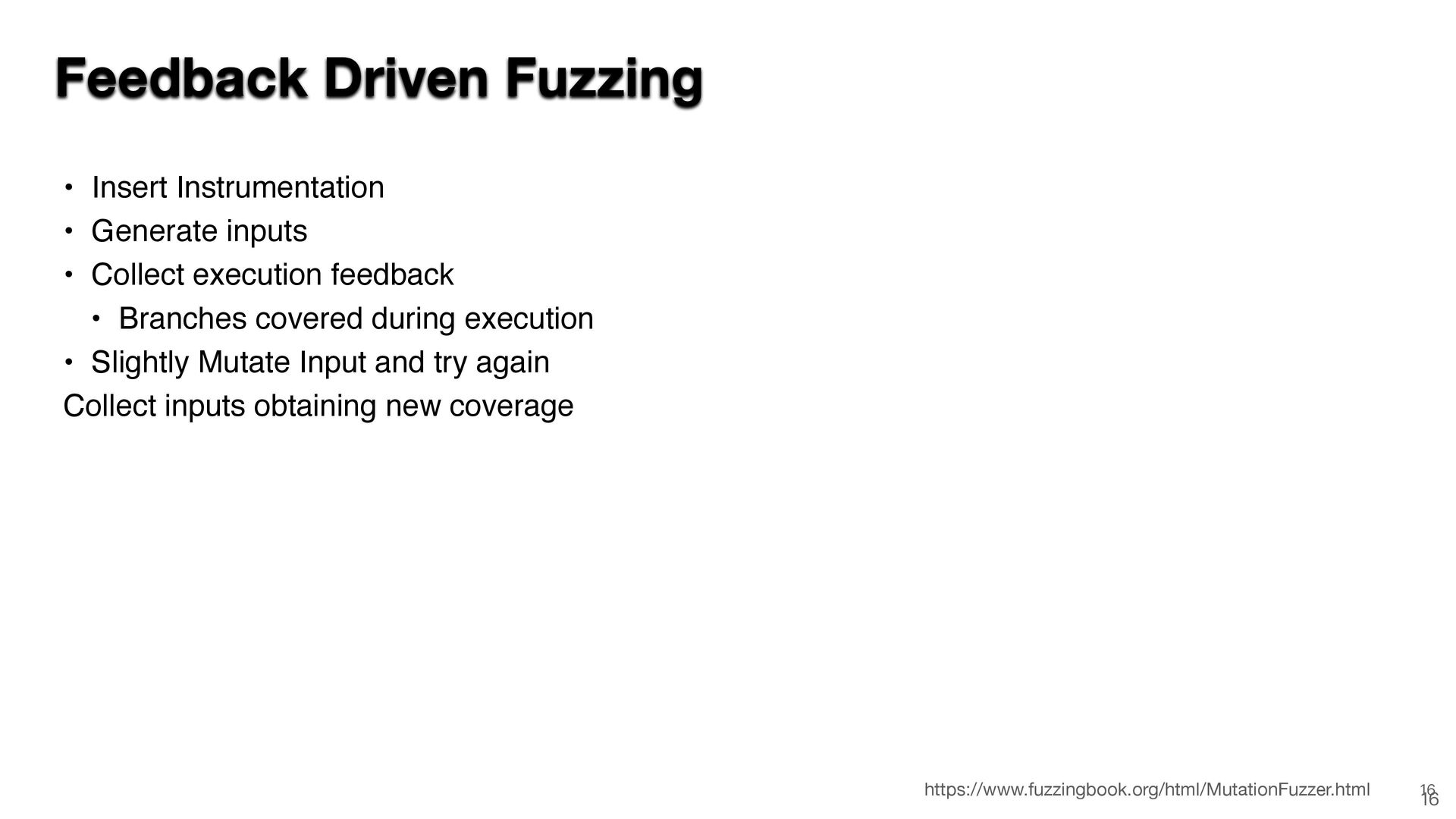
• Insert Instrumentation • Generate inputs • Collect execution feedback
• Branches covered during execution • Slightly Mutate Input and try again Collect inputs obtaining new coverage 16 Feedback Driven Fuzzing 16 https://www.fuzzingbook.org/html/MutationFuzzer.html -
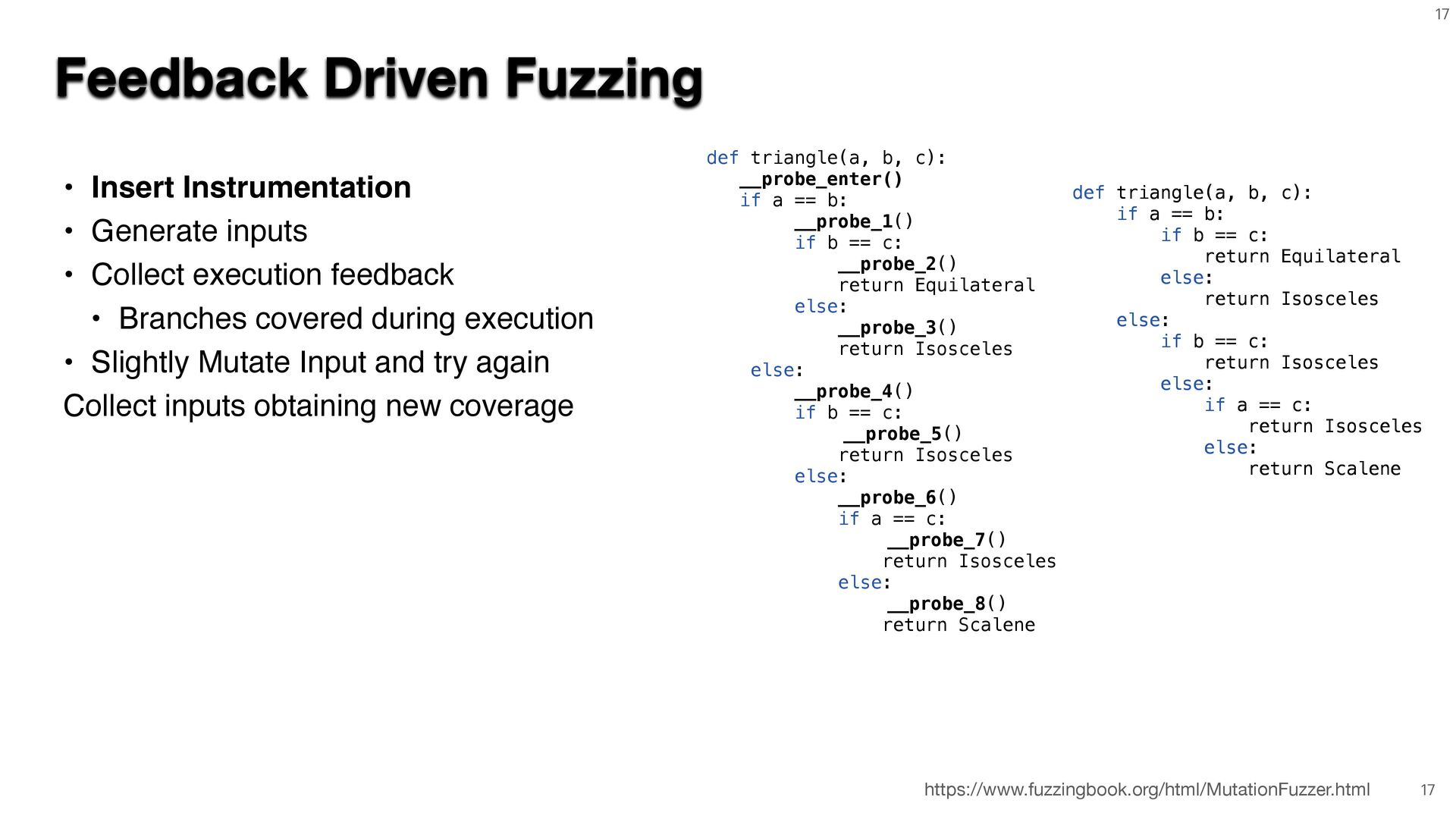
17 def triangle(a, b, c): if a == b: if
b == c: return Equilateral else: return Isosceles else: if b == c: return Isosceles else: if a == c: return Isosceles else: return Scalene def triangle(a, b, c): __probe_enter() if a == b: __probe_1() if b == c: __probe_2() return Equilateral else: __probe_3() return Isosceles else: __probe_4() if b == c: __probe_5() return Isosceles else: __probe_6() if a == c: __probe_7() return Isosceles else: __probe_8() return Scalene def triangle(a, b, c): if a == b: if b == c: return Equilateral else: return Isosceles else: if b == c: return Isosceles else: if a == c: return Isosceles else: return Scalene • Insert Instrumentation • Generate inputs • Collect execution feedback • Branches covered during execution • Slightly Mutate Input and try again Collect inputs obtaining new coverage 17 https://www.fuzzingbook.org/html/MutationFuzzer.html Feedback Driven Fuzzing -
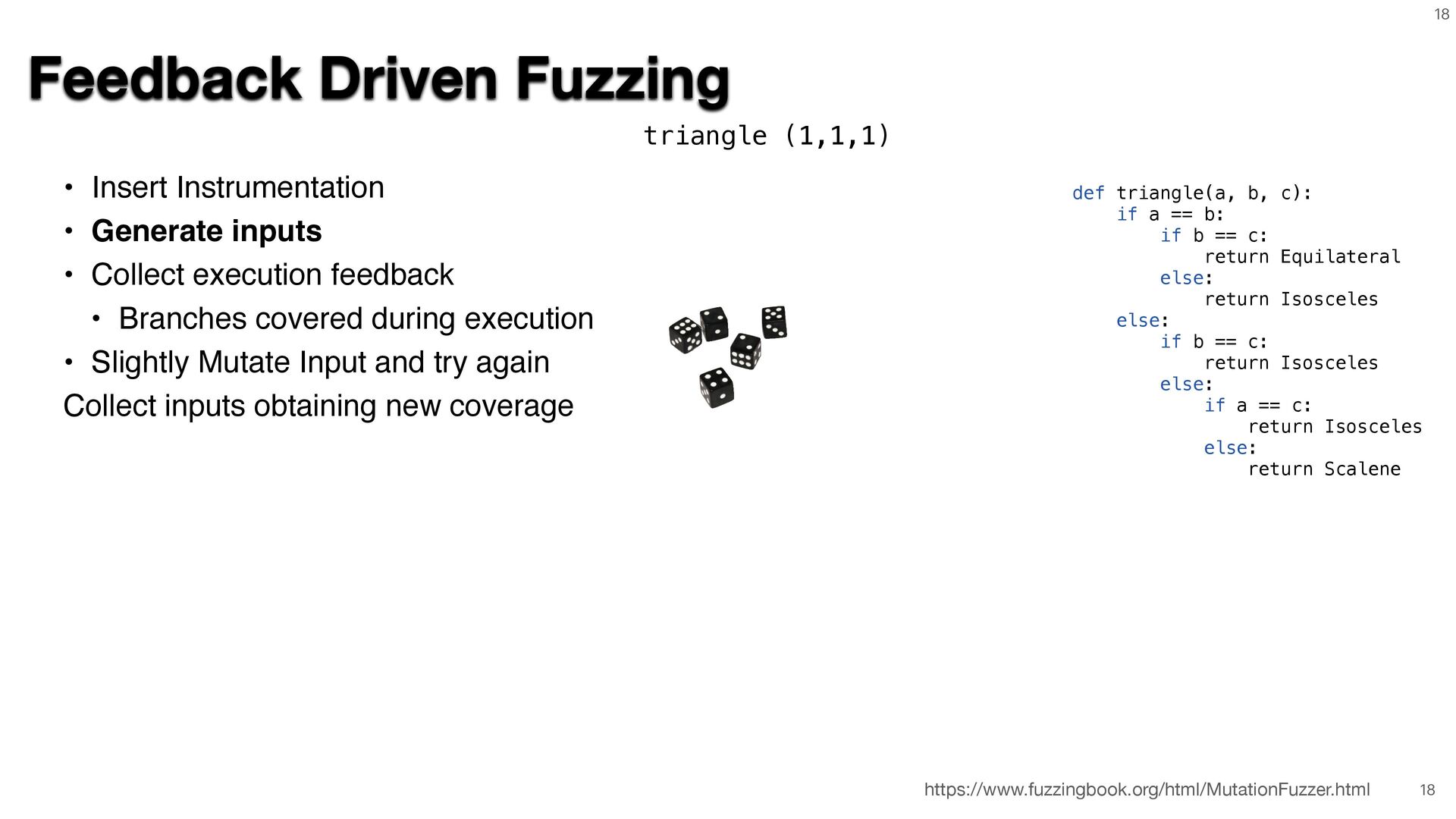
18 Feedback Driven Fuzzing triangle (1,1,1) def triangle(a, b, c):
if a == b: if b == c: return Equilateral else: return Isosceles else: if b == c: return Isosceles else: if a == c: return Isosceles else: return Scalene • Insert Instrumentation • Generate inputs • Collect execution feedback • Branches covered during execution • Slightly Mutate Input and try again Collect inputs obtaining new coverage 18 https://www.fuzzingbook.org/html/MutationFuzzer.html -
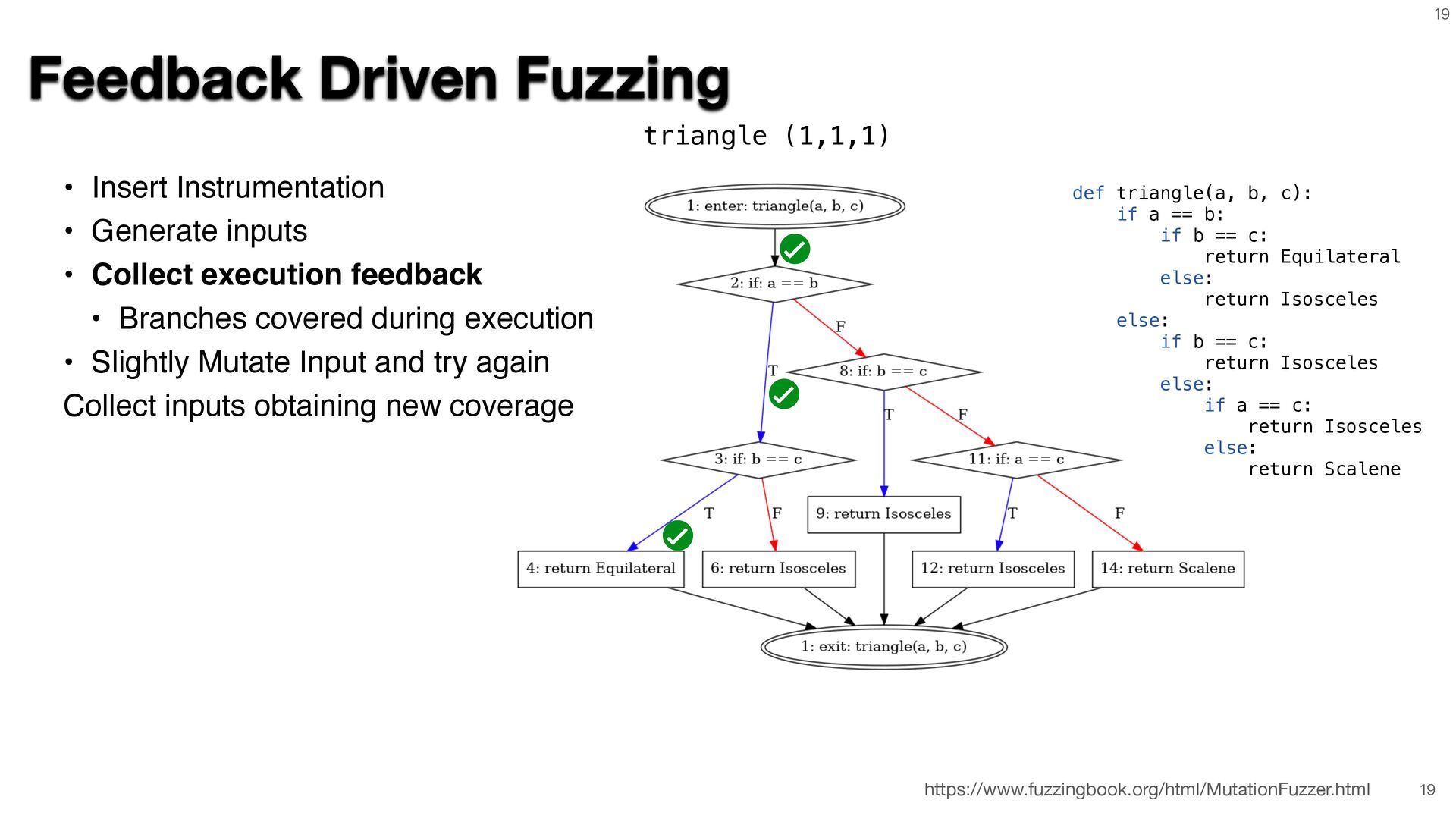
19 triangle (1,1,1) def triangle(a, b, c): if a ==
b: if b == c: return Equilateral else: return Isosceles else: if b == c: return Isosceles else: if a == c: return Isosceles else: return Scalene • Insert Instrumentation • Generate inputs • Collect execution feedback • Branches covered during execution • Slightly Mutate Input and try again Collect inputs obtaining new coverage 19 https://www.fuzzingbook.org/html/MutationFuzzer.html Feedback Driven Fuzzing -
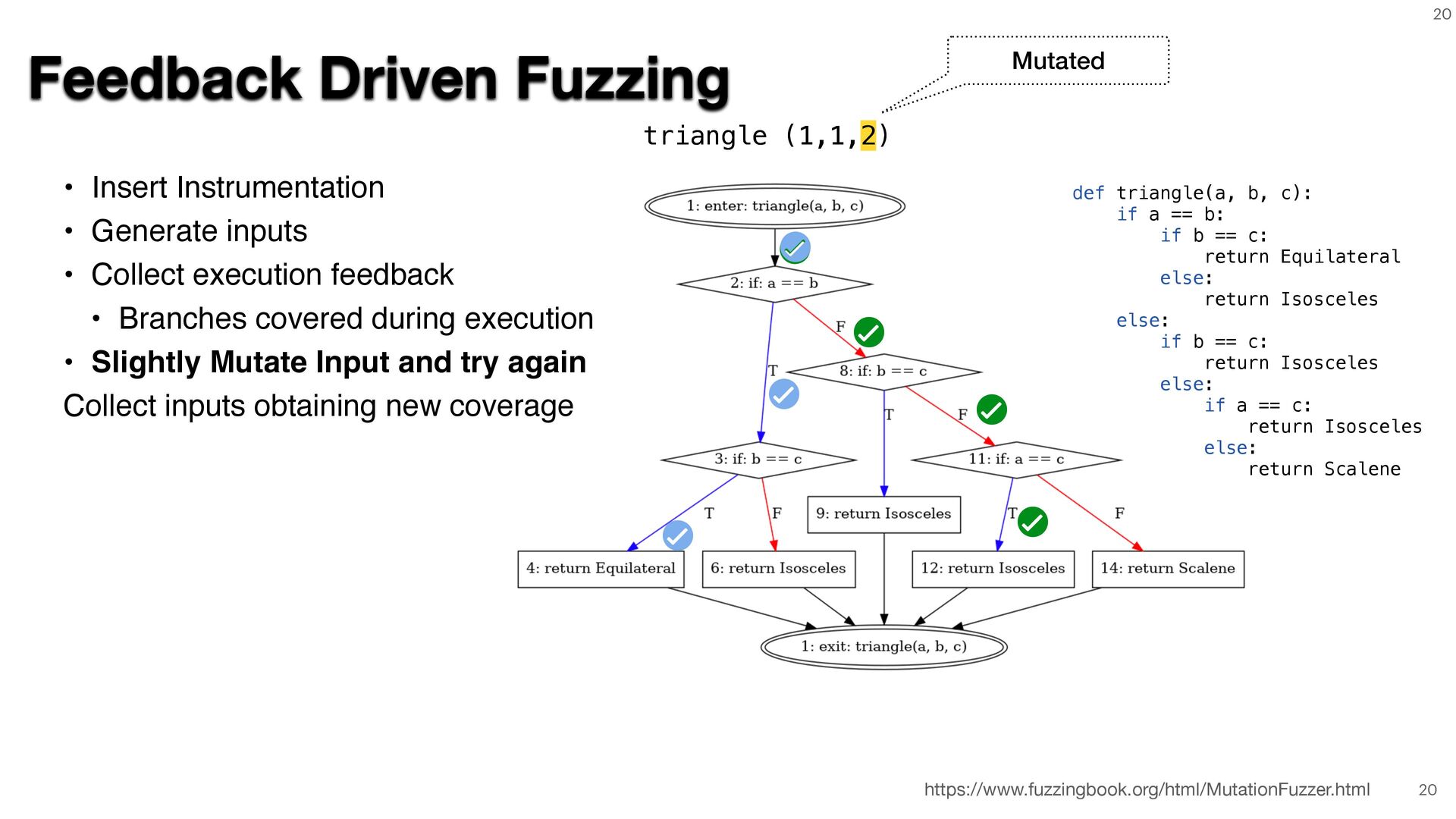
triangle (1,1,1) 20 triangle (1,1,2) def triangle(a, b, c): if
a == b: if b == c: return Equilateral else: return Isosceles else: if b == c: return Isosceles else: if a == c: return Isosceles else: return Scalene • Insert Instrumentation • Generate inputs • Collect execution feedback • Branches covered during execution • Slightly Mutate Input and try again Collect inputs obtaining new coverage Mutated 20 https://www.fuzzingbook.org/html/MutationFuzzer.html Feedback Driven Fuzzing -
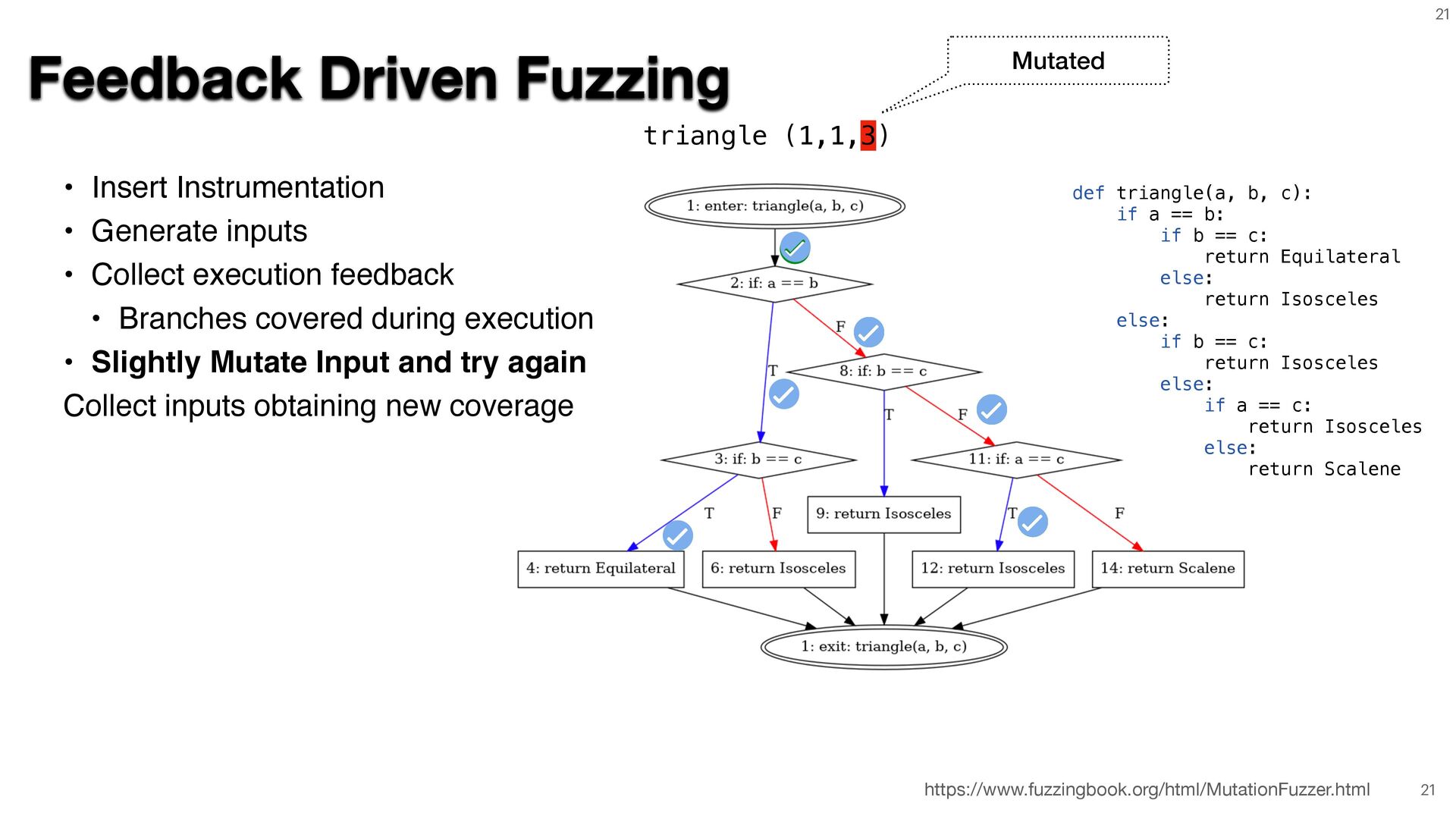
21 triangle (1,1,3) def triangle(a, b, c): if a ==
b: if b == c: return Equilateral else: return Isosceles else: if b == c: return Isosceles else: if a == c: return Isosceles else: return Scalene • Insert Instrumentation • Generate inputs • Collect execution feedback • Branches covered during execution • Slightly Mutate Input and try again Collect inputs obtaining new coverage Mutated 21 https://www.fuzzingbook.org/html/MutationFuzzer.html Feedback Driven Fuzzing -
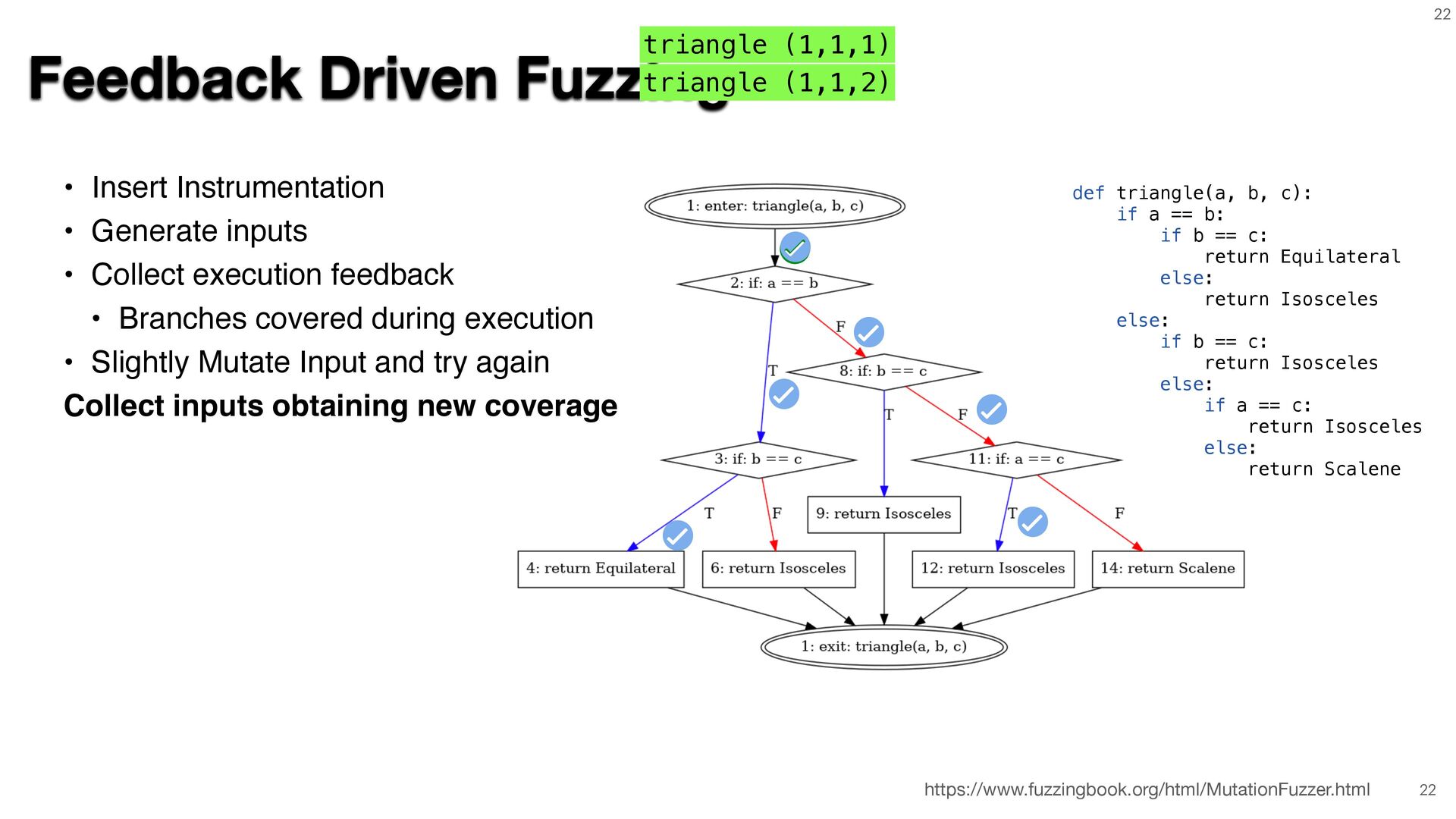
Feedback Driven Fuzzing 22 triangle (1,1,2) def triangle(a, b, c):
if a == b: if b == c: return Equilateral else: return Isosceles else: if b == c: return Isosceles else: if a == c: return Isosceles else: return Scalene • Insert Instrumentation • Generate inputs • Collect execution feedback • Branches covered during execution • Slightly Mutate Input and try again Collect inputs obtaining new coverage 22 https://www.fuzzingbook.org/html/MutationFuzzer.html triangle (1,1,1) triangle (1,1,3) -
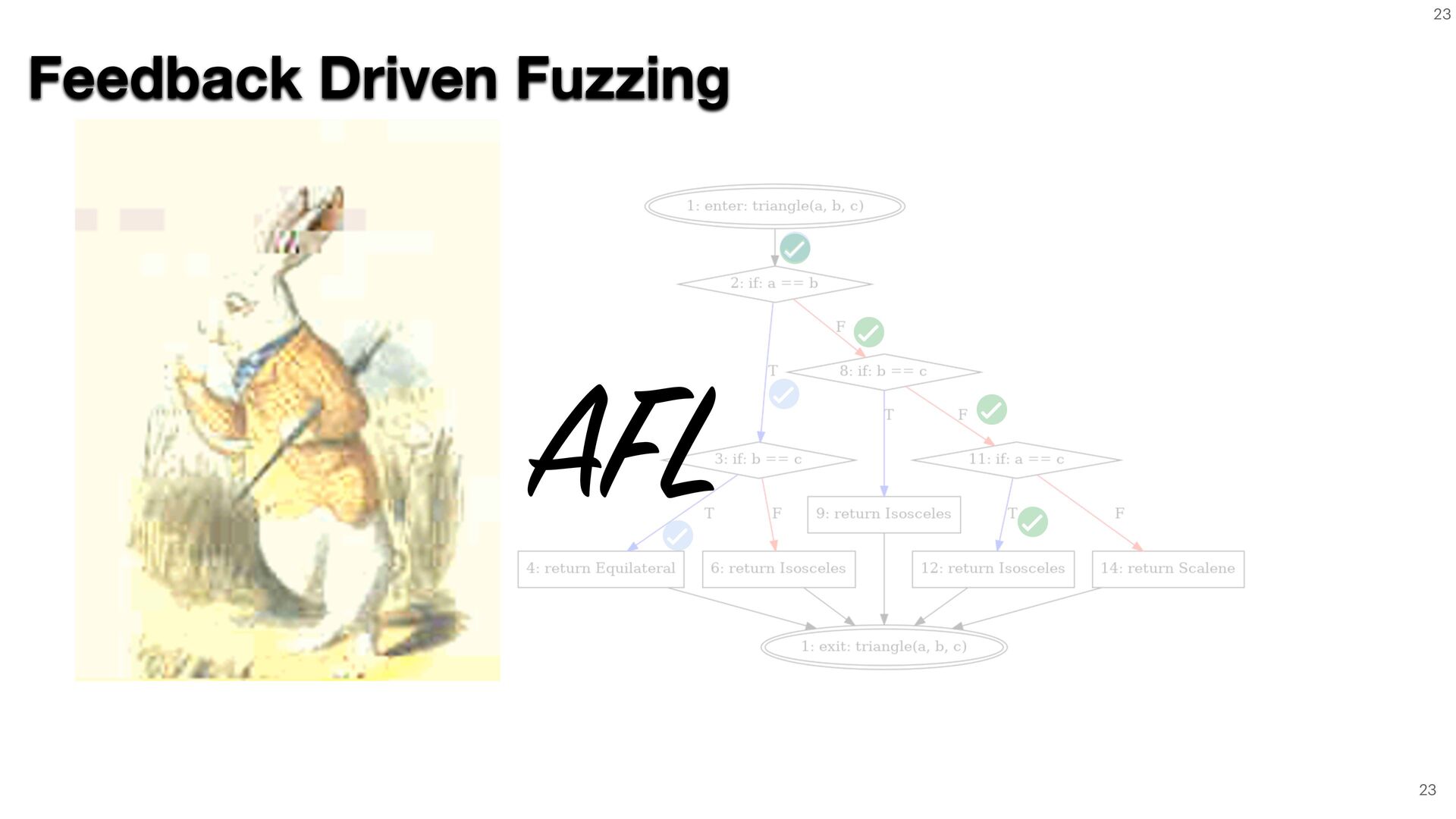
Feedback Driven Fuzzing • Insert Instrumentation • Generate inputs •
Collect execution feedback • Branches covered during execution • Slightly Mutate Input and try again Collect inputs obtaining new coverage 23 triangle (1,1,2) def triangle(a, b, c): if a == b: if b == c: return Equilateral else: return Isosceles else: if b == c: return Isosceles else: if a == c: return Isosceles else: return Scalene triangle (1,1,1) AFL 23 -
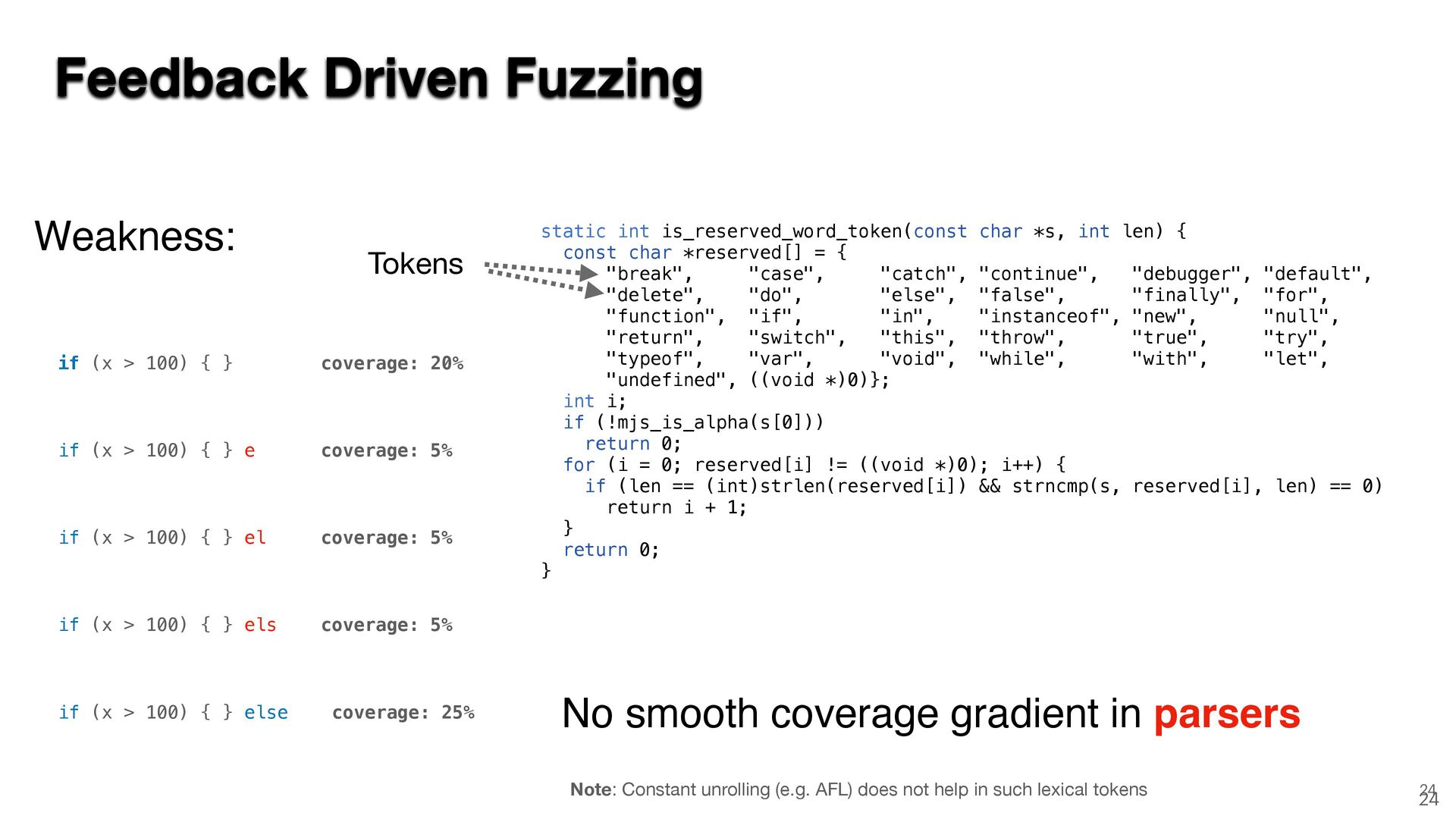
24 Feedback Driven Fuzzing Weakness: static int is_reserved_word_token(const char *s,
int len) { const char *reserved[] = { "break", "case", "catch", "continue", "debugger", "default", "delete", "do", "else", "false", "finally", "for", "function", "if", "in", "instanceof", "new", "null", "return", "switch", "this", "throw", "true", "try", "typeof", "var", "void", "while", "with", "let", "undefined", ((void *)0)}; int i; if (!mjs_is_alpha(s[0])) return 0; for (i = 0; reserved[i] != ((void *)0); i++) { if (len == (int)strlen(reserved[i]) && strncmp(s, reserved[i], len) == 0) return i + 1; } return 0; } Tokens if (x > 100) { } coverage: 20% if (x > 100) { } e coverage: 5% if (x > 100) { } el coverage: 5% if (x > 100) { } els coverage: 5% if (x > 100) { } else coverage: 25% No smooth coverage gradient in parsers 24 Note: Constant unrolling (e.g. AFL) does not help in such lexical tokens -
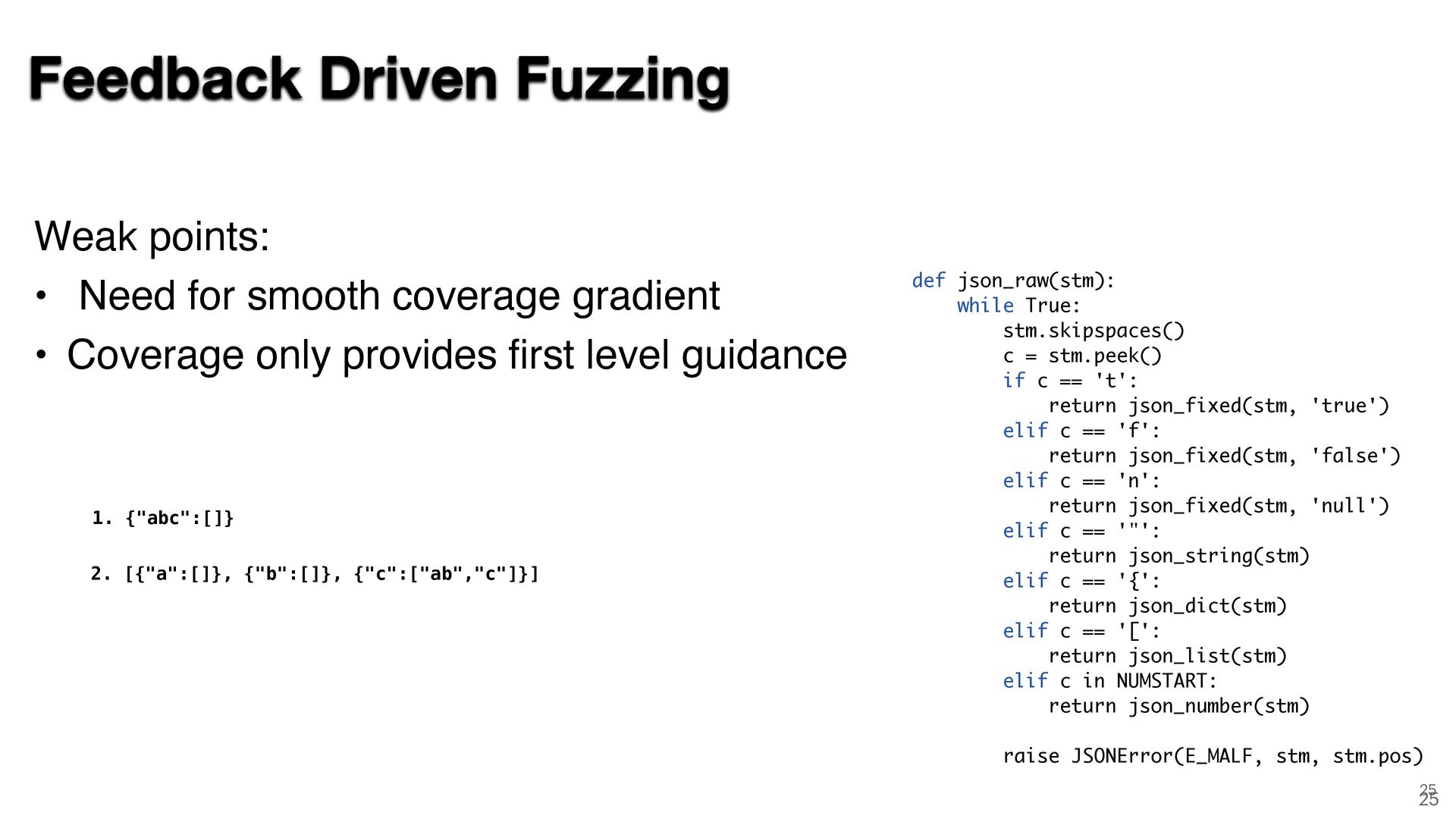
25 def json_raw(stm): while True: stm.skipspaces() c = stm.peek() if
c == 't': return json_fixed(stm, 'true') elif c == 'f': return json_fixed(stm, 'false') elif c == 'n': return json_fixed(stm, 'null') elif c == '"': return json_string(stm) elif c == '{': return json_dict(stm) elif c == '[': return json_list(stm) elif c in NUMSTART: return json_number(stm) raise JSONError(E_MALF, stm, stm.pos) Weak points: • Need for smooth coverage gradient • Coverage only provides first level guidance 1. {"abc":[]} 2. [{"a":[]}, {"b":[]}, {"c":["ab","c"]}] 25 Feedback Driven Fuzzing -
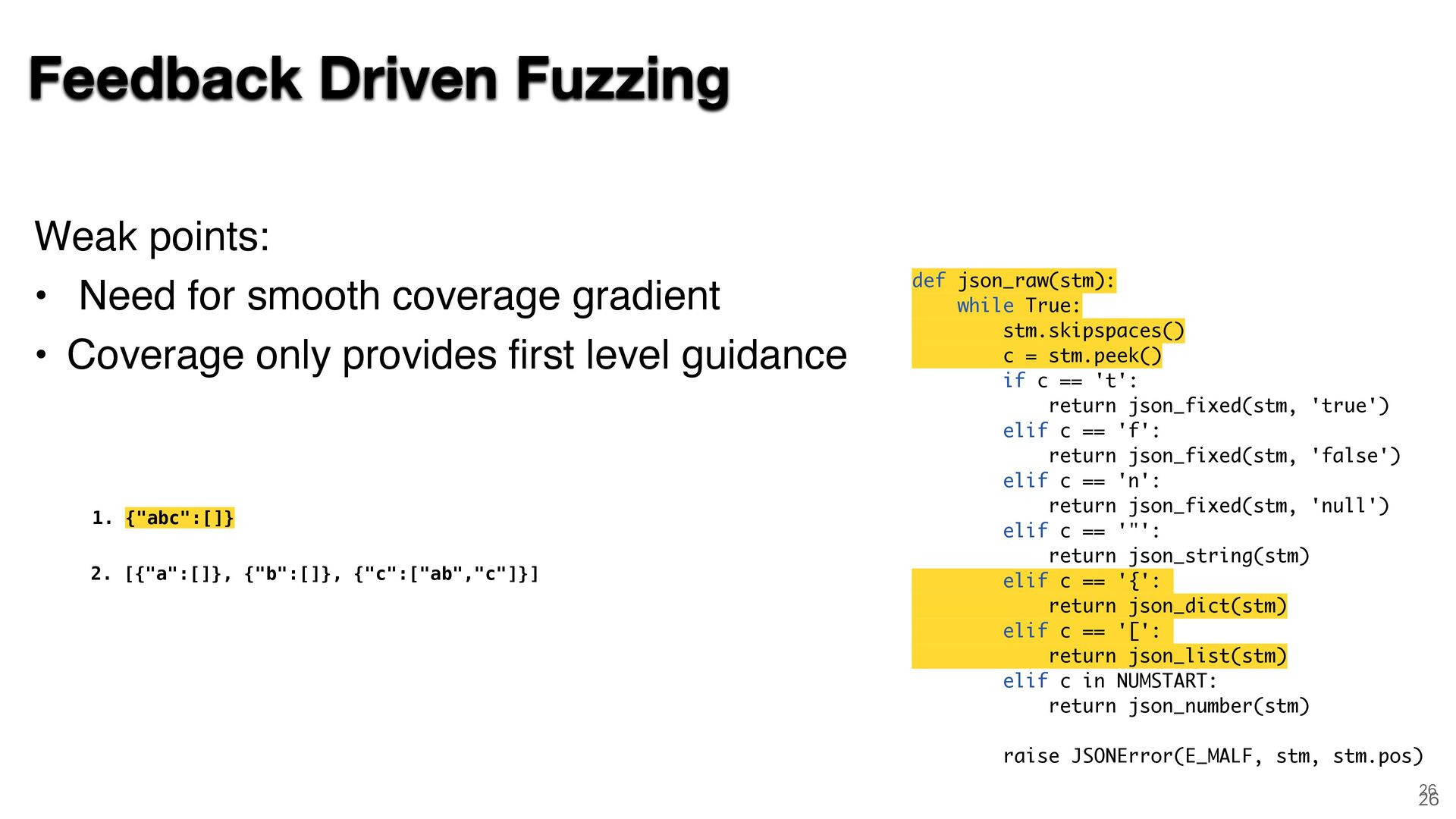
26 def json_raw(stm): while True: stm.skipspaces() c = stm.peek() if
c == 't': return json_fixed(stm, 'true') elif c == 'f': return json_fixed(stm, 'false') elif c == 'n': return json_fixed(stm, 'null') elif c == '"': return json_string(stm) elif c == '{': return json_dict(stm) elif c == '[': return json_list(stm) elif c in NUMSTART: return json_number(stm) raise JSONError(E_MALF, stm, stm.pos) Weak points: • Need for smooth coverage gradient • Coverage only provides first level guidance 1. {"abc":[]} 2. [{"a":[]}, {"b":[]}, {"c":["ab","c"]}] 26 Feedback Driven Fuzzing -
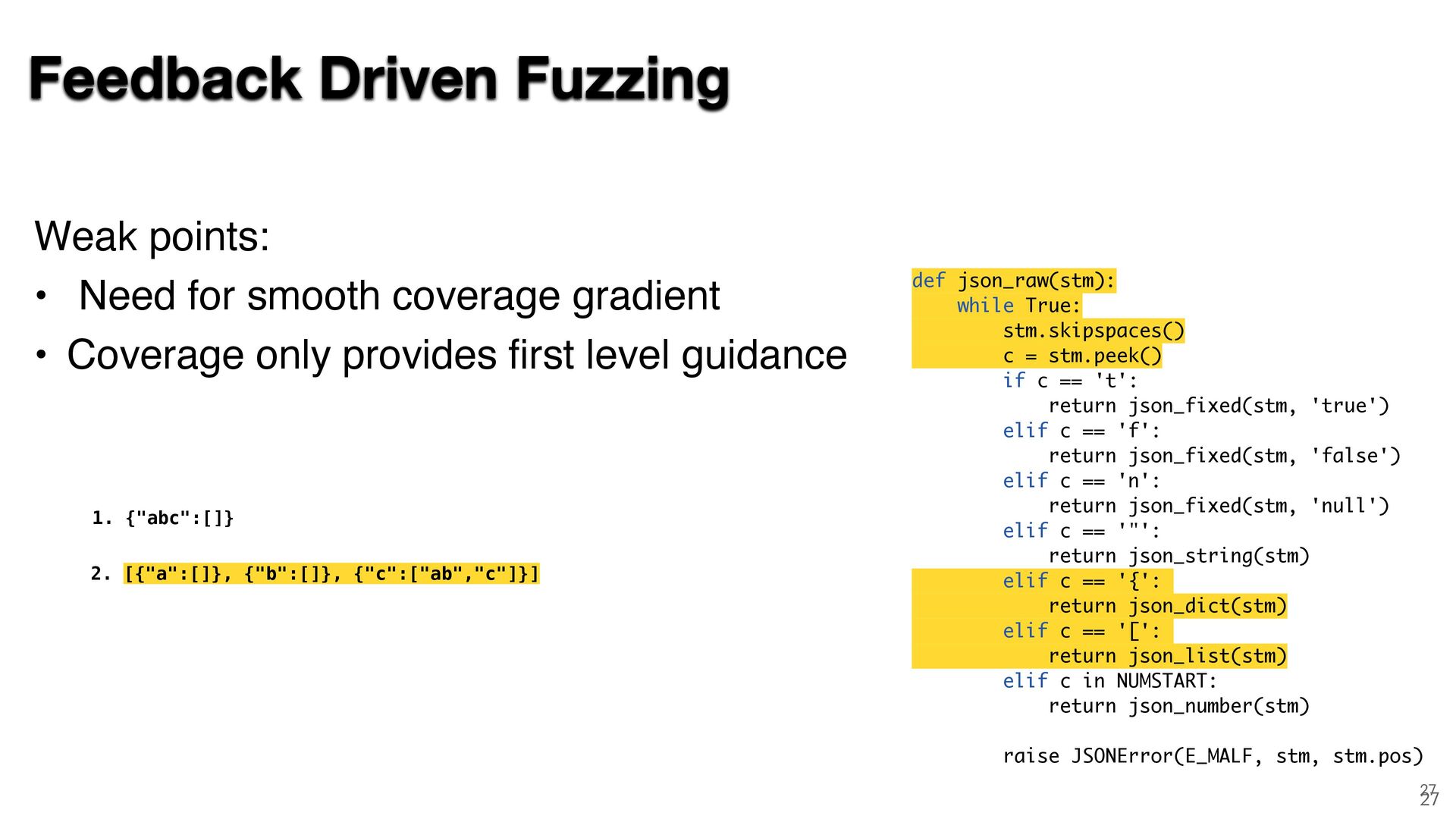
27 def json_raw(stm): while True: stm.skipspaces() c = stm.peek() if
c == 't': return json_fixed(stm, 'true') elif c == 'f': return json_fixed(stm, 'false') elif c == 'n': return json_fixed(stm, 'null') elif c == '"': return json_string(stm) elif c == '{': return json_dict(stm) elif c == '[': return json_list(stm) elif c in NUMSTART: return json_number(stm) raise JSONError(E_MALF, stm, stm.pos) Weak points: • Need for smooth coverage gradient • Coverage only provides first level guidance 1. {"abc":[]} 2. [{"a":[]}, {"b":[]}, {"c":["ab","c"]}] 27 Feedback Driven Fuzzing -
31 Fuzzing Parsers $ ./fuzz [;x1-GPZ+wcckc];,N9J+?#6^6\e?]9lu 2_%'4GX"0VUB[E/r ~fApu6b8<{%siq8Z h.6{V,hr?;{Ti.r3PIxMMMv6{xS^+'Hq! AxB"YXRS@!Kd6;wtAMefFWM(`|J_<1~o}
z3K(CCzRH JIIvHz>_*.\>JrlU32~eGP? lR=bF3+;y$3lodQ<B89!5"W2fK*vE7v{' )KC-i,c{<[~m!]o;{.'}Gj\(X}EtYetrp bY@aGZ1{P!AZU7x#4(Rtn!q4nCwqol^y6 }0|Ko=*JK~;zMKV=9Nai:wxu{J&UV#HaU )*BiC<),`+t*gka<W=Z.%T5WGHZpI30D< Pq>&]BS6R&j?#tP7iaV}-}`\?[_[Z^LBM PG-FKj'\xwuZ1=Q`^`5,$N$Q@[!CuRzJ2 D|vBy!^zkhdf3C5PAkR?V((-%><hn|3=' i2Qx]D$qs4O`1@fevnG'2\11Vf3piU37@ 5:dfd45*(7^%5ap\zIyl"'f,$ee,J4Gw: cgNKLie3nx9(`efSlg6#[K"@WjhZ}r[Sc un&sBCS,T[/3]KAeEnQ7lU)3Pn,0)G/6N -wyzj/MTd#A;r*(ds./df3r8Odaf?/<#r Parser Syntax Error Interpreter # -
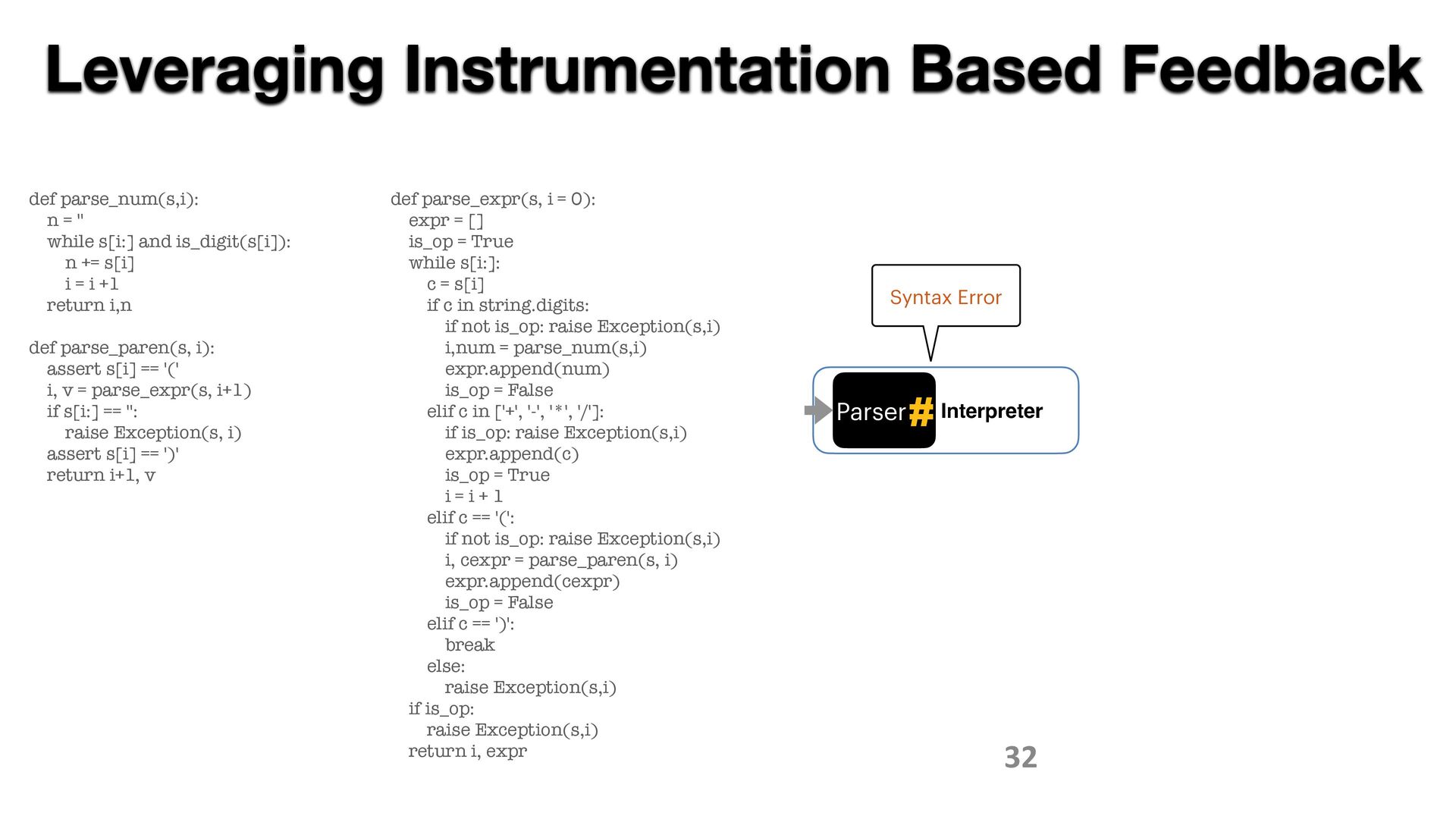
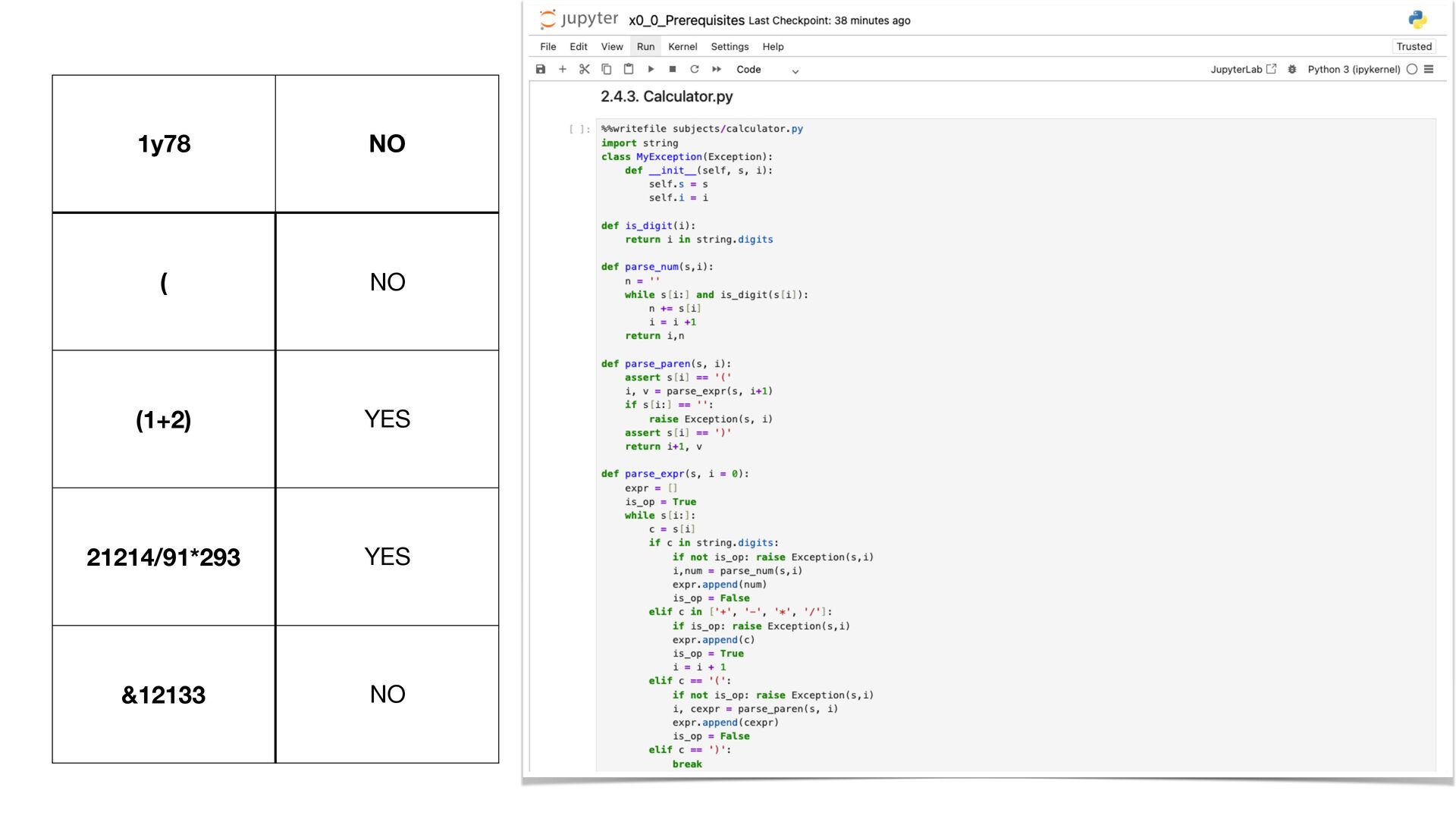
32 Leveraging Instrumentation Based Feedback def parse_num(s,i): n = ''
while s[i:] and is_digit(s[i]): n += s[i] i = i +1 return i,n def parse_paren(s, i): assert s[i] == '(' i, v = parse_expr(s, i+1) if s[i:] == '': raise Exception(s, i) assert s[i] == ')' return i+1, v def parse_expr(s, i = 0): expr = [] is_op = True while s[i:]: c = s[i] if c in string.digits: if not is_op: raise Exception(s,i) i,num = parse_num(s,i) expr.append(num) is_op = False elif c in ['+', '-', '*', '/']: if is_op: raise Exception(s,i) expr.append(c) is_op = True i = i + 1 elif c == '(': if not is_op: raise Exception(s,i) i, cexpr = parse_paren(s, i) expr.append(cexpr) is_op = False elif c == ')': break else: raise Exception(s,i) if is_op: raise Exception(s,i) return i, expr Parser Syntax Error Interpreter # -
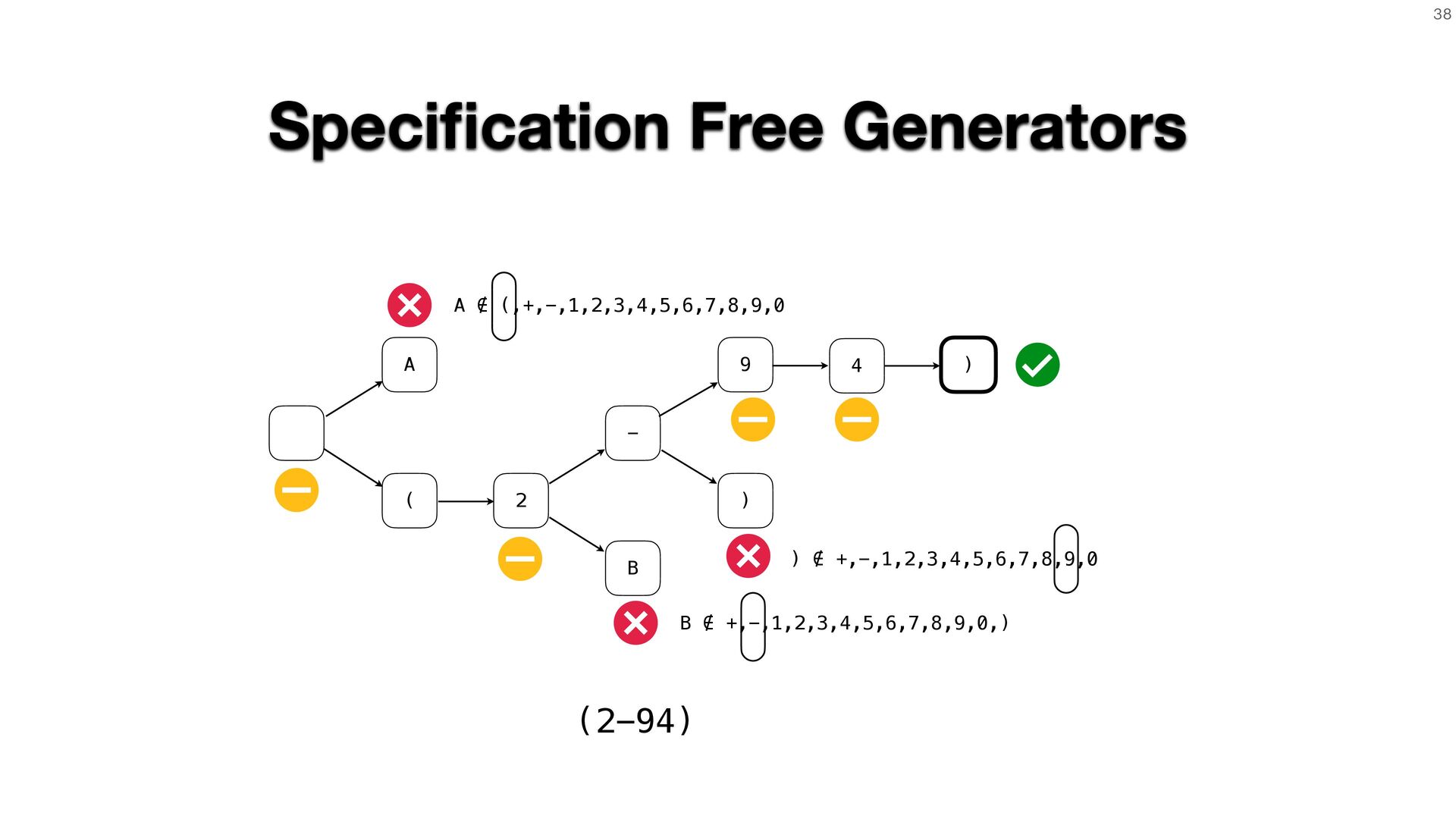
38 Speci fi cation Free Generators A ( 2 -
B 9 ) 4 ) A ∉ (,+,-,1,2,3,4,5,6,7,8,9,0 B ∉ +,-,1,2,3,4,5,6,7,8,9,0,) ) ∉ +,-,1,2,3,4,5,6,7,8,9,0 (2-94) -
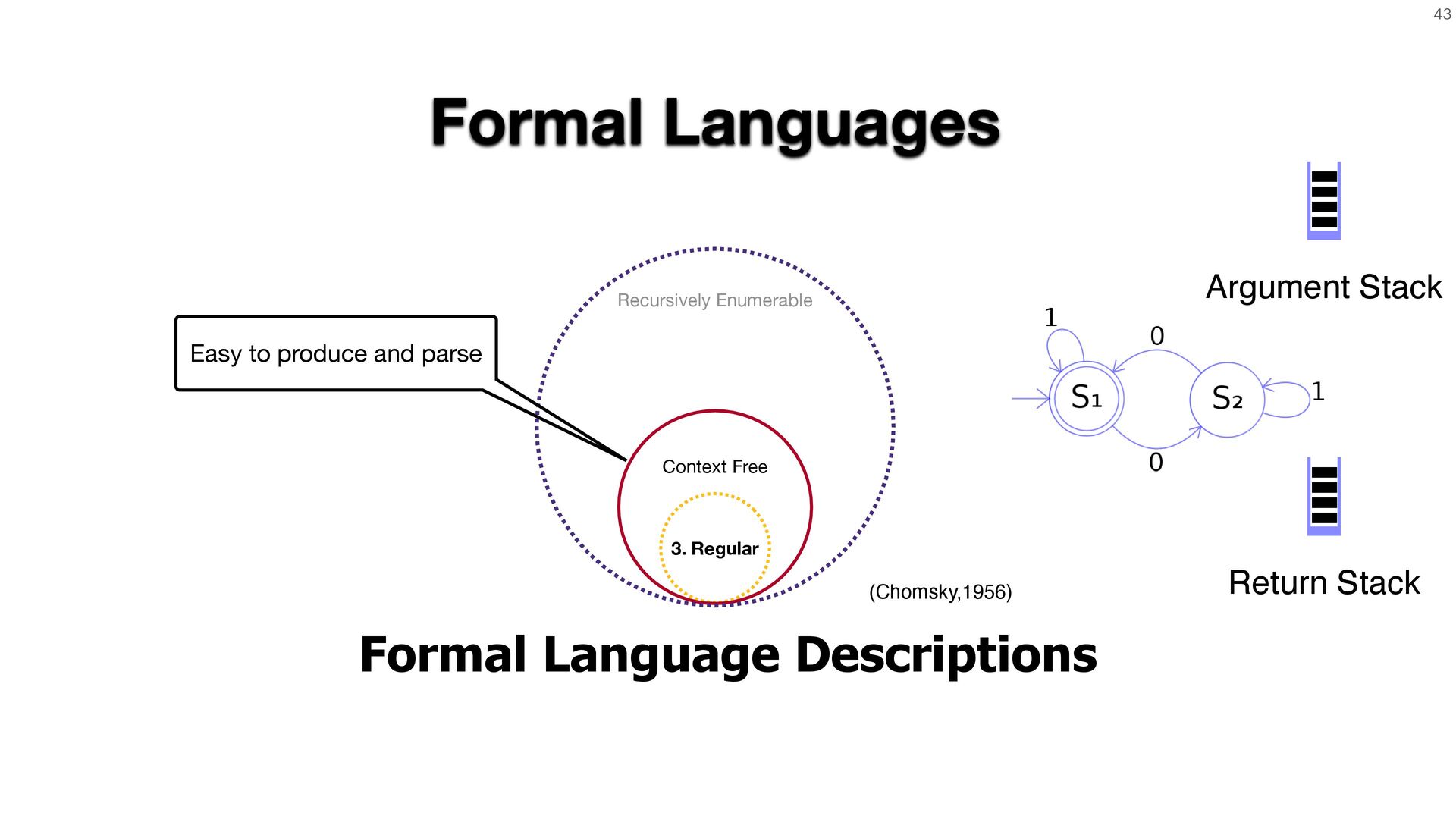
43 Formal Languages Formal Language Descriptions 3. Regular Context Free
Recursively Enumerable (Chomsky,1956) Easy to produce and parse Argument Stack Return Stack -
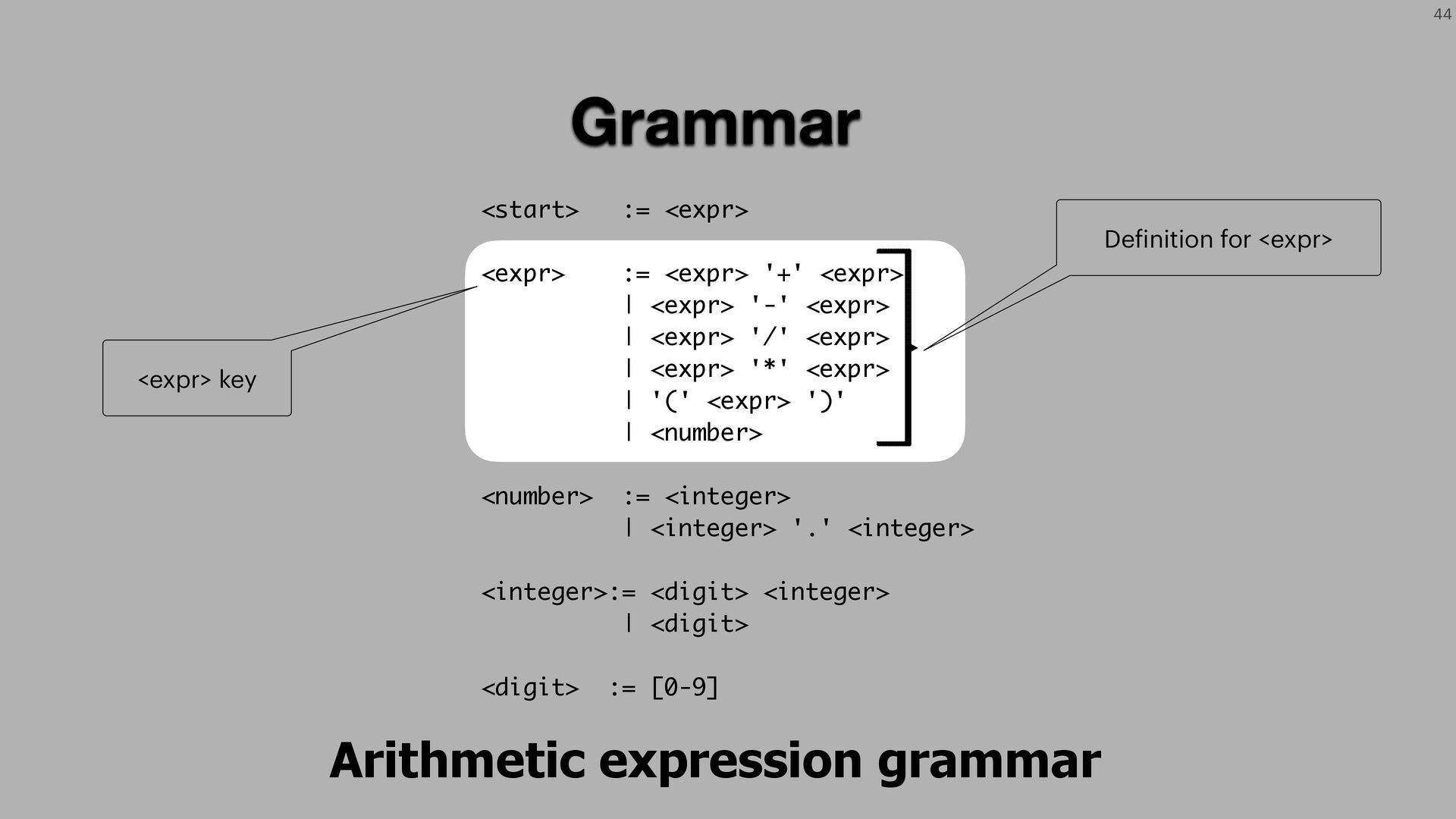
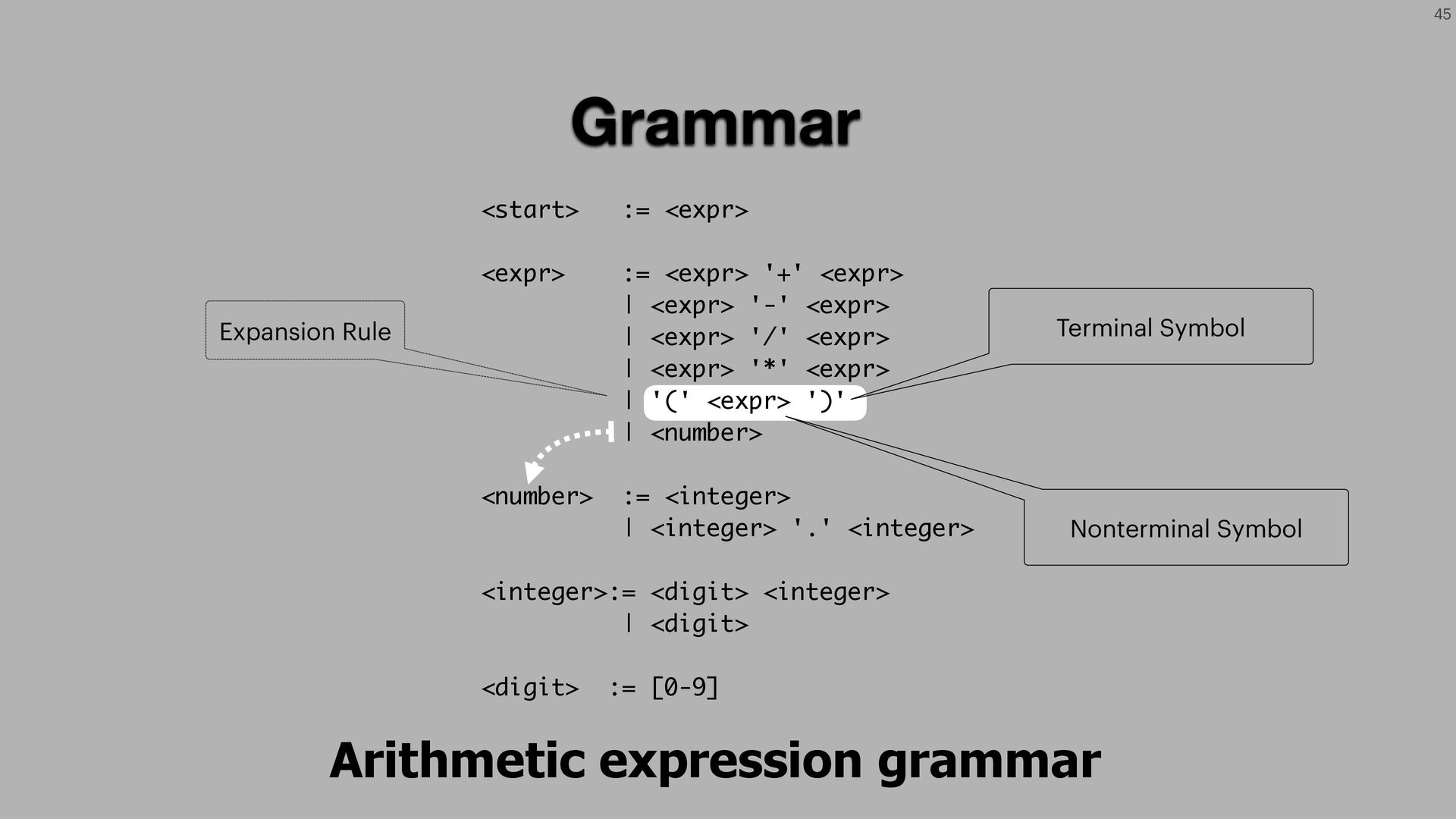
44 Grammar <start> := <expr> <expr> := <expr> '+' <expr>
| <expr> '-' <expr> | <expr> '/' <expr> | <expr> '*' <expr> | '(' <expr> ')' | <number> <number> := <integer> | <integer> '.' <integer> <integer>:= <digit> <integer> | <digit> <digit> := [0-9] Arithmetic expression grammar De f inition for <expr> <expr> key -
45 <start> := <expr> <expr> := <expr> '+' <expr> |
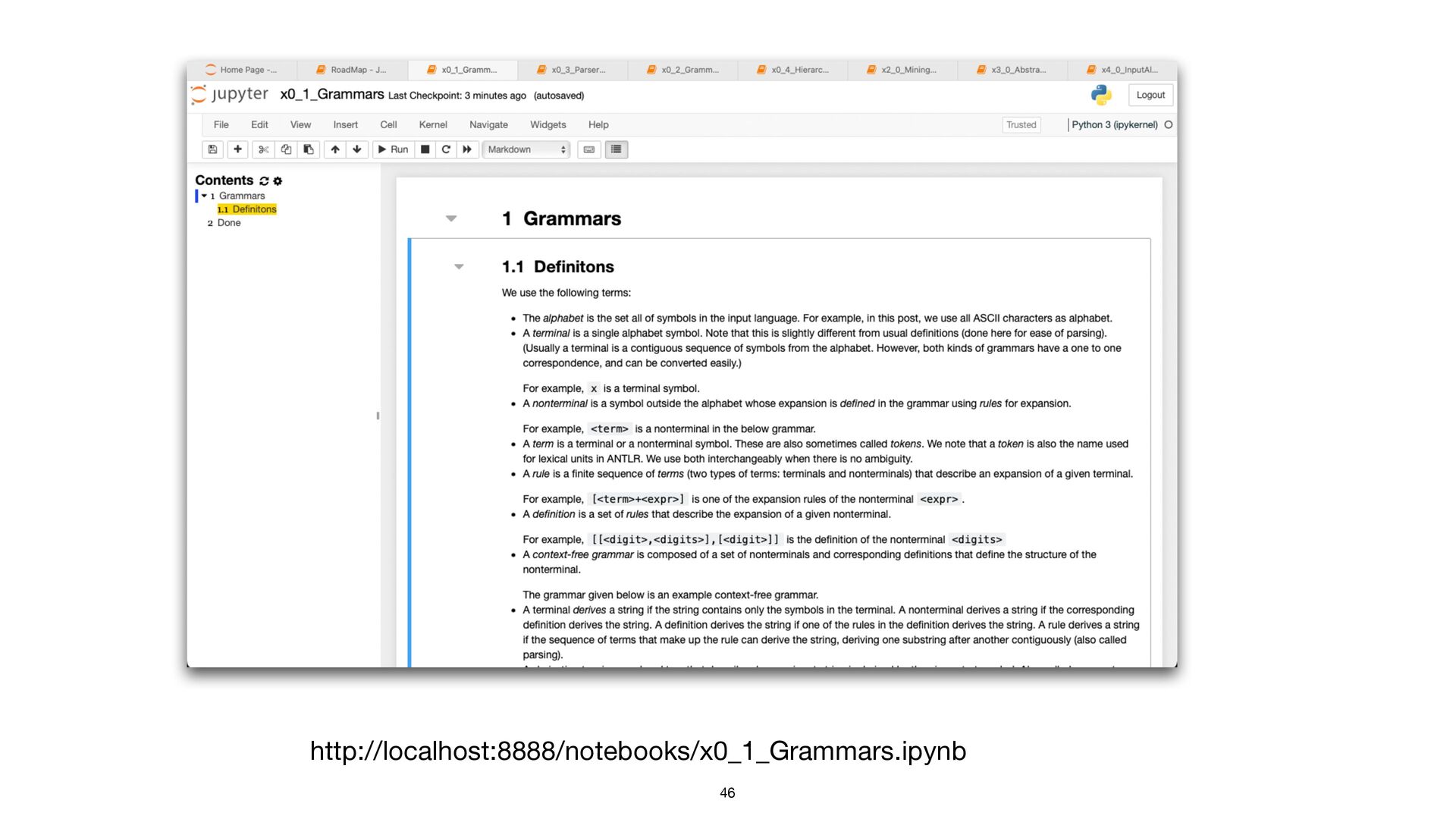
<expr> '-' <expr> | <expr> '/' <expr> | <expr> '*' <expr> | '(' <expr> ')' | <number> <number> := <integer> | <integer> '.' <integer> <integer>:= <digit> <integer> | <digit> <digit> := [0-9] Grammar Arithmetic expression grammar Expansion Rule Terminal Symbol Nonterminal Symbol -
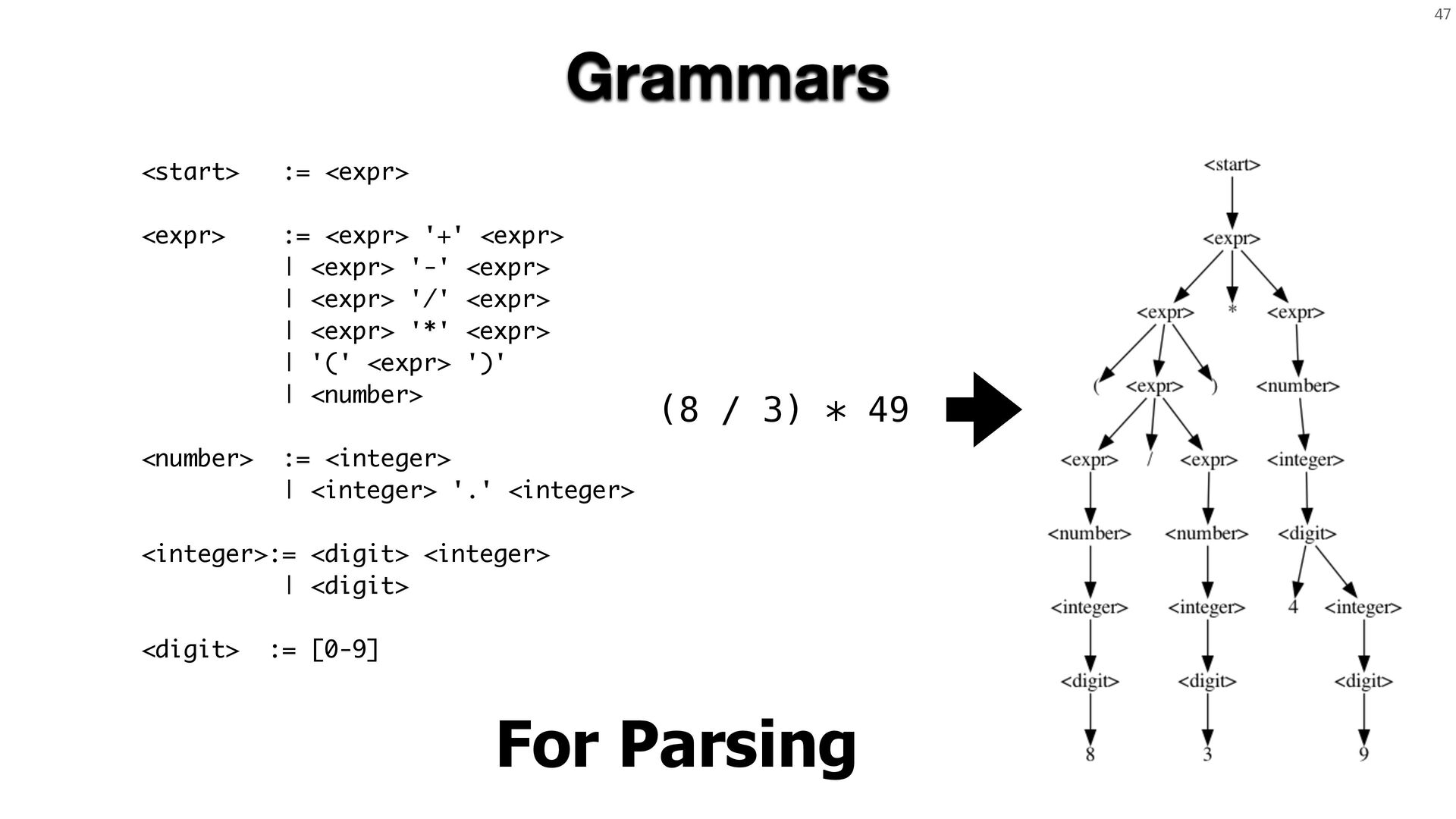
47 Grammars For Parsing (8 / 3) * 49 <start>
:= <expr> <expr> := <expr> '+' <expr> | <expr> '-' <expr> | <expr> '/' <expr> | <expr> '*' <expr> | '(' <expr> ')' | <number> <number> := <integer> | <integer> '.' <integer> <integer>:= <digit> <integer> | <digit> <digit> := [0-9] -
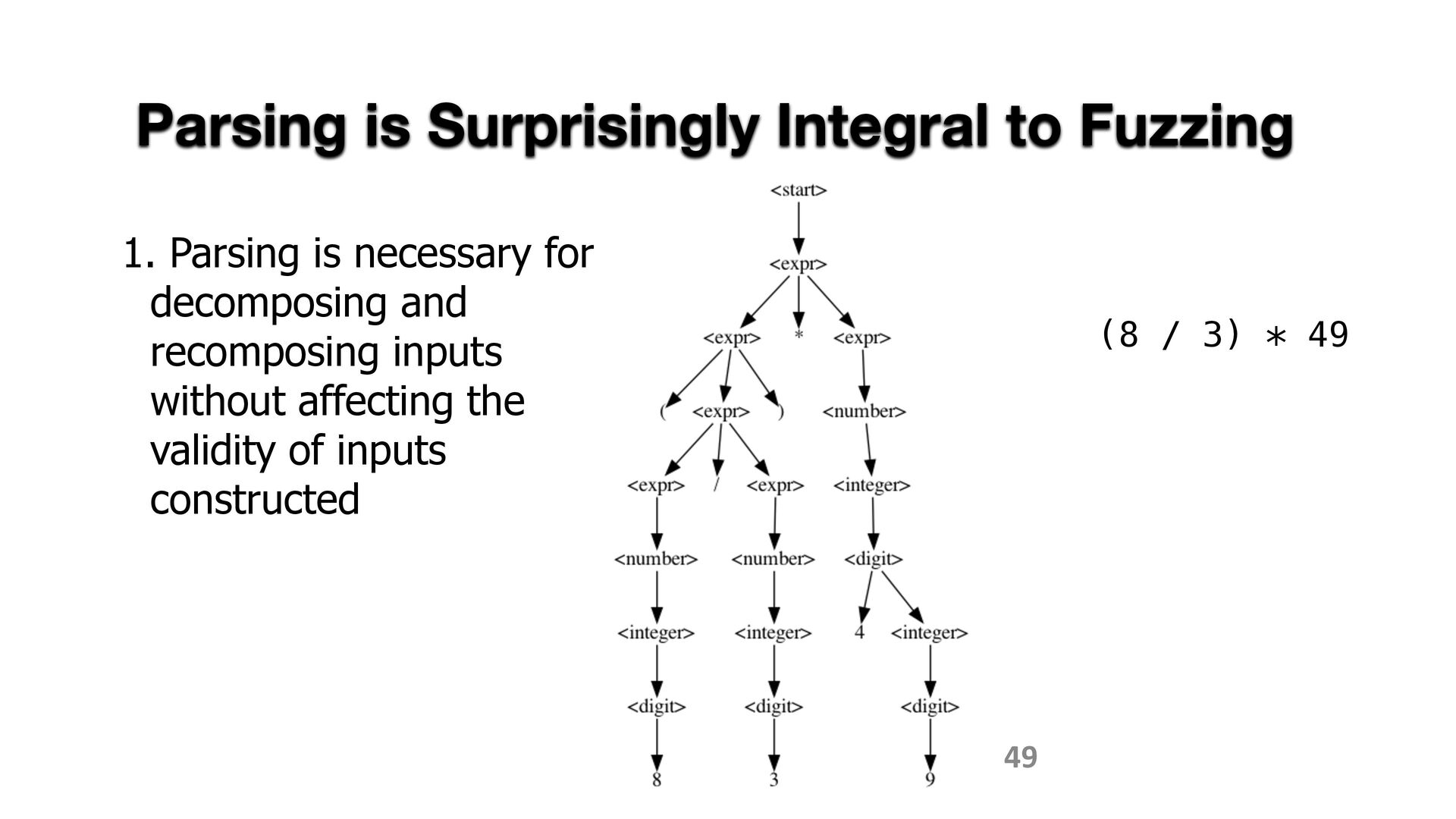
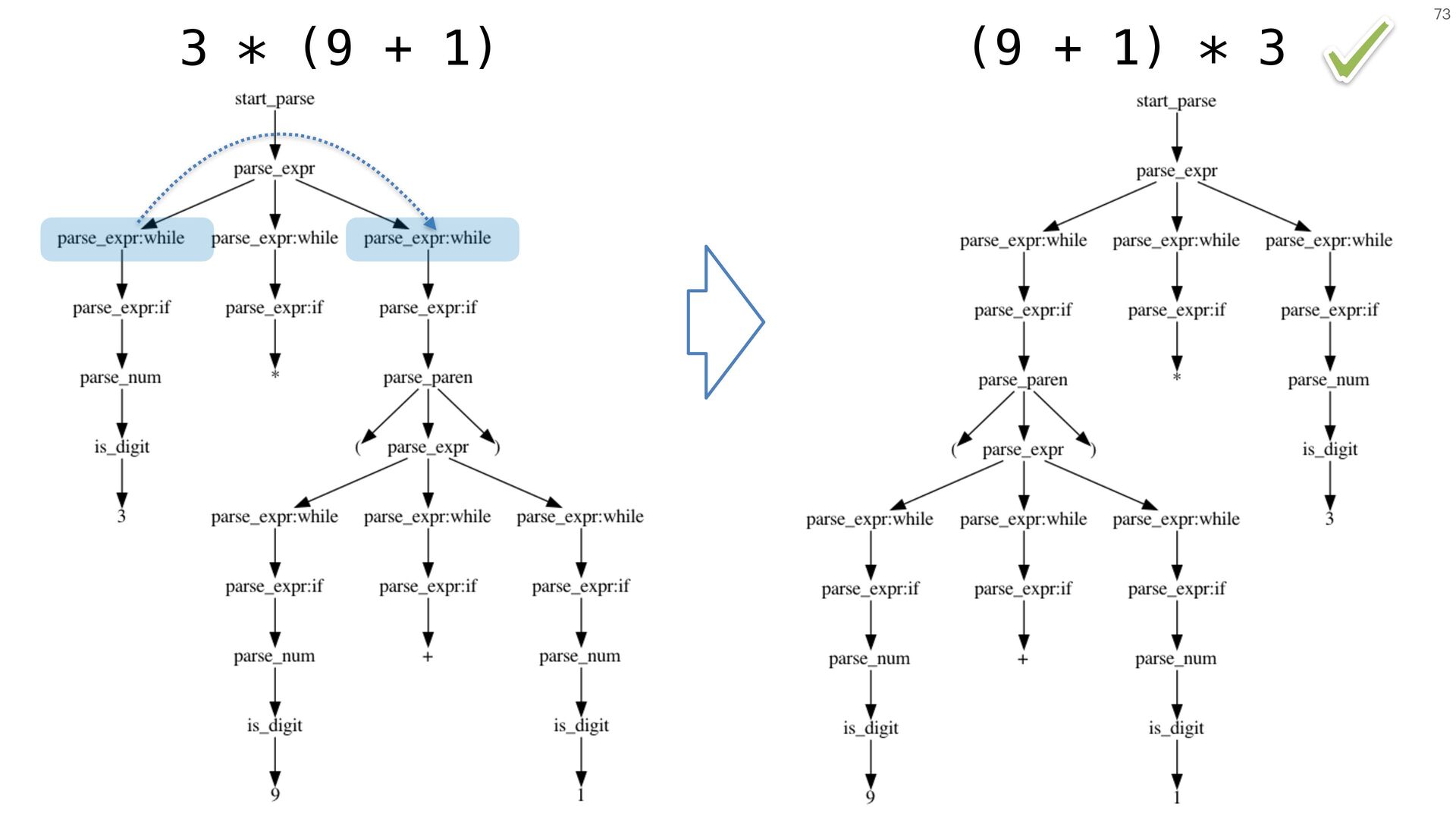
49 Parsing is Surprisingly Integral to Fuzzing 1. Parsing is
necessary for decomposing and recomposing inputs without affecting the validity of inputs constructed (8 / 3) * 49 -
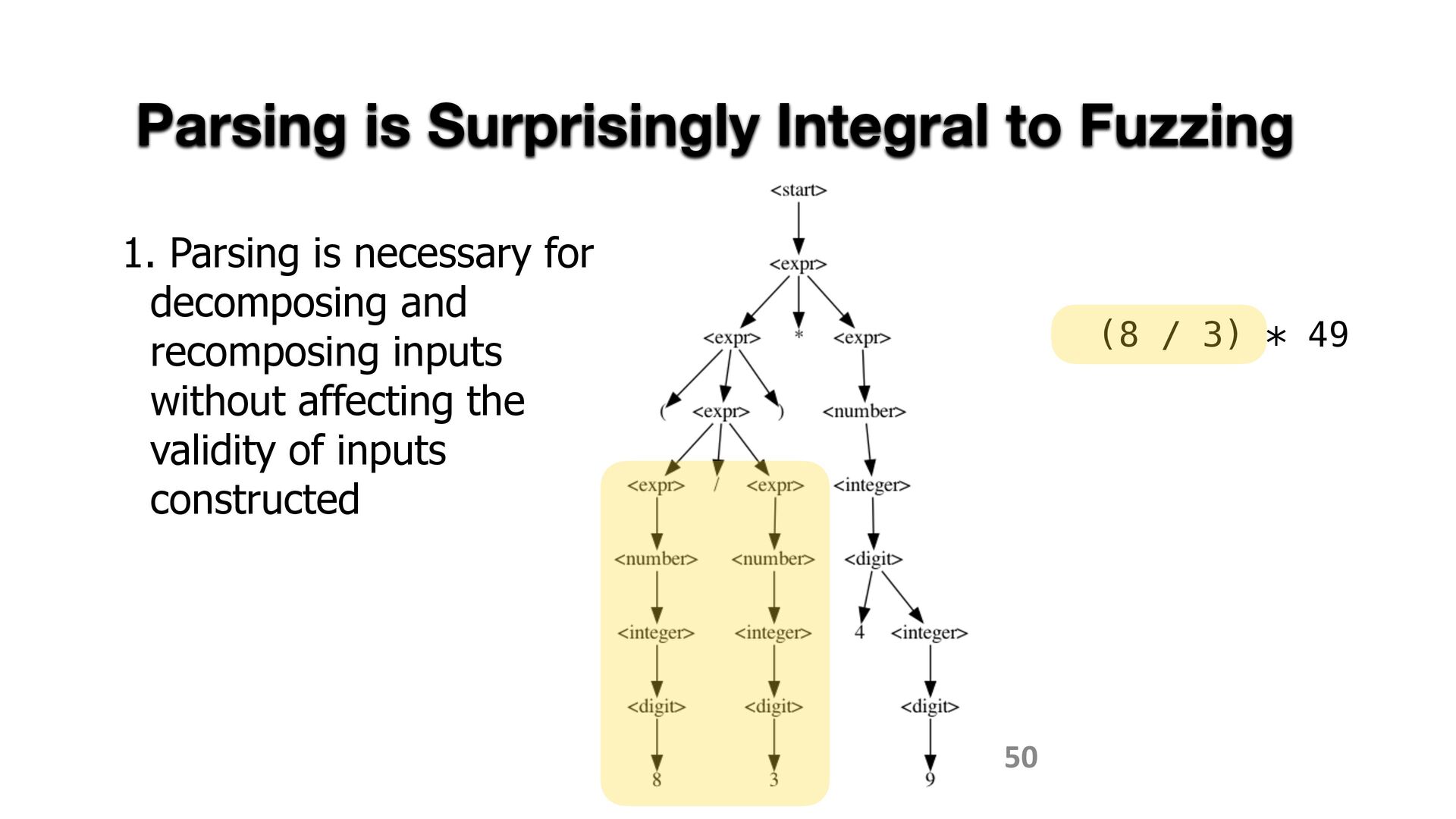
50 Parsing is Surprisingly Integral to Fuzzing 1. Parsing is
necessary for decomposing and recomposing inputs without affecting the validity of inputs constructed (8 / 3) * 49 -
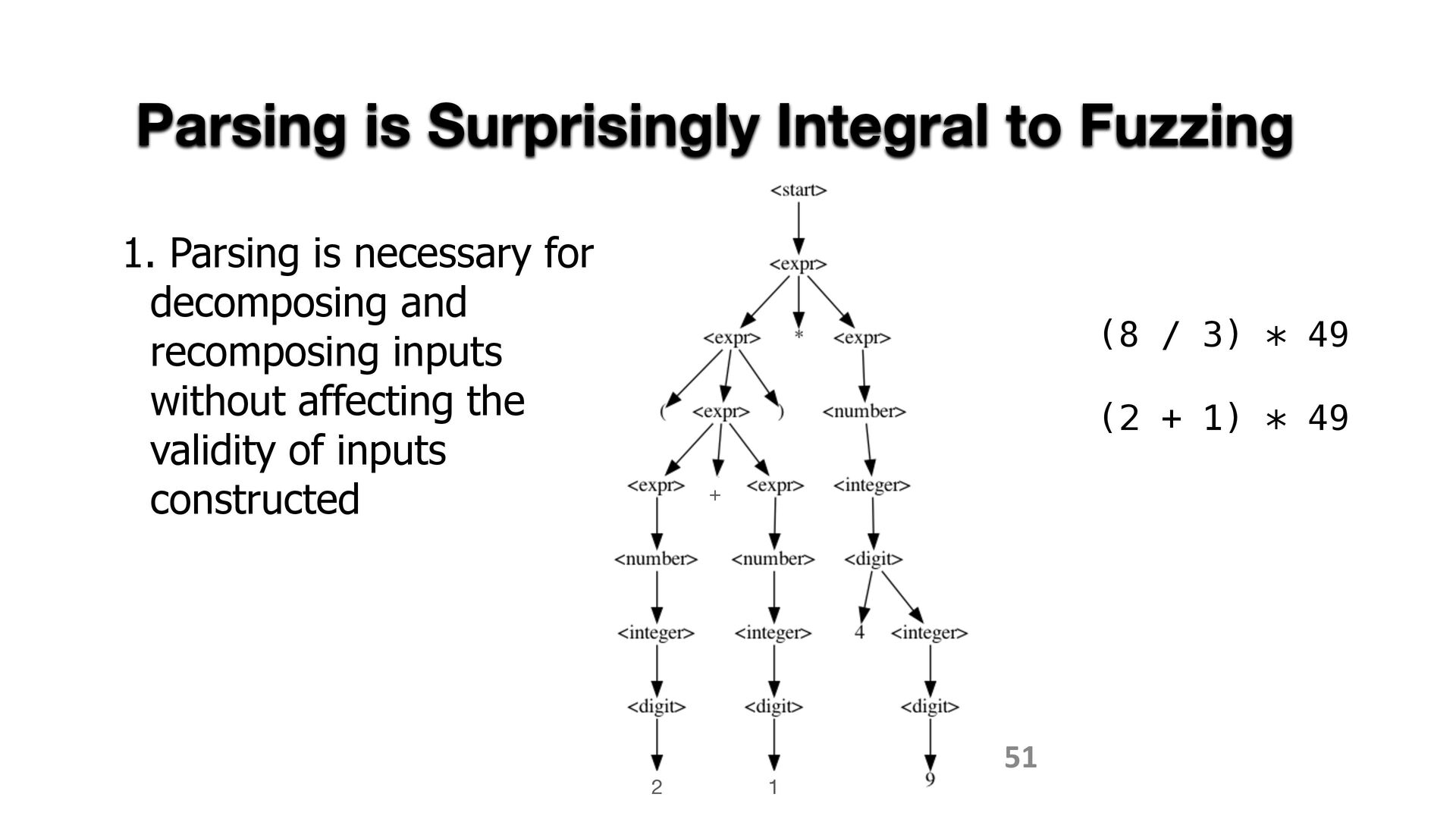
51 Parsing is Surprisingly Integral to Fuzzing 1. Parsing is
necessary for decomposing and recomposing inputs without affecting the validity of inputs constructed (2 + 1) * 49 1 2 + (8 / 3) * 49 -
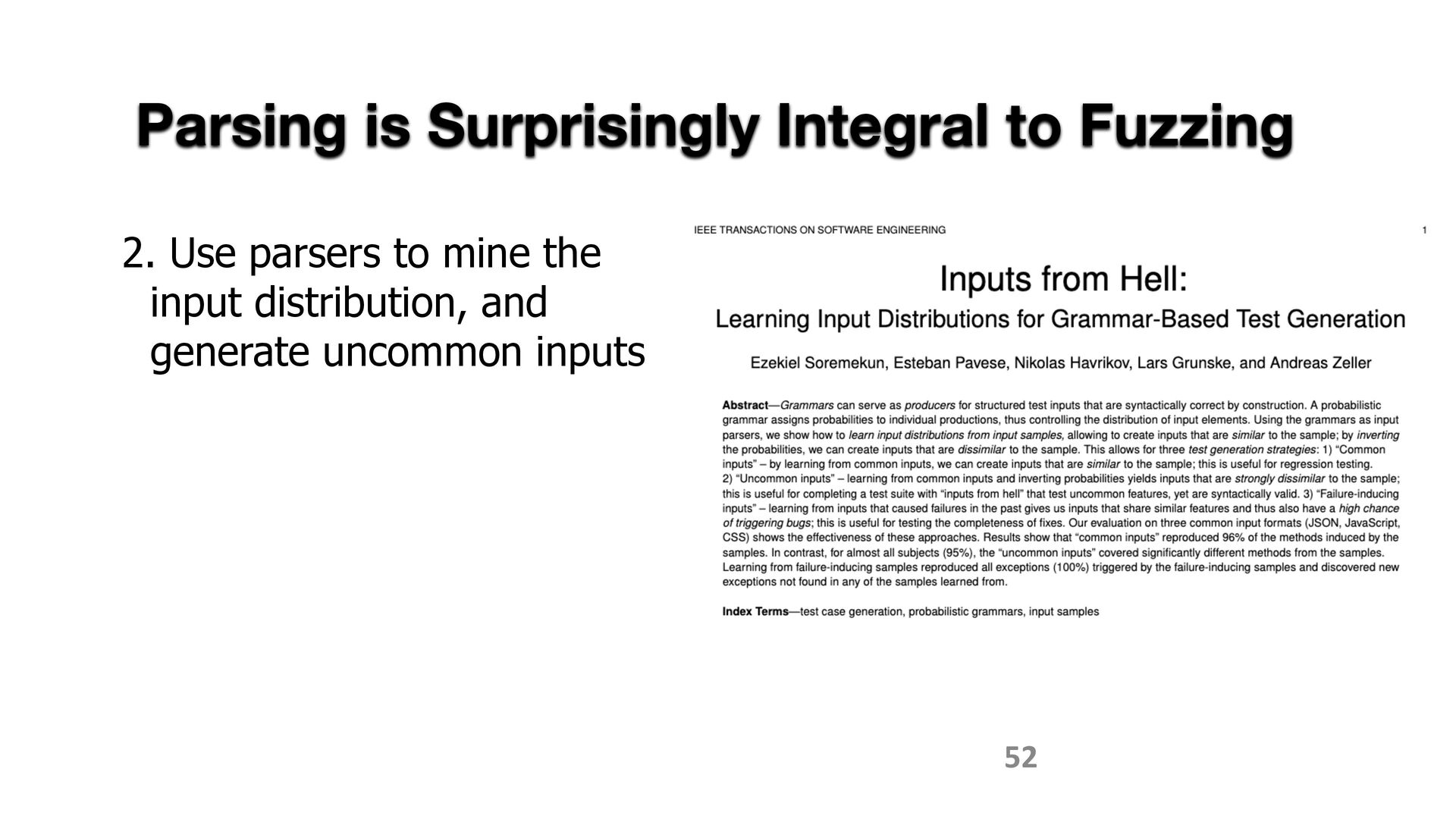
52 Parsing is Surprisingly Integral to Fuzzing 2. Use parsers
to mine the input distribution, and generate uncommon inputs -
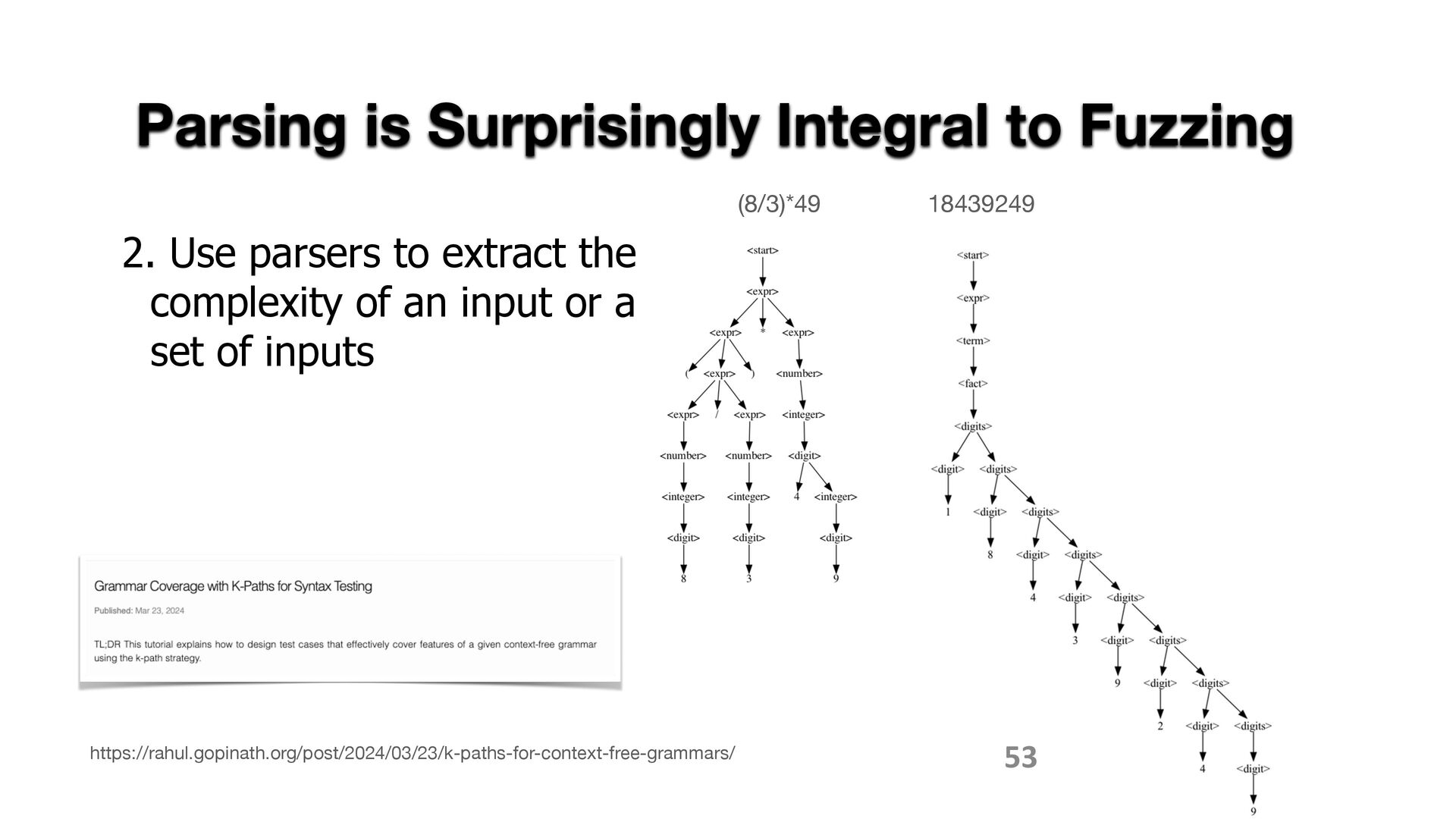
53 Parsing is Surprisingly Integral to Fuzzing 2. Use parsers
to extract the complexity of an input or a set of inputs 18439249 (8/3)*49 https://rahul.gopinath.org/post/2024/03/23/k-paths-for-context-free-grammars/ -
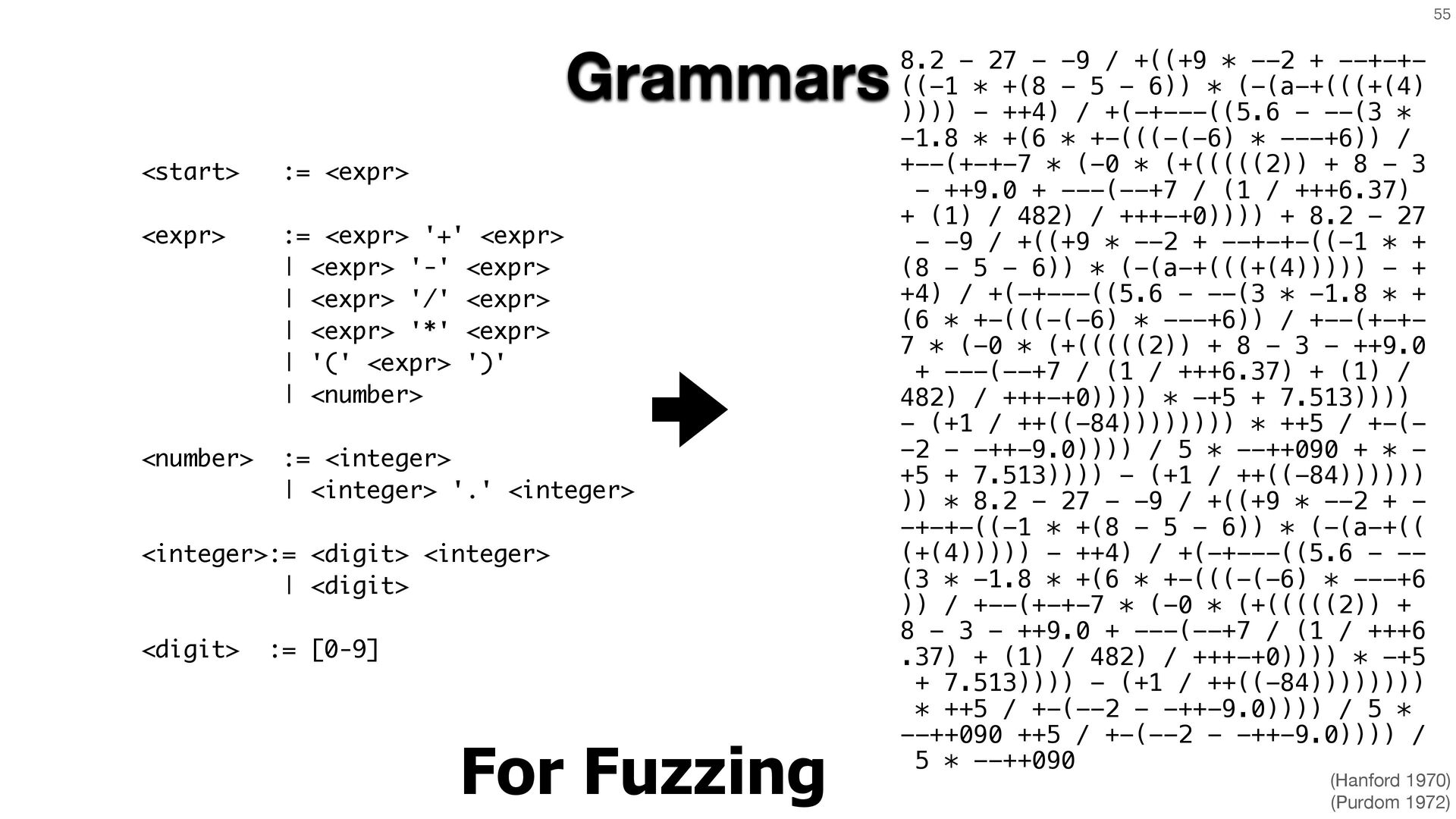
55 Grammars 8.2 - 27 - -9 / +((+9 *
--2 + --+-+- ((-1 * +(8 - 5 - 6)) * (-(a-+(((+(4) )))) - ++4) / +(-+---((5.6 - --(3 * -1.8 * +(6 * +-(((-(-6) * ---+6)) / +--(+-+-7 * (-0 * (+(((((2)) + 8 - 3 - ++9.0 + ---(--+7 / (1 / +++6.37) + (1) / 482) / +++-+0)))) + 8.2 - 27 - -9 / +((+9 * --2 + --+-+-((-1 * + (8 - 5 - 6)) * (-(a-+(((+(4))))) - + +4) / +(-+---((5.6 - --(3 * -1.8 * + (6 * +-(((-(-6) * ---+6)) / +--(+-+- 7 * (-0 * (+(((((2)) + 8 - 3 - ++9.0 + ---(--+7 / (1 / +++6.37) + (1) / 482) / +++-+0)))) * -+5 + 7.513)))) - (+1 / ++((-84)))))))) * ++5 / +-(- -2 - -++-9.0)))) / 5 * --++090 + * - +5 + 7.513)))) - (+1 / ++((-84)))))) )) * 8.2 - 27 - -9 / +((+9 * --2 + - -+-+-((-1 * +(8 - 5 - 6)) * (-(a-+(( (+(4))))) - ++4) / +(-+---((5.6 - -- (3 * -1.8 * +(6 * +-(((-(-6) * ---+6 )) / +--(+-+-7 * (-0 * (+(((((2)) + 8 - 3 - ++9.0 + ---(--+7 / (1 / +++6 .37) + (1) / 482) / +++-+0)))) * -+5 + 7.513)))) - (+1 / ++((-84)))))))) * ++5 / +-(--2 - -++-9.0)))) / 5 * --++090 ++5 / +-(--2 - -++-9.0)))) / 5 * --++090 <start> := <expr> <expr> := <expr> '+' <expr> | <expr> '-' <expr> | <expr> '/' <expr> | <expr> '*' <expr> | '(' <expr> ')' | <number> <number> := <integer> | <integer> '.' <integer> <integer>:= <digit> <integer> | <digit> <digit> := [0-9] For Fuzzing (Hanford 1970) (Purdom 1972) -
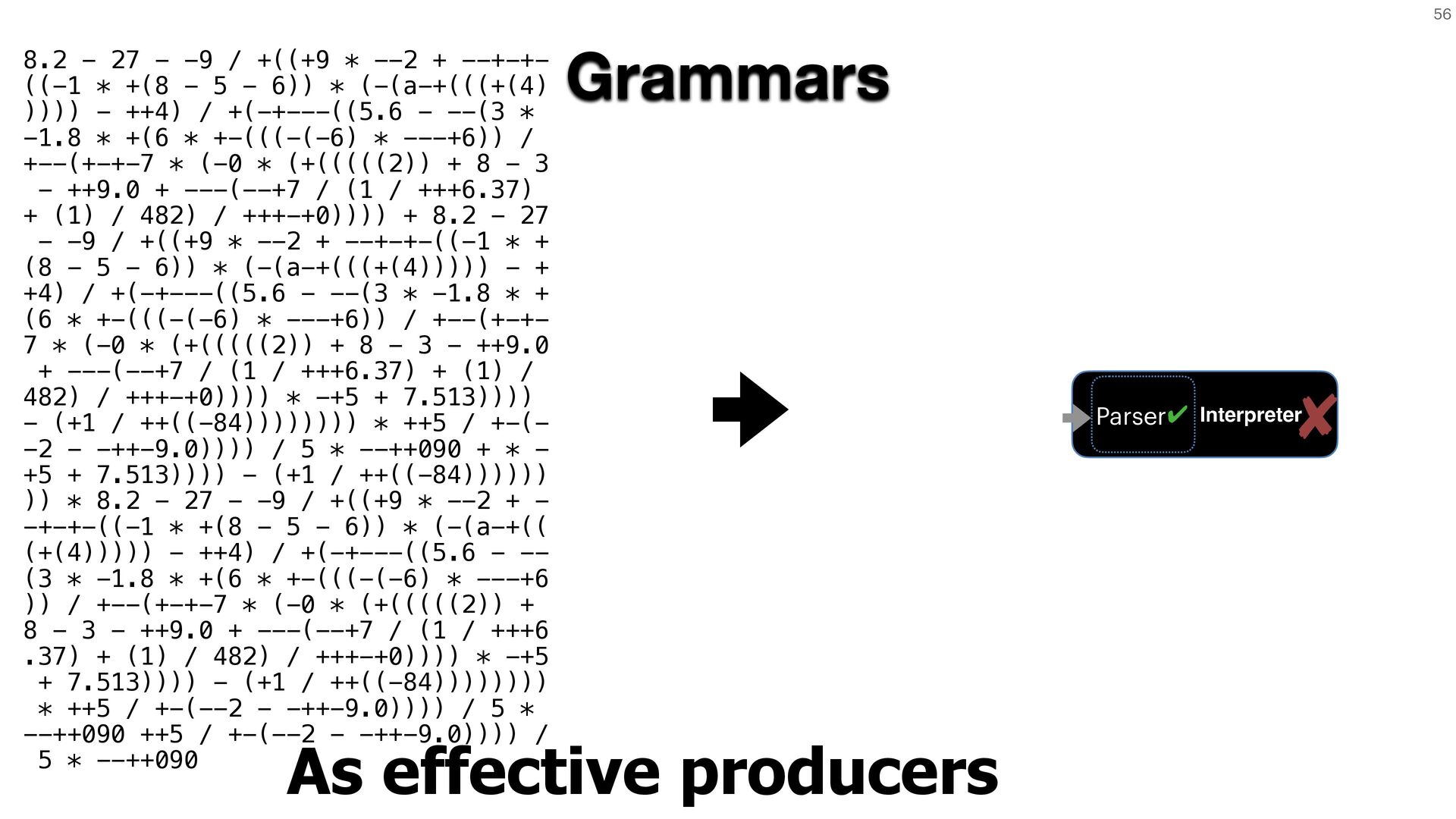
56 Grammars As effective producers Interpreter Parser ✘ ✔ 8.2
- 27 - -9 / +((+9 * --2 + --+-+- ((-1 * +(8 - 5 - 6)) * (-(a-+(((+(4) )))) - ++4) / +(-+---((5.6 - --(3 * -1.8 * +(6 * +-(((-(-6) * ---+6)) / +--(+-+-7 * (-0 * (+(((((2)) + 8 - 3 - ++9.0 + ---(--+7 / (1 / +++6.37) + (1) / 482) / +++-+0)))) + 8.2 - 27 - -9 / +((+9 * --2 + --+-+-((-1 * + (8 - 5 - 6)) * (-(a-+(((+(4))))) - + +4) / +(-+---((5.6 - --(3 * -1.8 * + (6 * +-(((-(-6) * ---+6)) / +--(+-+- 7 * (-0 * (+(((((2)) + 8 - 3 - ++9.0 + ---(--+7 / (1 / +++6.37) + (1) / 482) / +++-+0)))) * -+5 + 7.513)))) - (+1 / ++((-84)))))))) * ++5 / +-(- -2 - -++-9.0)))) / 5 * --++090 + * - +5 + 7.513)))) - (+1 / ++((-84)))))) )) * 8.2 - 27 - -9 / +((+9 * --2 + - -+-+-((-1 * +(8 - 5 - 6)) * (-(a-+(( (+(4))))) - ++4) / +(-+---((5.6 - -- (3 * -1.8 * +(6 * +-(((-(-6) * ---+6 )) / +--(+-+-7 * (-0 * (+(((((2)) + 8 - 3 - ++9.0 + ---(--+7 / (1 / +++6 .37) + (1) / 482) / +++-+0)))) * -+5 + 7.513)))) - (+1 / ++((-84)))))))) * ++5 / +-(--2 - -++-9.0)))) / 5 * --++090 ++5 / +-(--2 - -++-9.0)))) / 5 * --++090 -
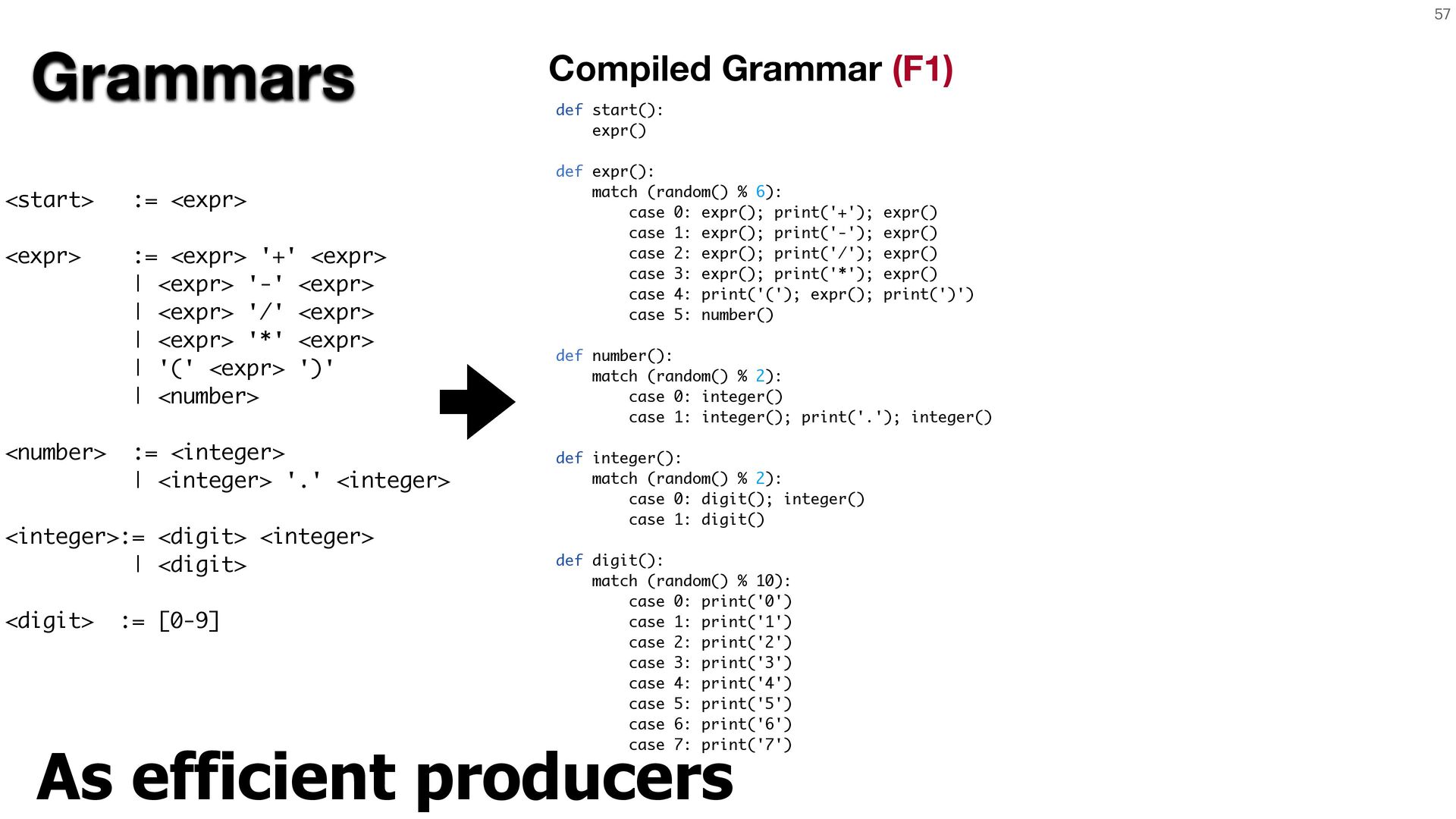
57 Grammars <start> := <expr> <expr> := <expr> '+' <expr>
| <expr> '-' <expr> | <expr> '/' <expr> | <expr> '*' <expr> | '(' <expr> ')' | <number> <number> := <integer> | <integer> '.' <integer> <integer>:= <digit> <integer> | <digit> <digit> := [0-9] As efficient producers def start(): expr() def expr(): match (random() % 6): case 0: expr(); print('+'); expr() case 1: expr(); print('-'); expr() case 2: expr(); print('/'); expr() case 3: expr(); print('*'); expr() case 4: print('('); expr(); print(')') case 5: number() def number(): match (random() % 2): case 0: integer() case 1: integer(); print('.'); integer() def integer(): match (random() % 2): case 0: digit(); integer() case 1: digit() def digit(): match (random() % 10): case 0: print('0') case 1: print('1') case 2: print('2') case 3: print('3') case 4: print('4') case 5: print('5') case 6: print('6') case 7: print('7') Compiled Grammar (F1) -
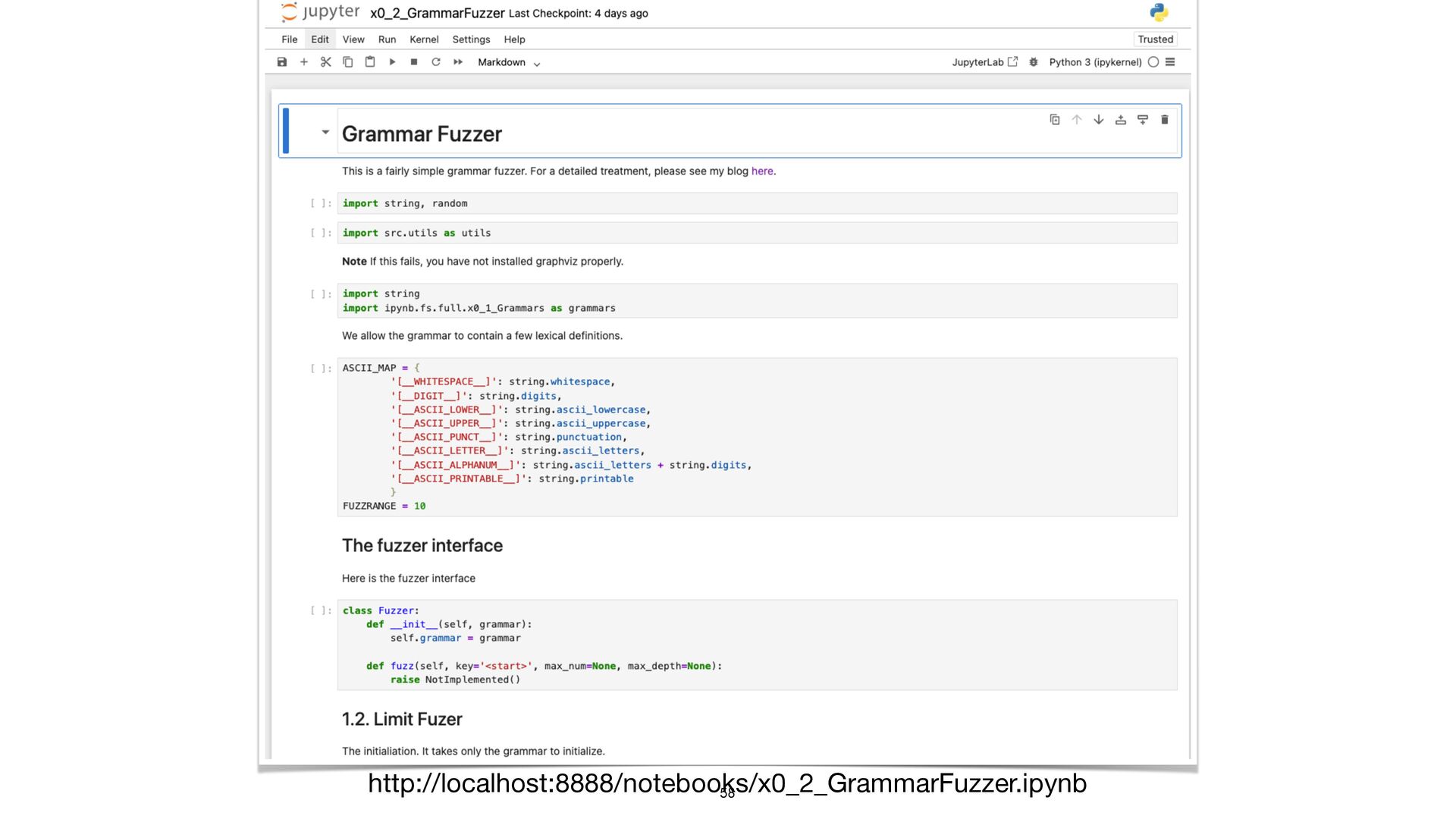
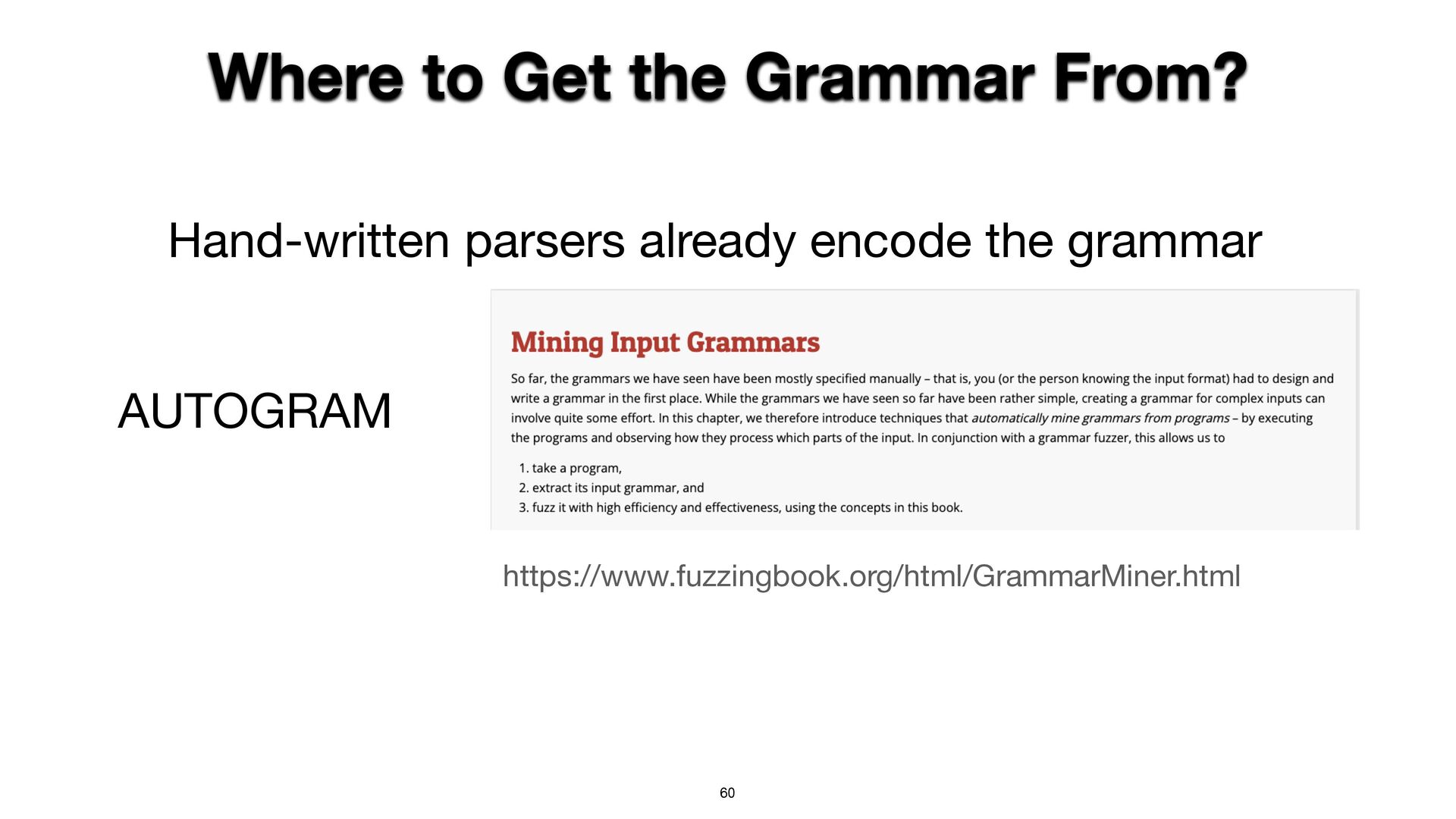
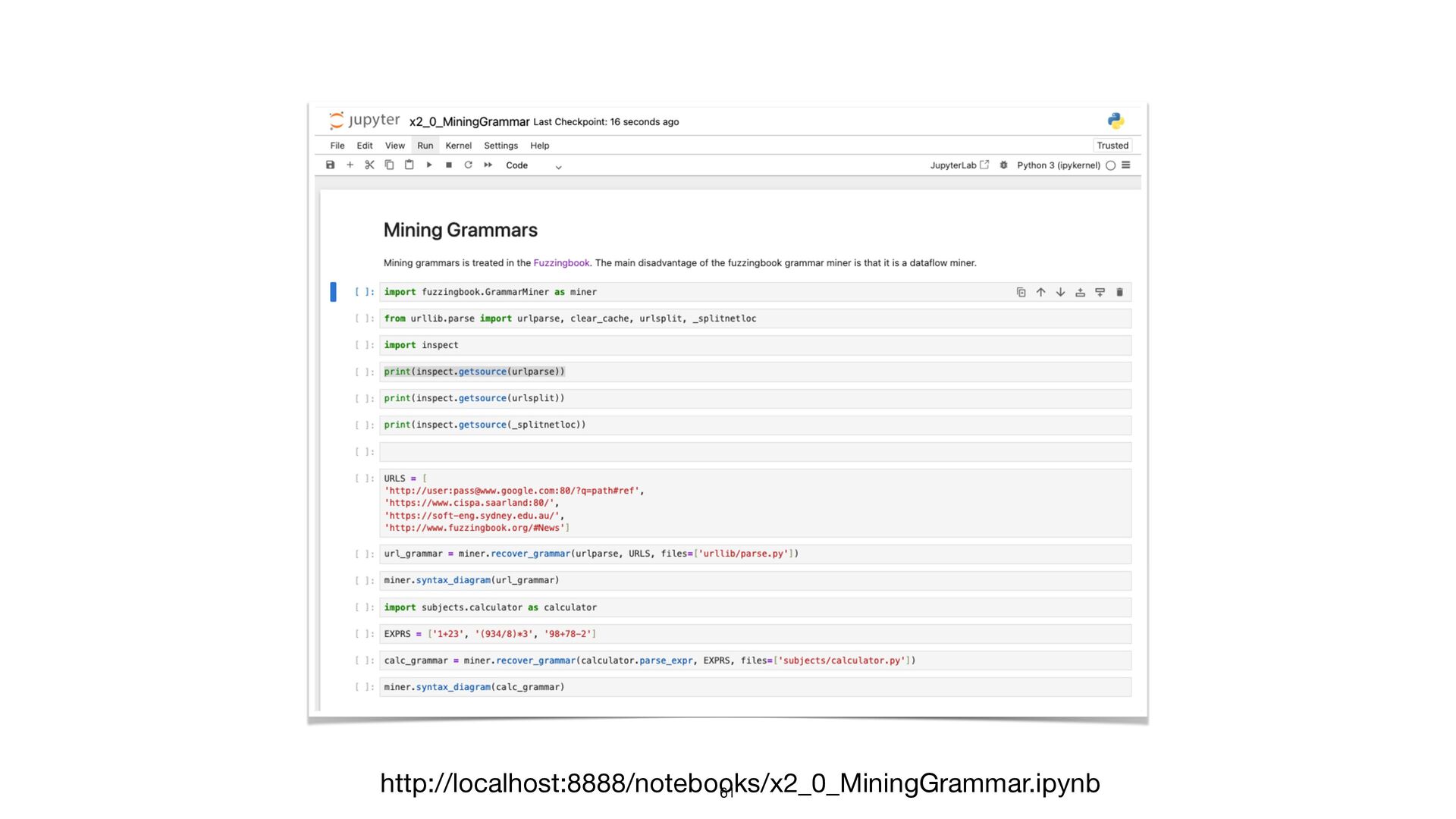
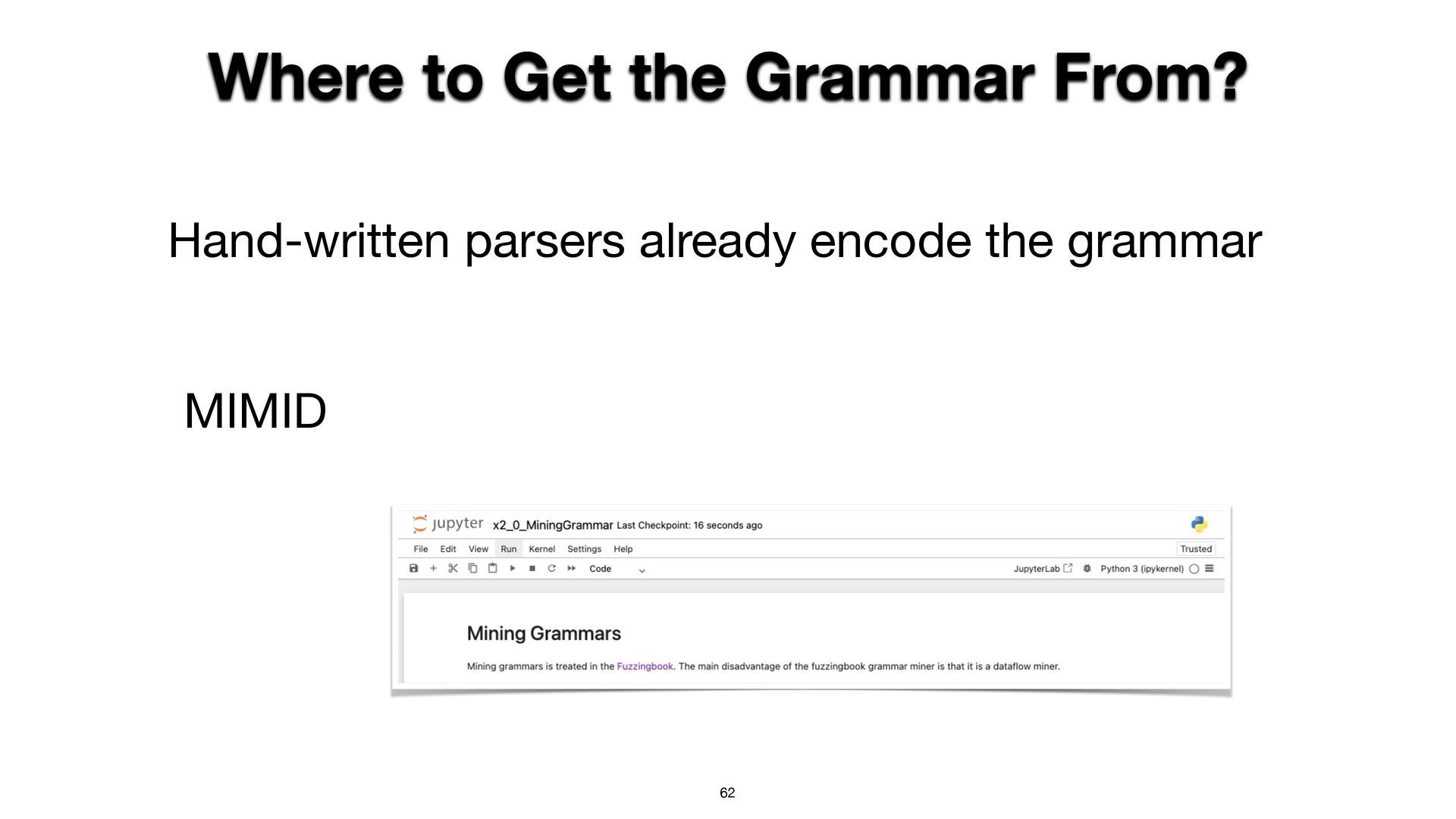
60 https://www.fuzzingbook.org/html/GrammarMiner.html AUTOGRAM Where to Get the Grammar From? Hand-written
parsers already encode the grammar -
62 MIMID Where to Get the Grammar From? Hand-written parsers
already encode the grammar -
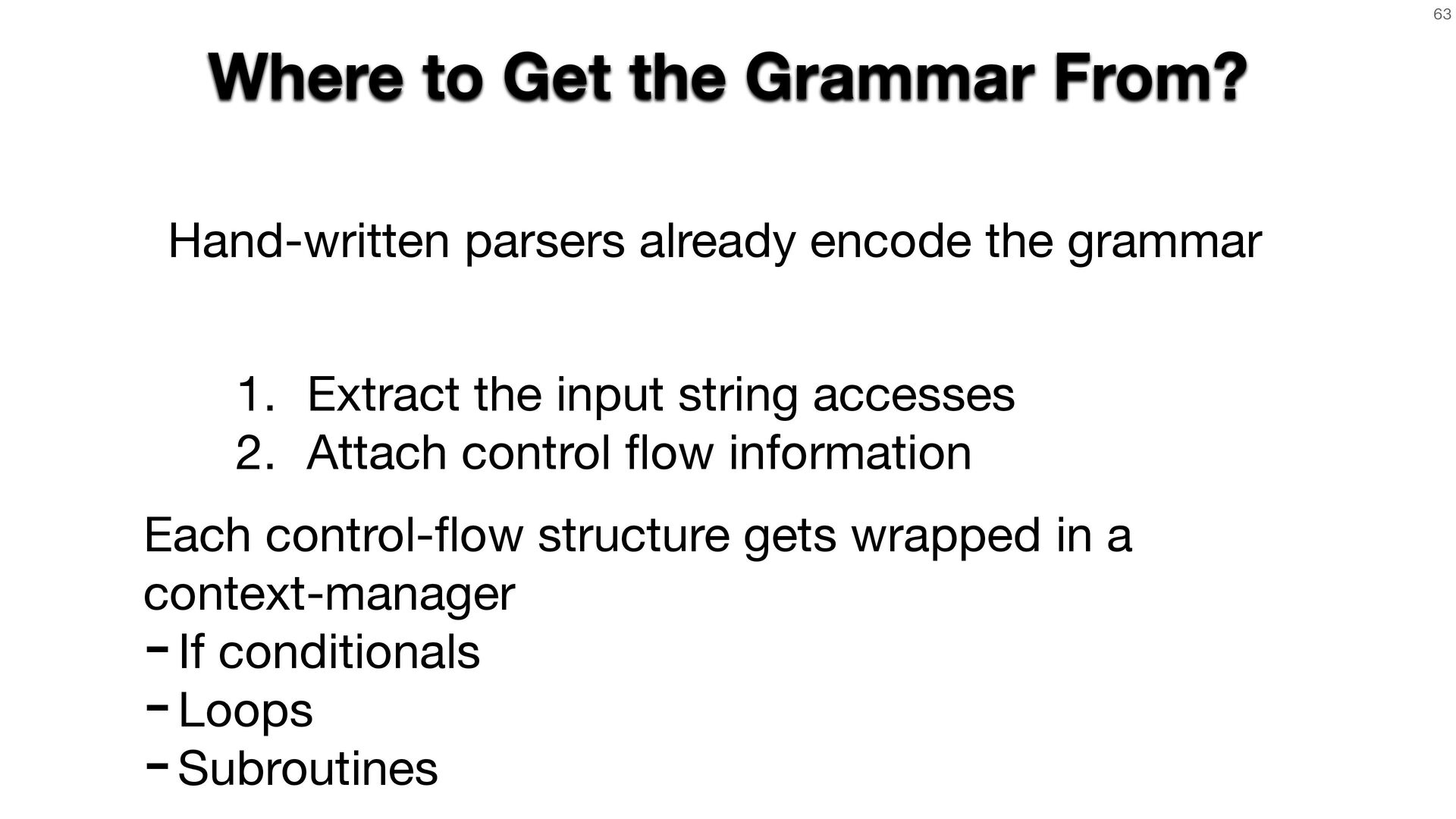
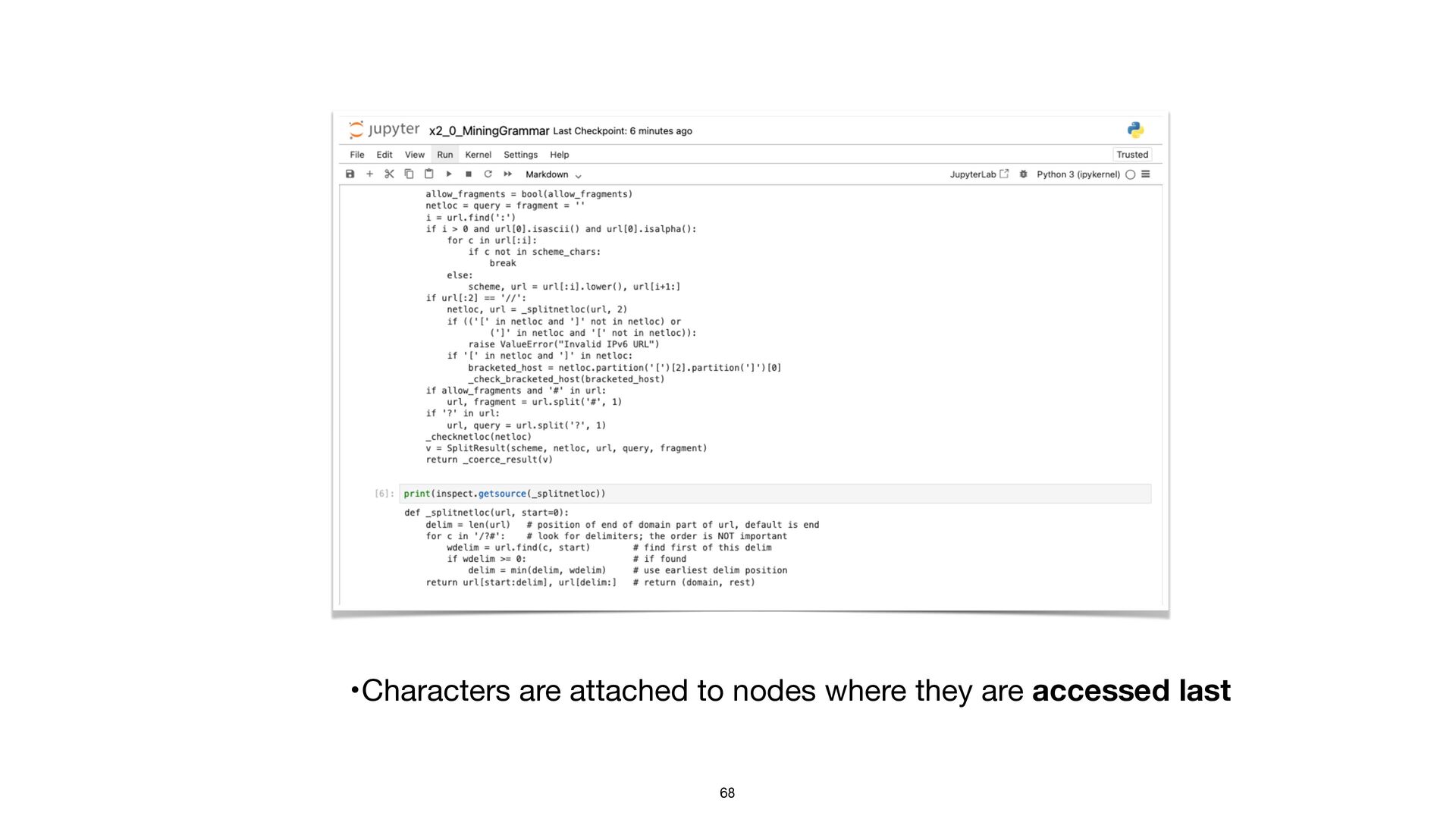
63 Where to Get the Grammar From? 1. Extract the
input string accesses 2. Attach control fl ow information Hand-written parsers already encode the grammar Each control- fl ow structure gets wrapped in a context-manager -If conditionals -Loops -Subroutines -
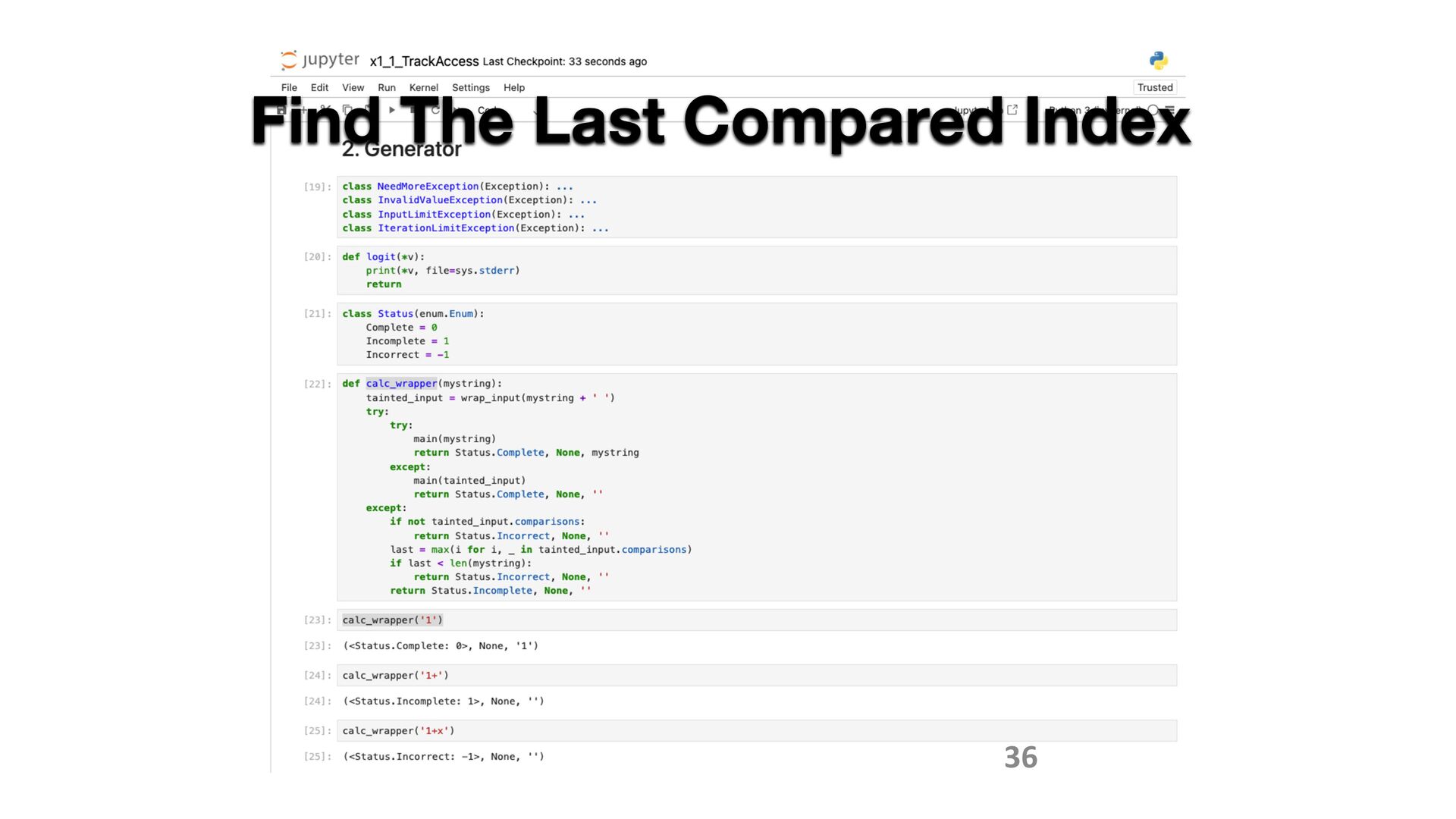
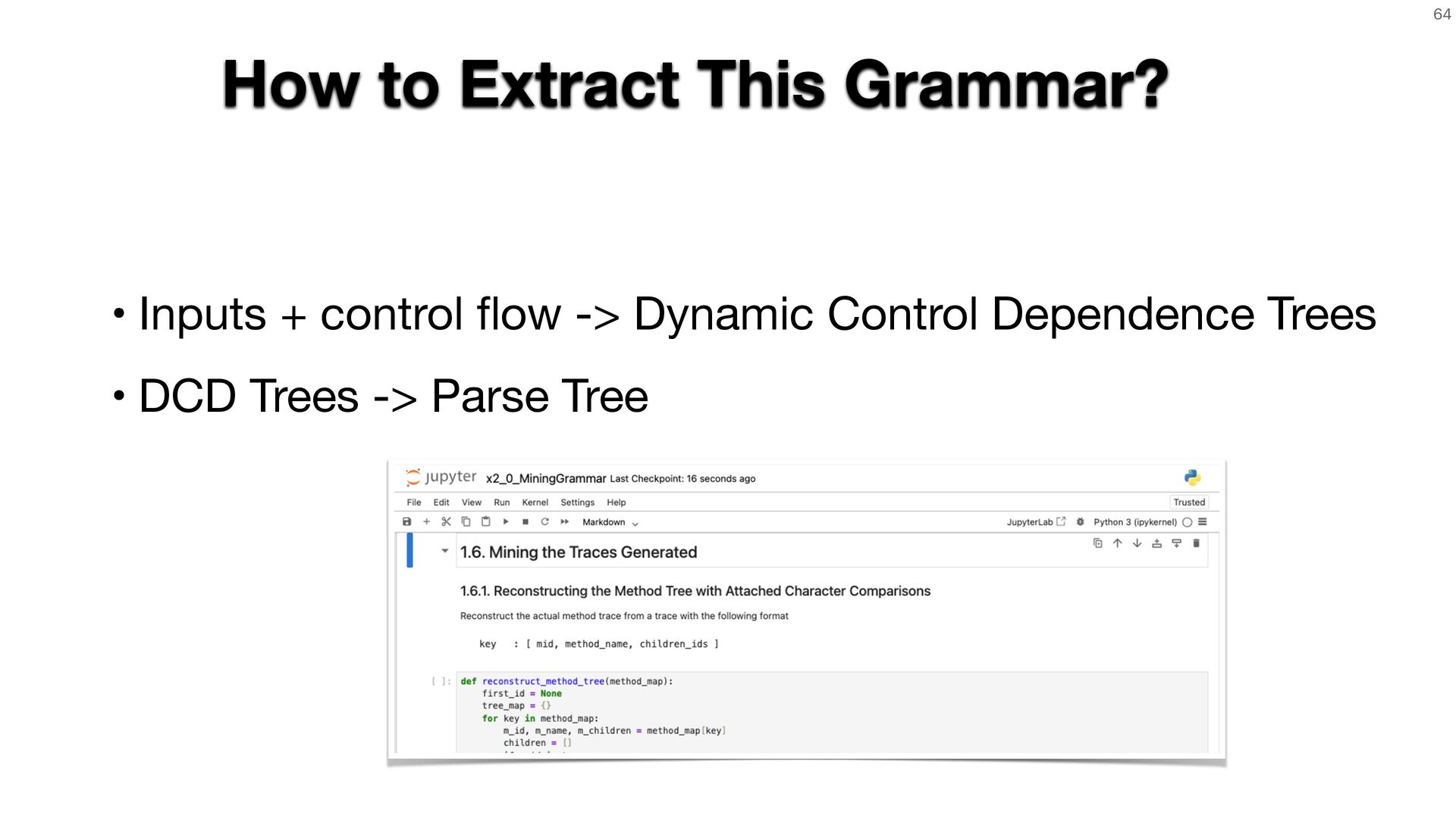
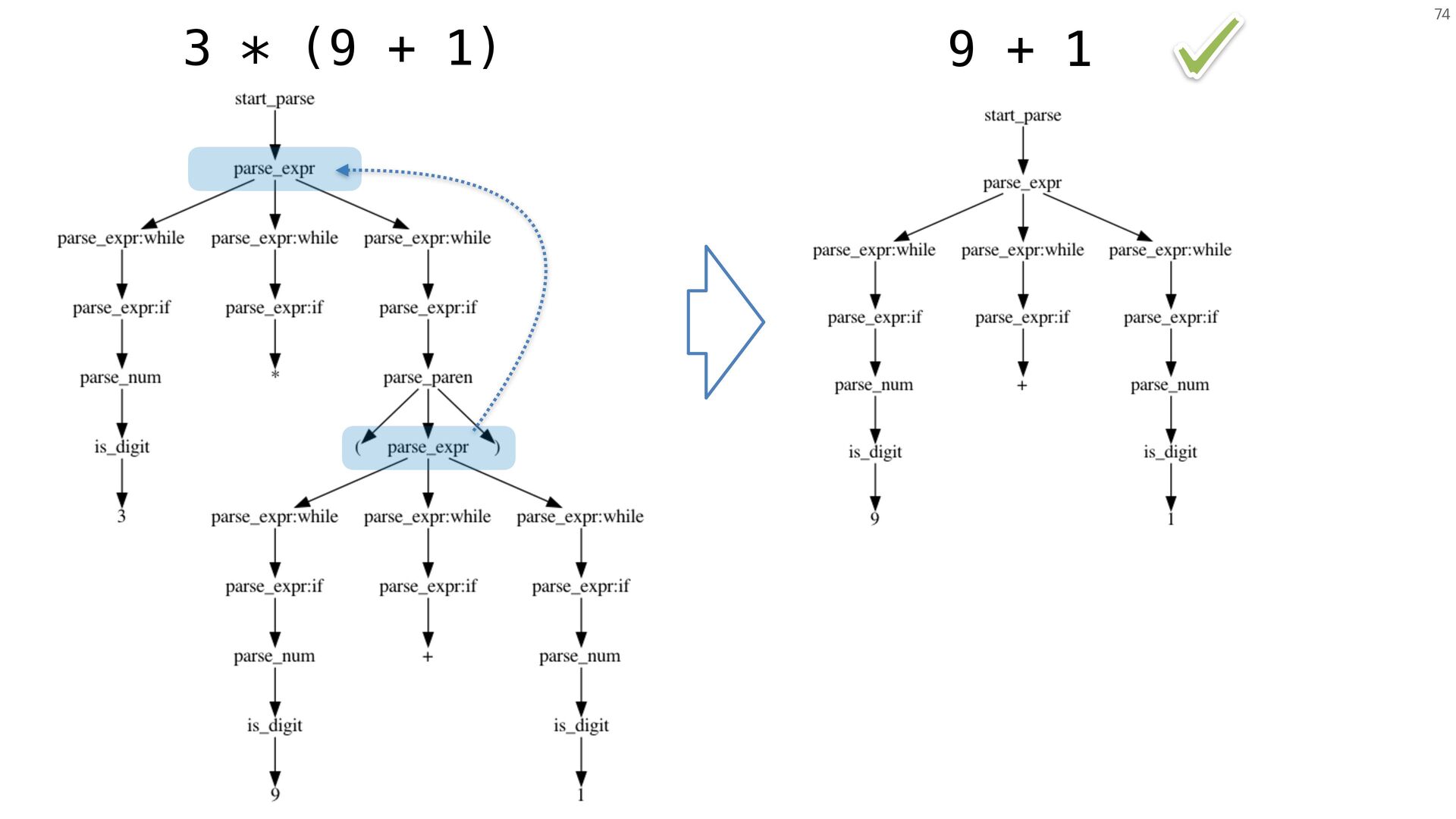
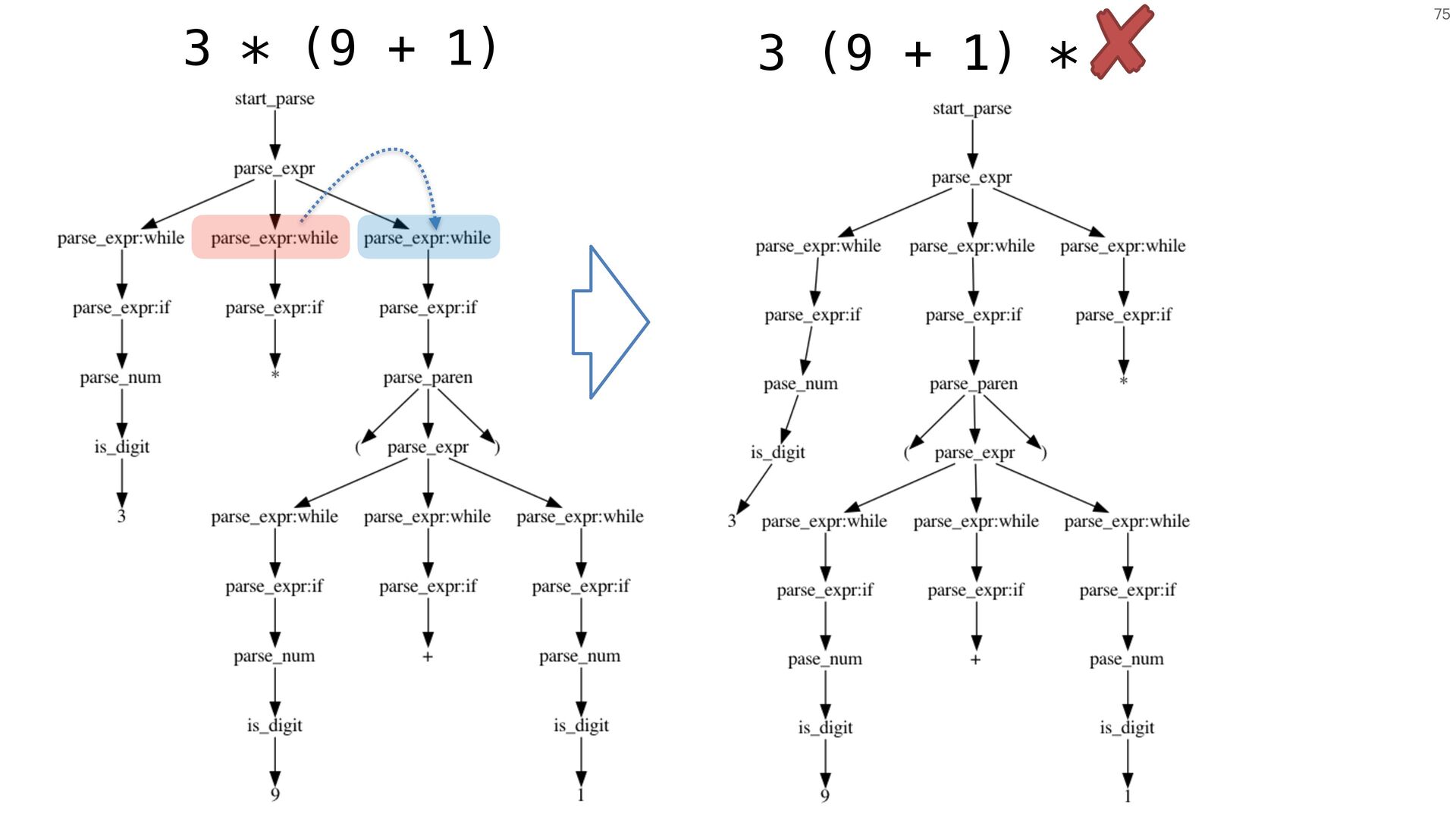
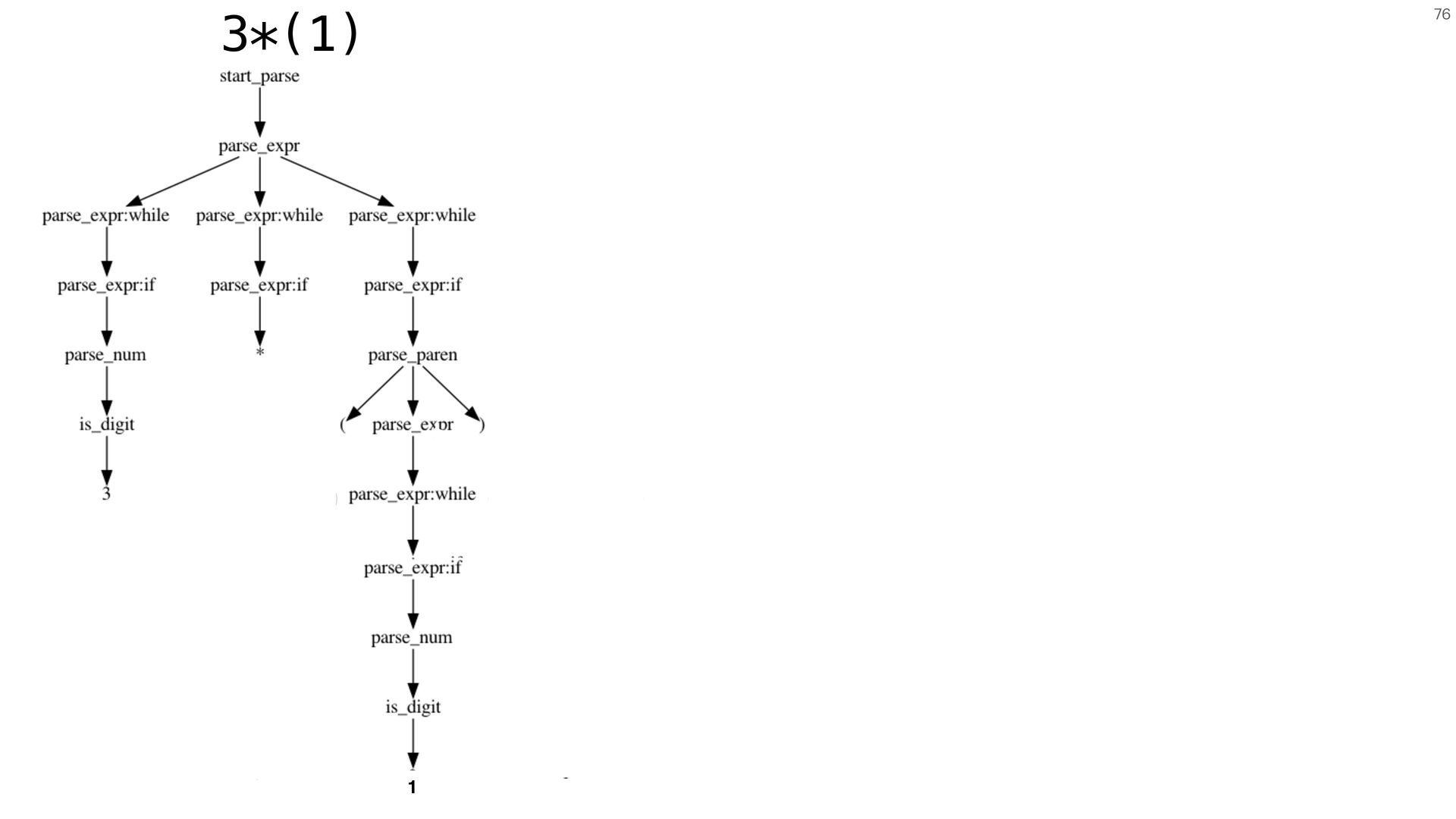
64 How to Extract This Grammar? • Inputs + control
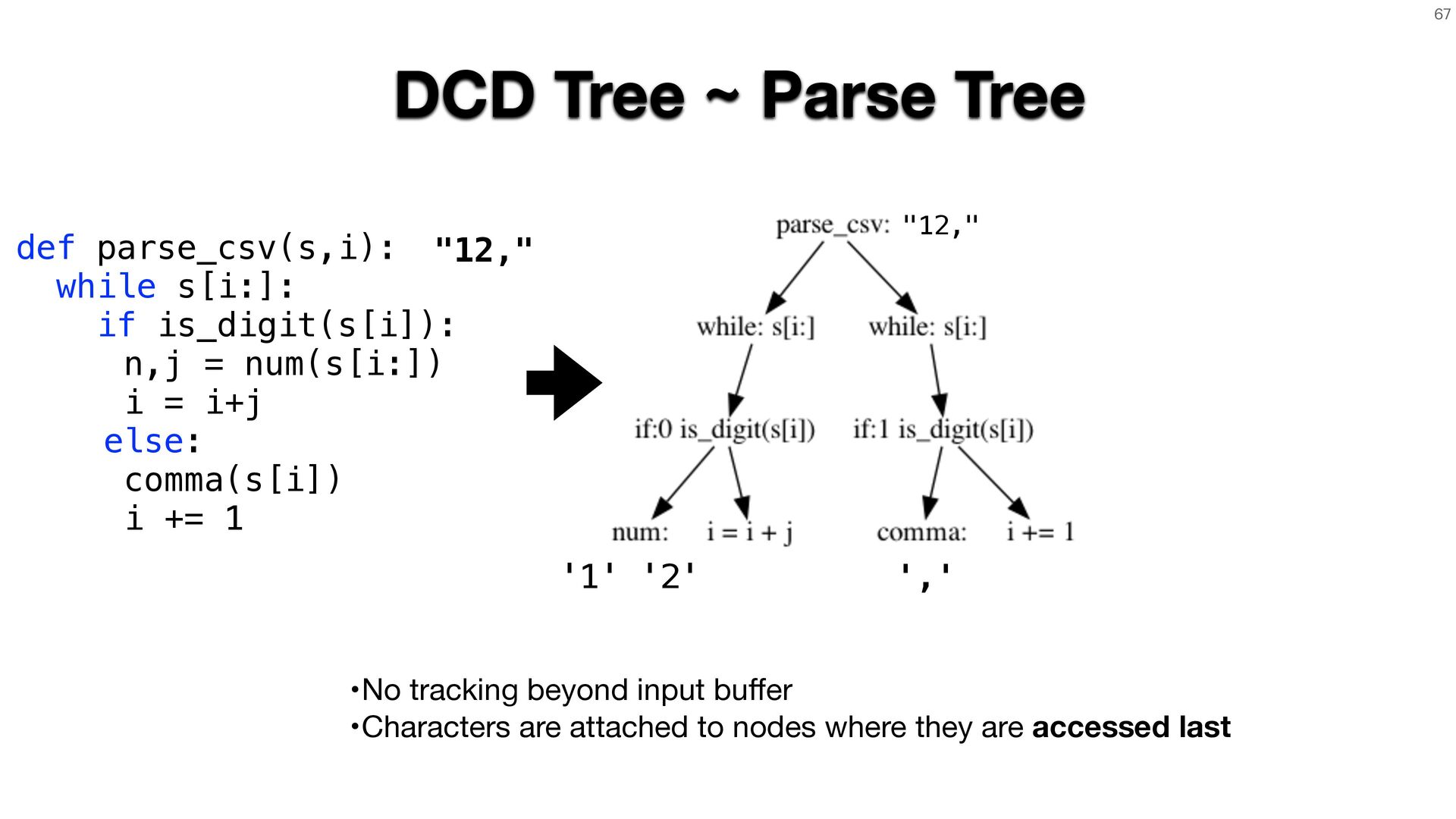
fl ow -> Dynamic Control Dependence Trees • DCD Trees -> Parse Tree -
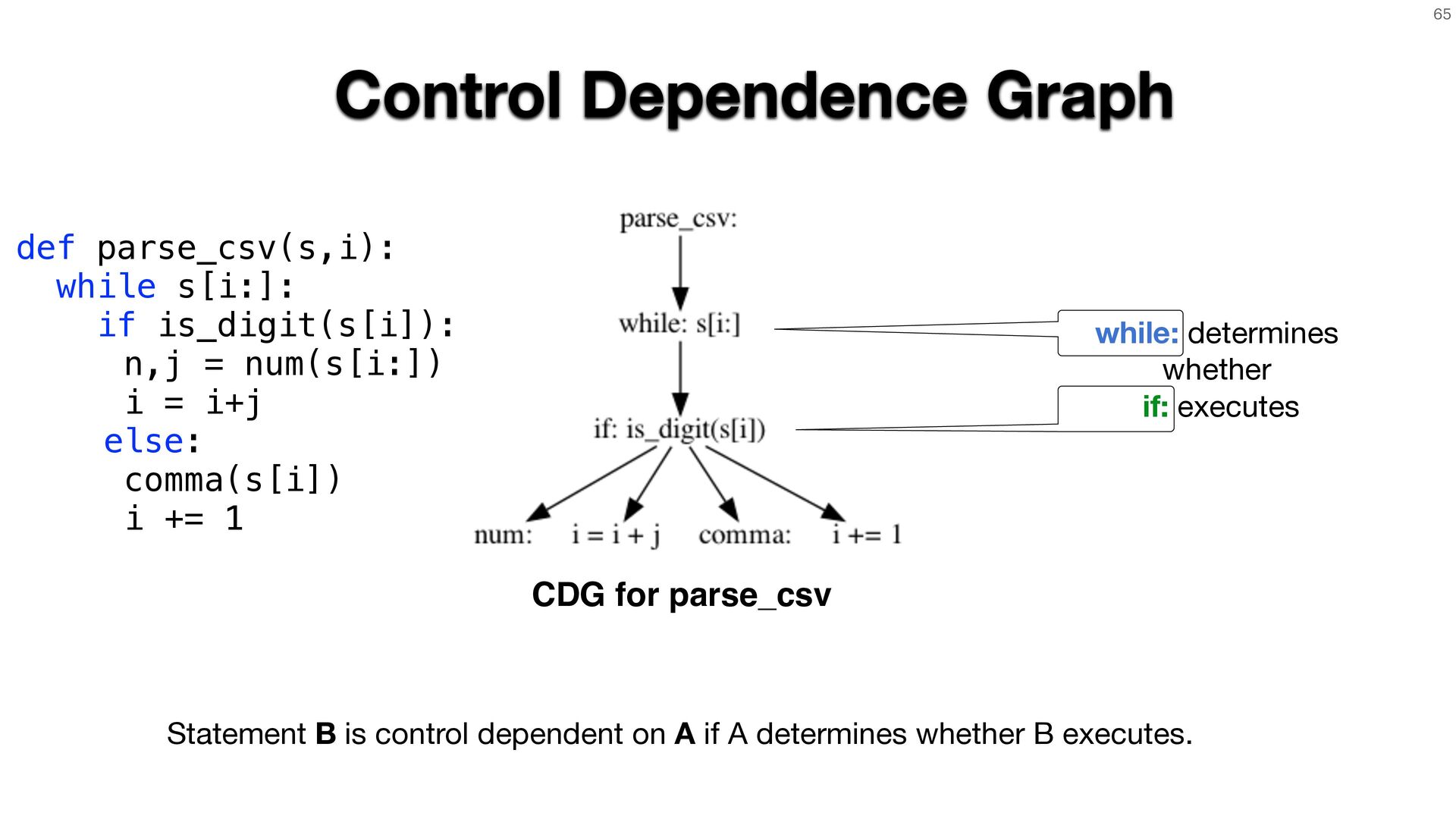
65 Control Dependence Graph Statement B is control dependent on
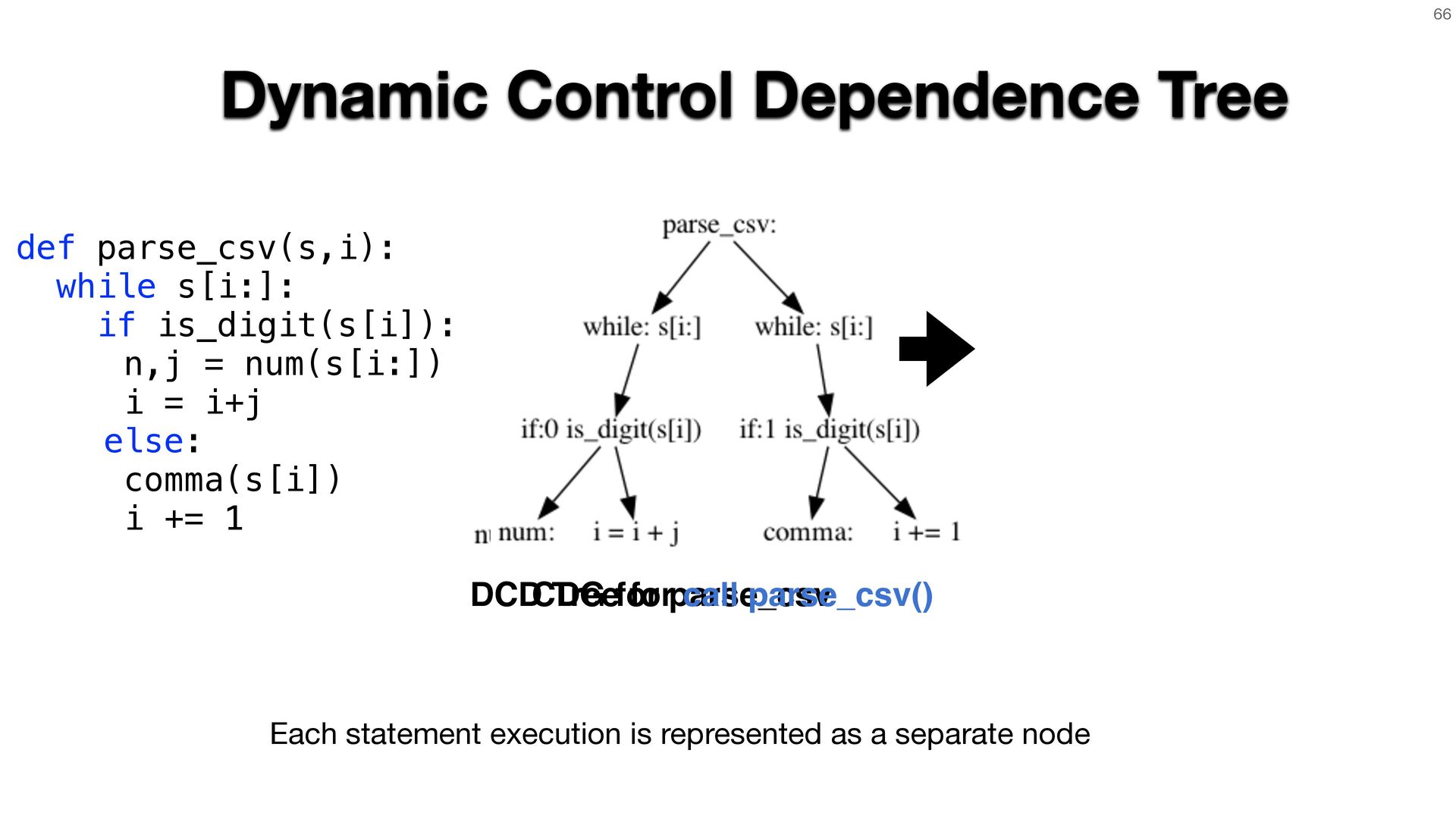
A if A determines whether B executes. def parse_csv(s,i): while s[i:]: if is_digit(s[i]): n,j = num(s[i:]) i = i+j else: comma(s[i]) i += 1 CDG for parse_csv while: determines whether if: executes -
66 def parse_csv(s,i): while s[i:]: if is_digit(s[i]): n,j = num(s[i:])
i = i+j else: comma(s[i]) i += 1 CDG for parse_csv Dynamic Control Dependence Tree Each statement execution is represented as a separate node DCD Tree for call parse_csv() -
67 def parse_csv(s,i): while s[i:]: if is_digit(s[i]): n,j = num(s[i:])
i = i+j else: comma(s[i]) i += 1 '1' '2' ',' DCD Tree ~ Parse Tree •No tracking beyond input bu ff er •Characters are attached to nodes where they are accessed last "12," "12," -
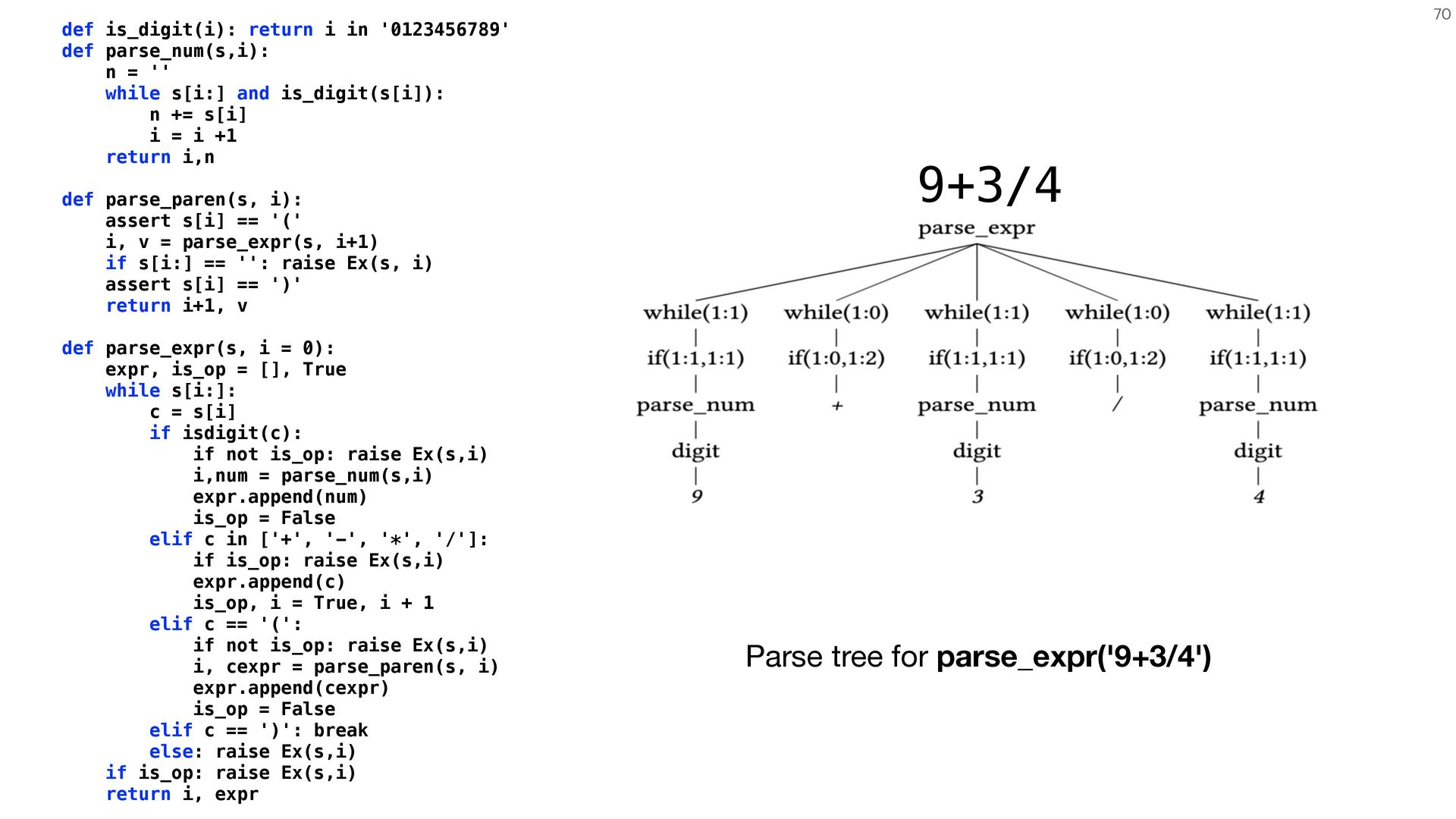
70 def is_digit(i): return i in '0123456789' def parse_num(s,i): n
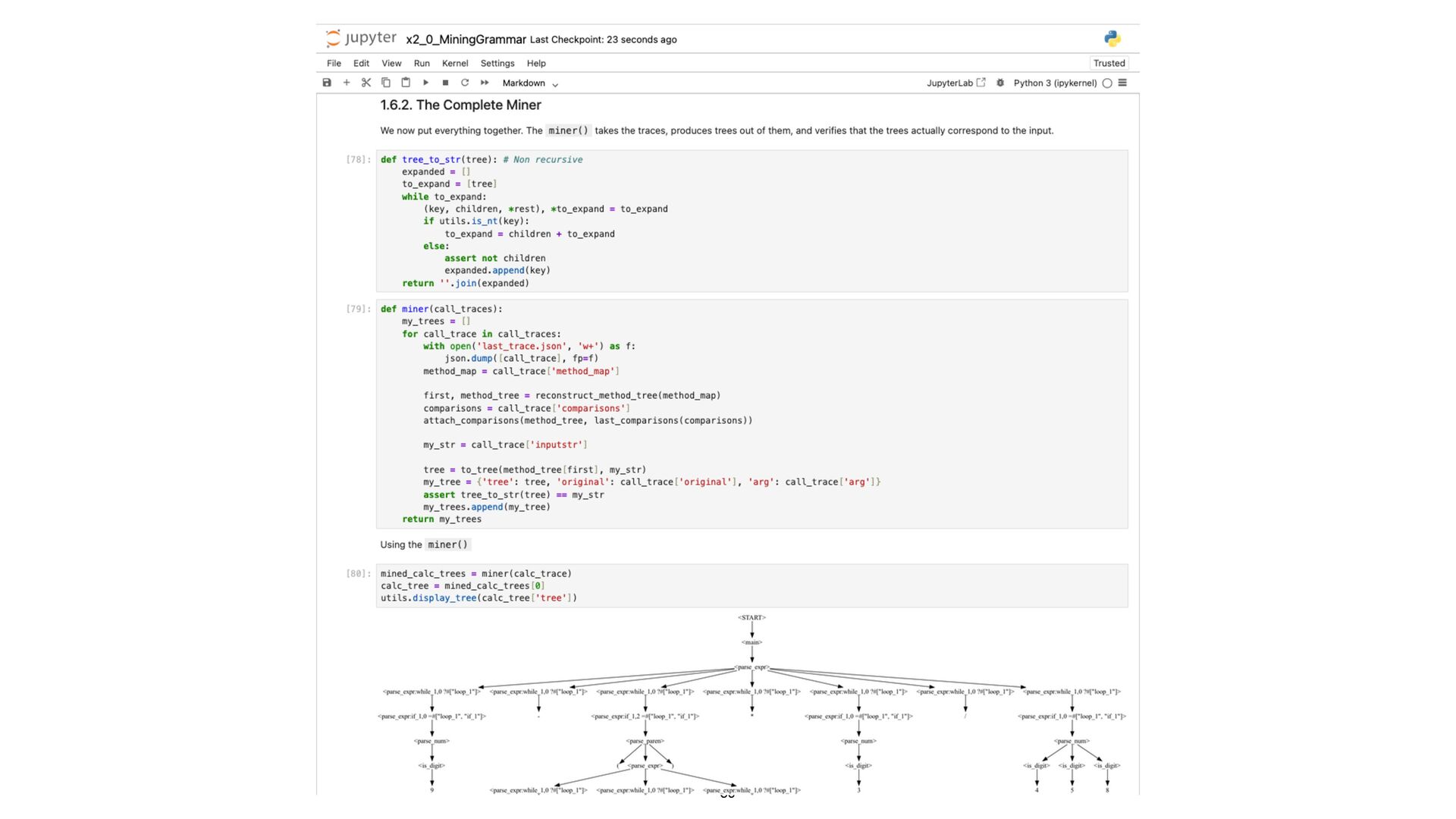
= '' while s[i:] and is_digit(s[i]): n += s[i] i = i +1 return i,n def parse_paren(s, i): assert s[i] == '(' i, v = parse_expr(s, i+1) if s[i:] == '': raise Ex(s, i) assert s[i] == ')' return i+1, v def parse_expr(s, i = 0): expr, is_op = [], True while s[i:]: c = s[i] if isdigit(c): if not is_op: raise Ex(s,i) i,num = parse_num(s,i) expr.append(num) is_op = False elif c in ['+', '-', '*', '/']: if is_op: raise Ex(s,i) expr.append(c) is_op, i = True, i + 1 elif c == '(': if not is_op: raise Ex(s,i) i, cexpr = parse_paren(s, i) expr.append(cexpr) is_op = False elif c == ')': break else: raise Ex(s,i) if is_op: raise Ex(s,i) return i, expr 9+3/4 Parse tree for parse_expr('9+3/4') -
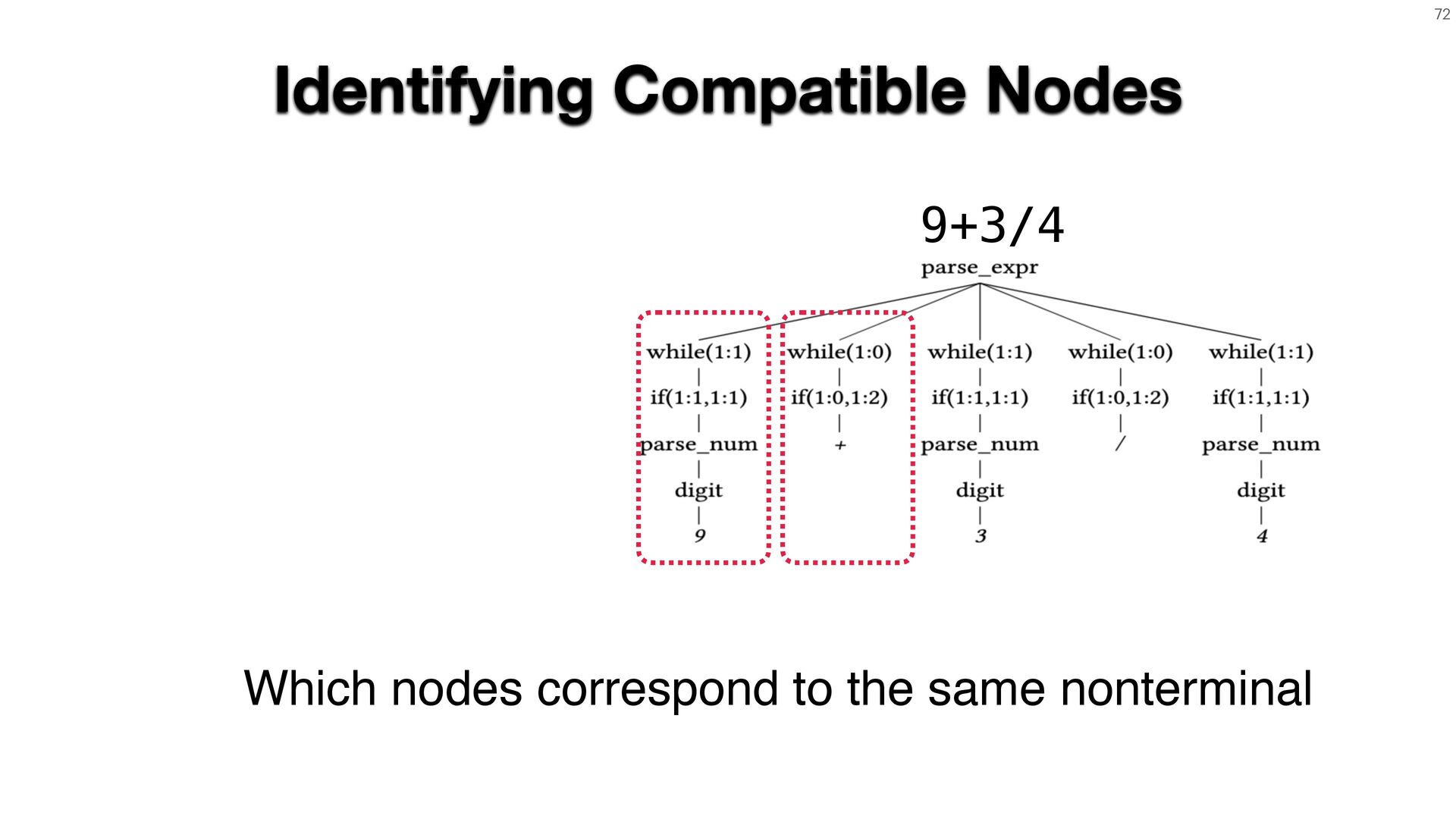
72 def is_digit(i): return i in '0123456789' def parse_num(s,i): n
= '' while s[i:] and is_digit(s[i]): n += s[i] i = i +1 return i,n def parse_paren(s, i): assert s[i] == '(' i, v = parse_expr(s, i+1) if s[i:] == '': raise Ex(s, i) assert s[i] == ')' return i+1, v def parse_expr(s, i = 0): expr, is_op = [], True while s[i:]: c = s[i] if isdigit(c): if not is_op: raise Ex(s,i) i,num = parse_num(s,i) expr.append(num) is_op = False elif c in ['+', '-', '*', '/']: if is_op: raise Ex(s,i) expr.append(c) is_op, i = True, i + 1 elif c == '(': if not is_op: raise Ex(s,i) i, cexpr = parse_paren(s, i) expr.append(cexpr) is_op = False elif c == ')': break else: raise Ex(s,i) if is_op: raise Ex(s,i) return i, expr 9+3/4 Identifying Compatible Nodes Which nodes correspond to the same nonterminal -
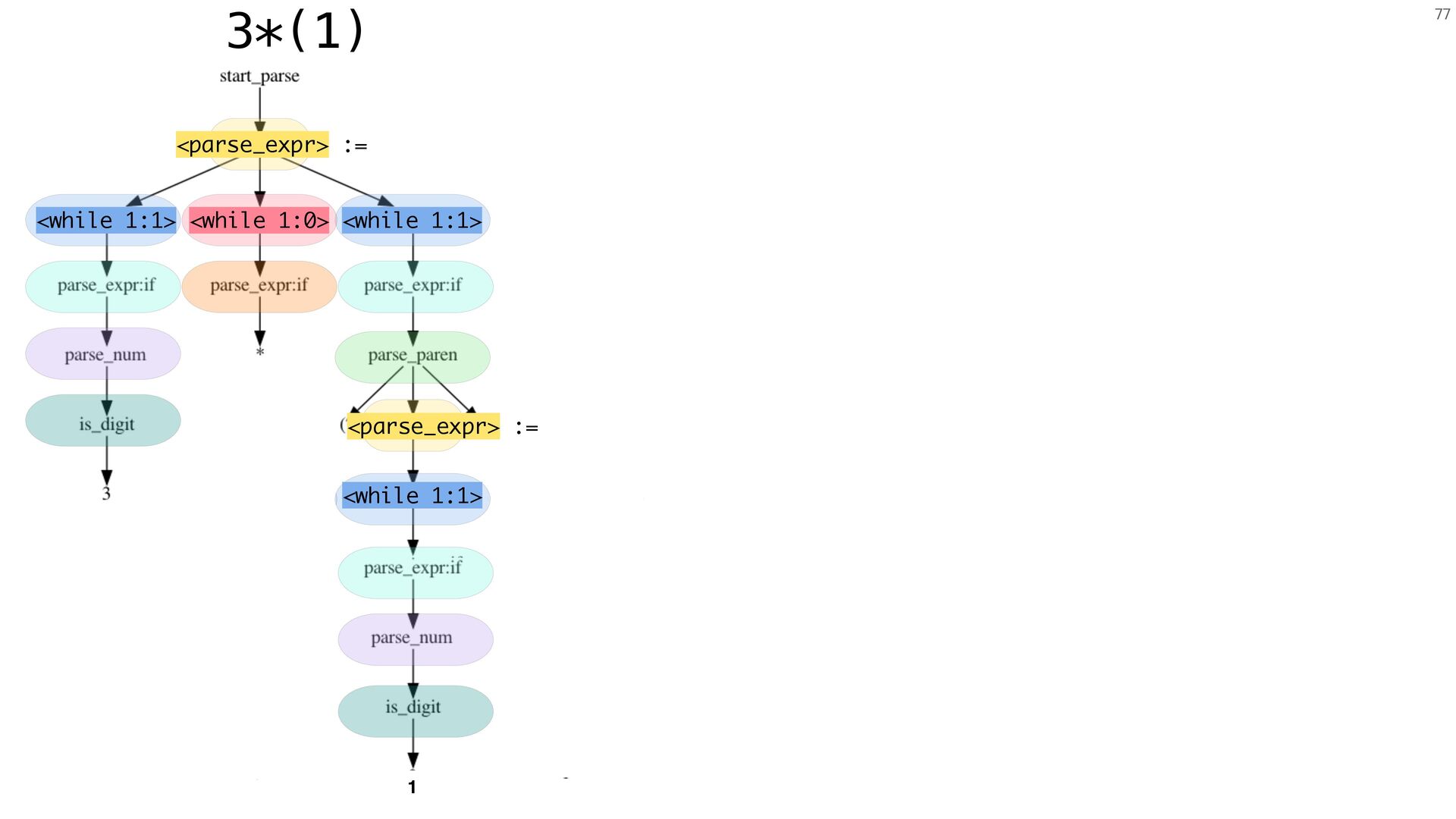
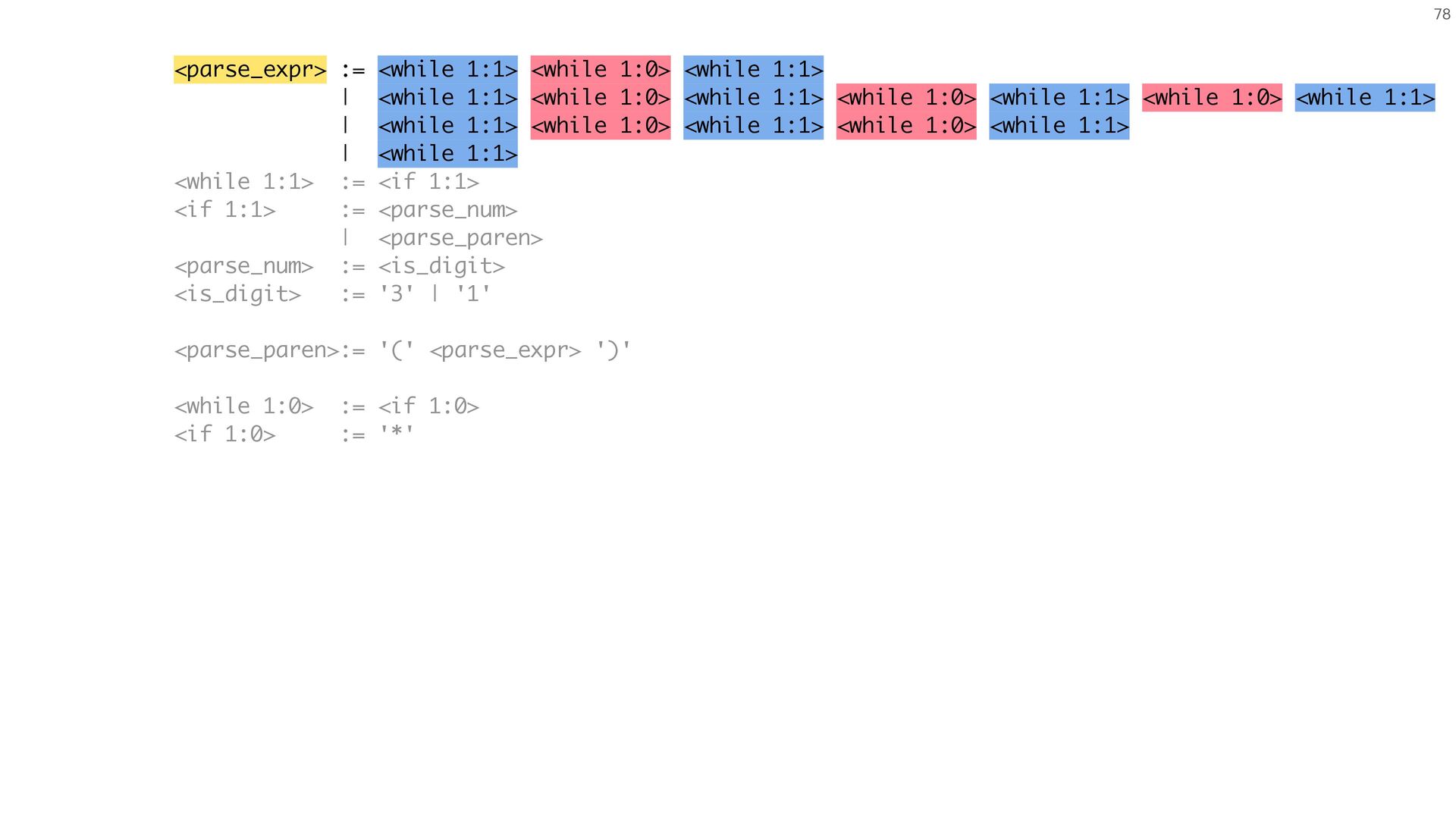
77 3*(1) 1 <parse_expr> := <while 1:1> <while 1:0> <while
1:1> <while 1:1> <parse_expr> := -
<parse_expr> := <while 1:1> <while 1:0> <while 1:1> | <while
1:1> <while 1:0> <while 1:1> <while 1:0> <while 1:1> <while 1:0> <while 1:1> | <while 1:1> <while 1:0> <while 1:1> <while 1:0> <while 1:1> | <while 1:1> <while 1:1> := <if 1:1> <if 1:1> := <parse_num> | <parse_paren> <parse_num> := <is_digit> <is_digit> := '3' | '1' <parse_paren>:= '(' <parse_expr> ')' <while 1:0> := <if 1:0> <if 1:0> := '*' 78 -
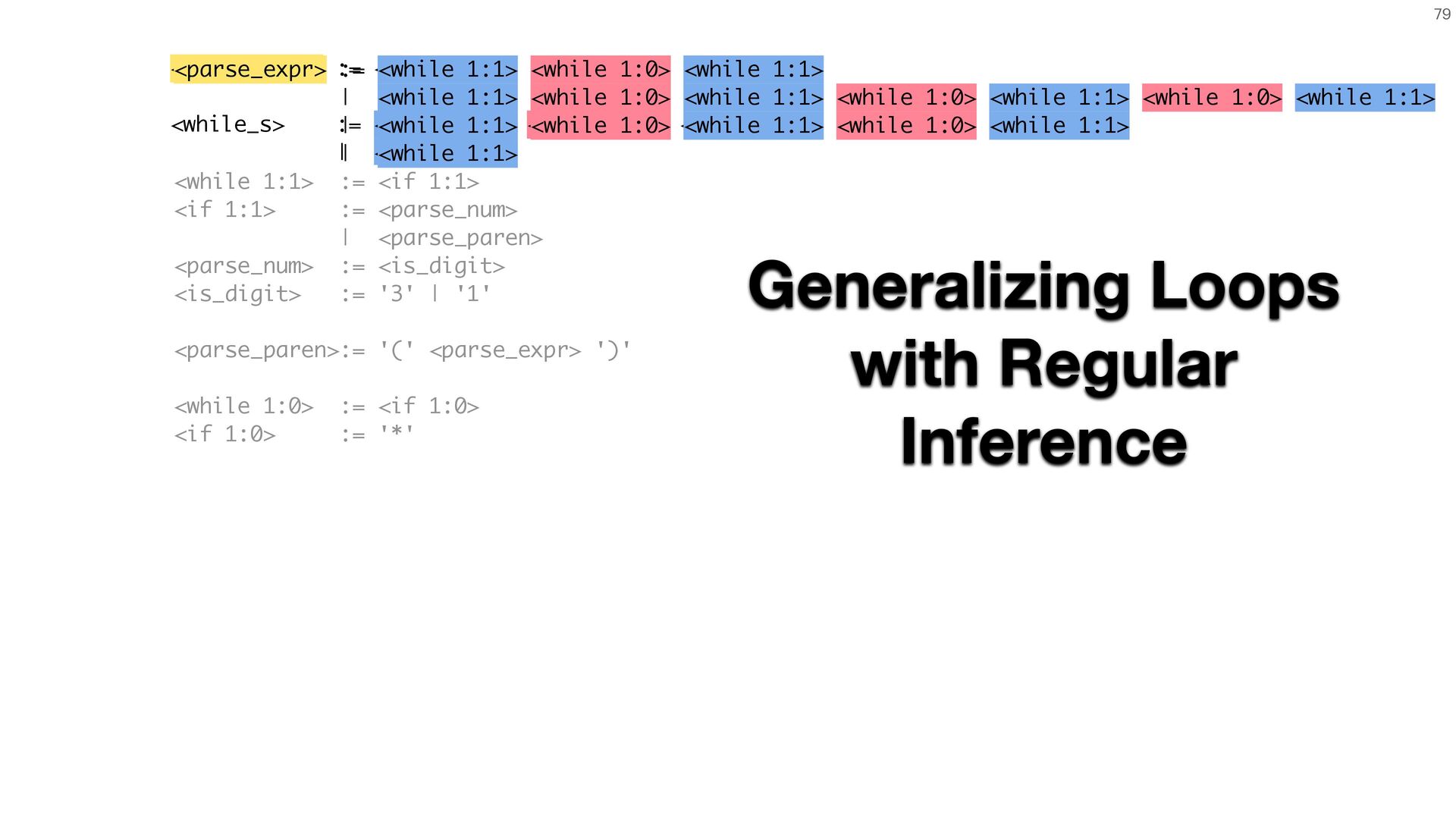
<parse_expr> := <while_s> <while_s> := <while_1:1> <while_1:0> <while_s> | <while_1:1>
<parse_expr> := <while 1:1> <while 1:0> <while 1:1> | <while 1:1> <while 1:0> <while 1:1> <while 1:0> <while 1:1> <while 1:0> <while 1:1> | <while 1:1> <while 1:0> <while 1:1> <while 1:0> <while 1:1> | <while 1:1> <while 1:1> := <if 1:1> <if 1:1> := <parse_num> | <parse_paren> <parse_num> := <is_digit> <is_digit> := '3' | '1' <parse_paren>:= '(' <parse_expr> ')' <while 1:0> := <if 1:0> <if 1:0> := '*' 79 Generalizing Loops with Regular Inference -
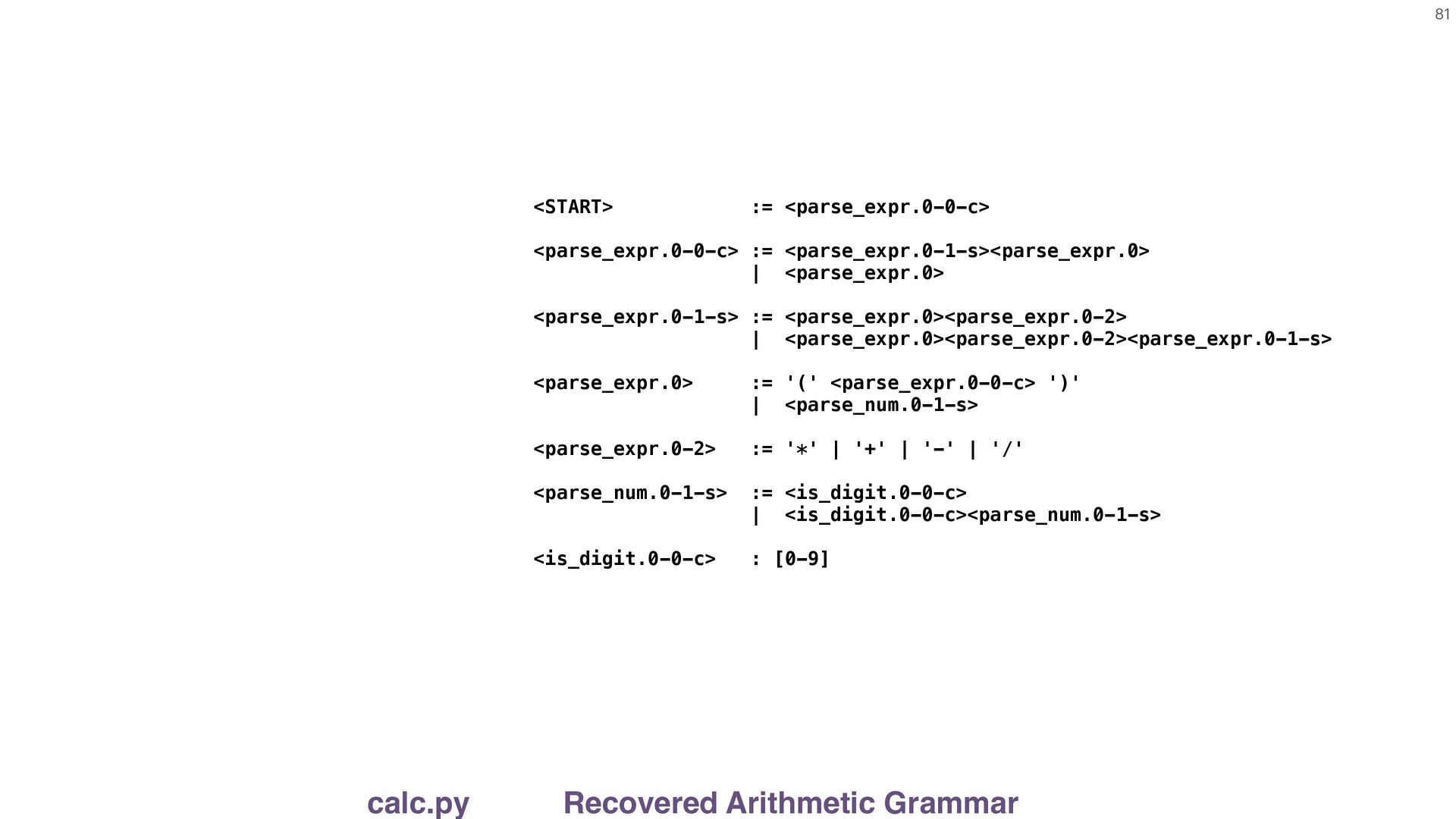
81 def is_digit(i): return i in '0123456789' def parse_num(s,i): n
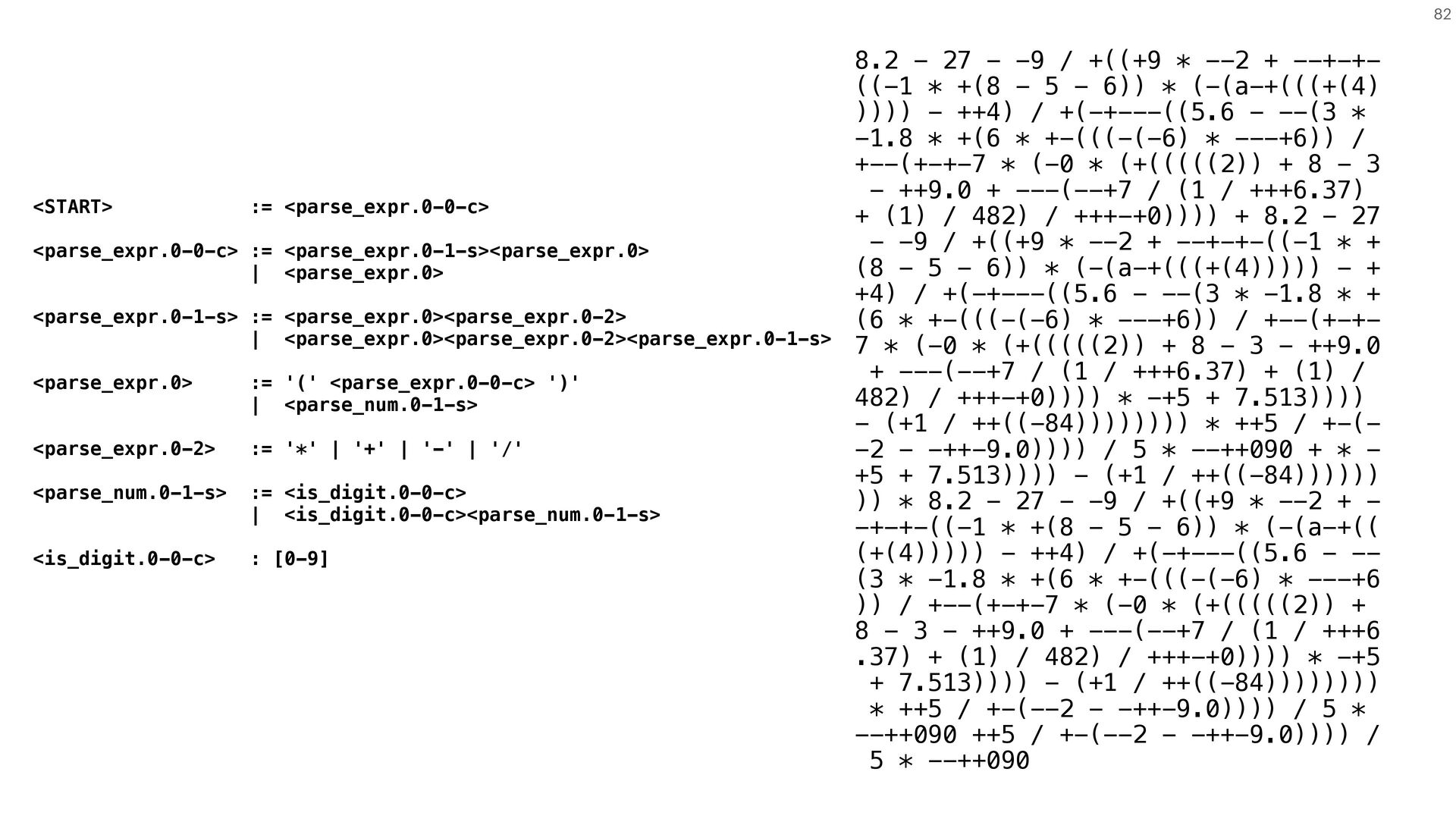
= '' while s[i:] and is_digit(s[i]): n += s[i] i = i +1 return i,n def parse_paren(s, i): assert s[i] == '(' i, v = parse_expr(s, i+1) if s[i:] == '': raise Ex(s, i) assert s[i] == ')' return i+1, v def parse_expr(s, i = 0): expr, is_op = [], True while s[i:]: c = s[i] if isdigit(c): if not is_op: raise Ex(s,i) i,num = parse_num(s,i) expr.append(num) is_op = False elif c in ['+', '-', '*', '/']: if is_op: raise Ex(s,i) expr.append(c) is_op, i = True, i + 1 elif c == '(': if not is_op: raise Ex(s,i) i, cexpr = parse_paren(s, i) expr.append(cexpr) is_op = False elif c == ')': break else: raise Ex(s,i) if is_op: raise Ex(s,i) return i, expr <START> := <parse_expr.0-0-c> <parse_expr.0-0-c> := <parse_expr.0-1-s><parse_expr.0> | <parse_expr.0> <parse_expr.0-1-s> := <parse_expr.0><parse_expr.0-2> | <parse_expr.0><parse_expr.0-2><parse_expr.0-1-s> <parse_expr.0> := '(' <parse_expr.0-0-c> ')' | <parse_num.0-1-s> <parse_expr.0-2> := '*' | '+' | '-' | '/' <parse_num.0-1-s> := <is_digit.0-0-c> | <is_digit.0-0-c><parse_num.0-1-s> <is_digit.0-0-c> : [0-9] calc.py Recovered Arithmetic Grammar -
82 8.2 - 27 - -9 / +((+9 * --2
+ --+-+- ((-1 * +(8 - 5 - 6)) * (-(a-+(((+(4) )))) - ++4) / +(-+---((5.6 - --(3 * -1.8 * +(6 * +-(((-(-6) * ---+6)) / +--(+-+-7 * (-0 * (+(((((2)) + 8 - 3 - ++9.0 + ---(--+7 / (1 / +++6.37) + (1) / 482) / +++-+0)))) + 8.2 - 27 - -9 / +((+9 * --2 + --+-+-((-1 * + (8 - 5 - 6)) * (-(a-+(((+(4))))) - + +4) / +(-+---((5.6 - --(3 * -1.8 * + (6 * +-(((-(-6) * ---+6)) / +--(+-+- 7 * (-0 * (+(((((2)) + 8 - 3 - ++9.0 + ---(--+7 / (1 / +++6.37) + (1) / 482) / +++-+0)))) * -+5 + 7.513)))) - (+1 / ++((-84)))))))) * ++5 / +-(- -2 - -++-9.0)))) / 5 * --++090 + * - +5 + 7.513)))) - (+1 / ++((-84)))))) )) * 8.2 - 27 - -9 / +((+9 * --2 + - -+-+-((-1 * +(8 - 5 - 6)) * (-(a-+(( (+(4))))) - ++4) / +(-+---((5.6 - -- (3 * -1.8 * +(6 * +-(((-(-6) * ---+6 )) / +--(+-+-7 * (-0 * (+(((((2)) + 8 - 3 - ++9.0 + ---(--+7 / (1 / +++6 .37) + (1) / 482) / +++-+0)))) * -+5 + 7.513)))) - (+1 / ++((-84)))))))) * ++5 / +-(--2 - -++-9.0)))) / 5 * --++090 ++5 / +-(--2 - -++-9.0)))) / 5 * --++090 <START> := <parse_expr.0-0-c> <parse_expr.0-0-c> := <parse_expr.0-1-s><parse_expr.0> | <parse_expr.0> <parse_expr.0-1-s> := <parse_expr.0><parse_expr.0-2> | <parse_expr.0><parse_expr.0-2><parse_expr.0-1-s> <parse_expr.0> := '(' <parse_expr.0-0-c> ')' | <parse_num.0-1-s> <parse_expr.0-2> := '*' | '+' | '-' | '/' <parse_num.0-1-s> := <is_digit.0-0-c> | <is_digit.0-0-c><parse_num.0-1-s> <is_digit.0-0-c> : [0-9] -
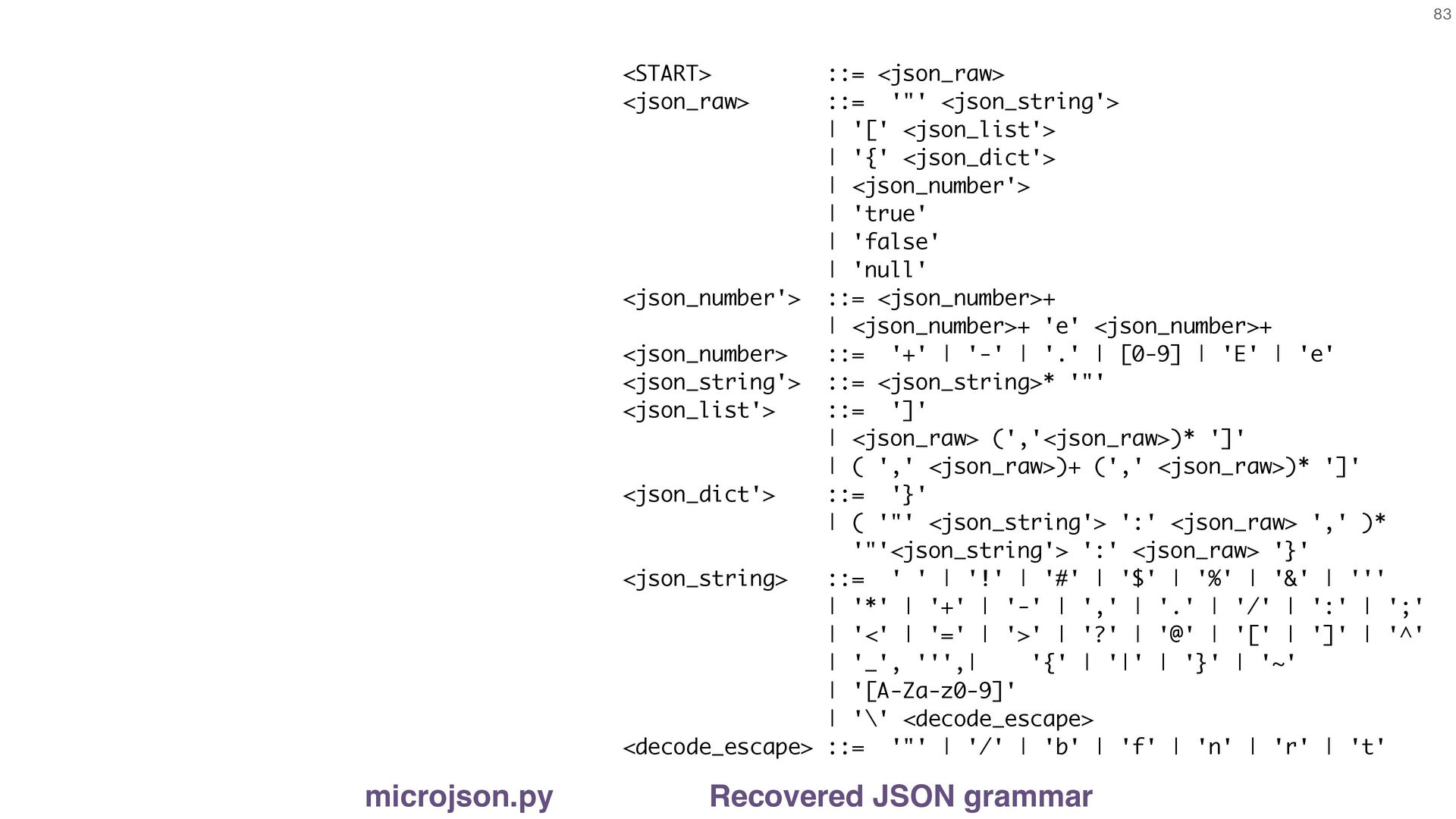
83 <START> ::= <json_raw> <json_raw> ::= '"' <json_string'> | '['
<json_list'> | '{' <json_dict'> | <json_number'> | 'true' | 'false' | 'null' <json_number'> ::= <json_number>+ | <json_number>+ 'e' <json_number>+ <json_number> ::= '+' | '-' | '.' | [0-9] | 'E' | 'e' <json_string'> ::= <json_string>* '"' <json_list'> ::= ']' | <json_raw> (','<json_raw>)* ']' | ( ',' <json_raw>)+ (',' <json_raw>)* ']' <json_dict'> ::= '}' | ( '"' <json_string'> ':' <json_raw> ',' )* '"'<json_string'> ':' <json_raw> '}' <json_string> ::= ' ' | '!' | '#' | '$' | '%' | '&' | ''' | '*' | '+' | '-' | ',' | '.' | '/' | ':' | ';' | '<' | '=' | '>' | '?' | '@' | '[' | ']' | '^' | '_', ''',| '{' | '|' | '}' | '~' | '[A-Za-z0-9]' | '\' <decode_escape> <decode_escape> ::= '"' | '/' | 'b' | 'f' | 'n' | 'r' | 't' stm.next() if expect_key: raise JSONError(E_DKEY, stm, stm.pos) if c == '}': return result expect_key = 1 continue # parse out a key/value pair elif c == '"': key = _from_json_string(stm) stm.skipspaces() c = stm.next() if c != ':': raise JSONError(E_COLON, stm, stm.pos) stm.skipspaces() val = _from_json_raw(stm) result[key] = val expect_key = 0 continue raise JSONError(E_MALF, stm, stm.pos) def _from_json_raw(stm): while True: stm.skipspaces() c = stm.peek() if c == '"': return _from_json_string(stm) elif c == '{': return _from_json_dict(stm) elif c == '[': return _from_json_list(stm) elif c == 't': return _from_json_fixed(stm, 'true', True, E_BOOL) elif c == 'f': return _from_json_fixed(stm, 'false', False, E_BOOL) elif c == 'n': return _from_json_fixed(stm, 'null', None, E_NULL) elif c in NUMSTART: return _from_json_number(stm) raise JSONError(E_MALF, stm, stm.pos) def from_json(data): stm = JSONStream(data) return _from_json_raw(stm) microjson.py Recovered JSON grammar
 rahulgopinath
 ept
 shibuiwilliam
 tkng
 hellosct1
 anikisencyo
 institutdelelevage
 nnchiba
 pman0214
 hotchpotch
 shunk031
 microbaseinc
 bkeepers
 cassininazir
 ipullrank
 techseoconnect
 tamaranovitovic
 kimpetersen
 lara
 sarafernandez
 tammyeverts
![9 $ ./fuzz [;x1-GPZ+wcckc];,N9J+?#6^6\e?]9lu 2_%'4GX"0VUB[E/r ~fApu6b8<{%siq8Z h.6{V,hr?;{Ti.r3PIxMMMv6{xS^+'Hq! AxB"YXRS@!Kd6;wtAMefFWM(`|J_<1~o} z3K(CCzRH JIIvHz>_*.\>JrlU32~eGP?](https://files.speakerdeck.com/presentations/d989a72935064fbab4ad1f30ff4798bd/slide_8.jpg)


![31 Fuzzing Parsers $ ./fuzz [;x1-GPZ+wcckc];,N9J+?#6^6\e?]9lu 2_%'4GX"0VUB[E/r ~fApu6b8<{%siq8Z h.6{V,hr?;{Ti.r3PIxMMMv6{xS^+'Hq! AxB"YXRS@!Kd6;wtAMefFWM(`|J_<1~o}](https://files.speakerdeck.com/presentations/d989a72935064fbab4ad1f30ff4798bd/slide_30.jpg)