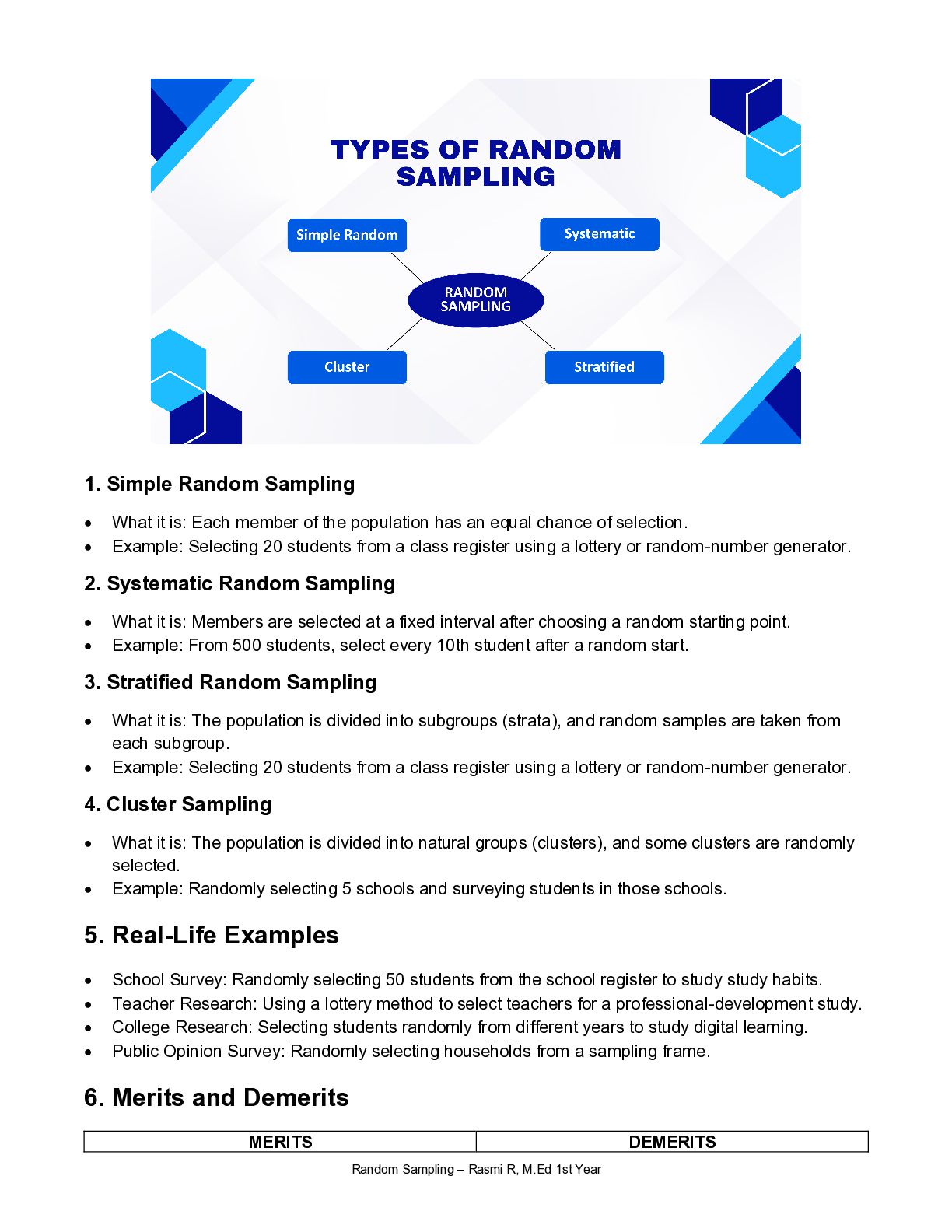
• • • Random sampling is a probability sampling technique used in research. It gives members of a population a known chance of being selected. It helps researchers obtain a sample that can represent the wider population. It reduces personal choice and selection bias in the sampling process. 2. Definition “A simple random sample is one in which every member of the population has an equal chance of being selected.” — C. R. Kothari, Research Methodology: Methods and Techniques 3. What is Random Sampling? • • • • • Random sampling begins with a clearly identified population. Every eligible member of the population has a chance to be selected. A random selection procedure is used to choose participants. The selected members together form the random sample. The basic process can be represented as: Population → Random Selection → Random Sample. 4. Types of Random Sampling • • • • Simple Random Sampling Systematic Random Sampling Stratified Random Sampling Cluster Sampling Random Sampling – Rasmi R, M.Ed 1st Year
member of the population has an equal chance of selection. Example: Selecting 20 students from a class register using a lottery or random-number generator. 2. Systematic Random Sampling • • What it is: Members are selected at a fixed interval after choosing a random starting point. Example: From 500 students, select every 10th student after a random start. 3. Stratified Random Sampling • • What it is: The population is divided into subgroups (strata), and random samples are taken from each subgroup. Example: Selecting 20 students from a class register using a lottery or random-number generator. 4. Cluster Sampling • • What it is: The population is divided into natural groups (clusters), and some clusters are randomly selected. Example: Randomly selecting 5 schools and surveying students in those schools. 5. Real-Life Examples • • • • School Survey: Randomly selecting 50 students from the school register to study study habits. Teacher Research: Using a lottery method to select teachers for a professional-development study. College Research: Selecting students randomly from different years to study digital learning. Public Opinion Survey: Randomly selecting households from a sampling frame. 6. Merits and Demerits MERITS DEMERITS Random Sampling – Rasmi R, M.Ed 1st Year
transparent May be time-consuming in large populations Can provide representative samples Can be costly when populations are dispersed Supports inferential statistics Chance may produce an unbalanced sample Fair opportunity for selection Non-response may reduce representativeness 7. Educational Implications • • • • • Helps researchers select students or teachers fairly for educational studies. Reduces personal bias when choosing participants for classroom research. Supports reliable conclusions about larger student populations. Useful for surveys on learning, attendance, teaching methods and school climate. Strengthens evidence-based educational planning and decision-making. 8. Scope of Random Sampling • • • • • • Educational research: studying students, teachers, curriculum and classroom practices. School surveys: measuring attendance, learning outcomes, satisfaction and school climate. Teacher education: evaluating training programmes and professional-development needs. Large-scale studies: obtaining samples from universities, districts or school systems. Comparative research: selecting participants from different grades, groups or institutions. Policy research: generating evidence to support educational planning and decision-making. 9. Conclusion • • • • Random sampling provides a systematic and fair way to select participants from a population. It reduces selection bias and can improve the representativeness of a sample. Different types are suited to different research situations and population structures. Careful planning and appropriate selection of the sampling method are essential for meaningful educational research. 10. References • • • • Kothari, C. R., & Garg, G. (2014). Research Methodology: Methods and Techniques. New Age International. Creswell, J. W., & Creswell, J. D. (2018). Research Design. SAGE Publications. Fraenkel, J. R., Wallen, N. E., & Hyun, H. H. (2012). How to Design and Evaluate Research in Education. McGraw-Hill. Best, J. W., & Kahn, J. V. (2006). Research in Education. Pearson. Random Sampling – Rasmi R, M.Ed 1st Year


 rasmi1999
 akademiya2063
 leimatthew05
 geshan
 uxyall
 3n
 thoeni
 rkendrick25
 kneath
 thirion
 asonas
 reverentgeek
 bcantrill