Share
Embed
Understanding CoroutineContext
These slides are from a lightning talk I gave at the Chicago Kotlin Users Group.
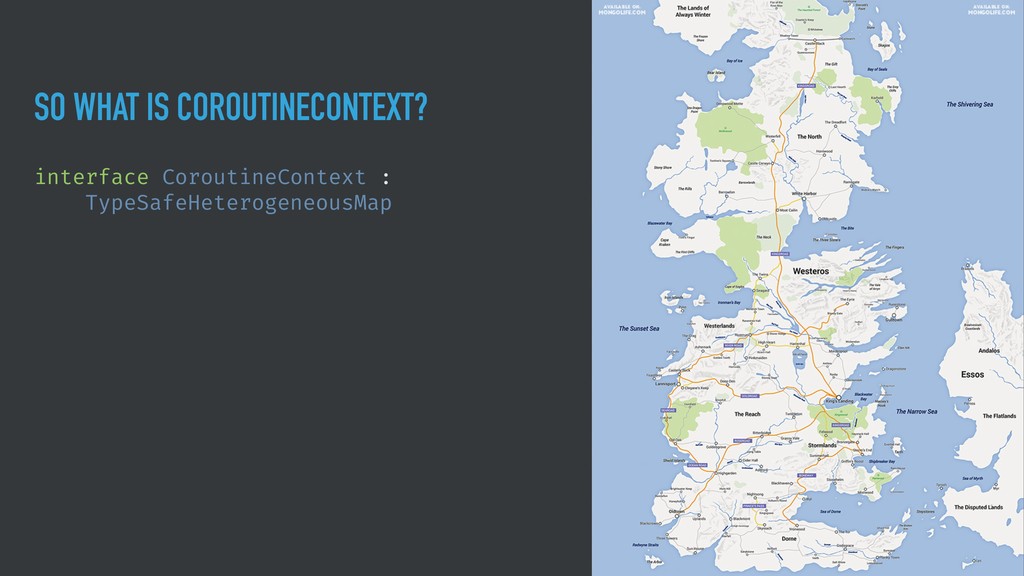
The properties of CoroutineContext are handled through a pattern called a type-safe heterogeneous map. This means that it has fantastic extensibility, but it's pretty difficult to determine what's going on by just browsing the source code.
This talk is a quick attempt at describing a different mental model for the CoroutineContext so that we might better understand how it works.
Rick Busarow
May 22, 2019
Transcript
35 slides
-
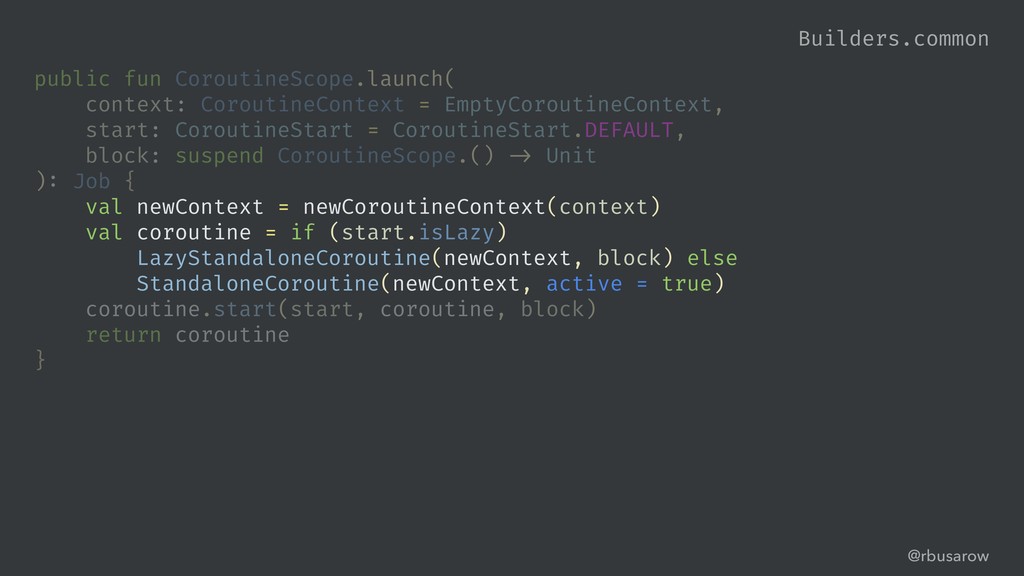
@rbusarow public fun CoroutineScope.launch( context: CoroutineContext = EmptyCoroutineContext, start: CoroutineStart
= CoroutineStart.DEFAULT, block: suspend CoroutineScope.() !-> Unit ): Job {~ val newContext = newCoroutineContext(context) val coroutine = if (start.isLazy) LazyStandaloneCoroutine(newContext, block) else StandaloneCoroutine(newContext, active = true) coroutine.start(start, coroutine, block) return coroutine }~ Builders.common -
@rbusarow public fun~CoroutineScope.launch( context: CoroutineContext = EmptyCoroutineContext, start: CoroutineStart =
CoroutineStart.DEFAULT, block: suspend CoroutineScope.() !->~Unit ):~Job {~ val newContext = newCoroutineContext(context) val coroutine = if (start.isLazy) LazyStandaloneCoroutine(newContext, block) else StandaloneCoroutine(newContext, active = true) coroutine.start(start, coroutine, block) return coroutine }~ Builders.common -
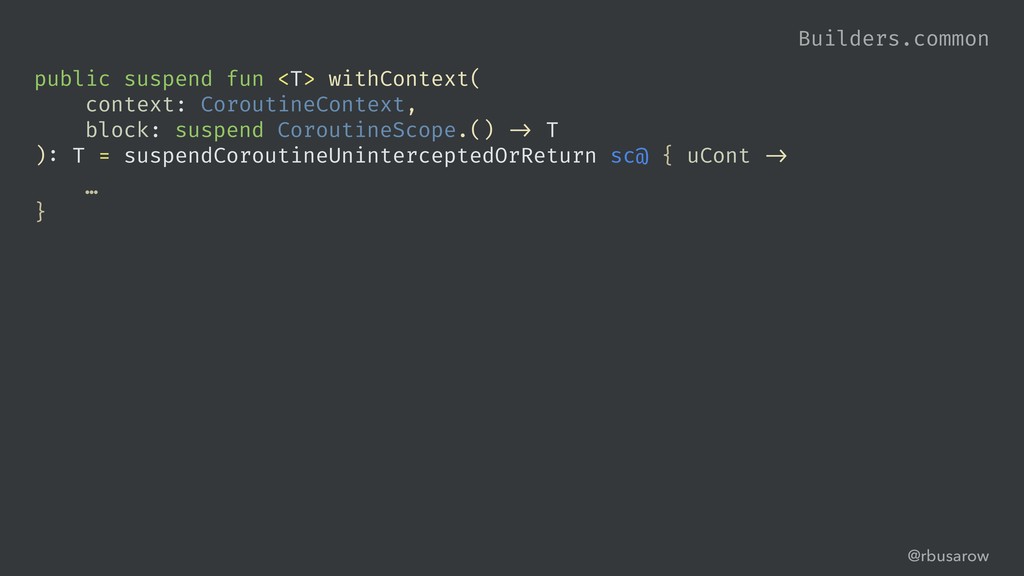
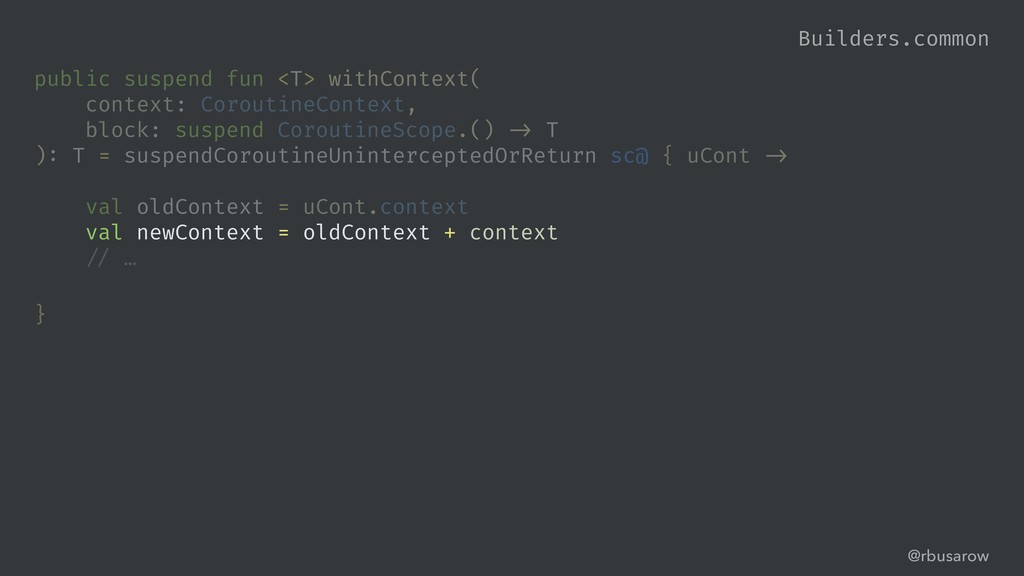
@rbusarow Builders.common public suspend fun <T> withContext( context: CoroutineContext, block:
suspend CoroutineScope.() !-> T ): T = suspendCoroutineUninterceptedOrReturn sc@ { uCont !-> … } -
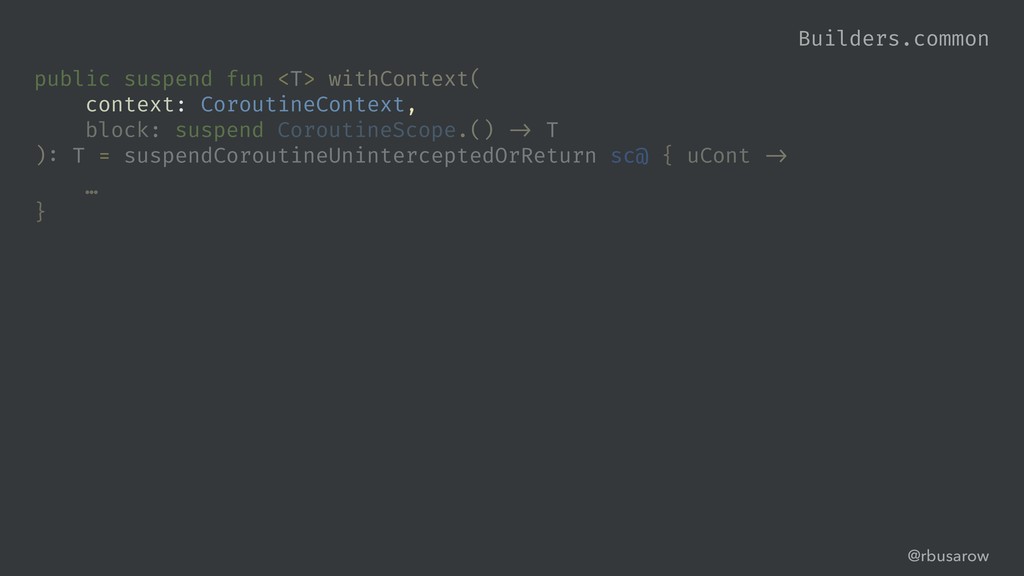
@rbusarow Builders.common public suspend fun <T> withContext( context: CoroutineContext, block:
suspend CoroutineScope.() !-> T ): T = suspendCoroutineUninterceptedOrReturn sc@ { uCont !-> … } -
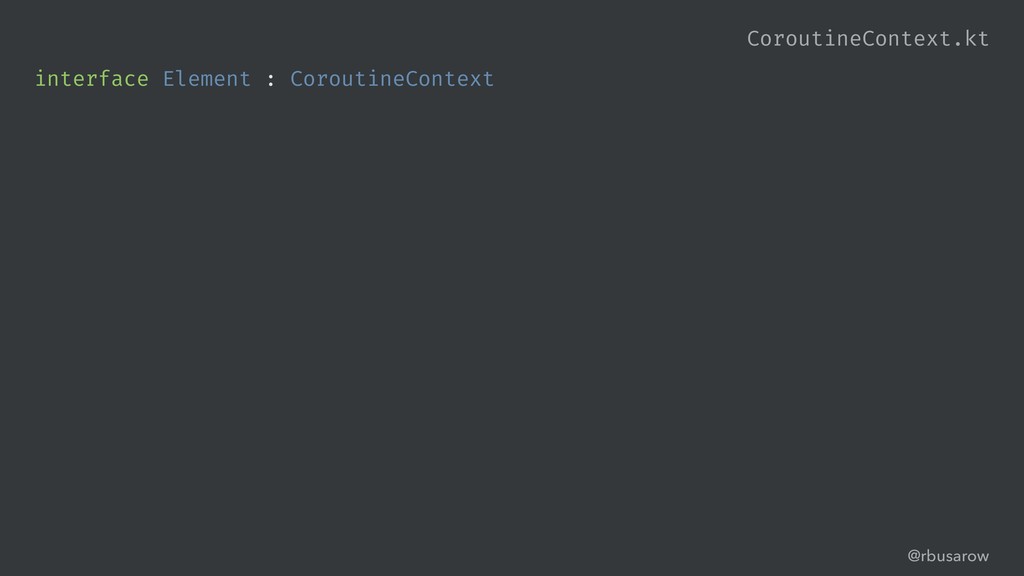
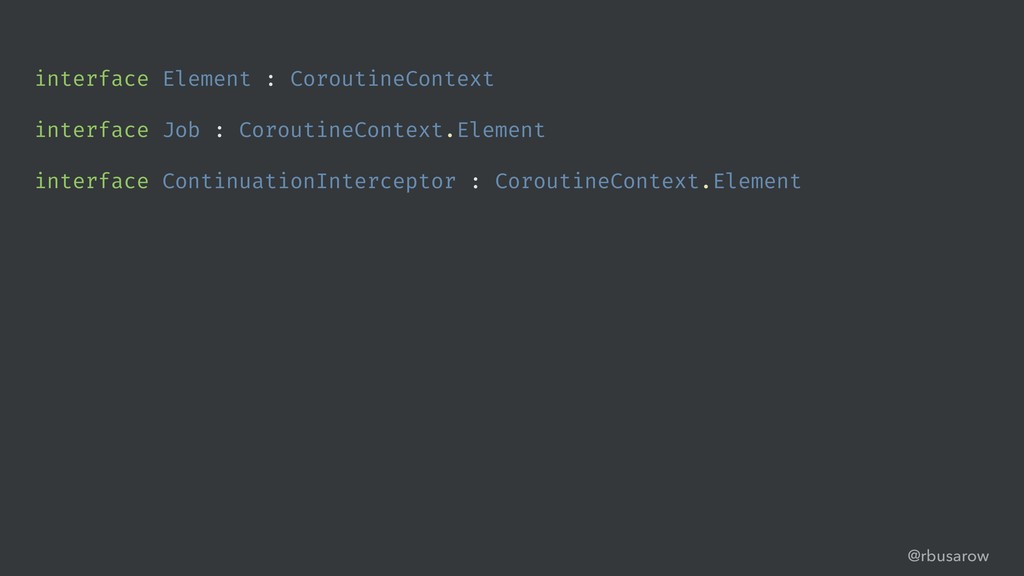
@rbusarow interface Element :~CoroutineContext interface Job :~CoroutineContext.Element interface ContinuationInterceptor :~CoroutineContext.Element
interface CoroutineExceptionHandler :~CoroutineContext.Element -
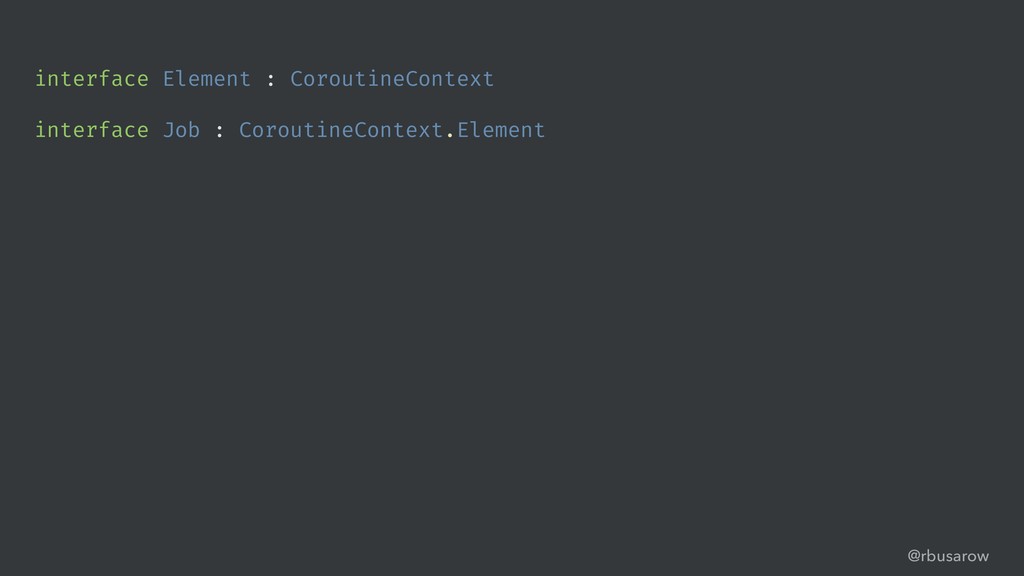
@rbusarow interface Element :~CoroutineContext interface Job :~CoroutineContext.Element interface ContinuationInterceptor :~CoroutineContext.Element
interface CoroutineExceptionHandler :~CoroutineContext.Element data class CoroutineName( val name: String ) : CoroutineContext.Element -
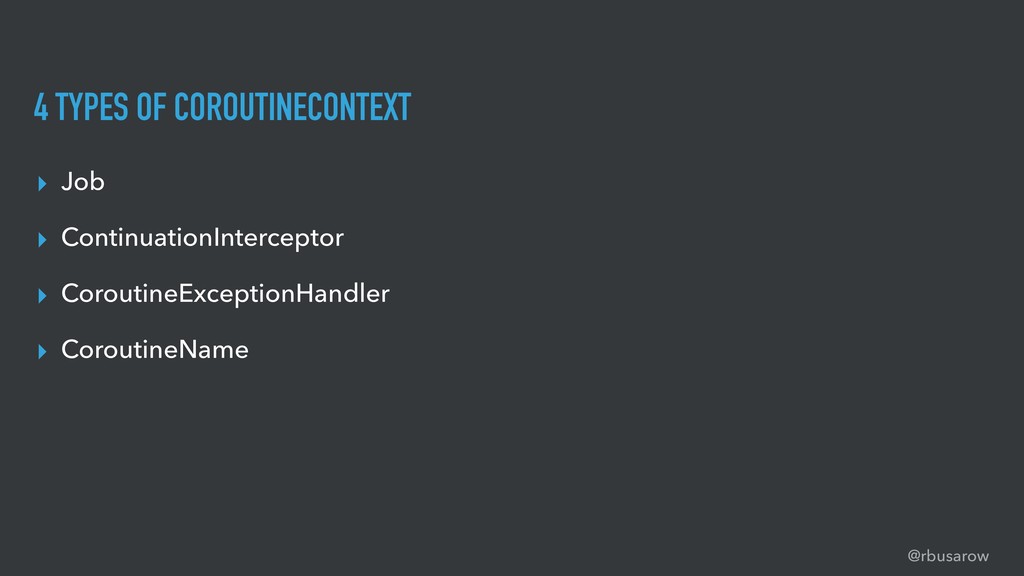
@rbusarow 4 TYPES OF COROUTINECONTEXT ▸ Job ▸ ContinuationInterceptor ▸
CoroutineExceptionHandler ▸ CoroutineName -
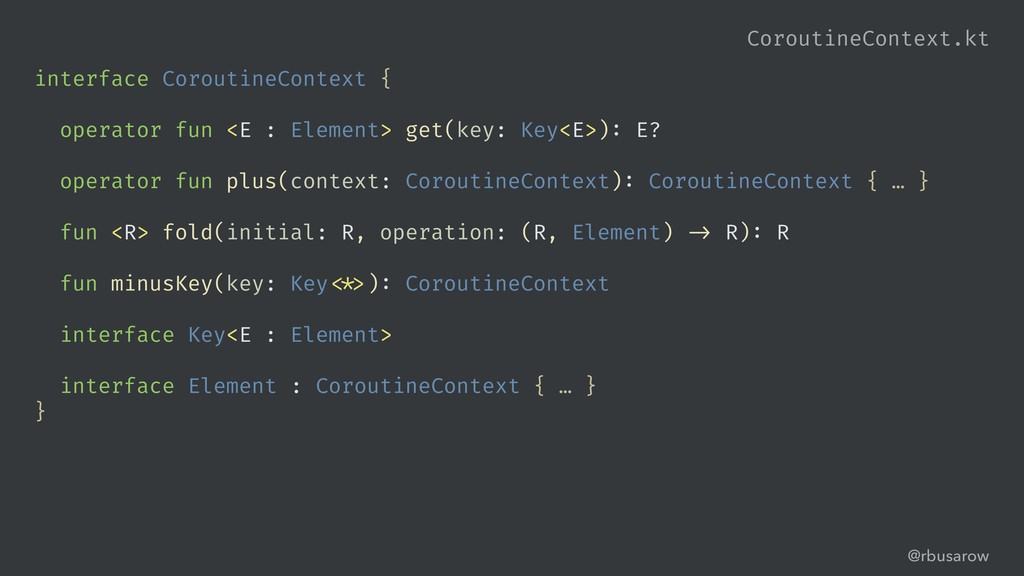
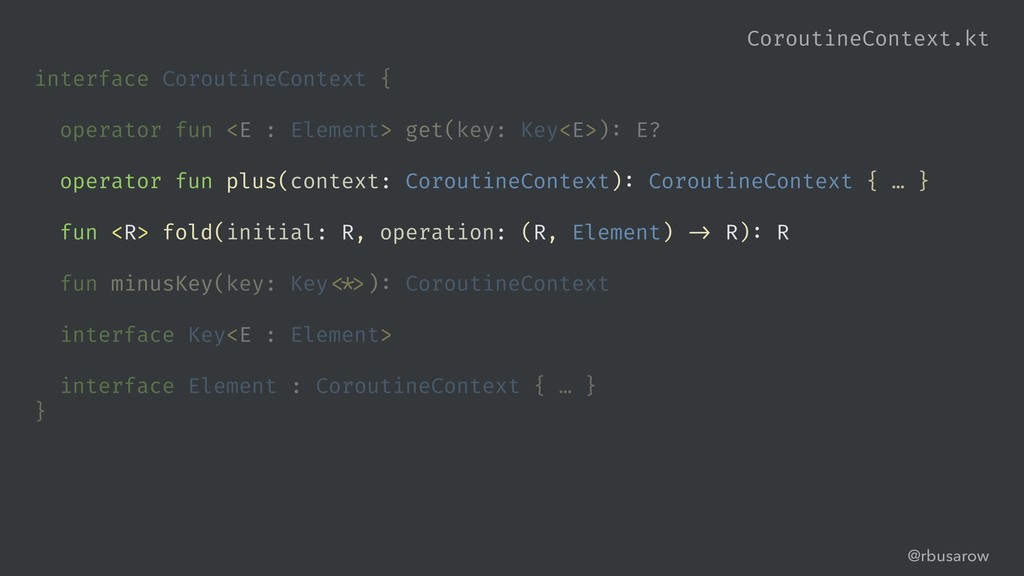
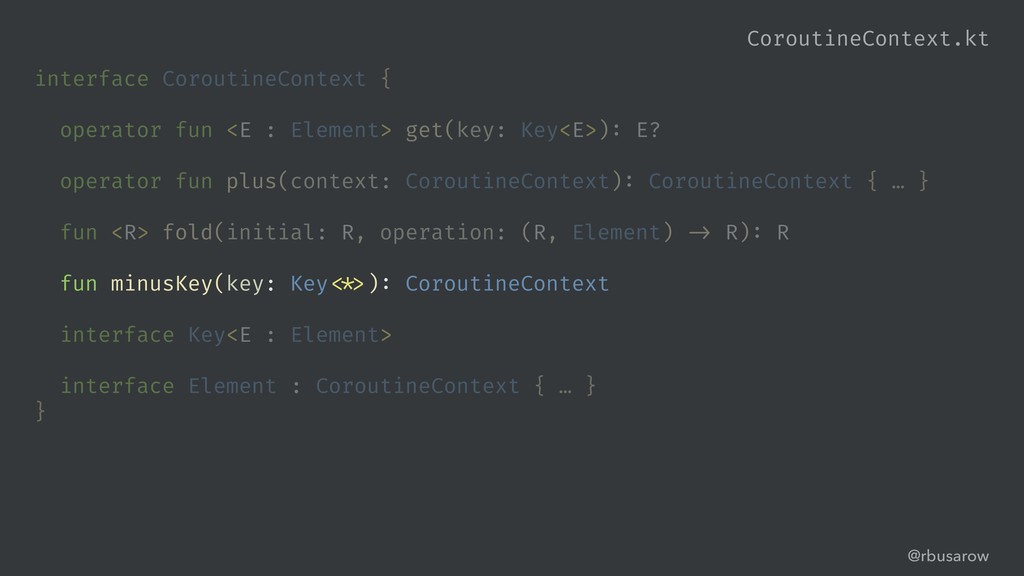
@rbusarow CoroutineContext.kt interface CoroutineContext {~ operator fun <E :~Element> get(key:
Key<E>): E? operator fun plus(context:~CoroutineContext): CoroutineContext {~…~} fun <R> fold(initial: R, operation: (R, Element) !-> R): R fun minusKey(key: Key!!<*>): CoroutineContext interface Key<E :~Element> interface Element :~CoroutineContext {~…~} }~ -
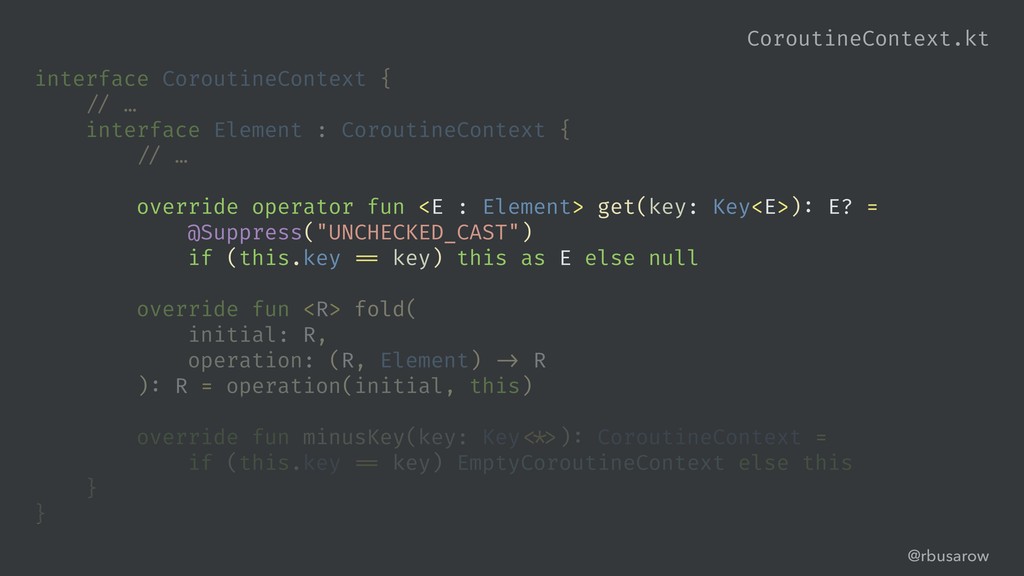
@rbusarow CoroutineContext.kt interface CoroutineContext { !// … interface Element :
CoroutineContext { !// … override operator fun <E : Element> get(key: Key<E>): E? = @Suppress("UNCHECKED_CAST") if (this.key !== key) this as E else null override fun <R> fold( initial: R, operation: (R, Element) !-> R ): R = operation(initial, this) override fun minusKey(key: Key!!<*>): CoroutineContext = if (this.key !== key) EmptyCoroutineContext else this } } -
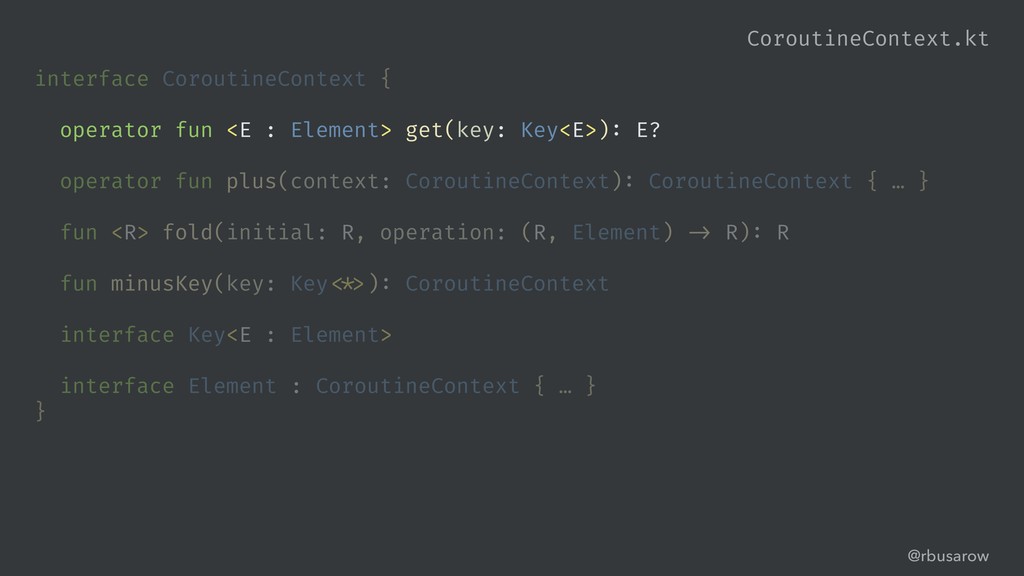
@rbusarow CoroutineContext.kt interface CoroutineContext {~ operator fun <E :~Element> get(key:
Key<E>): E? operator fun plus(context:~CoroutineContext): CoroutineContext {~…~} fun <R> fold(initial: R, operation: (R, Element) !-> R): R fun minusKey(key: Key!!<*>): CoroutineContext interface Key<E :~Element> interface Element :~CoroutineContext {~…~} }~ -
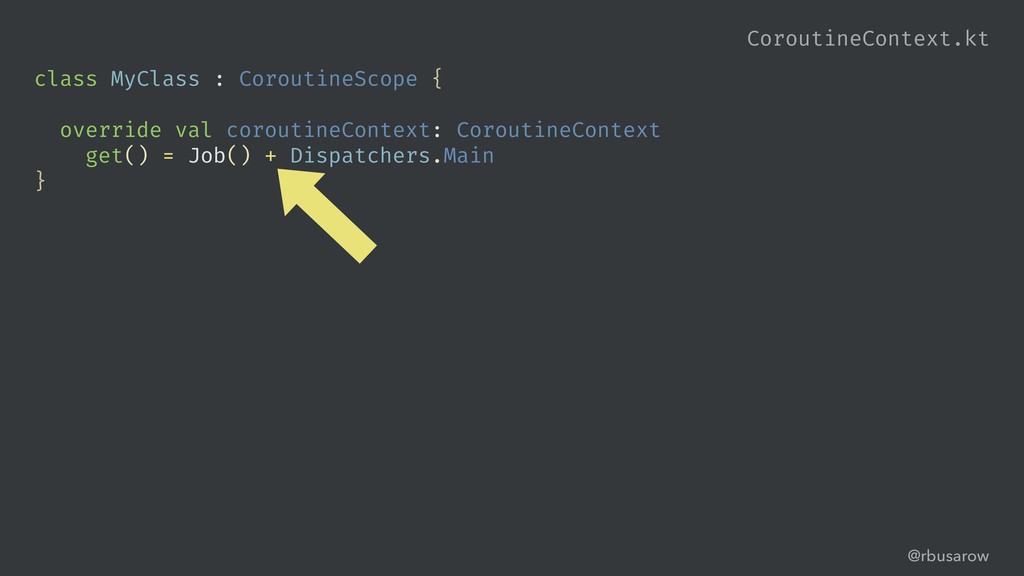
@rbusarow CoroutineContext.kt class MyClass : CoroutineScope { override val coroutineContext:
CoroutineContext get() = Job() + Dispatchers.Main } -
@rbusarow CoroutineContext.kt class MyClass : CoroutineScope { override val coroutineContext:
CoroutineContext get() = Job() + Dispatchers.Main } -
@rbusarow CoroutineContext.kt interface CoroutineContext {~ operator fun <E :~Element> get(key:
Key<E>): E? operator~fun~plus(context:~CoroutineContext):~CoroutineContext {~…~} fun <R> fold(initial: R, operation: (R, Element) !->~R): R fun minusKey(key: Key!!<*>): CoroutineContext interface Key<E :~Element> interface Element :~CoroutineContext {~…~} }~ -
@rbusarow CoroutineContext.kt operator~fun~plus(context:~CoroutineContext):~CoroutineContext = if (context !!=== EmptyCoroutineContext) this else
context.fold(this) { acc, element !-> val removed = acc.minusKey(element.key) if (removed !!=== EmptyCoroutineContext) element else { val interceptor = removed[ContinuationInterceptor] if (interceptor !== null) CombinedContext(removed, element) else { val left = removed.minusKey(ContinuationInterceptor) if (left !!=== EmptyCoroutineContext) CombinedContext( element, interceptor ) else CombinedContext(CombinedContext(left, element), interceptor) } } } -
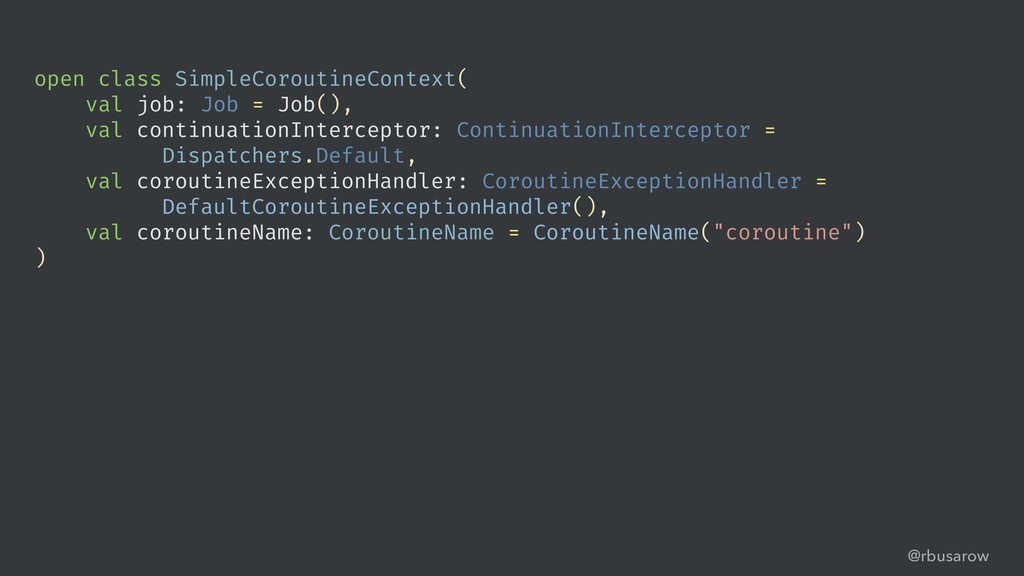
@rbusarow open class SimpleCoroutineContext( val job: Job =~Job(), val continuationInterceptor:
ContinuationInterceptor =~ Dispatchers.Default, val coroutineExceptionHandler: CoroutineExceptionHandler =~ DefaultCoroutineExceptionHandler(), val coroutineName: CoroutineName =~CoroutineName("coroutine") )~ -
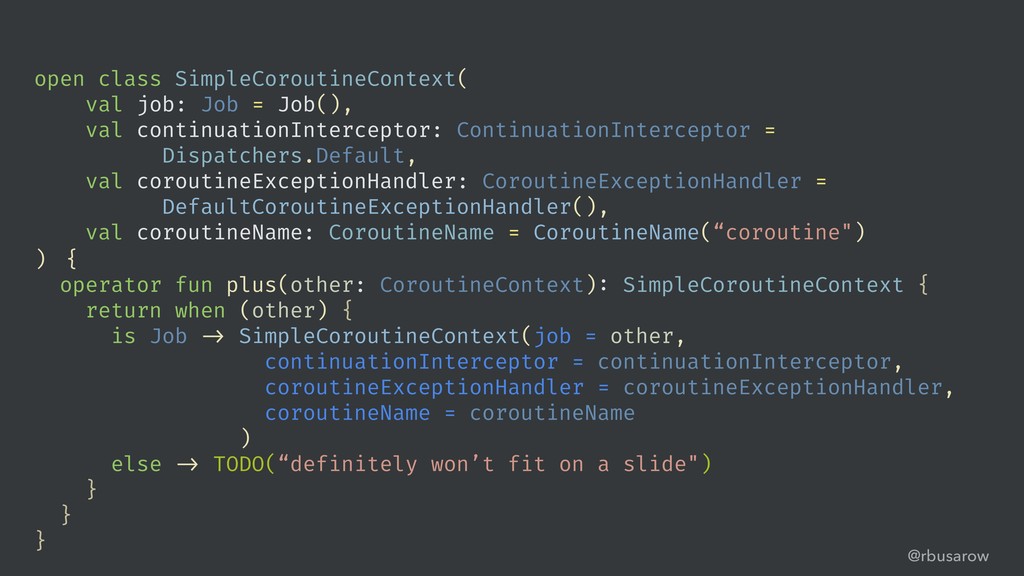
@rbusarow open class SimpleCoroutineContext( val job: Job =~Job(), val continuationInterceptor:
ContinuationInterceptor =~ Dispatchers.Default, val coroutineExceptionHandler: CoroutineExceptionHandler =~ DefaultCoroutineExceptionHandler(), val coroutineName: CoroutineName =~CoroutineName(“coroutine") )~ { operator fun plus(other: CoroutineContext): SimpleCoroutineContext { return when (other) { is Job !-> SimpleCoroutineContext(job = other, continuationInterceptor = continuationInterceptor, coroutineExceptionHandler = coroutineExceptionHandler, coroutineName = coroutineName ) else !-> TODO(“definitely won’t fit on a slide") } } } -
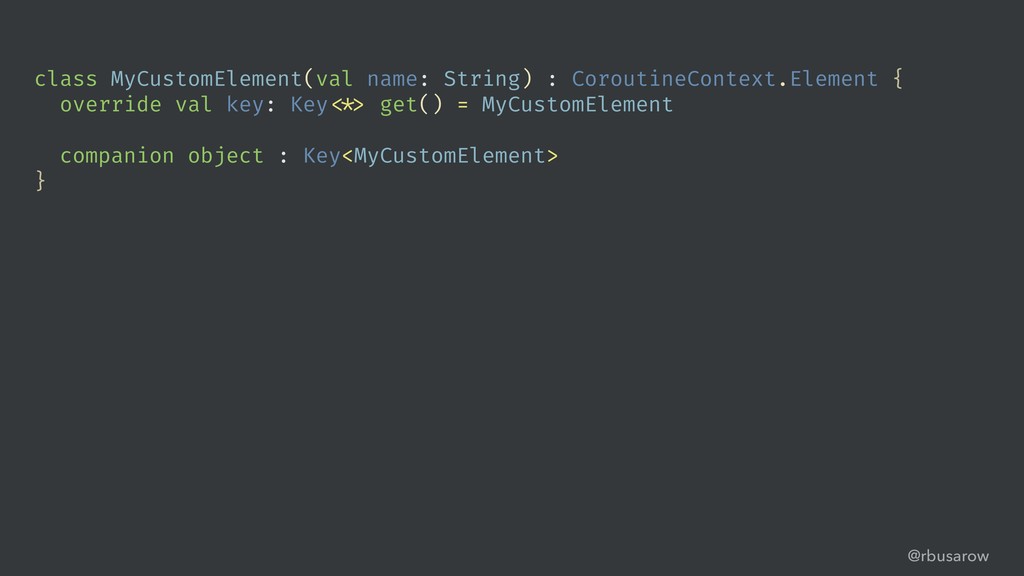
@rbusarow class MyCustomElement(val name: String) : CoroutineContext.Element {~ override val
key: Key!!<*> get() =~MyCustomElement companion object :~Key<MyCustomElement> }~ -
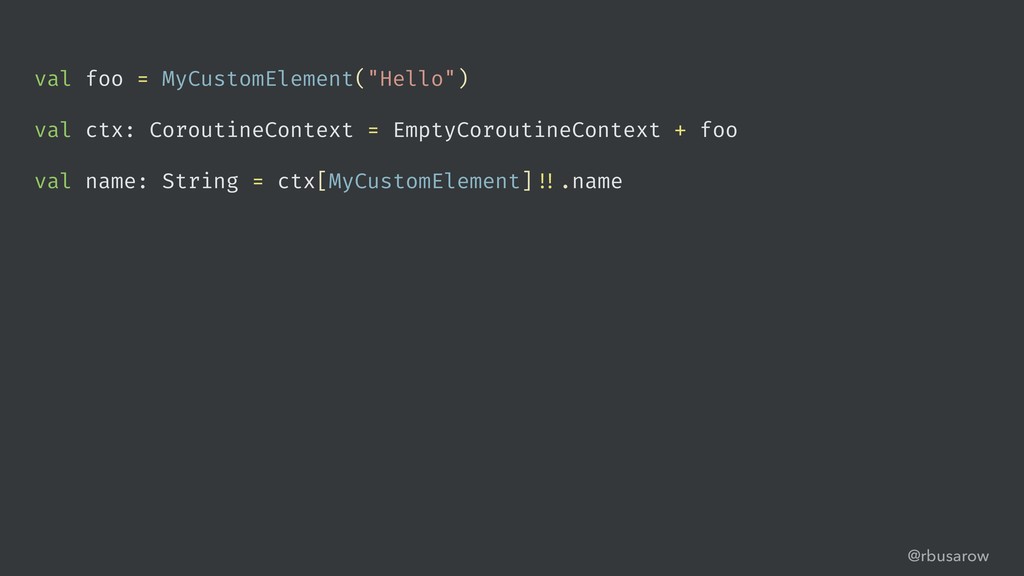
@rbusarow val foo = MyCustomElement("Hello") val ctx: CoroutineContext = EmptyCoroutineContext
+ foo val name: String = ctx[MyCustomElement]!!!.name -
@rbusarow CoroutineContext.kt interface CoroutineContext {~ operator fun <E :~Element> get(key:
Key<E>): E? operator~fun~plus(context:~CoroutineContext):~CoroutineContext {~…~} fun <R> fold(initial: R, operation: (R, Element) !->~R): R fun minusKey(key: Key!!<*>): CoroutineContext interface Key<E :~Element> interface Element :~CoroutineContext {~…~} }~ -
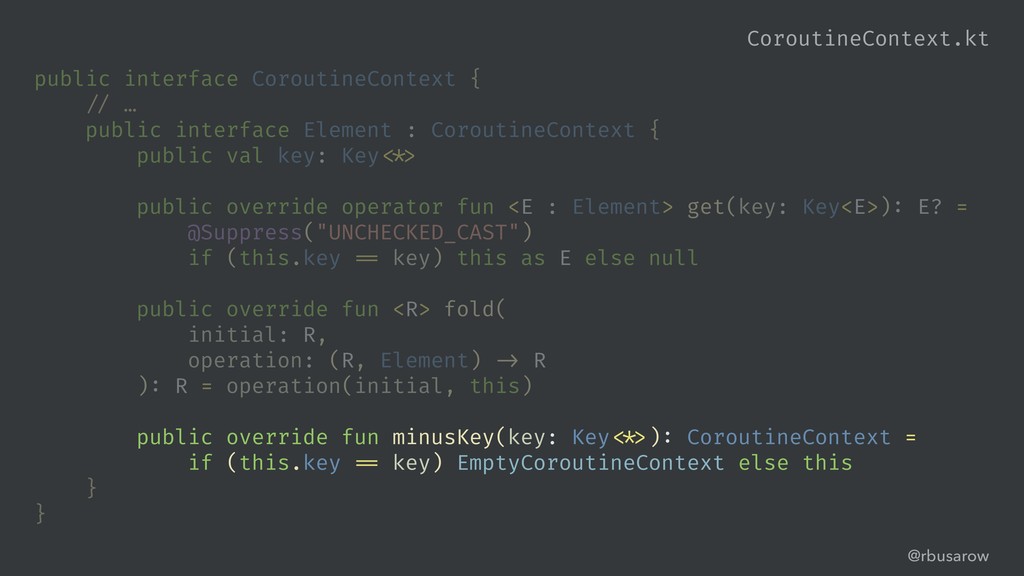
@rbusarow CoroutineContext.kt public interface CoroutineContext { !// … public interface
Element : CoroutineContext { public val key: Key!!<*> public override operator fun <E : Element> get(key: Key<E>): E? = @Suppress("UNCHECKED_CAST") if (this.key !== key) this as E else null public override fun <R> fold( initial: R, operation: (R, Element) !-> R ): R = operation(initial, this) public override fun minusKey(key: Key!!<*>): CoroutineContext = if (this.key !== key) EmptyCoroutineContext else this } } -
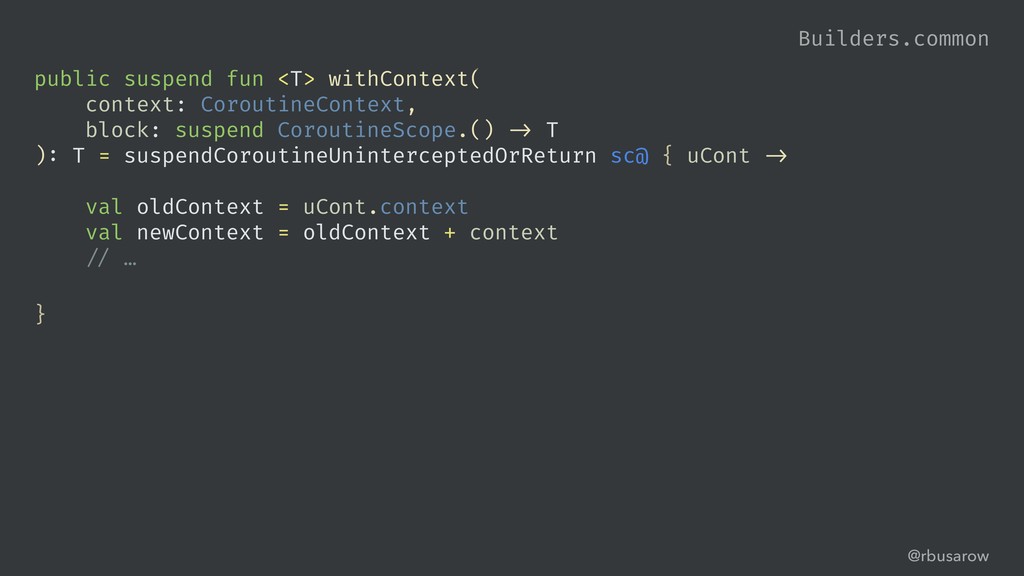
@rbusarow Builders.common public suspend fun <T> withContext( context: CoroutineContext, block:
suspend CoroutineScope.() !-> T ): T = suspendCoroutineUninterceptedOrReturn sc@ { uCont !-> val oldContext = uCont.context val newContext = oldContext + context !// … } -
@rbusarow Builders.common public suspend fun <T> withContext( context: CoroutineContext, block:
suspend CoroutineScope.() !-> T ): T = suspendCoroutineUninterceptedOrReturn sc@ { uCont !-> val oldContext = uCont.context val newContext = oldContext + context !// … } -
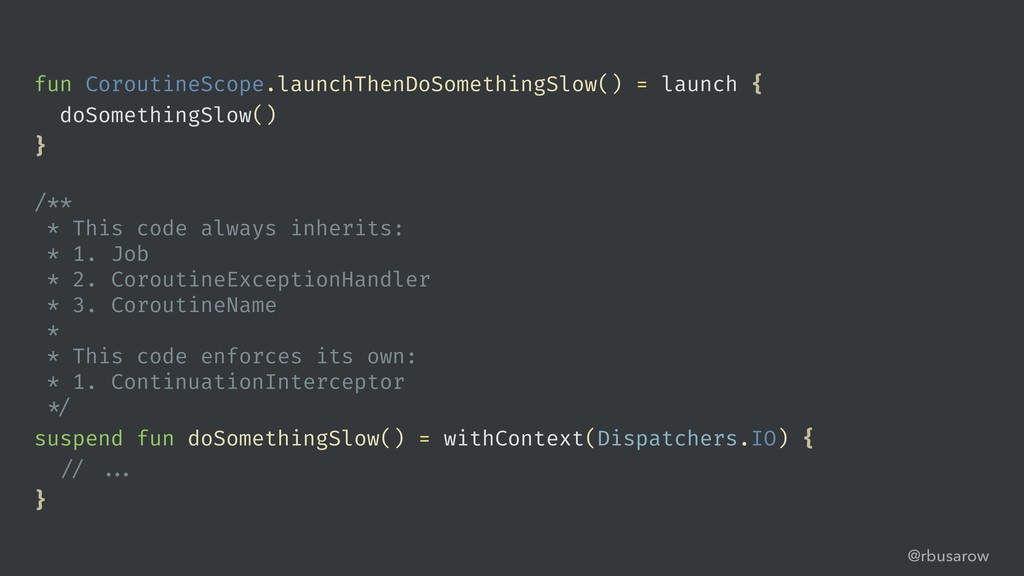
@rbusarow fun CoroutineScope.launchThenDoSomethingSlow() = launch { doSomethingSlow() } /** *
This code always inherits: * 1. Job * 2. CoroutineExceptionHandler * 3. CoroutineName * * This code enforces its own: * 1. ContinuationInterceptor !*/ suspend fun doSomethingSlow() = withContext(Dispatchers.IO) { !// !!... } -
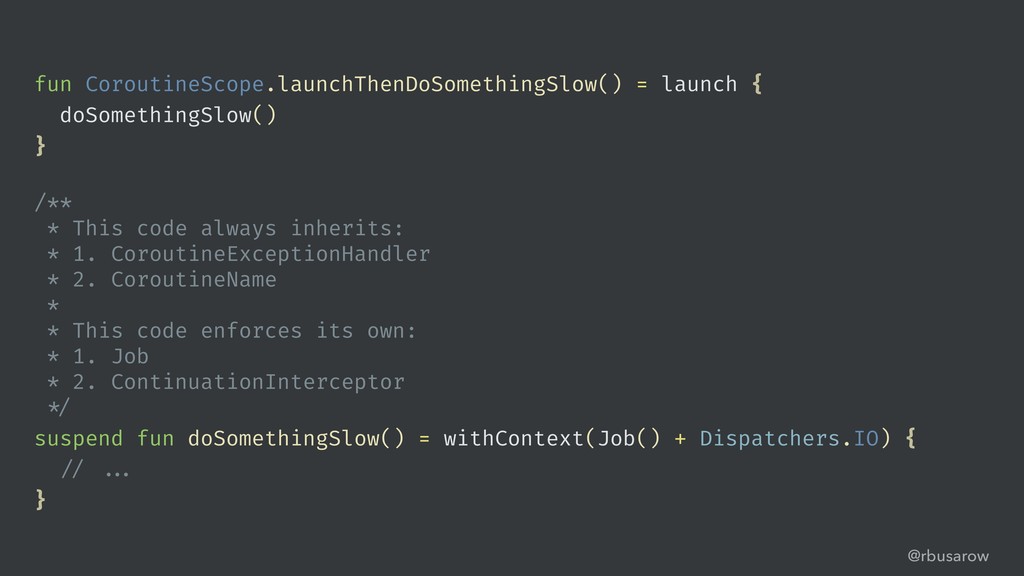
@rbusarow fun CoroutineScope.launchThenDoSomethingSlow() = launch { doSomethingSlow() } /** *
This code always inherits: * 1. CoroutineExceptionHandler * 2. CoroutineName * * This code enforces its own: * 1. Job * 2. ContinuationInterceptor !*/ suspend fun doSomethingSlow() = withContext(Job() + Dispatchers.IO) { !// !!... }