Share
Embed
The TTL on our Skills
A short overview of how we think about problems and create the mental shortcuts needed in a face paced environment. And eventually how we need to reevaluate those conclusions from earlier points in our career.
Ramin K
April 21, 2016
Transcript
39 slides
-
Antisthenes - 400(ish) BC “The most useful piece of learning
for the uses of life is to unlearn what is untrue.” Or has become untrue. (cue ominous music) -
Hi, I’m Ramin Career Highlights • Operations for serveral startups
• Telco, ISP, webhosting, video streaming, SaaS • Windows office automation consulting • Consumer and enterprise web apps • 20 years (almost) and 13 companies • Currently an SRE at Twitter -
New Places/Old Problems Some variations, but themes the same •
It’s always been done that way • We don’t run $common_tech, it doesn’t work • Cargo-culting of configs • Processes that are inappropriate for the workloads • Institutional Inertia -
The Human Brain We are pattern finding maniacs • We
do it constantly. • We do it unconsciously. • That last one might be a problem. -
Related to Sysadmin how? We rarely start from scratch •
Rely on experience first • Match current circumstances against past experiences • If that fails, try a bunch of things • Finally if all else fails, start from the beginning and work logically towards a solution -
Related to Sysadmin how? Mechanized thinking • Aka the Einstellung
Effect • Predisposition to solve a problem in a specific manner based on recent successes • Human brain's ways of finding an appropriate solution/behavior as efficiently as possible, but not the most efficient solution -
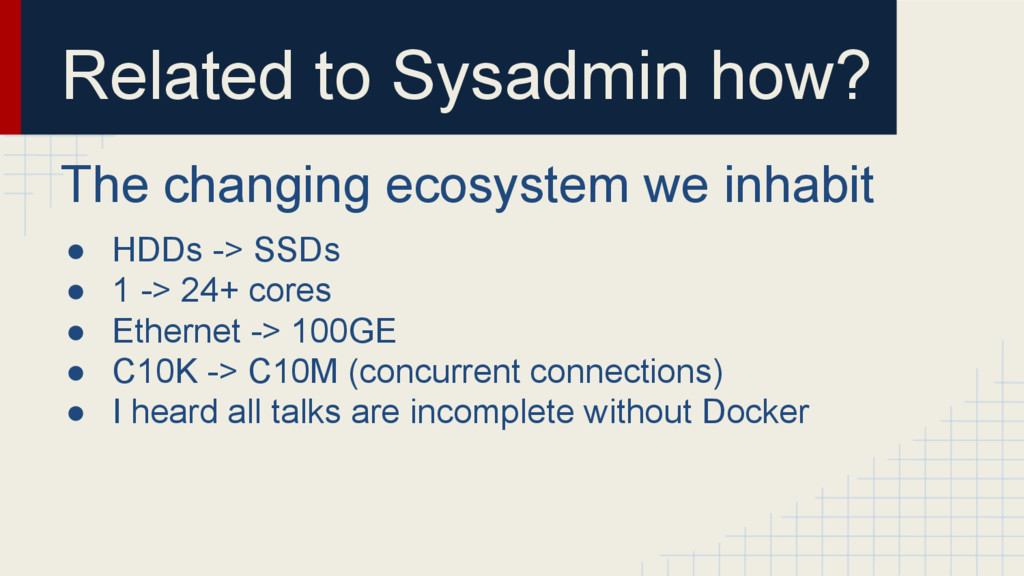
Related to Sysadmin how? The changing ecosystem we inhabit •
HDDs -> SSDs • 1 -> 24+ cores • Ethernet -> 100GE • C10K -> C10M (concurrent connections) • I heard all talks are incomplete without Docker -
Heuristics - definition “Any approach to problem solving, learning, or
discovery that employs a practical method not guaranteed to be optimal or perfect, but sufficient for the immediate goals.” -- Wikipedia -
Why Heuristics Why are we relying on heuristics? • Every
profession uses them • Takes less time to use • Takes less information to use • Takes less experience to use -
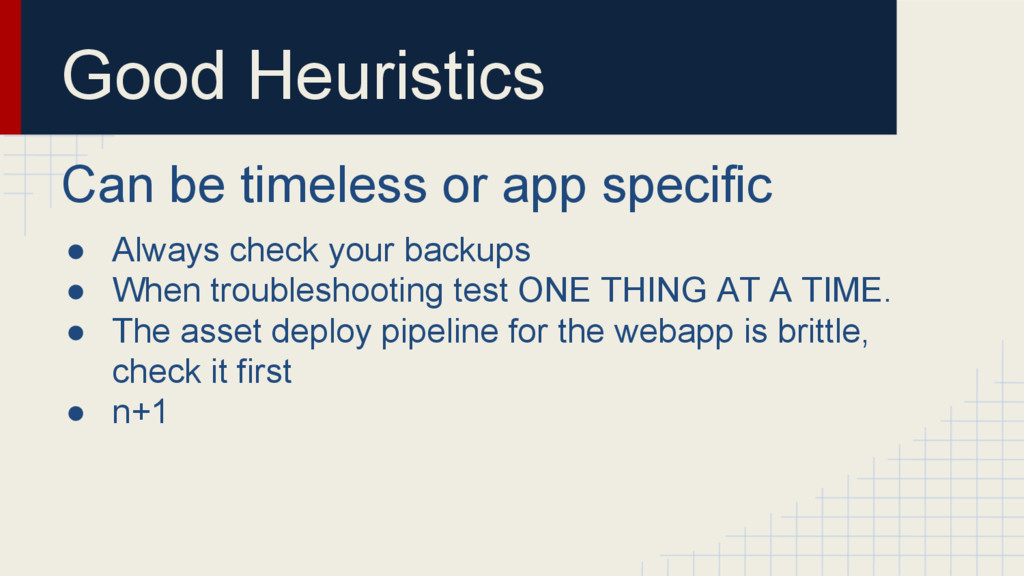
Good Heuristics Can be timeless or app specific • Always
check your backups • When troubleshooting test ONE THING AT A TIME. • The asset deploy pipeline for the webapp is brittle, check it first • n+1 -
Expired (Bad?) Heuristics Like every myth, a bit of truth
• It’s always the network • Building from src gets you more performance • RAID 5 is a good default • Add your own here -
Bounds of Rationality “when individuals make decisions, their rationality is
limited by the available information, the tractability of the decision problem, the cognitive limitations of their minds, and the time available to make the decision” --wikipedia -
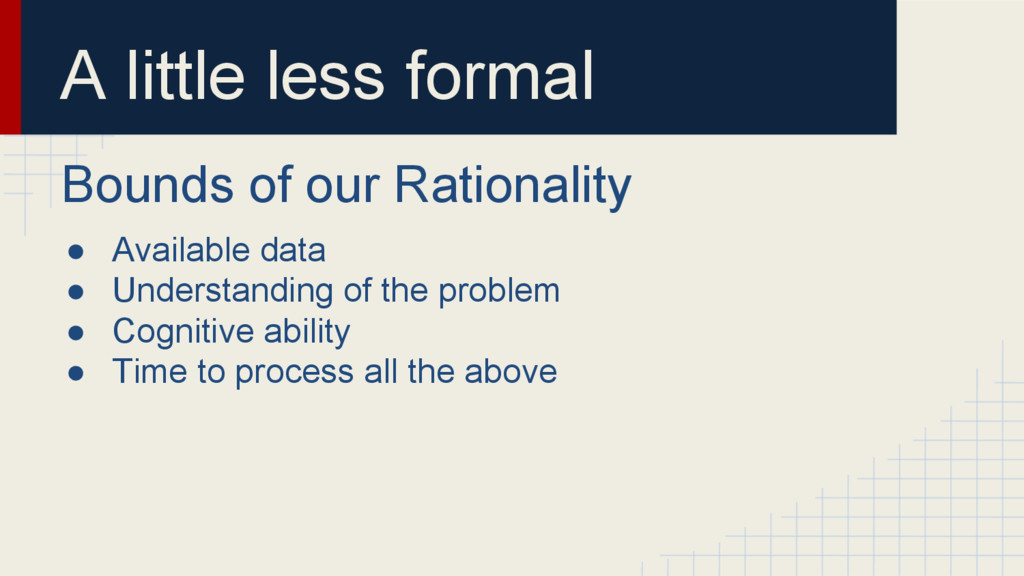
A little less formal Bounds of our Rationality • Available
data • Understanding of the problem • Cognitive ability • Time to process all the above -
In hindsight, it’s obvious Bounds of Rationality grows over time
• Monday morning quarterbacks • Bad postmortems • Accept your earlier work as part of the process -
Let’s start tying it together Heuristics are created within the
bounds of our rationality • Incomplete data • May not completely understand the problem • Need to solve it now • Looking for a pattern -
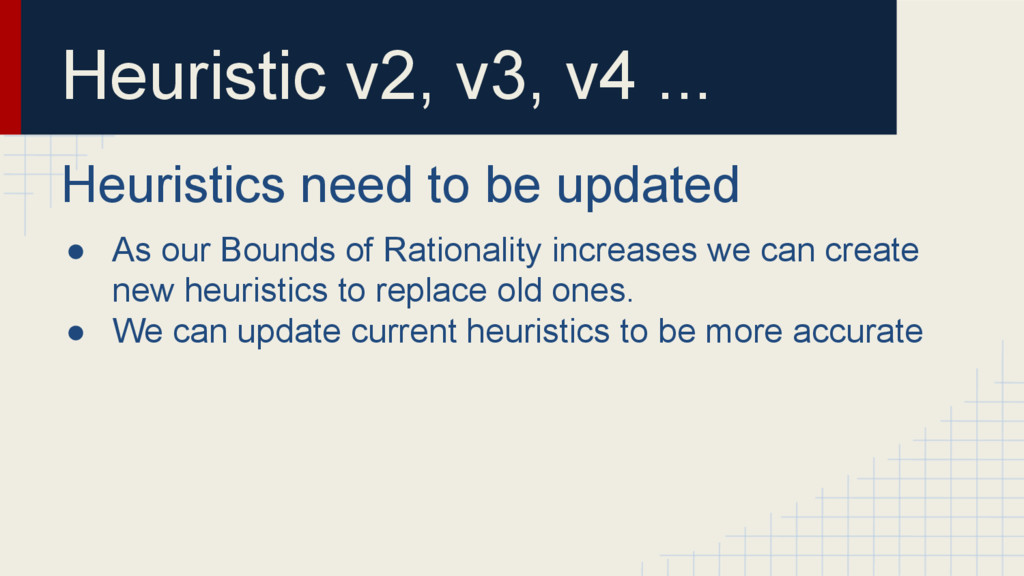
Heuristic v2, v3, v4 ... Heuristics need to be updated
• As our Bounds of Rationality increases we can create new heuristics to replace old ones. • We can update current heuristics to be more accurate -
Cognitive Behavior Therapy “Mainstream CBT helps individuals replace ‘maladaptive... coping
skills, cognitions, emotions and behaviors with more adaptive ones’, by challenging an individual's way of thinking and the way that they react to certain habits or behaviors” --wikipedia -
Cherry picking cognition For our purposes we are concerned with
cognitions rather than behavior • We want to apply this to heuristics • Behavior therapy is a huge field -
A general example We feel responsible for parents divorce •
Caused a fight between our parents • Shortly thereafter parents divorced • We caused the divorce -
A general example (reality) At 30yrs old we can see
it differently • We were seven years old • Left toy at supermarket, had to go back • Caused a fight between our parents • This fight was actually one of dozens • Other stress factors in the relationship also recalled like moving, new job, death in the family, etc. -
A sysadmin example We caused the outage to last longer
• One of the DB slaves stopped replicating • Didn’t notice the alert on that slave • Web app using bad slave couldn’t serve API traffic • Distracted by drop off in serving out of cache • Even after fixed, site was slow for a few hours -
A sysadmin example (+1day) Some problems in the system •
Release went out • All DB slaves experienced replication lag. It wasn’t till they started to catch up that it was possible to notice one was wedged • Replication alert lost in the general alert noise • Site performance was worse than expected -
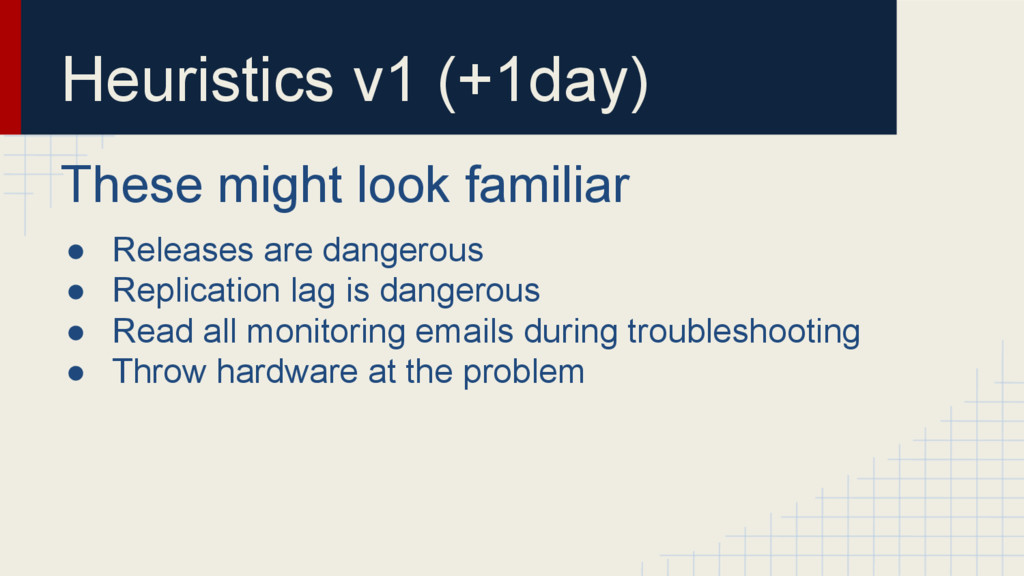
Heuristics v1 (+1day) These might look familiar • Releases are
dangerous • Replication lag is dangerous • Read all monitoring emails during troubleshooting • Throw hardware at the problem -
A sysadmin example (+1wk) So so many problems in the
system • Schema update locked busiest table for 8 minutes • All DB slaves experienced replication lag. It wasn’t till they started to catch up that it was possible to notice one was wedged • The TTL on hot data was 5 minutes which expired during the schema update. • API could not serve the high traffic event w/ cold cache -
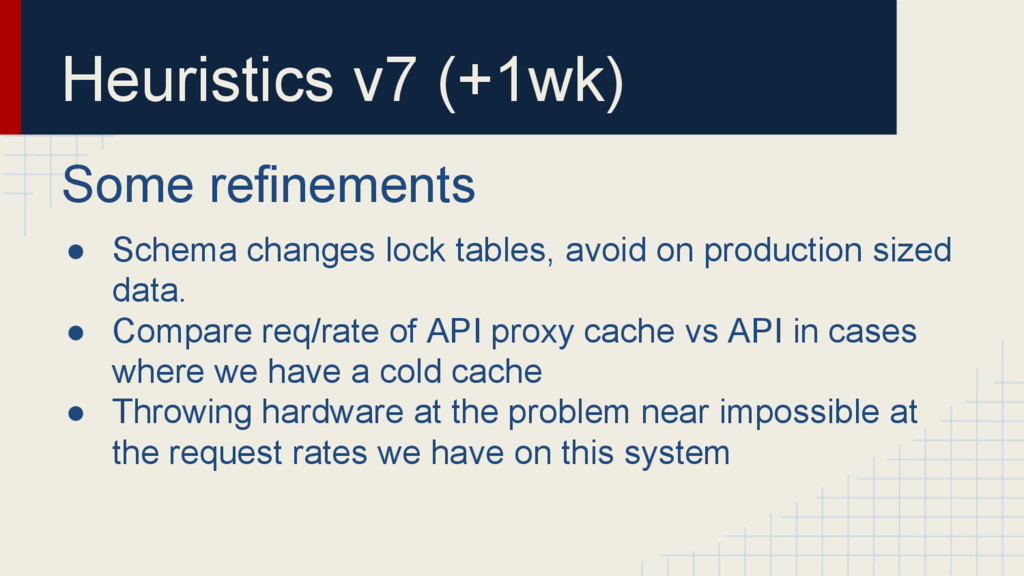
Heuristics v7 (+1wk) Some refinements • Schema changes lock tables,
avoid on production sized data. • Compare req/rate of API proxy cache vs API in cases where we have a cold cache • Throwing hardware at the problem near impossible at the request rates we have on this system -
Borrowing again from CBT Context matters, avoid • Overgeneralizations •
Polarization (“it’s black or white”) • Filtering, magnifying the negative -
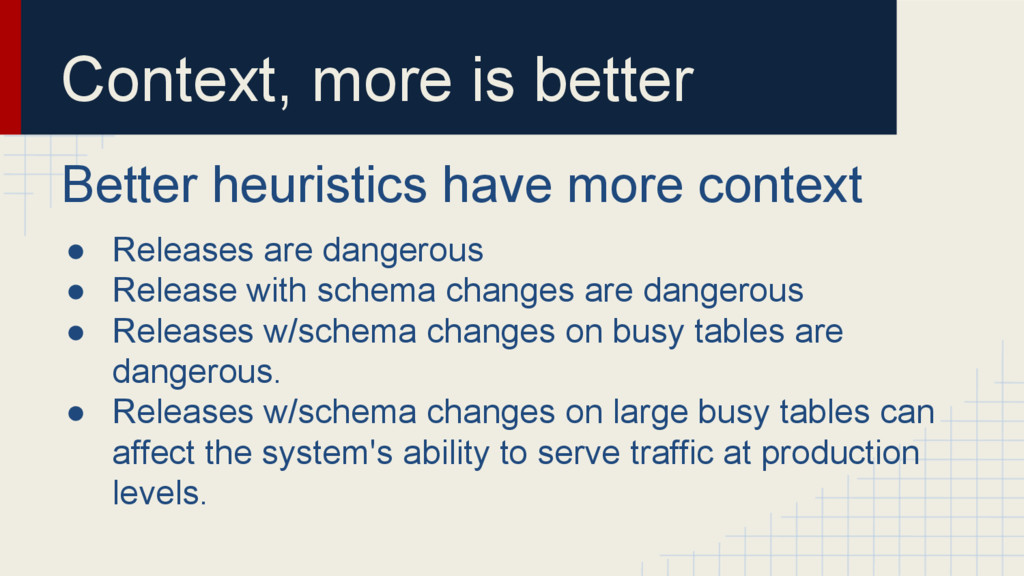
Context, more is better Better heuristics have more context •
Releases are dangerous • Release with schema changes are dangerous • Releases w/schema changes on busy tables are dangerous. • Releases w/schema changes on large busy tables can affect the system's ability to serve traffic at production levels. -
Is this Heuristic done? No, no, nope, nada • Online
schema changes more widespread • Will work on most tables • Wait, “most tables”? -
Borrowing more from CBT You need a second person (at
least) • Keeps you honest with yourself • Keeps you from taking too much responsibility • Asks the questions you didn’t think to ask • “use your words” • Post mortems, done well, should look like this -
Reprocssing How would I solve X problem today? • Our
design principles are heuristics too • Caution yourself, it works -
Reprocssing Was X as successful as it appeared? • Retrospectives
• Switching jobs makes this a bit harder • Keep in touch with coworkers -
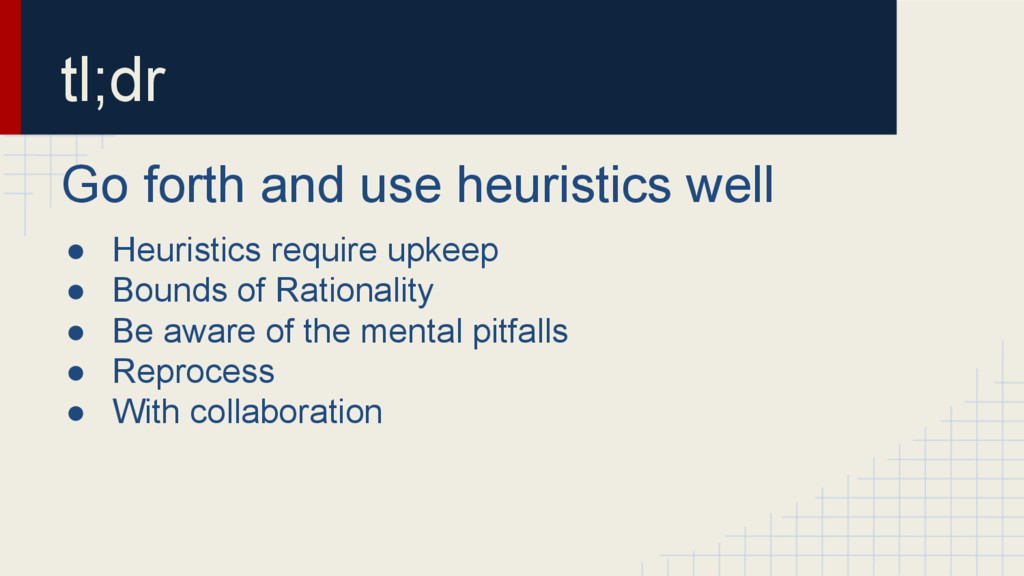
tl;dr Go forth and use heuristics well • Heuristics require
upkeep • Bounds of Rationality • Be aware of the mental pitfalls • Reprocess • With collaboration -
Appendix 1. https://en.wikipedia.org/wiki/Red_Queen_hypothesis 2. https://medium.com/@garywiz/five-things-old-programmers-need-to-remember-e78caf0b0973#.361en9sfi 3. https://en.wikipedia.org/wiki/Einstellung_effect 4. http://randymatusky.com/2015/02/25/the-hidden-learning-potential-behind-the-einstellung-effect/ 5.
http://bigthink.com/endless-innovation/humans-are-the-worlds-best-pattern-recognition-machines-but-for-how-long 6. http://www.kegel.com/c10k.html 7. http://www.amazon.com/Drift-into-Failure-Sidney-Dekker/dp/1409422216 8. http://www.amazon.com/Thinking-Systems-Primer-Meadows-Donella-ebook/dp/B005VSRFEA/ 9. http://io9.gizmodo.com/5746904/how-pigeons-get-to-be-superstitious 10. http://psychcentral.com/lib/15-common-cognitive-distortions/ 11. https://en.wikipedia.org/wiki/Rubber_duck_debugging