Share
Embed
Nikita Lutsenko: Advanced Obj-C <-> Swift Interoperability
Presented at AltConf 2016
Realm
June 13, 2016
Transcript
56 slides
-
Agenda → ObjC -> Swift → Swift <- ObjC →
Swift <-> ObjC -
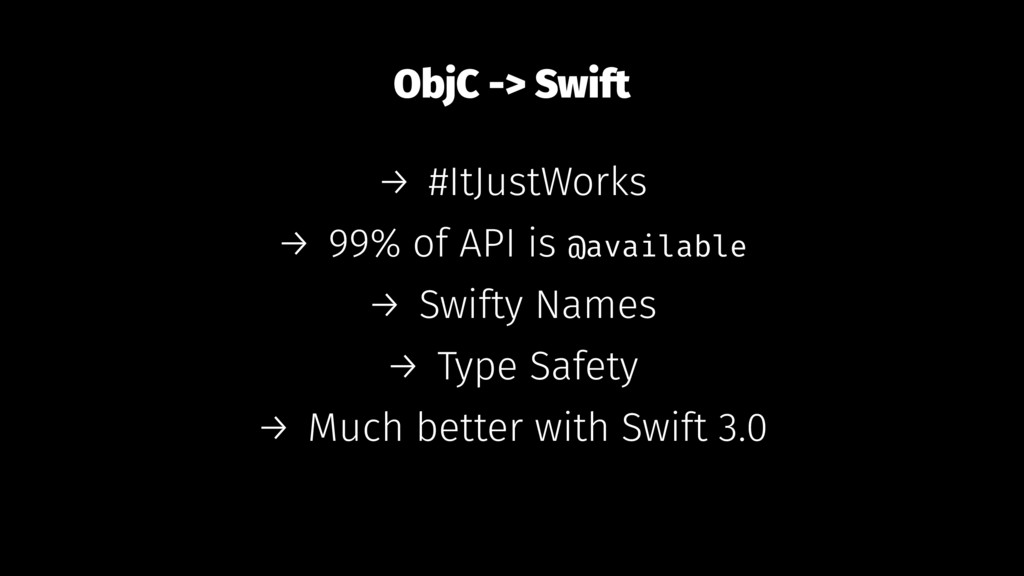
ObjC -> Swift → #ItJustWorks → 99% of API is
@available → Swifty Names → Type Safety → Much better with Swift 3.0 -
ObjC -> Swift 2.* → Nullability Annotations → Error Handling
→ NS_SWIFT_NAME → NS_SWIFT_UNAVAILABLE → NS_REFINED_FOR_SWIFT → NS_SWIFT_NOTHROW -
ObjC - (BOOL)performRequest:(NSURLRequest *)request; - (BOOL)performRequest:(NSURLRequest *)request error:(NSError **)error; Swift
2.* public func performRequest(request: NSURLRequest!) -> Bool public func performRequest(request: NSURLRequest!, error: ()) throws -
Nullability Annotations - (BOOL)performRequest:(nullable NSURLRequest *)request; - (BOOL)performRequest:(nullable NSURLRequest *)request
error:(NSError **)error; public func performRequest(request: NSURLRequest?) -> Bool public func performRequest(request: NSURLRequest?, error: ()) throws -
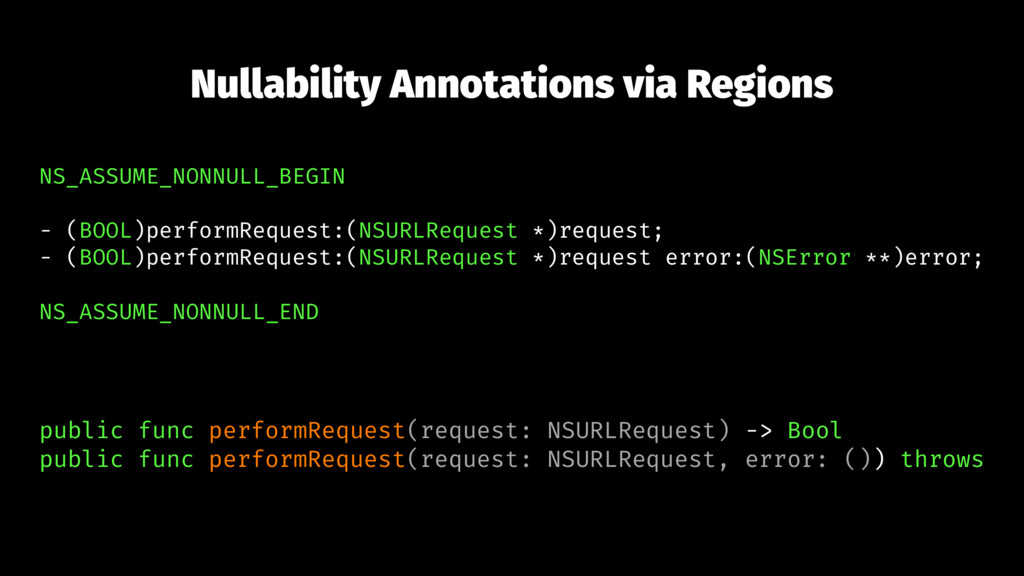
Nullability Annotations via Regions NS_ASSUME_NONNULL_BEGIN - (BOOL)performRequest:(NSURLRequest *)request; - (BOOL)performRequest:(NSURLRequest
*)request error:(NSError **)error; NS_ASSUME_NONNULL_END public func performRequest(request: NSURLRequest) -> Bool public func performRequest(request: NSURLRequest, error: ()) throws -
NS_SWIFT_NAME - (BOOL)performRequest:(nullable NSURLRequest *)request NS_SWIFT_NAME(perform(request:)); - (BOOL)performRequest:(nullable NSURLRequest *)request
error:(NSError **)error NS_SWIFT_NAME(perform(request:)); public func perform(request request: NSURLRequest?) -> Bool public func perform(request request: NSURLRequest?) throws -
NS_SWIFT_UNAVAILABLE - (BOOL)performRequest:(nullable NSURLRequest *)request NS_SWIFT_UNAVAILABLE(""); - (BOOL)performRequest:(nullable NSURLRequest *)request
error:(NSError **)error NS_SWIFT_NAME(perform(request:)); public func perform(request request: NSURLRequest?) throws -
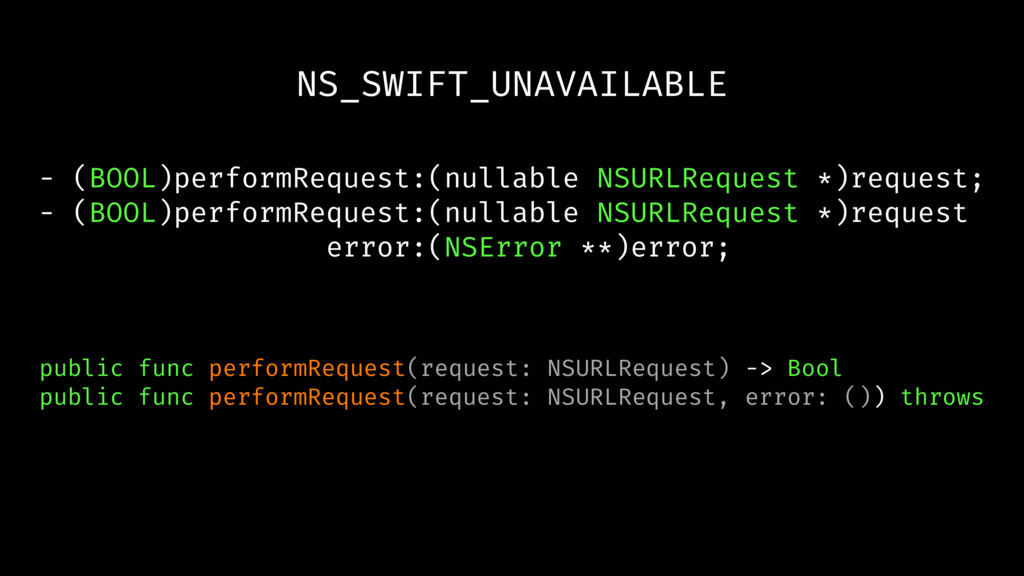
NS_SWIFT_UNAVAILABLE - (BOOL)performRequest:(nullable NSURLRequest *)request; - (BOOL)performRequest:(nullable NSURLRequest *)request error:(NSError
**)error; public func performRequest(request: NSURLRequest) -> Bool public func performRequest(request: NSURLRequest, error: ()) throws -
NS_SWIFT_UNAVAILABLE - (BOOL)performRequest:(nullable NSURLRequest *)request NS_SWIFT_UNAVAILABLE(""); - (BOOL)performRequest:(nullable NSURLRequest *)request
error:(NSError **)error; public func performRequest(request: NSURLRequest?) throws -
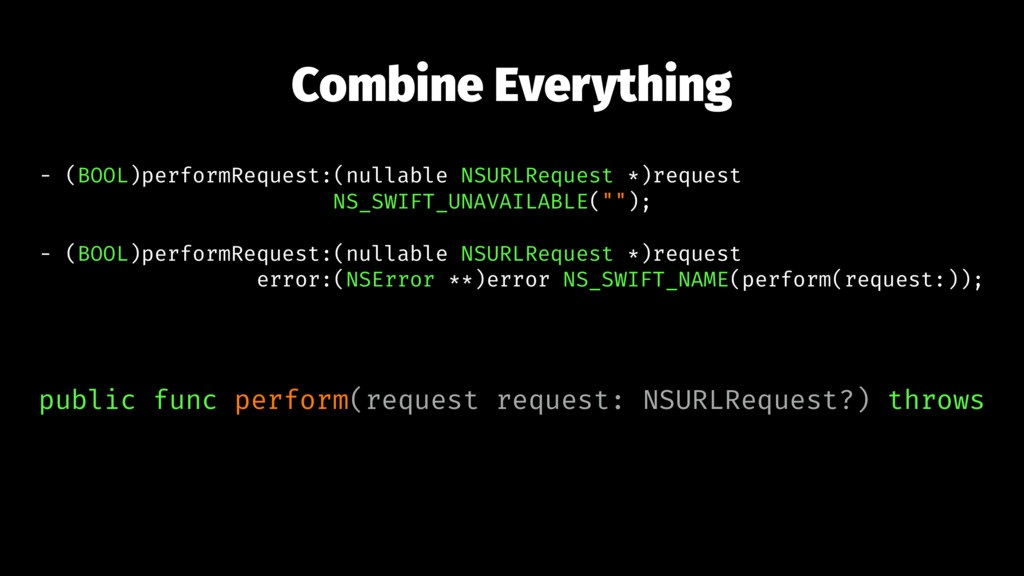
Combine Everything - (BOOL)performRequest:(nullable NSURLRequest *)request NS_SWIFT_UNAVAILABLE(""); - (BOOL)performRequest:(nullable NSURLRequest
*)request error:(NSError **)error NS_SWIFT_NAME(perform(request:)); public func perform(request request: NSURLRequest?) throws -
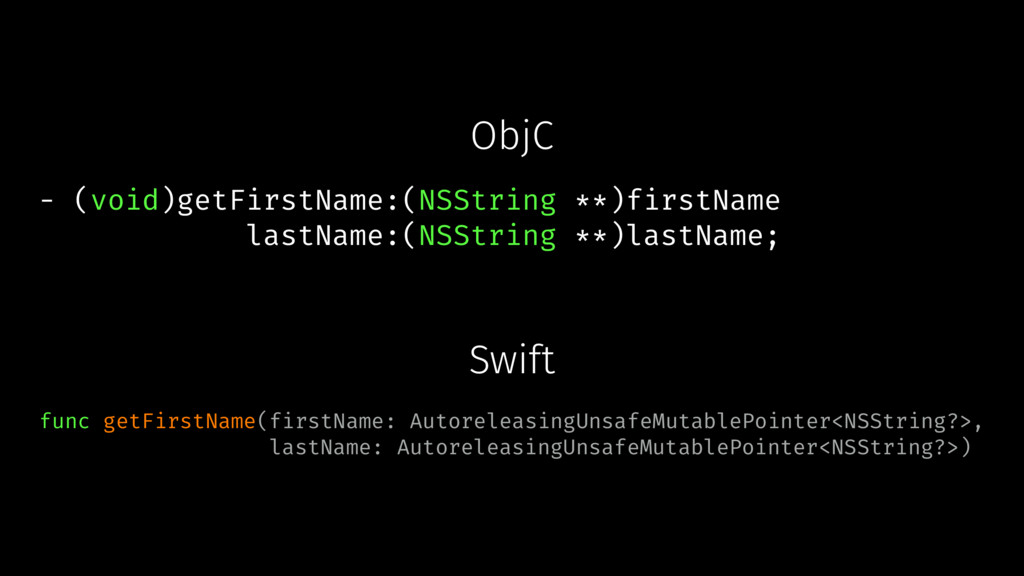
ObjC - (void)getFirstName:(NSString **)firstName lastName:(NSString **)lastName; Swift func getFirstName(firstName: AutoreleasingUnsafeMutablePointer<NSString?>,
lastName: AutoreleasingUnsafeMutablePointer<NSString?>) -
ObjC - (void)getFirstName:(NSString **)firstName lastName:(NSString **)lastName NS_SWIFT_NAME(get(firstName:lastName:)); Swift func get(firstName
firstName: AutoreleasingUnsafeMutablePointer<NSString?>, lastName: AutoreleasingUnsafeMutablePointer<NSString?>) -
ObjC - (void)getFirstName:(NSString **)firstName lastName:(NSString **)lastName NS_REFINED_FOR_SWIFT; Swift extension Person
{ var names: (firstName: String?, lastName: String?) { var firstName: NSString? = nil var lastName: NSString? = nil __getFirstName(&firstName, lastName: &lastName) return (firstName: firstName as String?, lastName: lastName as String?) } } -
ObjC -> Swift 3.0 → "The Grand Rename" → Objective-C
Lightweight Generics → NS_NOESCAPE/CF_NOESCAPE → NS_EXTENSIBLE_STRING_ENUM -
ObjC Generics @interface MyNetworkController<Request: NSURLRequest *> : NSObject - (void)performRequest:(nullable
Request)request; @end public class MyNetworkController : NSObject { public func performRequest(request: NSURLRequest?) } -
ObjC Generics @interface MyNetworkController<Request: NSURLRequest *> : NSObject - (void)performRequest:(nullable
Request)request; @end public class MyNetworkController<Request : NSURLRequest> : NSObject { public func perform(_ request: Request?) } -
NSEXTENSIBLESTRING_ENUM ObjC typedef NSString *NSRunLoopMode; extern NSRunLoopMode const NSDefaultRunLoopMode; Swift
2 public typealias NSRunLoopMode = NSString public let NSDefaultRunLoopMode: String -
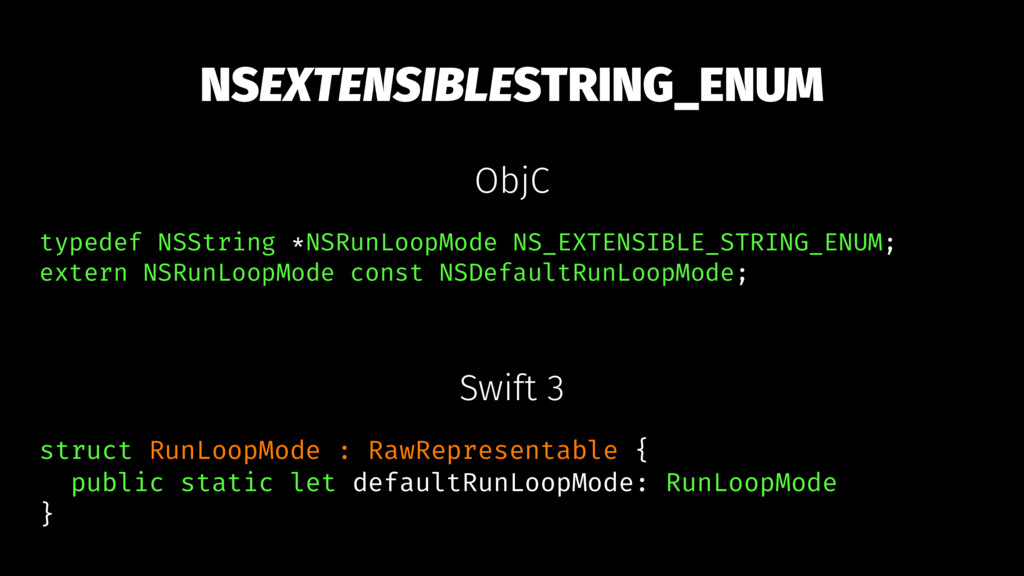
NSEXTENSIBLESTRING_ENUM ObjC typedef NSString *NSRunLoopMode NS_EXTENSIBLE_STRING_ENUM; extern NSRunLoopMode const NSDefaultRunLoopMode;
Swift 3 struct RunLoopMode : RawRepresentable { public static let defaultRunLoopMode: RunLoopMode } -
ObjC -> Swift → Use Nullability Annotations → Use Objective-C
Generics → Rename (NS_SWIFT_NAME) → Refine (NS_REFINED_FOR_SWIFT) → Rinse (NS_SWIFT_UNAVAILABLE) → Repeat -
Swift -> ObjC → No Tuples → No Generics →
No Typealiases → No Swift Enums → No Swift Structs → No Global Variables → No Free-standing Functions → Only ObjC Runtime Compatible -
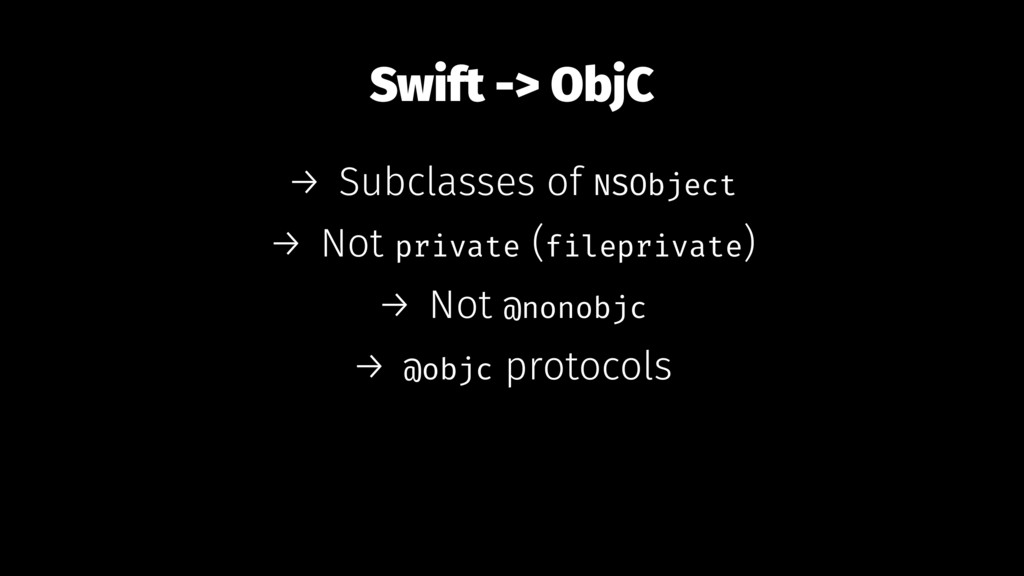
Swift -> ObjC → Subclasses of NSObject → Not private
(fileprivate) → Not @nonobjc → @objc protocols -
@objc & @nonobjc → Subclasses of NSObject → Explicit export
to ObjC → Concrete extensions → @objc protocols → Int enums -
@objc protocols → Special case of protocol → Weaker and
not-Swifty → Supports optional → Extensions are inaccessible from ObjC -
Value Types via _ObjectiveCBridgeable → Powers Foundation → Implementation Detail
Protocol → Native ObjC Types <-> Native Swift Types -
_ObjectiveCBridgeable public protocol _ObjectiveCBridgeable { associatedtype _ObjectiveCType : AnyObject static
func _isBridgedToObjectiveC() -> Bool func _bridgeToObjectiveC() -> _ObjectiveCType static func _forceBridgeFromObjectiveC(_ source: _ObjectiveCType, result: inout Self?) static func _conditionallyBridgeFromObjectiveC( _ source: _ObjectiveCType, result: inout Self? ) -> Bool static func _unconditionallyBridgeFromObjectiveC(_ source: _ObjectiveCType?) -> Self } -
Swift <-Pitfalls-> ObjC → Closure -> Block Performance → Type
Compatibility → Objective-C Runtime Hackery -
Type Compatibility NSArray<NSString *> *names = @[ @"John", @"Jane" ];
MSArray<id <NSCopying>> *array = names; -
Type Compatibility let names: [String] = ["John", "Jane"] let array:
[CustomDebugStringConvertible] = names -
Type Compatibility let names: [String] = ["John", "Jane"] let array:
[CustomDebugStringConvertible] = names fatal error: can't unsafeBitCast between types of different sizes -
Type Compatibility let names: [String] = ["John", "Jane"] let array:
[CustomDebugStringConvertible] = names.map({ $0 as CustomDebugStringConvertible }) -
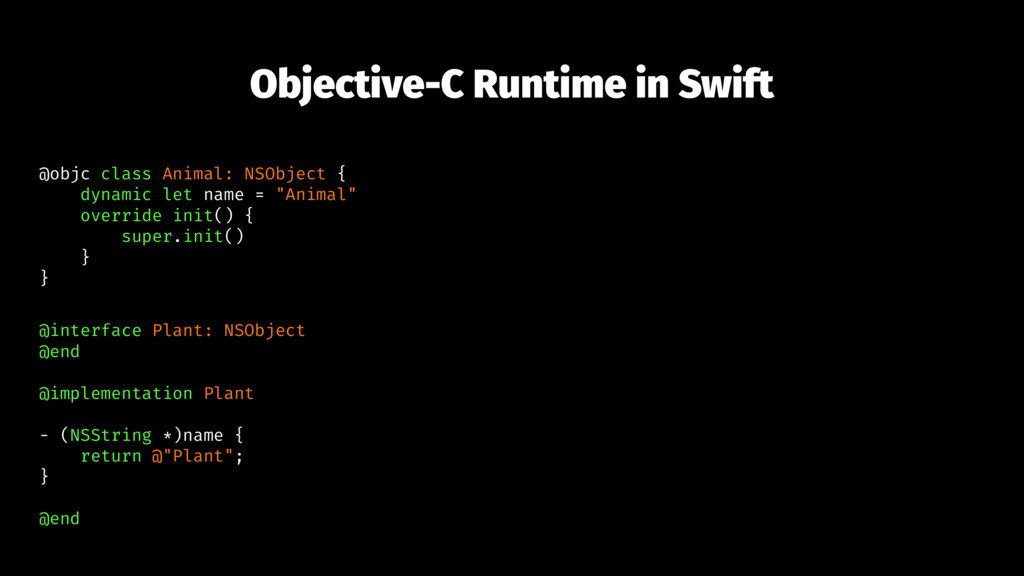
Objective-C Runtime in Swift @objc class Animal: NSObject { let
name = "Animal" override init() { super.init() } } @interface Plant: NSObject @end @implementation Plant - (NSString *)name { return @"Plant"; } @end -
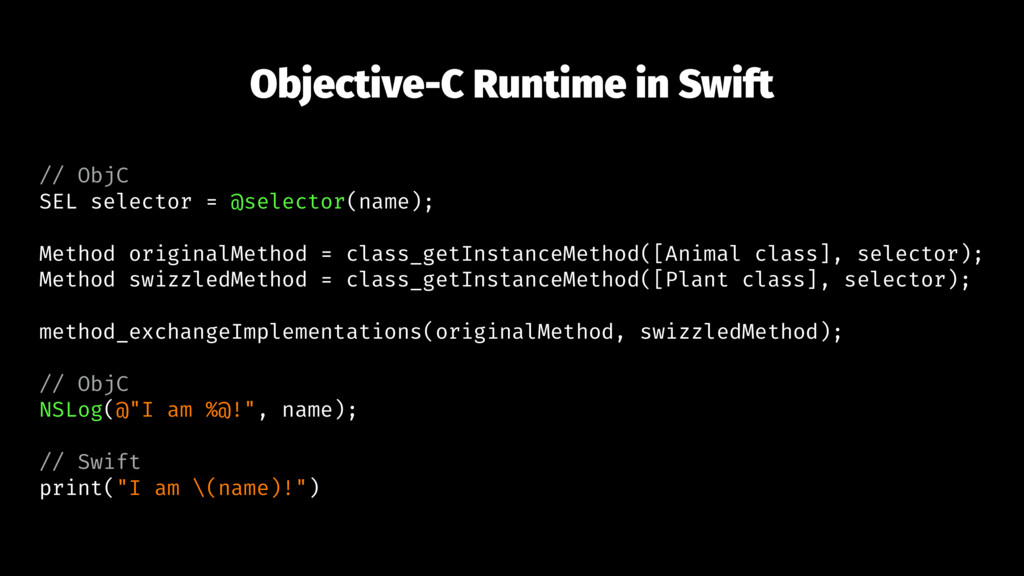
Objective-C Runtime in Swift // ObjC SEL selector = @selector(name);
Method originalMethod = class_getInstanceMethod([Animal class], selector); Method swizzledMethod = class_getInstanceMethod([Plant class], selector); method_exchangeImplementations(originalMethod, swizzledMethod); // ObjC NSLog(@"I am %@!", name); // Swift print("I am \(name)!") -
Objective-C Runtime in Swift // ObjC SEL selector = @selector(name);
Method originalMethod = class_getInstanceMethod([Animal class], selector); Method swizzledMethod = class_getInstanceMethod([Plant class], selector); method_exchangeImplementations(originalMethod, swizzledMethod); // ObjC NSLog(@"I am %@!", name); // I am Plant! // Swift print("I am \(name)!") // I am Animal! -
Objective-C Runtime in Swift @objc class Animal: NSObject { let
name = "Animal" override init() { super.init() } } @interface Plant: NSObject @end @implementation Plant - (NSString *)name { return @"Plant"; } @end -
Objective-C Runtime in Swift @objc class Animal: NSObject { dynamic
let name = "Animal" override init() { super.init() } } @interface Plant: NSObject @end @implementation Plant - (NSString *)name { return @"Plant"; } @end -
Objective-C Runtime in Swift // ObjC SEL selector = @selector(name);
Method originalMethod = class_getInstanceMethod([Animal class], selector); Method swizzledMethod = class_getInstanceMethod([Plant class], selector); method_exchangeImplementations(originalMethod, swizzledMethod); // ObjC NSLog(@"I am %@!", name); // Swift print("I am \(name)!") -
Objective-C Runtime in Swift // ObjC SEL selector = @selector(name);
Method originalMethod = class_getInstanceMethod([Animal class], selector); Method swizzledMethod = class_getInstanceMethod([Plant class], selector); method_exchangeImplementations(originalMethod, swizzledMethod); // ObjC NSLog(@"I am %@!", name); // I am Plant! // Swift print("I am \(name)!") // I am Plant! -
Swift <-> ObjC → You don't need this! → Migrate
to Swift! → OpenGL Graphics → Interacting with C++ → System calls (server side ftw!) → Super-über-high-performance